




Abstract
Introduction
Depression, anxiety, and stress are highly prevalent among adolescents. The role of impaired family and school environments in adolescents’ depression, anxiety, and stress in Jordan has yet to be established.
Objective
The purpose of this study was to explore the association of family and school environments with the depression, anxiety, and stress of adolescents in Jordan.
Methods
A cross-sectional correlational survey was used. A sample of 220 adolescents aged 12–18 years completed the study. Data were collected about family and school environments and adolescents’ depression, anxiety, and stress.
Results
School climate had a strong significant relationship with both general family functioning (r = .53, p < 0.01) and family process (r = .58, p < 0.01). General family functioning and school climate were uniquely associated with stress, anxiety, and depression (Β = −.280 or higher), p < 0.05, controlling for demographics.
Conclusion
The general family functioning and overall school climate were shown to play important role in adolescents’ depression, anxiety, and stress. School nurses and psychiatric nurses may want to respond to the needs of adolescents with depression, anxiety, and stress through campaigns, lectures, and conferences and encourage them to access professional psychological counseling.
Introduction
Stress is typically caused by internal and external stressors or stimuli that cause physiological symptoms and psychological responses, while anxiety and depression are both identified as psychological or emotional responses to stress (Townsend & Morgan, 2017). Depression and anxiety are the most prevalent psychological symptoms of stress among adolescents (Abou Abbas & Al Buhairan, 2018). Family and school factors are usually linked to health and well-being during adolescence (Escobar et al., 2020). Risk factors for adolescent depression and anxiety include multiple personal, family, and school environmental factors (Washington et al., 2017). Family process and school environment require particular attention since factors such as family dynamics and school environment affect adolescents’ growth and development (Moore et al., 2018). Moreover, family relationships and the school environment could contribute to the development of adolescent depression, stress, and anxiety (Moore et al., 2018; Platt et al., 2016). Appropriate social relationships within the family, school, and peers are associated with more positive physical and mental well-being (Blaževic, 2016; Moore et al., 2018). Because school nurses often have repeat-contact and therapeutic relationships with students, they can give insight in which students may need a referral and which students may need professional psychological services. School nurses and psychiatric nurses are in a unique position to support students and improve their health and well-being.
Review of Literature
Globally, adolescents between 10 and 19 years are affected by different burden diseases, 16% of them are mental disorders (WHO, 2019). Studies have documented that stress, depression, and anxiety might affect adolescents physical functioning, quality of life, social and family relationships, and academic productivity (Singh et al., 2015; Naz et al., 2020), leading to poor academic achievement and even dropping out of school (Muhammed et al., 2018). Depression has consistently been identified as a leading cause of suicide attempts in adolescents (Johnson et al., 2018).
Stress and other psychological symptoms are also linked to the female gender, socioeconomic status, life satisfaction, self-esteem, self-efficacy, and spirituality (Negi et al., 2019; Saleh et al., 2017). Obesity and overweight also were found as predictors of adolescents’ stress, depression, and anxiety (Wahed & Hassan, 2017). Lack of emotional support and violence showed negative effects on adolescents’ mental well-being (Malti, 2020).
In a study conducted in the UK by Butler et al. (2022), school sources of support had a protective effect on the mental well-being of children with low family support, indicating the crucial role that school resources can play in reducing symptoms of anxiety and depression among adolescents. In another study conducted by Escobar et al. (2020) in Brazil, with a sample of 102,072 adolescents from public and private schools, psychological health issues were associated with some family contexts including family violence and relationships with parents. In the same study, poor peer relationships at school and insecurity at school were associated with feelings of isolation and trouble sleeping. Ford et al. (2021) concluded that school contextual factors and school climate are independently associated with depression and psychopathology among adolescents.
In Jordan, many schools are so expensive when compared with the incomes of most Jordanian families. Thus, teaching students in these schools imposes a severe economic burden on many families. Meanwhile, many schools are crowded and serve large numbers of Syrian refugee children. In 2016, the capital of Jordan, Amman, was ranked as the most expensive city among all Arab cities and 29th worldwide (The Economist Intelligent Unit, 2016). The educational system in Jordan is also facing challenges related to the rising youth population in the country. The combination of economical and cultural factors could contribute to depression, anxiety, and stress in Jordanian school students.
Concerning depression, anxiety, and stress in Jordanian adolescents, a national study conducted in 2018 with a sample of 2,349 Jordanian adolescents aged 12–17 and representing all major regions in the country, showed that nearly 35% of participants had moderate to severe levels of depression. Depression symptoms were strongly correlated with living in families with low monthly income, and families with medical problems (Dardas et al., 2018). Malak and Khalifeh (2018) reported a high prevalence of anxiety and depression symptoms (nearly 40–70%). Interestingly, school class was found as a major predictor of anxiety and depression among Jordanian adolescents. These studies, however, targeted some aspects of school (i.e., school class) and family (i.e., poor income) rather than examining the role of the overall school and family environments (i.e., family functioning, family process, and school climate).
The Current Study
In this study, we let Bronfenbrenner's ecological systems model of human development guides our empirical work (Bronfenbrenner, 1977). Bronfenbrenner's model argued that human development is influenced by the reciprocal interaction between people and objects in the environment (Bronfenbrenner & Ceci, 1994). The immediate environment is very important in shaping human development and is referred to as microsystems that the individual is part of, typically the workplace, school, and home environment (Bronfenbrenner, 1992). The immediate environment (microsystems) may interact with psychological development to influence the risk for youth anxiety, stress, and depression. For example, a poor home or school environment could interact with attention and contribute to hypothalamic–pituitary–adrenal (HPA) axis dysregulation (Doom et al., 2021). In the present study, we focus on the role of processes in the microsystems (i.e., school and family) in predicting anxiety, stress, and depression in Jordanian adolescents.
To date, limited research studies have been conducted on the predisposing factors in terms of family and school environment related to stress, anxiety, and depression in Jordanian adolescents (Malak & Khalifeh, 2018). In addition, the association of impaired family and school environments with adolescents’ depression, anxiety, and stress symptoms has yet to be established. Establishing the link between these variables could help school nurses and psychiatric nurses who often provide care for adolescents with anxiety, stress, and depression symptoms to address their emotional concerns. Particularly, these nurses can better understand students’ needs and provide confidential and private services to anxious and depressed adolescents. Therefore, the main purpose of this study is to explore the relationship between depression, anxiety, and stress symptoms among adolescents and the family and school environment. The present study is one of the earliest studies in Jordan which linked stress, depression, and anxiety to family and school environment among adolescents.
Study Objectives
To examine the relationship of family functioning, family process, and school climate with depression, anxiety, and stress symptoms among Jordanian adolescents.
To identify factors that are uniquely associated with depression, anxiety, and stress symptoms among adolescents.
Methodology
Research Design
The researchers used a cross-sectional correlational survey for this study. The conduct and reporting of this study adhere to the STROBE guidelines for cross-sectional studies (Vandenbroucke et al., 2007).
Sample and Setting
The sample was recruited from two public and two private schools in Amman, the capital of Jordan. At each school, all students aged between 12 and 18 years were asked to participate. Including both public and private schools are helpful to enhance comparability and generalizability. The private schools are so expensive when compared with the incomes of most Jordanian families. Thus, teaching students in private schools imposes severe economic burdens on many families. Meanwhile, public schools are crowded and serve large numbers of Syrian refugee children.
The required sample size was calculated using the G*power program to obtain a power = 0.80 or more for linear regressions, with an alpha set at 0.05, a medium effect size of 0.15, and 10 possible predictors. The needed sample size was 118 participants. To allow for a possible non-response rate of nearly 30% of subjects (Islam, 2018), 32 more students were invited, resulting in a total of 150 subjects invited from each sector. Therefore, questionnaires were distributed to a convenience sample of 300 students.
Inclusion criteria
Students were invited to take part in the study if they met the following criteria: being Jordanian, aged 12–18 years, and having the approval of their guardians/parents to participate in the study.
Instruments
Adolescent sociodemographic questionnaire
This questionnaire collects information on adolescents’ sociodemographic and health characteristics. In particular, adolescents’ (gender, age, history of chronic health problems, current grade point average, and the number of days of school missed this year). In addition to adolescent parent's information (age, employment status, marital status of parents, history of health or mental problems), education (illiteracy to graduate degrees), employment status, availability of health insurance, family monthly income, and a family member with a health problem.
Family environment measures
To provide a comprehensive assessment of the family system, two measures were employed to assess the family environment; the General Functioning Family scale (Byles et al., 1988) and the Adolescent Family Process Measure (Vazsonyi et al., 2003).
The General Functioning Family scale (GF) (Byles et al., 1988) was used to measure family functioning. The scale has 12 items measuring overall family functioning. The scale has response categories of “strongly agree,” “agree,” “disagree,” and “strongly disagree,” with five items reverse coded. A higher GF total score indicates more healthy family functioning (Byles et al., 1988). The Cronbach's alpha coefficient for the scale was 0.82 in a study by Alzoubi and Ali (2021).
The Adolescent Family Process Measure (AFP) is a 25-item scale developed by Vazsonyi et al. (2003), which assesses maternal and paternal closeness (items 1–6), support (items 7–10), monitoring (items 11–14), communication (items 15–19), conflict (items 20–22), and peer approval (items 23–25) (Vazsonyi et al., 2003). The AFP is a five-point Likert-type scale ranging from 0 = never to 5 = very often, with mean scores ranging from 0 to 5. AFP is reliable and valid scale in Arab adolescents population (α = .87) (Massarwi & Khoury-Kassabri, 2021).
School Environment Measure
School Environment was assessed using the Perceived School Climate subscale of the international standard version of the Health Behavior in School-Aged Children (HBSC) (Currie et al., 2008). The subscale is a five-item Likert-type scale from strongly agree to strongly disagree. Scores range from 5 to 25. Higher scores indicated a more positive perception of the school climate. According to Nassar et al. (2018), Cronbach alpha reliability for the school climate, peer support and teacher support subscales on a large sample of Jordan participants was 0.69, 0.80, and 0.73, respectively.
Depression Stress Anxiety Scales-21 (DASS-21)
DASS-21 is a self-reported measure used to assess three negative emotional states (depression, anxiety, and stress). The measure is widely used in literature and has excellent psychometrics across many studies worldwide (Lovibond & Lovibond, 1995), including the Arab populations (Al-Zahrani et al., 2015). Responders are asked to raters each item on a four-point Likert scale from 0 to 3 to indicate the frequency of reporting negative emotional states in the last week, with higher scores indicating more severe depression, anxiety, and stress.
Data Collection and Ethical Considerations
Data collection was performed in December 2019. Before conducting this study, the researcher obtained approval from the institutional review board of the University of Jordan (IRB number = 685/2019/19). Regular visits were conducted by the researcher. During the first visit, the researchers invited adolescents’ families for a meeting at the selected school and explain to them the study's purpose. Guardians’/parents’ consent forms were signed by this meeting. Both parents and adolescents signed the consent form which includes a detailed description of the study and assured that participation in the study is voluntary and for research purposes rather than school requirements. After guardians/parents of the adolescents signed the consent form and agreed to share their information, the researcher conducted the second visit to discuss the study purposes with the participants who were assured of anonymity and confidentiality by requesting teachers to leave the class during filling and submission of the questionnaires. The questionnaires were self-administered in the presence of the data collector who explained all items to students. The estimated time to complete the questionnaire was about 20 min. Out of 300 adolescents invited, 220 completed the study (response rate = 73.3%).
Statistical Analysis
Data analysis was performed using the SPSS version 26. There were no missing data. Descriptive statistics were employed to describe sample characteristics using means, standard deviations, frequencies, and percentages. The independent t-test was performed to assess differences in stress, anxiety, and depression scores according to gender and school type. Pearson correlation was used to examine the relationships among the main study variables. Hierarchical multiple regression was used to identify the predictors of stress, anxiety, and depression.
Results
Sample Characteristics
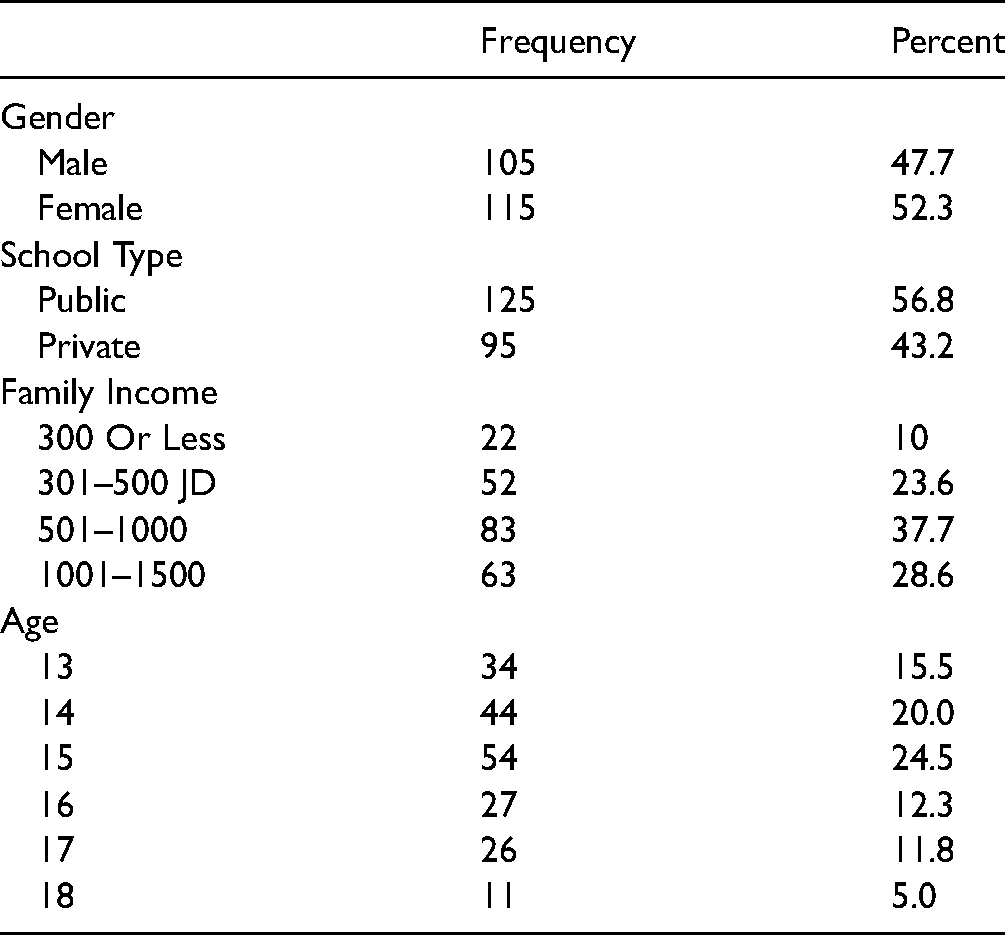
Participants were 105 (47.7%) male and 115 (52.3%) female. More than half of the study respondents were from public schools (n = 125, 56.8%), while the remaining were from private schools (n = 95, 43.2%). Participants reported that the vast majority of their parents were married (94.1%), while the remaining 5.9% were divorced or widowed. About 34% of the participants reported a family income of less than 500JD. Participants’ age ranged from 13 and 18 years (Table 1).
The Characteristics of the Study Participants (N = 220).
General Family Functioning and Family Process Association with School Climate
Table 2 presents the association of school climate with both general family functioning and family process. The results have shown that school climate was positively and significantly associated with both general family functioning (r = .532, p < 0.01) and family process (r = .580, p < 0.01).
The Results of Pearson Correlation for the Relationship Between General Family Functioning, Family Process, and School Climate (N = 220).

**p < 0.01.
General Family Functioning, Family Process, and School Climate Association with Anxiety, Stress, and Depression
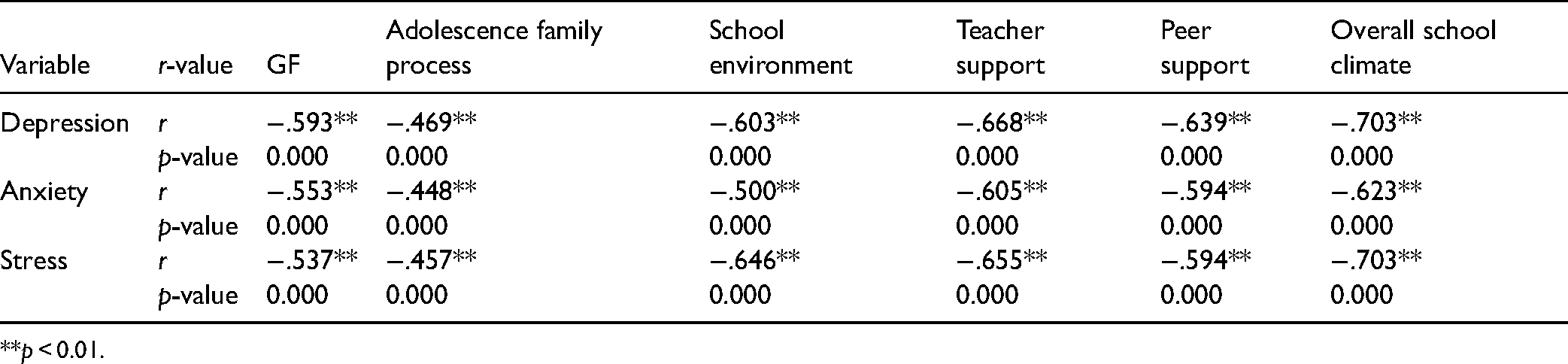
Table 3 presents the association of general family functioning, family process, and school climate with anxiety, stress, and depression. The results have shown that the three main study variables (i.e., general family functioning, family process, and school climate) were significantly and negatively associated with anxiety, stress, and depression (p < 0.01). The correlations were moderate to strong (ranging from −.448 to −.703).
The Results of Pearson Correlation for the Relationship of General Functioning and Family Process with Anxiety, Stress, and Depression (N = 220).
**p < 0.01.
Demographic Variables Associated with Depression, Anxiety, and Stress
The analysis revealed three demographic variables associated with depression, anxiety, and stress including gender, school type, and the number of family members. Regarding gender, the independent t-test has shown that male participants had significantly higher stress, anxiety, and depression mean scores than female participants (Table 4). Besides, students in public schools had significantly higher stress, anxiety, and depression mean scores than those in private hospitals. Regarding the number of family members, the Pearson correlation has shown a significant positive relationship between the number of family members and stress (r = .241, p < 0.01), anxiety (r = .168, p = 0.12), and depression (r = .250, p < 0.01).
The Results of Independent T-Test for the Differences in Stress, Anxiety, and Depression Scores According to Gender and School Type (N = 220).

Factors Uniquely Associated with Depression, Anxiety, and Stress
To identify factors uniquely associated with stress among adolescents, regression analysis was conducted as shown in Table 5 (model 1). Based on the previous analysis, six variables were correlated with stress among adolescents including general family functioning, adolescent family process, gender, school type, and the number of family members. These variables were entered into one regression model. The overall regression model was statistically significant, F(6, 213) = 40.89, p < 0.01, R = .732, R2 = .535, adjusted R2 = .522. The model explained about 52% of the variance in stress. However, only General Family Functioning (B = −.223, t = −3.844, p < 0.01), and overall School Climate (B = −.548, t = −8.481, p < 0.01) were uniquely associated with stress.
The Results of Regression Analysis for the Predictors of Stress, Anxiety, and Depression (N = 220).

The regression analysis performed to identify factors uniquely associated with anxiety is shown in 5 (model 2). The overall regression model was statistically significant, F(6, 213) = 32.56, p < 0.01, R = .686, R2 = .471, adjusted R2 = .456. The model explained about 46% of the variance in anxiety. However, only three variables out of the six entered into regression analysis were uniquely associated with anxiety including general family functioning (B = −.280, t = −4.520, p < 0.01), gender (B = −.107, t = −2.103, p = .037), and overall school climate (B = −.412, t = −5.975, p < 0.01).
The regression analysis performed to identify factors uniquely associated with depression is shown in 5 (model 1). The overall regression model was statistically significant, F(6, 213) = 47.94, p < 0.01, R = .758, R2 = .575, adjusted R2 = .563. The model explained about 56% of the variance in depression. However, only general family functioning (B = −.297, t = −5.348, p < 0.01), and overall school climate (B = −.489, t = −7.913, p < 0.01) were uniquely associated with depression.
Discussion
The findings of this study have shown that school climate was positively and significantly associated with both general family functioning and family process. According to Bronfenbrenner's ecological systems theory (1986), adolescents’ behaviors are influenced by both the family and the environment closest to them such as school. As individuals enter adolescence, school plays an important role in their lives like families because they spend more time at school. These findings are consistent with the study of Verhoeven et al. (2019) that found that school has a profound impact on adolescents’ development.
There are reciprocal interactions between adolescents and the multiple ecological systems over time (Bronfenbrenner, 1986). The children's behaviors are influenced by their social context, which plays a significant role in the child's relationship with other ecological systems. Since the model proposes that the microsystems (family and school) are the most influential determinants of child interaction. School climate is a strong influencer for adolescents during this period of major changes in individuals’ life (Centers for Disease Control and Prevention, 2022; Verhoeven et al., 2019).
The current study revealed a significant negative correlation between the study variables (i.e., general family functioning, family process, and school climate) with anxiety, stress, and depression, indicating that adolescents who experienced a positive family functioning, family process, and school climate were less likely to exhibit anxiety, stress, and depression. Consistent with the present findings, previous research revealed that family functioning and processes and school climate can predict adolescents’ psychological health (Moore et al., 2018).
Positive family functioning and an appropriate school climate that holds warmth and support might help adolescence reduce anxiety, stress, and depression. Conversely, when adolescents experience a negative school climate, they might have more challenges that increase the potential for stress, anxiety, and depression to arise.
The results of this study provide healthcare providers school nurses, families, teachers, and adolescents themselves with knowledge regarding adolescents’ depression, anxiety, and stress. In line with previous research, socioeconomic status of students, school and family experiences, and barriers to accessing mental health support and counseling services are likely to influence children's self-reported depression, anxiety, and stress (Al-Rawashdeh et al., 2021; Atoum et al., 2018; Rayan et al., 2020; Shosha, 2016). Health professionals working with adolescents need to be aware of and responsive to the presence of depression, anxiety, and stress among the students so that early intervention might be offered to adolescents. Teachers should guide positive peer relationships between adolescents to foster a positive school climate for them. Families should create a warm family climate, promote effective family functioning and family process, and support warm family relationships to provide support for adolescents’ growth and development.
Two of the most powerful factors uniquely associated with stress, anxiety, and depression in this study were General Family Functioning and Overall School Climate. This result was consistent with other studies (Moore et al., 2018; Platt et al., 2016; Zhang & Wang, 2020). Clinically, it is crucial to recognize this set of predictors associated with depression, anxiety, and stress in Jordanian adolescents. School nurses should screen students for depression, anxiety, and stress and make referrals to professional psychological services as needed.
Limitations
The current study has potential limitations. First, using different self-report instruments to measure the study variables might affect the study's internal validity. Second, the study used a cross-sectional design, which cannot examine causal relationships. Therefore, stronger designs are needed in future research to test the influencing factors of adolescents’ anxiety, stress, and depression. One of the main limitations of the study, however, refers to the data collection method. Aspects of schools and homes can be better assessed from students’ perspectives using in-depth investigation through a qualitative approach and interviews with students. Therefore, the results of this study should be viewed with caution due to the limitation of the study measures and data collection method.
Implications for Practice
The findings of this research study have implications for practice. School nurses and psychiatric nurses may want to respond to the psychological symptoms among adolescents and support them through campaigns, lectures, conferences, the internet, and television programs to reduce stigma and encourage them to access available services. School nurses should routinely assess adolescents’ families and the school environment. Early interventions are required for children with psychological distress. In school settings, adolescents should be encouraged to maintain positive peer relationships. Families should be instructed about the importance of creating a warm family climate that supports adolescents’ growth and development. Indeed, healthcare providers working with adolescents who have depression, stress, or anxiety, whether in the hospital or community settings, should recognize families’ participation in treatment plans proposed for their adolescents. In particular, healthcare providers, including school nurses and psychiatric nurses, are required to implement a comprehensive physical and mental assessment for this age group to identify potential problems, needs, resources, and strengths to help children maintain their health and well-being.
Discussing and counseling for both families and school teachers is needed. By equipping school nurses with the needed knowledge and skills based on evidence-based practice, specialized care for adolescents who have depression, stress or anxiety will be ensured.
Developing guidelines for the diagnosis, referral, and management of adolescents with depression, anxiety, and stress is needed to improve the quality of care provided to those target populations. The guidelines could include a precise diagnosis and management pathway that could guide the school nurses.
Conclusions
This study highlights important research and practice implications, specifically for psychiatric nurses and school nurses. The results show a unique link between stress, anxiety, and depression and both school and home environments. Adolescents at school need access to professional psychological services and counseling. Educating adolescent students and their parents and teachers is necessary to increase their awareness and understanding of the risk factors for anxiety, stress, and depression. School nurses should play a role in educating teachers that high levels of anxiety, stress, and depression need urgent interventions, both at home and at school.
Footnotes
Authors’ Note
The current study was approved by the institutional review board of the University of Jordan (IRB number = 685/2019/19). Study conception and design (All authors); Data collection (OZA); Data analysis and interpretation (AHR); Drafting of the article (All authors); Critical revision of the article (All authors).
Declaration of Conflicting Interests
The author(s) declared no potential conflicts of interest with respect to the research, authorship, and/or publication of this article.
Funding
The author(s) disclosed receipt of the following financial support for the research, authorship, and/or publication of this article: This study was funded by the institutional research fund at the University of Jordan's Deanship of Scientific Research.
