




Abstract
The transition from hospital to home after surgery is a vulnerable time for all cardiac surgical patients, particularly older adults. This postoperative phase presents multiple physical, physiological, emotional, and socioeconomic challenges, not only for patients but also for their families and informal caregivers, who often describe this period as stressful and overwhelming. Health-care professionals, particularly nurses, play an integral role in a patient's discharge process; the challenges can be ameliorated through timely discharge planning and effective discharge education. The context-sensitive solutions shared in this paper propose enhancing nurses’ discharge practices to provide individualized care and to facilitate the hospital-to-home transition.
Keywords
Implications for Practice and Research
The period after cardiac surgery presents multiple physical, physiological, emotional, and socioeconomic challenges for patients and families and other caregivers. Good planning for the hospital-to-home transition can lead to more positive health outcomes, fewer readmissions, fewer complications, and better coping. A context-sensitive discharge education program would include nurses trained to provide education to patients with varying levels of health literacy, calmly and clearly, while avoiding medical jargon, in a quiet and shame-free environment, in the presence of relatives and informal caregivers.
Cardiac surgery has steadily evolved throughout the years. In tandem, the population of patients undergoing cardiac surgical procedures has changed; patients of older ages and higher risk profiles are now commonly operated on (Jones et al., 2022; Manché, 2016). Seco et al. (2014) pointed out that although poorer outcomes may be associated with older cardiac surgery patients due to a number of risk factors, treatment management through cardiac surgery should not be overlooked or denied to older adults simply because of their chronological age, without considering their true biological age.
The Post-Cardiac Surgery Discharge Experience
Postoperative recovery involves physical and physiological healing, resumption of functional activities, and the sense of returning to normal life (Baker, 1989). While acknowledging that little is known about patients’ perspectives of the hospital-to-home transition, Cain et al. (2012) contended that good planning for the hospital-to-home transition can lead to more positive health outcomes, fewer readmissions, fewer complications, and better coping. Their contention draws upon the understanding that patients remain medically vulnerable postsurgery; in turn, this implies that the immediate- and medium-term postdischarge periods are pivotal stages in their recovery trajectory. Different patients respond to postoperative changes differently, as they start to acquire different coping strategies, adapt to their new self, and accept the fact that their presurgery self is now an individual who may be experiencing altered functional capacity.
Postoperative Discharge and Health Literacy
Health literacy (HL) refers to one's ability to gain, appraise, and utilize information to maintain good health (Sørensen et al., 2015). The impact of HL on a cardiac surgical patient's perioperative experience is yet to be determined. However, the literature discusses how limitations in HL affect one's ability to comprehend the nature, risks, and benefits inherent in a surgical procedure; adhere to discharge instructions; and participate effectively with health-care professionals in a plan of care (Chang et al., 2020; De Oliveira et al., 2015; Roy et al., 2019).
According to the World Health Organization (WHO, 2023), an average person has insufficient literacy skills to understand health information. The WHO adds that, during discharge from hospital, patients are often provided with a great deal of inappropriate information, as the discharge instructions and jargon-filled letters provided are often too difficult for patients and their informal caregivers to comprehend (WHO, 2023).
Enhancing Nursing Practice: The Virtue of Context Sensitivity
In study among patients aged 65 years and older that explored their individual experiences of recovery after major cardiac surgery (Dimech et al., 2023), we noted how stressful and overwhelming the hospital-to-home transition can be, both to the patients and their informal caregiver/s, who all have to assume responsibility of their own care; one which was previously managed professionally by the health-care team. Table 1 contains examples of the study participants’ comments.
Participants’ Perspectives on the Hospital-to-Home Transition.
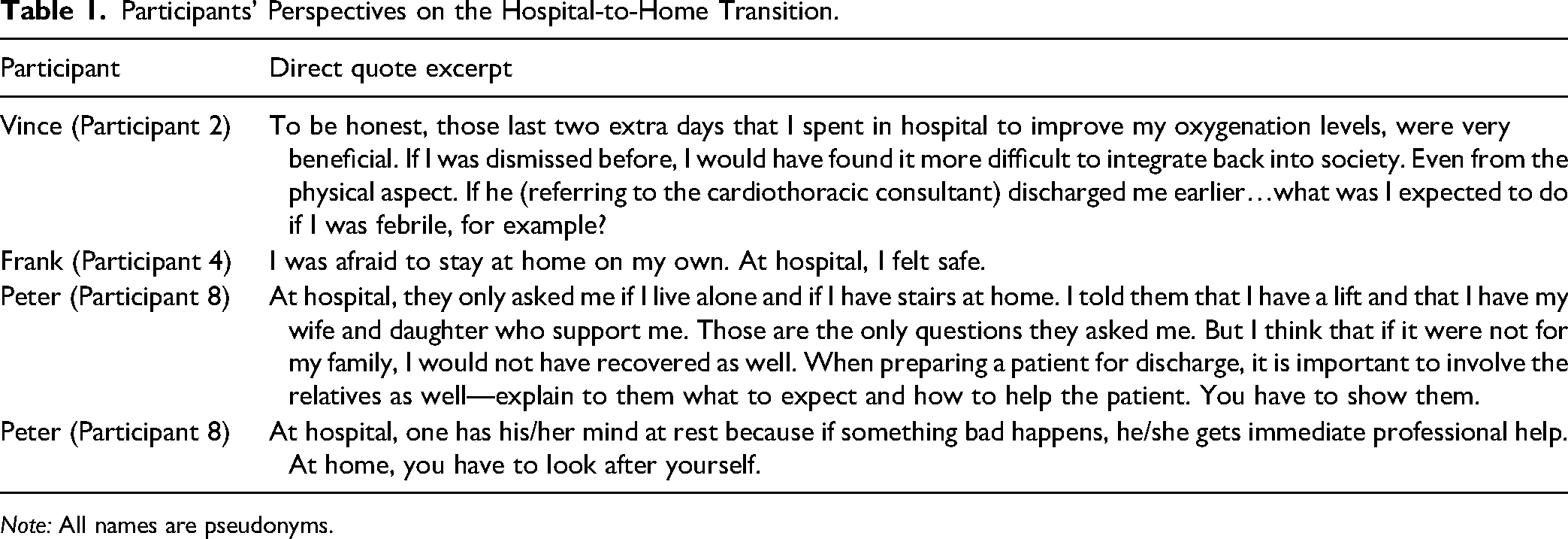
Note: All names are pseudonyms.
Health-care professionals, particularly nurses, can contribute to a successful and seamless transition through early discharge planning, thus decreasing length of hospitalization, hospital readmissions, and risk of mortality (Gabriel et al., 2017), and through context-sensitive discharge education (sensitive to the users’ and providers’ context in which services are provided).
Discharge planning should start on the day of admission (Feijo et al., 2022). Bajorek and McElroy (2020) observed that since it is often difficult on admission to accurately predict the day of hospital discharge, patients and their families tend to receive large amounts of information very close to their actual discharge. Moreover, the discharge process is often rushed and therefore significantly compromised. Calkins et al. (1997) added that health-care professionals often overestimate the time spent on providing discharge education, as well as patients’ level of understanding. These observations are a cause for concern.
Further challenges, limitations, and gaps associated with the discharge process include compromised ability to understand discharge instructions, lack of readiness to learn, and the lack of involvement of informal caregivers in discharge planning. Information may be unclear and may not be tailored to individuals’ learning styles, HL requirements, and varying social determinants; information provided by different health-care providers may be confusing or contradictory.
Nurses play an integral role in the discharge process (Farrugia, 2013), coordinating care and providing timely communication with key stakeholders (patients, relatives, informal caregivers, and other health-care professionals) to ensure a smooth transition of care. They are the ones responsible for the provision of tailor-made and patient-centered information, through a language-sensitive (defined as the use of caring and supportive words with consideration to patient's situation/diagnosis; Aycock et al., 2017) and culture-sensitive (defined as the awareness and acceptance of cultural differences; Gradellini et al., 2021) approach: one which has as close a bearing as possible to each patient's setting and concerns, to contribute to their rehabilitative process (Reddick & Holland, 2015). The idea is to empower and actively engage patients in their plan of care, with the aim of improving their discharge experience and overall health status (Provencher et al., 2021).
Recommendations for Practice and Research
The need for the implementation of a national HL improvement program has been highlighted by Nugent et al. (2023) in a study establishing an association between HL and self-management as well as glycemic control in patients diagnosed with Type 2 diabetes mellitus. We recommend a similar initiative, the planning and launching of a context-sensitive discharge educational program, specifically for cardiac surgical patients and their families and informal caregivers. Such a program would seek to safeguard that patients’ individualized needs and concerns after discharge from hospital are effectively met, as the responsibility of care shifts from health-care staff to patients themselves. The program would include improved discharge practices. For example, nurses should be trained to provide context-sensitive education to patients with varying HL levels, calmly and clearly, while avoiding medical jargon, in a quiet and shame-free environment, in the presence of relatives and informal caregivers. The use of the teach-back method (a technique for verifying patients’ level of understanding of the provided information) (Talevski et al., 2020) should be considered in an effort to secure enhanced comprehension and moreover, increased cooperation. We also recommend revising printed postoperative discharge instructions, making them more patient-friendly by including more images and reducing text, and by converting paragraphs into short points, and recording professional-quality videos addressing basic discharge instructions.
After implementation of these recommendations (nurse training in context-sensitive education, teach-back methods, revision of postoperative discharge materials, and videos), a future study of these interventions would be of great value to illustrate the impact to the discharged patient.
Conclusion
As highlighted by Wong et al. (2017), a one-size-fits-all approach to health education is not effective to attain the Institute for Healthcare Improvement's Triple Aim for health care: improving patients’ care experiences, sustaining overall population health, and decreasing health-care costs (Berwick et al., 2008). Through this discussion paper, we delineated the scope of the discharge process as an apt opportunity to provide further quality care, and the impact of the process on patients’ recovery. We advocated for the importance of humanising the discharge process. Nursing is an interpersonal process; one which is set in a specific context. The context-sensitive solutions shared in this paper may pave way for the amelioration of cardiac surgical patients’ difficult experiences of recovery.
Disclosure
The authors have no relevant financial interest or affiliations with any commercial interests related to the subjects discussed within this article.
Footnotes
Funding
The author(s) received no financial support for the research, authorship and/or publication of this article.
