



Abstract
Background
Health systemsneed adequate personnelin order to function; improvements in health-care services delivery, and coverage and the enjoyment of standard healthcare as a right, depend on the availability, mixture, quality, and accessibility of the health-care workforce.
Purpose
This review aimed to synthesize reliable evidence ondetermining factors among health science students’ career choices to enhance policy advocacy for better health-care delivery.
Method
We sourced empirical studies from Scopus, PubMed, ScienceDirect and Google Scholar. From a total of 9,056 researcharticlesfrom 2010 to 2022, 27 studies with a total of 45,832 respondents met the inclusion criteria.
Results
The majority of the studies were of medical students; internal medicine was the commonest choice (64.3%), with psychiatry and public health receiving lesser attention. In the four available studies of nursing students, midwifery was not chosen at all. There is a paucity of studies on this all-important concept for nursing students. The determining factors of choice of specialty were in four themes: personal, socioeconomic, professional, and educational/policy. Among the barriers to choosing particular specialties were low prestige among colleagues, stigma, long working hours, and poor public recognition.
Conclusion
The career choices of health science students do not reflect an adequate mix of health-care team members to meet the health-care needs of the world. Reforms of policy and educational training are needed.
Keywords
Background of Study
Health-care professionals play key roles in the health-care system and in the health of people globally. Health systems needs adequatepersonnelin order to function; improvements in health-care services delivery, and coverage and the enjoyment of standard healthcare as a right, depend on the availability, mixture, quality, and accessibility of the health-care workforce (World Health Organization [WHO], 2022). This dependence was strongly manifested during the COVID-19 pandemic, in which the most common reason for disrupted health-care delivery was lack of personnel (WHO, 2021). Theseworkers are pivotal in the attainment and sustainmentof, and progress toward, universal health coverage (Campbell et al., 2013); every effort is needed to ensure their availability, adequate distribution, and sustainmentin order to guarantee efficient health-care delivery.
Health-care delivery is a team effort that efficiently delivers quality care if properly and adequately mixed and distributed.
Many countries, especially Low-Income Countries, face serious shortages and inadequate distribution of health-care workers due to lack of appropriate policy, low health-care system financing, and poor economic and general welfare compensation for the health-care workforce(Madu et al., 2014).Among the WHO's six regions(African, The Americas, Southeast Asian, European, Eastern Mediterranean, and Western Pacific), African and Eastern Mediterranean regions have the worst shortages of health-care personnel, with doctor/patient ratios of less than 2.5/10,000, compared to the American and European regions with about 20.4/10,000 and 33.3/10,000 respectively (WHO, 2006, 2013). There is a projected shortage of 10-15 million health-care workers by 2030, with the worst shortages in developing regions like Africa and Eastern Mediterranean (WHO, 2013, 2016; Boniol et al., 2022). This constitutes a serious threat to universal health coverage and the health and well-being goals of the United Nations (General Assembly of the United Nations, 2019).
Boniol et al. (2022) recommend continued research on career choices and their associated factors, and improved investment in the health-care workforce, especially in Africa and other developing nations where workforce shortages are projected.
Prospective health-care workers’ choice of specialty determines the availability and future composition of the health-care workforce(Ossai et al., 2016).Because health-care delivery is a team effort, deficiencies in one area create very detrimental gaps in the system. Understanding the career intentions of health-care personnel and the determining factors is essential in career guidance, health-care system planning and policy making across countries. Evidence has shown that most health-care personnel receive no career guidance; this lack poses a threat to the equitable distribution of healthcare (Ossai et al., 2016). Young health-care workers often prefer certain specialties and sub?specialties to the detriment ofother areas (Madu et al., 2014; Matarese et al., 2019; Marzouq et al., 2019). This imbalance highlights the urgent need for a widely sourced assessment of gaps in health-care workforce distribution with regards to areas of specialization, to aid in developing policy aimed at making all areas of healthcare attractive, to ensure equitable healthcare according to local needs.
The challenges brought about by emerging and re-emerging contagious diseases like COVID-19 and Ebola, and the mental health issues associated with them, have caused a shift in thehealth-care needs of people across countries (Moynihan et al., 2021), requiring a corresponding adjustment in human resources to create equity in distribution of the health-care workforce. The institutions responsible for training health science students will play a critical role in guiding them toward career choices. Policy makers will also play key roles in encouraging funding of training facilities and equitable distribution of specialties across all areas of health-care need. This guidance and policy making requires empirical evidence about career choices and determining factors, obtained from reliable sources, to ensure that potential health professionals are well oriented toward clinical areas that are in dire need of human resources (Matarese et al., 2019). This systematic review aims to address the gap in assessment of career intentions and determining factors among medical, nursing, and other health science students.
Methods
Aim
This review was conducted to assess the career intentions and the determining factors among health science students.
Guidance and policy making require empirical evidence about career choices and determining factors, obtained from reliable sources.
Design
This systematic review was done using the procedures outlined in Preferred Reporting Items for Systematic Review and Meta-Analysis (PRISMA) (Njaka et al., 2020;McKenzie et al., 2021).
Original research studies that were peer reviewed Studies that focused on career choices and the determinants among medical, nursing, and other health science students Respondents were medical, nursing, and other health science students. Studies published in English Studies published between 2010 and 2022
Search Method
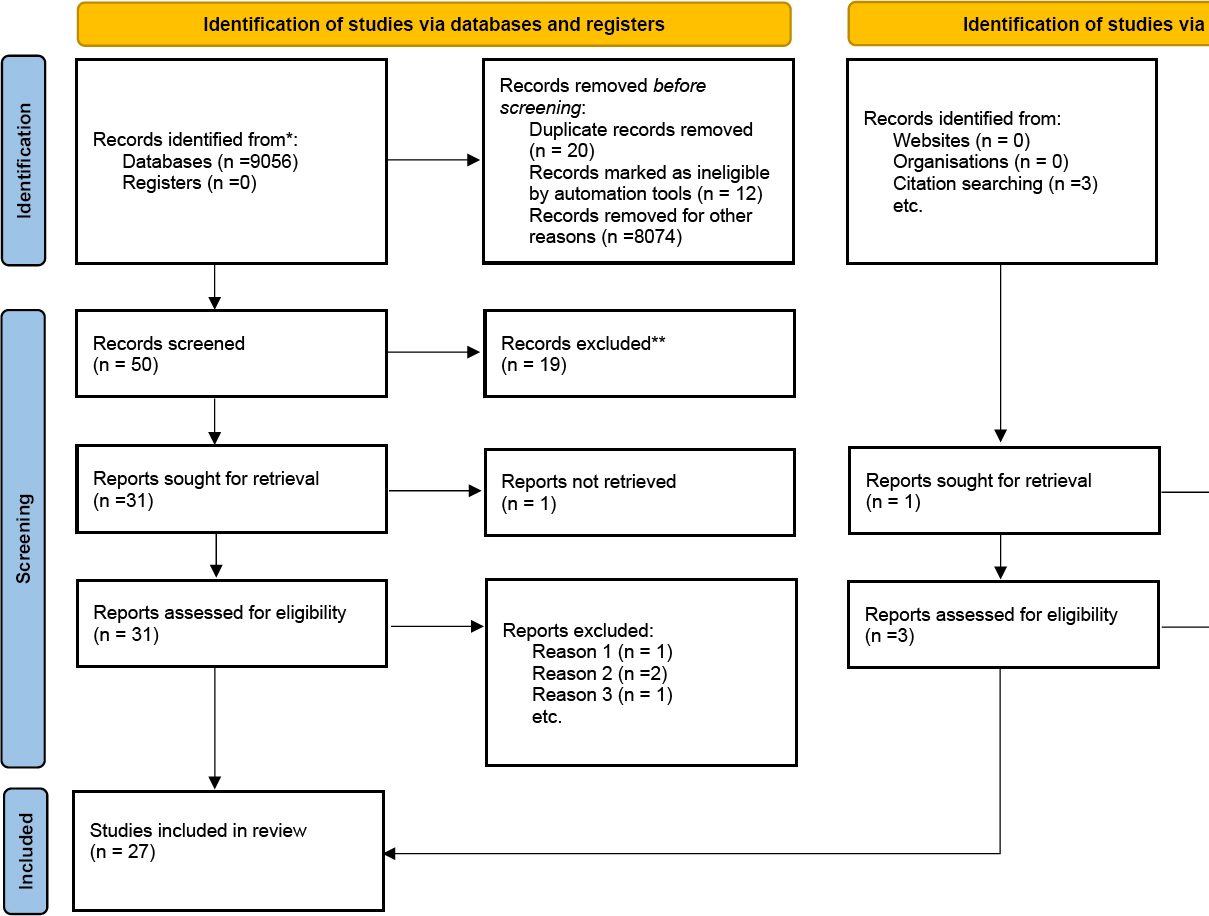
The following databases were searched between October 30 and December 20, 2022, for scholarly articles on the subject matter: Scopus, PubMed, Science Direct and Google Scholar. The search was conducted using the following keywords, MeSH terms combined adequately with Boolean operators (OR, AND, NOT): “Career Intention” OR “Specialization” OR “Specialty Preference” OR “Career preference” AND “Determinants” OR “Associated Factors” OR “Barrier” AND “Medical Students” OR “Nursing students” OR “Health Students”. Figure 1 summarizes the steps in the search.
PRISMA Flow Diagram
Search Outcome
Initial search of the databases yielded a total of 9,056 articles. Application of the inclusion criteria yielded a total of 200 scholarly articles. Duplicates and review articles were removed, leaving a total of 50 articles that were reviewed at the title and abstract level. Of these articles, 27 met the inclusion criteria for this review. Study eligibility was assessed independently by the authors through review of the abstracts, and differences were resolved through group discussion. Reasons for exclusion of the other 23 articles were: a) not a research article, b) incompleteness, c) full article not accessible, d) sample size not indicated, and/or e) respondents not health science students. See Figure 1.
Quality Appraisal
The quality of the included articles was assessed using Downes et al.'s (2016) critical appraisal tool for cross-sectional studies (AXIS). This method was considered adequate for the purpose since the majority of the articles employed a cross-sectional design. The tool has been used in similar systematic reviews (e.g.Njaka et al., 2020). Criteria applied were a) standardized sampling method such as random sampling, b) sample size determined using appropriate method, c) response rate reported, and d) use of validated tool. Each of these criteria was determined by two authors and confirmed by the other authors. Any disagreement was resolved through discussion. Each study was scored I for yes and 0 for no or don't know.
The few available studies of nursing students’ career choices did not show any evidence of proper career guidance.
Data Extraction
Data for this review was extracted independently by each author using a data extraction form developed by the authors, that recorded the articles’ authors, the year of publication, the country of the study, the respondents, sample size, response rate, study design, and findings. Any disagreements were resolved via discussion.
Results
A total of 27 studies met the inclusion criteria for a review on career intentions and associated factors among health science students (see Table 1, appended at end of article). Of the 27 studies, 22 employed cross-sectional design, fouremployed qualitative design, and one utilized mixed-method design. Twenty-one studieswere of medical students and practitioners, while only four studies were on nursing students, one was of dental students, and one of pharmacy students. Other relevant details are in Table 1.
Characteristics of Studies Included in Review

Four studies were excluded for various reasons (see Table 2).
Studies Excluded from Review

Respondents’ Career Intentions
Table 3 displays the career intentions of the respondents. The career intentions of the medical students were grouped into two categories: surgical and medical specialties. The surgical specialties had a pooled choice rate of 24%-51.2% across studies, while the medical specialties had a pooled choice rate of 32.5%-67.6% across studies. Specific specialties had individual rates across countries and studies. Emergency medicine ranged from 17.4% to 20.2%, anaesthesia from 0.7% to 7%, internal medicine from 10% to 64.3%, psychiatry from 1.6% to 7.8%, and public health from 6.8% to 36.5%. For nursing, only five specialties were reported across studies: psychiatry, with 2.3%-5.2%, public health, with 5.1%, medical/surgical nursing, with 9.7%-51.1%, and paediatrics, with 0.6%-22.8%.
Specialty Preferences among Medical and Nursing Students.

Factors Influencing Career Choices among Health Science Students
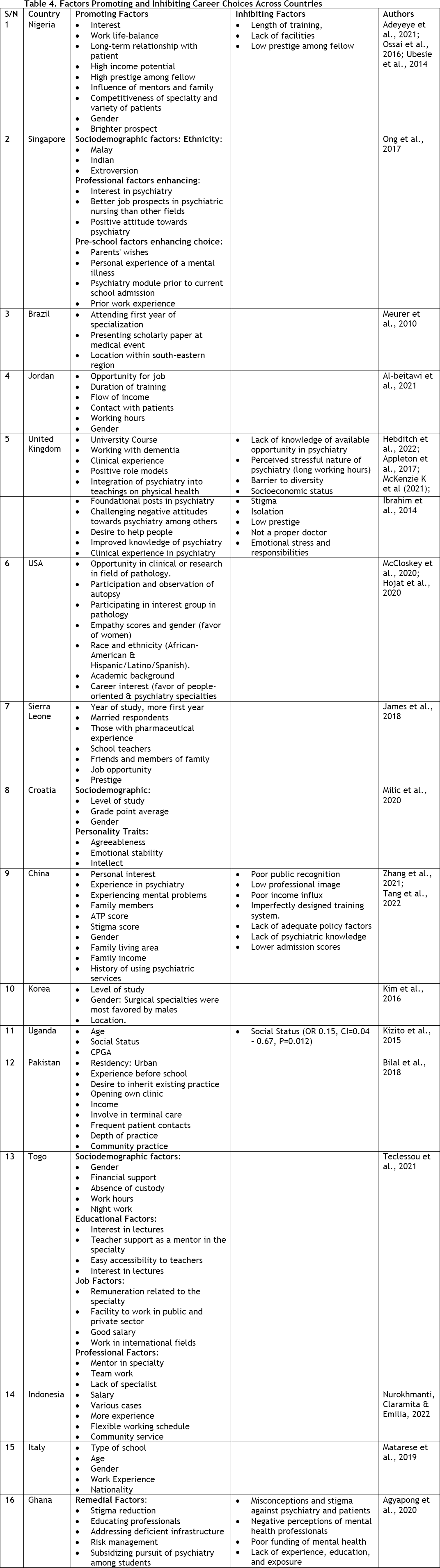
Seventeen studies reported on factors influencing career intentions among health science students across diverse countries. Careful synthesis of data revealed common themes. Table 4 shows the factors influencing and inhibiting career choice.
Factors Promoting and Inhibiting Career Choices Across Countries
This review showed that health-care personnel globally are not equitably distributed in terms of specialties that reflect current health issues.
Barriers to Career Choices in Specialty Areas
Barriers to particular specialty areas are grouped by country in Table 4 under professional/specialty factors, personal factors, educational factors, socioeconomic factors, and policy factors. The specialty factors included low prestige among colleagues, stigma, long working hours, and poor public recognition.
Educational Factors perceived as hindrances to career choices in specialty areas includedlack of facilities for training and practice, length of training, and poorly designed training systems. Economic Factors included perceived income flow and socioeconomic status. Policy Factors played a key role in non-choice of careers across three studies, including lack of adequate policy on specialty training and poor funding of the specialty programs. Personal Factorsincluded lack of knowledge of available opportunities in the specialty area, lower examination scores, and lack of experience.
Discussion of Findings
This systematic review of 27 peer-reviewed, well-conducted studies is the first comprehensive review on career choices and associated factors across countries. With projected health-care workforce shortages and the currently overtaxed health system owing to challenges like COVID-19 and health-care workers’ psychological issues, this review highlights critical information needed across countries, but especially in Low-Income Countries, to avert projected shortages and improve health-care delivery.
This review found that among medical students, medical specialties had the highest rate of choice followed closely by surgical specialties (Al-beitawi et al., 2021; Khamees et al., 2022; Kim et al., 2016). Among the medical specialties, internal medicine was the most preferred, while psychiatry, obstetrics and gynecology, and public health received lesser attention (Khamees et al., 2022; Ossai et al., 2016; Milic et al., 2020; Kim et al., 2016; Bilal et al., 2018; Ubesie et al., 2014). Overall, this review showed that health-care personnel globally are not equitably distributed in terms of specialties that reflect current health issues. Public health and psychiatry were not preferred areas among the future health-care team;this would be detrimental to global health and safety, considering the turbulent nature of the global environment and its health consequences (Khamees et al., 2022; Appleton et al., 2017; Ossai et al., 2016; Milic et al., 2020; Zhang et al., 2021). The challenges to the global health-care system that occurred during the COVID-19 pandemic in terms of human resources and funding require that proactive measures be taken to avert reoccurrence.
Most importantly, health-care delivery is a team effort that efficiently delivers quality care if properly and adequately mixed and distributed (James, 2021). This fact calls fordeeper reflection on the choices of specialty that health science students make, and the impacts of policies and funding of all specialties, with special consideration of current and future human needs (Nicholson et al., 2016). As reported by WHO (2022), the mismatch between education and employment strategies contributes to the continued shortage of health-care workers. In other words, the available personnel do not fit the areas of need in the health-care system; hence the need for policy on training, career guidance, and proper distribution of health-care workers as societal needs evolve.
The high rate of mental disorders across developed and developing countries has been made worseby the psychological challenges associated with the emergence of COVID-19(Moynihan et al., 2021). Approximately 71% of people diagnosed with mental disorders lack access to any treatment; only 0.6% of these who live in developing countries have access to treatment from mental health professionals (Uwakwe, 2019; Soroye et al., 2021). This review shows that this shortage is likely to worsenfor specialties like psychiatry, highlighting the need for policies and deliberate actions by training institutions to provide career guidance for health science students, to address the global need across specialties.
Among nurses, the studies revealed preference for surgical, emergency, and intensive care specialties, to the detriment of others. Geriatric and psychiatricnursing received less preference, while midwifery receivednone at all, despite the indispensability of this specialty (Matarese et al., 2019; Hebditch et al., 2022). Due to the few studies available on career choices of nursing students, it would be difficult to arrive at a conclusion about their career preferences. The few available studies of nursing students’ career choices did not show any evidence of proper career guidance (Mann, 2022). There is urgent need for more studies across countries to form a multinational understanding of the workforce challenges at hand.
Of the socioeconomic factors influencing the choice of specialty among health-care students summarized in Table 4, those of key interest include income, social status, and bright prospect (Ong et al., 2017; Al-beitawi et al., 2021). These factors point out that health-care system funding and other resources, and economic and general welfare packages, lack equity in their distribution across specialties. Hospital administrators must make efforts to correct this imbalance, as it is a threat to team mixtures in health-care systems. Health-care workers of equal educational level and job responsibilities should be well remunerated across all specialties, to prevent the major shortage of human resources reported across countries in the events of the COVID-19 pandemic (Mohanty & Mohanty, 2019).
Some studies reported lack of proper facilities, prolonged training periods, and lack of policy support as major deterrents to choosing some specialty areas, particularly in Low-Income Countries (Adeyeye et al., 2021; Ossai et al., 2016; Ubesie et al., 2014). There is urgent need to draft policies stipulating appropriate training periods and ensuring compliance with these standards. Proper funding of health-care institutions is needed to ensure adequate facilities. Financial aid in the form of student loans will help those in need of it to advance in their specialty training.
It was disheartening to read of health science students being deterred from choosing a given specialty because of low prestige and stigmatizing attitudes among health-care team members (Hebditch et al., 2022; Appleton et al., 2017; McKenzie et al., 2021; Ibrahim et al., 2014;Njaka, 2021). This highlights the need for a general reorientation of health-care professionals’ attitudes, and for the incorporation of anti-stigma programs into health professions curricula. Building efficient health-care teams and systems demands that the above factors identified as determinants of career intentions among prospective health professionals be taken into account in drafting institutional plans and policy making.
Implications for Action
The findings of this review have key implications for health-care administrators, national and international leaders in health, and health-care workforce training institutions. Training institutions should draft career guides, and assign mentors to help students make healthy decisions about career choices. Countries and health-care administrators need to avoid placing undue priority on certain aspects of health care to the detriment of others, and to provide financial support for students, to ensure that the most knowledgeable are well distributed across all specialties. Policies regarding equality of funding among health professionals is an urgent implication of this study.
An important hindrance to choosing a given specialty is low prestige among health-care professionals; any country with an interest in developing a formidable health-care team must take this issue into consideration.
Conclusion
This review has highlighted some pertinent issues regarding career aspirations among health-care students. In general, a good number of studies have been conducted on this concept among medical students, but only a few among nursing students. Despite the current trend in health-care needs, in our review, internal medicine was the specialty most preferred by medical students, with the least preferred being psychiatry and public health, and midwifery as a nursing specialty was not preferred at all. Several personal, socioeconomic, professional, and educational factors were revealed as determinants of career choice; prominent deterrents to choosing particular specialties were prolonged training time, lack of prestige, lack of proper facilities, and lack of policy.
The key strength of this review lies in the aggregated data on career preference among health science students from reliable sources These determinants of career choices from studies across the world present vital evidence for policy formulation in shaping health systems to fit the needs of the society. It is evident across studies that health science students often do not have career guides and mentors in their training institutions.
The few studies assessing career choices among nursing students make it advisable to use the findings with caution when generalizing about nursing students. In all the studies, the career choices reported by the students may not be theirfinal destination; their minds may change over time. An important hindrance to choosing a given specialty is low prestige among health-care professionals; any country with an interest in developing a formidable health-care team must take this issue into consideration.