




Abstract
Introduction
Investigating the correlation between quality of life (QoL) and academic resilience (AR) and understanding their influencing factors is crucial for adequately preparing nursing students to navigate the challenges in their future professional careers.
Objectives
This research aims to investigate the relationship between QoL and AR among nursing students. Additionally, to explore factors influencing these variables from the students’ perspectives.
Methods
A mixed-methods design, incorporating both quantitative and qualitative data, was conducted at a Saudi nursing college. The quantitative data were collected through a cross-sectional design, with a convenience sample of 190 students completing the Brunnsviken Brief Quality of Life Scale (BBQ) and the Academic Resilience Scale (ARS-30). Simultaneously, qualitative data were collected using open-ended questions to gain insights into the factors influencing their QoL and AR, as well as the role of nursing education. The analysis involved inferential statistics and content analysis.
Results
The study revealed that Saudi nursing students reported a moderate level of both QoL and AR. A significant positive correlation indicates that AR explains around 34.0% of the variation in QoL (p < 0.005). The qualitative data identified various supportive and barrier factors impacting the QoL and AR of nursing students, and students reflected on the significant role of nursing educators and academic advising.
Conclusion
The findings hold implications for interventions such as establishing supportive educational environments, enhancing academic advising, implementing resilience-building and wellness programs, peer support initiatives, and encouraging social engagement—all essential strategies to bolster nursing students’ overall well-being, QoL, and AR.
Introduction
In today's complex world, essential skills such as adaptability and resilience are pivotal for enhancing an individual's quality of life (QoL) and overall well-being (Yang & Wang, 2022). Quality of Life (QoL) is broadly defined as an individual's overall satisfaction with life, encompassing physical, psychological, and social dimensions that contribute to one's sense of well-being (Grande et al., 2022). College students, particularly those in demanding fields like nursing, often encounter various stressors that significantly impact their QoL (Labrague et al., 2018). Research has demonstrated that the stress of academic expectations and clinical practice negatively affects both learning outcomes and psychological well-being (Li & Hasson, 2020), and this effect is especially pronounced among nursing students (Labrague et al., 2018).
In this context, resilience—the ability to adapt and recover from adversity—becomes a crucial factor in maintaining a positive QoL (Grande et al., 2022). Academic resilience, specifically, refers to the capacity to persevere and succeed in academic environments despite challenges, making it especially vital for nursing students who face unique academic and clinical pressures (Chow et al., 2020). Research suggests that resilience could help students cope more effectively with academic stress (Li, 2017).
The contemporary focus on understanding QoL among nursing students, particularly within the Saudi National Society, underscores the intricate relationship between mental health and QoL (Aboshaiqah & Cruz, 2019; Grande et al., 2022). The psychological domain has been identified as a key factor in shaping students' QoL, with resilience playing a central role in buffering students against academic pressures (Grande et al., 2021). This has led to growing advocacy for nursing colleges to actively foster students' resilience, which is crucial for their future professional success (Da Silva et al., 2020; Ríos-Risquez et al., 2018).
Numerous studies have linked the stressful experiences of nursing students to diminished QoL (Aboshaiqah & Cruz, 2019; Keener et al., 2021; Woods-Giscombe, 2021), while others have explored the relationship between resilience and stress in nursing students (McDermott et al., 2020; Van Hoek et al., 2019). However, limited research has directly examined the relationship between quality of life (QoL) and academic resilience (AR), along with their influential factors, among Saudi nursing students in the Western region over the past decade. Using a mixed-methods approach, this study aims to fill that gap and extend the literature on these variables within the Saudi academic nursing context. By exploring this relationship and identifying key influencing factors, the study integrates self-reported measures with reflective qualitative insights to provide a nuanced understanding of students' experiences. The combination of quantitative and qualitative findings might contribute to a more comprehensive understanding of academic QoL and AR, offering practical guidance for educators and policymakers to enhance student well-being, resilience, and academic performance.
Review of Literature
The World Health Organization Quality of Life Assessment Group (WHOQOL, 2021) defines QoL as a comprehensive, multidimensional evaluation that combines both subjective and objective elements to assess an individual's overall life experience. According to WHOQOL (2021), QoL encompasses various factors, including an individual's aspirations, expectations, personal standards, challenges, and the physical and social environment. This holistic perspective on QoL includes an individual's overall state of well-being, their subjective sense of satisfaction or dissatisfaction with life, and incorporates dimensions of physical and mental health, psychological balance, social relationships, and environmental provisions (Grande et al., 2022; WHOQOL, 2021). The interconnectedness of these aspects demonstrates that QoL is not just about physical health but also how individuals perceive their life circumstances in relation to their personal goals and societal expectations.
Research in the field of nursing education has shown that nursing students experience higher levels of stress compared to their peers in other health professions (Li & Hassan, 2020). Nursing students face a multitude of challenges, including academic pressure, anxiety related to exams, the heavy demands of clinical and theoretical learning, and negative clinical experiences (García-Izquierdo et al., 2018). Similarly, feelings of unpreparedness, fear of making mistakes, and the need to balance academic responsibilities with personal life often accompany the transition from classroom learning to real-world clinical settings (Keener et al., 2021). Additionally, the burden of managing health concerns, especially in the context of pandemic diseases like COVID-19, further intensifies the stress experienced by nursing students (Abou Hashish & Banoona, 2022). The emotional toll of managing patient care, emergencies, role expectations, and heavy workloads intensifies these pressures, leading to heightened stress levels, frustration, depression, and even dropout rates (Hwang & Shin, 2018).
Several factors influence how nursing students perceive their QoL, including socioeconomic conditions, psychological health, and physical well-being (Cruz et al., 2018; Labrague et al., 2018; Torres & Paragas, 2019). The WHOQOL framework emphasizes the importance of considering multiple life domains when evaluating QoL. In line with this, Lindner et al. (2016) identified six key domains for measuring QoL: recreation, philosophy of life, self-regard, creativity, learning, and friendship. These domains provide a holistic understanding of how students cope with academic and life stressors.
Recreation serves as an important outlet for stress relief, allowing students to engage in leisure activities that promote mental health and balance (Takiguchi et al., 2023). A philosophy of life, or having a clear sense of purpose, helps students navigate academic pressures by providing them with direction and resilience. Self-regard, or self-esteem, plays a crucial role in how students view their abilities and overall worth, directly influencing their motivation and success (Lindner et al., 2016; Sharma & Yukhymenko-Lescroart, 2024). Creativity fosters problem-solving and adaptability, both of which are essential for managing the complexities of nursing education. Learning, as a continuous pursuit of knowledge, not only contributes to professional development but also enhances students' sense of accomplishment and intellectual growth (Abou Hashish & Bajbeir, 2022; Khalil & Abou Hashish, 2022; Lindner et al., 2016). Lastly, friendship and social support networks offer emotional reinforcement, reducing feelings of isolation and promoting collaboration among peers ( Alnajjar & Abou Hashish, 2024). Assessing students' QoL is crucial in identifying areas for support and implementing interventions to improve both academic performance and personal well-being.
Previous studies proposed strategies for enhancing QoL, including wellness and mindfulness programs to boost coping and resilience (Abou Hashish & Atalla, 2023; Woods-Giscombe, 2021).
Specifically, academic resilience (AR) serves as a tailored aspect of resilience within an educational context, signifying the heightened capacity for educational achievement despite adversity (Cassidy, 2016; Yang & Wang, 2022). It encapsulates the ability of students to persevere and perform academically when faced with various risk factors or challenges (Grande et al., 2022). This resilience plays a pivotal role in aiding students’ adaptation to both academic and clinical settings, allowing them to navigate the demanding nursing curriculum (Hwang & Shin, 2018).
Cassidy (2016) identifies three key factors of academic resilience: perseverance, reflecting and adaptive-help-seeking, and negative affect and emotional response. Perseverance encompasses themes of diligence, goal adherence, feedback utilization, creative problem-solving, and perceiving adversity as an opportunity for growth. Reflecting and adaptive-help-seeking involves recognizing strengths and weaknesses, modifying study approaches, seeking support, monitoring progress, and applying rewards or consequences. Negative affect and emotional response involve emotions like anxiety, catastrophizing, and expressions of hopelessness (Cassidy, 2016; Grande et al., 2022).
Recent research has well documented the concept of resilience in the context of nursing students. For instance, Aryuwat et al. (2023) describe resilience as essential for helping students cope with the transition from classroom learning to clinical practice and the emotional and physical demands of their studies. This becomes especially important during crises like the COVID-19 pandemic, which disrupted learning environments. Likely, Aryuwat et al. (2023) and Keener et al. (2021) emphasize resilience's mediating role in maintaining students’ psychological well-being, helping them mitigate stress, anxiety, and depression. Studies by Ching et al. (2020) and Eaves and Payne (2019) show that students with higher resilience are better equipped to handle stress and burnout, particularly during clinical placements, where stress levels tend to peak. Additionally, Hwang and Shin (2018) further demonstrate that students with higher resilience experience better interpersonal relationships, greater satisfaction with their clinical experiences, and lower levels of stress. Overall, these studies highlighted the importance of fostering resilience in nursing education to prepare students for academic and clinical success.
Conceptual Framework and Research Hypothesis
Drawing from existing literature on QoL and AR, the study hypothesized that AR plays a critical role in helping students manage academic and clinical stress. By enabling students to cope more effectively with challenges, AR enhances their well-being during their educational journey, which positively impacts their QoL.
To clarify this relationship, the following hypothesis were proposed:
- - What are the facilitating factors that influence nursing students’ quality of life and academic resilience? - What are the barriers or negative factors that influence nursing students’ quality of life and academic resilience?
In addition, given the integral role of resilience in academic success and psychological well-being, understanding the factors that contribute to or hinder AR and QoL and how these can be enhanced through nursing education is crucial for both students and educators. As illustrated in Figure 1, stressors and contextual factors in the academic environment may influence both AR and QoL. Therefore, this study employs a mixed-methods design, combining quantitative data to assess nursing students’ perceptions of AR and QoL and exploring the relationship between these variables. While the qualitative component allows students to respond to open-ended questions, reflecting on the factors that influence their AR and QoL. This comprehensive approach could provide a deeper understanding of how various factors interact to shape students’ experiences, as well as actionable insights for improving nursing education and student well-being. Specifically, the following research questions guide the qualitative aspect of the study:

Proposed conceptual framework.
Aim of the Study
This study aims to investigate the relationship between quality of life (QoL) and academic resilience (AR) among nursing students by examining their self-reported perceptions of both variables. Additionally, the study seeks to identify the key factors influencing these variables from the students’ perspectives using open-ended questions.
Research Questions
How do nursing students perceive their own QoL and AR? What is the relationship between QoL and AR among nursing students? What key factors do nursing students identify as influencing their QoL and AR? Are there any significant demographic or contextual factors (e.g., age, academic year) that could influence QoL and AR among nursing students?
Methods
Research Setting and Design
The study was conducted at the College of Nursing—Jeddah (CONJ), which is affiliated with King Saud bin Abdul-Aziz University for Health Sciences (KSAU-HS) in Saudi Arabia. CONJ admits female nursing students and offers a four-year nursing program, followed by a mandatory internship year. After successfully completing the five-year program, students graduate as registered nurses, fully qualified to practice in various healthcare settings. This study employed a convergent parallel mixed-methods design, integrating both quantitative and qualitative data collected simultaneously. The quantitative component used a cross-sectional design with self-reported questionnaires to measure QoL and AR among nursing students. Simultaneously, qualitative data were gathered through open-ended questions to explore students’ perspectives on the factors influencing their QoL and AR, as well as the impact of nursing education on these variables. The convergent parallel design facilitates simultaneous data collection and cross-validation, analyzing both data types separately before merging them during interpretation (Creswell & Plano Clark, 2017). This approach provides a comprehensive understanding of the relationship between QoL and AR while identifying key influencing factors.
Sample and Inclusion/Exclusion Criteria
The study specifically included third- and fourth-year undergraduate nursing students (N = 264) enrolled at the College of Nursing, Jeddah (CONJ) during the 2023–2024 academic year. Students in the preparatory year as well as intern nurses were excluded. To ensure a sufficient sample size, a minimum of 168 participants was targeted, calculated using the Raosoft sample size calculator with a 0.5 margin of error and a 95% confidence interval. To account for potential missing data and to gather broader insights, all eligible students were invited to participate, resulting in 190 responses, exceeding the initial target. A pre-test phase, involving 16 students, was conducted prior to the main study to validate the study instruments.
Research Instruments
The study utilized a self-reported questionnaire structured into four sections:
A. Section 1: Demographic and information section, which is designed to gather data on students’ demographic and academic characteristics, encompassing age and academic level. B. Section 2: Brunnsviken Brief Quality of Life scale (BBQ) developed by Lindner et al. (2016). This section aimed to assess overall QoL by evaluating perceived satisfaction and importance across 12 items covering six life domains: recreation, philosophy of life, self-regard, creativity, learning, and friendship. Responses were rated on a five-point Likert rating scale, visually scored 0–4, with written anchor points at 0 (strongly disagree) and 4 (strongly agree). The total life score was computed by multiplying satisfaction and importance ratings for each domain, resulting in scores ranging from 0 to 96. Higher scores indicated a higher QoL. The psychometric evaluation conducted by the tool developer indicated that the BBQ is a valid and reliable measure of subjective quality of life (QoL) for use in both clinical and research settings. The BBQ has demonstrated a Cronbach's alpha coefficient of 0.76, reflecting acceptable internal consistency, and an intraclass correlation coefficient (ICC) of 0.82, which indicates a high level of test-retest reliability. The BBQ is currently available in 31 languages, making it widely accessible for diverse populations (Lindner et al., 2016). - Section 3: Academic Resilience Scale (ARS-30) developed by Cassidy (2016) to gauge students’ resilience in managing academic challenges. This scale comprised 30-item with three components: perseverance (14 items), reflecting and adaptive-help-seeking (9 items), and negative affect and emotional response (7 items). Scores ranged from 1 to 5, with higher scores indicating prominent levels of AR. The psychometric evaluation conducted by the tool developer indicated that the ARS-30 represents a unique and novel approach to measuring academic resilience in university students. The ARS-30 demonstrated a high level of internal consistency, with a Cronbach's alpha coefficient of 0.90. Additionally, factor-level reliability analysis revealed equally acceptable Cronbach's alphas ranging from 0.78 to 0.83 (Cassidy, 2016), supporting the tool's reliability across its various dimensions. Both instruments (BBQ and ARS-30) were used with permission from their respective authors. - Section 4: A reflective qualitative part developed by the researchers comprised three open-ended questions probing factors influencing nursing students’ QoL and AR from their perspectives. These questions prop into facilitating factors, barriers, or negative influences, and the significance of nursing education in enhancing QoL and AR. The following questions are utilized:
What are the facilitating factors that influence nursing students’ QoL and AR from your perspective? What are the barriers or negative factors that influence nursing students’ QoL and AR from your perspective? To what extent do you agree that nursing education is important in improving students’ coping and resilient behaviors in undergraduate education, and state why?
Validity and Reliability
To ensure the validity and reliability of the instrument in this study, academic experts validated the content of the study instruments in their English format prior to data collection. Additionally, the pre-testing phase, conducted with 16 students, indicated that no modifications were required for the final instruments. The study instruments demonstrated robust internal reliability, with Cronbach's alpha correlation coefficients of 0.854 for the BBQ and 0.877 for the ARS-30, both at a statistically significant level of p ≤ 0.05.
Data Collection
Upon receiving Institutional Review Board (IRB) approval, the researchers administered the questionnaires to consenting nursing students. Both paper-based and electronic versions of the questionnaire were made available to provide flexibility. By agreement with the students, paper-based questionnaires were distributed in class and collected immediately after completion, while an electronic version (via Microsoft Forms) was shared through email and WhatsApp, with a one-week submission window for online completion. Comprehensive instructions were provided for both formats to ensure clarity and consistency.
To maintain data integrity and prevent duplicate responses, the electronic system tracked submissions, and each student received a unique identifier for both the paper-based and electronic formats. This approach ensured accurate and timely data collection. Each student took approximately 20 min to complete the questionnaire, with data collection spanning 4 weeks during the first semester of the academic year 2023–2024.
Ethical Considerations
The study received approval from CONJ and KAIMRC (IRB approval: SP23J-095-05). Before participation, students were informed of the study's purpose, emphasizing their right to refuse or withdraw without academic consequences. Informed consent was obtained from all students, and the researchers ensured data privacy and confidentiality.
Data Analysis
Quantitative Data
Data analysis was conducted using the Statistical Package for Social Sciences (SPSS) version 25. Descriptive statistics (means and standard deviation) were employed to summarize the results, while Analysis of Variance (ANOVA) compared means. Pearson's correlation examined relationships between variables, and regression analysis (R2) tested the predictive capacity of the independent variable (AR) on the dependent variable (QoL). The predetermined level of significance for p-values was set at p ≤ 0.05.
Qualitative Data
The qualitative data were analyzed using a content analysis approach, in which nursing students’ responses to three open-ended questions were systematically examined to identify key themes and patterns related to factors influencing their QoL and AR. The analysis focused on identifying both facilitating and barrier factors, as well as the perceived role of nursing education in fostering resilience. Two independent researchers manually conducted the coding process, reviewing all nursing students’ responses to ensure a thorough analysis. Initially, the researchers familiarized themselves with the data by reading through the responses several times to gain an overall understanding. Afterward, they began the process of initial coding by highlighting key ideas and phrases that consistently emerged across the responses. These codes reflected common concepts such as “supportive learning environment” or “high levels of stress.” The researchers grouped the codes into broader categories, such as “facilitating factors” or “barriers,” once they completed the initial coding.
The researchers then inductively derived themes/factors from the data. This means that the researchers allowed the patterns and themes to emerge naturally from the nursing students’ responses, rather than imposing predetermined categories. For example, factors like “passion for nursing,” “support,” and “academic advising” were recurrent across the dataset, reflecting the core challenges and supports nursing students perceived in relation to their QoL and AR.
To ensure the validity and reliability of the coding, both researchers independently coded the data and then discussed their findings. Discrepancies were addressed through collaborative review, and consensus was reached on the final themes and categories. This iterative approach ensured that the analysis accurately reflected the perspectives of the nursing students while minimizing researcher bias.
Results
Participants’ Characteristics
A total of 190 nursing students successfully participated in the study. The average age of the students was 22.01 ± 1.24 years. The third academic year enrolled the highest percentage of students (62.1%), while the fourth year enrolled 37.9%. Approximately 71.8% of students had a grade point average (GPA) ranging from A+ to B. Additionally, a majority of students (89.5%) reported no mental or physical problems (See Table 1).
Results According to Research Questions
Descriptive Analysis of the Score and Level of QOL and AR among Nursing Students
Table 2 presents the overall mean score and standard deviation (SD) for QoL, which were calculated as 2.47 ± 1.02, with a total score of 42.77 ± 28.28. This corresponds to a mean percentage score of 61.69 ± 25.80, indicating a moderate level of QoL. The satisfaction domain of QoL exhibited a mean score of 2.42 ± 1.0, while the importance domain recorded a slightly higher mean score of 2.51 ± 1.06. Both domains achieved mean percentage scores of 60.53 ± 25.09 and 62.85 ± 26.51, respectively, indicating a moderate level.
Distribution of Nursing Students According to Demographic/ Academic Data (n = 190).

SD: Standard deviation.
Descriptive Analysis of QoL among Nursing Students.

SD: Standard deviation.
*Low (<33.3%) Moderate (33.3-<66.7%) High (≥66.7).
In Table 3, the average AR scores among nursing students show a moderate trend with an overall mean score of 3.08 ± 0.44 and a corresponding mean percentage score of 51.92 ± 10.88. The average score for resilience was highest in negative affect and emotional response (3.18 ± 0.44), then reflecting and adaptive help-seeking (52.37 ± 17.11), and finally perseverance (3.01 ± 0.69), showing a moderate level of AR across these areas.
Descriptive Analysis of AR among Nursing Students.

SD: Standard deviation.
*Low (<33.3%) Moderate (33.3-<66.7%) High (≥66.7).
Correlation and Regression Analysis Between QoL and AR
Figure 2 illustrated a significant, positive, and significant correlation between AR and QoL (r = 0.551, p < 0.001). Moreover, Table 4 indicated a regression coefficient value of R2 = 0.339, suggesting that AR, as an independent variable, significantly contributes to predicting about 34.0% of the variance in the level of QoL. This model demonstrated statistical significance (p < 0.001) and supports the study hypothesis (H1).

Correlation between QOL and AR.
Simple Linear Regression Analysis for the Effect of AR on QoL.
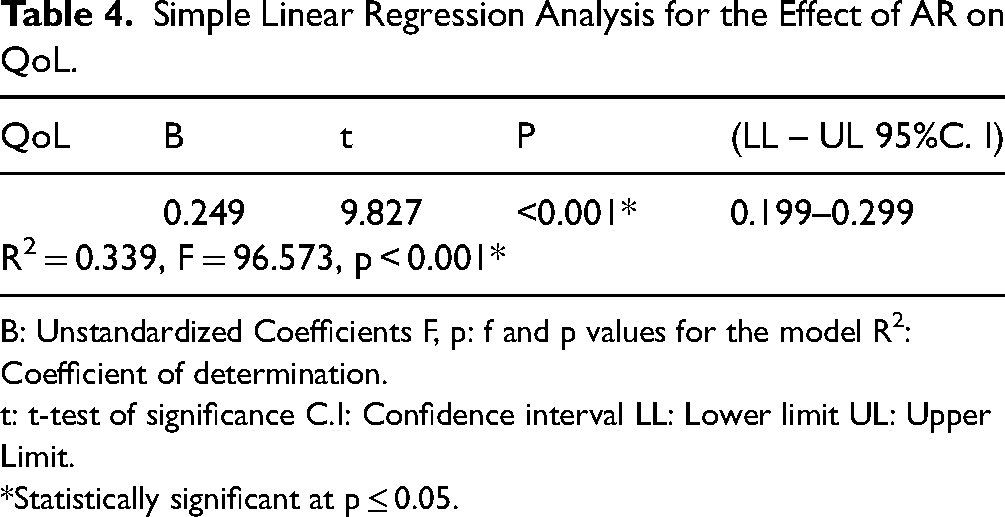
B: Unstandardized Coefficients F, p: f and p values for the model R2: Coefficient of determination.
t: t-test of significance C.I: Confidence interval LL: Lower limit UL: Upper Limit.
*Statistically significant at p ≤ 0.05.
The QoL and AR According to Students’ Demographic/ Academic Data
The findings reveal significant differences in perceived variables such as GPA and reported mental or physical problems, whereas age and academic year did not show significant differences. Students with a B-level GPA displayed the highest mean scores for both QoL and AR compared to other GPA levels (p = 0.031, 0.003, respectively). Similarly, students who did not report mental or physical problems demonstrated the highest mean scores for both QoL and AR compared to their counterparts (p = 0.004, 0.029), respectively. See Supplementary Table 1.
Factors Influence Nursing Students’ QoL and AR
The majority of students (n = 166; 83.4%) responded to the open-ended questions. The qualitative analysis revealed a range of factors influencing nursing students’ QoL and AR. These factors are categorized into three themes: (a) facilitators, (b) barriers, and (c) the impact of nursing education, supported by direct student quotations. The findings are presented in Supplementary Table 2, which includes the frequency and percentage of students who mentioned each factor. For instance, 91.57% of students noted “support from close persons” as a facilitating factor, while 98.2% identified “lack of social support” as a significant barrier. Additionally, to enrich the findings, selected quotations from students were provided, highlighting personal insights into how nursing education and various supports influence their QoL and AR. See Supplementary Table 2 for detailed themes and factors, along with several examples of student quotations that illustrate these reflections.
Facilitators
Nursing students identified several positive factors that enhanced their QoL and academic AR. A passion for nursing and a strong desire to help others, as well as supportive teachers and a nurturing learning environment, were key facilitators. Access to academic advising systems and wellness centers provided essential resources for managing stress and maintaining a balance between academic and personal life. Additionally, students emphasized the importance of strong family relationships, support from close friends, and maintaining good mental health.
Other critical facilitators included having a stable psychosocial and financial situation, engaging in hobbies and spending time with loved ones, and achieving personal and academic success through hard work. Students also reflected on the importance of receiving effective feedback and motivation from their college or workplace. Personal attributes such as passion for nursing, mastery of stress and time management, and self-efficacy all contribute to bolstering AR and QoL, as well as maintaining a healthy lifestyle that includes adequate sleep and self-care routines. Together, these factors contributed to students’ ability to manage the demands of their nursing education while maintaining their overall well-being.
Sample quotations from students illustrate these reflections: “My passion for nursing and desire to help others is what keeps me going.” “Having strong family support and a positive mindset has really helped me through tough times.”
“Believing in my ability to handle the challenges of my academic journey has been a major factor in staying resilient. Having and posing self-efficacy and control is essential to succeed.”
Barriers
On the other hand, nursing students reported several negative factors that hindered their QoL and AR. Among these barriers were high levels of stress and anxiety, primarily caused by the academic workload and demands of nursing education. Many students expressed a lack of social support from peers and faculty, as well as unsupportive or demanding clinical instructors, which further exacerbated their stress. Additionally, students faced difficulties in maintaining a healthy lifestyle due to irregular schedules, and many struggled to balance academic responsibilities with their personal lives.
Other significant barriers included the fear of making mistakes or failing in clinical practice, which often led to self-doubt, as well as physical exhaustion from long hours during clinical rotations. Many students also cited challenges such as transportation difficulties, financial constraints, poor time management, and conflicts with peers, which contributed to a sense of overwhelm. The fast-paced and challenging nature of nursing studies, along with uncertainty about future career opportunities, further increased their stress levels.
Sample quotations from students illustrate these experiences: “The academic demands are overwhelming at times, which increase my level of stress and anxiety.” “Sometimes, I feels like there's no real support system, especially from peers and some faculty members.” “Balancing academic responsibilities with personal life is a struggle. It's hard to maintain a healthy lifestyle.”
Impact of Nursing Education
A significant number of students emphasized the positive role nursing education played in enhancing their quality of life (QoL) and academic resilience (AR). They reflected on how it shaped both their clinical skills and mindset, preparing them for the demands of the nursing profession. Academic advisors and wellness centers were frequently mentioned as crucial resources for managing stress and developing effective coping mechanisms. Nurse educators also played a key role as mentors, offering personalized guidance to help students build resilience and improve their overall well-being.
Sample quotations from students illustrate these reflections: “I believe that nursing education has been pivotal in shaping not just the clinical skills but also the mindset. Educators are preparing us to face the challenges of this demanding profession.” “Students are lucky to have academic advisors and a wellness center in the college that students can go to if they need help. I really appreciate the support from the academic advisors.”
Integration of Quantitative and Qualitative Findings
The correlation and regression analyses reveal a significant, positive relationship between AR and QoL, with AR predicting 34.0% of the variance in QoL. This indicates that as students’ resilience increases, so does their perceived quality of life. The qualitative analysis reinforces these findings by identifying key facilitators and barriers that influence both AR and QoL. Figure 3 integrates these insights, demonstrating how resilience positively impacts QoL. The figure further outlines how academic, personal, and contextual factors can act as either facilitators or barriers. For instance, academic facilitators such as supportive educators, academic advising, and wellness centers promote both AR and QoL, while academic stressors, unsupportive contexts, and challenging environments diminish them. Personal or individual factors, such as passion for nursing, effective time management, and self-efficacy, play a vital role in enhancing both AR and QoL. Conversely, the absence of these personal attributes can serve as a barrier, resulting in lower resilience and diminished quality of life. Additionally, contextual barriers such as a lack of support and resources further affect these outcomes. This integrated approach, linking quantitative and qualitative data, provides a comprehensive understanding of the factors shaping nursing students’ academic resilience and quality of life.

Factors influence nursing students’ QoL and AR.
Discussion
This study aimed to investigate the relationship between AR and QoL among nursing students and identify factors that influence these variables. Using a mixed-methods design, the study achieved its aim and combined quantitative data to assess correlations and predictions alongside qualitative data to gain deeper insights into the specific factors (facilitators and barriers) affecting AR and QoL. This comprehensive approach could allow for a robust understanding of how different factors interact to shape nursing students’ resilience and well-being.
Correlation and Contribution of AR to QoL
The quantitative findings revealed a significant positive correlation between AR and QoL, with AR accounting for approximately 34.0% of the variance in QoL. This supports the hypothesis (H1) and suggests that nursing students with higher resilience tend to report better QoL. The results indicate that the more resilience nursing students possess and cultivate, the better their quality of life could be. Nursing students’ adeptness in managing emotions, overcoming challenges, seeking assistance, and displaying perseverance significantly contributes to their overall well-being. This finding aligns with previous studies, such as Chamberlain et al. (2016), who identified resilience as a crucial factor in mitigating the impact of stress and improving overall well-being among USA nursing students. In a related study, Kupcewicz et al. (2020) reported that stress management and coping strategies were key predictors of QoL among nursing students in Poland, Spain, and Slovakia, further reinforcing the importance of AR in promoting life satisfaction.
Moreover, the findings of the current study are consistent with those of Keener et al. (2021), who identified resilience as a significant predictor, correlating with approximately 38% of the QoL domains among U.S. nursing students. Similarly, Van Hoek et al. (2019) found resilience to be a significant predictor of academic outcomes, such as intention to leave, academic success, and dropout rates among Belgian nursing students, indicating the need for further exploration of additional predictors. McDermott et al. (2020) also pointed to resilience's key role in supporting Australian nursing students’ psychological well-being. In contrast, Grande et al. (2022) reported no significant relationship between QoL and AR but stressed that AR plays a critical role in improving the QoL of Brazilian nursing students, particularly as they cope with academic pressures and external commitments. While AR is crucial in determining QoL, other factors, including personal traits, social support, and self-efficacy, also significantly influence a student's resilience.
Integrative Findings on Factors Influencing QoL and AR among Nursing Students
Despite the positive correlation between AR and QoL, the findings indicate moderate levels of both among nursing students. This result could be attributed to several factors, including academic workload, external support systems, and personal health, which continue to significantly shape students’ experiences. Additionally, the dual burden of academic responsibilities and clinical training presents considerable stressors, often limiting opportunities for self-care. As nursing students struggle to balance academic pressures with personal duties, they experience insufficient time for sleep, mental health care, and relaxation, all of which contribute to diminished QoL. This interpretation aligns with previous research. Studies from the USA and Saudi Arabia have consistently linked the stressful experiences of nursing students to reduced QoL (Aboshaiqah & Cruz, 2019; Keener et al., 2021; Woods-Giscombe, 2021). Keener et al. (2021) reported that academic and clinical demands negatively impact resilience and well-being among US nursing students. Similarly, Torres and Paragas (2019) found that Filipino nursing students scored lower in the psychological and physical health domains of QoL due to the intense academic and clinical demands of their studies.
The qualitative findings support these results, offering deeper insights into the specific facilitators and barriers that shape students’ academic QoL and AR. Nursing students identified several personal, contextual, and educational factors that had a significant impact on their experiences. They reported challenges related to the academic nature of nursing studies, including high levels of stress and exhaustion from academic demands, dense lecture content, and a lack of peer and faculty support. Individual factors such as negative thinking, fear of clinical errors, lifestyle challenges, time management issues, and interpersonal conflicts emerged as significant barriers. Additionally, contextual factors like financial constraints and career uncertainty contributed to increased stress and exhaustion, negatively impacting students’ resilience and ability to adapt. These barriers collectively affect nursing students’ ability to cope, hindering their academic success and well-being.
The result aligns with previous studies that identified factors influencing nursing students’ academic experiences, extending beyond academics to include sociocultural considerations. For instance, South African students frequently cited academic workload, lack of social support, fear of clinical errors, and physical exhaustion as obstacles (Dube & Mlotshwa, 2018). Similarly, Keener et al. (2021) and Torres and Paragas (2019) identified academic pressures and clinical stressors as detrimental to U.S. students’ QoL and resilience. Physical aspects also play a significant role in influencing QoL, with lifestyle habits, adequate rest, sleep patterns, and even obesity affecting Italian students’ well-being (Salvi et al., 2020). Additionally, a study across Poland, Spain, and Slovakia (Kupcewicz et al., 2020) emphasized a direct link between stress levels, coping strategies, and nursing students’ QoL. These findings emphasized the importance of addressing both academic and personal factors to enhance nursing students’ overall quality of life and resilience.
On the other hand, nursing students identified several factors that contributed positively to their QoL and AR. These factors included a supportive academic environment, access to wellness centers, as well as individual attributes such as a passion for nursing, effective stress and time management, self-efficacy, and altruistic motives. Additionally, they reported that engaging in hobbies, maintaining strong family connections, maintaining a balanced life, mental health stability, financial security, and a healthy lifestyle were instrumental in bolstering their resilience and quality of life. Similarly, Hwang and Shin (2018) noted that personal traits and institutional support were essential in fostering resilience among South Korean nursing students. Keener et al. (2021) and Hudson et al. (2019) also emphasized the positive influence of social interaction and engagement in professional activities on U.S. nursing students’ learning experiences, fostering critical thinking and problem-solving skills vital for practical settings. Likewise, Salvi et al. (2020) emphasized the importance of lifestyle factors, including adequate sleep and rest, in improving the QoL of Italian students, suggesting that nursing programs should integrate wellness strategies to better support students’ resilience and well-being.
Other studies conducted in Saudi Arabia emphasized the importance of interactive discussions, fostering safe learning environments, providing time for reflection, and nurturing supportive faculty-student relationships as key factors in promoting nursing students’ academic journeys, self-efficacy, and career readiness (Khalil & Abou Hashish, 2022; Abou Hashish & Bajbeir, 2022; Abou Hashish & Banoona, 2022). These findings underline the complex interplay of factors shaping nursing students’ experiences and the need for creating supportive environments and equipping nursing students with effective coping strategies to improve their overall well-being and academic success (Keener et al., 2021; Woods-Giscombe, 2021).
Moreover, in the quantitative analysis of factors influencing QoL and AR among nursing students, academic levels did not have a significant impact on these variables. However, two key factors emerged as influential: GPA and self-reported mental or physical health issues. Surprisingly, nursing students who achieved a moderate (B-level) GPA demonstrated the highest levels of both QoL and AR. This suggests that moderate academic achiever nursing students experience greater life satisfaction and resilience in facing academic challenges compared to those with lower GPAs. The adaptability and resilience of moderate-achieving students likely stem from their experiences in overcoming challenges and maintaining a realistic view of their capabilities. Additionally, students without reported mental or physical health issues exhibited the highest levels of QoL and AR. This emphasizes the vital role of emotional and physical health in a student's ability to effectively navigate stress and challenges, contributing to academic success and a higher quality of life.
Aligning with the current findings regarding GPA and studied variables, Grande et al. (2022) noted a positive relationship between GPA and QoL, highlighting the distinct experiences and individuality among Brazilian nursing students despite shared characteristics. They found that mid-level academic performers often exhibited greater resilience and life satisfaction compared to lower or higher achievers. In contrast, while Thomas and Asselin (2018) observed higher resilience among advanced-level Chinese nursing students, Hwang and Shin (2018) reported that South Korean nursing students demonstrated high levels of AR, social disposition, and academic proficiency regardless of their academic year. Additionally, McDermott et al. (2020) found a strong correlation between the mental health of Australian nursing students and their academic success, recommending that institutions prioritize mental health support to improve resilience and quality of life among nursing students.
Role of Nursing Education and Educators
Moreover, the qualitative findings revealed the pivotal role of nurse educators and academic advisors in enhancing AR and QoL. Nursing students emphasized the importance of nursing education and the influential role of educators in nurturing their QoL, coping strategies, and AR. They perceive nursing education as foundational in preparing them for future careers, equipping them with skills to navigate academic and clinical challenges, and enhancing their understanding of mental health and overall well-being. Although students acknowledge the instrumental support they receive from academic advisors and educators, they also note that nursing education's impact on their coping and resilience may vary among individuals based on their specific needs, aspirations, and behaviors. The current study's result is consistent with studies conducted in various contexts by Abou Hashish & Banoona (2022) in Saudi Arabia, Spurr et al. (2021) in Canada, and Chow et al. (2020) in Hong Kong, which emphasized the crucial role of nursing education, clinical instructors, and the overall educational environment in students’ development. Additionally, Thomas & Asselin (2018) in China and Keener et al. (2021) in the USA emphasized nurse educators’ pivotal role in maintaining or elevating students’ resilience levels by employing various strategies, such as creating supportive learning environments, integrating reflective exercises, implementing peer support programs, and incorporating mindfulness approaches. Moreover, studies by Chamberlain et al. (2016), Lekan et al. (2018) in the USA, and Cleary et al. (2018) in Australia collectively support these strategies, contributing to fostering resilience within the nursing education framework. These studies advocate for integrating considerations of QoL, coping strategies, and AR training within nursing education, emphasizing the importance of instilling advocacy skills, self-efficacy, and resilience within the curriculum.
Strengths and Limitations
The study provides valuable insights into the quality of life (QoL) and academic resilience (AR) among nursing students, shedding light on their unique challenges and factors contributing to their well-being. A key strength of the study lies in its mixed-methods design, combining quantitative self-reported questionnaires with qualitative open-ended questions. This approach allowed for a deeper understanding of students’ lived experiences, capturing both numerical data and personal reflections on the factors that shape their academic life and resilience. The integration of these methods enhanced the richness of the findings, offering a more holistic view of the topic.
However, several methodological limitations should be noted. First, the reliance on self-reported data may introduce response biases, as students might provide socially desirable answers or misjudge their own behaviors and experiences. Additionally, the study only includes nursing students from a single institution, which restricts the applicability of the findings to other populations or academic fields. This context-specific scope means that the results might not fully represent the experiences of nursing students in different regions or healthcare systems. Moreover, as a cross-sectional study, this research captures data at one point in time, limiting its ability to track changes or developments in QoL and AR over time. Longitudinal studies would be better suited to exploring how these variables evolve during nursing education. Another limitation is the study's lack of focus on specific interventions or strategies to improve nursing students’ QoL and AR, which would have practical implications for educational or institutional reforms.
Implications of the Study
This study offers several implications and recommendations for nursing education and future research.
Implications for Nursing Education and Practice
- Educational institutions must prioritize the mental health and well-being of nursing students. This can be achieved through the implementation of comprehensive mental health services, providing access to counseling, peer support groups, and wellness programs. The study emphasizes the importance of academic advising systems and student wellness centers as key strategies for promoting students’ overall well-being. These resources should be made more accessible and integrated into the everyday support structures for nursing students.
- Faculty members and academic advisors should be trained to offer tailored guidance, focusing not only on academic performance but also on emotional and psychological support. Institutions can enhance their support by organizing workshops and seminars that teach time management, stress management, and coping strategies. Such initiatives would provide students with practical tools to balance academic demands with personal commitments, potentially reducing burnout and improving academic resilience.
- Collaboration between nursing education institutions and healthcare organizations is also crucial. Providing students with more hands-on experiences in real-world clinical settings will allow them to develop the resilience and adaptability necessary for future professional roles. These experiences can also enhance their understanding of the challenges they will face in healthcare, preparing them for a smoother transition into the workforce.
Recommendations for Future Research
- Future research should expand the scope beyond nursing students, exploring the QoL and AR among students in other healthcare and non-healthcare fields. This comparative research could provide valuable insights into whether nursing students face unique challenges or if similar patterns exist across different disciplines. - Longitudinal studies are also needed to assess the long-term effects of interventions aimed at improving nursing students’ QoL and AR. By tracking changes over time, researchers can better understand how resilience develops and how students’ well-being is affected throughout their academic journey. - Additionally, further studies should evaluate the effectiveness of specific programs designed to enhance resilience among nursing students. This could include interventions such as mindfulness training, peer support initiatives, or resilience-building workshops. Such research would provide evidence-based recommendations for improving nursing education practices, contributing to the well-being and success of future nurses.
Conclusions
Through its mixed-methods design, this study provided a comprehensive exploration of the levels and factors influencing AR and QoL among nursing students. The findings revealed moderate levels of both QoL and AR, largely due to academic demands and associated pressures. A positive correlation between QoL and AR indicated that higher resilience is associated with a better quality of life. Students with moderate GPAs and good mental or physical health demonstrated the highest levels of QoL and AR, emphasizing the need to address these factors for improved well-being and academic success.
Qualitative data pointed to both supportive and hindering factors that affect students’ QoL and AR, with nursing education playing a critical role. Additionally, academic, personal, and contextual factors shape students’ overall experiences.
The study presents several implications and recommendations for enhancing students’ QoL and AR. Nursing programs should adopt holistic strategies, including stress management, mental health resources, and resilience training. By addressing academic and personal challenges while fostering a supportive learning environment, educational institutions can help students succeed academically while maintaining their well-being. These interventions are crucial not only for academic success but also for preparing nursing students to thrive in the demanding healthcare profession.
Supplemental Material
sj-pdf-1-son-10.1177_23779608241303690 - Supplemental material for Investigating Quality of Life, Academic Resilience, and Influential Factors in Nursing Education: A Mixed-Methods Study among Nursing Students
Supplemental material, sj-pdf-1-son-10.1177_23779608241303690 for Investigating Quality of Life, Academic Resilience, and Influential Factors in Nursing Education: A Mixed-Methods Study among Nursing Students by Ebtsam Aly Abou Hashish, Erada Bajbeir, Salwa Amer Almabadi, Nowr Dakhel Alzebali and Shahad Fawzi Alhubishi in SAGE Open Nursing
Supplemental Material
sj-pdf-2-son-10.1177_23779608241303690 - Supplemental material for Investigating Quality of Life, Academic Resilience, and Influential Factors in Nursing Education: A Mixed-Methods Study among Nursing Students
Supplemental material, sj-pdf-2-son-10.1177_23779608241303690 for Investigating Quality of Life, Academic Resilience, and Influential Factors in Nursing Education: A Mixed-Methods Study among Nursing Students by Ebtsam Aly Abou Hashish, Erada Bajbeir, Salwa Amer Almabadi, Nowr Dakhel Alzebali and Shahad Fawzi Alhubishi in SAGE Open Nursing
Supplemental Material
sj-docx-3-son-10.1177_23779608241303690 - Supplemental material for Investigating Quality of Life, Academic Resilience, and Influential Factors in Nursing Education: A Mixed-Methods Study among Nursing Students
Supplemental material, sj-docx-3-son-10.1177_23779608241303690 for Investigating Quality of Life, Academic Resilience, and Influential Factors in Nursing Education: A Mixed-Methods Study among Nursing Students by Ebtsam Aly Abou Hashish, Erada Bajbeir, Salwa Amer Almabadi, Nowr Dakhel Alzebali and Shahad Fawzi Alhubishi in SAGE Open Nursing
Footnotes
Acknowledgements
The authors thank all the participants who take part in the current study.
Authors’ Contributions
All authors have made substantial contributions to the conception and design of the study, acquisition of data, analysis and interpretation of data; drafting the article or revising. Abou Hashish E: principal investigator, final manuscript, and correspondence.
Declaration of Conflicting Interests
The authors declared no potential conflicts of interest with respect to the research, authorship, and/or publication of this article.
Ethical Approval
The study received approval from College of Nursing – Jeddah (CONJ) and KAIMRC (IRB Approval: SP23J-095-05).
Funding
The authors received no financial support for the research, authorship, and/or publication of this article.
Supplemental Material
Supplemental material for this article is available online.

References
Supplementary Material
Please find the following supplemental material available below.
For Open Access articles published under a Creative Commons License, all supplemental material carries the same license as the article it is associated with.
For non-Open Access articles published, all supplemental material carries a non-exclusive license, and permission requests for re-use of supplemental material or any part of supplemental material shall be sent directly to the copyright owner as specified in the copyright notice associated with the article.
