




Abstract
Neighbourhood associations are major players in urban politics throughout North American cities and increasingly are becoming a political force in other parts of the world. However, while there is a rich and well-developed literature on the role played by neighbourhood associations in urban politics, few studies examine whether their membership reflects the socio-demographic composition and interests of the broader public. This paper addresses this gap in the literature using survey data from voters conducted during the Vancouver and Toronto 2018 municipal elections. We compare the responses of participants who identify as members of neighbourhood associations (or their equivalents) with those of the broader voting public. We find that members of neighbourhood associations in both cities are not representative of the broader population. They are more likely to be white, older and have higher education than the average voter. In addition, while the ideology of neighbourhood association members differs little from that of the broader public, their policy priorities are different from those of the majority of voters in both cities. Our findings suggest that neighbourhood associations fail in providing descriptive representation and may not offer substantive representation. These findings raise important questions about the role of neighbourhood associations in local governance. Our study also demonstrates the merit of using individual-level surveys to learn more about the composition and policy preferences of neighbourhood associations.
Introduction
Neighbourhood associations are major players in urban politics – particularly in the politics of urban development – in many North American cities, and they are increasingly becoming a political force in other parts of the world. The literature devoted to neighbourhood associations, and neighbourhood organisations more broadly, is rich and well developed. This literature addresses how these associations emerge and how they influence government policies, while considering what role they can play in representing local interests. However, although this literature has broadened our understanding of these organisations, our knowledge of the descriptive and substantive representativeness of neighbourhood associations’ membership is still limited. In particular, much of the existing research does not address whether the membership of these organisations reflects the sociodemographic composition of the communities they purport to represent, nor whether the policy interests of their members align with those of the general public.
This paper remedies this omission in the existing literature and addresses the important question of representation by examining the sociodemographic, ideology and policy preferences of members of neighbourhood associations in two Canadian cities: Toronto and Vancouver. The paper uses data from the Canadian Municipal Election Study (CMES), where participants were asked if they are a member of a neighbourhood, ratepayer or residents’ association. We believe this is the first study to use individual-level survey data to examine the composition of neighbourhood associations, and the first ever to study the composition of neighbourhood associations in Canada. Using CMES data we can compare current and past members of neighbourhood associations with the broader electorate in these two cities. We find that there are significant sociodemographic differences between members of neighbourhood associations and the broader voting public. Members of neighbourhood associations in Toronto and Vancouver are more likely to be white, older, highly educated and own their own home. And while they do not differ ideologically from average voters, they do differ when it comes to issue priorities.
Our findings suggest that neighbourhood associations fail in providing descriptive representation, supporting traditional depictions of the organisations as being largely educated and white (though no more affluent than most voters). And while members differed little from other residents in their ideological leanings, their policy foci diverged from those of the broader public, suggesting they may not provide substantive representation. Given their perception of their own importance (which is very high compared with other voters) and existing research that demonstrates their influence on government policy at the local level, our findings suggest that these influential organisations could drive politicians to emphasise issues that are different from those of the majority of residents in their respective cities.
Our study also demonstrates the feasibility of using individual-level surveys in order to learn more about the composition and policy preferences of neighbourhood associations and grassroots organisations in general. We believe that individual-level surveys of residents, with more focused questions on policy interests and preferences, could provide even more insight into the nature of neighbourhood associations.
The remainder of this paper is structured as follows. We define and discuss the emergence of neighbourhood associations in North America, as well as the broader literature on neighbourhood associations and organisations. We then introduce our two case studies and the role and influence of neighbourhood associations in the two cities. Following this discussion, we explain our methodology, deliver our findings and, finally, offer our concluding thoughts and discuss future research possibilities.
What are neighbourhood associations?
The term ‘neighbourhood association’ is somewhat ambiguous. The term may be used in a general sense to refer to any type of community organisation. For our purposes, we draw on Pekkanen’s (2006) definition as he applied it to neighbourhood associations in Japan:
Although neighbourhood associations go by many names (ratepayer and residents’ association being the most common in our two case cities), they can be distinguished from other community organisations by their adoption of strictly defined neighbourhood boundaries. Unlike the similarly named homeowner associations in the USA, which require all tenants in a community to be members and which function as a condominium or strata board, neighbourhood associations, though often incorporated entities, are voluntary, grassroots organisations.
Owing to their primarily grassroots nature and varying recognition and support by municipal governments, the role and influence of neighbourhood associations vary by jurisdiction. For instance, some municipalities, such as Seattle, actively encourage the creation of neighbourhood associations (Moore, 2013), while in Toronto, the municipality does not play a role in their creation (Flynn, 2019). Nonetheless, they exist in varying forms throughout much of Canada and the USA, and increasingly in other countries.
While the reasons for neighbourhood associations’ genesis vary, in North America there is evidence that neighbourhood associations initially form to combat proposed development within their neighbourhood; only later extending their focus beyond issues of urban development. In his seminal book on neighbourhood associations, Between Citizen and City, Thomas (1986) argues that the increasing encroachment of development on established neighbourhoods, and communities’ perception of these encroachments as threats, result in the creation of strong neighbourhood-based civic organisations that could challenge pro-development forces. Further research by Logan and Rabrenovic (1990), Scheller and Yerena (2018) and Wohlers (2009) support Thomas’s assessment. As a result of this focus on urban development – specifically, opposing development that may alter the character of their neighbourhood – neighbourhood associations are often the main opponent of pro-growth forces in North American cities (Moore, 2013). While the reasons for their emergence may differ in other parts of the world, regardless of jurisdictions, neighbourhood associations’ raison d’être is to influence government policy and shape or direct the governance of the communities they claim to represent.
Since the publication of Between Citizen and City, there have been numerous studies carried out in North America and other parts of the world demonstrating that neighbourhood associations are a major, and increasingly important, actor in urban politics in many cities. In North America, Logan and Rabrenovic (1990), Moore (2013), Swindell (2000), and Wohlers (2009) provide evidence of strong and active neighbourhood associations in the Capital District of New York; Toronto, Ontario; Indianapolis, Indiana; and Davenport and Rock Island, Illinois, respectively. And, although he does not refer specifically to neighbourhood associations in his work, DeLeon (1992) argues that organised middle-class communities were the driving force behind a coalition of actors that successfully toppled the pro-growth regime in San Francisco. Beyond North America, there is increasing scholarship about the growth and importance of neighbourhood associations in a variety of different settings, including Delhi and Mumbai, India (Lama-Rewal, 2007; Zérah, 2007), Turkey (Erman and Coşkun-Yildar, 2007) and Japan (Pekkanen and Tsujinaka, 2008).
Do neighbourhood associations represent the broader public?
Given the growing proliferation of neighbourhood associations and evidence of their impact on urban politics, whether or not they represent the residents of their neighbourhood and cities is an important question. Anthony Downs (1981: 172) characterises them as ‘both parochial and conservative regarding any changes in local conditions’, suggesting that they could oppose progressive policies in their own neighbourhood and throughout their cities. And though, overall, Thomas (1986) seems to view these organisations in a positive light, he does offer an important caution regarding them, which is as important today as it was in 1986.
Thomas begins his book by discussing how reforms to municipal institutions, and the perception of elected officials and other stakeholders, changed during the 1960s and 1970s, opening a window for new, improved and better-organised neighbourhood organisations to start influencing urban politics and development. Although he uses the term ‘organisation’ in place of ‘association’ throughout his book, and focuses specifically on the community councils in Cincinnati, his depiction of the community councils mirrors that of neighbourhood associations and similar organisations in the rest of North America. These councils emerged and coalesced, in-part, as a foil to pro-growth forces. Thomas demonstrates that neighbourhood associations are much stronger, and more capable of fending off co-optation, than early urban political economy scholars such as Peterson (1981) would allow.
According to Thomas, in the case of Cincinnati, neighbourhood associations went from simply being influential players in local politics, to becoming embedded in municipal government. This type of embeddedness may not exist in all cities, but the nature of this embeddedness led Thomas to question how representative these organisations were. Although Thomas, ultimately, sees the emergence of neighbourhood associations in the form of community councils as a positive element in Cincinnati, he notes at one point that were it not for Lyndon B Johnson’s War on Poverty, which helped to mobilise and organise black residents in the city – particularly black renters – Cincinnati’s community councils would largely represent the interests of affluent whites (Thomas, 1986: 58–60). The caution, then, is that while these organisations may claim to represent the interests of residents, neighbourhood associations may not, themselves, be representative of the larger population of cities.
Despite this important concern, there has been very little research into representativeness of neighbourhood associations’ membership beyond a single chapter in Thomas’s book. Many authors have questioned how effective neighbourhood associations are at representing the interests of residents in cities. For instance, both Cnaan (1991) and Lama-Rewal (2007) question how democratic they are and raise concerns regarding accountability and due process. Lama-Rewal (2007) argues that they have hindered the creation of local democratic institutions in Delhi; although she believes the associations themselves are becoming more democratic.
Mesch and Schwirian’s (1996) study is one of the few to examine the sociodemographic composition of neighbourhood associations since Between Citizen and City. In the context of that study, the authors looked at socioeconomic status and race as possible explanations for the relative effectiveness of neighbourhood associations. The authors found that socioeconomic status did play an important role in the overall effectiveness of these organisations, while race did not. As Mesch and Schwirian were interested in understanding the effectiveness of neighbourhood associations, not representation, they did not delve further into the implications of their finding; although, the authors note that such a finding ‘is more consistent with the elitist perspective on city politics that argues that inequalities in city politics are the result of a bias towards wealthy and stable neighborhoods’ (Mesch and Schwirian, 1996: 480).
The absence of a true understanding of the representative nature (or lack thereof) of these organisations is a major gap in this literature because, as Mesch and Schwirian suggest in passing, these organisations could be more reflective of elitist interests than those of the residents they claim to represent. Our study of Toronto and Vancouver explores the question of representation, in sociodemographic (descriptive), attitudinal and behavioural terms. Of course, our findings in these two cities may not be reflective of the composition of neighbourhood associations in all other cities, but we believe they raise very important questions about the nature of these organisations at a time when they appear to be growing in popularity and are being conceived as possible parties to governance (Flynn, 2019).
Neighbourhood associations in Toronto and Vancouver
Unlike in the USA, there is not an abundance of research on neighbourhood associations in Canada. However, the literature that exists provides specific and detailed accounts of the role and importance of neighbourhood associations in Vancouver and Toronto. While some neighbourhood associations in the two cities date back to the early 1900s (Flynn, 2019; Hasson and Ley, 1994), as in the USA their rise to prominence, and particularly their role in the politics of urban development, began in the 1960s and 1970s.
Vancouver
In their work Neighbourhood Organisations and the Welfare State– a comparison of Vancouver neighbourhood organisations with similar organisations in Jerusalem –Hasson and Ley (1994) discuss four different organisations in Vancouver, representing varying ethno- and sociodemographic neighbourhoods. However, they distinguish between the traditional ‘ratepayer associations’, which emerged in the wealthier enclaves of the city, and more progressive movements in other lower income areas. The distinction they make parallels that of Thomas (1986), when he distinguishes between white, upper-class associations and their black, lower-income counterparts in Cincinnati.
Despite the distinction, all four of the organisations Hasson and Ley discuss meet our definition of neighbourhood associations and in all four cases these associations either emerged or grew in importance as a direct result of encroaching development or planning policies that the respective organisations feared would undermine or destroy the lives of neighbourhood residents. More broadly, according to Hasson and Ley (1994), neighbourhood associations cemented themselves as important actors in Vancouver politics beginning in the late 1960s and early 1970s when they successfully opposed a proposed system of freeways that threatened many of the city’s neighbourhoods. The authors further suggest that their influence over and involvement in Vancouver city politics continued and grew through the 1990s.
Despite limited new research into Vancouver’s neighbourhood associations, there is little reason to believe much has changed in Vancouver since the publication of Hasson and Ley’s book. Today, the Coalition of Vancouver Neighbourhoods (CVN), an umbrella group for most of the cities’ neighbourhood associations, boasts a membership of 27 active residents, neighbourhood and ratepayer associations, suggesting that the overall movement is alive and well. Although we do not know whether they continue to wield the same influence they once did, neighbourhood associations in Vancouver continue to be active actors in city politics, particularly as the city continues to undergo significant growth and experiences escalating housing costs.
Toronto
Research into the neighbourhood associations in Toronto is, fortunately, very recent. Both Moore (2013), in his book Planning Politics in Toronto, and Flynn (2019) describe neighbourhood associations in that city as being major players in urban politics, and Moore depicts them as being the main foil to the city’s developers.
The emergence of neighbourhood associations in Toronto mirrors closely that of associations in Vancouver. Some date back to the first half of the 20th century; however, for the most part, neighbourhood associations in Toronto rose to prominence following an ideological shift in the city council and in opposition to developments that threatened established neighbourhoods, both wealthy and poor. In fact, the most famous battle fought by neighbourhood associations in Toronto – led in part by Jane Jacobs – was to stop the construction of a highway that would plough through both affluent and poorer enclaves in the city (Flynn, 2019; Moore, 2013).
In Moore’s account of planning politics in Toronto, he argues neighbourhood associations’ intercession into planning politics during the first part of Toronto’s current development boom resulted in the city council rejecting a greater proportion of planning proposals that came before the council (Moore, 2013: 74–78).
In Flynn’s (2019) recent discussion of the city’s business improvement associations and neighbourhood associations, she discusses recent cases of neighbourhood association involvement in urban planning, and notes that over 100 of these organisations exist in the city. She also notes that many of these associations only emerged after Metro Toronto merged with its six lower-tier municipalities in 1998 (Flynn, 2019), a period of time that corresponds with the start of Toronto’s condo boom (Moore, 2013).
Toronto’s neighbourhood associations remain an important force in city politics. Flynn suggests they could play an even greater role in the city’s governance by helping to fill a vacuum created by the reduction of city council members from 44 councillors to 25. However, she notes that these organisations need to better reflect the socio-demographic composition of the city’s residents, adopt transparent forms of governance and that they need to exist throughout the city rather than in largely affluent neighbourhoods. Such an argument emphasises the need to understand who comprises the membership of these organisations, and whether their interests correspond with those of the average resident in the city.
Studying neighbourhood association through the CMES
To understand how representative neighbourhood associations are in Toronto and Vancouver, we consider two questions:
Do members of neighbourhood associations in Vancouver and Toronto reflect the sociodemographic diversity present in these cities (descriptive representation)?
Do Vancouver and Toronto neighbourhood association members’ political attitudes and voting behaviour align with those of the broader public (substantive representation)?
In distinguishing between descriptive and substantive representation, we draw on Peterson’s (1970) summary of Pitkin’s typology or representation. Descriptive representation refers to how closely representatives reflect the characteristics of the people they purport to represent. Substantive representation refers to representatives’ influence (e.g. whether they can affect policy change) and their orientation (i.e. whether their policy priorities align with those of the people they represent). For substantive representation, we examine only how neighbourhood association members’ policy preferences align with those of the broader public, as we cannot test for influence – though prior research on Toronto and Vancouver suggest the neighbourhood associations do have some degree of influence.
In order to answer these two questions we make use of data from the Canadian Municipal Election Study, a comparative study of elections in eight large municipalities in Canada in 2017 and 2018. We chose to focus solely on Vancouver and Toronto because of existing research on neighbourhood associations in each city, and the fact that questions about these associations were only asked in these cases.
The online survey of Toronto voters took place during the final month of the municipal election campaign ending on 22 October 2018. The online survey of Vancouver voters took place during the final month of the municipal election campaign ending on 20 October 2018. Respondents were interviewed before the election and invited to be re-interviewed afterwards. Return-to-sample rates were 65.5% in Toronto and 54.5% in Vancouver. Surveys were administered by Forum Research Inc.
Along with typical questions included in most election surveys relating to sociodemographics, voting intention, turnout, ideology, efficacy and policy positions of respondents, we included a question in our surveys asking respondents: Are you now or have you ever been a member of a Neighbourhood, Residents’ and/or Ratepayers’ Association (or equivalent)? 1
In total, 1525 voters responded to our survey in Toronto and 874 responded to our survey in Vancouver. Of those respondents, 24.1% in Toronto and 17.4% in Vancouver identified themselves as being or having been members of a neighbourhood association. These figures may be higher than the actual proportion of neighbourhood association members in each city, given that politically active respondents are likely to self-select into our surveys and we expect members of neighbourhood associations to fit into this group. In this instance, however, this overestimation strengthens the analysis that follows. It provides us with a high enough number of respondents involved in neighbourhood associations to allow for sufficient statistical leverage to consider our research questions and demonstrates the utility of a survey approach to studying neighbourhood associations. We do not expect that this overestimation should bias any of the comparisons below (though, as is the case with most research, there is value in replicating our findings in other settings and with other sources of data).
There are two stages to our data analysis corresponding to our two research questions. First, we compare the sociodemographic characteristics of existing and former members of neighbourhood associations with those of non-members to determine whether neighbourhood association membership in Toronto and Vancouver reflects the cities’ diverse populations (descriptive representation). Second, we compare the attitudes of members and past members with those of non-members by examining their ideology, voting preference and which issues they identified as most important during the election (public transit, property tax, traffic, economic development and affordability) in order to investigate whether neighbourhood associations provide substantive representation of city residents.
Findings
Before addressing our central research questions, we first examine whether members and past members of neighbourhood associations perceive themselves as being more influential than other respondents to our surveys, and whether they are more likely to believe that local government has a significant impact upon their lives. That is, do members of neighbourhood associations see local government differently than other electors?
First, we find that members of neighbourhood associations report a higher sense of local political efficacy. They were far more likely to believe that local government ‘cares about what people like me think’. Among members of neighbourhood associations, 26.5% strongly agreed with the statement, while only 18.6% of other electors thought so (N = 2339, p < 0.001). Furthermore, they are also more likely to believe that municipal government has a big impact on their life; 70.4% of neighbourhood association members shared the opinion that the municipal government had a ‘lot’ of impact upon their quality of life, while this figure was only 58.7% for non-neighbourhood association members (N = 4033, p < 0.001). These findings seemingly reflect the reality of the influence of these associations on local politics. That is, neighbourhood association members feel more powerful than their non-neighbourhood association counterparts but they also feel more greatly affected by local government. These findings also further underscore the importance of examining the representativeness of neighbourhood associations. Are these organisations comprised of the select few who feel they wield influence and power in municipal politics, or do they reflect the broader communities they purport to represent?
Table 1 addresses our first question: Do members of neighbourhood associations in Vancouver and Toronto reflect the sociodemographic diversity present in these cities? The table contains the results of bivariate comparisons between each sociodemographic characteristic and that of reported neighbourhood association membership. Each row of entries examines a sociodemographic characteristic, while the rows are mutually exclusive and collectively exhaustive categories. All characteristics are coded as dummies to simplify comparison. Entries report the share of each group that belongs (or has belonged) to a neighbourhood association. We also include a column which indicates the estimated difference of rate of neighbourhood association membership, as well as statistical significance. The results of this table allow us to compare members with non-members in descriptive terms.
Neighbourhood association membership and sociodemographic characteristics.
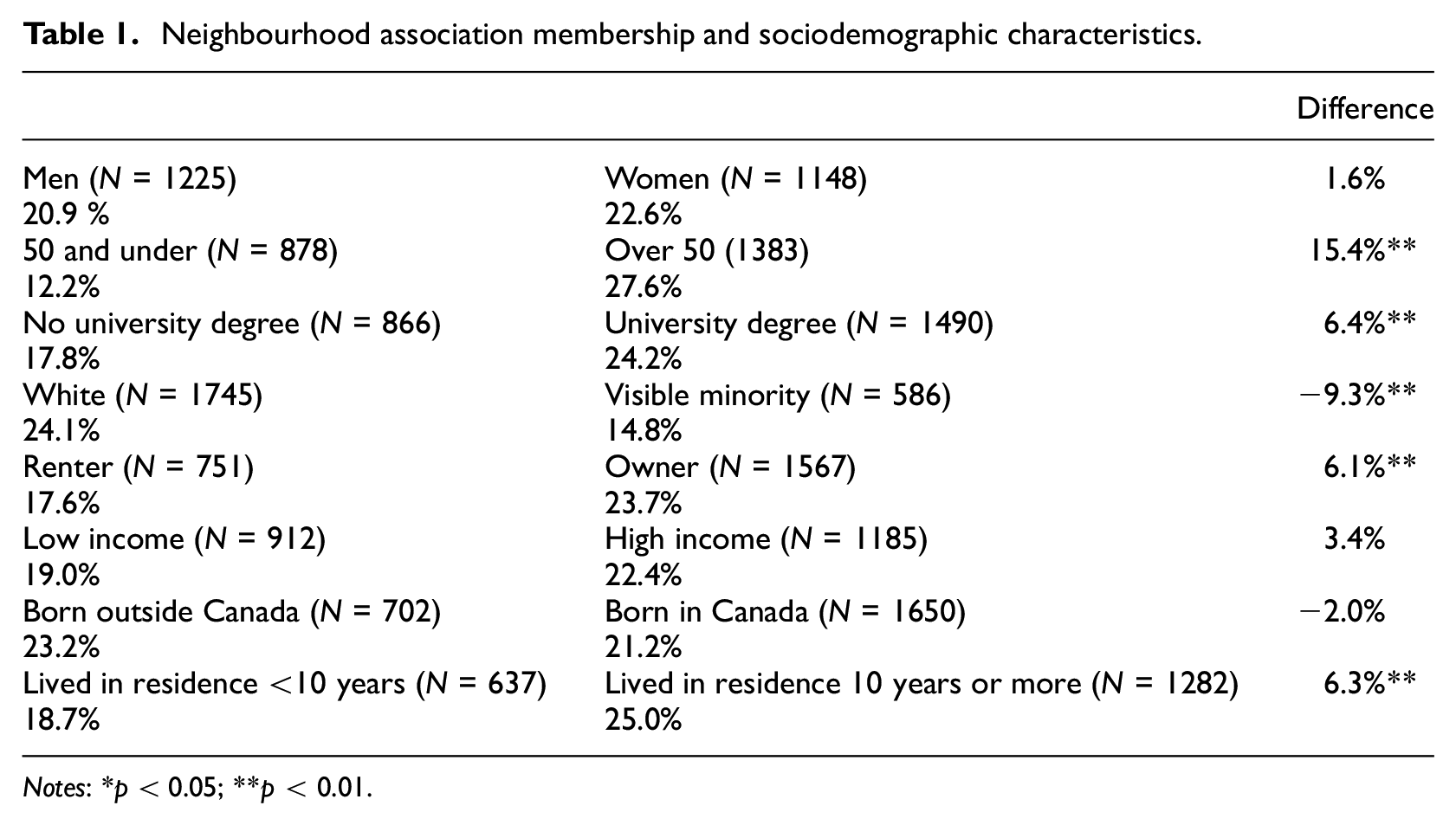
Notes: *p < 0.05; **p < 0.01.
Table 1 paints a portrait of neighbourhood association members in Toronto and Vancouver as being more white, older, more educated, homeowners and having lived in their home much longer than average voters. Given that age and education typically correlate with likelihood of voting and we only surveyed voters, these differences could be even more pronounced when comparing members of neighbourhood associations with the broader public.
That neighbourhood associations in the two cities are not dominated by higher income residents (contrary to most depictions of them), include equal representation of men and women, and appear to include a proportion of immigrants comparable with the broader voting public, suggests that these organisations have some positive attributes. However, beyond these few characteristics, the membership of neighbourhood associations in the two cities is not reflective of the broader population, suggesting they fail in the descriptive representation of their city residents.
The higher age of members likely reflects the greater capacity of retirees to participate in such organisations, an issue common with many similar voluntary organisations. Furthermore, that residents who have lived in a neighbourhood for longer periods of time are more engaged than more recent arrivals is not surprising. The main cause for concern when looking at the sociodemographics of these organisations is the apparent under-representation of visible minorities, renters and people with lower levels of education. The under-representation of visible minorities is particularly glaring, as both Toronto and Vancouver boast highly diverse populations. As of the 2016 Canadian Census, 51.5% of Torontonians and 50.6% of Vancouverites identified as visible minorities.
Our findings suggest that on a purely descriptive level, neighbourhood associations are not representative of the broader population. However, while greater diversity of membership would undoubtedly boost neighbourhood associations’ claims to represent city residents, if the attitudes of neighbourhood association members largely align with those of the larger public, then the absence of perfect sociodemographic representation may not matter. Neighbourhood associations may still substantively be representative of the interests of residents. To compare attitudes, we look at respondents’ ideology, their vote choice for mayor and, lastly, what issues they identified as most important in the election. Each measure ranges from 0 to 1.
Table 2 shows the relationship between membership in a neighbourhood association and several indicators of political ideology. The table includes the results of a series of ordinary least squares regression models where the three ideological indicators of interest serve as the dependent variables (all of which are coded to range from 0 to 1): standard left–right ideological self-placement, as well as indices for social and economic conservatism (see Appendix I for variable coding, available online). For each factor, we run a basic model where the only explanatory variables are neighbourhood association membership and a dummy variable for city. We also include a more complete model with controls for the sociodemographic indicators (all of which are coded as dummies). We employ asterisks to indicate significance level. Significant entries for the neighbourhood association variable would indicate that neighbourhood association members differ ideologically from their non-neighbourhood association counterparts.
Neighbourhood association membership and ideology.
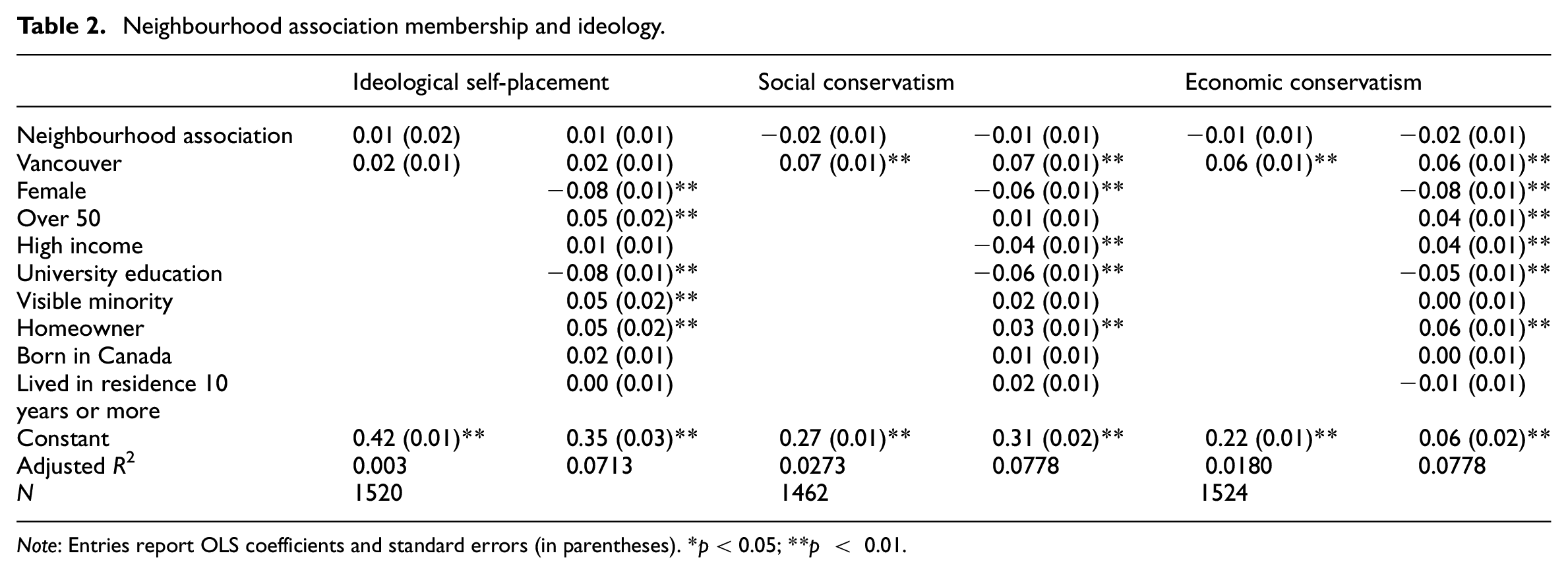
Note: Entries report OLS coefficients and standard errors (in parentheses). *p < 0.05; **p < 0.01.
This table includes ideological self-placement (where respondents place themselves on a left–right political axis), as well as two dimensions of objective ideology (indices for social and economic conservatism). At least in broad terms, we find no evidence that members of neighbourhood associations are ideologically distinct from non-members. Given the size of our sample, these null findings are quite convincing.
Next, we look at voting preferences for mayor in the two cities. John Tory (a centre-right candidate) was the eventual winner in the 2018 mayoral contest in Toronto, while Kennedy Stewart (who is on the centre-left) was the victor in Vancouver. Table 3 shows the results from two sets of logistic regression models, where a binary indicator of vote choice for the winning candidate (as opposed to all other candidates) serves as the outcome variable. 2 The basic models look at vote support for Tory and Stewart without controls, while the larger models include controls for sociodemographics. Entries report marginal effects (and thus can be interpreted in a similar manner to the OLS models in Tables 2 and 4) upon the probability of voting for the winning mayoral candidate. The effects are calculated by leaving values of other variables unchanged.
Neighbourhood association membership and mayoral vote choice.
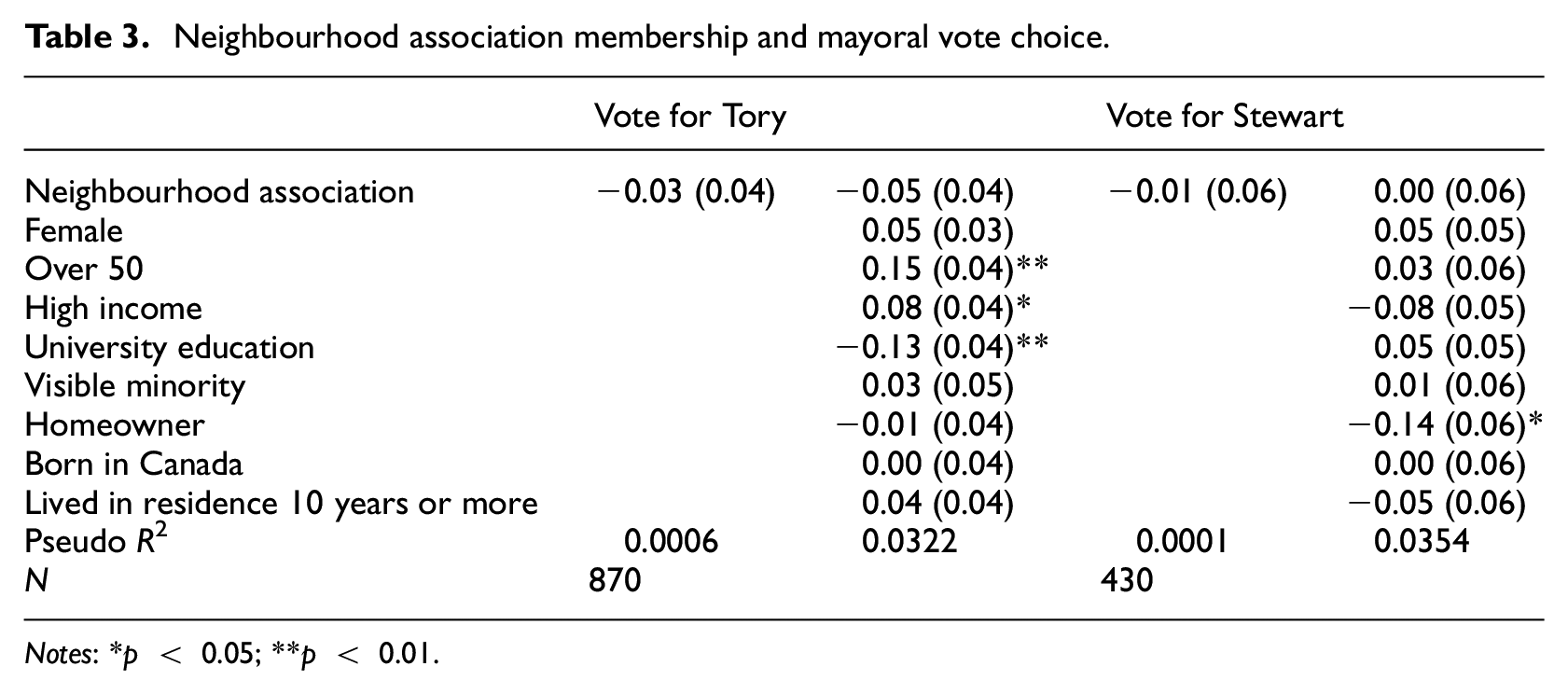
Notes: *p < 0.05; **p < 0.01.
Neighbourhood association membership and issue importance.
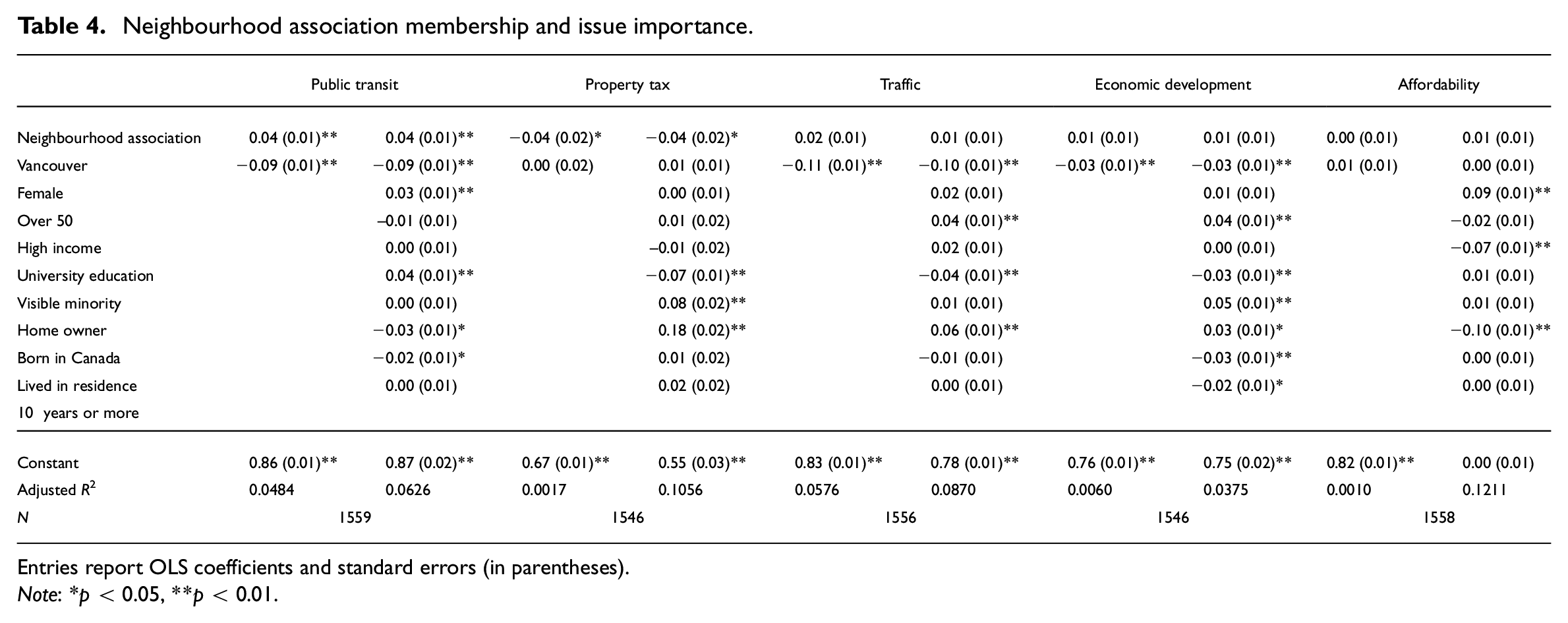
Entries report OLS coefficients and standard errors (in parentheses).
Note: *p < 0.05, **p < 0.01.
As with the test of ideology, we find no differences between members of neighbourhood associations and non-members with respect to vote choice, providing additional evidence that the preferences of members of neighbourhood associations do not differ from those of other electors. So while our findings suggest that members of neighbourhood associations do not reflect the sociodemographic diversity of their cities, their attitudes toward politics are seemingly no different from those of the average voter. If this is indeed true, then the composition of neighbourhood association membership may not be hindering these associations’ capacity to reflect the broader interests of residents in the city.
However, examining voting behaviour and political ideology can only tell us so much about these organisations. First, though neighbourhood associations may influence elections, their main role in city politics takes place between elections, not during. Existing research on neighbourhood associations in North America, and in both of our case studies, suggests these organisations largely attempt to exert pressure on decision-makers during the policy decision-making process. For instance, they will actively try to intervene in planning policy when a decision could affect development in their neighbourhoods.
In addition to allowing a comparison of members of neighbourhood associations with other electors on the basis of ideology and vote choice, CMES data enables us to conduct a comparison of member and non-member perceptions of issue importance. The CMES survey includes questions asking respondents to express how important specific issues or policies are, on a scale from 0 to 10 (re-scaled here to range from 0 to 1) – affordability, economic development, property tax, public transit and traffic. This list of issues provides insight into which policy concerns are the most pressing to neighbourhood association members, and whether their policy concerns align or diverge from those of non-members.
Table 4 contains the results of this analysis. The table is set up in the same manner as Tables 2 and 3; it includes a basic model with neighbourhood association membership and city only, and then a second model with controls, for each outcome variable (issue). The issue importance questions are interval level (coded to range from 0 to 1), so models are ordinary least squares regressions.
Here we see members and former members of neighbourhood associations diverging from non-members. While there is no difference between members and non-members on the importance of traffic, economic development and affordability, members of neighbourhood associations perceive transit as a much more important issue than non-members and perceive property taxes as less important than non-members. Flynn’s (2019) analysis of the location of active neighbourhood associations in Toronto provides some explanation of these findings. Flynn found that neighbourhood associations formed largely in highly affluent areas of the city and her maps showing their locations suggest that they are more likely to exist in Toronto’s downtown and along its major transit routes. If Vancouver neighbourhood associations are similarly located, then the greater focus of neighbourhood associations on transit and lesser focus on property taxes may reflect their proximity to and greater use of transit and their greater affluence, which could negate concerns over property taxes.
While our analysis addresses only five policy issues among many, these issues are key to the politics of both cities and there is evidence that the policy priorities of neighbourhood associations in Toronto and Vancouver diverge from those of the majority of voters. Since the role of neighbourhood associations largely plays out in the policy-making process, these findings suggest that these organisations may not substantively represent the interests of the general public.
Conclusion
Our data suggest that neighbourhood associations do not reflect the socio-democratic composition of their cities. That is, the composition of neighbourhood associations’ membership does not provide descriptive representation of Toronto and Vancouver residents. We also found that they may not provide substantive representation of city residents either. While members of neighbourhood associations differ little from non-members in terms of voting decisions and ideology (political preferences), they place a comparatively high emphasis on public transit and lower emphasis on property taxes, ceteris paribus, than non-members. These findings support Thomas’s caution about the ability of these organisations to represent the larger population of cities. The membership of neighbourhood associations in Toronto and Vancouver does not reflect these cities’ diverse populations and, while there is little to distinguish members and non-members based on traditional measures of ideology as well as voting intention, there may well be a disconnect between the policy interests and preferences of neighbourhood association members and those of the broader public.
If neighbourhood associations wielded little influence in either city, the socio-demographic composition and orientation of their members might not matter. However, the existing literature on neighbourhood associations in both cities suggests they do wield considerable influence. And members appear to be cognisant of their influence. We found that members are more likely to believe that local government cares about what they think and they are also more likely to believe that local government has a significant impact on their lives. Our findings raise important questions about what type of contribution neighbourhood associations can make to governance in their cities, and whether they currently enhance or hinder democracy. As Flynn (2019) notes, they could bring an added level of democracy to the local level, if they are actors for positive change.
Our study cannot answer what role neighbourhood associations play in enhancing or hindering democracy at the local level. While we found no ideological division between members and non-members, our findings neither support nor refute Downs’ (1981) depictions of neighbourhood associations as ‘parochial and conservative’. Nevertheless, our study does raise important questions about neighbourhood associations and provides a new approach to learning about their membership and the role they play in urban politics. Individual-level surveys of residents, on their own, will not answer every question about neighbourhood associations and their role in local governance and democracy but they can play an important role in enhancing our understanding.
Future surveys with more explicit questions pertaining to neighbourhood associations and their membership could provide a wealth of information for analysis. For instance, future studies could and should include a greater array of policy issues, particularly ones relating to development and encroachment, to examine whether neighbourhood associations are the conservative and parochial bodies Downs describes. Surveys could also include specific questions about members’ and non-members’ attitudes toward certain types of development – such as subsidised housing; non-members knowledge of and attitude toward neighbourhood associations; members’ and non-members’ perceptions of the role and purpose of neighbourhood associations; and open-ended questions asking members to identify the association they belong to. Such lines of questioning can extend beyond the study of representation and answer broader questions about the role of neighbourhood associations in local democracy.
Supplemental Material
sj-pdf-1-usj-10.1177_0042098020964439 – Supplemental material for The representativeness of neighbourhood associationsin Toronto and Vancouver
Supplemental material, sj-pdf-1-usj-10.1177_0042098020964439 for The representativeness of neighbourhood associationsin Toronto and Vancouver by Aaron A Moore and R Michael McGregor in Urban Studies
Footnotes
Declaration of conflicting interests
The author(s) declared no potential conflicts of interest with respect to the research, authorship, and/or publication of this article.
Funding
The author(s) disclosed receipt of the following financial support for the research, authorship, and/or publication of this article: Funding for this research was provided by the Social Science and Humanities Research Council of Canada (Grant #435-2017-0993).

Supplemental material
Supplemental material for this article is available online.
Notes
References
Supplementary Material
Please find the following supplemental material available below.
For Open Access articles published under a Creative Commons License, all supplemental material carries the same license as the article it is associated with.
For non-Open Access articles published, all supplemental material carries a non-exclusive license, and permission requests for re-use of supplemental material or any part of supplemental material shall be sent directly to the copyright owner as specified in the copyright notice associated with the article.
