



Abstract
In this paper, we argue that, relative to chief executives at higher levels of government, mayors in Latin America often operate with fewer outside checks on their scope of action, with problematic consequences for democracy. To make this argument, we examine a number of factors that can render mayors especially powerful and autonomous as political actors, and distinguish between the vertical (inter-governmental) and horizontal (inter-branch) dimensions of their autonomy. Vertically, we show that mayors have more institutional leeway than governors given the absence of the mechanism of interventions from the national government that could check their power. Horizontally, we identify a number of institutional and noninstitutional advantages that can enable mayors to exercise predominance vis-à-vis municipal legislative bodies and other actors in the local political landscape. To support our argument, we provide evidence gathered from fieldwork in six municipalities in three different countries (Chile, Paraguay, and Peru).
Around the world, territorial reforms to elevate the role of municipalities have generated a great deal of optimism about mayors as both innovators and pragmatists. The smaller scale of municipal governance is widely credited with enabling mayors to experiment with new policy ideas and solutions, while the need to solve pressing everyday problems in real time is said to push them toward ideological flexibility and compromise. If mayors ruled the world, according to Benjamin Barber (2013), they would stand a better chance than nation-states of rescuing democracy, revitalizing citizenship, and solving the planet's climate crisis. As Timothy Campbell (2003) argues, mayors have emerged as the protagonists of a “quiet revolution” marked by new forms of citizen participation, the prioritization of poverty-reduction measures, and the mobilization of new sources of financing. This optimism is especially widely felt in Latin America where, behind most municipal success stories, one can usually find an entrepreneurial mayor committed to changing the status quo (Wampler 2007; Van Cott 2008; Grindle 2009; Zapata-Garesché 2021). From Colombia to Mexico to Ecuador, the greater autonomy extended to mayors has been credited with enabling them to provide effective solutions that often contrast starkly with the dysfunction of national governments (Pasotti 2010; Faguet 2012; Carrión 2015; Moncada 2016).
In contrast to this positive take on mayors, other scholars have pointed to the negative roles that they can play in many settings. For example, some scholars have noted that, while decentralization may interrupt established patterns of clientelism at the center, it can also generate new forms of mayoral-led clientelism as mayors come to enjoy greater patronage opportunities under their own control (Szwarcberg 2013; Weitz-Shapiro 2014; Herrera 2017a; Oliveros 2021). The combination of more generous access to fiscal revenues in the context of deficient auditing mechanisms can result in widespread mayoral corruption (Muñoz 2019). Where mayors encounter strong local opposition parties, they are more likely to weaken rather than strengthen participatory institutions (Goldfrank 2007, 150). Depending on the electoral incentives they face, mayors may adopt highly coercive behaviors toward squatters and street vendors when they do not depend on the votes of the poor to win office (Holland 2017). Under certain conditions, mayors have governed in ways that expand rather than restrict the scope for urban violence (Moncada 2016; Durán-Martínez 2018).
Thus, the positive or negative import of growing mayoral leadership is quite ambiguous and the enhanced autonomy of mayors relative to higher scales of government may be either advantageous or disadvantageous for local governance. In line with the second strand of this literature, we argue that mayoral autonomy can have negative consequences for municipal democracy; mayors can deploy the kinds of authoritarian and/or informal practices that are inimical to democracy but that are less likely to be exposed and countered than when they are enacted by actors operating at higher scales in the political system. In this paper, we hope to show that some of the same institutional elements that have enabled mayors to use their autonomy for good can also lead to much more pernicious outcomes such as their perpetuation in power through abusive behaviors, undemocratic practices, and hyper-presidential or “hyper-mayoral” forms of rule.
Comparing across scales of government, we argue that vertical and horizontal dynamics render mayors even more potentially autonomous than presidents at the national level in the sense that, as chief executives, they are often subject to fewer possible checks at the local level. Despite variation across Latin American municipalities, common features of the institutional landscape at the municipal level can lend themselves especially well to abuse by mayors who are so inclined. To date, these common features have been inadequately conceptualized, a glaring absence in the sizable literature on municipal governance that we aim to address by identifying a number of key institutional and societal factors that generate either vertical or horizontal sources of mayoral autonomy. We do this by focusing on unitary cases because mayors are, comparatively speaking, more important in unitary as opposed to federal systems given their traditional status as the most prominent subnational political actors.
Our central contribution in this paper is to conceptualize and assess the two distinct dimensions that enhance mayoral autonomy as political actors: (1) vertically relative to actors at higher scales of government and (2) horizontally relative to actors at the same, municipal scale of governance. We aim to show that these vertical and horizontal relationships point in the same direction in the sense that each can be seen as enhancing rather than undermining the autonomy of the mayor relative to a host of other actors. While both sets of relationships are important in explaining the phenomenon of “unchecked mayors,” the horizontal dimension is more multifaceted than the vertical dimension of autonomy and therefore requires more in the way of conceptualization, disaggregation, and illustration. As Jon Pierre (2014, 881) argues in his work on urban regimes, “while vertical autonomy can be measured from studies of constitutional autonomy, horizontal autonomy requires in-depth analysis” of local structures and behaviors. We provide preliminary evidence of these local dynamics from three different Latin American unitary countries (Chile, Paraguay, and Peru) that show rather converging patterns of executive–legislative relations characterized by the predominance of mayors.
This article proceeds as follows. The next section turns to the important literature on urban machines for clues as to how it is that mayors in Latin America have been able to escape effective checks and perpetuate themselves in office. Section three conceptualizes the two main dimensions of mayoral autonomy (vertical and horizontal) and disaggregates the latter category into the factors that have served to limit checks on the mayor. We emphasize the importance of electoral, administrative, and societal dynamics that tend to favor mayors over other actors who would seek to check their power. We offer representative examples of our central dynamic, drawn from a number of metropolitan municipalities. Section four examines the scope conditions of our argument and section five concludes by examining some of its key implications.
Theoretical Perspectives on Mayoral Autonomy
How can the urban politics literature help us understand the problematic tendency of mayors to dominate the local landscape in so much of Latin America, including in its largest cities? Considering the vast scholarship on urban machines in the United States, one plausible hypothesis is that mayors have been able to perpetuate themselves in power and escape meaningful checks because of their ability to rely on political machines, or organizations that secure stable electoral support in exchange for patronage and other “private-regarding” benefits for individual voters (Gosnell 1933; Banfield and Wilson 1963). Political scientists have understood the emergence of machines in the United States in the nineteenth century as an organizational response to the separation of powers at the local level, which fragmented authority between mayors and councilors in ways that undermined the possibility of robust and effective responses to rapid societal changes like immigration and urbanization (Merton 1968; Greenstein 1969; Scott 1969). In contrast to Europe at the time, where class-based ideology structured parties, machines were interclass operations (diGaetano 1988) that played a dual “broker/buffer” role as organizations that delivered particularistic benefits while absorbing new entrants into the political system (Katznelson 1976). Also unlike Europe, federalism meant that local urban machines in the United States operated with a great degree of political autonomy from national bureaucrats and higher-level governments (Piven and Cloward 1982). 1 “Organized through the device of the political party,” as Clarence Stone (1996, 448) argued, “the huge array of party workers, favor seekers, and officeholders who made up the political machine operated by informal understanding.”
Applying this literature to the Latin America context, we see many of the same elements that have been emphasized by scholars in the literature on urban machines in the United States. For example, Latin American countries use separation of power systems not just at the national level, where presidentialism is the norm, but at the local level as well—an institutional design that would presumably set the stage for the emergence of machines. Across the twentieth century, Latin America experienced rapid and extensive urbanization, such that the majority of its population now live in cities, including in often sprawling metropolises where new arrivals face acute needs in terms of service provision. Although only a few countries are formal federations, widespread decentralization at the end of the twentieth century transferred the kinds of resources and prerogatives that could ostensibly lend themselves to the construction and maintenance of urban political machines. Latin America is also seen as a region of widespread informality, where informal institutions routinely eclipse formal ones in explaining key political outcomes (Brinks, Levitsky and Murillo 2019). Furthermore, Latin America is home to widespread and well-documented forms of clientelism (Stokes et al. 2013; González-Ocantos and Oliveros 2021).
However, despite the fact that some political parties in some Latin American countries do indeed operate vibrant political machines, urban machines do not explain the phenomenon we seek to explain. Machines where they exist can certainly help mayors perpetuate themselves in office, but mayors in many Latin American countries—including the three unitary cases that we examine in this article—simply do not have at their disposal the kinds of reliable organizations that can turn out electoral victories with “mechanical regularity” (Stone 1996, 446). Our core argument is that the kinds of structural advantages that we emphasize in this paper—both vertical and horizontal—largely obviate the need for machine organizations, which mayors do not need in order to dominate the local landscape. In place of robust machines, mayors are able to personally circumvent and/or coopt horizontal checks from municipal councils while enjoying a great deal of autonomy vis-à-vis possible vertical checks from the above. In order to control power for several decades, as in some of our cases, mayors do indeed rely on a close group of trusted collaborators and societal leaders, but these are not party machines and are instead closely tied to the municipal bureaucratic apparatus (Dosek 2024, 220). These tools can, however, serve as functional substitutes for a full-scale urban machine. As a result, the goal of subjecting mayors to greater democratic controls will require not the erosion of urban machines, which declined in the United States along with civil service reform and the growth of the national bureaucracy under the New Deal (diGaetano 1988), but rather other kinds of institutional reforms and societal changes.
Because the literature that was developed to understand machines in the United States is of limited utility in explaining why so many mayors in Latin America go “unchecked,” our analysis draws upon and adapts the literatures that have emerged on presidentialism, subnational authoritarianism, and decentralization in Latin America. Despite limitations, each of these literatures can be gleaned for insights about the kind of mayoral autonomy that we see across the region. First, how does the critique of presidentialism (Linz 1990; Hochstetler 2006; Pérez-Liñan 2010) travel to municipalities, which is a subnational level of government that is highly germane to the debate over the separation of powers and yet almost completely ignored by that literature? In Latin America, most municipalities replicate the presidentialist designs that dominate at the national level (Kouba and Dosek 2022). Mayors and councilors are typically elected separately and enjoy their own distinct connections to the electorate (i.e., the “dual democratic legitimacy” that Linz lamented) (1990), but the scenarios most feared by critics are either impossible (a local military coup) or unlikely (the institutional removal of the mayoral by the council akin to the “interrupted presidencies” that Valenzuela diagnosed) (2004). 2 At the local level, presidentialism is less likely to produce rigid stalemates (let alone military interventions) and more likely to produce mayoral domination not unlike the patterns of “hyper-presidentialism” and “delegative democracy” that were identified and studied at the national level (O’Donnell 1994; Nino 1996). In contrast to presidents, mayors rarely face the kind of deep-seated and intransigent hostility by councilors that presidents often experience vis-à-vis legislators. In part, this is because inter-branch conflicts are less likely to take an ideological overlay in the municipality, where there are fewer highly divisive policy disputes given the nature of local government. 3 At the local level, politics tends to be less programmatic and more personalistic. It is also the case that parties tend to be weaker at the local level, with inter-branch struggles less often taking on a sharply partisan tone. The lines between parties are more likely to blur at the local level in ways that can facilitate compromise, especially when mayors can personally engage in clientelistic exchanges to build support. Simply put, mayors are less likely to face rigid opposition in the municipal council, enabling them to enact local forms of “hyper-mayoralism,” and to experience fewer horizontal checks than presidents often do.
Turning to the literature on authoritarianism and subnational regimes, scholars in recent years have significantly expanded our understanding of the persistence of subnational forms of authoritarian rule in countries whose national political regimes are democratic (Gibson 2013; Giraudy 2015; Behrend and Whitehead 2016; Gervasoni 2018). This literature has generated a vibrant debate over how to explain regime change at the subnational level, but it has focused on three federal countries (Argentina, Brazil, and Mexico) to the exclusion of unitary cases (which are more numerous in Latin America). What happens when the focus shifts from federal to unitary contexts, and from governors to mayors? Even in Brazil and Mexico, where municipalities enjoy constitutional status separate from the states in which they are located (unlike Argentina where their roles are set by provincial constitutions), abusive behaviors by mayors have not received much scholarly attention (Herrera 2017b). In unitary cases, mayors are likely to be the most important subnational actors even as many unitary countries (e.g., Bolivia, Chile, Peru) have recently introduced direct elections for governors. Ironically, the widespread perception that mayors are less powerful and significant than governors may serve to help protect them when they behave undemocratically out of a sense that, however egregious, their behavior is unlikely to threaten political stability at the national level. Unless they are governing capital cities, mayors are far more likely to “fly under the radar screen.” Their greater numbers and their lesser visibility from the national level may redound to the benefit of mayors seeking to use their autonomy to entrench themselves in power. Shifting from the provincial to the local level, the inherent importance (and frequency) of interactions between levels of government becomes less evident in ways that may potentially enhance mayoral autonomy relative to both governors and presidents.
Unlike the scholarship on presidentialism and subnational political regimes, the literature on decentralization has indeed paid a great deal of attention to mayors (Falleti 2010). As this period has unfolded, the early optimism surrounding mayors as the heroes of decentralization has given way to growing pessimism surrounding the many challenges they face, emphasizing both the fiscal constraints on mayors whose jurisdictions do not include taxable productive assets (Rodden 2005), as well as the limited capacity of many municipal governments, who struggle mightily to provide high quality education, health care, and infrastructure. Few decentralization programs focused on capacity building, which unlike statutory authority cannot be transferred overnight or quickly accumulated. Failures due to capacity deficits have even set the stage for the recentralization of fiscal revenues and administrative authority in some countries and in some sectors (Dickovick and Eaton 2013). In contrast to its administrative and fiscal dimensions, political decentralization has proven to be far more “sticky” and less likely to be subject to reversal. If elected mayors are here to stay, it is important to note that their widespread administrative and fiscal weaknesses do not prevent them from operating as caudillos at the local level in terms of the exertion and abuses of political control. What we see in many countries is weak local governments (due to fiscal and administrative constraints) dominated by strong mayors who have been able to concentrate power, even if the amount of power at the local level might be quite limited. For many local residents, the local state is the mayor and the mayor is the local state, and this embodiment of power in one person may occur to a far greater degree than is true of the association between the president and the central state at the national level. The informal political practices (Behrend and Whitehead 2016; Dosek 2024, chapter 1) that mayors can deploy to dominate their locales might not be that expensive in fiscal terms, and might not require much in the way of bureaucratic capacity.
To summarize, while scholarship on presidentialism and subnational authoritarianism has largely overlooked mayors, the literature on decentralization has emphasized the fiscal and administrative constraints on mayors rather than their ability to maneuver in ways that are frequently unchecked by other actors.
Dimensions of Mayoral Autonomy
Case-based literature has long shown that mayors can often become local “caudillos” or “caciques” (Kersting et al. 2009, 99; Pressacco 2012, 95; Eaton 2017, 54). Indeed, some studies suggest that local governments in Latin America can be seen through the lens of “municipal presidentialism” (Morales and Navia 2012; Hernández Bonivento 2016, 143) or feature “alcaldecentrismo” (mayoral-centrism), with few institutional constraints (Muñoz 2005; Cameron 2010, 9). In this section, we explore two important dimensions (vertical and horizontal) of mayoral autonomy by examining the institutional, administrative, and societal factors that enable mayors to exercise power in discretionary and arbitrary ways. We focus both on formal institutional design as well as informal political dynamics that allow the heads of local executive power to act as “unchecked mayors.”
The empirical evidence comes from several months of fieldwork during 2017 and 2018 in three unitary countries (Chile, Paraguay, and Peru), focusing on six metropolitan municipalities (Renca and La Cisterna in Santiago, Chile; San Lorenzo and Limpio in the Asunción Metropolitan Area in Paraguay; and Chorrillos and Los Olivos in Lima, Perú). Our case selection includes some of the most long-lived (at least three governing periods) and prominent cases of caudillos (and clans) in the metropolitan areas of each country's capital city. The analysis relies on forty in-depth interviews conducted through snowball sampling with several seeds (Tansey 2007) in each municipality, and included local politicians (e.g., mayors, councilors), party brokers, social leaders, and local journalists (see List of Interviews in the Appendix).
All the caudillos and the clan in Limpio were dominant between the early 2000s and the late 2010s. They came to power via competitive elections, gradually widening the margins of victory (reaching advantages larger than 20 percentage points of difference), but losing their electoral predominance toward the end of their tenure. The presence of these caudillos reflect high mayoral reelection rates—as high as 60–70%—in Chile and Paraguay (Bunker and Navia 2010, 262–264; Dosek, Pérez Talia and Duarte-Recalde 2016, 151), albeit much more limited in Peru. However, regarding the latter case, reelection rates are comparatively higher in Lima with respect to the rest of the territory (Aragón and Incio 2014, 20–21).
The local electoral system features certain particularities in each case. While mayors are elected for a four year period in Chile and Peru, their mandate is five years long in Paraguay. In all countries, local elections are held nonconcurrently from national ones and mayors are elected by a simple majority of votes. Illimited immediate reelection was permitted in Peru and Chile until 2015 and 2020, respectively. In contrast, reelections rules have changed (and were reinterpreted) in the last three decades in Paraguay, permitting currently one consecutive reelection. Mayors and councilors have been elected on separate ballots in Chile and Paraguay since the early 2000s, while on the same list in Peru, where the mayoral candidate is the head of the list and the rest of the persons (potentially) become councilors. Prior to the 2021 municipal elections in Paraguay, councilors were elected on a closed list, as is also the case in Peru, while Chile uses open lists. Local council seats are distributed according to the D'Hondt method in Chile and Paraguay, while Peru features an “automatic majority” system, whereby the winning party obtains 50% + 1 seats on the council. This strongly impacts the partisan compositions of the councils. While in Peru mayors won electoral victories marked by large majorities with small margins for the opposition, in Paraguay and Chile mayors still won majorities, but they tend to be smaller in size as compared to Peru and are frequently based on negotiations with and/or cooptation of some formally opposition councilors, breaking with the strictly partisan alignment logic (Interviews #1, #2, #21, #30).
Despite these local-level variations and quite different national contexts in our three country cases in terms of degrees of decentralization (Daughters and Harper 2007), state capacity (Luna and Soifer 2017), electoral systems (Molina 2007), vertical congruence and institutionalization of party systems (Freidenberg and Suárez-Cao 2014), and the organizational strength and territorial presence of political parties (Luna and Mardones 2017; Levitsky and Zavaleta 2019; Dosek and Duarte-Recalde 2023), we see similar logics in the use of informal political practices (Dosek 2024). The effective reliance on these practices is especially striking given the greater scrutiny mayors are expected to experience in metropolitan contexts.
The Vertical Dimension of Autonomy
The idea of local autonomy is frequently present in studies on decentralization and local governments, but rarely explicitly conceptualized. Intuitively, the concept refers to the absence of arbitrary interventions by higher-level governments in municipal matters and the possibility that local politicians can make their own decisions about how to use the governing tools at their disposal. Bland, for example, emphasizes the effective impossibility of “arbitrary removal of locally elected officials” by higher-level politicians, and posits that “important degrees of autonomy” are a necessary condition of local democracy (Bland 2011, 69–70). Recent literature on subnational authoritarianism in federal countries has taken on more explicitly the concept of autonomy. Building on Giraudy's (2015) operationalization of subnational democracy and Bland's understanding of subnational governments’ autonomy, Harbers, Bartman and van Wingerden (2019, 1155) suggest that in some countries the (threat of the) use of “federal intervention” or its equivalents may be deployed to remove (or threaten to remove) governors from their offices or simply to condition subnational politicians’ actions. Thus, local autonomy is an important element of analysis in the study of subnational democracy and the position of local governments in multilevel political games.
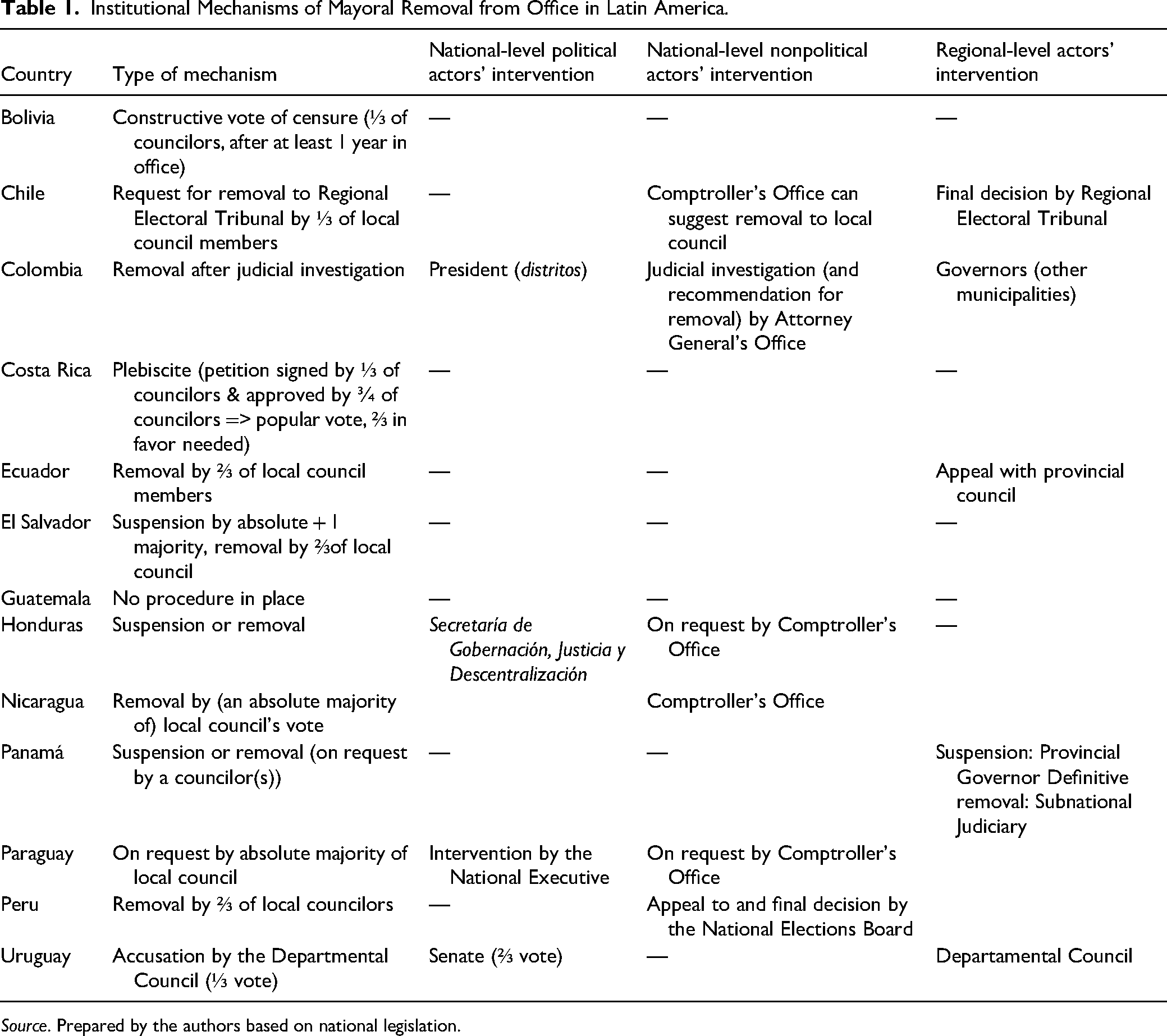
In line with this literature, we examine the position of local government in unitary countries and the possibility of higher-level (national) actors to interfere in local matters through institutional mechanisms functionally equivalent to federal (national) intervention. We note that in the majority of unitary countries in Latin America, these types of formal mechanisms directly linked to national executive (or legislative) power do not exist. Despite the fact that certain institutional mechanisms exist to remove mayors, these do not involve national level actors in their working; normally judicial or electoral authorities are the ones who can potentially intervene, sometimes at the instigation of local councils. Thus in formal, vertical terms these governments can enjoy unexpectedly significant degrees of autonomy.
Table 1 shows that only in four of the 13 unitary countries does there exist the possibility of some kind of intervention by national-level political actors, broadly equivalent to “federal intervention” in countries such as Argentina or India. In the Paraguayan case, which is broadly similar to federal cases, the municipal council votes to solicit intervention by the national executive branch, which must then be approved by the lower house of the Paraguayan Parliament. Only after Deputies’ favorable vote by an absolute majority can the national executive power appoint an “interventor.”
Institutional Mechanisms of Mayoral Removal from Office in Latin America.
Source. Prepared by the authors based on national legislation.
National political actors are also involved in the cases of Honduras, Colombia, and Uruguay. In Honduras, the Secretaría de Gobernación, Justicia y Descentralización, which functions like a ministry of the interior, may suspend or remove mayors. In Uruguay, the national Senate decides by a 2/3 vote the removal of a mayor based on the accusation of 1/3 of the members of the regional Junta Departamental of the Department in which the district is located. Finally, in the Colombian case, either the president (in the case of districts and municipalities with special status) or departmental governors (in the case of normal municipalities) can declare the removal of a mayor following a judicial investigation by the Procuraduría General de la Nación. 4
In all the other unitary cases, however, national executives are not involved in the removal of municipal mayors. In fact, no national political actor participates in existing legal/institutional procedures to remove mayors. In general terms, local councilor are responsible for initiating (and deciding) the process of the mayor's removal. The majority of votes required to do so varies from ⅓ of councilors (e.g., Chile, Bolivia), to a qualified majority of ⅔ (e.g., Peru, Ecuador), to an absolute majority (Nicaragua). Normally, these local decisions must be upheld by some judicial national or regional actor, to whom appeals can also be directed.
Thus, in a vast majority of cases the procedure must be initiated locally, by the municipal council which is usually controlled (or co-opted) by the mayor. This is particularly the case in countries where electoral systems benefit local executives with some kind of “automatic majority” (see below). As a consequence, opposition councilors willing to undergo an open confrontation with the mayors are in a relatively weak position, particularly where at least an absolute majority of the council members is needed to vote in order for the removal process to get started. As one national congressperson told us in Chile without hiding their frustration, “I have tried everything, but I could not [oust her],” referring to the mayor of Renca (Interview #1). As the flipside of this affirmation, many local councilors claimed that mayors are “autonomous” and there is not much that can done about their arbitrary exercise of power (Interviews #2, #3, #4).
In addition to formal limits on the national removal of mayors, the local autonomy of mayors in unitary countries is also conditioned by the relative (un)importance of municipalities in the multilevel political game and by the limited strength and presence of political parties in the territory. Municipalities are comparatively smaller, less populous and thus electorally less important than provinces/states in federal countries. In addition, municipalities do not constitute electoral districts for national legislative elections, as is normally the case of the intermediate level units. And local party leaders have less influence in intra-party politics, having less say in the decisions regarding party authorities, candidates, and overall strategies. Thus with the exception of mayors of capital and certain big/populous cities, mayors tend not to be perceived as a threat to national level politicians and thus the latter are less interested in local power dynamics, which paradoxically leave the mayors with considerable room to maneuver and control local matters.
In the absence of formal mechanisms of national intervention, party systems theoretically could, but in practice do not, serve as effective vertical checks on mayors. In many Latin American party systems, an important disconnection or incongruence exists between levels (Freidenberg and Suárez-Cao 2014). In this sense, party dynamics follow different logics at different levels of the system, and national political parties generally experience more difficulties establishing an organic presence uniformly across the national territory. At the same time, regional/local movements and independent candidates often play an important role in electoral contests below the national level. Territorial party structures are typically very personalistic, revolving around a dominant local leader, with an important use of clientelistic and patronage resources (Roberts 2012, 49; Muñoz and Dargent 2017, 190) and limited connection with the regional and national party elites. In addition, direct elections of mayors and the separate election of mayors from councilors foster their independence from political parties (Copus 2004; Fallend, Ignits and Swianiewicz 2006, 258; Resnick 2023). Consequently, they frequently escape partisan controls from co-partisans at higher levels of government. In many cases, parties’ local candidates are popular figures in the localities without tight links to political parties (Luna and Mardones 2017), only using the party label to run for public office (but not even to campaigning on it).
Where political parties are weaker as in Peru (Levitsky and Zavaleta 2019) and, increasingly becoming so as in Chile (Luna and Mardones 2017), mayors can either co-opt the local branch of the party and put themselves on an equal footing with the political party in the locality, or else create a parallel structure dependent on their person and thus overshadow the local party branch, hollowing it out of people and power (Interviews, #23, #26, #27, #28). In other contexts, where party structures are still strong, such as in Paraguay (Dosek and Duarte-Recalde 2023, 326), local party leaders might create local factions or identify with one of the national party sectors (Interviews #10, #40). Political parties thus exercise only lose control over “their” mayors or they tacitly support them despite abusive political practices. Nevertheless, they remain useful for the mobilization of votes for higher-level elections (Interview #1, #29). This lack of real control tends to reinforce in turn the “unchecked” power of mayors.
The Horizontal Dimension of Autonomy
Executive–legislative relations are notoriously understudied at the local level in Latin America. They are not only important for vertical dynamics and the possibility of the removal of mayors as we have seen above, but are also crucial for local governance per se. It is thus fundamental to explore their dynamics in order to understand the extent to which mayors can act in an (un)checked fashion.
The parameters for the interactions between mayors and local councils are laid down in municipal laws and other types of legislation. However, local politics is known for its informal character, high levels of personalization, and the lesser importance of political parties. Leveraging insights from the literature on national executive–legislative relations in Latin America (Cox and Morgenstern 2001; García Montero 2008; Saiegh 2010; Jones 2012), we explore both the formal and informal/contextual dimensions of local power dynamics and highlight particularities and differences vis-à-vis the national level. We suggest that many of the weaknesses that national legislative bodies suffer are all the more pronounced at the municipal level. Although there are some exceptions and differences across countries, local councils are often quite weak in their relations to the mayor.
Formally, the vast majority of Latin American municipal legislation stipulates that councilors are expected to oversee (fiscalizar) and control the mayor and approve the policies promoted by the mayor, particularly the municipal budget. 5 Beyond these two roles, councils also contribute to fostering popular participation and municipal planning, among many other more particular and country-specific responsibilities and attributes. 6 In one of the few analyses of local councils, Kersting et al. (2009, 101) note that local executive–legislative relations are characterized by an “unequal power” balance, whereby generally “the power of the legislatures vis-à-vis the executive is limited to that of either ratifying municipal legislation or not.”
In the remainder of this subsection, we focus on the local electoral system, structural weaknesses of local councilors, and societal constraints as three key factors that tip the balance of power in favor of local executives.
Electoral Advantages. First, we posit that there are certain electoral and political characteristics of local competition that foster the position of the mayor. Starting with electoral rules, two features of the electoral system tend to benefit mayors. Many countries allow the indefinite reelection of mayors, contrary to what is now common in the majority of presidential elections. By 2018 (Dosek 2019, 16–18), half of the countries in the region permitted consecutive election of mayors with no limit (although this has changed recently in Chile, Ecuador, and Costa Rica). The ability of mayors to seek reelection enhances their emergence as dominant figures in local politics. For example, in Chorrillos, Augusto Miyashiro governed for five consecutive periods between 1999 and 2018, and then launched successfully his son as his successor in the mayor's office, only because a legal reform prohibited immediate reelection for local offices in Peru. Following similar logics but in a different institutional context with only one consecutive reelection permitted, the Gómez Verlangieri clan in Limpio alternated four different members of the family in the mayoral office between 1991 and 2015.
Furthermore, in some countries such as Peru, El Salvador, and generally in Mexico, 7 the winning party/candidate for mayor automatically receives an absolute majority of seats on the local council, independently of the percentage of vote they obtained in the elections, thus greatly strengthening their position. This gives the mayor independence in promoting their own policies, while at the same time gaining major leeway to avoid any initiative of removal sponsored by the councilors. In countries with an “automatic majority” electoral system for the council, mayors face little opposition. Exercising partisan opposition is particularly complicated. As one interviewee complained in the Peruvian municipality of Los Olivos, “the mayor has his own majority—he doesn’t have to listen to us” (Interview #6). Similarly, where mayors and councilors run on the same ballot, it is typically the mayor who decides the composition of the lists and the position/rank of each candidate (Szwarcberg 2010). Both features of the electoral system (reelection and guaranteed majorities) strengthen the position of the local executive, differentiating them from the presidents. 8
In addition to formal features of the electoral system, local politics tends to be more personalistic and candidate-centered, and less programmatic than national-level politics (Luna and Mardones 2017; Interview #30). Public discussion at the municipal level centers less around ideological controversies and focuses more on programmatic (and visible) solutions to local problems/issues (Interview #29, #31). This dynamic favors the mayors, as they are the real decision-makers, de facto represent the state, and enjoy much greater visibility than councilors; in the most extreme cases, they can turn the municipalities into their “chacra (farm)” (Interview #5, #11) or become the virtual “owners” of the districts (Interview #16), as interviewees in two Peruvian municipalities and in Limpio, respectively, suggest. As we know from the national level literature (Jones 2012), lower degrees of ideological polarization, such as those observed in local politics, tend to favor executives as they make coalition-building and legislative alliance-formation more likely, and thus redound to the benefit of mayors.
Structural Weaknesses of Local Councilors. The second critical factor that favors mayors results from the weak position and limited administrative capacities of local councilors, who tend to be in a structurally weaker position than national legislators. This reality stems particularly from three aspects: (1) their limited functions and ability to provide administrative support, (2) their absence from the day-to-day working of the municipality and, more often than not, (3) their political dependence on the mayor. In consequence, constraints on their formal and de facto powers debilitate their capacity to control and oversee mayors’ (wrong)doings.
First, as we mentioned above, the powers of councilors are quite limited and often ambiguous. In some contexts, they cannot even reject the mayor's decisions, and in others the mayors have veto power to overcome the council's opposition (Kersting et al. 2009, 101). In addition to the limited nature of their formal powers, councilors often lack bureaucratic capacity relative to the mayor and as compared to national-level legislators. As Kersting et al. (2009, 100) point out with respect to financial decisions, with few exceptions councilors do not have “any technical support team to give [them] advice.” They typically have a very limited (if any) number of advisors and/or permanent staff. Normally, councilors are not even employees of the municipalities and work elsewhere, be it in other municipalities, in other parts of the state apparatus, or in the private sector. In some cases they are explicitly prohibited from working elsewhere in the municipality. The norm is that councilors do not receive a salary for their job as councilors, and work ad honorem (e.g., Uruguay or Guatemala) or receive dietas (per diem allowances) for attending council meetings. In cases where the position on the council is not ad honorem, mayors can sometimes unilaterally decide to stop paying councilors dietas or allowances (Interview #10) which are normally used to engage in political exchanges (“hacer política”) (Interview #4), as the testimonies from Chile and Paraguay suggest.
Second, notwithstanding this variation in terms of their salaried status, councilors are not present in the day-to-day operations of the municipality and only receive residents within certain delimited time slots each week. Normally they come to the municipality once a week to attend to residents’ concerns and attend council meetings, and may not even live in the district. Thus their capacity to follow what is going on in the district and in the municipality itself in particular is quite limited (Interview #9). As a consequence, they often face an important informational imbalance vis-à-vis the mayor. The possibility of requesting information might exist institutionally, but mayors may not respond to them or provide only very limited information and data, which further limits councilors’ oversight capacity (Interview #32). In extreme cases, mayors can block them from accessing information, as happened to some of the councilors in Renca (Interview #9). The right to request information varies contextually among countries and the effective response might also be conditioned upon political alignments. As one interviewee claimed, apart from attending council meetings, councilors in Los Olivos only “show up [in the streets] every four years” during the campaign period (Interview #6).
Third, these administrative constraints on councilors are compounded by the reality that, politically speaking, they tend to depend on the mayor. In order to deliver to their constituencies and interest groups, as well as to be seen at inaugurations, they need to be on good terms with the mayor. Councilors strive to appear in (the photos from) meetings and ceremonies, which allows them to become visible and renowned, to be in contact with voters and, in the longer term, to gain more adherents (Interview #33). In order to obtain favors and solve peoples’ problems, they require the support of the mayors. Mayoral support is critical for councilors to have local projects (e.g., sports playgrounds, taxi stops, electricity connections, street-lighting) approved and executed. As one party member in San Lorenzo noted, “if you are not part of the mayor's governing majority, the mayor can block all your projects and you are left with nothing to do” (Interview #12). This is particularly true for councilors who have few independent financial resources. As Ordóñez (2023) has shown recently for the Chilean case, councilors with their own financial resources constitute an exception to this general rule, as they can get things done without recurring to the mayor. In turn, these logics might condition the capacity and willingness of the councilors who depend on the mayors to control the latter. The weakness of political parties locally, the pervasiveness of personalistic political cultures, and the fact that councilors are often not professional politicians only exacerbate these patterns. This is particularly the case when the legislators are more responsive to (local) executives (Jones 2012) because they run on the same ticket, as is the case in El Salvador, Honduras, Peru, and Uruguay (Kouba and Dosek 2022).
Given these realities, councilors report that they find it useless to “oppose the [mayor] merely for the sake of opposition” (Interview #13). In the words of one councilor in La Cisterna, “it is simply not politically advantageous for me to take on this guy [the mayor] and confront him if only five people are going to see it…Because although the council is a public body, it is not of public interest, you see…What is it that interests people? Seeing you at a fair greeting them, seeing you at [the meeting of] a social organization, seeing you on a soccer field at the weekend, seeing you at mass, sharing with you, that's what interests people. People don’t care if you vote A, B or C in the council, so, politically speaking, you don’t win anything [by positioning yourself] in the council” (Interview #14). As a result, as another councilor in Los Olivos noted, “the [opposition] councilors are not really opposition; they fold [to the mayor] and end up negotiating with him” (Interview #15).
Societal Factors. The third set of factors that favor the mayor emerge from civil society and from the limited possibilities of local “societal accountability” in most Latin American municipalities (Smulovitz and Peruzzotti 2000). Contrary to the regional or provincial level, local media outlets are scarce at the municipal level. Although there might be some media in bigger cities, they tend to be quite dependent on municipalities via state subsidies and advertising revenue (Arellano-Yanguas 2019, 266). Consequently, their capacity to focus negative attention on the mayor's office is limited. In any case, the local media market is normally less diverse than it is at the national level. The attention of national mass media to local matters tends to be limited, and normally restricted to election periods or noteworthy scandals. National media attention also tends to decrease outside of the capital or other big cities.
It is common that, as interviewees in San Lorenzo and La Cisterna mentioned, municipalities themselves have established some type of municipal magazine/newspaper/bulletin and/or operate press departments (Interview #24) that cover the “achievements” of the local administration and the main events in the district (Interview #25). These publications and the production of reports depend on the municipality in terms of financing and staff and are thus not to be expected to be critical, rather the opposite. Alternative print media are rarely supported (if they existed). Local radio stations might exist, but if they are critical of the mayor, they might be exposed to control and pressures. Through administrative procedures at higher levels, their broadcasting may be threatened and/or directly revoked, as the testimonies from Limpio suggest (Interviews #16, #17). In the most extreme cases, local journalists might face harassment and persecution, as happened, for instance, in both Limpio and San Lorenzo (Interviews #17, #21).
Apart from media coverage, the existence of civil society organizations and watchdogs is generally restricted. If at the national level civil society is in many cases weak or disorganized with limited say in public matters, locally the existence of these organizations is even more constricted. Many are prone to be co-opted or can be easily intimidated. According to testimonies from Los Olivos and La Cisterna, social organizations such as neighborhood councils and functional organizations such as housing committees, improvements committees, citizens security committee (even sport clubs, mothers’ centers, or soup kitchens) are normally controlled by leaders aligned with the mayor (and a strong pro-incumbent logics exist among them) (Interviews #18, #19). If not, they can face arbitrary decisions and punishment in terms of their access to the municipality, have their resources cut, have their legal recognition be revoked, and/or be threatened with the creation of parallel organizational structures by the mayor's team, as interviewees both in Renca and Los Olivos acknowledge (Interviews #15, #20). Again, in the most extreme cases, and even in a context such as the Chilean, social leaders might be monitored, followed, identified, filmed and otherwise harassed (Interviews #22, #23). Consequently, the actors and mechanisms of “societal accountability” are quite limited (Smulovitz and Peruzzotti 2000).
Other Factors that Might Shape Mayoral Dominance
The factors related to the vertical and horizontal autonomy of local executives that we emphasize here are not the only ones that influence the “unchecked” position of local mayors in Latin American unitary countries. There might be other factors that could constrain mayors’ room to maneuver within the local landscape such as powerful business interests (Faguet 2006), criminal organizations (Clavel 2017; Rodríguez Parrado 2023), or even international factors such as cities’ branding and promotion strategies (Pasotti 2010; Stren and Friendly 2019). However, with respect to the first two factors, at least with the evidence we have for our six cases, mayors seem to rather condition the business activities in their districts and might even collude with local criminal actors. Similar to the subnational dynamics in Argentina described by Behrend (2011), local executives can control or condition access to local business opportunities (such as public biddings, construction projects, and the extension of new business permits) (Interviews #21, #36, #37, #38, #39). Regarding criminal organizations, mayors oftentimes collude with them and create a mutually beneficial scheme of criminal governance (Briceño 2018) or might even in some cases use them to strengthen their position and threaten local opposition or other actors in the district (Interviews #15, #36). 9 These dynamics thus can bolster or uphold mayors’ autonomy and power rather than subvert it. 10 Lastly, possible limitations in terms of international reputation are less likely given that at least in Chile and Peru we study local sub-metropolitan municipalities (and not big cities) that have less (international) visibility and concerns about their international image, but even in the case of the Paraguayan municipalities we have not found any evidence during the fieldwork that would point to any limitations on mayors’ autonomy in this sense.
Finally, the possible intervention of political parties will not necessarily have a democratizing effect vis-à-vis local caudillos, as the theoretical literature argues (Schattschneider 1960; Borges 2016). As Giraudy (2015, 20) showed for subnational nondemocratic regimes in federal countries, presidents might actually support autocratic governors if it is in their political interests to do so. In a similar way, in the cases analyzed here, national-level political party leaders do not always mind caudillo rule in metropolitan municipalities, given that they might provide valuable mobilizing structures and resources (Interviews #1, #10, and #35). In other words, national politicians do not necessarily seek to promote local democracy and, depending on the context, they can be either indifferent to or tacitly supportive of local abuses of power, and thus fail to constitute a meaningful constraint on mayors’ autonomy.
Scope Conditions
Our examination of the vertical and horizontal dimensions of mayoral autonomy yields the description above of what we see as a common dynamic in Latin America's unitary countries. However, despite taking advantage of the “most-different” context in our three national cases, we do not argue that these patterns apply uniformly and/or automatically in all countries of the region (including especially federal countries), or even across all the municipalities within a single country. Thus, we suggest that our argument might in fact have important scope conditions with respect to size, fiscal transfers, and unitarism, which we examine below and which should be subject to further scrutiny in future research.
First, although national legislation considers all local governments uniformly as equal (Kersting et al. 2009; Nickson 2018, 135), some studies have suggested that factors like the size of the districts or geographical scale (both often correlated) can introduce variation in the functioning of executive–legislative relations. Kersting et al. (2009, 100–104) argue that particularly in smaller municipalities, “management tends to be highly personalized in the figure of the mayor.” Likewise, local administration tends to be more politicized, local management more prone to corruption when financial transfers are suddenly increased, and council members more frequently lacking in the independent technical support they would need in order to make sound decisions. In Brazil, Mendes da Rocha (2021) argues that the size of the municipality is an important factor for the relative position of the mayor. According to this author, “governismo” is generally more present in smaller districts, where the actions of the mayor are less frequently subject to oversight by the council (Mendes da Rocha 2021), notwithstanding the common perception of all Brazilian municipal governments as “governistas” (e.g., dominated by mayors). 11
In this context, much larger metropolitan municipalities could be considered as a “least likely” (Levy 2008) stage for the emergence of unchecked mayors, and for a number of reasons including the closer proximity of national political power, the more pervasive media coverage, the stronger presence of political parties, and the greater degree of societal accountability. Thus if we find extensive evidence of mayoral predominance in these least likely cases, it is all the more probable that these types of dynamics exist in distant, rural areas, where the reach of the state is more limited, where media attention is lower, and where national politics are more distant. In fact, the extant literature suggests that nondemocratic subnational regimes and caudillo rule is more frequently to be found in precisely these kinds of municipalities (Benton 2012, 261–262; McMann et al. 2021, 20; Pérez Sandoval 2022).
Second, our analysis does not take into account directly levels of fiscal decentralization. Naturally, the levels of fiscal resources vary across countries and across municipalities. Higher-level governments can sometimes condition and/or delay the timing of fiscal transfers on local governments’ political alignment with national executives, and thus undermine the position of local mayors (Eaton 2012, 34). However, local politics is cheaper than national politics, and it is in fact easier to control these “small local worlds” than national politics and national public opinion. Often mayors do not need a large amount of resources to be able to politically control their municipalities, unlike the provision of high quality local services, which does indeed require resources as well as inter-institutional coordination. In any case, in the six cases we studied, the interviewees did not mention that scarce resources were a problem that prevented local caudillos from being able to control their districts.
Third, our analysis sheds little light on the relative position of mayors in federal countries, and we acknowledge that their position might in fact be weaker vis-à-vis their counterparts in unitary countries. In Argentina, for example, provincial governors do in fact have the power of intervention (and possible destitution) of local executives, which should condition the vertical dimension of local governments’ autonomy at least vis-à-vis the provincial level of government. Much, however, depends on variation in the treatment of municipal governments across federal systems. Relative to Argentina, mayors experience far greater autonomy in Brazil, where municipal governments enjoy constitutional recognition as a proper level of government with autonomy, and in Mexico, where “municipalities, not states, are considered the ‘basic unit’ of the federation” (Gibson 2013, 122).
Conclusions
One of the ironies of decentralization in Latin America is that, even as it transformed national politics by limiting the power of central governments, it largely replicated centralist patterns of governance within the local sphere—now in the form of mayors who have been able to dominate the municipal landscape too easily. The kinds of checks on unilateral and arbitrary executive power that are the hallmark of representative democracy are either absent or weak at the municipal level across much of Latin America. According to the argument developed in this paper, simply too much power is concentrated in the office of the mayor relative to other local actors (governmental and nongovernmental)—a common dynamic that undermines the pursuit of more robust forms of democracy. While the “strong mayor/weak council” model (Kersting et al. 2009, 99) that pervades Latin America may indeed produce outstanding mayors, it can at the same time produce local caudillos and, in the small jurisdictions that make up the bulk of Latin America's municipalities, the latter is more likely than the former. Caudillos are indeed more likely where informal political practices are the norm, where local administrative apparatuses are weak and/or politicized, where political parties are fragile with limited territorial reach, and where local councilors operate as unpaid amateurs. Bolstered by these many advantages, mayors may not need sophisticated urban (party) machines to perpetuate themselves in power.
We have shown that mayors in unitary countries in Latin America (which far outnumber federal cases) enjoy important doses of autonomy both in vertical (inter-level) and horizontal (inter-branch) terms. Vertically, mayors are less liable to being removed from office by political actors at higher levels of government than is the case with governors in federal systems. Horizontally, they can often overawe the main institutional actor that is meant to serve as a check on their behavior: the local council and the representatives who are elected to sit on these bodies and to share governing authority with the mayor. So long as liberal, representative democracy remains the dominant model of democracy in the region (which is the case despite the proliferation of reforms designed to enhance more participatory forms of democracy across Latin America), the ability of mayors to operate without effective checks should appropriately be considered as a major problem of democracy in the region.
This situation is problematic for Latin American democracies not only because local governments are important per se given that they are the first (and maybe the only) point of citizens’ contact with the state, but also because mayors are now in charge of some of the most important services that the state can provide, including health care and education. Beyond the policies under direct municipal control, mayors also play a critical role in the implementation of other significant national policies (Fenwick 2015; Niedzwiecki 2018). More generally, how well subnational governments work and how much trust citizens place in these governments are important determinants of democratic legitimacy more generally, and of the perceived efficacy of democracy (Weitz-Shapiro 2008; Fidalgo 2022).
Our findings echo results from investigations of subnational executive–legislative relations in other regions of the world. In Africa, where countries vary in the use of appointments, indirect elections, and direct elections to select municipal authorities, the change in several countries from a “strong council system” to a “strong mayor system” (and directly elected local executives) has strengthened mayors’ autonomy both vertically and horizontally (Resnick 2023). Southeast Asia is characterized by significant variation in the concentration of power in the hands of local strongmen. While this is traditionally more pronounced in the Philippines and Thailand, recent reforms have also empowered mayors and district heads in Indonesia, although local elections remain quite competitive in the latter country (Sidel 2005; Buehler et al. 2021). In India, a new study reports that limited procedural knowledge on the part of ward councilors severely limits their ability to serve as effective representatives (Auerbach et al. forthcoming). Finally, Ledyaev and Chirikova (2017) document similar logics of mayoral dominance vis-à-vis councilors in Russia. Thus, the predominant position of mayors might not be particular to the Latin American presidential system but rather should be seen as a more general phenomenon. This points toward the need for more cross-country and even cross-regional comparative research (Lankina 2012; Zhang 2020; Le Galès and Robinson 2023) and for more concerted dialog between urban studies and comparative politics (Post 2018; Marques 2021). Future research should focus on uncovering the (local and/or national) strategies that have successfully led to the downfall of local caudillos in places where they had been able to entrench their power, and the emergence of more democratically minded mayors. 12
Following the logic of the two dimensions of autonomy emphasized in this paper, we close by proposing some possible measures, contingent upon local contexts, that might limit the power of mayors or at least encourage their oversight. Vertically, national-level auditing institutions should be strengthened in their authority and capacity to expose local abuses. More normatively, for democracy to flourish, parties need to recuperate their democratic vocation with respect to their local branches, even as recent studies suggest that the opposite is happening in many Latin American countries (Dosek and Alva Mendoza 2023). Horizontally, we offer one suggestion for each of the three key factors identified above. First, while illimited reelection has already been restricted in several countries in the region, “automatic majorities” on local councils should be eliminated if they are ever going to serve as checks on mayors. Second, councilors could participate more fully in the day-to-day administration of municipalities if their jobs were full-time and compensated with salaries that are independent of the will of the mayor. Third, local civil society should be strengthened, incentivized, and supported, including if necessary by national (governmental and nongovernmental) actors. National media should devote more attention to local politics and the day-to-day running of local administrations, unless and until local media outlets can perform this function. In this context, social media also have an important role to play in denouncing any (alleged) wrongdoings, even as action on such denunciations will likely depend on local party opposition.
Footnotes
Declaration of Conflicting Interests
The authors declared no potential conflicts of interest with respect to the research, authorship, and/or publication of this article.
Funding
The authors received no financial support for the research, authorship, and/or publication of this article.
