



Abstract
Case studies have illuminated that U.S. real estate agents, as key housing market gatekeepers, continue to maintain racial residential stratification well into the twenty-first century. We use novel survey data gathered from real estate agents across the United States to descriptively explore agents’ ideas about clients of color in the housing market, as well as their practices, such as conducting business through social networks. Our findings provide evidence of the subtle and more overt ways that these ideas and practices that, when taken together, constitute what we call racialized real estate agency and contribute to ongoing racial segregation. We issue a call for future research to continue examining the ways agents’ and other gatekeepers’ ideas and practices contribute to or mitigate stratifying processes and describe the utility of such research for policy.
Background
Since real estate agency emerged as a legitimate profession in the early twentieth century (Hornstein 2005), real estate agents have become key gatekeepers in the U.S. housing market (Besbris 2016, 2020; Besbris and Korver-Glenn 2022; Korver-Glenn 2018a, 2021; Shi and Tapia 2016). They shape how housing consumers perceive individual homes and neighborhoods (Benites-Gambirazio 2020; Besbris 2020; Besbris and Korver-Glenn 2022; Korver-Glenn 2021); which homes consumers view when seeking to buy or rent (Ross and Turner 2005); consumers’ connections to, or exclusion from, other housing market resources, such as mortgage bankers and mortgage loans (Korver-Glenn 2021); and how homes are advertised (Perkins, Thorns and Newton 2008).
In recognition of this important gatekeeper role, the real estate industry has implemented strategies to educate new agents about the existence and impact of racial discrimination in the housing market and the responsibilities of agents to uphold fair housing practices. Agents are required to complete fair housing training and pass exam(s) containing information about fair housing law, its importance, and the consequences of violating it, as part of their credentialing and licensing processes. For example, the Texas Real Estate Commission's “Principles of Real Estate” includes courses that include “at least three classroom hours of instruction on federal, state, and local laws relating to housing discrimination, housing credit discrimination, and community reinvestment” (Texas Real Estate Commission 2022).
Recent research indicates that, despite this training, real estate agents in some markets carry out their gatekeeping work in ways that draw upon and reify racial status hierarchies and material inequalities. For example, Korver-Glenn (2021) found that real estate agents (and other real estate professionals) in Houston continue to explicitly evaluate people and neighborhoods through the lens of racist stereotypes (see also Choi et al. 2019; Korver-Glenn 2018b). Thus, while real estate agents are ostensibly made aware of racial discrimination in the housing market and the penalties for perpetuating it (at times they are even actually penalized (e.g., McDermott 2021)), they may continue to use racial ideologies and engage in racially stratifying practices that directly or indirectly rely on these ideologies as a routine part of their work. The reliance on these ideologies is likely reflected in a wide range of practices, from subtle differences in interpersonal interactions and the provision of information about housing options to more extreme examples of racial steering whereby agents direct homebuyers towards or away from certain neighborhoods based on their race. Because the housing exchange process entails many successive interactions and transactions, agents’ use of these ideologies and practices can have a cumulative dimension, accruing advantages for White consumers and disadvantages for consumers of color as the process unfolds (Korver-Glenn 2018b; Krysan and Crowder 2017). Similarly, other gatekeepers, such as mortgage bankers and appraisers, can likewise draw from racial ideologies and use racially stratifying practices in ways that accumulate inequality across the housing exchange process (Besbris and Korver-Glenn 2022; Howell and Korver-Glenn 2022; Korver-Glenn 2021).
While these ideologies and practices likely shape patterns of neighborhood sorting and residential segregation (Massey and Denton 1993; Krysan and Crowder 2017), evidence of attitudes and practices of real estate agents is still underdeveloped. We have rich information about dynamics in single housing markets, but the absence of data that spans multiple markets leaves open important questions about the broader patterns of beliefs and practices of real estate agents. To develop a more complete understanding of the processes maintaining residential stratification, we use novel survey data to explore the racialized real estate agency among twenty-first century real estate agents. These survey data, which were gathered from a sample of real estate agents operating in dozens of markets across the United States, allow us to examine agents’ ideas about race and the real estate industry, and their practices within the industry, including practices such as conducting business through social networks.
While these data do not provide a comprehensive account of the role of real estate practices in reproducing racial segregation, they do provide important clues about some of the subtle, but heretofore largely opaque, practices that may perpetuate stratification and the attitudes that inform these stratifying behaviors. In particular, these data allow us to assess the extent to which real estate agents across the country perceive bias against customers of color in the housing market and how they explain racial inequities. This investigation provides important clues about the adherence to hegemonic colorblind racism (Bonilla-Silva 2006), or racism that draws on ostensibly non-racial justifications for racial inequality, such as meritocracy, and the persistence or resurgence of “old-fashioned” racism, characterized by overt racial prejudice and animus, the use of stereotypical racial epithets, and/or blatant forms of discriminatory treatment (Bonilla-Silva 2019), by real estate agents.
The data also allow us to assess some of the potentially stratifying practices employed by real estate agents. Recent research suggests that residential stratification is reproduced subtly through stratifying (if not explicitly racist) practices (Korver-Glenn 2021; Krysan 2008; Krysan and Crowder 2017). One example of agents’ racially stratifying practices is doing business through social networks that are racially segregated (Korver-Glenn 2018a; Krysan 2008). Same-race — particularly White — agent-consumer networks likely hide from public view at least some overt forms of discrimination and support the conditions under which colorblind and “old-fashioned” racist ideas can flourish. For instance, same-race agent-consumer networks could support the conditions under which agents (or consumers) can claim that they do not “see race” or are “not racist” and that race “doesn’t matter.” For Whites, this may be in part because their racially homophilous world shields them from interacting with people from other racialized groups who have experienced racial discrimination. 1 Moreover, same-race agent-consumer networks may combine with other racially stratifying practices such as pocket listings. Pocket listings are for-sale home listings that real estate agents market to their social networks prior to or instead of listing them publicly (e.g., on the local multiple listing service (MLS)). Whether agents eventually or never list the homes for sale publicly, the people in agents’ social networks have the first opportunity to know about and try to purchase pocket listing homes. In combination with racially segregated networks, this practice would support racially unequal flows of consumers into and out of neighborhoods—even if colorblind or “old-fashioned” racist ideas were absent (a conclusion that existing research does not support; see Korver-Glenn 2018a).
In the following sections, we provide an overview of our data and present statistics related to agents’ perceptions of, and assumptions about, consumers of color and residential segregation, as well as whether and the extent to which they engage in potentially stratifying practices such as pocket listings. We conclude by briefly discussing the implications of our findings for future research and for the development of more comprehensive conceptual models to explain the role of real estate agents in the perpetuation of residential stratification.
Data and Methods
We use data from a survey that was commissioned by Redfin in March 2019. Lucid, a research firm contracted by Redfin, invited real estate agents to participate in an online survey, using agent email addresses posted in the local MLS as well as real estate agents listed in Lucid's larger database to construct their sampling frame. Real estate agents did not know that Redfin had commissioned the study. Each respondent received a gift card or charitable donation of $50 for completing the survey. In total, 501 real estate agents completed the survey. The final sample includes both independent agents and those working in brokerage firms (not just Redfin) who had at least one sale in the prior year. The sample includes agents working in fifty-three different markets with no single market containing more than 6% of agents in the sample. Redfin shared the deidentified data with the research team at no cost. Redfin was not involved in the analysis in any way, and the findings presented here do not represent Redfin. After removing respondents who did not answer key questions, our effective sample includes 358 agents.
We conduct descriptive analysis to understand the role of agents and their homophilous networks in the perpetuation of racial residential segregation. Specifically, we examine the extent to which agents work with customers from their own racial group, agents’ use of pocket listings for these clients, and their attitudes about minority customers. Based on the argument that residential segregation establishes social dynamics that reinforce stratifying housing processes (Krysan and Crowder 2017), we also examine how these practices vary by level of residential segregation in the market in which agents operate.
To determine the extent of racially homophilous agent-client networks in our data, we use the following survey question that asks about the racial composition of agents’ clientele: “Thinking about your last ten clients, indicate how many were: (1) American Indian or Native Alaskan; (2) Asian; (3) Black or African; (4) Hispanic or Latinx; (5) Native Hawaiian or Pacific Islander; (6) White; (7) Two or more races; or (8) Prefer not to say.” 2 To assess the racial composition of the agent-client networks, we estimate an ordinary least squares regression, predicting the number of clients that are of a given race/ethnicity as a function of the self-reported race of the agent. We also control for basic demographic and professional characteristics of agents, including the gender, age, and marital status of the agent, their reported class-origins (whether grew up in an affluent, middle-class, or poor family), whether they work as an agent full- or part-time, the length of time as an agent, and the number of sales by the agent in the preceding year.
To assess one way in which homophilous clientele networks could be translated to racially disparate residential opportunities, we investigate the extent to which agents use pocket listings to provide their clients with exclusive access to housing opportunities. In the survey, respondents were asked: “Thinking back on your time in real estate, of the total listings you’ve encountered as a listing agent or buyer's agent, what percentage have been pocket listings?” Respondents were then shown seven options: None, under 10%, 11–20%, 21–30%, 31–40%, 41–50%, and more than 50%.
To assess agents’ conceptions of residential stratification, we focus on agents’ attitudes about the experiences of consumers of color in the real estate industry. Respondents were asked: “To what extent do you agree or disagree with the following statements about minority customers in the real estate industry: (1) minority customers are by and large treated fairly; (2) the only significant difference in service is due to the customer's wealth, not race; (3) bias is pervasive, many agents unconsciously presume minority customers are less desirable.”
We explore how these outcomes vary by the racial composition of the clientele and the level of residential segregation in the market area in which the agents worked. The racial composition of the clientele are dichotomized into majority White clientele (i.e., agents who indicated that more than five of their last ten clients were White) and not majority White clientele (i.e., agents who indicated that the majority of their last ten clients were Black, Asian, Latinx, Other, or prefer not to say, or agents where there was no clear majority).
In addition to understanding how these outcomes vary by the racial composition of the clientele, we also examine how they differ by the level of residential segregation in the market area that the agents worked. To do so, we use the following survey question “In what market did you work for most of 2018?” Respondents were shown market-area names, such as Atlanta area, Austin area, Chicago area, etc., or “Other” to select from. We then assign census-defined Core-Based Statistical Area (CBSA) codes to each of the fifty-three market areas reported by agents (except for the undefined “Other” response) and calculate the level of residential segregation in the market using tract-level data from the 2015–2019 American Community Survey. We measure segregation using the multigroup Entropy index, also known as Theil's H, calculated based on the relative concentration of five racial/ethnic groups—non-Latinx White, non-Latinx Black, Latinx, non-Latinx Asian, and other (see Massey and Denton 1988; Iceland 2004; and Reardon and Firebaugh 2002 for a detailed explanation of the Entropy index). 3 For our analysis, we create a simple dichotomous variable indicating whether each real estate agent responding to the survey works in a CBSA with a high versus low level of segregation. The CBSA is considered highly-segregated if it has an Entropy score at or above the 75th percentile of Entropy scores for all CBSA's in the United States. With this approach, twenty-eight of the fifty-three markets represented in our sample are characterized as highly segregated.
Results
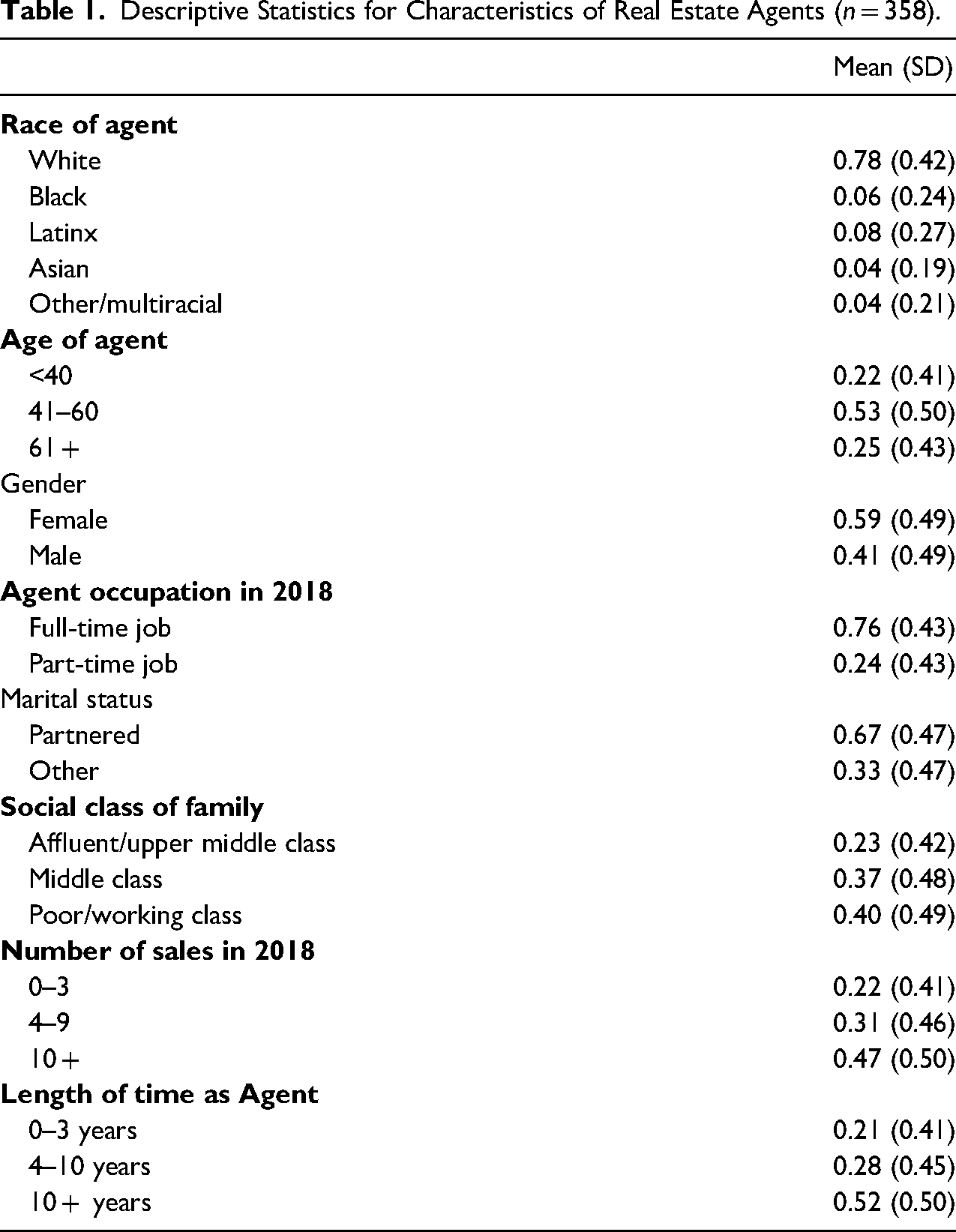
We first describe the demographic characteristics of the agents in our sample based on the descriptive statistics provided in Table 1. The majority of agents (78%) in our sample self-report as White, while 6% as Black, 8% as Latinx, 4% as Asian, and 4% as Other/Multiracial. The distribution of real estate agents in our sample by race are comparable to national labor force statistics from the Current Population Survey. 4 More than half of the agents in our sample are forty-one to sixty years old, female, are married/have a partner, and grew up in a middle class or poor/working class family. For most agents in our sample (76%), being a real estate agent was a full-time occupation in 2018, the year before the survey was conducted. Our sample also contains more seasoned agents (more than half have been an agent for more than ten years) and a strong concentration of high-volume agents (47% of the agents closed more than ten sales in 2018).
Descriptive Statistics for Characteristics of Real Estate Agents (n = 358).
We now turn to the descriptive analysis in order to understand the racial composition of agent-client networks and their role in the perpetuation of racial residential segregation. Our data provide evidence of considerable racial homophily in agent-consumer networks. Figure 1 presents the adjusted racial composition of clientele by self-reported racial identity of agents, after accounting for the agent's demographic and employment characteristics. Figure 1 shows that agents are generally more likely to have clients of their own race than any other race/ethnicity. Among their ten most recent clients, White agents are likely to have five to six White clients, on average, and less than two clients of each of the other races/ethnicities. Similarly, Black, Latinx, and Asian agents, on average, have three to five clients of their own respective races and around two or fewer clients of each of the other races/ethnicities. Agents who identify as an “other” race or multiracial, however, are more likely to indicate that they prefer not to say the race of the majority of their clients.
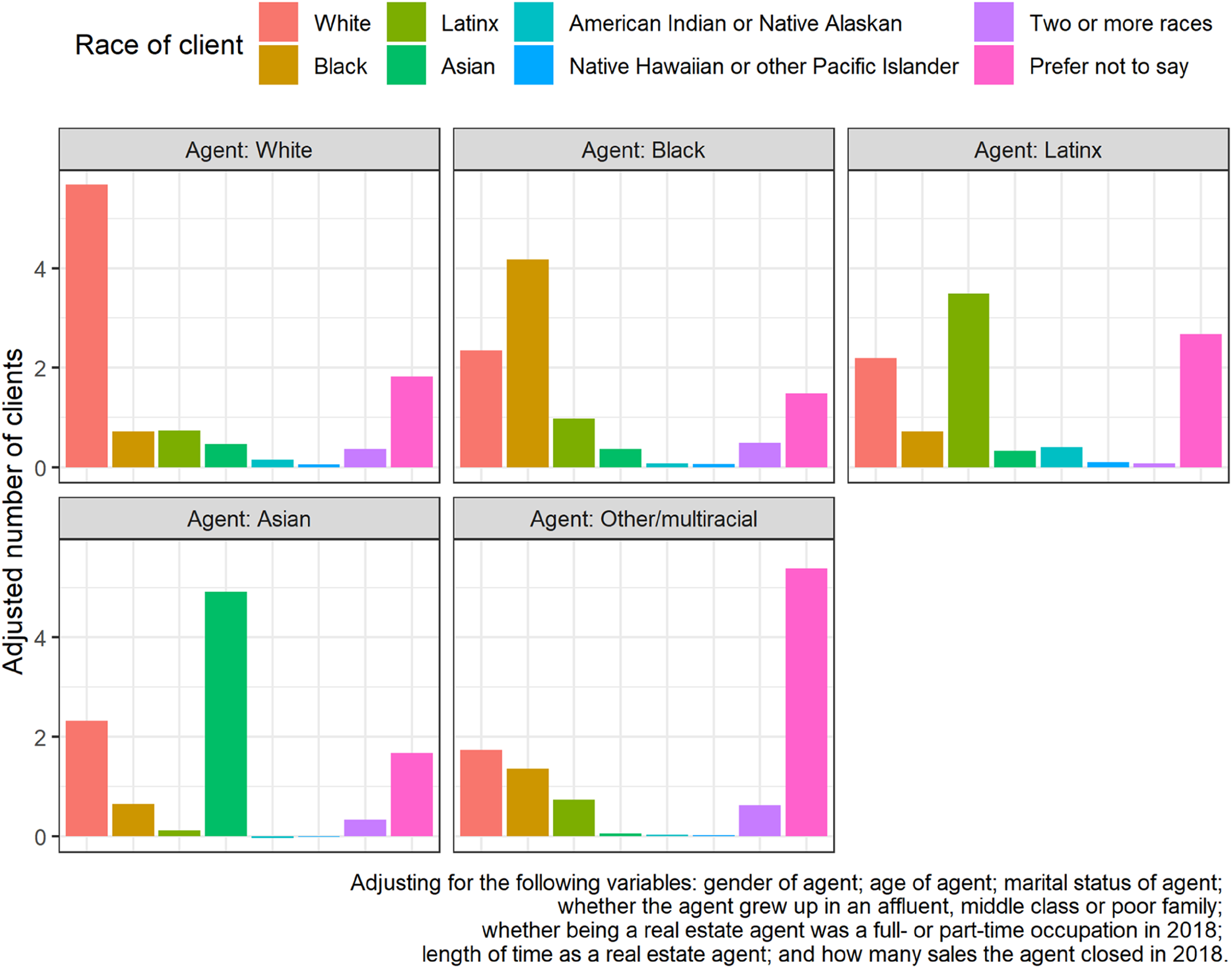
Adjusted racial composition of clients by race of agent.
In past research, Krysan (2008) found that homeseekers in Detroit tend to work with agents from their own racial group. Our findings suggest that this racial homophily is reflected in the other side of the agent-client diad and extends well beyond the dynamics in a single, highly-segregated metropolitan area. The homophily of these agent-consumer relationships is likely a reflection of the operation of racially circumscribed networks: they are more likely to develop through social networks, including referrals and repeat customers, rather than other avenues, such as open houses or online portals. In fact, the majority of agents in our sample report that at least one of their recent sales (last ten closed sales by the time of the survey) were to clients who came to them through referrals (83%) and were repeat customers (71%). In contrast, a minority of agents indicate that at least one of their recent sales came through advertising (30%), open houses (32%), online portals (30%), and other means available to potential customers outside of referrals and repeat customers.
One way to exemplify the potentially insidious effects of agents’ racially segregated networks is by exploring how such homophily may be conducive to the hoarding of resources, especially through the use of pocket listings. Figure 2 illustrates the percentage of agents using pocket listings of the total listings they have encountered. We find that the majority of agents use pocket listings; only four in ten agents reported never using pocket listings during their time as a real estate agent. Although a larger share report only using pocket listings for a minority (under 10%) of their total listings, the overall prevailing use of pocket listings in the real estate market can result in the maintenance of segregation through racialized opportunity hoarding. Pocket listings allow real estate agents to market the home for sale through their social networks prior to or instead of listing it for sale on the local MLS, thereby ensuring that their racially homogenous networks have exclusive access to for-sale homes.
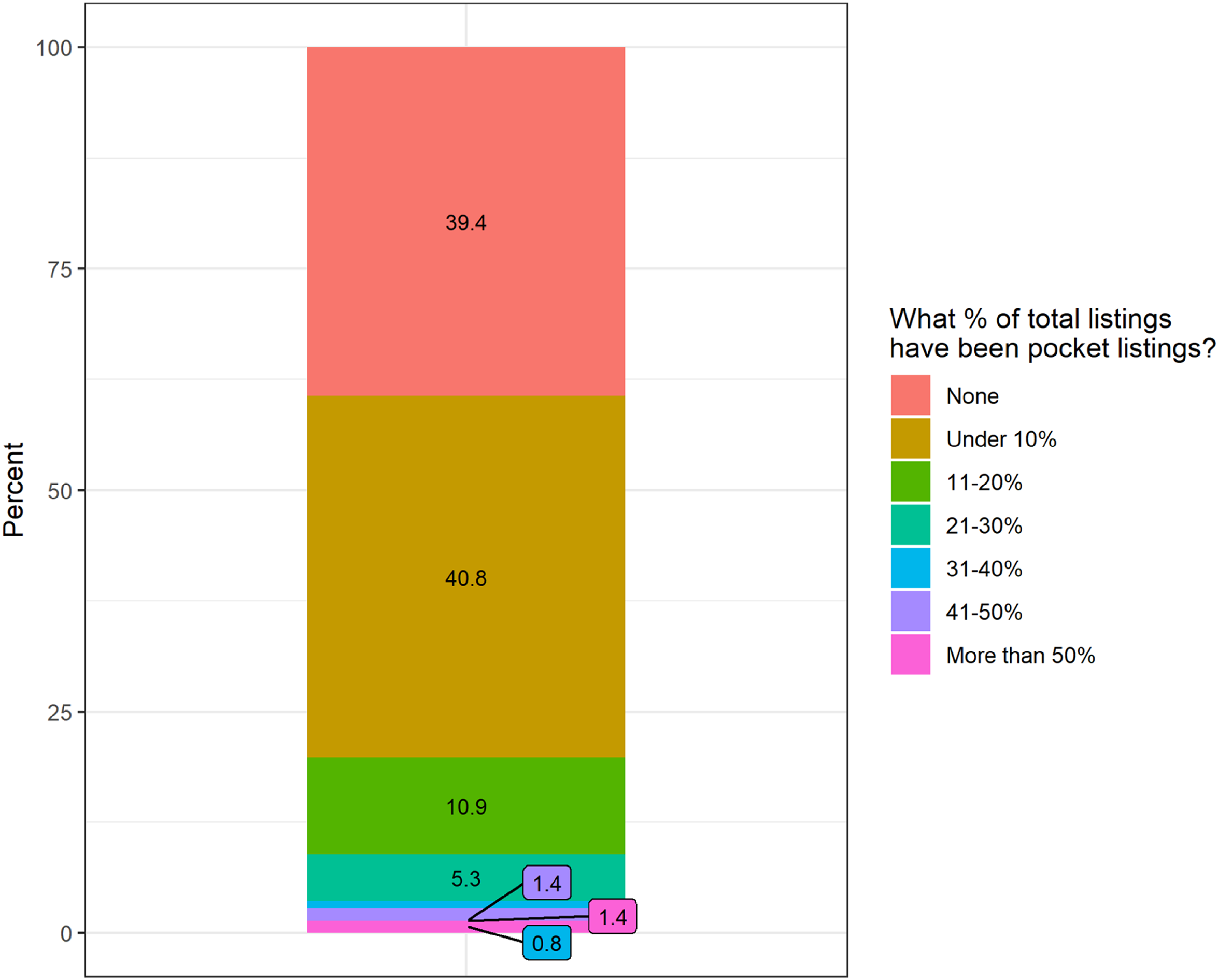
Percentage of agents using pocket listings.
Our analyses also suggest that homophilous networks likely allow for the persistence of colorblind or “old-fashioned” racist ideas, including assumptions about the role of race in shaping residential opportunities and attitudes toward consumers of color. In general, the agents in our sample perceive little racial bias in the real estate practices. As shown in Figure 3, almost two-thirds (63.4%) of agents agree or strongly agree with the notion that “minority customers are by and large treated fairly” in the real estate market. Just 22.6% agree or strongly agree that bias against clients of color is pervasive. And reflecting adherence to the belief in colorblind dynamics, fewer than one in four (24.6%) agents disagree or strongly disagree with the argument that racialized differences in services received by real estate customers are due to “customer's wealth, not race.”
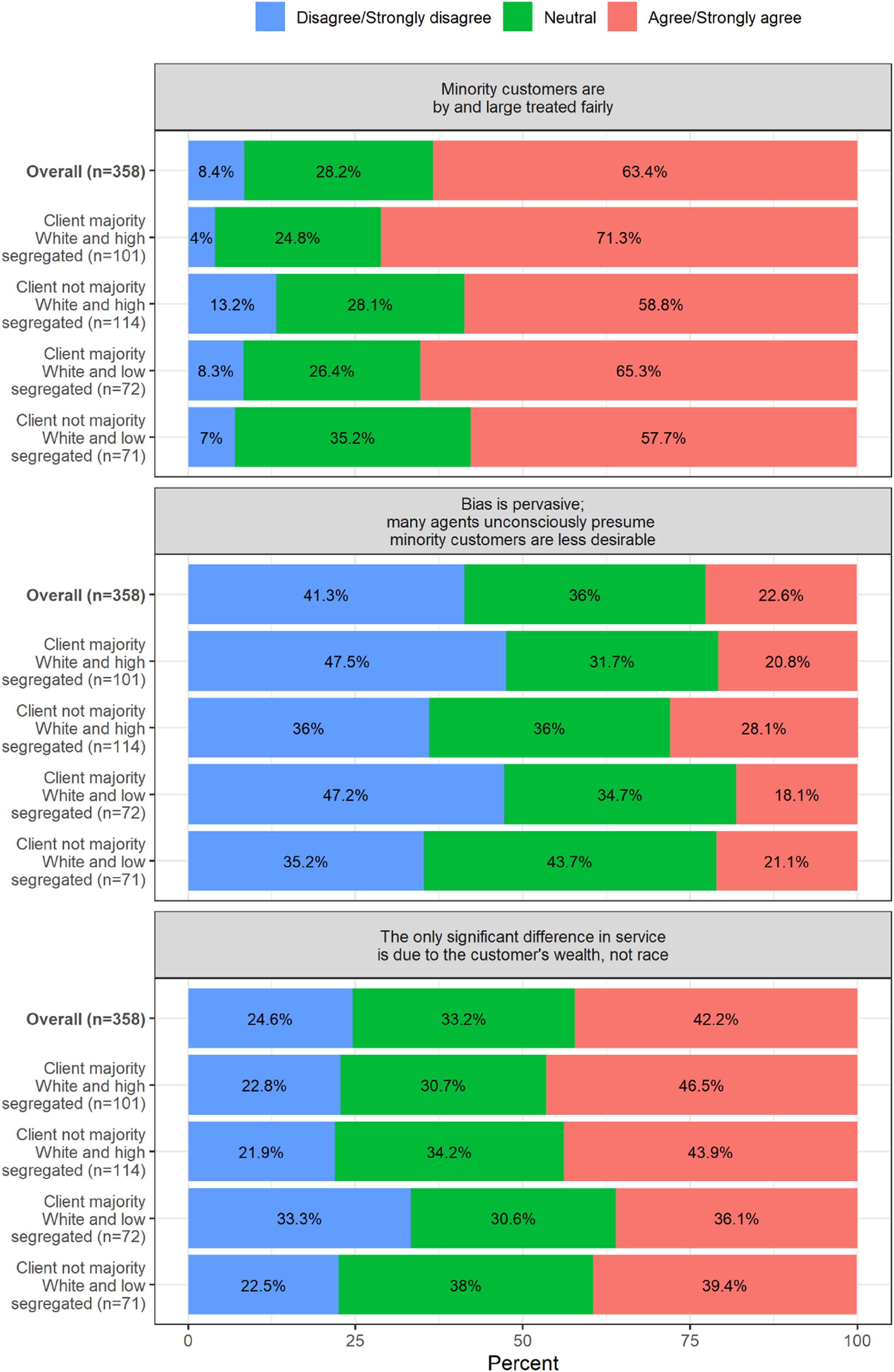
Agreement with statements about minority customers for all agents overall and by the racial composition of clientele and the residential segregation level of the housing market.
However, these attitudes vary by agents’ exposure to bias in real estate processes by virtue of working with clients of color, especially in highly stratified markets. Among agents working with mostly White clients, around 70% agree or strongly agree that “minority” clients are treated fairly (71.3% of those working with White clients in highly-segregated markets, and 65.3% of those working with White clients in lower-segregation markets). In contrast, among agents working primarily with non-White customers, the percentage agreeing or strongly agreeing with the idea that customers of color are treated fairly is about ten percentage points lower (58.8% of those working with non-White clients in highly-segregated markets, and 57.7% of those working with non-White clients in lower-segregation markets). Even more telling is the fact that the percentage disagreeing or strongly disagreeing with the idea that customers of color are treated fairly is about twice as high among agents working with customers of color in highly segregated markets (13.2%) than among other agents. In fact, only 4% of agents working with a majority White clientele in highly segregated market areas disagree or strongly disagree with this claim. In other words, those with the least amount of exposure to consumers of color and, given the composition of their clientele and high level of market segregation, the least activity in neighborhoods occupied by non-White populations, are most likely to believe that “minority” customers face little racial discrimination in the real estate market.
Similarly, agents with a majority White clientele are more likely than those with a majority non-White clientele to believe that bias against “minority” customers is not pervasive in the housing market. Whereas about half (47.5% and 47.2%) of agents working primarily with White clients disagree or strongly disagree with the idea that bias against customers of color in the real estate market is pervasive, only about one-third of agents working primarily with non-White customers disagree or strongly disagree with the claim of pervasive bias.
Moreover, about half (46.5%) of all agents working with a majority White clientele in highly segregated market areas agree or strongly agree that economic factors are more important than race in shaping the treatment of consumers of color in the real estate market. Only 22.8% of these agents disagree or strongly disagree with this economic explanation for racialized differences in service in the real estate market. These figures stand in contrast to 36.1% of agents working with a majority White clientele in lower segregation markets who agree/strongly agree with this statement, and 33.3% of agents who disagree/strongly disagree. This comparison suggests that agents with the least amount of both engagement with consumers of color and activity in neighborhoods occupied by non-White populations are more likely to cling to colorblind notions of racial residential stratification. Nevertheless, there is little difference between agents working with predominantly clients of color and those working with majority White clientele in highly segregated market areas.
Overall, these findings suggest that agents working with more consumers of color, and especially those in highly segregated markets where discrimination is likely to be most common, are least likely to cling to ideas of equity in the housing market. Thus, we argue that homophilous agent-client networks, especially relationships involving a White agent and a White client, may conceal from public view overt forms of racial prejudice, providing conditions for “old-fashioned” racism to continue. Moreover, these racially homophilous networks and relative protection from examples of overt discriminatory treatment by clients may help to reinforce colorblind attitudes, including the notion that race does not matter in the housing market. When White agents work predominantly with White clients, they may be under the impression that racially minoritized consumers do not face discrimination or prejudice. In contrast, real estate agents of color, who are more likely to work with consumers of color, are more exposed to their own and their clients’ experiences of racial bias in the housing market. This makes racial bias more apparent to them than to the White agents and consumers who simultaneously do not “see” racial bias even as they perpetuate it. These findings thus further buttress the harmful implications of homophilous networks on the perpetuation of colorblind racism in the real estate industry, including the notion that agents, especially those working with predominantly White clients, do not “see race” or are “not racist.”
Discussion and Conclusion
Recognizing the key role real estate agents play in shaping housing consumers’ opportunities, the present research note draws on novel survey data gathered from agents across dozens of U.S. markets to provide a descriptive examination of real estate agents’ racialized practices and beliefs. To do so, we draw on research emphasizing the more subtle but no less pernicious mechanisms perpetuating neighborhood racial segregation (e.g., Krysan and Crowder 2017), hegemonic colorblind racism (Bonilla-Silva 2006), and the persistence or resurgence of “old-fashioned” racism (Bonilla-Silva 2019). Overall, we find that real estate agents develop racially homogenous networks with clients, primarily through social networks, including referrals and repeat customers. Through these homophilous agent-client networks, we find there are increased opportunities for agents to engage in seemingly colorblind practices that perpetuate segregation and reinforce stereotypical attitudes about consumers of color.
First, we find that most agents use pocket listings, which leads to the perpetuation of racially stratified resources. Given that the agent-client networks are largely racially homogenous, the use of pocket listings likely facilitates the hoarding of resources within relatively racially-homogenous networks. As most U.S. real estate agents are White, their use of pocket listings is more likely to result in the accumulation of for-sale home options for White homebuyers, thereby excluding access to housing for consumers of color. In this way, real estate agents engage in a racially stratifying practice that perpetuates segregation and inequalities in the housing market.
Second, we find that agents generally hold colorblind and “old-fashioned” racist ideas, such as the notion that “minority” clients face little discrimination or prejudice and that agents are not biased against consumers of color. These attitudes among agents promote general colorblind assertions that they do not “see race,” are “not racist” and that race “doesn’t matter.” Importantly, these attitudes are generally stronger among agents who have majority White clientele (and who are more likely to be White themselves), thereby limiting their interactions with clients of color who have experienced racial discrimination and prejudice and, in turn, enhancing the assumption that racially minoritized consumers do not face discrimination or prejudice. The homophilous agent-client network thus provides another avenue through which colorblind racist ideologies are reinforced and segregation is maintained.
With these findings in mind, we propose racialized real estate agency as a way to make sense of contemporary real estate agents’ role in perpetuating racial and economic inequalities. Racialized real estate agency means that real estate agents perpetuate both ideas and practices that can be more or less overtly racist but nevertheless have similar implications for perpetuating racial housing inequalities and segregation. Although overt, “old-fashioned” racist ideas and practices are common in the contemporary housing market—particularly among White real estate agents (Korver-Glenn 2021)—colorblind racism and practices, such as withholding or (re)directing the flow of important information in racially unequal ways, are likely more common among real estate agents given their fair housing training and credentialing and the broader social context that now frowns upon publicly displayed “old-fashioned” racism (Bonilla-Silva 2006). Whether overt and old-fashioned or colorblind and more subtle, racialized real estate agency reinforces racial residential stratification as real estate agents’ ideas and attitudes undergird and inform racially stratifying practices—affording plentiful and better opportunities to White consumers and limiting opportunities for consumers of color.
Overall, these results and what we call racialized real estate agency are a stepping stone to a much broader research agenda investigating the subtle processes of the housing market that reflect and reinforce racialization and stratification, especially through key gatekeepers like real estate agents. As real estate agents play an important role in the housing market that can perpetuate and reify racial inequalities, better understanding their ideologies, practices, and processes provides the opportunity to shed more light on the varied ways racial segregation is maintained and buttressed.
The findings presented here are thus a call for more research on the subtle, colorblind, and highly racialized processes and ideologies in the real estate market through the attitudes and practices of key gatekeepers and housing market intermediaries, including mortgage bankers, mortgage coaches, and appraisers as well as real estate agents, and the consequences of such racialized processes. For example, future research could pair survey data about mortgage bankers’ attitudes and practices with data on home buyers’ mortgage loan and residential outcomes (see also Stuart 2003). Or, given the centrality of neighborhoods to the main appraisal method used today (the sales comparison approach) as well as the persistence of neighborhood racial inequality in home values (Howell and Korver-Glenn 2022), future work could examine appraisers’ racialized ideas about neighborhoods and the association of these ideas with valuation practices and home value outcomes (see also Besbris and Korver-Glenn 2022). Pursuing work in this vein would allow researchers to test the relationships between gatekeeper attitudes and practices with consumer residential outcomes, and estimate the extent to which gatekeeper attitudes and practices contribute to or interrupt racial residential stratification.
Moreover, although in this research note these unique survey data allow us to reveal subtle, racialized attitudes and practices among agents that traditional quantitative data used in housing research are not able to ascertain, the data are limited. For example, although the sample is majority White, which reflects the predominantly White real estate brokerage industry, we are not able to capture the nuanced attitudes and practices of real estate agents of color because they are underrepresented in the sample. We thus need more survey data that prioritizes recruiting agents of color in order to help us better understand the broader subtle racialized processes in the housing market.
Moving forward, we urge social scientists to continue exploring the ways key housing market gatekeepers consciously or unconsciously contribute to or attempt to mitigate racial residential stratification processes through their attitudes and practices. Future research along these lines could usefully inform real estate policies and procedures—such as the type and format of content required in fair housing training/continuing education courses and whether and how pocket listings are penalized—and what policies could encourage inter-racial agent-client relationships and disincentivize racially segregated opportunity hoarding. As real estate industries across the U.S. reckon with ongoing racism (e.g., Choi et al. 2019; Mock 2021), these questions urgently need answers.
Footnotes
Acknowledgments
The authors gratefully acknowledge Redfin for providing access to the data for this project.
Declaration of Conflicting Interests
The author(s) declared no potential conflicts of interest with respect to the research, authorship, and/or publication of this article.
Funding
The author(s) received no financial compensation for the research, authorship, and/or publication of this article. Partial support for this research came from a Eunice Kennedy Shriver National Institute of Child Health and Human Development research infrastructure grant, P2C HD042828, to the Center for Studies in Demography & Ecology at the University of Washington. The content is solely the responsibility of the authors and does not necessarily represent the official views of the National Institutes of Health.
