



Abstract
Gentrification is a pressing concern for many lower income neighborhoods around the country. However, despite voluminous evidence of the economic and health impacts of gentrification, we know less about how gentrification impacts attitudes. I investigate whether gentrification of Black neighborhoods is associated with more negative attitudinal evaluations of the racial group of their gentrifiers, and whether these attitudes are the same for gentrifiers of different racial groups. I construct a merged dataset combining individual responses from the Democracy Fund + UCLA Nationscape Survey, ZIP code level contextual data from the American Community Survey, and an original dataset of restaurant prices and reviews. In general, in-migration of non-Black newcomers does not lead to more negative attitudes toward these newcomers’ racial group. White-led gentrification of Black neighborhoods may lead to more negative views toward Whites, but only when accompanied by substantial rent increases. Latino-led and Asian-led gentrification are not associated with similar effects.
Introduction
The last two decades have seen significant increases in rent-burden (Larrimore and Schuetz 2017), gentrification, 1 and displacement pressure in less advantaged, primarily Black neighborhoods (Freeman 2006). As land has become scarcer around major urban centers, exurban development has reached the outer limit of many workers commuting tolerance (see, e.g. Marchetti 1994). Housing production similarly cratered in the wake of the sub-prime mortgage crisis. The story of housing in the first decades of the 21st century has been a return to the city and increasing housing costs as cities fail to grapple with the failure of sprawl as a release valve for housing demand. These patterns have contributed to the revitalization of urban centers, but also to skyrocketing rents and increasing levels of homelessness (Colburn and Page Aldern 2022). Simultaneously, it is clear that many affluent White residents of single-family neighborhoods do not want higher density housing in their communities (Einstein, Glick, and Palmer 2019; Trounstine 2018, 2023), As a result of all this, homelessness now sees more than 750,000 Americans sleeping on the street or in shelters on any given night.
Newcomers to urban neighborhoods, both White (Freeman and Cai 2015) as well as Asian and Latino (Hwang 2016), have reshaped urban housing markets. However, despite these large-scale changes, and copious research on the economic and health impacts of gentrification and displacement, we know surprisingly little about how gentrification impacts the attitudes of those living in gentrifying neighborhoods. I investigate one type of these attitudes: the extent to which Black residents living in gentrifying neighborhoods have more negative feelings toward the racial group of the new residents.
To answer this question, I utilize data from the Democracy Fund + UCLA Nationscape Survey, which surveyed nearly 500,000 Americans over the course of 2019–2021, merged with ZIP code level contextual data from the American Community Survey (ACS) and an original data set of more than 500,000 restaurant prices and reviews to help provide further context to the neighborhoods in question.
Contrary to popular perception, and to theoretical predictions, I find that in-migration itself has no discernible impact on Black attitudes toward the racial group of the newcomers. Moreover, when I investigate whether rent increases change this result, I find that they do so only for White in-migration. I find no effects for Latino-led or Asian-led in-migration on Black attitudes toward Latinos and Asians even as rents rise.
Gentrification and Outgroup Attitudes
Many theories in the extant literature seek to explain attitude formation toward racial outgroups. One candidate is Contact Theory (Allport 1954) which contends that consistent, long-term, cooperative interactions are likely to reduce racial prejudice (Achard et al. 2024; Brown et al. 2003; Mousa 2020; Pettigrew and Tropp 2006; Savelkoul et al. 2011). However, Contact Theory is more plainly adapted for explaining how the dominant racial group reacts to changing demographics (Dixon and Rosenbaum 2004), and even more specifically how Whites react to Blacks, with many studies finding inconsistent or null results for contact between other groups (Page-Gould, Mendoza-Denton, and Tropp 2008; Scacco and Warren 2018). Therefore it is less likely that the predictions of Contact Theory will hold true in this case. Moreover, several studies note that there is a relative lack of causally identified work demonstrating the predictions of contact (Bertrand and Duflo 2017; Paluck, Green, and Green 2019), and little longitudinal work or work that examines the racial views of adults, which tend to be more crystallized than among children or young adults (Abrams 2010; Tesler 2015).
Another candidate is Group Threat Theory (Blalock 1967; Blumer 1958). This theory contends that higher levels of diversity lead the dominant group (usually Whites) in an area to perceive a threat to their groups’ primacy, and thereby, to worsening views of the out group (Craig and Richeson 2014; Enos 2017; Major, Blodorn, and Blascovich 2018), changes in political behavior (Enos 2016), and more support for politicians and groups they perceive to be hostile to the out group (Bai and Federico 2021; Hooghe and Dassonneville 2018; Luttig, Federico, and Lavine 2017; Mason, Wronski, and Kane 2021; Mutz 2018; Sides, Tesler, and Vavreck 2018). Group Threat is also not limited to predictions about the socially dominant group (Craig and Richeson 2018; Kim 2000). However, there are also limited scope conditions to Group Threat, ranging from economic positioning (Gay 2006; Quillian 1995) to the geographic level at which demographics shifts occur (Hall and Krysan 2017; Oliver and Wong 2003; Schlueter and Scheepers 2010) to the kinds of interactions newcomers have (Craig, Rucker, and Richeson 2018; Paolini, Harwood, and Rubin 2010). So, while more plausible, Group Threat is also not narrowly tailored to the circumstances surrounding gentrification.
Instead, we must look specifically at the context of gentrification to understand how we should expect existing residents’ views to change. Despite popular conceptions of gentrification as a primarily White migration pattern, it largely has not been for the last 50 + years as new immigrants to the United States settle in urban areas. While many have settled in middle class White areas (see, e.g. Frasure 2007; Frasure-Yokley 2015), many others have settled in places that were predominantly Black and low-income following the White Flight of the 1950s-1970s (Bogen 1987; Oliver and Johnson 1984; Waldinger 1989). These neighborhoods may become more attractive to White gentrifiers over time, but one of the common patterns of gentrification today is Latino/Asian newcomers moving into Black neighborhoods first, and then being followed by White newcomers in subsequent years (Hwang 2016).
The economics literature largely demonstrates that people move to economic opportunity net of housing costs (see, e.g. Ganong and Shoag 2017). Higher income individuals thus have a very strong economic incentive to seek out neighborhoods with lower housing costs that are nonetheless located within higher opportunity areas Indeed, many gentrifiers move to lower-income neighborhoods because they themselves are priced out of existing middle-and-upper-income areas, or because there is simply a dearth of vacant units in higher income areas even when they can afford area housing costs (Cho and Whitehead 2022; McKinnish, Walsh, and White 2010). The end result is that higher and moderate income individuals end up moving to lower cost neighborhoods in economically dynamic metropolitan areas, often displacing existing residents. This economic motivation is highlighted by the fact that neighborhoods are particularly likely to gentrify if they are close to the central business district (Freeman and Cai 2015; Owens and Candipan 2019). Everyone needs somewhere to live, and when higher resourced individuals move into less advantaged neighborhoods, it is the poorer households who get out-competed for space.
While displacement and gentrification are not synonyms, it is evident that residents in gentrifying neighborhoods still face displacement pressure, even if the evidence is mixed on whether this pressure is caused by gentrification itself (Chum 2015; Hepburn, Louis and Desmond 2023; Lee and Perkins 2023). But, for the uncertainty that exists about gentrification versus displacement, it is clear that residents experiencing either, particularly renters, Blacks, and economically vulnerable residents, suffer a range negative health and economic outcomes (Anguelovski et al. 2021; Atkinson et al. 2011; Lim et al. 2017; Messer et al. 2008; Newman and Wyly 2006; Qiang, Timmins, and Wang 2021; Schnake-Mahl et al. 2020; Shaw and Hagemans 2015; Smith, Anderson, and Page 2016; Tran et al. 2020). Residents facing this pressure, and experiencing these negative impacts, may reasonably assign blame for those pressures to their gentrifiers, and, by extension, the racial group to which they belong. If we think that objective, real-world impacts and conditions are important to people's attitudes, then gentrification ought to affect incumbent residents attitudes toward to racial group of the incoming residents.
Lastly, there is reason to expect these effects may be isolated to White newcomers. Theories of Racial Triangulation (Kim 1999; 2000; Masuoka and Junn 2013; Zou and Cheryan 2017), which examine how different groups are seen relative to Whites, and Racial Hierarchy (Bonilla-Silva 1999; Citrin and Sears 2014; Glazer 1997; Leslie and Sears 2022; Sears and Savalei 2006; Sears et al. 1999), which find Blacks are most disadvantaged by the American racial order and constrained by a much stricter color line, suggest that context is much more critical to Blacks perceptions of Latinos and Asians than it is for Whites. In situations where Latinos and Asians are not perceived to be proximate to Whiteness, Blacks may have little reason to identify them as the ultimate source of the problems that came with their arrival, nor to conflate non-White gentrifiers with non-White populations in general. This may mitigate any potential negative feelings that we would otherwise expect to arise.
Similarly, Blacks perceive substantial discrimination against Latinos and Asians (Daniller 2021). These perceptions of discrimination can serve as a basis for feelings of interracial commonality (Craig and Richeson 2012; Huang 2021; Kaufmann 2003; Richeson and Craig 2011). If Black residents in gentrifying neighborhoods view Latino and Asian newcomers as being largely in the same boat as themselves, then their views of Latinos and Asians as a group may be less impacted by Latino and Asian newcomers. 2
Finally, despite declines since the Jim Crow era, segregation between Blacks and Whites remains the country's most entrenched form of segregation (Logan 2013). If there are impacts of gentrification on attitudes, the most likely place for them to appear is when the change in neighborhood demographics goes against this color line: when White newcomers enter Black neighborhoods.
Hypotheses
Based on this review of the literature, I have developed three hypotheses for empirical testing.
Data to Measure Gentrification
I have constructed a data set composed of all respondents in the UCLA Nationscape survey 3 merged with ACS 5-Year estimates at the ZIP Code Tabulation Area (ZCTA) 4 level from 2022 (which is centered on 2020) and 2015 (which is centered on 2013). This data set allows me to construct several change variables, including variables on demographic change, real changes in median rents, the change in the percentage of the population that is rent-burdened, and more. The main dependent variable of interest here is Nationscape's group favorability ratings among Black respondents. In Nationscape, this is a four-point scale, ranging from 1 (“Very Favorable”) to 4 (“Very Unfavorable”). 5 I recode this variable so that a 1 represents “Very Unfavorable” and a 4 “Very Favorable.” This aids in the ease of interpretation of the results so that negative opinion shifts are represented by negative coefficients. 6
In order to identify neighborhoods with a high density of Black residents, I subset this data into two categories: ZCTAs that are more than 15 percent black, and ZCTAs that are plurality black. 7
It is important to note that the 15 percent+ ZCTAs in which Nationscape respondents live are not a perfect reflection of where Black Americans live. Black Nationscape respondents live in ZIP Codes that are more urban, more highly populated, have a higher proportion of renters, and have slightly higher rates of both poverty and college educated residents than the average ZIP code of the general Black population. Therefore, these differences between the in-sample and out-of-sample areas should be considered when thinking about how far these results may generalize. That said, as we can see in Figures 1 and 2 below, the regional composition of the Nationscape data closely mirrors the overall regional composition in the ACS data. The rural proportion is higher in the ACS data, but the population in Nationscape is concentrated in the same geographic areas. Further, the population of Black respondents in Nationscape is more concentrated in neighborhoods which are likely to face gentrification in the first place. Therefore, while this is a limitation of the present study, and these results may not generalize to the whole Black population of the country, they are more likely to generalize to urban Black populations, which Figures 1 and 2 demonstrate Nationscape captured very well. 8
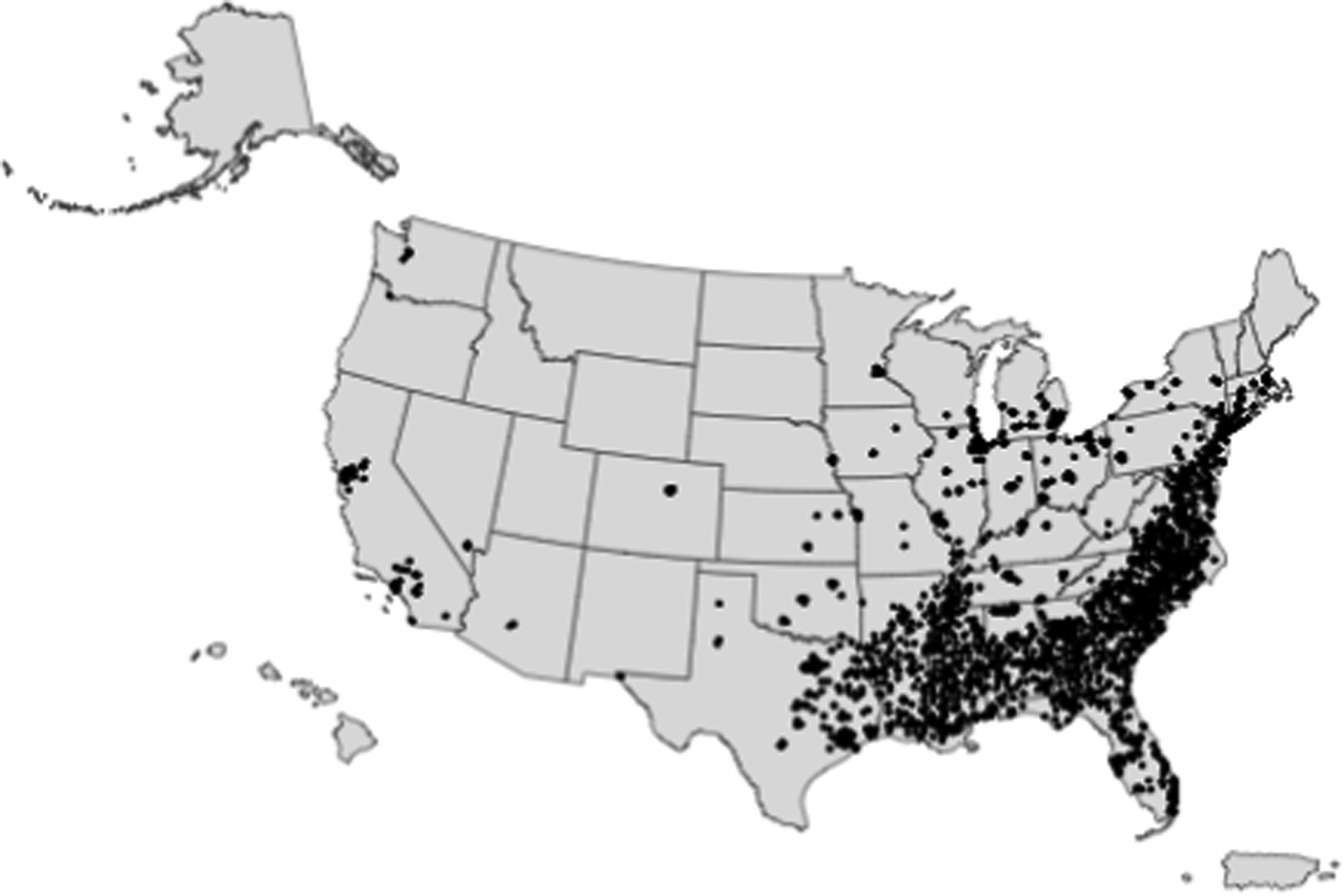
15 percent+ Black ZCTAs in Nationscape.
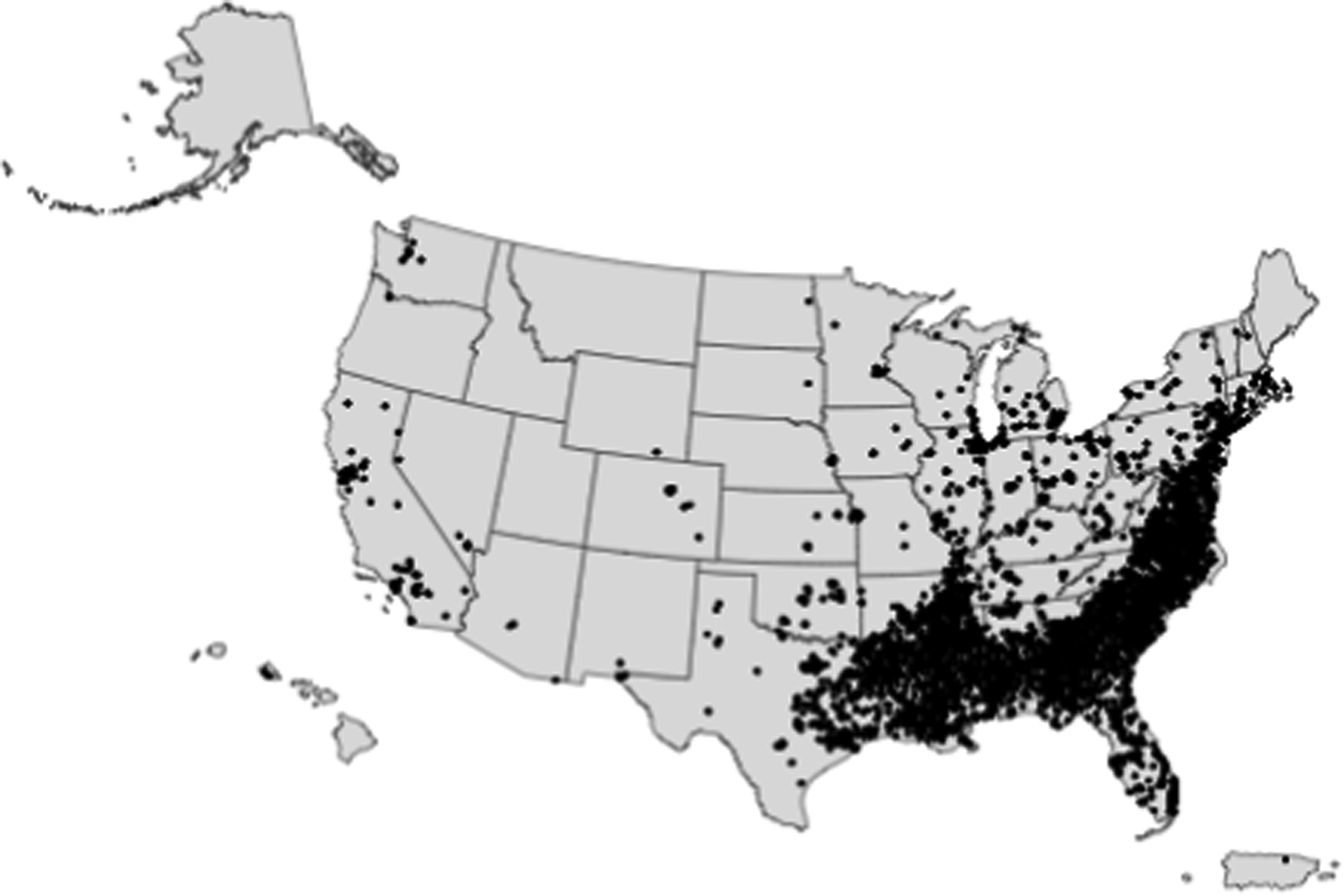
15 percent+ Black ZCTAs in 2015 ACS.
It is also important to note here that, while gentrification is indeed a significant problem that looms large in housing politics, it is relatively rare in that, at least on the timescale considered here, only a minority of the neighborhoods where Black Americans live are actively gentrifying. Over a longer period, such as the last 20–30 years, most Black neighborhoods in urban areas have faced some degree of gentrification pressure, but they are not experiencing it all at once. Different neighborhoods have gentrified at different times, and not all of them did so during the time period covered by my data. As Figure 3 9 shows, the changes in several of the most commonly used indicators of gentrification are either very close to zero, or even in the opposite direction of what we would expect for a gentrifying area. There are a few areas which are changing rapidly, but most Black respondents in Nationscape are not living in areas that we would consider gentrifying.
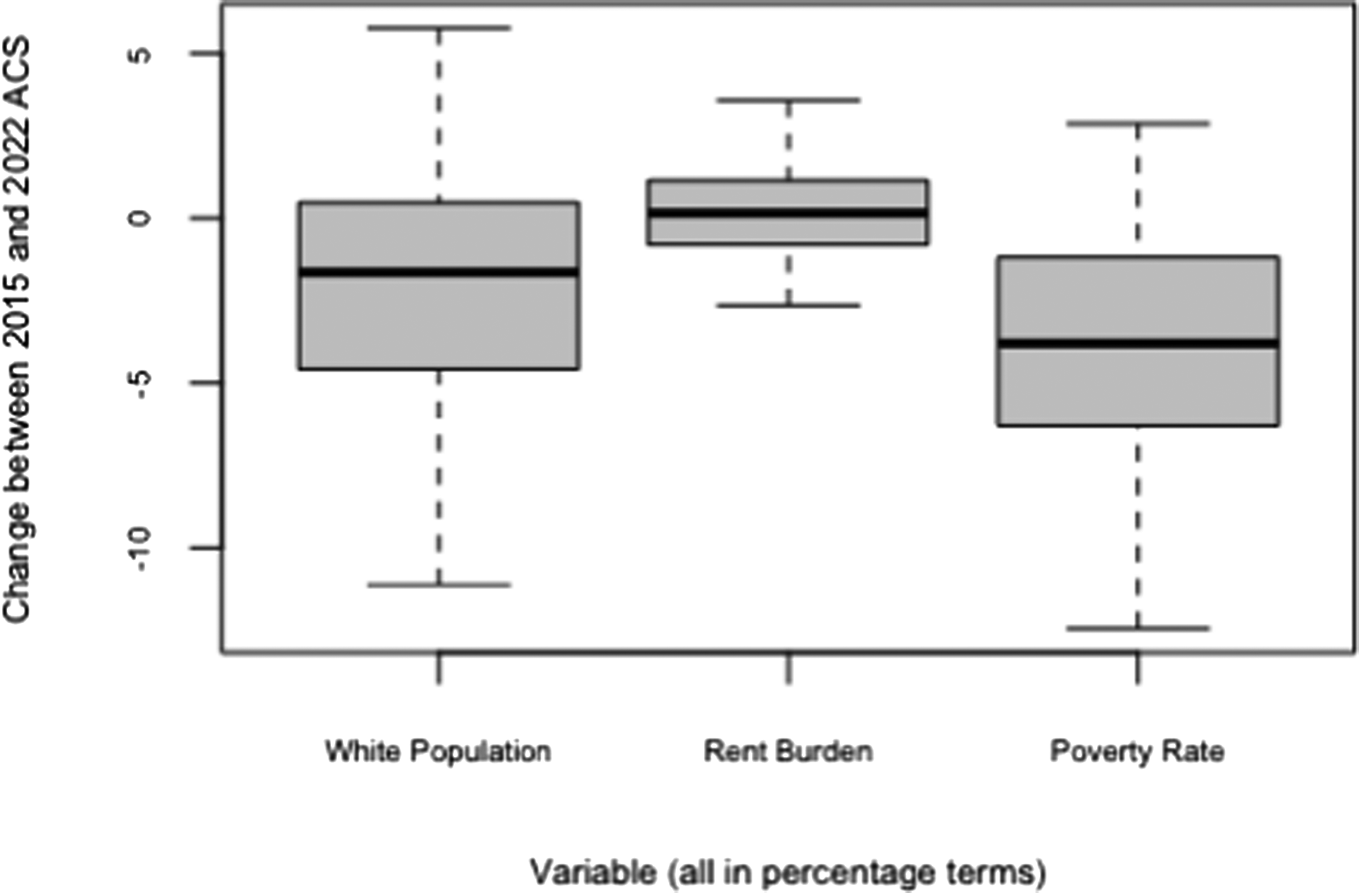
Change in gentrification indicators (middle 90 percent).
I supplement this data with an original data set of average ratings and prices from 513,186 restaurants scraped from Google Maps. These restaurants serve as a proxy for the kinds of cultural changes that may accompany economic changes in gentrifying areas. The intuition for including these measures is straightforward. Areas where these economic changes are taking place are also more likely to experience other changes in the fabric of the neighborhood such as the types of businesses, restaurants, churches, and other community haunts (Freeman 2006). Previous research on White reactions to immigrants has suggested an important cultural dimension to attitudes beyond merely economics (see, e.g. Chandler and Tsai 2001; Citrin and Sides 2008; Citrin et al. 1997; Hainmueller and Hiscox 2010; Newman, Hartman, and Taber 2012). It is possible that these cultural changes may also be important for Blacks and we need to account for them.
All other things being equal, a higher concentration of restaurants that are more expensive, or which have higher ratings, should be indicative of neighborhood changes. 10 The literature on patterns of gentrification suggests that gentrification (particularly White-led) often follows the opening of these sorts of establishments. Including these measures allows me to gauge the extent to which a given neighborhood might be attractive to gentrifiers and the extent to which the social fabric of a neighborhood has changed along with rent levels.
Of course, using restaurant prices and ratings is not a perfect proxy for cultural change. And as we lack restaurant ratings from the pre-period (indeed, these are likely impossible to recover), we cannot construct this variable as a change variable like the rest of the variables in the main analysis. As a result, we ought to think of the results derived from them as suggestive, not dispositive.
ZCTAs as “Neighborhoods”
It is also worth dwelling on the choice of ZCTA as the level of analysis given the modifiable areal unit problem. The primary reason for this choice is that ZIP codes are the lowest level of aggregation available in Nationscape. Census Tracts and Blocks were not collected and are not available. This is a limitation of the present study, as it does not allow me to see whether an even smaller level of aggregation produces different effects. We know from a large body of scholarship that segregation is more apparent the smaller a geography we consider (see, e.g. Reardon and O'Sullivan 2004; Reardon et al. 2008; Wong 2004). This being the case, changes as the smaller tract level would likely be more apparent to residents than changes at the ZIP code level, which could easily be happening in a such a way that people may have little sense that they are happening at all. This is especially worth considering in ZIP codes which are larger geographically, such as those in suburban or rural areas. Similarly, people's declining familiarity with their immediate neighbors (Davis and Parker 2018) may mean that they have a stronger reaction to changing demographics on their block, but a weaker one to changes in their broader ZIP code as they go about their daily life.
That said, this does not mean nothing can be learned from using ZIP codes. ZCTAs also have several advantages. ZIP codes are the level at which life happens. They include businesses, parks, schools, restaurants, libraries, and more. With American social connectedness declining (Kannan and Veazie 2023; Murthy 2023; Putnam 2000; Sawhill 2020), worsening levels of social trust (Kennedy, Tyson, and Funk 2022; Rainie and Perrin 2019), and the aforementioned lack of familiarity with most of their neighbors, people's immediate, street level demographics are not necessarily reflective of where they are likely to have the most interaction with others. Thus, in contrast to the stronger (most likely negative) reactions that using tracts might provide, they may also interrupt the scope conditions for Contact Theory, meaning that using them may mechanically limit our ability to find evidence consistent or not consistent with its predictions. ZIP codes have an advantage in this respect even as they may have disadvantages elsewhere.
Additionally, due to their focus on statistical uniformity, 11 census tracts often break up neighborhoods as we understand them. For example, Boyle Heights in Los Angeles is made up of no fewer than 20 different census tracts. Morningside Heights in New York is composed of all or parts of 10 tracts. South Congress in Austin counts half a dozen tracts. Lastly, ZIP codes are also legible to people. Practically everyone knows their own ZIP code and many ZIP codes are coterminous with smaller cities.
As a result, while we should be cognizant of the disadvantages that only having ZIP codes imposes on this paper, ZIP codes also have several advantages that should give us confidence in their suitability as an appropriate geography to consider even if they are not the only geography we might consider.
Model Specification
I fit a model with robust standard errors clustered at the ZIP Code level, of the form:

My central results are robust to changes in specification, choice of variables, and whether standard errors are clustered by ZCTA. For the sake of clarity and space, I present solely the fully specified models below.
Black Attitudes Toward Newcomers are Moderated by Increasing Rents
In contrast to the central predictions of both Contact Theory and Group Threat Theory, my results provide no evidence for Hypothesis 1. As Table 1 demonstrates, there is no effect of increasing concentrations of non-Black residents on Black respondents’ feelings toward those populations as a group. This suggests that demographic changes alone are associated with little difference in racial attitudes in these contexts. Also notable is the fact that Blacks’ group favorability ratings are substantively high even under these circumstances. None of the averages indicate community level animosity toward any non-Black racial group.
Demographic Change Alone is Not Associated With Poorer Attitudes Toward Newcomers.
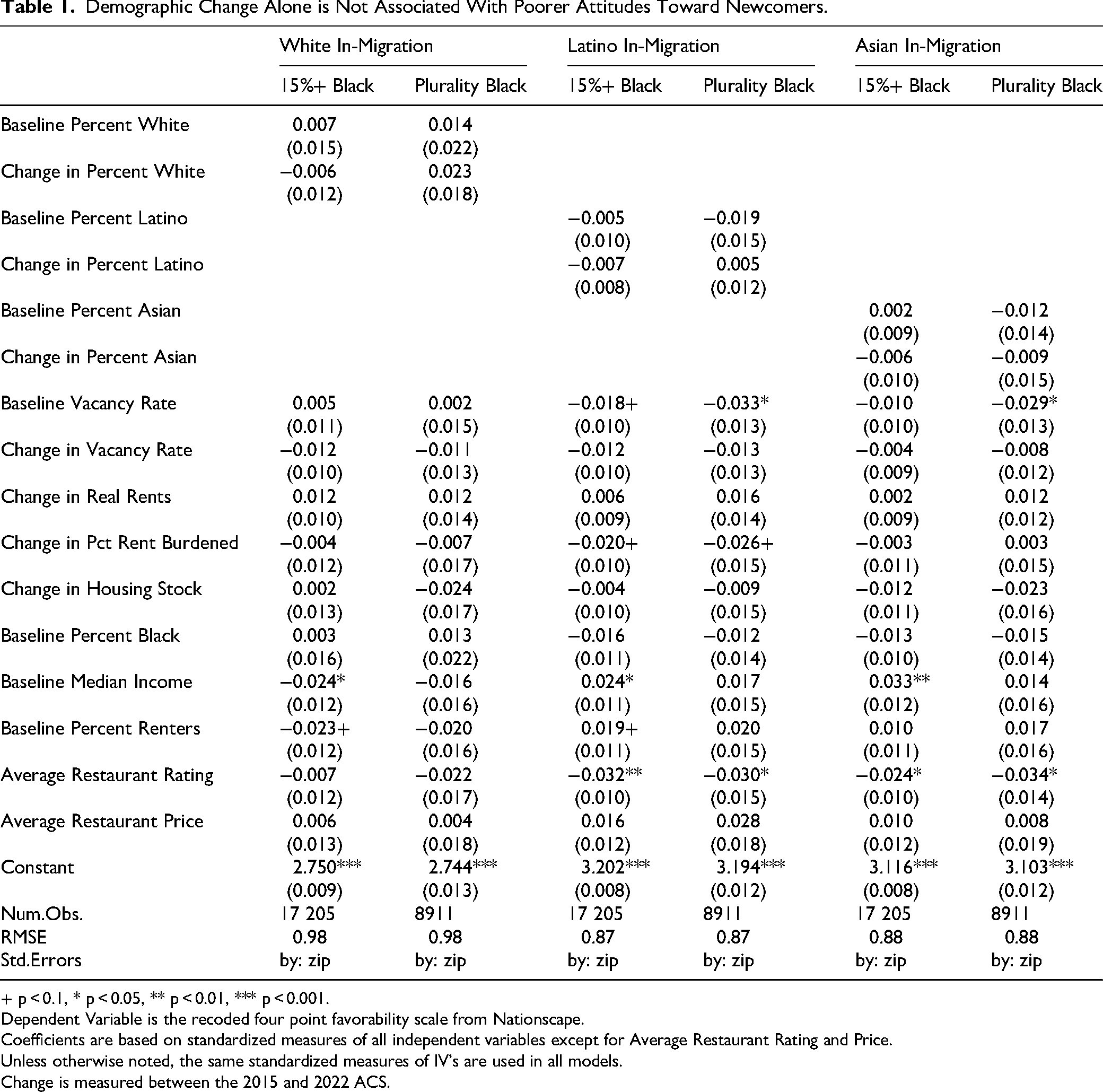
+ p < 0.1, * p < 0.05, ** p < 0.01, *** p < 0.001.
Dependent Variable is the recoded four point favorability scale from Nationscape.
Coefficients are based on standardized measures of all independent variables except for Average Restaurant Rating and Price.
Unless otherwise noted, the same standardized measures of IV's are used in all models.
Change is measured between the 2015 and 2022 ACS.
While improving racial comity would been preferable, it is nonetheless a positive that changing ethnic demographics do not seem to lead to worsening racial enmity from Black residents. This also allows for the possibility that 21st century neighborhood integration may be able to proceed without the specter of racial tensions.
However, as we can see in Table 2, as hypothesized, the interaction term is negative and significant for Whites and only for Whites, 12 providing evidence for Hypotheses 2 and 3. 13 Objective economic conditions appear to be a critical influence on Black respondents’ poorer evaluations of Whites as a group. 14 White residents moving into the neighborhood is associated with lower Blacks’ affective evaluations of them as a group, but only when their arrival is accompanied by rent increases. 15 These results are consistent in both the 15 percent+ ZIP code case, as well as the in the plurality case. The estimated effect is larger in the plurality case, suggesting that White arrivals are more strongly associated with negative evaluations in more heavily Black areas.
Rent Increases Moderate Black Attitudes Only for White In-Migration.
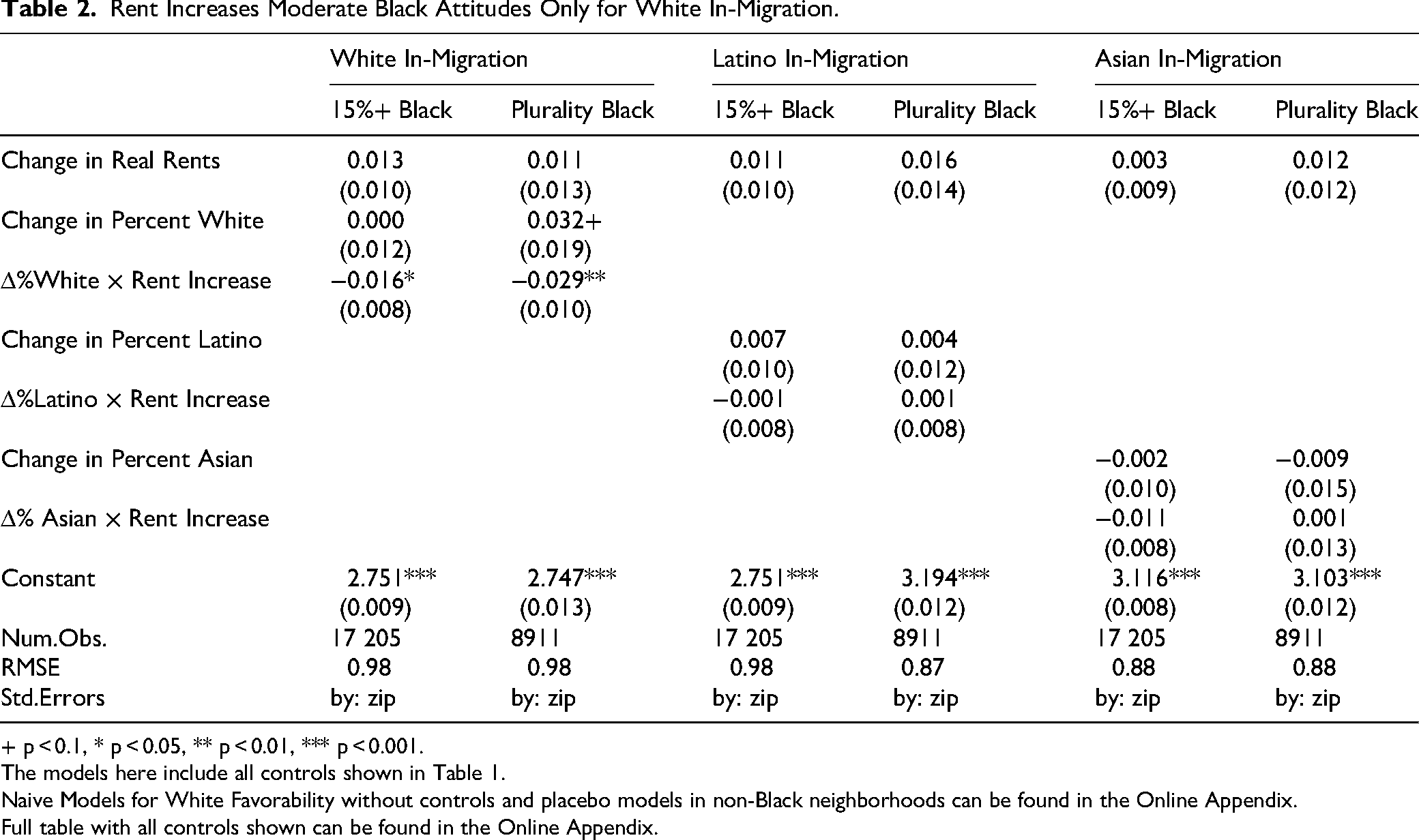
+ p < 0.1, * p < 0.05, ** p < 0.01, *** p < 0.001.
The models here include all controls shown in Table 1.
Naive Models for White Favorability without controls and placebo models in non-Black neighborhoods can be found in the Online Appendix.
Full table with all controls shown can be found in the Online Appendix.
These negative effects are present when accounting for possible cultural changes using the restaurant data, and, as shown in Table S6 in the Appendix, when including an interaction term on White population change and the restaurant variables. This further reinforces the conclusion that objective economic conditions are paramount to Black residents. There is suggestive evidence here that the kinds of cultural changes proxied for by the restaurant data might matter for Latinos and Asians, as well as conditionally for Whites (shown in the appendix), but the salient point is that they do not change the impact of the economic concerns. In other words, economic concerns definitely matter, and cultural concerns may. It is not merely one or the other.
As shown in the Online Appendix, this central moderating result appears to hold under a wide range of specifications. Further, as Table S8 in the Online Appendix demonstrates, the estimated effect size is larger under specifications that include fixed effects at the state, county, and metro area level, perhaps indicating that these demographic shifts matter even more the more we account for apart from them.
Contact and Threat: The Role of Economic Context
Figure 4 below aids in the interpretation of these results. Consistent with Table 2 above, it demonstrates that White population increases are moderated by the degree of rent increases. Several features of this figure are worth noting. First, all interaction plots of this kind are subject to data sparsity at the extremes of the moderator distribution, and the confidence bands in Figure 4 widen considerably at high rent values, where relatively few ZIP codes in our sample are observed. The estimates in these regions should therefore be interpreted with caution.
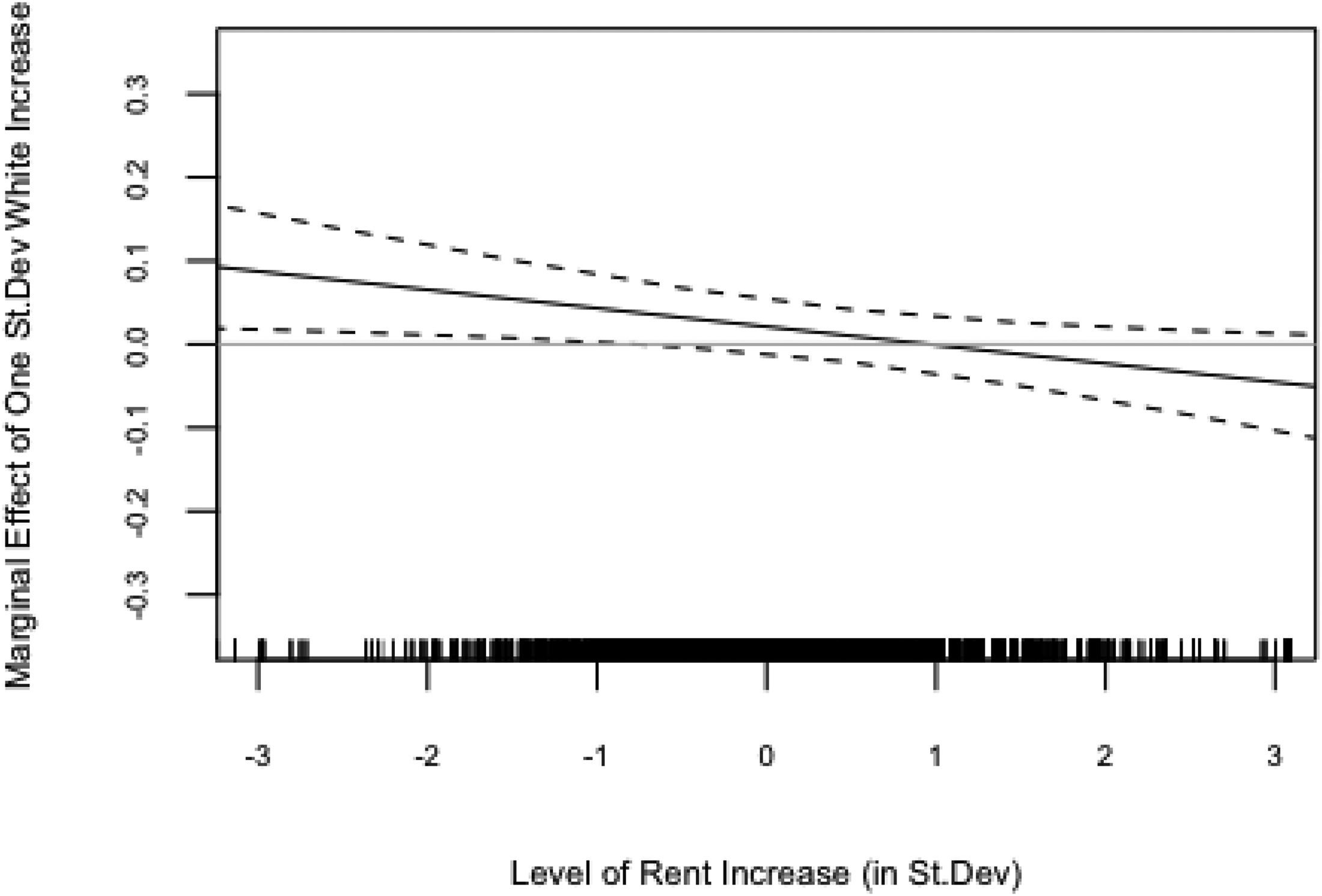
The impact of white in-migration change depending on rent increases.
To more rigorously characterize the shape of this relationship and assess whether the linearity assumption underlying the multiplicative interaction model is well-founded, I implement the kernel estimator proposed by Hainmueller, Mummolo, and Xu (2019), presented in the appendix. The kernel estimator is more flexible than a parametric interaction model but is also considerably more data-hungry, as it estimates the marginal effect locally at each value of the moderator rather than imposing a global functional form. As a result, confidence bands are wider than those produced by the linear interaction model, particularly at the tails of the rent distribution where observations are sparse, and the estimates in these regions should be interpreted with appropriate caution.
With that caveat in mind, the kernel estimator reveals a substantively informative and monotonic pattern: the marginal effect of White in-migration on White favorability is positive and significant at low levels of rent increase, diminishes as rent increases become more substantial, and crosses zero at moderate rent levels, with the point estimate consistent with a negative association at high rent levels. This negative association at the upper tail does not reach conventional thresholds of statistical significance, likely due to the aforementioned data sparsity. Nevertheless, this directional pattern is consistent with the terciles plot (also presented in the appendix), which shows that mean White favorability tends to be higher in high White in-migration areas when rents are stable, and lower in high White in-migration areas when rents are rising substantially. 16
This pattern suggests a more nuanced theoretical interpretation than either Contact Theory or Group Threat Theory alone would predict. In neighborhoods where White newcomers arrive but rents remain relatively stable, Black residents’ views of Whites as a group are, if anything, more favorable, consistent with the predictions of Contact Theory that sustained intergroup exposure can reduce prejudice under benign conditions. However, as rent increases accompany White in-migration, this positive association diminishes and eventually reverses, consistent with the predictions of Group Threat Theory that economic threat may contribute to negative outgroup evaluations. Rent increases thus appear to function as a moderator that influences which theoretical mechanism predominates: contact effects when economic conditions are stable, with threat effects becoming more impactful when they are not.
With respect to Black reactions to White newcomers in high rent-increase environments, the predictions of Group Threat Theory appear increasingly relevant. The resource threat of increasing rents which accompanies White arrival does appear associated with less favorable Black evaluations of Whites as a group, though whether Group Threat fully predominates or merely begins to compete with contact effects at high rent levels remains an open question given data sparsity at the upper tail of the distribution. One possible explanation for this pattern is that, while they live in proximity to one another, there is still substantial lifestyle segregation between more affluent White newcomers and the incumbent working class Black residents of these neighborhoods as described by Hyra (2017; particularly chapters 5 and 6). Such dynamics would preclude the kinds of cooperative interactions that scholars have argued underlie the predictions of Contact Theory from occurring, while simultaneously presenting incumbent residents with tangible economic challenges—tipping the balance away from contact effects and toward the threat responses Group Threat Theory predicts.
Racial Hierarchy and Attribution Theory as Lenses for Null Effects of Non-White Newcomers
On the other hand, for non-White newcomers, my results are more consistent with the predictions of Racial Hierarchy. If Group Threat were the sole mechanism operating, we would not expect to see differential effects for White, Latino, and Asian newcomers. The economic threat engendered by gentrification is not markedly different in neighborhoods that are experiencing White-led gentrification as opposed to Latino-led or Asian-led gentrification. White and Latino population changes are similarly correlated with rent increases, and Asian population changes are more highly correlated with rent increases than either. 17 Therefore, while Group Threat offers us a cogent lens through which to view responses to White newcomers, we must look to the predictions of theories of Racial Hierarchy to understand why there is no comparable response to non-White newcomers.
These results thus suggest a nuanced understanding of gentrification among Black residents of gentrifying areas. Black residents of gentrifying neighborhoods view Whites less favorably as a group when White-led gentrification coincides with their housing becoming more expensive. This implies that incumbent Black residents see White newcomers moving into their neighborhood, notice their rents increasing at the same time, and so they may make the reasonable inference that the newcomers are responsible for the deterioration of their residential security. 18 This, combined with the lens of racial hierarchy and the preceding discussion of whether Asian and Latino newcomers are perceived as proximate to Whiteness, hints at an attributional motivation for the differential effects between White and non-White arrivals.
This inference likewise aligns with classic literature on attribution theory (e.g. Heider 1958; Hewstone and Cairns 2001; Malle 2011; Ross 1977), which holds that individuals are highly motivated to seek causal explanations for outcomes (Kelley 1973) and often over-attribute responsibility to individual actors rather than to system-level factors. In intergroup contexts, these attributions can reinforce prejudice (Pettigrew 1979). Even more directly, the search for explanations about why gentrification has happened has previously been described as a “search for villains” (Ehrenhalt 2022). In turn, this suggests that incumbent Black residents may be engaging in a form of updating (as described in Hill 2017 for instance), where the increased perception that White newcomers are responsible for the challenges faced by their neighborhoods causes Black residents to update their views about Whites as a group. Of course, this is not the sole plausible mechanism, but it is the one that I believe is most consistent with my results.
It is also worth dwelling for a moment on the fact that the estimates for Asian newcomers are occasionally significant at the 10 percent level. The Racial Hierarchy lens helps us gain some purchase here as well. Asian Americans are more likely than Latinos to be triangulated as proximate to Whiteness (Kim 2000) and they face the pervasive “model minority” stereotype (Cheryan and Bodenhausen 2011). Some work thus argues that Asian-Americans occupy an intermediate rung on the American racial ladder—sitting above Latinos and Blacks, but below Whites (Bergsieker, Shelton, and Richeson 2010; O’Brien and Major 2005). In contrast to the situation described above (where Asians are not perceived to be proximate to Whiteness), in situations where Asians are triangulated as closer to Whites and above Blacks in the racial hierarchy, then Blacks may identify them as the ultimate source of the problems that accompany their arrival, producing the same sorts of negative evaluations we observed for White-led gentrification.
Discussion
My results indicate that economic considerations are critical to whether changing neighborhood demographics may lead to negative attitudinal evaluations, and that Black residents have a nuanced understanding of gentrification. Their views are not influenced by demographic change alone, but instead by the combination of demographic and economic changes. However, a skeptical reader may question whether the significant effects I find are substantively meaningful, or whether they are so small as to suggest that the effects are meaningfully null across the board. This is once again a tempting conclusion, but I do not believe we can make this determination.
By outward appearance, these effects may appear quite small. But they are not as small as they might seem at first glance. For instance, the estimated effect (assuming linearity) in the Black plurality ZIP code facing the highest level of gentrification is more than half of the size of moving from ‘Very Liberal’ to ‘Very Conservative’ on the standard Ideo5 scale. 19 The effect of a single standard deviation is approximately 30 percent of the size of moving one step along the ideology scale. Similarly, this same effect is 12.1 percent the size of the difference between Black Democrats and Black Republicans. 20 Given what we know about how important ideology and partisanship are to how people move through the world and how they reason about it (e.g. theories of motivated reasoning, biased assimilation, affective polarization, and partisanship as identity), these effects are perhaps more important than we would think in isolation.
Additionally, this is likely an underestimate of the size of this effect. Due to the nature of the available data, I am only able to estimate the impact on views of Whites among Black residents who stayed in their ZIP code. Since we know that gentrification may be associated with displacement, we should consider the possibility that neighborhoods experiencing increases in the White share of the population and increases in median rents are also experiencing displacement. Further, as the previous literature has noted, the negative impacts of gentrification fall most heavily on those who are displaced by gentrification's pressures. If we think that economic considerations and real material threat are central to people's views, then we might expect that the strongest effects of gentrification on Black views of Whites as a group would be found among those residents who left. I am unable to measure these views with the available data. As such, the results here likely represent a lower bound of the size of the effect that gentrification has on Black residents’ views of Whites as a group.
Some readers might also wonder whether the Black residents whose opinions I am measuring are indeed those who have lived there for a substantial time rather than, perhaps, wealthier Blacks who arrived at the same time as the White gentrifiers. I account for this possibility in two ways. On the front end, since I am subsetting my data to ZCTAs that already had substantial Black populations in the 2015 ACS, the probability that the lion's share of the respondents who are there in 2020 are new arrivals is small. Second, while it is the case that residential mobility in the United States has been declining for the last four decades and the vast majority of moves are within-county (Frost 2020), we may still be worried that the conditions surrounding gentrification would result in higher proportions of new arrivals in gentrifying neighborhoods and that these new arrivals would drive the effects we observe. I account for this possibility by adding in a control for the percentage of Black residents who moved in to the neighborhood in the last year using data from the 2022 ACS. As shown in Appendix Table S11, this specification does not alter the main result.
These results add substantially to our understanding of the racial views of Black residents in neighborhoods undergoing gentrification and inform ongoing debates about policy responses to gentrification.
On the one hand, Blacks’ views of Whites, Latinos, and Asians are not lower merely through the presence of newcomers in their neighborhoods. Further, the fact that, even in substantially Black neighborhoods where the opportunities for positive relationships to develop are more limited, the average favorability rating that Black respondents give to Whites, Latinos, and Asians is positive, is similarly encouraging.
On the other, my results suggest that the current dynamics of urban housing markets are challenging for Black–White relations. Economic pressures driven by rising housing costs in gentrifying neighborhoods may contribute to poorer views of Whites as a racial group among Blacks who find themselves bearing the brunt of the negative impacts of our housing crisis. If we do not remedy these housing market conditions, and gentrification further intensifies, my results suggest that Black views of Whites could further deteriorate.
The attitudes of Blacks living in gentrifying, high rent-increase ethnic neighborhoods toward the racial group of non-Black newcomers are broadly consistent with the predictions of Theories of Racial Hierarchy. Negative associations are only observed when the arrival of White Residents is accompanied by a corresponding increase in rent, and do not arise at all for Asians or Latinos. Economic considerations thus appear to be a paramount moderator in Blacks’ attitudinal evaluations of Whites as a group under conditions of gentrification. These results suggest one more reason why it is incumbent upon policymakers to find ways to address the economic threat that Black neighborhoods face.
Supplemental Material
sj-doc-1-uar-10.1177_10780874261441174 - Supplemental material for Attitudes Toward Racial Outgroups During Gentrification
Supplemental material, sj-doc-1-uar-10.1177_10780874261441174 for Attitudes Toward Racial Outgroups During Gentrification by Clayton Becker in Urban Affairs Review
Footnotes
Acknowledgments
The author would like to thank Lynn Vavreck, Julia Payson, Natalie Masuoka, Lorrie Frasure, Matt Baretto, Chris Tausanovitch, Michelle Torres, and Dan Thompson for helpful comments and feedback on previous drafts of the manuscript as well as participants in the UCLA American Politics Research Group for suggestions on analyses and literature.

Ethical Approval and Informed Consent Statements
The portions of this research that utilized data with potentially personally identifying information were approved the UCLA IRB with ID IRB-24-0609.
Funding
The author received no financial support for the research, authorship, and/or publication of this article.
Declaration of Conflicting Interests
The author declared no potential conflicts of interest with respect to the research, authorship, and/or publication of this article.
Data Availability Statement
A version of the data used in this paper with the ZIP code field hashed to remove any potentially personally identifying information is available on the Harvard Dataverse at https://doi.org/10.7910/DVN/I8GFU2.
Supplemental Material
Supplemental material for this article is available online.
Notes
Author Biography
References
Supplementary Material
Please find the following supplemental material available below.
For Open Access articles published under a Creative Commons License, all supplemental material carries the same license as the article it is associated with.
For non-Open Access articles published, all supplemental material carries a non-exclusive license, and permission requests for re-use of supplemental material or any part of supplemental material shall be sent directly to the copyright owner as specified in the copyright notice associated with the article.
