



Abstract
Cities worldwide operate on the frontlines to support forced migrants. Some of these cities even overstep their formal prerogatives by refusing to comply with, and at times overtly subverting, the prescriptions of national authorities. This article builds a conceptual framework to understand such forms of insurgent urban asylum policy-making. We argue that insurgency depends on how city governments mediate the constraints and opportunities that emanate from the horizontal and vertical dimensions of multi-level governance, which capture city-level political dynamics as well as intergovernmental interactions. To illustrate our framework, we compare asylum policy-making in Barcelona, Milan, and Munich during the 2010s “refugee crisis.” While Munich invested in rather uncontroversial integration programs, Milan and Barcelona overstepped their jurisdictional boundaries and supported migrants considered “illegal” by national governments. These insurgent responses were enacted as a “remedy from below,” stemming from a sense of urgency that was not as pressing for Munich’s policy-makers because of the greater capacity of Germany’s asylum system.
Introduction: Asylum Policies—Between State Authority and Urban Insurgency
Progressives worldwide increasingly look to cities as the essential bulwarks in the battle for the rights of migrants. Over the last years, labels such as “sanctuary cities” (e.g., Darling and Bauder 2019), “solidarity cities” (e.g., Agustín and Jørgensen 2019), “refuge cities” (e.g., Mayer 2018), and “welcoming cities” (e.g., Bazurli 2019) have proliferated in academic and political debates. These initiatives are generally crafted at the grassroots level. This means that civil society organizations experiment with discourses and practices of migrant solidarity that sympathetic local officials possibly translate into full-fledged policy programs (de Graauw and Vermeulen 2016; Kaufmann and Strebel 2020). Another salient feature of these initiatives is their confrontational, or at least polemical, stance towards nation-states, blamed for the suffering inflicted on migrants through exclusionary policies and punitive practices (Darling and Bauder 2019). Aside from these common traits, and behind their highly evocative names, there are fundamental differences among these urban initiatives, notably their view of how to resist the state monopoly over immigration and citizenship (Kaufmann et al. 2021). Supplementing state services for refugees through municipal welfare, for example, is very different than supporting migrants who are even denied legal status by nation-states. How can we explain this variety of pro-migrant urban policies?
This article aims to conceptualize the different roles that cities can play in challenging national migration regimes, with a specific focus on urban asylum governance in the European context. The realm of asylum is, de jure, the sole jurisdiction of nation-states. They set out the conditions for accessing their territory, they process applications, and they determine the legal status and welfare entitlements of asylum-seekers. Within this centralized framework, nation-states at most task local governments with integrating asylum-seekers who obtained (or those in the process of obtaining) a positive humanitarian protection status, i.e., a Geneva Convention refugee status or a subsidiary protection status (cf. Łukasiewicz, Oren, and Tripathi 2021). However, in reality, European cities were in the trenches of coping with the “refugee crisis” of the 2010s. As the EU and its member states failed in sharing the responsibilities of humanitarian protection (Guiraudon 2018; Lutz, Kaufmann, and Stünzi 2020), numerous municipalities exceeded their formal prerogatives to assist forced migrants in need—regardless of their formal protection status (Bazurli 2019; Mayer 2018).
We define these instances of municipal defiance as insurgent urban asylum policy-making. The term “insurgent” underlines the fundamental opposition of these policies to the power of the nation-state to separate— through policing, detention, exclusion, and expulsion—those who deserve membership in a national polity from those who, instead, ought to be punished for their own “outsider-ness” (Stumpf 2012, 15; Dauvergne 2008; Crawley and Skleparis 2018). Against this background, insurgent asylum policies project an alternative, inclusive vision of belonging based on the principle of jus domicili (membership upon residence, cf. Varsanyi 2006; Kaufmann 2019). Scholars of urban politics have emphasized that grassroots activism at the city-level is the guiding force behind these modes of dealing with migration challenges (e.g., de Graauw and Vermeulen 2016; Steil and Vasi 2014), whereas political scientists have focused more on federalism, and intergovernmental relations across territorial levels (e.g., Scholten 2013; Gulasekaram and Ramakrishnan 2015).
We integrate these different perspectives into a multi-level governance (MLG) framework to explain the (non-) emergence of insurgent urban asylum policies. MLG refers to the assorted state and non-state actors that shape policy-making at various spatial scales without a structuring authority and in the context of proliferating, interdependent jurisdictions (e.g., Hooghe and Marks 2003; Kaufmann and Sidney 2020). In this article, we take up the call of migration scholars to unleash the explanatory potential of MLG perspectives, that is, their capacity to address “why” and “how” questions and to move beyond the merely descriptive usages of this concept (cf. Caponio and Jones-Correa 2018, 2006). We theorize that insurgency in urban asylum policies depends on two dimensions of MLG. The horizontal dimension captures urban governance dynamics, i.e., the interactions between the city administration and grassroots organizations, local parties, and other actors that have a stake in city politics, especially those that mobilize from the bottom up. The vertical dimension incorporates intergovernmental interactions as well as the impact of supralocal policy-making on the preferences and strategies of urban actors. City governments face opportunities and constraints originating from these two dimensions. They are able to mediate, interpret, and strategically use different, possibly contrasting signals that come from both below and above.
We illustrate our conceptual framework through a comparative case study of urban asylum policy-making in three large European cities: Barcelona, Milan, and Munich. The findings reveal that forging alliances among progressive actors was a condition for crafting inclusionary provisions in all of the cities analyzed (i.e., the horizontal dimension). Grassroots solidarity initiatives were vocal enough to attract the backing of political leaders in city governments, thus giving rise to broad pro-migrant coalitions at the city-level. However, while Munich limited its endeavors to rather uncontroversial integration policies, Milan and Barcelona overstepped their jurisdictional boundaries, ignored supralocal policies, and supported migrants deemed to be “illegal” (or at least not entitled) from the perspective of the nation-state. These insurgent responses emerged as a “remedy from below.” This sense of urgency was not as pressing for Munich’s policy-makers because of the greater capacity of Germany’s asylum system (i.e., the vertical dimension).
Our findings expand our understanding of the terms “sanctuary,” “solidarity,” “refuge,” and “welcoming” cities by distinguishing between insurgent and non-insurgent initiatives. They contribute to the literature on migration policy-making by demonstrating the explanatory potential of MLG perspectives (Caponio and Jones-Correa 2018), which prove productive for accommodating different scholarly contributions within an overarching conceptual framework. However, we believe that our study also speaks to urban studies scholars outside the perimeter of migration studies. The burgeoning debates on “new municipalism” (Russell 2019; Thompson 2020), “progressive cities” (Joy and Vogel 2021), and “contentious governance” (Verhoeven 2021) share some common threads, notably, the significance of alliance-building dynamics at the city-level, the subversion of state-centrism over a variety of policy domains, and the possibility of harnessing the urban scale to achieve far-reaching democratic and societal transformations. We contend that urban initiatives that defend and expand migrant rights should be part of the policy agenda for “a just, democratic, and sustainable future” (Kaufmann and Sidney 2020, 1).
Conceptual Framework: The Multi-Level Governance of Urban Asylum Policy-Making
MLG serves as our conceptual framework for explaining urban asylum policy-making. Given the limitations of the prevailing national level focus in policy studies, MLG perspectives have found their way into the analysis of migration policies (e.g., Scholten 2013) and urban policies (e.g., Kaufmann and Sidney 2020). But precisely because of its appeal, the concept has been stretched to the point of losing its analytical value (cf. Alcantara, Broschek, and Nelles 2016). We apply the criteria offered by Caponio and Jones-Correa (2018) to describe an instance of MLG as multi-level policy-making that has to “challenge vertical, state-centered formal hierarchies of distribution of power and responsibility, and, at least to some extent […] state/society boundaries” (ibid. 1996). In a nutshell, the defining feature of the MLG concept is the concurrence of horizontal relations between local state and non-state actors and vertical relations across government tiers (see also Campomori and Ambrosini 2020). By intersecting different strands of literature, we will theorize that these two dimensions of MLG allow us to explain the variety of urban asylum policies (Caponio and Jones-Correa 2018, 2006), including their (non-)insurgent character.
Horizontal Multi-Level Governance: The Urban Politics of Asylum
With horizontal MLG we refer to the interactions among state and non-state actors at the city-level. Existing literature shows that civil society organizations that mobilize from below and local government officials who are sympathetic to their demands are crucial drivers of immigrant integration policies at the city-level (cf. de Graauw and Vermeulen 2016).
These policies are often spurred by migrants and organizations that support them. The peculiar qualities of city life allow migrants to access assorted opportunities to be acknowledged as legitimate community members (Varsanyi 2006)—and to possibly become vocal political subjects (Nicholls 2016). Opportunities for urban belonging (Bauder 2016) find the most meaningful expressions and most disruptive implications in the case of migrants whose legal status is irregular or precarious—including forced migrants who are seeking asylum. In the face of their exclusion from formal national citizenship, the city may become an alternative locus of membership no longer bound to an a priori political community but based on the reality of presence and residence in a place (Varsanyi 2006; Kaufmann 2019). The prospect of a grounded—and thus unbounded—urban citizenship has become a spearhead of social-movement struggles for the “right to the city,” because of their aim to emancipate all people inhabiting the urban space (cf. Purcell 2014). Of course, urban migration policies can also take exclusionary and repellent characteristics.
Urban institutional actors have assorted incentives for promoting inclusionary, possibly insurgent, asylum policies. This is the case of political parties, who compete in the (local) electoral arena by (de-)emphasizing a variety of issues—including immigration. Left-leaning parties can embrace migrants’ cause to galvanize their egalitarian constituencies (e.g., Collingwood and Gonzalez O’Brien 2019). Activists are also likely to exert an influence on municipal bureaucrats (de Graauw and Vermeulen 2021). In fact, civil society actors provide these municipal actors with indispensable and otherwise unavailable resources, such as knowledge of social problems “on the ground,” organizational flexibility in the midst of humanitarian emergencies, and legitimacy among policy target groups (e.g., Mayer 2018). In sum, grassroots activists and local officials may share a mutual interest in upsetting the monopoly of the nation-state over immigration and citizenship. This commonality can trigger strategies of contentious governance, i.e., where governmental players join forces with non-governmental players to take contentious actions against policies they want to prevent or redress (Verhoeven 2021).
Vertical Multi-Level Governance: Hierarchy and Insubordination in Asylum Policy-Making
The vertical dimension of MLG captures the formal and informal relationships among institutional actors at various territorial tiers. Although local governments are dependent on, and constitutionally subservient to, nation-states (Liu et al. 2010), they still have a strategic toolbox at their disposal for shaping policies in line with their vision and interest (Bazurli 2020). We scrutinize these opportunities and constraints in the field of asylum, and we then theorize under what conditions city governments opt for insurgent policy-making.
Asylum and humanitarian protection are typically the exclusive prerogative of the nation-state. National authorities expect local governments to support them by only enacting integration policies for migrants whose protection request is successful or pending. As for the EU, existing literature points to restrictive asylum policy-making in terms of entry into national asylum systems and weakly harmonized and security-oriented factions of national governments (e.g., Scipioni 2018). Amid the “refugee crisis” of the 2010s, national asylum systems were barely capable of dealing with higher numbers of asylum seekers (Niemann and Zaun 2018; Lutz, Kaufmann, and Stünzi 2020). Aside from these challenges at the European level, the capacity of national asylum systems also varied greatly (Zaun 2017). The performance of a national asylum system may drive city governments to pursue different policy responses that are likely to compensate for the lack or malfunctioning of national provisions (Mayer 2018).
National asylum systems are thus important for explaining urban asylum policies. These urban asylum policies can lead to intergovernmental conflicts if nation-states perceive that cities undermine their policy-making authority. Conflicts among levels of governments tend to arise when policy-makers at different territorial scales have different interpretations of policy problems and if they have conflicting goals in their policy designs (e.g., Scholten 2013; Caponio and Jones-Correa 2018). Because interpretations can differ across government tiers, policy-making may become “decoupled,” that is, governmental players follow divergent policy paths and may even be in conflict with one another.
The vertical dimension of MLG also grants policy-making opportunities for urban actors. These actors can tap into policy-making venues at different institutions and government tiers (e.g., Sapotichne and Smith 2012). These strategies of (vertical) venue-shopping allow them to coordinate and negotiate their policy goals outside of their jurisdiction and to access external networks, resources, and expertise. Mayors and cities governments operate under institutional constraints that can be transposed by MLG networks. However, these networks can simultaneously act as vehicles that help to transcend these constraints (Bazurli, Caponio, and Graauw 2022; Kaufmann and Strebel 2020). Thus, the scope of urban policy-making is not predetermined by the degree of formal local autonomy and/or supralocal policies. This intergovernmental framework is indeed flexible and malleable in so far as that urban actors may try to stretch, counter, or circumvent the limitations they come up against.
To be sure, intergovernmental relations do not take the same form within all political systems. Vertical interactions are more complicated in federal states when compared with unitary ones. Regional, provincial, and other “middle-tier” governments increasingly engage with migration governance, and should therefore be incorporated into MLG frameworks (Campomori and Caponio 2017). Federalism can provide opportunities for asylum policy-making at the city-level. Policy entrepreneurs have greater chances of influencing decision-making when authority is dispersed across multiple venues (e.g., Sapotichne and Smith 2012). Yet federalism may also impose limitations due to the strong role of second-tier governments and the hierarchical subordination of local governments. A flagrant example is that of state anti-sanctuary laws that, “in one fell swoop,” may ban sanctuary cities within the whole jurisdiction of a state (Collingwood and Gonzalez O’Brien 2019, 96).
City Governments: Mediating and Exploiting Multi-Level Governance
City governments, as part of both the state and the urban community, are situated at the crossroads of the horizontal and vertical dimensions of MLG. This implies a complex “tightrope-walk,” given that they have to respond to possible conflicts and demands that emerge from below while having to share (and compete for) power with supralocal institutions. Their position also opens up policy-making possibilities because they can tap into multiple policy-making venues.
Local officials are able and keen to crystalize the manifold forces that support migrants within the urban political realm, clustering them in potent—albeit variably unstable and internally contested—alliances. This is especially true for left-leaning urban politicians given their relative ideological and organizational proximity to social movements. The intense and meticulous processes of consensus-building play a decisive role when it comes to pro-migrant policy-making (de Graauw and Vermeulen 2016; Kaufmann and Strebel 2020). City governments, and especially mayors, are not confined to their jurisdictions; they have an audience that extends beyond their city, and they thus have the capacity to set the political agenda at the city-level and beyond (Sapotichne and Smith 2012). They can champion highly visible policy changes that epitomize the values of their voter base but that also respond to the challenges of their city and of others (Hughes 2017).
These horizontal interactions do not unfold in a vacuum; they are interpreted and mediated in the context of intergovernmental relations. Signals that descend from supralocal authorities can galvanize city governments into more or less insurgent policy choices. If national asylum systems have a limited scope and limited capacities in the face of collective problems that must be tackled locally, city governments may opt to rise up against supralocal policy-makers—i.e., to overstep their jurisdictional boundaries—as a “remedy from below.” Conversely, in the face of more capable governance systems, city governments may still adopt inclusionary provisions while limiting their policy-making endeavors to the boundaries of less controversial policies, that is, without resorting to insurgent means. Therefore, we expect that alliance-building between progressive actors at the city-level (i.e., the horizontal dimension) is a necessary condition for crafting accommodative asylum policies, whereas variations in national asylum governance (i.e., the vertical dimension) is what ultimately accounts for the insurgent character of these policies (see, Figure 1).
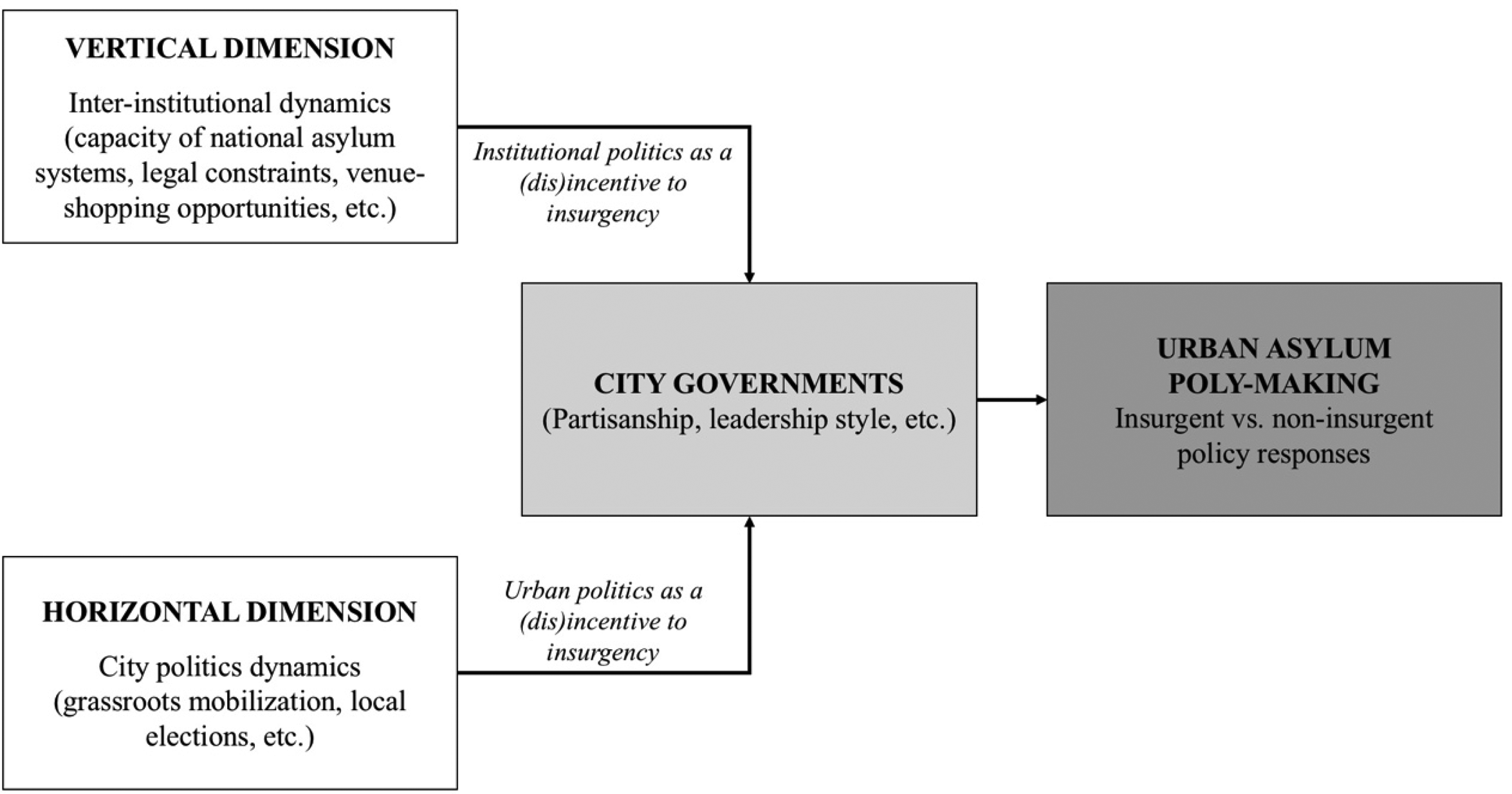
Conceptual framework: multi-level governance of urban asylum policy-making.
Case Selection, Research Design, and Data
We apply our theoretical argument to a comparative case study of asylum policy-making in Barcelona (Spain), Milan (Italy), and Munich (Germany). These three cities are particularly suitable for our comparative endeavor as they are similar in terms of demography, economy, and society (Table 1 summarizes key figures). Barcelona is the capital of the autonomous region of Catalunya and the second largest city in Spain. Foreign immigration in Barcelona has risen rapidly since the 1990s. Milan, the capital of the Lombardy region, is also the second largest Italian city. Since the 1970s, the transition to the service economy has gone hand in hand with the rapid growth of the foreign population. Munich is the capital of the state (Land) of Bavaria and the third largest city in Germany. Foreign-born residents have increased steadily since the introduction of Germany’s “guest-worker” scheme in the 1950s. These three affluent cities share an enduring legacy of integration policies, but they have also experienced severe social inequalities, especially during the Great Recession (for more case details, see Garcés Mascareñas 2014; Caponio 2014; Gebhardt 2016).
Socio-Economic Indicators for Barcelona, Milan, and Munich.
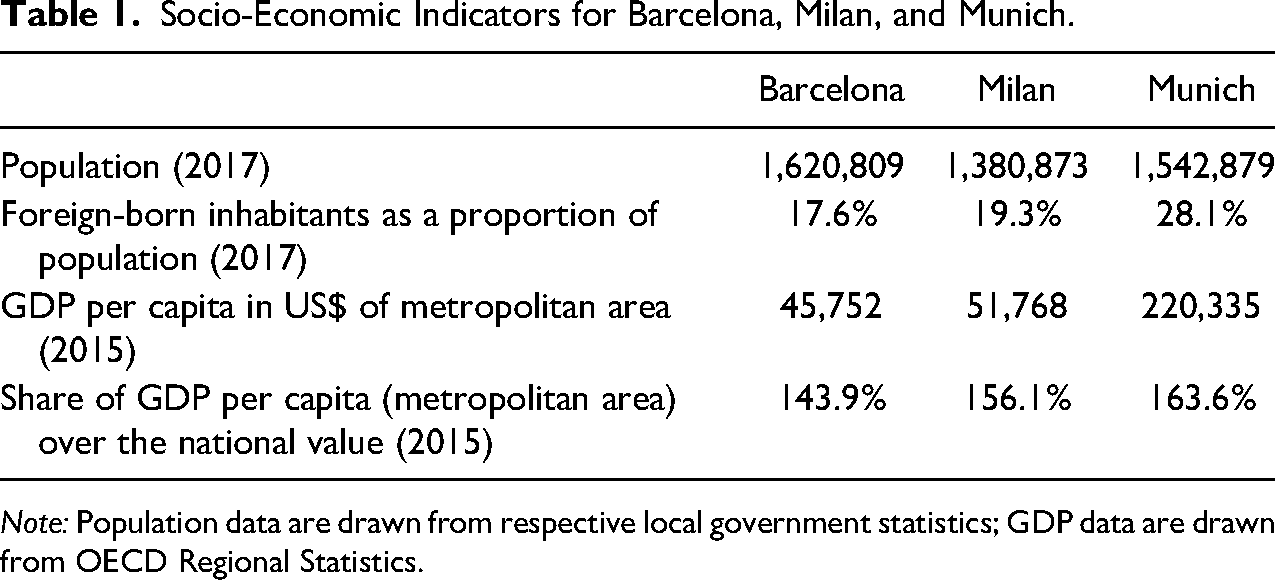
Note: Population data are drawn from respective local government statistics; GDP data are drawn from OECD Regional Statistics.
These three cities intensely experienced the “refugee crisis.” Milan assisted around 130,000 forced migrants during the 2013 to 2018 period (Comune di Milano 2017). Most of these migrants arrived to Milan’s railway station between 2014 and 2016 in an attempt to move toward their preferred destinations in Northern Europe (Pogliano and Ponzo 2017). From 2014 to 2018, 1.8 million forced migrants reached Germany (Eurostat 2020). In the autumn of 2015, most of these migrants passed through Munich’s railway station (12,000 of them did so on 12 September 2015 alone). 1 The German asylum system accommodated roughly 21,500 refugees in the city between 2012 and 2016 (Office for Intercultural Work Munich 2018, 22–23). Barcelona’s government assisted 16,739 asylum-seekers in the 2013 to 2018 period (Ajuntament de Barcelona 2019). While seemingly modest, this figure has increased dramatically year upon year (e.g., 424 in 2013 and 7433 in 2018, i.e., +1653 percent in five years). The majority of these migrants, many of whom originate from Latin America, were not in transit.
While sharing significant similarities in their demographic, economic, and societal contexts, the three cases possess significant variations in terms of the explanatory factors of our conceptual framework—namely, the horizontal and vertical dimensions of MLG. As the empirical section shows, these differences are crucial for explaining why and how urban asylum policies vary across the cases. Although solidarity initiatives promoted by both civil society actors and local officials have mushroomed in all the three cities, the eventual policy responses manifested in very different forms. We will first describe the case of Barcelona, which is an exemplary case of insurgency in urban asylum policy-making. Next, the “intermediate” case of Milan illustrates how insurgency can be employed as an occasional response in the face of a humanitarian emergency. Last, the case of Munich illustrates how, within the context of a capable national asylum system, urban policy-makers are more likely to pursue solidarity initiatives without resorting to any acts of defiance.
We collected data within the context of two different research projects. For Milan and Barcelona, results draw on fieldwork carried out during 2017 to 2019 and include 57 semi-structured interviews (32 in Barcelona and 25 in Milan). Data on Munich (including seven interviews) were collected from 2019 to 2020 for this study in light of the theoretical relevance of comparing these three cases. We (re-)analyzed all of the empirical materials based on the conceptual framework presented above. We selected the interview partners with a view to ensuring sufficient variety within the cases and between them, and to do justice to case specific peculiarities. Interviewees include city and regional officials, elected politicians, civil society representatives, and experts, to capture diverse perspectives and environments. To ensure anonymity, we cite interviews by referring to the first letter of the relevant country (S = Spain; I = Italy; G = Germany) and a number (cf. the Appendix for the list of interviews). We also extensively analyzed academic articles, policy documents, evaluations, and media reports.
The Case of Barcelona: Urban Asylum Policies as Acts of Insurgency
Spain’s Asylum System and its Implications for Local Governments
Spain became the main European port of entry for forced migrants in 2018 (UNHCR 2020). In the face of rising numbers of asylum applications (e.g., 2,588 in 2012 and 53,000 in 2018), the central government strengthened the resources of the Reception and Integration System (Sistema de Acogida y Integración—SAI). Notably, the available slots for asylum-seekers’ reception increased from 930 in September 2015 to 8,776 in October 2018. These importance changes, however, did not go hand in hand with an overall rethinking of intergovernmental relations. The Ministry of the Interior regulates the refugee status determination, whereas the Ministry of Employment and Social Affairs is in charge of asylum-seekers’ reception. Within Spain’s highly centralized governance system, the formal prerogatives of sub-national authorities were, and remain, nonexistent (for an excellent assessment, see Garcés Mascareñas and Moreno Amador 2019).
Despite (or precisely due to) their lack of formal competencies, Spanish municipalities covered the lion’s share of the reception and integration of forced migrants, even before 2018. While the verdict on asylum requests takes up to three years, the national integration program lasts between 18 and 24 months. Thus, migrants may finish their integration process while their applications are still pending—possibly becoming undocumented if the request is eventually rejected. Also, implementation stalemates occur even before the submission of applications because of the insufficient capacity of front-offices to receive migrants. In short, local communities have faced major issues related to deficiencies in Spain’s asylum governance. Recent research on Barcelona demonstrates that the saturation of the housing market and the collapse of the reception system resulted in extremely high levels of migrants’ homelessness in the city (Ribera Almandoz, Delclós, and Mascareñas 2020).
Urban Asylum Policies in Barcelona
Barcelona’s government mostly responded to the condition of forced migrants by voluntarily establishing an urban asylum system that works independently of the nation-state. In September 2015, the local government launched a policy program called Barcelona Refugee City (Barcelona Ciutat Refugi— BCR). The city explicitly framed it as a plan to counter the holes in asylum policy of supralocal institutions at the city-level.
While originally conceived as an emergency plan to face the prospect of an impending humanitarian crisis, BCR eventually took the form of a stable system for the reception and integration of newcomers and migrants already settled in the city (cf. Garcés Mascareñas and Gebhardt 2020, 5–6). The BCR implements integration services through a pre-existing municipal structure called the Care Service for Immigrants, Emigrants and Refugees (Servei d'Atenció a Immigrants, Emigrants i Refugiats—SAIER). SAIER serves as a one-stop office funded by the city government and outsourced to civil society organizations, who also played a decisive role in policy formulation. Other services under this office include the Nausica program, which aims to support the integration of extremely vulnerable migrants who are excluded from the SAI. From 2013 to 2018, SAIER increased the number of asylum-seekers it provided service to, from 424 to 4405 ( +1653 percent). The city government earmarked roughly EUR 6 million of its own resources to fund the BCR program during its first three years (ibid.), without financial or organizational support from the nation-state.
To compensate for the lack of meaningful coordination with national authorities, municipal officials have made sustained efforts to build an international network of cities and NGOs. An example of these efforts is the attempt to resettle migrants from the rest of Europe to Barcelona skipping over the Spanish executive who has had limited commitment to the EU relocation mechanism. For instance, in March 2016, the city government reached a pre-agreement with the mayor of Athens to resettle 100 migrants in Barcelona. Although the municipality expressed its own willingness to cover the expenses surrounding their reception, Mariano Rajoy (prime minister and leader of the conservative Partido Popular) did not give state approval.
While there have been meager concrete results, international networking has been extremely influential in terms of agenda-setting. Ada Colau, the mayor of Barcelona, was the main promoter of the initiative “Cities of Refuge” (Ciudades Refugio). This initiative aimed to drive policy change at the national and European levels. Fifty-five Spanish left-wing municipalities joined the network soon after its launch in August 2015, including Madrid, Valencia, and Zaragoza. But these endeavors traveled beyond the boundaries of Spanish politics. In September 2015, Colau released a manifesto entitled, “We, the cities of Europe” (Ajuntament de Barcelona 2015). The manifesto was prepared together with Anne Hidalgo (mayor of Paris), Spyros Galinos (mayor of Lesbos), and Giusi Nicolini (mayor of Lampedusa), and it denounced the humanitarian emergency in the Mediterranean Sea, calling European institutions “not to turn their backs on the cities, to listen to the outcry coming from them” in their attempt to welcome migrants. Also, on 9–11 June 2017, Barcelona hosted the first International Municipalist Summit of Fearless Cities, a global network of progressive municipalities. The policy roundtable on immigration launched on the following statement: “While States build walls and fences, cities and towns are welcoming refugees and providing spaces of sanctuary to undocumented residents” (quoted in Bazurli 2020, 26).
The Multi-Level Governance of Asylum in Barcelona
The MLG context in which urban policy-makers operate has influenced the policy outcomes described above. Since 2015, the year that marked the peak of the “refugee crisis,” Barcelona’s government has been ruled by Barcelona in Common (Barcelona en Comú – BeC), a political platform coalescing movements and parties on the radical left. Its success at the ballot box can be viewed as the long tail of the 15M/Indignados movement, which emerged in 2011 and inspired similar “square movements” worldwide, such as Occupy Wall Street. Immigrants significantly buttressed the emergence of BeC, mostly because of their massive participation in housing struggles, of which Colau was a prominent spokesperson of until her candidacy in 2014. BeC’s government agenda on immigration has a quite radical and contentious profile, as exemplified by the attempt to shut down Barcelona’s Immigrant Detention Center—an institution under the sole jurisdiction of the nation-state. BeC’s administration has received praise because of its radical-left ideology, its insistence on the democratization of urban politics and policy, its persistent challenging of Spanish authorities over a variety of policy issues, and its role as perceived spearhead of a new municipalist movement at the global level (Russell 2019; Thompson 2020; Bazurli and Delclós 2022).
Within this context, the government of Barcelona’s approach to asylum policy has consisted in both pressuring and circumventing the national state. Interactions with the Spanish executive have been mostly of a confrontational nature and have scarcely been productive. Therefore, precisely to bypass this lack of receptiveness, the city government resorted to engaging in (vertical) venue-shopping, i.e., by crafting a “self-sufficient” urban asylum system and by weaving (inter-)national networks as alternative sites of policy-making. As stated by a member of the city government, [t]he political objective is to create a municipal counterbalance to a national policy. […] Multi-level governance does not exist here. Zero. We insisted in talking with the State for two years […] but we obtained a far larger opportunity for coordination through the municipal network of Spanish and foreign cities than with the central government. (Interview S11)
This strategy has been pursued “in tandem” with civil society. For instance, the campaign “We Want to Welcome” (Volem Acollir) has targeted the EU and the Spanish governments for their lack of commitment to migrant protection. The confrontation climaxed in an extremely large demonstration staged on 18 February 2017, in which roughly 500,000 people participated. Importantly, the campaign not only united activists from civil society; city officials were also among its promoters and spokespersons.
These conflictual interactions across government tiers were strained even further by the mobilizations escalated in the 2010s for Catalunya’s attempt to secede from Spain—the so-called Procés (cf. della Porta and Portos 2021). Since 2012, the regional government of Catalunya has been led by pro-independence parties that range from the radical left to the center-right, which have been galvanized by the common prospect of secession. These parties have also embraced radical pro-migrant stances. However, it is possible that this is for the sake of broadening their electoral support among left-wing voters while articulating a line of conflict between Catalan and Spanish authorities. Accordingly, despite the different political colors, both city and regional officials, in cooperation with local civil society, played a decisive role in pushing for the reform of Spain’s asylum system. The Catalan government has even brought the Spanish executive to court for reclaiming competencies over migrants’ integration. As reported by Garcés Mascareñas and Moreno Amador [i]n January 2018 the Madrid’s High Court of Justice ruled in favor of the Catalan government, which means not only the restructuring of the financing but also the redefinition of the reception system itself, implying more decentralization and therefore the need for a formal redistribution system of asylum seekers across the national territory. (2019, 3)
The Case of Milan: Temporary Insurgency in the Face of a Humanitarian Emergency
Italy’s Asylum System and its Implications for Local Governments
Italy provided a significant share of humanitarian assistance amid the so-called “refugee crisis.” In the aftermath of the “Arab Spring,” vast numbers of migrants from the Global South landed in Italian territory or lost their lives trying to (657,588 and 16,012, respectively, in the 2014 to 2019 period, cf. UNHCR 2020). This hardship was magnified by the EU Common European Asylum System, which prescribes that asylum-seekers should request protection in the first country of arrival and settle there until the end of the procedure. Italy made tentative steps toward a stable and far-reaching asylum system through the 2015 “Reception Decree” (Campomori and Ambrosini 2020), which allocated competencies across government tiers. National authorities took charge of first aid and identification procedures at landing points and first reception in emergency accommodation centers. Also, this decree tasked municipalities, in cooperation with NGOs, with managing the ordinary instrument for integration, named the Protection System for Asylum Seekers and Refugees (Sistema di Protezione per Richiedenti Asilo e Rifugiati—SPRAR), which received wide praise for being effective and respectful of human rights.
The 2018 “Security Decree I,” a legislative provision aimed at restricting asylum rights and criminalizing migrants and their supporters, dismantled many of these arrangements (Bazurli, Campomori, and Casula 2020). Accordingly, the already deficient standards of first reception further deteriorated. The two-year “humanitarian protection status” was replaced with various “residence permits for special cases” and a “special protection status,” which have illegalized the status of approximately 37,000 migrants as of July 2020 due to their more restrictive criteria. Finally, except for unaccompanied minors, only successful asylum applicants have been granted access to SPRAR services. 2 This means that migrants with a pending application have nearly no access to integration programs. Hence, the “Security Decree I” drastically narrowed the most “virtuous” component of Italy's asylum system as well as the role of local government in asylum governance. Yet, paradoxically, municipalities now shoulder a greater burden of integration, as they have to meet the needs of a growing, highly precarious population (e.g., rejected asylum-seekers) while only having shrinking resources at their disposal to do so.
Urban Asylum Policies in Milan
At the outset of the “Arab Spring,” Milan's Central Railway Station became an informal camp for migrants in transit to northern Europe. The situation escalated in 2014 when more than 50,000 people arrived in the city, and there were peaks of almost 1,000 people a day. The city government's response revolved around two main policy axes: complementing and circumventing supralocal policies. First, the municipality expanded the capacity of nationally-managed infrastructures through various concessions from the national authorities. In October 2014, Milan’s immigrant detention center was converted into a shelter for migrants in transit. Later on, between July 2015 and April 2016, a large and relatively well-equipped reception point was established near the railway station. This gradual enlargement of the urban asylum system occurred under a framework agreement with the prefecture (prefettura, the Ministry of Interior’s local branch) that granted the municipality exceptional resources and greater autonomy in the management of facilities (Pogliano and Ponzo 2017, 24).
Second, Milan obtained room to maneuver through its non-compliance with national and EU immigration laws. These laws forbid migrants from accessing Italy’s reception system without first filing an asylum request in its jurisdiction. The municipality resorted to the “Apulia Law,” 3 approved in the 1990s to receive Balkan migrants fleeing war, as a legal loophole to host migrants in transit in spite of this prohibition. In doing so, Milan’s asylum policies targeted a population that was “illegal” from the perspective of the nation-state (cf. Artero 2018). Even more strikingly, as national law provides that foreigners must request protection within eight days of arrival, the municipality purposely refrained from identifying the people that it hosted for less than eight days (as was most often the case). This leniency allowed these migrants to leave the country before being identified, de facto eluding the Dublin Regulation. As a city official put it, the city government created “a humanitarian channel, actually not authorized by the central government and the EU” (I13).
Arrivals diminished after 2016. The humanitarian crisis left the legacy of a stable and far-reaching urban asylum system that hosted more than 6000 migrants in the city in July 2017 (Comune di Milano 2017). The plight of forced migrants in the city, however, has worsened since then. As reported by Artero and Fontanari (2021), Milan’s police headquarters have increasingly compressed migrants’ rights through the application of arbitrary bureaucratic criteria at its front offices and the aggressive policing of people of color in public spaces. As the next paragraphs clarify, these practices have sought to align urban governance arrangements with the securitarian turn in national politics.
The Multi-Level Governance of Asylum in Milan
Milan’s response to the 2013–2016 humanitarian crisis has to be interpreted in light of the weak planning capacities and the logic of emergency permeating Italy’s asylum governance. Local officials felt the urgency to bypass what they perceived as a severe institutional constraint to cope with a rapid and far-reaching societal transformation. In their eyes, overstepping their jurisdictional boundaries was the only viable strategy for pursuing this objective. One leading administrative figure describes this decision-making process well: That phase has been extremely troubled, strenuous, filled of doubts […] Ambiguity has been… enormous! […] After all, we somehow allowed people to move to northern Europe outside of any rules. […] But what is the role of a local government in face of this kind of situations? To support people, or not to? The real problem is that the state did not take any stance on these issues until 2015, and thus left local governments alone […] in taking decisions that, perhaps, were out of our reach. […] We chose to take responsibility for organizing the reception of these people in the best possible way. (Interview I22)
To be clear, local officials did not operate above the law. Instead, they exploited the gray areas of national legislation so as to carve out a legal cover for circumventing specific obligations.
These inter-institutional dynamics would have been virtually impossible without a set of driving forces at the city-level. A center-left coalition led by the Partito Democratico (Democratic Party) commanded Milan's government. Giuliano Pisapia, city mayor from 2011 to 2016, has a leftist militancy background and his successor Beppe Sala expressed the desire for substantial continuity in terms of political personnel and agenda. The two mayors pursued agenda-setting strategies to bring their national-level counterparts to the bargaining table. For instance, Beppe Sala made national headlines on 19 September 2016. In a letter sent to the Italian newspaper La Repubblica he emphasized how “Milan is doing everything in its means” to cope with the crisis and called on the national government to “ease the huge weight on the shoulders of cities.” 4 Importantly, local officials benefited from grassroots participation to strengthen their position in supralocal arenas. The role of Pierfrancesco Majorino, Deputy Mayor of Social Policies, is particularly illustrative. He was the “mastermind” behind the campaign “Together Without Walls” (Insieme Senza Muri), which culminated on 20 May 2017 in a massive pro-migrant demonstration co-organized by local officials and activists.
The 2015 to 2017 period marked a watershed in Italy’s migration politics. Left-leaning national incumbents gradually conformed to the security-oriented discourse of their right-wing opponents. They limited the opportunities for rejected asylum-seekers to file an appeal, extended the deportation system, obstructed NGO-led search and rescue operations in the Central Mediterranean, and averted departures from Libya by signing deals with local authorities, smugglers, and militias. Amid this securitarian escalation, Milan’s government mostly maintained a pro-migrant stance. They mainly interacted with the Italian executive (of the same political color) through negotiations that took place “behind closed doors.” However, since 2018, inter-institutional conflicts have intensified following the appointment of Matteo Salvini, the leader of the far-right Lega (League) party and main author of “Security Decree I” as Minister of Interior. Many (overwhelmingly left-leaning) Italian mayors catalyzed the contestation of, and threatened to disobey, Salvini’s immigration crackdown on humanitarian and constitutional grounds. 5 However, most of these mayors, including Milan’s, eventually refrained from taking any concrete actions following their declarations of intent. The relationship with a section of Milanese activists thus deteriorated because they accused the city government of being too conformist and opportunistic in exploiting their participation.
The Case of Munich: Urban Asylum Policy-Making Within the Confines of German Federalism
Germany’s Asylum System and its Implications for Local Governments
The reception of over 1.2 million forced migrants in 2015 and 2016 challenged the German asylum system. With the exception of in 2015 and 2016, the German asylum system processed between 125,000 and 225,000 asylum seekers since 2013 and below 100,000 asylum seekers before 2013 (Eurostat 2020). The overwhelmed capacity of the German asylum system led to backlogs in registering and proceeding asylum seekers. In normal times, the federal government is responsible for processing and deciding on asylum applications. Asylum seekers do not have a choice as to where they want to live. The federal government assigns them to different Länder on the basis of a distribution formula. The Länder finance the accommodation and welfare of migrants in their territory, and they delegate their accommodation and welfare to municipalities (Schammann and Kühn 2017; Thränhardt and Weiss 2017).
During the “refugee crisis,” many Länder, municipalities, civil society organizations, and individual residents increased their efforts to guarantee the reception and initial care of asylum seekers (Thränhardt and Weiss 2017; Mayer 2018). In these first months, municipalities concentrated on ensuring migrants had access to accommodation and emergency aid, while looking to integration policies in the long run (Gesemann and Roth 2016).
Urban Asylum Policies in Munich
Munich has had its own asylum integration policy agenda since the 1990s. The so-called Munich Way in Refugee Policy (Münchner Weg der Flüchtlingspolitik) focuses on the rapid integration of all asylum seekers. This policy rationale differs from national or state integration policies that only want to invest in integration after forced migrants receive a positive humanitarian protection status.
In autumn 2015, Munich and its main train station served as hotspots for forced migrants who wanted to either lodge an asylum application in Germany or travel through Germany to seek asylum in Nordic countries. There was a very visible engagement of residents and civil society organizations at the main station who helped receive and welcome the arriving forced migrants.
In the aftermath of the initially overwhelming situation, the social democratic mayor of Munich, Dieter Reiter, initiated a local asylum policy reform in 2016 (Münchner Gesamtplan zur Integration von Flüchtlingen; see, Office for Intercultural Work Munich 2018). The aim of this reform was to integrate the many existing services available to forced migrants and to thereby identify integration needs that were not yet sufficiently addressed through these services. The goal of the city was to try to fill gaps and to provide additional services to integrate forced migrants. A city official recalls that this reform effort was an extraordinary experience because all the central actors that are involved in the integration of migrants in Munich have been actively participating in the creation of the policy reform (…) with the goal to create comprehensive integration services to best meet our goal of integrating people from day one. (Interview G4)
These actors included refugee-focused NGOs, private sector organizations and representatives from the national, state, and city government. This policy reform deliberately sought to comply with the German and Bavarian legal migration frameworks.
The Multi-Level Governance of Asylum in Munich
Munich’s city administration was the central actor that coordinated the integration policy reform, and it was the actor that mediated policy conflicts between supralocal governments and local NGOs. Munich is traditionally a stronghold of the Social Democratic Party (SPD), who has governed Munich almost uninterruptedly since the end of World War II. Dieter Reiter became city mayor in 2014. In the 2014 election, the conservative Christian Social Union (CSU) replaced the Green Party as SPD’s coalition partner in the city executive; however, this did not bring about any major changes to Munich’s migration policies (Gebhardt 2016).
Munich has many active civil society organizations that support forced migrants. Some of these organizations grew following the events in autumn 2015. These civil society organizations have organized themselves into umbrella organizations (for example MORGEN or Wilkommen in München). These umbrella organizations coordinate assorted civil society initiatives in dialogues with public actors. Civil society organizations mainly cooperate with the city given that their relationship with the high-tier structure of Land Bavaria is absent or conflictual. A civil society representative explains that some civil society organizations get funding from the Land Bavaria for providing services to forced migrants; “nevertheless, we’re not bound to the restrictive asylum policy of the Land and can get active mostly within the city of Munich” (Interview G5). Other civil society organizations do not get into contact with Bavaria, as they “are their biggest critics” (Interview G3). Thus, civil society organizations are crucial actors in Munich’s asylum policy formulation and implementation.
Munich’s asylum policy reform deliberatively aims to surpass the integration services offered by the federal and Bavarian governments. The city covers the financial load for these additional services. A city official explains that these additional finances “pose not much of a problem as Munich is financially very well-situated and has a well-functioning labor market” (Interview G4). Another city official explains that funding for labor market integration is available as there is a broad consensus between local political actors that “resources invested in the labor market integration have been paid off after a short time” (Interview G6). The city also receives funding from the EU through the European Social Fund (ESF) for their integration services. The provision of additional integration services was, on the one hand, possible because Munich is financially well-situated and, on the other hand, because Munich is involved in several EU projects that are funded by the ESF.
The scope and the content of Munich’s asylum policy is constrained by federal and Bavarian legal frameworks. Supralocal policies do not often align with Munich’s policy goals: “The restrictive asylum policies go against the integration efforts of Munich, […] the continuing limitations for example as to who has access to integration courses, is counterproductive for the process of integration” (Interview G6). This can lead to intergovernmental conflicts, but these conflicts have never openly erupted. The Land Bavaria wants to exert control over Munich’s asylum policy through the district government of Upper Bavaria (Oberbayern), the district is in charge of checking whether the city’s asylum policies are in line with Bavarian policies. The city also tries to influence nation-state policies in these MLG settings. The mayor and the city administration have urged the district government to improve living conditions in the state-led refugee centers in Munich, as well as in the state-led first reception centers. However, the city of Munich has never taken an open stance against supralocal asylum policies.
To sum up, the events of 2015 led Munich’s mayor to put together a comprehensive asylum policy reform focused on integrating forced migrants by strengthening and extending existing local integration structures and services. The involvement of all central actors in the formulation of this policy reform, its focus on integration, the compliance of the city of Munich with supralocal policies as well as the rather consensual politics within MLG settings are key characteristics of Munich’s asylum policy.
Discussion: Varieties of Urban Asylum Policy-Making in Barcelona, Milan, and Munich
Although local governments do not normally have any formal authority in asylum governance, European cities have been at the forefront of support for forced migrants amid the “refugee crisis” of the 2010s. Some cities even broke with the formal line of authority—refusing to comply with, and sometimes overtly subverting, the prescriptions of national governments. The discrepancy between the formal allocation of responsibilities and the reality of governance makes urban asylum policies a relevant phenomenon to study, and it problematizes the “nation-state” biases in prevalent political theories. Our central argument is that the willingness of local governments to commit acts of insurgency against the nation-state depends on the horizontal and vertical dimensions of MLG, which capture city-level political dynamics and intergovernmental interactions, respectively. We theorize that city governments leverage the opportunities and constraints that ensue from these two dimensions: in the first case they are eager to exceed their competencies when urban politics make it strategically convenient, and in the second case, they act when they feel the urgency to remedy the ineffective or unjust asylum policies of supralocal institutions.
To illustrate our conceptual framework, we present a comparative case study of urban asylum policy-making in three large European cities: Barcelona, Milan, and Munich. During the 2010s, all three cities took an accommodative stance to support forced migrants. Moreover, our findings demonstrate that urban asylum policies can, in fact, vary based on their insurgent or non-insurgent character. Table 2 summarizes the main findings.
Main Comparative Findings.
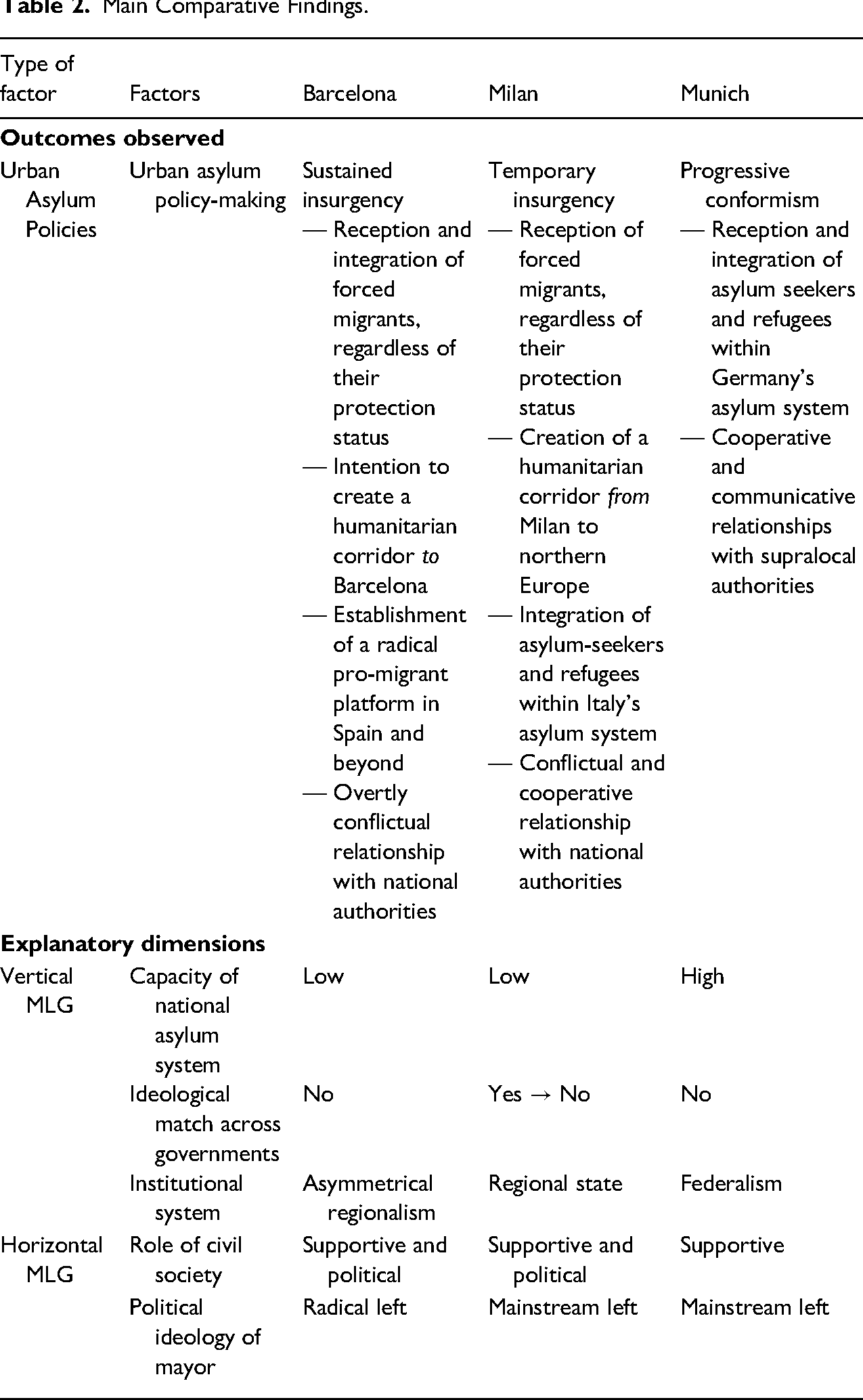
Munich’s city government focused on integrating forced migrants through supplementary integration services. These integration services, however, did not undermine the directives of Germany’s asylum system. Emerging policy problems were rapidly tackled through “orderly” cooperation between national authorities, the Länder, and municipalities. Hence, Munich represents a case of progressive conformism in urban asylum policy-making. Conversely, Barcelona’s and Milan’s governments subverted and ignored national and EU prescriptions on policies. Barcelona’s administration launched its own humanitarian protection program, which aims to boost local services and to resettle asylum-seekers across Europe, independent of national authorities. Milan expanded the capacity of nationally-managed reception infrastructures and, more strikingly, took important decisions about not checking the identification of forced migrants, thereby defying applicable EU asylum laws. In these ways, the two cities supported migrants deemed to be “illegal” (or at least not entitled) in the perspective of supralocal authorities and sought to foster their access to humanitarian protection, which is technically the prerogative of national authorities. We explain these different urban policy responses to the “refugee crisis” in view of the available capacities of national asylum systems, the mobilization of civil society actors, as well as the strategic agency of city governments to navigate the constraints and opportunities that ensue from MLG.
Further insights emerge if we zoom into the examples of the two insurgent cities of Milan and Barcelona. In Milan, forced migrants in transit could benefit from the assorted welfare services provided by the city, however the city’s violation of EU and national laws was ultimately aimed at letting migrants leave the city. Local officials maintained a progressive stance in the long term; but they refrained from engaging in further acts of defiance—thus exemplifying a case of temporary insurgency in the face of a humanitarian emergency. This is particularly evident when looking at the confrontational attitude adopted toward Matteo Salvini, leader of the far-right Lega party, and Minister of Interior from 2018 to 2019. The city government threatened to suspend the anti-immigrant laws he authored—despite not actually taking concrete measures to do so. In Barcelona, insurgent asylum policy-making has been far more ideological. The city government—a quite unique experiment of movement-party coalition on the radical left—has been guided by the prospect of radically transforming EU migration governance and imagining new possibilities of belonging at the city-level (cf. Bauder 2016). This explains the mostly opposite demand from the Barcelona government to Spanish authorities in favor of hosting more migrants, i.e., to let them come to the city. Thus, we can label migration policy-making in Barcelona as a case of sustained insurgency.
Aside from these differences along the vertical dimension of MLG, the role of robust, well-connected, and highly mobilized civil society organizations was decisive for profound urban asylum policy-making in all three cities. First, these actors provided indispensable material, cognitive, and human resources for far-reaching policy responses, especially in the midst of humanitarian emergencies, as exemplified by solidarity initiatives at Milan’s and Munich’s railway stations. Second, civil society played an influential role in setting the political agenda—especially through large pro-migrant demonstrations. These latter have incentivized left-leaning city officials to be responsive toward protestors who presumably belonged to their constituency and who could provide resources to be invested in multi-level negotiations. In turn, activists exploited this responsiveness to push their demands into the institutional space. Alliance-building among urban actors was thus a strategy for securing political gains while shaping policies within an otherwise unreceptive, hostile context.
City governments operated at the intersection of urban politics (horizontal dimensions) and institutional authority (vertical dimension). Due to their strategic position, they could leverage opportunities across the horizontal and vertical dimensions of MLG. Horizontally, they galvanized their voter base by championing a pro-migration agenda and then crafted a large and cohesive coalition around a progressive political vision. Vertically, they capitalized on local supporters to pressure or circumvent their supralocal counterparts. Ada Colau, mayor of Barcelona, succeeded in establishing an international network of cities and NGOs and thus in creating an alternative policy venue. In Milan, the humanitarian emergency opened a window of opportunity for city officials to strengthen their progressive credentials by constructing a conflict between a “common front” (i.e., urban actors) and a “common enemy” (i.e., the upper tiers of government). In Munich, the city government was the driving force in policy-making, operating as a mediator between the Bavarian government and local civil society organizations.
Conclusion: Insurgent Asylum Policies as a Vital Ingredient of New Municipalism?
Our comparative case study reveals that cities do not necessarily reproduce the logics inscribed in supralocal restrictive policies. By connecting the urban polis to the global cosmopolis (Magnusson 2013) through a politics of proximity (Russell 2019), insurgent asylum policies make a powerful case for the city “as a space that challenges the exclusions perpetrated at the scale of the nation-state” (Darling and Bauder 2019, 4). The main rationale behind the choice to analyze Barcelona, Milan, and Munich was to explain varieties of urban asylum policies through a novel conceptual framework that integrates different scholarly perspectives. Caution is thus needed when it comes to the generalizability of findings across other geographical and temporal contexts. We contend, however, that insurgency may become an ever more ordinary feature of pro-migrant policy-making as a consequence of restrictive national migration regimes, and of the rampant nativism informing them.
Other European cities have indeed taken similar initiatives to support forced migrants. Naples and Palermo directly opposed Salvini’s policies by declaring that their harbors would remain open to forced migrants seeking to reach Italian shores. In Germany, 143 local governments joined the Seebrücke movement that demands freedom of movement for those encamped in Greek islands and elsewhere across the Mediterranean Sea (Schwiertz and Steinhilper 2021). 6 Moreover, various European cities pursue insurgent policies and practices that address the precarious situation of irregular migrants. These policies and practices range from trying to develop or expand residency rights to facilitating access to various city services (Kaufmann et al. 2021). The future will show whether such urban migration policies are limited in time (during extraordinary moments of humanitarian crisis) and space (to affluent, cosmopolitan, well-resourced cities, and/or to cities with high level of migration policy-making autonomy). Yet, it may be that insurgent asylum and migration policy-making could become an essential feature of a new municipalist movement at a global level, a strategy for which Barcelona has been praised as the bulwark (Russell 2019; Thompson 2020).
This article contributes to different strands of the existing literature. Lying at the intersection of multiple disciplinary perspectives, it builds a conceptual framework to study urban asylum policies that is hopefully informative for and applicable by urban scholars studying other empirical cases. By doing so, we make a substantial effort to enhance the explanatory potential of the MLG approach to migration and urban studies (cf. Caponio and Jones-Correa 2018). Our conceptual framework goes beyond classic theorizations of intergovernmentalism and federalism, which generally assume state power to be orderly structured in multi-level governmental hierarchies (Alcantara, Broschek, and Nelles 2016). We conceptualize and illustrate that the vertical and horizontal dimensions of MLG, with city governments situated at their intersection, are influential in driving different outcomes in urban asylum policy-making.
More broadly, this article analyzes the urban scale as an arena where state/societal boundaries tend to blur, and where city governments and civil society organizations collaborate to stretch, oppose, and possibly subvert unwanted supralocal policies (cf. Bazurli 2020; Verhoeven 2021). Instances of insurgent policy-making help us to decenter the nation-state from (migration) policy analysis by “seeing like a city” (Magnusson 2013; Kaufmann and Sidney 2020). Cities are more than the lowest level of policy-making; they are sites of distinctive, transformative political processes, where discourses and displays of solidarity can be imagined, designed, implemented, and transposed to other localities or government tiers—well beyond their immediate local realms.
Footnotes
Acknowledgments
We wish to thank Tiziana Caponio, Els de Graauw, Maximilian Filsinger, Miriam Haselbacher, Tihomir Sabchev, Dan Ziebarth, two anonymous reviewers, and the Editors of the Urban Affairs Review for excellent feedback on the paper. We are also honored that the paper has received the award for the “Best Paper in Urban or Regional Politics” presented at the 2020 American Political Science Association’s Annual Meeting & Exhibition. We are especially grateful to Dominique Strebel, who helped us conducting fieldwork on the case of Munich, and to all the interviewees who have participated in this research. Part of this research has been carried out within the framework of the research project ‘De-bordering activities and citizenship from below of asylum seekers in Italy: Policies, practices, people’ (PRIN-ASIT).
Declaration of Conflicting Interests
The author(s) declared no potential conflicts of interest with respect to the research, authorship, and/or publication of this article.
Funding
The author(s) disclosed receipt of the following financial support for the research, authorship, and/or publication of this article: Funded by the Italian Ministry of Education, University and Research.
