




Abstract
When countries are impacted by a crisis, comparisons at the national level are often drawn. Whilst useful, this approach fails to explore how local measures are enacted alongside centralised responses. This paper addresses that gap by examining England’s intergovernmental response to the Covid-19 pandemic. With a focus on multi-level governance (MLG) and resilience theories the paper explores how tiers of government respond to the demands of the crisis. The focus is primarily on the responses of those involved with responding to the economic crisis with a recognition of the interlinked health and environmental crises. Adopting a case study approach, which included some of the areas hardest hit by the pandemic, the paper asks whether the application of MLG provided a resilient system to the shock of the pandemic. The findings illustrate local government sought to respond quickly, but decision-making was too often centrally controlled rather than devolved to the most appropriate scale. The paper draws lessons for how England might think constructively about its post pandemic reorientation considering the adaptation of intergovernmental roles and subnational governance that permits greater devolution to facilitate place-based recovery. Drawing on the knowledge gained throughout the pandemic, the paper argues that to Level Up in England and address the long-term economic and societal imbalances will demand a place-based recovery model.
Introduction
Covid-19 represents the largest global crisis in generations and its impact will be both long lasting and far reaching. There is a small but growing body of conceptual and empirical research across policy and academic circles that seeks to understand how states have responded to the crisis and are beginning to adapt to life post-Covid. Comparisons have been drawn at the national level to critique state responses (Benton, 2020; Jüptner and Klimovský, 2021; Kuhlmann and Franzke, 2021; OECD, 2020; Ren, 2020) and, whilst central government has a critical and often leading role to play in response planning across different policy areas, this approach fails to capture any subnational data to understand local measures and nuance. Crises impact locally and so local government agencies and organisations with their locally embedded knowledge, skills and networks have a crucial role to play in ensuring both the resilience of local places to a crisis and their subsequent recovery.
This paper examines England’s intergovernmental response to the Covid-19 pandemic crisis with a focus on resilience and multi-level governance (MLG) theories to explore how the tiers of government were able to respond to the demands of the crisis. The focus is primarily on the responses of institutions tasked with responding to the economic crisis with a recognition of the interlinked health and environmental crises.
The pandemic has demanded a response from a local government sector reduced in capacity after a decade of austerity policy, greatly impeding its ability to respond and cope with the demands of the crisis at the local level. The paper draws on the findings of an empirical study using a series of 15 semi-structured interviews with a range of key stakeholders from some of the areas hardest hit by the pandemic in the North East (NE), Tees Valley (TV) and East Midlands (EM) to consider whether the application of MLG in an English context provided a resilient system that enabled institutions and ultimately the communities they serve to absorb the shocks of the pandemic.
The findings illustrate that local government and community-based services sought to respond quickly and collaboratively to the evolving demands of crisis. Despite years of austerity, they were able to draw on their reserves of human and social capital to react to the needs of local businesses and communities. However, that response was clearly restricted by ongoing governance problems in England where central–local government relationships remain complex. Decision-making was too often centrally controlled rather than devolved to the most local scale capable of responding, revealing a reluctance to decentralise governance.
The paper begins with a review of the relevant literature on the theory of resilience, highlighting the key components of a resilient social-ecological system that can sustain shocks, adapt and recover. These are summarised into a series of principles and propositions. A short explanation of England’s complex system of governance provides context and is followed by an explanation of the methodological approach to the data collection and analysis. The findings are organised around the principles and propositions and are followed by a discussion and conclusion that draws lessons for how to think constructively about intergovernmental and subnational government roles and how that knowledge could be used to address the long-term societal challenges that will be key to a sustainable recovery.
Resilient places: Establishing key theoretical principles
The paper uses resilience theory to explore the ability of localities to absorb and respond to the stresses and shocks of the Covid-19 pandemic. There has been a dramatic rise in the application of resilience thinking across a wide range of disciplines beyond its evolution in ecology, including application to the fields of economic geography and regional studies (Martin and Gardiner, 2019; Martin and Sunley, 2015).
The notion of resilience refers to the extent to which a place or ecosystem is able to withstand, absorb and adapt to shocks or disturbances to that system (Holling, 1973). The term resilient place can be defined as societies that are structurally organised to minimise the effects of these shocks by maintaining and adapting their essential structures and functions. These places are able to respond to and survive potentially catastrophic events such as those caused by natural disasters or the pandemic stemming from the Covid-19 virus. They also have the capacity and capability to reorientate and recover by swiftly acting to restore the socio-economic health of the community.
A full analysis of the application of resilience theory to understand economic shocks is beyond the scope of this paper (see Martin and Sunley, 2015; Modica and Reggiani, 2015 for in-depth analysis), but a summary of its key principles is drawn from the evidence base to frame the subsequent analysis.
Scale matching
This principle relates to the scale at which the disaster response should be located. Following the principle of subsidiarity, central authorities including national government should adopt a subsidiary function, performing only those tasks which cannot be performed at a more local level or are more effectively taken at a regional or national level.
The literature on disaster management calls for clarity about how authority and responsibility are allocated across key disaster management actors. Across multiple studies exploring responses to natural disasters from flood and bushfires in Australia (Melo Zurita et al., 2015), to wildland fires in the European Union (Galiana et al., 2013) and hurricane and flood devastation in the United States (Baker and Refsgaard, 2007), the evidence encourages the response to a crisis or disaster to be matched to the scale of subsidiarity and establishing the most appropriate level at which action is needed, and how to move appropriate resources to those localities impacted by the disaster.
The most appropriate level will vary and may call for regional- or larger-scale management. In the case of the Covid-19 pandemic, which impacted whole countries, conceptually, a centralised command and control structure might appear an attractive and appropriate scale for managing the crisis. However, centralised command runs the risk of being ‘monolithic, rather than integrative’ (Baker and Refsgaard, 2007: p. 334). The ability to respond quickly with what is often referred to as a surge response enables capacity in the form of staff, structures, systems and resources to be directed to where the disaster impacts (Paturas et al., 2010; Therrien, 2017). During the pandemic the surge response would become an important institutional responsibility of organisations with front-line responsibilities including health, emergency services and local authorities.
Data on infections and deaths from Covid-19 in England reveal that the virus impacted local areas differently with clear disparities across regional, local and demographic data (Blundell et al., 2020; Davenport et al., 2020; Martin et al., 2022). A failure to utilise local knowledge and an inadequate understanding of local environments have been highlighted as risks to an effective crisis response that can impede the speed of the response (Galiana et al., 2013; Melo Zurita et al., 2015; Tobin, 1999). Local authorities understand their communities best which discourages the adoption of a centralised, placeless system that might fail to comprehend these place-based nuances in the data (Ayres et al., 2018; Beer et al., 2019; Martin et al., 2022). Mobility, flexibility and the capacity to make critical decisions quickly and accurately are essential characteristics of effective institutions (Beer and Lester, 2015; Berkes and Ross, 2016). The literature demonstrates that determining needs and guiding the response would be better directed by local public authorities who understand their local areas and have the authority and levers to direct local responses quickly.
Human and social capital
The second principle drawn from the resilience literature is the value of human and social capital as a means of building resilience during and post disaster. Human capital provides the resource of individual skills and capabilities that institutions are able to draw on to accomplish their objectives. Institutions involved in responding to disasters depend on a range of human capital in their organisations, particularly individuals with local knowledge. Social capital is equally important and refers to those features of social life including networks, norms and trust that enable participants to act together more effectively to pursue shared objectives (Aldrich and Meyer, 2015; Henry et al., 2011). Social capital networks enable collective action and can provide access to various resources following a disaster that might not be provided externally. These might include information, aid, financial resources and childcare along with emotional and psychological support (Elliott et al., 2010; Hurlbert et al., 2000).
Several studies have investigated the role of human and social capital as a key factor underpinning the resilience of places to disaster and shocks. Disaster scholars have used social capital to understand the trajectory of individuals (based on what resources are accessed through social networks) as well as communities (based on levels of trust, collective action and other public goods) (Aldrich and Meyer, 2015). The evidence demonstrates that the presence of strong social networks enables individuals and communities to secure both financial and nonfinancial resources. Conversely those with low social capital (such as isolated individuals with few social ties) were less likely to act or seek or receive assistance from others (Aldrich and Meyer, 2015). For example Partelow’s (2021) research exploring the post-earthquake response on Gili Trawangan in Indonesia found that social capital provided a means of enabling communities to act together more effectively during and post disaster. Beyond the focus on disaster management, the regional development literature (Hudson, 2010; Martin, 2012; Martin and Sunley, 2015) similarly highlights the ability to repurpose and translate resources and human capital into new firms and job opportunities after a major economic shock as a key element of regional resilience.
Adaptive management
The ability to self-organise, learn from previous shocks and adapt are key elements of resilient systems. The concept of adaptive management (the learning process whereby policies change as experience is gained over time) was first developed in the 1970s (Holling, 1973). It remains relevant as a guide to the adaption of places to shocks. Adger et al.’s (2005) research exploring resilience to coastal disasters globally demonstrated that society’s vulnerability to disasters was influenced by the build-up or erosion of resilience that occurred both before and after a disaster. They argued that resilient social-ecological systems needed to embed a range of mechanisms for living with, and learning from, change and unexpected shocks. However, those mechanisms were often allowed to erode over time post disaster or were intentionally eliminated because their value was not appreciated until a disaster struck.
This has been seen in responses to natural disasters across multiple countries globally, and Walker et al. (2004) argue that although adaptive management has been widely promoted, it has often failed because existing governance structures have prevented it from functioning effectively. Baker and Refsgaard (2007) examination of the response to Hurricane Katrina found that adoption of a public management paradigm that favoured efficiency was in part to blame. Such practices had identified and eliminated redundancy and waste in the expectation that they could be replaced quickly when needed. However, as disaster struck, this was not the case, which left supply routes of essential aid items disrupted.
Resilient places apply institutional learning to develop new, more appropriate policies and management practices having learnt from experience. These are different from returning to the original state, and involves adaptation of components, structures, functions and resource use (Martin and Gardiner, 2019: 1809). Returning to the same state that existed prior to the event (referred to as bounce back) demonstrates a failure to use the knowledge gained through the experience (Rist et al., 2013; Walker et al., 2004). Thus, a resilient place can be seen as one that, whilst similar in many aspects following a disaster, will use what it learnt to intentionally change itself in order to bounce forward (Martin and Sunley, 2015).
Contextualising multi-level governance
Multi-level governance describes the dispersion of power from central governments to other ‘centres’ and the sharing of policymaking responsibility between supranational, national, regional and local government. As such MLG theory seeks to understand the complex array of actors and processes involved in policy making (Stephenson, 2013) operating within ‘a system of continuous negotiation among nested governments at several territorial tiers’ (Marks, 1993: p. 392). MLG looks across levels (vertically and horizontally) to identify continuously negotiated relationships and power dynamics within a governance territory (Daniell and Mercer, 2017; Hooghe and Marks, 2004; Zürn, 2020).
Crisis and disaster management scholars often highlight effective MLG as a characteristic of a resilient system and identify the benefits of applying such as mode of governance to connect both vertically from central to local authorities and horizontally across agencies as a key element of the response effort (Adger et al., 2005; Baker and Refsgaard, 2007). The distance between the disaster and the decision-makers in a centralised system has been shown to limit the learning process needed to change strategy rapidly as the crisis evolves. The regional and local impact of the pandemic was heterogeneous in nature and so the fight against an infectious disease like Covid-19 should not fall to a single jurisdiction.
MLG relationships are vital to successful regional development policy in any circumstances (Catney and Henneberry, 2016) and it is essential that different institutional actors are clear on their roles first in the immediate response to a shock and then through the subsequent recovery in the medium to longer term (Berkes and Ross, 2016). This requires central government to maintain good, trusting relationships with local and regional actors, and partners within regions to work together effectively.
England applies one of the most centralised fiscal and governance systems of any OECD country whereby local authorities have little autonomy of action and limited powers to raise local resources (Bentley et al., 2017; Liddle and Murphy, 2012; Martin and Gardiner, 2019; Peck et al., 2013). A compulsive reorganisation (Jones, 2010) of governance institutions in England by central government has been applied as means to address economic and social disparities which has resulted in a complex system of governance arrangements comprising overlapping subnational institutions.
Local governance in England is provided through a complex network of organisations without coterminous boundaries whereby health, housing, policing and local government often cover different territories with vertical accountability to different central bodies and not to their locality. There are then a number of regional constructs in place that have been created by recent administrations. The Conservative/Liberal Democrat Coalition government (2010–2015) enacted the creation of 38 Local Enterprise Partnerships (LEPs) - multi-agency partnerships that lead on economic development. The White Paper Local Growth: realising every place’s potential (BIS, 2010) set out the government’s vision for the LEPs which marked a shift from away from centralised government towards the geography of local communities, authorities and businesses. The Local Democracy, Economic Development and Construction Act (2009) bolstered by the Cities and Local Government Devolution Act (2016) added another tier of governance in the form of combined authorities (CA), most led by a ‘metro’ mayor (so called because they tend to cover metropolitan sub-regions) who acts as the public face and lead largely through consensus building rather than independent formal powers. The legislation allowed these voluntarily coalitions to pool responsibility and resource whilst taking on greater freedoms and flexibilities from central government to deliver transport, regeneration and economic development more efficiently and effectively, packaged together as conditional “devolution deals” between combined authorities and central government. The rationale behind the creation of these new institutions was they would improve the productivity of large cities in the North and Midlands that lagged behind London and the Southeast of the county. Nine city regions in England exist that have metro mayors and one exists without a mayor, in the Northeast Combined Authority (see Figure 1). Current state of English devolution by mayoral arrangement and party. Source: Institute for Government analysis (May 2021).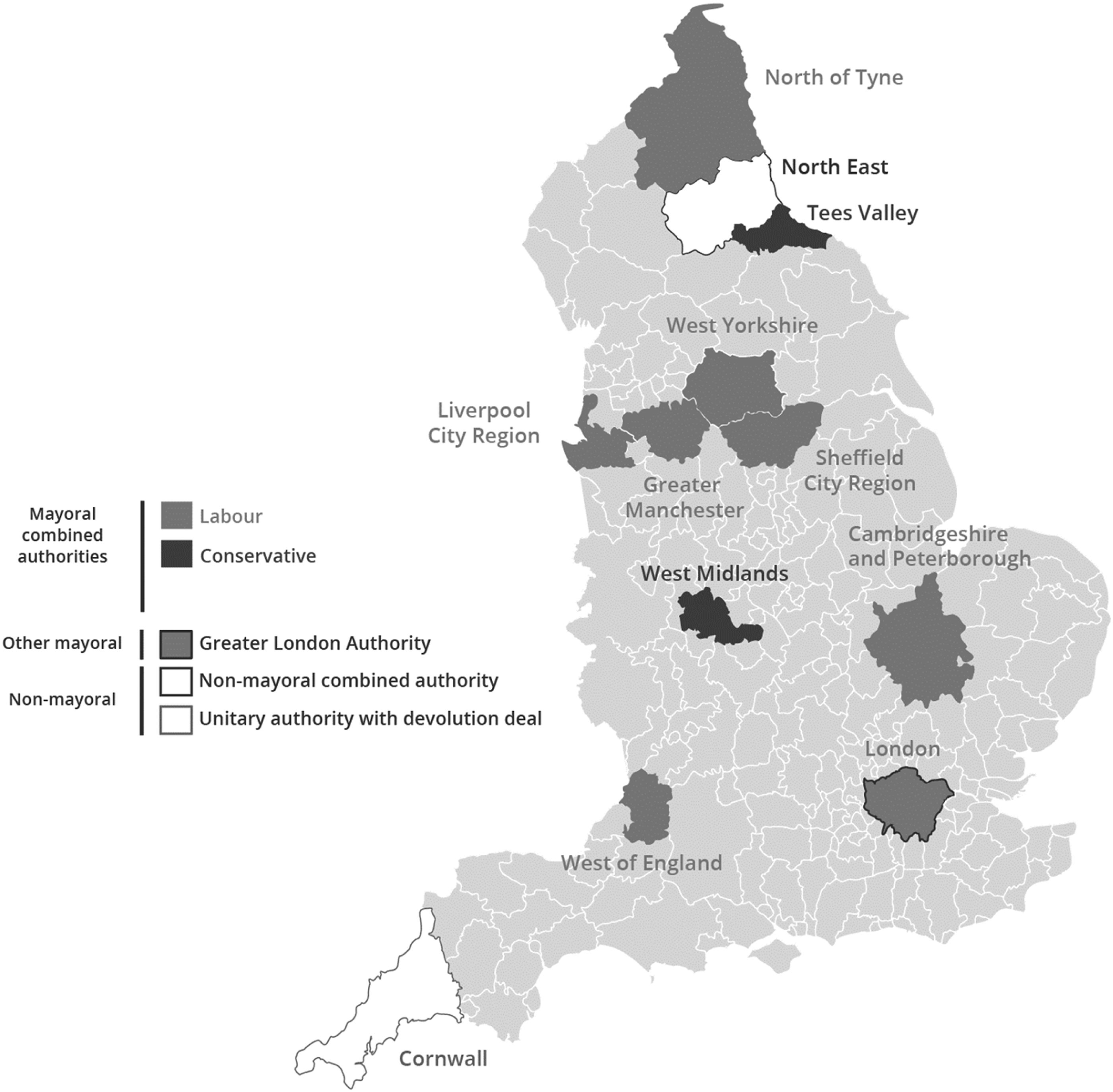
As such England’s governance arrangement reflect a patchwork of MLG types. For those areas with CA status, governance is predominantly based on a ‘territorial rationality’ and emphasises the role of decentralised governance for horizontal coordination and harmonisation of potentially conflicting policy goals. However only 41% of England’s population (representing 43% of economic output but only 14% of land area) live in areas with some form of mayoral devolution deal (Institute for Government, 2021). The remaining areas remain much more aligned to Type II that institutionally separates political accountability and administrative execution and privileges vertical coordination across levels of government. It is premised on functional rationality and relies more on centralised decision-making rather than local discretion.
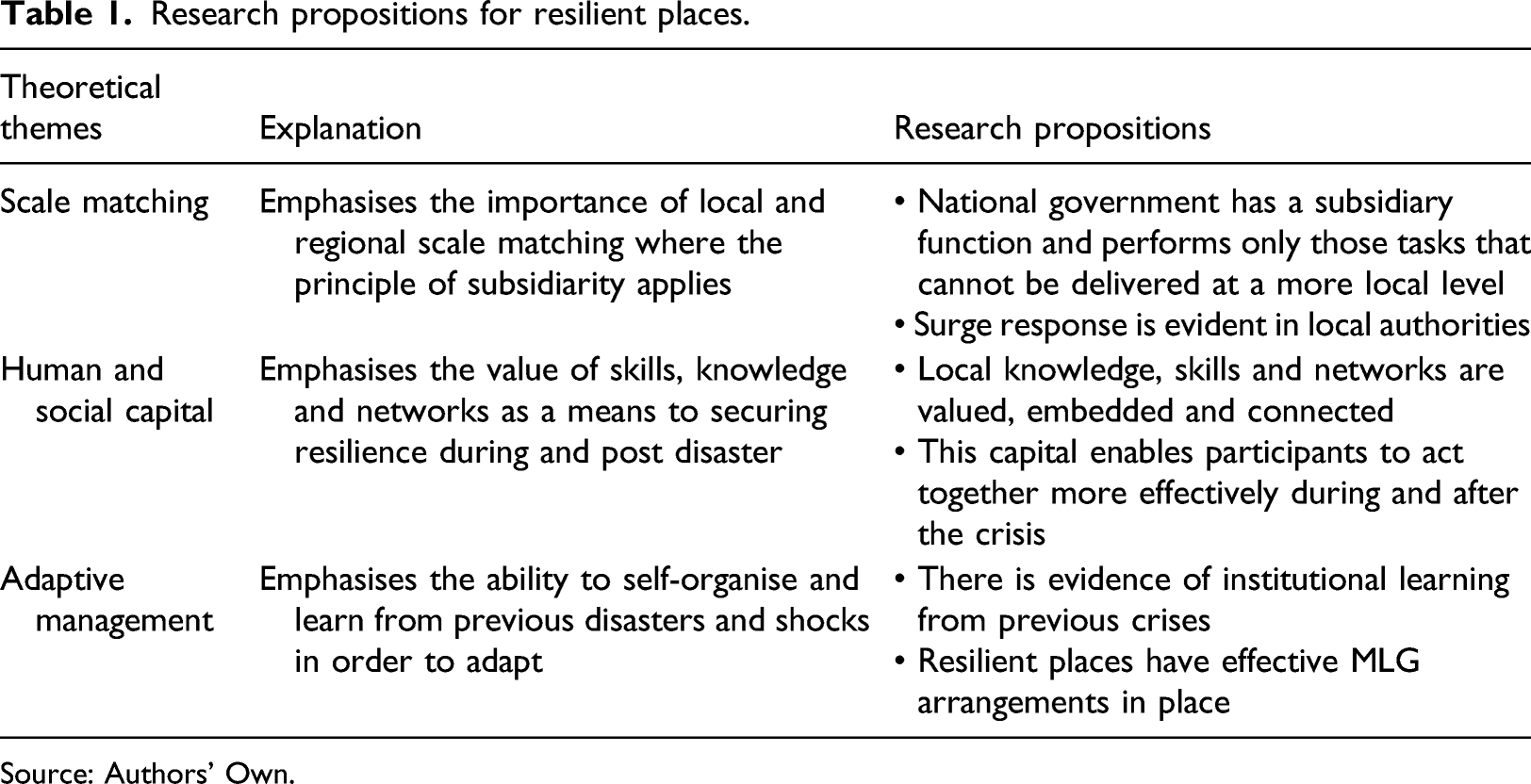
Research propositions for resilient places.
Source: Authors’ Own.
The next section describes our methodological approach to explore how such a complex system of governance was able to withstand and respond to the crisis.
Methodology
The exploration of the research propositions required an in-depth examination of the response to the pandemic across different tiers of governance in England. This encouraged a qualitative research design and a multiple instrumental case study design was chosen because it enabled the researchers to select and explore a diverse range of cases that would involve a range of different organisations, geographies and tiers of governance. The regional scale was chosen to ensure interviews at both the local and regional level could be captured. Different locations were selected to access a range of interviewees across the geographical contexts including areas with and without CA. This was important to provide depth and ensure maximum opportunity for the transferability of findings.
Consideration also had to be given to issues of feasibility and pragmatism given that the interviews were being conducted relatively early on in the pandemic (between September and December 2020), when agencies were rightly preoccupied with mounting the emergency response and not on research participation. The research team considered a number of regions they had an existing research relationship with and from that pool selected three case study regions in England: the East Midlands (EM), Northeast (NE) and Tees Valley (TV).
These were chosen partly because they were researchable from a functional perspective in terms of the accessibility and openness of key participants but also because they met the criteria of a multiple instrumental case study design (Stake, 2000; Yin, 2009). To explore differences within and between cases the selection needed to include regions with different governance arrangements including those with (TV and NE) and without (EM) combined authorities.
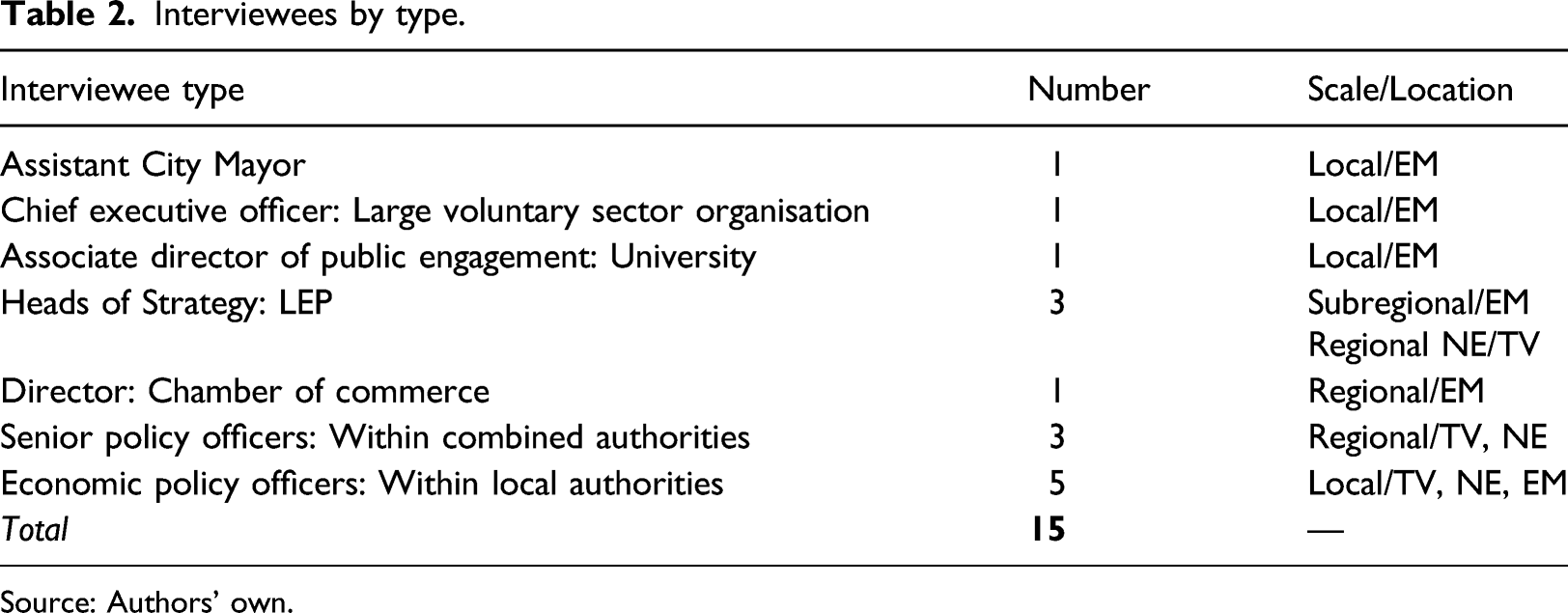
Interviewees by type.
Source: Authors’ own.
An interview guide ensured the research team’s line of questioning was consistent and covered a range of topics on the response to the pandemic across the tiers of governance. Interviews were recorded with the respondents’ consent and were transcribed before being thematically analysed and the data coded. The key theoretical themes and propositions noted in Table 1 acted as the initial framework for the initial coding. Open coding also ensured any additional and contradictory themes were added, ensuring the analysis was not blinded by the initial framework (Marshall and Rossman, 2016). The data from these interviews was analysed thematically and separately by each of the authors before comparing the emerging themes. This ensured issues of bias were reduced.
There are some limitations to the study to note. Despite its advantages, the case study approach has received criticism for its lack of generalisation due to its reliance on a limited number of participants (Yin, 1984). The selection was constrained partly by the research period and the chaotic nature of researching within that environment. With more time the researchers could have included a greater number of regions, or within those regions, a larger pool of interviewees. Local actors from higher education, business and the voluntary sector were included in the interviews to expand the interviews beyond the public sector but 10 of the 15 interviewees were policy officers from combined or local authorities and so likely to hold similar worldviews.
Demonstrating resilience? Multi-level governance during the pandemic
To give some context to the findings section, it is worth briefly summarising the nature of the response to the pandemic from central and local government. The central government response has involved a range of measures designed to tackle the health crisis and control the spread of the virus including lockdown measures firstly introduced in March 2020 which saw businesses and schools closed. These were then followed by the imposition of localised lockdowns with the first implemented in Leicester on 4 July 2020, and border controls, social distancing and work from home encouragement and enforcement. The interlinked economic crisis has been tackled by a range of stimulus measures in the form of business interruption and bounce back loans, support funds for charitable sector and the self-employed and employment related measures in the form of job retention/furlough scheme, employment support through the Kickstart and apprenticeship schemes (House of Commons, 2021). Many of these schemes and actions were interpreted, implemented and administered at the local level and interviews collectively discussed a breadth of activities that formed part of the response effort including • Community engagement and communication • Establishing and managing pools of volunteers • Business engagement and communication • Testing and tracing – door to door and community-based walk-in testing to drive up testing rates • Advice to workplaces and businesses • Enforcement activities • Coordination of the Local Resilience Forum and Incident Management Teams • Local PPE sourcing • Data gathering, surveys and analysis of local businesses • Data gathering with the community hubs to track infection and isolation • Set and support of community hubs to support communities and those in self-isolation • Working with local voluntary sector groups to reach all communities • Administration and roll out of central government grant and support schemes to businesses and self-employed • Redeployment of staff to set up, manage and support community hubs and food banks • Redeployment of staff to check business compliance with the easing of restrictions • Provision of free school meals, laptops and support to families and children during periods of school closure/home schooling
At the local level, areas drew on their horizontal, established networks to act and adapt quickly, at times even ahead of central government decisions being made. In the North East, interviewees in the LEP explained how the use of regional analysis of feedback from businesses prompted them to set up a Covid Economic Response Group comprising the LEP, and both the CAs in the region within days of the first lockdown. In Leicester interviewees spoke of mobilising quickly to shut down in person and office-based council operations a week before the first national lockdown in March 2020. Often council staff whose jobs were no longer viable were redeployed rather than furloughed. Interviewees from one of the local authorities within the Tees Valley CA commented on the enthusiasm and commitment of local staff to get involved in supporting the crisis response:
That’s something you can’t quantify but was a massive part of the response. There was no hierarchical thing of ‘well, that’s not my job, that’s not in my job description’. A lot of people just rolled up their sleeves and wanted to get on with it, and that’s what happened (Local authority interviewee, TV)
The remainder of the findings section is organised around the three principles of resilient places.
Scale matching
Evidence from the interviews demonstrated a frustration from local and regional actors that the response to the pandemic was too heavily centralised and failed to devolve key tasks and resources that would have been better delivered at the local level. Whilst some interviewees were positive about aspects of the centralised response, particularly from the Treasury, which adopted a ‘spend what you need’ stance, there were multiple reports of a centralised command and control approach with complex reporting into the centre and a lack of useful and accurate data out. One interviewee commented that ‘decisions are being done to us by government and not with us’.
Whilst some recognised that the crisis placed central government in a difficult and ‘unprecedented’ situation, there was widespread criticism of poor leadership, data sharing and communication from central government. This included frustration at overcentralisation of key schemes such as financial support for businesses, the Test and Trace scheme, and provision of laptops and free school meals to local schools. For Leicester City Council, who were subject to the first local lockdown and remained in lockdown the longest of all, the frustration at a heavily centralised command and control system was clear: We didn't get any data. We got gaslighted for weeks because they [central government] were saying, ‘Yes, we’ve given you information’ but it was wrong and out of date (Deputy Mayor interviewee, EM).
Following the principle of subsidiarity, the willingness and capability of local agencies to respond quickly was evident in the interviews. Local authority interviewees highlighted multiple examples of agencies working together to mobilise quickly, redeploy staff and use available human and financial resources flexibly: We mobilised quickly and we shut down a lot of our operations a week before Johnson announced it. People were redeployed, spaces were redeployed, the theatre became a food hub, which distributed about 30,000 food packages over the course of the lockdown, and we set up supply chains through our city catering system (Deputy Mayor interviewee, EM)
Across the cases, local authorities were using available resources be they staff, structures, or systems to surge their response to areas of need (Paturas et al., 2010; Therrien, 2017). Interviewees argued that the local scale was more effective with local agency having a far greater impact. Interviewees favoured increased devolution that recognised the interdependencies of actors, resources and activities at the micro level, although there was some debate on where that level of subsidiarity should be drawn. Interviewees recognised the benefits that were accrued from collaboration between key actors at the local authority level who were place-based and able to provide civic leadership, whereas central government remained placeless and unable to tailor the response to local contextual differences: Local government has a level of recognition that there are complexities whereas national government is offering broad-brush solutions which leave local communities feeling neglected by national government. (Higher Education interviewee, EM)
However, the complexity of MLG arrangements in England has made it difficult for central government to find clear and consistent communication pathways to local partners, and interviewees recognised the need for improved connectivity across the tiers of governance: If I was in government, I’d be getting a bit frustrated that I’m having to have conversations with 300-plus local authorities and 40-plus LEPs and CAs. (LEP interview, EM)
Interviewees were critical of central government’s continued lack of understanding of the heterogenous nature of the subnational economic geography and their economic development strategies that had overly focused on Brexit. Despite central government rhetoric of Levelling Up, each government department continued to operate in silos without a unified definition of ‘place’. Interviewees noted an ongoing favouring of city policy networks to gather feedback on the impact of the pandemic at the local level. Central government was said to favour mayoral CAs, and negotiations between central and local tiers was said to follow those paths of least resistance. Those with a CA recognised the benefits the political platform offered as ‘channel to communicate and influence’ vertically to central government, and horizontally across other CAs to identify common issues and challenges providing ‘strength in numbers in terms of communicating to government’. The CA could also engage all local authorities in its reach in shaping larger-scale responses. However, some local authority interviewees from within that boundary queried the value and impact of the CA when it was the local authority who were legally empowered to deliver and administer COVID support schemes:
The Mayor [of the CA} has brought to bear some of his own small-level grant programmes to try and help some of the businesses in the hospitality sector specifically. How much of that is for political expedience or just waving from the sidelines saying, ‘I’m involved too you know’ (Local authority interviewee, TV)
Areas without a CA like the East Midlands expressed frustration at those areas who did for getting what was perceived as a higher than pro-rata share of central government funding: ‘It’s starting to feel like the prize of a combined authority is a long way off for us and that feels like an awful lot of money going to Manchester or others instead of us in the meantime. Those of us who haven’t got devolution are getting increasingly irritated, angry about the continuing disparity. (LEP interviewee, EM)
Interviewees from a range of actions (LEP, Chamber of Commerce and local authority) all recognised that having a mayoral CA facilitated ‘a convincing, single, clear message from a place’ and provided central government with fewer routes of communication and negotiation. Some called for a return to a consistent, regional tier of governance that could translate policy coming out of central government ‘to something coherent before it hits the local areas’ (LEP interview, EM).
Human and social capital
Resilient places are able to draw on the human and social capital within their institutions to act together more effectively during and after a crisis. Interviewees provided multiple examples from across the case studies of coordinated responses at the local level where agencies worked collaboratively and combined resources, data and experience to coordinate a local response to address the paucity of a centralised effort: We dealt with the shielding list because the list provided by central government was not very good. We supplemented that with our own social care list and worked with the local NHS as well. We ended up with a much more comprehensive list that we were confident with. There was a great deal of coordination between the council, other agencies, voluntary groups, the local police that continued fairly seamlessly. (Deputy Mayor interviewee, EM)
Central government responses have relied heavily on depleted local authority resources, but despite their reduced capacity, local institutions were able to swiftly pool and adapt their human resources to respond to the crisis. Interviewees revealed a strong sense of goodwill and commitment to response effort at the local level: We redeployed an awful lot of staff across the council to support the response. We have the best part of 3,000 people working for the council; furlough was an option for council staff, but we decided to redeploy where we could. That was done voluntarily. We never had to force anyone to do anything. People wanted to get involved and wanted to be helpful (Local authority interviewee, TV)
Several interviewees criticised central government for poor communication and a lack of coordination and joined-up thinking, with interviewees critical of the lack of joint messaging from government departments. Many interviewees spoke of the pace and intensity of the work involved in interpreting and administering multiple and frequently changing support packages that were centrally determined with little consultation or direction provided to local areas who took on the burden of administration: A lot of people became not just business advisers but almost counsellors to the number of businesses in desperate situations. I think that’s been the most tiring aspect of it. Yes, processing grants has taken up a lot of time, but trying to support businesses and help businesses navigate their way through the range of schemes that have been introduced has been difficult. (Local authority interviewee, NE)
Human and social capital (knowledge, skills and networks) were clearly valued locally but there was frustration that this local expertise and resource was being overlooked by central government. This was said to hamper the effort to respond to the pandemic locally and protect people’s health, wellbeing and livelihoods. They [central government] just get it hopelessly wrong. There’s no need for a national system. They don’t understand how simple it could be if they just allowed local experts to lead on this. We’re talking about procurement experts who manage supply chains worth millions. We’re talking public health experts who are epidemiologists. We’re talking about a whole body of professional local expertise that have just [been] completely ignored. (Deputy Mayor interviewee, EM)
The pandemic elicited an outpouring of grass-roots support from the voluntary and community sector and interviewees at the local level praised the efforts of these volunteers and micro-organisations. However, there was frustration that their contribution was undervalued if not overlooked by central government: Because in reality beyond the furlough funding and economic stimulus, in terms of on-the-ground community cohesion, if you took away the third sector and community volunteers in all of this, who would pick up the pieces? There’s a blissful ignorance in national government to the amount of work that’s going on, to what people are doing for their communities. (Higher Education interviewee, EM)
Adaptive management
The literature demonstrates that resilient organisations learn from earlier experiences and apply that institutional learning in the development of more appropriate policies and processes to bounce forward from the crisis (Martin and Gardiner, 2019; Rist et al., 2013; Walker et al., 2004). The findings revealed a mixed picture of adaptive management practices across the fabric of MLG institutions in the case study areas. The previous section shows how at the local level, agencies collaborate to surge respond to the crisis. At the national level, interviewees were critical of the under-preparedness of central government who it was argued had failed to adapt to the lessons learnt from previous crises. As one interviewee explained: Looking back, I don’t think they’d [central government] really done the work after MERS and SARS, or even after the credit crunch to understand and learn lessons, or if we had we hadn’t filed it away anywhere where anyone could get at it, you know, I’ve looked on National Archives and I couldn’t really find anything. (LEP interviewee, EM)
Nationally driven, austerity policies had run down resources including the well reported, lack of crucial stocks of personal protective equipment in the early stages of the pandemic (House of Commons, 2021). These policies had also drastically impacted the level of staffing in some of the local authority areas, where economic development teams had been reduced to minimal numbers. They expressed concern that they lacked the capacity for adaption and conceptualisation of new ideas: I think, probably because of the impact of austerity, what we’ve done over the years is chipped away at the resource that’s available to do some of that developmental work and conceptualisation at an early stage. The scope we have to generate new ideas, specifically in response to Covid, I would say is probably quite limited in that capacity across the region. (Local authority interviewee, NE)
That said, there were examples from all locations of a swift mobilisation of subnational agencies to avoid a reliance on centralised top-down systems that have been subject to considerable criticism. Interviewees indicated a clear persistence of domineering power and control whereby the governance arrangements remained heavily centralised. Despite attempts at devolution through the CAs and LEP structures, conditional localism (Hildreth, 2011) persists in England. Local levels of governance reported being gaslit or hamstrung by an overly centralised system that limited the ability of local actors to be adaptive: As a principle, any sort of local management and implementation of any sorts of policies should be managed locally, and it shouldn’t be so prescribed as to be so bureaucratic. So, the laptop thing, give us some money and say, ‘make sure every kid gets a laptop’ and we’ll deal with it. National systems which govern local implementation are falling down all over the place. So, delegate responsibility for the management of local implementation. (Deputy Mayor, EM)
Interviewees spoke of developing plans to secure a recovery that applied their experiential learning and would enable them to adapt through a post-Covid recovery. Interviewees argued that returning to the same state would be an error. There was little appetite to bounce back to the existing economic development plans that were written to secure the favour and funding of central government, where industrial policy overemphasised sector deals and knowledge-intensive, highly skilled jobs: I would argue that the government’s industrial policy is not wide enough to provide jobs for the whole of our economy. There is a danger that we will just go back to the same approach as we had previously where government rhetoric focuses on higher-value sectors and innovation and not the broader economy, including lower-value sectors and sectors that account for a high proportion of employment that is really important to our local economy. (Local authority interviewee, NE)
Interviewees across the case study locations called for a broader and more inclusive approach to the recovery and a series of key principles were consistently articulated locally to Build Back Better/Level Up. Firstly, following the so-called Preston Model (Brown and Jones, 2021), interviewees from all localities spoke of working collaboratively across institutions to make sure that local employment, procurement and land development practices and supply chains were applied in the most beneficial way to fulfil public duties and secure an inclusive growth agenda that was locally embedded to achieve community wealth and wellbeing: It’s about looking at how those contracts can be awarded to local companies, how can the jobs that are going to be available on that site be available to local workers. So, the local impact of those schemes has been really at the heart of their design (Combined Authority interviewee, TV)
Secondly, acknowledging the vital contribution to the pandemic response from hyperlocal voluntary and community organisations, interviewees called on government to value and harness community power and wealth building. Thirdly, interviewees demonstrated an increased appetite for a recovery model that valued a place-based approach where Levelling Up was driven locally. There was an overwhelming sense across all interviews that local agency had far greater potential impact if power or resources were devolved however this was coupled with ongoing concern that central government was unprepared and not adaptive to the changing mood.
Discussion – lessons for levelling up
This paper has applied key principles of resilience theory to explore England’s intergovernmental response to the Covid-19 pandemic crisis with a focus on institutions tasked with responding to the economic crisis. Whilst it would be premature to make any firm conclusions about the socio-spatial impacts of the pandemic given that the end-date remains unknown, the disruption that follows a crisis presents an opportunity for reflection and change. Returning to the same state that existed prior to the pandemic would represent a failure to utilise the knowledge gained through the experience.
Whilst the regional and local impact of COVID-19 is highly heterogeneous, a consideration of how other states have reacted offers valuable insight and there is a growing body of evidence to illustrate how countries adopted differentiated territorial approaches (OECD, 2020). Studies exploring the adequacy of American federalism to the immediate challenges posed by COVID-19 report tensions in alternative systems of governance (Benton, 2020). Ren’s (2020) comparison of lockdown orders in America, China and Italy early on in the pandemic found tensions between national and local governments, and a recognition of the strength of local territorial institutions that were often overlooked by early centralised responses. Studies conducted in federal European countries reveal a similar tendency towards centralised coordination during the immediate crisis. The authors report that given the viability of subnational governments in countries like Germany, it is striking that the response to a regionally varied pandemic was greater centralisation towards the federal executive (Kuhlmann and Franzke, 2021). However, Oates (2019: 225–229) theory of fiscal federalism postulates that when major social crises arise, and societies are being subjected to unusually violent pressures or disturbances, the immediate period of turmoil is likely to magnify the relative importance of the central government and weaken the strength of the local autonomy, leading to political and fiscal centralisation. As the pandemic continues through later waves, a more functional orientation emerged with increased importance placed on place-based responses, and a greater reliance on local decision-making (Kuhlmann and Franzke, 2021). Jüptner and Klimovský’s (2021) analysis of Czech and Slovak intergovernmental systems through the crisis also found early responses to be fragmented between state administration and local self-government. During the second wave of the pandemic, in both countries the central government’s reputation had suffered significantly due to inadequate and unreliable measures, and a series of bottom-up initiatives led by local or regional governments were found to be more effective than centralised measures.
These studies confirm that centralised, command and control is a natural response to the immediate impact of the crisis. However, once the immediate impact has past, states that have clearer, more consistent and embedded MLG systems appear better equipped to facilitate the dispersal of resources and the sharing of decision-making across levels of government and with non-governmental actors. Considerable normative potential exists in the conduct of these empirical studies from countries in which functionally specific bodies are elected locally and accountable to the populations they serve and further comparative research is encouraged to draw the lessons for a heavily centralised states like England.
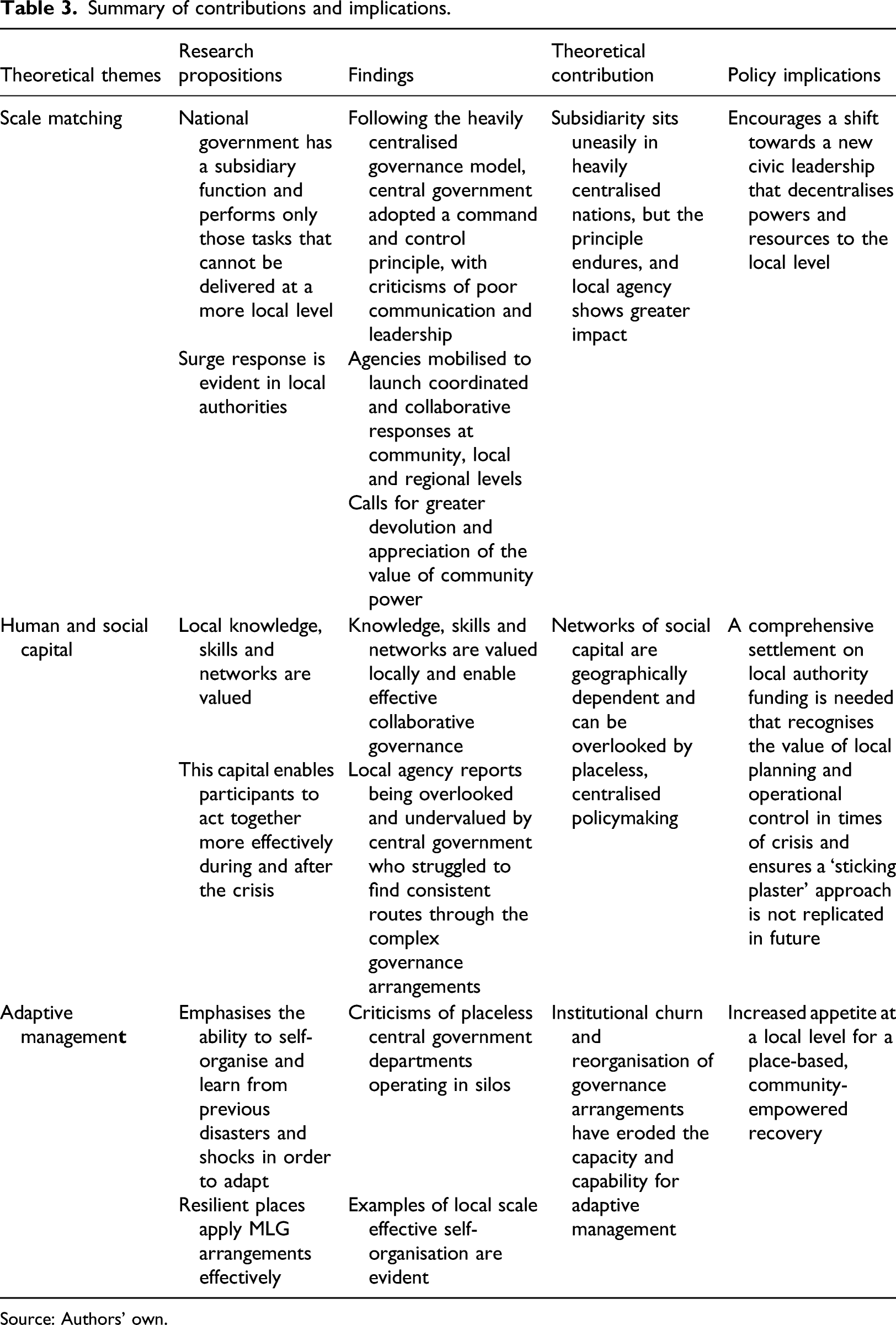
Summary of contributions and implications.
Source: Authors’ own.
Firstly, the findings illustrate how the heavily centralised model of governance in England led to a top-down, command and control approach to decision-making. This resulted in shortcomings in central government’s capacity to make decisions and communicate clearly to those at a regional and local scale. The emerging literature from other nations has shown that in federal states an initial centralised crisis response gives way to a more functional, place-based scale with greater reliance on local decision-making as the pandemic continues through later waves (Benton, 2020; Kuhlmann and Franzke 2021; Ren, 2020). This scale matching was less evident in the English case studies. Subsidiarity proved difficult in such a heavily centralised nation where, despite attempts at decentralisation, central government continued a pattern of ‘letting go and holding on’ (Matthews, 2016). This created frustration even anger from those at local and regional levels of governance who faced a tension between responding to local priorities and acting as a delivery arm of central government. Despite the controlling arm of central government, the principle of subsidiarity endured at a sub national level driven by the embedded knowledgebase of local agency.
Secondly, the findings reveal examples across the case studies of local agency coordinating collaborative responses at a community, local and regional scale. There was evidence of the innovative application of human and social capital to redeploy staff, repurpose buildings and adapt system to build more accurate data. This was combined with the contribution from grass-roots voluntary and community sector organisations to reveal valuable networks of social capital at a local level that are geographically dependent, echoing the literature around learning economies and learning regions (Maskell, 1999; Storper, 1995). As places begin to recover from the shock and consider life post pandemic, a strong impetus for a place-based recovery emanates from this local agency. However, these embedded, historical patterns of trust that exist between people and place were too often undervalued by central government.
Thirdly, the findings show that the response to the pandemic (certainly at a national scale) was hampered by a lack of adaptive management and limited institutional learning from earlier health and economic crises. The adoption of efficiency-based management strategies combined with a decade of austerity left England unprepared and under-resourced to respond to the impact of the virus. The learning from earlier crises (either health or financial) appears to have been lost. Years of institutional churn and reorganisation of governance arrangements have eroded the capacity for places to apply adaptive management. And yet the findings uncovered adaptive, locally embedded networks across the case studies capable of coordinating a response even when overlooked by placeless, centralised policymaking.
As England starts to move towards rebuilding the economy through the Levelling Up agenda, the findings prompt a normative inquiry as to the nature of resilient forms of governance. The ongoing application of a system of governance where power is retained centrally by policymakers whose decisions are carried out by neutral bureaucrats must be queried. For policy makers determining the paths to recovery, ‘levelling up’ should place greater value on the experience and knowledge that is embedded within heterogeneous communities across England. Accountability must shift downwards from the vertical towards local communities. Levelling Up needs to balance the authority of the top with the local knowledge at the bottom and local areas should be entrusted to lead in the development of place-based institutional arrangements that draw upon local and regional resources of human and social capital.
In terms of policy implications, the paper reinforces support for the growing argument in the UK for increased devolution by presenting real-world evidence across multiple localities of the value of local planning and operational control in times of crisis. The findings reinforce the view that discrete economic development policy is more appropriately designed and delivered locally. Local institutions are at the heart of providing the services that underpin the broader determinants of wellbeing and growth and are key to efforts to address the long-term challenges, amplified by the crisis.
The empirical evidence demonstrates an increased appetite for devolution to all parts of England and the much-delayed Levelling Up White Paper (HMG, 2022) has since provided some clarity on central government’s proposed approach to increased devolution. The model helpfully extends the offer to all of England, going beyond the metro-mayor city regions to offer ‘county deals’ but it remains one of deal making. This risks a continuation of the patchwork, piecemeal approach that has left England with a wide range of overlapping subnational institutions. Given the tensions evident in the findings, this new institutional landscape will require further clarity on the division of powers between mayors, combined and local authorities, and how they can best work together to provide strategic direction on matters of local economic development.
Meeting the long-term societal challenges, amplified by the pandemic, will be key to a sustainable economic recovery. Throughout the pandemic, the findings demonstrate the capability of local agencies to do a huge amount of work with limited resources. What is needed now is a greater value placed on the human and social capital within these agencies and the communities they represent. Further, after a decade of austerity policy this will require local institutions across government, health and education to be funded sufficiently through a comprehensive solution for local government finance. The findings support a shift towards a new civic leadership (Hambleton, 2015) that is facilitative, participative and co-created; where decision-making and the resources to support those decisions are trusted to the local level and not centrally controlled. Levelling up requires properly funded services and effective institutions working in partnership with other levels of government. Retaining local and subnational state capacity in the face of fiscal pressures will be the key if government is to recommit to and accelerate policies to boost economies in lagging and left behind places including those in the Northeast, Tees Valley and the East Midlands. This was initially absent from the language of Levelling Up whose early focus was on short term, physical capital and infrastructure projects (Jennings et al., 2020). The Levelling Up White Paper (HMG, 2022) now acknowledges that local government funding has been over reliant on bidding for funding and offers some initial thoughts about place-based budgets. However, a more detailed framework is needed for a systematic approach to subnational governance that facilitates improved collaboration, coordination and joint working between different geographical tiers of government and related agencies.
Footnotes
Acknowledgements
The authors are grateful to the anonymous reviewers and to the editors for their constructive comments and suggestions. We would also like to thank the interviewees who gave up their time to speak to us during an extremely challenging time.
Declaration of Conflicting Interests
The author(s) declared no potential conflicts of interest with respect to the research, authorship and/or publication of this article.
Funding
The author(s) received no financial support for the research, authorship and/or publication of this article.
