



Abstract
This paper examines the variety of municipal government-social enterprise relationships in Dublin and the multiple roles of Dublin City Council in the city’s social enterprise ecosystem. It situates the analysis of municipal government-social enterprise relationships within the framework of multi-level governance and the role of Dublin City Council as a policy actor in an evolving and relatively fluid policy system. It examines the City Council’s involvement in a number of EU and OECD policy and research initiatives, the formulation and implementation of Ireland’s first national social enterprise policy, the more limited, though significant, role of the regional governance tier in Irish economic and enterprise development policy, and the City Council’s role as a policy maker and policy taker. The research finds that Dublin City Council’s multiple roles have contributed to the development of social enterprise in Dublin. It identifies the importance of institutional, organisational and policy constraints for further development of social enterprise in the city. It shows the strong relevance of the municipality’s governance processes to future innovation and development.
Introduction
Although the term is relatively recent, social enterprises of various types have been well established in Ireland for more than a century. Their development has been an integral part of Ireland’s modern social and economic history. The co-operative movement has a long and established presence (Doyle, 2019) and has contributed to the well-being and economic growth of rural Ireland while the Raiffiessen Banks (Colvin and McLaughlin, 2014), and the more recently established Credit Unions, have played a vital role in meeting socio-economic needs over the years (Power et al., 2012).
One of the more interesting distinguishing features of the social economy in Ireland was, until recently at least, the absence of a discrete co-ordinated policy framework. Distinct elements of the social economy operated under a complex, and quite complicated, range of statutory and policy frameworks, with a variety of government departments having responsibility. For example, credit unions fall under the remit of the Department of Finance, social finance providers under the remit of the Department of Social Protection, co-operatives under the Department of Enterprise, Trade and Employment, the regulator of some social enterprises is the national charity regulator, and responsibility for development of a national social enterprise policy lies with the Department of Rural and Community Development. In addition, the Department of Justice is a key policy stakeholder, having been the first government department to launch a social enterprise strategy for people with criminal convictions seeking to re-integrate into mainstream economic activity (Government of Ireland, 2017). Furthermore, the relationship between the local/municipal, regional, national and EU governance tiers was, until 2019, very unclear and poorly developed (Ó Broin and Doyle, 2022).
This article explores the role of Dublin City Council, Ireland’s largest municipal government, and its efforts since 2015 to support the development of a thriving and robust social enterprise ecosystem in the city. It details the unusual nature of Ireland’s governance system, the actions of Dublin City Council as it devised and implemented a novel approach to social enterprise development, the implications of this approach and the challenges facing the municipality as it works to continue its efforts in a very different policy environment.
The article proceeds as follows. After the introduction, it describes the distinct character of the Irish governance system and the Dublin City Council approach to social enterprise development within this system, with a particular focus on the work prior to the onset of the COVID-19 pandemic. The article analyses the consequences of the municipality’s approach and the challenges facing it as it works to continue its efforts in a very different policy environment. The article utilises the analytical framework developed by Royles and Lewis (2019) to analyse policy decisions taken in relation to social enterprise - giving due consideration to the multi-level institutional factors that influence such decisions. The fourth section describes the article’s methodology and the fifth reports the research’s findings before discussing these and finally summarizing its conclusions.
The Irish governance system
Local and municipal government in Ireland is highly centralised and general subordination to central government has been a dominant theme since the foundation of an independent Irish state in 1922. Irish local governments are very dependent on the centre for finance as they have limited revenue raising capabilities (Ó Broin and Jacobson, 2017). A critical difference between the Irish system and other categories of local government systems in Europe is the strong role played by central government in determining the functions and financial independence of local authorities. This factor, combined with weak political structures and an electoral system that incentivises national politicians to maintain close involvement and high profiles in their communities (at the expense of local politicians), has played a significant role in inhibiting the development of local government as an alternative locus of power and influence (Callanan, 2018).
From the beginning, there has been a marked reluctance to devolve any significant power to the local government system (Quinn, 2015). The most significant institutional change to the system, that had been introduced by the United Kingdom’s Local Government (Ireland) Act, 1898, was the introduction of the local and municipal management system between 1929 and 1940. In the mid-1950s the system was amended to address some concerns about balance of power between the manager and councillors, but the dominant dynamic in centre-local relations is that local government cannot be entrusted with significant powers and powers that have been devolved are best managed by the centrally appointed executive management as distinct from the locally elected political leadership (Callanan, 2016).
The Irish local and municipal government system is nominally based on the classical separation of powers, where the councillors have responsibility for reserved functions, that is, they formulate the policy framework for the local authority, though this description is rather misleading. Irish local government legislation states that all functions, which are not stated in law as being reserved functions, are automatically deemed executive functions and are the responsibility of the appointed chief executive. In such an arrangement, one would expect that the councillors formulate policy, and the chief executive is responsible for its implementation and the day-to-day running of the municipality (Collins, 1987: 610). The reality is rather different as the legal separation of powers is not operationalised in a coherent manner and it has long been recognised that the chief executive is the primary initiator of policy. Quinlivan cites Lindblom’s ‘Mutual Adjustment Theory’ (1965) to explain how this aspect of local government operates in Ireland, the councillors and the chief executives ‘co-ordinate with each other … without rules that fully describe their relations to each other’ (2008: 610). In addition, central government has, on occasion, removed functions from councillors and allocated them to the municipality’s chief executive, for example, waste management. Davies notes that during the ‘1990s it became clear that Ireland was facing a waste crisis with landfill sites rapidly reaching capacity’ (Davies, 2007: 52). Municipalities appeared incapable of providing a local solution, ‘the crisis was not simply a technical one regarding the capacity of the state to dispose of waste; it was also a crisis of governance’ (Davies, 2007: 52). As a consequence of what many saw as a councillor-caused policy paralysis, the central government introduced the Waste Management Act, 1996 which removed councillor input into the development and implementation of waste strategies.
Since 2001 there have been two distinct rounds of reform. The Local Government Act 2001 simplified the local government structure, with the principal tier of local and municipal government (county and city councils) covering the entire territory of the state, with some limited exceptions. In addition, the reform saw the establishment of Strategic Policy Committees (SPCs). According to Quinn (2015), the SPCs: represent a new way of working for all concerned – a formal role for sectoral nominees who previously operated outside the institutions of local government; a shift in focus to policy making as well as a sharing of jurisdiction for elected representatives and a move to facilitative rather than techno-authoritative approaches for local authority personnel (2015: 8).
Two dynamics existed with the establishment of SPCs. The first related to introducing at local level a model of social partnership that was perceived to be successful at national level. The second provided a more structured process for councillors to be involved in policy making (Phelan, 2021). Since their establishment, the SPCs have faced challenges including conflicts between councillors and sectoral representatives (Callanan, 2005; Forde, 2005), and a lack of engagement from sectoral interests, councillors and municipal staff (Phelan, 2021). While these issues have largely been addressed, it is apparent that the expansive policy making role envisaged for the SPCs did not come to fruition and is unlikely to do so.
A second round of reform arose from Ireland’s experience of the global financial crisis which saw the enactment of the Local Government Reform Act 2014, introducing significant structural reforms, including: (1) the merging of a number of city and county councils; (2) the dissolution of town councils; (3) a new regional governance tier.
In addition to these structural reforms, the legislation also provided that municipal governments would henceforth have a formal competence for local economic and enterprise development. Heretofore this competence had been the responsibility of a separate municipal authority, the City Enterprise Board (Hanley and O’Gorman, 2004; O’Gorman and Cooney, 2007). The Enterprise Boards were abolished in 2014 through the enactment of the County Enterprise Board (Dissolution) Act, and their responsibilities were transferred to a new Local Enterprise Office system, under the auspices of the municipality but retaining a link with the national enterprise support agency, Enterprise Ireland. Furthermore, the reform process also saw the introduction of two new policy instruments, a Regional Spatial and Economic Strategy to be devised and implemented by the newly established Regional Assemblies, and a Local Economic and Community Plan to be devised and implemented by municipal governments. Both policy instruments include a social enterprise element. In addition, the 2014 reform stated that at least one of the municipal government’s Strategic Policy Committees must be established to consider matters which relate to the functions of the municipal government in relation to economic development and enterprise support. It was within this fluid policy environment that Dublin City Council decided in 2015 to establish an advisory group to support its economic development and enterprise department as it worked with social enterprise.
Analytical framework
This article utilises the analytical framework developed by Royles and Lewis (2019) to analyse policy decisions taken in relation to social enterprise – giving due consideration to the multi-level institutional factors that influence such decisions. The framework places particular emphasis on evidence that municipal and regional governments are often ‘catalysts for policy initiatives’ that recognise and promote the areas of policy in a context where policy decisions are increasingly influenced by political structures at multiple levels of governance. While Royles and Lewis’ analytical framework was devised to contribute to a better understanding of the ‘key institutional configurations that can affect language policy choices’ at the municipal and regional governance tiers (2019: 713), the four structural features they identify, that is, formal powers, institutional development of governance arrangements, the nature of the party system and civil society activism, also provide a useful framework for analysing social enterprise policy initiatives in the Irish context.
At the municipal and regional level of analysis, the degree of fiscal independence and the nature of formal competences determine the level of autonomy to adopt distinctive approaches to areas of policy. Royles and Lewis highlight the key factors of the division of powers between levels of government, and the basis for ‘utilising any regulatory, distributive and constituent instruments to support a policy initiative’. For example, policy choices are dependent on the degree to which legislative measures in relation to a policy domain, in this case social enterprise, exist and can be utilised. The extent of fiscal autonomy may similarly structure decisions regarding financial support to programmes to promote a policy initiative, such as bespoke training, or mentoring or financial support, including grants. Adshead notes that ‘in the absence of dispersed power within the domestic arena’, central government (and within that, the Department of Finance and the Department of Public Expenditure and Reform) are ‘able to exercise a strong directive control’ over key decisions (2014: 426).
The second dimension is the institutional development of governance arrangements relating to social enterprise policy (Stephan et al., 2015). Associated aspects include the internal arrangements of governmental institutions for social enterprise policy, and coordination between social enterprise policy and other domains which affect that policy (Cannon et al., 2022), including more mainstream economic and enterprise development policy initiatives. The development of sustainable arrangements can be challenging as these may be perceived to be at odds with, or of questionable relevance to, the dominant economic priorities of municipal government (Tangney, 2020). Another facet may be the impact of specific bodies charged with social enterprise policy development (Florek, 2013).
The third dimension, the party system, is a critical aspect when analysing language policy as there tends to be significant ‘nationalist or regionalist parties’ and the ‘connection between regional or minority languages and nationalist or regionalist parties is often substantial’ (2019: 714). However, when using the framework for analysing social enterprise policy, the connection between support for social enterprise and political parties in a strongly proportional party system like Ireland’s, is quite limited. A key explanation for this lack of connection is that social enterprise, as a term, is a relatively recent arrival to Irish policy discourse and tends to have a very particular connotation, that is, Work Integration Social Enterprises (O’Hara and O’Shaughnessy, 2021; O’Shaughnessy and O’Hara, 2016). Social enterprises are perceived to be involved in processes of social innovation rather than in economic empowerment (Ó Broin, 2017). Thus, significant social economy stakeholders, such as Credit Unions and producer co-operatives, are not perceived to be social enterprises (Social Democrats, 2023). As a result, political parties have very few policy positions on social enterprises and, indeed, the first significant mention of social enterprise in a political party or government policy statement did not appear until 2011, with the inclusion of a commitment to develop a national social enterprise policy in the 2011–2016 Programme for Government (Government of Ireland, 2011). That being said, it is important to note that, with limited exception, Irish political parties across the left-right spectrum are strongly supportive of Credit Unions and producer co-operatives and these have never been perceived to be tied to socialist or social democratic parties, as is the case in many other EU member states (Mangan, 2021). Rather, their connections are with the broad independence movement in Ireland from the 1890s and, as such, are an inheritance of all parties originating in that movement.
The final dimension in Royles and Lewis’ framework is civil society activism. This relates to the nature of the ‘relationship with governmental institutions, organisational capacity and/or opportunity to influence’ social enterprise policy (2019: 714). Forms can vary from formal involvement in institutionalised channels, a very common phenomenon under the Irish social partnership model of corporatist economic and social policy making (Murphy, 2017) to direct action methods, less common in the Irish system. Recent research has highlighted the considerable ability of Irish civil society stakeholders to influence the social enterprise policy formulation process at critical junctures and to shape the final policy (Ó Broin and Doyle, 2022; Forde, 2022).
The national level
At national level, the key structural feature is the framework for inter-tier relations. The impact of the framework on social enterprise policy choices may differ substantially. Of significance here, is the degree to which policy decisions are taken within a context of formalised and institutionalised inter-tier protocols. Key issues are the nature of inter-tier relations in areas relevant to social enterprises, and the prevalence of formalised bilateral or multilateral structures, relating to social enterprise policy, between different tiers of governance. This is particularly important in a strongly centralised state like Ireland. While such national institutional contexts may be the dominant influence which shapes social enterprise policy choices, the international institutional context (at European Union (EU) level, and at the broader international level) can also be important.
The European Union level
The political and economic structures of the European Union tend to have mixed impacts on member states’ social enterprise policy. Royles and Lewis outline three institutional variables which may influence policy choices. First, the EU may provide formal recognition, including within its institutional arrangements, for example, the Social Business Initiative of the European Commission (2011) or recent efforts to agree on a single European social enterprise legal structure (Liptrap, 2021). Second, the EU may elaborate programmes of activity backed by finance that supports social enterprise promotion efforts, for example, the Employment and Social Innovation (EaSI) programme (2021–2027). Third, it may act as a focal point for networks associated with social enterprises, for example, the European Social Economy Regions (ESER) initiative. The relative impact on approaches to social enterprise policy, or specific social enterprise initiatives, can depend on member state structures, for example: to what extent municipal and regional governments have a direct presence in Brussels; where there is such a presence, to what extent it is used to exert influence in the social enterprise policy domain.
The international level
Finally, at the international system level Royles and Lewis detail three institutional structures that can impact on policy. The first is international treaties which can often contain clauses that have an impact on policy. As it relates to social enterprise, this structure may have some impact though it may be little more than symbolic, for example, Ireland’s signing of the Toledo Declaration on Social Enterprise in December 2020. While not having any direct legal effect, it was claimed to be a ‘further articulation of Ireland’s firm commitment to social enterprise’ (Government of Ireland, 2020). Second, international networks may provide a structure of support for social enterprise activists, who strive to exercise influence on their respective states, for example, the involvement of some Irish social enterprise representatives in the work of the Social Enterprise World Forum (Baker et al., 2021). Royles and Lewis note, thirdly, that national policies may benefit from recognition and external legitimacy in other states, for example, official language status policy. However, such external legitimacy rarely applies in the area of social enterprise policy. This article suggests a fourth structure to be added to the above; that is membership of institutional, ideational, capacity building and knowledge development and sharing international governmental organisations. The particularly relevant organisations in this regard are the Organisation of Economic Co-operation and Development (Armingeon and Beyeler, 2004) and the International Labour Organisation.
Royles and Lewis observe that domestic ‘institutional settings may reinforce and complement one another and generate a basis for wide-ranging policy interventions’ (2019: 715) to support social enterprises. The reverse may also apply, whereby different domestic institutional features and levels may be at odds with one another and constrain interventions. Either way, in analysing social enterprise policy choices, domestic institutional environments at the state, regional and municipal levels are likely to be the predominant influences. International level structures are likely to play a more limited role, though interventions at these levels may provide an overarching framework that directly affects domestic institutional settings and influences state-level approaches, or the dynamic between the state and regional or municipal levels.
Method
Interviewees.
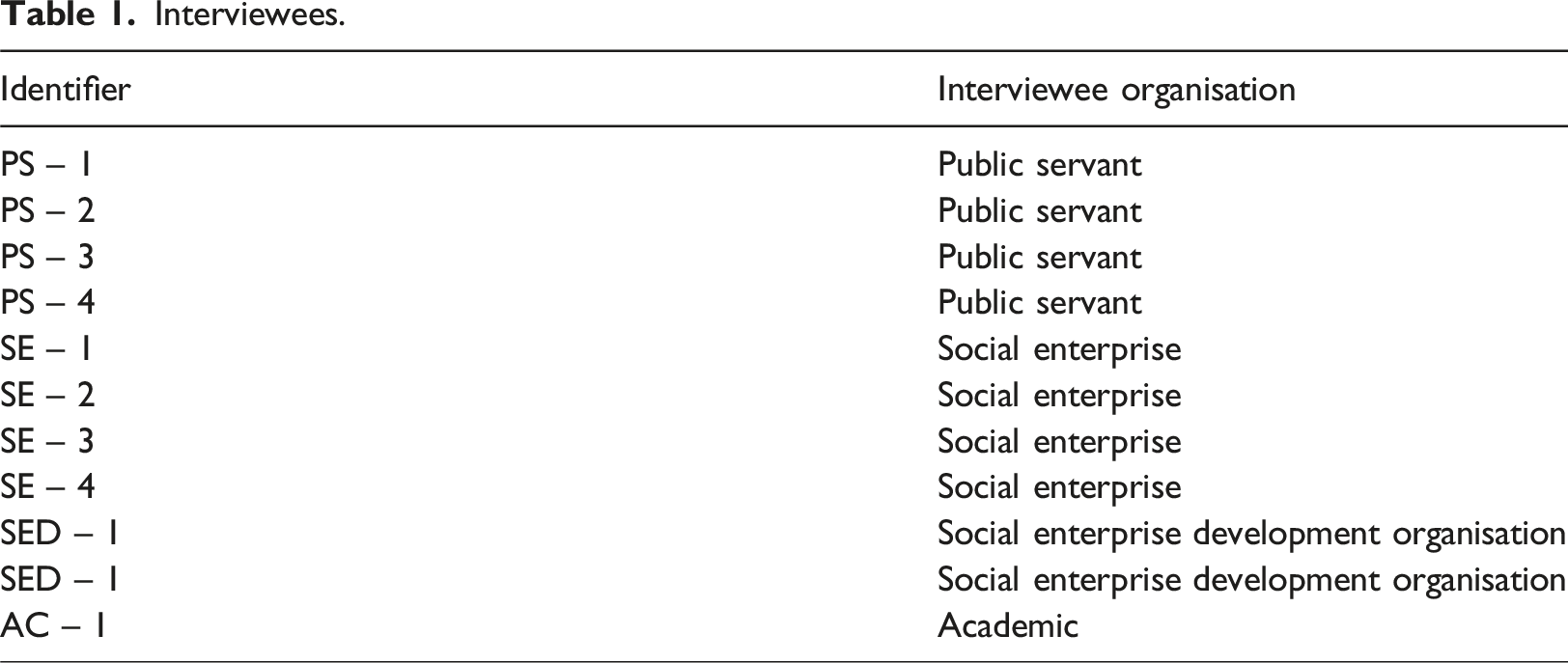
The documentary research involved an analysis of the documentation of the Dublin City Social Enterprise Committee, from its first meeting in 2015 to its last meeting of 2022. This included: the context documentation, the terms of reference (2015) framework for activities (2016); meeting documentation, agendas and minutes; report documentation, Committee-generated evaluation and impact reports on their activities. The documentation was made available to the author by the City Council.
Dublin City Council and social enterprise
The decision by Dublin City Council to establish a group composed of ‘individuals or groups who are a lead party in promoting and supporting the development of new social enterprises in the Dublin Area’ (Dublin City Council 2015a: 1) arose from a series of conversations initiated in 2014 by the City Council’s Deputy Chief Executive. That individual, recently retired, had very significant experience of EU-funded community development and urban regeneration initiatives in the City Council and was a strong promoter of social enterprise within the municipality (PS – 1).
The first iteration of the committee was called the Advisory Group of the Social Enterprise Grant Award Scheme. Its role was to advise the City Council’s Enterprise Office and the Economic Development and Enterprise SPC, on the awarding of grants to social enterprises worth up €45,000 per annum (Dublin City Council, 2014). The Grant Scheme is administered on behalf of the municipality by a social enterprise development organisation, Inner City Enterprises (ICE). The Advisory Group was composed of social enterprise representatives, representatives from social enterprise development organisations, a representative from a national social enterprise network and an academic from a local university. Later a second academic would join the group. The Advisory Group was chaired by a public servant working for the municipality’s economic and enterprise development department, and a secretariat, drawn from staff working in the department, was provided by the municipality. The Advisory Group provides updates to the Economic Development and Enterprise SPC through the public servant who chairs the Advisory Group, and the Manager of ICE, the administrator of the Grant Scheme. To all intents and purposes, the Advisory Group is treated, if not formally, as a working group or sub-committee of the statutorily-established Economic Development and Enterprise Strategic Policy Committee of the City Council. However, the Advisory Group/Committee ‘doesn’t operate in line with Working Group protocols’ (PS – 1). The overwhelming majority of such working groups have councillors as members and as chairperson. ‘This is not, and has never been, the case’ for the Social Enterprise Advisory Group (PS – 1).
In April 2016, following the successful completion of the first round of grant awards (Dublin City Council, 2015b), the Advisory Group was formally requested to contribute to the drafting of Dublin City Council’s first Local Economic and Community Plan. This was a very significant development and represented the Advisory Group’s first extension beyond its founding remit. As the Advisory Group contributed to the development of the Local Economic and Community Plan (2016–2022), it became clear that the original Terms of References of the Advisory Group needed to be reviewed (Dublin City Council, 2016a), and a Framework for Action was devised and agreed in September 2016 for a renamed Dublin City Council Social Enterprise Committee (Dublin City Council, 2016b). The Framework for Action noted the absence of a national social enterprise policy and the framework provided by the EU Social Business Initiative’s three themes, that is, making it easier for social enterprises to obtain funding, increasing the visibility of social entrepreneurship, and making the legal environment friendlier for social enterprises (SED – 1; SE – 1).
The renamed Social Enterprise Committee, while retaining its management of the Grant Scheme and building on its experience of contributing to the City’s new Local Economic and Community Plan (2016–2022), began to expand its range of initiatives. In 2017 it established: a training programme to support social enterprises; a 12-month PLATO Network for social enterprise managers (Dublin City Council 2017a); a social enterprise toolkit for early-stage social enterprises; and it examined the potential of an online higher education social enterprise programme, involving a local university and a social enterprise with online learning expertise. As these pilot initiatives were concluded and evaluated over the course of 2017 and 2018 (Dublin City Council, 2017b), the Social Enterprise Committee also began to examine the role the City Council could play in public procurement. In this context, it worked with an academic researcher to review the potential opportunities offered by the construction of a new national children’s hospital. In 2017 it was estimated that construction costs would be approximately €983 million (Irish Times, 2019). The Committee also participated in a number of EU and international initiatives. These included co-hosting, with a local university, the European Commission/OECD’s pilot testing workshop of the Better Entrepreneurship Policy Tool focussing on social enterprise in March 2018. The workshop, led by staff from the OECD’s Centre for Entrepreneurship, SMEs, Regions and Cities, brought together key national policy stakeholders to test a policy toolkit that was designed to ‘catalyse policies supporting social enterprise development, to better inform, encourage experimentation, and engage stakeholders in designing and implementing policies’ at the municipal, regional and national level (https://betterentrepreneurship.eu/). The Committee also joined a European network, the European Social Economy Regions initiative, which was launched in February 2018. This network promotes the role of the social economy in economic development and facilitates capacity building and knowledge exchange between the members (PS – 2).
In parallel with this expansion in activity, the Committee also contributed to the development of a new national social enterprise policy (PS – 1, PS – 3). From June 2018 to April 2019, members of the Committee, and key staff of Dublin City Council, played a very significant role in the development of the policy, and its subsequent implementation, once the policy was formally launched. The Committee’s chairperson and two members of the Dublin City Social Enterprise Committee were asked to serve on the National Social Enterprise Policy Implementation Group.
In addition, the staff working with the Social Enterprise Committee was advising on the development of the first Regional Economic and Spatial Strategy (2019–2031) for the Eastern and Midland Regional Assembly (EMRA) area, the wider region in which Dublin is located (PS – 2 and PS – 4). The Regional Assembly undertook as one of its Regional Policy Objectives to ‘support local authorities in the design, development and roll-out of social enterprise practices, with a strong emphasis on collaboration’ (EMRA, 2019: 144). 2019 also saw the Social Enterprise Committee publish a detailed impact report of the Social Enterprise Grant Scheme (Dublin City Council, 2019a), and organise a significant Social Enterprise Summit on 16th October in City Hall. The Summit, which brought together leading stakeholders, examined ‘the current status and future direction of social enterprise development in Dublin and Ireland’ and discussed the ‘context, trends, challenges, opportunities and the social enterprise ecosystem’ (Dublin City Council, 2019b). An exhibition space, featuring social enterprise support organisations and social enterprises, was also provided to encourage further networking. The Summit was broadcast live on the Dublin City Council website.
At the same time, the municipality provided physical premises for a small number of social enterprises across the city (SE – 1). The premises were provided through a variety of local leasing arrangements at a non-market rate. Support was also provided for a social enterprise development organisation, the administrator of the annual social enterprise grant scheme, to convert an existing municipality-owned and rundown complex into a modern social enterprise hub (SED – 1). It is important to note that such property development and allocation decisions remain outside the remit of the Social Enterprise Committee.
The final function that the municipality undertook related to social enterprise regulation or, more accurately, a form of quasi-regulation. Due to the limited funding opportunities for social enterprises in Dublin, the funds available through the annual grant schemes are critical but meeting the schemes criteria can create significant challenges for such enterprises. There is no national social enterprise regulator in Ireland or a recognised legal structure, form or status for social enterprises. Thus they operate largely as independent entities. However, in order to be eligible for funding under the grant schemes, social enterprises must have adopted a legal structure from among a range of available structures listed under the Companies legislation 2014, and the earlier Co-operative legislation. Confusingly, not all available legal structures are eligible. As of 2024, the criteria are being reviewed to enable more recently established social enterprises apply for funding. However, the experience highlights the impact that arose when the municipality’s leadership in the social enterprise domain had unforeseen and unintended consequences.
By January 2020 the Dublin City Council Social Enterprise Committee could be said to be the leading municipality supporting social enterprise development (SE – 1, PS – 2, SED – 1 and SED – 2), a position it continues to maintain. However, while the Committee has initiated and sustained a considerable number of successful projects, it finds it quite difficult to reach across departmental boundaries (SE – 1, SE – 4, PS – 1, SED – 2). This reflects the institutional silos and limited knowledge-exchange processes one finds in many municipalities (Bouwer et al., 2021).
Discussion
‘Municipalities and social enterprises could be ideal collaboration partners. Both want to make a social impact’, whether it involves reintegrating people back into the labour market, recycling mattresses or upcycling furniture and fashion (PWCNL, 2018: 3). Unfortunately, assessing the impact of a municipality’s support for social enterprise is quite difficult as, while recent years have seen an increase in research in the area, it is from a low base (Bailey et al., 2018; Hogenstijn et al., 2018; Woo and Jung, 2023). Assessing the efforts of a municipality (like Dublin) is particularly challenging as the research on social enterprise in Ireland is very limited and that, combined with the low level of international research, makes comparative analysis difficult.
This article endeavours to contribute to the discussion on the role of municipalities in supporting social enterprise development through the lens of Dublin City’s Social Enterprise Committee, and to highlight the implications for municipal government and social enterprise research.
The influence of the municipality in the social enterprise policy domain is more significant that one would expect in a centralised state like Ireland. The municipality was able to achieve a considerable, though understated, influence on both policy formulation and the development of social enterprise support initiatives, largely due to the late development of a national social enterprise policy. That being said, the municipality was able to exert this influence by sharing its experience and knowledge with both regional and national tiers in an understated and positive manner (PS – 2, PS – 3, PS – 4). As Royles and Lewis’ framework indicates, this is unexpected in a system as centralised as Ireland’s, and one with limited protocols for sharing competencies and communications between governance tiers. The expectation would be that such influence would require a ‘policy making’ national tier and ‘policy taking’ municipal and regional tiers (Kössler and Kress, 2021). The second reason for Dublin’s influence was the breadth of its activities. In addition to being first to attempt to develop a supporting framework for social enterprises in its catchment area, its experience of a wider variety of social enterprise-related initiatives meant that, not only had it longer to tell its story, it also had more to tell. Furthermore, there is some evidence that the gap between the conclusion of the National Social Enterprise Policy (2019–2022) and the launch of the second National Social Enterprise Policy (2024–2027) in July 2024 highlighted a perception that the first national policy had struggled to get traction: Where is the national policy now at? It is March 2024 and there is no policy. What has fallen out of the policy in terms of actions, investment and funding? I know what is happening in Dublin but what is happening in the rest of the country? SE4
This perception was not helped by the delay in staring the planning for the successor strategy. It was expected that this would start in early 2022 but the public consultation didn’t begin until December 2023. 1
There is a broad range of functions a municipality might engage in to support social enterprises including (but not limited to): awareness raising; funding; procurement support; regulation; training and mentoring; networking; and provision of premises (Hogenstijn et al., 2018; Korosec and Berman, 2006; PWCNL, 2018). Dublin City Social Enterprise Committee started off with a budget of €45,000 in 2015. At this time the social enterprise awareness raising budget alone for the municipality of Copenhagen was approximately €134,000 (Chodorkoff and Hulgard, 2019: 56). The €45,000 was increased to €100,000 in 2019 when the national department with responsibility for social enterprise policy, the Department of Rural and Community Development, provided matching funding. Within these financial constraints, the municipality expanded its activities over the course of its first 5 years of operations, from awareness raising, financial support through its annual grant scheme, and facilitating networking to providing bespoke training programmes and procurement support. In addition, it found itself unexpectedly serving a quasi-regulatory role.
It is important to note that, to date, the Dublin City Social Enterprise Committee has not devised a social enterprise strategy for the municipality, though specific districts of the city have devised local strategies (Dublin City Council, 2020, 2022). Instead, its range of initiatives has been developed by a small staff team, in conjunction with a committee of voluntary representatives, in response to the perceived needs of the municipality’s social enterprise ecosystem. That is both a great strength and a significant weakness. The Committee’s work is shaped by committed stakeholders and is well situated within the municipality’s structures to initiate and oversee the development of a plethora of distinctive projects. However, the silo-based structure of the municipality, and the capacity of other components of the municipality to engage with the work of the Committee, is limited. This is not unexpected and the literature reflects that social enterprises do not always fit within the frameworks offered by their municipalities (Karré and Van Meerkerk, 2023; Muftugil-Yalcin and Anouk Mooijman, 2023).
This is not to portray Dublin as unique among municipalities in the developed world. There are numerous examples of these functions being undertaken elsewhere and at a more significant scale: the networking opportunities created by the Ateneus Cooperatius initiative in Catalonia and the Partnership for Social Innovation in Sweden; the investment finance provided by FirstPort in Scotland; the personalised consultancy services for social enterprises provided by the Aracoop Internacional in Catalonia (INTERREG, 2021); and the wide range of functions undertaken by municipalities in the Republic of Korea, including the provision of premises (Jeong, 2017; Jung et al., 2016). What makes Dublin unusual, perhaps even remarkable, is that, as a municipality with limited legal competences, in a strongly centralised governance system that lacked a national policy framework for social enterprise development, and with very limited resources, it has managed to trial and maintain so many initiatives.
Conclusion
To conclude, this article contributes to the discussion of the role of municipalities in supporting social enterprise development and building a more robust social enterprise ecosystem. It points to the fact that the municipality, acting on multiple fronts, can contribute to the further development of social enterprise in Dublin, even within the constraints of the existing governance system. However, it also makes clear that this will require it moving beyond the policy silo approaches that view economic and (social) enterprise development, social value, social cohesion and public service delivery as separate and disconnected.
Doubtlessly, further research on municipality-led social enterprise development is needed to unpack its complexity further.
Footnotes
Declaration of conflicting interests
The author(s) declared no potential conflicts of interest with respect to the research, authorship, and/or publication of this article.
Funding
The author(s) received no financial support for the research, authorship, and/or publication of this article.
