



Abstract
This article investigates how the policy capacity of urban governments in Europe to deal with the social challenges caused by the 2008-2009 financial crisis, has been strongly shaped by the institutional multi-level governance (MLG) settings in which cities were embedded. We consider the financial crisis as an important ‘stress test’ for urban policy. Urban governments faced a highly complex, trilemmatic situation: they faced not only growing social and economic problems at the local level, but also a process of devolution of institutional responsibility from central to local governments, and important cuts in central funding. Our analysis is based on an empirical investigation carried out between 2009 and 2016 in six major European cities: Barcelona, Copenhagen, Lyon, Manchester, Milan, and Munich. What clearly emerges from the research is that European cities may still show a certain capacity to innovate and govern economic changes and social challenges only if supported by an enabling MLG system.
Introduction
This article investigates how the policy capacity of urban governments in Europe to deal with the social challenges caused by the 2008–2009 financial crisis, has been strongly shaped by the institutional multi-level governance (MLG) settings in which cities were embedded. The focus is on the “input” and the “output” aspects of urban policy: what the main social challenges have been for urban governments due to the crisis; how cities have reacted to them; and how changes in the MLG system have significantly affected their policy action. In light of the current crisis due to COVID-19, which has been affecting the economic and social stability of many EU cities in a severe way, a better understanding of the implications of the 2008–2009 crisis sounds timely.
Our starting point is the analysis of the huge, although the differentiated, impact of the financial crisis in 2008–2009 on the social and economic conditions of many European cities. We consider the financial crisis as an important ‘stress test’ for urban policy: rising inequalities and poverty risks as well as a persistent economic stagnation, required an exceptional effort by urban governments to support economic growth, and develop social cohesion policies—defined here as policies oriented to contain social inequalities (Ranci 2011)—and combine these two actions together.
At the same time, however, even the MLG settings in which urban policies were embedded significantly changed in different directions as a consequence of an austerity policy both at national and EU levels, as well as a result of governance reforms. We argue that this alteration of the inter-institutional context had a huge impact on urban governments and their capacity to react to the crisis. Urban governments faced a highly complex, trilemmatic situation: they faced not only growing social and economic problems at the local level, but also a process of devolution of institutional responsibility from central to local governments, and important cuts in central funding. The crisis, therefore, not only challenged urban policy, but it also altered the institutional framework in which urban policy has taken place.
By focussing on the state–city relationship, this article fills a gap in the current literature on urban policy. In urban regime theory, inter-institutional vertical relationships are mainly understood in hierarchical terms, as over-imposed structures posing legal limitations and financial constraints to the capacity of urban policymakers (Stone 1989). Urban governance theories, however, consider the intergovernmental relationship as contingencies that can be managed through ad hoc, contextual forms of collaborative arrangements (Bell and Hindmoor 2009). In reproducing, to some extent, the traditional dichotomy between structure and agency, these approaches do not adequately consider how strongly administrative rules and resources are filtered through the state–city nexus to shape urban governance, ambiguously facilitating and constraining political action (Pierre 2014).
Furthermore, in recent years researchers using interdisciplinary approaches have paid increasing attention to governance reforms in the welfare state mainly at the national level on the one hand (Kazepov 2010; Piattoni 2010), and to the capacity of local actors in cities to influence urban policymaking on the other (Brendsen et al. 2016). Focusing on the European scenario, some authors have argued that the autonomy and capacity for collective action of major European cities have not been significantly eroded by globalization and welfare retrenchment (Bagnasco and Le Galès 2000; Le Galès 2002; Kazepov 2005; Crouch and Le Galès 2012). According to these authors, national governments have become more selective in their support and have increasingly concentrated their financial and political efforts in the most competitive, globalized cities, not only contributing to rising spatial and social inequality, but also fostering the resurgence of many European cities since the 1990s (Scott 2008). On the other hand, welfare retrenchment has not been extensively achieved across Europe, due to policy resistance on the part of welfare-state stakeholders and the strong degree of stickiness of welfare-providing public institutions (Pierson 2001).
In contrast, the financial and regulatory multi-tier institutional context in which cities operate, and the implications for the capacity of urban governments to respond to social needs exacerbated by the economic crisis, have been under-investigated. According to da Cruz, Rode, and McQuarrie (2019, 1), “in both academic and public arenas, the dominating narrative of governance seems to evolve around political issues of unequal power, democratization, representation, and public participation. Issues linked to (multilevel) institutions of governance and state reform—and how these impact the pursuit of wider societal goals—seem to have less traction, particularly in public discourse.” Instead, in this article, we make the point that in many EU cities, even innovative urban policies characterized by ground-breaking ideas and participatory designs, have been affected by a limited policy capacity of urban governments, especially when it comes to funding. Consequently, such innovative policies have been usually able to reach only selected groups, and local innovations have been tempered or thwarted despite local politics and activism. And, in order to understand these dynamics, MLG settings matter.
As recently highlighted by Therborn (2017), without neglecting the existence of other, different forms of organization, today in Europe it is particularly important to focus on cities as embedded first and foremost in national states. This implies a not inconsiderable interdependence between different institutional/governmental scales that constitutes the backbone of governance (multilevel governance), together with the horizontal coordination of interests, actors, and organizations (territorial governance) (Kaufmann and Mara 2020).
Studies on the impact of globalization over urban governance have also highlighted the relevance of intergovernmental vertical settings. Vertical integration allows cities not only to garner assets from central governments, but also to enjoy favorable bargaining advantages, to broaden narrow local conceptions of development (Keating 1991), and to find central support for capital investments (Savitch and Kantor 2002). The availability of integrated multiple governments explains why European cities are better able than American ones to deal with global players from a position of greater strength (Savitch and Kantor 2002, 38).
Within this framework, our investigation focuses on the role of national MLG settings in shaping the policy capacity of some of Europe's largest cities. Our analysis is based on an empirical investigation carried out between 2009 and 2016 in six major European cities: Barcelona, Copenhagen, Lyon, Manchester, Milan, and Munich (Cucca and Ranci 2017). The prolonged time span allowed us to capture not only the actual impact of the crisis on cities, but also how local policies contributed to their (partial or total) recovery. With the exception of Copenhagen, they are the second or third largest cities in their countries, playing an important role in their respective national economies. In contrast to capital cities (Kaufmann 2018), their role in the global marketplace is mainly due to their economic global relevance and competitiveness, and not mixed up with the important political functions of capitals (Hodos 2022). At the same time, second cities take up a privileged position within their own national contexts in terms of economic primacy and attractiveness. Their common positions, combined with the variety of the national situations in which they are embedded, allow a comparative analysis of the role played by different MLG systems in shaping their policy capacity to react to the financial crisis.
In summary, in the last decades, all our cities have been exposed, to different extents, to parallel dynamics of de-industrialization, de-concentration (urban expansion), and globalization: the main drivers of what Savitch and Kantor called the “great transformation” that has taken place since the 1990s in both American and European cities. The same scholars argue that while “cities are not necessarily the passive recipients of this change, but have the capacity to guide it and share its impact … that capacity may be constrained and mediated by underlying structures, and it may differ from city to city” (Savitch and Kantor 2002, 6).
While their economic infrastructure has played a crucial role in the timing and capacity of cities to recover from the crisis, our attention in this article is focused on policy capacity. By policy capacity, we mean “the ability to marshal the necessary resources … to set strategic directions, for the allocation of scarce resources to public ends” (Painter and Pierre 2005, 3), or in a broader sense the set of skills and resources necessary to perform policy functions (Wu, Ramesh, and Howlett 2015). While policy capacity partially depends on the available skills and competencies, as well as the political orientation of policy makers, it also depends on the available financial resources and the legal constraints given by the overall institutional setting.
Building on current research into multilevel institutional structures, we first propose a typology accounting for the diversity of MLG settings that is emerging in our cities. Two analytical dimensions are simultaneously considered: (a) the regulatory setting, which determines the manner in which responsibilities are distributed and coordinated between central, regional, and urban governments; and (b) functional interdependence between central and local authorities, which is mainly determined by financing and spending commitments. We then examine how these different institutional settings have changed under the pressure of the financial crisis. In many contexts, the financial crisis has acted as a sort of ‘stress test’ (Hemerijck 2012) for urban policies, challenging their policy capacity to cope with pressure from increasing social needs in a context of more limited financial resources and national financial support (EC 2016). We will show how cities have been squeezed between the pressures of reduced financial support and increasing social needs, and how they have variously dealt with such tension.
We consider two specific fields of local policy to empirically investigate the urban policy capacity to react to the social and economic crisis: (a) strategies aimed at supporting employment at the local level combined with actions designed to increase the economic competitiveness and attractiveness of the city; and (b) local programs (such as urban renewal projects) developed to improve housing affordability combined with actions to sustain real estate markets. Unemployment and housing affordability problems have in fact been the two most urgent social problems faced by cities during these times of crisis (see section “The Impact of the Financial Crisis and Austerity”). These two policy fields, therefore, constitute important large-scale testing grounds for current urban policies for social cohesion in European cities since decent conditions of housing affordability and safe employment are crucial to limit the increase of social inequality at the urban level.
The empirical analysis was carried out by multiple research teams based in the chosen cities. Based on a common analysis template, each city-based team conducted a total of ten interviews with key informants (Cucca and Ranci 2017). We undertook a content analysis of the qualitative data and discussed our results and related interpretations with each national team in meetings and repeated discussions. In spite of some empirical discrepancy, anchoring the key points of inquiry to a common problem enabled us to bring the case studies into meaningful comparative conversations with one another (Robinson 2011) and to apply some cautious inductive generalizations to urban theory.
European Cities Embedded in Different Multi-Level Governance Settings: A Classification
Nation-states have significantly shaped European cities through a number of nationwide, inter-scalar policies (Van Kempen and Alan 2009; Kazepov 2010).
Since the 1980s (although with different timing in different contexts) the overarching regulatory role played by the state in many European countries has weakened due to welfare retrenchment strategies, progressive decentralization of responsibility, and liberalization and privatization policies (Brenner and Theodore 2002, 2004). National policies to preserve or promote territorial equity have increasingly given way to selective, place-based measures aiming to increase the competitiveness of specific targeted cities (Brenner and Theodore 2002; Crouch and Le Galès 2012). New inter-scalar arrangements with a more selective entrepreneurial focus have therefore arisen (Jessop and Sum 2000). At the same time, policies for social cohesion and spatial equity have been progressively decentralized and jointly managed at the central, regional, and local government scales (Brenner and Theodore 2002).
Some authors argue that the autonomy and capacity for collective action of major European cities have not been significantly eroded by this new scenario (Borraz and Le Galès 2010; Crouch and Le Galès 2012). Governments have become more selective in their support and have increasingly concentrated their financial and political efforts in the most competitive, globalized cities, not only contributing to rising spatial and social inequality but also fostering the resurgence of many European cities during the 1990s and the early 2000s (Scott 2008). On the other hand, welfare retrenchment has not been extensively achieved across Europe, due to policy resistance on the part of welfare-state stakeholders and the strong stickiness of welfare-providing public institutions (Pierson 2001).
Nevertheless, a number of authors have noted the important influence of national or other supra-local governments on urban policy (Sellers 2002, 2005) as well as an increasing differentiation between cities as a consequence of this new inter-scalar setting and economic restructuring of post-industrial capitalism (Van Kempen and Alan 2009). Reduced state intervention, combined with increasing economic globalization, has meant not only increased territorial inequality, but also greater localism and place-based path dependence. Local traditions have emerged as a source not only of home-grown activism but also of increasing differentiation between localities and local policy orientations. As a result, European cities have become more divided than before (ibidem). At the same time, differences between welfare regimes across Europe have become even more significant for cities affected by rising inequality and lower central funding (Andreotti, Mingione, and Polizzi 2012). According to Van Kempen and Alan (2009), cities embedded within weak welfare regimes have developed along the lines of an “American city” model, while cities embedded within strong welfare states have been able to preserve their own identity as a “European city.” From this perspective, therefore, state retrenchment and downward rescaling of social welfare have paradoxically reinforced the multi-scalar interdependence of cities and nation-states, since cities have become simultaneously less dependent on central funding, more responsible for social cohesion and local competitiveness, but also more constrained by tighter national austerity rules. At the same time, these settings have been found highly differentiated across European cities.
In a broader perspective that considers the impact of globalization on urban policy, the study of Savitch and Kantor (2002) on ten American and European cities has shown the relevance of “glocal choices”: while the spread of global marketplace challenges cities to improve their competitiveness as well as to contrast the “creative destruction” of modern capitalism (Schumpeter 1942), urban policies are formulated at the crossroad of local and global dynamics. And the political discretion of cities “increases when they are economically secure and anchored in strong intergovernmental arrangements” (Savitch and Kantor 2002, 27). Multilevel accounts are therefore needed to nest urban policy not only within globalization trends, but also within inter-governmental dynamics and settings involving local, regional, and national levels (Sellers 2005).
In this context, a growing interest in multilevel governance (MLG) settings has emerged in recent years. Attempting to understand the political economy of urban policy using a multilevel governance approach helps to break down either a city- or a state-centric understanding and better characterizes the relationships between different levels of government.
The MLG concept has been introduced to grasp the complexities emerging in the various patterns of allocation of power among manifold actors at various tiers of government. The term was first used by Marks (1993) to capture developments in EU structural policy following its major reform in 1988. Marks referred to MLG as “a system of continuous negotiation among nested governments at several territorial tiers—supranational, national, regional, and local—as the result of a broad process of institutional creation and decisional re-allocation” (Marks 1993, 392). Subsequently, Marks and others applied the concept of MLG more broadly to the EU decision-making process (Marks, Hooghe, and Blank 1996). From this perspective, MLG was found to assume different configurations. According to Hooghe and Marks (2001), two main types of multilevel governance can be identified: type I, a hierarchical approach that focuses on the ways in which competencies and authority are shared between different levels of government; and type II, a polycentric model in which multiple overlapping and interconnected horizontal spheres of authority are involved in governing particular issues. A large number of models have been elaborated on these grounds, which are generally based on a distinction between hierarchical and soft models of vertical governance (Treib, Bähr, and Falkner 2007), or between high and low levels of obligation. In general, it is recognized that top-down constraints shape the governing capacity of cities along multiple dimensions. According to Kazepov (2010), vertical MLG systems include at least a jurisdictional and a functional dimension: they shape the regulatory as well as the financial autonomy of cities. It is in this complex inter-governmental setting between national/regional and local levels that cities shape their policy capacity.
Following Kazepov (2010) and Barberis, Sabatinelli, and Alberto (2010), two main aspects characterizing local autonomy within MLG settings can be therefore identified:
The degree of regulatory autonomy granted to local or regional authorities: to what extent urban or regional policy is subjected to national and central regulation through specific laws and/or resulting from direct political decisions. Rescaling dynamics have a strong impact on this dimension. According to Kazepov (2010), for example, downward rescaling of competencies to local and regional authorities in the European context is better understood as “subsidiarisation,” a process by which a central authority only performs tasks that cannot be performed effectively at a more immediate or local level. Different degrees of local regulatory autonomy can be found across Europe, ranging from contexts characterized by high subsidiarization of governance tasks to situations where most of the policy responsibility is concentrated at the central level; Financial dependence of local authorities on the state, which is related to the level and amount of local public funding that is provided by the state, and/or the degree of central limitation in sub-national financing and/or expenditures. Situations range here between two opposite extremes, from contexts where local authorities enjoy strong central support in financing to contexts where financial resources are mostly locally based with very limited state financial support.
These two criteria capture the main dimensions of local autonomy: the normative one, which is related to the degree of independence left to local policy decision makers in respect of extra-local (national/federal) jurisdictions, and the functional one, which refers to the actual room for autonomous financing and expenditure actions left to local actors by central authorities. Combining the two criteria discussed above, Table 1 identifies four specific MLG settings within which specific urban policies are to be developed.
A Typology of Multi-Level Institutional Governance Settings (Cities Positioning Before 2007 Crisis).
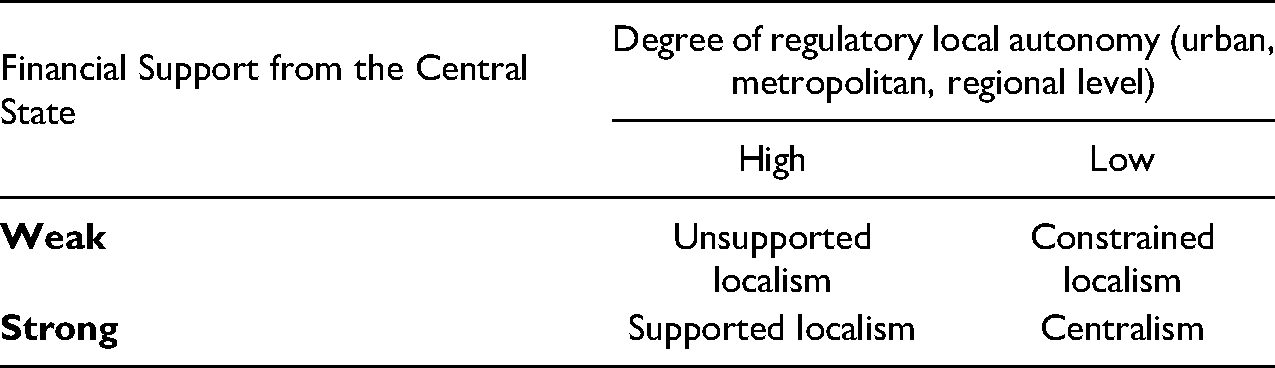
A supported localism MLG setting is characterized by large metropolitan or regional autonomy in setting urban policy rules and goals with strong state financial support. Locally based programs get funding from central programs with ample room for setting specific goals and methodology, and with high involvement of local stakeholders in the planning activity. Within a subsidiarity system, therefore, local stakeholders enjoy generous, not highly restrictive, support from the state.
An unsupported localism model is characterized by high local autonomy, possibly reinforced by a national federalist institutional structure, followed by no or very poor financial support from the state. In this situation, central constraints are limited since the responsibility for urban competitiveness, welfare protection, and social cohesion is basically devolved to the local and/or regional levels. However, in contrast to the previous situation, central funding and/or decentralization of funding responsibility are very limited. The result is that urban policy depends heavily on the capacity of local governments to carry out large-scale planning relying on locally funded or European programs. Subsidiarity here is more an implicit requirement than an explicit policy goal.
A constrained localism setting is characterized by low autonomy due to highly centralized regulatory power and weak financial support from the central state. Cities embedded in this type of MLG setting deal with strict financial and sectorial regulation on the one hand, and relatively scarce funding on the other; this is a difficult situation that may spur closer cooperation between municipalities within the same metropolitan area in order to provide supplementary place-based programs addressing specific local needs.
Finally, Centralism is characterized by strong national interventionism combined with generous financing. In this case, local governments have limited functional and institutional autonomy and depend heavily on state interventionism.
To sum up, the classification presented here (Table 1) may help to explain the existence of highly differentiated multi-level institutional settings across Western Europe. This classification shows a complex picture, due to the existence of different MLG settings in which functional and regulatory vertical inter-institutional relationships are peculiarly intertwined and combined with each other.
The Impact of the Financial Crisis and Austerity
In 2016, a prominent report on The State of European cities was jointly delivered by the European Commission and UN-Habitat to support ‘more evidence-based urban policy making in Europe’ (EC 2016, 11). In the report, it is maintained that “cities are no longer seen as only a source of problems” and that they are “increasingly recognised for their economic, social and environmental potential” (EC 2016, 11). This view was primarily based on the evidence of the important performances achieved in the last two decades by most European cities in the field of employment, GDP growth, education, technological innovation, and global competitiveness.
In the same report, however, the social conditions of European cities were shown to be strongly hit by the financial crisis. Its impact was significant in two respects. First, urban governments had to face increasing social needs due to the spread of the crisis in larger parts of the urban population; they had therefore to expand their existing social programs and/or promote policy innovation and harmonize such intervention with pro-growth policies supporting the global competitiveness of the city. These were hard tasks to accomplish in a time of cost containment and cuts in public financing. Second, austerity measures at national levels, strongly enforced by the European Stability and Growth Pact, 1 generally changed the financial and regulatory context in which urban governments had been operating until 2007–2008, significantly restricting their financial and spending capacity. The “stress test” therefore mainly involved two aspects of urban policies: the capacity of urban governments to respond to social needs exacerbated by the economic crisis, and the financial and regulatory multi-tier institutional context in which they operate.
On the demand side, the impact was particularly strong on the employment and housing conditions of people living in urban contexts. According to the same EU report, the share of households with very low work intensity was much higher in cities than in rural areas, and this figure significantly increased across European cities between 2008 and 2014 (EU 2016, 90). There is also evidence that the cost, quality, and availability of housing were major concerns in many cities in Europe, and that overcrowding and low affordability tended to get worse in cities going through a rapid population and/or income growth (EU 2016, 97). To sum up, the report provides evidence of an increasing trade-off between the generally strong economic performances of a large number of European cities on the one hand, and the very high level of labor market exclusion, overcrowding, and housing affordability problems in those same cities on the other (EU, 2016).
Evidence from our six cities basically confirms these trends, but it also shows that our cities followed different paths in recovering from the crisis. While all the cities showed growth in their GDP per capita in the period 2001–2007, the same cities, Munich excepted (see Table 2), went through a general decline in the following years. The crisis also affected their unemployment rate. Before the crisis, Manchester excepted, there was a general trend towards an increase in employment rates, although the cities started from extremely different bases. During and after the crisis, however, trends changed significantly: while Munich maintained a steady growth and Lyon basically maintained the same employment rate, the other cities experienced a dramatic drop in employment. In general, therefore, the crisis contributed to increasing the disparity between these cities.
Yearly Variations in GDP per Capita (Current Price 2015) and Employment Rates, Before and After the Crisis, for Each City.
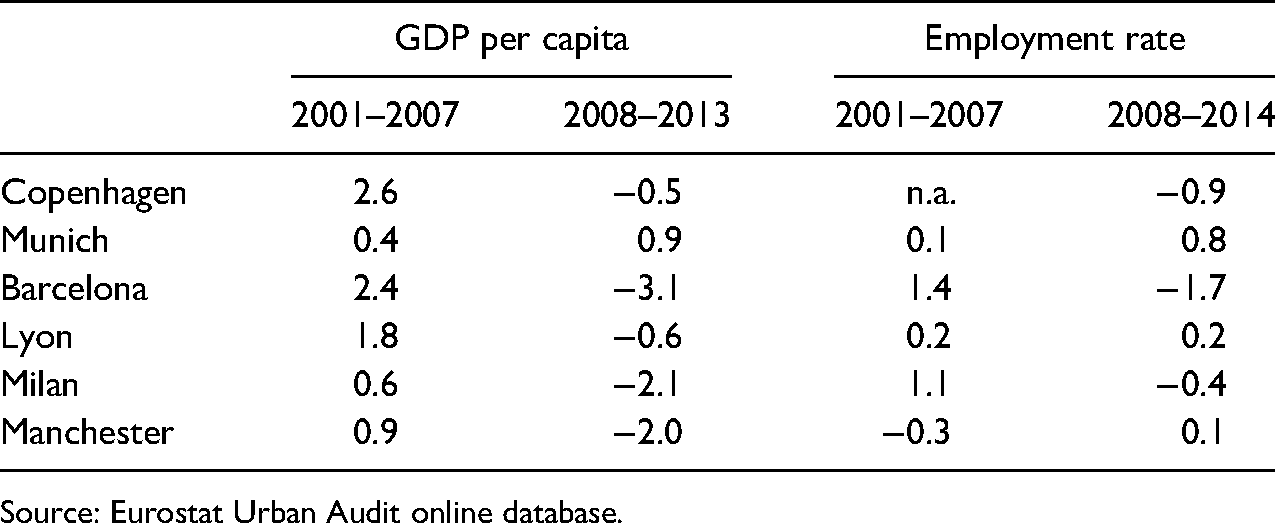
Source: Eurostat Urban Audit online database.
The crisis also reduced the financial and functional autonomy of urban governments. The UN-Habitat report shares a general belief that European cities have a unique potential to successfully balance policies of economic growth and competitiveness with programs targeted at promoting social inclusion, welfare, and cohesion. However, there is evidence that since the onset of the financial crisis a new scenario has become dominant, in which the previous highly functional and political autonomy of cities has come under strong pressure as a result of stricter criteria for the distribution of funding by nation-states, and the increased influence of the European Union and monetary authorities on public budgets.
According to the abovementioned report, while city governments generally increased their autonomy and their scale in the last two decades (mainly through merging dynamics and higher horizontal coordination), their financial capacity and autonomy was strongly hit by the financial crisis. Between 2009 and 2014, the average share of public investments by EU-25 local authorities dropped sharply by 19 percent, from 1.6 percent to 1.3 percent of total GDP, and this was not compensated for by alternative resources (EU 2016, 192). Furthermore, local government spending underwent a significant decline from 2009 onwards (EU 2016, 193–94).
To sum up, evidence shows that the historical capacity of European cities to address inequalities and promote economic growth at the same time was significantly challenged during the crisis. Two aspects put urban policies under pressure: the rise of social needs to exceptional levels due to a dramatic drop in jobs and household incomes (and in affordable housing as a consequence); and a pronounced reduction in the financial and spending capacity of urban governments due to national and EU-level austerity programs. Faced with these unprecedented, though differentiated, challenges, urban policies in the six cities considered developed differently. Among the factors relevant to understand these reactions, MLG settings play an important role and in the next sections, we analyze how these patterns have changed during the crisis.
Shifting Games. MLG Setting and the Governance Capacity of Cities Facing the Economic Crisis
General Trends
According to the typology drawn up in the section “European Cities Embedded in Different Multi-Level Governance Settings: A Classification,” the cities considered in our investigation demonstrate different MLG settings. With regard to the normative dimension, our research has revealed a wide variety of situations. In Manchester, urban policy is embedded within strong, all-encompassing state constraints; in Barcelona and Milan regulation and decision-making are more devolved to local authorities; Lyon and Copenhagen, in contrast, display a balanced equilibrium between self-government and central control (Kjellberg 1995); finally, in Munich, the local government enjoys a higher degree of autonomy strongly reinforced by the federalist structure of the German state. These results are highly consistent with the national patterns observed by the State of European Cities 2016 report (187 and following): while the United Kingdom exhibits a very low level of municipal and regional autonomy, in Spain, Italy, and France local autonomy reaches a medium level but a strong normative role is played by the regional level; finally, Germany and Denmark are characterized by strong regulatory power at the local level (see Table 3).
National Multi-Level Governance Frameworks.
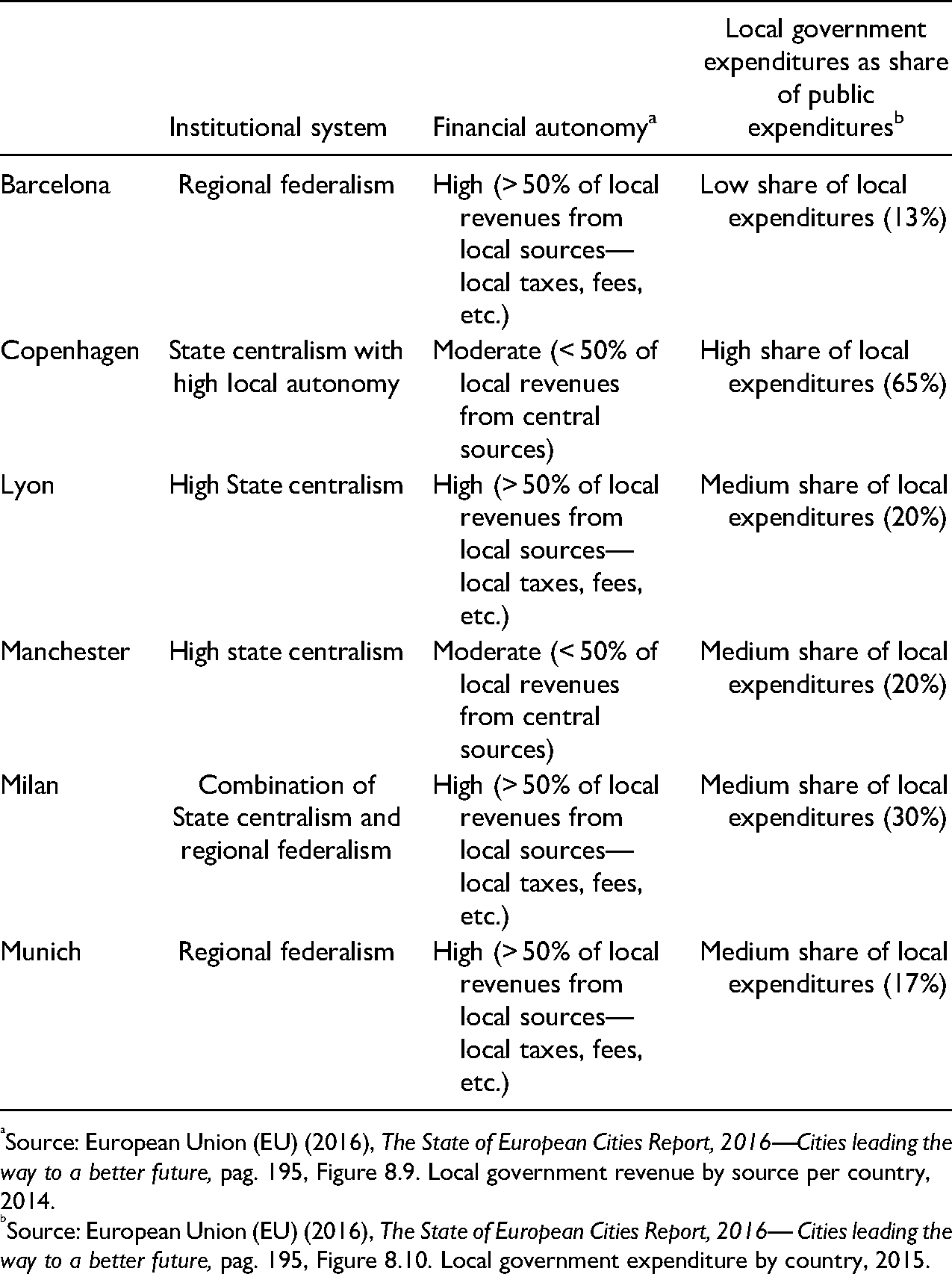
Source: European Union (EU) (2016), The State of European Cities Report, 2016—Cities leading the way to a better future, pag. 195, Figure 8.9. Local government revenue by source per country, 2014.
Source: European Union (EU) (2016), The State of European Cities Report, 2016— Cities leading the way to a better future, pag. 195, Figure 8.10. Local government expenditure by country, 2015.
As predicted in our theoretical model and shown in Table 4, the degree of local regulatory autonomy is not however consistent with the capacity for expenditure. Considerable disparities have been found in the multi-level financial relationships across Europe: while in generous, extended welfare regimes (Universalistic and Continental regimes, to use the Esping-Andersen 1990 typology) urban policies have been traditionally promoted by large amounts of central funding, in residual welfare regimes (in liberal and south European regimes) local governments have enjoyed less financial support from the state. Contrary to the misconception that cities in Europe have recently increased their degree of autonomy in respect of state financing, austerity policies have led to deep cuts in local public investment and expenditure (EU 2016). This reduction in the financial autonomy of cities has occurred across the different MLG settings, affecting the ability of local governments to promote effective policies combining economic development with social protection, as reported in many investigations on social innovation in Europe (Brendsen et al. 2016).
Changes in Different MLIG Settings due to the Financial Crisis and Austerity Measures (2003–2013).
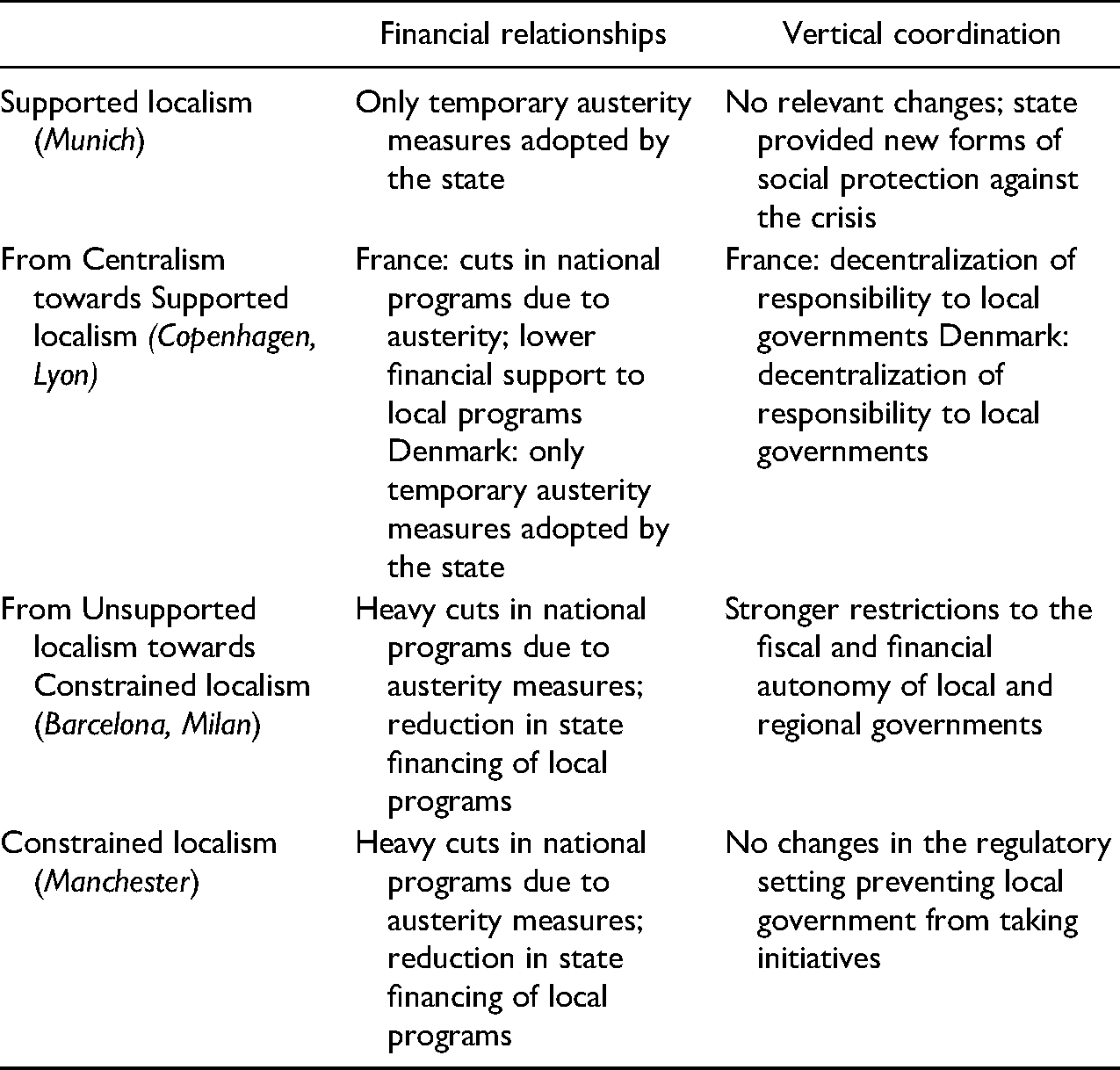
In the following subsections, we will describe these changes by considering two main shifts, that are contributing to a more polarized picture: a shift towards supported localism, and another one towards constrained localism. Our investigation has indeed shown that two general trends in MLG settings have become prevalent. The first, characterizing the MLG setting of Munich, Lyon, and Copenhagen, is towards a “supported localism” model featuring a certain degree of freedom in local actions within more general coordination providing them with selective support from state and regional governments. The second, characterizing the situation of Manchester, Milan, and Barcelona, is towards a constrained localism model, which features very tight financial constraints set by central authorities accompanied by very weak financial support from the central state.
(Towards) Supported Localism
In the framework of our classification, Munich is the city closest to a stable, supported localism MLG setting (Thierstein, Auernhammer, and Wenner 2017). Most urban programs have been implemented by the municipality with strong cooperation at the city-region level and generous funding provided by national state schemes (Evans and Karecha 2014; Cucca and Ranci 2017). Moreover, Germany's federalist structure has helped to coordinate local, regional, and national efforts. Highly representative of this integrated model is the Munich Perspective program, a strategic Masterplan established in 1997 through which both local and extra-local public investments combined with private investments were channeled to specific areas of the city, linking economic development with territorial planning in the attempt to concentrate economic innovation in strategic areas. Economic development has been used as a driver for the regeneration of suburban, deindustrialized, or deprived areas by promoting infrastructural and ad hoc training, and providing incentives for private companies to locate their businesses there. The German government's strong orientation towards investing in place-based competitiveness by supporting high value-added programs in attractive urban areas (Mazzucato 2015), has successfully combined with the vision and strategic capacity of the city government. A similar approach has also been used to develop specific local programs designed to protect against unemployment due to the financial crisis. State social schemes providing unemployment protection were complemented by local policy measures targeting low-skilled workers. As part of the Munich employment and qualification programs, for example, special programs for young people were launched to reduce long-term unemployment, to provide work-care balance and apprenticeships for young unemployed people, and to support ethnic businesses. In contrast to contexts where employment protection is solely provided by state-scale policies, in the case of Munich a complementary strategy was applied to meet the needs of specific groups of workers through special place-based programs. Moreover, affordable housing has been an important issue in the public debate due to the huge price of accessing housing and the low provision of social housing (10%). The main task of housing policies at the urban level has been to provide affordable housing while maintaining an adequate quality of life in all the urban districts. These measures have been interestingly linked with an attempt to customize social infrastructures for childcare, care for the elderly, and for other social services, and have been promoted through a socially equitable land-use approach. In 1994 Munich had already begun a socially equitable land-use approach (“Sozialgerechte Bodennutzung [SoBoN]”) aimed at sharing the costs of new housing developments with the investor (Landeshauptstadt München 2009). Joint property cooperatives are supported by the “Münchener Modell,” whereby one-third of the building plot is assigned to free-market interventions, another third to cooperatives and the remaining third to social housing rental interventions. Cooperatives are also in charge of the sale of the property being resold on the housing market, avoiding price increases with speculative roots, and thus contributing to a reduction in private housing prices. This planning instrument resulted in approximately 40,000 new housing units, including 10,000 subsidized units by 2014. However, Munich's housing market has become polarized between prestigious and expensive housing choices (particularly for rent) and the availability of rental houses (for instance in the northern parts of Munich such as Feldmoching-Hasenbergl) that are neither attractive nor renovated, but meet the requirements of immigrants as well as of the low-income population (Mazzoleni and Pechmann 2016). In a saturated spatial context such as Munich, the creation of new housing becomes increasingly difficult due to the limited availability of building plots and rising construction costs. As a result, the successful competitiveness of Munich's urban region and growing attractiveness might be challenged by growing socio-spatial inequalities.
Munich emerged relatively unscathed from the economic crisis. Germany swiftly recovered from the crisis, and in 2009 had already returned to positive GDP and employment growth. In Munich, the extensive institutional and financial autonomy of the city-region enabled much better economic and demographic performance than in other German cities, consolidating Munich's economic supremacy in the country as a whole. The Munich Perspective program remained basically intact in spite of the crisis and continued to be developed and funded according to the original plan. To sum up, Munich has basically followed its previous institutional path with no significant changes, due to the moderate economic implications of the crisis and limited austerity measures at a national level.
The situations of Copenhagen and Lyon have been instead marked by significant changes over the last years. They have partially shifted away from a Centralism model that characterized the years before the financial crisis, towards a situation more close to a supported localism pattern.
In Lyon (Dormois, Galimberti, and Pinson 2017), fiscal austerity reduced direct state intervention and support for local programs. During the crisis, the city was forced to respond to increasing social demand with reduced financial resources: a hard-to-solve dilemma showing how far local policy was still dependent on state support. However, the city started up new programs based on self-financing. An inter-communal group of local authorities, the Grand Lyon, was set up to deal with large-scale issues (such as mobility), leading to the creation of Masterplans and a local housing program (Programme local de l’habitat) at the inter-municipal scale. Innovative sectors (such as biotech and clean-tech) were moreover supported through the institution of pôles de competitivité aimed at fostering publicly financed cooperation between local universities and private companies. However, no local policies were developed to address the rising poverty due to unemployment, leaving the whole responsibility for this to the central state. The consequence was that public policy at a local level was basically unable to counteract the increasing dualization of the labor market. A more active role by local policies was played to address the deficit of affordable housing. Lyon is located in a national context presenting a relatively good diffusion of public and social housing, and where housing policies have been recently sustained by different levels of government. In this favorable context, Lyon has been characterized by a twofold, contradictory, policy orientation. On the one hand, urban planning has supported the gentrification of central areas through the restoration of historic neighborhoods, improvement in the quality of public spaces, and concentration of crucial infrastructures in central neighborhoods. Moreover, demolition and rebuilding of buildings in the most distressed areas have diminished the available resources for social housing policy, and the upgrading of the public stock contributed to increasing rental prices. On the other hand, a large range of housing affordability policies was introduced at the national level, which enabled approximately 50 percent coverage of the demand for low-cost housing. Among these, the “servitude de mixité sociale” in areas with a shortage of low-cost housing is worth mentioning, as this was a rule imposing a minimal share of social housing for each future real estate development (20% or 25% of social housing).
In Copenhagen (Andersen 2017), since the 1980s the Danish government had adopted a strong neo-liberal local agenda to reverse the city's declining financial fortunes, and to this end had focused on economic development and encouraging private enterprise. On the other hand, while the generous Scandinavian welfare state provided the poorest sections of the population with a large range of public services and social benefits, local housing programs and planning activity were subject to deep, centrally enforced cuts. A clear example of this “dualist strategy” is provided by housing policy. Over the last two decades, housing has become much less affordable, mainly as a result of major changes in housing market regulations. Since the 1990s, the city government has promoted home ownership in an attempt to capture high-income groups and repair a severely compromised local budget. Public intervention to regenerate deprived neighborhoods (e.g., Vesterbro) and encourage private investment in new development areas (Oresund) has led to gentrification and increased housing costs. Moreover, during the 1990s, a sell-off of municipal housing was encouraged by the national government to cover the city's public debt. After the emergency of the 1990s, Copenhagen obtained greater normative and functional power as a consequence of institutional reforms which led to the balance of overall expenditure tilting heavily in favor of local government.
Urban planning changed from primarily a subject of democratic negotiation into a guiding instrument for investors. The city planning department started actively to promote development opportunities and help investors identify construction sites. Furthermore, to accelerate the transformation of run-down industrial space to residential areas, the city established a development company to plan and implement larger projects in the harbor area.
The combined effects of this shift in urban policy have been remarkable. In the space of a few years, Copenhagen has become one of the most successful cities in northern Europe in terms of GDP growth. The many government investments triggered a major round of private capital flow into the built environment, and a series of visible, rapid transformations in the city followed. However, this phase of rapid growth was hindered by the 2008–2009 fiscal crisis. Initially, the crisis affected the property market while unemployment remained low (5%–6%). However, since 2010, labor shortages have given way to surplus demand. The unemployed who were older than fifty, in particular, had significant problems returning to the labor market, and the youngsters with little or no work experience had similar problems. Moreover, both unskilled and graduated workers with a university background in humanities or social sciences had problems gaining employment (Andersen 2017). In general, if on the one hand, the persistence of welfare state policies provided the most vulnerable population with strong protection, on the other these policies were instrumental to the urban policy goal of supporting a highly competitive economy. A reform of the governance system introduced in the wake of the financial crisis gave the local level even more autonomy than before (Andersen and Winther 2010)
To sum up, in both Copenhagen and Lyon, pro-growth policies adopted at the city level have been complemented by generous social protection offered by the national welfare state, which retained most of the responsibility for unemployment protection in both cases. The consequence has been the creation of a dual system, where local public hiring incentives in the most competitive sectors were combined with state assistance provided to workers excluded from the labor market. Attempts were made to break this dualism by promoting labor activation programs targeting low-skilled workers and specific categories of unemployed people, especially in Copenhagen.
In both these cities, the MLG setting has thus partially changed. From urban governments with little room for autonomy and enjoying the generous support of nationally framed interventionist policy aimed at fostering place-based competitiveness and attractiveness, they have developed into more autonomous governance systems. This has been mainly provoked by governance reforms promoted at a national level to try to foster better conditions for economic and social recovery at a local level.
(Towards) Constrained Localism
In contrast to Munich, Lyon, and Copenhagen, urban policy in Manchester is clearly characterized by a constrained localism model. Of all the cities analyzed, Manchester is the one that suffered the greatest loss of autonomy both in the normative and functional spheres (Headlam 2017). This loss of autonomy is the result of the strong trend towards financial recentralization that occurred in the United Kingdom in the 1980s and 1990s, coinciding with the abolition of the Greater Manchester Council in 1986. More than 70 percent of the city's total funding came from central government, with local councils funded by a combination of central government grants. Despite this regulatory and fiscal centralism, Manchester has garnered significant attention for the way in which it has sought to work across administrative boundaries of the conurbation to build partnerships for tackling key economic and social challenges through horizontal and vertical alliances with other public and private bodies and higher levels of government (Gordon, Harding, and Harloe 2012). Efforts to regenerate the city after the previous traumatic phase of de-industrialization focused on attracting mobile capital and labor into knowledge-intensive, high-value service sectors. A “city deal” agreement was signed between the Greater Manchester Association and the government to promote a skill-learning program, including a specific Apprenticeship Guarantee addressing the issue of NEETs (not in employment and training). However, only a very small number of young people were involved. Apart from this example, the local policy agenda was basically focused on high-skilled jobs, and this fact increased the risk of labor market exclusion. In spite of these efforts, the structural situation that is distinctive of a “constrained localism” setting explains why the rapid economic growth experienced by the city over the last decade has come together with local government's general failure to address its wide spatial and social disparities. A clear example of such difficulty is housing policy. On the one hand, regional stakeholders did not have the requisite powers to make significant interventions in this policy area. On the other hand, despite the relatively high proportion of residents living in social housing, this provision was no longer under the direct responsibility of local authorities and was largely “stock-transferred” to independent bodies outside public control. Though many housing interventions were launched by the Greater Manchester City Region (GMCR), mainly through public–private partnerships and private finance initiatives, many of them were recently canceled in a wave of cuts of regeneration schemes by the national government. One exemplary policy is the Manchester Mortgage Scheme introduced by the Manchester City Council in 2014, in order to tackle the chronic shortage of affordable housing and lack of finance capital for people to obtain mortgage finance. The promoters of this scheme were Manchester City Council, the Greater Manchester Pension Fund (GMPF), and the Co-operative Group, based in Manchester. The local authority identified five sites in the city on which it planned to build nearly 250 homes for sale or rent through a pilot scheme. As part of the plans, the council created a mortgage guarantee scheme targeted specifically at first-time buyers, allowing them to underwrite up to 20 percent of the total loan. The GMPF was supposed to pay for construction costs. The aim of the Manchester Mortgage Scheme was therefore to address the problem of the lack of mortgage finance, which was perceived as a core reason for the housing crisis in the city-region, in the absence of large-scale, nationally led programs to alter the nature of the housing market and its unevenness across the city-region. The scheme has been looked at by central government as a way of funding infrastructure in an age of declining public spending by leveraging major pension funds, which is quite representative of a constrained localism approach to governance.
According to our classification, before the crisis, Barcelona (Cano, Pradel, and García 2017) and Milan (Torri 2017) were characterized by an unsupported localism MLG setting, where high local normative autonomy comes with poor financial support from the state. In this context, local initiatives were not able to pursue consistently significant goals. The crisis has moreover implied a loss in local autonomy due to greater constraints on local expenditure, while responsibility for social programs has largely remained with local authorities.
Since the 1970s, Barcelona has been well known for close, long-standing cooperation between regional and local governments (Cano, Pradel, and García 2017). For a long time, weak state financial support was supplemented by a strong system of urban governance, with tight integration of social and political forces and local institutions. A high level of local institutional coordination made intensive strategic planning activity and frequent use of public–private partnerships possible. The economic crisis, however, exposed the weak financial basis of the Barcelona model. The case of housing policy is particularly significant in this respect. Between 1995 and 2006, housing prices in Barcelona increased by 500 percent, paralleled by a reduction in the size of the public housing stock (only 0.5% of GDP was devoted to housing policy). While state housing regulation was directed toward fostering ownership, with little development of public housing, locally-based policy measures to regenerate peripheral neighborhoods and support the rental sector (e.g., the “State Plan for Housing and Rehabilitation”) were extensively implemented by the municipality, albeit on an extremely restricted budget (Blanco, Salazar, and Bianchi 2020). The financial crisis severely impacted this strategy, reducing available funding in the face of a shocking increase in problems relating to housing affordability and property market mismatches. Only recently, under the new left-wing government has public support for housing affordability returned to the urban agenda, although it is still too early to evaluate the results.
Barcelona has also implemented policies to address the major increase in unemployment due to the crisis. In the first phase of the crisis, a local pact focusing on “quality of employment” was signed between the local administration, local trade unions, and business organizations. This pact led to the institution of the local agency Barcelona Activa, a public limited company with public capital, with the explicit aim of implementing activation policies for economic promotion and improving employment in numbers and quality, as well as offering know-how for the creation and consolidation of new small- and medium-sized enterprises. Its board of directors consisted of representatives of all the political municipal groups, employer associations, trade unions, and university representatives. From the very beginning, the agency adopted the European Union employment guidelines, and the developed actions were focused on the central prescriptions of the European Employment Strategy, which consisted of (a) improving the skills of unemployed and employed workers, (b) fostering entrepreneurship, and (c) developing specific programs for women to further equal opportunities in the labor market. Until 2011, the left-wing city governing coalition and trade unions therefore emphasized policies to develop employees’ skills to fit the new service economy of the city. This orientation complemented measures aimed to attract new companies and to create new clusters of activity (in the 22nd district, for example) through active employment policies that included improving workers’ qualifications.
After 2011, this model changed due to the restrictions imposed by austerity programs and by the arrival in power of the Catalan Conservative Party in the city council. In fact, conservative parties and employer associations promoted policies focused on economic competitiveness, rather than on human capital development, as a way to create employment. Furthermore, the new approach gave less relevance to the social dialogue between trade unions and employer associations, in favor of more diverse participation of actors in the definition of policies for competitiveness. Since 2011, the city council promoted the forum Barcelona Growth (Barcelona Creixement) that tried to involve local and foreign actors (including not only the local Chamber of Commerce but also foreign Chambers of Commerce and other representatives of business interests abroad) in an overall strategy for economic growth.
Due to austerity measures at different levels, Barcelona Activa also saw its budget decrease. In 2012, the budget of the agency was cut by 57 percent, particularly affecting the strategies for employment (training and professional orientation) (Cano, Pradel, and García 2017). The new conservative government took the new situation as an opportunity to reformulate the model of development of active employment policies. The new formulation was based on putting companies at the center of strategies for employment, and thus, reorganizing the whole agency towards bringing services to companies. The re-orientation of the employment development model was therefore based not only on supporting competitiveness, leaving social cohesion aside, but also with a sharper focus on jobs creation regardless of their quality. With this new focus, the new local government emphasized the role of the private sector in the generation of employment and competitiveness for the city.
In Milan, during the first decade of the twenty-first century, local development policies focused exclusively on providing incentives for highly competitive companies in specific sectors without developing a strong steering capacity on the part of local authorities. A neo-liberal urban agenda was set to distribute financial incentives to enterprises operating in globally integrated sectors (such as design, fashion, biotechnologies, high-quality medical services, and research), to allow large-scale real estate developments, and to promote EXPO 2015, a global event designed to boost the city's attractiveness. In contrast, only limited measures were implemented to address the problems of deprived areas. A major political reversal in 2011 subsequently ushered in a partial policy re-orientation based on providing infrastructure for innovative start-ups and spin-offs (Andreotti 2019). However, social cohesion policies were severely weakened by the unsupported localism framework. A national constitutional law introduced in 2001 shifted regulatory and financial responsibilities for housing, employment, and social services from the state to local authorities. The result was very poor development of such policies at the urban scale, as local authorities lacked financial resources to replace central public investments. Moreover, weak inter-institutional cooperation and lack of strong political vision at the urban scale, together with limited financial resources, drove urban policy towards a residual strategy. Since the onset of the crisis, the only actions to counter the rising risks of unemployment and poverty were private-led social initiatives. Housing affordability problems were mainly addressed through public and private partnerships aimed at increasing the supply of affordable rented accommodation, with very limited impact. Only in recent years, has the new administration implemented a new agenda for housing policies (Pasqui 2017).
In a policy guideline document entitled La città come bene comune (the city as a common good), the new left-wing government set out new guidelines for urban planning in the city (Comune di Milano 2011), in marked contrast to the previous tendency to encourage further urban densification. The new goals were now reducing building, reviving social housing, expanding green areas, reducing private traffic, boosting cycling mobility, strengthening the public transport network, and above all improving public infrastructure and services within private projects. In all new dwellings, at least 50 percent of the total surface area had to be given over to local infrastructure. Another key part of this strategy is represented by the establishment of a new housing policy aimed to meet the housing demand that has emerged during the crisis and to develop a more extensive system of supplying low-cost housing for disadvantaged groups. The adopted strategy is based on the renovation of existing but unused public or private housing stock. Furthermore, a Social Agency for Housing modeled on other cities has been set up to integrate various instruments and lines of action aimed at reducing housing deprivation by involving public and private resources. The Agency aims to increase the stock of low-cost dwellings by proposing an “agreed rent” as a new instrument for mitigating household deprivation and to help bring together owners and tenants interested in entering into an agreed rent contract by offering financial incentives and a series of instruments to safeguard and guide the parties signing the contract.
This paradigmatic change in policy orientation, focused on a new urban planning approach and the development of a system to offer low-cost accommodation, has therefore placed urban development at the center of local political action (once again), with a view to repairing the dualism between economic growth and social cohesion. This transition, however, has come at a particularly difficult time, owing to a series of contextual factors. Firstly, the sharp economic crisis has severely constrained both public and private investments in the housing sector. Secondly, austerity policies at the national level forced the local government to make sharp budget cuts. Finally, the realization of the international event Expo 2015 absorbed a large proportion of the organizational and economic resources of the new administration in office. To sum up, lack of public funds, previous administrative commitments, and a poor chance to mobilize private capital in times of crisis have only allowed small-scale social programs, such as the provision of public land for a few public housing projects, or the setting up of a small public fund reserve to subsidize the low-rent social housing sector.
The cases of Milan and Barcelona (Andreotti 2019; Blanco, Salazar, and Bianchi 2020) show that, within a unsupportedlocalism model, the lack of central financial support can only be partially and temporarily offset by urban activism and the capacity of local policymakers to build horizontal, place-based coalitions. In the absence of such exceptional political or social conditions, this model not only renders urban policy precarious and residual, but also leads it in the direction of a new Constrained localism model, which further weakens its capacity to strengthen local cohesion.
Concluding Remarks
The “stress test” caused by the 2008–2009 financial crisis has revealed the fragile status of many urban governance systems in Europe (Brenner 2010). Their ability to govern social and economic transformation effectively has been challenged by the emergence of a new policy trilemma: (i) growing social needs demanding further social cohesion policy; (ii) increasing responsibility in key policy areas due to devolution programs or the inability of central government policies to deal with critical local situations; and (iii) stronger financial constraints caused by austerity policies, cuts in government funding and greater central constraints on local funding and expenditure. In response to this trilemma, our analysis has shown that reactions have been different across the six cities examined and that trajectories of change have brought about greater diversification in urban policy than before, especially as far as the outputs of these policies are concerned. Indeed, all the cities considered here have developed specific—and to some extent innovative—programs (Cattacin et al. 2016). However, while their agency capacity was often resilient in spite of difficult circumstances, in some cities the policy outputs were able to address only tiny segments of the population.
This varying capacity of cities to govern change is the result of a number of factors already considered in previous research, including the specific policy orientation and capacity of local governments, the public resonance of “neo-liberal versus progressive” discourse, the availability or lack of public funds within the national and/or European framework, and the different roles played by traditional and new social stakeholders in setting urban policy agendas. However, in this study, the state–city institutional framework has been shown to be crucial in enabling local governments to act in favor of social cohesion (Therborn 2017).
The policy trajectories of the cities here analyzed have been very different and have radicalized the pre-existing variety of MLG settings. In few cases (Munich and Manchester), the MLG setting has been stable, while in most cities it has changed as a result of national reforms giving additional regulative power to local levels (Lyon and Copenhagen) or as a result of decreasing financial power following national austerity measures (Barcelona and Milan). While cities such as Munich, Copenhagen, and Lyon have been able to adjust their level of vertical multi-level coordination to implement previous—or new—local strategies to deal with social emergencies, in Barcelona, Milan, and Manchester the capacity of urban governments to combine the protection of the weakest social groups with the promotion of the city's economic development has significantly weakened.
Two general trends in MLG settings have become prevalent: the first is towards a Supported localism model characterized by a certain degree of freedom in local actions within more general coordination providing them with selective support from state and regional governments, while the second is towards a Constrained localism model characterized by very tight financial constraints set by central authorities accompanied by weak financial support from the central state.
To conclude, we found a significant association for the cities under consideration between the characteristics of their respective MLG frameworks and their policy outputs. Our result shows that institutional aspects related to the MLG framework, in addition to decision-making dynamics and the role of public and civil society actors, play a crucial part in either expanding or limiting the capacity of urban policy to effectively respond to social challenges.
From a more theoretical perspective, our result advocates for a stronger consideration of the MLG setting within urban governance analysis, by overcoming disproportionate, rather ideological assumptions about the high degree of local autonomy and urban policy capacity (Pierre 2014). A framework for comparative urban governance must be able, therefore, to take into account different degrees of vertical functional and regulatory autonomy, as these are key aspects of local policy capacity.
Our study presents some limitations that need to be overcome through a more complex research design. The association between MLG setting and cities’ policy capacity does not imply a clear causal nexus between these two aspects. Moreover, our research has developed four ideal-typical MLG settings, but it is unable to test whether different strategies can be carried out by cities within the same institutional framework. Therefore, we need to understand to what extent the same MLG setting has influenced the policy capacity of lower-tier cities within the same national context. Finally, future research will need to understand whether the polarization occurring in MLG settings is here to stay, and how strong cities’ capacity to meet coming social and economic challenges will be.
What clearly emerges from our research is that the various fates of European cities will be inextricably linked to dynamics and policy trends at the European and national levels. If on the one hand the idea of a “European city” that is effectively resistant to national policy changes can be considered inadequate, on the other, European cities may still show a certain capacity to innovate and govern economic changes and social challenges only if supported by an enabling MLG system. In light of the current crisis due to COVID-19, which has been severely affecting the economic and social stability of many EU cities, the findings of this investigation invite a stronger consideration of the MLG settings in the design of effective urban policies and programs at a local level.
Footnotes
Declaration of Conflicting Interests
The authors declared no potential conflicts of interest with respect to the research, authorship, and/or publication of this article.
Funding
The authors received no financial support for the research, authorship, and/or publication of this article.
