




Abstract
An examination of women's experience on public transport in Bangladesh and Cambodia found that victimization does reduce perceived safety or transport use. In a cultural context where women are socialized to fear and avoid public spaces, experiencing victimization may confirm rather than change previous beliefs. Moreover, it is possible that the participants’ use of public transport was driven by necessity rather than choice and that they were unable to change travel patterns in response to victimization. These findings underscore the importance of targeting public violence toward women and the broader societal norms that limit their participation in public life.
Introduction
The safety of women in public spaces began to draw attention from feminist scholars in the 1970s and 1980s (Pain, 1991). MacKinnon (1979) explored sexual harassment in the relatively structured setting of the American workplace. Stanko (1985) explored the common contemporary and historical experiences of threat and harassment directed at women in public, primarily in the United Kingdom, including the precautionary steps women felt they had to adopt when moving through public spaces. In the United States, Wekerle and Rutherford (1987) highlighted the transport disadvantage experienced by women, although they focused on disadvantage in terms of access, cost, and time rather than exposure to harassment or violence. At the same time, scholars of criminology, geography, and urban studies also began to explore women's subjective fear of crime and how it impacts women's perception and movement through public spaces (Pain, 1991).
More recently, research into public abuse of women has been stimulated by greater interest from agencies seeking to take action to address women's safety, with publications in the field increasing over two-fold between 2015 and 2020 (Fileborn & O’Neill, 2023). While traditionally, the majority of studies on women's public safety have been from the Global North, there is an increasing awareness of harassment in the low-income countries of the Global South. Campaigns such as the UN's Safe Cities and Safe Public Spaces initiative and numerous grassroots campaigns and activist movements have been initiated to identify, address, and mobilize against abuse in this part of the world (Das, 2019; Kearl, 2015; UN Women, 2021).
In the Global South, gender inequality and violence against women are particularly pronounced. Compared to high-income countries, the gender gap in terms of literacy, access to technology, political representation, and labor force participation is greater in this region of the world and more women and girls are exposed to intimate partner violence and discriminatory social institutions, child marriage, and maternal mortality (Nguyen & Wodon, 2015; Tavares & Wodon, 2018). Harassment in public spaces from strangers, including on transport systems also occurs with greater prevalence and severity in the developing economies of the Global South (Gekoski et al., 2017; Hoor-Ul-Ain, 2020). For instance, a 2014 survey of transport systems in 16 middle -and high-income megacities found that the five safest cities (New York, Tokyo, Beijing, London, and Seoul) were all located in high-income countries while the five least safe were found in middle-income countries (Colombia, Mexico, Peru, India, and Indonesia: Thomson Reuters Foundation, 2014).
When using public transport systems women experience violence across two dimensions: violence that is directed toward them based on their gender (sexual violence and harassment) and violence that stems from systemic societal issues such as poverty, unemployment, urbanization, and crime (Taylor, 2011). Together and in concert with other forms of discrimination, sexual and nonsexual aggression in public places impedes women's safety and mobility and subsequently their ability to participate fully and equally in society and to contribute to economic growth (Ding et al. 2020). Attempts at quantifying the cost of unsafe transport have been made. For instance, aggregate country-level data indicate that limited access to and safety of transport lowers the probability of female labor force participation by 16.5% in developing economies and 5.7% in emerging economies (International Labour Organization, 2017). Research from India (Borker, 2021) shows that female college students will choose a university in the bottom half of the quality distribution over a university in the top 20% if their travel safety increases by one standard deviation (SD = 3.1% reduction in reported rapes). A second survey found that 52% of its respondents had turned down education or work opportunities due to transport safety concerns (Ratho & Jain, 2021).
Sexual Aggression and Violence
As with street harassment more broadly, harassment on public transport is linked to aspects of patriarchal cultures that relate to the subordination of women and the sexual entitlement and dominance of men (Chakraborty, 2016). Within this context, public transport may amplify men's harassment of women as several aspects of the transit system, such as overcrowded transport and deserted transit stops, offer both opportunity and anonymity to perpetrators (Natarajan, 2016; Neupane & Chesney-Lind, 2014). In several countries in South Asia, including but not limited to, Bangladesh, Pakistan, and India, women in public spaces are frequently subjected to “Eve teasing,” a euphemism for street harassment that by most definitions include verbal and physical forms of harassment such as catcalling, leering, stalking, indecent exposure and masturbation, and groping (Kathpalia et al., 2019; Natarajan, 2016; Talboys et al., 2017), although some definitions extend to include assault and rape. The extent of Eve teasing in public places is well-documented in Bangladesh (Chowdhury & Fileborn, 2020; Islam & Amin, 2016), and while research specific to public transport is less common, reports released by ActionAid in 2016 (Arzua et al.) and by BRAC in 2018, indicate that between 84% and 94% of women have experienced sexual harassment when commuting.
Although Eve teasing is sometimes trivialized either as less serious than other forms of gender-based violence (e.g., domestic abuse, acid attacks, and rape), research shows that it has profound and damaging effects on women's sense of safety and emotional well-being (Parvej et al., 2020). Women overwhelmingly report that they dislike it, and links have been made between Eve teasing and anxiety, hopelessness, depression, and suicide (Beattie et al., 2019; Kathpalia et al., 2019). The impact of Eve teasing on transport behavior is less well understood. However, research from urban India indicates that women may not change their mode of transport in response to sexual harassment, but rather modify travel behaviors, such as avoiding local buses at late hours and during peak hours, preferring to travel in groups, and carrying weapons (Bharucha & Khatri, 2018; Mitra-Sarkar & Partheeban, 2011). The finding that women modify travel patterns rather than travel mode suggests that the women who travel on public transport, despite its inherent dangers, are those who may have little choice but to do so.
In Cambodia, women experience significant levels of discrimination and abuse. The 2021 Global Gender Gap report ranks Cambodia 103rd among the 156 countries for which data are available, with large gender gaps particularly noted in terms of educational and political participation (ranked 128th and 126th, respectively; World Economic Forum, 2021) Although there are indications that the incidence and acceptability of domestic violence are decreasing, it remains a significant problem (Fulu et al., 2013; Ministry of Women's Affairs, 2014). Data published in 2015 suggest that physical or sexual violence occurs in 18% of all marriages and data summarized and published in 2018 showed that 5% of women in domestic relationships have experienced violence in the form of kicking, dragging, or beating while 12% have been slapped and 11% have been pushed, shaken, or had something thrown at them (Kosal et al., 2015; National Institute of Statistics, 2018). When presented with three reasons for domestic abuse, 36% of men and women aged 15–49 years agreed at least one of those reasons justifies a man knocking his spouse on the head. A further 18%, 13%, 10%, and 9% agreed that he is justified in tying up or hitting her; threatening her with a knife, gun, or other weapon; burning or choking her; and throwing acid at her, respectively (National Institute of Statistics, Ministry of Planning, 2018).
Despite pervasive issues with gender-based discrimination and violence in Cambodia, research on harassment in public spaces is sparse, allowing for only a partial understanding of its nature and prevalence at best. Studies examining the living conditions of female garment workers have noted that they experience harassment by “gangsters” (in local terminology), men who loiter around factories to harass or attack female workers as they leave their workplace (Kelly, 2014). A large-scale nationally representative survey of Cambodian garment industry workers found that 13.5% of female workers had experienced sexual harassment in the community, and 11.2% on the way to work (CARE International, 2017). However, it was noted that for this sample, work journeys were generally undertaken during the daytime and in the company of other workers. As such, the generalizability of these findings is uncertain and the wider prevalence of public harassment is not well understood.
Nonsexual Forms of Aggression and Violence
Research on women's exposure to nonsexual harassment and crime on public transport is limited in the Global North and largely absent from the literature on the Global South. Although research indicates that some transport crimes such as assault and robbery are more commonly directed toward men (Morgan & Smith, 2006), there is cause to believe that nonsexual aggression has a disproportionate effect on women. In the larger literature on fear and crime, women consistently report feeling more vulnerable to almost all forms of crime (Fox et al., 2009; Pryce et al., 2018; Snedker, 2012) and in all road traffic environments (Basu et al., 2021). They also report greater levels of fear and emotional distress following violent victimization and acts of public harassment such as pushing, yelling, or cursing (Bastomski & Smith, 2017; Logan & Walker, 2021a, 2021b) and engage in more avoidance behavior, such as avoiding busy public places, after their victimization (Bastomski & Smith, 2017).
The reason for women's disproportionate fear of crime is likely multifaceted and partly explained by differences in physical stature and ability to defend themselves from attacks or by a greater willingness to admit to feelings of anxiety and fear (Choi & Merlo, 2021). However, sociological explanations have also been put forward, including the argument that for women, even nonsexual victimization (e.g., robbery or burglary) involves the perceived risk of accompanying sexual assault, which adds an additional dimension of fear (Choi et al., 2020; Özascilar, 2013). It has also been argued that aggression toward women in public spaces is a “motivated and communicative act that reflects and reinforces broader structural relations of power” (Bastomski & Smith, 2017, p. 74) and that women are socialized into understanding public spaces as a male domain that is hostile and dangerous for women (Dhillon & Bakaya, 2014). Regardless of the underlying mechanism, the heightened fear of crime underscores the importance of understanding how nonsexual aggression and violence impact women's travel behavior and mobility.
Study Aim
This study sought to further the understanding of the influence of sexual harassment and nonsexual forms of aggression and crime on women's perceived safety and use of public transport in the Global South. Data used in this article were drawn from a larger mixed-methods project that examined women's use of public transport for education and work purposes in Dhaka (Bangladesh) and Phnom Penh (Cambodia). In the current study, quantitative data from Bangladesh and Cambodia were analyzed to answer the following two questions:
What forms of sexual and nonsexual aggression and violence are women subjected to during public transport trips in Bangladesh and Cambodia? Does sexual and nonsexual victimization impact women's perceived safety and use of public transport?
The study included women who used transport for either educational or work purposes. Educational attainment and employment have the potential to strengthen women's standing in society through their association with improved health, upward social and economic mobility, increased political and civic participation (World Bank Group, 2015), and a better understanding of the barriers to mobility that women who engage in these activities face is therefore of importance.
In recognition of the fact that women experience harassment across different public spaces, participants’ experiences when travelling were examined from origin to destination, across different modes of transport if several were used, and inclusive of time spent walking. The examination of sexual harassment and violence was undertaken to supplement the existing information on street harassment by examining its nature and prevalence during public transport trips (Research Question 1), a public space that may amplify women's harassment due to the anonymity and opportunity it offers perpetrators, and by examining its influence on feelings of safety when using public transport and on travel patterns specifically (Research Question 2). Beyond this, the examination of nonsexual aggression and violence was included with the view of adding to the information available on women's transport issues, which is heavily skewed toward sexual harassment and violence.
Method
Participants and Recruitment
The research was conducted as a collaboration between Jahanjirnagar University, Dhaka and the Institute for Road Safety, Phnom Penh and Queensland University of Technology (QUT), Brisbane. Ethical approval was obtained from the QUT Human Research Ethics Committee to collect survey data from women aged 18 years and above, who were using paid public transport to access places of employment or education. Bangladeshi participants were mostly recruited at bus stops in Central Dhaka or academic institutions while the Cambodian participants were recruited from bus stops in Phnom Penh. A sample of 400 women was obtained, of whom 203 were using public transport to access places of employment (Bangladesh, n = 100; Cambodia, n = 103) and 197 to access educational facilities (Bangladesh, n = 100; Cambodia, n = 97). All but one participant in the Cambodian sample stated that access to transport impacted their ability to study or work while 100% of the Bangladeshi sample stated the same.
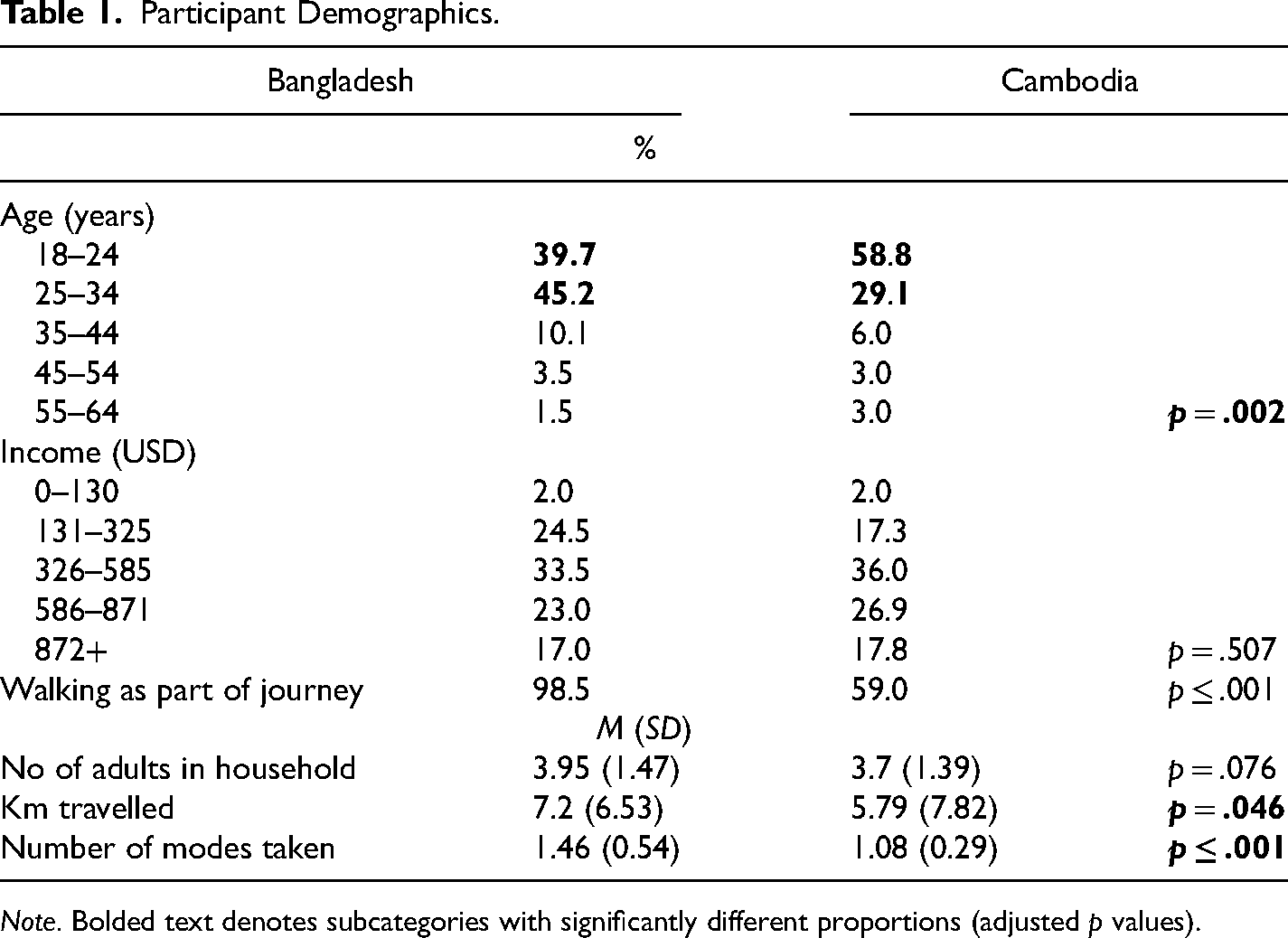
An overview of participant demographics is presented in Table 1, alongside country-level comparisons exploring differences between the two samples. Participants from both countries were predominantly young, with 84.9% of the Bangladeshi and 87.9% of the Cambodian sample aged between 18 and 34 years (see a full breakdown of age groups in Table 1); however, a significantly greater proportion of Cambodian participants fell into the 18–24 year bracket while a significantly greater proportion of the Bangladeshi fell within the 25–34 year bracket. The Cambodian sample was also found to travel significantly shorter distances (measured as the average distance travelled from origin to destination and vice versa) and to use fewer means of transport during their trips, probably because Phnom Penh has a much smaller area than Dhaka. No significant differences were found in household income and the number of adults in each household between the two samples.
Participant Demographics.
Note. Bolded text denotes subcategories with significantly different proportions (adjusted p values).
Material
Data were obtained from a semistructured questionnaire that, in addition to the demographics presented above, collected qualitative and quantitative information on participants’ travel patterns, safety concerns, perception of different modes of transport, feelings of safety, sexual and nonsexual victimization and traffic injuries during trips (experienced or witnessed for others), and suggestions for strategies to improve travel safety. The current study made use of a subset of the quantitative data to answer the research questions, as follows.
Sexual and nonsexual victimization
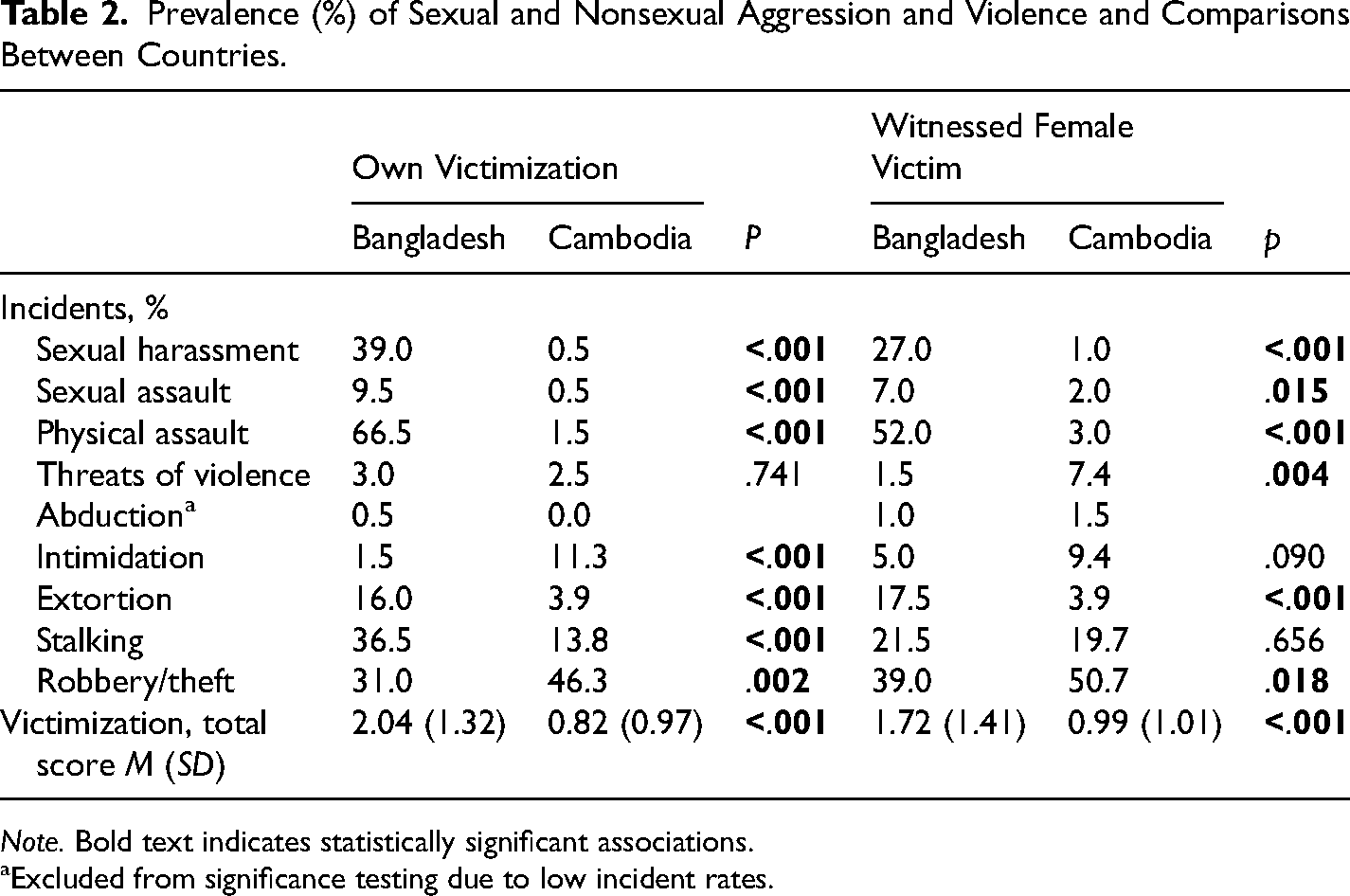
Incidents of sexual and nonsexual victimization were measured through a series of yes/no questions about having experienced acts such as sexual harassment, sexual assault, threats of violence, and robbery (see Table 2 for a full overview). The survey contained standard definitions of each type of aggression, which were shown to participants if they asked for clarification. Participants’ own victimization as well as victimization witnessed in other women were included in the analysis, based on the recognition that people form impressions of safety based both on personal and vicarious experiences (Drakulich, 2015). A composite score, adding the number of categories of victimization for each participant was calculated for experienced and witnessed victimization separately (range = 0–9).
Prevalence (%) of Sexual and Nonsexual Aggression and Violence and Comparisons Between Countries.
Note. Bold text indicates statistically significant associations.
Excluded from significance testing due to low incident rates.
Perceived safety and use of public transport
Participants’ perceived safety when using public transport was measured by two questions. Women were asked to indicate how safe they felt during the duration of their journey and those who indicated that they walked as part of their trip were asked how safe they felt when walking. Answers were given on a 5-point Likert scale where 1 denoted “always” and 5 “never.” Transport use was measured as participants’ tendency to suppress their travel because of safety concerns (as opposed to financial or cultural reasons). In an open-ended question, participants were asked to indicate if and what improvements or solutions would make them feel safer during their trips. Among those participants who felt safety needed to be improved, a dichotomous yes/no question assessed whether they would increase their travel if their safety concerns were addressed; an answer of “yes” was taken to indicate current travel suppression.
Data Analysis
To investigate the forms of sexual and nonsexual aggression and violence that women are subjected to during public transport trips in Bangladesh and Cambodia we tabulated the results. Then chi-square tests were used to compare victimization scores between the two countries.
To investigate the impact of sexual and nonsexual victimization on women's perceived safety and use of public transport, descriptives, and regression analyses were conducted. Separate multiple regression models were calculated for the two country samples to predict the impact of sexual and nonsexual aggression on perceived safety when walking and during the journey. As previously noted, the outcome variables (perceived safety when walking/during the journey) were measured on a discrete ordinal Likert scale. While the use of linear regression to predict an ordinal outcome variable has been contested, Monte Carlo simulations have found that linear and ordered logit models produce comparable results when the dependent variable has five or more levels (Kromrey & Redina-Gobioff, 2002). As the interpretation of multiple regression parameters is more intuitive and easier to discuss, this analytical method was chosen.
Age and income were originally included as standard control variables; however, the income variable was removed from all models due to issues with multicollinearity. As significant differences between the countries were detected in average journey length and number of transports used these variables were also entered as control factors. For the models predicting safety during journeys, walking was included as a control variable as a significantly greater proportion of participants in the Bangladeshi sample walked as part of their journey.
Results
Research Question 1: Sexual and Nonsexual Victimization
Table 2 presents participants’ experiences and witnessed victimization. In both countries, a physical assault was the most commonly experienced incident, followed by sexual harassment and stalking. Some acts, most notably sexual harassment and assault, were more often experienced than witnessed, while others, such as robbery and theft, were more often witnessed. Chi-square tests were used to compare victimization scores between the two samples. Results showed a significantly higher incidence rate for several experienced incidents in Bangladesh, including sexual harassment, physical assault, and stalking; while experienced intimidation and robbery/theft were significantly higher in Cambodia. Analysis of country differences showed similar patterns for witnessed incidents, with the exceptions of threats of violence which were significantly higher in the Cambodian sample, and stalking and intimidation where no significant difference was found between the countries. Overall, the Bangladeshi sample recorded significantly higher composite scores of experienced and witnessed victimization; in total 67.5% of this sample reported two or more forms of victimization compared to 18% in the Cambodian sample.
Research Question 2: Impact of Victimization on Perceived Safety and Use of Public Transport
Analyses of perceived safety when walking included participants who reported walking as part of their journey, while analyses of perceived safety during the journey made use of the entire sample. Perceived safety when walking scores were higher (indicating reduced sense of safety) in the Bangladeshi sample (M = 2.95, SD = 0.88) compared to the Cambodian sample (M = 2.67, SD = 0.73), a significant difference of 0.28, t(312) = 2.90, p = .004. A similar pattern was found for perceived safety during journeys, with significantly higher scores in the Bangladeshi sample (M = 3.25, SD = 0.90) compared to the Cambodian sample (M = 2.63, SD = 0.68), t(369.10) = 7.85, p < .001; a mean difference of 0.62.
Travel suppression, as measured by a dichotomous yes/no question, was found among 96.3% of Bangladeshi participants and 90.5% of Cambodian participants. The highly uneven distribution of participants across the yes/no response categories precluded the use of predictive modeling (binary logistic regression). Instead, differences in total experienced and total witnessed scores were examined for participants who reported travel suppression versus no travel suppression. Nonparametric tests were used to account for nonnormality within the data (specifically, the lack of robustness to nonnormality given the unequal distribution of the sample). A Mann–Whitney U test calculated for the Bangladeshi sample found no significant differences between the suppression and no suppression group on either experienced victimization (mean rank 94.76 vs 87.71, U = 586.00, z = −0.351, p = .726) or witnessed victimization (mean rank 94.76 vs 87.79, U = 586.50, z = −0.343, p = .732) scores. Similar results were found for the Cambodian sample, where the Mann–Whitney U test found no significant differences between the suppression and no suppression group on either experienced victimization (mean rank 86.29 vs 72.66, U = 1026.50 z = −1.138, p = .255) or witnessed victimization (mean rank 85.52 vs 80.03, U = 1144.50, z = −0.455, p = .649).
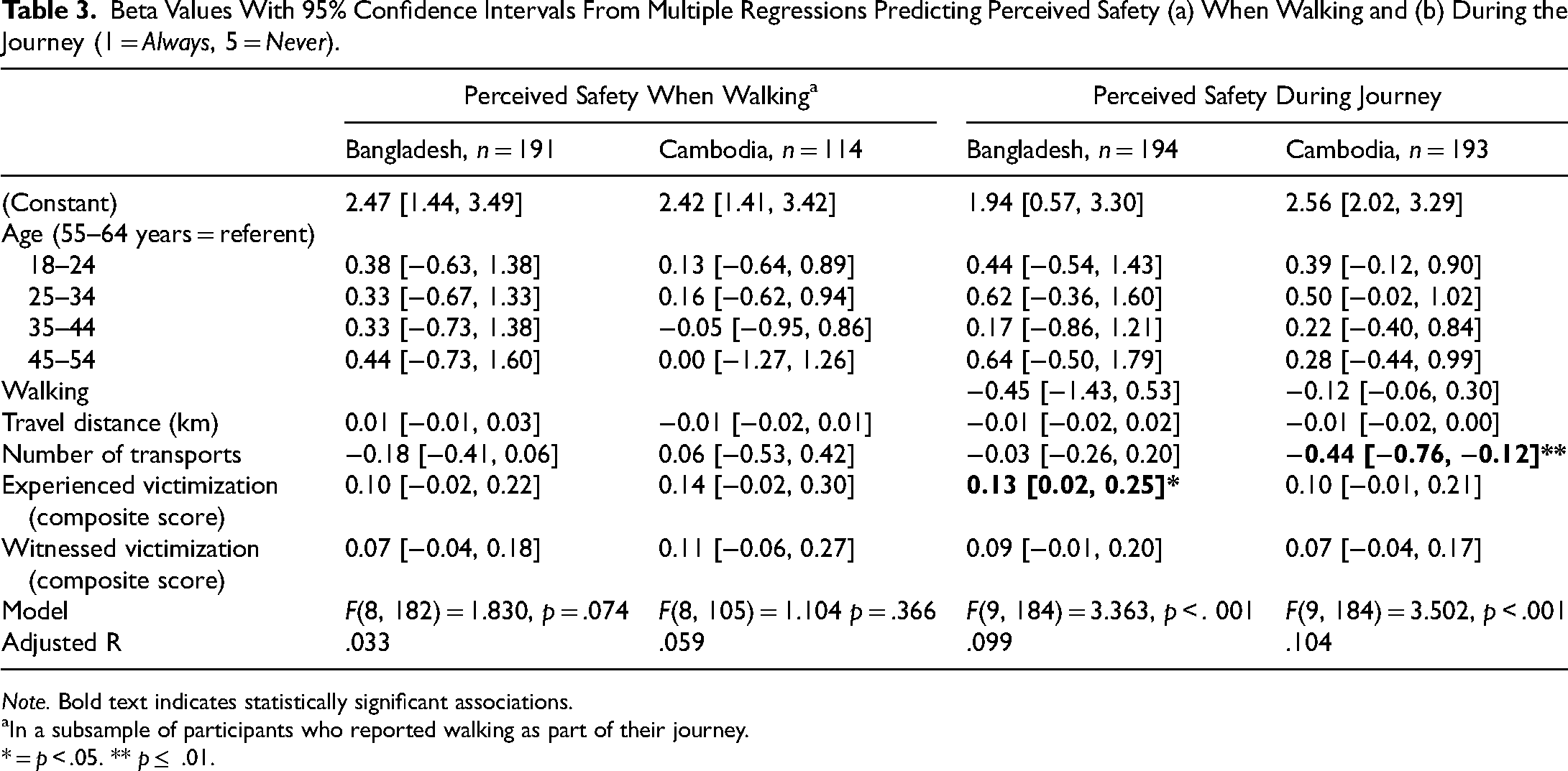
The results of the regressions are shown in Table 3. No significant predictors were present in the models predicting perceived safety when walking in either the Bangladeshi or the Cambodian sample. For regression models predicting a sense of safety during the journey, experienced victimization scores were a significant predictor for the Bangladeshi sample, with an increase in scores associated with an increase in the dependent variable (i.e., reduced perceived safety). This model accounted for just under 10% of the variance. For the Cambodian sample, the number of transports taken was the only significant predictor. A greater number of transports were associated with an increase in perceived safety, potentially indicating a familiarity effect. The model accounted for just over 10% of the variance.
Beta Values With 95% Confidence Intervals From Multiple Regressions Predicting Perceived Safety (a) When Walking and (b) During the Journey (1 = Always, 5 = Never).
Note. Bold text indicates statistically significant associations.
In a subsample of participants who reported walking as part of their journey.
* = p < .05. ** p ≤ .01.
Discussion
To address the limited understanding of women's experiences when using public transport in the Global South, the current study investigated the prevalence of sexual and nonsexual victimization and its impact on risk perceptions and transport use among female travelers in Bangladesh and Cambodia. In terms of prevalence, the most common form of victimization was found to be nonsexual in nature; 46.3% of Cambodian women had been subjected to robbery/theft while 66.5% of the Bangladeshi sample had been subjected to physical assault during their journeys. Accurate crime statistics are difficult to obtain in Cambodia, due to limited data and low levels of reporting and recording of criminal offenses. However, the country is beset by high crime rates and the police force is both underpopulated and underfunded (Broadhurst, 2002; Broadhurst et al., 2013; Cox & Sopheak, 2012, 2012). Thus, it is perhaps not surprising that close to half of all Cambodian participants had experienced theft or robbery during public transport trips. In the Bangladeshi sample, women's experiences of physical assault, which included striking, touching, moving, or applying force without consent, may at least in part be related to the congested and crowded nature of travel, during which scuffles among passengers trying to access transport or seating sometimes occur (Arzua et al., 2016).
The frequent nature of nonsexual victimization found in the current study stands in contrast to much of the literature from the Global North, which has emphasized women's experiences of sexual harassment and other forms of gender-based violence in public transport and transit environments, as well as the broader literature on women's experiences in public spaces that have been published in the Global South. Although often left out of studies on transport safety for women, nonsexual aggression is an important topic of study, particularly in a cultural context where women's devaluation and exclusion are widespread and accepted. As noted by Dhillon and Bakaya (2014, p. 3), patriarchal societies “share a discourse that discourages women from leaving the private sphere, which is the supposed site of patriarchal protection, whereas public space is imagined as inherently dangerous.” Men's dominance over women in public spaces and women's socialization into fear may exacerbate the emotional toll of victimization and may also lay the grounds for victim-blaming and reduced women's access to legal protection and justice (Brickell, 2017; CARE International, 2017; Chakraborty, 2016).
In terms of sexual victimization, reports from NGOs in Bangladesh indicate that up to 94% of women have experienced some form of sexual harassment in public transport (Arzua et al., 2016; BRAC, 2018). The lower proportions of women who reported these experiences in the current study—39.0% for sexual harassment and 9.5% for sexual assault—is most likely the result of narrowing the focus to incidents experienced during the one or two most common trips the participants made for work or educational purposes. Moreover, 36.5% of the Bangladeshi sample reported past instances of stalking. Although the item measuring stalking did not specifically ask women to indicate the nature of these experiences, it is possible that some of them could be classified as sexual harassment.
While relevant comparative data is lacking from Cambodia, it is similarly presumed that the incident rates reported in this sample are lower than the victimization women experience throughout public spaces. Nonetheless, the proportion of Cambodian women who had experienced sexual harassment or assault (0.5% for both incident types) was lower than expected, particularly when considering the prevailing issues around gender equality in this country (World Economic Forum, 2021). The understanding of sexual harassment and assault is culturally anchored (Hsu, 2011) and it is possible that recent media attention and burgeoning activism around Eve teasing and other forms of violence toward women that is taking place in Bangladesh (Chowdhury & Fileborn, 2020; Mowly & Bahfen, 2020) may have sensitized participants and encouraged the reporting of experiences of sexual aggression and violence they may have previously been overlooked. Further research is needed to address the limited understanding of Cambodian women's experience during public transport trips, including studies that explore the conceptualization of sexual violence and the willingness to report it in surveys.
Perceived Sense of Safety and Transport Use
This study found that a large proportion of women reduced their use of public transport due to safety concerns. However, having experienced or witnessed victimization during public transport trips had no impact on travel suppression, and only minimally affected the women's sense of safety during their trips. In terms of the latter, having witnessed victimization of other women did not predict perceived safety when walking or during journeys as a whole in either country; and while experienced victimization predicted a reduction in perceived safety when walking, this effect was only found in the Bangladeshi sample and not replicated for perceived safety during the journey as a whole. Previous research has shown that perceptions of safety while walking among women are mainly influenced by factors external to the pedestrian such as the built environment, land use, and time of day (Basu et al., 2021). Women have generally lower perceptions of safety when walking in urban environments, independently of their age or past experiences.
At first glance, these findings might appear contradictory. In a qualitative study with 12–18-year-old girls from Bangladesh conducted by Nahar et al. (2013), participants described how street harassment (Eve teasing) resulted in constant feelings of anxiety and insecurity, and several studies from the Global North have shown a quantitative link between victimization and a reduced sense of safety among women in public spaces (Davidson et al., 2016; Logan & Walker, 2021a). However, it is possible that the cultural and social context within which sexual harassment occurs can offer an explanation for the current findings. In traditional patriarchal societies, such as Bangladesh, Cambodia, and many other countries of the Global South, rates of gender-based violence are higher and women's resistance comes at a greater cost and with less likelihood of success (Chakraborty, 2016; Maclin et al., 2020). This reality, in conjunction with women's early exposure to gender-based violence and learned fear of public spaces more broadly, may result in a low sense of safety when using public transport that is instilled before (and regardless of) women's actual exposure to violence. By extension, it may also mean that personal and witnessed attacks will do little more than confirm women's expectations, therefore having minimal impact on perceptions of safety.
The fact that victimization had a limited impact on women's perceived safety when using public transport may similarly explain why it failed to impact their levels of self-regulation and travel suppression. It is possible that the absence of a relationship between victimization and travel suppression was due to a ceiling effect where women had already reduced their “nonessential” mobility as much as possible in response to crime, aggression, and harassment. This possible conclusion resonates with findings from the survey published by CARE International (2017) on sexual harassment in the Cambodian garment industry. The survey included a qualitative segment where women described a reluctance to leave their homes for reasons other than work. These self-imposed restrictions were not only a response to a fear of being victimized but were also influenced by societal gender norms that limit women's independence and mobility and blame and shame women for the abuse they experience in public spaces. While the restriction of movement in response to threats to safety occurs in both genders, women are thought to be more adversely impacted than men (Maclin et al., 2020).
There may also be a financial component behind the absence of a relationship between victimization and travel suppression. Sexual harassment is often heightened on public transport, and women who travel under these high-risk circumstances (rather than using safer options such as private transport or taxis), may be those who have little other choice but to do so (King et al., 2021). That is, if the women's use of public transport was driven by necessity rather than choice, experiences of victimization may not result in further reduced levels of travel. As such, sexual and nonsexual harassment on public transport not only reinforces mobility inequity but may also present a particularly insidious form of public violence as it occurs in situations that the women have little or no power to avoid.
Limitations
The current study used a face-to-face method of data collection, approaching participants at public locations in Dhaka and Phnom Penh. Although no personal information was collected or recorded, it is possible that the face-to-face format impacted participants’ willingness to truthfully report previous experiences of victimization. It should also be noted that the study did not seek to obtain a representative sample of women who used transport for work or education, which places limits on the generalizability of the findings. Last, the study collected data among women who undertook trips for work or educational purposes, and as such, did not capture participants who avoid pursuing educational or vocational opportunities due to fear of violence in public spaces nor those that cannot afford to use paid transport. It must therefore be noted that the findings presented here do not provide a full societal snapshot of the impact of victimization on women's sense of safety and transport use.
Conclusions
This study found that women experience both sexual and nonsexual violence during journeys to work and places of education. While women's victimization during public transport trips is not a problem unique to the Global South, unlike literature from the Global North the victimization experienced by the women in this study had minimal to no impact on sense of safety and travel patterns. Studies from Global South have previously outlined the use of self-adaptive behavior to minimize the risk of victimization, particularly among women, and identified that such behavior decreases access to livelihood opportunities, education, healthcare, and social activities (CARE International, 2017; Maclin et al., 2020). These findings highlight not only an urgent need to address violence against women on public transport but also that such efforts must occur in concert with broader changes to gender norms that work to limit women's use of public spaces and the protection of women's right to freedom of movement.
Footnotes
Author Note
Mujibul Anam is also affiliated with School of Medicine and Dentistry, (Public Health), Griffith University, Gold Coast, Queensland, Australia.
Declaration of Conflicting Interests
The author(s) declared no potential conflicts of interest with respect to the research, authorship, and/or publication of this article.
Funding
The author(s) received no financial support for the research, authorship, and/or publication of this article.

Author Biographies
The author’s current affiliation is the Department of Values, Technology and Innovation, Faculty of Technology, Policy and Management, Delft University of Technology, 2628BX Delft, The Netherlands.
The author’s current affiliation is the School of Medicine and Dentistry (Public Health), Griffith University, Gold Coast Campus, QLD 4222, Australia