




Abstract
Previous research relates violent victimization early in life to a wide range of unfavorable outcomes in adulthood, among them a lack of educational attainment. A tendency to conduct separate investigations into violent victimization in different areas of life has so far hampered our understanding of both overall victimization processes and its outcomes. The present study overcomes this issue by investigating the cumulative burden of violent victimization during childhood and adolescence as well as the associations between victimization and educational attainment in young adulthood. The study uses a nationally representative sample of 18 to 19-year-old Norwegian students (n = 3,160) from the school-based UngVold 2007 survey, merged with information from official registers up to 2016 (age 27–28). Using latent class analysis (LCA), we combine retrospective accounts of experiences with parental, peer, and sexual violence during childhood and adolescence with educational attainment in young adulthood. The analyses reveal five classes of violent victimization: (1) non-victims (55.7%), (2) peer victims (16.6%), (3) victims of parental violence (14.5%), (4) victims witnessing domestic violence (5.6%), and (5) polyvictims (experiencing parental, peer, and/or sexual violence: 7.6%). They also show lower educational attainment in all groups reporting victimization through physical contact compared to non-victims, particularly among peer victims and polyvictims. Violence thus seems to impair educational attainment for a large share of the population. The identification of particularly lower education among the polyvictims also show the importance of considering the cumulative burden of violence when deciding on treatment needs and the design of help services for victims.
Keywords
Introduction
The literature reports a staggering scale of violent victimization among children and adolescents. A recent research synthesis claimed that a minimum of 50% of all children in Asia, Africa, and Northern America experienced past-year violence (Hillis et al., 2016). Against the backdrop of efforts by the United Nations to end all violence against children, these are bleak figures. Children and adolescents are exposed to a variety of violent experiences by a range of perpetrators, for example, physical violence from parents and peers, sexual abuse from parents, other adults, or peers, maltreatment by parents, and bearing witness to domestic violence (Finkelhor et al., 2009). Peer violence is more common than parental violence, especially among older adolescents (Finkelhor et al., 2009). A non-negligible number of young people also report multiple forms of violence, often referred to as polyvictimization (Finkelhor et al., 2007).
Although this overlap in different types of violent victimization is well known, previous research tended to focus only on one type of violence at a time. In a recent study, Hamby et al. (2018) argued that this “siloed” approach has hampered our understanding of interpersonal violence, thereby limiting the effects of possible preventive efforts. They further argued that it was more important to examine the cumulative burden of violence than violence in particular environments or by specific perpetrators. Due to the considerable overlap between different subtypes of violence and maltreatment, research has highlighted person-oriented analytic techniques, such as latent class analysis (LCA), as ideal for modeling heterogeneity in violent victimization (Macmillan, 2009). This analytic strategy enables the determination of meaningful subgroups of individuals based on their overall victimization patterns, thereby mitigating the issue of only considering particular types of violent victimization.
Extensive research has related both child maltreatment (Gilbert et al., 2009) and adolescent victimization (McDougall & Vaillancourt, 2015) to a wide range of unfavorable adult life outcomes, such as lower educational attainment and low-skilled employment, mental and physical health problems, and crime. Studies have also identified a cumulative negative effect of being exposed to more than one type of violence and abuse (Vachon et al., 2015). These findings highlight the importance of increasing our understanding of the associations between the intersection of various types of violent victimization by different perpetrators and adult life outcomes.
In the present study, we utilize a nationally representative retrospective survey among final-year senior high school students in Norway (18–19-year-olds) and data from administrative registers to study associations between a variety of violent experiences during childhood and adolescence and educational attainment in young adulthood. The analyses include different types of violence from parents and peers during childhood and adolescence and experiences of sexual violence. Furthermore, we use LCA to study patterns of violent victimization and account for previous findings on the variety and overlap of different types of victimization.
Previous Research
Latent classes of violent victimization
Previous LCA-based studies on violent victimization during childhood and adolescence can be variously categorized according to their emphasis on different types of violence. Currently, child maltreatment studies are the most developed research area, where several studies have used LCA to examine patterns in maltreatment experiences. These studies commonly include experiences of parental violence, childhood sexual abuse, neglect, and other types of child maltreatment. A recent review identified 16 empirical studies on child maltreatment using LCA and latent profile analysis (Debowska et al., 2017), with the number of identified latent classes differing between two and four. One commonality among studies in this research area is the identification of low-maltreatment and polyvictimization classes. A second group of studies have been limited to peer victimization and bullying (see, e.g., Bradshaw et al., 2013; Schultze-Krumbholz et al., 2015). In these studies, the largest identified latent class has usually concerned the noninvolved, while classes of individuals reporting high levels of physical, verbal, and relational bullying have also been identified. In the maltreatment literature, individuals in this latter class would be considered polyvictims. LCA studies on sexual violence in adolescence have mainly targeted victimized populations to derive latent classes characterizing the victimization experiences instead of latent classes of victimization in general (see e.g., Walsh et al., 2021). However, in a recent study, Siller et al. (2022) analyzed bullying and sexual violence among U.S. middle and high school students. They identified a latent class reporting high levels of both bullying and sexual violence, a latent class reporting only bullying victimization, and a low-victimization class.
There is a dearth of studies using LCA to co-examine child maltreatment, peer victimization, and sexual violence. Mariscal et al. (2021) analyzed patterns of past-year victimization among 1,525 Latino teens in the Unites States and identified six latent classes of violent victimization. Like other LCA studies, they identified a group of noninvolved as well as of polyvictims, that is, those reporting multiple forms of violence by multiple perpetrators. They further identified three peer victimization groups: psychological dating violence, psychological violence, and physical violence. Finally, a group exclusively reported being victimized by physical violence from juvenile family members. Turner et al. (2016) used LCA to examine the context of violent victimization in a nationally representative sample of U.S. adolescents by including information on the perpetrator and the place of victimization. The polyvictims reported victimization at home, in school, and in other locations by both family members and peers, with peer victimization being especially common. Five other classes were identified: non-victims, home victims, school victims, home and school victims, and community victims. A third study utilized LCA to investigate patterns and predictors of violence against children in Uganda from different perpetrators (Clarke et al., 2016). The study identified three distinct classes of violent victimization. One class mainly reported emotional, physical, and sexual violence from peers and emotional violence from school staff. The second class reported emotional and physical violence from parents and other relatives and emotional violence from school staff. The final class reported few victimization experiences.
Overall, existing LCA studies on violent victimization have been consistent in reporting a non- or low-victimized class as well as a polyvictim class, while the identification of other classes has depended more on the indicators used to extract the latent classes from the analyses. A strong point of the reviewed literature is that it contains populations from a wide range of countries, among them Uganda (Clarke et al., 2016), India (in Debowska et al., 2017), and China (in Debowska et al., 2017), although most studies are still based on samples from either the United States or Western Europe. Notwithstanding, studies commonly lack information on other diversity criteria of importance to violent victimization, such as social background and sexual orientation.
Associations between violent victimization and educational attainment
Many studies from around the world have established associations between violent victimization during childhood and adolescence and health outcomes in adulthood (Gilbert et al., 2009; Moore et al., 2017). Observed associations are often understood as resulting from psychological trauma caused by violent victimization, which can substantially affect a person’s ability to function (Gilbert et al., 2009). Studies have identified similar associations between violent victimization and adult socioeconomic outcomes, even though the amount of research is smaller than that on health outcomes. A drawback of existing research is that studies often include a single type of violent victimization, such as child maltreatment or sexual abuse, instead of covering the overall burden of violent victimization. Nevertheless, there are exceptions.
In a long-running study in the Unites Kingdom, Menard and Covey (2021) examined participants in their late 30s and early 40s for associations between exposure to violence during childhood and adolescence and a wide range of socioeconomic indicators, including educational attainment. The study included measures on parental physical abuse, witnessing domestic violence, general violent victimization during adolescence, and exposure to neighborhood violence. The overall conclusion was that direct victimization experiences, such as parental physical abuse and adolescent victimization, were more consistently associated with lower educational attainment than victimization experiences not involving physical contact. Other studies have identified similar associations between violent victimization during adolescence and a lack of educational attainment among U.S. adolescents (Macmillan, 2000; Macmillan & Hagan, 2004). The studies further found that violent victimization remained significantly associated with lower educational attainment in adulthood, even after taking several important confounders into account, such as parental socioeconomic status, migration background, and living in a single-parent family.
Longitudinal studies have also combined information on education and employment outcomes for victims of violence in order to further scrutinize how these phenomena are associated. A U.S. study identified clear associations between a wide range of childhood and adolescent victimization experiences and several employment outcomes, where mediation analysis attributed a significant part of the association to a lack of educational attainment among victims compared to non-victims (Fernandez et al., 2015). In another U.S. study, Macmillan (2000) estimated that between 50% and 70% of an observed association between violent victimization during adolescence and adult income could be explained by a lack of educational attainment and working in low-status occupations. Subsequent analyses of the same sample identified associations of similar magnitude between adolescent victimization and the likelihood of receiving public assistance in early adulthood, while the overall chance of being employed was not affected by lack of educational attainment and occupational status (Macmillan & Hagan, 2004).
Overall, previous research findings have indicated that violent victimization during childhood and adolescence may severely hamper educational attainment in adulthood, with implications for future socioeconomic success. However, we lack studies originating outside the U.S. or United Kingdom and those highlighting the living conditions of minority groups (e.g., according to sexual orientation, ethnicity, or religion).
The Present Study
Studies have highlighted that the tendency to conduct separate investigations of violent victimization in different areas of life has hampered our understanding of overall victimization processes and thereby the design of proper help services for victims of violence (Hamby et al., 2018). Accordingly, the present study uses common analyses of various types of violent victimization by a range of perpetrators. Moreover, previous studies using LCA have mainly focused on describing the characteristics of the latent classes of victims of violence identified in their analyses. To our knowledge, no study has analyzed the associations between latent classes of violent victimization and educational attainment in adult life. In line with previous research, we expect violent victimization during childhood and adolescence to be associated with fewer years of completed education in young adulthood. We also expect cascading effects of victimization, where the experience of multiple types of violence from a range of perpetrators has a more severe impact on adult life functioning than experiencing one type of victimization. Previous studies have identified parental socioeconomic status, migration background, and living in a single-parent family as important confounders of the association between childhood and adolescent violent victimization and future educational attainment (Macmillan & Hagan, 2004; Menard & Covey, 2021). We included approximations of these factors as confounders in the analyses.
Methods
Procedure and Participants
The present study combined questionnaire data from the UngVold 2007 study (n = 6,468; 58.3% females) among final-year senior high school students in Norway with time series data from official registers. The survey was conducted in 2007 at 67 schools, which were selected by Statistics Norway from a pool of all senior high schools in Norway to obtain a nationally representative sample of schools. The school sample was stratified according to geographical region, and each school’s sampling probability was proportional to the number of enrolled students. The participating students mainly attended study programs preparing them for enrollment in higher education (87.6%). They answered a paper questionnaire during two consecutive school hours, with a teacher present in the room. The schools were instructed to conduct the surveys, as they would have conducted an examination, so as to prevent answers to highly sensitive questions being visible to other students in the class. The study was approved by the Norwegian Data Protection Authority and the Regional Committees for Medical and Health Research Ethics.
All students in the sampled schools were invited to participate in the survey. The analyses in this paper were restricted to 18 to 19-year-old students who consented to their survey answers being merged with data from official registers. The final sample consisted of 3,160 students (61.1% females). The analyses show that the sample of students in the final data file differed from those in the initial sample on several characteristics. Bivariate logistic regression analyses comparing the two samples showed that female gender (odds ratio [OR] = 1.21; p < .01) and migration background (OR = 0.60; p < .01) were associated with consenting to merging survey answers with information from official registers, indicating that the analytic sample may have been less representative for males and participants with two foreign-born parents compared to the original survey sample.
Measures
The measures used in the analyses comprised many single items from the questionnaire. For the sake of brevity, the complete range of items is presented in the Supplemental Material. All the instruments on violent victimization separated respondents reporting at least one lifetime experience of victimization during their upbringing from those reporting none. The decision to use binary variables instead of counting the number of victimization experiences was based on the design of the questionnaire, discussed later in the limitations section.
Physical violence
Physical violence was measured using two instruments, one measuring victimization from parents and one from peers. The instrument on parental physical violence consisted of information from 20 items. Seven behaviorally specific items counted instances of different acts of violence with an increasing degree of severity from the respondents’ mother and seven items measured violence from their father. The items were inspired by the Parent–Child Conflict Tactics Scale (Straus, 1979; Straus et al., 1998). All items separated victimization before and after the age of 13. Three items also measured whether the respondents had ever been injured due to maternal violence, and three similar items measured paternal violence. The instrument on physical violence from peers consisted of six items measuring experiences of violent victimization from either known or unknown adolescents, a girlfriend, boyfriend, or sibling. Three items counted instances of peer physical violence not resulting in injury, violence resulting in visible injuries, and violence requiring medical assistance, all separated into victimization experiences in the previous 12 months and lifetime victimization.
Verbal violence
Verbal violence was also measured using two instruments: parental and peer victimization. Both instruments included items on verbal violence from the same questionnaires as the instruments on physical violence. The instrument on verbal violence from parents consisted of 12 items, three counting instances of verbal violence from the respondents’ mother and three from their father, each separating incidents before and after the age of 13. The questionnaire on verbal violence from peers contained six items counting the number of instances of respectively violent threats, severe bullying, and sexual harassment, separated into victimization in the previous 12 months and lifetime victimization.
Witnessing domestic violence
Three instruments covered witnessing domestic violence and were separated into verbal violence toward a parent, physical violence toward a parent, and physical violence toward a sibling. The instrument on verbal violence toward a parent consisted of eight items, two counting instances of verbal violence toward the father and two toward the mother, each separated into instances in the previous 12 months and lifetime instances. The instrument on witnessing physical violence in the family consisted of 32 items, seven counting instances of physical violence toward the respondents’ mother and seven toward their father, each separating instances in the previous 12 months from lifetime instances. Moreover, two items for each of the parents covered whether they ever had been injured due to violence in the home. The wording on both verbal and physical violence toward parents were similar to those covering verbal and physical violence toward the respondents. The items included in the instruments on verbal and physical violence against a parent were inspired by the Conflict Tactics Scale (Straus, 1979; Straus et al., 1996). A final instrument consisted of two items measuring whether the respondents had ever witnessed their mother or father use physical violence toward a sibling.
Sexual violence
Sexual violence was measured using two instruments that separated experiences before and after the age of 13 years. Each instrument counted instances of 10 behaviorally specific sexual acts that have occurred against the respondents’ will. The severity of the experiences ranged from unwanted groping to rape, including complete penetration.
Educational attainment in 2016
The highest level of completed education in 2016 was assessed using register data. For the educational level attained, the respondents were categorized as follows: junior high school or lower education (0), having completed senior high school (1), having 1 to 3 years of higher education (2), or having 4 or more years of higher education (3).
Confounders
Several variables were included as potential confounders of the association between latent classes of violent victimization and educational attainment in young adulthood. First, the analyses included the highest level of education attained by parents when the respondents were 16 years old as a proxy for socioeconomic background, which ranged from 0 (junior high school or lower education) to 3 (having 4 or more years of higher education). Second, a variable on migration background separated those with two foreign-born parents from the remainder of the sample (0 = no; 1 = yes). Third, a variable separated those living in single-parent households when they were 16 from the remainder of the sample (0 = no; 1 = yes). Finally, a variable showed the respondents’ registered sex at birth (0 = male; 1 = female). All the variables were generated from data from official registers.
Statistical Analyses
The present analyses consisted of three main phases. First, a series of latent class models with one to eight classes were fitted using R 4.1 (R Core Team, 2020), Mplus v. 8.6 (Muthén & Muthén, 1998–2017), and the MplusAutomation package in R (Hallquist & Wiley, 2018). All models were fitted using a three-stage optimization process with random starts for obtaining the best estimates of the model parameters. The latent classes were calculated based on nine dichotomous variables measuring violent victimization during childhood and adolescence. We chose to retain a five-class model after evaluating all models based on a wide range of fit statistics and diagnostic criteria recommended in the literature (Masyn, 2013; Nylund-Gibson & Young, 2018). Second, the selected latent five-class model was evaluated using both statistical measures and visual inspection. The indices and techniques used in the first and second phase are further explained in the Supplemental Material. Finally, associations between predictors and distal outcomes of the latent classes were analyzed. All analyses were performed in Mplus using the two-step estimation method proposed by Bakk and Kuha (2018). The approach accounts for the possibility that directly including predictors and distal outcomes in LCAs may influence the formation of the latent classes, in which case, the identified classes would no longer be formed by the indicators included in the initial steps of the analyses. Using a stepwise approach also accounts for measurement uncertainty when assigning individuals to latent classes, which would be lost if the latent classes were treated as observed. Simulation studies have identified Bakk and Kuha’s (2018) method as the preferred approach for studying distal outcomes in LCA (Asparouhov & Muthén, 2021).
Additional analyses were performed to gauge the sensitivity and validity of the presented analyses, all returning comparable results. First, a set of analyses derived latent classes based on separate measures of violent victimization from the respondents’ father and mother. Second, similar analyses were performed using instruments measuring victimization experiences before and after the age of 13 or the previous 12 months and lifetime experiences. The additional analyses are presented in the Supplemental Material (Supplemental Tables 2, 3 and Supplemental Figures 3, 4).
Missing data in the final analyses were handled by the full information maximum likelihood procedure, thereby providing missing data routines considered to be state of the art (Schafer & Graham, 2002). The coding of the statistical analyses and the tables and figures in the paper were inspired by the work of Garber (2021) and Nylund-Gibson et al. (2022). The full reproducible code of all the analyses is available at https://osf.io/mdvgy.
Results
Table 1 presents descriptive statistics for all the variables included in the analyses. Nine types of violent victimization were included in the formation of the latent classes, each showing the proportion of the participants reporting at least one lifetime victimization experience. The most common type of victimization was being exposed to verbal violence from peers (29.4%; n = 925), while having experienced sexual violence before the age of 13 (5.7%; n = 180) was the least common. The average score on the instrument measuring the participants’ educational attainment in 2016 was 2.00 (SD = 0.78), which translates into having completed at least 1 year of higher education after senior high school. The remaining results from the analyses are presented in two parts: (a) identification and assignment to latent classes of violent victimization and (b) associations between the latent classes and educational attainment in young adulthood. For readers who are unfamiliar with LCA or quantitative methods in general, refer to Figures 1 and 2 for the main findings of the study.
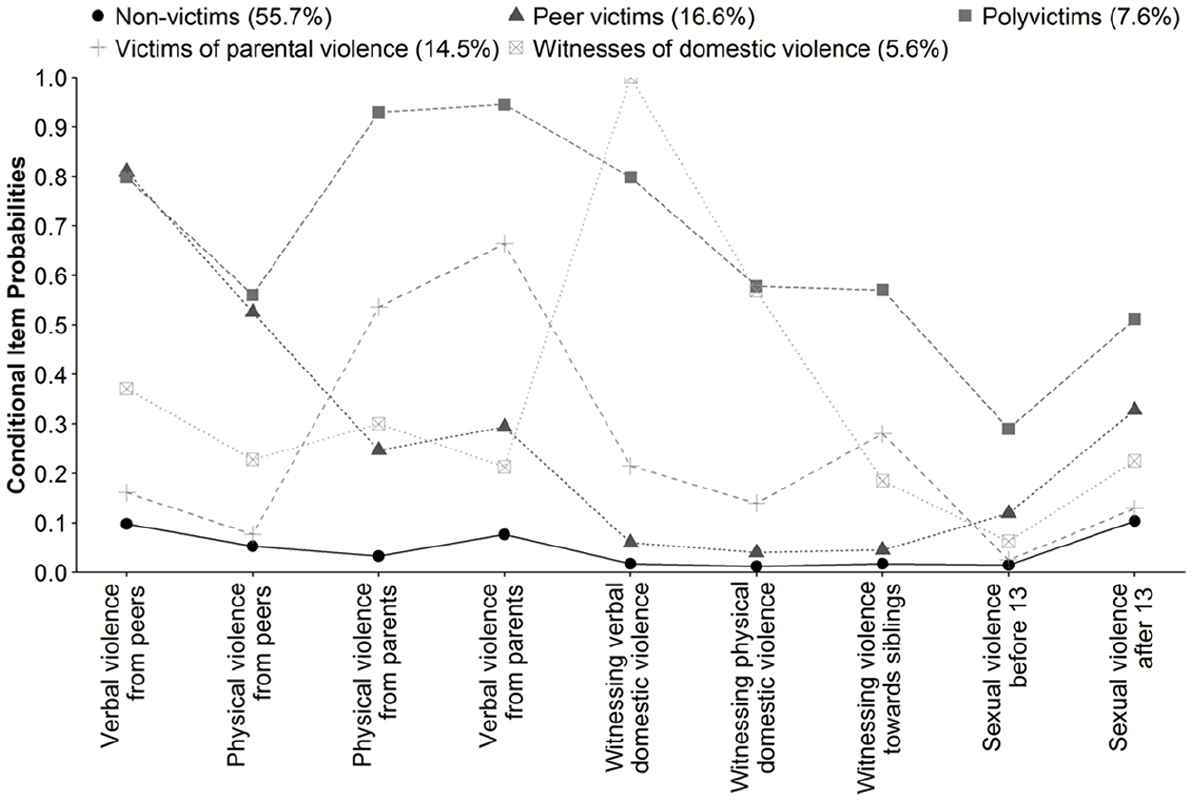
Conditional item probability plot.
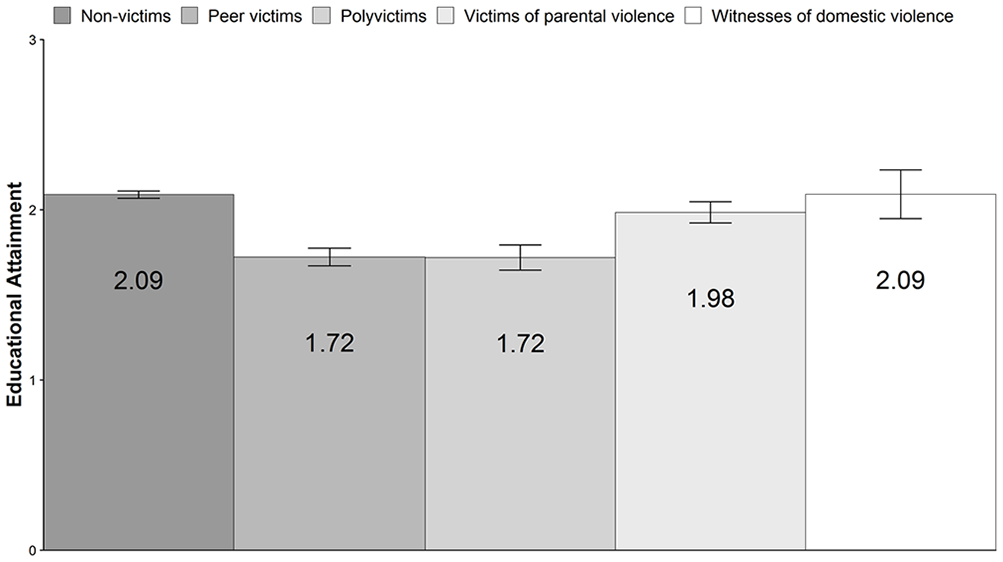
Educational attainment in latent classes of violent victimization.
Descriptive Statistics for Variables Used in LCA as Indicator Variables (nine items), Educational Attainment in 2016, and Confounders (four items).
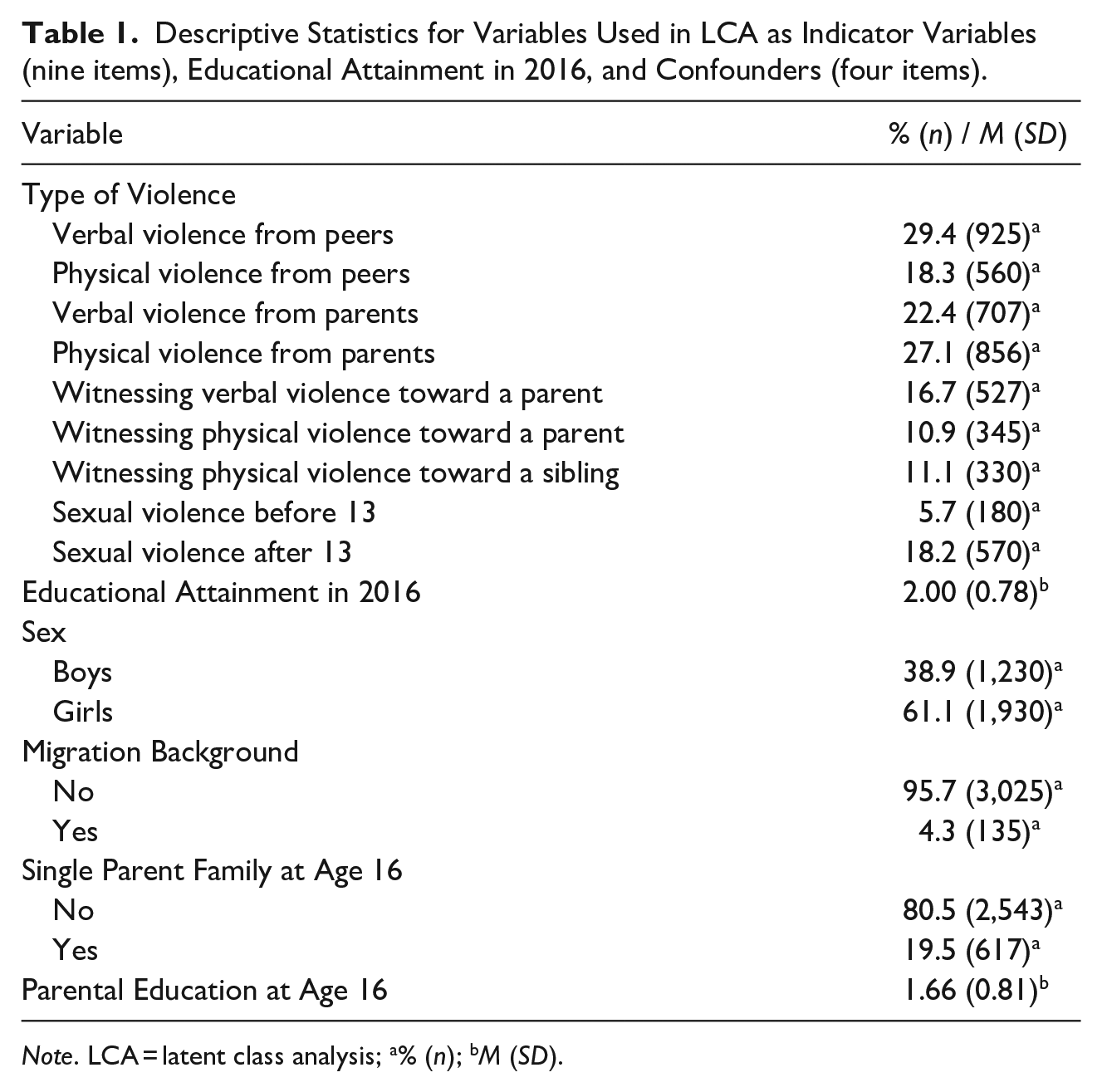
Note. LCA = latent class analysis; a% (n); bM (SD).
Latent Classes of Violent Victimization
The latent class models were estimated, ranging from one to eight latent classes (see Table 2). Based on an overall consideration of a wide range of fit statistics and a substantive interpretation of the identified classes, the five-class model was retained. This model had the lowest consistent Akaike information criterion (CAIC) and Bayesian information criterion (BIC) values as well as a Bayes factor (BF) indicating strong support for it over the four-class model and a correct model probability (cmP) value highly recommending the five-class solution as the best of the considered models. The sample-size adjusted BIC (aBIC) and Vuong–Lo–Mendell–Rubin adjusted likelihood ratio test (VLMR-LRT) favored the six-class model, while the approximate weight of evidence criterion (AWE) suggested a four-class model. The bootstrapped likelihood ratio test (BLRT) failed to promote any of the suggested models.
Model Fit Indices for Exploratory Latent Class Analysis of Violent Victimization.
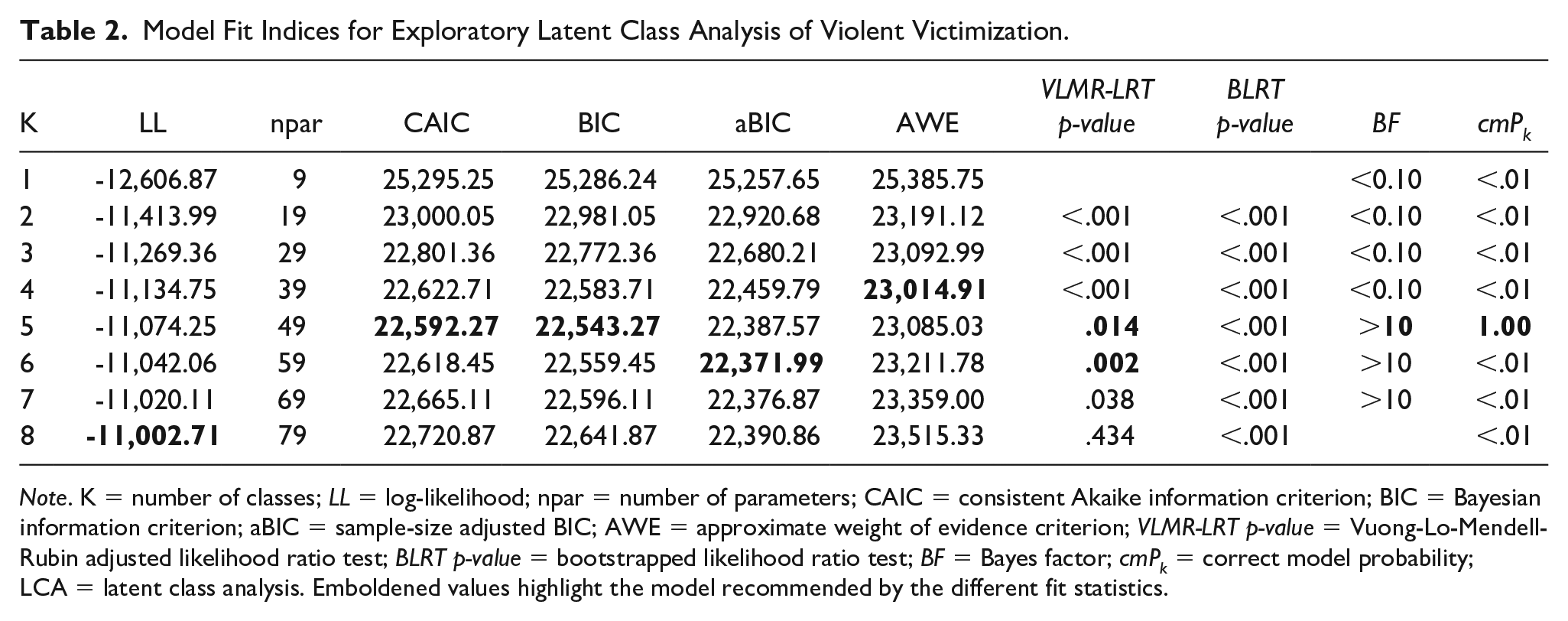
Note. K = number of classes; LL = log-likelihood; npar = number of parameters; CAIC = consistent Akaike information criterion; BIC = Bayesian information criterion; aBIC = sample-size adjusted BIC; AWE = approximate weight of evidence criterion; VLMR-LRT p-value = Vuong-Lo-Mendell-Rubin adjusted likelihood ratio test; BLRT p-value = bootstrapped likelihood ratio test; BF = Bayes factor; cmPk = correct model probability; LCA = latent class analysis. Emboldened values highlight the model recommended by the different fit statistics.
Next, the selected five-class model was evaluated based on both statistical measures and a visual inspection. A substantive interpretation of the five identified classes was conducted based on the conditional item probabilities presented in Figure 1. The largest of the identified classes was labeled non-victims 1 (55.7%; n = 1,953), whose members reported few victimization experiences, with conditional item probabilities ranging from .01 to .1 for all the included instruments. The second largest of the identified classes was labeled peer victims (16.6%; n = 479), whose members reported a high level of verbal and physical violence from peers, sexual violence after the age of 13, and little parental violence. The third largest class (14.5%; n = 315) was labeled victims of parental violence, whose members reported both verbal and physical parental violence but little violence from peers. The fourth class (5.6%; n = 167) was labeled witnesses of domestic violence, whose members reported witnessing domestic violence during their upbringing but few personal victimization experiences. The final class was labeled polyvictims (7.6%; n = 240). These individuals reported both high levels of verbal and physical violence from parents and peers and also witnessed domestic violence. The level of sexual violence both before and after the age of 13 was also higher in this latent class compared to the other classes. The item probability plot shows that all the identified classes were homogeneous on at least two of the latent class indicators, with conditional item probabilities of > .70 or < .30. Some items still did not contribute much to discriminating the latent classes, for example, the two items on sexual violence. The level of sexual violence was higher among polyvictims and peer victims, but discrimination between the classes was mainly caused by other latent class indicators. For the sake of presenting a complete picture of violent victimization, the indicators were retained in the model. The entropy value of the model was 0.72, which is somewhat lower than ideal. An inspection of the different classification diagnostics in Table 3 still shows that the modal class assignment proportions (mcaP) for all the identified classes fell within the 95% CI of πˆ and that all the average posterior probability of correct classification (AvePP) values indicated adequately accurate class assignments. The odds of correct classification ratio (OCC) values also indicate a high degree of classification accuracy, even though the OCC for the latent class labeled non-victims was directly below the desired threshold criterion of 5.
Model Classification Proportions and Diagnostics for a Five-Class Unconditional Latent Class Analysis.
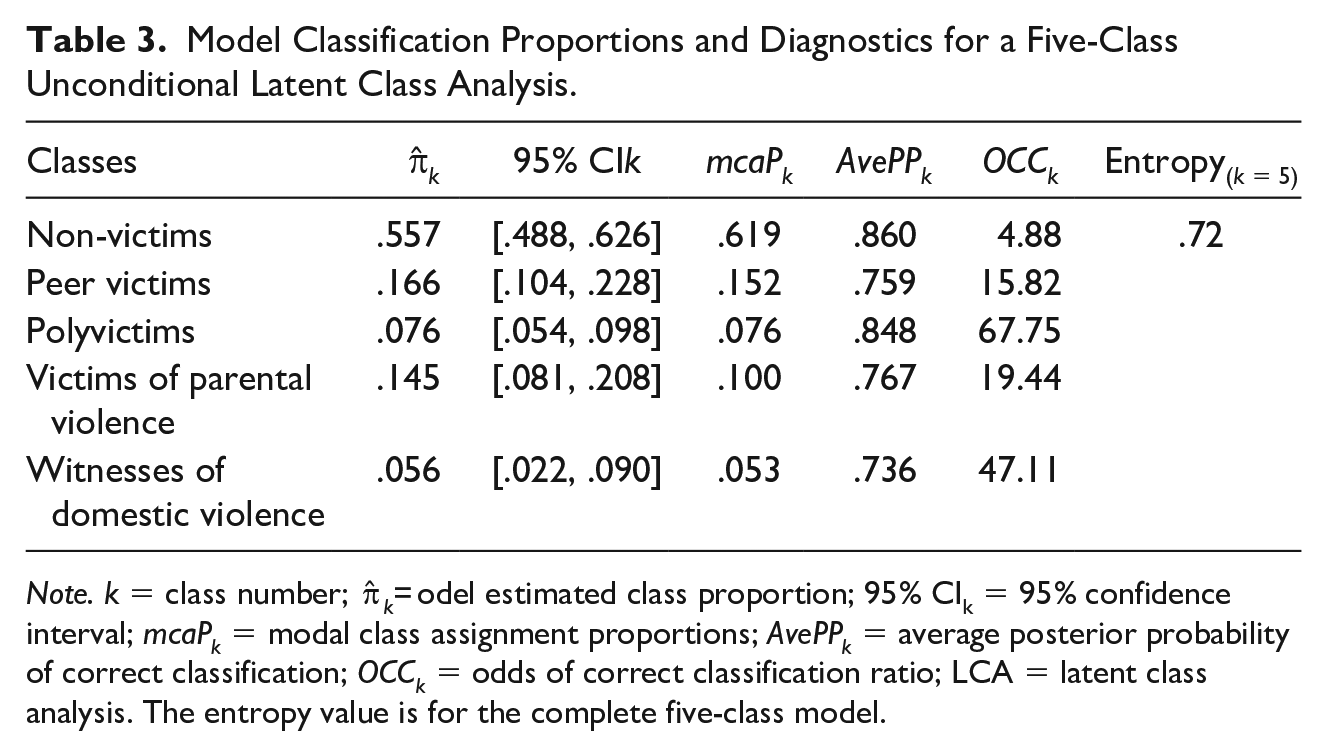
Note. k = class number; πˆ k = odel estimated class proportion; 95% CIk = 95% confidence interval; mcaPk = modal class assignment proportions; AvePPk = average posterior probability of correct classification; OCCk = odds of correct classification ratio; LCA = latent class analysis. The entropy value is for the complete five-class model.
Educational Attainment in Latent Classes of Violent Victimization
Figure 2 shows a significant lack of educational attainment in several of the latent classes of violent victimization. On average, non-victims had completed at least 1 year of higher education by the age of 28 (a value of 2 on the instrument on educational attainment), and about one in ten respondents in this class had completed at least 4 years of higher education. The latent class respondents who had witnessed domestic violence during their upbringing had obtained a comparable level of education. The average value on the instrument measuring educational attainment was somewhat lower among the respondents in the latent class labeled victims of parental violence, with a score of 1.98. The score was significantly lower than for the non-victims, although not compared to witnesses of domestic violence. The respondents in the latent classes labeled peer victims and polyvictims had obtained significantly lower levels of education than those in the other three classes, with values indicating that, on average, three in four had completed at least 1 year of higher education, while one in four had completed no education after senior high school.
Discussion
Violent victimization during childhood and adolescence represents an acute global social problem. Like previous research, our analyzes show a high prevalence of victimization. This paper also contributes two additional insights into victimization and its associated outcomes. First, we found a latent structure of interpersonal victimization during childhood and adolescence, implying that experiences of victimization among children and youth tend to be systematically clustered. Second, we examined the relationship between the latent classes of victimization and education in later life by using high-quality administrative data. We found that victims had lower educational attainment in young adulthood than non-victims and that the education level varied according to the nature of the victimization experienced. We now delve deeper into these findings.
In the first step, our analyses revealed five latent classes of violent victimization: non-victims (55.7%), peer victims (16.6%), victims of parental violence (14.5%), victims witnessing domestic violence (5.6%), and polyvictims (experiencing parental, peer, and/or sexual violence: 7.6%). These findings corroborate those of earlier LCA-based studies (e.g., Clarke et al., 2016; Mariscal et al., 2021; Turner et al., 2016), such as the low-victimization class being the largest group as well as the identification of the polyvictimization and peer victimization classes. The main difference in our analyzes compared to previous studies is that we also identified a distinct class of youth that had witnessed domestic violence but seldom had physical victimization experiences.
In the second step, we analyzed the relationship between victimization and educational attainment by the age of 27 to 28. In line with previous studies on educational outcomes (e.g., Macmillan, 2000; Macmillan & Hagan, 2004; Menard & Covey, 2021), and in accordance with our expectations, the analyses showed a significant lack of educational attainment in all groups reporting victimization through physical contact compared to non-victims. In addition, we observed systematic educational differences in type of victimization. The most significant negative impacts on education were identified among the peer victims and polyvictims. The educational level among the victims of parental violence was only slightly lower than among non-victims. The only latent class of victimization that did not differ significantly from non-victims were those witnessing domestic violence. This is consistent with findings from Menard and Covey (2021) from the United Kingdom. Also, as expected, polyvictimization appeared to be particularly adverse in relation to educational attainment.
The significance of these differences could be debated. On one hand, it could be argued that the differences in educational attainment were inconsequential. For instance, the peer victims and polyvictims scored an average of 0.3 points lower on the instrument measuring educational attainment than those in the other classes. Nevertheless, calculating the effect size of this score returned a value of 0.41 for Hedges’ g, normally considered close to a medium effect. These two groups of victims also comprised a third of the study population. If they, in fact, reached a systematically lower educational attainment than they would have achieved were it not for their exposure to violence and the mechanisms interwoven into such experiences, then the results could be argued to be of importance. The estimates were also calculated net of known confounders, thereby reflecting an adjusted and more “direct” victimization effect. Moreover, the data were collected from the students 4 to 5 months prior to the completion of a senior high school study program preparing them for enrollment in higher education, rendering it likely that several victims may have already left school and that those remaining were quite well adapted. This suggests that violent victimization does have significant detrimental effects both on the education of those affected and society at large.
At first glance, some of the results may appear puzzling. Why was victimization without physical contact not associated with adverse outcomes? And why was there only a weak negative impact of parental violence? One possible answer to both questions could be that many of the respondents experiencing severe domestic violence ended up in the polyvictims class, while the latent classes of parental violence and those witnessing domestic violence mainly comprised those reporting less severe or possibly fewer occurrences of victimization. Compared to the “weak” impact of parental violence on education, it can also seem surprising that peer victimization and bullying had a far stronger negative effect. One possibility is that peer victimization and bullying may be particularly harmful to educational attainment as this often occurs within the school environment. Moreover, these experiences are likely to be recent events, while parental violence may have been in the distant past. It may also seem strange that a latent class contains several forms of violence that are likely to have different effects. This is a methodological consequence of using latent class analyses. If we had extracted a larger number of latent classes, our guess is that, at some time point, we would have identified latent classes reporting only verbal violence from both parents and peers. However, this was not recommended by the statistical measures used to decide on the most meaningful number of latent classes in this study.
Strengths and Limitations
The present study used high-quality survey data and data from official registers and identified a significant lack of educational attainment among young people reporting violent victimization during childhood and adolescence. Educational success also varied in the latent classes of victimization. The latent class analyses findings highlight the importance of treating violent victimization as a complex phenomenon consisting of patterns of exposure and not as isolated events. The current study is also one of the few studies on violent victimization and educational attainment that does not originate in the United States or the United Kingdom, thereby strengthening previous findings on the observed associations with evidence from new social contexts.
However, the study is not without limitations. First, the survey material was collected among final-year senior high school students, which is a somewhat selective sample. Adolescents who opted for vocational education or had dropped out of school were not part of the initial sample, thereby resulting in a study sample with a less than ideal diversity composition in terms of social background. Additionally, the study has not addressed other important criteria of diversity that were noted as lacking in the reviewed literature, such as sexual orientation and religion. Second, the decision to use cutoffs of one lifetime experience of the different types of violent victimization made it difficult to gauge the severity of the victimization. The decision resulted from using secondary data. The data also contained information on the number of victimization experiences, but the information was collected as an open text response in the questionnaire, with a large amount of missing values on all the items (up to 30%). We therefore opted to use the binary items with significantly fewer missing values. Third, the entropy value of the model was somewhat lower than ideal. An inspection of the AvePP values indicated that the lower entropy was especially related to an inconsistent classification among the latent classes of non-victims and peer victims and of parental violence and witnesses of domestic violence, respectively, which may have also resulted from using binary victimization instruments instead of counts. Although LCA may provide many advantages when analyzing complex phenomena, such inconsistencies in the identified latent classes add an additional complexity when interpreting the results. Fourth, information on violent victimization was collected retrospectively, which may have impacted the precision of the information. Nevertheless, Fergusson et al. (2011) found negligible bias in studies on the associations between retrospective reports of childhood maltreatment and adult life outcomes. Fifth, the study did not include a proper instrument to measure the potential confounding effects of parental socioeconomic status but instead used parental education as an approximation. Finally, the use of educational attainment as the sole outcome of violent victimization is a limitation because information on, for example, the work situation or the reception of welfare benefits, may also be important for highlighting the participants’ living conditions. We have decided to focus on educational attainment as the only outcome for three main reasons: (1) The participants in our study was in their late 20 s. Many were in a trajectory of pursuing higher education and had not yet fully entered the labor market. (2) The participants was recruited from the academic track of senior high school, so not pursuing further education after high school is a significant trajectory change. (3) The study focuses partly on identifying latent classes of victimization and partly on determining the long-term outcomes of victimization experiences. If multiple outcomes were included, the study would be too massive to fit into a single manuscript.
Future Research Directions
Future studies should apply LCA on data pertaining to different types of violent victimization to further examine and validate the latent class structure of such experiences. An important endeavor in this respect would be to determine whether latent classes vary between subgroups, such as those with different social backgrounds, sexual orientations, or ethnicities, and whether associations between victimization and educational attainment vary in these groups. Future studies should also sample younger students to enable analyses on the educational pathways of students who opt for choices other than university studies. By sampling younger students, it would also be possible to empirically investigate our assertion that students close to completing senior high school are a better adapted group than other adolescents. An investigation of what keeps them in school could be a vital contribution to developing evidence-based prevention efforts and help services. To better understand how victimization experiences hamper education, scholars should apply a variety of research strategies. Qualitative studies with retrospective designs could be applied to assess victims’ account of the association between victimization and education. Also, long-term panel studies could enable designs that inform us about victimization and the mechanisms that link such experiences to educational outcomes. Also, to grasp further implications of victimization, research should examine additional outcomes, such as employment, relationship formation, social inclusion, and leisure time activities.
Conclusion
In this paper, we employed LCA and combined retrospective accounts of experiences of parental, peer, and sexual violence during childhood and adolescence with educational attainment in young adulthood. The analyses revealed five classes of violent victimization: (1) non-victims, (2) peer victims, (3) victims of parental violence, (4) victims witnessing domestic violence, and (5) polyvictims (experiencing parental, peer, and/or sexual violence). The application of person-oriented analyses, such as LCA, highlights how different types of violent victimization are interwoven and form complex patterns in the lives of young people. Leaving behind the “siloed” approach (Hamby et al., 2018) to studying different types of victimization separately paves the road for designing prevention and intervention efforts that fully acknowledge the necessity of simultaneously assessing violent victimization in more than one area of life. In the second step, the analyses showed a significant lack of educational attainment in all groups reporting victimization through physical contact compared to non-victims, with the most significant impact identified among peer victims and polyvictims. The results underscore the importance of considering the cumulative burden of violence to which individuals are exposed when deciding on treatment needs and the design of both prevention efforts and proper help services for victims.
Supplemental Material
sj-docx-1-jiv-10.1177_08862605221130388 – Supplemental material for Interpersonal Victimization During Childhood and Adolescence and Educational Attainment in Young Adulthood: A Latent Class Analysis Approach
Supplemental material, sj-docx-1-jiv-10.1177_08862605221130388 for Interpersonal Victimization During Childhood and Adolescence and Educational Attainment in Young Adulthood: A Latent Class Analysis Approach by Lars Roar Frøyland and Patrick Lie Andersen in Journal of Interpersonal Violence
Footnotes
Declaration of Conflicting Interests
The author(s) declared no potential conflicts of interests with respect to the authorship and/or publication of this article.
Funding
The author(s) disclosed receipt of the following financial support for the research and/or authorship of this article: This research was supported with grants from the Norwegian Ministry of Justice and Public Security. The authors would like to thank all the participating adolescents and colleagues in the Department for Youth Research at NOVA and the Crime, Drugs, & Sex Research Seminar at the University of Oslo for comments on the draft.

Supplemental Material
Supplemental material for this article is available online.
Notes
Author Biographies
References
Supplementary Material
Please find the following supplemental material available below.
For Open Access articles published under a Creative Commons License, all supplemental material carries the same license as the article it is associated with.
For non-Open Access articles published, all supplemental material carries a non-exclusive license, and permission requests for re-use of supplemental material or any part of supplemental material shall be sent directly to the copyright owner as specified in the copyright notice associated with the article.
