




Abstract
This article responds to Tynan and Bishop’s call for relational engagement in literature reviews, employing Indigenous epistemologies and a relational, conversational approach to examine trends in urban Indigenous health research. Reflecting on a comprehensive literature review, we highlight shifts in research focus, authorship, and methodologies. The analysis, guided by Indigenous scholars with diverse disciplinary backgrounds, centers on current and emerging trends, while addressing the impact of funding priorities and sociopolitical contexts on research. Despite growing recognition of Indigenous scholarship and community engagement, our discussions reveal challenges in maintaining authenticity in community-driven methodologies. We emphasize the need to further decolonize research approaches, highlighting the role of relational methodologies that honor Indigenous epistemologies. By integrating oral traditions, community-based sources, and relational citation practices, this article advocates for a paradigm shift in literature reviews, urging scholars to prioritize Indigenous ways of knowing and strengthen the relational dynamics within research processes to better address urban Indigenous health and well-being.
Keywords
Introduction
In Canada, urban Indigenous Peoples are defined as First Nation, Métis, or Inuit People living outside of their traditional territories and/or within urban spaces (BC Association of Aboriginal Friendship Centres, 2020). They represent the fastest-growing population in Canada (Statistics Canada, 2023), with approximately 61% of Indigenous peoples living in urban settings (National Association of Friendship Centres, 2021). Despite this growth, research initiatives focused on urban Indigenous Peoples’ well-being remain minimal and limited in scope. Colonization continues to displace Indigenous Peoples from their original territories, disrupting the transmission of cultural knowledge, land-based and community connectedness, and wellness activities such as ceremony, harvesting, hunting, and gathering. In addition, Indigenous peoples often move for positive reasons and maintain connections and belonging across multiple territories, engaging in place-making (Legault, 2021). The loss of traditional practices and removal from land affects fundamental health determinants crucial for the overall health and well-being of Indigenous peoples (King et al., 2009). Ongoing racism and discrimination results in culturally unsafe services (D. L. M. Kurtz et al., 2008), especially in urban settings (Okanagan Urban Aboriginal Health Research Collective 2009; Wylie et al., 2019). Without multilevel system change, including prioritizing their voices in future research, practice, and policy planning and implementation, urban Indigenous Peoples will continue to experience health inequities.
This article examines the finding of a literature review focused on health of urban Indigenous Peoples, while also engaging in a relational process to interact with the review itself. Through generative discussions and interdisciplinary perspectives, we sought to understand current and emerging trends in the literature. Guided by Indigenous epistemologies that understand knowledge as inherently relational and contextualized, we aimed to build on trawlwulwuy and Gamilaroi scholar’s Tynan and Bishop’s (2023) Decolonizing the Literature Review: A Relational Approach to inform an emergent approach to engaging in a relational literature review process through collective dialogue. Tynan and Bishop explain that engaging in relationality “prompts us to consider networks of peoples, not just topics, disciplines, and literature,” including the “vast networks of Country (Land), kinship, more-than-humans, ancestors, knowledges, and memories that are attached to and comprise ‘people’” (p. 503). Through transcriptions of our dialogues, we share not only the findings of the review but also the relational dynamics that shaped our understanding, inviting readers to be a part of this process.
Locating Ourselves
As is common practice within Indigenous spaces, we begin this conversation by introducing ourselves, including our networks and the peoples and places from which we come, which inform the knowledge we bring into this conversation. Gabrielle Legault is a Red River Métis scholar from Lac Pelletier, Saskatchewan (Treaty 4), who traces her Métis ancestry through her mom, grandpa, and great-grandmother (Julia Lamotte, nee Fagnant). She is an assistant professor in Indigenous Studies. Her research focuses on the intersections between Indigenous identity, well-being, and place. Kelsey Darnay is an Anishinaabe PhD candidate with band membership in Garden River First Nation. Her research focuses on Indigenous Restorative Justice as an alternative to incarceration and uses Mino Bimaadiziwin to guide her work. Shawn Wilson is from Opaskweyak Cree Nation from Northern Manitoba. He is an associate professor in Indigenous Studies and though he swears a lot, he’s a nice guy (so he says). Peter Hutchinson is Métis originally from Treaty 6 near Lac La Biche, Alberta. His Métis identity comes from his grandmothers, while his grandfathers are settlers. He is an assistant professor in Indigenous Studies and conducts research on Indigenous population and public health.
We are all working within the traditional and unceded territory of the Syilx Okanagan Peoples at the University of British Columbia’s Okanagan Campus. At the time of writing, we were members of the Urban Indigenous Wellbeing Collective, a group that brings together Indigenous community members, health providers, and a team of interdisciplinary Indigenous and ally researchers, with a common commitment to respectfully work with, and respond to, urban Indigenous community-identified research priorities for holistic wellness. 1 We would like to also acknowledge those who supported the literature search and provided feedback on this article: Sam Grinnell, Naomi Balogh, Mathew Wanbon, Christian Isbister, Mimi Mutahi, Karlyn Olsen, and Lindsay Dupré.
Locating the Literature
Viewing health through the lens of holism (inclusive of physical, spiritual, emotional, and mental well-being), as a collective, we engaged in a broad literature review to identify current and historic trends in urban Indigenous health research. We conducted a systematic scan of academic articles, theses, and books concerned with urban Indigenous Peoples and health. We searched general databases such as Google Scholar and UBC Summons, 2 in addition to the Indigenous Studies Portal and Native Health Database. Our initial searches were structured around three keywords, inclusive of a subject and topic. Each search included “urban” and “Indigenous,” followed by one topic, such as “emotional health,” “mental health,” “spiritual health,” “physical health,” “healthcare,” into determinants of health including “housing,” “education,” or “food.” As we continued, our topics became more specific. For example, the broad keyword “education” was narrowed to “pedagogy,” “teachings,” “land-based learning,” “schooling,” and “post-secondary education.” As we learned of different niches, our keywords were modified accordingly to explore more of the field. Our search expanded to focus on different methodologies employed by researchers in the urban Indigenous health sphere. Broad keywords such as “arts-based research” were narrowed to specific methods of inquiry such as “photovoice.” Each subsequent search learned from the previous. We then extended the search beyond academic literature to include resources created by and/or for Indigenous community organizations. After a few months, our preliminary search conducted through Google Scholar was exhausted, resulting in approximately 350 accumulated resources.
We then transitioned to a citation chaining (also called chain citing) approach to uncover new sources and locate influential works. Citation chaining involves following chains of citations by examining bibliographies for relevant research. Particular sources appeared frequently in citations, such as Shawn Wilson’s (2008) Research is Ceremony in addition to Plains Cree/Saulteaux scholar Margaret Kovach’s (2021) Indigenous Research Methodologies and Maori scholar Linda Tuhiwai Smith’s (1999) Decolonizing Methodologies. These works were foundational to much of the Indigenous-authored literature that emerged during our searches. Early on, we noted authorship including author background, home community, indigeneity, and methodological approach, foreshadowing our discussions.
In conducting our literature review, we realized that our literature review process was mostly typical, following a standard Western systematic approach, which does not account for Indigenous epistemologies. Tynan and Bishop (2023) describe feeling frustrated with “the conventions and expectations of dominant literature review approaches, which can feel at odds with Indigenous and decolonizing methodologies” (p. 498). They advocate for a relational literature review, which “graft[s] Indigenous relational processes onto the Western academic convention of the literature review” (499). Despite being advocates for and practitioners of Indigenous research methodologies (IRM), we hadn’t questioned our existing approaches to a foundational aspect of the research process, the literature review. With the intent to build on our understanding of Tynan and Bishop’s (2023) article and reflect on not only the content but also the process of our review focused on urban Indigenous well-being, we engaged in group conversations. Since we understand knowledge to be generated not only through individual interactions with data or texts, but also through collective interactions with one another and the Land (Yunkaporta, 2021), we decided that a broad scoping review was inadequate. Our reflections on existing literature through conversation could provide valuable insights and help contextualize the review, while also discussing ways to further decolonize our own research approaches by engaging in a relational literature review, inclusive of Indigenous epistemologies (Kovach, 2021). As conversations are rarely linear, we share the below mind map (Figure 1) to illustrate key points of connection touched upon throughout our discussions. In the subsequent section, we share the findings we encountered and the dialogue that it provoked.
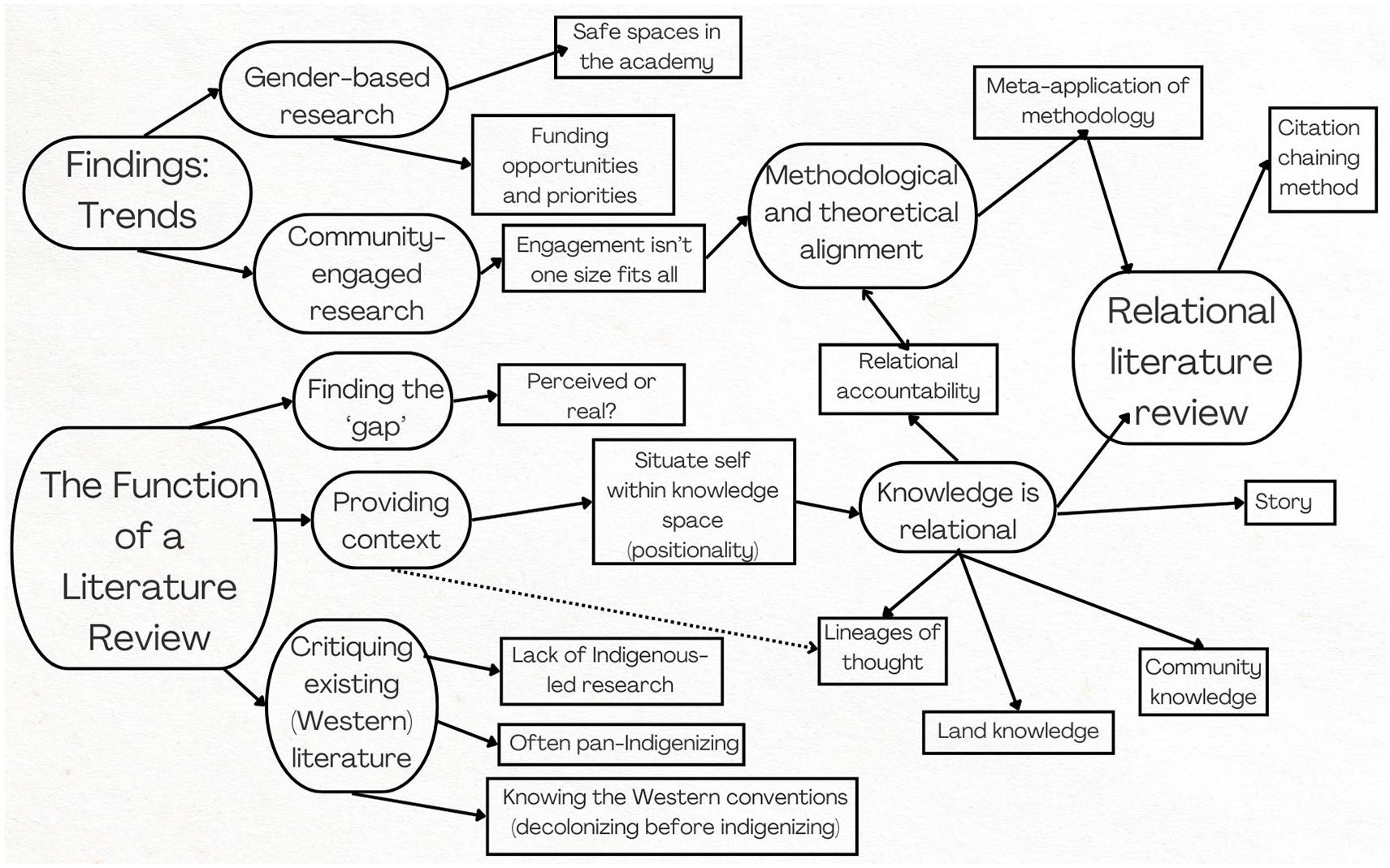
A Mind Map Illustrating the Conversation, Depicting Connections Between Ideas.
Literature Review Findings and Discussion
Based on the sources reviewed, we identified shifts in Indigenous health research topic focus, authorship, and methodologies employed. We noted an increase in gender-focused research, notably an upsurge of research on Indigenous women’s health and safety (from 2003 to 2010). In addition, we identified a very recent trend of applying an intersectional lens inclusive of Two-Spirit perspectives and diverse abilities (within the past 5 years). Scheim et al. (2013) look at Indigenous gender-diverse people within Ontario and the barriers to well-being. Similar to other Indigenous health and well-being research, there is a focus on breaking down barriers to well-being. Knudson et al. (2021) reflect on their research with Indigenous Peoples with disabilities and how they went about their research in a good way. 3 With the increase of research in this area, a focus of ethical research with Indigenous Peoples and communities is prioritized.
As Indigenous Peoples, we recognize that Two-Spirit individuals have always been a part of our communities. 4 More specifically, in the literature, we noticed a focus on Two-Spirit or trans-identifying youth, and not older generations. The Urban Native Youth Association (UNYA) created a pamphlet for Two-Spirit identifying Indigenous youth ages 15-30. The UNYA (n.d.) offers inviting and safe spaces for Two-Spirit youth. Furthermore, Ansloos et al. (2021) article features qualitative interviews with Indigenous youth ages 18 to 35 years old focusing on gender-queer Indigenous activists.
Interestingly, research including Two-Spirit and trans youth was rarely included (or identified) unless gender or gender and sexuality were a focus. Other research focused on the development of resources for LGBTQ2S+ youth or was related to health care provision (Alaers, 2010; Ansloos et al., 2021; Brotman et al., 2002; UNYA, n.d.). This intersectional approach is recent, as most gender-based research engages with cis-gendered women, indicating a need for further intersectional research to incorporate the perspectives and needs of LGBTQ2S+ people of all ages.
We discussed these findings through conversation, and our conversations brought our attention to how our identities and individual learning journeys are in many ways central to Indigenous research. And, that research trends are impacted by priorities set out within funding calls which often align with what is happening in our sociopolitical contexts. The following dialogue comes from one of our conversations about this.
I think the trends we see may reflect the type of students we get because a lot of research is generated by doctoral students.
I would imagine that increased accessibility to education makes a big difference.
Youth research is usually done by younger researchers and researching the older generations is often done by researchers who are getting older themselves. Cis men rarely engage with a specific group, but are generally overrepresented regardless because it’s not thought of as a specific group because it’s almost thought of as the default. And again, except with cis women, unless you’re specifically looking at gender issues. And then we’ve got a lot more trans and Two-Spirit people who are being accepted into the academy now, so I think that’s probably going to mean more literature reflective of that.
It seems only in the last five years of publication have we seen Two-Spirit people discussed in the health literature. I don’t know if now there’s more funding that’s targeted in that way, or if there’s people with those identities doing the research and feeling comfortable in doing the research or if it’s just an increased awareness that this is something that’s valuable or needed.
I think it’s probably about having a safe space where people can be out in the academy. There has been some progress to create safer spaces within the past ten years or so, though there continues to be issues. One’s not necessarily going to do research into those areas if it’s not safe.
With research being political and calls for funding depending on buzzwords and certain topics, it influences what people are researching. Trends are based on what the academy and funders decide are important priorities. For example, we found historically there was a lot of literature on HIV research, and now we don’t see as much.
Some of the research has been called for by community. For example, the CIHR Indigenous Health and Gender grant we applied for. 5 The call emerged from what they called an Idea and Learning Fair, where scholars and community members got together to talk about Indigenous perspectives on gender and wellbeing. That’s a cool shift to see, a funding call where it’s less top down and more community informed. I would like to see more of that, but I’m skeptical about the use of buzzwords. The last Indigenous health grant I applied for, the call must have used the word “resilience” a hundred times. In our application, we had to echo that word “resilience” back to the funder, even though community members have said ‘We don’t like to use the term resilient. We don’t use that because we don’t think we should have to be resilient.’
That whole idea is based on a neoliberal agenda, where the problem is your own problem, so you need to be resilient. It’s not like society is the problem.
And now “reconciliation” is the new favorite word. That connection between funding and the trends in literature is a new realization for me. I’d never thought too hard about how the literature reflects the funding calls, because of course you need money to do your research.
In recent years, funding calls have also included an increased focus on Indigenous scholars as well as community-engaged research approaches, including IRM. In our literature review, we noted a considerable increase in literature employing IRM, in addition to both decolonizing and community-based research approaches, especially from 2013 to 2015 (e.g., Evans et al., 2014; D. Kurtz, 2013). 6 Furthermore, we identified an emergence of texts citing use of participatory action research (PAR) across both Indigenous and non-Indigenous authored texts (for instance, Adams et al., 2012; Evans et al., 2009; Leeuw et al., 2012), but prior to 2010, there is a considerable disparity in how this is understood, as we often observed a devaluing of community knowledges, in favor of researchers being represented as knowledge experts.
As researchers working closely with community, we struggle with funding not adequately accommodating the community engagement process, and how this might preclude research from being truly responsive to the needs of community. Even with an emerging body of research claiming to be community-engaged or even citing Indigenous methodologies, there is clearly a wide range of how this is being interpreted and applied.
In our research, we’re developing community agreements. Most community advisory councils are not really developing research question at first. You’re first developing relationships, then you build accountability structures and then a research question evolves out of those conversations and relationships. But that is what is expected within the academy and especially by funders, to have the research questions right away.
It feels insincere in these cases to say it is community-emerging, if there isn’t time to develop those relationships. Especially having to do it a year ahead of time before you’re even funded. It feels so problematic to even identify the research question as it will likely change if you are wanting the research to be responsive to community concerns. I struggle with that. When I did my PhD I read a lot into Community-Based Research and Participatory Action Research to understand how do Indigenous Research Methodologies differ, what are the key differences? What I came to understand is PAR and CBR come from different paradigms than Indigenous research, and in CBR and PAR, there can still be researchers who consider themselves the expert, which is problematic from an Indigenous paradigm—that I’m the expert on your experience. It’s so uncomfortable, but in these funding applications and in the academy, we’re expected to do that to a degree.
While Peter and Gabrielle struggle with adequate funding to support the engagement process that is often expected by community partner, Shawn explains that Indigenous community engagement is not one-size-fits-all, but varies depending on context:
It’s also different when you get more experience, too, because then you realize that you can use different approaches in different circumstances. It doesn’t have to always be the same. I can use this one here, and this one there. I think the more you research, the more you learn about the different tools that you can use. If you have the basic understanding of “I want to make sure I’m acting in the proper way and being helpful,” then you realize, I can do that in this community. I’m going to have to do that differently here than I’m going to in this other community. You need to just adjust the methods, adjust the strategy based on who you’re working with.
I think a lot of that comes down to community capacity. I work with volunteer organizations, so the capacity to engage is very different from somewhere where people might get paid to show up and engage. I think you come out of grad school, and you have this really idealized perspective of what Community-Based Research is going to look like, that you’re going to have somebody in your ear telling you what to do the whole time. And then in the end, that’s not how it works, and it takes twice as long as you think it will. Similar to how we see that with people just citing you Shawn, and then saying they’re doing Indigenous research, I think we see that with PAR and CBR too where people just say, ‘oh, I’m doing Community-Based Research’ and it’s clear that, no, your methodology is not engaged, it’s consultation at the very best.
You can’t just chuck a couple of numbers in there and say you’re doing quantitative research. You have to have a research design that matches the data that you want to get. Otherwise, your data is useless, so it’s the same thing with CBR or IRM. If they say, “I’m doing community-engaged research,” but your research design is totally different than what you say you’re doing, how can you trust the results?
Or they don’t tell you enough detail about how they actually did the research. I saw this when I was looking through successful grant applications, researchers were vaguely saying, “I’m working with an Indigenous community,” and I wondered, “Who? How can you not say who you’re working with?”
Or just including someone’s name on it. I had my name included on someone’s SSHRC or CIHR application, just because someone phoned and left a voicemail.
And they said that they talked to you?
Yeah, they left a voicemail. That was their idea of consultation.
There’s no closing up the feedback loop, which is the thing that’s so instrumental in Community-Based Research.
There has to be a happy medium though too because there’s a certain point when you get to that point when—
You could go back and forth forever.
You get to a point where you have to go with implied consent because it’s almost like you can be over consulting. At some point they’re saying “look, I trust you, so I’m trusting you’re doing the right thing.”
As Mi’kmaw and Chikasaw scholars Battiste and Youngblood Henderson (2000) point out, “most existing research on Indigenous people is contaminated by Eurocentric prejudice” (pp. 132–133). Although scholarship has moved away from this approach, there is still an “unwillingness to accept the value of Indigenous knowledge, [as] there is a steadfast refusal to accept the worthiness of ‘raw’ Indigenous knowledge” (Frideres, 2011, p. 42). The inclusion of Indigenous methodologies and knowledges ensures that research with Indigenous communities involves Indigenous paradigms through understanding, recognizing, accepting, and respecting Indigenous knowledge systems as valid and valuable on their own terms. With an increase of Indigenous scholars in the academy, we see an upsurge of IRM in the health field. Indigenous scholars have contributed to the shift in methodological approaches in research by focusing on Indigenous ways of knowing, being, and doing within their research process. As Kovach (2021) explains, Indigenous methodology “flows from Indigenous ways of knowing (epistemology), incorporating an Indigenous theoretical perspective and using aligned methods (e.g., qualitative interviews, storytelling)” (p. 22). Therefore, ethical research involving Indigenous Peoples requires equal partnerships between communities and researchers that is community-led and follows Indigenous methodologies and protocols.
With the introduction of the Tri-Council Policy Statement: Ethical Conduct for Research Involving Humans, and more recently, the updated Chapter 9: Research Involving the First Nations, Inuit and Métis Peoples of Canada (CIHR, NSERC, SSHRC, 2022), in a Canadian academic context, research methodologies have shifted to increased community engagement. By following Indigenous methodologies, especially local community knowledges, we can create a more relational and ethical approach to research with Indigenous Peoples. Still, due to the need to satisfy behavioral ethic boards, we wonder how often IRM are being simply described as such as a performative act to signal compliance, versus authentic engagement with Indigenous knowledges and inquiry approaches.
This issue is not limited to non-Indigenous researchers; it also affects Indigenous scholars. Sometimes, the authenticity of Indigenous knowledge in their research is questionable but is still recognized and upheld solely because of their indigeneity. Being Indigenous does not automatically mean one is ready, qualified, or equipped to ethically engage with Indigenous methodologies. Although there are more Indigenous students and scholars in academia today, gaps in mentorship and training processes persist. For instance, when students or scholars use Indigenous methodologies from nations or places they are not connected to, it can lead to the appropriation, misuse, and misapplication of Indigenous knowledge, thus threatening the integrity of these knowledge systems.
In our conversations, Shawn expressed frustration about how his book Research is Ceremony is frequently cited, but that many who cite use of Indigenous Methodologies are doing so artificially, without necessarily reading it or understanding what it means.
Do you see those citations?
Kind of, but I don’t check all of them, because I get a lot of them. But some of them are pure bullshit. So, it’s nice when it’s being cited by people that are actually using Indigenous methodologies. I mean, you’re using that to justify it, but it’s people that are just using—
They’re co-opting your work?
Exactly.
We see this elsewhere, where people are claiming it to be doing Indigenous research in health, but they’re really just handing surveys to Indigenous people. And they’re focusing on trauma, they’re focusing on deficit. And there’s no relational aspect to it. There’s none of those things that we typically see within an Indigenous research method. But they’re calling it Indigenous research, just because Indigenous people completed the survey.
Well even when looking at student research, I’m always making notes on the methods and making notes on the topic, and if this doesn’t match with that, then you can’t trust your findings on the topic. I read a lot of theses, where their research design calls for one thing and the data that they’re presenting presents something else. We need to be asking, “if that’s not in your design, why did you get that data?” And I have no way of knowing how that data got there or where it came from. It doesn’t happen as much these days, but it used to happen a lot—where people would include demographic information and its sort of quasi statistics and I mean don’t even go there because your research design doesn’t do anything to ensure that those statistics are going to be in any way meaningful, so why are you bothering to include it?
Yeah, so moving away from what the institution wants us to study and focus on what we [Indigenous students] want to study, which influences how we approach our research and the methodologies we use.
I think if we’re looking at wellbeing research and especially in the mental health space, a lot of research is more narrative inquiry or story based.
A lot of people I’m talking to are using a lot more stories in their work, and even the literature review has story included.
Hopefully then if people are using PAR in their research, they’re also using PAR in how they go about their literature reviews. To me there should be a meta-application of your research methodology too. If you’re using arts-based research you should also be using arts-based methods for your lit review as well. I mean quantitative surveys, that’s what Cochrane Reviews are. People have been doing that already. That’s not a big deal, but I think it’s cool how we, as Indigenous researchers, are starting to have conversations as a part of our literature review process, to reflect how we approach research as a relational process.
Talking About the Literature Review
As Tynan and Bishop (2023) outline, literature reviews are often starting places for the research process and have not, until recently, been questioned by academics. The dominant models of literature reviews, including systematic reviews and thematic reviews, are often used in social science and health sciences (Tynan & Bishop, 2023; The University of British Columbia, 2024). A literature review is an analytical summary of existing research relevant to your chosen field of study. This review aims to outline, synthesize, assess, and elucidate the existing literature. It is intended to provide a theoretical foundation for your research and aids you, as the researcher, in defining the scope and direction of your study (Jesson et al., 2011). The goal is to outline existing knowledge in a field of research and inform or guide future research directions, through “finding the gap.” However, these approaches “ignore the importance of methodology and how this is a reflection of scholars’ axiology, ontology, and epistemology” (Tynan & Bishop, 2023, p. 490). Importantly, Tynan and Bishop critique the inherently colonial underpinnings of mainstream Western literature review methodologies and the language used within, including the constant desire to colonize the so-called “vacant” knowledge spaces, or literature gaps, akin to intellectual terra nullius.
Peter, having a background in quantitative public health research describes his experience with conducting literature reviews:
I’m horribly influenced by systematic reviews and normally what I’ve tried to do in the past is stick to one format of systematic review and then often we can’t stay within this systematic review because there’s usually not enough information. As you know Indigenous research isn’t the most prevalent research out there, so a lot of times we have to switch it up because we can’t do a full systematic review, so we change it to a scoping review or narrative review just because of the lack of information doesn’t allow for it to fall within the guidelines of a systematic review.
As Peter points out, the lack of existing Indigenous research precludes following Western literature review methods. Often research focused on Indigenous peoples in generalized, pan-Indigenized and rarely is data disaggregated. For instance, a recent study demonstrated that despite Métis people being a culturally unique and distinct Indigenous population in Canada, few studies have evaluated their health separate from the broader Indigenous population (Gmitroski et al., 2023). Furthermore, there are knowledges within our communities that are relevant to our research topics that may not be easily located if at all among published literature and the databases we search. This doesn’t mean that this knowledge is not important, but could be protected, unpublished, or held within community.
A database search may be a good tool, but it doesn’t pick up a lot of Indigenous content. I feel sometimes with the library it’s almost dangerous to type the word “Indigenous” in the search bar because the type of research it will show you, it’s rarely from an Indigenous perspective. It’s usually on us, not with us.
As Indigenous scholars, we acknowledge that the literature may not entirely capture existing knowledge due to obstacles in academia, rigid institutional behavioral ethics review processes, and other exclusionary practices. For instance, oral histories are frequently omitted from the literature reviewed (MacLeod, 2021). We also discussed perceived (or real) gaps as resulting from a lack of representation, as Indigenous researchers increase, so should Indigenous research. Furthermore, we recognize that some Indigenous Traditional Knowledge is not meant for academic settings and should not be included here. Therefore, what might appear as a “gap” may simply reflect the absence (or intentional silence) of academic literature on a given topic.
These perceived gaps may be fully existent within community spaces; however, its emphasis within academic spaces may be limited. This can be attributed to a desire to protect sacred knowledges from entering the academy, an area of concern that has gained considerable visibility in recent years. The discussion that follows includes reflections on our own understanding of the value of conducting literature reviews, how we approach this process, the challenges with typical Western literature reviews, and our ideas regarding a more relational approach.
A literature review is setting a context, the broader context within which I’m working and then narrowing it down to the very specific context of where the work is taking place. It’s very specific to location, but then it ripples way out there. Sometimes it’s important to set the social, historical, political context in which the research topic is happening. We need the literature review for that context-setting piece.
Within the context of Indigenous research, most of the work of the lit review has involved critiquing Western views of whatever the topic is. Although that has changed as there have been more and more Indigenous people doing research. But up until ten years ago or less even, it’s been more of a traditional review that’s saying “this is what all those Westerners have written about us [Indigenous Peoples] and it totally misses the mark. ” So, it is about finding gaps in knowledge. It’s a total gap in our knowledge. It’s not being recognized at all.
But these days, it’s quite a bit different. Now when I’m reading recent literature, I really like it when people place themselves, so you can see the specific context from which they are writing. So, to me that speaks to the authority of the authors. And I want to see that in there, so I know what community they’re from or what’s their tribal affiliation (for lack of a better word) so that I know who they’re accountable to. Traditional literature is just accountable to the journal or your institution that you’re writing from. I want to see how people are accountable to their community. That’s changed a lot in the last ten years in terms of relational accountability.
I appreciate the shift in authorship and recognition. I like to see the positionality of the author at the forefront. I think that’s important. I know when I’m reading something, and I see positionality statements within the paper and having a place or a nation that it’s important for me to situate the context of the researcher and the research.
But it’s funny because we’ve been doing that at conferences for a long time, when you go to an Indigenous conference, it always lists your tribal affiliation. It’s like we count that as important when we listen to someone talk, but not as important when people write.
Yeah, because my first conference, I did not explain my positionality. It was just brief. And then watching other people’s presentations, I really enjoyed it. They told me where they’re from, who their family is, their community. I think that was important. And now I do the same. It enhances the presentation.
It enhances trustworthiness for me.
When you’re reading other people’s work, and you’re reading somebody’s literature review, that’s all about setting up the context and their rationale for doing the study. For me, the positioning is part of the rationale for why someone bothers doing that study. It’s the key to understand their bias.
And why they make certain decisions or choose certain theories. I think that positioning is becoming something that I’m seeing as much more tied to people’s theoretical framework and methodology than I previously understood. The decisions you make throughout your research are all informed by your positionality. So, if you don’t state it, then it’s this faked objectivity, as if you have no biases, that you don’t care about anything.
So much stuff we now know is culturally based. All our senses are culturally biased: how we taste things, how we see things, it’s all culturally trained. Of course it’s going to have a big impact on how you gather research data because you’re not going to see or hear certain things that are important if you’re not connected to the context of that research.
You trust certain relationships and certain knowledges when you find out where scholars are from or about that relationship that they have or if they explicitly acknowledge that relationship at all and if they are connected to that knowledge.
I thought that was interesting how you said in an earlier conversation, that if you know somebody who did that research, then you basically weight it heavier because you think, “well, I know that person’s trustworthy and a good person and thoughtful in their research.” I think the longer you’re in the Academy, the better you can vet not just literature but also who’s writing it, because you know people and you know what you’re doing a little more. I spend a lot of time Googling people and seeing what else they’ve written and who are they working with. If I see somebody is writing with someone that I personally know that person is vetted through proxy.
That’s totally a relational thing because it’s what happens in community. Not just anyone is going to be accepted in the community, but if a friend of yours introduces you to them, that friend is vouching for them, and you’ll be more likely to accept them. It’s like that for you, your colleague must be vouching for them because he’s working with them himself and accepts them.
Exactly, and until you know them yourself, you have to go off what you know. That’s what I find myself doing, trying to figure out who else are they working with or maybe they’re working with a certain program or something that I’m familiar with, then I will think “okay, this is legitimate.” I think it takes a lot more effort than a standard Western systematic review where you’re just looking for findings and you don’t really care about who wrote it.
But that said, you don’t want to be engaging in nepotism and only citing people you know or yourself. I do think Indigenous researchers are intentional about who they cite. I try to cite students once they’ve published and try to promote people that are coming up in the academy to support them. I think it’s a relational process. Which reminds me of this idea of relational citation practice that the Indigenous Initiatives librarian at UBC Okanagan, Christian Isbister talks about: citation chaining. I always did it when I did research, but didn’t know it had a name. It’s checking the bibliography and then seeing who the author is citing and following it along.
Yeah, I was always doing that. That’s like the snowball technique in finding research participants. When you’re thinking about sampling, that’s a really good way to get the most informed sample. But it’s the same thing in literature, you can get a really informed sample in that one area, using citation chaining.
And thinking also about who is not included in this?
Yeah, who are they not citing? And who are they citing?
I’m trying to understand who is the person who’s connected to this knowledge, taking an Indigenous view of knowledge, that it’s not something that’s just out there that we’re grabbing from everywhere as these “thing-like bits of information that can be separated not only from their social context but also from the people who ‘know’ them” that we’re going to bring into our work. 7 But thinking about “who are the people who are attached to these ideas? And where did their ideas come from?” For Indigenous scholars, thinking of Shawn and the impact of ‘Research is Ceremony’, the idea of relational accountability. I don’t understand that idea as something that Shawn just woke up and invented one day. None of our ideas just come out of nowhere. That idea came from his research and the people he talked with, but it is very deeply rooted in Cree views of relationality that is connected to the Land. It is an important part of Cree culture. It’s not just tracing these ideas through Shawn, but even those who would have influenced his thinking or other Cree and Métis scholars who’ve talked about these ideas, like Maria Campbell and how she’s talked about wahkohtowin for example, as relational obligation. My aim is to think more broadly about specific ideas as connected to a lineage of thinkers.
Then if we think of literature reviews as context setting and then it’s almost like you’re saying “alright, looking back three generations, this is how this idea developed” and then hopefully you’re going to take your idea forward three generations as well. It’s nice to be able to track the lineage of an idea.
It has to do with the ownership of knowledge. It’s the whole underlying assumption behind knowledge itself and how we’re assuming that knowledge is individually owned from a Western perspective. So, if you’re writing on something and you cite it, then you publish, that’s your knowledge [from a Western perspective], which is very different from Indigenous ways of looking at it. So how do you go about authorship? When you’re writing something, you’re not claiming ownership over that knowledge, you’re just the one that’s writing it down.
We’re starting to see community members’ contributions recognized through authorship.
I think there’s some people now even starting to put the territory as the first author.
So, you are citing this tree, or a specific piece of Land. And yes, that’s Land knowledge.
That goes beyond Land acknowledgement, including the Land in citation.
It’s looking at “site/ation.” 8 I think hopefully that’s where authorship is shifting towards because that’s where knowledge is really coming from. And hopefully it’s shifting from studying on to studying with and progressing towards studying for, as more communities develop their own sovereignty and self-autonomy.
One of the things that I’m always aware of is where do I draw the line in between the literature review and what I already know? There are several teachers and Elder knowledge holders and people I’ve learned many lessons from, and I always wonder why don’t I include them in my literature review? Because they’re the ones who made me think this way and if part of that review is to situate where I am within that space of knowledge, then why aren’t I including these Elders and these knowledge holders and these brilliant teachers that I’ve had? Why aren’t I including them? And then, and it goes beyond that to, why aren’t I including acknowledgement of the Land? Because I endlessly learn from the natural environment. I can’t not make analogies that are related to Land for some reason, so in that space of the literature review, I wonder how do I get to that? How do I acknowledge all those spaces and all that time that I’ve spent learning from the Land? And then there’s this idea of intuition as well and how do how do I cite intuition?
Yeah, who did you learn this knowledge from? Did it come from your community? Or is it part of your worldview? But where did you get that?
I run into this with students who want to include dream knowledge in their research, which is an important source of Indigenous knowledge amongst many people, and it’s a bit tricky. Like are you explicit in your research that that’s where that information came from or is that just for you to know?
I encourage people to use that as one source, and not the only source. That might be where inspiration comes from, but you need to seek more information and not see that as an end. I think if we’re thinking about a relational literature review and we’re doing things relationally, then where is the relational accountability? We also have to have some accountability when we’re doing that literature review, because you can’t have relationality without the accountability, because I think that’s when things can become sort of airy-fairy bullshit, when people say only “oh I learned this in a dream.” Because if you’re using a dream as a source of knowledge, it’s not accountable to anyone. I need to know when and where that dream happened, who helped you interpret it, and a million other relational aspects of the dream’s context. Dreams are important sources of information, but not out of context and it’s that accountability that gives context. Similarly, if we’re trying to promote a relational view of doing literature reviews then we have to also have some forms of accountability. It still has to be systematic, and the accountability and context are what make it systematic.
Reading across Indigenous scholarship people are still doing a pretty typical Western lit review, but in their writing, I see Indigenous scholars engaging in a more relational approach, when they start bringing in things like teachings, stories, things they’ve learned from Elders, but they’re not calling it a part of their literature review. It’s just informing their decision making. In teaching my Indigenous Research class, I challenged students to do a relational literature review in preparing their research proposals. They had to have at least four out of eight sources be peer-reviewed academic sources, but the other four could be conversations or other sources of knowledge. We had several students who were taking Indigenous language fluency degrees, and they brought in teachings from their language class, Elders, and other knowledges that they’ve encountered from the Land. But the non-language students didn’t do it. They pretty much all did a typical Western lit review, because they were comfortable with that. But the language students’ lit reviews were incredible. They were so woven in with the teachings and what they’ve learned both in and outside of their language education program, and the captikʷł 9 they brought in, just brought so much richness to their work. I felt it really enriched the lit review in a way that challenged the way I thought about building the contexts for existing knowledge. It was totally experimental in that I didn’t know what I was going to end up with, but it made me think that there are so many other ways we can do a literature review.
It’s funny though, because you have to know the Western conventions before you can break out of it. Especially if you start to see Western knowledge as a subset of Indigenous Knowledge—you have to know what that subset is in order to know all the stuff around it. For me it was really useful learning how to do a Western style systemic review, and learning the systems of doing those, so even things like how to do a Boolean search properly.
Sometimes when you argue for Indigenous Methodologies, when you start, you’re fighting against the Western ones, but just do it, there’s no need to justify it against a Western methodology—just describe the Indigenous one. But are we following that same approach with literature reviews? I don’t know. It’s like sometimes in order to address indigenization, we first have to go through a process of decolonization. So maybe this is like a process of decolonization in that it’s a comparative stage before we can fully do something Indigenous.
Conclusion
In synthesizing our discussions and the existing literature, we arrive call for a paradigm shift in how literature reviews are conceptualized and conducted within Indigenous research contexts. Our collective dialogue and reflections on the existing literature offer new insights, helping to contextualize the findings of our review on urban Indigenous Health. Inspired by and drawing from the critical reflections of Tynan and Bishop (2023), we recognize that mainstream Western approaches to literature reviews often overlook the complex interplay between scholars’ axiology, ontology, and epistemology. We advocate for challenging and decolonizing these entrenched methodologies to make space for Indigenous ways of knowing and being. Like Tynan and Bishop who describe their own engagement with relationality, we express a common practice of beginning our searches through those we know with expertise, then
they make the introductions and, in doing so, vouch for them (and us). This protocol shows how citational practices can also be relational and expand relational networks, based on trust, reciprocity, and accountability. The layers of relationality continue to expand through such a process. (p. 503)
Central to our conversations was the recognition of relational accountability in research, whereby authors situate themselves within their respective Indigenous communities and acknowledge the sources of their knowledge. The inclusion of positionality statements and the emphasis on author accountability serve to foreground the relationality inherent in Indigenous research paradigms, cultivating transparency and trustworthiness in research. Integrating Indigenous knowledges into the literature review process—especially when database searches fall short—requires privileging community-based sources and oral traditions including stories and Elder knowledges. We build upon the concept of “site/ation,” advocating for the inclusion of acknowledging our teachings from the Land as integral components of literature reviews. Inspired by citation chaining, we also encourage scholars to adopt relational citation practices that trace the lineage of ideas and honor the contributions of Indigenous Knowledge Keepers. These practices not only honor Indigenous sovereignties but also challenge the colonial erasure of Indigenous presence and knowledge systems. By embracing Indigenous methodologies and epistemologies, we hope to enrich literature review processes and contribute to a more holistic understanding of the health and well-being of urban Indigenous peoples. Our dialogues underscore the transformative potential of relationally engaging with literature, both in terms of content and method.
Footnotes
Declaration of Conflicting Interests
The author(s) declared no potential conflicts of interest with respect to the research, authorship, and/or publication of this article.
Funding
The author(s) disclosed receipt of the following financial support for the research, authorship, and/or publication of this article: This research, and the Urban Indigenous Wellbeing Collective was funded by the University of British Columbia’s Eminence Program (2021-2024).
