



Abstract
Narrative inquiry methods are central to qualitative research that seeks to understand phenomena through the lived experiences of research participants. This research used a form of narrative inquiry—storytelling, to invite four young people with intellectual disability referred to as the “story owners” to share their stories about sexuality and relationships. Through a reflexive approach, this article unpacks the relational and physical contexts that surrounded the narrative inquiry methods, which the researchers describe as the narrative environment. In this narrative environment, each story owner co-developed their story with an academic researcher. The research found that the key components of the narrative environment which were co-created somewhat differently by each story owner were space and place, objects, people, and relationships and communication. Take home messages provided in this research can assist novice researchers and co-researchers in their methodological approach to narrative research with people with intellectual disability.
Keywords
Introduction
Narrative inquiry is a qualitative research approach that assumes people have stories to tell about their lives and that these stories are of interest and importance to understanding the human condition and the socio-political contexts of the stories told (Moen, 2006). Taking a social constructivist approach, narrative inquiry is a way of constructing human knowledge (Moen, 2006). Polkinghorne’s (1988, p. 13) seminal work on narrative inquiry, highlighted that narrative (either oral or written) “. . . can refer to the process of making a story, to the cognitive scheme of the story, or to the result of the process—also called ‘stories,’ ‘tales’, or ‘histories’.” Chase (2005) further described narrative inquiry as “retrospective meaning making.”
People with intellectual disability have not always been viewed as capable of writing or telling their stories in research, and for many narrative and other qualitative research methods have been inaccessible (O’Shea & Frawley, 2020). The stories co-produced in this research were shaped in a narrative environment in which space, place, objects, people, and relationships were key to both the process (the method) and its outcome (the stories). Freeman (2011) noted that the environment in which narrative inquiry is conducted is important because narratives are not isolated from the contexts in which they are told but are malleable, responding to or being a function of these contexts.
In the context of this article, the term narrative environment is applied in an ecological way to describe and understand the layers of space, place, objects and people that underpin the environment where the “story” is being told. It acknowledges the process of narrative inquiry which “explores the experiences of an individual and how social, cultural and environmental factors impact and shape the individual’s experience” (Haydon & van der Riet, 2017, p. 85). Therefore, we use the term here to unpack, be transparent about, and understand the contextual framing of the narrative inquiry.
For over two decades, researchers have explored the ways spaces and opportunities can appropriately situate people with intellectual disability as experts by experience (Di Lorito et al., 2018). Narrative inquiry (at times referred to as life history or life story research) has featured in much of this research (Atkinson, 2004, 2010; Atkinson et al., 2000; Atkinson & Walmsley, 1999). Two preeminent researchers in this field Jan Walmsley and Kelley Johnson drew on Atkinson’s earlier work when they wrote what many view as the guidebook on inclusive research (Walmsley & Johnson, 2003). Since then, there has been ongoing development in research which uses narrative methods to center people with intellectual disability in research about them (Frawley et al., 2002; Milner & Frawley, 2019).
While this work centered the lived experiences and voices of people with intellectual disability in new ways and across many topics, there is very little written about the way the narrative work was done. Importantly, questions about the “co” of these co-produced stories and how the narrative inquiry methods support or challenge the process is missing. Pino Gavidia and Adu (2022, p. 2) noted that “when engaging in narrative inquiry, we become co-participants to co-construct the knowledge alongside the participants.”
Nind and Vinha (2014) also remind us that a key position within qualitative research and narrative inquiry is recognizing the role of the researcher as a potential subject within the research project. There is a need to examine the role of the researcher to further develop an understanding of narrative research methods (Moen, 2006). This acknowledges that the narrative researcher will inevitably influence the research experience and the environment in which the story is told and produced. The approach in the current research drew on work previously undertaken on story development with people with intellectual disability around sexuality and relationships where the stories became resources in sexuality and relationship education (Frawley et al., 2017; Frawley & O’Shea, 2020; O’Shea & Frawley, 2020).
The research reported in this article forms part of a larger project that aimed to build the capacity of young adults with intellectual disability to establish and maintain positive personal, intimate, and sexual relationships. This larger project had three phases. Phase One involved narrative research with four young people with intellectual disability. These participants were invited to share their stories about relationships and sexuality. Phase Two involved a participatory action research group (PARG) co-developing sexual education resources specifically designed for young adults with intellectual disability. Phase Three involved the trialing of these resources by sexuality educators and community professionals. The final resources can be found on the Deakin University Institute of Health Transformation website. 1
In this article, we describe Phase One—the narrative process. We describe the how of narrative inquiry, exploring the position of the academic researcher within the co-construction of narratives. The intention is to better understand how the narrative environment engaged story owners to co-produce their life stories and how this relates to undertaking inclusive research.
Method
This qualitative study used narrative inquiry with young people with intellectual disability to explore with them their lived experiences of sexuality and relationships. The approaches used to co-create the participants’ stories included qualitative interviewing techniques and story development from the transcripts of these interviews resulting in a narrative of the young person’s experiences told by them in their own words. More details on the steps taken to co-develop the stories can be found below in section “Analysis.”
Ethics
This research was approved by the Deakin University Human Research Ethics Committee (project ID # 2020-307). All participants provided written informed consent.
Participant Recruitment
Young people with intellectual disability were invited to this research to talk about their experiences and co-produce a life story about sexuality and relationships. A snowball approach was used to recruit participants drawing on the researchers’ networks (Parker et al., 2019). In this research the people whose stories were co-produced are called the story owners.
Participants self-identified as having an intellectual disability, were 16 to 25 years of age and able to give consent to tell their story about their experiences of relationships and sexuality. Story owners agreed to their story being co-produced with author M.W. and sharing it (in an anonymized format) with the PARG, and having it published in a set of resources. Story owners were reimbursed via a gift voucher for their time working on their story during and in between story-telling sessions.
Description of Participants
Four young people from metropolitan and regional areas of three Australian states and territories participated in the study. Participants were female (2), male (1), and nonbinary (1), and lived alone or with others in supported living settings. The pseudonyms and titles used in their stories were chosen by each story owner. Each pseudonym reflected a personal trait, cultural reference, or other aspect of their identity. Details of key places, elements, people, or key events were also changed for anonymity; changes did not alter the essence or themes within a narrative.
Setting Parameters and Building Rapport
Initial conversations with each story owner included an open discussion about how their anonymized story would be used within a set of resources to assist other young people with disability to talk about relationships, sexuality, and intimacy. Stories would be used in education and counseling settings, after being trialed by community professionals as part of the research. Within these parameters, the story owners agreed to sharing their stories and began the process of deciding how they would tell their individual story.
Analysis
The stories were co-developed by each participant and the author M.W. over a number of meetings that took place either in person or online. For the purposes of understanding and describing the narrative environment that was co-developed with each participant, the author M.W. used reflexive journaling and shared these reflections in regular meetings with the research team. Olmos-Vega et al. (2023) describe how reflexivity used in this way can “. . . account for the significance of the intertwined personal, interpersonal, methodological, and contextual factors that bring research into being” (p. 241).
For each story owner, the first two verbatim transcriptions, created in Microsoft Word, were edited by author M.W. to form the first draft of the story. This began with omitting unconnected topics, for example, introductions, conversations about the weather and other discussion not relating to the core narrative of sexuality and relationships. The researcher’s dialogue was mostly deleted unless they made a notable contribution to the narrative. For example:
“What kind of websites do you look at? “Story owner: “The Muscle Men””—summarized to “I look at men online . . .”
The remaining text was organized around common topics and arranged to form a cohesive, chronological narrative. Topics or groups such as “schooling” and “relationships” were used as accessible ways to group information for the storyteller to review, and future readers to understand. For instance, Aliyah talked about her family at all storytelling sessions. In the final narrative, the short anecdotes were grouped together to create a more detailed description of the family. This approach represented the least intrusive way for gathering stories into written form, and encompassed the often non-linear practice of oral storytelling. Harwood (2001) described the “non-definitive story”—one which does not require chronology or even completeness. Our aim in story co-production was to conduct practices which maximized opportunities for participants self-representation and engagement in the practice.
Once the initial story outline was written and the story owner agreed they were happy with it, the story owner and author M.W. met for a series of editing meetings. This involved M.W. reading the story out loud and pausing at the end of each sentence or paragraph so the story owner could provide critique and make changes. Some prompts were used, for instance, “this section reads as if it were spoken word, can we change this so that it flows better as a sentence?” or “How about we make this clearer by saying . . . ?” Or “Is that [sentence/paragraph] okay as it is?” At the end of an editing session, a clear plan about what’s next? was agreed upon. Often this would include a commitment about what would happen between sessions, for example the researcher may commit to making changes such as altering or replacing words, adding in a new anecdote shared in an editing meeting, or rearranging the order of the narrative based on what the story owner decided made the most sense. The narrative co-development process is explained in Figure 1.
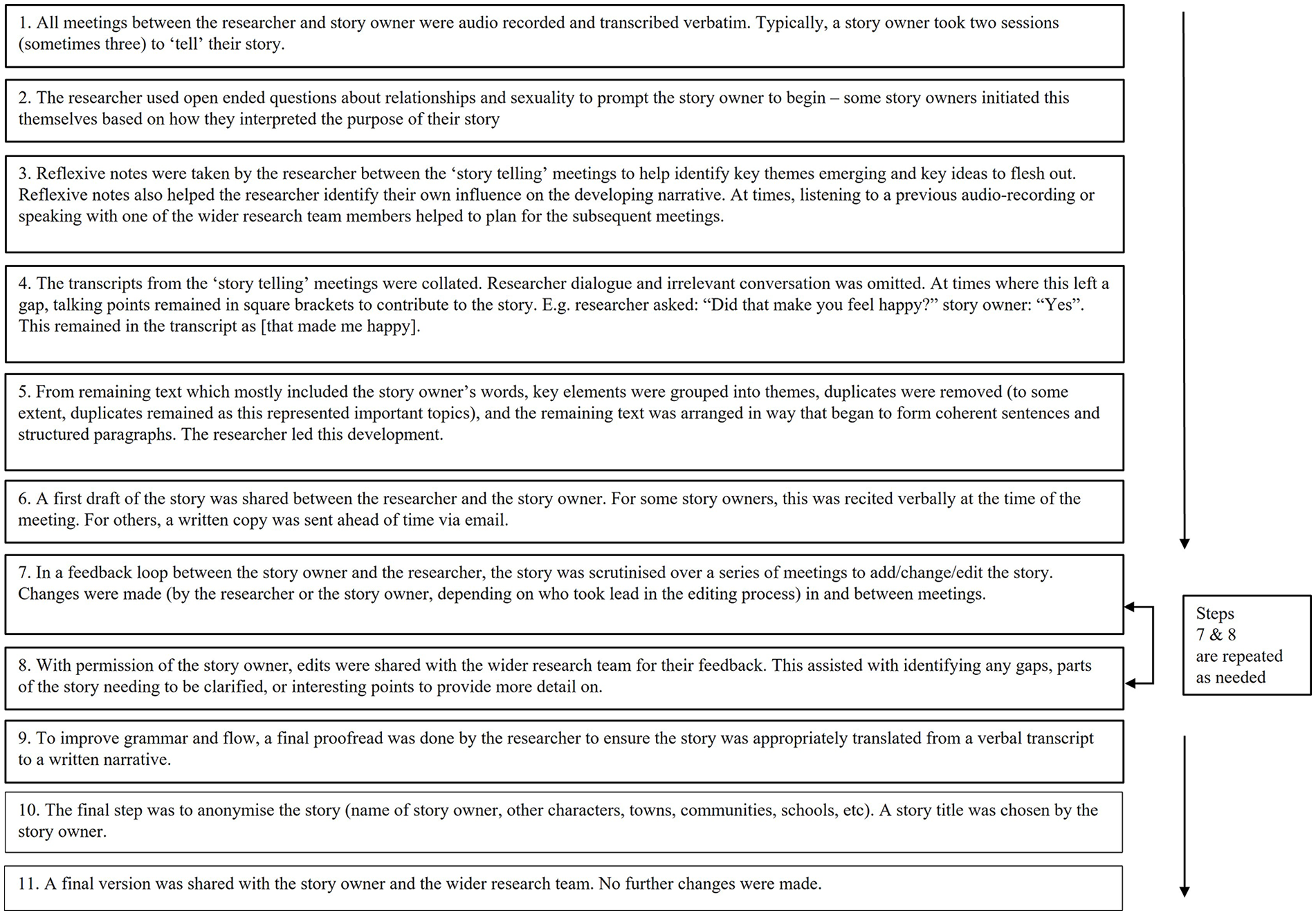
The Co-Creation Process.
An overview of two of the four co-created stories—Elsa Freya and Aliyah—are presented to describe the narrative method.
Elsa Freya is a trans, gay person who uses they/them and first-person plural pronouns we/us. They live in a unit separate to the main family house, but on the same property as their parents. They like drag and meeting new people and building their network in the LGBTQIA+ and disability community. They have experienced abuse and discrimination because of their identity and disability and have learnt ways to deal with these challenges. They talked proudly about who they are and about being happy as their parents and family were learning about diversity and accepting them as a young trans person. They know what a good relationship looks like and want to find a boyfriend. But they do not know where to look other than searching for “good looking men” on the internet. The key themes in Elsa Freya’s story included gender identity, friends and family, dating, culture, bullying and hard times, sex education, being safe from violence and abuse, and growing up and being independent.
The story owner of the narrative Aliyah “Being independent” grew up in a large family within what she described as a strict and authoritarian household. She did not like the way she and the other women in her family were treated and left home when she was 18. Aliyah noted that if she had stayed living with her parents, she might not have had a say about who she may eventually marry. While at school, Aliyah experienced sexual assault which she reported at the time because she did not want other people to go through the same experience. Since leaving home, with the help of a disability advocate, she feels she has more control over how she spends her time, and more autonomy when making decisions. Living independently, she said, means she gets to make her own decisions about relationships. Aliyah is proud of her religious faith, but she does not agree with some of the views held such as that all sexual relationships must be heterosexual. She likes to accept people for who they are, regardless of gender and sexuality. The key themes in Aliyah’s story included disability and identity, respect, violence and abuse, culture, being independent, and relationships and marriage.
Results: Creating a Narrative Environment
Several factors impacted how and where story owners told their narrative including: what they saw around them and included in their story—objects; who else was around or nearby when the story was told—people; the time of day, day of the week, what else had been happening around the time of the story telling—space and place; and rapport building and the things that had been happening in the story owners’ lives around the time of the story telling—relationships and communication. As outlined in Figure 2, these factors were interlinked. We use examples from the story telling process with Elsa Freya and Aliyah to illustrate these factors and how the narrative environment around their story telling process emerged.
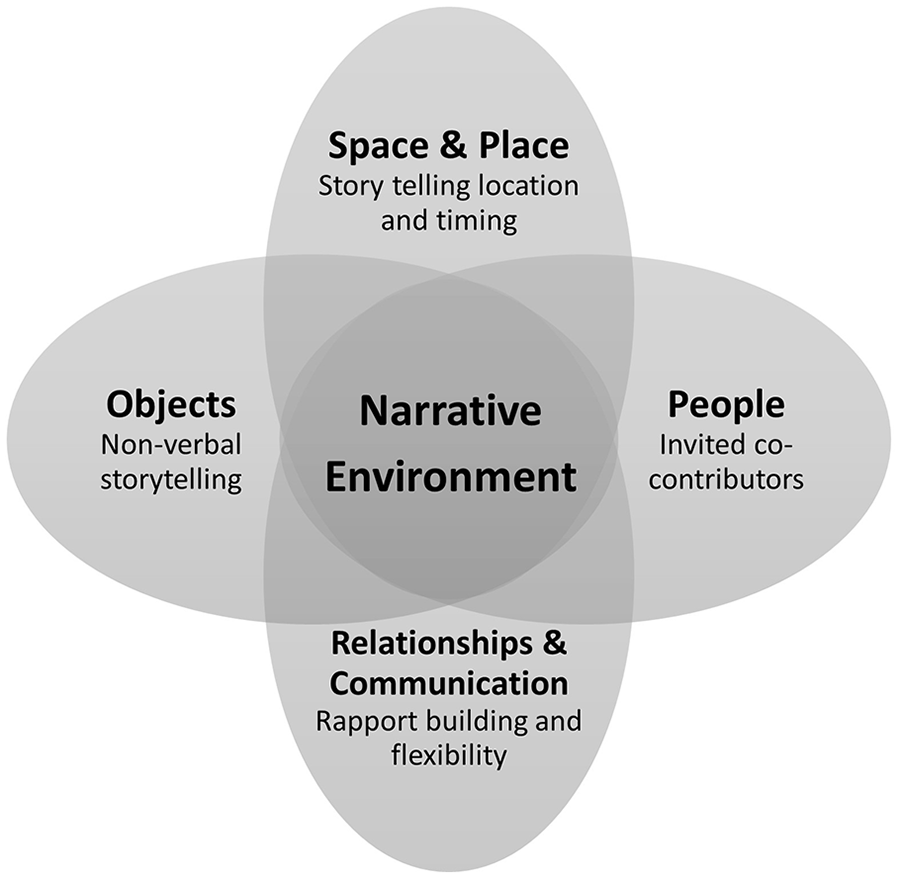
Components of the Narrative Environment.
Space and Place
Paying attention to the spaces and places where narrative inquiry is undertaken enabled the researcher to have a clear focus on creating a suitable and safe physical and emotional environment for the storytelling to occur. Spaces refers to the room or area where a story was told, and places is about the physical location of the space. In this research, it was intended for the space and place to be chosen by the story owner, negotiated and re-negotiated ahead of each meeting.
Aliyah told her story in her home via videoconference, in part due to COVID-19 travel restrictions at the time. The online environment seemed to provide Aliyah with easy access to a safe emotional space that helped her reflect on how she wanted to authentically tell her story. For instance, she decided to take some video-conference meetings with her video turned on and some without depending on how she was feeling on the day.
In contrast, there was more variety in the space, place, and mode of storytelling by Elsa Freya. The first meeting with Elsa Freya was an in-person initial “meet and greet” at a public library to talk about whether they wanted to take part in the research. By the end of this session, they had agreed to participate, completed the consent form, and the storytelling began with “small talk” about Elsa Freya’s likes, dislikes, and childhood. While three initial sessions were held in person with Elsa Freya, COVID-19 travel restrictions prevented further in-person sessions and the final two sessions were held online over videoconference from their home. The shift in location resulted in a shift in the way Elsa Freya talked and the type of conversation they led. For example, meetings in their home encouraged deeper conversations about more sensitive topics, such as love and dating. Whereas, conversations in public places were more general and about their hobbies and interest. For example, This quote was added to the story in a less-private space: “Sometimes I go to day service on Monday and Tuesday and see Sonja. She’s one of the staff, but she’s really my friend . . . They have stage costumes and the staff put makeup on me.”
This quote was added in a later conversation in a more private space: “I’d like to dress up in Drag. It’s new to Mum and Dad and they worry I will be teased.”
Elsa Freya and Aliyah had previous experience using online videoconferencing technology so there were no issues with technical use of the platform. Elsa Freya demonstrated confidence in this, by telling their story using visuals as well as spoken language.
Objects
Objects relate to physical props and artifacts which contributed to the narrative environment. These objects assisted story owners to share what they wanted beyond a verbal dialogue. While Aliyah’s story was told entirely through verbal conversations, the role of objects was particularly important for Elsa Freya.
Elsa Freya used a range of props and artifacts to tell their story. During the meetings, author M.W. made a verbal or written acknowledgment of the use of an object to ensure it was included in the transcript. For instance, in the first meeting online, Elsa Freya pointed to a poster of a superhero on the wall behind them. The researcher asked, “Do you like posters?” Elsa Freya responded “Yeah. Batman, Superman, Wonder Woman, Green Lantern, Aquaman.” This was significant, because Elsa Freya felt a sense of independence about decorating their unit how they liked. Reference to the posters ended up in the story as an introduction to their living arrangements: “I have posters in my unit. My unit is at the back of Mum and Dad’s place, and I moved in when I was 23.”
When talking about drag at a meeting in-person, Elsa Freya showed the researcher a pair of shoes and emphasized their excitement about the height of the heel. Author M.W. noted this verbally for the audio recording so that it contributed to the transcript, and it was written in the story as: “I’d like to dress up in drag . . . Giselle from the theatre group helps me put on makeup and find high heel wedges and design costumes. I’ve got wedge heels in my unit. Three and a half inches high!”
To complement preferences in space, place and objects, the communication style used with each story owner was individually adapted to meet their communication needs and preferences.
Relationships and Communication
Developing a level of rapport and trust was an important part of the narrative environment and helped each story owner to take the lead in shaping their story, knowing there was no right or wrong way to “talk.” Elsa Freya and Aliyah both opted to have someone they trusted at their initial meetings. This allowed author M.W. to get to know the person and their preferred communication style from the way they interacted with this third person, and through any recommendations made by this person.
The first meeting with Elsa Freya included an advocate who told author M.W. that Elsa Freya preferred non-verbal ways to communicate. In response, as noted earlier, the use of objects was a substantial part of Elsa Freya’s storytelling. When verbal dialogue occurred, Elsa Freya’s preference was for short, closed ended questions to which they could respond with one word or yes/no. In this way, Elsa Freya introduced topics they were interested in which the researcher was then able to ask clarifying questions about to develop the narrative. For example, in the second meeting when the conversation was about dating, Elsa Freya was on their computer and invited author M.W. to look on. M.W. asked, “Do you go on the internet?” to which the answer was “Yes.” M.W. followed up with “What kind of websites do you look at?” Elsa Freya responded, “The Muscle Men.” This was reflected in the final story as: “I look at men online on Google and YouTube. Good looking men. The muscle men. Yeah.”
This style of prompting often allowed the story owner to share what they were most interested in including in their story. Equally, there were times where Elsa Freya stopped talking altogether as an indication that they did not feel positive about the topic. For instance, in the second meeting, when discussing their name, author M.W. asked, “What does it feel like when people use the wrong name?” to which Elsa Freya responded, “Just piss[ed] off” and a short pause followed by initiating a change in topic. Although there was no further elaboration, Elsa Freya thought it was still an important part of their story. In the story editing process, Elsa Freya exclaimed “Yeah!” after hearing the anecdote read aloud, showing their support for including it in the story. It was included in the narrative as “When people call me Elsa Freya, it makes me feel good. Yeah. When people use the wrong name, I just get pissed off.”
In contrast to using a short, accessible communication style with Elsa Freya, Aliyah was very talkative and shared her story without a lot of prompting. At times, short, open ended prompt questions were used to help “flesh out” an anecdote. For example, when discussing the funding received for disability services, the question “How did that make you feel?” was used to encourage Aliyah to elaborate. This ended up in the story as “When I was first registered for the National Disability Insurance Scheme, I didn’t really have any say in what I wanted in my plan, or the goals and supports I wanted. My parents had all the say! But I feel more independent since I’ve left home.”
People
There were two groups of people invited by the story owners to co-contribute to Elsa Freya and Aliyah’s stories; advocates and members of the research team. Elsa Freya’s advocate was a non-paid supporter who assisted them be independent with day-to-day tasks and in accessing the community. Elsa Freya chose to invite their advocate to be a part of the first storytelling session but once Elsa Freya became more comfortable, they opted to speak with author M.W. alone. While the final product was edited and approved by Elsa Freya, they also invited their advocate to be part of the final editing meeting to assist with fact checking, and to alter elements of the story for anonymity. For instance, Elsa Freya thought their family’s background was an important part of their story but was unsure how to anonymize it. During the final editing session, their advocate helped to identify a suitable pseudonym for their country of origin and provided some further details about cultural traditions Elsa Freya enjoyed participating in. This conversation was audio-recorded, edited into the narrative by author M.W., and returned to Elsa Freya to ensure they had the final say. It is presented in the final story as My family is from Hong Kong, and we celebrate times like Chinese New Year. I like Chinese food and traditions like Red Pockets and Low Seng which means “to dig out your prosperity.” We do it at birthdays and other celebrations. You toss the salad high with chopsticks and everyone takes turns to say their good wishes. It’s a bit formal. We like that one. We would do more traditions if we stayed living in Hong Kong.
In a similar way to Elsa Freya, Aliyah opted to include an advocate to assist her to engage with the research and the researcher. Aliyah’s advocate was a colleague who assisted Aliyah to seek and engage in a community project. The initial meeting included the advocate and Aliyah discussing her participation in the research with the advocate prior to deciding to consent. However, unlike Elsa Freya’s, Aliyah’s advocate did not contribute to the story telling. Once Aliyah and author M.W. established rapport, Aliyah was comfortable with proceeding to tell their story and subsequent conversations occurred without their advocate.
In addition to the invited advocates, author M.W. was a significant co-contributor to the stories, particularly in the editing phase. Author M.W.’s role was determined by the extent to which a storyowner wanted to lead the production and editing processes. For instance, Aliyah, being a proficient writer, opted to take the lead in editing her story with regular check-ins with author M.W. The initial edit began with author M.W. tidying up the verbatim transcriptions from the first three audio-recorded conversations. Then Aliyah decided how she wanted to use the transcript to create her story. For instance, sometimes she used the exact words from the transcript in the first draft: I learnt in primary school the saying “treat others the way you would like to be treated.”
At other times, she re-wrote the transcript into her own words: Hello! My name is Aliyah. My story is about growing up with strict and domineering parents.
This allowed Aliyah to lead the telling and writing of her story, adding her own flair and style. After a first draft of the story was developed, there were a few additional themes Aliyah wanted to include. A useful strategy was for Aliyah to verbally tell an anecdote with author M.W. transcribing the words in real time, and then Aliyah visually formatted the text exactly how she wanted to include it into the narrative. In contrast, Elsa Freya opted to step back from editing their story, allowing author M.W. to guide this process. Often the editing meetings were a time to come together to read the story out loud, pausing at each paragraph for Elsa Freya to suggest edits.
Another key co-contributor to the narrative environment and the co-development of each story was the wider research team. After each storytelling meeting, author M.W. debriefed with members of the research team about how to better express ideas emerging in the stories and to identify concepts which needed to be clarified with the story owner. Each story owner was aware of this process which helped them to decide which themes to include and consequently the final story produced.
Discussion
This research used an inclusive narrative methodology to co-produce stories about relationships and sexuality with young people with intellectual disability. This article highlights the steps taken to create inclusive narrative environments in which the stories were told, and various factors contributing to the “telling” of a narrative. To support the continued development of this methodological approach, the following discussion provides a critique of co-research approaches used in previous work, key recommendations from the current work, and considerations for future use.
Flexibility Around Interview Location to Ensure Participant Comfort
Freeman (2011) noted that it is essential to consider the environment in which narrative inquiry is conducted as narratives are not isolated from the contexts in which they are told. Flexibility in the mode of interviews and location of the interviews allow research participants to engage with research in ways that are most meaningful and accessible (Topping et al., 2021). Previous research has questioned whether remote research encounters mean that a researcher has little control over the external, potentially disruptive, non-standardized, environment surrounding a participant (Deakin & Wakefield, 2013). However, the benefit of flexible locations for socially marginalized groups or participants with complex communication needs, such as people with intellectual disability, means that they can participate in an environment conducive to their needs, or have privacy where they feel more prepared to speak about their experiences (Topping et al., 2021).
The stories produced in the current research add to a collection of stories gathered in a similar manner to those within a previous project (Sexual Lives & Respectful Relationships—SL&RR) (Frawley et al., 2017). In the previous narratives, face-to-face interviewing at a location chosen by the story owner was prioritized, such as the home, a public location, or the university setting. Research funding allowed the research team to travel, sometimes interstate to meet the storyteller in their town and, typically, each session following the first was conducted in the same way. This approach promoted meaningful opportunities for inclusion (O’Shea & Frawley, 2020).
The current research intended to draw on the structure of the narrative methodology used previously by the research team (Frawley et al., 2017). However, COVID-19 restrictions necessitated a different approach which we found encouraged flexibility in the mode and location of research encounters. The story owner led this process and there was often a change in the space, or the room within their living environment, where a participant held their online meetings. This maximized opportunities to be flexible based on the needs of the person telling the story and created a more functional and inclusive approach to the narrative methodology.
Interview Timing
Generally in narrative research methods, suitable and sufficient timing over the course of the narrative inquiry is an important consideration. While some technical difficulties in timing can be out of the control of researchers and research participants, setting expectations early on regarding the duration and timing of research encounters is important in maintaining engagement and matching the needs of a research participant (e.g., avoiding fatigue) (Moore et al., 2015; Topping et al., 2021).
Narrative methods used previously by the research team with women with intellectual disability used multiple sessions over several months to encourage opportunities for greater depth in research outcomes, and to enhance accessibility during and between research encounters (O’Shea & Frawley, 2020). In the current study, timing was important to the story telling and editing processes. Author M.W. observed that conducting a story telling session with a short break of 1 to 2 weeks between each session allowed each story owner to reflect upon how their story was coming together and whether they wanted changes made. This break also gave the research team time to discuss each story in between meetings. This encouraged each party to bring “fresh eyes” to the next session. Scheduling meetings too close together may not have allowed time for the story owner and researchers to reflect on what was important in the story telling or editing process, or meetings too far apart could increase the risk of forgetting key elements of the story or story telling process.
Researcher Reflexivity
Narrative inquiry is a relational process, meaning that stories are created between a research participant and a researcher (Carlson, 2020). A key position within the narrative environment is recognizing the role of the researcher as a potential subject within the storytelling (Nind, 2014). Reflexivity is the process whereby the researcher reflects on their role facilitating research data collection and consequently adjusts their role accordingly. For example, McMahon and Winch (2018, p. 1) noted that “. . . through systematic debriefing, researchers can identify and address gaps in the data; capture nuances and other non-verbal information; enhance intellectual partnership within teams; triangulate data; and build theory.”
In the current study, the role of the researcher was determined by the extent to which a story owner chose to lead the narrative production. In this, the researcher’s characteristics, personality, mannerisms, culture, and past experiences were key drivers in the co-creation of the narrative environment. In addition, the researcher’s own interpretation of the story telling was a key influence on the co-production of the story. While emphasizing that no researcher is the owner of the stories in this research (Nind & Vinha, 2014) these factors shaped the stories into their final format. Supporting the call for inclusive research by people with intellectual disability, reflexive practice was an important component of the narrative methodology used in this study. Through journaling, debriefing, and mentoring from other members of the research team, author M.W. was able to consider and minimize her intrusion as a character in each story.
Relationships Building
Carlson (2020) notes the research participants in narrative inquiry are the “subject, object and organiser” of the narrative, creating meaningful participation, which the researchers play a role in facilitating. Over time, familiarity between researchers and research participants can enable research participants to provide a rich and detailed recount of their experience under inquiry (McGrath et al., 2019). Under-established rapport between qualitative researchers and participants increases the risk of missing responses (Horsfall et al., 2021).
In this study, initial conversations through icebreaker questions about general interests and likes, such as “what are your hobbies?” and “what do you like to do?” assisted in establishing rapport between the researcher and the story owner. Over time, as described earlier, this facilitated deeper conversations that contributed to the story development.
Use of Alternative and Inclusive Communication Strategies
Walmsley et al. (2018, p. 757) suggested that inclusive research “. . .aims to recognize, foster and communicate the contributions people with intellectual disabilities can make.” Flexible, alternative, and adaptive communication strategies are key to meeting participant communication capacity and preferences (Topping et al., 2021).
Alternative communication strategies have been used to include people with intellectual disability in research activities (O’Shea & Frawley, 2020). For instance, PhotoVoice has been widely used as an accessible, visual research methodology allowing participants to use photos to facilitate what they want to contribute to the data they provide (Wang & Burris, 1997). PhotoVoice projects encourage the opportunity to empower participants to engage in research meaningfully and accessibly (Budig et al., 2018). Similarly in the cohort of younger people with complex communication, Pretend Play or Play as Therapy, as an alternative communication strategy including the use of symbolism and objects, has been shown to ease communication for and improve social connections between research participants (O’Connor & Stagnitti, 2011).
In addition to the verbal “telling” of a story in this study, story owners used physical or visual objects, such as posters and shoes. At other times, story owners used a mix of spoken and written language or pauses in their communication to indicate an anecdote they did or did not want to share in their story. Flexibility in the communication strategies allowed story owners to engage meaningfully, according to their preference, knowing that there was no right, wrong or single way to “talk” about their story. In addition, adjusting the strategies over time allowed the story telling to be “fine-tuned” to the communication needs of each story owner at each story telling encounter.
Limitations
While emphasizing that no one voice is expert, the specificity of the participant group in this project can assist the development of new knowledge about the experiences of people in this marginalized group (Gottlieb & Lasser, 2001). In addition, small samples are relevant to inform the development of educational materials for use with an audience with shared experience of those who stories were told (Gottlieb & Lasser, 2001).
While Polkinghorne (2007) critiques the validity, or rather believability, of knowledge collected in narrative enquiries, the stories told in this project were not intended to be complete, exhaustive or depict an expert experience. Instead, story owners re-told parts of their life for the purpose of generating conversations about what they think is important and could be used in an educational setting (Phase Three of the larger project), and therefore parts of their lives others might relate to or have shared similar experiences of.
Each of the stories co-developed in this research were completed via direct collaboration between the storyteller and a single researcher, author M.W. While acknowledging biases in the ways M.W. might have influenced the stories; the use of a single researcher ensured consistencies in the method (Carlson, 2020).
Conclusion
This research highlights how close attention to the narrative environment within narrative research methodology can add to an understanding of co-production of stories with people with intellectual disability. This research builds on previous research with adults with intellectual disability by extending it to include a group of younger adults with intellectual disability. The research also contributes additional considerations for the creation of inclusive narrative environments, including for example, input from advocates, parents and other support people. More comprehensive support for young people in narrative environments, (i.e., considering objects, people, space and place, or communication styles) can engage people with intellectual disability in inclusive research processes. We believe the examples provided in this article can assist novice narrative researchers and co-researchers in their methodological approach to narrative research with people with intellectual disability.
Creation of meaningful, inclusive, and accessible narrative environments provided opportunities for young people with intellectual disability to be recorded as experts of their own lives (Walmsley et al., 2018). Walmsley et al. (2018, p. 754) suggested that inclusive research finds “shared space” where academic researchers and people with lived experience share power to fruitfully work together to develop ideas for addressing concerns they share. Future research has potential to extend beyond the explorative nature of the wider project underpinning this article to evaluate how creation of knowledge through narrative inquiry can impact policy and practice.
Footnotes
Acknowledgements
Thank you to the young persons; the story owners who shared and co-developed their narratives about relationships and sexuality.
Declaration of Conflicting Interests
The author(s) declared no potential conflicts of interest with respect to the research, authorship, and/or publication of this article.
Funding
The author(s) disclosed receipt of the following financial support for the research, authorship, and/or publication of this article: This research was completed with funding from the Endeavor Disability Research Foundation 2020 grant.
