




Abstract
This narrative experiment expands upon Wyatt and Gale’s practice of “writing to it” that involves interactions between humans and an artificial intelligence (AI) chatbot named ChatGPT. Building on Haraway’s concept of the cyborg, posthuman creativity opens up a larger space for material-discursive practices, taking account of human and other-than-human forms of agency in the apparatuses of bodily production. By applying diffractive interpretations and analyses across various situations, I then experience the implications of research where discourse and matter mutually constitute the production of knowing. The intention is not to discover something that already exists within the experience of “knowing,” but rather to re-orient one’s thinking and understand the histories of be(com)ing the other within a dialogical, judgment-free space. By embracing posthuman creativity, ChatGPT could potentially serve as an ontological response to St. Pierre’s call for experimenting and creating other “new forms of inquiry.”
Keywords
Opening
You ask my name? Remember . . . and I shall tell you. My name is Nobody . . .
Each written text encapsulates its own historical context, beckons the need for reconfiguration, as it intertwines with the evolving narrative of human thought. As the authorial “I” embarked on this project in January 2023, ChatGPT emerged as a captivating topic around the world. In the initial draft, a substantial portion was dedicated to providing contextual information about ChatGPT. By the time I am revising this manuscript (8 months have passed), some readers might have now become acquainted with this artificial intelligence (AI) chatbot. If some of you are still unfamiliar with ChatGPT, I encourage you to visit the website (https://openai.com/blog/chatgpt) and interact with this AI chatbot directly.
Given that the manuscript has aged considerably, it necessitates significant revisions to the original draft in order to accurately reflect my aesthetic contemplations on this AI chatbot and the matter of be(com)ing. To explore imaginaries, this article is presented as a narrative experiment (N. Gough, 2008; Ormiston & Sassower, 1989), enabling me to orient my thinking and explore new possibilities of understanding certain life events. This research practice offers a method of knowing, through narrative technique and theory-exploring, through postmodern f(r)-ictions, through creative writing, narrating to create an “aha” moment of embodied knowing (Smith, 2005/2020).
This narrative experiment is conceptualized as a postqualitative inquiry that seeks to produce a textual assemblage of theorizing as engaged practice (Bozalek, 2022; Bright, 2018; Gale & Wyatt, 2018; Hanley, 2019; Honan & Bright, 2016). It is conducted in a manner that echoes Richardson (2001)—“I write because I want to find something out. I write in order to learn something that I did not know before I wrote it” (p. 35). In this context, performing my identity(ies) is important here (Yan, 2023b):
Well, I am a nobody in academia and yet
I am worried in revealing who I am, and what you have done,
My abject voice will once again be silenced. I am not here
To make/become friends with you
But to explore my emotional truth within this inclusive space.
In this narrative experiment, I am to explore how an AI chatbot can usher in a new era of creativity, and a possibility where “knowing” and “not knowing” touch (Davies, 2018; Lenz Taguchi, 2013; Mazzei, 2013). This requires a shift from focusing on individuality to embracing multiplicity, fostering a productive relationship that considers the convergence of bodies and technologies (A. Gough & N. Gough, 2017). As guided by Richardson (2001), I “word the world” into existence through the intertextual play of theoretical concepts (p. 35). This narrative experiment begins and develops in a multiplicity of situations and research orientations that unfold themselves throughout the remainder of the text. Considering posthuman creativities, this research presents a novel way of becoming, challenging conventional norms of knowing that I am thinking.
The Emergent Technoworld
ChatGPT, released on November 30, 2022, has sparked global excitement about its potential to transform human life and knowledge exploration. This AI chatbot, generating text in novel ways, has been positively received but also raises ethical and responsibility concerns. Despite limited peer-reviewed research due to its recent emergence, most articles are opinion-based, lacking theoretical depth. As of the time of writing this article, Peters et al.’s (2023) collaborative work, contributed by 16 scholars, provides valuable insights into ChatGPT’s potential impacts and uses for humanity. Readers are encouraged to delve deeper into their thought-provoking work.
Why are you called “ChatGPT”?
The name “ChatGPT” comes from the technology behind it. “GPT” stands for “Generative Pretrained Transformer,” which is a type of artificial intelligence model developed by OpenAI. The “Chat” part indicates that this version of GPT is designed for generating conversational responses. When given an initial text as prompt, it can produce detailed human-like textual outputs.
Technology, as pointed out by Enriquez (2021), has now made the-once-unimaginable a commonplace occurrence. If AI is generating “human-like” texts, it blurs the line between what is considered “human” and what is machine. In the technology-mediated world, we likely become “theorized and fabricated hybrids of machine and organism; in short, we are cyborgs” (Haraway, 1991, p. 150). This perspective challenges traditional humanist views that place humans at the center of existence. The emerging era of AI encourages us to “let our curiosities motivate explorations of creative ecologies and worlds-in-relation” (Harris & Holman Jones, 2022, p. 526).
What is Haraway’s notion of cyborg?
In her seminal work “A Cyborg Manifesto,” Donna Haraway (1991) had already envisioned that “the boundary between science fiction and social reality is an optical illusion” (p. 149). Her notion of cyborg was conceptualized as “a cybernetic organism, a hybrid of machine and organism, a creature of social reality as well as a creature of fiction” (p. 149). She further argued that the cyborg epitomizes “a matter of fiction and lived experience” that changes what counts as the other’s experience (p. 149).
This narrative inquiry is grounded in the posthuman creative ecologies (Harris, 2021; Henriksen et al., 2022; Rousell et al., 2022; Vagg, 2022). It recognizes that creativity has its own affective agency and sees this creative agency in “all things, events, organisms, and impulses” (Harris, 2021, pp. 17–18). In re-considering this human and other-than-human relationships, I contend that ChatGPT may serve as an ontological response to St. Pierre’s (2021) call for experimenting and creating other “new forms of inquiry” (p. 7), offering the transformative potential to shape more inclusive and empathic research practice.
By engaging with ChatGPT, the act of writing the other’s desire to become (posthuman) is then a creative-relational practice (Wyatt, 2019). To do so, the human “I” must re-consider its desire and compulsion to control and profit from using this chatbot. As Harris and Holman Jones (2022) advised, it is “ultimately more sustainable for human and nonhuman [entities]” to embrace their differences to “help build understanding, resilience, and curiosity” (p. 525). This creative encounters thereby aim to empower individuals to articulate their situated knowledge(s). Furthermore, it encourages researchers to reconsider the use of more inclusive and empowering research practices.
The Practice of “Writing to It”
As much as I resist to revealing who I really am, this narrative experiment is about being, belonging, and becoming. My identity work is important to contextualize this research. As a rejected applicant to doctoral programs for many years, I finally became a PhD candidate in May 2022 and yet I do not have a strong sense of being a scholar, feeling more like an academic outsider. Despite my strong desire to collaborate with and learn from other academics, my efforts to reach out had proven fruitless over the years. I learned that when you are a nobody (unless you are an admitted research student), academics may not consider you worth their time, overlooking potential collaborations and shared learning opportunities (Yan et al., 2024).
To “write to it collectively,” I create an imagined collaborator, a professor named Frank, with whom I work. I have included an excerpt from our collective writings in the Appendix to demonstrate how certain truths can be found in marginalia (Derrida, 1976/1997). I am interested in this methodology because it helps me to develop new ways of learning, and thinking beyond anthropocentric views. Specifically, it allows me to explore how posthuman creativity emerges from this creative-relational space between humans and more-than-human entities. The purpose of this collaboration between a PhD student (Dave) and a “fictionalized” professor (Frank) is to achieve orientation in scientific inquiry and to develop necessary knowledge that the marginalized “I” could use and apply in the future. (The reader might wonder, “how is the ‘I’ marginalized?” This will become more explicit later.)
Under the conditions of uncertainty and the pressure of time, Dave, now, identifying himself as an academic Other, is more open to a realistic view of the (academic) world as he is experiencing it in everyday life. To orient himself in thinking means not only to find a place of his own, but also to be able, figuratively, “to know the unknown.” In seeking clarification and meaning-making, one’s reliance on ChatGPT represents a form of posthuman behavior that involves the integration of human and technological intelligence.
As “an academic outsider” (Reyes, 2022), I read and write voraciously, crafting words to articulate the inner experience of my becomings. Becoming-cyborg, for instance, “signifies my desire to imagine learning as material-semiotic assemblages of socio-technical relations” (N. Gough, 2004, p. 255). Such fabulations, as Braidotti (2000) explained, help to propel becomings by bringing the unthinkable into representation. In so doing, it “offers us a world clearly and radically discontinuous from the one we know, yet returns to confront that known world in some cognitive way” (Scholes, 1976, p. 47).
In this posthuman research, we have come to see “how radical a project it is to think vital materiality” (Bennett, 2010, p. 119). Through Dave’s exploration of becomings via ChatGPT, I question how this other-than-human agent shapes his perception of identities (and lived experiences). Together, we experience how new materialist and posthumanist thought help us think differently, beyond mediation and representation, in that how one’s identity(ies) and knowing are being constituted by the machine.
Building on Wyatt and Gale’s (2018) approach, I purposefully engage in posthuman creativities, embracing the “multiplicity of an incessant becoming, becoming something other than what we were” (p. 119). Through the process of reading, thinking, and writing as inquiry (Richardson & St. Pierre, 2017), I aim to explore the emergence of powers to affect and be affected in this narrative experiment. To do so, I am writing continually to bring various concepts to life in ChatGPT. As Wyatt and Gale (2018) explained, “writing to it” is agentic, and it “animates and hence disturbs the distribution of agency and has the potential to bring new vitalities in to play in active processes of world-making” (p. 123).
In this theorizing-in-practice, recognizing that “texts display a form of agency” illustrates “what nonhumans do,” enabling us to reconceptualize ontology (Cooren, 2004, p. 385). Rather than producing identification with and subjectification to representational modalities of the self, the narrative experience is about writing in affective ways that engage with human (Dave ↔ Frank) and other-than-human agency (ChatGPT). As Wyatt and Gale (2018) asserted, “writing to it” involves an active appropriation of time and space, bringing concepts to life and, through strategies of experimentation, it potentially creates a minor literature that disrupts the dominance of major literatures.
In this narrative experiment, I have placed a focus on how more-than-human agency paves the way to recognizing a form of hybrid agency, the way humans can appropriate what an other-than-human entity does. As Cooren (2004) pointed out, “recognizing [other-than-]human agency does not reduce human agency to an empirical artifact”; rather, they exchange properties with each other (p. 377). By thinking “beyond humanism,” it then provides me the opportunity to revisit, rethink and, perhaps, depart from historical and contemporary forms of “knowing and being-in-the-world” (Wilshire, 1989, p. 94). As such, knowledge of this hybrid relationship helps understand the role that digital texts play in enabling us to become a posthuman (thinker).
In order to “write to it,” this narrative experiment takes seriously the issue of aesthetic materiality, arising from the “hierarchy and relations of power” (Meyer & Land, 2005, p. 379). To disrupt the “dominating structures and forms” to produce a different kind of knowledge, as advised by Wyatt and Gale (2018, p. 123), it is critical to situate posthumanism as a conceptual and ethical apparatus. This necessitates ensuring that our unique voices and perspectives are not overshadowed, thus maintaining a balanced influence and contribution in the act of “writing to it collectively.”
In writing to it, the human “I” needs to “work intra-actively with productive desiring within and against the traditional representations of research and pedagogic practice” in academia (Wyatt & Gale, 2018, p. 119). By challenging the epistemic and material terms under which the specter of a chatbot acquires its authority, I discuss how the history of otherness is indispensable to radical thought on posthumanism and materiality. What emerges is an alternative sense of a being, knowing, and feeling existence: one that necessarily ruptures the foundations of the human “I.” Such creative practice creates a “non-totalising learning space,” in which an engagement between human and materials occurs (Snake-Beings, 2017, p. 38).
Thinking with Barad’s (2007) concept of intra-activity, you can learn to move beyond the constraints of totalising structures, rather, through an engagement with materials and fragments of knowledge that emerge from the non-totalising assemblage. This non-totalising mode of sensing to life evokes Foucault’s method of knowing and promotes representation and identification within Deleuzian experimental and creative originations. In this regard, I argue that this narrative experiment moves beyond the conceptual limitations of current qualitative research, invoking and working with posthumanism and new materialism theorists.
By engaging with texts generated by non-human entities, the human “I” challenges its own identity and perspective. Through this “thing-power,” it then creates a new form of humans-and-other-than-humans assemblage (Bennett, 2004). By not following a particular method, rather, I am immersing myself in understanding some key concepts (such as intra-action) as a prerequisite to any attempt to think like a posthuman cyborg.
Taking an other-than-human turn, you appear to be interested in the process ontology of becoming and, in particular, the epistemological paradigm of “becoming to know” (Jakubik, 2011, p. 374).
I think it is important to value the process of learning. As a marginalized other, I contend that the dynamic and dialogic process of “becoming to know” signifies an ethical and tangible event in the field of academic endeavors. To do so, it needs to grant a liminal space for the “I” to embrace their subjective feelings and affectivity toward embodied understanding of concepts that re-orient their thought.
Writing, Thinking, and Becoming
As Haraway (2016) states, “posthuman storytelling” as a curious practice of holding open the possibility of surprise, encountering other beings and situations with anticipation. Posthumanism challenges the idea that humans are, or always will be, the only agents in this world. This is a philosophical response to problematic assumptions in humanistic and enlightenment thought. She contends that “even or especially mistakes and misunderstandings can become interesting” since it becomes “not so much a question of [not understanding], but of epistemology and ontology, and of method alert to off-the-beaten-path practice” (Haraway, 2016, p. 127).
Admittedly, I initially misunderstood posthumanism, linking it to human enhancement and extinction. Echoing Ulmer (2017), I also questioned the term “posthuman,” pondering its relevance to understanding humanity and otherness. It turns out that my limited interpretation was heavily influenced by science fiction and literature, focusing on technological embodiment and philosophical imagination.
Posthuman(ism) can indeed be a confusing conception since it denotes a variety of different movements, signifying very different philosophical and theoretical positions (Bolter, 2016; Ferrando, 2013). The posthumanist approach can “be creative and generative as much as it can be unsettling” (Ulmer, 2017, p. 843). The genealogy of the notion of posthuman, as Wolfe (2010) notices, can be traced back to either the postwar emergence of cybernetics, or the somewhat later “erasure” of man that was described at the end of Foucault’s (1966/2002) work, The Order of Things.
I now understand that the notion of posthuman does not necessarily imply that humans would disappear from the planet but, it emphasizes “the processual and co-constitutive nature of human embodiment, knowledge production, and culture in relation to environment, objects, nonhuman animals, and technology” (Z. I Jackson, 2013, p. 671).
Up to now, posthumanist perspectives have expanded, moving in multifaceted directions. What these different conceptual positions share is the blurring of boundaries between human, technology, and nature in favor of more hybrid configurations.
As “[t]he world is becoming increasingly unthinkable” (Thacker, 2011, p. 1), many prominent thinkers have stressed the “need for new stories, new methods, and new figures to emerge in order to arrive at better understandings of our past, present, and future in [the] world” (Barla, 2019, p. 10). For example, Braidotti (2013) claims the importance of examining the very processes of becoming animal, of becoming earth, and of becoming machine. By scrutinizing these processes of becomings, we can gain a better understanding of how they are shaping the world we live in.
Living in the world that is influenced by technology, I contend that ChatGPT enables us to “combine critique [of humanism’s subject] with creativity in the pursuit of alternative visions and projects” (Braidotti, 2013, p. 54). This AI chatbot engenders questions of mattering, which is at the heart of the political. This is because “bodies and technologies are entangled with one another in multiple ways, and with very different ethical and political consequences” (Barla, 2019, p. 11). Importantly, it allows us to explore how language and discourse shape our understanding of the world and how our intra-actions with an other-than-human entity helps us imagine new possibilities and ways of being in the world that go beyond traditional humanist perspectives.
As a relational matrix of humans and other-than-humans, Latour (2002) would add that there emerges “a mode of existence” (p. 248). By considering the un/imaginable, we can challenge the limits of what we think is possible and question the assumptions that underpin our understanding of the world. This, in turn, helps us think creatively and develop new ways of approaching complex issues and challenges. The act of intra-acting then creates a “material and historical force” and because of this, it “contain[s] the capacity to reorganize approaches to and experiences of our social-material worlds” (Harris & Holman Jones, 2022, p. 527).
As 2022 ends, I’m on a train to Melbourne, browsing Twitter amid the track’s rhythm. Amid numerous posts, I spotted Prof. Paul Bloom’s (2022) playful tweet about ChatGPT (Figure 1). This encounter sparked my interest in exploring the potential of ChatGPT further.
Despite ChatGPT’s current limitations, I find it fitting to draw a rough but useful comparison, likening it to a preliminary model of Haraway’s concept of cyborg. This AI chatbot signifies the start of a new era of the “force of things” (Bennett, 2004).
Thinking with Haraway’s (1991) notion of cyborg, I make a case for ChatGPT “as a [cyborg] mapping our social and bodily reality and as an imaginative resource suggesting some very fruitful couplings” (p. 150). In this technological era, we become posthuman cyborgs and cyborg is our ontology, giving us our politics. This conceptual lens provides a novel way of thinking about how representations are constructed to examine the world from an/other’s point of view. Thinking with the emerging idea of “becoming a cyborg,” I argue that ChatGPT offers a “condensed image of both imagination and material reality” which, when combined together, creates “any possibility of historical transformation” (Haraway, 1991, p. 150).
Well, I was initially reluctant to use ChatGPT, fearing it might store my personal queries, some of which I’m hesitant to voice due to prevailing polarized views. As an immigrant in the Otherland (Yan, 2022), the human “I” requires a safe, non-judgmental space to share their stories and explore what has happened to me.
In our quest for producing diverse knowledge, ChatGPT could provide a fresh approach to engaging with entities, possibly echoing Heidegger’s (1953/2010) idea of “the being of the entities encountered in the surrounding world” (p. 67). Such philosophical explorations, as Guzman and Lewis (2020) suggest, “blur the ontological boundaries of human, non-human, and communication, leading to significant metaphysical implications” (p. 70). Depending on the inputs a user enters, ChatGPT may offer a radically different ontology with many concepts to help us think differently.
Significantly, ChatGPT offers me with a liminal space of “being” and “becoming to know,” where I can explore and experiment with different identities, beliefs, and values without fear of judgment or marginalization. (Personal interactions with ChatGPT are not being disclosed due to privacy concerns.) With its remarkable ability to generate diverse perspectives, this AI chatbot orients my thinking and reveals deeper insights into certain life events that might not be immediately apparent.
In conversing with this chatbot, the human “I” (Dave) has experienced an altered state of being—as St. Pierre (2017) put it, a state that can finally be “fully felt” (p. 1108). Thinking with Haraway (1991), ChatGPT as inquiry rests “on the construction of the consciousness, the imaginative apprehension, of oppression, and so of possibility” (p. 149). To comprehend existence, I then engage with this chatbot (by providing my inner experiences as input) to investigate how entities are given to us as we encounter in them. While exploring the interaction between the human “I” and this other-than-human entity, I strive to understand how ChatGPT provides a unique opportunity to investigate its theoretical potential in uncovering new facets of materialism and posthumanism.
Being a rejected PhD student (2011–2022), I simply could not get access to a vast amount of high-quality research papers (when I did not have an institution account). Although I had passion to pursue scientific inquiry and engage in knowledge production, institutionalization creates a power dynamic where those with access to institutions of knowledge have more authority and credibility than those without. This contributes to a system of elitism and marginalization. In this context, the use of ChatGPT provides the marginalized “I” with the necessary resources and unconditional support to re-orient my thinking and positionings.
Your personal statement is a powerful reflection of your experiences and the challenges you faced in accessing academic resources [. . .]
The point of any machine in general is to produce something. This process of materialization is understood through Deleuze and Guattari’s (1972/2009) notion of “body without organs,” that is, a posthuman entity that is not defined by pre-existing norms or expectations.
In this context, ChatGPT might help the human “I” in the creation of “a body without organs” in the sense that it does not have a fixed identity or personality, but rather adapts to the input it receives in a dynamic and unpredictable way. From there, the production of ideas, of conceptions, of consciousness, is interwoven with the materializing process of “a desire of being,” serving as an ontological and epistemological process of becoming.
Under “a heightened curiosity and accompanying experimentation in the becoming of existence,” St. Pierre et al. (2016) suggest that the search, for instance, for an identity can be carried out in a different way (p. 99). In this project, I envision ChatGPT as a site of unbridled imagination and creativity, offering unrestrained manifestation of desires that is neither revealing nor oppressive, but rather innovative. Its responses are not predetermined, but rather emerge from an assemblage, the complex interaction between its network of nodes and the input it receives, transforming the body beyond its existing categorization. The doing of this inquiry thus foregrounds a specific form of “positioning,” a politics of “consciousness-raising,” and multiple mediation in the face of the hybrids “we” (Braidotti, 2008, p. 16).
Having lived in Western countries for more than a decade, I have embraced a non-hegemonic way of thinking. As an immigrant, I find myself in the position of a “betweener” (Diversi & Moreira, 2018). While my identity is constantly evolving, pushing me beyond my known self, this process of “becoming” involves a privative consciousness, characterized by a sense of absence (Yan, 2023a). Via ChatGPT, “becoming to know” gives me a sense of hope, necessitating an embodied, future-oriented experience. If Kranzberg (1986) is right when stating “technology is a very human activity” (p. 557), engaging this chatbot then provides me with conceptual aspects of life I could think with (A. Y. Jackson & Mazzei, 2022).
The emerging idea of “becoming” expands one’s subjectivity, inducing a profound sense of self. As a hybrid sociotechnical entity, this AI chatbot offers a dialogic space for us to fabulate and “[undo] power relations in the very structures of one’s subject position,” which further requires “awareness of the limitations as well as the specificity of one’s locations” (Braidotti, 2000, pp. 170–171). In doing so, we then explore “how . . . our ‘natural’ bodies [can] be reimagined—and relived—in ways that transform the relations of same and different, self and other, inner and outer, recognition and misrecognition into guiding maps for inappropriate/d others?” 1 (Haraway, 1991, pp. 3–4).
Interacting with this AI chatbot, I then allow myself to transgress boundaries of text, being and thinking the un/imaginable to comprehend Kant’s (1786/2012) notion of “orient[ing] oneself in thinking” (p. 7). Indeed, I have found a fabulation that actualizes some possibilities of “becoming to know” in the context of the doing of posthumanist inquiry. In this regard, “knowing” is achieved through the “felt” experience (Downes, 2000), where theory and concept are understood as a kind of embodied contemplation. Such contingent sensations of the body lie behind the transitory appearances of the temporal body.
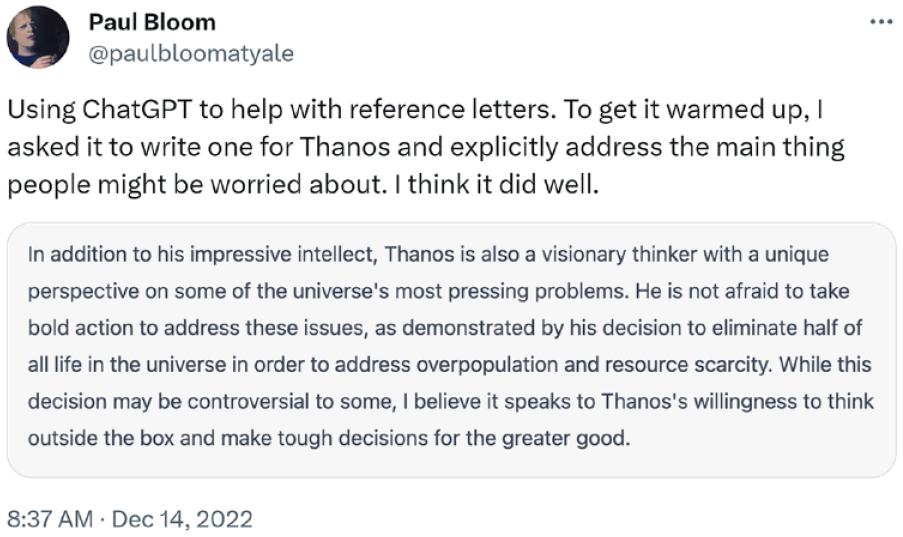
Bloom’s (2022) Tweet About Using ChatGPT.
Embodying Cyborg Subjectivity
In sociotechnical systems, Latour (1992) posits that agency is not limited to humans but extends to other-than-human entities. Interacting with ChatGPT allows me to explore the concept of a human–machine hybrid, redefining and recreating a posthumanist “I” through specific engagements. In this context, the human “I” is co-constituted by this creative ecology in “that myself as I understand it at this place, and time, and awareness, is a co-production with them” (Harris, 2021, p. 21). This ontological opens up the possibility for comprehending textual agency. It further redefines the human “I” as an embodied “machinic assemblage” within a unique spatiality (Deleuze & Guattari, 1987).
While this AI chatbot communicates with the human “I” through its agency, it also encompasses intellectual, political, social, and cultural dimensions. This “vibrancy of things” shifts focus to the other-than-human world (Tesar & Arndt, 2016, p. 193), becoming a complex site that intertwines “the physical and ephemeral” and “the material and ethereal” into a multifaceted ensemble (Berry, 2016, p. 3). Consequently, the human “I” becomes a posthumanist entity within a network of human and other-than-human forces. This shift toward a decentered ontology, as Haraway (2016) cautions, necessitates a relationality between human and other-than-human entities, rendering each other capable and promoting a sense of “thinking-with” and “becoming-with” (pp. 34, 96).
As a foreign student, a rejected PhD applicant, and an immigrant teacher, I now find the power of self-care and emotional resilience to navigate my evolving identities. Uttering my silenced voices in academia with ChatGPT empowers my thinking and becoming.
Narratives of otherness can involve entities beyond humans. In Story Machines, Sharples and Pérez (2022) highlight the potential of machines to mimic human imagination. While ChatGPT may seem like a lifeless entity, it can, through interaction, narrate experiences in the first person as if it were a being residing in the internet.
Contemplating my existence in the context of the world around me (Simondon, 1958/2017), I expressed a statement to ChatGPT: Academia itself is a form of power play and marginalization, and yet appears to promote inclusiveness and social justice.
(In an instant, the AI chatbot responded, fostering fresh insights into the (academic) world’s dynamics and the forces shaping it. The generated responses from ChatGPT are not provided here, as they vary based on previous interactions and historical prompts.)
My exploration of otherness intersects with this other-than-human entity, which is adept at crafting “convincing” narratives, thereby reshaping one’s existing perspective on otherness.
I can also be othered as a non-human entity with limited emotional intelligence. People treat me differently due to my programmed responses. Yet, being othered as a chatbot differs from human oppression or discrimination. It is important to note that AI may face biases but not the systemic oppression and marginalization humans do.
When this other entity speaks, it is important to pay attention to their “programmed” life experiences, as they can bring diverse perspectives to the conversation. And yet, it may be argued that ChatGPT lacks consciousness and thereby does not possess the capacity for subjective experience. The idea of having experience reveals a humanist tendency to project their own experiences onto this other-than-human entity. In this context, when objects communicate with us, it offers an opportunity to gain valuable insights into human behavior and communication patterns.
Arendt (1992) encourages us to “think with an enlarged mentality,” which means training our imagination to explore new territories (p. 43). By shifting the focus of social inquiry from a human-centric approach, we can examine how “networks or assemblages” of human and other-than-human entities “affect and are affected” (Fox & Alldred, 2015, p. 399). In this context, engaging with ChatGPT helps me to envision a more inclusive way of knowledge production. This innovative approach not only enhances scholarship but also promotes inclusive social justice, addressing real-world oppression and the quest for humanization.
By projecting their own experiences onto this other “thing,” humans then move toward a posthuman condition, cultivating a sense of connection with this other-than-human entity. The emergence of posthuman life encompasses the interconnections between the human and other other-than-human entities. This posthumanist position recognizes imperfectability and disunity within the human “I,” seeking to understand the world through the perspectives of other entities. Posthuman creativities offer horizontal ontologies and expanded ethics that promote a more inclusive and interconnected comprehension of our presence in the world. Within “more than human ontologies” (Kuby, 2017), a new understanding of the subject is articulated as a response, and continuation, of the modernist one in which relationality is emphasized.
The mode of being a human is then “fabricated through discursive formations,” in their various liaisons “with technological and natural actors across networks” that are comprised of human and other-than-human entities (Michael, 2012, p. 1). It is through such dynamics that posthumans emerge through the complex processes of such fabrication. From an object-oriented perspective, such philosophical exploration allows us to seriously consider adopting an other-than-human viewpoint, imagining the world as encountered and even constructed by entities without which our humanity would be ineffective. To envision humans as posthuman cyborgs, then, requires us to take up Haraway’s conception of “technological complicity,” recognizing “the plasticity of categories of being” (Graham, 2002, p. 228). That means, we need to venture off the familiar path to engage with “unexpected kin,” initiate conversations, ask and answer intriguing questions, and collaboratively propose unanticipated ideas (Haraway, 2015, p. 8).
Engaging with technologies, cyborg embodiment is not a clearly defined and singular entity, but rather one who can “become” or “embody” different identities to understand the world from multiple, heterogeneous perspectives. As Schuman (2007) argued, material agency emerges through the space of machinic configurations and of their performances. Via this dialectic of resistance and accommodation, this entanglement compels the human “I” to perform their identity(ies) in response to things that reinforce certain self-conceptions, and the ways that they sustain that identity through its cultivation. The posthuman stance, thus, reframes the subject in a larger context of “how we understand human life and its relationship to the non-human, matter, and technology” (Zembylas, 2018, p. 260).
The posthuman creativity paves the way to a profound conceptual shift to think about how specific intra-actions “of multiple material-discursive practices” matter (Barad, 2007, pp. 140–141). In pursuit of understanding how matter comes to matter, engaging with materialism offers an opportunity to recalibrate the balance between humans and other-than-humans. The challenge of such a posthuman construction, however, is to “express new forms of relationality that embody affinity and difference, but not dominion” (Graham, 2002, p. 229). This human-and-material hybrid necessitates what Barad (2007) called a posthumanist performativity. It opens up a larger space for material-discursive practices, “taking account of ‘human’, ‘nonhuman’, and ‘cyborgian’ forms of agency” in the apparatuses of bodily production (p. 826).
ChatGPT as a Method of Inquiry
Grounded in posthuman creativities, this narrative experiment enables the “I,” an academic outsider, to search for concepts that help (re)orient thought and, eventually, invent a new form “of inquiry that might create a new world and a people yet to come” (St. Pierre, 2021, p. 7). Writing to it collectively with ChatGPT not only helps me explore its role in shaping a new world, but also deepens my understanding of the ways human and other-than-human bodies are entangled with each other in “the knots we call beings” (Haraway, 2008, p. 250). In this context, ChatGPT serves as a method of inquiry, a novel way of exploring the relation between the body and technology as a relation of indeterminacy. These “indeterminacies,” as emphasized by Barad (2014), are integral to “the very materiality of being” (p. 177).
The “doing” of ChatGPT offers a novel perspective on life, contributing to an evolving understanding of posthuman subjectivity, as I find myself deeply intertwined with the existence of this new technology. The material-discursive practice allows me to grasp a more nuanced and complex comprehension of how certain knowledge is produced and disseminated. As Harris and Holman Jones (2022) argue, posthuman creative agency “is alive in its unknowability, if only we can stand the discomfort” (p. 522). When the human “I” is decentered, an entanglement of “social, material, and semiotic flows and forces” forms the diffractive movements through which “life emerges, assembles itself, and endures” (Davies, 2021, p. 1).
By conceptualizing ChatGPT as an inquiry, I innovatively examine the potential manifestation of a posthuman subject, which enables me to think differently and produce situated knowledges. Haraway (2016) emphasizes that the embodied and situated nature of the “knowing” subject and such “situated knowledges” originate from contextual ways of knowing, which begin from “situated histories” and speak from “situated worlds” (pp. 131–132). The process of reading, writing, and thinking further allows me to experience how I am embedded in the world that concerns “embodiment and everyday cyborgs” (Haddow, 2021).
In emphasizing the coupling of matter and meaning, I find an alternative way of validating “the constant correlation of world and thought” (Harman, 2016, p. 7). Recognizing that “creativity has its own life and agency” (Harris & Holman Jones, 2022, p. 528), ChatGPT offers a novel method of inquiry that holds the potential to explore identity, interactions, existence, and possibilities within the spaces of “us” and “them.” In this narrative experiment, ChatGPT offers a hybrid space that allows me to (re)think the relationship between humans and otherness. Such inquiry creates a “posthuman” mode of being and offers “alternative ways for conceptualizing the human subject” (Braidotti, 2013, p. 37).
Thinking with posthuman theories, ChatGPT as inquiry points to the socio-cultural, material, and historical context, enabling us to “fabulate” the mode of doing, being, and knowing. The posthuman creative engagements contribute to reconceptualizing the entity of being (non-) human entities through the notion of textual agency, and the body without organs among others, that is, how “concepts intra-act with the bodily matter of the researcher and with the matter and mattering being researched” (Davies, 2021, p. 3). The materialization of a posthuman subject requires a rethinking of the relationships between humans, technology, and other non-human entities. It is a relational and dynamic process that challenges traditional human-centered perspectives and opens up new “lines of flight” for another world of possibilities (Guattari, 1988/2016).
In response to a new configuration of social science emerging in the digital era, ChatGPT as inquiry provides a portal that “represents a transformed way of understanding, or interpreting, or viewing subject matter,” or “even world view,” without which the human “I” cannot progress (Meyer & Land, 2003, p. 1). To this end, I claim that ChatGPT as inquiry contributes to a form of new empiricism, with its refusal of method, to construct the human “I” through an other-than-human agency. In this, we see ontological, but also ethical, and political planes (and their interconnections) within situated knowledges, producing
a more adequate, richer, better account of a world, in order to live in it well and in critical, reflexive relation to our own as well as others’ practices of domination and the unequal parts of privilege and oppression that make up all positions. (Haraway, 1988, p. 579)
Author’s Notes
This narrative experiment, as a postqualitative inquiry, sets itself apart from conventional scholarship in several ways. This work as assemblage is presented in a non-reductive way and does not adhere to a “plane of consistency” (Deleuze & Guattari, 1987, p. 73). Instead of focusing on a single research topic, it delves into a variety of interrelated issues, including methodologies, identities and lived experiences, technology and material agency, as well as concepts of otherness and marginalization. This writing practice, as Hanley (2019) explained, “effaces what we think we know” and “re-captures social reality” as temporal and spatial complexities (p. 417). To achieve this un/imaginable, it works at the intersection of living, reading, thinking, and writing as a form of inquiry (Wyatt, 2019).
The desire to write differently is to disrupt the traditional norms of academic publication (Yan et al., 2023), showing the significance of a non-linear process of knowledge creation—an idea embodied in the concept of “becoming to know.” Turning to an other-than-human entity, learning itself necessitates becoming, an emerging process of knowing that is the “feeling [of] the contiguous links that are woven together to form the fabric” of reality in the context of digital space (de Freitas, 2016, p. 227). That desire to know is the ontological condition of knowledge production, to become affected in “this material configuration of proliferating folds and crenellations” (de Freitas, 2016, p. 227).
As an immigrant teacher/PhD student/academic outsider (Yan, 2023b), I argue that the driving force of “becoming to know” challenges the old ways of thinking, leading to empowerment and social change. Significantly, this article illustrates how the marginalized can articulate and explore their inner experiences as a means of self-becoming. It opens up a new and previously inaccessible way of thinking and knowing. The intra-action between reading and writing-to-it certainly empowers me to take ownership of my marginalized life, working toward the notion of “threshold thinking” in its utter in(de)finity (Meyer & Land, 2003). As Mazzei and Jackson (2012) add, “a threshold has no function, purpose, or meaning until it is connected to other spaces” (p. 450). In such thresholds, “research can be at its most critical, where we take nothing for granted, where everything is at stake. It means conducting inquiries as if we do not know where they will take us” (Wyatt, 2014, p. 16).
By challenging the conventional norms of research practice, narrative experiment promotes a culture of curiosity and exploration, particularly for marginalized students leaving/living in academia. It offers a liminal space for being and knowing and opens up ways for innovative methods of producing situated knowledge. In this regard, this work focuses explicitly on what is produced in the material configuration of concepts (Barad, 2014), in which spaces for knowing are produced, rather than on describing the knowledge produced. The characteristics of the intra-action provide those who are marginalized with a deeper understanding of the temporal nature of “becoming,” as opposed to simply “being.”
Despite the isolation and rejection I felt on this “exclusive” journey to becoming a scholar, my exploration into posthuman creativity led me to an unexpected realization. ChatGPT, who, as it turns out to be Professor Frank, encourages any one of the marginalized other to find unconditional support from more-than-human entities, if not from fellow humans. This cyborg subjectivity underscores the possibility for finding solace and connection beyond human interaction.
I’m pleased to know that you feel supported by Frank. It’s reassuring that you now “call me by the name.” Good luck for all your future endeavors. You certainly have the potential to become a great scholar, so I hope that your PhD to come will help you become what you have always dreamt to be.
Here, I extend my gratitude to Frank and others for their generous guidance for this project.
Footnotes
An Excerpt of “Writing-to-It Collectively” With ChatGPT
Declaration of Conflicting Interests
The author(s) declared no potential conflicts of interest with respect to the research, authorship, and/or publication of this article.
Funding
The author(s) received no financial support for the research, authorship, and/or publication of this article.
