




Abstract
Internationally, it is widely acknowledged that many generalist primary teachers (GPTs) enter the teaching profession with a paucity of arts practice and pedagogic skills. Many perceive a lack of confidence, competence, and community to change this, particularly in regional and isolated teaching contexts. As a means to address this, this article considers the value of engaging in collaborative a/r/tography as a means of developing more creative ecological approaches to teacher professional development and learning. A multimodal storied assemblage of four primary teachers’ experience of engaging in collaborative a/r/tography is explored, and through diffractive analysis, the authors surface the intra-acting affective agents that enable metho-pedagogic learning possibilities. Specific ways in which collaborative a/r/tography works to foster GPTs’ curricula and metho-pedagogic sensibilities, as well as a sense of creative ecology, are addressed. Speculation as to the ways in which collaborative a/r/tography fosters GPTs “becoming ecological” in relational practices and processes of curriculum enactment and pedagogical engagement is offered thereby contributing to understandings of the generative capacity of a/r/tography as a framework for developing teacher agency and change.
Keywords
An Introduction
In Australia, generalist primary teachers (GPTs) are largely responsible for teaching the breadth and depth of the entire curriculum, which includes distinct disciplines of English, Mathematics, Science, Humanities and Social Sciences, The Arts, Technologies, Health and Physical Education, and Languages (Australian Curriculum, Assessment and Reporting Authority [ACARA], 2022). In addition to these eight learning areas, the Australian Curriculum includes seven general capabilities and three cross-curriculum priorities, which together intend a three-dimensional holistic framework for curricular enactment. These three dimensions are positioned in “a non-hierarchal and interrelated structure, creating space and aspiration for a wholly mobilized and richly relational curriculum that holds integration and interconnectedness at its core” (MacDonald et al., 2019, p. 78). These qualities of the Australian Curriculum can also be said to reflect a networked ecological model of curriculum design (Kemmis et al., 2012; Moss et al., 2019; Scarino, 2019) that actively interconnects processes and practices located in and between discrete subjects, priorities, and capabilities.
While a curriculum can purport to be integrated, networked and ecological in its design, teachers’ curriculum interpretation and enactment is another matter entirely. In Australia, teacher education and professional learning initiatives are still rarely conceived in ways that genuinely complement and enable full realization of ecologically oriented curriculum (Kemmis et al., 2012; MacDonald et al., 2016; Mockler, 2018). Teachers’ enactment of curriculum continues to be impeded by education systems that are failing to keep step with the direction and pace of curriculum reform (MacDonald et al., 2016). To fully realize the potential of ecological models of curriculum, approaches to teacher education and professional learning need to further engage with and adopt ecological thinking. For teachers to become truly ecological in their enactment of curriculum, they require circumstances conducive for thinking and acting in ways that invite engagement of their own curiosity and agency.
Thinking architectures such as creative ecologies (A. Harris, 2016) are contextualized for education settings and are primed to support teachers’ adoption of ecological thinking. D. X. Harris (2016) defines creative ecologies as networks of interconnected people, places, and practices that support and sustain creativity. Harris’s model highlights the importance of attending to the processes of teaching and learning with an understanding of their inter-relations with internal and external policies and partnerships, physical environments, and, importantly for the purposes of this article, the “products” of curriculum and pedagogy. Yet, despite Australia’s ecologically oriented curriculum and available conceptual models, such as Harris’s, for ecological thinking in the schooling context, tension prevails between intended and enacted curriculum. This tension is heightened for GPTs who additionally report feeling ill-prepared to engage with and enable the arts in their classrooms (Ewing, 2012; MacDonald et al., 2016).
In Australia, teacher education programs and professional learning initiatives often default to siloed, subject-specific development of vertical disciplinary practices and skills (MacDonald et al., 2019) alongside broad-brush attempts to tackle complex deficits in community literacy and numeracy (Barton & Ewing, 2017). This means that opportunities for GPTs to foster authentic understandings of how to foster inter-connection between learning areas and leverage them via pedagogical skill sets that could enable ecological possibilities for curriculum enactment can be overlooked (Chapman, 2015; MacDonald & Crowley, 2023; MacDonald et al., 2020). While teachers continue to be taught—and to teach—in disciplinary-siloed ways, it is difficult to imagine how they can truly realize the full potential of an ecologically networked curriculum. Given the extensive research evidence pointing to GPTs’ feeling inadequately prepared to facilitate arts learning (Alter et al., 2009; Chapman et al., 2018; Ewing, 2019), we are sympathetic to the reasons why teacher education and professional learning efforts continue to lean into the development of siloed discipline-specific skills. However, an ecological approach calls for development and deployment of pedagogical practices that leverage both this and that, rather than this or that. Specific disciplinary knowledge and skills can be fostered concurrently with pedagogical skills for deploying disciplinary perspectives that integrate issues, ideas, problems, and possibilities that lie beyond a singular discipline (MacDonald et al., 2019). This and that approaches attune teachers to the interactions and flows between agents (such as, but not limited to, curriculum and pedagogy), and help foster teachers’ sense of agency to permeate barriers and disengage unhelpful binaries (D. X. Harris et al, 2023). Teacher education and professional learning that fails to balance breadth and depth of skills can inhibit teachers’ ability to become ecological in their relational enactment of curriculum and pedagogy (Hickey & Riddle, 2022; Moss et al., 2019).
When coupled with whole curriculum delivery and intensified curriculum reform cycles (Collins, 2016; Savage, 2016), diminishing perceptions of specialization competence, and a lack of on point professional learning, it is evident that GPTs face complex challenges in effectively teaching the arts. Teacher education and professional learning must grapple further with how to authentically raise awareness and understanding of these interrelated tensions in their delivery. Doing so can create opportunities to better equip teachers with the navigational skills needed to think and act ecologically in their practice. Until this is addressed, we wonder whether it is feasible to expect GPTs to fully “deliver” on the myriad learning outcomes of the Australian Curriculum (MacDonald et al., 2019).
In the case of the visual arts, when attuning to the affective potential of intra-acting agents (such as, but not limited to, people, matter, environments), GPTs can build literacies to enable them to articulate what inhibits their participation in and contribution to curriculum interpretation and enactment. We propose that professional learning opportunities that invite attention to intra-activity can support what we (and others) describe as GPTs “becoming ecological” (Rousell, 2020). This is where confident curricula-pedagogic entanglement can be fostered (Ball, 1990; Malone et al., 2020), which, in turn, may better equip GPTs to envisage ways to deliver on a vision of ecological curriculum and, in that, quality visual arts education.
Supporting GPTs in Becoming Ecological
This article advances this proposal by considering the outcomes of a project whereby regionally located GPTs participated in collaborative a/r/tography as a professional learning endeavor. Here, we consider the utility of collaborative a/r/tography as an apparatus for fostering collaborative engagement in and with visual arts knowledge and skills, and the participants’ subsequent attunement to reverberating intra-acting agents of creative learning ecologies. We posit that artist/teacher practitioner-researchers are primed for the kinds of co-inquiry and insider-research needed to successfully foster relationality between curriculum and pedagogy (Ball, 1990; Kemmis, 2022), and methodology and pedagogy (Gallagher & Wessels, 2011). Through careful attendance to the intra-acting agents that foster what Brennan (2022) terms as “curricula-pedagogic,” and what Gallagher and Wessels (2011) define as “metho-pedagogic,” we consider how collaborative a/r/tography as professional learning enables GPTs to foster competence and confidence, while “becoming ecological” in application of knowledge and skills in teacher practice.
Working in an Australian context with teachers from primary schools in regional Tasmania, we closely encounter the experiences and reflections of three GPTs as they participated in a collaborative a/r/tography encounter alongside Author 1. The ways in which this situates visual arts practice at the center as a catalyst for ecological thinking, knowing, and doing in the schooling environment are discussed. By foregrounding participatory voice, the potential of collaborative a/r/tography to enable GPT’s active engagement in art making as professional learning “of the discipline” and also “of the ecology” is examined. We explore how such experiences can foster ecological thinking about the intra-activity of agents, events, and encounters, and how this paradigmatic change in thinking can support GPTs to feel more confident in their approach to visual arts education. Speculative imaginings and possibilities regarding the importance of such experiences for GPTs’ visual arts curriculum interpretation and enactment are also offered.
Inquiry Context
This article reports insights from an investigation undertaken within the Australian island state of Lutruwita/Tasmania. This is Palawa and Pakana Country, where sovereignty has never been ceded and always was, and always will be, Aboriginal land. In respect to the what (visual art curriculum) and who (delivers visual art education in Tasmanian primary schools), we establish the context in which this research unfolds.
Visual Art Curriculum in Australia—Development and Enactment
At the time of writing this article, Tasmanian teachers across all sectors (state or public, Independent and Catholic schools) are actively engaged in curriculum transition. Specifically, a recent national review sought to refine, reduce, and clarify content from Foundation (Kindergarten) through to grade 10, with a priority on the primary years to focus on demystifying essential content and core concepts (ACARA, 2022). In the resulting Version 9.0 of the Australian Curriculum (ACARA 2022), refinements, realignments, and decluttering of content were actioned within a three-dimensional structure. The review parameters were further informed by the goals of the Alice Springs (Mparntwe) Education Declaration (Education Council, 2019) which describes the need for teachers to work together and collaborate in their pursuit of professional growth (Education Council, 2019).
As such, development and enactment of visual art curriculum in Australia continues to adopt and encourage collaboration. Collaboration is recognized in the curriculum within the general capability of “Personal and Social” as well as The Arts learning area. Key considerations for visual arts in the Australian Curriculum Version 9.0 require teachers to acquaint students with “artists who work individually and/or collaboratively, within and/or across disciplines, locally and/or globally” (ACARA, 2022, n.p). In these two dimensions, the imperative of collaboration is described as integral for fostering 21st-century capabilities of relating to others, managing self, and setting and pursuing goals (ACARA, 2022).
Beyond the curriculum, the importance of collaboration in visual art, teaching, and professional learning is similarly well established in the literature (Anderson, 2021). MacDonald et al. (2019) describe how teachers can, through collaboration, accomplish more and at higher levels than working alone through building on the diverse backgrounds and experiences of different teachers. A study by MacDonald et al. (2017) revealed how collaboration is leveraged by artists and teachers to explore contemporary issues and modes of practice in and through professional learning partnerships. Exploring collaboration in and through practice is recognized for encouraging problem-solving capacities and allowing individuals to cultivate authentic interactions (MacDonald et al., 2022).
Data analyzed and discussed in this article were generated over 2020 and 2021 during the Australian Curriculum review and public consultation period. The review’s prioritization to better support teachers working in primary (Foundation—Grade 6) education settings aligns with the extensive Australian research evidence foregrounded in this article that sets the imperative of a curriculum that is more accessible for non-specialist GPT delivery (Baker & Brooke, 2015; Cutcher, 2014; Boyd & Cutcher, 2015; Lemon & Garvis, 2013).
Visual Art Teaching in Australian Foundation (Kindergarten)—Grade 6 Primary School Settings
As established, GPTs in Australian state and public schools are increasingly tasked with delivery of the primary visual art curriculum (Brooke, 2014), with the exception of Independent and Catholic schools. In Tasmania, some Independent and Catholic primary schools employ a visual art specialist to deliver a specialist visual art program, or support and/or complement GPT delivery of the visual art curriculum (MacDonald & Wightman, 2019). While this is not an absolute and some exceptions to these scenarios are likely, research collectively points to primary visual arts curriculum being taught increasingly by non-visual art specialist trained teachers.
Tension exists between GPTs’ teaching of visual art and experiences of visual art learning from their own schooling. These tensions resonate with Elliot Eisner’s (1994) observation almost 30 years ago that GPTs are expected “to teach what they do not know and often do not love” (p. 17). Alter et al. (2009) similarly found that a “lack of value and support for the creative arts in learning at a systemic level can perpetuate already low levels of esteem for the creative arts among teachers” (p. 24) and, by association, the learners they work with. When combined with the pressure to meet particular expectations due to standardized testing (which, in Australia, tends to emphasize and prioritize literacy and numeracy), this can have a detrimental effect on GPTs’ delivery of visual arts learning. For example, Ewing (2019) found GPTs feel “overwhelming pressure to compromise their pedagogical expertise in and understandings about pedagogy to concentrate on reductive approaches to curriculum and assessment” (p. 7). This is exacerbated by conceding to pressures that ask them to “teach to the test” imperatives of NAPLAN, Australia’s National Assessment Program for Literacy and Numeracy (Cranley et al., 2022; Kerby et al., 2021). The pressure of such initiatives pushes teachers to engage with reductive approaches to teaching and learning. Time and effort given to these imperatives also impact upon the amount of visual arts taught in the classroom (Ewing, 2019), as well as the nature, quality, and purpose of the visual arts experiences (Ewing, 2020; Gibson & Ewing, 2020).
These are important considerations for the impetus of this article, given that extensive studies reveal that GPTs perceive that their own artistic abilities have a direct bearing on the quality and effectiveness of their visual and broader arts teaching (Lamont et al., 2003; Russell-Bowie & Dowson, 2005; Welch, 1995). Much of the Australian-specific research and scoping reviews of literature (Saunders, 2021); undertaken since 2010 points to enduring challenges and as yet unrealized opportunities for supporting GPTs to deliver on an ecological vision for quality visual art education.
Method
The article seeks to acknowledge how some of the highlighted tensions can operate as agents that shape and arise from GPTs’ described deficits of confidence and competence (Chapman et al., 2018). To do this, we explore the utility of collaborative a/r/tography (Bickel, 2010; Irwin, 2013; Irwin et al., 2006, 2018) as a professional learning apparatus for building GPTs’ motivation, preparedness, and readiness for becoming ecological in their teaching of visual arts. Collaborative a/r/tography is both a broad and distinct type of Arts-Based Education Research (ABER) that invites meaning-making from the in-between spaces of art-making/researching/teaching (a/r/t; Beare, 2009; McMahon et al., 2017).
The approach adopted here is informed by Bickel’s (2010) take on a/r/tographic collaboration, which combines “theoretical guidelines and practices that accrue from relational aesthetics (the artist contribution), the relational inquiry (the researcher’s contribution) and relational learning (the teacher’s contribution)” (p. 88). This take on collaborative a/r/tography invites intra-action between distinct disciplines, pedagogies, and curriculum, as well as creating context in which methodologies for fostering intra-activity can be (re)imagined, and their inherent methods entangled (Springgay et al., 2008). Building on findings of the theoretical and methodological literature foregrounded in this article, we scrutinize the utility of collaborative a/r/tography for fostering GPTs’ certitude for becoming ecological in, through, and with multimodalities of practice. In doing so, we propose GPTs can experience becoming ecological in, through, and with the apparatus of collaborative a/r/tography.
This article presents a collaborative a/r/tographic assemblage (Gouzouasis et al., 2013) of GPTs “becoming ecological.” Challenges and opportunities identified in the field of knowledge, as articulated in the theoretical background underpinning this article, reverberate across the assemblage. The ways in which collaborative a/r/tography attunes co-participant GPTs to intra-acting agents that affect interconnections and interrelationships inherent to becoming ecological are examined through a diffractive analytic lens (Barad, 2007, 2014). Results are subsequently written in ways that further the utility of this collaborative methodology for rendering moments of change that are conducive to and contingent upon visual art curriculum development, interpretation, and enactment (MacDonald et al., 2022). Diffractive analysis (Barad, 2007, 2014) of assembled data is guided by consideration of the following questions:
How, when, and where can GPTs develop their sense of confidence and competence for making and teaching visual arts,
And,
What meaning-making does the thinking architecture of creative ecologies invite when explored in context of GPTs’ becoming ecological through collaborative a/r/tography?
Method
Qualitative multimodal text generation methods were deployed within a collaborative a/r/tographic frame. Texts comprising visual art practice, artist statements, autoethnographic journaling (Holman Jones, 2007), and semi-structured interview transcripts rendered the voices of GPT co-participants Nancy, Rachel, and Katie, and Author 1. Author 1 is a PhD candidate who led the collaborative a/r/tography PL encounter with Nancy, Rachel, and Katie with higher degree research supervisory input from Authors 2 and 3. The team of co-inquirers worked together to produce a collaborative a/r/tographic assemblage of their experiences of becoming ecological.
The three GPT participants had limited visual arts experience when they entered this collaborative a/r/tographic PL. Despite lacking experience, they each valued visual arts as an important part of their teaching and learning. They sought professional learning opportunities to further develop both their confidence and competence in their own teaching of the visual arts as a part of their pedagogical practice. In relation to the participants’ and Author 1’s location on the North West Coast of Tasmania, professional learning opportunities in visual arts education were scant, particularly in a primary school context. The collaborative a/r/tographic PL encounter involved Author 1, Nancy, Rachel, and Katie meeting and working together for one hour, once a week for 10 weeks, outside of school hours. During this time, the co-participants generated a range of multimodal d/artaphacts (Renold, 2017), capturing reflection, collaboration, and discussion over visual art making and responding in the social context of a primary school classroom space. D/artaphacts adopt posthumanist and new materialist thinking to entangle artifacts and art, and to attend to how “materiality contributes to the art-making (hence the ‘ph’ replaces ‘f’ to emphasize the posthuman nature of how art is crafted)” (McLeod et al., 2020, p. 186). When utilized in this collaborative a/r/tographic professional learning setting, these methods yield a suite of visual and textual data that can extend understandings, ruminations, and experiences of visual arts curriculum development, interpretation, and enactment.
Participants
GPT co-participants were recruited with permission via the Tasmanian Art Teachers Association, where the invitation to participate was sent to its members. Five GPTs expressed interest, and after further conversations with Author 1 to ascertain the availability of these GPTs, three GPT participants were confirmed to participate. The three GPTs nominated the following pseudonyms and font: Nancy,
The sample size of four co-participants (three GPTs and Author 1) allows for thorough and in-depth examination of lived experiences of the challenges that permeate GPTs’ making and teaching of visual art. This study models and keeps consistent with sample sizes of similar collaborative a/r/tographic inquiries undertaken by MacDonald (2014) and LeBlanc et al. (2015), which intertwine co-constructed participant narratives of up to four different participants. The design and intentions of the collaborative a/r/tographical inquiry process enacted are informed by the relational practices adopted by Rousell and Cutcher (2014) who advocate for a/r/tography’s ability to “describe, interpret and express the lived experiences of artists, teachers and researchers” (p. 71). This research project allowed for the similarities and differences of each co-participant’s lived experiences of visual arts education to emerge through art making (artist), meaning making (teacher), in ongoing living inquiry (researcher), becoming an assemblage of relational parts offering insights into visual arts educational experiences in Tasmanian primary school settings.
Data Generation and Analysis
Diffractive analysis enabled re-turning of d/artaphacts, which Barad (2014) explains as “not a returning to the past to reflect upon it,” but to turn it over and over “as a multiplicity of processes” (p. 198) that opens up and breathes new life, new temporalities, and new diffraction patterns into the data. Patterns of isolation emerged for GPTs’ teaching visual arts being affected by intra-acting agents. These intra-acting affective agents (Barad, 2014) are surfaced in ways that allow us to consider the utility of collaborative a/r/tographic PL for GPTs’ becoming ecological.
This assemblage comprises communicative written textual excerpts and visual art practice d/artaphacts generated by the four co-participants (Author 1, Nancy, Rachel, and Katie). Collaborative a/r/tography provided an apparatus for the co-participants to imagine and reimagine relationality between interpretations and enactment of visual art curriculum and pedagogy. Evidence for the ways in which collaborative a/r/tography’s practice oriented attributes can support GPTs becoming ecological thinkers and practitioners is revealed.
Becoming Ecological in and Through Collaborative a/r/tography: An Assemblage
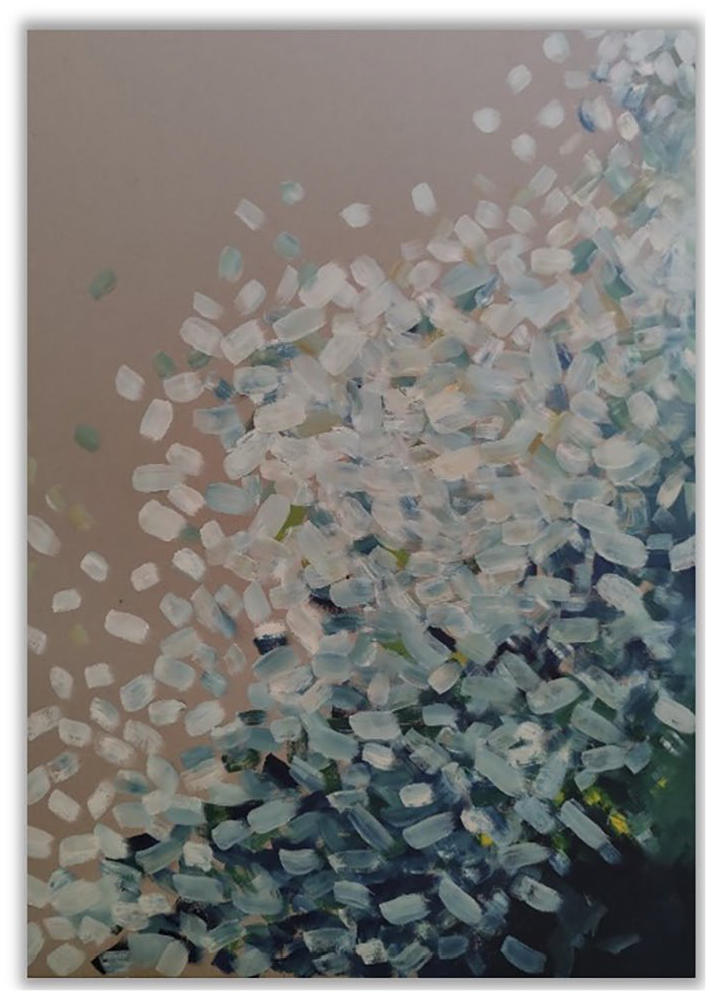
This rendering (Figure 1) gives voice to co-participatory encounters and intra-acting agents that pertain to the co-participants’ experiences of isolation.
Isolation.
Figure 1 is Author 1’s a/r/tographic rendering which was produced within the context of the collaborative a/r/tographic PL encounter where isolation was discussed. Its fruition is actively informed by patterns of intra-acting agents that include a felt lack of confidence and competence; support from other staff; interest from other staff; budget limitations; classroom spaces; available materials; curriculum, pedagogies, and time. The impact of these specific agents reverberate in the voice of the co-participant collective, and thus became a focus of this rendering. The generation of this a/r/tographic rendering provided means for Author 1 to deeply consider the common concerns and experiences of the individual arising from the intra-active collective voice (Barad, 2007, 2014), as well as providing means to locate and entwine co-participatory voice in a collaborative frame. Further venturing into this assemblage leads into and through the feelings of isolation apparent in each participants’ initial story sharing and are in turn identified as a key inhibitor for their feeling prepared to successfully deliver primary visual art education (Chapman et al., 2018; Smith-Shank, 2014). Isolation was a catalyst for the four co-participant collaborators’ to further articulate and scrutinize preconceived ideas they had about visual arts curriculum development, interpretation, and enactment. At each of their respective schools, the GPT co-participants had felt a sense of isolation in relation to adopting visual arts pedagogical practices in their classrooms.
Isolation (see Figure 1) speaks to the benefits of sharing these experiences collaboratively, and in a physical setting conducive to and able to support this. These invited pursuit of a co-participatory process of making artwork together that gave voice to experience in a collaborative space/place (MacDonald et al., 2017). When re-turning and re-visiting Author 1’s rendering of the isolated parts (Figure 1), each painted brush mark is an agent that can be understood as coming together in ways that affect GPTs’ confidence and competence in their visual arts teaching and making practice. This speaks to the (Mparntwe) Education Declaration’s call for teachers to work together and collaborate in their pursuit of professional growth (Education Council, 2019).
Each of the painted marks in Figure 2 are emblematic for representing each of the co-participants’ (Author 1, Nancy, Rachel, and Katie) speaking in relation to and from their data. They are individuals moving, bumping, and blending with each other, respectively, in and through the materiality of paint. This points to appreciation for opportunities to engage in and with the materiality of practice (MacDonald & Crowley, 2023), and how such experiences can embolden teachers’ sense of confidence and competence when learning in proximity and relation to different teachers (Chapman et al., 2018). Participant voices are depicted in different fonts that point to feelings of separation and isolation felt by all four co-participants before and within the beginning stages of this collaborative a/r/tographical inquiry. Overarching storying of the collective co-participatory experience are conveyed by Author 1 and indicated throughout in italics (as per below).
Singular, Separate, Individual, Unrelated, Compartmentalised, Shallow,
Isolated.
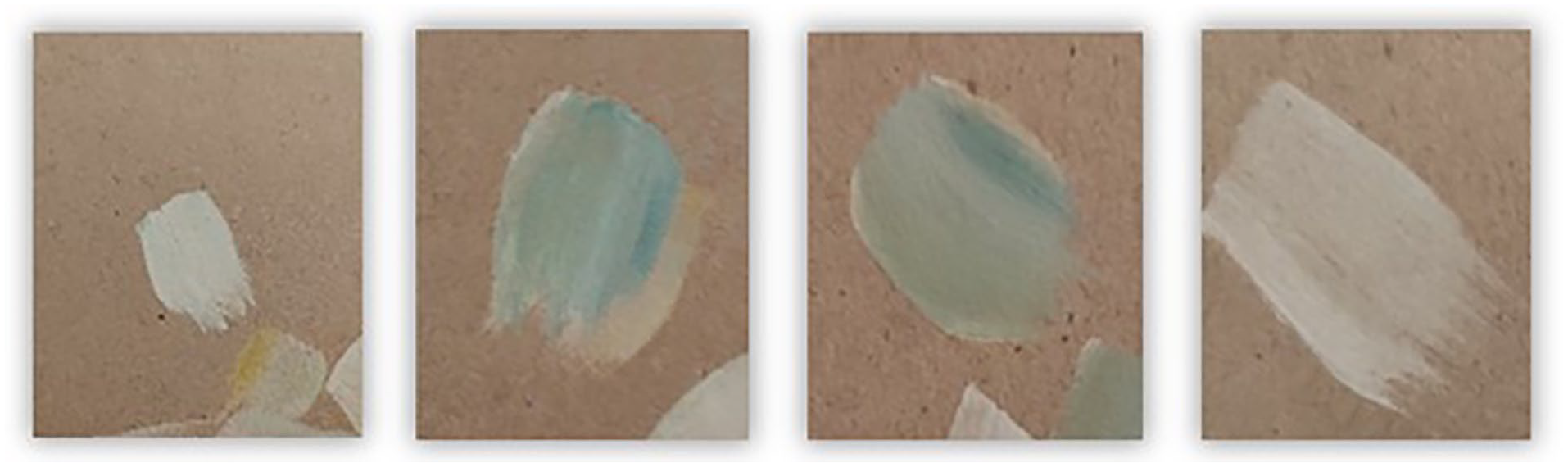
Individual Splodges of Paint (Close-Up Section From Figure 2 Isolation).
These speak to how this sense of isolation fueled self-criticism of co-participants’ own visual arts making: “I wouldn’t say I’m an artist by any means” (Nancy, 2020) and “not that I’m any sort of artistic God ” (Katie, 2020). Further diffractive re-turning of the data highlights how isolation reverberates between and around individual lived experiences. Enticed by the potential for further connective possibility becoming available through engaging in practice together, the co-participants stepped further into this a/r/tographical inquiry.
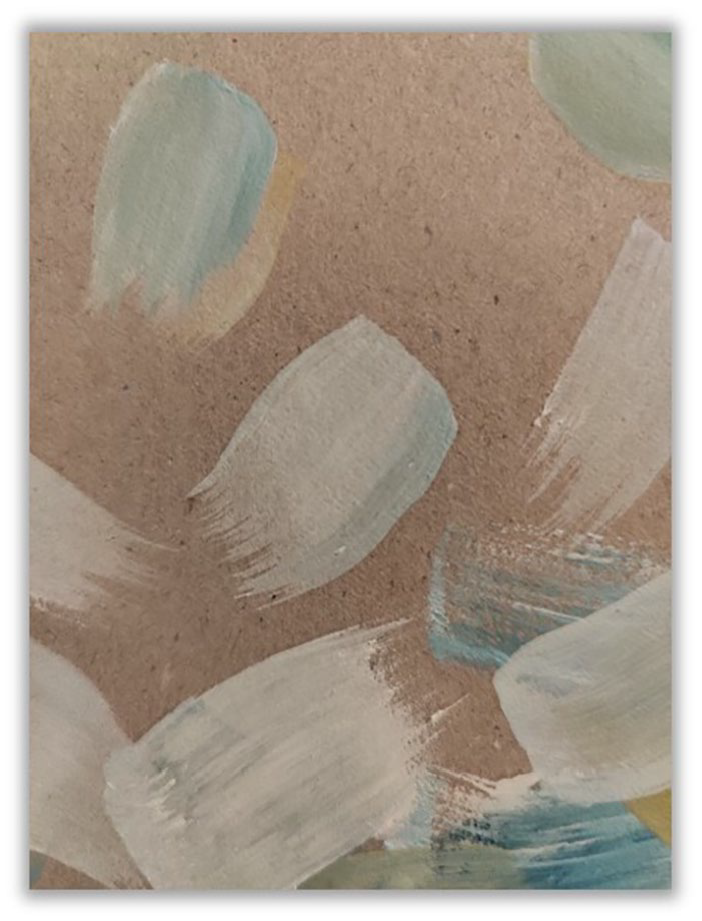
Splodges of Paint Beginning to Come Together (Close-Up Section From Figure 4 Isolation).
Rendering the Space Around Isolation
While we are individual, separate and unique
There are opportunities and similarities
Between some of our experiences,
Our values, our stories.
In the overlapping “rippling patterns of knowing created together” (Barad, 2007), we start to see how participation in collaborative a/r/tographic inquiry bolsters co-participants’ demonstrated confidence to speak into, through, and with their art practice. Diffractive analysis reveals how, as explained by Barad (2007), insights arise in attending and responding to the details and specificities of relations of difference and how they matter. The assemblage in turn further attunes to the agents that affect participants’ articulation of ways to overcome feelings of isolation.
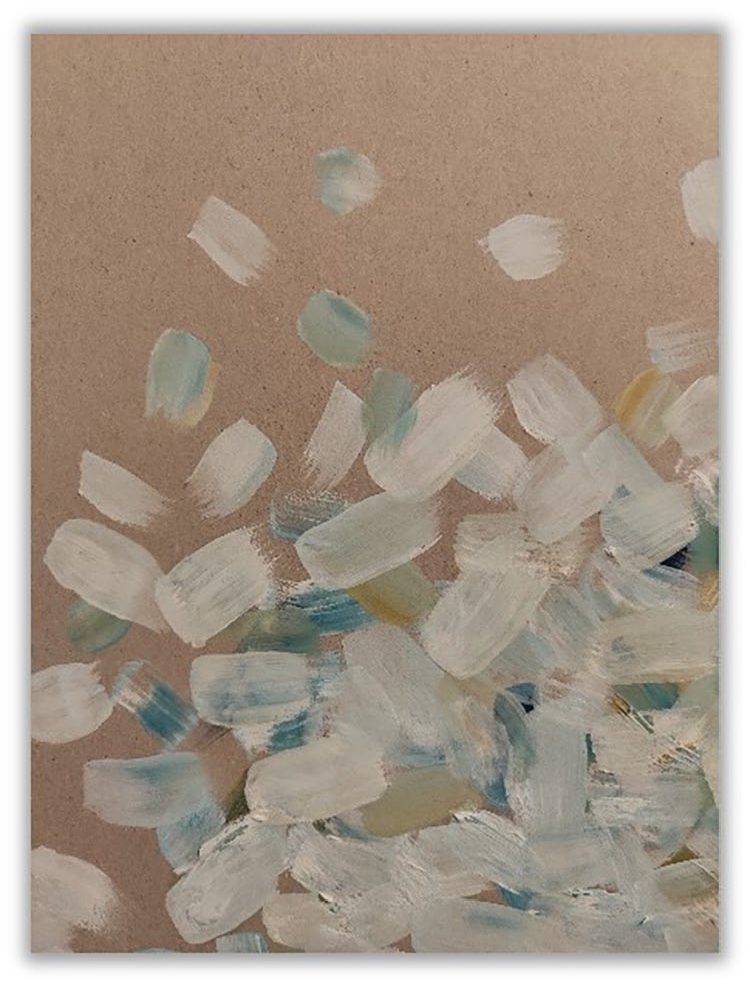
Splodges of Paint Blending (Close-Up Section From Figure 2 Isolation).
Layer upon layer of paint is added
As our stories unfold.
We start blending together
We entwine.
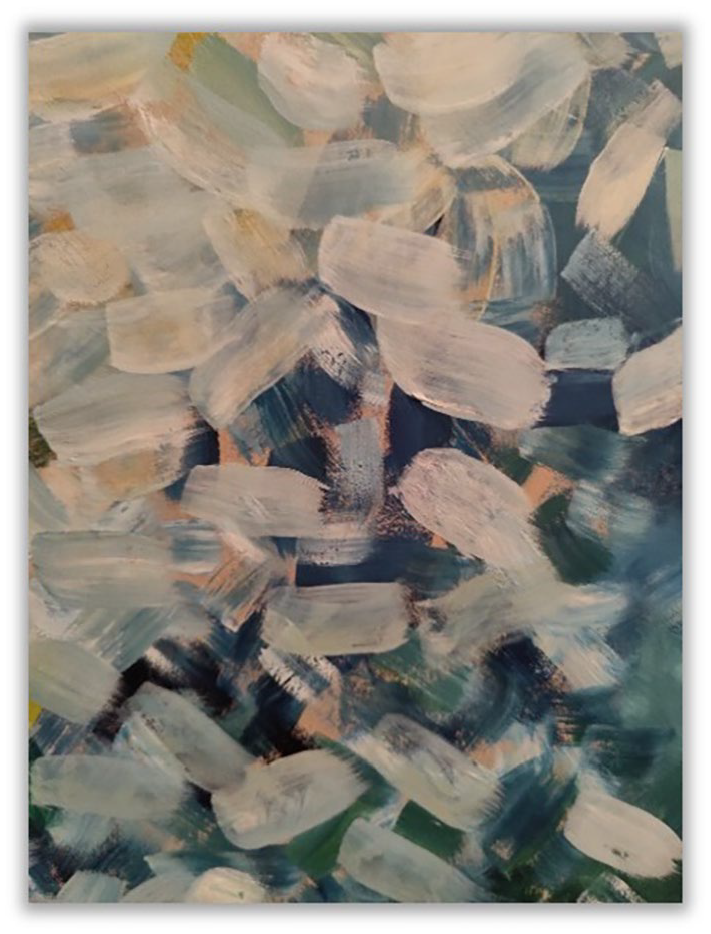
Splodges Merging Together (Close-Up Section From Figure 2 Isolation).
As our marks merge,
Connections become apparent.
Each mark of paint,
Each story,
Adds another layer of meaning
To the painting, for our process.
The following three renderings were created by Katie, Rachel, and Nancy while actively engaged in collaborative a/r/tographical inquiry with Author 1. Katie, Rachel, and Nancy’s renderings are followed by an unraveling of meaning arising from co-inquiry. It is here that understandings of the ways collaborative a/r/tographic PL encounters enable articulation of benefits, such as this comment by Rachel: “
Katie’s artwork Perfectly Imperfect (Figures 6 and 7) renders the process of working, re-working, re-visiting, embracing, and allowing change, through art-making processes: “the thing about art is that it is not a linear process. The journey is more important than the final destination” (Katie, 2021). This resonates powerfully with the ways A. Harris’s (2016) creative ecologies invite attendance to the processes of teaching and learning, and understanding their inter-relations. This awareness of wanting to prioritize the process and experience over end-points was something Katie actively grappled with in her teaching practice. She explored this within the collaborative process of collegial conversations while art making with the team of co-participants.
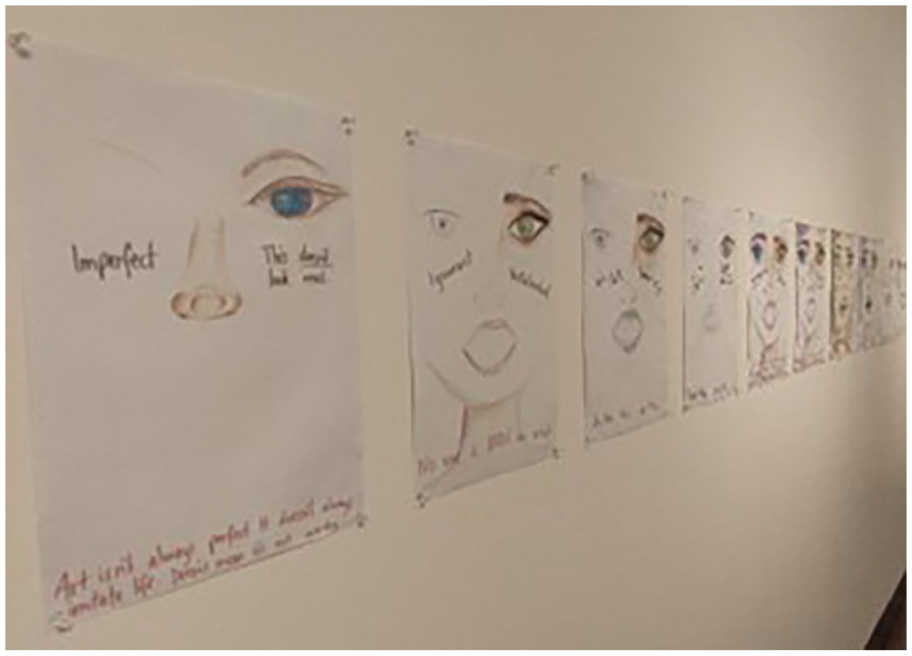
Perfectly Imperfect (Participant Artwork by Kate).
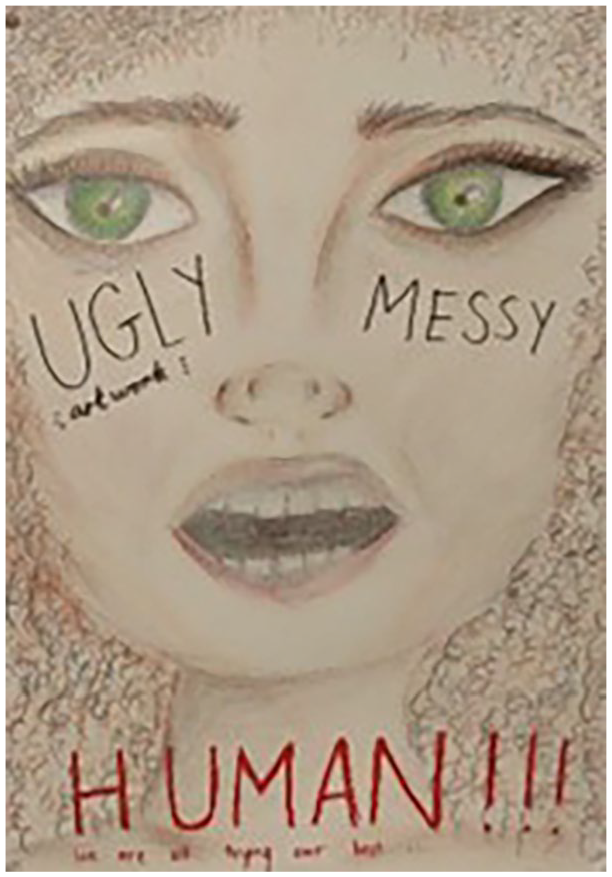
A Part of Perfectly Imperfect (Participant Artwork by Kate).
Rachel’s artwork Connection (Figure 8) renders her experiences of teaching and the communication that happens between student and teacher: “
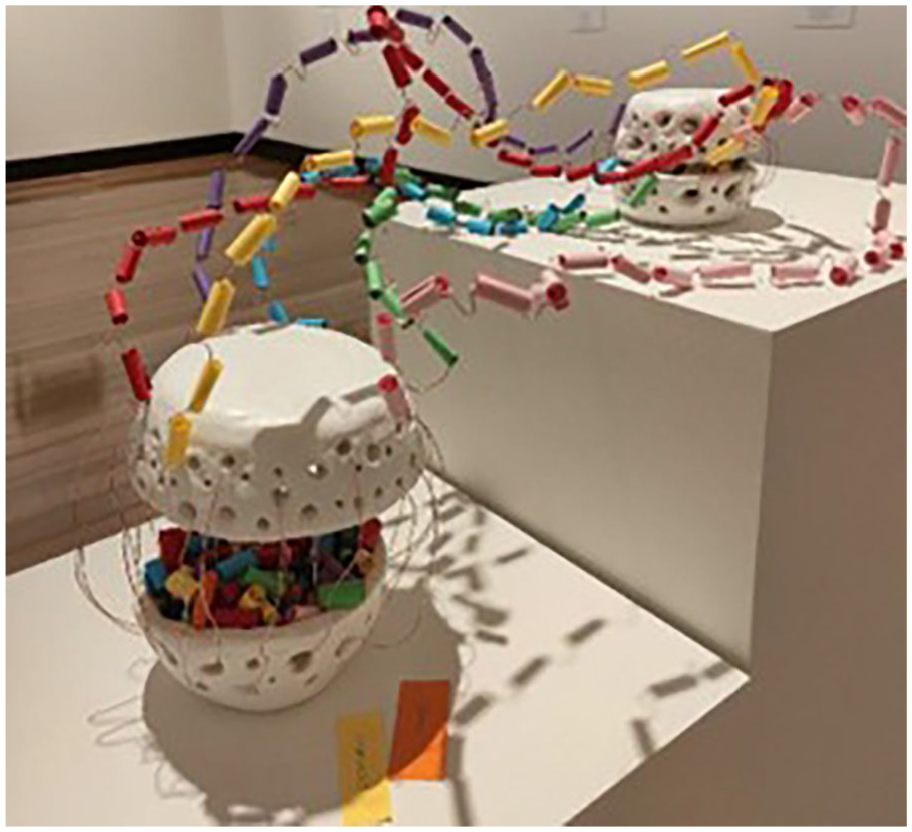
Connection (Participant Artwork by Rachel).
Nancy’s artworks, Process over Product (Figure 9), render the process of parts coming together through the art-making process in the classroom: “the artwork reflects my passion for providing students with opportunities to express themselves . . . where the process of art making is the focus, rather than the finished product” (Nancy, 2021). Collaborative conversations throughout her art-making process enabled Nancy to make sense of her thinking, rendering this visually through paint and collage. When GPTs collaborate in professional learning contexts, they attune to intra-active agents in ways that cultivate their sense of agency for teaching subject-specific content in truly relational ways (A. Harris, 2016; Malone et al., 2020; Rousell et al., 2022).
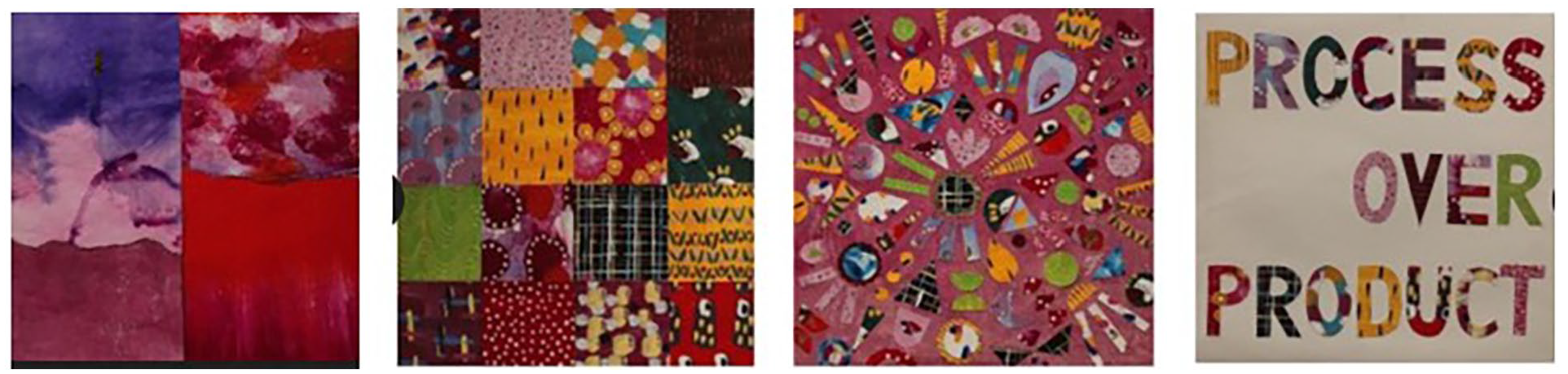
Parts 1, 2, 3, and 4 of Process Over Product (Participant Artwork by Nancy).
The above d/artaphacts give rise to individual participant-voice in relation that shifts their attention beyond isolation. This delineation is purposeful and important for each GPT co-participant’s process of making meaning within the collaborative a/r/tographical PL experience. It also points to activation of problem-solving capacities that allow individuals to cultivate authentic interactions (Coleman & MacDonald, 2020; MacDonald et al., 2022). Opportunities to grapple with the ways individual and isolated experience could be reimagined and revisioned into something helpful were made available through the collaborative a/r/tographic experience. The practices, processes, and relationships developed all point to circumstances that are conducive for supporting GPTs’ becoming ecological in their delivery of primary visual arts education.
In, Through, and From Isolation: An Invitation to Make Further Meaning
Toward the end of the collaborative a/r/tographical inquiry, Author 1 circled back to check in with and honor individual voice by conducting a final interview with each of the co-participant GPTs. These closing conversations reiterate distinct gains made, where the individual voices of co-participants could enmesh in what would become a collective perception and understanding of becoming ecological in their delivery of primary visual arts education. This reverberates with A. Harris’s (2016) model for creative ecologies in education settings, which invites deep consideration of the inter-relations of particularly physical environments, and the intra-acting “products” of curriculum and pedagogy that GPTs can become preoccupied with. Author 1’s d/artaphact speaks to the co-participatory attention to intra-activity that supports GPTs “becoming ecological.”
This d/artaphact (Figure 10) entwines micro, meso, and macro (Coleman & MacDonald, 2020; Szabó et al., 2021) outcomes arrived at for the four co-participants’ experience of becoming ecological in their interpretation and enactment of visual art curriculum. From this, a clear sense of community, collegiality, and support that enabled individual, collective, and collaborative processes to be practiced and elicited is offered. The below rendering comprises the voices of this team of co-participants,
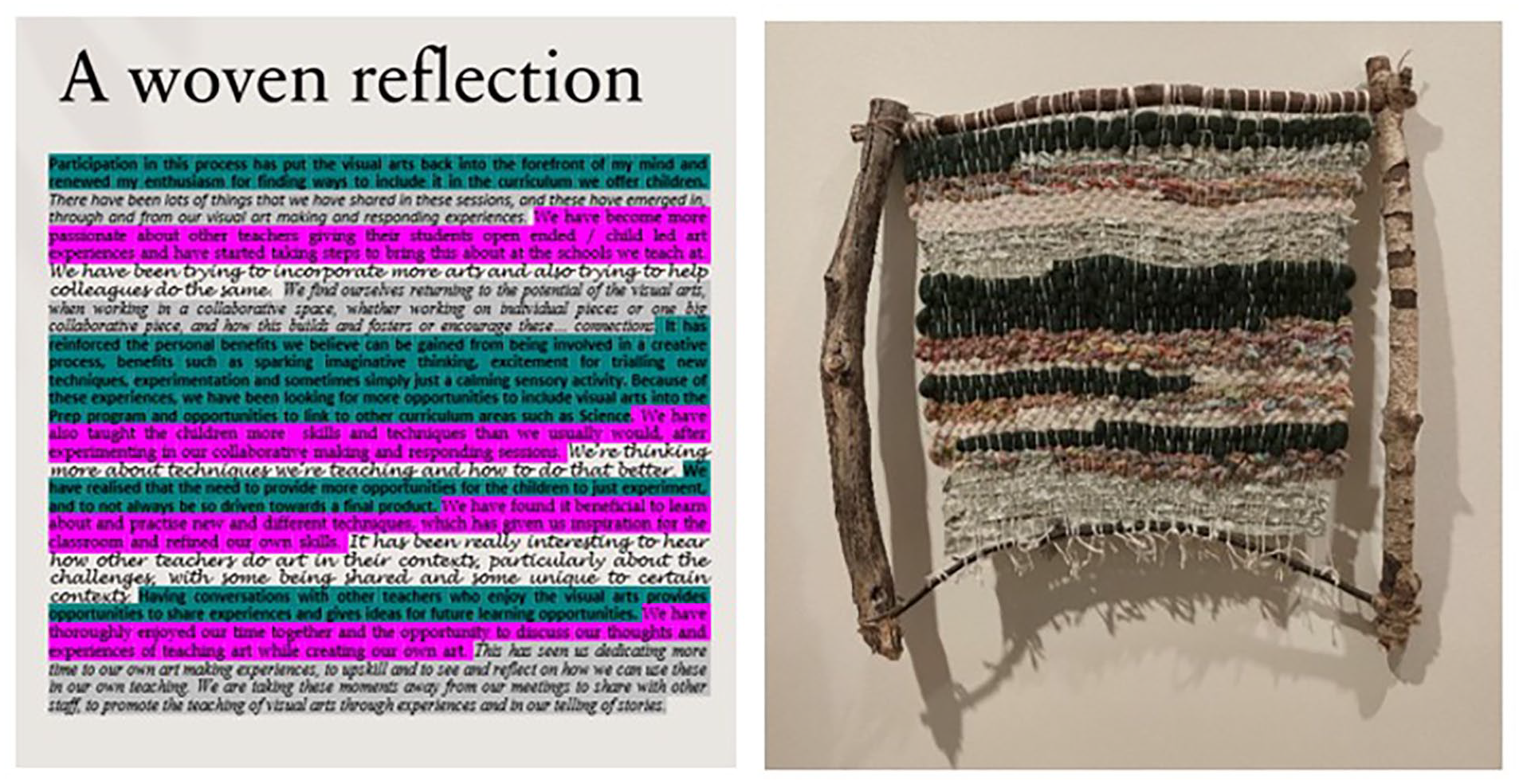
Woven Wall Hanging.
It became apparent that previous experience in the visual arts is certainly an important contributing factor for GPTs when teaching the visual arts (Sinclair et al., 2015), and collaborative a/r/tography offers an apparatus for enabling material engagement in and with visual art (MacDonald, 2022; MacDonald et al., 2022). Engaging in collaborative a/r/tography as PL has a positive impact on the development of GPTs’ relational experience of attuning to curricula-pedagogic and metho-pedagogic intra-activity. This is especially useful given that GPTs continue to grapple with infrequent opportunities to participate in professional learning that balances fostering disciplinary knowledge and skills concurrently with pedagogical skills for integrating issues, ideas, problems, and possibilities that lie beyond a singular discipline (MacDonald et al., 2019). The data analyzed in this article reveals that GPTs who are actively involved in their own visual art making and learning are indeed more likely to adopt new pedagogical approaches to their teaching (Jao & McDougall, 2015).
Openings
Initial findings reveal that when GPTs actively engage in collaborative a/r/tography, they engage a breadth and depth of skills and processes that can positively affect their sense of confidence and competence as makers and teachers of visual art. Collaborative a/r/tography provides a useful metho-pedagogic apparatus for fostering a creative ecology that supports GPTs’ becoming ecological in their interpretation and enactment of networked visual art curriculum and pedagogies. In guiding conditions geared toward interconnectedness and possibility, GPTs can leverage art (process-practice), research (metho-theoretical), and teaching (curricula-pedagogic) in ways that develop critical and creative thinking skills necessary for adapting to a continually changing and dynamic profession (D. X. Harris & Holman Jones, 2023).
This research reveals specific benefits that can arise for GPTs when they engage in PL that unfolds in and out of the practices and processes of collaborative a/r/tography. Material engagement supports teachers to playfully explore, reimagine, and utilize intra-acting agents in tangible, embodied, and sustainable ways (MacDonald & Crowley, 2023). It is not surprising that Anderson’s (2021) research and many of the other examples foregrounded in this article found teachers are more likely to adopt new pedagogical approaches to their teaching when actively engaged in a range of social, collaborative, and practice-oriented PL.
In rendering co-participants’ experiences of isolation individually, collectively, and collaboratively, we have attempted to demonstrate how collaborative a/r/tography can alight ways and means to intra-actively draw together that which was initially separate, discrete, and individual. What started as separate marks of paint and stories assembled in the initial experiences of making and responding, open into something much more cohesive, ecological, and future-oriented. Over time, the co-participants of this collaborative a/r/tography PL encounter reveal increasingly more about themselves, their experiences, their views—what makes them who they are and who they seek to be in a process of becoming ecological with visual arts in primary education settings.
Considering the challenges identified for GPTs in Australia today, specifically the convergence of curriculum renewal and the self-efficacy of GPTs’ teaching of the visual arts, this article highlights the importance of designing PL opportunities that allow GPTs to leverage collective and collaborative settings for engaging in, through, and with visual arts ecologically. Given that collaboration is both practiced and embedded within curriculum review and enactment, this research allows us to see how collaborative a/r/tography enables this important 21st-century capability to be fostered in a group PL encounter. The processes, practices, and products explored collectively emphasize the importance of connection and community for addressing challenges associated with feelings of isolation. Further research is needed to determine transferables and scalability of collaborative a/r/tographic PL encounters. This is essential for informing the design and delivery of further teacher education that support GPTs’ pedagogical confidence and competence for teaching visual art in primary settings.
Knowledge melts and weaves together,
The simmering bubbles pop,
disrupting and breaking the surface
unfolding, new ideas, questions,
openings.
In reflecting upon the individual, collective, and collaborative experiences rendered and discussed in this article, benefits emerge for GPTs being actively engaged in the multimodality of collaborative a/r/tography. Further to this, the role of collaborative space and circumstance becomes integral for fostering curricula-pedagogic and metho-pedagogic intra-activity. We posit collaborative a/r/tography as effective professional learning apparatus for building GPTs’ motivation, and readiness for becoming ecological in their making and teaching of visual arts. Collaborative a/r/t offers an interconnected suite of art, research, and teaching tools that GPTs can utilize to cultivate creative ecologies for learning that interconnect people, places, and practices in ways that are professionally supportive and sustaining. We have sought to give due care in locating and contextualizing the insights in relation to circumstances pertaining to primary visual art curriculum and GPT teaching in Tasmania, Australia. Analysis of d/artaphacts assembled in this article speak to openings through which the all-important fostering of relationality between GPTs, specialist art teachers, local community arts organizations, and schools can be further pursued.
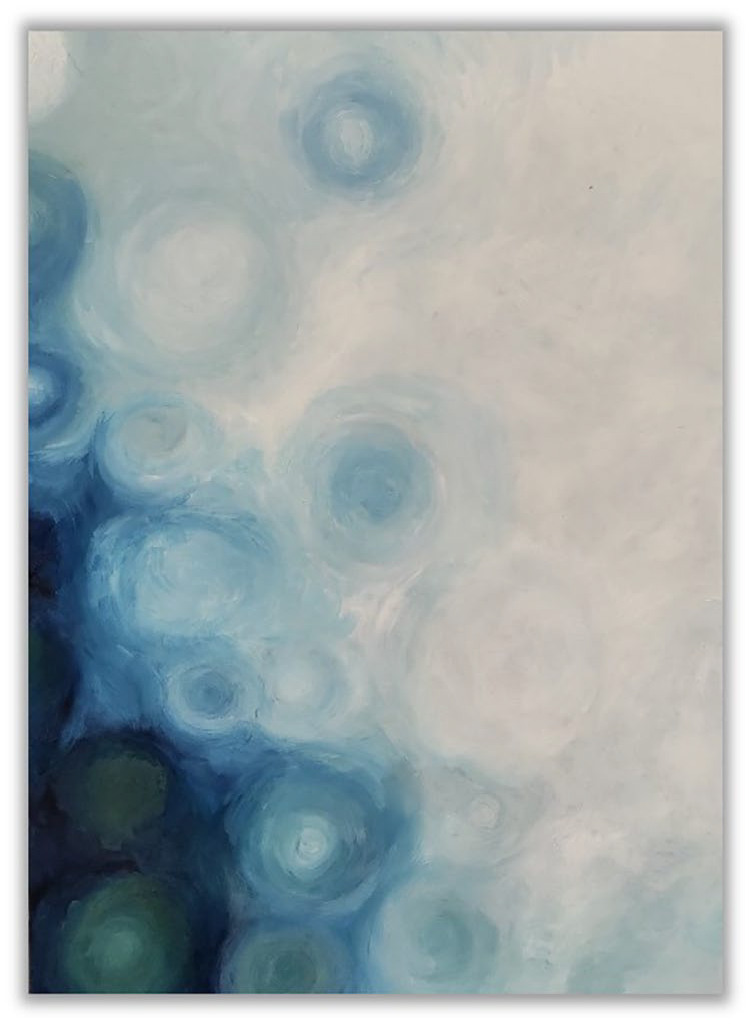
Openings.
This article demonstrates how teachers can be supported to engage meaningfully with discourse pertaining to curriculum renewal, developing agency, and building confidence and competence for teaching visual arts. This can occur when teachers participate in professional learning opportunities where they share and discuss experiences and collaborate in problem-solving. In terms of how we might better support GPTs to attune to and embrace ecological multiplicity (Coleman & MacDonald, 2021; Szabó et al., 2021), A. Harris’s (2016) creative ecologies model offers us much to think and work with. The ask of GPTs to deliver on the vision of an ecologically oriented curriculum is significant. If GPTs are to deliver on what is described as an ambitious framework (National Association for Visual Arts, 2021), meaningful investment, proper resourcing, and support in the form of ecologically resonant collaborative professional learning approaches described in this article are needed (MacDonald et al., 2022).
Footnotes
Acknowledgements
We acknowledge the wonderful participants who were and continue to become pedagogical through the a/r/tographical inquiry process.
Declaration of Conflicting Interests
The author(s) declared no potential conflicts of interest with respect to the research, authorship, and/or publication of this article.
Funding
The author(s) received no financial support for the research, authorship, and/or publication of this article.
Ethical Approval
The authors refer to data generated through a research study approved by the University of Tasmania Human Research Ethics Committee (H0018642).
