




Abstract
What do doors do?
Open
Close
Invite In
Shut Out
Jam
Stick
Wedge open
Welcome: Entice and Invite
Offer a glimpse into
Bar
SLAM SHUT
Get kicked in
Get kicked shut
Splinter
Warp
Hang
Sit ajar
Gently linger in our minds
Cause hurt and separation
Affecting thoughts
Moments of joy or pain
Longing, Waiting
Fearful longing,
Fearful waiting,
Anticipating
Wondering
Haunting
“Come-on-in”
This article is based on research-creation experimentations arising from the provocations “what do doors do?” and “how do doors matter?” We ponder how knowledge-making practices come to life when you take a little time to notice the mattering of doors. We use collaborative feminist praxis to generate arts-based post-qualitative entanglements as generative invitations for door storying that illuminate the potentialities of commoning practices.
Opening the Door 
This article takes as its entry point a noticing of the everydayness of doors. Because you do not just open or close doors, do you? You often pause, remember, hesitate, peer, stride past, or even downright avoid troublesome doors. Some doors remain locked. Some doors recurrently include and exclude. In this article, collectively composed as a research-creation experimentation in feminist theory-method-research-writing praxis, we engage in storying with doors as a means to find generative footholds for pondering in/exclusions in academia. In a world where such repeated mundane acts as door opening barely registers, we pause and roll around what might be produced in the material-discursive mundanities of events that congregate around doors.
Through door-doings, we produce commons and “forms of life” which stand resistant to late-stage capitalism (Caffentzis & Federici, 2014). In our door-openings, we find common ground (with each other, with you, and with the more-than-human world) to “come on in.” Coming on in, or a “doing in common” invites collaboration with “material and immaterial elements that constitute commons-wealth” (De Angelis, 2019, pp. 212–13 cited in Woodman & Zaunseder, 2022, p. 2). Commons are generous spaces that challenge existing structures but also generate alternative modes of being that are voluntary, cooperative, and horizontal (Ruiz Cayuela, 2021, p. 1547). Commoning is a fruitful feminist unbounded knowledge-sense-making through a “creation of common spaces for uncommon knowledge” (Tan, 2016, p. 15). By commoning, we collaborate as an act of resistance and a reclaiming of radical imaginaries, in acts of occupation. In refusing boundaries, we enable creative multiplying spaces that nurture collective knowledge seeking of common goods.
By posing the provocations “what do doors do” and “how do doors matter?” we muse on door-doings and happenings where knowledge-making practices come to life by and through noticing the mattering of doors. We find a multiplicity of lively human-non-human-more-than-human potentialities nestling and proliferating away in the humdrum affordances of doors. As you read our storyings of what doors do, we invite you to open and imagine, with the capacious affective, embodied, haptic, and multi-sensory door slammings, shuttings, and commonings that matter to you.
Opening Door Storyings
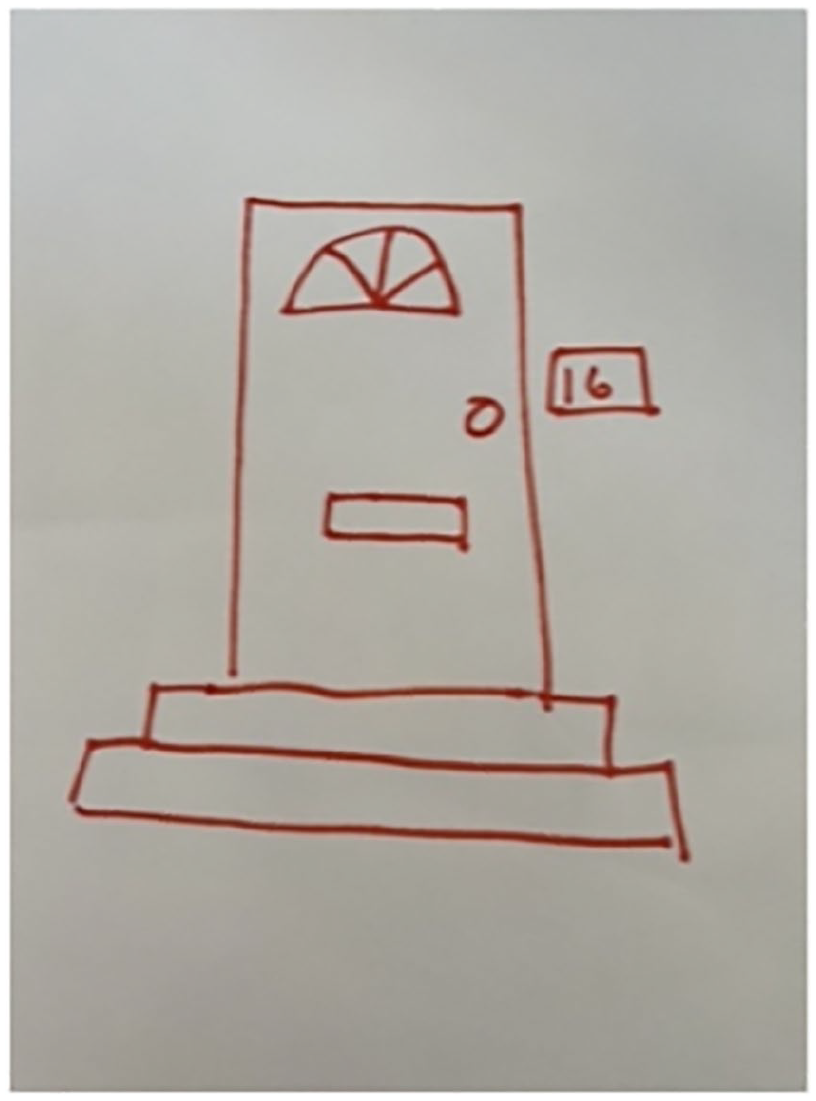
Door-Conferencing: Doings With Doors
Our door storyings collective came together at a research-creation (Manning & Massumi, 2014) event at a 2022 conference where a collection of doors in all shapes and sizes was offered as a provocation. Participants were invited to interact and intra-act (Barad, 2007) with, make, and respond to the doors whether they be real, remembered, or imagined. Inviting, creating, re-creating, and telling stories of many kinds of door experiences emerged all at once. What stories! With commoning characteristics of society making and cultural knowledge sharing (Woodman & Zaunseder, 2022, p. 2) what stories arrived and the stories kept on (and keep on) coming. Are you formulating a door story as you are reading this? Hold on to it, we will ask for it later!
The 2022 doors conference event emerged from two previous events. The first was Carol Taylor’s (2020) Coming to the door. Or, doors and what they do provocation on research for imagining the pluriversity which posed several questions: What is a door? What is it for? What work does a door do? Which doors have come to matter to you and why? What are your door stories? The rich archive of responses can be found here: 10. Carol A. Taylor—DesigningThePluriversity (designingpluriversity.org). The second was a door-parade event by the Get up and Move! Collective in which doors, door prompts, and graffiti doors had been situated in an open space in the university for passersby to engage with. The door matterings produced made us think that everyone had a door story—or many door stories—to tell.
And so.
Insights from these two theory-method-praxis explorations were enfolded into the BERA conference door-doings, a curated event in which delegates were invited to collaborate in making doors, doorways, and door frames out of a variety of materials as an opening to think-with and respond to questions of “what do doors do?” as provocations. In addition to the creations that were produced in the workshop, several installations were placed throughout the conference venue, including a freestanding door, a letter box, and miniature boxes with doors attached. These were situated and dispersed around the venue and stayed there for the conference duration enabling delegates who did not attend the workshop, and venue staff and administrators, to contribute stories of their encounters and wonderings about doors.
The aim of the workshop was to re-conceptualize what we do in academic conferences and what we value as knowledge production, taking inspiration from Fairchild et al.’s (2022) undisciplined experimentations. Like them, in this article, we re-turn—tunnel through, aerate and re-co-compose—the conference event and its materials to continue our thinking-doing-makings with doors. These re-turns enable new diffractive patterns to emerge (Barad, 2007, 2014); in new enlivened productions as we common(ed) to work-collaborate-co-compose together with/through vignettes of recorded spoken stories, writings, drawings, sculptures, and PowerPoint slides. On, on and on the doors kept opening, proliferating new doings . . . makings . . . and producing new “theory-practice spaces in which differential matterings actually matter” (Taylor, 2021a, p. 237).
We continue to be provoked by “what do doors do?” We continue to ask: “how do doors matter?” We continue to wonder about the possibilities and tensions doors produce We question whether doors can be less exclusionary and prohibitive We wonder how doors open to enable new ways of thinking, knowing, doing. We think door stories are important. We think we probably all have hidden door stories waiting to be told. We sense that door stories are “speculative stories [that] have no ending, they are processual, middling and immanent and that is why they are so exciting” (Fairchild et al., 2022, p. 206).
Door Storying Getting Creative: Re-Membering, Re-Telling, Re-Turning
Our door storying happened through working as a collective. As a mixture of established and early career researchers, we enacted a feminist materialist posthumanist praxis of holding open the academic door to each other in the real life and virtual spaces we occupy. Working as a research collective since the conference event, we have made and shared stories through virtual events with commoning practices of relationality and collectivity between the human and non-human worlds tied up with door-doings (Bollier & Helfrich, 2015). Something happens in the re-turning. Sharing door stories did something and we wanted to do something with that doing. Our collective door speculations in this article open a door on our door stories so far. So far—because we enter in the middle of an enquiry that twists, turns, and keeps on sending out roots and spurting new growth in rhizomatic fashions. Doors just keep on opening and closing to us in our meetings, creating commoning spaces for catch-ups, workshops, and follow-up readings.
Door storyings remind, trouble, touch. Door storyings invite thinking otherwise Musing door differentiations. Door storyings as knowing-with and (k)not knowing Door uncertainties.
Doors open and participation becomes collaboration becomes co-creation becomes commoning. We bring histories, ghosts, and geographies in “acts of occupation in time and space” (Ultra-red, 2016, p. 192). Commoning shapes and reshapes our murmurations and re-creations as we weave affective entanglements from door storyings which are “never resolved lest [they] become [. . .] bordered” (Ultra-red, 2016, p. 190). The creative door storyings below instantiate this commoning. They refuse containment and settlement. They open the door to ghosts and geographies, to giving and receiving, to becomings-with thick with response-abilities (Haraway, 2016). Our storyings do not to represent but embrace the ability of doors to spark imagination, generate new doors, and becoming doors. The ethico-politics of the stories is their desire for new door-doings (of possibility). Such door stories are yet to be imagined for others to pass-through and think-with.
Our door storyings are creative responses, collaged articulations, murmurations, patternings of words, thoughts, writings, images that threw us off, caught us, or held a space open for our thinking-making. They embrace playfulness to “creat[e] cracks in the existing knowledge” (Pyyry, 2022, p. 76). They are responsive to Braidotti’s (2013) call for an affirmative and relational ethical approach that “looks for the ways in which otherness prompts, mobilises and allows for flows of affirmation of values and forces which are not yet sustained by the current conditions” (Braidotti, 2013, p. 342). We listened to the whispers and moved with their reverberations together, attentive to the entanglements, commonings, and connections emerging.
Door Storying 1: Commoning With the Algorithm
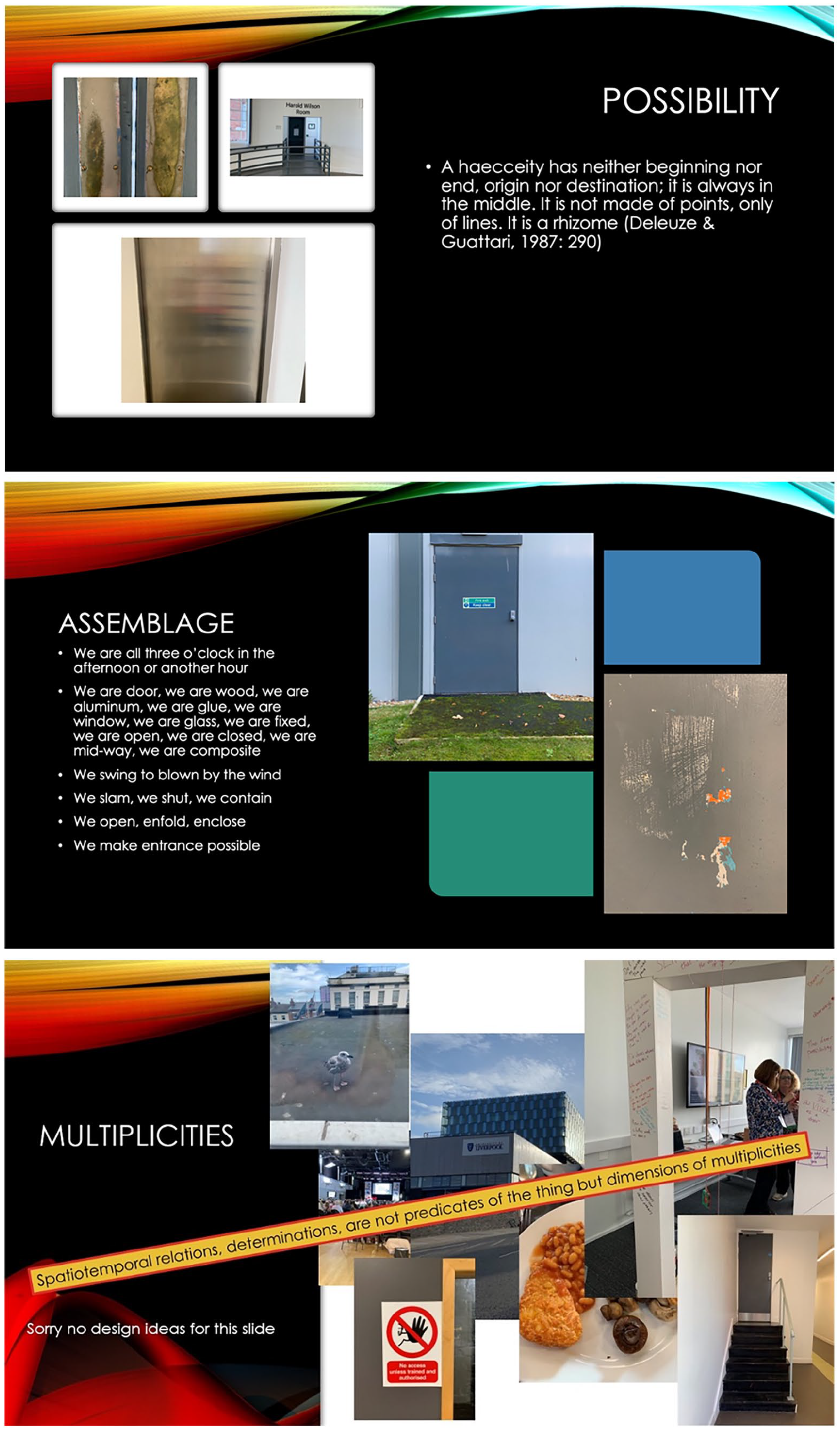
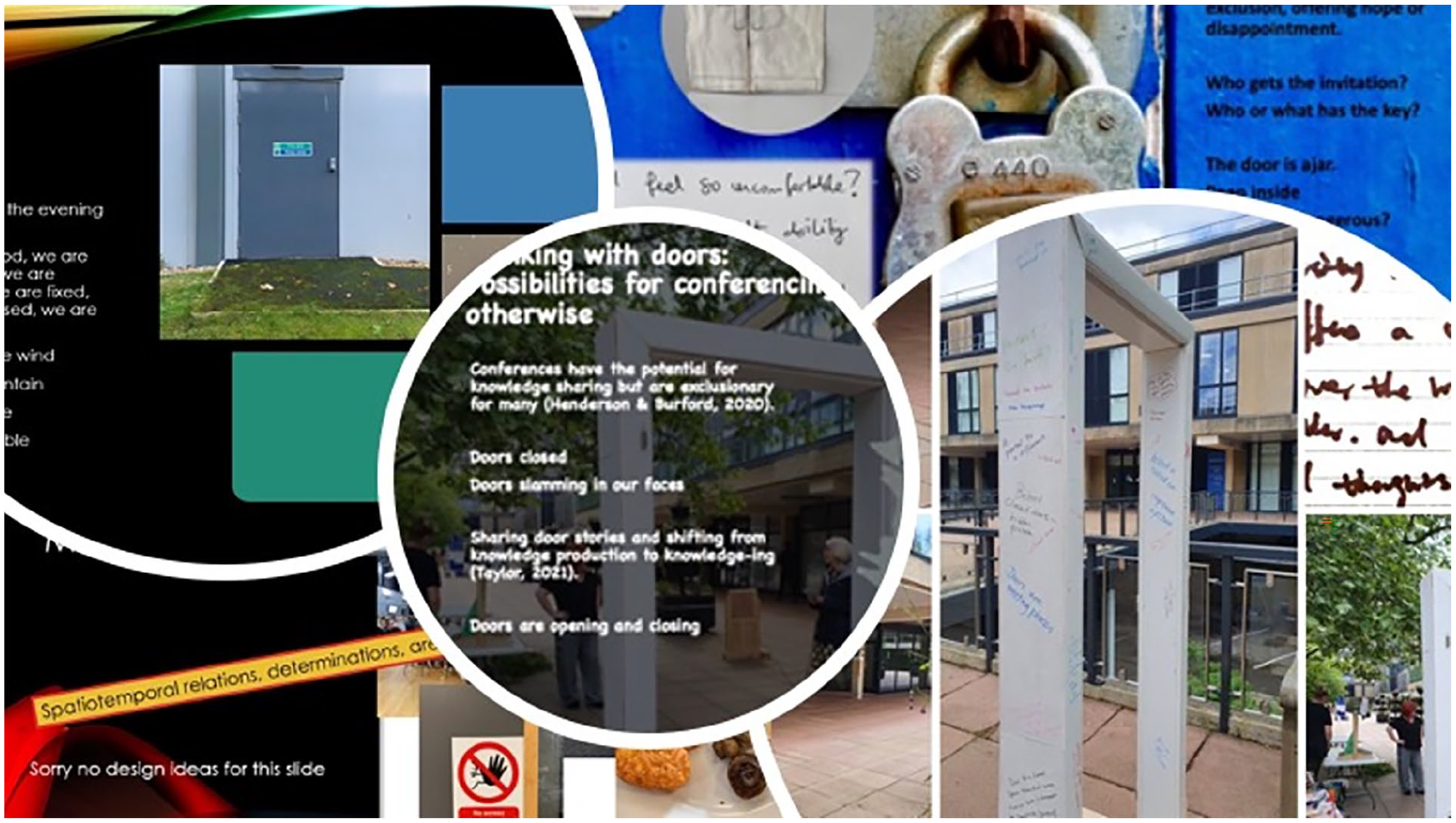
Drawing on arts-based and collaging approaches (Vaughan, 2005), we challenged ourselves to become more creative in our experimentation with and through the PowerPoint algorithm. As university lecturers, we are familiar with MS PowerPoint as a crucial if rather pedestrian pedagogical tool for organizing ideas and structuring presentations. Following the suggestion, one of us had first developed in their doctoral thesis (Lewis, 2022) of working with PowerPoints in experimental ways, we decided to import images and text into a series of two or three PowerPoint slides and to see “what happens if” (Taylor, 2016) we follow the “design ideas” button in PowerPoint at the side of the screen. Where would it take us? What would it do? What differences and divergences might emerge from commoning with algorithms (García-López et al., 2021)?
As we worked with PowerPoint design ideas, we slowed down and wallowed in the data. We re-turned to and re-organized the materials in PowerPoint in ways that called to our senses and drew us into door storyings that began to emerge through the process of making these slides. Then PowerPoint intra-acted with our slides in serendipitous algorithmic encounters, prompting new relationships between quotations, images, and empirical materials. PowerPoint’s algorithm does not differentiate between the visual and the linguistic or prioritize the human. It does not attend to the context or content of an image. It makes cuts in unexpected places, drawing our attention away from the human and toward the materiality of doors in conference spaces and in connections with other matterings—that which assembles around and through conference spaces. However, there were times when the algorithm would not play with us, stating simply that there were “no design ideas available for this slide” . . . had we overwhelmed it with too many images? Had our demands for more inventive text-image-displays caused it to run out of steam?
Having been told previously that there were “no design ideas available for this slide,” one set of slides was revisited after a few days. Inexplicably, there were now design ideas available. Perhaps both the ideas and the algorithm needed to sit for a few days—do algorithms need to rest? Interestingly, the algorithm now offered new suggestions, creating new cuts, positioning both text and image in different ways, and foregrounding different ideas than those curated by the human. The intra-action between the materiality of the algorithm and the materiality of the text and images quite literally moved some onto the dark, while leaving others in the light. What did this “mean”? With/in these new agential cuts, text-image-design coalesced in creating new, emergent data, where the “in-cision is also a de-cision” (Wysocki & Sheridan, 2019, cited in Sheridan et al., 2020, p. 1279). We watched and wondered with/in the inhuman-nonhuman-more-than-human research assemblage.
Knock! Knock!
Who’s there?
BOO
Playing With the Algorithm: Doors’ Haecceity
Playing With the Algorithm: Doors’ Ongoing-Ness
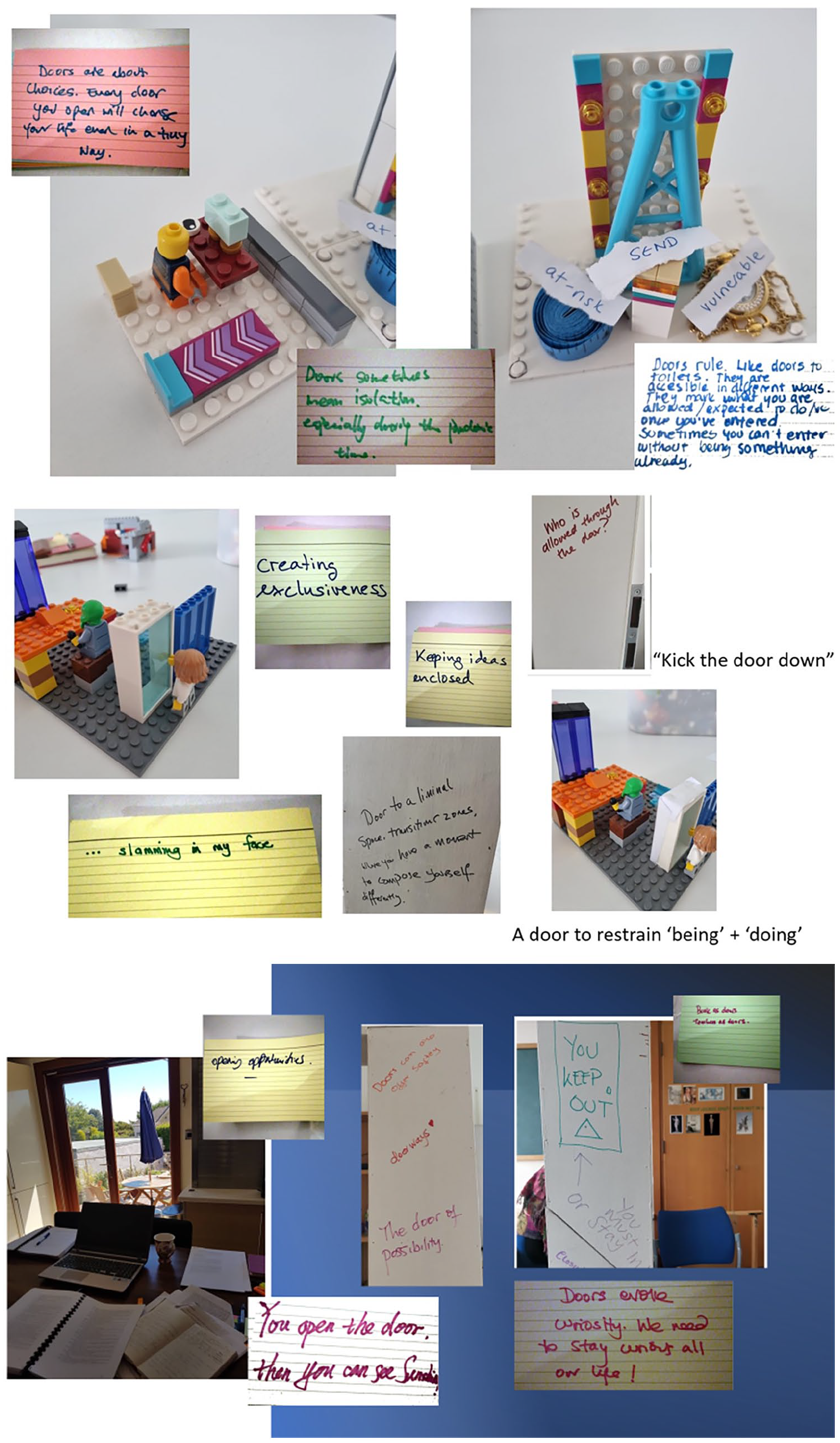
Playing With the Algorithm: Conferencing Otherwise
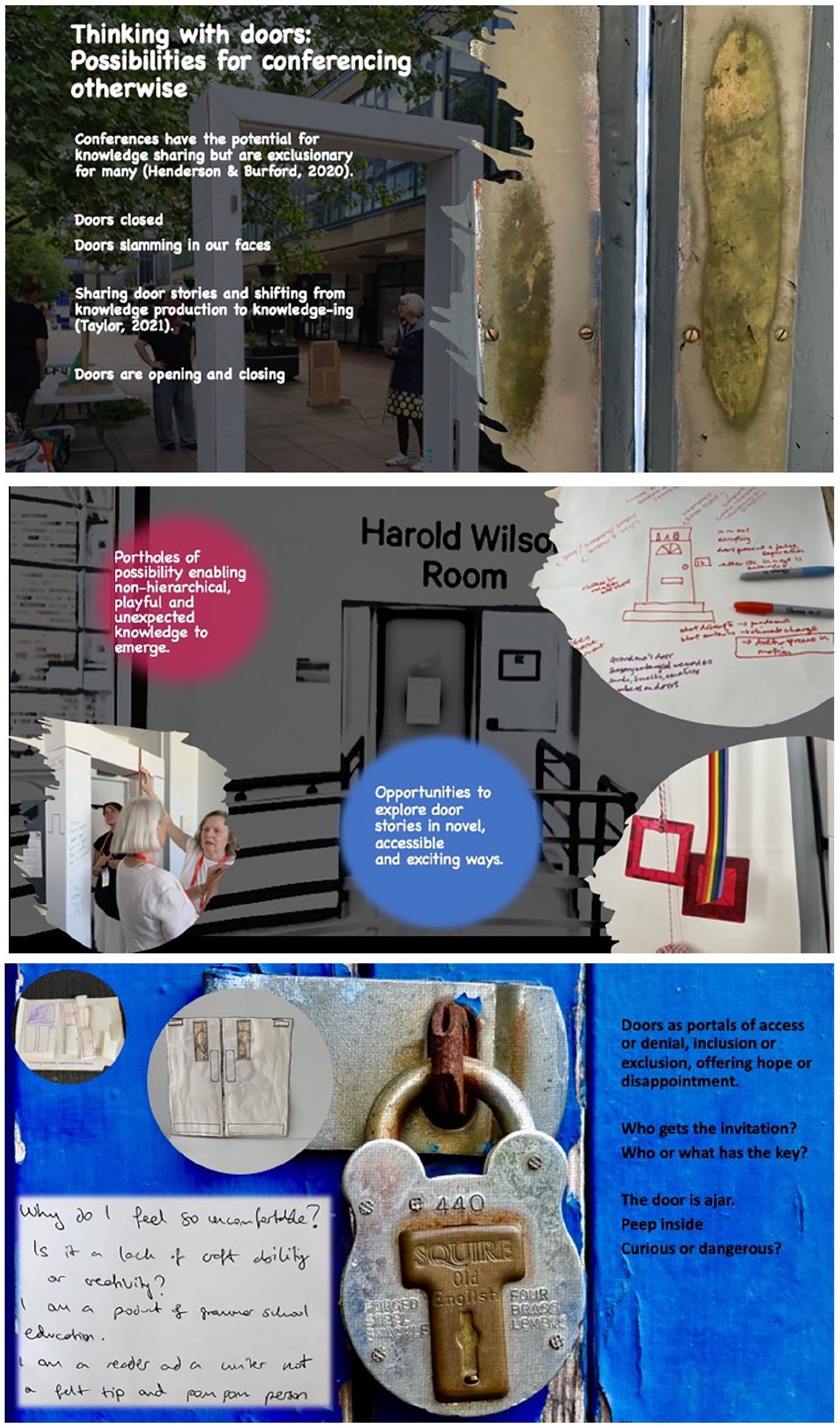
Commoning: An Inhuman-Nonhuman-More-Than-Human Door Story
Door Storying 2: Doors as Data-Ghosts
Thinking with doors may bring forth generous notions such as hospitality, invitation, and visitation (Derrida & Stiegler, 2002; Taylor, 2021b). But also may not. Doors as visitations of memory do not always bring the comfort of a welcome; they may bring a heavy history (Ultra-red, 2016). Doors can also open up all kinds of trouble. Derrida’s (2006) notion of hauntology suggests that some ideas do not stay put in the past but keep on resurfacing. In some of our door storyings, there lurk discomforting ghostly affects. Doors harbor data-ghosts that can be irritating and re-turn lost and forgotten time-spaces (Albin-Clark, 2022, 2023). Doors as data-ghosts vibrate with the matterings of life and death by entangling the mundane harsh commonality of violence, illness, exclusion, and brute injustice. Here, doors are at their very worst.
Doors as Data-Ghosts

Door Storying 3: Theoretical-Ethical-Poetic Patternings of Collaborative Commoning
Becoming with . . . rhythms of moments that matter, listening to the whispers, and sensing affective traces that “jump” in and over time (Huuki & Lanas, 2019), mattering and re-mattering.
Working against . . . the dominance of coherence and linearity.
Responding . . . and keeping wonderings alive.
Moving with . . . memories and discussion, cutting and pasting words and images, creating patterns, playing with new words, making partial and provisional situated cuts.
Becoming touched and . . . still moving with the writings of ongoing-ness.
Fragmentings that . . . are neither linear nor necessarily directly related.
Allowing “shifting diffraction patterns” to generate new insights each time we re-turn and revisit (Bozalek et al., 2021, p. 846).
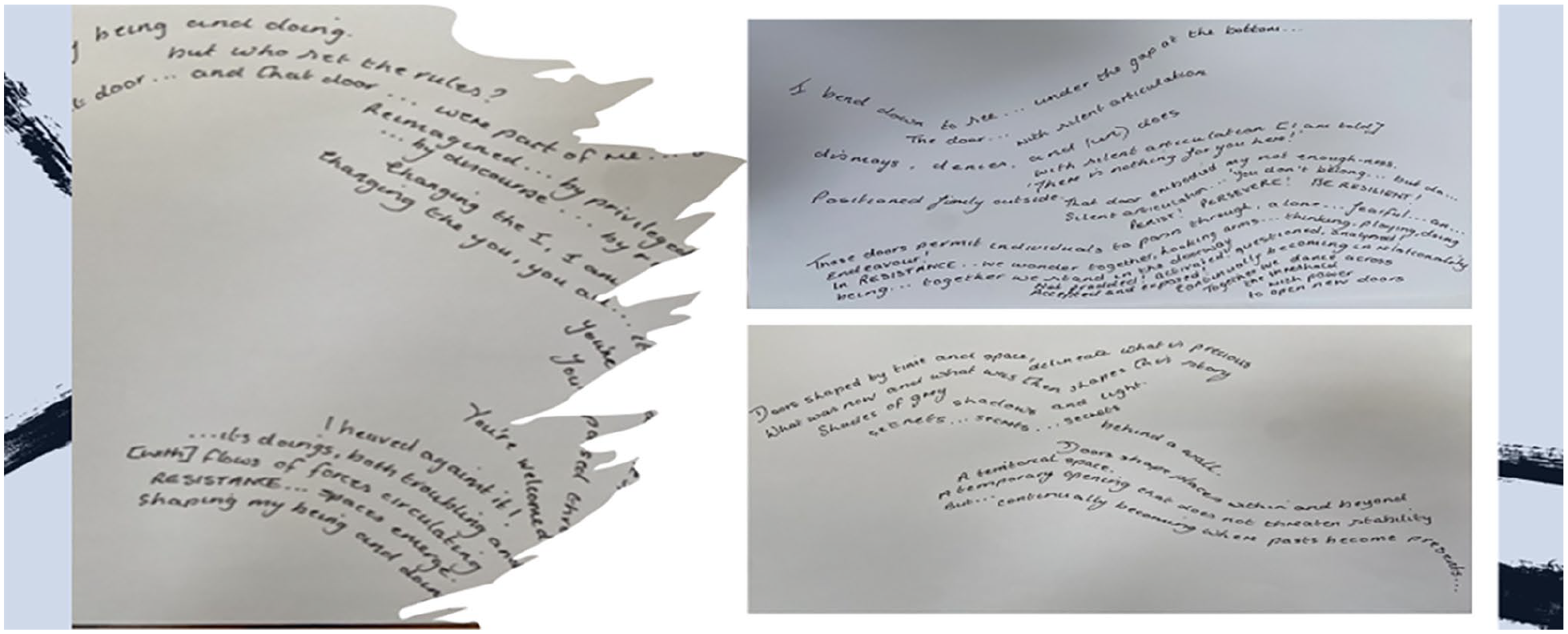
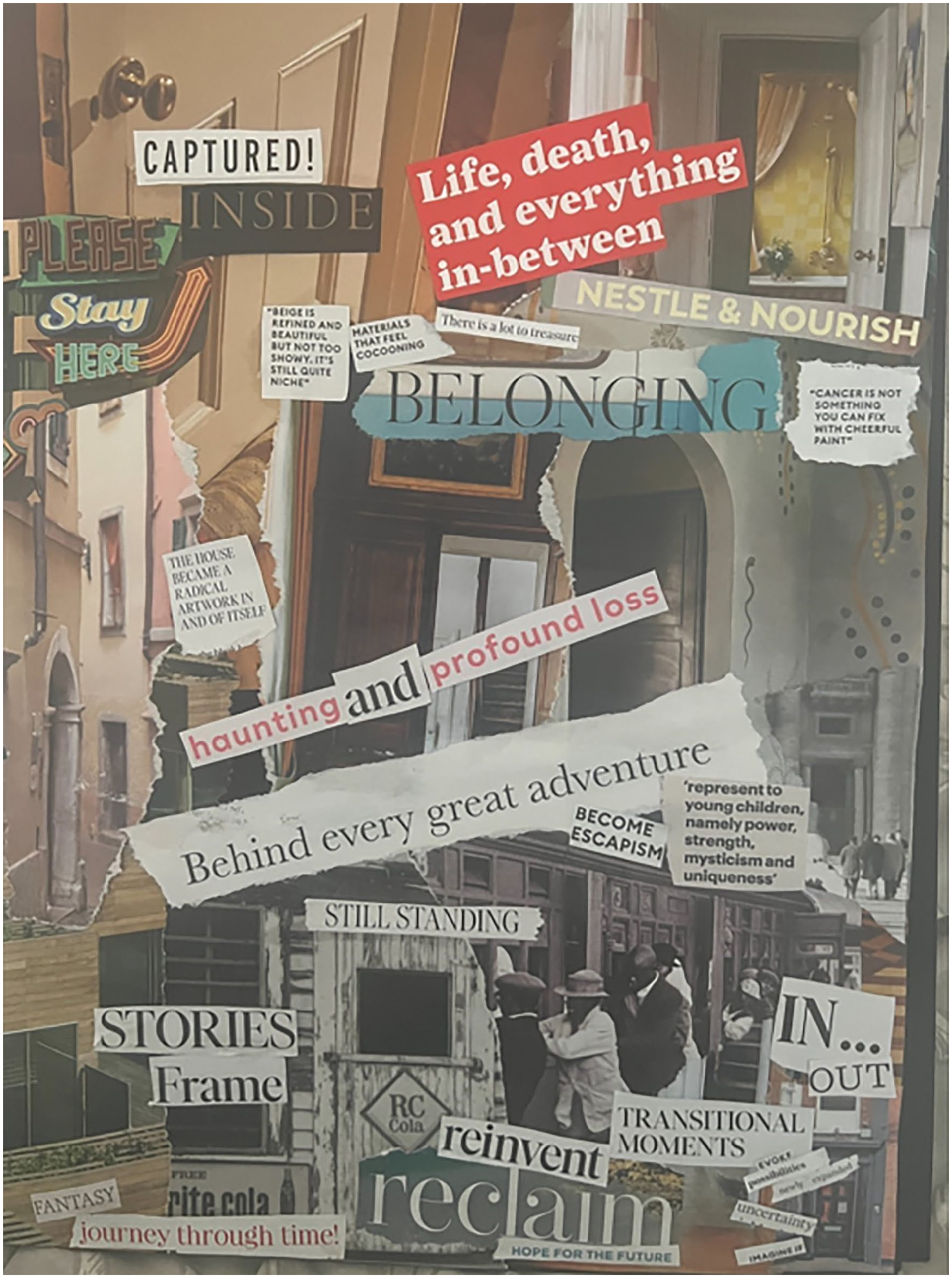
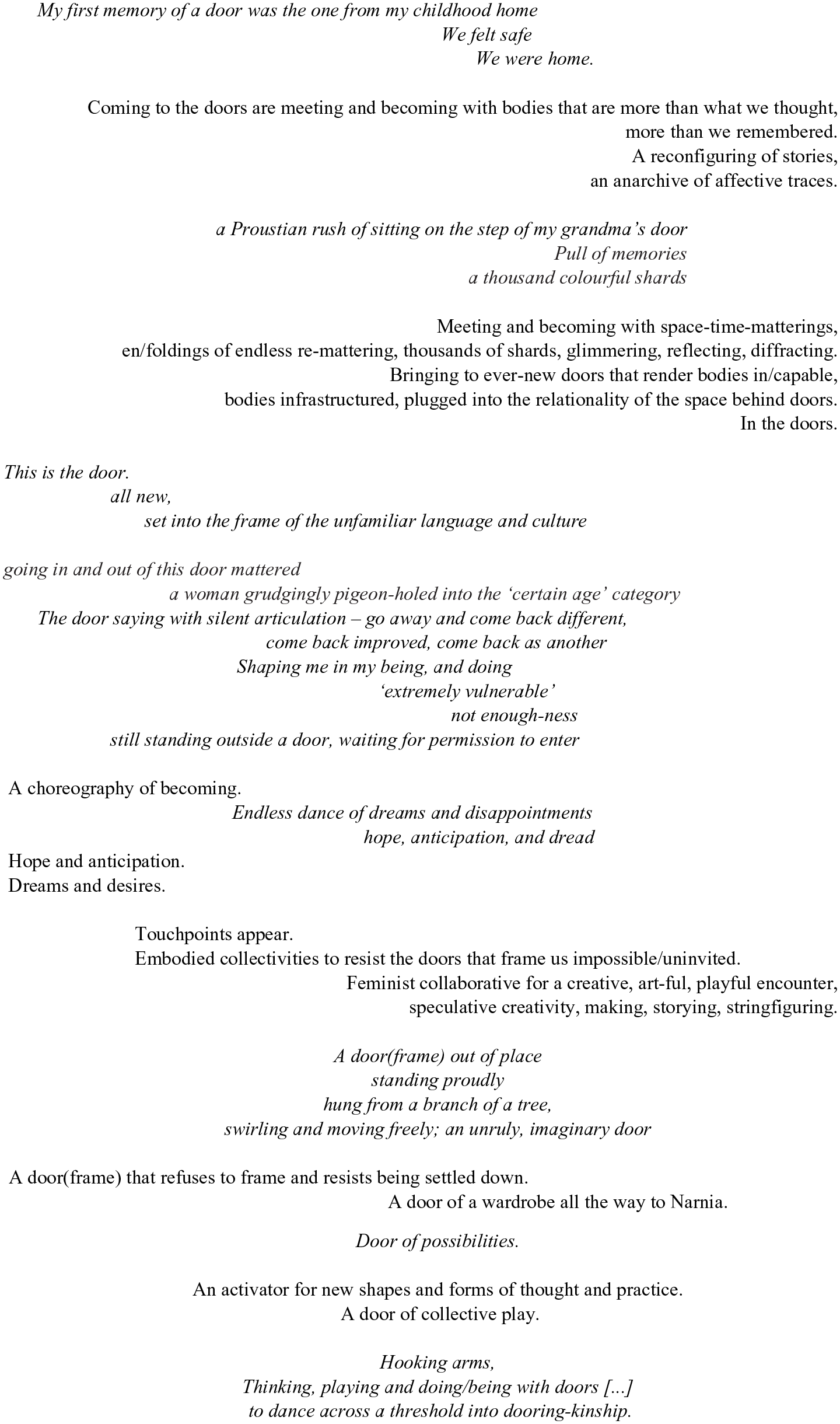
Three creative patternings of collaborative commoning emerged to “bounce and shape still more ideas” (Kuby et al., 2022, p. 289):
(Re)turning and (Re)Visiting With Our Stories, Voices Entangle, Connect, Weave, and Form as We Listened to the Whispers and Echoes, Feeling the Reverbrations. Surrounded by Pages of Life Stories, Copies are Connected by Highlights, Cutting, Moving, and Turning to Reveal the Murmurations of Our Collective Story. These Murmurations are Refusing to be Bounded; Created in “Acts of Occupation in Time and Space” (Ultra-red, 2016, p. 192) that Neither Constrain Our Questions or Very Participation
Door Storyings So What? Concluding or Exiting/Entering door Stories
So many Yet, so many Imaginative Troublesome Haunting Glass Sliding Revolving Locked door stories storied door stories yet to be doors you dream these doors Doors as trapdoors you didn’t see that coming! doors not opening that again in a hurry doors where the ghostly matters lurk Doorless doors meta lockings/unlockings doors does transparency mean a welcome? doors or are they a wall that moves? doors they go on and on doors that stay locked, even with a key
So, fellow door co-conspirators, we re-turn to questions we first posed: “what do doors do and ‘how do doors matter?’” At this stage of the game, another question pops up: and so what?
Well first of all, we have found door storying an entrance for the doings of post-qualitative research. Post-qualitative research may be a veritable closed door for the uninitiated and the novice. But, because post-qualitative research is done without a methodological roadmap, it starts anew with each enquiry. New doors will always pose new codes of entry and old keys will just not do the job.
Second, a key to the door for us was the collective nature of feminist praxis of research-creation. The experimental, arts-based practices we used became entwined with other rememberings and retellings of door stories. Doors doings, matterings, and storying gave us so many dense ideas to wrestle with, bringing theories and knowledge-making to life for doing research outside of lonely sole-authored furrows. This is where the glorious notion of research as commoning practice came on in. Commoning has been used by art-activists who use listening as a collective experiment in not seeking conclusions, but rather in teasing out what is troubling (Ultra-red, 2016). Commoning as a collaborative not only helped navigate the post-qualitative world, but also invited the hospitality of feminist praxis through elements of non-competitive and non-hierarchical relationalities. While commoning takes patient work, we have found collective knowledge-making possible through unlocking with door storying.
Third, we wonder if: Storying with doors resists traditional research practices that perpetrate illusions of expertise. Everyone has encounters with doors and are the narrators of their door entanglements. From early becomings, people become aware of doors and can recount encounters, of open and capacious doors, of blocking and injurious doors, and often reimagine the possibility of gentler enabling doors. Everyone has a door story!
And so. There are so many more door stories yet to be. We imagine you have many door stories. Everyone (and every door) has a door story to story. We will leave our door unlocked for your door-doings.
Ripping, Cutting, Sticking, Overlaying. Words and Images Overlapping. Clumsy Fingers, Blunt Scissors, Unintended Shapes Created. The Process of Collage Producing Something New, a Different Kind of Knowledge. A Non-Linear, Textured, Unfinished, and not Entirely Intentional “Art-Iculation” of an Encounter Becoming With Stories About Doors
Theoretical-Ethical-Poetic Patterning of Note-Takings, Ctrl+C’ings. Ctrl+V’ings, Selectings and Highlightings, Thinking-Withs and Theorizings With Donna Haraway, Karen Barad, Erin Manning, Senselab, and Many Others, String-Figurings With Care-Fully Placed Italics to Mark the Lend-Copied-Taken-Cut-and-Paste Sentences not Our Own in an Effort to Hold (on to) the Storytellers
Footnotes
Declaration of Conflicting Interests
The author(s) declared no potential conflicts of interest with respect to the research, authorship, and/or publication of this article.
Funding
The author(s) received no financial support for the research, authorship, and/or publication of this article.
