



Abstract
This article uses the figuration of the volcano to demonstrate the disruptive and irruptive power of post-qualitative research. The article’s volcanic irruptions aim to keep data on the move, to show how data continually and slowly proliferate in rhizomatic, nomadic, and unforeseen ways via different, ongoing experimentations, instantiating the processual research practices of knowledge-ing. This article includes, and celebrates, empirical materials collectively produced as part of a collaborative research project entitled Get Up and Move!, which enacted posthumanist, feminist materialist research practices. We were curious about how we might activate the volcano to disrupt traditional modes of data collection, analysis, and dissemination rituals through research-creation events. By concept-ing with the volcano, through the creation of volcanic calligrams, we intra-act with data, as data erupt and irrupt in powerful, agentic, and surprising ways.
Beginnings: Undoings and Doings
The figuration of the volcano demonstrates the disruptive and irruptive power of post-qualitative research. Concept-ing (Taylor et al., in press) with volcanoes activates data as hot lava: moving, changing, evolving, searching out unknown channels, corridors, and cracks. These irruptions and eruptions break open, change forever, and create anew. Other data may lie dormant—contained in our bodyminds and digital folders—and may perhaps (we can never know) become ready for future volcanic expressions. Enabling the data to intra-act with volcanoes keeps it on the move to show how data continually and slowly proliferate, emerge, and spawn in rhizomatic, nomadic, and unforeseen ways via different, ongoing experimentations, instantiating processual research practices of, what Taylor refers to as, “knowledge-ing” (2021). This article shares these doings with data and the insights that have emerged throughout the knowledge-ing process.
The empirical materials shared, and celebrated, in this article were collectively produced as part of a collaborative research project entitled Get Up and Move!, which enacted posthumanist, feminist materialist research practices. The Get Up and Move! Collective came together through a series of walkings, writings, and reflections where we created and co-created knowledge together-apart (Bastos et al., 2022). Our “data” were slowly collected, in photographs, writings, dialogues, audio and video recordings, and in our bodyminds. What could we do with these data? How might we attend to, agitate, and animate our data? How does our data continue to agitate and animate us?
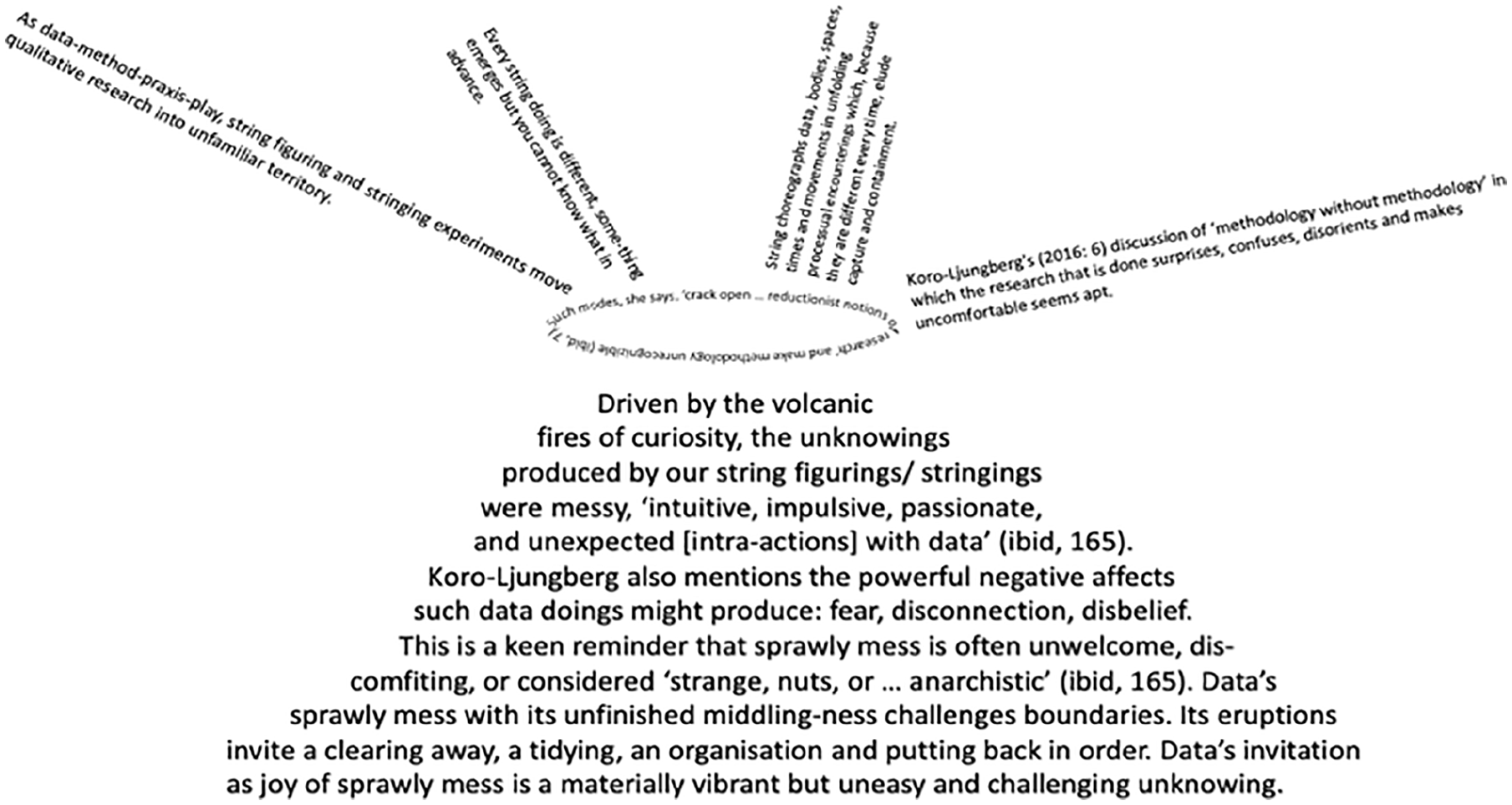
We were curious about how we might disrupt traditional modes of data collection, analysis, and dissemination rituals through research-creation events (Fairchild et al., 2022; Manning & Massumi, 2014). Research-creation practices “activate immanent co-creation of knowledge through art-based expression and experimentation” (Fairchild et al., 2022, p. 8). We devised events to enable intra-actions with the data so that we might erupt, explode, and become with and in-between one another including collaging (Cranham et al., 2022; Culshaw, 2019; Fairchild et al., 2022), painting with data (Balmer, 2021), string figuring (Fairchild et al., 2022; Haraway, 2016; Zarabadi et al., 2019), collaborative writing simultaneously (Cranham et al., in press), collective biography (Davies & Gannon, 2006), and video collaging (Hogarth et al., 2022). As data-method-praxis-play, our processual methodologies are experiments which take our post-qualitative inquiry into unfamiliar territory. Every doing is different, some-thing emerges but you cannot know what in advance. Data-doings choreograph data, bodies, spaces, times, and movements in unfolding processual encounterings which, because they are different every time, elude capture and containment. To write this article, we re/visited, re/membered, and played with our “treasure chest” of data through numerous and ongoing experimentations. These procedural practices are enactments of feminist new materialist posthumanist modes of researching.
In this article, we share stories of these intra-actions attending to how our embodied, embedded sympoesis has (slowly) allowed for eruptions and irruptions as data sprawls and spawns. The sharing of resonances and experiences is an “iterative process of collective re-creation of memory and meaning” (Taylor et al., in press). These appear throughout the article in the form of volcanic calligrams to explore the ways in which data irrupted and erupted and to resist presenting data in normative, structured, linear lines of black and white writing. We explore the ways in which our volcanic calligramming re-turned our sprawlings and became generative, creative practices that were “emphatically experimental and comfortable with knowledge production in uncertainty, multiplicity, and friction” (van der Tuin & Verhoeff, 2022, p. 2).
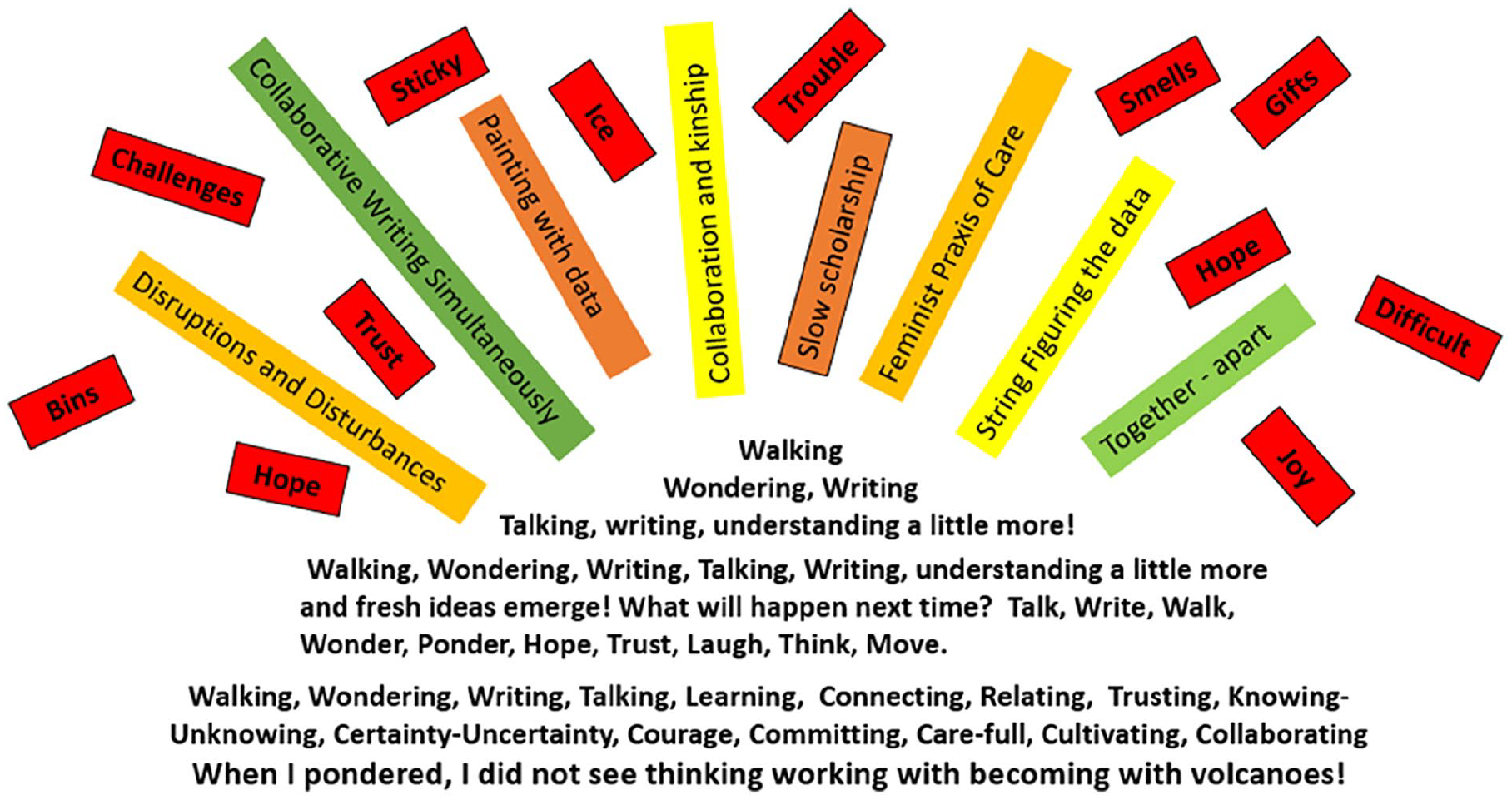
Hot Spots, Fire, and Intense Heat.
By engaging in “calligram creation,” the placing of words and letters to create visual images that relate to the words themselves, we have worked with the concept of the volcano to play, think, and do with data. By concept-ing (Taylor et al., in press) with the volcano through calligramming, we have made unpredictable, lively poems and texts that have engaged us in data un/en/foldings: I open up a word document. We write the first line—press enter, tab, tab, tab. Space. Press enter. Tab tab tab. A slightly longer line now. What words to use? Enter. Tab tab tab.
The fluidity of language and of data makes writing a difficult task yet writing with the volcano allowed us to use words to create images and to play with this fluidity. The volcanic calligrams interrupt normative research processes including the writing and reading of academic papers. In what follows, we share our various undertakings and demonstrate how knowledge-ing experimentations with volcanic calligramming produces alternative ways to work with data.
Volcanic Rumblings
Lockdown lethargy, hunched over laptops in isolated offices distant and apart, doing our academic work alone, in a silent world.
And yet.
It was there all the time and we didn’t know it. A magma chamber of academic collaboration, dormant, waiting for an opening for release, to erupt, to spawn new relations, new ways of working, new data, waiting to breathe new life into academic doings, beings, and becomings. The moment arrived as an invitation from one of us to Get Up and Move!—an online meeting with a research proposal-provocation: “Go on a 20 minute walk. Notice changes in the environment. How does what you notice shape how you feel? How this was different to other days?.”
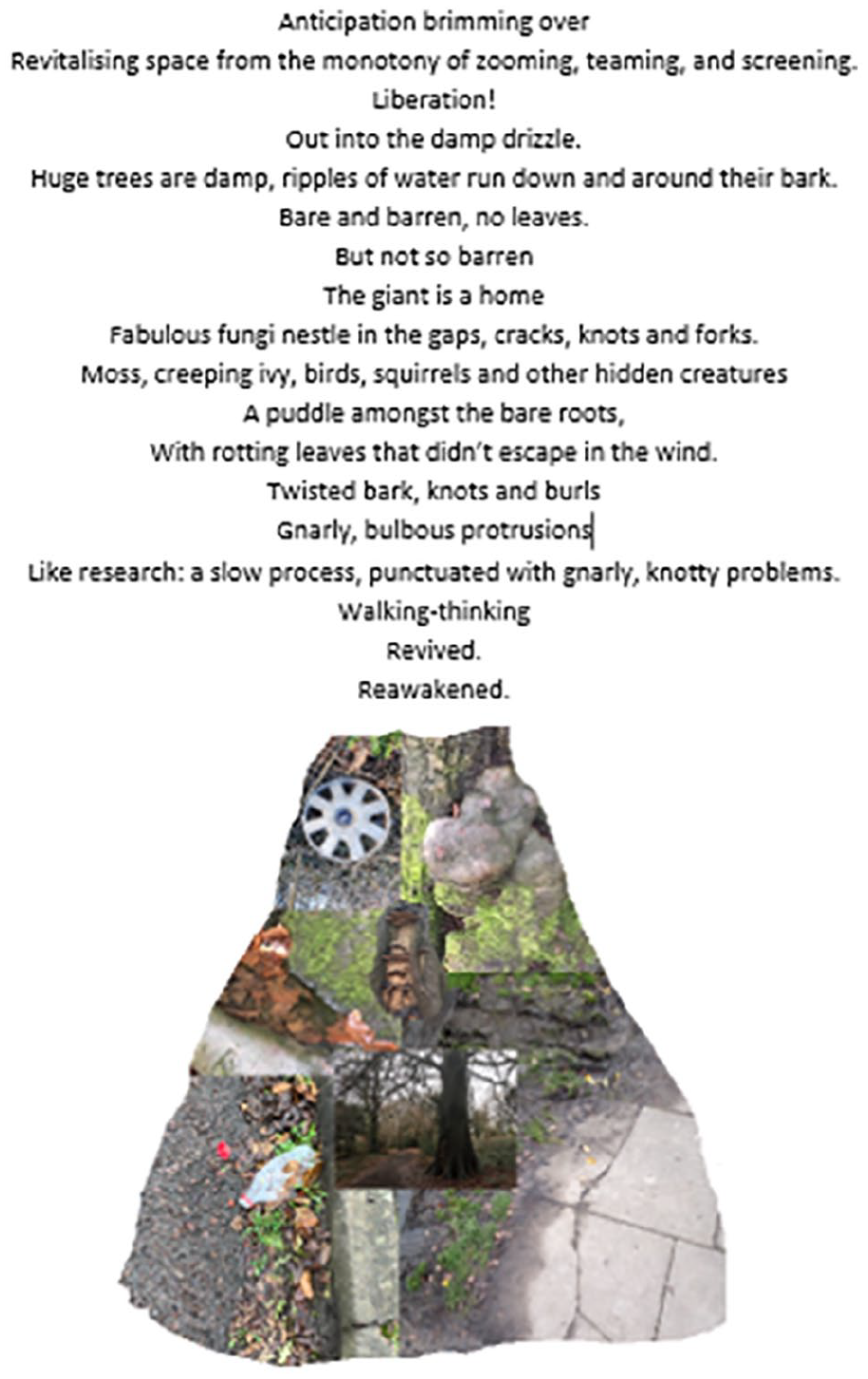
Fabulous Funghi.
Magma Flows. A collective awakening, it seems, as excited reflections are shared back with others in the online world. We wait together-ready to hear and share our newly fascinating meanders with no agenda. Initially hesitant, our discussion of this first walk produced laughter and smiles, forging connections with each other, with things, other people, nonhuman nature, ourselves.
Magma Flows. Following the walk and discussion we each wrote about our walks, and read each other’s reflections. We came together to discuss them again.
Magma Flows. We shared experiences that are hard to put into words: bodily, sensory encounters, “fresh air on the cheeks,” “the cold air opens up the far corners of my lungs but I can also taste car fumes” and affective experiences engendered through walking, “sad, anxious, happy, glee, inspirational.” We noticed things we hadn’t before: “a startlingly red plastic bottle top, a single bird singing loudly in a tree; a lone leaf still showing bits of its autumn colours.” And the human “stuff”: “litter in the gutter, hub cap in the fence. Wherever I glanced there was stuff, produced by humans, for humans.” “Muddy grass verges with criss-cross patterns made when car tires are driven over them . . . concrete paving slabs and the cracks that have formed. I think about these human-made materials that are now cracked—possibly by tree roots growing underneath.” “So much stuff.”
Lingering With Ash Clouds Un/Re/Forming
We agreed to meet again, to go on another walk—Walk 2.
Spirits lift moving with body and the senses down a path I don’t usually take familiar unfamiliar surroundings walk I must winter walks dull grey trees beige and bare It’s spectacular! A beautiful, other-worldly sight our body, sensing and noticing reverberation moved up through my ankle, my knee, hips and lower back seasons became embodied It smells. I almost gip! continue my dance in the wind all the way home
Walking with an active attentiveness of/in/to the body and the senses as well as walking in an area that we had not been before was a reaction to the isolation of lockdown. Springgay and Truman (2022) note that as “countless places have entered various stages of lockdown over the past 2 years, the capacity to walk has taken on new meanings.” At the time, our contact with each other was virtual through pixelated faces on a computer screen and our lockdown surroundings were becoming all too familiar. Our walkings were entangled with our isolation, our lonelieness and search for connection. The lockdown rules and confinement they brought were embodied and agitated in our walks, as stiff and isolated bodies resisted moving and we became attuned to notice in different ways to our busy pre-lockdown lives. In connecting with our unfamiliar surroundings, we paid attention to the sensations of our body, sensing and noticing the relations between our body and the material world.
It was a winter walk, and the season became embodied: cold teeth, ankle deep in freezing water, limbs swirling in the Arctic wind, chemical discharges at the sight of snowdrops in just enough daylight, fingers red with cold, wellingtons crunch, crunch. Like the dormant chamber of a volcano, the dark and cold wintery conditions invite a state of rest and regeneration, readying for an eruption of growth and vibrancy when conditions become more favorable. Through our winter walks, embodied feelings of cold, fear, worry, upset, uncertainty, of age and of happiness erupted from their dormant, isolated chambers as we each walked our unfamiliar spaces and lived through moments of delight and transformation. As we recalled and shared sounds and sights of nature and animals, sounds of action, of walking, sounds of the surroundings, like the smoke, ashes, and debris of a volcano ash cloud plummeting into the air, new possibilities started to emerge. The recalling and sharing of our individual experiences to each other through discussion, writing, photos and videos was a process of giving and receiving that joined us together, generating openness, empathy, and trust that prepared us for future work together, a cloud that is still hovering and reshaping with potential to be blown in unknown directions.
Dawn-ing Elements and Energies
By Walk 3, it may have been safe to wonder: Did we know what we were doing now? Probably not, but at least we felt more at ease and less anxious about the unknown, or did we? Walk 3 involved an invitation to walk with the elements and energies at dawn—walking-with air, water, fire, earth, and/or The Periodic Table of elements. Little did we know what elements and what energies would be attended to, brewing waiting to emerge in our walkings, writings and talkings, and which would lay dormant.
Dawn is a time of quiet, when a latent world awakens to the gentle invasion by light. A time when other animals dominate, streets and paths deserted of traffic and people, presenting opportunity for some, while causing discomfort for others. This invitation therefore involved a daring to commit, as fears of safety and unbelonging emerged: Dawn is not my time [. . .] I know this walk, this path, this town so well but stepping into this space at dawn was stepping into a world and a time that was not mine. I was an imposter. I suddenly feel nervous about leaving whilst it is still dark and the streets are quiet.
Yet, this seemingly calm environment is in fact erupting, alive, and rumbling. The dawn chorus of hoots, chatter, birdsong, and cock-a-doodle doos signals what is to come—a readying for another day of busy doings and beings. In this productive time, attending to the elements and energies erupted in many ways for us as a collective. We were drawn to water where earth and water meet producing opportunities at the margins in the wake of the relentless wars played day in, day out. We attended to energies past and present, walking in the present along scars etched deeply in the past by pervading colonialism and misogyny. We felt the intensity of the materiality. Some of us attended to the embodied experience of walking, musing with the elements, where anything/everything stops or begins: My moving body one small gathering point in the vast distances of the on-coming-light filled vastness.
The elements featured across our walks—the perception of the sun as a rising fire, the earthy mud on our boots, the wind howling, and the light splashes of droplets of rain—but what erupted, irrupted, or laid dormant in our third walk was a product of its “spacetimemattering” (Barad, 2007).
As the rings of trees mark the sedimented history of their intra-actions within and as part of the world, so matter carries within itself the sedimented historialities of the practices through which it is produced as part of its ongoing becoming. (Barad, 2007, p. 180)
In each of our elemental encounters, the sedimented histories irrupted into conflicting guilt and privilege sedimented in colonial bridges suspended in air, erupted into possibility along blurred elemental boundaries and networked entanglements or laid dormant in wonder of how elemental encounters may be unfolding.
How are my senses mixing and mutating, and joining forces with the elements?
Dawn and the unknown remain a source of nervous energy and in this continued enfolding of matter, what came to matter in our third walk could not have been foreseen, and any further productions will remain in the realm of possibility.
[S]o when is the Dawn? Am I “in it”? Have I already missed it?
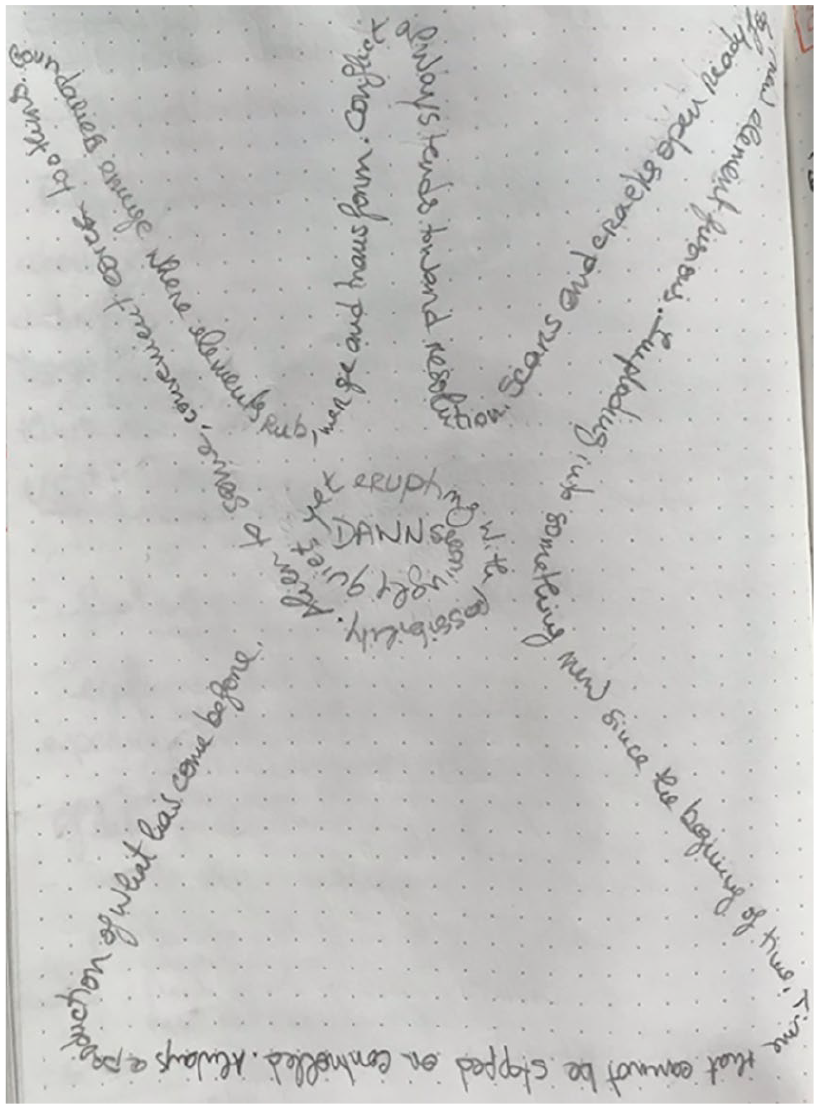
Dawn-ing.
And the Data Keep Proliferating
To experiment, we set ourselves an enabling constraint: “make some notes/bullet points identifying hotspots—resonances, differences, possibilities, provocations, micro-moments etc. in and amongst the stories, images and our recorded conversations.” Massumi describes “enabling constraints” as: sets of designed constraints that are meant to create specific conditions for creative interaction where something is set to happen, but there is no pre-conceived notion of exactly what the outcome will be or should be. (2015, p. 73)
We crafted some writings-reflections-ponderings-wonderings-diffractions-makings-playings-explorings. We uploaded these to the online shared folder, our “treasure chest,” by a specified date. These data continued bubbling and bubbling forth—more streams of hot lava leaking, trickling, bursting.
The “Get up and Move!” treasure chest of data, winking mischievously, glistening brightly, and sparkling provocatively. We had done three walks. Magma flows invitingly. What would be our next moves? Magma flows unpredictably. We wondered what might happen as we began to work with the data to embrace the not-yet-known possibilities, the potential creations that might emerge. Magma flows flowingly. We continue delving into the treasure, plunging in, becoming responsive to/with the data materials in whatever way they provoked us.
How to plunge into data’s molten movings? How to un/constrain ourselves with the data? How to unstifle our creativity in response to data’s potentially illimitable creativity? How to enable data to sprawl in the joyful ways it seems to want to? (Note to ask Hannah—when did “sprawly mess” first become a thing? Was it after the first pass with the data? Were we already thinking that we were working with a sprawly mess when we decided to stick to 2 pages?) Hi Karen, “sprawly mess” came about in our first discussion about this paper, after all of our data experimentations but I think that we were working with it from earlier than that! Hannah. Thanks Hannah—if we keep “sprawly mess” in the paper title I could add in how this relates to us deciding to stick to 2 pages of A4 to manage / contain what we did in/with the 1st pass. Also, I like how we can’t quite remember because it’s a wonderful sprawly leaky mess!
We sensed the data’s potential to bubble forth, spill, explode, and ignite in ways beyond human control. The sprawly mess data magma was already joyfully erupting! Our human eyes were not yet adequately tuned into its joyful sprawlings, although our senses were apprehending the something (what?) going on. The data were doing their subterranean work, under our feet, behind our back—data conspiring, data colluding, data proliferating and gathering for a volcanic encounter. Data daring us: try to move with us; data provoking us: try to catch us!
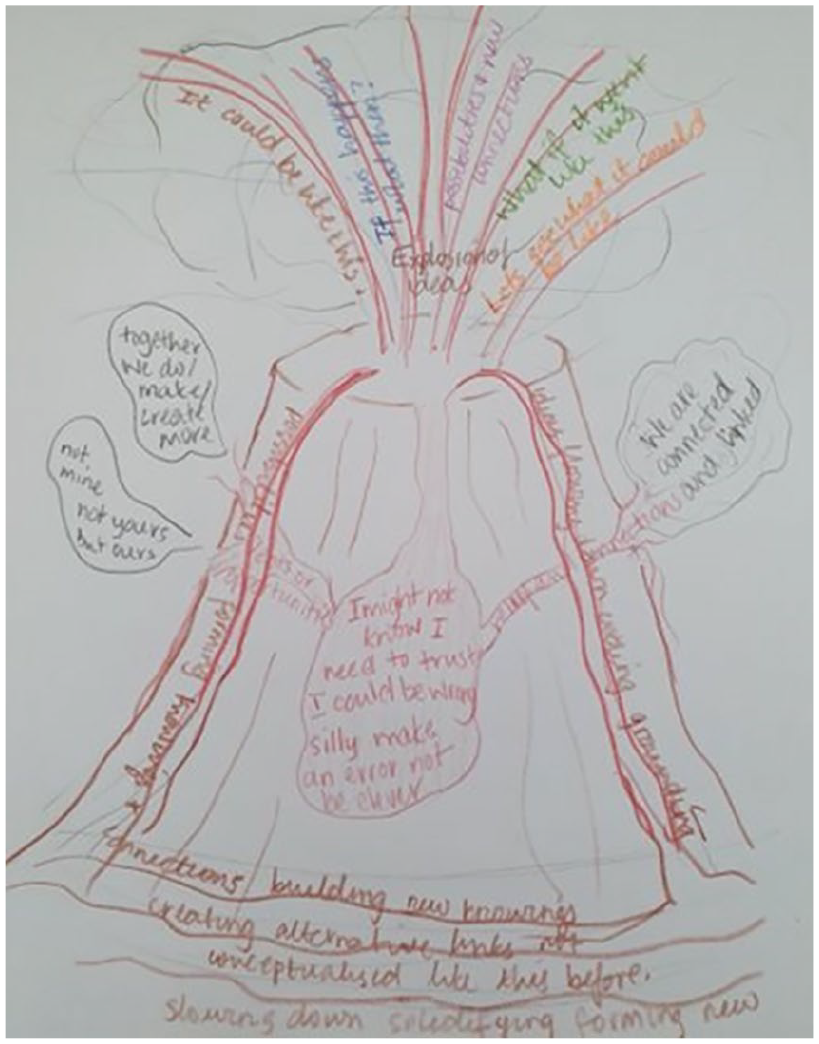
Molten Magma, New Data Encounters.
Data Explosions With Paint, Scissors, Glue
We dedicated two days to data experimentations following our “first pass at the data.” The first of these was a hybrid creative session where several of us met—face to face!—on campus, joined online by those unable to travel. We planned several “experiments,” the invitation for this was as follows: We have done three walks. We have creatively “created data.” Now we can continue to move with the data by creatively experimenting to produce something new. How can we experiment with data so that we can make/ do/ think something new? We are moving with data to create new connections—with each other, with the data and with those we will share this work with. During this session—our “second pass through the data” (Taylor & Gannon, 2018)—we will experiment with different ways to play with the data to “spread thought and meaning in unpredictable and productive emergences.” (Mazzei, in Taylor & Gannon, 2018, p. 484)
Our morning began with a session to paint and collage with our data. Collaging (inspired by Fairchild et al., 2022) comes from the French term “papiers colles” or “decoupage” and involves cutting and then pasting together/layering. We created individual and collective collages by assembling materials and digital items out of the “data” we had created. The process of collaging—cutting together/apart—provides a different way of “reducing” data in order that we might share it, without subjecting it to interpretation. A pile of printed text and images from our walks and writings were placed on a table alongside glue, scissors, tissue paper, paint, and pastels. Those working online used materials and digital tools to work with the same idea of selecting and cutting then placing alongside/ in front/ above/ behind. We looked for parts of the data that glowed—hot spots where the affect of the data moved intensely. The heat of the data activated our responses. Throughout this process, we added layers to our collages with paint, words, and pastels. Layers and layers. Palimpsest. We took inspiration from Balmer whose “painting with data” involved layering over data to “conceptualise how different aesthetics help us to see the different shapes, forms and moulds that make us, our relationships and our worlds.” (2021, p.1143) He argues that this prioritizes “addition above extraction; juxtaposition over thematisation; and collaging rather than ordering” (p. 1143).
As we combined these processes of taking away and then adding to layering, a “cutting together-apart” (Barad, 2014), we became surprised by insights and bore witness to connections being made (see Figure 1).
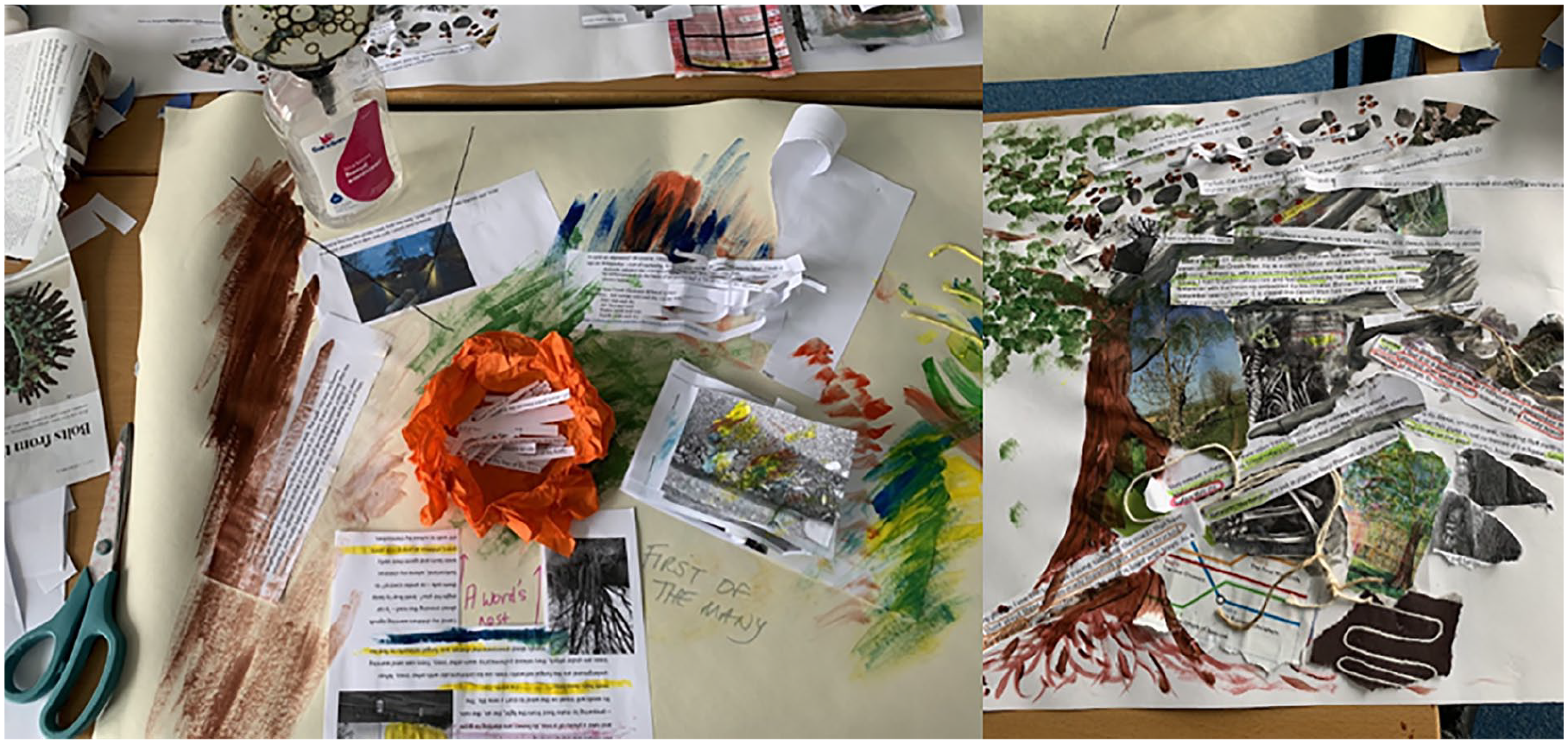
Birds Nest, Words Nest.
The enactment of the experiment itself produced collaged layers of us working together-apart, in multiple locations through screens. Images overlaid each other on laptops and through the campus projector.
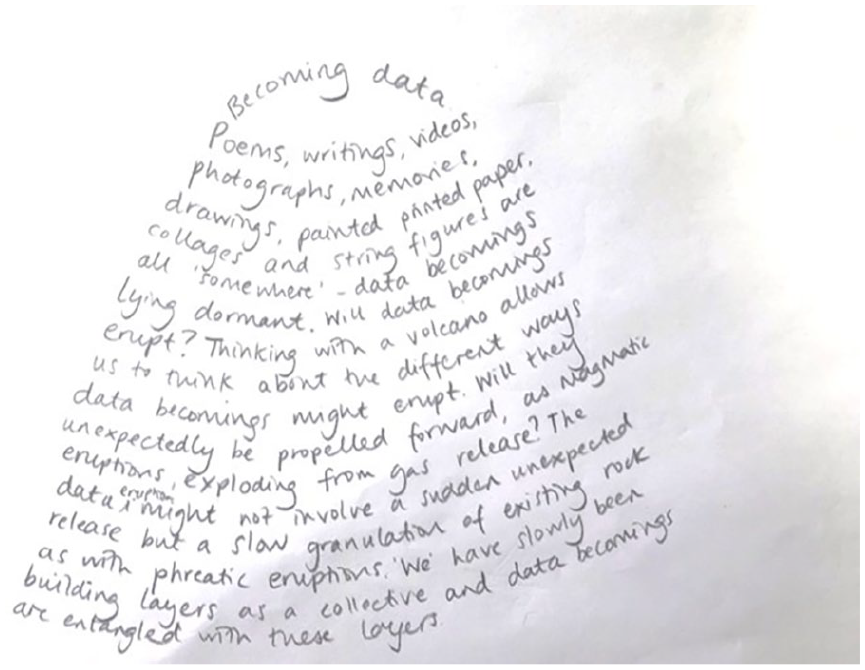
Slow Granulations.
Sticky Viscous Stringy Figuring
The invitation for our next data event was as follows: Let’s use string to tangle ourselves up with empirical materials from our various/multiple walking experiments in ways that move us to feel-think-know differently. You may ask “feel-think-know differently” about what? Our experiments are not “about” in that sense. They are propositions—research-creations—moves in instantiating an imminent methodology in which the doing is the mattering. So, lets . . . walk-with string, think-with string, do with string, make-with string, re-member with string, come-to-know with string, move-with string, become-with string, Here-and-now. Let’s produce some stringly time-space-matterings in the here-and-now. Let’s see what happens.
At the beginning of the day, there are four of us in the room, three of us at home participating online in Teams; together-ready (see Figure 2). We were fired into experimental motion: volcanoes rumbling as our doings unfolded and materialized on tables, walls, floors, threw themselves out of windows, sprawled into corridors. In the room, we pushed, pulled, tied, attached, secured, fixed, stuck, hooked, looped, hung, stuck, pasted, clipped and stapled string-to-string, things-to-string, objects-to-string, bodies-to-string. Our stringly doings connected and entangled objects, bodies, and spaces—micro-spaces (under the table), larger spaces (floor to door to ceiling), and inside and outside (see Figure 3).
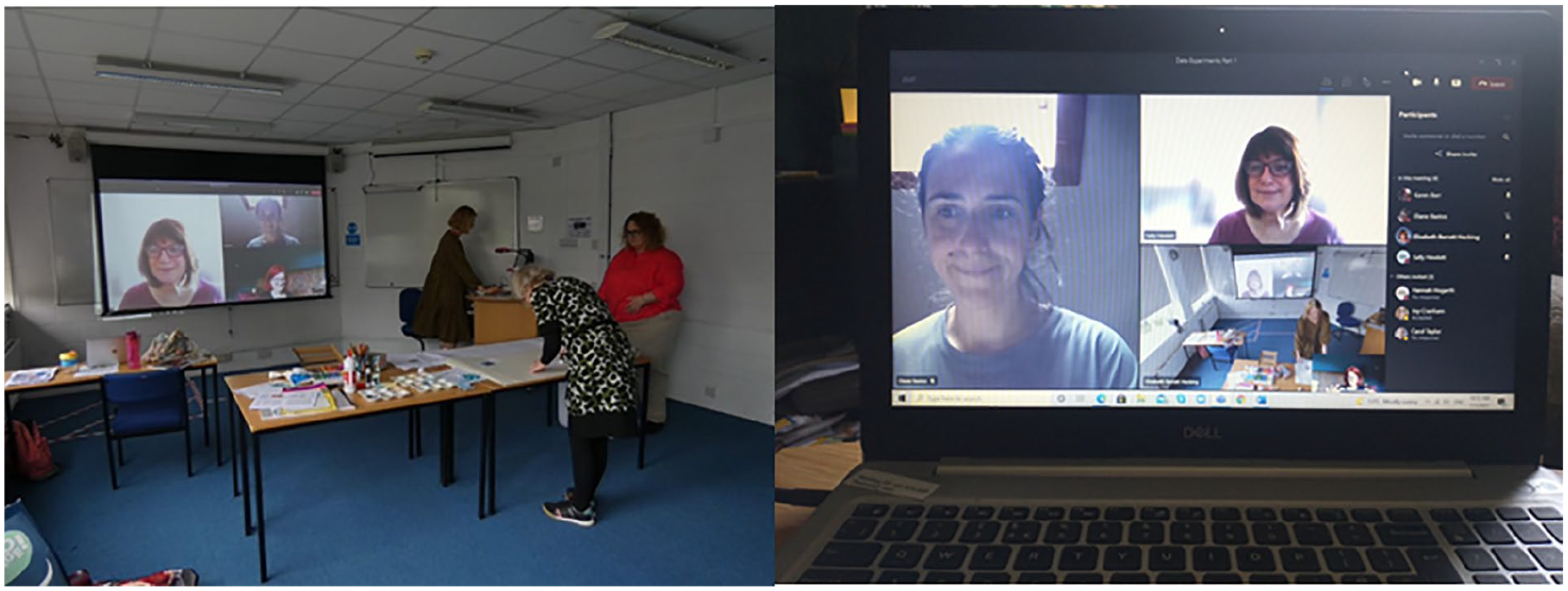
Hybrid Collaging.
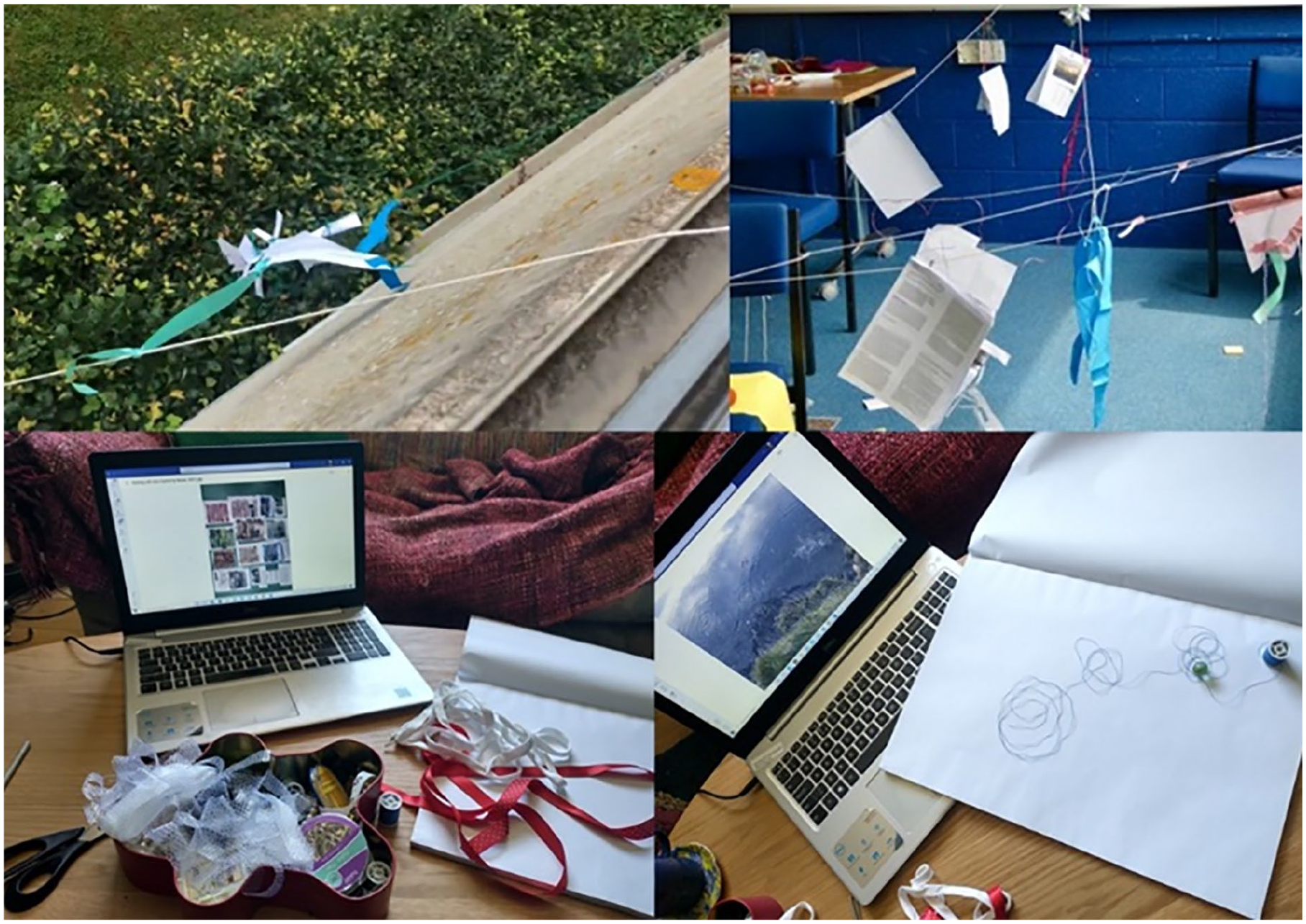
Stringy Tangles.
Boundaries disappeared; data-as-lava flowed; stringings provoked stringings, criss-cross, multidimensional, matrixial. We smiled and sweated as we worked and moved, bodies-and-string tangling and tingling. Stopping momentarily, thread in hand, a pause before more looping, knotting, and tangling: ah, this is the “what” that string is enabling to emerge. What is this “what”/what are these “whats”? String continued provoking. Volcanoes continued rumbling. Working with string’s materiality, we follow string’s thingly scent (Bennett, 2010), heed the matterings it is in the here-and-now producing. Our stringly irruptions put bodies and spaces in flowing motion, de-centering human cognition and the illusory mastery of methods.
String is cheap Lo-fi Inconsequential and unglamorous A thing of outdoor sheds A ball of stuff discarded with fluff in the backs of drawers Until needed Then It’s attachment and connection properties are highly valued. Ponder awhile and you find: String of different colours, textures, smoothnesses and roughnesses, sizes, lengths How long and strong is a piece of string?
Our stringings were inspired by Haraway’s (2016) speculative feminist interest in string figures, sometimes referred to as cat’s cradle, which are loops of string manipulated by hands to form three dimensional patterns often in a sequence. Haraway (2016, p. 10) speaks of string figuring as: Playing games . . . giving and receiving patterns, dropping threads and failing but sometimes finding something that works, something inconsequential and maybe even beautiful, that wasn’t there before, of relaying connections that matter, of telling stories in hand upon hand, digit upon digit, attachment site upon attachment site, to craft conditions for finite flourishing on terra, on earth.
Our collaborative stringing was a sprawly mess of unknowing. We could not name, identify, or designate what “it” was. And yet. It moved us to do, think, feel, know differently.
Spurting, Discomfiting, Anarchistic Data.
Data’s sprawly mess with its unfinished middling-ness challenges boundaries. Its eruptions invite a clearing away, a tidying, an organization and putting back in order. Data’s invitation as joy of sprawly mess is a materially vibrant but uneasy and challenging unknowing.
Collaborative Writing Simultaneously
Collaborative Writing Simultaneously (CWS; Cranham et al., in press) erupted from a desire to write collectively with concepts that emerged through our walkings/doings/experimentings. In groups of two to three, we entered Microsoft Team meetings and documents and started to talk and write with data. These collaborative writings were formed simultaneously and were not created individually to then be shared and refined but occurred out of collaborative emergence, with two or more bodies producing a singular text in real time (see Figure 4). The space between bodies filled with new ideas and possibilities building connections with utterances and wonderings, which were then captured with symbolic representations in the form of writings and mark making. This practice challenges traditional modes of authorship and proprietorship of knowledge, aiding the transition from individual “I”s’ to a relational “we.” As with a lava flow, the end products of CWS are not pre-determined. CWS enacts a consequence of the convergence of bodies, time, and space; while volcanic eruptions involve immense pressure, heat and time: both produce something that would not have occurred without the dynamic energy and complex relationships involved in that unique spacetime.
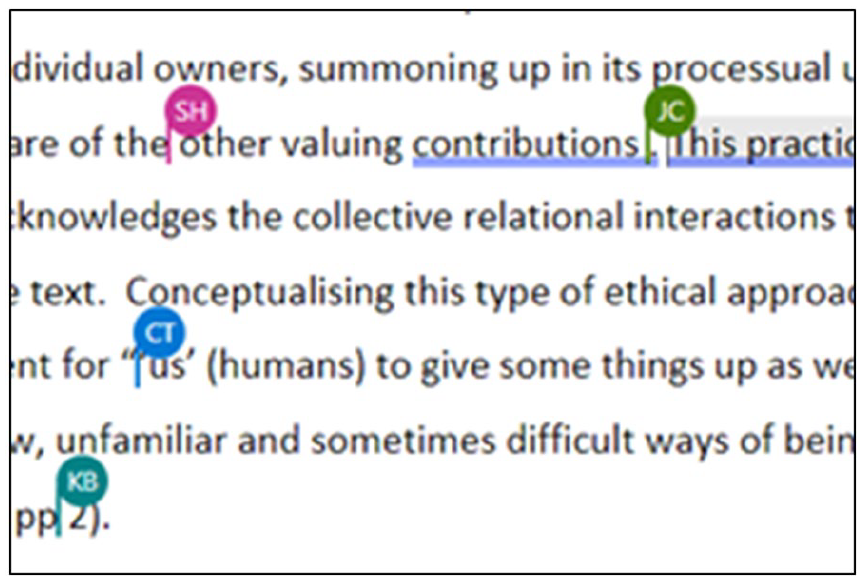
Initialed Cursors Hovering Over Shared Sentences.
When reconceptualising CWS in relation to its volcanic properties for forming new creations, possibilities erupt and emerge. Before the process began there was uncertainty, like pressure building in a magma chamber and relief/release came when ideas were shared and concepts crafted anew. This is an energetic phase, as ideas are thrown out, exposed, and pondered over. With each explosion of ideas, the thoughts mingle and merge, some solidify and become grounded taking form as words, symbols, or shapes. While others float high in the air waiting capture, drifting further away until no longer present, gone as the smoke flume slowly dissipates. Faded, for now. Those that were contained, form fresh creations, a collection of ideas pushing up against each other finding space to be articulated and crafted into fresh knowledge production, as the lava flows—altering the old and creating new lands. Becoming further entangled with data through our CWS allowed us to pay “explicit attention to the ethical, political, affective and entangled nature of ‘research’” and explore the ways in which our research “data” are “simultaneously personal, performative and full of transformative potential” (Renold & Ivinson, 2022, p. 109).
Stratus, Cirrus, Cumulus, Nimbostratus (Can Anybody Think of More Cloud Names?)
Data generation and experimentations have continued to proliferate in unplanned ways while we produce outputs from our project including conference and journal papers (Bastos et al., 2022; Cranham et al., in press; Hogarth et al., 2022; Taylor et al., in press). While preparing for an online pre-recorded presentation, one of us suggested that we record our feet moving to convey us walking “together-apart.” An unexpected irruption! New data starts to emerge involving new walkings and videoings of our moving feet and a video collage. The together/apartness of co-producing something in different locations, at more-or-less similar times with shared aims allowed new understandings.
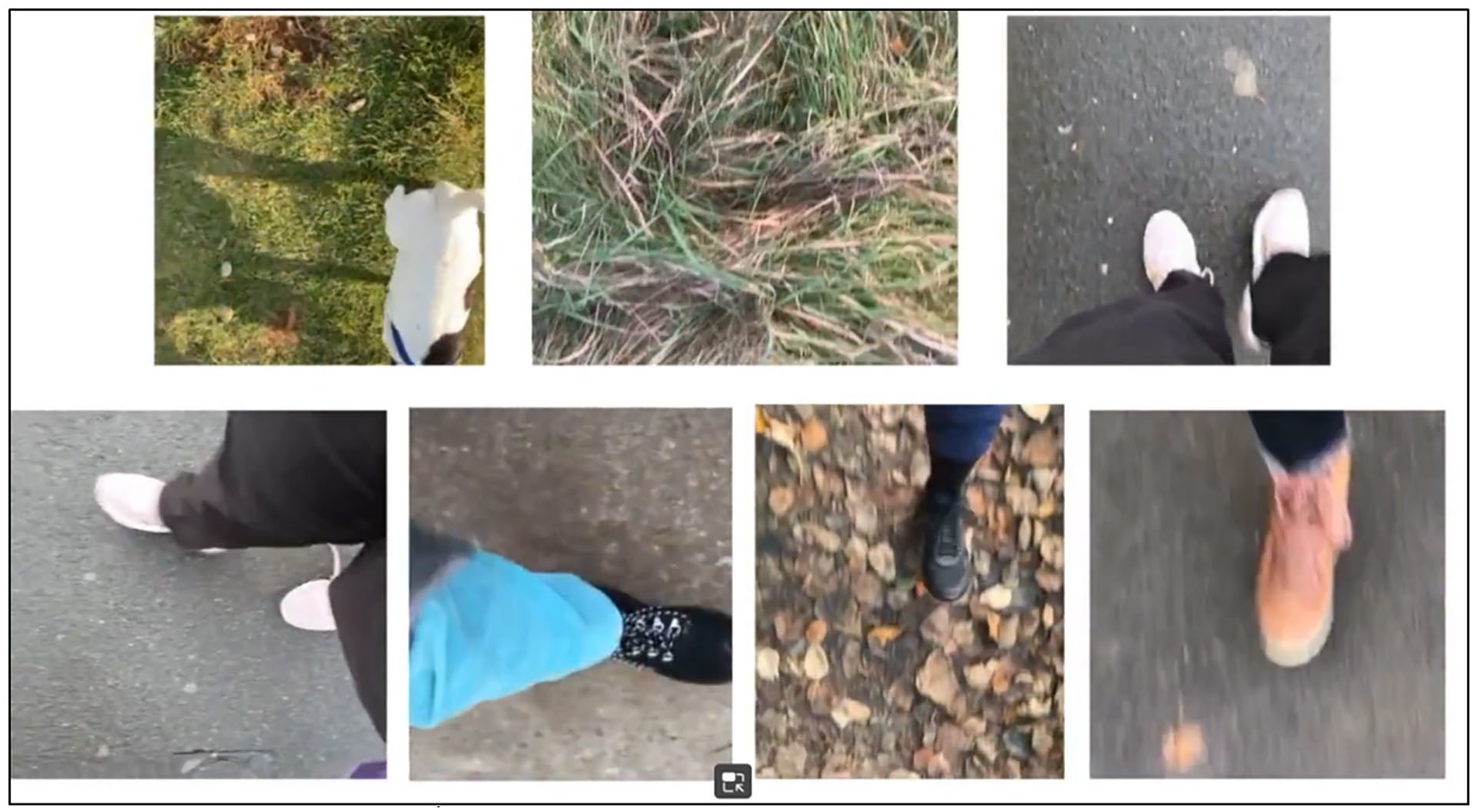
Moving Feet Together/Apart.
Data sprawls again, leading to new human/more-than-human assemblages of pavement, grass, phone, crack, moss, rocks, eye, nose, dog, stones, sea, bird, shoes, socks, trousers, powerpoint. We find ourselves entangled in unforeseen ways and these assemblages lead to insights for seeing and being in the world. We shared our video online and delegates started to engage with the work—lava flows in unusual places. It seeps through digital collaborative sites from a computer in a University office in Leuven, Belgium, to a kitchen in Australia.
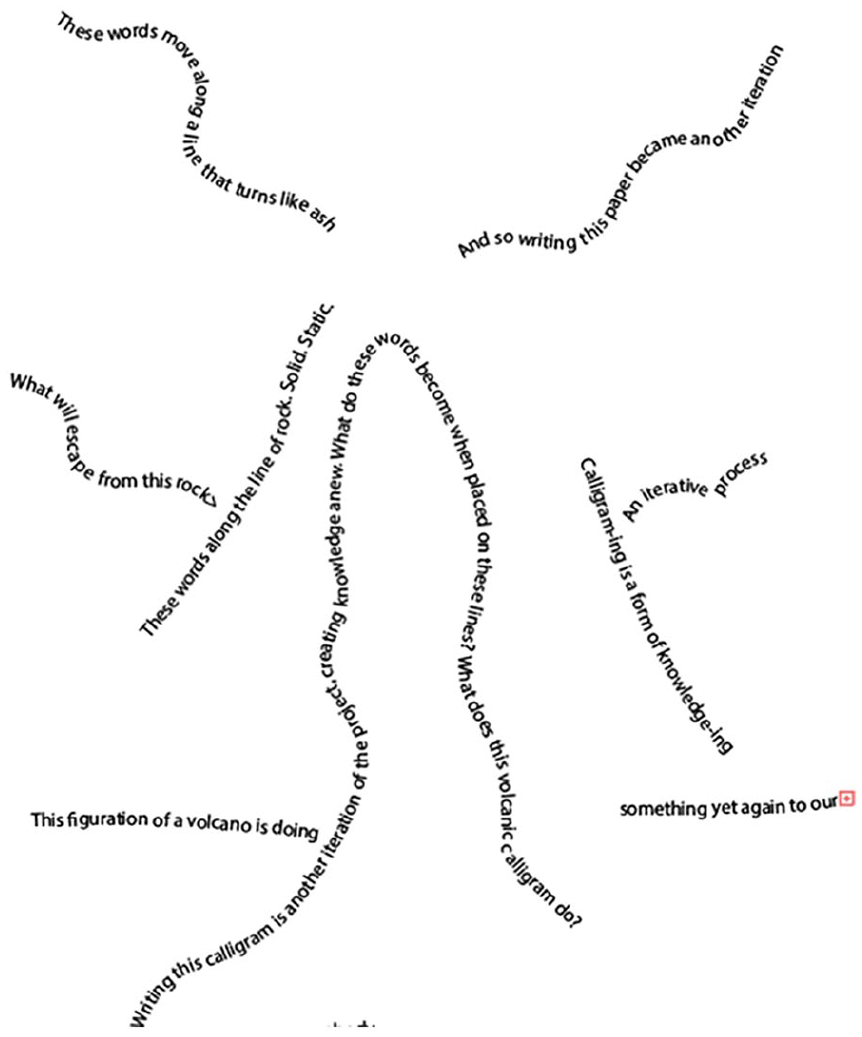
Processual Calligramming.
Un/Settlings
Our data-doings were in situ spacetimematterings that erupted and irrupted to seek new relationalities and possibilties; they enacted a mode of embodied and sensorialist research-creation, a form of collaborative feminist praxis, and an ongoing unfolding of experience (in the here-and-now). Our volcanic calligramming was a processual mattering of coming-to-know in the instant of the doing and became a way for us to share the unfoldings of our creative research praxis. Each iteration of the project produces ground from which new life grows just as volcanic ash settled and creates new fertile ground. As we piece together this article, we are curious about how, where, and what the ash might un/settle. What might be preserved/ produced/ transformed? Data continue to lie dormant. Data continue to bubble and flow.
Footnotes
Declaration of Conflicting Interests
The author(s) declared no potential conflicts of interest with respect to the research, authorship, and/or publication of this article.
Funding
The author(s) received no financial support for the research, authorship, and/or publication of this article.

Author Biographies
“The Get up and Move! Collective” co-authored this article and are a group of academics and PhD students in the Department of Education at the University of Bath, UK. The group came together online during the COVID-19 pandemic and experimented with walking methodologies and collective biography to enact feminist materialist and posthumanist educational research and practice (Bastos et al., 2022; Cranham et al., in press; Taylor et al., in press).