




Abstract
In this article, the author considers his ongoing experience as a PhD student to argue for the significance of “trajectory” toward doctoral and early career research. He suggests that his background in special education shapes his methodology (critical disability studies), his research-creation praxis, and his approach to theory. He exemplifies this through two research-creation projects: Neuroqueer(ing) Noise, which was an in-school project in an early childhood classroom, and Oblique Curiosities, which is an ongoing composition project. The author then offers four propositions for doctoral students interested in drawing from “post philosophies.” This article is of relevance to postgraduate students interested in post philosophies, research-creation, or arts-based early childhood educational research.
Preamble
When I came to prepare some notes for this session, I found myself thinking a lot about trajectories: particularly, the trajectory of my approach to my academic research and how that trajectory still matters in my research. When I use the word “trajectory,” I mean it in two senses. In the first sense, I mean the trajectory of how I activate research methods; in other words, the theories I’m using methodologically. In the second sense, I mean my trajectory toward those theories, or how I personally found my way into this thinking space (and which still influences which theories I use and how I apply them). I hope tracing my own trajectory of how I came to apply post philosophies in my doctoral research will help other PhD students.
I’ll be drawing from two different research-creation projects. The first, Neuroqueer(ing) Noise, was a 14-month in-school artist residency with a neurodiverse 1 early childhood class in northern England. The project explores the instability of the category “neurotypical” at its intersection with raciality and disability. The second project I’m going to draw from is Oblique Curiosities, which is a glitch folk, electronica music duo consisting of me and Sarah E. Truman (who gave the previous webinar in this series). We write songs as a way of thinking through method and theory. I’m going to address the same four questions that everyone else in this series has so far attended to.
1. How does your philosophical approach influence your ways of doing inquiry?
I’ll answer this first question by contextualizing both projects as research-creation.
2. What are your perspectives on method and methodology?
As I’ll explain, my methodology is critical disability studies, which I inform through queer theory, theories of affect, and Whitehead’s conceptualization of propositions.
3. What does this philosophical approach make thinkable or possible for inquiry?
I’ll answer this third question by sharing examples of practice and data from across my two research-creation projects.
4. What mechanisms could be put in place at universities to support students doing post philosophy inspired ways of inquiring?
In answering this, I’m going to speak more to the lessons that I wish I’d learnt earlier in my PhD regarding how to bring these theories to doctoral study.
How Does Your Philosophical Approach Influence Your Ways of Doing Inquiry?
Before talking about how theory influences my ways of doing inquiry, I first need to explain how I came to the academy and what my trajectory to theory was.
My first degree was in music. I am a composer and producer. I later became a primary and special education teacher. When working as a special educator, I had two problems that I took with me from practice into my doctoral studies. The first problem is that certain tendencies—what we might call autistic tendencies—are pathologized in schools. For instance, “special” interests (such as playing with trains or light switches) or liking to play by oneself. As a gay man, it always felt to me like there was some overlap with homophobia: the idea that certain tendencies were a problem and needed to be normalized. The second problem that I brought with me to my doctoral studies is that inclusion doesn’t work. As a special education teacher, I found myself applying for funding packages for young people to pay for support hours, all the while knowing that there was no amount of money that could make them pass in a system that was predicated on their failure. So, if inclusion doesn’t work, what else can we do?
I’m telling you all this because the trajectory by which I came to the academy is also my trajectory to methods and theories, and those trajectories matter: My intention to problematize “inclusion” materially constitutes the research. In this way, I conceptualize critical disability studies as my methodology: by this, I mean that I apply my research methods to unsettle neurotypical ideas of ability.
How I do research: Research-creation
The research projects I discuss here are both research-creation: research-creation is my research praxis. Erin Manning, Stephanie Springgay, and Sarah Truman have already offered detailed discussions of research-creation in their own webinars, but I wanted to explain how I personally mobilize the concept.
I understand research-creation as a way of researching socio-material processes as art practices. It’s enacted as feminist, queer crip, and anti-colonial praxis (Loveless, 2019; Shannon, 2020; Springgay, 2020; Truman et al., 2019). Natalie Loveless (2019) describes research-creation as transdisciplinary: The disciplines that I operate across when doing research-creation are those of the artist, the researcher, and the teacher. So, to return to the idea of trajectory, research-creation as a transdisciplinary practice is a justification for me thinking through the practices that already shape my thinking: those of the artist, the teacher, and the researcher.
Research-creation does not adopt a specific methodology. (By methodology, I mean the theoretical orientation to the research methods.) However, research-creation practitioners often draw from feminist materialisms and, particularly, in my work, theories of affect and process philosophies, including Whitehead’s articulation of propositions. I also think about research-creation itself as a kind of proposition for what can be done within the confines of the academy and the early childhood classroom: I’ll talk about this more at the end of the webinar. So, having talked about how my philosophical approach influences my way of doing inquiry, I want to expand upon what my philosophical approach is.
What Are Your Perspectives on Methodology(ies) and/or Method? How Do You Envision That in Your Approaches to Doing Inquiry?
As I explained at the start, my methodology is critical disability studies. This isn’t a new idea within disability studies: Julie Minich (2016) and Sami Schalk (2017) have written on this within cultural studies. Taking critical disability studies as my methodology means using method to unsettle (neuro)typical notions of ability in the classroom. I use several theories to help me do this: I use queer and neuroqueer theory. I use theories of affect. And I also mobilize Alfred North Whitehead’s articulation of propositions. I’ll now explain each of these theories.
What is queer theory?
I’m going to start by talking about queer theory. I want to explain how I orient toward that concept personally, as well as introduce it to those who are not familiar with it. I understand queer theory as the application of LGBTQIA+ experiences to socio-material processes as a way of unsettling or “queering” them. My work is particularly informed by José Esteban Muñoz. Muñoz (1999) draws from Michel Pêcheux’s theory of dis-identification to offer three strategies for how oppressed people conform to or resist dominant discursive and ideological forms. The first of these strategies is the idea of identification, by which an oppressed subject tries to pass by dematerializing their “apparent” 2 differences and so make themselves identical. The second strategy is that of counter-identification, by which subjects establish a counter-identity that resists the dominant culture and is formed through solidarity in the face of oppression. However, whether it’s assimilation into the dominant identity or assimilation into the counter-identity, both still reify some kind of assimilation and so Muñoz offers us a third strategy: that of dis-identification. Dis-identification seeks to unsettle both dominant identity as well as the whole notion of any identity. Thus, dis-identification “neither opts to assimilate within such a structure nor strictly opposes it” instead it “works on and against dominant ideology” (Muñoz, 1999, loc. 457). These three strategies of identification are important to how I approach disability and particularly autism in my project, as I’ll explain at the end of this section.
Important also to Muñoz (2009) is the idea that queerness is not yet here. Rather, it’s something that we need to keep open to those queernesses that we have yet to encounter. When I teach this to undergraduate students, I tell them that it’s like the “+” of “LGBTQIA+,” in that it keeps the concept open to other queernesses we don’t yet have a language for. And, for Muñoz (2015), keeping queerness open like this is laborious: it’s what he calls a “necessary queer labor of the incommensurate” (p. 209). This is important for how I orient toward autisms in the classroom because autism is described in many different ways in the literature. In my project, I try to keep autism open to what it could be but hasn’t yet become. Again, I’ll explain this more at the end of this section.
Neuroqueer theory is another theory that I use. Neuroqueerness is an emerging perspective on neurodivergence (or intellectual or learning disability), as well as a term of identity for neurodivergent people. In some ways, Neuroqueer is an extension of crip theory—crip theory being the application of queer theory’s disruptive lens to disability (although, “crip” has a bodily emphasis, which is not found in neuroqueer theory). So, neuroqueer is both a counter-identity in terms of being a gathering place for solidarity in the face of oppression and also a disruption of the whole notion of identity (Yergeau, 2018). That’s how I mobilize queer theory in my research: We’ll turn now to talk about theories of affect.
What are affect theories?
Affect theories have been discussed so many times over the course of the series that I’m not going to give a detailed definition. Rather, after Brian Massumi (2015), I’m going to offer a series of propositions for how I personally activate the concept:
Affect does not exist, by which I mean affect theories don’t describe some force or entity that preexists my engagement with it.
Theories of affect pertain to the passage of intensities or forces in such a way that modulates a body (mind)’s capacities to affect other body (mind)s.
An affect is anything that reconfigures the ability of those body (mind)s it encounters to be affected by other body (mind)s.
Affect’s transmission is “articulated” (Weheliye, 2014), and so is the “system” of systemic whiteness, ableism, and cis-hetero-sexism.
Affect theories attend to the ways in which emotion is a material force.
Emotion is one, human-facing aspect of affect.
I hope that gives some sense of how I conceptualize affect theory. Next, I’ll expand upon Whitehead’s conceptualization of propositions (my final theoretical perspective).
What is a proposition?
A proposition is any idea that can be written as a statement that can be judged as true or false. Whitehead (1929/1978) expands upon that definition quite extensively in Process and Reality. He defines proposition as the restriction of a potential to a particular material arrangement. For Whitehead, this restriction is speculative, or a “lure for feeling.” Take, for instance, the proposition “coriander is blue.” “Coriander is blue” is a proposition in that it’s expressing an idea as a statement that can be judged true or false: specifically, the restriction of the potential “blueness” to the material arrangement of coriander. But important also for “coriander is blue” is that it’s not true: it’s false. Coriander is not blue, it’s green, and that’s important when we mobilize propositions. We need to keep a hold of this idea of truth, not least because falsely luring the potential of blueness to something that we know isn’t blue “defamiliarises” (or “queers”) habits of thought (hooks, 1995).
I mentioned before that I initially struggled with the notion of propositions. This was because, when I first started learning about them, they kind of made sense to me straightaway. The reason why they made sense is that, as a composer, I’ve written music for plays and films, and, whenever you write music for these things, there’s always a list of the different pieces of music required for that project, which might say we need something like “14 seconds of tense, purple silence with a hint of triumph at the end.” In saying that, certain potentials are restricted to the compositional event. And so, as a way of restricting potential to enable creative activity, the proposition always kind of made sense to me. The difficulty I had was then matching this understanding up with how Whitehead conceptualizes propositions, and my supervisor Elizabeth de Freitas (who gave an earlier webinar in this series) has been really supportive of that process. I have now published an article in the journal Matter about Whitehead’s propositions (Shannon, 2021b). I’m not sure that the article itself is very interesting, but it might be helpful if you’re interested in Whitehead’s conceptualization of propositions and how that activates creative activity.
Propositions are also important to the curation of research-creation. Research-creation is never a “turn up and see what happens”: it’s always carefully curated. I use propositions as a way of curating my research, as I’ll come to illustrate when I start addressing the next question.
Summary of “perspectives”
These theoretical resources—(neuro)queer theory, affect theory, and propositions—make it possible for me to think two things. The first is an organizing concept for critical autism studies that I write as A/autisms (Shannon, 2021a). A/autisms contests individual models of autism by explicitly attending to how neurodivergence is shaped moment by moment in the classroom (in encounter) but without losing hold of disability identity and politics, or the reality of autistic ability and disability. The second thing these theories do is allow me to think about the more-than-sonic. The more-than-sonic is a way of attending to the aspects of our experience of sound that aren’t themselves sound: memory, vision, temperature, affect, and so on. My argument is that, by composing music, we can make it possible to physically hear these more-than-sonic aspects of sonic experience.
Having talked through what my methodological perspectives are, I’m now going to share some examples from my research about how I mobilize them in my inquiry.
What Does This Philosophical Approach Make Thinkable or Possible for Inquiry?
I’ve organized this discussion of my research around six propositions for how I personally orient toward the concept “research-creation.” I write propositions in the form of an imperative followed by a logical statement. This is because I think that the imperative form is easy to activate, but including the logical statement also makes it easier to keep hold of the true/false judgment that’s essential to Whitehead’s proposition. My six propositions for research-creation are:
1. “Straddle the hyphen”:: Research-creation is art, research, and theory.
2. “Issue forth novel reverberations”:: Research-creation is more than representational.
3. “Fail flamboyantly”:: Research-creation courts failure.
4. “Remember the politics of approach”:: Research-creation is politically attuned.
5. “Plan to be responsive”:: Research-creation both curates and attends to what emerges.
6. “Cannibalize concresced products”:: Research-creation is processual.
I’m going to explicate Propositions 1 and 2 using examples from Oblique Curiosities, and 3 to 6 using examples from my in-school project, Neuroqueer(ing) Noise.
Proposition 1: “Straddle the hyphen”:: Research-creation is art, research, and theory
You might summarize this proposition as “When you compose a song, you’re doing research and theorizing that research all at the same time.” This is what Chapman and Sawchuk (2012) call creation-as-research, whereby the research couldn’t have happened if there was no creative practice. In this way, research-creation illustrates “imbricated relationships between form and content” (Loveless, interviewed in Truman et al., 2019, p. 230).
I’m going to share an example from Oblique Curiosities that explicates how the process of composing songs is also the process of researching and then theorizing that research. The example is Cosmic Beavers, which features a performance by Professor Kathryn Yusoff. This song came about from a proposition by Professor Yusoff after she wondered speculatively what might happen if the giant beavers that lived on Turtle Island during the Pleistocene hadn’t become extinct, but rather hung around and then shredded Lewis and Clark before they began their notorious expedition. Sarah and I expanded upon that proposition to create this song. You can listen to the song using the following link (audio description and captioned lyrics are available following the link).
https://soundcloud.com/oblique-curiosities/cosmic-beavers
In the song, we speculate on the real-life giant beavers (castoroides) as “cosmic beavers,” who maintain the proper flow of time by shredding inconducive elements and then using them to maintain the “time dam.” In the song, two of the elements that the cosmic beavers extract are Lewis and Clark, preventing their famous expedition. In this way, our speculation on the existence of these cosmic beavers is also a theorizing of how archival accounts of history—for example, the archival accounts of Lewis and Clark—are themselves a kind of fiction.
Speculating in this way comes with an ethical responsibility for what it is that you generate through that speculation, which leads me into my next proposition.
Proposition 2: “Issue forth novel reverberations”:: Research-creation is more than representational
Some sound studies scholarship repeats ocular centric logics by separating out and essentializing the sound that it attends to from the researcher. Alternatively, research-creation as an approach to sound method composes with an event from inside that event, so it attends to how researchers are implicated with what it is that they come to research—or what Springgay and Truman (2018) call the “speculative middle.” Moreover, more-than-representational approaches to research circulate affective intensities, and this is part of the ethics of doing research-creation: we have to be responsible for what it is that we will circulate. I’m going to illustrate this with another Oblique Curiosities song. This song is called Wouldn’t That Be Sexy, which is from a project called Queer the Landscape.
Queer the Landscape was a walking composing project that took place across the border of Scotland and England, though the countryside. We walked more than 100 kilometers as part of this project. Our proposition for this walk was to “queer the landscape.” You can listen to the song using the following link (audio description and captioned lyrics are available).
https://soundcloud.com/oblique-curiosities/3-wouldnt-that-be-sexy
People are sometimes quite surprised when they hear the music that we created, in that it doesn’t sound particularly pastoral, or very much like what we think countryside songs will sound like. And part of that is the ethics of doing research-creation praxis. We wanted to defamiliarize the pastoral by also attending to exhaustion, humor, delirium, the pervading creepiness of England, and the prevailing imperialism of the English countryside. My next proposition attends to how research-creation mobilizes this defamiliarization through its courting of failure.
Proposition 3: “Fail flamboyantly”:: Research-creation courts failure
Natalie Loveless (2019) writes that the failure to completely fill any one discipline properly is what makes transdisciplinary methods productive. Traditional qualitative educational research has required that researchers “know”: to know what they want to find out, to know how they’ll find it, to know how it might be analyzed and represented, and to know what it contributes to their field (St. Pierre, 2016). But this knowing—this drive to know—very much animates scientific autism research, namely, the questions of
What is autism? (etiology).
How can we make the autistic body(mind) more legible?
How can we more effectively intervene in the autistic body(mind)?
I applied this failure to do method properly—the failure to properly “know” what animates research-creation as transdisciplinary praxis—in my research with electrodermal activity devices. Electrodermal activity devices measure arousal (or galvanic skin response). They’re becoming increasingly popular in research on autistic people and that usage is animated by the same questions and drive to know that animates scientific autism research. For instance, the idea that autism is a cohesive thing that can be found inside a particular body(mind), and the need to make that autism legible and then measurable, and ultimately preventable. Moreover, these devices play into the history of using electricity to normalize autistic people. They also have these very narrow operating parameters: They can only run within certain temperatures and if you move too much, or breathe, or upset them, you disrupt the electrodermal signal. They’re best used in highly controlled, experimental contexts, where the researcher deliberately arouses the person wearing it: This plays into the history of autistic people being narrated as lacking agency (Shannon, 2021a).
My use of these devices in my own research mapped against the way they’ve been taken up in research and the life sciences. But I also wanted to intervene in the particular narration of autism that was generated literally on the surface of the skin by these devices. I created my own research device that could also attend to a different kind of arousal. I call it the Walking Scoring Device. There’s a picture of it in Figure 1. It’s made of a firm length of cardboard about 45 centimeters long. On one end is a bulldog clip and tied to the other end is a toilet roll, which extends across the board so you can score or write on it.
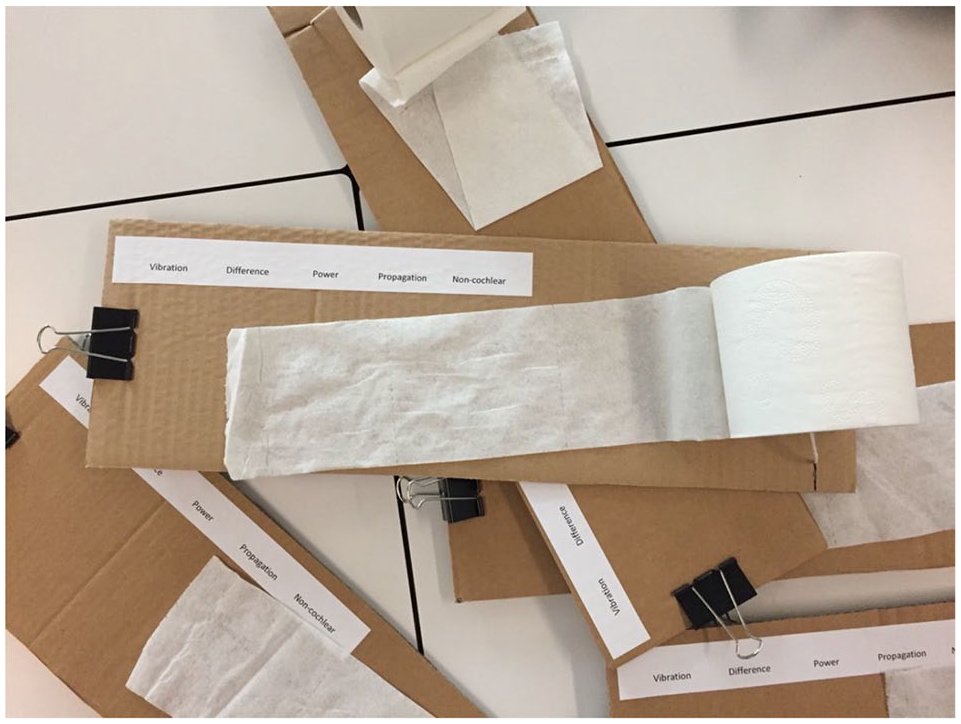
The picture shows Walking Scoring Devices.
I often use toilet roll as an early childhood educator. It’s really good for doing music scoring activities with because, unlike a rectangular piece of paper, the toilet roll extends infinitely so young people can score without running out of space: you can just sort of keep on going and going and going and going and make a terrible mess, but not be limited by the end of the paper. However, the toilet paper is a very poor medium for writing on: you quickly poke through it with pens or the wrong kinds of pencils. If they get wet they turn mushy, and trying to keep a hold of the written-on paper, while juggling the board and your pencil quickly gets you in a tangle. Thus, the construction of the device is designed to imply a kind of usefulness, but they’re ultimately ridiculous and impractical.
In this way, they are propositions for research: They’re enabling constraints in that they confine the compositional process along one axis, to enable a particular, lengthy mode of creativity along the other axis. But they’re also propositions for method and so I’ll share a brief vignette from the project when I used these. At the very start of my research in the school, knowing that I was using electrodermal devices, I wore one device myself for a few weeks and broadcast it onto the classroom’s white board so I could explain what it was doing and how it worked.
One of the young people commented at one point that the peaks and troughs of the electrodermal line reminded them of a train journey, and so the following week I introduced these Walking Scoring Devices. In the same way that the electrodermal devices measure arousal, we used the toilet roll to score a different kind of arousal while listening to Villa Lobos’ The Little Train of the Caipira. The following week, we pulled apart the toilet roll scores and stuck them together in different kinds of ways, which unsettled what the line generated by the electrodermal devices does, making it illegible and ephemeral and refusing that “need to know.” I take up these devices much more extensively in articles (Shannon, 2021a), but there’s obviously a politics to this, which I look to in discussing the next proposition.
Proposition 4: “Remember the politics of approach”:: Research-creation is politically attuned
The fourth proposition relates to how, because it’s more than representational, doing research-creation comes with a responsibility for what the work recirculates. Moreover, in methodologically applying the feminist materialisms, we have to remember that research-creation is a feminist praxis (Hackett, 2021; Truman, 2019), and so not just observing but also enacting emancipatory changes. So, the question that we bring into the research encounter is “What are you going to materialize?”
The research school is in a very diverse part of Leeds in northern England. We had 17 languages in the research class. The work I’m going to draw from is Walking through Leeds on a windy day. It was a soundwalking project, and we composed it between October 2018 and February 2019 when the children were aged 6 to 7 years. The class topic for this period was human and physical features of the local community, which is a compulsory component of the curriculum. Part of the unit was planned to include a walk around the school’s local area. So, the teachers and I discussed it, and I suggested we do it as one of a pair of soundwalks. In preparation for the walk, we spent a few weeks on a “deep listening” project (I’m using deep listening here after the composer Pauline Oliveros and particularly her composition Lear). We practiced listening to sounds both outside and inside the body, and experimented with how audio samples could be worked into music compositions alongside acoustic instruments (including listening to Pink Floyd’s Money and Steve Reich’s Different Trains). We completed this walk around the local vicinity using iOS devices with microphones plugged into them. Initially, I planned to take some audio recordings during this walk and then I’d program them into a keyboard and then we’d use the keyboard to make a new composition.
But two propositions emerged that I had to respond to. First, the wind pretty much ruined the audio recordings. But second, when we came to list the sounds that we heard during the walk, it was highly speculative. The young people said that they not only heard a bus that we passed, some footfalls, birdsong, and Mr. Shannon talking nonstop, but also speculative sounds like fireworks, seagulls, a police car, and a gorilla that I definitely hadn’t heard. With this in mind, the activity changed and instead of using sounds that we found on the walk, I found samples of the speculative sounds, put them into a keyboard, and then we composed with those. But this idea of “Mr. Shannon talking non-stop” also stuck with me and so two months later when we finished working with the keyboard and the sampled sounds, I reintroduced this idea of my talking nonstop to explore how it related to the walk. One of the young people (“Ioan”) commented, “in school, we talking English.”
The following week, we talked about it some more and I proposed recording samples that could be used in a composition using home languages. Some of the children asked for Post-it notes, so they could compose their sentences in advance of recording them. For example, “Abdulrahim” spoke a sentence in Arabic, which five months later, through peals of laughter, he told me had meant “I’m going to smack your bottom”—I had shared it at about four or five conferences by this point so that was really good to hear! Children who didn’t have a home language that wasn’t English spoke in English sentences or else a language that they made up on the spot. Finally, we assembled all these compositional elements and then repeated the original walk, using this composition as an audio walk, playing it into the site, so not only the speculative sounds of the gorilla and fireworks, but also the home language statements then became built into the soundscape, literally materializing these absent sonic presences into the local space. The whole work lasts 33 min and is available on Soundcloud here:
https://soundcloud.com/davidbenshannon/walking-through-leeds-on-a-windy-day/s-9fgdH.
Proposition 5: “Plan to be responsive”:: Research-creation both curates and attends to what emerges
Propositions are responsive but they’re also always curated and that’s really important to how we do research-creation: it’s never just “turning up and seeing what happens.” Rather you have a plan, and that plan is propositional so it can adapt to things that come up. So, the outcome is undetermined but it’s never just “turn up and see.” And the proposition, I argue in the pre-reading I shared (Shannon, 2021b), is helpful for organizing research in that way: as a carefully planned curation that remains responsive to what might emerge.
Proposition 6: “Cannibalize concresced products”:: Research-creation is processual
The product of research-creation is always food for the next wave of research-creation. For instance, in Walking through Leeds on a windy day, the waves of composition that took place, the speculation, the composing using samples, the distortion of the wind, the home languages, and then also how I went on to further compose with the work: So I picked up on some vocal improvisations some other children had done and centered those in the work, providing like a harmonic explanation of what I was hearing it with when the children made those improvisations. And then that became a further proposition for doing the audio walk, which led to a further proposition down the line, and using junk materials to discuss about plastic waste so it’s always something that feeds into the next thing that you’re doing and that’s also true for Oblique Curiosities. The initial nine songs that we came up with have fed into us making a band and a genre (glitch folk), and into a further series of songs and concepts that we continue to work on and publish with. In other words, the products themselves don’t sit still for very long and aren’t what we analyze: rather, they’re food for the next thing.
What Mechanisms Could Be Put in Place at Universities to Help Supervisors and/or Committees Support Students Doing Post Philosophy Inspired Ways of Inquiring?
Like I said at the start, I’m not going to talk about the mechanisms that could be put in place for universities to support students. Instead, I’m going to offer some propositions for postgraduate students: things that I wish I’d understood and attended to from the start. Hopefully, that’ll be helpful for other PhD students.
Clear writing is not anti-intellectual
The first of these is the idea that clear writing is not anti-intellectual. We surround ourselves with such beautiful, poetic theory texts. However, I do wonder sometimes whether these texts value our time in the same way that we value theirs. So, writing with clarity and really laboring over it is something that I’ve really been trying to do over the past couple of years. I think it’s also important as a commitment to doing accessible work too: like, I want to make sure that my colleagues and friends who are teachers or teaching assistants who don’t always speak English as a home language, who don’t always have a first degree, I want them to be able to read this work that I’ve generated. These people taught me how to teach, right? So, if they can’t read it, I have to wonder who it’s for. Certainly, that’s one of the things I appreciate about Karen Barad’s work: she writes so pedagogically. That’s something that I’m really passionate about and it will certainly help with examiners too!
Anxiety is essential to courting failure (but it’s also terrible)
This proposition came from a discussion with my supervisors about a draft of my writing in March 2020. I was talking about Loveless’s writing on the importance of anxiety to transdisciplinary research, 3 and Dr Abigail Hackett left the question, “Is the uncertainty of post qualitative research good for researcher mental health?” This question stuck with me through a bunch of lockdowns and I absolutely think it’s not. I wish I had known how difficult and draining these theories would be to mobilize at the start of the process, so I was expecting it more. Not to dissuade me from taking them on, but just to have realized earlier that that they’re difficult, and they’re supposed to be difficult, and it’s okay that they’re difficult. And part of this, for me, is the importance of being able to press “send” on my writing: I’m terrible for agonizing and shilly-shallying, and moving things up and down pages trying to get a sense of the hugeness of these theories in the written form, and delaying sending anything to my supervisors for as long as possible until it was either perfect or I was beyond caring. Even this week, I sent them a chapter but then (because it was saved in the cloud) I was already rewriting it the next day, which is preposterous, isn’t it? So, just the importance of being able to let writing go is a habit that I wish I’d gotten into much earlier in the process.
Plan everything
As I mentioned earlier, I curate research-creation through propositions. Planning that curation is really important: research-creation is never a “turn up and see.” There are two reasons for this: the first is to make sure that what you’re doing in the classroom is theoretically consistent with the ideas that you have. And the second is the practicalities of these things. While keeping things open to seeing what emerges sounds nice, there are always risks that come with that: like, how are you going to make sure that what you’re going to do is not dangerous if you haven’t already thought it through? So, I’d write a side of paper, planning everything from the practicalities of how to move children between activities, to the artistic interventions we were going to do, to the resources I’d need, to what kind of propositions I was going to share, and how I would go about explaining each of these things to the young people. I’d always change things based on the young people’s suggestions or ideas but usually that’d be for the following episode or later in the sequence, not the current one. That’s also an accessibility element to this: Some of our young people in Neuroqueer(ing) Noise found my presence quite disruptive enough without having things be ad hoc.
Children aren’t always wonderful and erudite
I feel like sometimes, when we read beautiful accounts of research in the classroom, everything seems to be going so perfectly, and the children always say such wonderful things all the time, but it’s just so unrealistic. I think it’s really important that we problematize these expectations. They not only create unrealistic expectations for researchers (especially early career researchers) and for how arts-based methods could unfold, but they also create unrealistic expectations for classroom practitioners and how classroom practice should unfold. And, to be honest, I think it creates unrealistic and problematic expectations of children.
I don’t know if you want to write about all the catastrophes necessarily but I’m certainly trying to account a little bit more for how exhausting research-creation praxis is, and this really is going back to my point from the start about research-creation itself being a proposition. I’m starting to think that it’s kind of impossible in some ways to straddle these three disciplines—of being the artist, the researcher, and the teacher—and still doing them all perfectly and successfully failing in the right way. So, I guess my closing statement is that I think that research-creation practice is a negotiation between theoretical ideals and the practicalities of being in a classroom and dealing with the inevitable pile of puke.
Questions
But, then, also the generative failure of the young people to pass moment-by-moment and how that was responded to by the practitioners is something that I’ve also written about (Shannon, 2020, under review), and I guess it also made space for me to respond in productive ways to the things that went horribly wrong, which I feel like I’m writing more and more about now (Shannon, under review). But also, what I’ve been coming to more and more as I finalize the thesis is the impossibility of that transdisciplinary commitment. Failing to meet the expectations of every discipline is generative but there are also expectations that we can’t afford to fail at. I think my failure at writing, to actually write about these things effectively, succinctly, and quickly, has been animating in terms of my thinking. But also, I need my PhD thesis to be successful and meet the expectations of that discipline. So, like I said earlier, there’s this pressure to fail in the right ways, which “not writing” is not an example of.
With the teachers, this included whatever curriculum goals they were aiming to meet that term, what vocabulary they were using in the classroom, sometimes what resources they’d gotten for a topic. The idea of doing the walk came about because they needed to do a walk anyway. In the workshops, we used the language of “human” and “physical” features of the city, just as they had in their geography lessons. So, then I introduced propositions that not only built on that, but also complicated that. I was also guided by the music curriculum to make sure that we did all the things we needed to do over the year.
And, with the young people, propositions came from things they might have expressed an interest in doing, or things they’d said during discussions. I’d bring these back, whether as quotations or I’d extend them into activation devices that would open up what we did in future sessions. I used activation devices a lot in the classroom, and (especially as it’s a classroom without a shared language) I’d take quite brash activation devices, things that would tip creative thought in particular directions without relying on speech. So, one of the last topics we did was during their work on plastic waste. We’d already done some work sounding plastic objects and recording them as musical samples so I showed them videos of us doing it all those weeks ago and then pushed that a bit further. I introduced Tan Dun’s organic music: I showed video recordings of performers playing water bowls and waterphones: I introduced that in one session and then in later episodes added like those photographs of birds that ate plastic and then the birds died and the plastic sort of takes the shape of the body of the bird, so I introduced those and then we layered up a work about the complexity of “organic.” But also, some propositions weren’t planned, and they were a way of changing the direction of something when it had gone wrong (like the wind ruined the audio recordings on the walk).
And finally, the importance of planning to make sure everything is safe: I walked the route in advance to make sure it was safe. When I had activities that required moving children around the space, I’d make sure to think through how I was going to move them. Things like that. That was quite a long, meandering answer: Did I get anywhere near what you asked me?
We have two more questions [from attendees]. What is the difference between your experience of making the songs and then performing the songs: is each performance iterative and generative or does it feel like you’re singing the happy birthday song, you know, like maybe over and over again?
Serious-play might also relate to access. Thinking about my own trajectory, I didn’t learn to do academic reading until my teacher training: On my undergraduate degree, we just sort of played jazz for three years and I never once looked at a book. So, coming to academic reading relatively late, I struggle sometimes to get through articles and books, and so I guess I try to earn readers’ time: not only in terms of signposting and being very clear, but also entertaining them a very little as they go.
Footnotes
Declaration of Conflicting Interests
The author(s) declared no potential conflicts of interest with respect to the research, authorship, and/or publication of this article.
Funding
The author(s) disclosed receipt of the following financial support for the research, authorship, and/or publication of this article: This research was funded by the Manchester Metropolitan University Vice Chancellor’s scholarship. Open Access publication was supported by Manchester Metropolitan University’s Open Access publication agreement with SAGE.
Notes
Author Biography
