




Abstract
Working with the concept of “leaking,” two art education researchers explore methodological and philosophical approaches to researching with children. Thinking with their individual studies in early childhood classrooms, the authors consider how conventional methods and methodology might leak when encountering the relations of children, classroom, materials, teacher, researcher, and so on. In both of their fieldwork, the notebook intended for field-note taking began to leak, becoming a sketchbook where the researcher and children could engage in collaborative thinking, making, and doing. This leaking provoked a (re)consideration of research with children as a site in which proficient and equally capable participants conjoin to explore the possibilities of research. The emergent events surrounding the sketchbook allowed to rethink the liminal space of researcher positionality, methodology, methods, children’s art, and childhood.
Keywords
Introduction
In this article, two art education researchers critically consider the ethics and methodological approaches to researching with children, with a particular focus on how the notebook of the adult researcher is leaking, provoking new ways of doing research. This inquiry derives from a significant similarity both researchers experienced, in which the notebook intended for conventional written field notes became appropriated as sites that produced collaborative drawing, diverse conversations, and provocative happenings that allow for rethinking research, methodology, methods, children, and childhood in school settings.
Thinking with French philosophers Gilles Deleuze and Félix Guattari’s (1987) concept of “leaking,” we wonder how our companion and use of sketchbooks and pens during our fieldwork caused the conventional ways of childhood research to leak. We (re)consider childhood research as a site in which proficient and equally capable contributors (both child and adult) converge. Rather than a process of prediction or categorization of children by adults through traditional perspectives and methods of research, we explore researching with children and materials by being open to noticing the ordinary yet uncanny happenings in the classroom. Throughout the article, we refer to the books that we carried as both “notebooks” and “sketchbooks.” We use the term “notebook” when referring to a material of the researcher to create field notes, and call it a “sketchbook” to signify the emergent, collaborative site between the researcher and the children.
As we write this inquiry together, we explore how the similar events we experienced during our respective research could be used to think differently and critically about childhood research method/ologies. One researcher conducted a study at an arts-integrated kindergarten classroom for 8 months, and the other in a first-grade general classroom of a public elementary school over the course of a typical school year. In both studies, the children desired to draw in the researcher’s sketchbook upon their classroom visits. As children noticed our ability to draw, they gradually requested more drawings from us and aspired to use the pages in our sketchbooks to draw rather than papers from the classroom. Also, considered as something “cool,” children insisted on using the particular pen the researcher brought and then drew on the sketchbook pages that were initially meant for jotting down field notes. In this act, we find that the children appropriated the tools and methods of research for their own artistic practices. Even when the researchers were not actively taking field notes, the emergent drawings and the events surrounding those drawings became materials to rethink children and childhood.
In what follows, we elaborate on our own extensive analysis and critical discoveries, such as the amplification of equality within childhood research and theorizations of adult/child collaborations among others. Specifically, the purpose of this inquiry is to engage with the leakiness of research methodologies to open up new conceptualizations of both research and childhood.
Leaking
Deleuze and Guattari (1987) assert that “there is no social system that does not leak from all directions” (p. 204). We conceptualize leaking not in its typical, negative connotation of something that is broken and needs repair or replacement, but rather that which exceeds the predictability of a system, producing something new and unexpected. To introduce our thinking about the concept of leaking as well as the case of the researcher’s notebook becoming a site for collaborative data making, we present a vignette from Jeff’s fieldwork where he and two students encountered a leaking pen while drawing in the sketchbook (Figure 1).
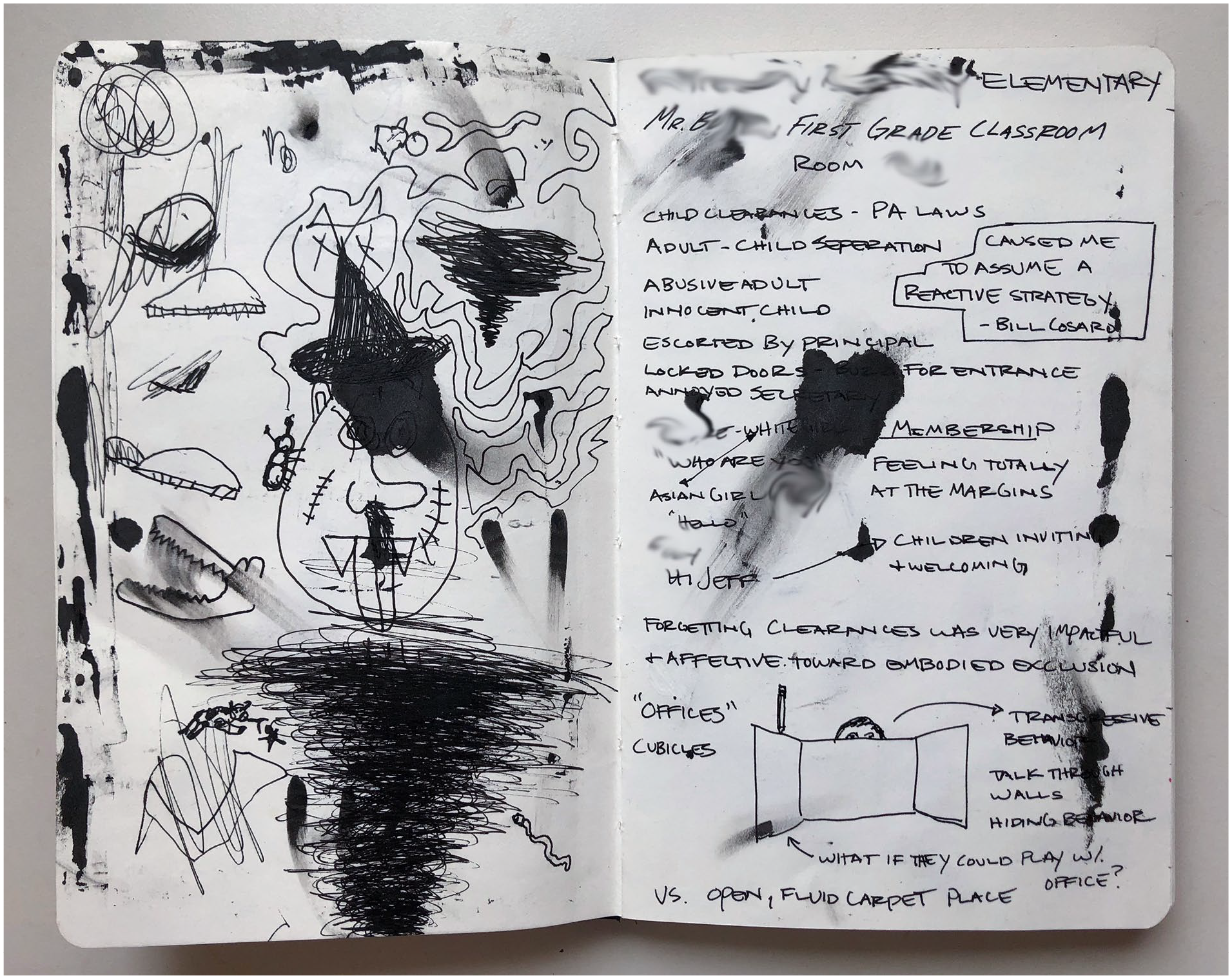
Jeff’s sketchbook.
I arrived at the school with the morning hustle of student drop-off. After entering the classroom and tucking my belongings under the counter, Lance walked over to me and asked, “Can I draw in your sketchbook?” “Of course,” I responded.
I retrieved my sketchbook and a few pens from my bag, and we sat down at one of the kidney-shaped tables.
Lance found an area on a page of the crowded sketchbook and began drawing. Aaron came to the table, asked for a pen, and began drawing in the sketchbook as well. As Lance was drawing, ink dripped off the pen making a blot on the page. Upon further investigation, he realized that there was quite a bit of ink on the pen and his fingers were spotted with ink. He handed the pen to me and asked for a different one. Looking at the pen, I realized that ink seemed to be leaking from a small hole near the tip of the pen. I wiped the excess ink onto the side of the sketchbook page creating a glossy pool of ink. I closed the sketchbook to absorb the extra ink knowing that it would print on the facing page. Lance and Aaron reacted excitedly to the printed ink and asked me to do it again. They looked closely at the pen to see if any more ink was leaking. When they saw that there wasn’t, we continued to draw. I used the leaking pen.
While Lance was drawing tornados, I started adding features to one of the figures. In the middle of drawing a unicorn horn, a gush of ink expelled from the pen creating a seemingly small puddle of ink. As I had done before I closed the page to soak up the ink puddle and transfer it to the other side. When I opened the page, there was a huge splotch of ink on both sides of the page, covering the horn and part of the head on one side and my field notes on the other.
“Oooooh!” we all said in unison. “Do that again!” they implored excitedly. “I don’t know how,” I admitted.
We kept drawing and they often asked if there was any more ink leaking. The pen persisted to slowly leak and the boys continued to ask about the leaking ink. Our graphic play was terminated when the classroom teacher called the class to sit on the carpet for the morning routine.
Pens are not supposed to leak. They are designed to contain and release the ink in a predictable and controllable way. When a pen does not release or contain ink as expected, it is considered defective. A leaking pen, such as the one in the story, may be discarded and replaced because the unpredictable ink disrupts normal pen use. In the vignette, Lance reacted to the leaking pen like many of us would; he considered the leaking pen as malfunctioning and asked for a replacement. However, when the leaking was given attention and began to be experimented with instead of being discarded, it produced a provocation that shifted the event.
While the pen in this vignette was literally leaking, the leaking pen also produces a conceptual leaking. To think leaking conceptually, we suggest, is to consider something as unpredictable, disruptive, and messy. While our use of leaking comes from the work of Deleuze and Guattari (1987), the actual word leak/leaking is used infrequently in English translations of their work. We also found that there is little literature that uses leaking as a conceptual framework. Although used infrequently, the idea of leaking permeates throughout Deleuze and Guattari’s work. Specifically, leaking has a connection with Deleuze and Guattari’s use of the French word fuite. Fuite is most commonly used in their concept ligne de fuite, which, in their book A Thousand Plateaus, Brian Massumi translates as line of flight. The French word “fuite,” however, has much more nuance as Massumi (1987) explains: FLIGHT/ESCAPE. Both words translate fuite, which has a different range of meanings than either of the English terms. Fuite covers not only the act of fleeing or eluding but also flowing [and] leaking. (p. xvi)
Thinking with Deleuze and Guattari’s use of fuite, we engage the concept of leaking to think of the ways that things unpredictably flow, seep, and trickle within contained and closed systems. For example, in the vignette, the normative conventions of drawing began to leak through the leaking pen and produced new ways of thinking and drawing. Instead of “drawing” in the normative sense of representation through techniques such as contour drawing and shading, the act of drawing entailed blotting, pooling, spreading, printing, and smudging. Moreover, another way to think about conceptual leaking is in regard to instrumentality. Instead of the pen being the instrument of the user, it performed an agency of its own, acting in ways unpredictable and uncontrollable, yet desirable. The pen and ink seemed to be the ones drawing and less the children and adult.
What we wish to emphasize is that leaking only happens in relation to containment. Ink cannot leak from a pen unless it is contained. Thus, we hesitate to present a direct critique of containment, but rather think critically about the relation between containment and leaking, alongside our research with children. The concept of leaking has affected the way we think about and do research. We consider methodology and methods as things that both contain and leak. The notebooks we intended to use for taking field notes appeared to leak and expanded into a space where we wrote less and drew more with the children. The role of children in the research process also started to leak: Children became active participants and creators of research and data instead of subjects to observe. In the following section, we investigate the relationship of containment and leaking within method/ology, specifically discussing the sketchbook and the ways in which it was both containing and leaking in our work with children in the classroom.
Containing ↔ Leaking Methodologies
Qualitative methodologies often accompany ready-made methods to employ in the research design, observation of participants, and the collection, analysis, and interpretation of data. We view these as the conventions of methodology that work to contain data into useful and manageable parts that allow the ability to research complex phenomena and ultimately contribute to finding the results of the research question. By “conventions,” we think of research methods that are well established and widely used. However, as Deleuze and Guattari would agree, the conventions of methodologies that contain data and research are leaking from all directions. We think about alternative and anomalous ways that data and participants exceed the containment of methodology, which often go unnoticed because they fall outside the boundaries of conventions. It is our aim in this article to see what happens and what is produced when attention is given to the nuances of leakages in research methods and our relationship with participants.
Among the qualitative approaches to doing research, we present the methodology of ethnography and specifically the method of taking field notes in a notebook, to explore the ways in which methodology and research methods leak. We both employed ethnography in our respective studies. As a descriptive study of a particular human culture that the researcher seeks to learn more about, ethnography has been performed with conventions, including gaining membership (Adler & Adler, 1987), observing participants (Fine & Glassner, 1979; Kawulich, 2005), writing field notes (Emerson et al., 2011), taking visual documentation (e.g., photo or video) that could later materialize into “narrative” forms (Richardson & St. Pierre, 2005), and/or conducting interviews with members of the group to amplify subjects’ voices (James, 2007). During fieldwork, ethnographers typically position themselves as a simultaneous participant-observer of the cultural or social group/system, interacting with and/or participating in the day-to-day lives of those they study for a prolonged period (Creswell & Poth, 2018).
Although the focus of this article is on ways in which methodology and research methods leak, it is important to note that we do not disregard conventional methods of research methodology, as both of our studies were initially designed to work within the conventions of ethnographic methods commonly used by childhood scholars. In fact, we took seriously the ethnographic convention of participant-observer position by actively taking field notes in our notebooks and engaging with the children either one on one or in groups. Akin to the pen that contains ink and acts as a vehicle to transfer information, the researcher’s notebook and the method of taking field notes often acts as a container to materialize the observation experiences of the researcher and participants.
But it was the unexpected events and encounters in relation to the notebook and the children that led us to notice leakages in the conventional methods of doing research with young children, particularly the use of our notebooks as a way to engage with data. As artists and art educators, we regarded our notebook for field notes not so much as a “notebook” but rather a sketchbook, as the purposes of a sketchbook are more fluid compared with a notebook. We feel that it was these qualities of a sketchbook that allowed us and the children to notice, attend, and even produce leakages in our research. We wonder what effect this label of the sketchbook had on our work with the children. Could the sketchbook, as a methodological concept, cause leaking in the ways fieldwork is conducted, field notes materialize, and data are conceptualized?
Stephanie Springgay and Zofia Zaliwska (2015) engage the creative possibilities of research by exploring the leakiness of method and methodology. They suggest, Research . . . becomes not a set of “things” one does but an ecology; a relational set in excess of the actualized experience. Data can no longer be something to be consumed and coded, or even understood, but made edgy; materialized through the production of something new . . . co-compos[ing] ourselves with data-in-the-making. (Springgay & Zaliwska, 2015, p. 142)
The practice of data-in-the-making “finds itself entangled in the middle of data” (Springgay & Zaliwska, 2015, p. 137), which is not only data being produced in “the field” but also within the entanglement of participants, materials, researcher, methods, and so on. Working with the concept of data-in-the-making, research happens “in the middle rather than at any distinguishable beginning” and “does not have any distinguishable end, either” (Powell, 2015, p. 536). The conventional methods of “collecting data” are often occur in a process and are followed by analysis, interpretation, and publication. Considering data-in-the-making as happening in the middle provokes research to engage with the present, in the moment, and less on what is to come.
Regarding research methods as a relational ecology begins to create cracks in conventions of methods and methodology that provokes leakages. Giving attention to the leakiness of methods as they are happening in the middle is to be open to the ways in which methods emerge from within the research event and even in collaboration with research participants. Methods and methodology need not be “one size fits all” but rather they can become immanent within the research itself (Springgay & Truman, 2018, p. 210). Instead of a focus on what methods are, we find it important to consider what methods can do. Springgay and Truman (2018) propose that what methods can do is to “agitate, problematize, and generate new modes of thinking-making-doing” (p. 211). Engaging with a practice of “data-in-the-making” destabilizes the process and methods of research causing them to leak. In the next section, we present encounters from our research that consider ways in which methodology is leaking in relation to the sketchbook, the children, and the concept of data-in-the-making.
Encounters With Leaking
Hayon’s Encounters
While Jeff’s encounter of a leaking pen holds more of a literal metaphor to the materiality of research methods, here I think about leaking more broadly and conceptually, one that spills out of my preconceived notions, positionality, and knowledge about children and their art making. In other words, I am attending to the fluidity or “flow” (Deleuze & Guattari, 1987) of research methodologies and the researcher’s “being” in the classroom, entangled with complex matters and negotiations between the acts of containing and leaking. In the kindergarten classroom, my presence was inseparable from the materials that accompanied me- the spiral notebook and pen- and the children were keen to notice them. For example, in lieu of a simple “Hi” or “Good morning,” a hurried request “Can I draw in your sketchbook?” was by far the typical greeting I received immediately upon entering the kindergarten classroom on every visit. Below are short drawing events that happened during one visit of less than 2 hr (Figures 2 and 3).
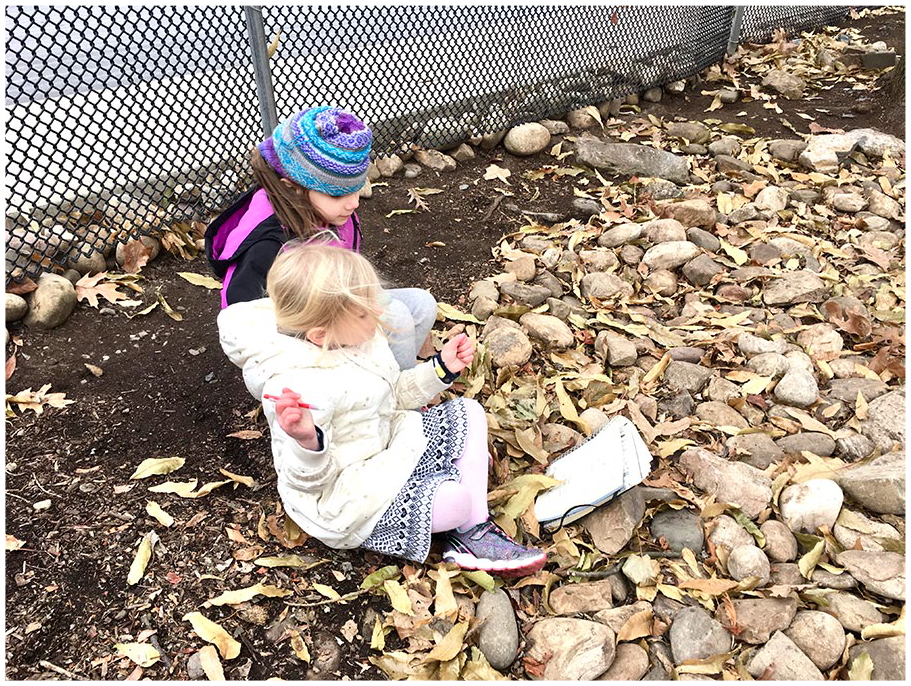
Children drew on my sketchbook at any available time.
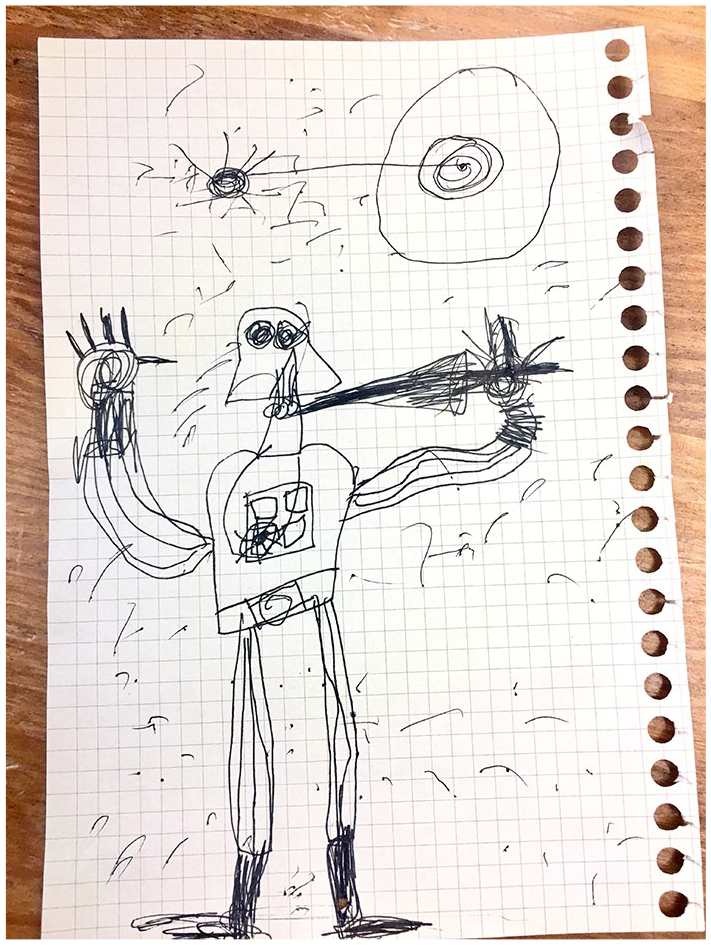
Oliver’s drawing of Darth Vader.
Encounter #1. When I entered the classroom, carpet time discussion on clean-up responsibilities after lunch was underway. Oliver stood up and went to the library area and picked up a book. He then spotted me sitting alone behind the carpet area and said, “You’re back” (I had been gone for a week). Shortly after, he asked me to draw Luke Skywalker from Star Wars. After I drew Luke Skywalker, he then asked me to draw, Darth Vader. I began to draw Darth Vader without looking up the image on my phone (as I often did), thinking I had drawn enough during my time here for the avid Star Wars fans in the classroom. However, Oliver realized I wasn’t drawing Darth Vader’s mask properly, and reminded me, “I said, Darth Vader.” He made me erase the marks and look up a photographic image of the character on my phone. Soon after, he made requests to draw other characters, along with demands to Google search them on my phone as well. At a point where he was satisfied with the marks rendered on the sketchbook, Oliver swiftly ripped off the page from the spiral sketchbook and took it with him as he walked away. As I never saw it again, the image below is not the original work but one that Oliver drew by himself, as his interest in drawing Darth Vader persisted. Encounter #2. Ayla, Leah, and Austin were drawing individually at the art table. I found Leah’s drawing of female figures quite interesting and made a note about this in my sketchbook. Ayla jumped to come close to me and recognized Leah’s name. “Where’s my name?” she asked. “Right here,” I responded, pointing to Ayla’s name written in my sketchbook. She asked what I had written about Leah. I slowly read the note “Leah asks me to draw an image of a girl she found on my iPhone.” After listening carefully, Ayla asked me what the word “image” means. I answered that it is similar to “a picture.” She was also curious about why I was taking notes, to which I responded, “Because I want to keep a record of what happened and remember it.” Ayla then demanded, “You should also write about Austin.” Without hesitation, I agreed, “Yeah, I should” and wrote Austin’s name in my sketchbook page.
These encounters invite me to think about the leakages in research, especially in how the binary of “the researcher” and “subjects” gets to be reimagined. Although I initially considered the sketchbook as a container for “data,” primarily in texts, it developed into a material of provocations and an open collaborative site for drawing in which methods of ethnography leaked. As seen above, there was no neat distinction between my activity of collecting data and engaging with children. Rather, it was an entangled matter where children were active contributors to making the data as they discovered the affordances of the sketchbook. In fact, my few attempts to actually use the notebook for note-taking drew more attention, often resulting in sharing the contents with children, as seen in Encounter #2. The leakages happened not only in the attempts to collect data, particularly in written field notes, but also in my positionality as a researcher and children’s role as participants.
Our sketchbooks for field notes were initially meant to contain knowledge and experience, one that often holds the authority of confidential information of the research. But the sketchbook as a field-note container began to leak. The sketchbooks were always open, blurring the lines of ownership as children actively contributed to the unfoldings of happenings. The pages were out of order, data/information in the sketchbook no longer confidential, and, in fact, directed by the children. The authorship of the contents was no longer solely belonged to the adult researcher but the children as well. Children became researchers, creating field notes and making data. Through our experiences, we consider the sketchbook to be something less determined and more fluid.
Jeff’s Reflection on Leaking Pen Vignette
I find it very curious as well as serendipitous that the encounter of the leaking pen described earlier (which happened near the end of my fieldwork) took place next to and on top of the notes I took on the first day I visited the first-grade classroom (Figure 1). Looking at those written field notes, I can see how I came into the classroom with a mind-set to research about the children and the school. I was trying to employ the techniques and thinking that had been discussed in my graduate courses about how to conduct ethnography and compile field notes. Those methods and thinking quickly started leaking on that first day visiting during an encounter with a group of children (Figure 4): Sitting at one of the tables watching, writing, and drawing in my sketchbook, Alex approached me and asked. “What are you doing?” “I’m writing in my sketchbook,” I responded. Alex looked closer. Sensing her interest, I began flipping through my sketchbook to show her some of my drawings. Alex took over, turning the pages and studying the drawings. Soon Aaron and then Nora joined. “You’re really good at drawing,” they remarked. Pointing at one of the drawings Aaron asked “How do you draw like that?” I explained one of my techniques of smudging the ink and demonstrated on the page I was currently writing field notes. I drew a square, made a quick squiggle inside, licked my finger, and used my saliva to smear the ink. “Can I try?” Aaron asked I handed him the pen and slid the sketchbook on the table closer to him. He drew a squiggle, licked his finger, and smudged the ink. Alex and Nora also took turns smudging the ink in the sketchbook.
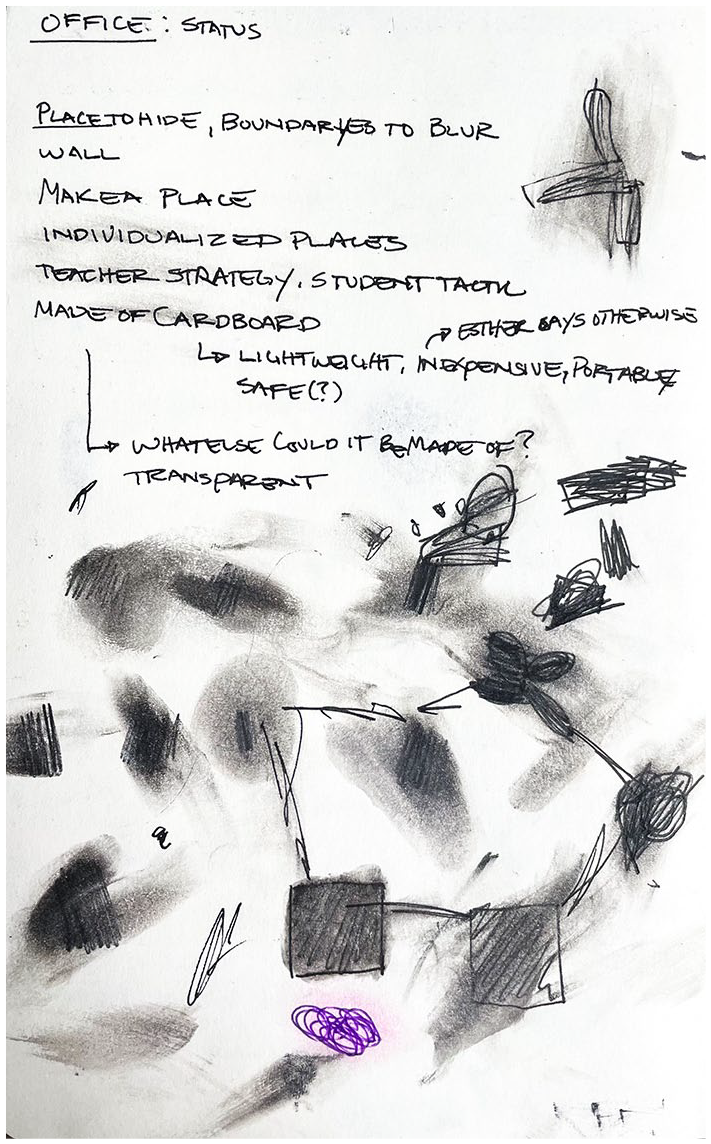
This page featuring field notes and smudged ink from Jeff’s sketchbook is located on the backside of the right page of the leaking pen event.
When Alex first approached me, I was engaged in conventional ways of doing childhood research through visual observation and written field notes of what the children were doing. Observation and field notes were two main ways that I intended to collect data. But that containment of data suddenly began to leak. Instead of recording (containing) about what the children were doing, my note-taking quickly turned into smudging the ink with them. The conventional research method of writing field notes in a notebook shifted to collaborative drawing in a sketchbook. Instead of data as something to be collected, the data were something that were created, and not only pictorial images but a collaborative and relational event of children, pen, adult, sketchbook, saliva, and so on. But data are not just something created within fieldwork. As I have continued to linger with these events in the classroom as well as bringing them in relation to Hayon’s experiences, I have been able to think about the data in new ways. As I attended to the ways that Hayon and the children engaged with the sketchbook, I was able to think about my own experiences and data differently. Research methods are not necessarily isolated or temporal, but rather, through the concept of data-in-the-making, research becomes relational and immanent with participants, materials, researcher, methods, and so on.
Leaking as Productive Side Effect
Leaning on an expanded understanding of childhood research through the concept of leaking, we suggest that working with children often constructs cracks within the containing conventions of methodologies that cause them to leak. We suggest that children are often actively searching for potential leaks to create their own space in an adult-centered world. They seem more open to experimenting with the containment of systems, including conventions of research. As we were able to see in Hayon’s story of taking field notes with children, the children did not miss the opportunity to actively participate in the research practice, one that demanded our attunement to reflect on our presence and relational matters within the site. Perhaps these seemingly undesirable or unexpected effects allow deeper engagement with researching with children. In fact, often times, research is about allowing ourselves
to be infected by the effort, investment, and craze of the particular practice or experience being investigated. Some might call this participation that is more artistic and, as with most artistic practices, it comes with the side-effect of making us more vulnerable and self-reflexive. (Dewsbury, 2016, p. 7)
Perhaps leaks are a productive “side-effect” of researching with children, which leads us to a vulnerable position that demands continuous self-reflection and attentiveness. In other words, though leakages might instantly cause discomfort, these occurrences that emerged from us being “infected by” engaging with children might in fact lead us to meaningful opportunities. How might childhood research be more open to attending to these side effects?
Our leaking research also revealed how adults’ desire to control the research and find solutions tends to overpower the curiosity about uncertain realms of research with children. The instinct of the adult researcher is often to securely contain and effectively govern the data and process of research. However, Olsson (2009) argues that a teacher/researcher should focus on what is immanent in the situation: Look for and construct the production of sense through nonsense. Do not look for solutions; look for and engage in the construction of problems and how this relates to the sense under production. Do not look for knowledge, look at learning processes, that is, look for and construct how the involved bodies join a problematic field. Do not look for methods, look for and construct how the entire culture surrounding the entering of a problematic field proceeds; take into account thoughts, speech, actions but also material and environments. (p. 119)
The leaking ink in the vignette presents a side effect of the pen that constructs a problem: the ink becoming uncontrollable and unpredictable. A solution to this problem could have been sought so the pen could continue working in its conventional and predictable methods. However, instead of finding a solution, the problem, while not making much sense, became a provocation to work with. It is the problem of the nonsensical that often lies in tension with the sensical. What made sense when we started our research was collecting data through the method of conventional field-note taking. Initially, when the children began engaging with our sketchbooks through drawing, it did not make much sense in relation to the conventions of doing research with children. We could have found a solution to this problem by telling the children that they should not draw in our sketchbooks, that we, as the adult researchers, were the only ones to be able to use the sketchbook and offer them another place to draw. Instead, we attended to the nonsensical problem by being curious and open to what might be happening. This openness and attention to the leakiness of methodology augmented the way we thought about and did research with children.
It is this problematic field between sense and nonsense with which we wish to linger—a liminal yet productive site between the urge to contain and the deliberate will of being open to what is to come in our engagement with children. It is also an invitation to educators and adults interested in children to be open to leakages so that we may also stray away from driving our interactions with children in directions that are too often contained. We, therefore, promote the constitution of side effects and the diversity of tensions—tensions that work as our greatest pedagogical tools in working and researching with young children.
Conclusion
We want to re-emphasize that leaking is contingent on acts of containment. It is certainly not our intention to suggest that conventional ways of doing research should be discounted or replaced, as we recognize how these established research approaches are useful and important. The issue lies in when we, as researchers, prioritize the conventional methods that shut down new possibilities of doing research. Our goal is to suggest openness and careful attention toward the leakiness of research where both conventional and experimental methods coexist.
In our work with children, the sketchbook became both a method and a methodological concept to think about research. By attending to the leakiness of conventional ways of doing research, we think about the sketchbook as a way to practice “data-in-the-making” (Springgay & Zaliwska, 2015). The sketchbook offered a site where both the adult and children converged to engage with each other, with drawings, and with research. Although we are not suggesting or promoting the sketchbook as a groundbreaking method for ethnography, childhood research, or research in general, we do believe that the material enacted as a collaborative site where research methods and practices were reimagined. In other words, the use of sketchbooks and the events surrounding them emerged from our work with the children and augmented the ways that we were thinking and doing research. What we do suggest, though, is an openness to the leakiness and emergence of research, that method and methodology become immanent within the research, contingent within the relations of places, people, and things.
There is no need to wonder if or where the leakings will arrive because it happens from all directions even when we fail to notice them. What we can do is try to be attuned to that leakiness by being open to what might happen. We find this openness to the unknown especially pertinent in childhood studies. By carefully attending to children and the ways that they think, make, and do, we can begin to notice the leaks in our own thinking and research.
Footnotes
Authors’ Note
All names of children are pseudonyms. Jeffrey M. Cornwall is now affiliated to The Pennsylvania State University, University Park, PA, USA.
Declaration of Conflicting Interests
The author(s) declared no potential conflicts of interest with respect to the research, authorship, and/or publication of this article.
Funding
The author(s) received no financial support for the research, authorship, and/or publication of this article.
