




Abstract
Taking the starting point that working with the concepts of Deleuze and Guattari requires relentless experimentation, this article builds on recent scholarship and (anti) methodological experiments to advance the boundaries of that work in qualitative research. Through a new and experimental encounter with one of their qualitative studies, the author grapples with the experience of embracing Deleuze and Guattari’s key concepts and what they mean—in this case—for their research practices. Their events, insights, and breakthroughs are presented through an imagined art exhibition and catalog entries dealing with the process.
Keywords
You stand before an artwork, a poster, holding an exhibition catalog. Displayed in front of an open door, the poster says:
Co-ordinates presents the images, texts and voices that escape when chaos is introduced to a neatly told story. The exhibition collects the detritus produced when documentation of a research project was introduced to the philosophy of Gilles Deleuze and Felix Guattari. Participants are invited to use the detritus to generate new co-ordinates by moving between images, memos, and voices, catalogue in hand to help with navigation. This virtual exhibition is here for a moment.
Catalog, Page 2
I exhumed my study and picked it apart. As I picked out the parts and threw them over my shoulder, I created non-sense. What started as “dismantling” became a stumbling, tumbling process of letting a presentation of my study fall apart to reveal its seams, joins, and possibilities.
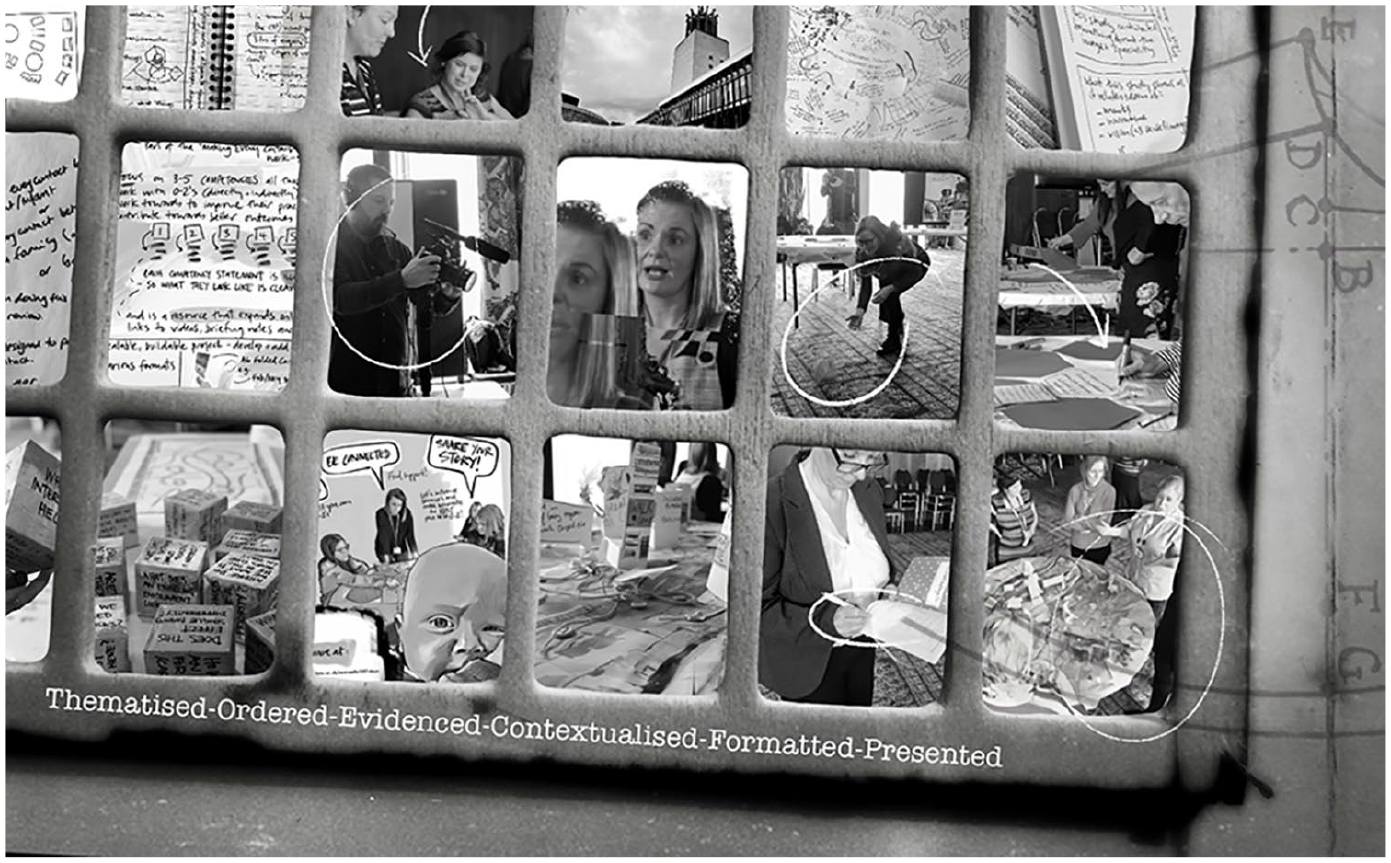
Pieces of a Study. 1
Catalog, Page 3
In developing this exhibition, the artist challenges their own inquiry methods and methods of qualitative research. Qualitative research is selected because it has much work to do, in:
. . . understanding, describing, explaining, unravelling, illuminating, chronicling, and documenting social life . . . the everyday. . . the mundane and ordinary, as much as to the extraordinary . . . study of the self and the complex relationships between, within, and among people and groups, including our own entanglements. (Leavy, 2020, p. 2)
Much qualitative research remains tethered to the objective paradigm and its ontologies of and epistemologies which restrict the ways these phenomena are conceptualized (Epstein, 2015). In addition, parts of qualitative research that remain grounded to the scientific method remain restricted in how such phenomena can be researched. Springgay and Truman (2018) discuss the predominance of qualitative research’s “methodocentricism, the pre-supposition of methods, a reliance of data modelled on knowability and visibility . . . and the dilemma of representation” (p. 204). MacLure (2013) warns about its methods treatment of data as an “inert and indifferent mass waiting to be in/formed and calibrated by our analytic acumen or coding system” (p. 660). There are many challenges to engage in the sort of critical, reflexive, and adaptive processes that reject “cookbook” methods and inflexible procedures (Silverman, 2020, pp. 4–9).
Much progress has been made in parts of the qualitative research field to explore beyond these frameworks. Postfoundational (Jackson & Mazzei, 2023) frameworks such as posthumanism (Braidotti, 2019), affect theory (Knudsen & Stage, 2015), and speculative fictioning (Burrows & O’Sullivan, 2019) have set out new “onto-epistemologies” (Barad, 2007) in qualitative enquiry. Most of these frameworks can be connected to the seminal work of Deleuze and Guattari (1972/2004, 1987/2004). However, developments in the practice of Postfoundational/Deleuzian qualitative research are proving resistant to change (Mazzei & McCoy, 2010). Springgay and Truman (2018) define the problem, which is not “this method or that,” but “The logic of procedure and extraction” (Springgay and Truman, 2018), which presumes methods can be known in advance, and that objective, inert data can be gathered.
In challenging the “logic of procedure and extraction” (Springgay & Truman, 2018) and turning to methods as postfoundational (Jackson & Mazzei, 2023) becomings, processes, events, chaos, or accidents, more examples are needed, not as templates or findings, but as events which open space for speculation and experimentation. This is an area in which the exhibition positions itself—as an event/site of speculation and experimentation in which the visitor (and qualitative researcher) can explore new co-ordinates, from the inside.
Video Installation (Clip) [a].
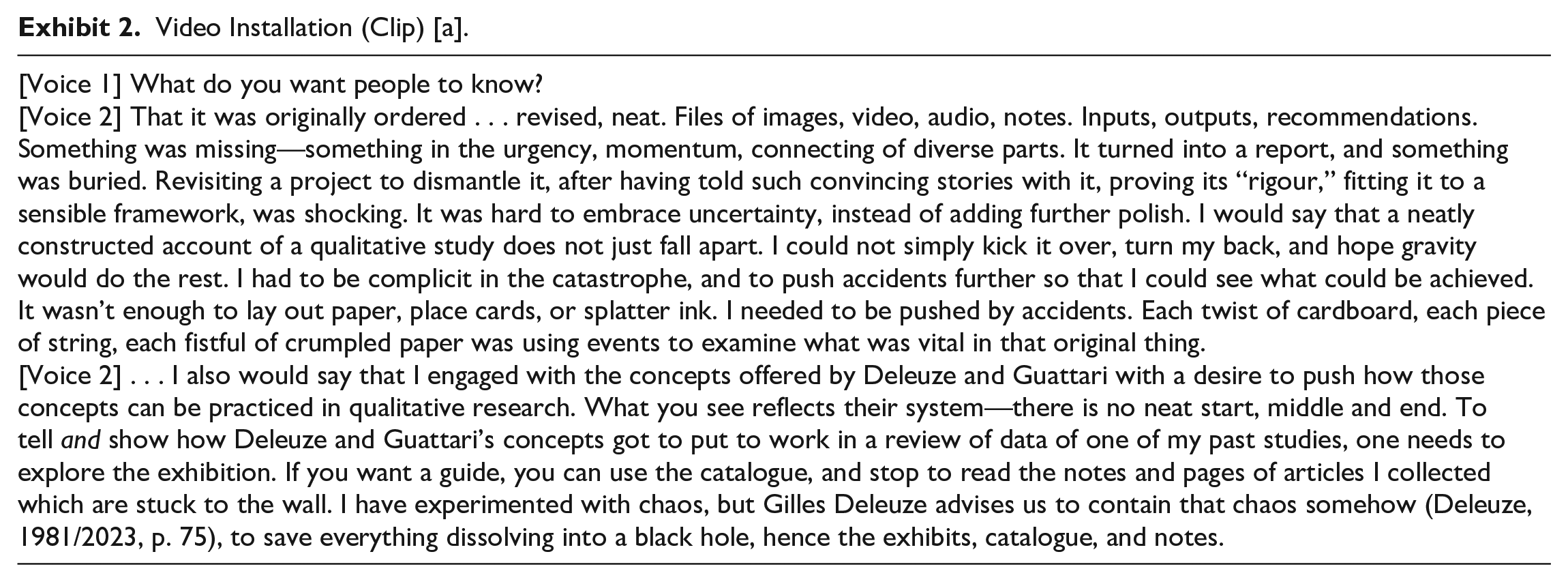
“I Imagine This Is From G. Deleuze”.

Catalog, Page 4
The exhibits are flat. Like Deleuze and Guattari’s philosophical system, everything is located on the surface, a single surface. In the immanence of the surface, the virtual and actual exist together (St. Pierre, 2019, p. 5). This opens all sorts of possibilities. The virtual is a dynamic field of possibility, potentiality, and the actual is that which is produced (e.g., an artwork, building, social structure). Virtual and actual are in a dynamic relationship, and on the immanent surface, differentiation produces the actual from the virtual. Differentiation unfolds the virtual at different points through variations (see “actual events” in Exhibit 4). Each (actual) brushstroke of the painter creates (virtual) possibilities that build upon it. There is no fixed “pure essence” of a structure, culture, or social relations as everything can be opened to new arrangements, connections, flows of desire, and systems of production.
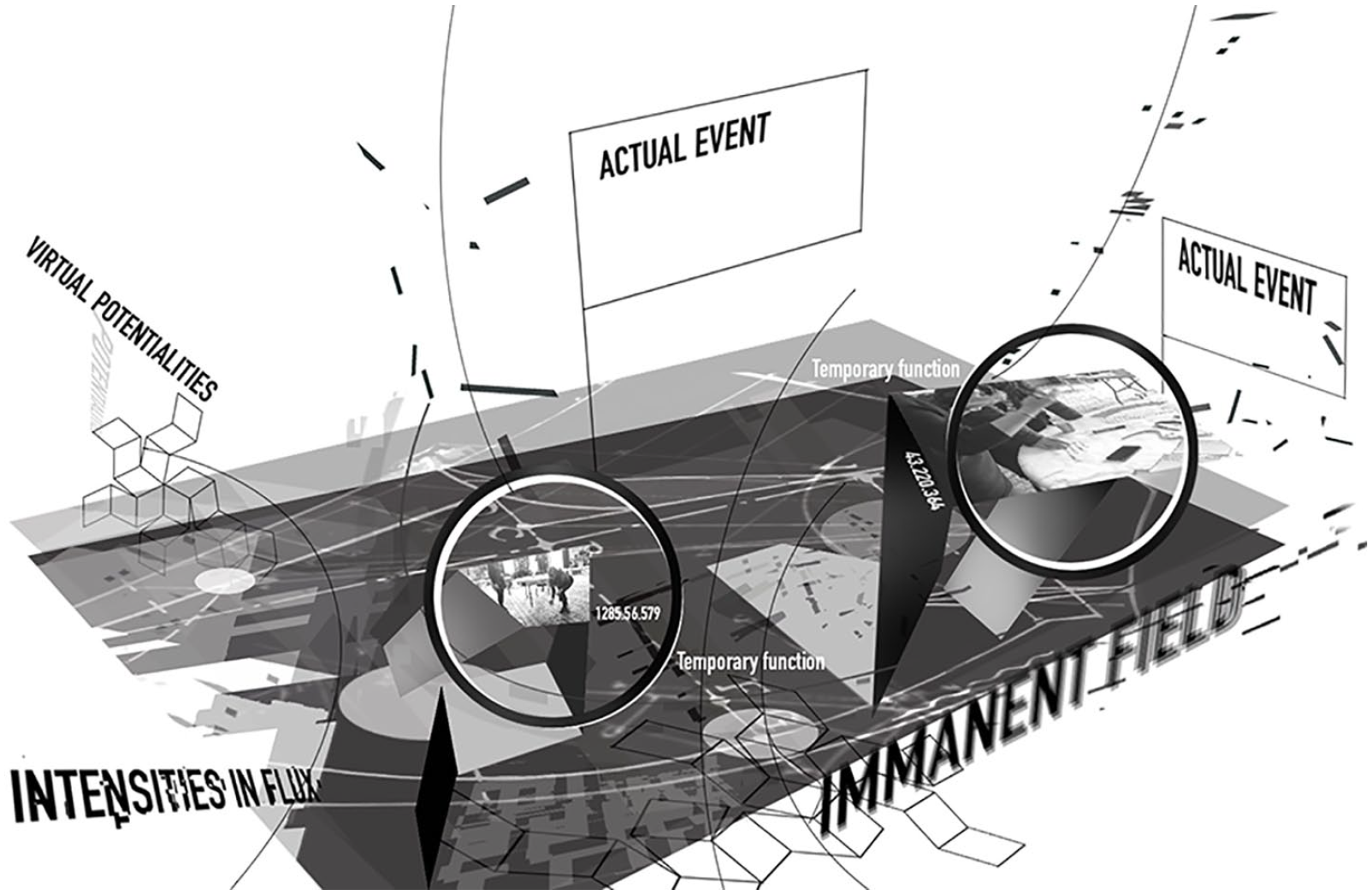
Surfaces and Actualized Events.
Immanence, and the work of the virtual and actual, is key to the project of Deleuze and Guattari, which focuses on dynamism, differentiation, and creative production. In the foreword to their 1972 text Anti-Oedipus, Foucault suggests that the work of Deleuze and Guattari asks “Questions that are less concerned with why this or that than how to proceed . . .” Their work “can be best read as an art . . . art as living counter to all forms of fascism” (Deleuze & Guattari, 1972/2004, p. xiii). In their own words, Deleuze and Guattari talk about philosophy as a creative project which must embrace ambiguity, make connections across diverse elements, and insist that all concepts must be “. . . invented, fabricated, or rather created” (Deleuze & Guattari, 1991/1994). Their concern is less about being “correct” than the selection of that which is useful (Deleuze & Guattari, 1972/2004, p. 134) and the ability to experiment with connections (Deleuze & Guattari, 1987/2004, p. 4).
Catalog, Page 5
Foundations for Deleuze and Guattari’s Schizoanalytic project built on the work such as Reich’s (1933/1997) The Mass Psychology of Fascism and were established in their 1972 work Anti Oedipus. As a project, Schizoanalysis rejects Freudian and Lacanian formulations of desire as a response to the absence of something in family relations and the organizing project of psychoanalysis generally. For Deleuze and Guattari, desire is re-stated as a productive force. Anything that produces a flow is a desiring machine. By replacing the individual as the focus of Schizoanalysis and introducing desire as a productive force, Deleuze and Guattari open the productive field of action (i.e., its scope, scale, and diversity) beyond the analysts’ couch. They also de-couple “production” from individual Oedipal, purpose-driven action, positing all production as the work of machine-like assemblages.
Video Installation (Clip)[b].
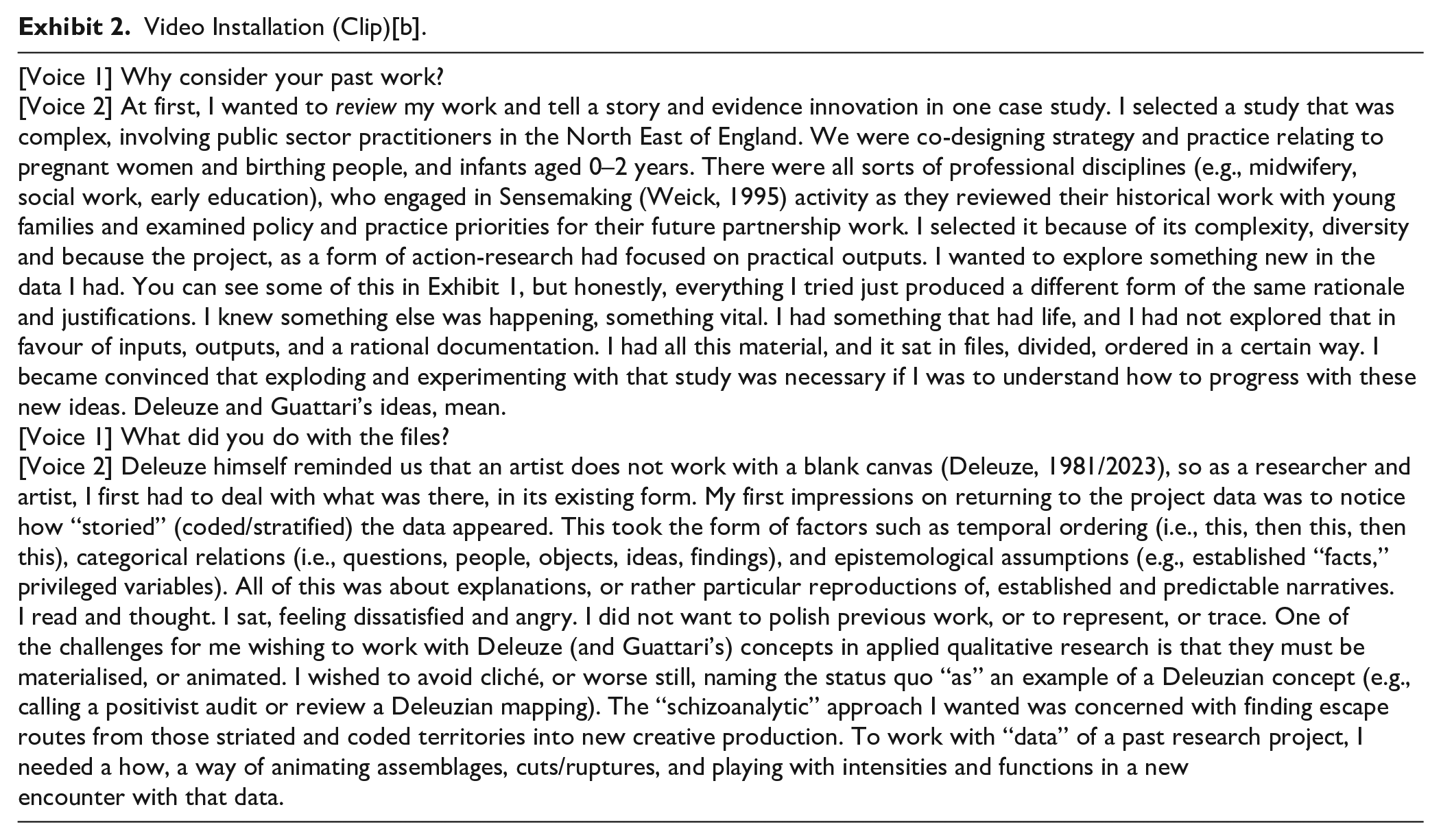
Catalog, Page 6
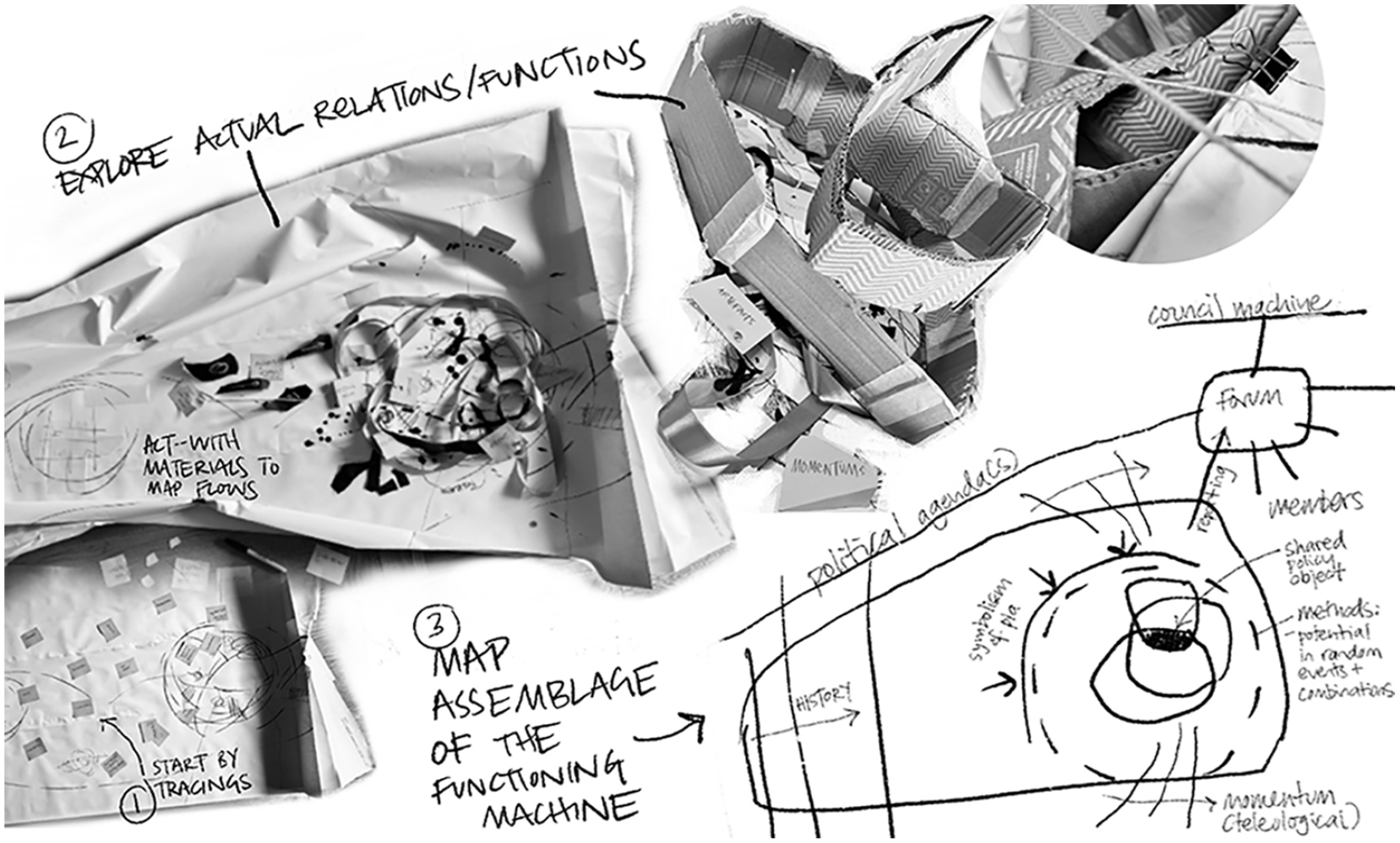
Exhibit 5 presents the artists’ process in creating an “assemblage” relating to the now deconstructed study. The artist sketches his process in note form, reproduced here:
i. Placed cards associated with production of something “new” on paper surface.
ii. Connected cards with string in basic functions (e.g., “new format” <> “browsing,” and “artifacts” <> “handling”).
iii. Then, tentative marks—introduce sensation of flows of activity/trajectory and proximity of lines/materializing sense of how participants were drawn in to a series of enquiry workshops.
iv. . . . pulling string led to a collapsing of part of the surface (unexpected: pinched and folded paper to bring things closer together and show acceleration/rhythm of activity).
v. Assorted materials handled to give sense-presence of original workshops: curious browsing, diffractive conversations, unexpected couplings of people-material in the study. Build these up from surface >looped, wrapped, tore, distributed ink splatters/exploring affordances, what it could or could not do/intense/engaged. (handling = mapping of the connections at work in the study).
Mapping the Assemblage.
Exhibit 5 retains tracings of preparatory activity (i, ii, iii) now mostly obscured. Tracing is an act of reproduction in which pre-existing structures are copied to a different surface. In this case, tracing with cards and line drawing have been used with caution by the artist as they play with means of taking basic information (e.g., sequences, methods, questions) from the records of the original study, as a means of starting from somewhere to find the ruptures, events, and cuts that show the assemblage at work. The work of tracing is implicated in the new; however, this is an ambiguous and dangerous activity. In its basic form, tracing is a tool of reproduction and perpetuates cliché. By itself, tracing or cliché has none of the desire, flow, or creative production Deleuze or Guattari are interested in. But one must start somewhere, and the cliché can be ruptured and its rhythms diffracted. Look at the art of Duchamp, Höch, Rauschenberg, or Sherman, which all subverts cliché. In Exhibit 5, tracing is limited and played with to provide a basis for mapping.
Mapping (here, the looping of cardboard, connecting with string, throwing ink, etc.) is the exploratory method, or “militant cartography” (Watson, 2009, p. 97) which is central to the production of new forms and concepts, and so to the schizoanalytic project. While utopian or romantic maps replace one fixed representation with another, schizoanalytic mapping is a relentless play with possibilities, and how they may be realized. Mapping is an activity focused on exploring the unknown (Zdebik, 2012, p. 34). Each map produced is unique to its case and situation (Watson, 2009, p. 11), so that it can affect the social transformation that Guattari was particularly concerned with (Watson, 2009, p. 16). Mapping is not a process that can be scheduled or specified in advance and is opposed to proceduralism because it is a form of contained chaos. Mapping is therefore a “precarious undertaking” (Watson, 2009, p. 114) in which care and chaos must work together. Ultimately, mapping can produce escape routes, or lines of flight from the actual into the (yet unrealized) virtual potential in the assemblage (Watson, 2009, p. 128). Lines of flight (escapes, new flows) come from careful examination of sites of rupture. Mapping explores the assemblage.
Assemblages are the “minimal unit of systematic organization” (Zdebik, 2012, p. 24) and operate by selecting and structuring, or coding and territorialization (Buchanan, 2021, p. 21, Zdebik, 2012, p. 26). Deleuze and Guattari’s assemblages are actual and connect to situations of material, place, and time which can be transformed. They “combine various components in different configurations” (Watson, 2009, p. 77) that can be biological, psychological, or social (Watson, 2009, p. 78) and are as diverse as ant colonies (an assemblage of ants, tunnels, territories, chemical trails, food sources, and threats) (Deleuze & Guattari, 1987/2004, pp. 141–143), affective assemblages (of emotions, sensations, memories) (Deleuze & Guattari, 1987/2004, pp. 157–160), algorithms (an assemblage of human bias, codes, data sets) (Gillespie, 2014), or in research design and activity (assemblages of institutions, contracts, methods, roles, and history).
Assemblages are unstable instances of complexity, freedom, and creation (Watson, 2009, p. 78)—explosions, rotations, and vibrations—those things that excite desire and cause flows (Buchanan, 2021, p. 72) such as new branches of an ant colony, a new way of relating data sparked by a glitching algorithm, or a new research encounter that comes from a researcher folding and rupturing her designs. Studying assemblages begins with questions, including embodied and sensory questions. Each assemblage is the answer to the question “given a specific situation, what kind of assemblage would be required to produce it?” (Buchanan, 2021, p. 22). As assemblages are forms of connective work, we can ask what they connect, and what parts they need to do their work (Buchanan, 2021, pp. 131–132).
Catalog, Essay: Literatures of Being Minor
Pieces in this exhibition showcase an exploratory change of style and format, corresponding to the artists past work. They describe this as “research.” In this short essay, the artist is identified as researcher, (re)working with concepts of Giles Deleuze and Felix Guattari. As their own critic, the artist undertakes a project in which the presentation of some past work is considered a form of orthodoxy, or proceduralism in which the vital movement of inquiry is removed, leaving what they call “facts.” Their studio is filled with texts (some on the floor, some pinned to the wall). The resultant collage of pages accompanies the exhibition, and visitors are encouraged to navigate terms such as “minor enquiry,” “immanent research,” “assemblages,” “becoming molecular” and “palpation” as concepts at work in moving beyond proceduralism.
For Deleuze and Guattari, a “minor science,” produced by the marginalized, is more interesting than the royal science, maintained by the dominant scientific paradigm (Deleuze & Guattari, 1986). A minor science is a procedure that is nomadic, eccentric, and “. . . follows the connections between singularities of matter and traits of expression, and lodges on the level of these connections” (Nordstrom, 2018, p. 369). Discussing the problem of conducting a “minor enquiry,” Mazzei et al. (2020) highlight the ever-present “. . . problem of communication, or representation” (Mazzei et al., 2020, p. 306), or how such research speaks to established systems of policy and practice. In applied research contexts, expectations around “evidence” and justification are maintained by royal policy and audit machines (Masny, 2016, p. 666). Many qualitative researchers at times face expectations for research to be “. . . definite, simplified, and prone to particular types of answers or expected outcomes” (Koro-Ljungberg & Barko, 2012) and may also be driven by pressures to “. . . promote definitive, simplified and ultimate answers even when studying complex and multidimensional . . . problems” (Koro-Ljungberg & Barko, p. 256).
Moving past “definite and simple” and toward the concepts of Deleuze and Guattari requires a fundamental shift in what qualitative research is and what it involves. This started for the artist by interrogating research “givens” and engaging with Deleuze and Guattari’s work so to denaturalize the “dogmatic image of thought” that restricts and traps (St. Pierre, 2017, p. 695). In qualitative research literature, the most fundamental progress with Deleuze and Guattari has involved disturbing this dogmatic image of thought and deterritorializing research practices. In 2011, Maclure has questioned how successfully we have been breaking these practices and of “. . . putting theory to work in the doing, thinking, and writing of research . . .” asking—“Are things as ruined as we have hoped?” (p. 998). Since then, others have joined voices, and a more coherent challenge to qualitative research has grown. The call is to explore the nature of minor science, and its drive to “. . . normalize qualitative research through a series of discrete processes that form an imperative” (Nordstrom, 2018, p. 369).
Such a shift to a minor science involves nothing less than examining “. . . conditions under which concepts are created and expressed” (Jackson et al., 2017, p. 666), loosening qualitative research from the imperatives of “knowledge production and a conventional dependency on procedural method” (Jackson et al., 2017) and the impulse to methodological frameworks (Hein, 2021). The stakes are high—labels, language, and models become problematic when they shorthand the thinking and doing of research (Schulte, 2018). Similarly, reaching for “some theory” imposes a lens or framework and its categorization (Mazzanti & Freeman, 2023; Schulte, 2018; Taguchi & St. Pierre, 2017). The alternative? According to Jackson et al. (2017), the break leads to embracing encounters that disturb, which use difference, de-center us, and fracture both the subject and ways of thinking. In this shift, our ways of talking, knowing, and doing qualitative research must be transformed (Mazzei & McCoy, 2010; Schulte, 2018, p. 196). Control and structure will not help the qualitative researcher to meaningfully anticipate the “how/when/why/where” (Taguchi & St. Pierre, 2017, p. 644) of an idea. However, for some, the lack of methodological ties involved in minor, “fully immanent research” may be unacceptable, and researchers must grapple with “difficult and uncomfortable” consequences (Hein, 2021, pp. 516–518).
Considering issues and situations as assemblages (Exhibit 5) has been one of the transformations which have been explored in qualitative research literature. Individual questions and findings can be treated as assemblages or relations of things that produce something (Feely, 2020; Koro-Ljungberg & Barko, 2012). In their review of social inquiry utilizing the concept of the assemblage, Fox and Alldred (2015) found a set of distinct advantages to using the concept. First, considering the research/event as an assemblage materialized greater varieties of data sources. Second, in place of methodology, key questions guided mapping of assemblages—such as “which affective relations articulate this assemblage?” and “what can the flows it produces do?” Such exploration has prompted others examination of deterritorializations and transformation. For example, Duff (2014) wrestled with the “paradox of subjectivity” (p.x) in studying experiences of embodiment and health. They found it productive to view “assemblages as the proper object” (p. 51). In such a shift, the problems and questions focused on capacities for affecting and being affected (Duff, 2014, p. 42). This enabled a focus on the Spinozian/Deleuzian question of “what can a body do?” (a relational question) as opposed to “what is a body?” (a question about an isolated subject).
Seeing data/production as assemblage is not enough. Knowing how to move with/in assemblages is key to producing movement, discovery, experimentation, and “artful knowing” (Mazzanti & Freeman, 2023). Mazzei and McCoy (2010) quote correspondence, arguing, “The difficult theories of Deleuze are now becoming the easy part, whereas the handicraft and inventive creative process of doing analysis becomes what is difficult” (Mazzei & McCoy, 2010, p. 505). In 2010, Mazzei and McKoy identified a lack of progress in how qualitative research practices were responding to Deleuze-Guattarian concepts. The articles they presented were examples of . . . moving. They characterized this moving in a “zigzag path . . . lurching, stammering, stuttering” (p. 508). Thinking of anti-methodological and postqualitative research sympathetic to Deleuze and Guattari has been fostered since this time, producing an image of inquiry focused on creation rather than reproduction. What has been called for is inquiry that “. . . constantly makes, unmakes, and remakes itself as it travels” (Nordstrom, 2018, p. 224).
To engage with this urge, qualitative researchers have been learning to do things like encounter, subvert, and dissolve. Inventing new, “nonstratified strategies” (Jackson et al., 2017, p. 673) has involved “. . . forgetting method, starting in the middle, and being receptive to chance encounter . . . [thinking without method] withdraws from rules, sets off chain reactions, and suspends finality” (p. 673/4). The challenge still is to encounter the real, not rehearse method (St. Pierre, 2019, p. 11). Being immersed in assemblages of data means creatively connecting “signs, structures, materialities, and practices” in entirely new ways, to see what unexpected and problematic happens (Schulte, 2014, p. 4). This is not something that can be fully planned and controlled or modeled. It is different each time it appears, dependant on “different contingent and unpredictable forces in experimentation with the real” (St. Pierre, 2019, p. 10).
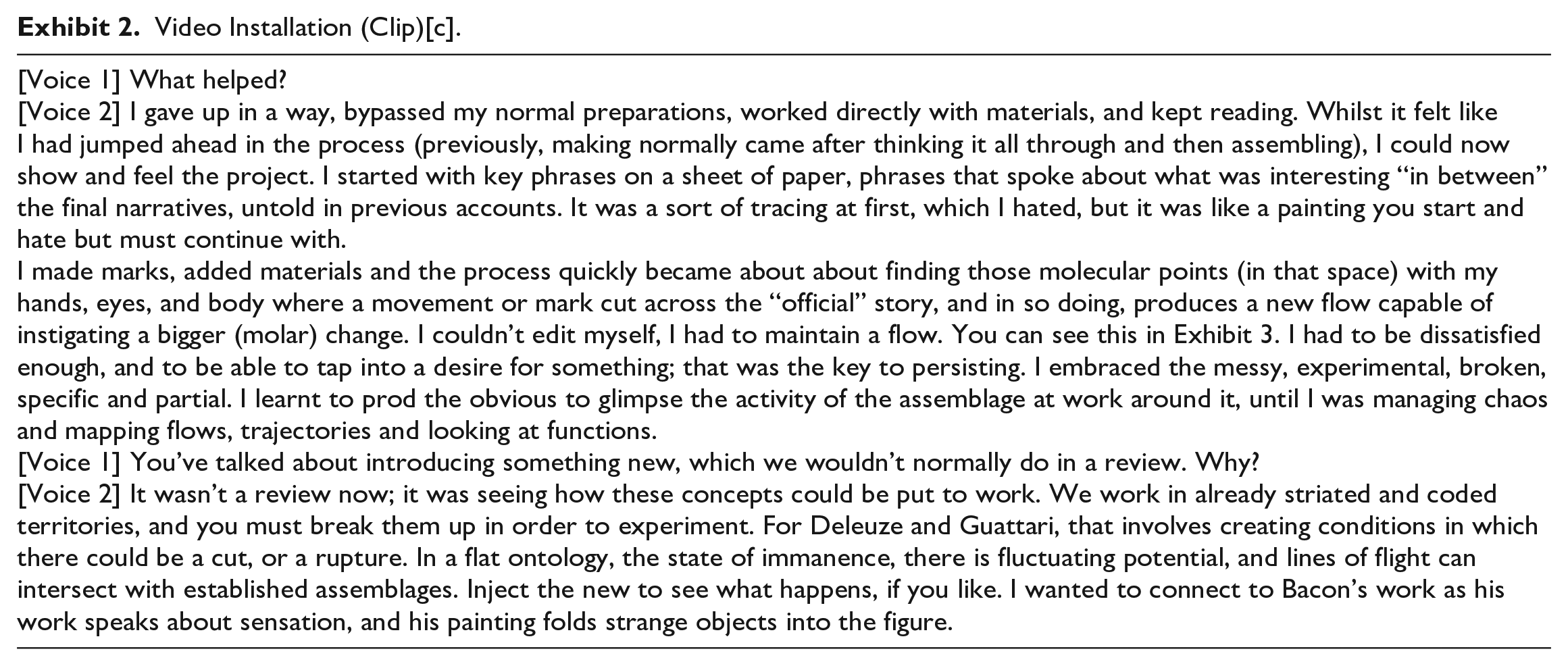
There are no instruction manuals. Progress stutters precisely because no template is offered. However, advice to “follow the action” (Fox, 2024, p. 1) resonates because knowledge is to be found in the events, and in the unexpected conjunctions of “and, and, and” (Buchanan, 2021, p. 25). Rather than chasing the events, dissolving into the flows must be practiced. This becoming molecular involves “specific movements, specific forms of motion and rest, speeds and slowness, points and flows of intensities” (Pirkko, 2006, p. 12). This brings one closer to sensitivity to the differences, repetitions, and affective sensations discussed by Wilson (2021). Becoming molecular and interacting with/in assemblages is not passive, but invites us into engaged, present experiences with data which generate problems and questions, described as “palpation” by Masny (2016, p. 670). Qualitative researchers need a thousand such palpations and may be better informed by thinking of inquiry as divination (MacLure, 2021), with “. . . techniques that are symbolic, intensive, and diagrammatic—ways of reading the world and tapping into the forces that compose events to unfold their ramifications and draw lines from the known to the unknown” (p. 502).
Video Installation (Clip)[c].
Catalog, Page 11
Careful though [Deleuze] was to distinguish the creations of philosophy (concepts) from those of the arts (broadly, precepts and affects), he thrills at the prospect of “interference,” when and where the practices of philosophy and art enjoy a kind of proximity. (Attiwill et al., 2017, p. 13) If you want to convey fact and if you have to do it, then this can only ever be done through a form of distortion. You must distort, if you can, what is called appearance into image. (Bacon, quoted in Jervis, 2015, p. 75)
In Exhibit 6, the act of Francis Bacon’s painting haunts the image as “an antagonist” whose sensations pass through other exhibits. Deleuze provides insights into the work of art with/as concepts in his text Francis Bacon: The Logic of Sensation (Deleuze, 1981/2023). Given that Deleuze embraces the “collusion” of art and philosophy, the qualitative researcher can draw insights into how they may put Deleuzian concepts to work, as Deleuze detects in Bacon’s work. Deleuze starts by stating that Bacon’s paintings are a break from representation, and “. . . no longer have anything to do with anything but ‘sensations’” (Deleuze, 1981/2023, p. 6). Yes, his paintings ostensibly are to do with figures, but in Bacon’s work, the figure is a form that relates to sensation (Deleuze, 1981/2023, p. 27). Faces, torsos, and limbs all exert effort on themselves to become a figure (Deleuze, 1981/2023, p. 11)—they are prothesis, capturing forces, real states, so they are “sensations and not imaginings” (Deleuze, 1981/2023, p. 13). Figures display movement of forces and often merge into forms like the animal or the umbrella. This is not literal, but the becoming-animal or becoming-umbrella is to do with traits and capturing events of transformation.
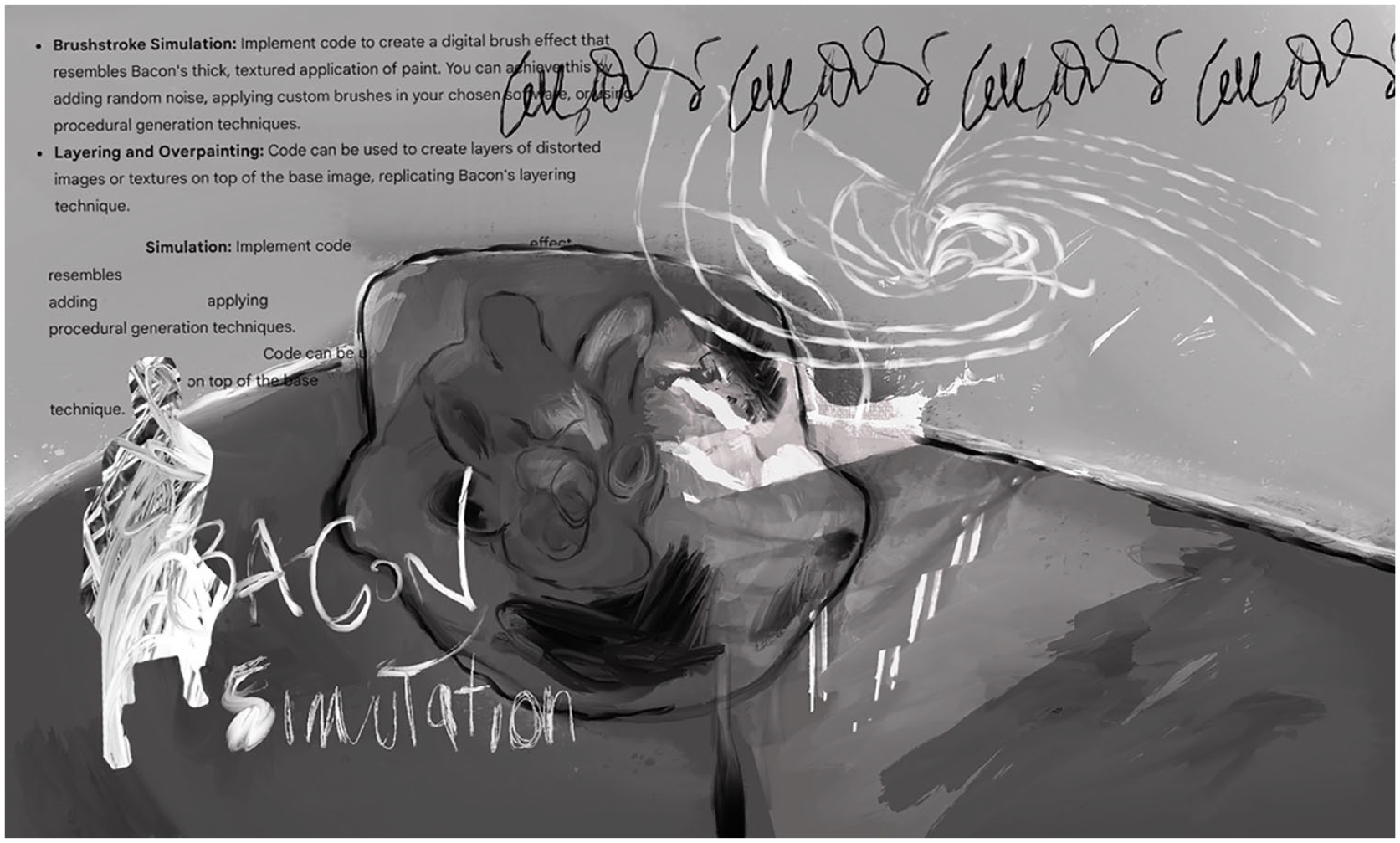
Antagonist: After Francis Bacon.
Sensations pass through Bacon’s figures, but they do not “join the dots” (i.e., this leads to this, leads to this), instead, Bacon’s swiping, scrubbing, and splashing of paint in certain areas of the canvas create what Bacon calls graphs, which Deleuze identifies as diagrams (Deleuze, 1981/2023, p. 69; Zdebik, 2012, p. 191). These zones of indiscernibility created by scrubbing, smearing, and combining mark the intrusion of “another world” or catastrophe into Bacon’s paintings (Deleuze, 1981/2023, p. 70), through folding (Zdebik, 2012, p. 177) and the creation of shared indiscernible spaces. These “indiscernible” spaces have a diagrammatic function, which is to be suggestive (Zdebik, 2012, p. 70) and to exist as the “possibility of fact—not the fact itself” (Zdebik, 2012, p. 76). It is a shared zone which captures and distributes forces, its effects seen through the whole painting.
Video Installation (Clip) [d].
Catalog, Page 13
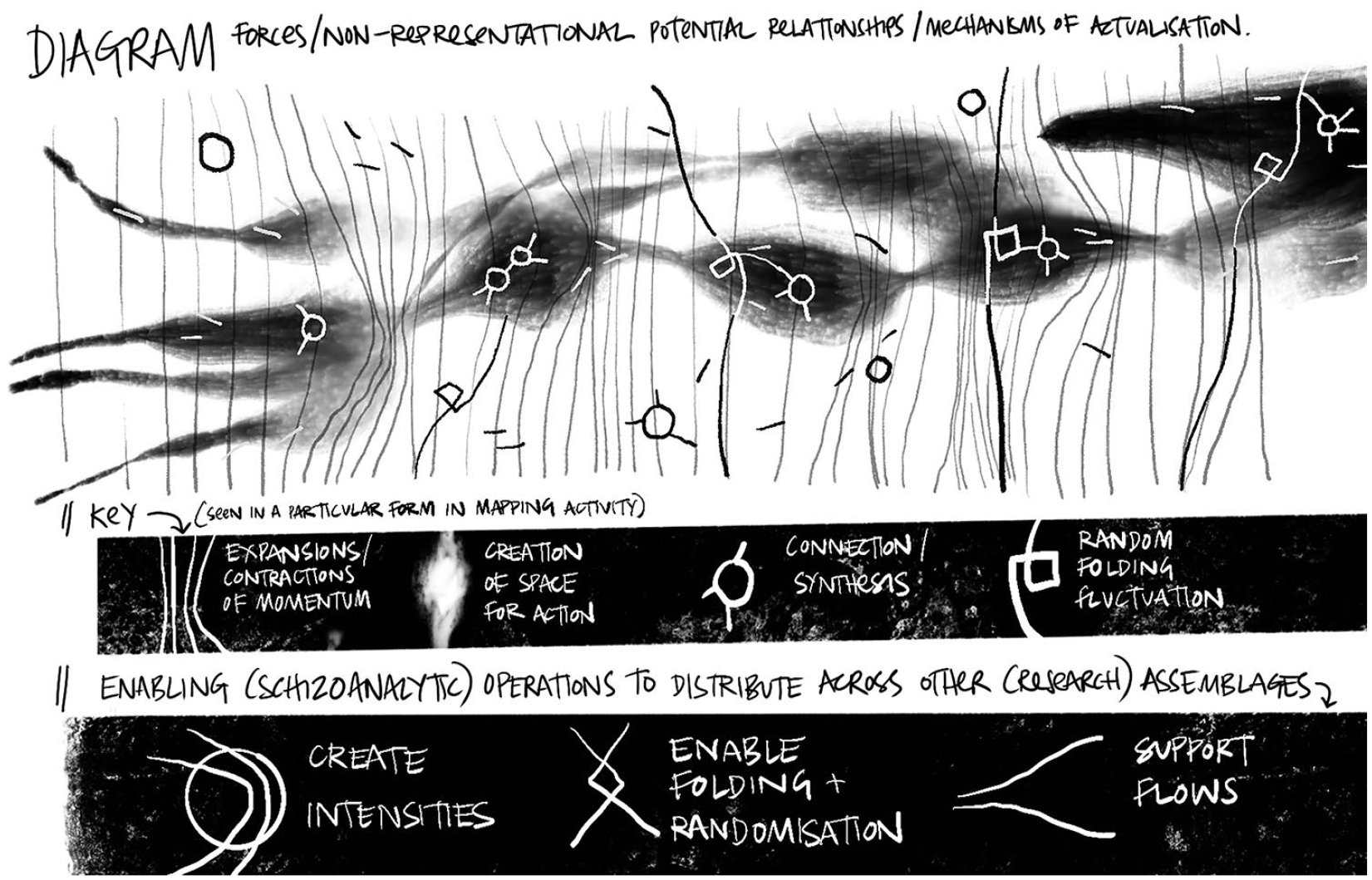
Exhibit 5 is a sketch of the diagram the artist relates to the tracing and mapping earlier displayed in Exhibit 3. Tracing, then mapping the assemblage (Exhibit 5) is an incomplete process. The assemblage describes the concrete relations that produce something actual. The diagram is an abstract map that takes our insight further. A diagram traditionally is something that is concerned with illustrating theorems, and Zdebik (2012, p. 1) gives the examples of the plan (a building not yet built), a map (a terrain not yet traveled), and a graph/schema (relations between variable quantities). Diagrams “map(s) out possibilities prior to their appearance, their representation . . . [and is] the dynamic, fluctuating process occurring between static structures” (Zdebik, 2012).
A diagram may be expressed across several assemblages, but it may be expressed differently in each. Foucault’s (1975/2020; Deleuze, 1986/2006) famous example is the surveillance diagram, which operates in separate systems of prison (a visible, formulated environment) and penal law (a discursive formation). In this case, the diagram is what is in-between the prison and penal law and expresses their intermingling essential traits. It is a diagram of pure functions, an abstract machine that can pass functions from one assemblage to the next. For example, the relationship of guards and prisoners in one assemblage can be transposed to other assemblages, such as the school, hospital, or barracks (Zdebik, 2012, p. 1), where surveillance is a concern. Watson (2009, p. 47) describes this as the passage of intensities, ideas, or functions across assemblages. All sorts of diagrams exist—for example, feudal or pastoral (Zdebik, 2012, p. 5)—and in this case, social welfare, and infancy.
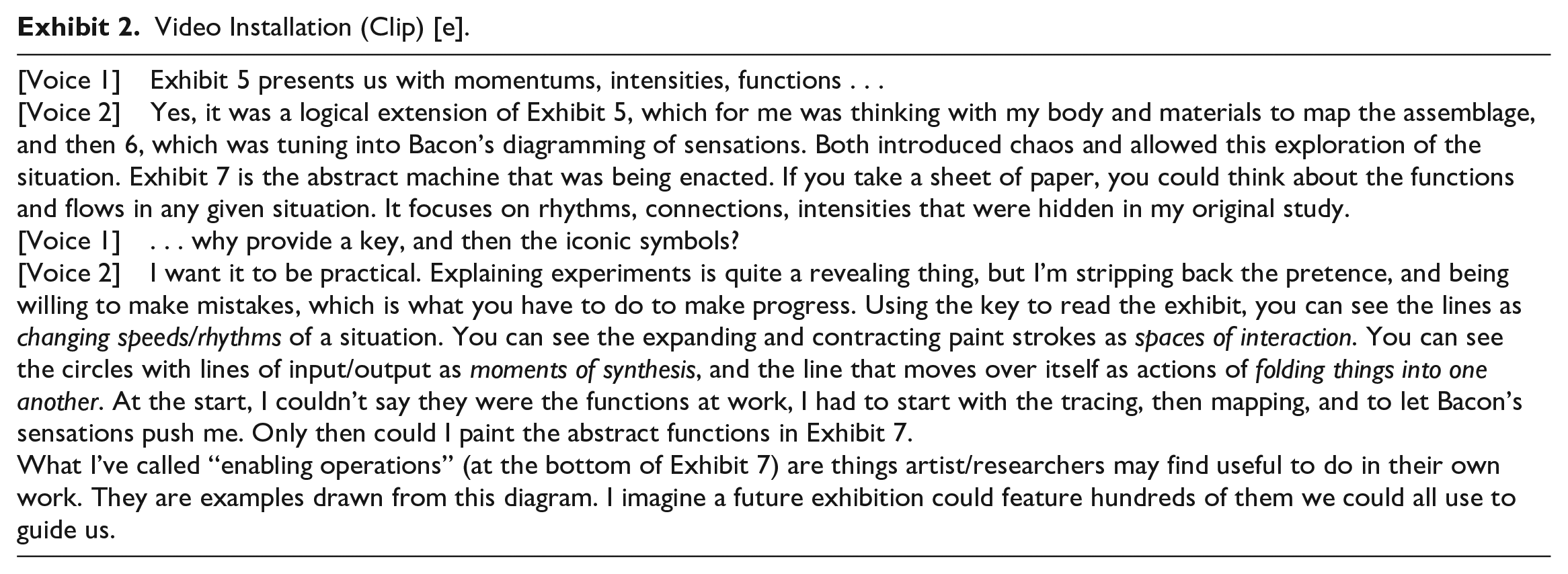
The diagram therefore proves useful to the artist or researcher who wishes to outline relationships, flows, or focal points within an assemblage or across a set of assemblages. Outside of the concrete assemblage, the diagram shows possibilities that can be expressed in different assemblages. In Exhibit 7, the artist presents an early diagram of their original study. Production of this diagram speaks to what was happening in this assemblage, but because it charts abstract functions (in this case, momentum, interaction, synthesis, folding), it focuses on examples of what was being produced and what might otherwise be produced if elements were configured differently. For the artist/researcher, efforts to chart a diagram that relates to their work are valuable—it identifies functions at play and opportunities for change. Because the diagram may be complex, and it is dynamic, the goal is not to produce something totalizing but to indicate the abstract machine as it is and could be.
Sketches for a Diagram.
Video Installation (Clip) [e].
It Could Be Otherwise.
Catalog, Page 15
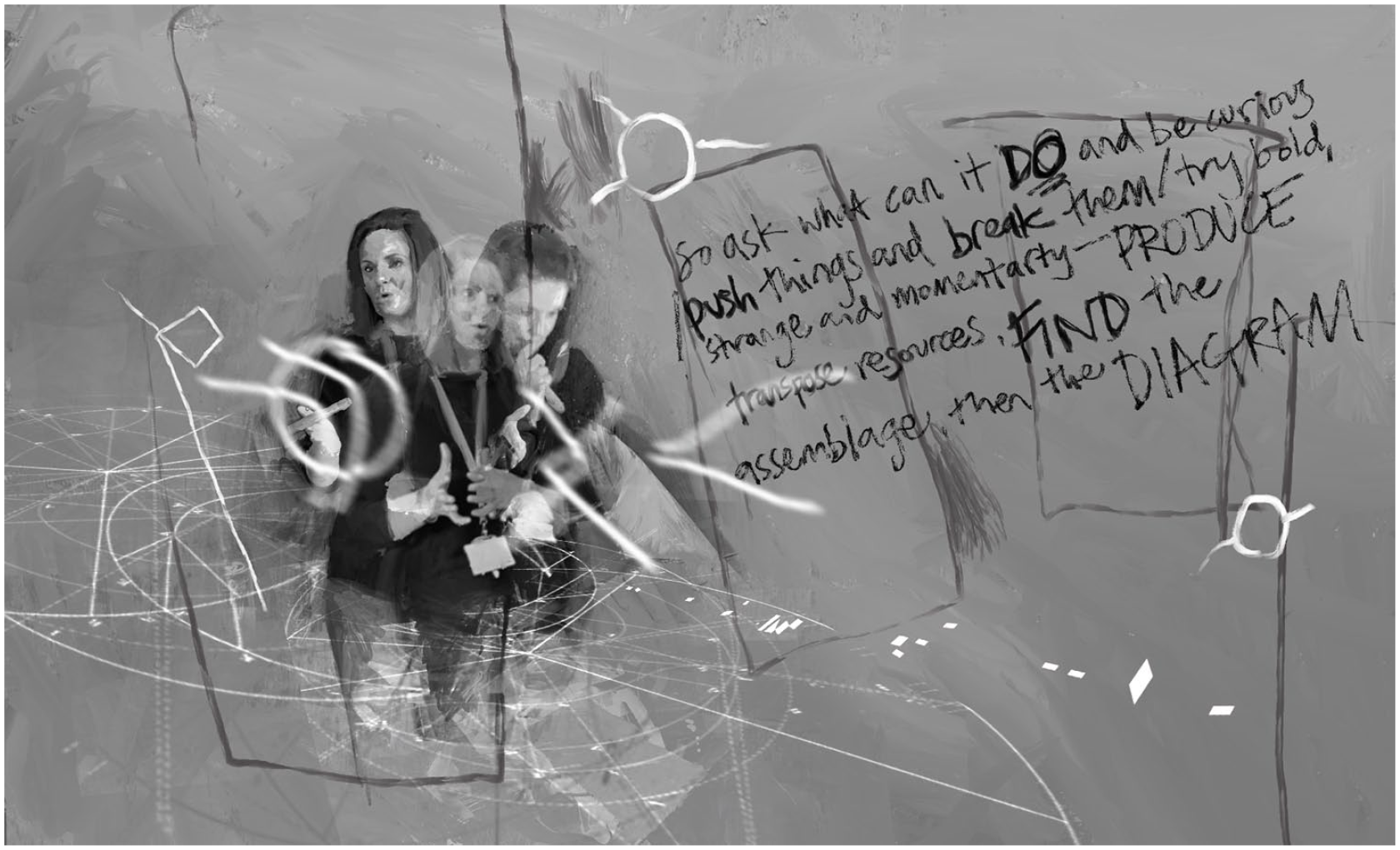
If you are dissatisfied, and desire to push [and not until then] You shake the royal science. You learn to work with catastrophes. You read and struggle and look like a fool. Practice schizoanalysis, with minimal tracing. Find a medium and make strange friends. Experiment relentlessly to open ruptures, then flows. This diagram can transfer functions into your assemblage if it connects.
Footnotes
Declaration of Conflicting Interests
The author declared no potential conflicts of interest with respect to the research, authorship, and/or publication of this article.
Funding
The author received no financial support for the research, authorship, and/or publication of this article.
