




Abstract
Undergirded by Self-Determination Theory, this study explores what could pull former Ghanaian journalists back into the profession. We argue that passion and real desire for societal transformation drive people into journalism and could serve as a “pull-back” factor. Data was gleaned from 30 former journalists through semi-structured interviews. Qualitative analysis revealed that while most journalists had a difficult time deciding to quit because of passion, some major push factors were poor work-life balance, safety concerns, and unfavorable work conditions, including burnout. We conclude that flexible work schedules, good remuneration, among others, can draw former journalists back into the profession.
Introduction
Journalism as a profession is infamous for its strenuous work conditions, which sometimes lead to trauma (Adjin-Tettey et al., 2025), that every so often comes on the altar of neglect of mental health from news organizations (Holton et al., 2021; Kotisova, 2019). Although journalism does not pay much, it is considered a profession characterized by a bad work-life balance (Mathews et al., 2023). In contemporary times, journalists, besides news reporting and news production, have an added pressure to conduct social media-based personal branding (Molyneux, 2019), adding to the feelings of exhaustion and burnout experienced (Bossio & Holton, 2019; MacDonald et al., 2016; Reinardy, 2011) that they experience. This has resulted in many journalists, including those at the peak of their careers, leaving the profession (GhanaWeb, 2025; Kamasah, 2020), although sometimes involuntarily.
While some of the above stated reasons could be the cause of journalists quitting their jobs, some scholars have endeavored to understand journalists’ specific conditions of service to pre-empt what may account for journalists’ leaving the profession (Adjin-Tettey, 2023; Jastramskis et al., 2025; Libert et al., 2022; Reinardy & Zion, 2020; Reyna, 2021), while others have also specifically sought to understand why former journalists quit the profession (Davis, 2022; Heffernan et al., 2022; Mathews et al., 2023), including its gender dimension (Mirabito et al., 2025). Such studies also serve to provide a framework for the possible push factors for journalists who are yet to decide their future in journalism and to suggest solutions to retain good talent in journalism. Yet, other studies have sought to ascertain where journalists go after leaving the newsroom (O’Donnell et al., 2016; Viererbl & Koch, 2021).
In Ghana, there is evidence that journalists are leaving the profession for reasons such as low pay and demands of the profession, limited opportunities for career advancement, the Socio-political system, including hazards of the job, editorial/political interference, and the media system, reflected in viability concerns, waning of ethical standards and respect for journalists (Adjin-Tettey, et al., 2025; Danso & Nyarko, 2026; Kamasah, 2020). We contend that the practice of journalism is frequently motivated by passion and very compelling reasons, such as social justice (Cretser-Hartenstein et al., 2024). Consequently, these compelling reasons may also provide tangible ground for former journalists to return to the field.
Nonetheless, the constant turnover could adversely impact newsroom morale (Hull, 2025) and could influence some to quit. But in a time when the media and information environment is battling with post-truth marked by alternative facts and fake news, newsrooms suffer tremendous loss when journalists, particularly those with a sense of ethics and high journalistic standards, leave the profession (Ivask, 2017). Therefore, documenting how former journalists can make the move to actually to leave journalism, what they miss most about the profession, and the possible re-entry motivations for them, even after starting new careers and professions, will indirectly reveal whether or not former journalists might return to newsrooms, while also serving as a case to put in measures to retain those currently employed in journalism.
Journalistic Precarity and Departures
By the nature of their profession, journalists must almost daily cover different forms of crises and difficult stories. As journalists become emotionally entwined with these stories, the same events and experiences shape their practice and working conditions. This complex relationship puts journalists at different forms of risk, including emotional trauma (Adjin-Tettey et al., 2025; Wahl-Jorgensen, 2019). Bearing all experiences in mind, journalism is considered a profession, requiring emotional labor (Bélair-Gagnon et al., 2024; Dworznik-Hoak, 2020) and demanding emotional manipulation (Papadopoulou et al., 2022; Seely, 2019). Hence, journalism practice could significantly impact journalists’ well-being (Thomson, 2018). Some of the diverse (negative) consequences of the emotional and psychological stress from journalism are alcoholism, depression, panic attacks, burnout, post-traumatic stress disorder, and substance abuse (Feinstein & Nicolson, 2005).
Furthermore, there is often a lack of competency in newsrooms to identify when journalists require psychosocial support, and sometimes, there are no competent avenues for meaningful conversations and actions addressing journalists’ well-being in the workplace (Deuze, 2023). Complicating matters is the dwindling economic resources in newsrooms, partly due to the collapse of media’s traditional revenue sources, resulting in the precarity of newswork (MacDonald et al., 2016; Patrick & Elks, 2015). These experiences cumulatively impact journalists’ perceptions about the profession as well as their approaches to their work.
There are also difficulties related to the use of criminal defamation laws to restrict reporting and attacks against journalists (Hanitzsch & Hadayat, 2012). According to Papadopoulou et al. (2025), “there is a complex interplay of emotions among journalists that could foster a sense of powerlessness and futility among practitioners” (p. 2,439). Similarly, Holton and Bélair-Gagnon (2023) submit that journalists face mounting challenges to their personal well-being, stemming from harassment from within news organizations and news audiences, burnout, and a lack of support resources from news organizations, which has compelled some to leave the profession. It has also been argued that the negative experiences of journalists could make them form a “love-hate relationship” with their profession, as well as “a deep-seated disappointment” about their inability to cause positive societal change (Papadopoulou et al., 2025, p. 2,439).
The literature also shows a complex range of determinants of job satisfaction, such as, professional development opportunities, the ability to realize journalistic ideals, work-life balance, remuneration, and management attentiveness to retention (Setiawati & Thomas, 2024), without which, we argue, can lead to maladaptive coping strategies (Slavtcheva-Petkova et al., 2023) and/or a total exit from the journalism profession. This study provides empirical evidence for the Ghanaian case, which is significant to the literature, given that Ghana has a vibrant media ecology and is not immune to the complex transformations and political-economy dimensions within the broader media landscape.
The State of Journalism in Ghana
Ghana has a vibrant media environment that hosts numerous mainstream media outlets (Yeboah-Banin & Adjin-Tettey, 2023) that absorb a significant number of graduates from Journalism training institutions, including the over 14 public and private universities (Diedong, 2008). Beyond mainstream media, there is also a vibrant digital media landscape that allows for diverse actors, such as citizen journalists, bloggers, and news websites, to participate in the creation and dissemination of news and information. However, despite Ghana’s 1992 Constitution’s provisions of freedom of expression and press freedom, as well as the promulgation of the Right to Information Law, the practice of journalism in Ghana is increasingly marked by threats to safety and professionalism (Adjin-Tettey & Braimah, 2023; Adjin-Tettey et al., 2023) and journalists experiencing trauma with limited professional and institutionalized support systems in place (Adjin-Tettey et al., 2025).
It has been found that the precarious nature of investigative journalism in Ghana, safety and security concerns resulting in constant fear, anxiety, psychological stress, post-traumatic stress, and financial concerns, has forced many journalists to self-censor by avoiding investigative reporting (Danso & Nyarko, 2026). Recent years have also seen the media industry threatened by the poor Ghanaian economy, technology-driven pressures, industry saturation, and the effects of the COVID-19 pandemic (Yeboah-Banin & Adjin-Tettey, 2023), resulting in poor working conditions, including low salaries (RSF, 2025). The country’s press freedom ranking has also seen a downward spiral due to some of the above reasons, despite its earlier glowing track record.
Further, a significant number of journalists have moved organizations in search of better opportunities or have quit the media scene entirely (Bokpe, 2019; GhanaWeb, 2025), indicative of the precarious nature of journalism in Ghana. This implies that people who decided to build careers in journalism have had to leave their passion, possibly abandoning their sense of purpose. If journalism is associated with a sense of purpose and passion, then the lack of these could have mental, emotional, and social consequences, and deprive former journalists of their psychosocial needs of community, social connectedness, and even a sense of purpose. Considering this context and background, the following research questions became foundational to this study: RQ1. What motivated former journalists to leave the newsroom, and what was the transition process like? and RQ2. a. What do former journalists miss most about journalism? Also, since there could be certain unpleasant experiences that might have pushed former journalists out of the profession, it is important to ascertain what they might have been happy to have left behind and what could make them return to newswork, leading us to the sub-research question: RQ2. b. What are former journalists happy to have left behind? and RQ3. What will motivate the decision for former journalists to return to journalism careers?
Theoretical Framework: Self-Determination Theory
The self-determination theory (SDT), proposed by Deci and Ryan (1985), is considered a metatheory (made up of several mini theories) of human personality and motivation regarding how individuals interact with and depend on the social environment (Legault, 2017; Ryan & Deci, 2000). The theory spells out intrinsic and extrinsic motivations and how they influence situational responses in different domains, and in social, cognitive, and personality development (Legault, 2017). The core of the SDT, considering this study, was the intrinsic and extrinsic motivations of former journalists to return to the journalism profession.
The specific tenets of the theory are that three innate psychological needs—autonomy (“the need to feel free and self-directed”), competence (“the need to feel effective”), and relatedness (“the need to connect closely with others”)—are important to nurture intrinsic motivation (Deci & Ryan, 1985; Legault, 2027, p. 2). While autonomy speaks to the need to feel that one’s behavior, including choice, is self-driven and volitional, such that the individual has flexibility to choose with minimal control, competence is achieved when people feel that their efforts result in growth or meaningful impact. Relatedness is the feeling of a sense of belongingness of a community or shared mission and adequately contributing to activities for the realization of collective goals, as well as being acknowledged as a valued contributor (Deci & Ryan, 1985; Ryan & Deci, 2000). The basic tenets of SDT have been applied to a variety of fields, such as sports, work, education, relationships, and health (Fernet, 2013; La Guardia & Patrick, 2008; Pelletier et al., 2001; Reeve & Lee, 2014; Russell & Bray, 2010).
Relating the key tenets of SDT to this study, we can posit that journalists who often value independence in deciding what stories to pursue and how to frame them (autonomy) may consider re-entry if they are certain that they will have editorial independence (less censorship, fewer commercial pressures, more creative control). When journalists are sure that they can use and grow their skills and achieve professional development (competence) and will be recognized for their expertise and/or competence, they may consider re-entry into journalism. Still on competence, if leaving was due to burnout (which does not bring out competency), re-entry may be motivated by a more supportive environment that grows one’s skills and enhances productivity. Yet again, a re-entry can be inspired by a desire to reconnect with journalism’s social mission, colleagues, or even the public (relatedness), while isolation or toxic newsroom environments, which became the reason for exit, will likely discourage re-entry into journalism.
A study of former and active Israeli journalists found that the availability of departure routes out of journalism, challenges related to the voicing of work-related concerns, and apathetic response to crises within news organizations resulted in the exit of journalists (Davidson & Meyers, 2016). Linking this to the SDT, disregarding journalists’ concerns prevented them from feeling like they were sufficiently recognized as valued members of news organizations enough for their concerns to be addressed, consequently leading to exits from the newsroom. Results from a near-decade-long comparative study in France and the United States on how journalists behave in market-driven newsrooms, in the face of declining work conditions, were that some journalists resist the changes, some surrender to them, while some find springboards for innovation and others leave the profession entirely (Powers & Vera-Zambrano, 2023). Those who resist the changes, as well as the innovative ones, could be said to be aligned with autonomy in the SDT, as their actions speak to how much they value their independence and therefore can resist the changes or are able to innovatively adapt to the changes. Yet the action of others who feel frustrated and leave the profession can be linked to the absence of relatedness in the SDT. This is because the pressures deny them the meaningful impact they seek to make, pushing them out of the profession. Additionally, Rick (2023) found that the precarity of journalism work contributed to exit from the profession, as freelance, female, and low-earning journalists were the most likely to leave. This speaks to the absence of satisfactory compensation for work done, which could make journalists feel that they are being acknowledged as valued contributors (relatedness).
According to Ryan and Deci (2017), individuals are more likely to experience intrinsic motivation to pursue goals aligned with their values and keep them engaged, but when that is not the case, their persistence and well-being are eroded, and in the case of this study, contributing to their exit from the profession. In the above-discussed cases, it can be said that the exits were all compelled by extrinsic motivations. On the other hand, those who persisted despite the difficulties found intrinsic reasons to do so, such as being innovative or opposing the changes. This could be because they found a sense of purpose in their careers and/or were passionate about their work, so much so that they did not want to quit despite the challenges or changes.
We use the SDT to understand the intrinsic and extrinsic motivations that will make former journalists return to the newsroom. We link journalism to passion and a sense of purpose amid the increasing transformations within the media scene. Hence, we contend that having worked in the Ghanaian media under the afore-discussed conditions, studying former journalists’ re-entry motivations, what they miss most, and what they are happy to have left behind provides a crucial understanding of what could attract former journalists back into the newsroom and also provide invaluable data for ensuring current practitioners are given the necessary conditions to thrive.
Moreover, the SDT informed the questions included in the interview guide about how being a journalist helped former journalists to achieve their personal goals (autonomy), job satisfaction (competence and relatedness), what would make them go back (intrinsic and extrinsic motivations), and skills honed through journalism that were helping them achieve their career and personal goals (relatedness).
Methods
To answer our research questions, we conducted qualitative semi-structured interviews with former journalists who had transitioned into other professions. The study’s theoretical framework (SDT) also informed this approach. This is because to understand the different motivations for returning to journalism, we considered it important to engage participants on an individual level through interviews, so that participants could express themselves without any restraint, enabling us to capture rich, in-depth data and unique personal insights which may not have been achieved through other approaches, such as surveys. The use of the semi-structured questionnaire also gave room for follow-ups, allowing us to capture more details from our respondents.
The sampling approach involved purposive sampling to select initial participants who met the inclusion criterion of former journalists who practiced journalism for at least 5 years and had switched to other professions. Participants selected through the purposive sampling approach were largely drawn from our existing network and those who were suggested by our network and met the inclusion criteria. Our choice of 5 years of experience was because it is enough time to have gained significant experience to familiarize oneself with journalism (Adjin-Tettey et al., 2024) and understand the demands of newswork. Also, it provided us the opportunity to select people who had had medium to long-term careers in journalism. And more specifically, we believed that 5 years was a reasonable timeframe to prove interest in the journalism profession, and to make a long-term to medium-term decision about staying in journalism. Our working definition for former journalists was that they were participants who worked primarily as journalists for the period they worked as practicing journalists. Our decision of 5 years of work experience in journalism before quitting is also well-aligned with the literature. This is because Viererbl and Koch (2021) defined former journalists as professionals who completed either a traineeship or journalism studies education and worked as journalists for at least 1 year or those who did not have any specific education and worked for 5 years for a media outlet, publishing on topical and socially relevant issues, as their main job.
The snowball sampling was also employed by asking participants to recommend at least two people whom they knew who met the inclusion criteria. By the 30th interview, we had met data saturation as previous data was repeated, and new data did not contribute anything new to address the research questions of the study (Rahimi & Khatooni, 2024).
Interviews were conducted with the aid of an interview guide that contained a total of 15 questions divided into four sections exploring motivations for departure, how useful journalism has been in their new careers, what they miss most about journalism, and what will make them go back to journalism. The SDT’s tenets of autonomy, competency and relatedness as pertains to this study grounded the questions framed around what informed former journalists’ decision to quit and re-entry motivations, hoping to draw some connections to whether exiting the profession was as a result of less autonomy, a feeling of incompetency and less relatedness as well as other factors not accounted for in the theory, which may inform the likely re-entry motivation drivers. Hence, some of the questions that covered the four sections in the interview guide, meant to address the research questions, were: what motivated your decision to leave journalism?; what did you not like about the journalism profession?; what aspects of journalism are you happy to have left behind?; how easy was it to decide to leave the journalism profession?; what would make you go back to the journalism profession?; and what about the journalism profession do you miss the most?
As much as we believe the age of respondents would have added some deeper social context to our data, we did not collect information about participants’ ages because of the cultural sensitivity and the context of the study, as most respondents might have been uncomfortable sharing their ages, sometimes due to age-related negative stereotypes (Goll et al., 2015), especially in a purposive and targeted sample such as ours.
Interviews were conducted between May and July 2025. Interviews were conducted via video conferencing and telephone and lasted an average of 1 hr, 25 min, and were audio-recorded under guarantee of confidentiality and anonymity and transcribed consequently.
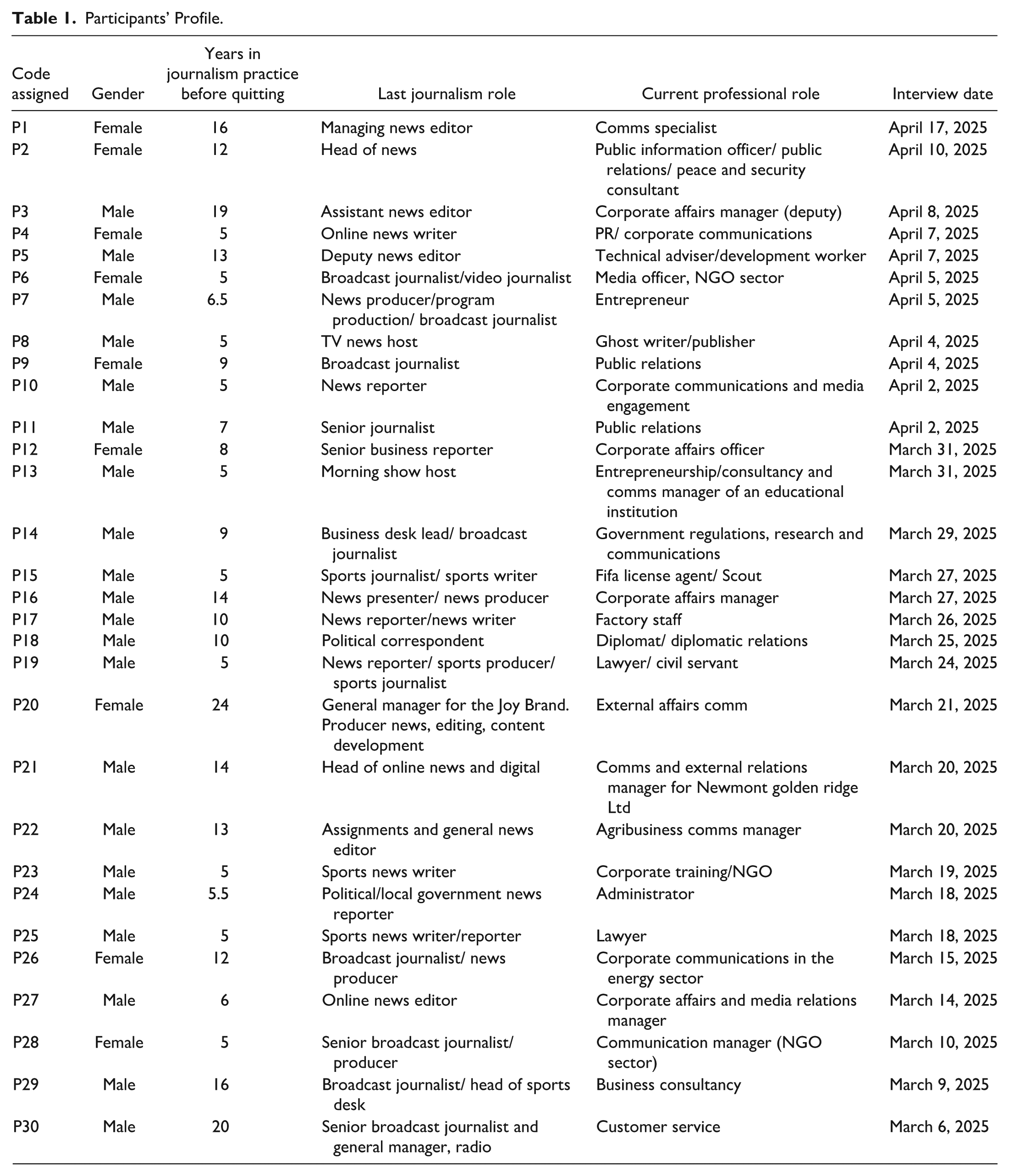
The data analysis followed the guidelines for reflexive thematic analysis suggested by Braun and Clarke (2021), which involves developing across-case themes and categories. The steps involved six recursive phases of: familiarization; coding; generating initial themes; reviewing and developing themes; refining, defining, and naming themes; and writing up. The process was largely unstructured and organic, with potential for codes to evolve to capture our understanding of the data by developing themes from codes and conceptualizing them as patterns of shared meaning underpinned by a central organizing concept (Braun et al., 2014)—What former journalists miss most and re-entry motivations. Table 1 provides an overview of the participants involved in the study.
Participants’ Profile.
Findings
The findings from the thematic data analysis are presented below, based on the narrative themes derived from our interviews and guided by the research questions of the study.
What It Was Like for Former Journalists to Leave the Newsroom
Understanding the experience of leaving the newsroom and possibly how easy it was for former journalists to leave newswork is important because it forms the basis of knowing if former journalists plan to come back to journalism and establishes how they were perhaps involuntarily compelled to leave the profession. Also, by exploring the data on how easy it was for journalists to quit newswork, we can, in certain aspects, understand how much love and passion former journalists had, or still have, for the profession. Ultimately, this sets the foundation for exploring their motivations for leaving the newsroom and whether they plan to ever return to the journalism profession. The dominant views reflected a mix of unfavorable work-related conditions, some of which caused a strain on former journalists’ well-being, and their quest to make the desired impact, as well as their inability to realize their professional goals, forcing them to quit mostly involuntarily. There was a near-unanimous agreement among respondents that leaving journalism was a difficult decision, as they had to fight it for years before eventually giving in and deciding to seek greener pastures in other professions. However, when leaving was propelled by the quest to secure better economic standards, it was seemingly easy to quit.
According to respondents, such as P26, they had dedicated all their adult life to learning and practicing the craft of journalism, so the idea of leaving the newsroom to pursue other careers always felt strange because they never thought they would leave and thrive elsewhere. It was not easy at all. I kept going back and forth for about three years before. The day I resigned, I was a mess. I didn’t leave my home for days because all I knew in my life was media and journalism. It was not an easy decision, even to date. . . I get very emotional about it (P26).
There was also an agreement among participants about their going through a hard time and experiencing symptoms of depression when they tried to quit journalism. For instance, P4 indicated that it was a lifelong dream to be a journalist and work in media, and the joys of media work spread to their friends and family, so the decision to quit journalism and move into a completely different career was a very difficult one to make. Oh, it was difficult. I went through depression. I really wanted to be a journalist, you know. When I was in journalism school, my mum was happy. Everybody around me was happy because they wanted to see me on TV. So, every time I go on air, I come home and everybody’s happy. They wanted to see me on TV. . . So, I really struggled when I decided to quit and move to corporate communications (P4).
Another respondent also expressed suffering from depression and having to see a psychologist before he could quit. He maintained that it was not easy to quit journalism, as he had been practicing since he completed secondary school. It was the only profession in the world that he felt comfortable enough to practice, and quitting made him suffer a serious mental health crisis, since he was unsure how successful he would be in a new field. In addition, because he had won many national journalism awards and was quite influential in the Ghanaian news media space, the thought of trading all that success for a new career in a completely different field disturbed him quite a lot: It was really tough because I never thought that I could shift like that . . . for me to just say ‘I will not do it [journalism] again.’ So, I had to see a psychologist to help me out, because this is what I had been doing all my life, right after secondary school. I thought it was fine to quit, but it wasn’t easy. I needed to speak to a psychologist to help me out, to counsel me that, ‘yeah, you can still go, move on and succeed’. But I was also thinking about the impact I had made, and whether I was going to have the same effect where I was going [in a new profession] (P3).
Similarly, another respondent indicated that he had practiced journalism for 16 years and knew it was time to make a change when he realized that the journalism profession didn’t align with his professional goals anymore, but it wasn’t easy for him to leave completely. So, even though he found a job in a different field, he was still volunteering in the newsroom and hosting shows on a part-time basis. In the words of P21: It wasn’t easy. It was about a four-year journey to walk away. It was really difficult. It’s something that I’m passionate about. Even after I left, I was still actively going to the studios once in a while. I had a technology radio show that I was doing. I managed that for two years, even when I left the station. (P21).
Others maintained that it was a very easy decision as they knew quitting journalism was the start to securing better economic standards. It was very easy. After looking at all the factors, as I’ve told you, I needed to make an impact, economic-wise too, it wasn’t great [. . .]. So, I considered all of these things, and I felt like it wasn’t worth it, and I don’t regret making that move because I have become better off after leaving, honestly. I keep asking myself where I would have been if I had continued to stay in the newsroom (P23).
For a respondent like P20, the decision to leave journalism was neither easy nor difficult but it was very emotional because when she planned to leave, she had taken up a contract which renewed her love for journalism and prolonged her plan to leave “I ended up at [mentions organization name] for eight years, and I was like, wow, and I said to myself, that was not the plan. Media can be addictive. . .. But I took the decision and never looked back” (P20).
The analysis of this section shows that journalism is a profession of passion (Adjin-Tettey et al., 2025), as much as it is a profession of intellect. We report that even though the journalists interviewed had checked out mentally, most of them could not bring themselves to quit entirely because they still had an attachment to the profession. Eventually, the passion for newswork can influence some journalists to stay in the profession for as long as 4 years, even when they have already decided to leave, but this does not prevent journalists from leaving. A similar finding was reported in research conducted in the United States, as participants claimed that leaving newswork was the hardest decision they ever made, but at the same time, the best decision they ever made (Hull, 2025).
What Former Journalists Miss Most About Journalism
Understanding what former journalists miss about the journalism profession could be an important factor for pre-empting what may influence or draw them back into newswork. Ultimately, if the aspects of the job that former journalists miss about the journalism profession cannot be found or fulfilled in other sectors, there could be a strong indication that they may eventually return to the newsroom.
Many of the things that the research participants miss about the journalism profession revolve around fame, access to public officials, and the fact that they set the tone and focus of conversations in the public sphere by interviewing politicians, popular sports personalities, and policymakers. Beyond these, the fact that they identified important social issues to give space and time to and to garner public and key stakeholder attention through their platforms was something they found significant and missed about journalism. For former journalists who seemingly had little nostalgia about their work in the past, it suggested that they might not venture into the newsroom again because they missed little about the newsroom and its routine or demands.
There were several things that former journalists interviewed for this study missed about the journalism profession; however, their news and public agenda roles were more pronounced throughout the interviews. According to one of the respondents: I miss the fact that I could meet people, all sorts of people, interesting people with all sorts of personalities. Oh yeah, I also miss the agenda setting. Making an impact, setting trends and seeing changes in certain situations. Oh yes, I will miss that one. . . also being the voice of the people and speaking. I mean, bringing societal issues up front for public discussion and policymakers’ attention (P 30).
Another view of our respondents was that being a journalist meant being a public figure and came with some prestige and respect when they were in public circles, making them celebrities in their own right, and they miss it. They explained that people had the tendency of treating them nicer, and they had easy access to public officials and policy makers when they worked in journalism, something they miss about the profession. You know, there’s a certain level of, I wouldn’t say fear, but respect that people give to you, when they realize that you work in a media house, right? Sometimes I miss that, because you go to certain events or programs and people are not even looking into your face [giving you attention], but the moment you pull out your ID card and introduce yourself, ‘I work for Joy FM, I work for TV3’. It opens the doors, because these are very powerful media houses. So, I miss that a lot. If you happen to work with very good media houses, you also get the opportunity to get exclusive access to information, you know. So, you can readily call a Minister of State, and they will be shaken and ready to talk to you, especially in times of crises and damage control. (P13).
In addition, a widespread view of former journalists was that they missed the excitement of the news-gathering process itself. They explained that the process of going out to scout different ideas and chasing them until they become complete stories ready to be published is one of the things they missed about the profession. They indicated that seeing one’s story develop from a mere idea to a published story that could have an impact on the lives of people is something they missed and cannot replace. Sometimes I miss the thrill of it. Sometimes the thrill of, you know, doing the particular act of news gathering, when you are chasing a particular story, and when you are going here and there, and it’s something that you are really interested in doing. You know, I miss that sometimes, and also sometimes, just being on the screen and on the radio and just talking about something that you know is going to improve the lives of the people (P16).
The ability to do human interest stories, which sometimes led to tangible results and success stories in communities, is also one of the things former journalists miss about doing newswork. Former journalists interviewed saw themselves as change makers and change agents in their communities and therefore admitted to missing having the opportunity to lead conversations that could bring development and change the lives of the people in their communities. I think the fact that you’re able to do stories that fulfil the human interest, especially political stories. The process of identifying a news lead and following up on it till it becomes a news report which goes on air, or gets printed in the newspaper . . .the fact that when you walk into a room and you mention your name, random people are like ‘Oh, wow, I read your story and I loved it.’ (P27).
In another breath, respondents, such as P1, claimed they don’t miss anything about the newsroom or the journalism profession. According to them, they are tired of the journalism profession and don’t even want to entertain the idea of missing anything because they don’t want to have any feeling that they have left something they loved behind. P1 explained that: No, I said I am tired [of journalism], you don’t have to ask me this question at all, I don’t miss anything about journalism (P1).
Most journalists who move into other corporate careers are aware that they cannot pursue human interest initiatives and lead social change initiatives. It is thus not surprising that former journalists miss the thrill of news gathering and news production, coupled with the fact that they got to set the national agenda and steer public discourse. By and large, it can also be deduced that the need to contribute and lead discussions around national development could be one of the motivating factors for re-entry into journalism. This finding is a confirmation of conclusions drawn by Hull (2025), who asserted that most former journalists look back fondly on their time in the newswork as some said they missed telling important stories, interviewing big names, and also miss the adrenaline rush of editing a story till it is ready to go on air.
What Former Journalists are Glad to Have Left Behind
What former journalists are happy they left behind speaks to some of the reasons they left journalism, and for which reason they may not return to the profession. There are several things former journalists are glad they left behind, especially when they compare their current careers to their old careers as journalists. Some of the things they are happy they left behind span from the hectic work schedule in the newsroom, the stress related to collecting and producing news stories, the poor salary coupled with the lack of permanent contracts and benefits, the overly routine nature of the profession, the inflexible work schedules that made them miss out on social events, the lack of relevant tools for work, and to the fact that after a while most of them experienced stagnation in their journalism careers. Other “personal” factors, such as growing families, marriage, and the acquisition of new skills and interests resulting from further education, also depleted their interest in the profession.
On stress, participants mentioned that while every profession may be stressful, the “always-on” nature of journalism, coupled with the minimal relief time journalists have, made it overly stressful, compared to the professions they currently work in. As P20 intimated: “There’s a lot of work to be done. But then you can manage it better. And the stress, there’s also stress, but then it’s a different kind of stress from when you’re working in the media.”
For participants, like P21, the fact that one easily hits the glass ceiling and the work becomes mundane, with little room for growth, and people practically must drag themselves to work. It gets worse when one’s work is not recognized as valuable enough to be invested in and journalists’ work is easily ignored. “People don’t feel that investing in the craft—reading, writing opinion pieces, researching—the fact that today people don’t feel that those aspects of journalism are important” (P21).
The stressful and busy nature of journalism also made some lose their appetite for food or go without food for many hours, leading to some health risks. While the demands of the job and their unhealthy lifestyles put their health at risk, they also sometimes ignore the health risks for months due to the lack of adequate time to seek medical attention. For P20, the fact that now she can have a more balanced life, including a healthy balance of work, pleasure, and healthy living, is something she cannot take for granted and is therefore happy she left journalism: You know, timing of work, and then also sometimes working double shifts, and even when you’re supposed to go off work, you find that, because you haven’t finished your work, and there are follow ups and stuff that you need to do, you sort of continue doing it. And it can impact your health; it can impact everything (P.20).
Similar to findings by O’Donnell et al. (2016) this experience of P.20 shows that the lack of flexibility in the schedules of journalists and the constantly on call nature of journalism can lead to a loss of interest in the profession, because unlike other communication-based professions, journalism doesn’t allow for personalized work conditions (autonomy) and flexible work schedules (O’Donnell et al., 2016).
Participants also hinted that the tendency of media owners and their political cronies to interfere in their work as journalists is something they are glad to have left behind. Participants revealed that the fact that most media houses in Ghana are owned by politicians or by politically exposed people made their job as journalists difficult, and they were usually caught in the web of pursuing ethical, unbiased journalism or pleasing their employers. A situation which sometimes meant they had to not pursue certain stories to their full detail because of the political leanings and interference of their employers. Participants mention that the interference is something they are glad to have left behind, because in their new professions, they are free to operate and perform without any hindrance or influences. P9 explained that: One other thing I am happy I don’t have to deal with anymore has to do with media ownership and the politicians. When these owners lean towards political parties, you would have to self-censor. A story will break and then there will be a call from somebody at the top of the political hierarchy and because of that we are not able to cover the story. As a newsroom [journalist] you know this is a big story that we can cover from different angles and the audiences need to know. But because of the political inclination of the media house and its owners, that story would not be covered (P9).
The issue of salary, benefits, and permanent contracts also seems to be a big factor that drives away journalists from newswork. A participant explained that it [journalism] wasn’t paying well at all, even some of my old colleagues are still stringers without any permanent contracts (P27).
This section discusses the factors that trigger the loss of interest in newswork. The findings show that stress in the profession (Viererbl & Koch, 2021), lack of career growth, and employer/political interference in newswork are some reasons journalists leave the profession. These findings are consistent with findings by Adjin-Tettey et al. (2025) and Adjin-Tettey et al. (2023), who reported interference of politicians and their supporters in the work of journalists, especially in a growing democracy like Ghana, exposing journalists to safety threats. This can sometimes lead to stress and can serve as a factor for journalists to abandon the profession.
What Could Bring Former Journalists Back to Journalism Practice?
We tried to find out if there was anything that could bring participants (former journalists) back to the journalism profession. They concurred that they would not return to the newsroom, but they would like to play more subtle part-time roles, such as in the training of future journalists. According to P3: “No, I will not go back full-time. I have paid my dues. What again is there for me to achieve? I may only go back because I want to train others.” Some participants also mentioned that even though they do not intend to go back to the newsroom as full-time journalists, they volunteer to help their colleagues in the newsroom with news coverage and news production during one-off important international and national events. Not going back full-time but going back to help. During the election [December 2024], I was there to help with election coverage. But as a full-time profession, I have not thought about it (P22).
Similarly, a view represented by our research participants indicated that even though they still have strong love and passion for the journalism profession, they do not want to ever work directly in a newsroom or as journalists. They expressed the view that journalism is a profession of love and passion and that love never goes away, and as a matter of fact, they are open to contributing to media development in other ways. P18 further explained: So, if I have a syndicated show, then yes. But a show that allows me to do full-time journalism, no! God forbid. Well, I don’t even want to think about it, but full-time journalism will be very difficult. But part-time journalism is very likely. So, for instance, if I am an analyst on a morning show on TV on the radio, I come in from 06 am to 09 am. I do my work. I go away (P18).
Respondents also advanced the view that a general improvement of the quality of human resources in the newsroom will be enough motivation to go back to journalism. They admit that they lost their interest in newswork because of the influx of untrained personnel who took up key roles in the news collection and news production process. Admittedly, working with untrained people meant the professionals had to take on more responsibilities because they had to help their colleagues who didn’t have enough training. Taking up more responsibilities for the above reason increased burnout and the workload on other colleagues. In the words of a participant: For me to come back, I think media owners should really invest in talent. And I think because we have so many TV stations and so many radio stations, professionalism keeps dwindling. It is so painful to see people who are on air, who are not trained, they sit on the radio screaming, causing a whole lot of confusion because they don’t know the basics of the profession. if I ever go back, it will be more of a managerial level, because that is where I can really make change (P28).
Other respondents were quite resentful and did not even want to entertain the idea of going back to the journalism profession, as was the case with P1: I am completely done with it. You don’t get it when I say I am tired? Maybe I should unpack that for you. I mean, look, journalism in Ghana is stressful, journalism in Ghana is such a senseless job, it is not funny. . . Look, even if they bring me a contract from CNN at this moment offering to pay me the highest salary, I won’t go (P1).
For other respondents, their economic capabilities and personal safety override the passion for newswork. The respondents indicate that their ability to take care of their growing families is more important to them than the passion or love for the journalism profession, and so they will only return if remuneration improves and if their personal safety can be guaranteed. This is in line with earlier findings by Adjin-Tettey et al. (2023), who reported that Ghanaian media houses found it difficult to retain talent because of the violence and safety concerns associated with practicing journalism in Ghana. If I’m supposed to practice journalism in an area where remuneration is okay, and safety and security are assured. Also, if there’s a lot of respect for the profession from people in authority. I think I can go back to it, because I have the passion for it. I can go back to journalism if these two issues are sorted, good remuneration, and the safety and security concerns. In a safer environment, I think I can go back to journalism (P25).
Whereas some former journalists don’t plan on coming back to newswork, we also learned that for others, it is mostly a case of economics and safety. Former journalists may return to newswork if working conditions for journalists are improved and the safety of journalists can be guaranteed. There is also another group of journalists who want to help newswork through volunteering, mentorship and training activities, but do not plan to practice journalism as a full-time profession. This finding contradicts reports by Hull (2025), who concluded that although former journalists still have an interest in the profession and miss it, they will never re-enter it.
Discussion
Grounded in the SDT and the fact that a significant number of journalists leave the profession due to work pressures, conditions of service and other work-related stress issues (Adjin-Tettey et al., 2025; Bossio & Holton, 2019; Holton et al., 2021; Kotisova, 2019; MacDonald et al., 2016; Mathews et al., 2023; Reinardy, 2011), sometimes, at the peak of their careers, this study sought to understand how easy it was for former journalists to leave the profession, what former journalists miss most about practicing journalism, what they are happy to have left behind and what could, possibly, motivate the decision for them to return to journalism. The findings reveal issues that can be considered to ensure that journalists, particularly those whose contributions to the field are deemed valuable, stay in the profession.
This study’s findings, hence, play a dual role: prevention and correction. This is because understanding the motivations for re-entry into the journalism profession is important for two reasons: first, it enables us to understand what can be done to prevent the efflux of experienced journalists from the newsroom, and allows us to understand from the angle of former journalists the things that can get them back into newswork. Based on key findings from this study, it can be deduced that former journalists may be motivated by flexible/favorable work schedules allowing them to have a good work-life balance, good remuneration, less stress associated with work, including safety provisions, job security with requisite benefits, resource allocation including relevant tools for work, career growth opportunities, and non/limited interference with work (autonomy) as some of the factors that can prevent the efflux of experienced journalists from the newsroom.
On the question of what can get former journalists back into newswork, it can be said that although the past experiences of working in journalism might have ripped former journalists off the passion to return to newswork, the same factors associated with what could prevent the exodus from journalism, as well as the opportunity to play subtle part-time roles, could bring former journalists back into the newsroom. These are two key areas the literature has yet to deeply interrogate, particularly in the context of Ghana, a gap this study ably fills. The two key areas also align with the literature on job satisfaction, which found professional development opportunities, the ability to realize journalistic ideals and good work-life balance, good remuneration, and management attentiveness to retention (Setiawati & Thomas, 2024) as key determinants. We submit that if the motivations for re-entry into journalism and what can be done to prevent the efflux of journalists gathered from this study are given some attention, the constant turnover that adversely impacts newsroom morale (Hull, 2025) could be done away with, and journalists with a sense of ethics and high journalistic standards (Ivask, 2017) could be maintained. Below, we discuss each key finding in detail, while making relevant empirical and theoretical connections.
One of the most prominent findings from our study is that most journalists usually have a difficult time deciding to quit the profession. This was largely because of the love and passion they have for journalism. However, editorial influence, work-related stress, safety concerns, as well as some other unfavorable conditions of service, force them out. This relates to Adjin-Tettey et al. (2025) study, which concluded that avoidance by disconnecting from the journalism profession is one of the ways journalists cope with safety concerns in journalism. Even though many of the former journalists sampled for this study indicated that it was not easy to quit journalism, signaling a deep-seated passion they had for the profession, findings from other parts of Africa prove that journalists who exit the profession as a way of avoiding the violence associated with it rarely go back to do newswork (Daniels, 2021).
The rather unsatisfactory remuneration, and other conditions of service and benefits associated with practicing journalism in Ghana are also key factors that could deter the return of former journalists to newswork. Unlike their previous journalism salaries, former journalists indicated that they were better remunerated and enjoyed more benefits in their current professions. Hence, until journalism can pay similar salaries, they would not consider a return to the profession. This is unsurprising, as Jastramskis et al. (2025) argue that the news industry’s failure to pay competitive salaries is why many newsworkers choose careers in other areas of communication, and why former journalists fail to return to newswork.
Also, as it were, the overwhelming reality of journalists’ everyday lives, which sometimes makes them abandon healthy lifestyles, could sometimes motivate journalists’ exit from the profession, highlighting the human costs of the profession. For example, former journalists mentioned “going long hours without food” due to the demands of the job. This is proof that even though many journalists have a passion for the profession, the toll it takes on their health and general well-being can drive them to abandon newswork and pursue other professional interests.
In terms of the actual motivations to return to newswork, most former journalists claimed they do not intend to work as full-time journalists, but they could accept opportunities to contribute to news production and programming on a part-time basis. Linked to this, the role of syndicated programs, which can give former journalists the chance to continue journalism even while they are fully employed in other professions, is another factor that could lead to their return to the newsroom. This is because most participants, although uninterested in working as full-time journalists, are willing to contribute to the news industry by way of syndicated programs. For others, an improvement in the quality of personnel in the newsroom is enough motivation to go back to journalism. Such participants believed that an improvement in newsroom talent would reduce employee burnout and also decrease instances where colleagues must assume the work responsibilities of other employees due to their inability to perform.
In terms of gender, our study revealed that women quit journalism primarily due to their domestic duties and social roles, such as raising children after getting married, whereas men usually quit due to the remuneration and economic aspects of practicing journalism. This finding shows how other life roles take precedence over journalism when female journalists decide to leave the profession, as Heaney (2018) found. Previous studies also found a mix of other factors, such as higher levels of exhaustion and lower levels of professional efficacy (Reinardy, 2009), power relations, newsroom labor, and workplace loyalties (Steiner, 1998), discriminatory pay and the lack of opportunity to serve newsroom leadership roles, which worsened work schedules (Mirabito et al., 2025) as causing defection of the journalism profession among female journalists. Another gender-related finding we want to report is that the longest-serving journalist in our sample is female, with 24 years of service, compared to the highest-serving male, who has 20 years. This demonstrates to some extent how resilient some women are in the face of sociocultural expectations and other challenges.
In addition, the findings of our study provide some implications for the application of the SDT. The relatedness component of the SDT, which refers to a professional being recognized as a valued contributor, can be connected to journalists’ view of a high/satisfactory salary as recognition of their worth to news organizations. Hence, former journalists who left the profession because they felt they were not being well compensated for the amount of work they did and the demands that came with their roles largely left because they did not have a sense of relatedness. It is for this reason that participants said they were pleased to have abandoned the subpar employment benefits, including poor salaries. By extension, to attract such journalists back into the newsroom, the relatedness vacuum must be filled with good remuneration and relevant work benefits, such as medical care, to commiserate with the journalism role and risks associated with it.
It can also be deduced from the theory that journalists who experienced editorial control in the form of pressure from managers and political actors dictating how certain stories should be run and the extent they could go did not feel a sense of autonomy. Editorial control, unlike editorial influence, makes key media actors and allied actors the ones who determine whether and how information will be received by the public, and when concretized, significantly influence editorial processes (van Drunen, 2020), making people who often have a parochial motive to exert their viewpoints on the public and successfully dictate public and policy agendas. Such influences are against journalistic ethics and do not allow journalists to do their work ethically, ultimately depriving them of the opportunity to live the values that the autonomy of a free media environment grants journalists. To attract such journalists back to the profession, they need to be assured of and granted editorial independence. While assurances of independence alone may not cut it for some, media houses that have an open culture of letting journalists be self-driven and volitional will likely attract journalists who still have the passion for the profession back to the practice.
Autonomy also relates to flexibility and competence. When journalists feel burned out and do not have the flexibility to choose days off and overwork themselves, it is a sign that they have lost autonomy over their careers. Overworking and getting to the point of burnout could also negatively affect journalists’ competence, as they do not achieve the desired outcomes. When one’s achievement is below expectations, they cannot grow in their careers as well. It is for this reason that former journalists were happy to find themselves in environments where they have the flexibility to take a break when necessary. It also turned out that the flexibility to work part-time could be a motivation for a comeback to journalism.
This study has also revealed that the social environment (media industry and the sociocultural and political environment where journalism is practiced), which hampers the implementation of policies and suggestions emanating from investigative and development-oriented outputs of journalistic work, has frustrated former journalists since they did not see any real change being realized with the work that they did. Thus, unlike the current institutions that they find themselves in, where they can, sometimes personally, implement development initiatives, measure and realize their impact, journalism’s bureaucratic hurdles, slow pace of development initiatives, and sometimes the unwillingness or the nonchalance of key development actors, such as public institutions, are strong disincentives for returning to journalism. As such, a potential key extrinsic motivation for staying in and the possible return to journalism, considering the SDT, could be the realization of results emanating from journalistic outputs.
The study’s empirical patterns advance the field of SDT research. The inability to be autonomous, in the form of feeling that there was too much editorial interference, not finding a sense of relatedness and not feeling affective, as former journalists battled with inflexible work schedules, poor conditions of service, career stagnation and difficulties with finding a good work-life balance, among others, were found to potentially nurture intrinsic and extrinsic motivations for journalists to leave the profession. These obstacles, which acted as push factors, conflicted with journalists’ love and passion for their work, which could lead them to realize significant impact in the communities they covered. As a result, the decision to leave or remain in the profession (Legault, 2027) was a matter of passion and determination to make an impact, contending with actual obstacles that drowned the sense of purpose for practicing journalism.
In closing the discussion in this section, we recognize that every media environment is unique with its own unique practices and challenges (Adjin-Tettey et al., 2025). Hence, within the broader African context, the factors that may influence the re-entry of former journalists into journalism may differ across countries. Because of the dynamics of media and journalistic practice both in the African setting and elsewhere, we are hesitant to claim that the conclusions drawn from this study are universal, even though these findings are insightful.
Conclusions and Recommendations
The study has provided insights into what could, potentially, motivate the decision for former journalists to return to journalism careers. Data also yielded some insights on how easy it was for former journalists to leave the profession, what they miss most about practicing journalism, and what they are happy to have left behind. These findings indirectly also shed light on what could draw former journalists, some of whom have left an indelible mark on the profession, back into newswork to make the necessary impact. Considering the findings, we suggest that media organizations ensure a conducive work environment for journalists, including proper remuneration. While at that, managers should be mindful of potential burnout of employees resulting from the demanding nature of the work and ensure work schedules that will guarantee that journalists are in the proper state of mind and health while doing their work. Flexible work schedules, proper healthcare and well-being programs, among others, must be considered to realize this.
Media houses must also ensure editorial independence for journalists to feel a sense of autonomy and to practice journalism with requisite integrity and ethical compliance.
Limitations and Future Research
Our project provides new knowledge on the motivations that can influence the return of former journalists to newswork, while they must be understood against the backdrop of certain research limitations. First, our study only sampled 30 former journalists in Ghana. Even though our sample is enough for a qualitative study, our findings cannot be generalized to the absolute situation for all former journalists in Ghana. In the future, we recommend a larger quantitative anonymous survey that will encompass many other variables (such as age) and a larger sample size, in order to have findings that could be generalized for the entire news industry of Ghana. Also, although variables, such as level of education and age, were not within the scope of our research objectives, they can be a starting point for future researchers who hope to provide further information and expand knowledge on the motivations behind the return of former journalists to newswork.
Footnotes
Declaration of Conflicting Interests
The authors declared no potential conflicts of interest with respect to the research, authorship, and/or publication of this article.
Funding
The authors received no financial support for the research, authorship, and/or publication of this article.
