



Abstract
Populism, especially that of the far right, has a major impact on journalism. Journalists have to respond to an increasingly hostile environment with dwindling resources and often precarious conditions. By using semistructured interviews with journalists who cover the populist far right in Italy and Spain, we investigate how they understand populism and its impact on their profession. Interviewees have a clear idea of what populism is, but feel that this concept is often used in a vague and politicized manner. Far-right populism’s hostility toward journalism has also generated professional problems such as difficult access to politicians, safety concerns, and violence.
The current global political panorama is witnessing growing electoral weight and the rise to power of far-right populist forces in many liberal democracies in the European Union and the United States, as well as in other countries (e.g. India). These forces have capitalized on an antisystem wave partly driven by a loss of confidence in traditional political parties and elites (Algan et al., 2025). Authors such as Thunert (2021) add that the erosion of trust in members of the political class and the news media has extended to experts and expert bodies, entailing a weakening of the position of both academia and the traditional journalistic platforms of public intellectuals. The decline in trust in expertise—which populists perceive as politicized and acting against the public interest (that of “the people”)—has contributed to the delegitimization of expert knowledge in the public sphere and to the undermining of the traditional authority of academia and professional journalism (Schudson, 2006); conversely, it has favored the legitimation of narratives that promote alternative realities that do not withstand confrontation with reality, propagate hatred against different social groups, erode pluralism and social coexistence, and may undermine the foundations of the democratic system (Chapelan, 2021). In this scenario, media discourses on populism have been growing, generating a “populist hype” (Hatakka & Herkman, 2022) that has been accompanied, however, by a certain ambiguity over the meaning attributed to the term “populism.”
The quest to define populism has generated an ongoing debate in academia. Populism has been described as an ideology (Mudde, 2004), a political discourse (Laclau, 2005), or a political communication style (Jagers & Walgrave, 2007), as well as a mixture of ideology and style (de Vreese et al., 2018). Mudde’s ideational approach defines populism as a “thin-centered ideology that considers society to be ultimately separated into two homogeneous and antagonistic camps, ‘the pure people’ versus ‘the corrupt elite’” (Mudde & Kaltwasser, 2017, p. 6). This definition depicts populism as something intrinsically prone to illiberal tendencies, while approaches like that of Laclau leave space for more democratic forms of populism.
Ambiguity over the term “populism,” however, has been perhaps even greater in the news media, generating concerns over the analytical value of the term (Hatakka & Herkman, 2022). Due to a combination of factors, understanding how journalists define and use the term “populism” is crucial. One such factor is that news content explicitly mentioning populism has spiked in recent years (see Hatakka & Herkman, 2022, p. 1,528). Meanwhile, however, populism remains loosely defined (Bale et al., 2011), often labeled as being a “negative” phenomenon (Brookes, 2018; Brown & Mondon, 2021; Herkman, 2016), and politicized by the media to delegitimize certain political actors, on both sides of the political spectrum (Bale et al., 2011; Berti et al., 2025). The term, moreover, has been weaponized by some political forces to negatively label and thus marginalize political opponents (Stavrakakis, 2018).
In a context where journalism is beset by problems such as disintermediation (i.e. the fact that journalistic gatekeeping can be easily bypassed, especially through social media), loss of credibility, scarce economic resources, rampant precariousness, and a general decline in press freedom in several countries, political journalists find themselves dealing with a popular term with unclear boundaries, a “floating signifier” (De Cleen et al., 2018) that powerful political actors can exploit to influence the news production processes (Herman & Chomsky, 1988).
At the same time, far-right populist forces consistently attack journalism, defining journalists as liars, enemies of the people, and servants of corrupt elites (Carlson et al., 2020; Fawzi, 2019; Krämer, 2018), implementing policies that restrict press freedom, and attempting to capture the media (see, for instance, Council of Europe, 2025). While a rich academic literature and a number of reports highlight the dangers posed to journalism by far-right populism (and by populism in general), there is still little understanding of how journalists (especially those who focus their work on populist forces) perceive the impact of populism on their profession and on them as individuals and professionals.
In this article, we aim to partially fill these two gaps in knowledge on the relationship between populism and journalism by explaining:
(A) How journalists who cover populist forces understand and use the term “populism.” We look into their definition of populism, as well as their ideas about the usefulness of the term, and their perception of how populism is co-defined by endogenous and exogenous factors.
(B) How journalists perceive the impact that populist forces are having on journalism practice and on themselves as individual professionals.
Our study goes beyond the current state of the art as it does not investigate journalists’ understanding of populism through their news content production, nor the impact on the profession through the analysis of populist actions and policies. Rather, we listen directly to the journalists by conducting semistructured interviews to delve into their individual ideas and perceptions. Across two countries characterized by highly politicized media systems (Italy and Spain), we find remarkable similarities in the way journalists conceive and use the concept of “populism,” and in their perception of the impact of populism on their profession. We find that despite the “populist hype,” many of our interviewees are aware of the ambiguity surrounding the term “populism.” Not all of them consider it useful, and some openly consider it “dangerous” in that it can easily be weaponized by politicians and imposed upon journalism for political purposes. Most journalists, however, recognize that populist forces pose dangers to journalism, but that these dangers are intensified by other external threats, as well as endogenous issues of journalism.
In the first section of the article, we review the literature on the use of the concept of populism in journalism and the impact of populism on the profession according to journalists’ own perceptions. Then, using semistructured interviews, we explore the understanding and impact of populism among journalists covering far-right populism in the two countries. Finally, we critically discuss the impact of certain dynamics (disintermediation, ostracism toward journalists, verbal and physical violence, and critical factors internal to journalism, in particular) on the profession and, ultimately, on the quality of democracy.
Literature Review: Populism Through the Eyes of Journalists
Two major lines of research investigate journalists’ understanding of populism. The first explores how the concept of populism is used by journalists in their news production. Such research originates from the long-standing academic debate concerning the meaning of the term “populism,” which remains a controversial “buzzword” (Hunger & Paxton, 2022), despite multiple attempts at clarification (e.g. the ideational approach, or populism as a communication style). Several studies in this area have demonstrated that populism is indeed used in journalism with a certain degree of ambiguity. In many cases, news outlets do not offer a clear definition of the term, which is frequently charged with negative connotations (Bale et al., 2011; Thornborrow et al., 2021) and a delegitimizing aura (Brookes, 2018), and is often conflated with ideological elements of the far right (Brown & Mondon, 2021; Hatakka & Herkman, 2022). In polarized and politicized media systems, the term can be easily weaponized, with ambiguity in its use by news outlets with different political leanings (Berti et al., 2025).
The second line of research focuses on the impact that populism has on journalism, both in terms of news production and professional practices and routines. Research in this area encompasses the combined effects of social media and populism on political communication and news content production, and the hostility that journalists often face when covering populist forces. The now much-explored “elective affinity” between populism and social media (Gerbaudo, 2018), for instance, has shown how populist politicians can bypass journalistic gatekeeping through disintermediation, thus gaining agenda-setting and framing power at the expense of journalists (Engesser et al., 2017; Jacobs & Spierings, 2019). This can be (and to a certain extent is) also done by nonpopulist actors, but some features of populism favor this type of communication. Among such features is populists’ hostility toward journalism (or at least so-called “mainstream” journalism), viewed as elitist, biased, and corrupt (see, among others, Juarez Miro, 2025; Van Dalen, 2021). This attitude, combined with the effects of digitalization and political polarization (the latter being, often, a defining strategy of populism), risks undermining journalism (Custodi et al., 2025), which is currently experiencing a gap between expectations and perceptions when it comes to its role in defending democracy (Fawzi et al., 2026).
Most of the research on these two major issues, however, has been conducted (at least in the context of Western liberal democracies) by looking either at journalistic content production or from the point of view of populist actors. Looking at journalistic contents enables us to understand how the term is generally used (i.e., often vaguely, with negative connotations and a conflation with far-right ideological elements), but does not inform us of the reasons why “populism” is used in such a way. Moreover, we cannot know if its use in news production actually reflects journalists’ understanding of this concept. Finally, we do not know exactly who is using it. Is it possible, for instance, that only a few journalists use this concept, thus determining its journalistic use in possible disagreement with other colleagues? Stanyer et al. (2019) have shown that across Europe, journalists hold a negative view of populism, regarding it as a threat to democracy. However, further research is needed to substantiate these findings. If we consider the widespread use of the concept of populism that has recently been made in the news media (and, more broadly, in the public sphere), its ambiguity generates concerns over its analytical value and possible weaponization. Thus, it is crucial to understand how journalists who cover politics and populist forces understand this term, whether they find it useful, and what influences they perceive as central in the definition of what populism is.
Recently, some research has explored journalists’ perceptions of these challenges. By using semistructured interviews to look at the case of the adversarial relationship between some Israeli journalists and far-right populist leader Benjamin Netanyahu, Panievsky (2021, 2022) found that journalists often responded to Netanyahu’s constant attacks by adopting two main strategies: amplifying attacks against them without responding, due to what appears to be a misinterpretation of the journalistic norm of objectivity; and leaning a bit further to the right to avoid accusations of imbalance (a strategy coined “strategic media bias”). By qualitatively analyzing a sample of articles published in German national and regional newspapers that contained substantial metajournalistic remarks on populism, Krämer and Langmann (2020) showed that German journalists’ discourses seemingly display a clear idea of the “correct” way to cover the far-right populist party Alternative für Deutschland, namely by avoiding demonization and applying the professional principles of objectivity, balance, and fairness with particular care. The authors point to several potential blind spots in this discourse, from the possibility that “political actors become important because they are considered important by the media”, to the scarce coverage of the perspectives of minorities attacked by populists (Krämer & Langmann, 2020, p. 5,655). In a similar study conducted in theUnited States, Koliska et al. (2020) used ethnographic content analysis to examine journalistic responses to Trump’s attacks within news articles and broadcast transcripts. The authors found that journalists responded to Donald Trump’s antipress statements not only by reaffirming journalistic practices and norms but also by highlighting journalism’s role in democracy and by attacking Trump himself. Such studies, though not numerous, are crucial to disentangle the complexities of the relationship between journalism and populism.
What is missing, however, is an investigation into the meaning attributed by journalists to the term “populism.” Indeed, both theoretical and empirical research have highlighted that several external, powerful actors can influence news media discourses. Shoemaker and Reese’s (1996) hierarchy of influences model shows how journalists’ individual agency is situated within a broader sociopolitical and economic environment (Reese, 2019a). The propaganda model, as proposed by Herman and Chomsky (1988), outlines several factors that influence the processes of news production, including the economic strength and size of newsrooms and the reliance on discourses of powerful agents (Mullen & Klaehn, 2010). Similar influences are identified by Colistra (2012) as relevant in determining the news media agenda. Among these influential actors are politicians, and some recent research has shown how self-declared anti-populists have weaponized the term “populism” to delegitimize and demonize political adversaries (Stavrakakis, 2018; Stavrakakis & Katsambekis, 2019). Other factors may be perceived by journalists as influential in defining populism and its relevance in the media discourse, including disintermediation through social media and overreliance on political sources for news production (a well-known issue, e.g. in Italian journalism, as shown by Cornia, 2014; Splendore, 2020). Moreover, the current state of economic crisis in journalism, 1 with shrinking newsrooms, job precarity, and shutdowns, may affect the power balance between journalists and other external forces, in particular those who act more aggressively toward journalism, such as far-right populists.
This leads to the question of the impact of populism on the journalistic profession. Existing studies mostly focus on populist actors by elaborating on the motives and expressions of their hostility toward journalists. Antimedia populism depicts journalists as enemies of the people, members of the elites (Fawzi, 2019; Fawzi & Krämer, 2021), and liars (Beiler & Kiesler, 2018). Such attacks can arouse a perception of journalism as being biased and not credible (Egelhofer et al., 2022), thus contributing to undermining its authority (Figenschou & Ihlebæk, 2019) and its institutional role in liberal democracies (Reese, 2019b). While these attacks mostly target journalists who are not acquiescent with populist forces, they constitute a structural threat to journalism’s role as a watchdog, especially when combined with policies restricting press freedom or more or less successful attempts to capture the media (Hungary is an emblematic example of the combination of these three factors in a country governed by a far-right populist leader—see Benedek, 2024).
In this article, we present a study conducted through semistructured interviews with journalists to explore both their understanding of the concept of populism and the perceived impact of populism on their professional experience. We aim to offer a broad portrait of journalists’ complex relationship with populism, while at the same time addressing specific gaps in knowledge dealt with in the preceding paragraphs.
As our exploration is particularly broad, we chose to narrow down our population of journalists, focusing on a particular subgroup, namely journalists who have covered the populist far-right from a critical stance and work for news organizations that are not considered close to far-right populist forces. In several cases, our interviewees or their news organizations have been criticized or attacked by far-right populists. The choice to focus on far-right populists is motivated by the current relevance of these political forces in liberal democracies. They have greater electoral success, are or have been in government in several countries, and therefore have more power to influence public debate and, through political communication as well as policymaking, can impact journalism more forcefully. As journalism is not a homogeneous field, we considered it important to explore a relatively homogeneous subgroup of journalists who, given their professional focus, can simultaneously be considered more relevant in building a journalistic discourse on far-right populism, and more likely to be targeted by these political forces.
Finally, we focus our research on Spain and Italy. These two countries have prominent far-right populist forces, namely VOX in Spain, the Lega (League) and Fratelli d’Italia (Brothers of Italy) in Italy (Rooduijn et al., 2023, 2024). These political actors have, to a greater or lesser extent, manifested antimedia attitudes. 2 In both Italy and Spain, however, other prominent populist forces with different political orientations exist. In particular, the far-left Podemos in Spain (Rooduijn et al., 2023) and the hybrid and eclectic Five Star Movement in Italy (Mosca & Tronconi, 2019). Finally, the media systems in Spain and Italy are characterized by widespread politicization, partisanship, and the polarization of journalism, where the concept of populism is often vague and can be easily weaponized by media with different political leanings (Berti et al., 2025). Such a heterogeneous environment—both in terms of prominent political actors and news media outlets—potentially amplifies the complexities of defining and understanding populism, allowing us to dig deeper into the meanings and significance of such a concept for journalists covering the populist far-right.
Methodology
Between October 2023 and April 2024, we conducted 20 online semistructured interviews (Galletta, 2013) with journalists (10 from Italy and 10 from Spain). Participants were recruited initially by screening for journalists who had covered the populist far right, and subsequently through a snowball approach, that is, by asking interviewees to refer us to colleagues (preferably from different news outlets) who could be interviewed on the same topics. We chose to narrow the scope of our research to journalists who a) had covered the populist far right from a critical stance, and b) worked for news media organizations not considered close to far-right populists. Although this choice certainly affects the possibility of generalizing our results to all journalists, it nevertheless allowed us to delve deeply into the professional experience and personal perception of a specific subgroup of journalists. In line with studies such as that of Amazeen et al. (2019), narrowing the population of journalists interviewed allows for a better understanding of how professionals who have dealt with populist far-right political organizations define them through their journalistic practice. We believe this is a particularly useful approach in polarized pluralist media systems (such as the Spanish and the Italian), where journalists are often entangled in complex networks of relationships with politics and, therefore, cannot be reduced to a single group of professionals with similar perspectives, practices, and problems. During recruitment, we strived to achieve a gender balance of the interviewees, interviewing 11 men (6 in Italy, and 5 in Spain) and 9 women (4 in Italy, and 5 in Spain). The median age was 37 (min. 30; max. 46). The journalists worked for a variety of media outlets, including print newspapers, online media outlets, television, and radio. Most of them specialized in politics, with a few focusing their job on crime news, investigative journalism, environmental journalism, disinformation, and racism (for a summary of the interviewees’ characteristics, see Appendix A). All of them were reporters, rather than holding editorial positions; several were freelancers and worked for more than one outlet. To some extent, this may further narrow down the scope of our investigation, as there might be relevant differences in the perception of far-right populism between reporters and journalists in other positions (e.g. editors, anchors). Our interest, however, was precisely to investigate the population of journalists who have direct experience with far-right populism and who are in a position where precarity, lack of power, and scarce visibility might play a role in structuring their relationships with these political forces.
The interviews lasted an average of ~38 min (min. 30 min; max. 50 min). They included broad questions on the definition and conceptualization of populism, followed by questions on its impact on journalism, and, finally, a focus on specific issues according to the interviewees’ expertise. The interview script (Appendix C) was used flexibly to allow the conversation to take new directions when necessary. The interviews were conducted online through institutional software. They were audio-recorded and subsequently transcribed. Transcriptions were shared with the interviewees, who could add, delete, modify, and then approve the text. The interviews were conducted in Italian, Spanish, or Catalan by native speakers.
The study was approved by the Universitat Rovira i Virgili’s ethics committee “Comitè Ètic d’Investigació en Persones, Societat i Medi Ambient” (code “CEIPSA-2022-PR-0035”). According to the approved study design, interviewees were de-identified, and all quotes used in this article are anonymized and identified by a code. The code states the country (ES/IT), the interview number in chronological order, and the interviewee’s gender (F/M) and age.
The interviews were analyzed qualitatively by means of a thematic analysis using the Atlas.ti software. Multiple readings of the texts led to the development of a codebook composed of main themes and sub-themes. The four main thematic areas were “definition,” “usefulness of the concept,” “connotation,” and “impact on journalism” (the coding manual is available in Appendix B). The development of the coding manual followed a mixed approach of inductive and deductive coding, with categories drawn and adapted from the existing literature, while others emerged through open coding (Elo & Kyngäs, 2008; van Gorp, 2010).
In the next section, we present the results of the analysis using various extracts from the interviews. The translations into English in the text were rendered by the authors.
Results
Defining Populism: Characteristics, Actors, and Connotations
When asked about how they would define populism, several of the interviewees mainly focused on two features: the first relates to populists’ appeals to the people, seen by many as a form of “demagoguery”; the second highlights how populists tend to oversimplify political issues by offering simple solutions to complex problems. For instance, one Italian male journalist stated that populists
are those movements and parties that refer to a certain type of imagery that aims to rubble-rouse, right? Hence with great demagogy and presenting themselves as direct and privileged interlocutors and more accredited to, how should I put it, bring the interests of the popular classes to the places of politics, right? That’s the term “populist.” So, a bit of that. That is, those who act as spokesmen for a self-styled, phantom “people.” Through precisely a whole series of ways of acting, of political action that are in fact very demagogic [. . .]. (IT5M40)
One Spanish journalist focused on how populist messages are oversimplified to the point of becoming misleading:
For me, populism is arguments that are easy to buy, told in a context of tension and that are very superficial, very digestible for citizens, and that, although they may not be fallacious in their form, in their content. . . they may not be a hundred percent fallacious, but they lack so much depth that they don’t quite fit reality. (ES7F38)
Several definitions, moreover, presented a higher degree of complexity, mixing the people-centrism and oversimplification of populism with other features, most prominently antielitism and enemy politics. Referring for instance to Five Star Movement’s leader Beppe Grillo, one Italian journalist claimed that “he was the first to say certain things and to intercept that disappointment of the people with respect to the so-called ‘caste’, the so-called ‘political class’” (IT10F46), while another said that populism “is also based on the exaltation of the people, systematically put in contradiction with the elites, the ruling classes, the deep state. . . in short, everything perceived as the seat of power and privilege” (IT4F34). One Spanish journalist focused instead on the relationship between oversimplification and racism in the discourse of the populist far right:
[. . .] the party of the moment comes along and tells you that this can be solved by expelling immigrants. These magical solutions, these simplistic solutions that are really, on the one hand, fallacious and, on the other hand, would, I think, tend to satisfy the mental circuits that society needs. That is to say, as an unemployed person, as a person who works ten hours a day, eight hours a day, I don’t feel like listening to or understanding the complexity of what it is that makes me work eight hours a day and not make ends meet. However, if they tell me not to reflect on all the political issues, on the logic of the system in which we live, but that you would be better off if Mohamed were expelled, well, I think I’m going on a bit too long, don’t you? But it is these mental shortcuts that are used, and with which I identify the concept of populism. (ES8M30)
A similar idea was expressed by an Italian journalist who, referring to an Italian far-right populist party, ironically commented:
Because they always have very easy solutions, don’t they? They always present every situation as something that in their recipe is solved with little, very easily. The classic equation is: there are immigrants arriving in Italy, and you sink the boats. Right? Of course, now I am exaggerating and generalizing, but. . . Even this ease in proposing solutions that could be very easy, when instead we know that the reality is much more complex, that is populism. (IT5M40)
It is another Italian journalist who offered perhaps the most complex definition of all, a coherent mix of demagoguery, oversimplification, anti-elitism, enemy politics, and charismatic leadership:
So, populism is a—can we call it a virus imbued with demagogy and. . . Yes, with demagogy, which is used by political movements [and] political parties to make the people feel somehow at the center, with their needs, their difficulties, etc.; which almost always identifies a very precise enemy, always to be put in front of the people; and which sets up a leader to rely upon. Thus, a political leader is placed at the center who has a solution for the people and only for the people. And he identifies an enemy, which can be precisely the other political class, the “caste,” but in specific cases, in the issues of everyday life, it is those. . . In the issue of migration, it is the migrant, identified as an enemy to be opposed, to be presented as an enemy to the people. And then it is the leader who provides a solution, somehow, to the needs and wants of the people. [. . .] And all this by deluding the people [. . .] with solutions that very often do not exist, that are the easiest to say, are the easiest and the most immediate to understand, but are unworkable. Many of the solutions that the populist parties propose are hardly feasible, but they are very understandable [. . .]. (IT10F46)
Charismatic leadership was discussed as a core feature of populism by only one other journalist, in Italy, who stated that “in Italy, in fact, there are no parties that are not leaderist in some way, and being leaderist, in fact they all have elements of populism” (IT8M43); he also associated populism to anti-elitism (“[. . .] should be referred to those parties or leaders who speak directly to the people and present themselves as defenders of the people against the elites”), as well as to “demagoguery” and “propaganda.”
Moreover, a few journalists from Italy directly associated populism with nationalism by claiming that “In my opinion, right-wing populism has become more and more akin to nationalism” (IT1M32), “So ‘populism’, right now, if you asked a person in the street, he would answer [. . .] ‘the defense of the nation’” (IT2M36), or “The term populist is often used to refer to that type of right-wingers: identitarian, nationalist, sovereigntist” (IT5M40).
This last observation invites one to focus on another interesting aspect of the definition of populism. While all interviewees were selected for having covered right-wing populism, several of them have a broader perspective on which political forces can be defined as populist. In Italy, the most mentioned political forces defined as populist are the far-right League and Brothers of Italy, but also the Five Star Movement, a hybrid and postideological political party which, during the period in which the interviews were conducted, was leaning toward the left. Moreover, some journalists specified that populism is not necessarily linked to a specific ideology, but is rather a strategy adaptable to numerous political forces. For instance:
populism is not [. . .] an ideology and it cannot be traced back to one specific programmatic content. It is more a way of doing politics, which, depending on the time and place, can be used [. . .] in different institutional frameworks. (IT3M39)
One TV journalist argued that “[. . .] in the most widespread opinion in journalism—and, in my opinion, this is a mistake, in any case a superficial approach—there is a tendency to associate, to use populism and the right as synonyms,” but “[. . .] in fact, from my point of view, all Italian parties, precisely because they have become leaderistic, have strong elements of populism, they are all populist. [. . .] Populism can be either right-wing or left-wing” (IT8M43). Likewise, one Spanish journalist affirmed: “I think that all parties are populists, all of them. There is none that does not appeal to a community or that does not meet the characteristics attributed to populism” (ES4M44). Several other Spanish journalists expressed a broader perspective on populism: “we can encompass many types of populism, depending on what ideological content you put into it” (ES3F44); “I would tell you that the extreme left could also make use of this populism. What I believe is that there are several categories of populism” (ES1F32); and “I understand populism as a political tool that can come from the right or that can come from the left” (ES2M41).
Regardless of the core features and ideological leanings of populism, the majority of the interviewees in both countries attributed a negative connotation to the concept, while only a few of them mentioned mixed connotations, and none a positive one. Most mixed connotations came from journalists who specified that, while the term is usually negatively connoted, they did not subscribe to this particular idea. For example, one Spanish journalist said:
I try not to use the concept of populism in a derogatory way because I understand it as a political tool that I will like more or less, but that can be shared by a much wider range of the political spectrum (ES2M41).
One Italian journalist explained:
[. . .P]opulism is considered a bad word in general by much of the Italian, but I think also European, media. So it is a negative characterization of political phenomena that are actually very different, very complex. Personally, however, I do not give it a totally negative definition, because I believe that populism is a response to a general crisis of democratic representation. So, then, it also depends on the declination one gives to it, to populism. That is why there are different populisms, with very different tendencies. (IT3M39)
Another Italian journalist claimed that populism should have a neutral connotation, but this neutrality shifts toward negativity in the politicized use that is made of the term in the news media:
[. . .] by journalism, it is used in a very negative way. And it is often used to classify, above all—how should I put it—opposing political parties and political camps [. . .] Since we have a tradition of very partisan journalism. . .[. . .]. (IT3M43)
By looking at those who attributed a negative connotation to populism, there is also a certain agreement that this was due to the politicization and weaponization of the term by political actors or partisan media: “it seems to me that unfortunately it has been used to stigmatize those proposals that deviated from the traditional parties” (ES4M44). This could be the case for political actors and media outlets in Spain that have criticized the left-wing populist governments that ruled many Latin American countries in the early 21st century, as well as political organizations that mirrored them, such as Podemos. Likewise, another journalist pointed out,
I think that this label was used a lot, and that it has always been a weapon perhaps on the part of the right and on the part of the media right to attack any more ambitious speech on the part of the left. (ES10F37)
Italian journalists’ answers also reflected the use of the concept of “populism” as a political weapon:
I think it was actually mainly used in the beginning as a negative characterization or accusation of the political opponent, [. . .] from the point of view of the so-called establishment that saw a wave of parties or movements coming, growing, that were not recognized within the so-called system. (IT3M39) “Surely nowadays, if a journalist speaks of a politician as a populist, he is not paying him a compliment”. (IT7F35)
In the following subsection, we discuss the interviewees’ reflections on the usefulness of the concept of populism in journalism. Their answers are often linked to this widespread perception of a term that is negatively connoted and weaponized.
A Useful Concept for Journalism?
The vast majority of the interviewees in each country interpreted populism as a problematic concept for journalism. There are three exceptions to this, all Italian journalists, who claimed, respectively, that “populism is certainly a political category used by journalists to define a macro-phenomenon that we have observed in more or less recent years, and I honestly cannot say how accurately” (IT4F34); “I must say that in my work I have always used it as a fairly useful category to define various news items. [. . .] In my job [. . .] it is a category, a concept that works” (IT5M40); “The concept of populism is very relevant in this historical phase” (IT10F46). One Spanish journalist argued that while she has always been somewhat skeptical of the term, it has its merits in helping define some political actors who are otherwise difficult to describe:
Yes, so look, populism is, I always say it’s a tailor’s drawer that works very well to fit everything that can’t quite be defined. And I have always been very reluctant to use the word populism until, in the end, I had to give up and I also started using it because there are really situations in which there is no better way to define or, if nothing else, to accompany other definitions. [. . .] I think it’s a concept that has served to better frame movements like the Five Star Movement, which weren’t. . . they were difficult to categorize. (ES3F44)
However, several interviewees argued that the concept of populism is too vague to be useful. One Spanish journalist explained: “I believe that it is a concept that not only I, but all my journalistic environment, have used without being very aware of what exactly we are talking about when we talk about populism” (ES1F32). One Italian journalist opined that populism was commonly used some years ago “[b]ecause it was very useful to summarize, in one word, something much more complex,” but that “[i]n the synthesis, of course, as always, information is lost. [. . .] And syntheses do not always age well; [. . .] the populist one is probably among those that have aged the worst” (IT1M32).
Other journalists claimed that the term has acquired such a negative connotation (due in part to its weaponization and politicized use by some political actors as well as by the media) to have become a delegitimizing label, rather than a descriptive term. “I hardly ever use it, and this is because it is much maligned [. . .] Through certain political and media discourses, social networks, etc., the meaning of this concept has been almost emptied of its content” (ES8M30), explained one of the Spanish journalists. One Italian journalist affirmed that the word has, to some extent, been imposed on journalists by politicians:
Whereas before it was the reporting of reality, hence of the newspapers, that also conditioned the dialectic of politicians, now it is the other way around. [. . .] And so the journalist, the average journalist, found himself having to use the word populism because it was a political introduction (IT2M36).
Likewise, another Italian journalist explained that the label “populist” was used by mainstream politicians and news media to delegitimize new, alternative political forces, but that eventually this became a “boomerang,” as these new forces used the populist identity forced upon them to turn it against their adversaries, depicted as snobbish and elitist (IT7F35).
Several journalists combined these two arguments (vagueness and politicization/weaponization), as can be seen in the following examples:
For me, it is a concept that I do not consider having very specific borders [. . .] Look, I think that from my professional point of view, we haven’t used the word much, if at all. We, of course, [. . .] try as much as possible to avoid qualifiers and all the things that can, all the words that can have a more interpretative charge. So [. . .] we try not to use this label [. . .]. (ES6M36) In my case, I usually don’t use it much because, as I am dedicated to international information, [. . .] it is in the international field where this vagueness of what populism is, is more exaggerated, [therefore] I use it very rarely, and if I do, I always try to specify what I mean by it. [. . .] I find it problematic to use a term that can designate such different things, especially since it is almost always done with pejorative intent. (ES9M44) I mean, sometimes [it is used] by opponents, like, to denigrate, right? By newspapers of one tendency or another, I would say. Other times it’s used, you know, a bit like that, randomly, you know. (IT6M34)
One Spanish interviewee felt particularly strongly about the imposition of this negatively connoted label upon the political realm, which he rejected completely:
Let me explain, I never use the term populism. It seems to me that it is a definition that could be applied to anyone in politics. [. . .] It seems to me that it is perverse because it has been used to criminalize radically democratic options located, for me, on the left, and put them in the same bag with absolutely illiberal and “liberticidal” options such as the extreme right. So, for me, the term populism is a trap and therefore I don’t use it, and I think it is used in a very malicious way to place virtue at a [political] center that is nothing but structural immobility that basically guarantees the status quo. (ES4M44)
Thus, despite often having elaborate and precise understandings of what populism is, many journalists seemed to consider it a rather problematic concept for their profession, due to a mix of vagueness and weaponization deriving from its political use. We will discuss this apparent contradiction later. Beforehand, we will delve into the third part of the interviews: discussing the perceived impact of (right-wing) populism on the journalistic profession.
The Impact of (Right-Wing) Populism on the Journalistic Profession
A Hostile Environment
In reflecting on the impact that populism (mainly, but not exclusively—as we will see—of the far right) has had on their profession, several journalists (with just a few exceptions) mentioned issues that, ultimately, relate to the perception of increased hostility. This hostility comes both from the top (the political leadership) and from the bottom (the sympathizers) of populist forces, and can take various forms: from greater or lesser explicit distrust, which causes journalists difficulties of access, to verbal and written threats and, in some cases, physical aggression and violence. Hostility, some interviewees argued, affects their job on several levels, from more personal decisions to avoid covering these political forces to professional issues in obtaining access to sources and events.
The perceived problematic relationship between these journalists and the populist forces they cover is perhaps most evident in cases when threats and violence arise. One Spanish journalist, for instance, explained how she felt threatened while covering a far-right party at its headquarters:
I mean, they never get to the point of physical aggression, but you do feel that [. . .] there is this thing of presence, like “here we are, here we command and at any moment I can throw your camera on the ground,” I don’t know, you know? That you always have this tension when working that you shouldn’t have. (ES1F32)
Other Spanish journalists recounted experiencing physical aggression, either to themselves or to colleagues.
[. . .F]or me, in fact, all of this has caused me an enormous economic and personal prejudice to the point that I live in hiding, literally in hiding, and that I had to change my address, following threats, following a very serious assault that I suffered, following a series of problems that have affected my personal and financial life [. . .]. (ES2M41)
In a long account of his experience, this journalist explained that he has to avoid being recognized when covering events of the populist far-right in Spain. This forced him to devise strategies such as pretending to be a participant in far-right rallies or positioning himself on balconies to keep a safe distance. Other journalists, he explained, experience similar difficulties:
Yes, yes, in fact, these days I am finding that several colleagues who went to the demonstrations in Madrid have had a lot of problems. Many problems, I mean, direct threats of physical assault, forcing them to delete photos from the camera, being expelled from the demonstration [. . .]. (ES2M41)
The result of this violence, according to him, is a reluctance by journalists to cover these events, considering the risk for freelancers, whose careers are often precarious, of losing their equipment (the journalist in question works as a freelancer); and ultimately, a lack of coverage which negatively affects democracy:
[when] you are assigned a subject like this, you think twice about going there because you know you are risking the equipment, and many of us are self-employed. And the equipment, if we lose the equipment, we are ruined. Then you will think twice before going to their next rally. . . (ES2M41)
Other Spanish journalists claimed to have received death threats online (ES8M30) or to have been told they were under surveillance (“I’ve been told for several years that I’m under surveillance”, ES3F44).
Italian journalists referred less often to experiences of violence but seemed aware that it is a potential problem. One of them, for instance, reflected upon how to deal with the strong distrust toward journalists:
It is dealt with in two ways. Either by lying, that is, pretending to be something else, and thus infiltrating the mechanisms in some way. Or by risking it. By risking saying who you are, but risking slaps, spitting, broken cars, broken cameras, etc. Which, however, can also be a storytelling tool, eh. (IT2M36)
Another vividly recalled the fear of covering some anti-vaccination rallies during the COVID-19 pandemic:
I can tell you about COVID for sure, because at all the demonstrations that we went to follow these demonstrators against vaccines, there were also journalists who were not only insulted, but also pushed around. I mean, there was a real hatred there toward the questions of the press. [. . .] Whenever any of us had to go to No-Vax demonstrations, we kind of made the sign of the cross, that is. Because we were ready for all kinds of insults. (IT9F37)
However, the Italian journalists focused rather on the lack of access to political representatives of populist forces, a problem also highlighted by several Spanish interviewees. Some interviewees recounted cases (either personal or undergone by colleagues) of being denied access to press conferences, interviews, or other political events (“[. . .W]hen they were born, they started to make the news because of the veto they applied to certain media, and among them the one I work for”, ES5F37; “It hasn’t happened to me personally, but our outlet was denied entry to VOX’s headquarters in the last Spanish general election”, ES6M36). Many complained about politicians not answering questions, or replying aggressively (“[. . .] she did not answer the questions, but responded by defending herself and then attacking. And this is also, perhaps, a strategy that many adopt”, IT10F46).
Several interviewees linked the difficulties in accessing politicians to the latter’s tendency to disintermediate their communication, mainly through the use of social media:
Well, I think there is a fundamental problem in the way political parties in Italy relate to newspapers. That is, newspapers are no longer essential for them to tell their story. Because Italian political parties have become very good at using social media. [. . .I]t is very difficult for journalists to report on politics. I am speaking to you, not as a parliamentary reporter, so obviously I have a different perception. I am speaking to you as an investigative journalist. And if I have to call a politician to account for an activity that was at the very least inappropriate and that I have detected through my work, to do so, I have to overcome several obstacles. And these obstacles are very often represented by press offices that are very effective and very good at doing their job, but which make the journalist’s work very complex. Because asking even a single question, regarding a matter of conflict of interest or inappropriateness that we have in some way documented and which we are about to report on, even getting a reply from a politician is very difficult. (IT1M32)
Problems mentioned include such practices as requesting that all interviews be approved before publication (IT3M39); sending questions for the politician to reply to alone, for example, in video format, in the absence of the journalist (IT2M36); or substituting full press conferences with reduced formats (“punti stampa”) with fewer journalists and less time for questions (IT6M34).
Two Italian journalists (IT5M40 and IT8M43) denied having problems of access to politicians. They are the only two exceptions in our sample. They did admit that there can be hostility toward journalists, but they claimed they never had issues accessing politicians. On the other hand, several journalists (mostly in Italy, but in one case also in Spain) argued that some of the techniques used by populists to disintermediate and obstruct access to journalists are actually spreading among other political forces, further complicating their profession.
In conclusion, as one Spanish journalist argued, hostility, in its various possible forms of threats, violence, or ostracism, has consequences on their profession, risks favoring misinformation and disinformation, and ultimately has a negative impact on democracy:
[. . .] there is the danger of ending up like press agencies of the parties because these parties usually veto journalists who are not in line with their actions, and then to inform you have to use the statements they give you or the few things that you can discover, let’s say. Therefore, it is difficult, and it is certainly a detriment to democracy. When there isn’t a free press that feels safe in being able to report, it is a detriment to democracy. And then also, all these parties of the populist radical right base, as you very well said, a large part of their strategy on fake news, on spreading lies, and this goes directly into the issue of the responsibility of journalists, to know what should be disseminated and what should not, and it is very complicated because then it also puts journalists in the position of having to do the job of debunking the lies they are spreading. (ES3F44)
Beyond the aspects outlined above, the journalists interviewed also mentioned several factors that, according to them, contribute to the increasing impact of populism on the journalistic profession. The following section aims to explore these factors in greater depth.
Co-Factors
While the impact of social media certainly plays a major role in many interviews, the most coded category refers to problems in the quality of journalism. Journalists often perceive that there are internal problems in journalism that contribute to modifying (usually negatively) their profession. The sense that the quality of journalism is declining is entangled with other internal factors, such as a tendency toward sensationalism, job precarity (it should be recalled that we interviewed several freelancers and journalists who are not in high-ranking positions), and the economic crisis facing the sector. One Italian journalist working on TV explained:
[. . .I]n 99% of Italian programs the piece cannot exceed three minutes, because, in the minds of the authors, the average viewer cannot pay attention to one thing for more than three minutes; and to help him stay glued to it, you must not be complex, you must speak in headlines too, and you must help him with music that already tells the viewer what he has to feel. So, whether it’s suspense, whether it’s fear, whether it’s a bit of a bullshit mockery of what politicians do. . . I mean, we’ve adapted. Now, I don’t know how we could survive in terms of copy sales or share quality, without adapting. But I would also take some of that responsibility. I mean, let’s say, I think we’ve all kind of stopped trying, for the most part. (IT7F35)
Another argued that “self-censorship” can be a form of “self-defense, in the context of a totally precarious profession” (IT6M34), while a third explained that “journalism is going through a phase of great weakness [. . .because] it is an economic system that does not stand on its own feet and therefore, unfortunately, is also at the mercy of politics” (IT3M39). Similarly, Spanish interviewees talked about a “state of journalism [. . .] totally precarious, totally abandoned” (ES7F38) and “a very precarious sector, where immediacy is becoming more and more important, and content [is becoming] easier to read and does not allow you to examine in depth” (ES8M30). Combining difficulties of access to politicians with a critique of current journalism, others (e.g. ES9M44 and ES10F37) complained about a tendency toward a “periodisme de declaració,” a Catalan expression that can be translated as “statement journalism,” meaning a form of journalism that creates content mainly through a recompilation of statements by politicians. This is linked to the most cited external co-factor impacting the relationship between journalism and populism, that is, social media. One journalist, for instance, commented with a hint of irony:
I think that very often our senior editors [. . .] should really ask themselves if it’s news that someone is saying something. Whoever. Then, we should also think about whether this someone who has said something is saying it with a very clear intention to provoke a certain reaction, especially in the opposite political camp. (ES9M44)
One Italian journalist working in a newscast explained that due to the growing importance of social media communication, their job has changed, and news pieces often consist of statements and social media content, while “we report many facts from the desk” (IT10F46). Another one reflected on this issue, concluding that there is a degree of inevitability in this process of disintermediation:
I ask you: if the Prime Minister, or the Secretary of the largest opposition party, makes a one-minute, two-minute, three-minute Facebook video. . . should a news channel, a talk show, a newspaper, a newspaper website give that news? The moment they give it, journalism is weaker than the force that politics has to override it. And everyone does that. So, in reality, journalism is objectively weaker. So, journalism is only able to intervene secondarily, when it analyzes that video, that message, or when it manages to make an investigation. But that takes time, and in the meantime, three other videos have come out. And so, journalism is objectively weaker from that point of view. And politics is much stronger and freer. And there comes out the populist, and therefore demagogic, propaganda character that politics manages to have because it bypasses journalistic intermediation [. . .]. (IT8M43)
Finally, several journalists reflected upon a perceived decrease in journalism’s reputation. This can be due to internal factors:
There is a loss of credibility of journalism that [. . .], in the case of Italian journalism, also concerns the phenomena I mentioned earlier, so really this extreme precariousness of the profession, an objective decline in the quality of the journalistic product, editorial concentration and the influence of politics. (IT4F34)
Or it can be due to external delegitimization (“whatever a blog by one of these far-right activists says or whatever the New York Times says is pretty much the same, because in the end ‘everyone lies’”, ES9M44).
Discussion and Conclusion
As seen in the literature review, previous research on the news media coverage of populism in several countries with different media systems usually revealed an often generic and pejorative use of the term, in many cases conflated with its host ideologies and, especially in polarized media systems, weaponized as a derogatory label for political opponents. Our research confirms that most of the interviewees attributed a negative connotation to the term populism, which they often related to the far right, as well as, especially in the Italian case, to more eclectic parties such as the Five Star Movement and, in a minority of instances, to politics at large. However, this negative connotation was contested by several interviewees, who claimed that this is due mostly to the simplistic use—if not a misuse—of a term that should instead have a more neutral connotation and whose origins and complex nature should be further investigated and understood by journalism. For instance:
From a journalistic point of view, there is a tendency to simplify populism, to dismiss it as something negative, without going to [. . .] understand exactly what is behind it, how it arises, the reasons for it, and the differences that exist within the movements that we can define as such. (IT3M39)
Moreover, despite the generic use of the term usually shown in journalistic content, our interviewees had quite a precise understanding of the nature and features of populism. Reflecting common elements of several academic theories and, in part, the complexities of academic debate (de Vreese et al., 2018; Mudde & Kaltwasser, 2017; Wodak, 2020), they discussed the nature of populism as ideology, rhetoric, or communication style, and identified as its main features people-centrism, anti-elitism, charismatic leadership, enemy politics, and oversimplification (and in a few cases, nationalism). This remarkable accuracy is in contrast with the vagueness of the term in the news media, and our interviewees seemed aware of the issue. When discussing the usefulness of the term, in fact, they held overwhelmingly skeptical positions by claiming that many journalists use it with alarming unawareness and vagueness, or within such pejorative frameworks as to strip the term of all descriptive power and render it a mere derogatory label. Some felt that the term has been forced upon political communication (and, consequently, journalism) by political actors who introduced it as a simplistic way of attacking opponents.
A double contradiction seems to be at play. The first resides within journalism itself, as our interviewees appeared to hold accurate definitions of populism and yet believed that the term is not particularly useful because of its vague and derogatory mainstream rendition. The second lies in the fact that, while our interviewees’ definitions of populism have much in common with academic definitions, this accuracy seems not to be reflected in journalistic productions. We looked at a very specific subgroup of journalists who report on politics and, in particular, far-right populism: several of them neither trust nor use the term “populism” often. Nevertheless, previous research has shown that “populism” is much used in journalism, and that our interviewees’ criticisms of its use are well-founded (Bale et al., 2011; Berti et al., 2025; Brookes, 2018; Brown & Mondon, 2021; Hatakka & Herkman, 2022; Herkman, 2016; Thornborrow et al., 2021). This yields questions about which journalists are using the term “populism,” why they are using it, and how they understand it. The hierarchy of influences model suggests to us that the answer may lie within newsroom routines and the hierarchical structure of media organizations (Shoemaker & Reese, 1996). This “buzzword” may, for instance, be used mostly by journalists who do not specifically cover the populist far-right, or by commentators and journalists in higher positions in newsrooms. Regarding this latter hypothesis, there is some contradictory, although limited, evidence (see Bale et al., 2011; Berti et al., 2025), but further research should delve into these potential dynamics.
The fact that some journalists feel that the concept of populism has been introduced in the news media by politics also brings us back to the “propaganda model” discussed in the literature review (Herman & Chomsky, 1988). Several issues mentioned by our interviewees, such as the overwhelming communicative power of social media and the difficulties of access to politicians, suggest that the strategic deployment of the concept of populism, with its ambiguity and negative connotations, can be pursued by politicians to influence news media discourse and, more broadly, the public sphere. As a result, “populism” loses analytical power and its use in the news media reflects the strategic purposes of political actors, rather than a shared meaning among journalists. Some of our interviewees’ statements also point to possible political influences in agenda-setting, suggesting that the “populist hype” might, at least partially, be a consequence of the popularity of a term that, in their view, could be substituted by more accurate terms such as “nationalism” or “far right.”
As for the second part of our analysis, most of our interviewees argued that the growing relevance of populist forces is having a notable impact on the journalistic profession. However, this impact cannot be fully understood unless it is integrated with multiple co-factors, which, in some cases, are internal and, in others, external to journalism. In our interviewees’ words, typical populist behaviors, such as explicit hostility, personal attacks, and ostracism, are exacerbated by the current weaknesses of journalism: its rampant precarity, the financial instability of newsrooms, a decrease in the quality of journalism, a perceived loss of reputation, and the impact of social media. Journalists are aware of their loss of power due to disintermediation, and often believe that their work is also shifting toward brevity, oversimplification, and the reproduction of sensationalistic, aggressive, and controversial content produced by politicians on social media. The combination of the effects of digitalization, economic pressures, and political factors such as polarization (strictly connected to hostility) has been linked not only to the undermining of journalism but also to the spread of false information (Custodi et al., 2025).
Moreover, the climate of hostility described by nearly all our interviewees is reflected in increased difficulties in performing their profession. They lament the lack of access to populist politicians and, therefore, a decrease in the quality of information they can provide to their audiences, to the detriment of democracy. This lack of access decreases journalists’ opportunities to pose direct questions to relevant populist actors. In terms of agenda-setting strategies (Colistra, 2012), this could offer an advantage to populists when combined with the possibility of spreading their narrative not just through press releases but also through social media. If we add time constraints, shrinking economic resources and job precarity to the equation, a growing imbalance in the power of journalists vis-à-vis populist politicians is notable. Further research should investigate whether, as we believe may be the case, there are imbalances in access to populist political forces, especially in partisan and polarized media systems. As one interviewee claimed:
[. . .] it may happen that broadcasts that are considered unfriendly, some unfriendly newspapers, may have more difficulty than others in being able to interview a certain politician, leader; and others have preferential channels [. . .] But, on the whole, I would say that Italian democracy is not doing badly. In the sense that pluralism is guaranteed, space to speak is guaranteed to everyone; everyone has a space, and citizens are able to get an idea. (IT8M43)
But is this true? Or is the watchdog power of journalism seriously undermined by obstructing or closing access to crucial information to journalists with a critical stance, and favoring coverage by journalists with a more positive or neutral stance? Could this phenomenon (not completely new in Mediterranean journalism, but exacerbated by populists) influence journalists’ behavior by pushing them toward milder approaches or even self-censorship? In other contexts, aggressive verbal attacks toward journalists have generated forms of soft censorship (Panievsky, 2021) or even more favorable (or at least less critical) coverage (Panievsky, 2022). Could ostracism and hostility push some journalists toward milder tones and self-censorship to avoid losing access, especially in a situation of rampant precarity? These risks are aggravated by other issues identified by the interviewees, namely verbal and physical violence and harassment, which can negatively impact journalists both professionally and personally (Kim & Shin, 2022; Waisbord, 2020). Our interviews show that several journalists had such experiences. Some of them mentioned individual protection strategies for daily life (by using pseudonyms, deleting social media profiles, and also self-censorship), as well as strategies to protect themselves from physical violence while reporting (e.g. moving in groups, staying close to the police, following events from balconies, and using undercover journalism and infiltration to gain access). However, all these strategies are devised by the journalists themselves, but there was no mention of more institutionalized practices to guarantee, insofar as possible, safety. Research should further investigate these informal practices as well as the possibility of more organized and institutionalized strategies for journalists’ safety (see also Nechushtai, 2023).
As mentioned in the introduction, distrust and hostility toward journalists are part of a broader issue of growing distrust in expertise (Thunert, 2021), as well as populist attacks on other democratic powers such as the judiciary, civil society organizations, and academia (Hernández-Huerta & Inclán, 2025; Kyriacou & Trivin, 2024). In this context, another major challenge for journalism lies in rebuilding public trust as a credible intermediary in the transmission of information, particularly in an environment marked by disinformation and declining institutional confidence. This challenge requires reducing the gap between the expectations concerning the normative role of journalism in defending democracy and the widespread perception that this role is not satisfactorily fulfilled (Fawzi et al., 2026).
Overall, our research shows that “populism” continues to be a problematic and contested concept in journalism. By looking at a specific subgroup of journalists, we shed light on their understanding of the term, and their decision to either (rarely) use it or (more often) not use it in their reporting. Moreover, we have delved into the perceived impact of (far-right) populism on their profession, uncovering a complex, multifactor system of influences where populist strategies (in particular, disintermediation, hostility, ostracism, and, in some instances, violence) are reinforced by journalism’s internal financial, qualitative, and reputational issues, and by external factors such as the role of social media. The overall picture suggests that the journalists interviewed have an entangled relationship with populism, structured over: a) a mix of powerful external influences (from political forces that strategically deploy “populism” as a rhetorical weapon, to far-right populists who try to impose their agenda and frames by simultaneously using disintermediated communication and barring access by certain journalists); and b) internal factors of weakness, such as economic and time pressures or job precarity. As a result, while they often have an accurate understanding of what populism is, they feel the term’s use in the news media is often too vague to have any real analytical power, while populist forces create obstacles to journalism by exploiting its structural weaknesses and powerful external factors (e.g. social media) to their own advantage.
As our research focuses on a subgroup of journalists (who cover the populist far-right from a critical stance), further attention should be given to other groups of journalists to disentangle the structural features, issues, and exogenous and endogenous influences that shape the relationship between journalism practice and populist politics from the point of view of journalists.
Although this article has focused on journalists’ perceptions of the impact of far-right populism on their work, hostility toward the media is not exclusive to these movements. In countries where it is present, far-left populism shares this trait, and both engage in smear campaigns aimed at intimidating and constraining media outlets that endeavor to carry out their role of holding politicians to account. This is the case in the countries examined in this study. In the case of Spain, Unidas Podemos—identified as a left-wing populist movement (Olivas et al., 2022; Renduelles & Solà, 2015)—maintains an ambivalent relationship with the press. On the one hand, some of its leaders have created their own media outlets, such as La Tuerka, a television channel founded by Pablo Iglesias, or have gained considerable visibility through appearances on high-audience television programs (Renduelles & Solà, 2015). On the other hand, they attack mainstream media by portraying them as part of the “caste,” that is, the enemy. For this party, the “caste” constitutes an amalgam of politicians, large corporations, media organizations, speculators, and other privileged groups (Olivas et al., 2022). These actors are morally evaluated in the discourse and political practice of Unidas Podemos, where politicians, senior officials, business leaders, or journalists are discredited through moralistic reasoning strategies intertwined with accusations of corruption (Olivas et al., 2022).
In Italy, the Five Star Movement, with its hybrid and inconsistent orientation that has shifted from right to left on several occasions (Bordignon & Ceccarini, 2015; Mosca & Tronconi, 2019), was initially characterized by a poor opinion of (and a poor relationship with) journalists, who were considered part of a caste of “enemies” of the people and insulted on several occasions by leader Beppe Grillo (Mosca, 2014). Several Italian journalists interviewed mention the Movement. Further research should focus on the relationship between journalism and expressions of populism that are not clearly oriented toward the right.
Footnotes
Appendix A
Profiles of Interviewed Journalists.
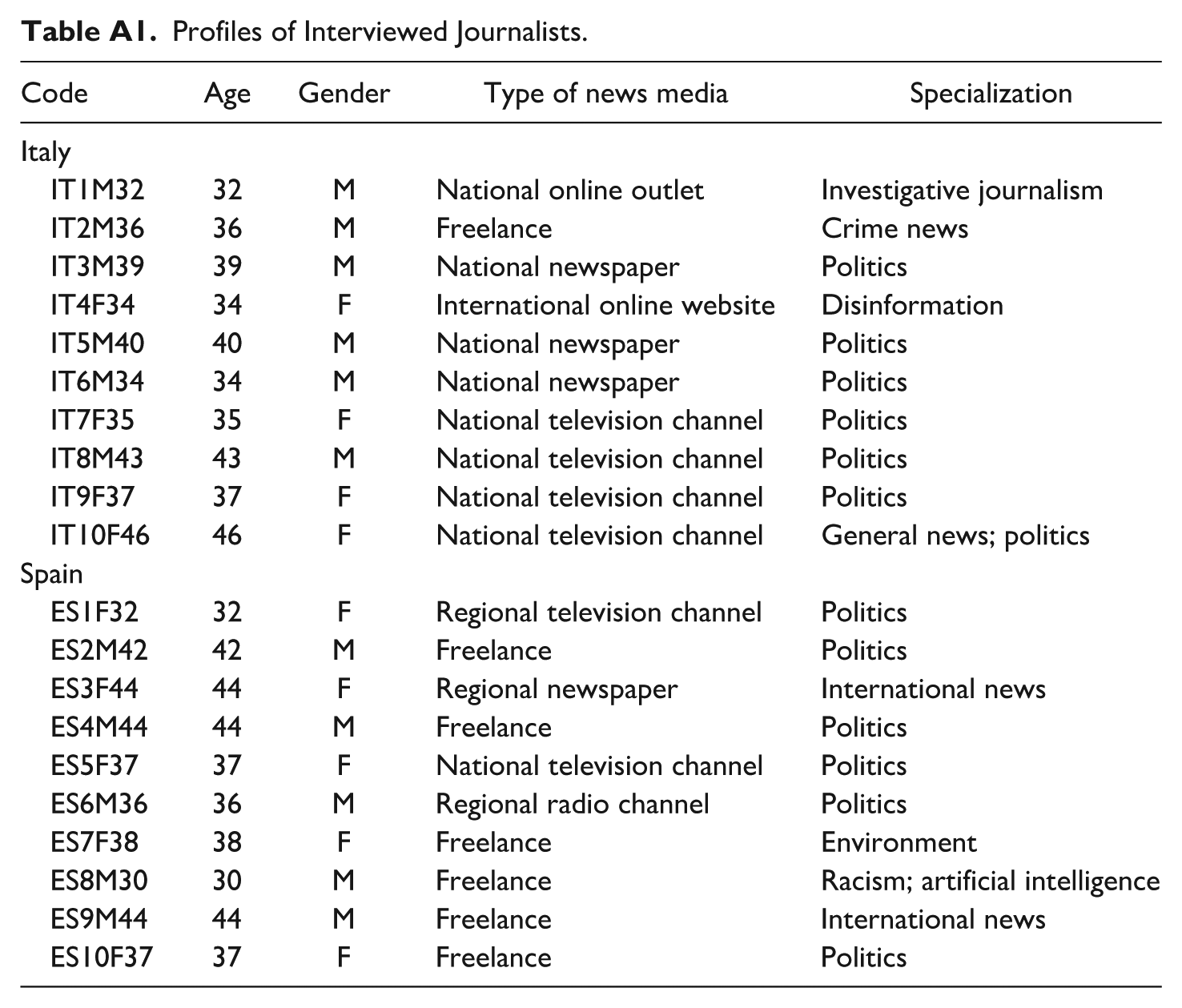
| Code | Age | Gender | Type of news media | Specialization |
|---|---|---|---|---|
| Italy | ||||
| IT1M32 | 32 | M | National online outlet | Investigative journalism |
| IT2M36 | 36 | M | Freelance | Crime news |
| IT3M39 | 39 | M | National newspaper | Politics |
| IT4F34 | 34 | F | International online website | Disinformation |
| IT5M40 | 40 | M | National newspaper | Politics |
| IT6M34 | 34 | M | National newspaper | Politics |
| IT7F35 | 35 | F | National television channel | Politics |
| IT8M43 | 43 | M | National television channel | Politics |
| IT9F37 | 37 | F | National television channel | Politics |
| IT10F46 | 46 | F | National television channel | General news; politics |
| Spain | ||||
| ES1F32 | 32 | F | Regional television channel | Politics |
| ES2M42 | 42 | M | Freelance | Politics |
| ES3F44 | 44 | F | Regional newspaper | International news |
| ES4M44 | 44 | M | Freelance | Politics |
| ES5F37 | 37 | F | National television channel | Politics |
| ES6M36 | 36 | M | Regional radio channel | Politics |
| ES7F38 | 38 | F | Freelance | Environment |
| ES8M30 | 30 | M | Freelance | Racism; artificial intelligence |
| ES9M44 | 44 | M | Freelance | International news |
| ES10F37 | 37 | F | Freelance | Politics |
Appendix B
Coding Manual for the Interviews.
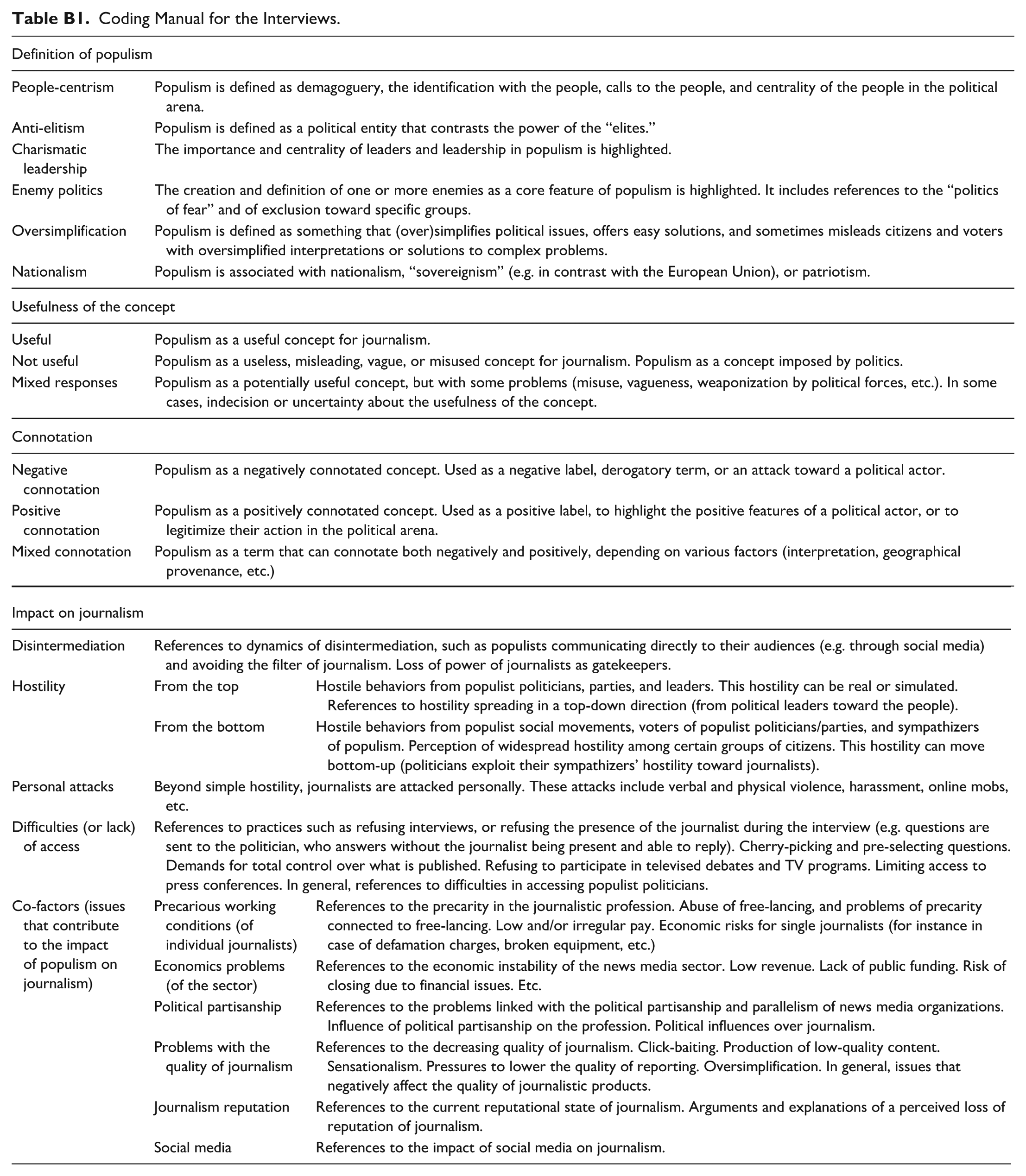
| Definition of populism | ||
|---|---|---|
| People-centrism | Populism is defined as demagoguery, the identification with the people, calls to the people, and centrality of the people in the political arena. | |
| Anti-elitism | Populism is defined as a political entity that contrasts the power of the “elites.” | |
| Charismatic leadership | The importance and centrality of leaders and leadership in populism is highlighted. | |
| Enemy politics | The creation and definition of one or more enemies as a core feature of populism is highlighted. It includes references to the “politics of fear” and of exclusion toward specific groups. | |
| Oversimplification | Populism is defined as something that (over)simplifies political issues, offers easy solutions, and sometimes misleads citizens and voters with oversimplified interpretations or solutions to complex problems. | |
| Nationalism | Populism is associated with nationalism, “sovereignism” (e.g. in contrast with the European Union), or patriotism. | |
| Usefulness of the concept | ||
| Useful | Populism as a useful concept for journalism. | |
| Not useful | Populism as a useless, misleading, vague, or misused concept for journalism. Populism as a concept imposed by politics. | |
| Mixed responses | Populism as a potentially useful concept, but with some problems (misuse, vagueness, weaponization by political forces, etc.). In some cases, indecision or uncertainty about the usefulness of the concept. | |
| Connotation | ||
| Negative connotation | Populism as a negatively connotated concept. Used as a negative label, derogatory term, or an attack toward a political actor. | |
| Positive connotation | Populism as a positively connotated concept. Used as a positive label, to highlight the positive features of a political actor, or to legitimize their action in the political arena. | |
| Mixed connotation | Populism as a term that can connotate both negatively and positively, depending on various factors (interpretation, geographical provenance, etc.) | |
| Impact on journalism | ||
| Disintermediation | References to dynamics of disintermediation, such as populists communicating directly to their audiences (e.g. through social media) and avoiding the filter of journalism. Loss of power of journalists as gatekeepers. | |
| Hostility | From the top | Hostile behaviors from populist politicians, parties, and leaders. This hostility can be real or simulated. References to hostility spreading in a top-down direction (from political leaders toward the people). |
| From the bottom | Hostile behaviors from populist social movements, voters of populist politicians/parties, and sympathizers of populism. Perception of widespread hostility among certain groups of citizens. This hostility can move bottom-up (politicians exploit their sympathizers’ hostility toward journalists). | |
| Personal attacks | Beyond simple hostility, journalists are attacked personally. These attacks include verbal and physical violence, harassment, online mobs, etc. | |
| Difficulties (or lack) of access | References to practices such as refusing interviews, or refusing the presence of the journalist during the interview (e.g. questions are sent to the politician, who answers without the journalist being present and able to reply). Cherry-picking and pre-selecting questions. Demands for total control over what is published. Refusing to participate in televised debates and TV programs. Limiting access to press conferences. In general, references to difficulties in accessing populist politicians. | |
| Co-factors (issues that contribute to the impact of populism on journalism) | Precarious working conditions (of individual journalists) | References to the precarity in the journalistic profession. Abuse of free-lancing, and problems of precarity connected to free-lancing. Low and/or irregular pay. Economic risks for single journalists (for instance in case of defamation charges, broken equipment, etc.) |
| Economics problems (of the sector) | References to the economic instability of the news media sector. Low revenue. Lack of public funding. Risk of closing due to financial issues. Etc. | |
| Political partisanship | References to the problems linked with the political partisanship and parallelism of news media organizations. Influence of political partisanship on the profession. Political influences over journalism. | |
| Problems with the quality of journalism | References to the decreasing quality of journalism. Click-baiting. Production of low-quality content. Sensationalism. Pressures to lower the quality of reporting. Oversimplification. In general, issues that negatively affect the quality of journalistic products. | |
| Journalism reputation | References to the current reputational state of journalism. Arguments and explanations of a perceived loss of reputation of journalism. | |
| Social media | References to the impact of social media on journalism. | |
Appendix C
Declaration of Conflicting Interests
The authors declared no potential conflicts of interest with respect to the research, authorship, and/or publication of this article.
Funding
The authors disclosed receipt of the following financial support for the research, authorship, and/or publication of this article: Carlo Berti acknowledges the support of the project MSCA Fellowships CZ—UK2 (reg. n. CZ.02.01.01/00/22_010/0008115), funded through the Johannes Amos Comenius Program.
