



Abstract
This study challenges the view of professional identity in journalism as role-based, arguing that journalists are more than their roles. Drawing from management and organization studies, we explore how the processes of identity work and meaningfulness negotiation coevolve over the course of journalists’ careers. Through analysis of 30 Finnish journalists’ interviews, we identify three narrative identities—artisans, advocates, and stewards—and explore the coevolution patterns of identity work and negotiation of work meaningfulness associated with them. Our findings refine the distinction between roles and identities in journalism and offer practical insights for individual well-being and management issues in media organizations.
“Journalism is not where I work. Journalism is who I am.”
The quote above, from Deborah D. Douglas, the founding co-editor-in-chief of the Emancipator, encapsulates the intensity often associated with identifying as a journalist. Rather than merely paying for the bills, journalism tends to get framed as a passion (Lindén et al., 2021) or even a lifestyle (Perreault & Bélair-Gagnon, 2024). Implicit in these framings is the idea that journalism as a career choice becomes a defining aspect of an individual’s identity. Indeed, recent research in journalism studies has tackled the emotional toll a career in journalism puts on individuals and hinted at its relation to professional identity (Hughes et al., 2021; Sherwood & O’Donnell, 2018), but a detailed investigation into the relationship between identity and well-being in journalism is still missing. Consequently, drawing from the management and organization studies (MOS) literatures on “identities” and “meaningful work,” this study sets out to explore how professional journalists’ identity work and negotiation of work meaningfulness coevolve and are related to well-being at work.
While questions of identity have provided journalism scholars ample opportunities for research in the past decade, the journalism studies literature has remained perplexingly vague on the conceptualization of professional identity (Raemy, 2021). The main avenue of research relating to identities in journalism is that of professional roles where scholars explore “what journalists ought to do, what they want to do, what journalists really do in practice, and what they think they do” (Hanitzsch, 2017, p. 3). These “doings” refer to journalistic role conceptions and performance—two distinct avenues of research into the normative, cognitive, practiced, and narrated roles of journalists (Hanitzsch & Vos, 2017). Because of the influence of the professional roles literature, our understanding of professional identity thus far has, however, been built upon a rather narrow understanding of identity, as Raemy (2021, p. 844) notes: “The discourse about professional identity seems to be biased by a focus on normative ideals.” In other words, research has tended to reduce the identity of a journalist to include just the normative, democracy-championing side rather than approaching journalists as whole people who bring their full selves—meaning other parts of their identities too—to work.
Consequently, this study examines journalists’ professional identity by utilizing the concepts of “identity work” (Brown, 2022) and “meaningful work” (Bailey et al., 2019). We explore how the processes of identity construction and meaningfulness negotiation coevolve, thus aiming for a holistic inquiry into identities in journalism. We treat identity as narratively constructed, and build on Giddens’ (1991, p. 54) notion that a person’s identity is constituted by their “capacity to keep a particular narrative ongoing” (emphasis in original). In this vein, identity work is seen as an individual’s attempt to invent, shape, and maintain desired accounts of themself (Brown & Coupland, 2015)—and in this study, specifically in the context of work. In contrast to previous journalism studies literature on professional identity, we separate professional identity and roles from each other: Identity is viewed as self-understanding (Sveningsson & Alvesson, 2003), whereas roles are institutional scripts for appropriate behavior (Stryker & Burke, 2000).
The other central concept of this study, meaningful work, can be defined as work that is “personally significant, worthwhile, and valued” (Lysova et al., 2023, p. 1227). It has been linked to, for example, increased levels of job and life satisfaction and overall well-being (Allan et al., 2019), but the concept is yet to be systematically applied to the context of journalism (for an exception, see Olsen, 2023). While meaningfulness is often treated as a static and positive psychological phenomenon (Rosso et al., 2010), we see meaningfulness as something that needs to be constantly negotiated in daily newsroom practice (Mitra & Buzzanell, 2017). While it is clear that journalists are primed for meaningfulness especially as they have a large potential for contributing toward societal good, experiencing their work as highly meaningful can also lead to negative consequences, such as accepting low pay or having a poor work–life balance (Wahl-Jorgensen, 2024). In relation to identity, this raises the question of how journalists balance between who they are (their self-understanding) and who the institution of journalism expects them to be (the roles fit for a journalist)—an act which can have consequences for journalists’ well-being in the long run.
In the bigger picture, our study is motivated by the notion that journalism, at least in Western democracies, has been experiencing increased threats to its legitimacy in the past 2 decades. Attacks from populist politicians and right-wing groups have contributed to the public’s eroding trust toward journalism (Nielsen & Fletcher, 2024), while the overall digitalization of society has stripped journalists of their traditional gatekeeping power (Hermida, 2020). In this context, the prestige once associated with being a journalist has waned and been replaced with notions of journalism as a “passion project” (Deuze & Prenger, 2018) or even a “passion trap” (Waschková Císařová, 2021). Mirroring these shifts, research in the past few years has highlighted themes of mental health and well-being in relation to the increased precarity of and attacks against journalists (Bélair-Gagnon et al., 2023). While highlighting the somewhat gruesome realities of being a journalist in the 2020s, these studies also show that journalists feel contentment and even happiness and joy in their work (Perreault & Mellado, 2024). Specifically, strong professional identity has been shown to function as a coping mechanism in stressful working environments (Hughes et al., 2021)—even to the point of providing a sensemaking framework for reporters in conflict zones (Shah et al., 2023). Against this backdrop, researching how professional identity and meaningful work coevolve in the current media landscape gains additional salience.
Our research builds on and contributes to the literature on professional identity in journalism (Raemy, 2021) as well as meaningful work and well-being in the media field (Bélair-Gagnon et al., 2023; Olsen, 2023) in three distinct ways. First, by separating the concepts of “identity” and “role,” we bring analytical clarity to the analysis of professional identity in journalism. We show how, ultimately, all journalists initially place themselves onto the field of journalism through an existing idea of who they are, rather than the socialized, professional version of themselves (i.e., their professional role) that emerges as careers progress. Second, by utilizing the concept of meaningful work, we start to fill a gap in well-being related research in journalism studies by outlining the aspects that make work meaningful for journalists. And third, our exploration of the coevolution process of identity work and work meaningfulness negotiation has salient practical implications for, for example, individual well-being and management issues in media organizations.
Theoretical Background
Professional Identity in Journalism Studies
Professional identity in journalism studies gets touted either as a solution or a challenge to a specific issue depending on the research context. In studies of newsroom innovation, for example, journalists’ inability to change due to a strong professional identity is often blamed for failed innovation efforts (Ryfe, 2009) while, on the other hand, the same construct has also been framed as a resource for coping with industrywide change resulting from digitalization (Grubenmann & Meckel, 2017). These differences in interpretation, of course, relate to the specific contexts of each study on the microlevel, but, on the macrolevel, also reflect more systematic challenges in how the concept of professional identity has been utilized.
In his review of literature on professional identity in journalism, Raemy (2021) points to discrepancies in the current body of knowledge. First, he argues that there is a conflation between journalists’ and journalism’s identity which results in problems in levels of analysis. In essence, scholars tend to analyze journalism’s institutional identity while attempting to say something about journalists’ identity on the individual level. As a symptom of this, Raemy (2021) notes, the terms “professional identity” and “role conception” are often used interchangeably without acknowledging whether the concepts convey the same idea or not. Second, normative perspectives often associated with the professional roles literature do not fully explain journalists’ identity and performance. Role perceptions and performance differ (Tandoc et al., 2013), which is a logical observation given that, on the one hand, journalists as people are not reducible to their professional roles and, on the other, roles are not mutually exclusive (Loosen et al., 2025; Mellado, 2015).
In general, the professional roles literature takes the journalist’s view of journalism’s role in society as its starting point. A journalistic role is usually defined in relation to the audience and what a journalist can do for members of the public (Loosen et al., 2025; Ferrucci & Vos, 2017). In practice, these are the classic roles that come to mind when describing what or who journalists can be: the adversary, the watchdog, the disseminator, the teacher, the entertainer and so on (for an overview of role theory, see, Mellado, 2020). Recent research has shown that roles can be situationally activated and multiple within the same individual journalist as well as reflected in specific audience relationship practices (Loosen et al., 2025). Overall, the professional roles literature has long acknowledged the gap between journalistic ideals and actual role performance (Mellado et al., 2020). Whereas this literature primarily focuses on discrepancies between role conceptions and performance—what journalists think they do and what they actually do—our approach offers a complementary viewpoint by focusing on identity. Specifically, we examine how journalists make sense of themselves in relation to this tension between ideals and practice.
Beyond professional roles, the literature on professional identity in journalism reveals several theoretical directions. Notably, what is described below are not necessarily clearly formed research streams but rather collections of theoretical devices scholars have recently favored. First, a major part of the literature takes its cue of how to define professional identity from Deuze’s (2005) influential article that conceptualizes journalism as an ideology built on the (ideal-typical) values of public service, objectivity, autonomy, immediacy, and ethics. Cited over 3,500 times by the end of 2024, his explication of what professionalism looks like in journalism has come to define much of the work on professional identity, even if he writes that “analyses of ideal-typical values of journalism—have shown that any definition of journalism as profession working truthfully, operating as a watchdog for the good of society and enabling citizens to be self-governing is not only naive, but also one-dimensional” (p. 458). Paradoxically enough, these ideal-typical values have come to function as de facto building blocks of the definition of the professional identity concept—whether they reflect empirical reality or not.
Second, a stream of research building on Deuze (2005) varyingly combines social identity theory (SIT; Tajfel, 1982) with discursive institutionalism (Hanitzsch & Vos, 2017) and boundary work (Carlson & Lewis, 2019). Studies have explored, for example, the differences between digital and print journalists (Ferrucci & Vos, 2017), professional photojournalists and citizen photographers (Ferrucci et al., 2020), and lifestyle journalists and the rest of the journalistic workforce (Cheng & Avieson, 2024). Analyses guided by SIT focus on how journalists make sense of the group they belong to (their in-group) and how they differentiate themselves and their peers from outsiders (out-group). In their study of digital journalists, for example, Ferrucci and Vos (2017) describe how digital journalists define their in-group through their exclusive focus on digital production, the organizational backing they receive for their work, and the role conception of a “digital journalist” their informants voiced. The out-group, on the other hand, is constructed of bloggers, social media persons, and citizen journalists. Studies using SIT also tend to highlight the normative ideals of journalism: Examining Singaporean lifestyle journalists, Cheng and Avieson (2024) note that some of their informants questioned the idea of being journalists in the first place as journalism’s institutional identity is so heavily tied to the hard news oriented ideals rather than the softer, lifestyle related content they produced.
Finally, the emotional turn in journalism studies (i.e., an increased interest in “the place of emotion in shaping the production, texts and audience engagement with journalism”; Wahl-Jorgensen, 2020, p. 178) has brought with it a shift away from normativity in studies of professional identity, that is, researchers have started to look at journalists as individuals, beyond their professional selves: Perreault and Bélair-Gagnon (2022), for example, found that lifestyle journalists tend to place themselves onto the field of journalism through their personal identity. Elsewhere, Perreault (2023) has noted that journalists reporting outside hard news beats are motivated to do their work because of their childhood experiences and the joy the work brings them. Similarly, research on journalists’ work–life balance (Leppäkumpu & Sivunen, 2022) and, for example, motherhood (Sampaio-Dias et al., 2024) addresses media professionals as multifaceted individuals. To build on this emerging view, the next section introduces key ideas from the MOS literature on identities.
Identity as a Narrative Process
While the journalism studies literature on professional identity has not made a clear distinction between the concepts of “role” and “identity,” the two can nonetheless be demarcated from each other. 2 Roles are “bundles of norms and expectations” (Baker & Faulkner, 1991, p. 280) which function as “the building blocks of social systems” (Katz & Khan, 1978, p. 219). In other words, roles are institutional directives which enable and constrain individuals’ views of themselves and guide their behavior. Identity, on the other hand, relates to fundamental human questions such as “who am I?” and “how should I act?” Identity is thus seen as something internal, “consisting of internalized meanings and expectations associated with a role” (Stryker & Burke, 2000, p. 289). The two concepts can be bridged with the concept of “role-identity,” where role is external, linked to social positions within the social structure and acting as a prescription for behavior, whereas identity is self-understanding (Stryker & Burke, 2000; Sveningsson & Alvesson, 2003). When a role becomes internalized as part of an individual’s understanding of their self, a role-identity is formed (Piliavin et al., 2002).
In this study, we treat identity as a process and hence adopt the concept of identity work (Brown, 2022; Brown & Coupland, 2015). As an internal process, identity work is a “process of continuously forming, repairing, maintaining, strengthening, or revising self-constructions” (Alvesson & Willmott, 2002, p. 626) within a specific institutional environment (Leung et al., 2014). Contrary to some of the earlier work in journalism studies on professional identity, we do not see identity as static or unitary but rather as dynamic, changeable, and context-driven (Wright et al., 2012). A similar approach was adopted, for example, by Jenkins (2019) who, in her study of a city magazine in Dallas, Texas, noted that local journalists negotiated multiple identities by balancing between what they personally saw as attributes fit for “a real journalist” and what their organizational affiliation on the one hand and geographical location on the other suggested they should be.
Individuals work on their identities through narratives (Clarke et al., 2009). An individual can invoke a range of identities by using discourse to play with and taste different social and professional identities (Pratt et al., 2006). In the process of attempting to construct self-narratives, discourse also allows individuals a sense of continuity in self-perceptions even when identities are multiple and hybrid (Caza et al., 2018). Engaging in identity work can help individuals navigate the sometimes conflicting pressures associated with their work as identity work allows them to reconcile misalignments between their identities and the work they do through identity revising (Pratt et al., 2006). Similarly, through identity work, individuals can internalize ideas related to a role more strongly which may lead to the strengthening of an identity (Caza et al., 2018). In journalism, internalizing the traditional watchdog role through socialization, for example, could be interpreted as a form of identity work.
While identity work as a concept highlights the constant, ongoing labor that individuals engage in to make sense of who they are and the work that they do (Brown, 2022), identity work in itself may at times increase and decrease in intensity. Research suggests that changes in professional identity are intertwined with changes in work practices, that is, a sense of who you are and what you do feed into each other (Reay et al., 2017). Specifically, professional identity changes occur when an individual’s sense of who they are as a professional does not match the work they do: Pratt et al. (2006) conceptualize this misalignment as a work-identity integrity assessment, which prompts individuals to work on their identities in various ways.
A misalignment in work-identity integrity may take place as a result of advancing in one’s career as work tasks change. Consequently, in managerial positions, identity work often involves balancing between discourses of control, caring, and self-promotion (Clarke et al., 2009), which can lead to “identity struggle” (Sveningsson & Alvesson, 2003). Identity struggle characterizes a process of forming multiple managerial identities which are “more or less contradictory and often changing (. . .) rather than one stable, continuous and secure, manager identity” (Sveningsson & Alvesson, 2003, p. 1165). In the context of journalism, identity struggle, for example, can be identified in journalists occupying middle management roles where the identities of a journalist and a manager can sometimes be in conflict with one another. The next section links our current discussion to the literature on meaningful work.
Meaningful Work and Journalism
Meaningful work is usually defined along two lines of focus, the “self” and the “other,” in that meaningfulness can be achieved via self-actualization, satisfaction, and the fulfillment an individual obtains from work as well as through the contribution one’s work makes to society (Bailey et al., 2019; Lepisto & Pratt, 2017). Put simply, meaningful work is work that feels personally fulfilling and makes a positive difference in society. In this conceptualization, the self-oriented pathway to work meaningfulness can be understood as actualizing oneself through the fulfillment of personal needs, motivations, and desires through work (Lepisto & Pratt, 2017). The other-oriented pathway, in turn, revolves around making a prosocial impact in one’s environment: A key in this is the individual’s own assessment that they have made a worthwhile contribution, seen as “worthy work” (Bailey et al., 2024).
In journalism studies, there is a relative lack of studies making use of the meaningful work concept. While the field has seen an increase in research focusing on, for example, happiness (Bélair-Gagnon, et al. 2023) and joy (Perreault & Mellado, 2024) in the wake of the emotional turn (Wahl-Jorgensen, 2019), the specific concept of meaningful work has not been extensively explored. In a rare study, Olsen (2023) examined how the implementation of automated journalism influenced different newsroom groups’ sense of work meaningfulness and found diverging outcomes: While newsroom technologists were less affected, some reporters “had experienced a dramatic loss of work meaningfulness” (p. 316) as a result of automation. Wahl-Jorgensen (2024), on the other hand, described how local journalism entrepreneurs value the meaningfulness of their work and are willing to negotiate, for example, financial security in favor of doing their work.
Generally, journalism presents a suitable context for studying work meaningfulness as the work itself is at least partially decoupled from the market logic and steered by values of public service, autonomy and impartiality (Lischka, 2020). In the meaningful work literature, work that carries with it a certain emphasis on values has been approached through the concept of “responsible careers,” that is, careers “in which people seek to have an impact on societal challenges, such as environmental sustainability and social justice” (Tams & Marshall, 2011, p. 110). This type of research often zooms in on corporate social responsibility (CSR) workers (Iatridis, et al., 2022; Mitra & Buzzanell, 2017) or volunteers (Florian et al., 2019; Weller et al., 2023), claiming that there is an implicit assumption that both CSR and volunteering are inherently meaningful. The assumption of meaningfulness arises from the idea that individuals in these professions are expected to challenge the profit maximization imperatives of organizations, and in addition to trading on their expertise and knowledge, they leverage their ethos and values too (Iatridis, et al., 2022). In the context of journalism, journalists are similarly expected to resist the market-orientation of media outlets in favor of public service-oriented reporting.
Meaningful work and professional identity—or, more broadly, meaningfulness and identity—can be understood as coevolving processes where individuals author identity narratives in their search for meaningfulness, on the one hand, or where meaningfulness itself serves as a discursive resource for identity work, on the other (Weller et al., 2023). As Harding (2019) notes, meaningful work requires an “I,” who both undertakes work and is constituted as an I through the act of undertaking that work: The work and its doer co-constitute each other. Put differently, how people define their purpose and what constitutes fulfillment for them are developed in combination with the self-narratives they craft (Ezzy, 1997). In journalism, the connection between meaningful work and professional identity can, consequently, be found in the intersection of values and expertise: The profession’s explicit focus on greater good creates the expectation that meaningfulness will directly influence journalists’ professional identity.
Finally, scholars of meaningfulness have also tackled the “dark side of meaningfulness” (Florian et al., 2019, p. 593) and approached it as a “double-edged sword” (Bunderson & Thompson, 2009, p. 40). In essence, for some, meaningfulness entails the positive opportunities described in the literature (Allan et al., 2019) but, for others, it might lead to accepting low pay, poor work–life balance, and unsuccessful careers (Berkelaar & Buzzanell, 2015; Cinque et al., 2021). In journalism research, similar ideas can be found in, for example, studies on journalism as aspirational work where scholars have shown that lifestyle journalists enter the profession with a passion for their specific niche topic but often end up in situations where the line between work and personal life gets blurred (Perreault & Bélair-Gagnon, 2022; see also Leppäkumpu & Sivunen, 2022).
Consequently, in this study, we explore how journalists narratively author their professional identities in search of work meaningfulness over the course of their careers. Based on the literature reviewed above, we ask: How do the processes of identity work and meaningfulness negotiation coevolve over the course of a career in journalism?
Methodology
Data Generation
The data for this study comprise 30 semistructured interviews with Finnish journalists. We conducted the interviews between October 2023 and May 2024 in two media organizations, the first of which operates a large national daily newspaper and the other a large regional daily newspaper. We interviewed 15 journalists from each organization with slightly differing sampling processes in between them: In the national newspaper, an email was sent out by newsroom management, and volunteers among the newsroom reached out to us for an interview; in the regional newspaper we were given permission from management to approach individual journalists for an interview. In sending out invitations, we aimed for a balanced sample between genders as well as longer and shorter tenures. The interview guide was structured to facilitate reflections on personal work meaningfulness, organizational factors relating to meaningful work, the societal significance of journalism as well as key developments in the informants’ careers. As is usual with this type of data generation method (Tracy, 2020), the interview guide functioned as an overall structuring device while allowing for deviations into topics that the informants wanted to elaborate on in more detail.
Interviews were conducted both face-to-face and over videoconferencing software, as per the informants’ preferences. 3 The average length of an interview was 61 min with the shortest taking 45 min and the longest 88 min. Nineteen of our informants identified as women and 11 as men, they mostly hold college-level degrees, and their mean age was 43.1 years (youngest being 27 and the oldest 64). They had work experience in the field of journalism from 2 to 42 years, the mean being 19.7 years. The transcribed data consist of 695 pages of text. Informants’ key characteristics (job title, organizational affiliation, and length of career) are detailed in Table 1 in the Appendix.
Data Analysis
To answer our research question, we advanced our analysis in several interlinked stages. The first analysis activity we undertook was a round of “data immersion” (Tracy, 2020, p. 213) reading where the first author read through all 30 interviews to immerse herself in the data. While some of the interviews were originally conducted by her, several people—including the third author—participated in data collection. The purpose of the data immersion was to give the first author a sense of the prevalent themes in the data as well as spark ideas both on which themes could be analyzed and how the analysis could be conducted. In a joint analysis session between the authors, the salience of identity for work meaningfulness as well as the temporal aspect of how one’s identity and sense of meaningfulness might change over time arose as an interesting entry point into the data.
The second stage of data analysis included more systematic open coding (Corbin & Strauss, 1990) of emergent themes in the informants’ talk. While professional identity and meaningful work functioned as sensitizing concepts (Charmaz, 2014) for the analysis, at this stage we retained an open approach and included all interesting codes into our preliminary coding structure. Through a process of refining and cutting codes, the results of the open coding ended up reflecting the varied sources of work meaningfulness the informants voiced in the interviews. At this point, the first author coded for units of meaning, that is, coherent segments of text expressing a single idea. Such segments could cover several sentences given that the informants’ descriptions of meaningful work often came to be in lengthy reflections on the topic. We reviewed the codes and their contents in joint analysis meetings, settling disagreements through discussion. This process led to an understanding of how our informants understood the meaningfulness of their work, what kind of values they attached to their work and how they approached the societal role of journalism (cf. Lepisto & Pratt, 2017). The sources of work meaningfulness prevalent among our informants can be found in Table 2 in the Appendix with sample quotes.
Simultaneously to open coding, we iterated between the data analysis and reading of relevant literature (Tracy, 2020) to find concepts that would explain what we were seeing in our data. Given that our data comprises interviews, we aligned our approach with other research considering the informants’ identities as practical discursive accomplishments, co-constructed with the researcher in the interview situation (Brown & Coupland, 2015). Hence, the strand of narrative identity research provided both the most methodological fit as well as explanatory power and guided us toward narrative analysis (Dailey et al., 2024).
In practice, we reverted to the full text of the interviews and wrote chronological summaries of the relevant sections of each interview, reconstructing each informant’s career history. In this phase, we treated each narrative as an analytic unit. These narrative summaries average at 1,250 characters per informant, amounting to approximately 37,000 characters in total. Essentially, the summaries capture the ongoing identity work our informants engaged in during their careers. Similar to Sturges and Bailey (2023), this step enabled us to create a “narrative map” of our informants’ career histories which we then analyzed jointly with the insights from the open coding.
We mapped the two analyses onto each other, looking for patterns between the summaries (the informants’ identity work) and the open codes (sources of work meaningfulness). This mapping allowed us to identify three different narrative identities, the forms of identity work associated with each of them as well as the role of work meaningfulness for that identity work. Consequently, the findings section details the following processes: Artisans and identity revising along with an expansion in sources of work meaningfulness, advocates and identity strengthening in tandem with cementing and broadening sources of work meaningfulness, and stewards and identity struggle along with a reconfiguration of sources of work meaningfulness. 4 Table 3 in the Appendix summarizes each coevolution pattern.
In the following findings section, sources of meaningfulness are presented within individual narrative identities for ease of communication and clarity, though it should be noted that the overall picture is more complicated than that. While it was clear that some sources of work meaningfulness were more pronounced in certain narratives (e.g., writing for artisans, helping others for stewards), the majority of them were also to a varying degree shared among the informants. In other words, there were, for example, advocates who enjoyed writing, but it was not the decisive reason for their journalism career. Consequently, in the analysis, we were most focused on the sources of meaningful work that related to the informants’ identity work. We return to the idea of widely shared sources of work meaningfulness in the discussion.
Findings
Artisans: Identity Revising and Broadening Sources of Work Meaningfulness
Writing has been like breathing to me. I’ve written letters for a long time and [in them] narrated events, analyzed how I feel, what’s happening and so on, so it has been extremely natural for me to write to others [publicly] too. And only later, kind of along the way, the societal meaning of this job has emerged. (J30, local reporter, regional news organization)
The above reflection crystallizes the coevolution of work meaningfulness and identity work for the group of journalists we label artisans. At the start of their careers, artisans describe being drawn to journalism because of the craft that is related to its making, whether it be writing, audio journalism, or visual storytelling. Both their identities and sources of work meaningfulness revolve around the craft as, in entering the profession, they find themselves being able to “do what they love.” Over time, through journalism education as well as time spent engaging with colleagues, sources, and the audience, they come to realize that their craft can affect people’s lives and larger societal matters. This shift necessitates identity revising: Artisans begin to see themselves not just as mere makers but also as contributors to public life, which requires simultaneously rethinking what counts as meaningful work. As they engage in revising their identity beyond the craft, their sources of work meaningfulness expand in tandem, shifting from personal fulfillment to societal contribution.
The artisans’ story begins with the love of the craft. In the interviews, they articulated a love or even a passion for the craft of doing journalism, which had initially propelled them to pursue this career path. A news reporter (J22), who had gone into journalism when they were seventeen, told us: “I’ve never written anything else besides news. But writing is my superpower.” Similarly, a reporter in the regional newspaper recounted how the ability to combine their inner curiosity and an affection for writing became the defining aspect of their career choice: In high school I just felt so strongly about the fact that you could combine . . . like you don’t have to focus on just one thing but rather look at the world quite openly and make use of that curiosity. And writing has always been a strong skill for me, it’s super useful in this job. (J20)
In essence, at the early stages of their careers, artisans’ identities and sources of work meaningfulness revolve around their ability to pursue a specific craft. For many in our data, that not only craft was writing as the informants worked for newspaper organizations but also other things, such as the “visual storytelling part of the job” (J24). Connectedly, artisans described how they drew meaning from continuous learning and creativity: “You get to learn new things all the time” (J23) and “It feels meaningful that I get to be creative in this job” (J9). The early stages of their careers reflect a somewhat stable coevolution of identity and work meaningfulness, where an interest in a craft initially propels an individual toward a career in journalism, later serving as both the defining aspect of one’s self-understanding and the self-oriented pathway to work meaningfulness (Lepisto & Pratt, 2017).
A shift, however, occurs when artisans come into contact with the realities of journalistic work either through internships during higher education or actual work experience. “First I was like ‘this job is fun’ (. . .) but then I went to study journalism and the democracy aspects of the job became clearer,” a news producer (J15) said. Gradually, as artisans engage with other journalists, sources, and the audience, they begin to see the possibilities that their craft has for enacting change in people’s lives as well as societally. A news journalist (J22) described the power of their writing like this: “I tend to think that if I can say something out loud then another person can say that ‘I recognize that’. And they can get help from that.” In the interviews, this point of “societal awakening” was often described as progressively “growing into” the societal role of a journalist. The following quotes illustrate this trajectory: I still have that original inner fire to find out things and tell them [to the audience] (. . .) but I have also grown into the societal role [of the job] during my career and maybe along with that the meaningfulness of my work has also expanded. Initially, I was driven to this work by that inner fire but as the years go by, I’m increasingly motivated by everything else [in this job]. Now, I get my motivation from winning the news race. (J18, local reporter, regional news organization) At some point I realized that I'm a good writer and that this might be a good career for me. (. . .) When I was younger, I felt that the job was just so cool but over the years other things have come to contribute to the experience too. Nowadays I’m also motivated by the idea of some kind of common good that I can bring about with my work. (J10, sports journalist, national news organization)
In reconstructing their identities from mere makers into contributors to public discussion, the artisans engage simultaneously in identity revising (Alvesson & Willmott, 2002) and expanding their sources of work meaningfulness. The role of journalism gets reframed through its societal significance in the artisans’ descriptions of meaningful work: “Feedback that I get [from the audience] and to see a story shape a decision making process [locally], they are so rewarding to me,” a news journalist (J26) described. Similarly, a sports journalist (J10) noted: “Nowadays, I’m able to write stories that have impact which increases the sense of meaningfulness to me” (J10). Put another way, the journalists’ realization regarding the societal impact of their craft expands their available sources of work meaningfulness to include the other-related avenue (Bailey et al., 2019) of meaningful work as well. Consequently, as artisans’ revise their craft-oriented identities to include the societal role of a journalist, their sense of work meaningfulness transforms in tandem.
Advocates: Identity Strengthening and Cementing/Broadening Sources of Work Meaningfulness
I was interested in societal affairs already in middle school and high school. At the end of the 70s, environmental issues and other social debates were kind of heated. Opposing nuclear power and so on. And I started from the idea that as a journalist I could shape those discussions. (J17, economic reporter, regional news organization)
As the quote above suggests, the beginning stages of a career for the journalists we call advocates revolve around an interest in societal issues. Before entering journalism, advocates are motivated by the idea of taking part in and steering public discussion, which encourages them to seek out a career in the media. Entering the newsroom, consequently, enables them to act upon an existing sense of purpose by practicing journalism, that is, doing journalism offers them the tools to enact an existing identity. In their work, advocates “uncover wrongdoings in the society” (J6), “defend the underdog” (J27) or, simply, “know when it’s flu season in your kids’ daycare” (J1). While repeatedly returning to journalism’s watchdog ideals strengthens the advocates’ existing identity, their work meaningfulness evolves concurrently with the self-oriented pathway feeding into the formation of the other-oriented route: At first, work meaningfulness serves as a discursive resource in the advocates’ search for personal fulfillment but, through the practice of journalism, it also leads to the internalization of the watchdog ideal which enables advocates to draw meaning from contributing to the common good. That is, advocates engage in identity strengthening through which their sources of work meaningfulness are simultaneously cemented (self-oriented pathway) as well as broadened (other-oriented pathway).
The starting point for an advocate’s career is a will to have an effect on societal issues. This urge is visible both in justifications for becoming a journalist as well as descriptions of alternate career paths. When asked whether their motivation for becoming a journalist had changed over the years, an opinion editor (J27) working for the regional newspaper answered: “Well, no, it’s always been the same, the urge to say something about a thing you feel is important.” In a similar vein, a feature journalist (J1) working for the national newspaper described their career choices: I would have wanted to become a performer or a theatre professional or a singer because writing didn’t come naturally to me. (..) There are people who are very interested in society and the world and they acquire knowledge about them. But then there’s us who, on top of that, want to immediately tell everything they know to the world. That side of me was stronger. (J1)
Consequently, for advocates, the entrance into journalism encourages a first of two shifts: The ability to practice journalism gives rise to both enacting and strengthening an existing identity as well as the cementing of existing sources of work meaningfulness. That is, as advocates repeatedly engage with the practice of journalism, they get to act upon an existing sense of purpose which is further supported by the normative values of journalism. In the interview material, advocates tend to highlight how their personal values align with journalism’s values in general. This alignment feeds into their sense of doing personally meaningful work: I think the stories that I write are societally important and I can advocate for things that I feel are personally significant, like ethical food production, or expose how vulnerable people are being exploited. Those are values that I personally try to live by in my life. (J6, investigative reporter, national news organization)
In terms of identity work, advocates engage in identity strengthening by maintaining their established identity. In these early stages, their identity work and meaningfulness negotiation draw from the same well of journalism’s societal relevance—in other words, work meaningfulness functions as a discursive resource in the advocates’ identity strengthening. As the advocates’ careers progress, however, a second shift occurs: Repeated engagements with watchdog journalism amount to a growing sense of moral responsibility toward the audience, contributing to an enlargement in their sources of work meaningfulness. Put differently, rather than being a tool in their search for personal fulfillment, journalism also becomes about actually helping others in the society. These views shine through in advocates’ talk regarding the audience and the engagement they have with it, especially as they elaborate on the rewarding aspects of their current roles: For a while now I’ve been thinking that the most interesting or meaningful stories are those where you can tell something about the world in a way that changes the readers’ way of looking at it. (J7, political reporter, national news organization) In editing the opinion pages, I try to lift up voices or views that . . . that come from people whose voices wouldn’t be heard otherwise, and they [the pages] are a bit more attached to reality then. A viewpoint that’s important to put to the paper, doing that is rewarding. (J27, opinion editor, regional news organization)
To sum up, the coevolution of identity work and meaningfulness negotiation crystallizes in the advocates’ use of an existing identity, which upon entering journalism they maintain and strengthen, alongside a cementing and broadening of their sources of work meaningfulness. Consequently, advocates’ identity work and meaningfulness negotiation highlight how defining one’s purpose and what constitutes fulfillment for them is developed in continuous iteration with the self-narratives one crafts (Ezzy, 1997). Finally, advocates reflect some degree of integration in their fusing of traditional journalistic notions related to watchdog journalism: By positioning themselves as having a moral obligation to serve the audience, advocates voice a role-identity (Piliavin et al., 2002) where parts of the institutionally sanctioned story of the “watchdog journalist” have become somewhat internalized as part of their self understanding (cf. Giddens, 1991; Weller et al., 2023).
Stewards: Identity Struggle and Reconfiguration of Sources of Work Meaningfulness
The final narrative identity and work meaningfulness coevolution in our data involves the two previous identities presented above but with the addition of a managerial role. The group we call stewards got their start in journalism either through the craft or the values of journalism, that is, there are threads of artisan or advocate identities in them. However, when stewards enter a managerial position, both their identity work and meaningfulness negotiation require a shift as being in a supervisory role changes both their actual work tasks as well as their relationship to others in the newsroom. As a result of advancing in their career, stewards need to reframe why journalism is worthy work to them: While as rank-and-file journalists they could draw work meaningfulness from the craft or their personal values, in a managerial role work meaningfulness increasingly hinges on aligning one’s views with the institution’s normative values and especially their measurable outcomes, such as audience analytics. Simultaneously, through a change in their peer relationships, they find themselves continuously trying to forge a new managerial identity and reconcile it with their previous sense of self—a process which is not necessarily completed but rather, more accurately described as an ongoing identity struggle.
Stewards begin their careers in journalism as artisans and advocates—either from love of the craft or an existing sense of purpose. They characterize their motivations for becoming journalists mainly through the allure of writing for a living or getting to shape public debate on personally significant issues: “I’ve always been interested in things in the society as well as writing. And after a gap year, I applied to study journalism in a university and got in. There, through the studies and internships, journalism started to feel like my path,” a lifestyle journalism editor (J4) described. Notably, however, stewards have progressed in their careers to a managerial position, overseeing others’ work, which becomes the tipping point for their need for identity work and work meaningfulness negotiation. When asked about meaningful things in their work, a news producer (J3) from the national news organization described that “I’m not a rank-and-file journalist right now, but I’ve always loved learning and going to places where others don’t get to go.” Later on, however, they contrast this experience to what their daily work is like currently: When I switched to this managerial role about a year ago, my whole view of this work changed. I try to pay attention to what stories our team writes and genuinely think about the relevance of each story. If it has none, then we will not do it. (J3)
In practice, the career change induces interconnected shifts in both stewards’ identity and sources of work meaningfulness. This takes place through a reframing of one’s values to better align them with the institution of journalism’s normative ideas on what is good journalism and how one’s work contributes toward it. A lifestyle journalism editor (J13), for example, described how they think they are “part of the bigger machine advocating for democracy and freedom of speech by association.” The following quote from them tangibly illustrates the discursive work stewards perform to realign their personal contribution in the managerial role to serve the interests of journalism as an institution: I work in lifestyle content, which is not, how should I put it, in the core of what journalism is supposed to be in the sense that it’s not political journalism or such. But one avenue of finding meaning is that we make market-friendly content, which brings money to the organization, which, in turn, makes it possible for others here to do investigative journalism or politics, economics or that kind of topics. (J13)
In addition to values, stewards also needed to reconfigure their relationship to their colleagues, which consequently shaped their work meaningfulness. Often, this meant shifting their focus from personal achievements to the successes of their team: “This job is about teamwork. (..) My work isn’t like ‘I, the heroic journalist will now write a story and I know it’s going to be good’ but rather, it's pretty far from that,” a news editor (J12) from the national news organization described. A specific feature in this process was the stewards’ highlighting of measurable goals and their own responsibility in making sure their teams reach said goals, as is illustrated by the following quote: If I’m being completely honest, in the job that I’m currently doing, I find it rewarding when a story is well read and liked, and it shows in audience analytics. In my job, it’s important to follow the analytics and reach those certain goals. (..) I feel like when I’ve been successful in writing a headline and wrangling the viewpoint and producing the story . . . and we’ve gotten there together, then that’s really rewarding. (J4)
To summarize, stewards’ brand of identity work and meaningfulness negotiation entails the simultaneous processes of identity re-crafting as well as a reconfiguration in sources of meaningfulness. Our empirical material also suggests that while stewards continuously engage in identity work to reconcile the tensions between their original identities and the new managerial ones, they enter a state of identity struggle (Sveningsson & Alvesson, 2003) due to a relative misalignment between the things they consider rewarding and worthy in their work and the actual realities of their managerial duties. This may be eased up through a reconfiguration in sources of work meaningfulness, where the self-oriented pathway to work meaningfulness of an artisan loving writing, for example, is turned into a steward finding worth in editing others’ stories. The continuous negotiation of who the stewards are as journalists, on the one hand, and as managers, on the other, however, can have consequences for their well-being in the long run.
Discussion and Conclusion
In this study, we have explored how professional identity and work meaningfulness coevolve over the course of a career in journalism. We make three contributions. First, our findings tangibly illustrate that, in the context of journalism, professional identity is not reducible to professional roles. Contrary to much of the research on professional identity that draws from the professional roles literature (Cheng & Avieson, 2024; Ferrucci & Vos, 2017), our analysis here illustrates how journalists’ professional identity is not anchored to the institution’s traditional normative roles. Rather, the three narrative identities of artisan, advocate, and steward highlight how professional identity in journalism is a combination of a deeper self-understanding where identity is “the self as reflexively understood by the person” (Giddens, 1991, p. 53) as well as roles understood as “generalized expectations of behavior (. . .) rather than prescriptions for self-understanding” (Sveningsson & Alvesson, 2003, p. 1169). This view aligns with Raemy (2021) who, in teasing out the contradictions of the current body of knowledge on professional identity in journalism, also called for more clarity between the concepts of “identity” and “role.” Furthermore, while previous research has noted that roles can be situationally activated and multiple (Loosen et al., 2025), our findings suggest that professional identity, understood as a deeper sense of self-understanding, may shape which professional roles feel “livable” for a journalist in the first place.
Connectedly, our findings indicate that rather than simply drawing from the ideals of the journalistic institution, journalists tend to start their identity construction from a personal standpoint anchored in their skills or values. Artisans use their skills as a basis for their identity construction whereas advocates draw on personal values to make sense of themselves in relation to the institution’s requirements and the work they do. These positions do not exclude each other but rather, the question is about how the balance between skills and values gets emphasized in a journalist’s career narrative. Conversant with Perreault and Bélair-Gagnon’s (2022) notion that lifestyle journalists place themselves onto the field of journalism through their personal identity, our treatment here builds on this finding by offering more nuance: Journalists from all beats initially make sense of themselves and their work through an existing idea of themselves, rather than the socialized, professional version of their identity that emerges later, over the course of their career (cf. Pratt et al., 2006). Additionally, our findings explicate how that sensemaking occurs, that is, either through a focus on skills or values.
Applying the skills and values lens to the situation of stewards, that is, journalists in middle managerial roles, a more complicated picture emerges. Our analysis shows that stewards must perform extra work in figuring out their managerial identity as well as in reconfiguring their sources of work meaningfulness. Part of this process is aligning one’s values with the journalistic institution’s normative ideals—which could be argued to be easier for a steward with an initial identity as a value-oriented advocate than a steward coming from a skills-oriented artisan background. Notably, losing the ability to write as part of one’s work could lead an artisan-steward to experience a significant fracture in their work-identity integrity (Pratt et al., 2006). In other words, advancing to a managerial role and the related change in work tasks it brings could induce a mismatch between who you are and what you do (Reay et al, 2017), intensifying the identity work required to solve the conflict. However, more research with a fitting sample is needed to further explicate this emerging pattern. Overall, the narrative identities and the coevolution patterns associated with them offer a framework for others interested in the interplay of identities/roles and meaningful work in journalism. What is described in the findings and above may be built upon and elaborated in future studies, further contributing to journalism studies’ increasing recognition of journalists as whole people as opposed to just the roles they execute.
As our second contribution, the findings build up to a novel understanding of what makes work meaningful for journalists: Across the board, journalists overwhelmingly emphasized journalism’s societal role as the one thing that makes journalistic work worth doing—irrespective of their beat, their narrative identity, or their organizational standing (cf. Olsen, 2023). Given that we consider identity work and meaningfulness negotiation as processes that coevolve (i.e., each shaping the other), this finding has consequences for how journalism studies should think about professional identity in future studies. While previous analyses of professional identity have tended to reproduce the normative categorization related to hard and soft news, or political and lifestyle journalism (Cheng & Avieson, 2024), thus often excluding reporters working on lifestyle-related subjects from the core of journalism (Perreault & Bélair-Gagnon, 2022), analyzing identity work and meaningfulness negotiation jointly provides a shift in this perspective. In practice, the dichotomy between hard and soft news becomes redundant when considered in relation to identity, as testified by the shared nature of sources of work meaningfulness in our data: Lifestyle and political journalists alike highlighted the societal role of journalism, whether it was guiding readers on their health-related decisions or making informed choices in elections.
This finding also resonates with the notion presented in the MOS literature that in jobs where employees hold certain values and through them are able to contribute to the common good, meaningfulness is likely to arise (Florian et al., 2019; Iatridis et al., 2022). Connectedly, scholars have shown that employees in these professions are more vulnerable to exploitation by employers in the form of, for example, low pay or successive fixed-term contracts (Berkelaar & Buzzanell, 2015; Bunderson & Thompson, 2009). In journalism studies, research indicates that journalists are willing to tolerate, for example, poor working conditions because the work is considered to be of high societal value (Wahl-Jorgensen, 2024; Waschková Císařová, 2021). In this study, the public service mission of the whole profession provided our informants the much-needed avenue to experience work meaningfulness fully. This has implications for the future of work in the media field: If individual journalists’ sense of work meaningfulness and through it, a sense of overall well-being in life (Allan et al., 2019), is connected to journalism’s institutional capacity to enact change in society, the decrease in journalism’s overall legitimacy may pose a threat to the well-being of the journalistic workforce at large. Finding solutions to preserving journalism’s legitimacy becomes, then, not only a question of making journalism profitable as a business but also figuring out how to make careers in journalism more sustainable than they currently are (cf. Waschková Císařová, 2021).
Finally, as our third contribution, we suggest practical ways in which the findings may also be utilized in newsrooms. On the individual level, recognizing one’s narrative identity may help journalists configure their working conditions to support work meaningfulness and overall well-being at work. A journalist identifying as an advocate, for example, may be motivated to prioritize investigative or solutions journalism that directly contributes to societal change, or throw themselves into writing op-eds to stimulate public discussion. On the organizational level, both upper and middle management can make use of our insights as tools for personnel management by taking into account the employees’ professional identity and the varying sources of work meaningfulness. More specifically, as journalists advance in their careers to occupy positions in middle management, questions of identity and meaningfulness tend to complicate: Our analysis suggests that career transitions like this require additional support for journalists to be able to retain their sense of well-being.
The insights developed above suggest several ways to continue exploring both professional identity and meaningful work in journalism. First, while the three narrative identities presented above begin to flesh out the interplay of identity, roles, and work meaningfulness among journalists, they are by no means exhaustive. Our empirical material seemed to point to the existence of a “drifter” identity, that is, someone who “drifted into” journalism without a conscious choice of becoming a journalist. Through education, the values of the profession started to feel like theirs and the crafting of a professional identity could begin. Our data, however, did not allow us to analyze this pattern fully—which leaves room for more research into narrative identities among journalists. Second, studies on professional identity are heavily focused on the American context (Hanitzsch, 2017) and while ours reflects a slightly different approach coming from a Nordic welfare state, studying professional identity in contexts where societal values place more emphasis on communality would be welcome. Finally, given that we approached our topic of work meaningfulness and professional identity with a processual lens, our reliance on interview data can be problematized. While interviews can yield much in terms of informant reflexivity (Tracy, 2020), they do not provide the researcher the ability to observe phenomena in the “real world.” Professional identity and work meaningfulness, however, could also be approached through observational methods: Following journalists in their day-to-day work could reveal intriguing (temporal) aspects of meaningfulness negotiation in the newsroom and contribute more generally to understanding the tensional nature of work meaningfulness (Mitra & Buzzanell, 2017).
Footnotes
Appendix
Phases of Identity Work and Meaningfulness Negotiation Coevolution.
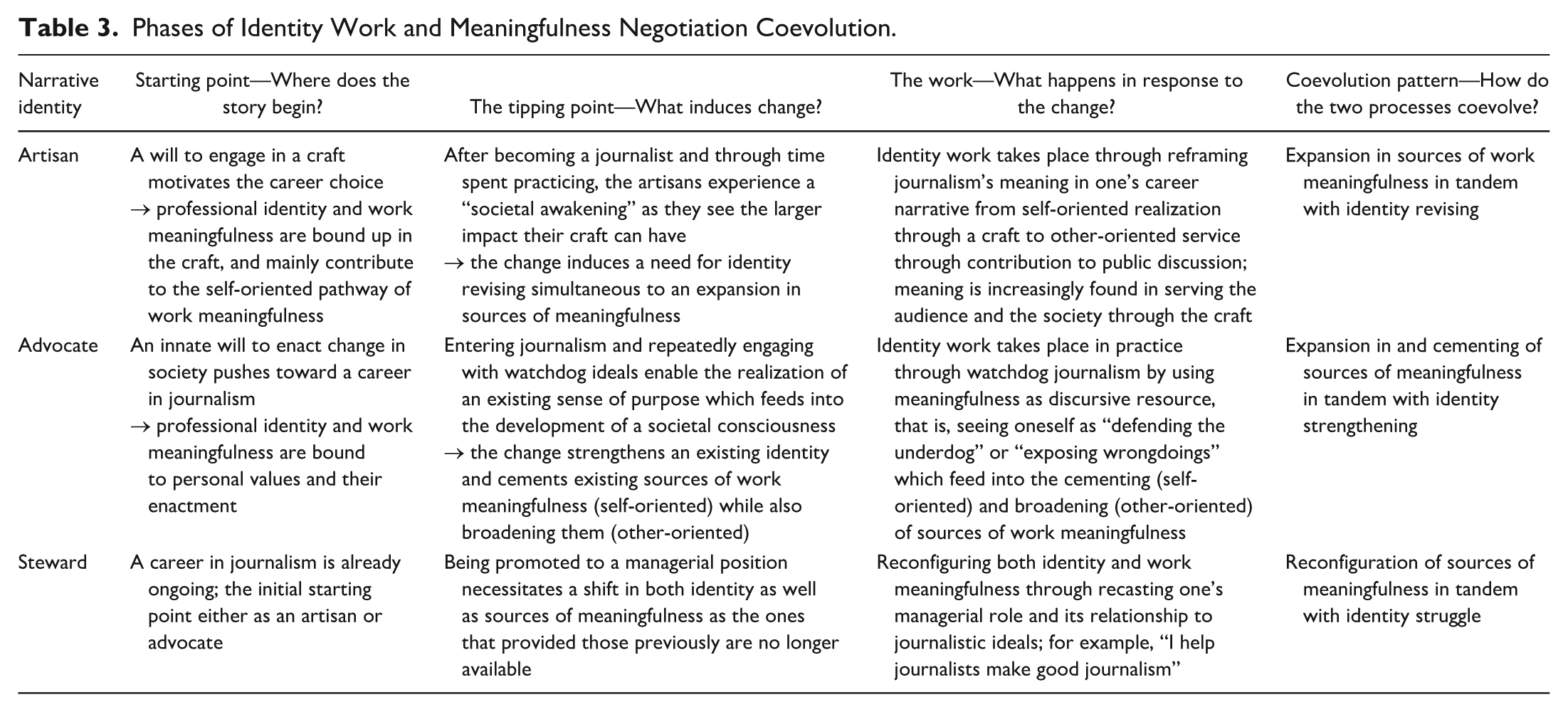
| Narrative identity | Starting point—Where does the story begin? | The tipping point—What induces change? | The work—What happens in response to the change? | Coevolution pattern—How do the two processes coevolve? |
|---|---|---|---|---|
| Artisan | A will to engage in a craft motivates the career choice → professional identity and work meaningfulness are bound up in the craft, and mainly contribute to the self-oriented pathway of work meaningfulness |
After becoming a journalist and through time spent practicing, the artisans experience a “societal awakening” as they see the larger impact their craft can have → the change induces a need for identity revising simultaneous to an expansion in sources of meaningfulness |
Identity work takes place through reframing journalism’s meaning in one’s career narrative from self-oriented realization through a craft to other-oriented service through contribution to public discussion; meaning is increasingly found in serving the audience and the society through the craft | Expansion in sources of work meaningfulness in tandem with identity revising |
| Advocate | An innate will to enact change in society pushes toward a career in journalism → professional identity and work meaningfulness are bound to personal values and their enactment |
Entering journalism and repeatedly engaging with watchdog ideals enable the realization of an existing sense of purpose which feeds into the development of a societal consciousness → the change strengthens an existing identity and cements existing sources of work meaningfulness (self-oriented) while also broadening them (other-oriented) |
Identity work takes place in practice through watchdog journalism by using meaningfulness as discursive resource, that is, seeing oneself as “defending the underdog” or “exposing wrongdoings” which feed into the cementing (self-oriented) and broadening (other-oriented) of sources of work meaningfulness | Expansion in and cementing of sources of meaningfulness in tandem with identity strengthening |
| Steward | A career in journalism is already ongoing; the initial starting point either as an artisan or advocate | Being promoted to a managerial position necessitates a shift in both identity as well as sources of meaningfulness as the ones that provided those previously are no longer available | Reconfiguring both identity and work meaningfulness through recasting one’s managerial role and its relationship to journalistic ideals; for example, “I help journalists make good journalism” | Reconfiguration of sources of meaningfulness in tandem with identity struggle |
Acknowledgements
We would like to thank Dr. Veera Ehrlén and Camilla Karttunen for their help in collecting the interview data as well as Katariina Järvinen for help in transcribing. Additionally, our thanks go to the two reviewers for constructive feedback on our work.
Data Availability Statement
The data underlying this article consist of qualitative interview materials. Due to the sensitive nature of the data and the need to protect participant confidentiality, the data are not publicly available.
Declaration of Conflicting Interests
The authors declared no potential conflicts of interest with respect to the research, authorship, and/or publication of this article.
Funding
The authors disclosed receipt of the following financial support for the research, authorship, and/or publication of this article: This work was supported by the C. V. Åkerlund Media Foundation.
