




Abstract
Media do not only enable social comparison with perfect idols but also with role models who seem “attainable” and thus within reach for youth, which can invoke inspiration. Yet, research lacks a comprehensive validated scale to reliably assess such attainability perceptions. Addressing this research gap, we developed the Perceptions of Media Role Models’ Attainability (PoMRA) scale and two short-form versions of this measure, which we tested and validated in three independent studies among youth (NTotal = 1,043, 16–25 years). We demonstrated a five-factor structure for the scale and established measurement invariance across gender and role model types.
The emergence of social media has granted youth access to diverse role models that can assist them in their identity construction. Many comparison targets flaunt their ostensibly picture-perfect lives online, conveying unrealistic standards to youth (Schreurs et al., 2022), with an adverse impact on their subjective well-being, mental health, and self-esteem (McComb et al., 2023). Simultaneously, social media offers increased visibility to personae who challenge dominant societal ideals (Ogden et al., 2020; Zurcher et al., 2024). For instance, plus-size models arguably convey a more accessible body image to impressionable recipients than flawless supermodels (Ogden et al., 2020). Research correspondingly suggests that positive outcomes of upward social comparison, such as increased well-being, may hinge on the perception that role models are “attainable,” meaning within reach for recipients (Fardouly et al., 2021; Lockwood & Kunda, 1997; Morgenroth et al., 2015). Accordingly, role models in mass media (e.g., in newspaper magazines, on TV, in advertisements) who make certain achievements seem attainable are particularly sought out as exemplars by people (Knobloch-Westerwick & Romero, 2011), and, upon exposure, foster self-enhancement motives among recipients (Lockwood & Kunda, 1997).
While attainability has already been a central concept in communication research in past decades, the advent of social media has arguably further increased its relevance: platforms like Instagram or TikTok present people with counter-stereotypical success stories and narratives (Webb et al., 2019), like during the body positivity movement (Lazuka et al., 2020). In addition, prevailing ideals are frequently portrayed as achievable on social media (Vandenbosch & Eggermont, 2021). Moreover, social media have brought forth a novel type of role model—social media influencers (SMIs)—who, as self-branded media personalities, appeal to audiences by blending popular success with ostensible ordinariness (Jin et al., 2019), making glossy lifestyles and fame seem accessible to recipients (Khamis et al., 2017).
Despite the importance of the concept, particularly in today’s media environment, and extant research on the topic (Fardouly et al., 2021; Luong et al., 2020), communication science still lacks a measurement instrument that allows scholars to reliably capture media role models’ attainability from the perspective of media users. Although psychological studies occasionally operationalized this construct, these measures were domain-specific, non-validated, and/or based on single indicators (Ivaldi & O’Neill, 2010; Politte-Corn & Fardouly, 2020; Trekels & Eggermont, 2018).
A reliable and validated measure for perceptions of media role models’ attainability would allow researchers to explain different attainability beliefs among recipients regarding the same media role model, for example, dependent on perceptions of present similarities to the role model or recipients’ self-esteem (Kim, 2021; Morgenroth et al., 2015). Furthermore, while upward social comparison is often associated with negative effects (Vogel et al., 2014), studies have also shown that social comparison can serve as a source of inspiration for young people (Meier et al., 2020). In this context, role models’ perceived attainability may act as an important boundary condition for (potentially positive) effects of upward social comparison on psychological and behavioral outcomes. Last, attainability perceptions may also differ between various types of media role models: SMIs (e.g., YouTubers, streamers, TikTokers) have been described as more attainable (Jin et al., 2019) than traditional celebrities (e.g., movie stars, athletes, musicians), given that they can convey a “sense of equality” to followers (Enke & Borchers, 2019, p. 264). A comprehensive attainability scale could help ascertain whether perceptions of attainability diverge between SMIs and traditional celebrities, possibly explaining differential endorser effectiveness (Gräve, 2017).
Against this background, we propose a novel multi-dimensional concept of perceived attainability. In the present study, we systematically integrated literature from different role modeling domains and validated the resulting dimensions with an expert survey (establishing content validity; DeVellis & Thorpe, 2022; Lynn, 1986). Subsequently, we tested and validated this novel attainability measure—called Perceptions of Media Role Models’ Attainability (or PoMRA)—using data from three independent youth samples. Four main conclusions are drawn from the scale development: First, we revealed that PoMRA can be measured as a multi-dimensional construct by revealing five sub-dimensions (i.e., attainability of skills, values, fame, person in general, and appearance) that can be composed to a second-order factor of global attainability. Second, we established convergent and discriminant validity of the scale by associating it with established concepts in the literature (e.g., perceived similarity; see Campbell, 1960; Lim, 2024; Noar, 2003). Third, we demonstrated measurement invariance suggesting that PoMRA can be applied to different types of media role models—including SMIs, but also traditional celebrities—and across genders, encountering some notable mean differences in this context. Fourth, we validated two short-form versions of the scale, which increases the usability of the scale in future research. Last, we highlight important avenues for PoMRA’s applicability in future studies.
Attainability as a Function of (Media) Role Models
While many young people have access to role models in their social environments, they often additionally seek out media idols, whom they rely on to “scaffold future selves” (Strasser-Burke & Symonds, 2020, p. 914). Role models can generally be understood as persons considered “exemplary, or worthy of imitation” (Yancey, 1998, p. 256). Media role models in particular—who can be described as (social) media personalities whom people look up to because of certain qualities which they have (Strasser-Burke & Symonds, 2020)—can impact the “values, beliefs, and behavior” of their fans due to their “enormous social influence” (Fraser & Brown, 2002, p. 186). In their Motivational Theory of Role Modeling, Morgenroth et al. (2015) argue for a precise definition of role models as “individuals who influence role aspirants’ achievements, motivation, and goals by acting as behavioral models, representations of the possible, and/or inspirations” (p. 468). In other words, they emphasize that role models do not only personify a state of self and level of success that role aspirants want to reach (desirability) but also show them how to achieve this (goal embodiment), and can act as realistic exemplars in doing so (attainability). Correspondingly, attainability can be defined as the perceived prospect of achieving future similarity to upward social comparison targets (see also Quinn et al., 2022), meaning that it reflects the extent to which people believe they can become like their role models in the future.
The three role model functions have also been covered by scholars in communication science. Yet, reliable scales only exist for goal embodiment (Bush et al., 2004) and role model desirability, reflected by the concept of wishful identification in this context (Hoffner & Buchanan, 2005). By contrast, research on the third function of role models (i.e., attainability) has mainly depended on experimental manipulations of the construct. While these works often refer to the concept as perceived attainability, many of these studies—given their experimental designs—do not actually take attainability perceptions among media users into consideration (Knobloch-Westerwick & Romero, 2011; Luong et al., 2020).
Extant Research on Attainability and Importance of Scale Development
Following the Expectancy-Value Theory (Eccles, 1983), attainable role models raise the expectancy of goal attainment among role aspirants by functioning as models who make aspirants’ personal goals seem achievable, which positively affects people’s motivation to pursue them (Morgenroth et al., 2015). Relatedly, in media studies, scholars commonly assume assimilation rather than contrast effects from upward social comparison with attainable role models (Knobloch-Westerwick, 2015), which manifests in higher self-satisfaction, self-enhancement, or inspiration among recipients (Knobloch-Westerwick & Romero, 2011; Lockwood & Kunda, 1997; Luong et al., 2020). Conversely, upward social comparison with unattainable role models (e.g., supermodels) typically results in self-deflation (Fardouly et al., 2021; Lockwood & Kunda, 1997). Correspondingly, it is frequently noted across contexts (e.g., body image; Fardouly et al., 2021) that attainable role models represent healthier comparison targets than unattainable role models (e.g., Kim, 2021). People may even be less likely to engage in upward social comparison in the first place if comparison targets’ characteristics or abilities are perceived as out of reach (Festinger, 1954).
However, some researchers have critically remarked that ideals embodied by role models in the current media environment may often be framed in ways that make them seem attainable (Vandenbosch & Eggermont, 2021) while they are not really feasible for media users (Knobloch-Westerwick, 2015). For instance, body images may be contextualized in a manner that make a body standard appear attainable when it is actually not (Knobloch-Westerwick, 2015). In a similar vein, Taniguchi and Ebesu Hubbard (2020) found that exposure to ostensibly attainable body ideals had negative effects on women’s body satisfaction, arising out of guilt for their inability to reach a seemingly realistic body standard.
With a measure that captures perceptions of media role models’ attainability, scholars can identify potential communication contexts in which attainable media role models are injurious and others in which they are beneficial. However, the few existing measures of the construct are limited in different ways. Some researchers assessed attainability perceptions using only a few indicators (Politte-Corn & Fardouly, 2020; Schneider et al., 2023). Others formulated domain-specific scales (Taniguchi and Ebesu Hubbard, 2020; Trekels & Eggermont, 2018), although existing literature in the field suggests that it is a multifaceted construct (see Table 1). In addition, existing measures were not validated (Ivaldi & O’Neill, 2010; Schneider et al., 2023). These shortcomings warrant a global, multi-dimensional, and validated measurement instrument to capture perceptions of media role models’ attainability.
Literature on (Media) Role Models’ Attainability Grouped in Seven Dimensions.
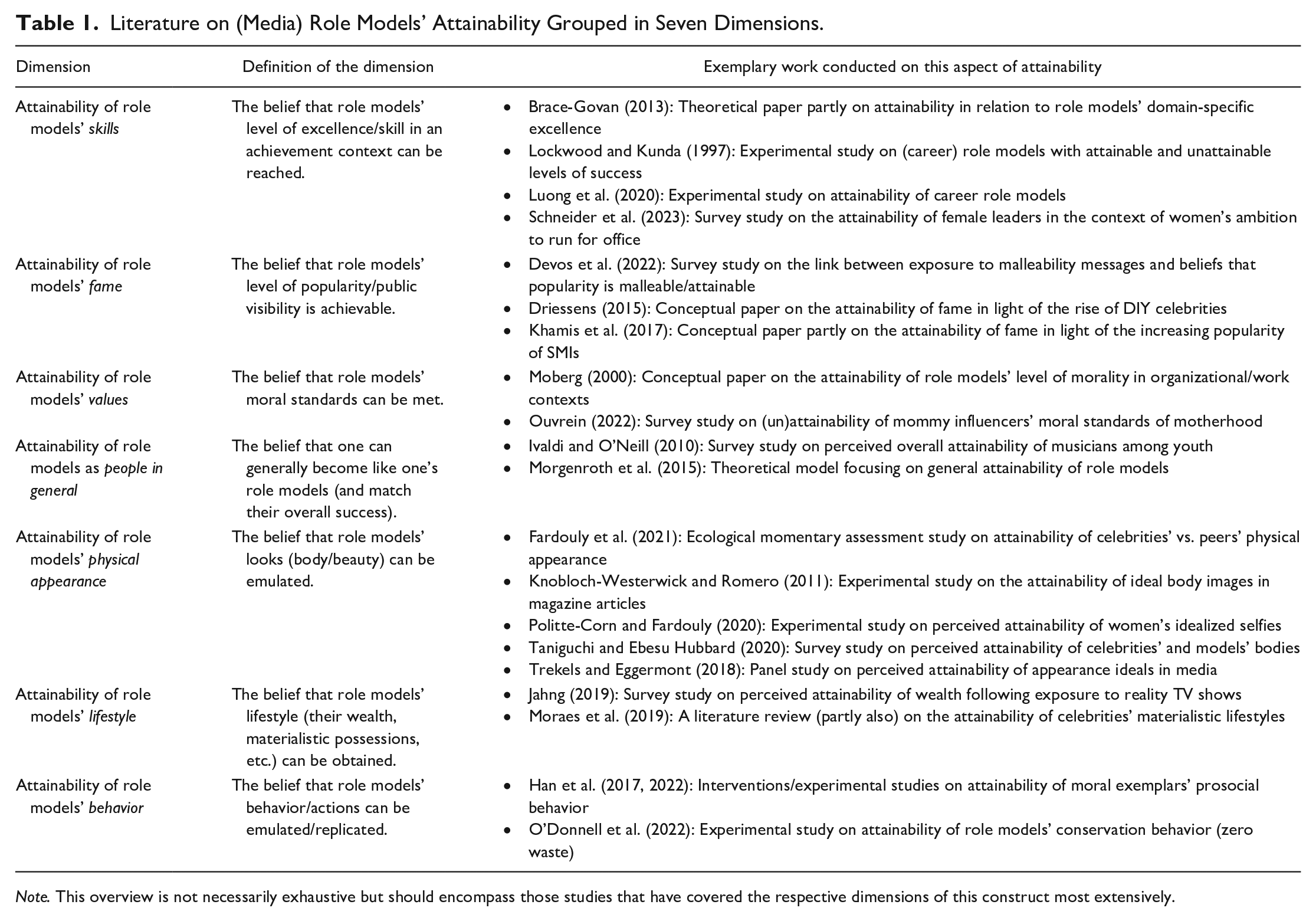
Note. This overview is not necessarily exhaustive but should encompass those studies that have covered the respective dimensions of this construct most extensively.
The Current Study
The goal of this work was thus to develop, test, and validate a multi-dimensional and encompassing measure of the attainability construct. We call our scale Perceptions of Media Role Models’ Attainability (short: PoMRA). Following item development and revision, and after establishing the content and face validity of the scale, we tested our scale in Study 1. Based on pre-registered hypotheses (presented after Study 1), we tested construct validity in Study 2 (Barten et al., 2012). This study also informed the short-form versions of the scale, which were validated in Study 3. Participants in our three independent samples ranged from 16 to 25 years. Young people were chosen as the relevant age group because social comparison is more pronounced at a younger age (Heckhausen & Krueger, 1993). In this context, media role models represent reference points for young people when they are exploring their identities (Strasser-Burke & Symonds, 2020).
This project was pre-registered in two parts on Open Science Framework (OSF) (https://osf.io/maf3y and https://osf.io/2a8nf). All data analyses were conducted with RStudio. All supplementary materials (e.g., appendix, scripts) are uploaded to OSF (https://osf.io/7g693).
Generation of Measurement Instrument and Content Validity
To develop and revise the novel scale, and to establish content validity—defined as the “representativeness or content relevance of the elements/items of an instrument” (Lynn, 1986, p. 382)—we relied on four steps in this scale development project. First, we conducted an extensive literature review to classify extant research on (media) role models’ attainability. Reviewing the literature is described as a central step when trying to establish the content validity of a measure, as it allows researchers to identify possible dimensions of a scale (Lynn, 1986). Here, we focused on categorizing previous work based on the respective investigated aspect of perceived attainability (e.g., physical appearance). This literature review suggested that research on attainability could be grouped into seven topics. In line with these foci, we constructed the dimensions of the scale, thus acting in accordance with the ideal-type procedure employed in the context of scale development projects (Lynn, 1986). Each facet of attainability relates to a distinct set of goals (e.g., appearance-related) that role aspirants may want to reach and for which role models can serve as attainable exemplars. Thus, the different attainability dimensions cover different areas in which (media) role models can be deemed (un)attainable. Since each supposed attainability dimension touches upon ways in which role models may seem within (or out of) reach, each dimension at the same time reflects perceptions of role models’ overall attainability. In this sense, each attainability item, regardless of which dimension it belongs to, shares a common theme with the other items of the scale. Table 1 shows an overview of the seven main topics in literature on (role models’) attainability, with details on the methodology and thematic focus of each paper.
Second, we formulated the items for each dimension, partly inspired by existing (but non-validated or non-exhaustive) scales that had previously been used in the literature to assess perceptions of media role models’ attainability (Ivaldi & O’Neill, 2010; Trekels & Eggermont, 2018). We ended up with 43 items to measure the construct on seven dimensions, with at least five items per dimension. The language of the survey studies was Dutch. A PhD student native in this language translated the English items into Dutch. Another Dutch-speaking PhD student then translated those items back into English. The original version of the English items and the English translation that followed the Dutch translation matched, suggesting that the Dutch translation was suitable to test and validate the items. Only a few items were slightly adapted.
Third, we conducted an expert survey among nine experts in the field. These were either experts who had worked on the topic of attainability or upward social comparison and/or had previous scale development experience. We asked them to evaluate each item regarding comprehensibility and readability, helping us to determine face validity (Lim, 2024). We also asked them to briefly summarize what the scale might capture and to assign the items to the respective dimensions to determine the content validity of the individual dimensions as well as the overall scale, acting in line with recommended procedures (DeVellis & Thorpe, 2022; Lynn, 1986). Experts correctly identified what the scale attempted to measure, thus suggesting that content validity was successfully achieved (Lynn, 1986). Informed by the expert survey, we deleted a total of five items, which failed to meet at least one of our standards (e.g., sufficient comprehensibility). We also adapted the formulation of 13 other items, most of which were, according to the experts, too difficult to interpret.
Fourth, we asked N = 7 participants within the relevant age group to determine whether the 38 remaining items were sufficiently comprehensible—this was the case. Therefore, we concluded that the measure had sufficient face validity—meaning it was deemed clear and comprehensible enough among the target population (Lim, 2024)—and, as a result, we made no further changes to the scale.
Study 1
In Study 1, we conducted a pre-registered survey among youth to test our scale.
Methods
We surveyed Dutch-speaking (i.e., Flemish) youth from Belgium using Qualtrics. We asked participants to think of their favorite media personality—a media figure whom they like and look up to 1 (e.g., actor, musician, SMI). Respondents then filled out the questionnaire with this media role model in mind (see Hoffner & Buchanan, 2005; McCutcheon et al., 2002). After posing some general questions related to their preferred media role models, we presented with the 38 attainability items, which related to the different dimensions of attainability as identified in the literature review.
Sample
Belgian (Flemish) youth between the ages of 16 and 22 were recruited and incentivized by the research company Dynata in February and March 2023. Informed consent, age, and active use of at least one social medium were used as inclusion criteria. Our sample was quota-based, that is, representative of gender in this age group. From the data (N = 541 participants), we excluded 12 straight-liners (i.e., respondents displaying zero variation in their responses to the attainability items, which included reverse-coded items), 32 participants who had filled out the survey quickly (less than half of the median response time) and had left open text boxes empty, and two outliers with a survey duration of around 15 hrs. We had a total of N = 46 excluded cases, leaving us with N = 495 valid responses. In the second step, we excluded people who were unable to name a media role model. Last, we excluded participants who did not pass the attention check (confirming that the media personality whom they had named was indeed their favorite media personality). We ended up with an analytical sample of N = 405 young users (50% men, 49% women, 1.2% non-binary or other, Mage = 19.71, SDage = 1.89). This sample size allowed us to have a number of at least five participants per item (5:1 item ration; Carpenter, 2018). Participants’ level of completed or—if not yet completed—current education was diverse, ranging from an elementary (8.4%) or secondary school diploma (51.6%) to an upper secondary degree (4.9%), university degree (32.3%), or PhD (1.5%).
Measures
After collecting common sociodemographic data, participants were asked to think of their favorite media personality (i.e., real people or fictional characters in mass/social media whom young people like and look up to, ranging from well-known entrepreneurs and politicians over athletes and musicians to SMIs and reality stars). In relation to these media figures, all 38 items used to test the scale were assessed (Supplemental Appendix B). Items were measured on seven-point Likert scales, with 1 indicating total disagreement and 7 total agreement. One item of the attainability battery (Att_rmdl3_10) was excluded prior to the analyses because the translation in the survey language was identical for this item and item Att_rmdl3_14.
Data Analysis
We performed an exploratory factor analysis (EFA) using principal axis factoring. Employing the Kaiser–Meyer–Olkin (KMO) test as well as Bartlett’s test of sphericity, we determined the applicability of the EFA. Subsequently, we consulted the K1 method (eigenvalues above 1 indicate the presence of a factor), scree plot, and parallel analysis to determine the number of factors (Carpenter, 2018). After determining the number of factors to be extracted, we used an oblique rotation method, namely promax (given the assumption that the dimensions of the scale are correlated with one another), to identify which variables loaded on which factors.
Results
The KMO test for sampling adequacy (overall Measure of Sampling Adequacy [MSA] = 0.96) and Bartlett’s test of sphericity (χ2 (666) = 10,403.81, p < .001) indicated the applicability of the factor analysis. However, we excluded two inverse items (Att_rmdl1_9, Att_rmdl3_4; see all items in Supplemental Appendix B) from the data, which had comparably low sampling adequacy and would have loaded on a separate two-item factor in the subsequent EFA, despite being theoretically unrelated to each other. With 35 items, the KMO test for sampling adequacy (overall MSA = 0.96; MSA for each item ≥0.93) and Bartlett’s test of sphericity (χ2 (595) = 10,200.73, p < .001) indicated very high applicability of the factor analysis.
We then proceeded to retrieve eigenvalues from the data, finding that there were five potential factors with an Eigenvalue above 1. Meanwhile, the scree plot suggested a solution with three factors. Last, we conducted parallel analysis, which showed that there were five factors whose eigenvalues were higher than the parallel components derived from the random correlation matrices (see html document with results on OSF). We thus concluded that a five-factor solution was most suitable in this case.
Correspondingly, we ran the subsequent factor analysis with 35 items and based on the supposition of five factors. To assess model fit, we used both the Comparative Fit Index (CFI) and the Root Mean Square Error of Approximation (RMSEA). The model showedhad good fit (CFI = 0.957, RMSEA = 0.041 [90% CI = 0.036, 0.046]). However, one item (Att_rmdl2_13) only loaded weakly on its factor (λ = .342), while another item cross-loaded on other dimensions of the scale (Att_rmdl1_10). These items were subsequently excluded from the data. We ran a second EFA with 33 items loading on five factors, which had good model fit (CFI = 0.961, RMSEA = 0.040 [90% CI = 0.035, 0.046]). The items included in this EFA all had factor loadings above 0.50, which would generally be considered acceptable loadings and offered some initial support for the reliability of the scale (Carpenter, 2018). The five factors explained 62% of the variance in the items—with attainability of skills explaining most (20%) of this variance.
Testing Construct Validity
In the next step, we aimed to establish the construct validity of our measure, defined as “the idea that a scale is measuring what we think it is measuring” (Noar, 2003, p. 627). To show that this is the case, researchers typically test “correlations between a measure of a construct and a number of other measures that should, theoretically, be associated with it (convergent validity) or vary independently of it (discriminant validity)” (Westen & Rosenthal, 2003, p. 608). Expected relationships are commonly expressed in the form of hypotheses (see, e.g., Rozendaal et al., 2016). Confirming them is a step toward achieving convergent validity. Notably, convergent validity can also be achieved by associating a novel scale with other measures meant to capture the same construct (Noar, 2003). Meanwhile, null relationships with theoretically unrelated constructs would be a sign of discriminant validity. In addition, evidence for discriminant validity can be found by demonstrating that a novel measure of one given construct does not correlate too highly with a measure of a similar construct, demonstrating the uniqueness of the construct, and showing that different dimensions of the same scale do not overlap (Campbell, 1960; Henseler et al., 2015).
In this study, we first hypothesized that our scale would correlate with a previous but flawed measure of the attainability construct. Probing the relationship between the measures functions as a first test of convergent validity (Noar, 2003). In this scale development, we compared our scale to Ivaldi and O’Neill’s attainability measure (2010). Their scale is relatively extensive, but treats attainability as a one-dimensional construct, not acknowledging on an empirical level that the items they used may be tapping into various distinct facets of attainability. Moreover, it arguably does not capture all central facets of attainability (e.g., attainability of role models’ values). These drawbacks highlight the need for a validated and multifaceted scale. Still, their scale also attempted to assess global attainability perceptions since their items principally reflect that judgments of media role models’ attainability are not only derived from perceptions of their achievements but also, for instance, perceptions of their physical appearance. Thus, their scale is a good point of comparison, and expectedly, our novel scale should correlate highly with this attainability measure.
Furthermore, attainability perceptions should especially be high among those people who already feel similar to their role models in some ways, as present similarity or people 2 in some respects increases the chance that future similarity to media role models in other respects is also perceived as realistic (Morgenroth et al., 2015). A reverse relationship is also plausible: Role models’ perceived attainability likely encourages role aspirants to follow in their role models’ steps (Festinger, 1954; Lockwood & Kunda, 1997), leading them to become more similar to them over time. We expect the constructs to be highly correlated, but that they can also be clearly differentiated from each other, considering that attitude homophily and perceived similarity capture present commonalities, while attainability describes the perceived realism of achieving similarity to role models in the future (Morgenroth et al., 2015). Thus, we hypothesized:
We additionally compared PoMRA to authenticity perceptions. We expected perceived authenticity to be linked to our new attainability measure because inflated ideals embodied by role models are likely to be perceived as unrealistic, in that they are seen as both unachievable and inauthentic. Empirical research also appears to support this argument: Celebrities who conform to the beauty standard of thinness are more likely to be seen as inauthentic than plus-size models, potentially because the former represent less realistic comparison targets than the latter (Shoenberger et al., 2020). Moreover, in an experimental study conducted by Morgenroth et al. (2021), manipulations of attainability spilled over to perceptions of exemplars’ authenticity. Consequently, the highly successful role model was perceived as less authentic than the attainable role model. Yet, these constructs are not identical since perceived authenticity can be described as a judgment of whether people’s behaviors and self-displays are reflective of their “true” selves (Moulard et al., 2015), clearly differing from our definition of role models’ attainability. While it should thus be possible to clearly delineate the constructs from each other, we expected them to be correlated for the above-stated reasons.
Although perceived desirability (here: wishful identification), attainability, and goal embodiment are considered integral functions of role models (Brace-Govan, 2013; Morgenroth et al., 2015), we do not know how they are related to each other. While Morgenroth et al. (2015) note that “these three functions are by no means independent of each other,” they also point out that “fulfilling one function might also hinder fulfilling another” (p. 478). For example, traditional celebrities’ successes may be seen as highly desirable, yet unattainable by role aspirants. It is, however, also possible that low attainability automatically decreases the perceived desirability of a role model because it makes them appear unattractive as a comparison target (Festinger, 1954). Since no empirical evidence existed to support either argument (Morgenroth et al., 2015), we posed a research question instead:
Study 2
In Study 2, we aimed to confirm the five-factor structure of PoMRA and determine its construct validity (i.e., convergent and discriminant validity) by answering the hypotheses presented above. We also explored which items were suited for constructing short-form versions of the scale.
Method
In Study 2, we established the scale’s construct validity (convergent and discriminant validity) by associating it with theoretically related and unrelated constructs. High correlations with related constructs would be indicative of convergent validity (Noar, 2003). Meanwhile, the ability to scrutinize between the novel scale and related constructs (despite high correlations) would be important to establish discriminant validity (Campbell, 1960; Henseler et al., 2015) since we believed attainability to be a unique construct. Discriminant validity would further be supported by non-existent relationships with theoretically unrelated variables (Noar, 2003). In this case, there was no theoretical reason to assume a relationship between attainability perceptions and age. Finding no link between the variables would thus further highlight the discriminant validity of the scale. Last, each dimension of the scale should be unique and distinct from other dimensions of the same scale, providing additional indication of discriminant validity.
In addition, Study 2 had the purpose of testing whether the scale was reliable. To determine the reliability of the scale, we consulted Cronbach’s alpha, factor loadings, and item-total/item-dimension correlation, which shows “the correlation of each item with the total score of the scale or subscales” (Morgado et al., 2018, p. 12).
Moreover, we used Study 2 to construct short versions of the scale. We conducted a pre-registered survey among Belgian (Flemish) youth. We asked participants to think of their favorite media personality (e.g., actor, musician, SMI), and subsequently fill out the questionnaire with this media role model in mind. After some general questions, we followed up with the attainability items. Finally, we assessed the constructs needed to test the hypotheses (e.g., attitude homophily).
Sample
We recruited N = 301 Belgian (Flemish) participants aged 16 to 25 via the polling company Kantar in January 2023, meeting quotas for age and gender. Kantar was also responsible for the compensation of participants. Informed consent and age were used as inclusion criteria for participating in the study. From the data, we excluded 16 respondents who did not pass our attention check (confirming that the person they named was indeed their favorite media personality), five participants for straight-lining (zero deviation on the attainability items), and five respondents due to long response times (seven times the median survey duration), leaving us with N = 275 valid completes.
From this sample, we excluded 33 cases prior to analyses for not naming a (valid) media role model. Thus, we performed the analysis with a total of 242 participants (41% men, 57% women, 2% non-binary or other, Mage = 20.47, SDage = 2.70). Participants’ educational levels varied, ranging from elementary (10.7%) or secondary school diploma (46.3%) to upper secondary degree (5%), university degree (33.5%), or PhD level (3.7%).
Measures
To measure PoMRA, we used the 33 items left at the end of the EFA. All other relevant variables to test the scale and hypotheses were also measured in relation to participants’ favorite media figures. Please find the full item list in the Supplemental Appendix B.
The unvalidated attainability measure (Ivaldi & O’Neill, 2010), which we compared to our scale, consisted of five items (e.g., “I think I could become as talented as this person”; M = 3.90, SD = 1.49, α = .87). Following van Looy et al. (2012), we assessed perceived similarity with media role models using four items (e.g., “This person resembles me”; M = 3.19, SD = 1.57, α = .90). We used a five-item measure (e.g., “This person thinks like me”) based on McCroskey et al. (1975) to assess attitude homophily (M = 3.64, SD = 1.42, α = .87). We measured role models’ perceived authenticity with eight items (e.g., “This person is an authentic person”; M = 5.16, SD = 1.36, α = .93; Xu et al., 2022). To assess goal embodiment perceptions, we used five items (e.g., “This person acts as a role model for me”; M = 4.86, SD = 1.45, α = .90; Rich, 1997). We measured wishful identification with four items (e.g., “This person is someone I would like to emulate”; M = 4.35, SD = 1.48, α = .84; Hoffner & Buchanan, 2005). Last, we used seven items (e.g., “This person is like an old friend”) inspired by the original scale by Rubin et al. (1985) to measure parasocial relationships with participants’ favorite media personalities (M = 4.65, SD = 1.20, α = .81).
Data Analysis
Based on the 5 dimensions and 33 items identified in the EFA of Study 1, we performed a second-order structure confirmatory factor analysis (CFA), assuming that the items reflect the expected factors, which, in turn, reflect a higher-order factor (i.e., overall attainability). To establish measurement invariance across groups, we tested the equivalence of the factor structure and then evaluated scalar, metric, and residual measurement invariance across two groups. First, we conducted a multi-group CFA between male and female participants (with men as the reference group). Establishing measurement invariance across genders is key to ascertain whether potential differences in attainability assessments between men and women actually reflect true differences or are the result of bias due to non-invariance (Dong & Dumas, 2020). We then additionally grouped cases by role model type: we differentiated between SMIs—that is, personalities who gain public visibility exclusively through social media—and traditional celebrities (e.g., athletes, musicians; Supplemental Appendix C)—that is, personalities who gain public visibility primarily through traditional media (such as TV; Khamis et al., 2017). Our scale is supposed to be applicable across different role model types, which is why we tested measurement invariance across these groups as well.
After we conducted tests for measurement invariance, we tested the construct validity of the novel scale. We used Pearson’s correlation coefficient to assess links between the measure (in its second-order structure) and related constructs as a test for convergent validity. Observed measures were combined into mean indices and then correlated. Meanwhile, discriminant validity was mainly assessed through the heterotrait-monotrait ratio (HTMT) of the correlations, “which is the average of . . . the correlations of indicators across constructs measuring different phenomena, relative to . . . the correlations of indicators within the same construct” (Henseler et al., 2015, p. 121). HTMT values should be below 0.90 to indicate that a construct can be clearly distinguished from other constructs that are similar to the construct of interest (Henseler et al., 2015). In this case, we tested all attainability dimensions against each other as well as against constructs with which the dimensions were highly correlated.
We also conducted exploratory analyses: To further assess convergent validity, we investigated the link between our novel scale and experiences of parasocial relationship with these personae, which we expected to be positive since Gartzia et al. (2021) have contended that “examples of attainable role models may include proximal referents based on perceptions of . . . close relationship” (p. 599). Meanwhile, since there was no theoretical reasoning to suppose that perceptions of attainability would vary with participants’ age, we interpreted a low or non-existent correlation between attainability and age as an indicator of the discriminant validity of our scale. We also conducted a two-tailed t-test to explore the relationship between participants’ gender and attainability perceptions. In addition, we checked whether perceptions of attainability would differ between role model types (SMIs vs. traditional celebrities). Our expectation was that SMIs would, across the board, be perceived as more attainable than traditional celebrities, due to differences in the origin of fame (Jin et al., 2019; Khamis et al., 2017). SMIs are essentially ordinary people who independently build a public audience through self-branding and attention labor on social media, while traditional celebrities gain public visibility through their success in industries (e.g., TV, modeling, sports) which receive substantial media attention (Brooks et al., 2021). Traditional celebrities do not only appear exceptional and out of reach for recipients due to the extraordinary skills that they display in their professions but also due to their reliance on outside support (e.g., from producers and agencies) on their road to fame (Jin et al., 2019). By contrast, SMIs gain celebrity status via means that are principally available to any person and are achievable without the involvement of third parties (Gräve, 2017). Their origin of fame might consequently also reflect on perceptions of SMIs as individuals, leading people to consider them to be more attainable than celebrities (Shehzala et al., 2024). By presenting themselves on the same level as their followers (Lehto, 2022), SMIs further highlight the ostensible attainability of the standards they set. Yet, so far, there has been a lack of studies lending strong empirical support to the idea that SMIs are more attainable than celebrities, though this difference might explain the former’s attractiveness as a novel role model type.
Last, we used the data to construct short versions of the scale. For this purpose, we selected the best-performing item(s) per dimension to develop a 10- and 5-item scale, primarily based on factor loadings. The model fit of the short scales was then tested and we also evaluated the internal consistency of the short measures.
Results
CFA and Measurement Invariance
We performed a CFA using the R package lavaan (Rosseel, 2012), which revealed that the data did not fit our model very well (χ2/df = 1.94, CFI = 0.924, TLI = 0.918, RMSEA = 0.062 [0.056, 0.068]). To tackle this issue, we excluded the worst-performing five items of the skills subdimension (Att_rmdl3_1, Att_rmdl3_3, Att_rmdl3_11, Att_rmdl3_13, Att_rmdl3_14) and an additional item loading on the fame subdimension (Att_rmdl2_7) from the analyses. These choices not only rendered the model more parsimonious (Carpenter, 2018) and significantly improved model fit (χ2/df = 1.59, CFI = 0.961, TLI = 0.958, RMSEA = 0.049 [0.041, 0.057]) but also helped to keep the number of items across dimensions consistent, as we reduced the number of items loading on the attainability of skills from 12 to 7.
We continued our analyses by testing measurement invariance with the 27 remaining items. The first multi-group CFA with gender as the group variable (men = 0, women = 1) showed an improvable model fit (χ2/df = 1.48, CFI = 0.937, TLI = 0.931, RMSEA = 0.064 [0.055, 0.072]). We excluded two items (Att_rmdl2_4, Att_rmdl2_5) from our analyses, which boosted the fit of the configural model (χ2/df = 1.41, CFI = 0.950, TLI = 0.944, RMSEA = 0.059 [0.049, 0.069]). In the following, we also confirmed the metric, scalar, and residual invariance of our scale (see html file on OSF), as differences in fit between models were below thresholds formulated in the literature (Chen, 2007). The second multi-group CFA with role model type as the group variable (traditional celebrities = 0, SMIs = 1) also showed an improvable model fit (χ2/df = 1.57, CFI = 0.933, TLI = 0.926, RMSEA = 0.069 [0.060, 0.077]). We thus excluded two more items of the attainability of skills subdimension from the analyses (Att_rmdl3_2, Att_rmdl3_9), which elevated the model fit to an acceptable level (χ2/df = 1.53, CFI = 0.943, TLI = 0.936, RMSEA = 0.066 [0.056, 0.076])). Model fit comparisons also supported metric, scalar, and residual invariance across SMIs and traditional celebrities (Supplemental Table A1), which was also again confirmed for men and women (Supplemental Table A2).
Following these tests, we ended up with a scale consisting of 23 items loading on 5 factors, which, in turn, loaded on one higher-order factor (see Table 2). This model had a very good fit (χ2/df = 1.61, CFI = 0.967, TLI = 0.963, RMSEA = 0.050 [0.040, 0.059]). Our measure was also internally consistent, with each dimension showing a Cronbach’s alpha of at least .86 (see Table 2), while the second-order factor attainability exhibited a Cronbach’s alpha of .95. Cronbach’s alpha is understood as an important indicator of the reliability of a scale (Lim, 2024), with values above .70 suggesting that a factor has sufficient reliability (Taber, 2018). Furthermore, factor loadings on each dimension and of each dimension on the second-order factor were all above .60, providing further support for the reliability of the scale dimensions and the overall scale. Last, item-total and item-dimension correlations were above .50 (see Table 2), and thus more than acceptable (Cristobal et al., 2007), suggesting consistency of each item with the respective dimension as well as with the overall scale.
Final Factor Structure and Items Following Tests for Measurement Invariance in Study 2.
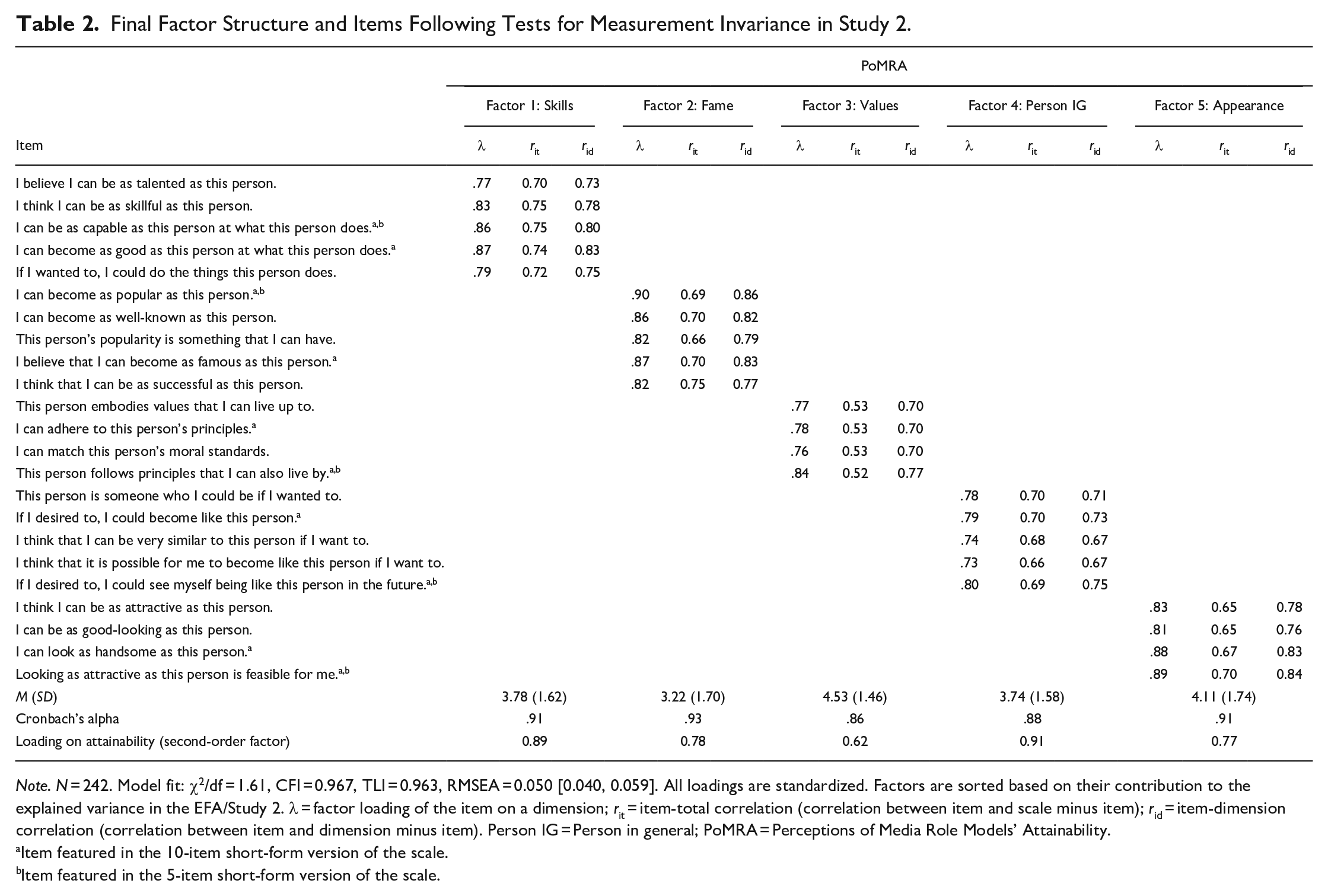
Note. N = 242. Model fit: χ2/df = 1.61, CFI = 0.967, TLI = 0.963, RMSEA = 0.050 [0.040, 0.059]. All loadings are standardized. Factors are sorted based on their contribution to the explained variance in the EFA/Study 2. λ = factor loading of the item on a dimension; rit = item-total correlation (correlation between item and scale minus item); rid = item-dimension correlation (correlation between item and dimension minus item). Person IG = Person in general; PoMRA = Perceptions of Media Role Models’ Attainability.
Item featured in the 10-item short-form version of the scale.
Item featured in the 5-item short-form version of the scale.
Hypotheses Testing and Construct Validity
Testing construct validity of the scale, H1 was confirmed, as the unvalidated attainability measure (Ivaldi & O’Neill, 2010) correlated highly with PoMRA, r(240) = .77, p < .001. H2 was also supported, as both perceived similarity, r(240) = .53, p < .001, and attitude homophily, r(240) = .57, p < .001, significantly and highly correlated with PoMRA. H3 was confirmed, but the association between authenticity and attainability was less pronounced than expected (weak rather than moderate/strong), r(240) = .27, p < .001. Regarding RQ1, we found that PoMRA was correlated with wishful identification, r(240) = .38, p < .001, and goal embodiment perceptions, r(240) = .24, p < .001 (Table 3).
Study 2: Correlation Table.
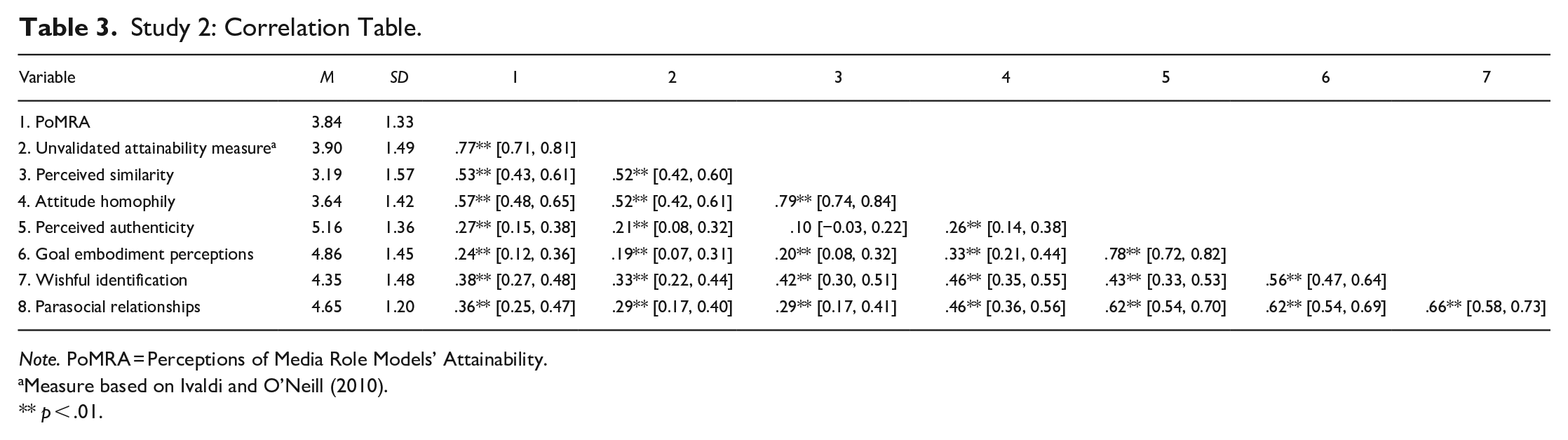
Note. PoMRA = Perceptions of Media Role Models’ Attainability.
Measure based on Ivaldi and O’Neill (2010).
** p < .01.
Due to the high correlations between PoMRA and similarity and attitude homophily, we used HTMT to distinguish between these constructs. We found that each HTMT value in the table was below 0.90, indicating that all attainability dimensions were sufficiently different from these other constructs as well as from each other (see Supplemental Table A5). As such, we were able to support the discriminant validity of our scale.
Exploratory Analyses
We additionally explored the relationship between parasocial relationships and attainability, finding a moderate association between the constructs, r(240) = .36, p < .001. Participants’ age, on the other hand, was unrelated to PoMRA, r(240) = −.06, p = .337, further supporting the discriminant validity of our scale, as there was no theoretical reason to assume a relationship between age and our novel scale. Meanwhile, men (M = 4.07, SD = 1.26) generally rated their media role models as more attainable than women (M = 3.68, SD = 1.35; t(218.90) = 2.30, p = .022). Last, we found that SMIs (M = 4.14, SD = 1.36) were indeed considered more attainable than other types of media role models (M = 3.69, SD = 1.29; t(153.19) = −2.51, p = .013). 3 Notably, no significant differences between types of role models were present for other constructs (e.g., authenticity, wishful identification; Supplemental Table A3).
Construction of Short Scale Versions
Primarily based on factor loadings (see Table 2), we selected the best items of each dimension and formed 10- and 5-item short-form versions of the attainability measure. The 10-item scale (here we adhered to the second-order structure) showed a good model fit (χ2/df = 1.95, CFI = 0.979, TLI = 0.969, RMSEA = 0.063 [0.038, 0.086]), while the 5-item scale did not (χ2/df = 4.55, CFI = 0.944, TLI = 0.888, RMSEA = 0.121 [0.073, 0.174]). One of the items of the 5-item scale (Att_rmdl3_8) was replaced by the second-best item of the respective dimension (Att_rmdl3_7), which significantly improved the model fit (χ2/df = 1.50, CFI = 0.992, TLI = 0.984, RMSEA = 0.046 [0.000, 0.108]). Both the 10-item (α = .89) and 5-item scale (α = .79) showed to be internally consistent.
Study 3
In Study 3, we aimed to validate the short-form versions of PoMRA. For this purpose, we again determined the measures’ internal consistency and construct validity using an independent sample of youth and answering the hypotheses presented previously. As recommended by short-scale experts (Stanton et al., 2002), only the short attainability scales were assessed (the remaining items of the long-form version of the scale were left out). Moreover, the 10- and 5-item scales featured in different parts of the survey in randomized order—again meeting recommendations by Stanton et al. (2022).
Method
To determine the construct validity of the short-form version of the scale, we correlated the measures with the same constructs used in Study 2 and again consulted HTMT values to distinguish the short-form versions of the scale from highly correlated constructs. Generally, the procedure of this study resembled that of Study 2. We added self-esteem to our questionnaire to see whether it would explain the gender difference in attainability perceptions that we discovered in Study 2 (Bleidorn et al., 2016; Morgenroth et al., 2015).
Sample
Study 3 was conducted among a gender-balanced sample of youth aged 18 to 25 who lived in either Belgium or the Netherlands and spoke Dutch (N = 217). We recruited participants via Prolific in September and October 2023. Respondents received 18£/hr for their participation. Once again, informed consent and age were used as inclusion criteria for participating in the study.
Participants who did not name a favorite media personality or did not confirm that the media personality whom they had named was indeed their favorite media personality (N = 11) were, in conjunction with our data cleaning in the other studies, excluded from the analyses. No participants needed to be excluded due to straight-lining or fast/slow response times. Thus, we performed the analysis with a total of 206 participants (48% men, 48% women, 4% non-binary or other, Mage = 22.37, SDage = 2.01). Participants obtained degrees were diverse, ranging from secondary school diplomas (15.5%) to upper secondary degrees (3.4%), bachelor’s degrees (51.5%), master’s degrees (26.2%), or PhD levels (3.7%).
Measures
We used the same measures as in Study 2 to determine the construct validity of the short scales. We additionally assessed participants’ self-esteem using five items (e.g., “I feel I do have much to be proud of”; Monteiro et al., 2022). Please find the descriptive statistics of the measures as part of the correlation table in Supplemental Table A4.
Data Analysis
First, we evaluated the internal consistency of the short scales and ran CFAs to evaluate model fit. Second, we correlated the 10- and 5-item scales with related variables, to see whether the short-form versions of PoMRA exhibited construct validity. Third, we ran a path model testing gender and self-esteem as predictors of attainability, to see whether self-esteem would explain the difference found between men and women in attainability perceptions. Last, we again investigated differences in attainability perceptions dependent on the role model type (SMIs vs. traditional celebrities).
Results
Confirmatory Factor Analysis
The 10-item scale, in its second-order structure, showed good model fit (χ2/df = 1.64, CFI = 0.984, TLI = 0.976, RMSEA = 0.056 [0.025, 0.083]), as did the 5-item scale with no second-order structure (χ2/df = 1.97, CFI = 0.978, TLI = 0.956, RMSEA = 0.069 [0.000, 0.132]). Both the 10-item (α = .86) and 5-item scale (α = .72) showed to be internally consistent (Taber, 2018). The short scales, measured in isolation from each other, were also highly correlated, r(204) = .83, p < .01.
Hypotheses Testing and Construct Validity
H1 was again confirmed, as the unvalidated attainability measure (Ivaldi & O’Neill, 2010) correlated highly with our two short-form measures, r(204) = .73, p < .001 (10-item scale) and r(204) = .71, p < .001 (5-item scale). H2 was also supported, as both perceived similarity, r(204) = .50, p < .001 (10-item scale) and r(204) = .56, p < .001 (5-item scale), and attitude homophily, r(204) = .44, p < .001 (10-item scale) and r(204) = .50, p < .001 (5-item scale), significantly and highly correlated with the measures. H3 was only partly confirmed: We did not find a significant association between authenticity and attainability for the 10-item scale, r(204) = .13, p = .065, but did find a weak correlation between authenticity and the 5-item PoMRA scale, r(204) = .14, p = .046. Last, we found that attainability was weakly to moderately correlated with wishful identification, r(204) = .24, p < .001 (10-item scale) and r(204) = .26, p < .001 (5-item scale), and goal embodiment perceptions, r(204) = .19, p = .005 (10-item scale) and r(204) = .23, p = .001 (5-item scale). HTMT values, comparing the short-form versions of our scale to similarity and attitude homophily, were below the suggested threshold of 0.90 and thus confirmed the discriminant validity of the short-form measures (see Tables A6 and A7).
Exploratory Analyses
We found a weak association between parasocial relationships and PoMRA, r(204) = .14, p = .0498 (10-item scale) and r(204) = .16, p = .020 (5-item scale). Like in Study 2, participants’ age did not significantly relate to PoMRA, r(204) = −.05, p = .475 (10-item scale) and r(204) = −.08, p = .246 (5-item scale). In the path models, we found both gender (men = 0, women 1; 10-item scale: b = −0.30, SE = 0.11, p = .006; 5-item scale: b = −0.29, SE = 0.11, p = .010) and self-esteem (10-item scale: b = 0.14, SE = 0.05, p = .009; 5-item scale: b = 0.11, SE = 0.06, p = .046) to significantly predict participants’ attainability perceptions. Last, participants deemed SMIs (M = 3.88, SD = 0.89) to be more attainable than other types of media role models (i.e., traditional celebrities like athletes or TV presenters; M = 3.38, SD = 1.10; t(100.57) = −3.24, p = .002), which was also confirmed with the 5-item scale (SMIs: M = 4.06, SD = 0.95; traditional celebrities: M = 3.42, SD = 1.09; t(93.62) = −4.00, p < .001).
General Discussion
In this work, we addressed the need for a scale to assess perceptions of media role models’ attainability, which is a relevant construct in media psychology to explain under which conditions exposure to media role models can have positive but also potentially adverse consequences for young people’s well-being and goal adoption (Lockwood & Kunda, 1997; Morgenroth et al., 2015). We correspondingly developed a measure—called PoMRA—to capture this construct. During this process, we established content validity by constructing scale dimensions based on a detailed literature review, using previous measures of attainability as inspirations for the item development, and by asking experts in the field to judge whether the items were suitable to measure this construct (DeVellis & Thorpe, 2022; Lynn, 1986). After administering the items to a small sample of youth, who deemed the items clear and comprehensible—suggesting that the scale had sufficient face validity (Lim, 2024)—we tested the scale in an EFA, which supported the presence of five dimensions in the data: skills, fame, values, person in general, and appearance.
Using data from two independent youth samples, we ended up with a 23-item measure—loading on five first-order factors and one second-order factor—which showed good psychometric properties. The scale and its individual dimensions were internally consistent, and items had high factor loadings, supporting the reliability of the scale. Meanwhile, hypothesis testing led us to conclude that the scale had high construct validity: PoMRA correlated significantly with similar constructs, such as perceived similarity or attitude homophily (Morgenroth et al., 2015), supporting the convergent validity of the scale (Noar, 2003). At the same time, each dimension of the novel scale was shown to be sufficiently distinct from these related measures, supporting the discriminant validity of the scale (Campbell, 1960; Lim, 2024). The PoMRA scale was also moderately connected with other role model functions, such as goal embodiment perceptions and wishful identification, hinting at a positive link between the constructs (Morgenroth et al., 2015). Relatedly, parasocial relationship intensity was higher with more attainable role models, implying that people develop closer bonds with media personalities who seem within reach for them (Derrick et al., 2008). Finally, using measurement invariance tests, we validated our scale for both celebrity and SMI targets as well as for male and female role aspirants.
Two short-form versions of PoMRA (10 and 5 items) also showed good model fit and internal consistency among a third independent youth sample and were highly correlated with each other. The two short-form versions were generally less strongly correlated with similar constructs than the long-form version of the scale, but the general order of the correlations (e.g., similarity and attitude homophily being most strongly related to attainability) remained mostly analogous, thus determining convergent validity of the short-form versions of PoMRA. HTMT values showed that the short-form versions of the scale could also be clearly distinguished from both perceived similarity and attitude homophily despite their relatively high correlations (Henseler et al., 2015). However, authenticity was only weakly correlated with the long-form and 5-item version of attainability and unrelated to the 10-item version of the scale. This finding indicates that recipients may not always deem attainable media role models authentic. We suppose that a link between authenticity and attainability may only exist for certain aspects of a media role model—for example, when it comes to beauty perceptions, where attainable beauty ideals may also seem more realistic and thus authentic.
Moreover, we found a gender difference in attainability perceptions in Study 2, suggesting that men had more faith in their ability to reach the standards set by their media role models. We thus added self-esteem as a predictor of attainability to our model in Study 3. However, this variable did not explain much of the gender difference. The association between gender and attainability perceptions remained almost equally strong with self-esteem in the model. Still, we found that more confident individuals were more likely to judge their media role models as attainable than individuals with low self-esteem.
In addition, our results suggest that SMIs, as a novel role model type, may be perceived as more attainable by youth than other media personalities. This finding is in line with research theoretically assuming such differences (Jin et al., 2019; Martensen et al., 2018), but this study is the very first to corroborate such a link based on quantitative data. This finding is especially insightful given that all other constructs (e.g., wishful identification, perceived authenticity, perceived similarity) were not significantly different between those who thought of SMIs and those who named traditional celebrities as their favorite role models. This finding suggests that attainability, rather than constructs like authenticity, may be the key trait distinguishing SMIs from traditional celebrities, explaining potential differences in their persuasive power (Gräve, 2017).
Agenda for Future Research
The PoMRA scale offers several avenues for future research. First, all three versions of the scale (23-, 10-, and 5-item) can be used in research seeking to understand differences in overall attainability between different types of media personalities. Building on the finding that SMIs are perceived as more attainable than other types of media figures, future studies should explore perceived attainability as a factor in comparisons between SMIs and other media personalities in different areas like advertising research, political communication, environmental communication, or entertainment. In these areas but also in other research fields, the different dimensions of the long-form version of the scale may be used separately to investigate specific aspects of role model attainability, as all subscales represent distinct factors and are internally consistent. For instance, body image scholars may primarily be interested in media role models’ appearance-related attainability and correspondingly only use the respective subdimension of the scale.
Second, perceived attainability should be included as a moderator in research concerned with the consequences of upward social comparison. While most research shows negative outcomes for well-being and mental health in response to upward social comparison (McComb et al., 2023), perceived attainability may act as a key boundary condition that explains when positive effects occur because people see attainable role models as more realistic comparison targets.
Third, the PoMRA scale may be particularly relevant in research on counter-stereotypical media role models and minority audiences’ goal adoption (Ramasubramanian, 2011). When marginalized groups are exposed to successful role models belonging to their ingroup, perceptions of their attainability may be the responsible mechanism explaining why people are more likely to emulate these role models and, for instance, pursue careers in underrepresented fields (Morgenroth et al., 2015).
Finally, future research should also examine the predictors and correlates of PoMRA. For instance, media type may be a crucial determinant of perceived attainability. While this concept predates social media (Lockwood & Kunda, 1997), platforms with user-generated content offer more diverse and therefore potentially more attainable representations than mass media (Lazuka et al., 2020; Zurcher et al., 2024). In addition, traits beyond self-esteem, such as perspective-taking, an internal locus of control, or self-efficacy may be important predictors of PoMRA. Studying individual factors that shape perceived attainability can help identify those who are more likely to select unattainable role models and may require protection from adverse effects on their well-being or mental health.
Limitations
Naturally, this study also has some shortcomings. However, they can all well be addressed in future research. First, in this work, we focused on developing a long-form version and short-form versions of the scale, as well as confirming the construct validity of the measures. However, we did not yet support the predictive validity of the measure, as our data were cross-sectional. We call on future research to conduct longitudinal studies on media role models in which the predictive validity of the novel scale can be tested. In this context, researchers would also be able to assess test-retest reliability of the novel measure.
Second, we call attention to the fact that the scale was tested and validated in Dutch rather than in English, which may be seen as a limitation of our work. However, we are confident that our scale will also work well in studies conducted in English: Markedly, the original English items of the scale were highly comparable to the items that were derived from the process of translating the items to Dutch and then back to English. Still, we encourage researchers to validate the scale and its factor structure in other contexts—also because cross-cultural differences may lead respondents elsewhere to respond differently to the items than Flemish and Dutch youth in this study.
Third, we encourage researchers to validate the scale among older populations, as our samples were based on youth only. However, we believe that testing and validating this measure among young people is important since media role models are particularly relevant figures in developmental phases, especially during adolescence (Heckhausen & Krueger, 1993; Strasser-Burke & Symonds, 2020). Although the age ranges varied slightly between the studies, the samples still cover individuals who are in a life stage between late adolescence and early adulthood.
Fourth, we did not investigate the measurement invariance of the two short-form versions of the scale since multi-group CFAs are difficult to run when there are few indicators per dimension and when the sample size is low (Kyriazos, 2018). We thus motivate future research to test the measurement invariance of the short-form versions of the scale, noting that large study samples are a prerequisite for this purpose.
Overall, in this work, we were able to close an important research gap that has persisted since the emergence of the first studies on attainability perceptions regarding (media) role models (Lockwood & Kunda, 1997). Particularly in times of social media, where young people are subject to diverse ideals and role models, the attainability concept can be vital in disentangling positive and negative effects stemming from upward social comparison with successful media personalities. This scale development thus represents an important next step in advancing research in this area.
Supplemental Material
sj-docx-1-jmq-10.1177_10776990251336388 – Supplemental material for Idols Within Reach: Measuring Perceptions of Media Role Models’ Attainability
Supplemental material, sj-docx-1-jmq-10.1177_10776990251336388 for Idols Within Reach: Measuring Perceptions of Media Role Models’ Attainability by Darian Harff, Heleen Dekoninck and Desiree Schmuck in Journalism & Mass Communication Quarterly
Footnotes
Acknowledgements
We thank the expert reviewers for their participation in the expert survey, which helped us revise the items of our scale.
Data Availability Statement
The data underlying this article are available on the Open Science Framework (OSF). The studies were also preregistered on OSF. Links are provided in the document.
Declaration of Conflicting Interests
The author(s) declared no potential conflicts of interest with respect to the research, authorship, and/or publication of this article.
Funding
The author(s) disclosed receipt of the following financial support for the research, authorship, and/or publication of this article: This work was supported by a KU Leuven Starting Grant under Grant STG/20/025 and a FWO aspirant fellowship under Grant 11F6423N awarded to Darian Harff.
Ethical Approval
Ethical approval for this study was obtained from the ethical internal review board of KU Leuven (projects G-2022-5379 and G-2022-6123-R4(AMD)).

Supplemental Material
Supplemental material for this article is available online.
Notes
Author Biographies
References
Supplementary Material
Please find the following supplemental material available below.
For Open Access articles published under a Creative Commons License, all supplemental material carries the same license as the article it is associated with.
For non-Open Access articles published, all supplemental material carries a non-exclusive license, and permission requests for re-use of supplemental material or any part of supplemental material shall be sent directly to the copyright owner as specified in the copyright notice associated with the article.
