



Abstract
This study aims to disentangle how exactly immersive journalism (IJ) relates to a spectrum of democratically relevant engaging outcomes. To do so, I consider a potentially engaging dimension of IJ: interactivity and a resulting “sense of agency.” In a pre-registered laboratory experiment (N = 150), I test the effect of exposure to IJ productions that vary in their range of interactivity on a spectrum of participatory intentions and behaviors. Results indicate that a medium level—but not a high level—of interactivity in IJ enhances participation in, but not participation through, journalism. In addition, presence, rather than agency, facilitates participative intentions.
Interactivity in Immersive Journalism as Engagement Booster
Immersive journalism (IJ) is often used to provide first-person (De la Peña et al., 2010) and more emotionally engaging accounts of the news (Goutier et al., 2021; Vázquez-Herrero & López-García, 2019). Due to its ability to provide the news audience with a sense of presence (Sundar et al., 2017) or to vicariously experience the emotions of another (Martingano et al., 2021), IJ is assumed to have a strong engaging influence on citizens. Engagement is important, as journalism faces a unique set of obstacles that came about with the rise of the digital, high-choice media environment. News agencies are confronted with a fragmented audience who select their news out of a wide variety of sources based on their preferences (e.g., Young & Anderson, 2017), a trend that is specifically prominent for a younger audience, which is often passive and unmotivated to consume news (Tamboer et al., 2022).
Despite expectations that IJ increases a broad range of engagement intentions, research shows that the currently most common format of IJ, 360° videos, may, in fact, not be very engaging. For instance, there is a lack of online engagement such as likes, clicks, and shares with the New York Times’ 360° news (Wang et al., 2018). One reason for the lack of engagement could be that while the technological inclusion of 360° videos elicits a sense of presence (Slater et al., 2018; Vettehen et al., 2019), it is meaningful interaction possibilities—that is, “the extent to which users can participate in modifying the form and content of a mediated environment in real-time” (Steuer, 1992, p. 84)—that would elicit a sense of agency, which is in turn assumed to be an “engagement booster” (Palmer, 2020; Vázquez-Herrero & López-García, 2019). A “sense of agency” means the feeling that one’s actions in the virtual environment have consequences (Jicol et al., 2021; Moore, 2016). It is a crucial psychological state to consider because it is assumed to be the mechanism that unlocks the engaging potential of IJ (Barnidge et al., 2022; Nielsen & Sheets, 2019; Wu et al., 2021) and has been shown to facilitate citizen engagement (Moore et al., 2016). Including interactive elements to IJ, such as having control over the linearity and pace of a story (Palmer, 2020), should elicit a sense of agency (Jicol et al., 2021). However, interactivity in IJ and the related sense of agency have received relatively limited scholarly focus until now (Kang, 2022).
All this suggests that interactivity in IJ may function similarly to the known effects of other interactive digital tools in journalism. Previous research has suggested that interactivity in the conceptual sense may result in increased participation in the media (i.e., increased interest, intention to use, and action toward a media brand) (Lawrence et al., 2018; Peters & Witschge, 2015). On the contrary, the literature seems to suggest that the effects of interactivity on participation through the media (i.e., taking action/intention to act in the civic and political sphere) may be limited—which puts it at odds with the political communication literature (e.g., Saurugger, 2010; Strömbäck, 2005) that is interested in precisely these outcomes as a result of political journalism. Nonetheless, preliminary research on IJ indeed suggests the potential of IJ to mobilize citizens, for example, to donate to non-governmental organizations (NGOs) (e.g., Kristofferson et al., 2022). A comprehensive view of IJ’s ability to create both participation in and through media is still lacking. This is surprising, given that IJ is founded on an engagement principle, where the intensive experience of a journalistic product should lead to behavioral adaptation (e.g., de Bruin et al., 2020).
Consequently, this research project uses a pre-registered laboratory experimental research design to address these two research gaps. I test the effect of three interactive versions (no-interactivity vs. medium-interactivity vs. high-interactivity) of the immersive journalistic experience “Hanen’s story” about a Syrian refugee in Greece on the concept of participating in and through the media. First, this allows me to explore the effects of different levels of interactivity in IJ while considering psychological processes that might drive these effects (Kang, 2022). Second, it gives a comprehensive overview of the engaging potential of IJ in relation to journalism’s democratic functions.
IJ as a Multidimensional Concept
IJ uses immersive technologies to provide the audience with a first-person (De la Peña et al., 2010), all-encompassing understanding of a news event (Bujić & Hamari, 2020). IJ can be defined along the following three characteristics: (a) inclusive technologies, (b) interaction possibilities, and (c) immersive narrative roles to tell the news (de Bruin et al., 2020; Palvik, 2019). Inclusive technologies are characterized as overlaying or replacing reality. They can be conceptualized along a spectrum from less inclusive technologies that are simply overlaying reality, such as augmented reality, to immersive audio and 360° videos to highly inclusive technologies that aim to replace reality, such as virtual reality (VR) (Slater & Wilbur, 1997; de Bruin et al., 2020; Skarbez et al., 2021). Inclusive technologies, such as VR, require new interaction possibilities to navigate this virtual environment and modify one’s experience (de Bruin et al., 2020; Steuer, 1992). In addition, through the use of immersive narratives, for example, embodied first-person narrative perspectives, the role of users within the environment becomes more active (de Bruin et al., 2020; Domínguez, 2017).
The shift toward a more technology-oriented focus of doing journalism can be contextualized along the audience turn (Costera Meijer, 2020) and the emotional turn (Beckett & Deuze, 2016) and is embedded in the evolution of the digital environment (Deuze, 2006). The aim of IJ is often to provide an experience of how it feels to be at a place (Sundar et al., 2017) or how it feels to be in someone else’s shoes (Martingano et al., 2021). While a number of studies on IJ have investigated response states (Valkenburg & Peter, 2013), such as a sense of presence, affective empathy, emotional impact, and attention (Greber et al., 2023; Sundar et al., 2017; Van Damme et al., 2019), much less attention has been given to media effects such as civic engagement or information-seeking (Kang, 2022; for exceptions, see Pjesivac et al., 2022). Given that IJ is set within a participatory paradigm of journalism concerning its expectation of democracy (Livingstone, 2013; Peters & Witschge, 2015), it is crucial to understand how the use of IJ aligns with these expected functions of a media system.
While IJ was popular in journalism (studies) from 2016 on, the production of IJ in its 360° format since then has declined (Sirkkunen et al., 2020). This can partially be traced back to the expiration of investments in IJ productions by tech companies, which are expensive and effortful to produce (Harris & Taylor, 2021; Sirkkunen et al., 2020). In addition, in its most common 360° video form, IJ was not yet drawing in audiences and keeping them on platforms (Wang et al., 2018). Most IJ produced by the New York Times lacked meaningful interaction possibilities beyond “looking around” (Palmer, 2020). However, these meaningful interaction possibilities that are often lacking in IJ productions are assumed to be what drives audience engagement. For instance, research has suggested that it is both the inclusion and technological interaction possibilities that are considered worthwhile by IJ audiences (Greber et al., 2023), and it is narrative interactivity in the form of nonlinearity of immersive productions that are found to be “engagement boosters” (Vázquez-Herrero & López-García, 2019). This becomes even more important when considering that with continuous investment, for example, by Meta and South Korea in the “metaverse” (Attlee, 2022; Microsoft Mesh, 2022), IJ is placed in highly interactive environments alongside other VR experiences, where it likely encounters a young audience familiar with highly interactive VR-based games (Zippia, 2023). To engage a young audience used to a highly interactive environment, it likely is not enough to merely transport them to a different reality; they might expect to explore this virtual journalistic product themselves. As the sophistication around VR, and subsequently, its relevance, increases, several scholars highlight that understanding interactivity in IJ is crucial to evaluate IJ at this point (Brannon et al., 2022; Kang, 2022; Vázquez-Herrero & López-García, 2019).
From Interactive Digital Journalism to Interactive IJ
According to Deuze (2006), interactivity is an inherent aspect of digital media. For journalism, the interactive components occur on two sides: embedding journalistic content in an interactive environment and including interactive elements in journalistic storytelling. Concerning the former, digital journalism is set within an interactive media ecosystem that allows users to navigate, control, personalize their news experience, interact with others, and upload user-generated content (Santos-Hermosa et al., 2022). Regarding the latter, interactive journalism, such as multi-modal, non-linear stories, newsgames, or interactive data visualizations, uses interactive components as part of its journalistic storytelling. Interactive journalism is “an emerging form of journalism content that emphasizes user engagement in the narrative through clicking, tapping or otherwise manipulating or actively engaging in the content or visual story elements” (Palvik, 2019, p. 130).
Interactivity in IJ can be seen as an extension of interactive journalism. It means “the extent to which users can participate in modifying the form and content of a mediated environment in real-time” (Steuer, 1992, p. 84). Interactivity in a virtual setting is further characterized by range, or the “amount of change that can be effected on the mediated environment” (Steuer, 1992, p. 86). In addition, it is defined along the specific dimensions that can be changed, which are further divided into technological interactivity, which entails interaction with the virtual environment (e.g., changing viewing direction, own location), and narrative interactivity, which entails the control users have over a story (e.g., pace, storylines, linearity) (de Bruin et al., 2020). Often, IJ uses innately natural ways of humans “interacting” with the inclusive environment, such as looking around and using hand gestures via controllers. Consequently, interactivity in IJ does not only allow the user to enact control over a virtual environment and explore it based on the user’s terms (Palmer, 2020), as would be the case in interactive journalism, but it also increases the feeling of being present in the virtual environment (Gutiérrez-Martínez et al., 2011; Jicol et al., 2021) and allows the user to enact a role in this virtual environment (Domínguez, 2017).
Interactivity in IJ as Path to Participation
Exposure to journalistic content, such as IJ, influences human behavior and intentions to act (Valkenburg & Peter, 2013). Consequently, the field of journalism has been in debate about which behaviors exposure to journalistic content should facilitate. These debates are informed by the assumed relationship between journalism and different forms of democracy, implying, for example, that journalism should enable information intake and mobilize people’s willingness to become active within a participatory understanding of democracy (Strömbäck, 2005). In the participation paradigm of audience research, the participation of the individual user in civil society, online and offline, as a potential outcome of interactive media consumption is similarly foregrounded (Livingstone, 2013). This means that providing citizens with more opportunities to interact with digital journalism is often assumed to aid journalism in fulfilling its responsibility vis-à-vis democracy (Peters & Witschge, 2015). However, digital interaction possibilities tend to facilitate—and are often aimed at—increasing participation in media rather than through media (Lawrence et al., 2018; Livingstone, 2013; Peters & Witschge, 2015; Schmidt et al., 2022). Consequently, interactivity in IJ could differ in its ability to support the functions of journalism set in a participatory democracy. Hence, IJ’s effects on participation in and through media should be distinguished.
Participation in the media is the participative outcome of a rather self-preservative nature for media agencies, such as increasing the evaluation of the worthwhileness of a product, intention to continue using a media brand or format, and increasing engagement such as sharing, liking, and clicking (Lawrence et al., 2018; Peters & Witschge, 2015; Vázquez-Herrero & López-García, 2019). Providing the user with control over IJ has been found to strengthen participation in media, such as engagement (Wu et al., 2021). In addition, participants evaluated technological interactivity, but not narrative interactivity, as worthwhile and reported a greater intention to continue using IJ (Greber et al., 2023). Fulfilling the need for interactivity in a VR environment was the strongest contributor to forms of engagement, such as commenting and liking (Cheng et al., 2022). Narrative interactivity in the form of the nonlinearity of a storyline in IJ resulted in more continuance intention and engagement (Vázquez-Herrero, 2021) and increased involvement and interest (Wu et al., 2021).
Participation through media refers to the extent to which citizens are willing to take action in “thicker” forms of participation in society and the political sphere due to consuming journalism. Such actions include information-seeking, civic engagement, and, broadly, political participation (Appelgren & Jönsson, 2021; Lawrence et al., 2018; Peters & Witschge, 2015). Theoretically, Nash (2017) argues that immersive and interactive documentaries provide a space in the private sphere to become active before becoming active in the public political sphere and, consequently, highlight their ability to facilitate participation through media. Empirically, studies focusing on IJ’s potential influence on participation through media are limited but suggest a positive relationship. Concerning information-seeking, one study comparing 360° IJ to a text stimulus found that the 360° modality did not lead to more information-seeking intentions (Pjesivac et al., 2022). Nonetheless, in advertisement research, fulfilling a need for interactivity results in more information-seeking (Cheng et al., 2022), and experiencing interactive VR was associated with additional information-seeking about a travel destination (Lee et al., 2021). Concerning civic engagement, VR, in contrast to videos—varying along the lines of inclusion and interactivity—increases donations for NGOs (Kristofferson et al., 2022). Similarly, the more realistic interactive news games, the higher donation intentions (Lin & Wu, 2020).
Ultimately, the hope is that the increased range of interaction possibilities functions as an “engagement booster” that facilitates a spectrum of participation, from participating in media to participating through media. Even more so, theories on political participation suggest a sequential relationship in that facilitating a form of participation in the media, such as intentional news use, would translate into participation through the media, such as discussing a topic (e.g., Cho et al., 2009). While previously, interactivity in a digital environment suggested only a limited activation of behaviors related to participation through media, preliminary research on IJ and political participation theories indicate a positive effect. Thus, the pre-registered hypotheses read as follows:
The Overlooked Mediating Role of Sense of Agency
One of the core characteristics of IJ is the combination of inclusive technologies and interaction possibilities (de Bruin et al., 2020). Initially recognized for its strong impact due to eliciting a sense of presence (e.g., De la Peña et al., 2010), the currently increasing focus on interaction possibilities necessitates an evaluation of the engagement potential of a sense of agency.
The sense of presence, or more specifically spatial presence, is defined as a feeling of “being there” (Lombard & Jones, 2015) and is linked to inclusive technology that allows for audio-visual immersion (Cummings & Bailenson, 2016). The sense of presence is often assumed to be the key factor behind the supposedly strong effects of IJ. VR productions have a stronger impact on changing attitudes than non-immersive counterparts, which is often linked to a sense of presence (Nikolaou et al., 2022). In addition, the sense of presence is associated with increasing engagement (Slater et al., 2018; Suh et al., 2018), story-sharing intentions (Sundar et al., 2017), enjoyment, distant suffering, and involvement (Van Damme et al., 2019).
However, the interaction possibilities and the related sense of agency have not yet been extensively studied in journalism (Jicol et al., 2021; Kang, 2022). This is surprising, as the sense of agency, which is defined as the “feeling of control over actions and their consequences.” (Moore, 2016), is considered to be the psychological mechanism behind the assumption of interactivity being an engagement booster (e.g., Sundar et al., 2015; Vázquez-Herrero & López-García, 2019). For instance, in human-computer interaction research, control over a virtual environment is conceptualized to facilitate a sense of agency, which in turn, increases action and exploration behavior in the virtual environment (Wen & Imamizu, 2022). Expanding on this notion, Sundar et al. (2015) further assume a positive relationship between a sense of agency and behaviors beyond the virtual experience, such as continued use of a product. Accordingly, users who experience a sense of agency also state they are motivated to further engage with an IJ experience (Tham et al., 2018) as it lets them control their own experience and focus on what interests them the most (Nielsen and Sheets, 2019). The sense of presence and the sense of agency are related, as when users in VR feel as if their actions in the virtual environment have meaningful consequences, they, in turn, tend to feel more present (e.g., Gutiérrez-Martínez et al., 2011; Jicol et al., 2021; Lallart et al., 2009; Wirth et al., 2007).
While many of the assumptions of the strong effects of IJ are based on a sense of presence, it is the sense of agency that supposedly facilitates engagement (see Vázquez-Herrero, 2021). However, we know little about how these two psychological states complement each other concerning their influence on a spectrum of participative outcomes. In addition, it is crucial to include both mechanisms in the analysis of interactivity in IJ, as the technological setup of inclusive technology requires a basic form of interactivity; to experimentally distinguish whether it is inclusive technology or interaction possibilities that drive participation, it is important to consider their related psychological mechanisms. Thus, I formulate the following pre-registered research question:
For an overview of the definitions of the concepts and assumed mechanisms, refer to Figure 1.
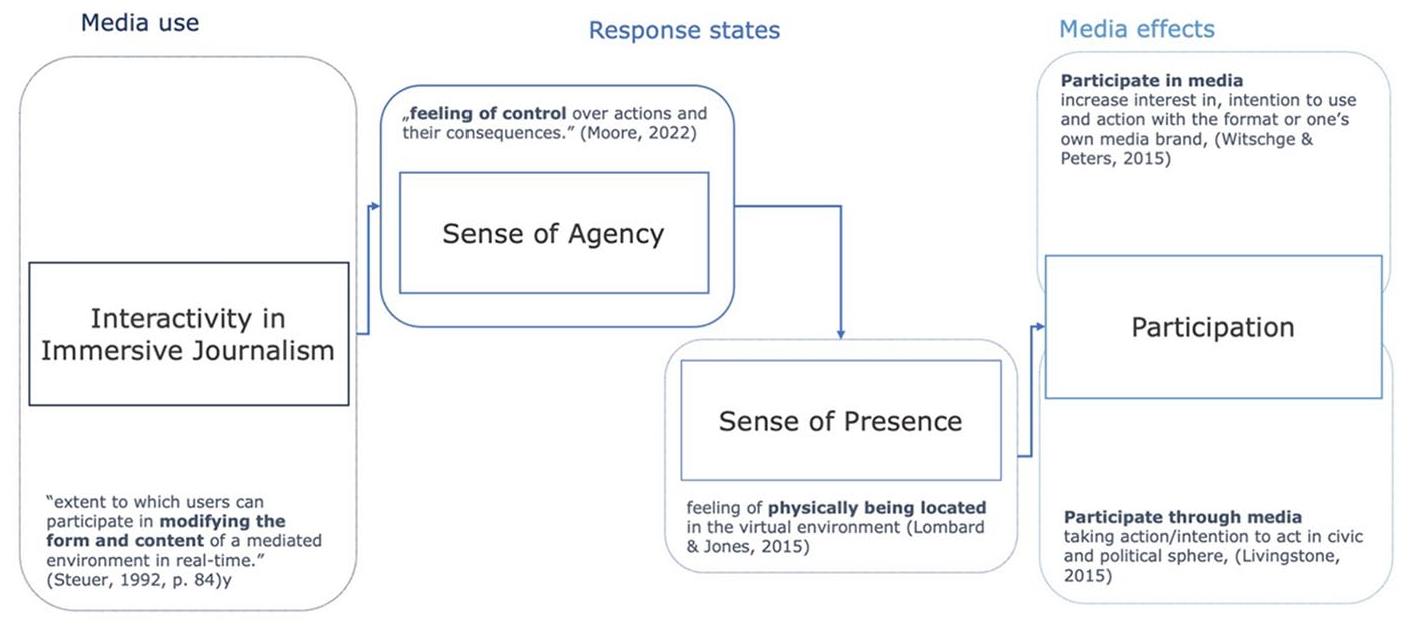
Effect Model Including Definitions for Each Concept; Valkenburg and Peter (2013).
Method
A laboratory experiment with three conditions varying in their range of interactivity (Steuer, 1992) tested the effects of interactivity in IJ. As a stimulus, I used “Hanen’s Story,” 1 an immersive story, told in German, about a refugee camp in Greece, produced by the Austrian Wiener Zeitung and the production company Junge Römer in 2017. The main character shows different parts of a refugee camp in Greece while talking about her family’s experience as Syrian refugees. To ensure the expected effects only occur due to the manipulated variables rather than the topic of the stimulus, a multiple-message rather than a single-message design should be employed (e.g., Thorson et al., 2012). However, due to the unfeasibility of finding a comparative IJ case that resembles the innovative interactivity possibilities altered in this case, I aimed to choose a case of IJ that approximates industry standards. “Hanen’s story” represents a typical case of IJ, as the genre of IJ focuses on emotionally touching, long-term social issues (e.g., Brannon et al., 2022) such as war and migration (Rodríguez-Fidalgo & Paíno-Ambrosio, 2022). In addition, the duration, capturing method, amount of shots, and narrative style approximate industry standards (Colussi & Assunção Reis, 2020; Rodríguez-Fidalgo & Paíno-Ambrosio, 2022; Sirkkunen et al., 2020), with the no- and high-interactivity conditions lasting for 5 minutes and 25 seconds, and the high-interactivity condition—due to the interactive possibilities—lasting on average 7 minutes (SD= 1.7 minutes).
The stimulus was adapted to manipulate three different levels along a range of interactivity, as defined by Steuer (1992): “The greater the number of parameters that can be modified, the greater the range of interactivity” (p. 104). 2 Each stimulus was shown with the Oculus Quest 2 to ensure that the different stimuli differed mainly due to their interactivity. In the no-interactivity group, participants were shown a video. In the medium-interactivity group, participants watched a 360° video in which they could explore an omnidirectional view. The stimulus included one scene in which the main character was shown in a mirror, responding to the participant’s head movements. This condition features basic interaction possibilities looking around (Palmer, 2020) and character responsiveness (Steed et al., 2018). In the high-interactivity group, in addition to the omnidirectional 360° video and the mirror scene, participants had control over the story’s order, pace, and the repetition of scenes. This was achieved by showing users a map of the refugee camp on which they could choose which location and associated scene in the refugee camp to visit next. The map was shown automatically at the end of scenes and could be called up during the experience. This increased the range of interactivity (Steuer, 1992), and is suggested by Palmer (2020) as a form of “meaningful interactivity.” Figure 2 illustrates some manipulations.
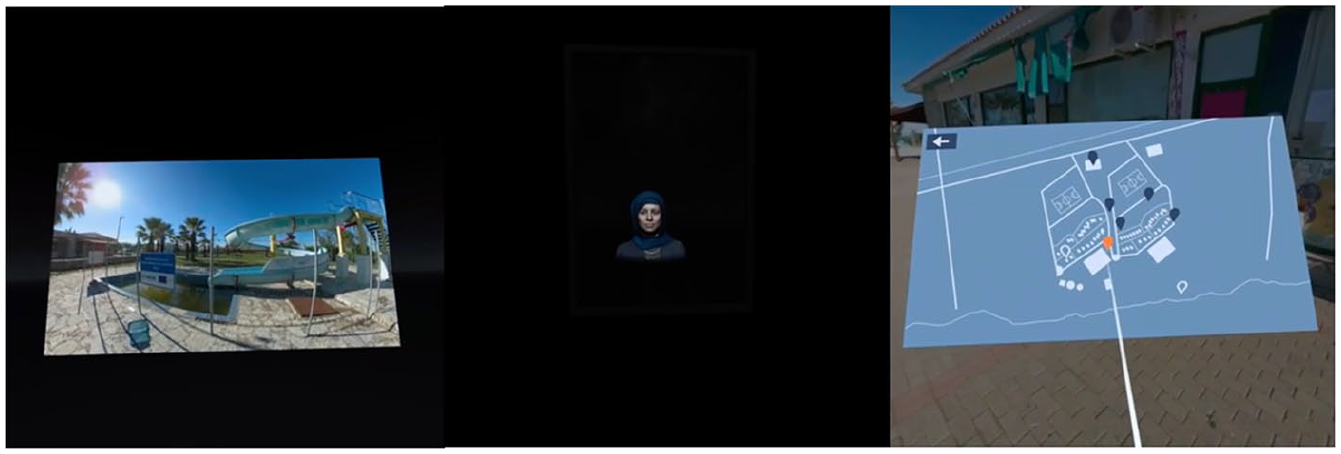
Screenshots of Stimulus. Left: No-Interactivity Video; Middle: Mirror Scene, Right: Map of the Refugee Camp.
Before data collection, participants filled out a health questionnaire and gave their informed consent. Then, participants were introduced to the Oculus Quest 2 and its controllers by playing the introduction game “First Steps.” Subsequently, participants completed a questionnaire including the sociodemographic and randomization variables. Then, participants were randomly assigned to one of the three experimental groups. Afterward, they were asked to answer the mediation questions and DVs. At the end of the questionnaire, participants read that they had officially finished the experiment. After this, three behavioral measures were included. Participants were given the opportunity to donate the money they received for their participation in the study to an NGO working in the shown refugee camp, they could sign up for a newsletter about updates at the refugee camp, and they could sign up to receive a free cardboard headset and access to the app “WITHIN,” which broadcasts immersive productions. After finishing the questionnaire, participants were debriefed, and each one received their full 15€ for participation.
Data collection started on 06.06.22, ended on 30.09.22, and was conducted in a laboratory in Vienna, Austria. Participants were recruited through flyers at shops, bakeries, and supermarkets and by advertising the study in different social media groups. The Institutional Review Board (IRB) board of the Department of Communication and Media Studies at the University of Vienna formally approved the data collection (IRB ID: 20220427_016). Before data collection, the hypotheses, the survey questionnaire, the power analysis, the data analysis plan, and the stimulus used were pre-registered. The pre-registration, including the dataset and R-code to replicate the analyses, can be found here: https://osf.io/x2wbz/?view_only=6694a6ea3af3409b863e2e6d40f6ad4a. This study was part of a greater data collection project which was also pre-registered at the same time.
Measures
Several variables along the lines of (a) participating in media and (b) participating through media were used to test the hypothesis. All items were measured on a scale from 1 (disagree) to 7 (completely agree).
To test the effect of agency on (a) participating in media, the evaluation of worthwhileness, engagement, and a behavioral continuance measure was used.
Worthwhileness
A news medium can be worth a user’s while and, consequently, part of their media repertoire due to seven dimensions: time, price, public connection, participatory potential, technological appeal, normative evaluations, and situational fit (Greber et al., 2023; Schrøder, 2015). Nine items captured the seven dimensions, such as “I think I would watch productions like this mainly due to the technology,” which together form worthwhileness (M = 4.36, SD = 1.06) with a CA of .77.
Engagement
Based on Schäfer et al. (2022), four items asked whether participants would leave a comment, provide an emoji, share the production on social media, or rate the experience. The four items form a scale (M = 3.52, SD = 1.72) with a good CA (.816).
Continued Use
At the end of the survey, after being informed that the formal part of the study had ended, participants could sign up to receive a cardboard headset and access to the documentary app “WITHIN.” Notably, 49.3% of participants signed up to receive the headset (dummy-coded: signing-up = 1).
To test the influence on (b) participation through media, information-seeking, signing up for a newsletter, civic engagement, and donating money were included in the data collection.
Information-Seeking
Information-seeking was captured using three items, such as “I would like to receive more information about the situation of refugees in Greece” (Schäfer et al., 2022), which together form a scale with a CA of .897 (M = 4.30, SD = 1.57).
Signing up for a Newsletter
At the end of the questionnaire, participants could sign up for a newsletter providing monthly information about the refugee camp. Notably, 42.7% of participants signed up for the newsletter (M = 0.42, SD = 0.495, dummy-coded: signing-up = 1).
Civic Engagement
Civic engagement is defined as “activities by ordinary citizens that are intended to influence circumstances in society that is of relevance to others, outside the own family and circle of close friends” (Adler & Goggin, 2005, p. 241). Civic engagement was captured based on a nine-item scale fashioned after the scale used by the Pew Research Group (Smith, 2013), with items such as “I would participate in a demonstration about the situation of refugees in Greece” and “I would share my thoughts and comments about the situation of refugees in Greece online.” The items form a scale with a good CA of .859 (M = 4.11, SD = 1.31).
Donating Money
At the end of the questionnaire, participants were given the opportunity to donate the money they would receive for participating in the study (up to 15€) (M = 2.89€, SD = 4.41).
Mediators
Agency
Four items were included to measure whether participants experienced a sense of control, agency, and activity during the experience (Sundar, 2013). The four items form an acceptable CA (.754) (M = 3.77, SD = 1.68).
Presence
To measure to what extent participants experienced a sense of being in a place, a five-item scale developed by Ahn et al. (2016, 2022) was used. This scale was chosen as it retained the core strengths of previous scales (Bailenson et al., 2005; Witmer & Singer, 1998), while tailoring the items to be more concise and directly relevant to this study. The items result in a scale with a good CA of .91 (M = 3.85, SD = 1.67).
Attention
Participants were asked whether they were able to pay attention during the experience. Notably, 84.7% of participants stated they paid attention during the experience, and 15.3% stated they could not.
Randomization check variables. Familiarity with VR (three items, CA = .816, M = 2.48, SD = 1.39), ideology on a left-right scale (1 left, 10 right; M = 3.26, SD = 1.30), attitude toward refugees (Hameleers et al., 2021; five items, CA = .813) (M = 6.32, SD = 1.03), populist attitudes (Schulz et al., 2018; six items, CA = .681, M = 4.14, SD = 0.94), political participation (six items, CA = .726, M = 5.00, SD = 1.13), and issue importance (M = 5.01, SD = 1.44).
Sample
Based on the pre-registered a priori power analysis for an ordinary least squares (OLS)-based regression, assuming the power = 0.8, alpha = .05, and a small effect size, a sample of 156 participants is required. Due to time constraints, 150 individuals participated in the experiment. The average age of participants is 26.83 years (SD = 10.12). 3 Most participants have completed A-Levels as their highest education (39.3%), followed by 23.3 % with a Bachelor’s degree, 16% with a Master’s degree, 10% practitioners of an A-Level course, 3.3% with another form of education, 2.7% with a PhD, and 2.7% on the lower level of secondary school. Notably, 54% of the participants were female. Participants are rather left-leaning (M = 3.26, SD = 1.30), politically active (M = 5.00, SD = 1.14), and central when it comes to populist attitudes (M = 4.14, SD = 0.94).
Randomization Check
Participants were randomly assigned to one of three groups: no-interactivity (n = 52), medium-interactivity (n = 45), and high-interactivity (n = 53). Randomization (analyses of variance (ANOVAs)) was successful for age, F (1,148) = 0.01, p = .922, gender, F (1,148)= 0.01, p = .922, education, F (1,148) = 0.21, p = .885, ideology, F (1,148) = 0.21, p = .641, populist attitudes, F (1,148)= 0.38, p= .538, and political participation, F (1,148)= 0.05, p= .831. However, randomization was not successful for familiarity with VR, F (1,148) = 4.78, p = .03. Participants in the no-interactivity group were slightly less knowledgeable about VR (M = 2.12, SD = 1.23) than those in the medium-interactivity (M = 2.60, SD = 1.45) or the high-interactivity (M = 2.71, SD = 1.44) groups. Therefore, familiarity is included as a control variable in all analyses. 4
Analysis Strategy
OLS-based regressions and logit regressions were conducted to test the pre-registered hypotheses. As randomization was successful except for familiarity, only familiarity was included as a control. Groups were dummy-coded (0 = less interactive version, 1 = more interactive version). For the mediation analyses, I used model 4 of PROCESS macro in R (Hayes, 2017), with 10,000 bootstrapped samples, bootstrapped standard errors, and 95% confidence intervals; partially standardized coefficients are reported. The dataset and the R-script for replicating the analysis can be found here: https://osf.io/x2wbz/?view_only=14daacf13d104f02abf010951913f23b. Full tables for the presented data can be found in Supplemental Appendix A. A list of pre-registration alterations can be found in Supplemental Appendix C.
Results
H1: Participating in Media
I investigate whether the H1a to c formalized assumption holds true that experiencing more interactive IJ translates into more participation in the media in the form of (a) increased evaluation of worthwhileness, (b) a stronger engagement, and (c) the willingness to continue using IJ productions. An overview of the results can be found in Table 1, and individual analysis including full regression results can be found in Supplemental Appendix A, Tables 5 through 7.
Influence of Interactivity on Participation in Media in the Form of (a) Worthwhileness, (b) Engagement, and (c) Continuing to Use IJ.
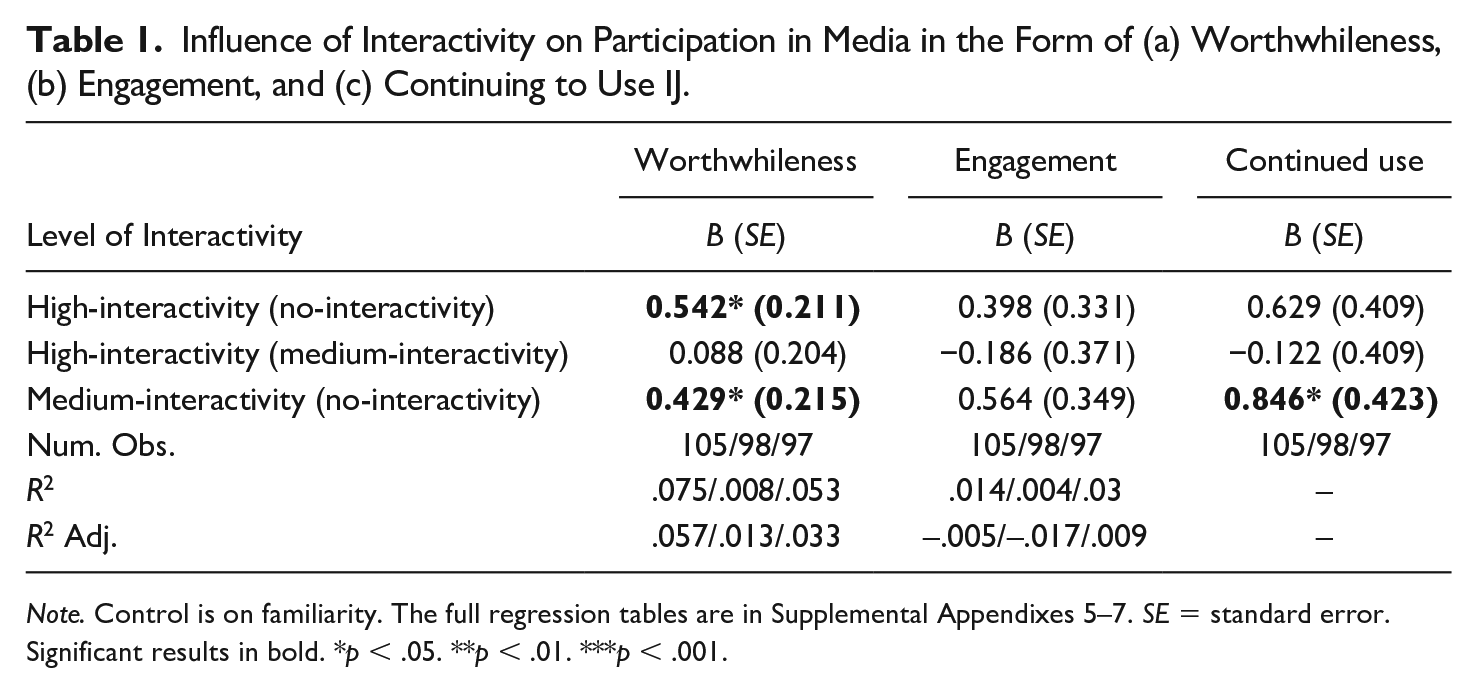
Note. Control is on familiarity. The full regression tables are in Supplemental Appendixes 5–7. SE = standard error. Significant results in bold.
p < .05. **p < .01. ***p < .001.
Concerning H1a, 5 participants evaluated both, the high-interactivity production (M = 4.58, SD = 1.026; b = 0.542, p = .011) and the medium-interactivity production (M = 4.48, SD = 0.97; b = 0.429, p = .024) as more worthwhile than the no-interactivity production (M = 4.00, SD = 1.08). Since there is no difference between the high- and medium-interactivity production, H1a is partially accepted. However, this pattern did not hold true for H1b, 6 as there is no difference between the three productions and their influence on engagement. H1b is rejected. Finally, concerning H1c, 7 when asked whether participants wanted to sign up for a free cardboard headset and IJ app, 54% of participants who saw the high-interactivity production (b = 0.629, p = .123) and 57% who saw the medium-interactivity production (b = 0.845, p= .045) signed up for access to the headsets and app, while only 36% of participants who saw the no-interactivity production signed up. There is no significant difference between the medium-interactivity and the high-interactivity groups (b = –0.121, p = .766). H1c is partially accepted.
H2: Participating Through Media
Hypotheses H2a to c state that more interactivity in IJ also leads to more (a) information-seeking behavior, (b) civic engagement, and (c) donations and signing up for newsletters (behavioral measure). An overview of the results can be found in Table 2, and detailed regression analyses can be found in Supplemental Appendix A, Tables 8 through 12.
Influence of Interactivity on Participation Through Media in the Form of (a) Information-Seeking Intentions and Behavior, (b) Civic Engagement, and (c) Donations
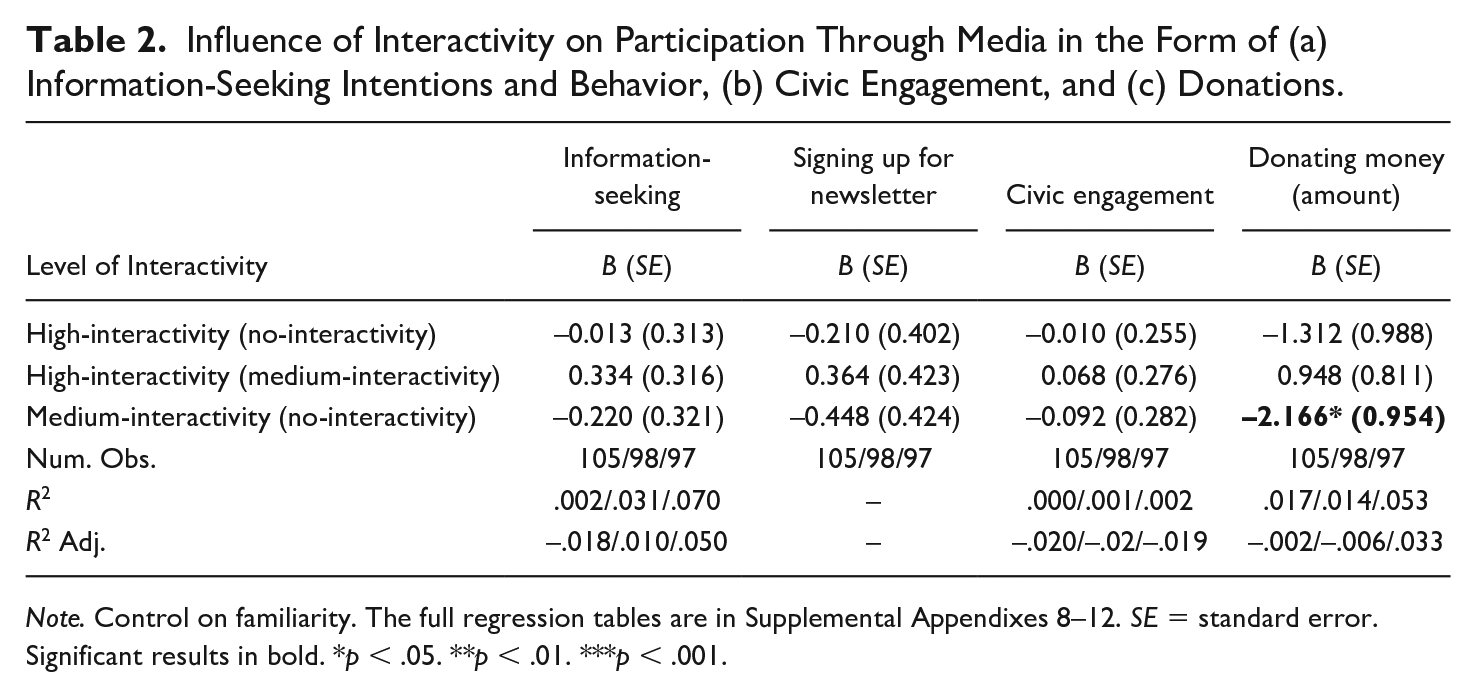
Note. Control on familiarity. The full regression tables are in Supplemental Appendixes 8–12. SE = standard error. Significant results in bold.
p < .05. **p < .01. ***p < .001.
Regarding H2a, results show that there is no significant difference between the three productions and their impact on information-seeking intention, 8 nor information-seeking in the form of signing up for a newsletter. 9 H2a is rejected. Similarly, while H2b assumes that more interactive IJ results in more civic engagement, 10 results indicate that participants are not more prompted to engage civically through the medium- and high-interactivity IJ productions. H2b is rejected. H2c tests the assumption that high- and medium-interactivity IJ translates into more donations. While the data indicate that there is no significant difference between the different productions in how many participants decided to donate money to an NGO, 11 there is a significant difference between the no-interactivity (M = 4.26, SD = 5.40) and the medium-interactivity group (M = 2.11, SD = 3.41; b = –2.166, p = .025) when it comes to the amount of money donated. 12 Counterintuitively, participants in the no-interactivity group were willing to donate more money than the medium-interactivity group. There is no significant difference between the no- and the high-interactivity condition. H2c is rejected.
RQ: Mediation Via a Sense of Agency and Sense of Presence
Increasing the range of interaction possibilities is expected to translate to a stronger sense of agency and, relatedly, presence. Indeed, the results concerning the sense of agency show that participants in the high-interactivity group (M = 4.82, SD = 1.54) experienced a stronger sense of agency than participants in the no-interactivity group (M = 2.76, SD = 1.28; b = 2.115, p < .001) and participants in the medium-interactivity group (M = 3.70, SD = 1.53; b = 1.118, p < .001). In addition, the sense of agency increased between the medium- and no-interactivity conditions (b = 0.899, p = .002). When it comes to the sense of presence, the high-interactivity group experienced more presence (M = 4.57, SD = 1.54) than participants in the no-interactivity group (M = 2.56, SD = 1.17; b = 2.069, p < .001). However, while the sense of presence is stronger for the medium-interactivity (M = 4.50, SD = 1.43) in comparison to the no-interactivity group (b = 1.966, p < .001), participants in the high-interactivity and the medium-interactivity group do not differ in their sense of presence.
To investigate how the sense of agency and the sense of presence function as mediators, I first test to which extent the two concepts are correlated. A Pearson’s correlation indicates that they are significantly correlated (r = .491, p < .001); this also holds true when controlling for the level of interactivity (r = .314, p < .001). Hayes (2017) indicates that a significant correlation between two mediators when controlling for the predictor variable indicates that the two mediators are related beyond the influence of the predictor variable, thus suggesting a serial mediation.
Theoretically, several studies indicate that a sense of agency influences the sense of presence in that the higher the sense of agency, the higher the sense of presence (e.g., Gutiérrez-Martínez et al., 2011; Jicol et al., 2021; Lallart et al., 2009; Wirth et al., 2007). Similarly, the sense of presence has previously been used in serial mediations as a second mediator (see Ahn et al., 2022). Finally, manipulating the level of interactivity in IJ is directly related to a sense of agency and only indirectly to the sense of presence. Based on all this, I propose a serial mediation with the range of interactivity in IJ influencing the sense of agency, which influences the sense of presence, which, in turn, influences participating in and through the media. However, importantly, the relationship between the sense of agency and the sense of presence empirically remains correlational; thus, a serial mediation with the sense of presence predicting the sense of agency is also reported in Supplemental Appendix B, Figures 3–5.
I conducted a serial mediation (PROCESS macro in R, model 6; Hayes, 2017) for each outcome variable, including the sense of agency as the first mediator, the sense of presence as a second mediator, and familiarity as a control variable. Figure 4 summarizes the results of the high- vs. no-interactivity condition of the mediations. 13 Multicollinearity analysis revealed moderate correlations (interactive groups VIF = 1.77; presence VIF = 1.81; agency VIF = 1.79).
Results indicate that there is a significant serial mediation in that the sense of agency positively relates to the sense of presence, which in turn positively mediates participative outcomes. However, the main driver behind this relationship seems to be the sense of presence rather than the sense of agency. When comparing the high-interactivity to the no-interactivity condition, as visualized in Figure 3, there is a significant and positive serial mediation via the sense of agency and the sense of presence for worthwhileness (a1db2 = 0.301, CI [0.1347, 0.5040]), engagement (a1db2 = 0.343, CI [0.1497, 0.5630]), information-seeking (a1db2= 0.132, CI [0.0168, 0.2860]), and civic engagement (a1db2= 0.212, CI = [0.0641, 0.4217]). While the sense of presence positively relates to the evaluation of worthwhileness, engagement, information-seeking, and civic engagement, the sense of agency negatively relates to engagement. A similar pattern emerges when comparing the medium-interactivity to the no-interactivity condition. 14 Specifically, there is a positive serial mediation for worthwhileness (a1db2 = 0.111, CI = [0.0325, 0.2154]), engagement (a1db2 = 0.121, CI = [0.0330, 0.2515]), information-seeking (a1db2 = 0.0618, CI = [0.0075, 0.1449]), and civic engagement (a1db2 = 0.091, CI = [0.0183, 0.218]). While both the sense of agency (a1b1 = 0.188, CI= [0.0840, 0.3728]) and the sense of presence (a2b2 = 0.595, CI = [0.3306, 0.8927]) significantly and positively mediate the evaluation of worthwhileness, only the sense of presence is correlated with engagement, information-seeking and civic engagement. In addition, some mediations indicate a negative and significant direct effect (e.g., worthwhileness, Figure 3), possibly indicating a competitive mediation with an omitted mediator (Hair et al., 2021).
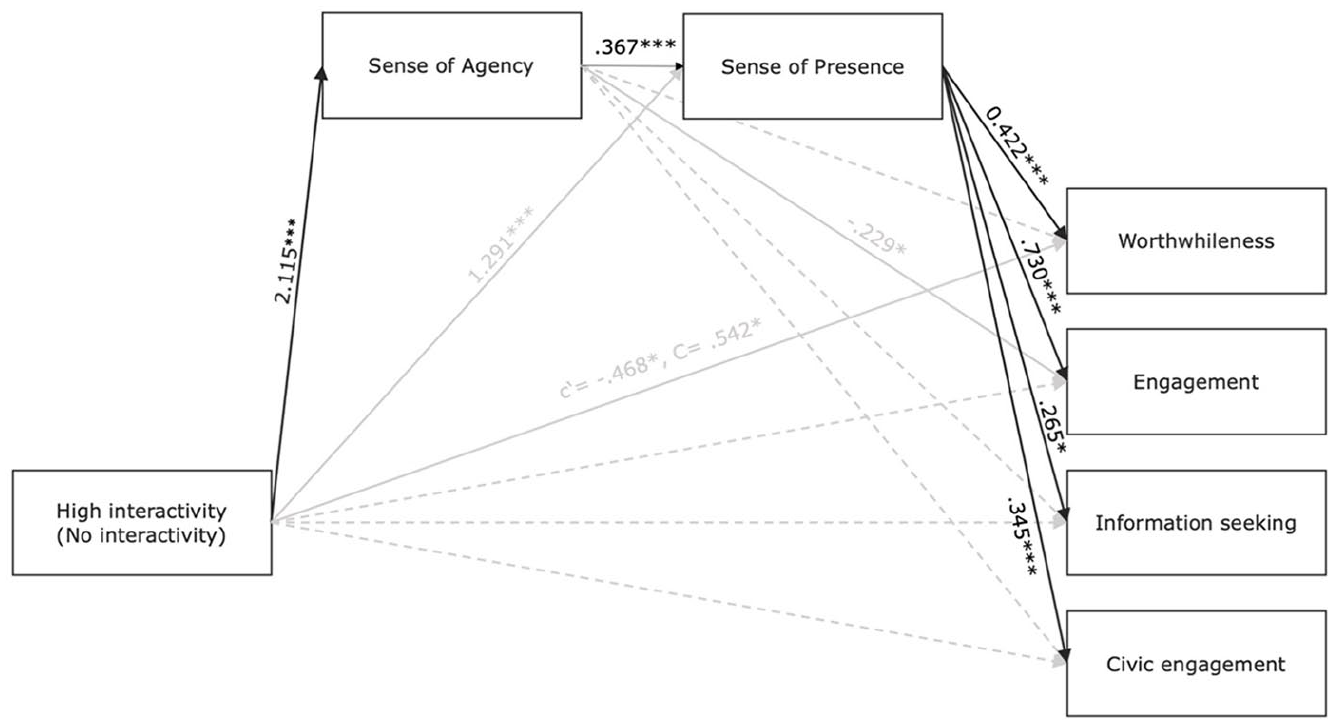
Serial Mediation (Model 6, PROCESS Macro, Hayes 2017) for high-interactivity (1) in Comparison to no-interactivity (0).
Conclusion
This study is set within a long line of research focusing on the effects of emerging technology in journalism (Rice & Bucy, 2023). The aim of this study was to evaluate IJ based on its potential to facilitate democratically beneficial behavior related to mobilizing people’s interest in and participation in civic life, such as H1a to c participating in and H2a to c through media (Peters & Witschge, 2015; Strömbäck, 2005). This connects to the expectation that increasing the range of interactivity in IJ—similarly to interactivity in digital journalism (Peters & Witschge, 2015)—functions as an “engagement booster” (Vázquez-Herrero & López-García, 2019) by increasing an individual’s sense of agency during an experience. The results indicate that medium-interactivity, which is operationalized as form of technological interactivity in the form of looking around in IJ, results in more participation in media, such as worthwhileness and continuance of using IJ, but not engagement; however, it does not translate to more participation through the media, in the form of information-seeking, civic engagement, and donations. Moreover, increasing the range of interactivity to high-interactivity by adding narrative interactivity in the form of controlling the pace and linearity of the IJ experience did not further increase this effect pattern. Consequently, H1a and c are partially accepted, while H1b and H2a to c are rejected. In addition, the mediation analysis shows that the sense of presence, rather than agency, functioned as an engaging mediator. The implications of this study are threefold. First, the results underline the engaging potential of a sense of presence. Second, the results indicate the important differentiation between technological and narrative interactivity rather than the range of interactivity and their respective expected effects. Third, given technological and financial constraints, journalists might be better off focusing on inclusive technology rather than extending interactivity in IJ.
The results of this experiment partially confirm earlier observations by Peters and Witschge (2015), suggesting that interactivity does result in greater participation in media, such as worthwhileness and continuance intention, but not in greater participation through media, such as information-seeking or civic engagement. However, while this holds true for technological interactivity, it does not increase further for narrative interactivity (de Bruin et al., 2020). This highlights the need for a critical reflection on the assumptions about interactive tools and the engaging role of IJ. First, the results highlight that effects do not seem to depend on the range of interactivity, but, to some extent, to the format of interactivity; namely, technological or narrative interactivity (de Bruin et al., 2020). This can also be seen in the mediation analyses. When comparing the high-interactivity condition, which features both technological and narrative interactivity formats, to the no-interactivity condition, the sense of agency has no significant impact on worthwhileness. However, when comparing the medium-interactivity condition, which features mainly technological interactivity formats, to the no-interactivity condition, the sense of agency positively influences the worthwhileness evaluation. Altogether, this means that the experience of agency is directly related to the format of interactivity used in IJ; and its effects on outcomes depend on this experience. All of this is in line with previous research, which finds that the audience’s evaluation of worthwhileness increases for technological interactivity but not narrative interactivity (Greber et al., 2023). Second, the scope of interactivity afforded in IJ remains limited (Peters and Witschge, 2015). That is, users of an IJ narrative exert control over their own experience by looking around or choosing scenes; however, the journalist mostly still retains narrative control over the experience by choosing which scenes and forms of interactivity to include (Mabrook, 2021), and even narrative interaction possibilities often do not result in meaningful consequences to a story (Palmer, 2020). While this approach to the implementation of interactivity is rooted in normative debates about the application of interactivity in IJ in relation to journalists’ narrative control (e.g., Aitamurto, 2019), the notion of upholding journalistic control compromises the technological potential for meaningful interaction opportunities found in other related fields, such as i-docs (Nash, 2017) or newsgames (Lin and Wu, 2020). Nonetheless, similar expectations of the engaging potential of IJ with its strong effects are taken over from these fields without fully realizing the same scope of interactivity in practice (also see Vázquez-Herrero & López-García, 2019, p. 263). The results of this bounded approach to interactivity, as exemplified in this study, are more related to participation in the media than through the media (Peters and Witschge, 2015). The bounded interactivity in IJ does not “empower” the audience but rather “activates” them. The study and discussion of IJ would benefit from a more nuanced discussion of IJ’s effect patterns vis-à-vis its normative confinement.
Research has shown that IJ has not met initial expectations regarding audience engagement (Wang et al., 2018), and this analysis offers a potential explanation. One suggested reason was that IJ was not engaging without meaningful interactivity (Palmer, 2020). The results of this experiment suggest another explanation. Participants in the medium-interactivity and high-interactivity conditions showed overall similar response patterns. The mediation analyses put these results in perspective. The sense of presence, rather than agency, positively influenced participative intentions. This finding aligns with several studies indicating that the sense of presence is an important mediator for strong effects of IJ (e.g., Sundar et al., 2017; Van Damme et al., 2019). Even more so, studies finding low audience engagement (e.g., Wang et al., 2018) cannot account for the device the audience used to experience IJ and, therefore, cannot make assumptions about whether they had the possibility of experiencing a sense of presence. Consequently, one of the reasons why IJ might not have resulted in more user engagement might simply be the low market penetration of VR goggles, meaning that a large part of the audience lacks the technological equipment that would allow them to experience a sense of presence (Ball et al., 2021; Cummings & Bailenson, 2016). In addition, the mediation analyses also suggest the existence of an unobserved mediator when comparing the video to the 360° condition that counterweights the positive influence of a sense of presence (Hair et al., 2021). A similar effect pattern can be found in another study (Pjesivac et al., 2022). This could be another piece of the puzzle explaining why IJ might not be as engaging as commonly expected. Potential avenues to explore are numerous, such as the cognitive demands placed on users (Van den Broeck et al., 2017) or that the audience might be overwhelmed with the intense experience the inclusive and interactive technology facilitates (Greber et al., 2022), and might not appreciate being “taken hostage” in a journalistic experience while wearing a headset (Goutier et al., 2021). Future studies could consider user evaluations of their experiences, as suggested for emotional experiences (Lecheler, 2020).
This study comes with limitations. First and foremost, the experiment represents a single-message design. Single-message designs are problematic in isolating an effect beyond one message (e.g., Thorson et al., 2018). For instance, it could also be that the topic of refugees—also used in the study by Pjesivac et al. (2022)—is salient in the population, leading to a ceiling effect. Therefore, future studies should replicate this study with different topics to ensure that the effect pattern found in this study is not related to the issue of migration but reflects the interactivity potential in IJ. Similarly, the results of this study are context-dependent, as the experience of a sense of agency is related to the form of interactivity provided to users (see Palvik, 2019). Hence, future studies should extend the interactivity possibilities in the IJ they test. Furthermore, as the inclusive and interactive elements of IJ are somewhat co-dependent, the experimental design does not enable a full, clean-cut differentiation between an increase in inclusion and an increase of interactivity for the comparison of the no-interactive and the medium-interactive conditions. Specifically, these conditions differ not only by the degree of interaction (i.e., looking around) but also by being visually surrounded by a story. The sense of presence and agency were used as mediators to mitigate this shortcoming. Nonetheless, this should be considered when interpreting the main effects. Moreover, the assumptions made concerning narrative and technological interactivity should be further investigated with a systematic manipulation of the two forms of interactivity. In addition, although effort was put into mitigating the novelty effect of IJ and increasing ecological validity by letting participants briefly play a game before data collection, it might still suffer from novelty effects (Jun et al., 2020). Research should take into account repeated exposure to IJ.
Supplemental Material
sj-csv-3-jmq-10.1177_10776990241271089 – Supplemental material for The Effect of Interactivity in Immersive Journalism on Participating In the Media and Through the Media
Supplemental material, sj-csv-3-jmq-10.1177_10776990241271089 for The Effect of Interactivity in Immersive Journalism on Participating In the Media and Through the Media by Hannah Greber in Journalism & Mass Communication Quarterly
Supplemental Material
sj-docx-5-jmq-10.1177_10776990241271089 – Supplemental material for The Effect of Interactivity in Immersive Journalism on Participating In the Media and Through the Media
Supplemental material, sj-docx-5-jmq-10.1177_10776990241271089 for The Effect of Interactivity in Immersive Journalism on Participating In the Media and Through the Media by Hannah Greber in Journalism & Mass Communication Quarterly
Supplemental Material
sj-docx-6-jmq-10.1177_10776990241271089 – Supplemental material for The Effect of Interactivity in Immersive Journalism on Participating In the Media and Through the Media
Supplemental material, sj-docx-6-jmq-10.1177_10776990241271089 for The Effect of Interactivity in Immersive Journalism on Participating In the Media and Through the Media by Hannah Greber in Journalism & Mass Communication Quarterly
Supplemental Material
sj-R-1-jmq-10.1177_10776990241271089 – Supplemental material for The Effect of Interactivity in Immersive Journalism on Participating In the Media and Through the Media
Supplemental material, sj-R-1-jmq-10.1177_10776990241271089 for The Effect of Interactivity in Immersive Journalism on Participating In the Media and Through the Media by Hannah Greber in Journalism & Mass Communication Quarterly
Supplemental Material
sj-R-2-jmq-10.1177_10776990241271089 – Supplemental material for The Effect of Interactivity in Immersive Journalism on Participating In the Media and Through the Media
Supplemental material, sj-R-2-jmq-10.1177_10776990241271089 for The Effect of Interactivity in Immersive Journalism on Participating In the Media and Through the Media by Hannah Greber in Journalism & Mass Communication Quarterly
Supplemental Material
sj-R-4-jmq-10.1177_10776990241271089 – Supplemental material for The Effect of Interactivity in Immersive Journalism on Participating In the Media and Through the Media
Supplemental material, sj-R-4-jmq-10.1177_10776990241271089 for The Effect of Interactivity in Immersive Journalism on Participating In the Media and Through the Media by Hannah Greber in Journalism & Mass Communication Quarterly
Footnotes
Declaration of Conflicting Interests
The author(s) declared no potential conflicts of interest with respect to the research, authorship, and/or publication of this article.
Funding
The author(s) disclosed receipt of the following financial support for the research, authorship, and/or publication of this article: This work was supported by Österreichische Nationalbank Jubiläumsfonds, under grant no. 18403, and by the DOC stipend of the ÖAW (Austrian Academy of Sciences), under grant no. 26419. This article’s proofreading was financed by the Faculty of Social Science of the University of Vienna.
Supplemental Material
Supplemental material for this article is available online.
Notes
Author Biographies
References
Supplementary Material
Please find the following supplemental material available below.
For Open Access articles published under a Creative Commons License, all supplemental material carries the same license as the article it is associated with.
For non-Open Access articles published, all supplemental material carries a non-exclusive license, and permission requests for re-use of supplemental material or any part of supplemental material shall be sent directly to the copyright owner as specified in the copyright notice associated with the article.
