




Abstract
The hierarchical influences model attributes significant influence to journalists over their news content. A quantitative content analysis was conducted to examine the impact of journalists’ gender and reporting experience on the media delegitimization of the trans community in Spain. The results emphasize their minimal impact. Instead, media attention and delegitimization of the trans community appear to be shaped by the prevailing value system cultivated in newsrooms, personal attitudes, values, and beliefs and journalistic role performance. These findings underscore the significance of theoretical knowledge over practical experience in the news coverage of specific news topics.
Journalists play a vital role in shaping the news agenda. The hierarchical influences model (Shoemaker & Reese, 2013) attributes significant influence to journalists over their news content. Alongside news values and media routines, they constitute a central component among the intramedia variables of Agenda Building, which can be defined as the process by which news organizations and journalists select and emphasize news issues and their attributes (Ardévol-Abreu et al., 2020). To analyze the influence of journalists in the issue and attribute selection, Shoemaker and Reese (2013) distinguished different factors, such as demographic characteristics of the journalists (e.g., gender) and previous experiences associated with the professional context. This study aims to examine how journalists’ gender and practical reporting experience on trans issues affect the presence of attributes that delegitimize the trans community in their news coverage of trans issues in Spain.
Changing diversity representations in media takes a long time (Moody-Ramirez et al., 2023). However, over the past two decades, news media visibility of trans people has increased, whereas media delegitimization of trans rights and misrepresentation of trans people have decreased (Åkerlund, 2019; Billard, 2016; Olveira-Araujo, 2022, 2023a). Trans-friendly news coverage is crucial as news media can shape the perception and behavior toward the trans population (Shelley, 2008), harm the mental well-being of trans individuals (Dhanani & Totton, 2023; Hughto et al., 2021; Humphrey, 2016; Pham et al., 2020), and influence the identification and social transition processes of trans people (Indremo et al., 2022; Olveira-Araujo, 2024b; Pang et al., 2020; Pham et al., 2020).
Several articles have explored various aspects of Agenda Building process in the news coverage of trans issues. This includes research on Intermedia Agenda Setting dynamics (Billard, 2019; Li, 2018; Olveira-Araujo, 2023b), which examines the influence of different news outlets on one another (McCombs & Valenzuela, 2020). In the case of Spain, progressive news media have transferred the salience of trans issues to conservative media, in addition to publishing more news articles and including fewer elements that delegitimize the trans community (Olveira-Araujo, 2023b). Similarly, national media have not only published more news articles but also transferred the salience of trans issues to local media.
In addition, previous literature has also analyzed extramedia factors, such as news sourcing patterns (Capuzza, 2014; Seely, 2021) and media relations of trans-related organizations (Billard, 2021; Olveira-Araujo, 2024a). For instance, the inclusion of nongovernmental organizations (NGOs) and advocate sources in news coverage of trans issues can have a significant positive impact on combating explicit forms of delegitimization, but not on more implicit forms of misrepresentation, such as genitalization (Olveira-Araujo, 2024a).
In terms of intramedia variables, Thorpe et al. (2023) analyzed six sports journalists who cover trans athletes. Their study revealed that these reporters engage in reflexive considerations about their practices and continuously educate themselves, their colleagues, and readers. On the contrary, Kijratanakoson (2023) investigated the journalistic role performance in news coverage of trans issues in Thailand. The study found that the six dimensions of journalistic role performance proposed by Mellado (2015) were evident in Thai news coverage of trans issues.
Given the potential impact of news media coverage on the trans population, a deeper understanding of the Agenda Building process can aid in the development of more effective communication strategies to advance trans rights and combat transphobia through the news media. This research specifically examines whether journalists’ gender influences their news coverage of trans issues, both quantitatively and qualitatively, thus supporting either the gender socialization model or the job socialization model. In addition, this study investigates whether practical experiences in reporting on trans issues have an impact on the quality of coverage and whether further education is required to enhance news media coverage of trans rights.
Gender Differences
Shoemaker and Reese (2013) highlight gender, along with ethnicity, sexual orientation of erotic desire (SOED), class, and elite status, as one of the demographic characteristics of journalists that can affect their news coverage. For example, women often use an indirect communication style that promotes relationship building, whereas men tend to employ more direct language, often including judgmental adjectives that may convey rudeness and isolate others (Mulac, 2001). The underlying assumption of possible gender differences in reporting, as posited by the gender model of socialization, is that women, due to their distinct gender-related socialization, may bring a different value system to their work (Rodgers & Thorson, 2003).
Gallego-Ayala (2003) proposes that men tend to underplay topics associated with women, such as the emotional and private lives of individuals, as well as the positive aspects of news stories. On the contrary, van Zoonen (1998) observes that women frequently reject the idea of objectivity and insensitivity often linked to the masculine journalistic approach. They argue that this objectivity can sometimes be used as an excuse to exclude compassion and human touch from news stories. In addition, men often prioritize competition, leadership, dominance, aggression, decisiveness, independence, and use of force to resolve conflicts, whereas women tend to emphasize principles, such as cooperation, peaceful conflict resolution, empathy, emotional depth, honesty, congeniality, and altruism (Meeks, 2013). Furthermore, men as editors may be more inclined to perceive topics associated with femininity or soft news as less significant (Lavie & Lehman-Wilzig, 2005).
According to Rodgers and Thorson (2003), these differences in the value system of men and women would result in more diverse news coverage in terms of news sources. In addition, women tend to exhibit more positive reporting styles in terms of story tone. For instance, some research has provided empirical evidence that news stories written by women and minority reporters are more likely to use women and minority sources (Armstrong, 2004; Gallagher, 2006; Mitchelstein et al., 2019; Zeldes et al., 2007; Zeldes & Fico, 2005), including in Spain (Mateos de Cabo et al., 2014). Furthermore, women’s representation on newspaper editorial boards led to more positive coverage of women (Shor et al., 2019). Considering that women may exhibit greater gender neutrality than men (Zoch & Turk, 1998) and that women, in general, tend to be more lesbian, gay, bisexual, and transgender (LGBT)-friendly than men (Holland et al., 2013), a higher number of news articles could be expected on trans issues bylined by typically feminine names compared with typically masculine names. Furthermore, it might be thought that news articles authored by typically feminine names would contain fewer elements that delegitimize the trans community compared with typically masculine names.
Contrary to the gender model of socialization, other literature suggests that women do not significantly differ in their roles and practices as reporters and editors when compared with men (De Swert & Hooghe, 2010; Freedman et al., 2007; Ross, 2007). These findings align with the job model, which assumes that women perform equally to men when their organizational experiences are similar (Rodgers & Thorson, 2003). According to the job model, media delegitimization of the trans community would likely result from the predominant value system fostered by socialization in newsrooms. In such a scenario, the number of news articles on trans issues authored by both typically feminine and masculine names would be similar, as would the rate of trans delegitimizing attributes within them.
However, organizational experiences may not be similar. For instance, the majority of women are often assigned to cover soft news areas, such as arts, education, and health (e.g., Mayo-Cubero, 2022; Mitchelstein et al., 2020; North, 2016). Moreover, they are usually assigned to news of less prestige and shorter length (Mateos de Cabo et al., 2014; North, 2016). Therefore, it is reasonable to anticipate that gender segregation within newsrooms may lead to a higher number of articles authored by women on trans issues. However, it would still be expected that these articles contain a similar rate of trans delegitimizing attributes.
According to Tajfel’s Social Identity Theory (SIT), individuals categorize themselves along a continuum, spanning from a purely personal and idiosyncratic identity to a wholly social or group identity (Harwood, 2020). This social identity is dynamic, varying based on the situation, and it significantly shapes one’s perception of reality and behavior. Regarding this research topic, the way journalists report on trans issues can differ based on their self-categorization, thus moderating the effects of the gender and job models. If journalists primarily identify with their gender when reporting on trans issues, variations in the number of news articles on trans issues and in the rate of trans delegitimizing attributes within them may emerge between news articles authored by typically feminine and masculine names. Conversely, if they align themselves more closely with their role as journalists, they are likely to adhere to the prevalent value system fostered through newsroom socialization, mitigating the emergence of gender differences. Ultimately, if they adopt an individualistic perspective, their personal attitudes, values, and beliefs will shape their reporting on trans issues.
Besides gender and job models and SIT, two additional factors should be considered. First, some research highlights a significant underrepresentation of women in newsrooms (e.g., Mitchelstein et al., 2020). However, this trend does not apply to Spain, where women slightly outnumber men (Mayo-Cubero, 2022). Second, at least since 2018, Spain has witnessed the rise of Trans Exclusionary Radical Feminist (TERF) ideologies (Willem et al., 2022). These narratives on social media include the erasure of women, arguments for the abolition of gender as an identity marker, and the lack of scientific support for trans rights, such as gender self-determination or social transition of children and youths. Consequently, TERF ideologies may have intensified anti-trans rights discourses within Spanish news media, originally triggered by far-right and ultraconservative narratives (Olveira-Araujo, 2023b). If news articles on trans issues authored by typically feminine names contain more elements that delegitimize the trans community compared with those bylined by typically masculine names, it could indicate the presence of TERF ideologies in Spanish news coverage of trans issues bylined by women. Taken together, two research questions arise:
Practical Reporting Experience
Shoemaker and Reese (2013) also emphasize experiences within the professional context. Reporting experience can be understood both as an outcome and as a process. In this study, practical reporting experience related to trans issues is operationalized as the number of news articles authored by reporters. Conversely, reporting experience as a process is defined as the ongoing development of journalistic skills, knowledge, and insights through active engagement in journalistic practice, particularly in covering specific topics or issues such as trans issues.
Some journalists may publish more news articles on trans issues than others for various reasons. Beyond gender, Shoemaker and Reese (2013) highlight personal attitudes, values, and beliefs. For instance, trans-friendly attitudes may lead journalists to seek increased visibility and more inclusive coverage of trans issues (Thorpe et al., 2023). Conversely, transprejudice attitudes may also result, nowadays, in greater visibility but delegitimizing news coverage of trans issues (Olveira-Araujo, 2023b). Media routines also may play a significant role (Shoemaker & Reese, 2013). Even if the Spanish media industry demands polyvalent journalists (Mayo-Cubero, 2022), news organizations tend to assign the same journalists to cover specific issues for the sake of efficiency, facilitating specialization to a certain extent.
Specialization may be one of the factors that might mediate the influence of practical experiences within the professional context on journalists’ news coverage (Shoemaker, 2006). Through specialization, the journalist can obtain a wider knowledge of specific issues. Given that experienced journalists in trans issues may be more specialized in such topic, it can be expected that news articles on trans issues bylined by journalists with more practical experience contain fewer attributes that delegitimize the trans community than news articles bylined by journalists with less reporting experience in the topic.
Practice is not the only way of achieving specialization; previous literature on generalist journalism practice suggests that theoretical knowledge is as important as reporting experience (Ismail & Ismail, 2017). In fact, the debate of theory versus practice is one of the historical arguments in journalism education (Solkin, 2022). Generally, this theoretical knowledge is acquired through formal journalism education. In the case of specialized journalism, it remains true. However, due to the specificity of certain journalistic specializations, self-training and other sources of knowledge can also be utilized, such as courses offered by different organizations, including NGOs or specialized news media outlets. If specialization in journalism comes, at least to a certain extent, from practical reporting experience, it might be expected that the chronological order in which journalists write their news articles on trans issues is negatively associated with attributes that delegitimize the trans community. Otherwise, it would suggest that specialization in the news coverage of trans issues may be acquired through formal education.
In addition to specialization, personal attitudes, values, and beliefs and journalistic role performance may moderate the influence of practical reporting experiences and specialization. On one hand, journalists with trans-friendly attitudes may proactively engage in ongoing efforts to educate themselves, their colleagues, and their readers (Thorpe et al., 2023). However, the majority of journalists may not share these attitudes and may not approach their work in a more relational, ethical, or reflexive manner (Thorpe et al., 2023). On the other hand, transprejudice attitudes may hinder journalists from acquiring a broader knowledge and educating themselves about trans issues. Thus, practical reporting experiences would be more influential in the news coverage of journalists when the news topic is chosen for the reporter compared with when the journalist chooses the news topic. In addition, the coverage of trans issues may depend on whether journalists perceive their role as neutral reporters, entertainers, advocates, and so forth (Kijratanakoson, 2023). Taken together, two additional research questions emerge regarding reporting experience, considering it both as an outcome and as a process:
Method
Data Collection
To address these research questions, a quantitative content analysis was conducted. A corpus of 18 digital newspapers was selected: eldiario.es, 20minutos.es, elpais.com, elmundo.es, abc.es, elcorreo.com, periodicodearagon.com, lavozdegalicia.es, larazon.es, elespañol.com, hugginftonpost.es, farodevigo.es, deia.eus, heraldo.es, libertaddigital.com, publico.es, naiz.eus, and okdiario.com. For national media (n = 11), their circulation, political alignment, and origin were considered. For local media (n = 7), three Spanish regions (Basque Country, Galicia, and Aragon) were focused on and their highest circulation newspapers were included. Together, they form a representative sample of digital newspapers in the Spanish news media ecosystem.
All the articles published between 2000 and 2020 that included the keywords transsexual, transgender, and trans (in Spanish: transexual, transgénero, and trans), and their plurals and derivatives, were collected using Scrapy framework (Kouzis-Loukas, 2016). Subsequently, the presence of these keywords and their allusion to trans issues were verified, and any duplicate articles or those with defects, such as missing headlines or body text, were removed. In such cases, it was checked whether the absence resulted from issues with the webpage rather than the download process. Next, the variable Preeminence was then coded, selecting only those articles where trans issues were the main topic. In addition, the variable Byline was coded, selecting only those articles bylined by journalists (n = 4,440).
A representative sample of news articles was extracted from the main corpus for hand or manual coding. To ensure representativeness, the minimum sample size was calculated (n ≤ 429) with a 95% confidence level and a margin of error of 4.5%. Eventually, a slightly larger sample (n = 486) was obtained through random sampling.
Coding Procedure
The protocol of analysis included 14 variables: Year of publication, Preeminence of trans issues within the news article, Byline of the news item, Gender of the reporter, Reporting experience on trans issues, Chronological order of the published articles, and a set of eight Transsexuality Delegitimacy Indicators previously used by Olveira-Araujo (2023a). The variable Preeminence was coded following Olveira-Araujo’s (2022) proposal: it was coded as the Main topic when the aforementioned keywords appeared at least once in the title or the first paragraph of the text without the co-occurrence of other types of gender and sexual diversity related to SOED. The remaining articles were coded as Subtopic or Mention and were excluded from this analysis, as previously explained.
The variable Byline distinguished three main categories: news agency, newspaper, and journalist. For journalists, Gender was coded based on first names using Wiki-Gendersort (Bérubé et al., 2020). This algorithm distinguishes between typically masculine, feminine, unisex, unknown names, and initials, with a demonstrated accuracy ranging from 97.1% to 99.9%. Whereas gender identity extends beyond a first name, as evidenced by trans realities, the algorithm’s performance underscores the efficiency and validity of using first names to infer gender, particularly in cases of insufficient information about gender. In this specific study, only masculine and feminine categories were considered; therefore, unisex, unknown names, and initials were coded as missing values. On the contrary, Reporting experience as an outcome on trans issues was operationalized as the number of news articles on trans issues authored by reporters and then, based on the frequencies, categorized as follows: three or fewer articles, between four and 10 articles, and more than 10 articles. The Chronological order of the published articles to analyze reporting experience as a process was determined by considering the date of publication. For details on the Transsexuality Delegitimacy Indicators, refer to Table 1.
Transsexuality Delegitimacy Indicators (Olveira-Araujo, 2023a).
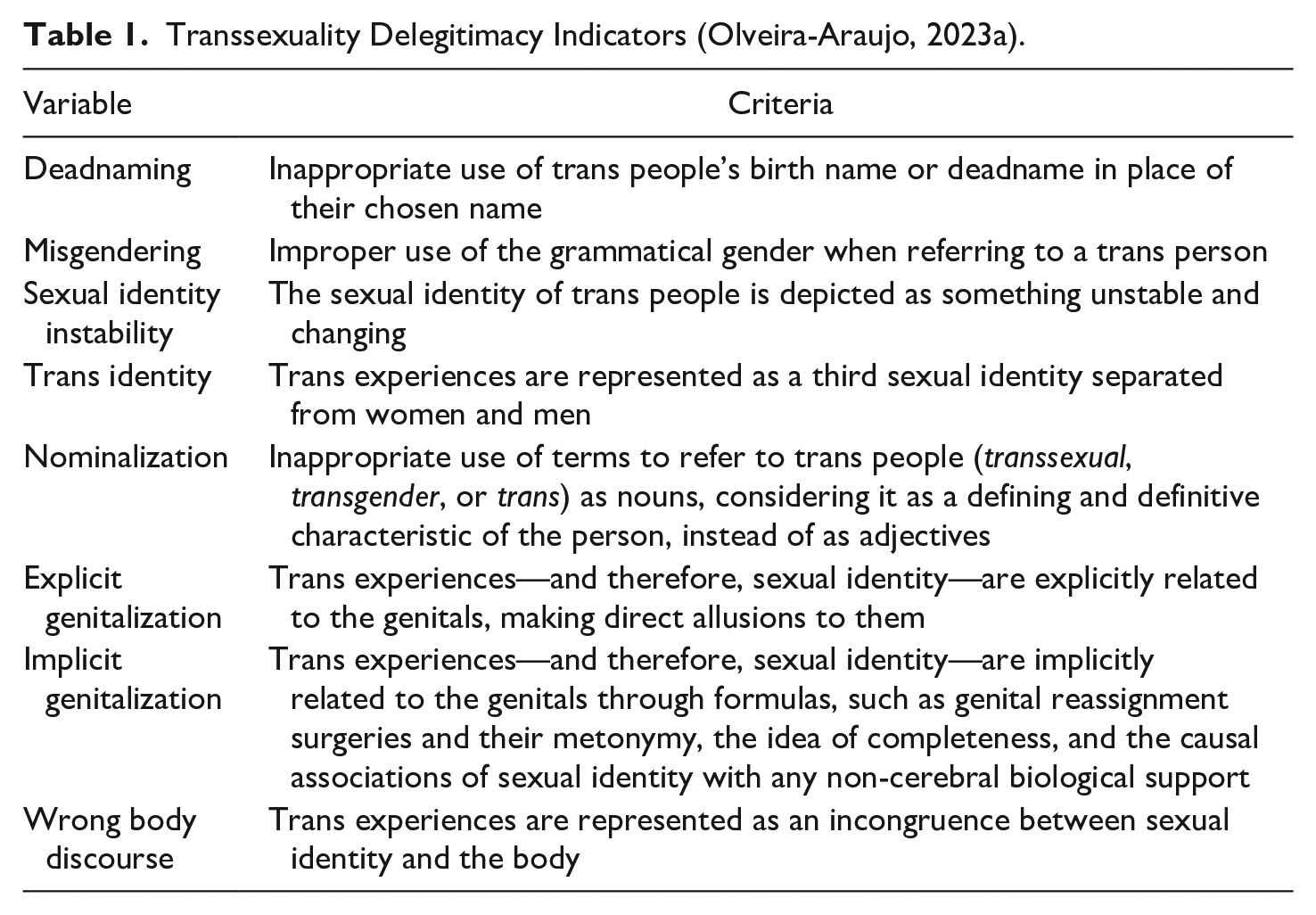
Deadnaming, Misgendering, and Sexual identity instability variables were manually coded in the representative sample using NVivo software as these variables are too complex for automatic coding. When necessary, other news from the corpus, as well as the internet, were consulted to learn more about the context of the coded articles. The remaining variables were automatically coded in all news articles using rule-based text classification with the spaCy library (Honnibal & Montani, 2017). An intercoder reliability test was conducted, involving 200 articles for automatically coded variables and 100 for hand-coded variables, resulting in an average Cohen’s kappa coefficient of .93 (SD = .07).
Data Analysis
Summary statistics were used to describe the corpus of analysis and examine whether there were gender differences in the number of news articles authored by typically feminine and typically masculine names (
Results
The analyzed digital media published 12,141 journalistic articles during the period 2000–2020 with trans issues as the main topic. Out of these, 41.6% (n = 5,049) were attributed to news agencies, 36.6% to individual reporters (n = 4,440), and 21.8% to the news outlets themselves (n = 2,652). Among the articles bylined by reporters, 94.5% (n = 4,197) provided valid information, forming the basis of the final analysis sample. National news media (n = 3,218, X̄ = 292.5, SD = 293.5) published most of these articles, compared with local news media (n = 979, X̄ = 139.8, SD = 107.9). Within the national news category, progressive outlets published more news articles (n = 2,028, X̄ = 405.6, SD = 400.6) than conservative outlets (n = 1,190, X̄ = 198.3, SD = 143.3). This sample of articles was authored by 2,529 different journalists. On average, each reporter wrote 2.2 articles (SD = 2.5). Among these journalists, 84.1% (n = 2,128) bylined three or fewer news items, whereas 13.1% (n = 332) contributed between four and ten news items. Only 2.7% (n = 69) of reporters wrote 11 or more news items.
Regarding delegitimacy indicators, deadnaming practices appeared in 11.7% (n = 57) of the articles bylined by reporters that were manually coded, while misgendering occurred in 17.9% (n = 87) and instability of gender identity in 19.1% (n = 93) of the articles. A negative trend in the relative frequencies of misgendering and gender identity instability was observed since the beginning of the analyzed time span (Figure 1). However, for deadnaming practices, the negative trend started around 2015. On the contrary, the wrong body discourse was found in 11.7% (n = 492) of articles written by reporters and mentions of trans identity in 5.1% (n = 215) of articles. Nominalization was a prevalent aspect, accounting for 69.8% (n = 2,928) of the articles. In addition, explicit genitalization was present in 17.6% (n = 739) of articles, and implicit genitalization in 29.6% (n = 1,241). Both nominalization and implicit genitalization exhibited a negative trend over time, whereas the wrong body discourse, trans identity, and explicit genitalization remained relatively stable (Figure 2).
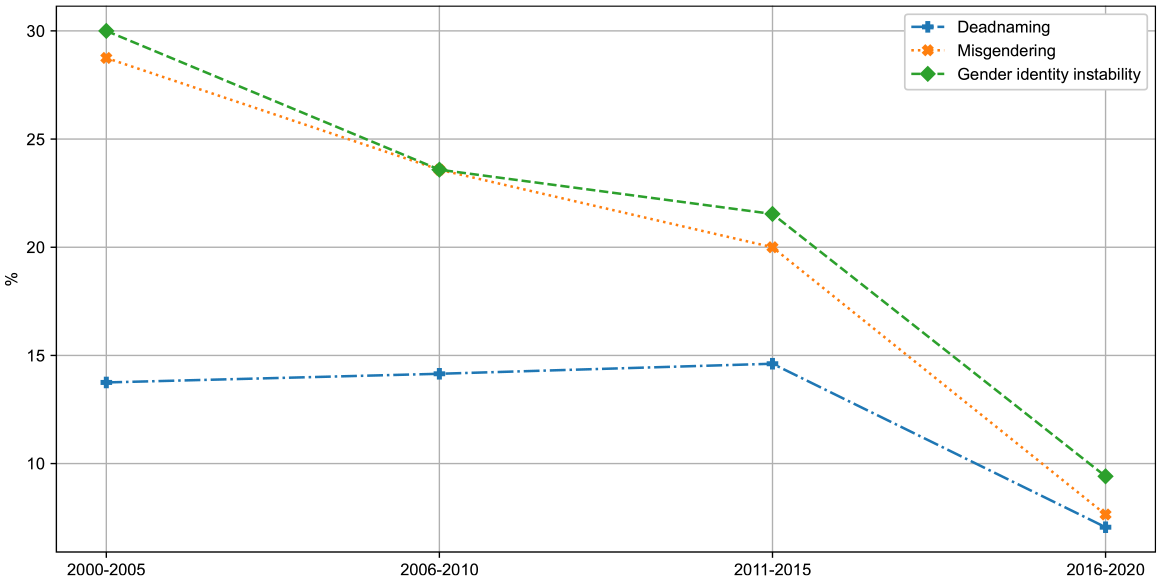
Evolution of Hand-Coded Indicators by Periods.
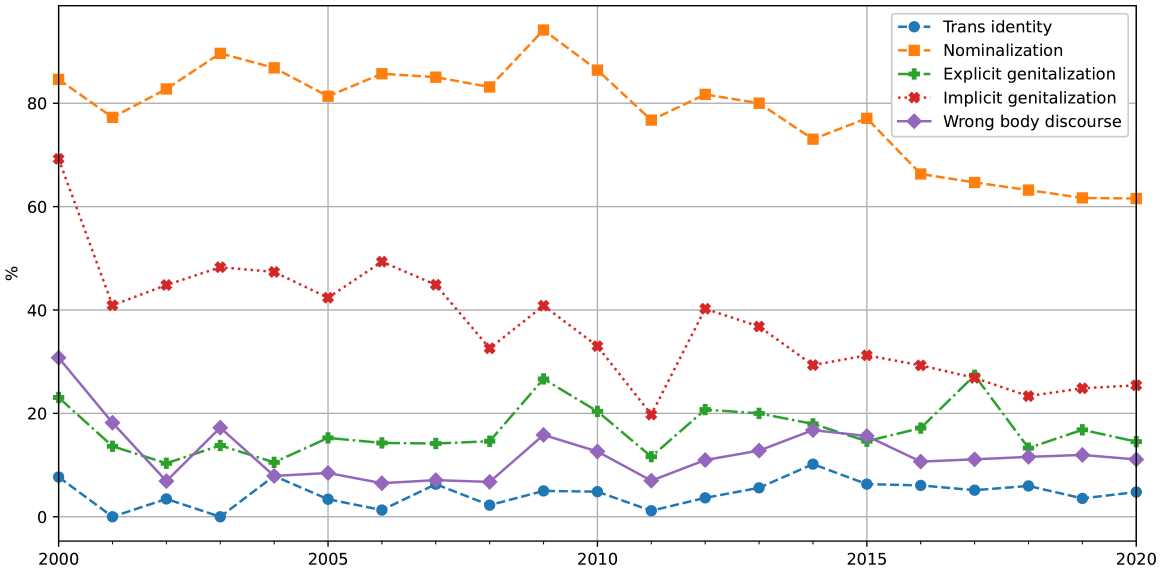
Annual Evolution of Automatically Coded Indicators.
Gender Differences
In 83.1% (n = 2,100) of cases, the names that bylined the news articles indicated the gender of the reporter. A total of 1,158 (55.1%) typically masculine names and 942 (44.9%) typically feminine names were identified. These names appeared as bylines in 86.4% (n = 3,626) of the analyzed news articles. Among these articles, 54.3% (n = 1,968) were authored by typically masculine names, whereas 45.7% (n = 1,658) were authored by typically feminine names. In addition, the number of articles of both typically masculine and typically feminine names that bylined between 4 and 10 news items was similar. However, there were more reporters with typically masculine names who wrote either three or fewer articles or more than 10 articles compared with those with typically feminine names, χ2(2, N = 3,626) = 8.770, p < .013. Therefore, the number of news articles on trans issues bylined by typically feminine names was slightly smaller than those authored by typically masculine names.
This pattern remained relatively stable over time (Figure 3). Nevertheless, this difference increased in 2006-2007 and 2017. These spikes coincided with the enactment of the Spanish law for the rectification of sex and name registration in 2007, as well as with the main peak of Spanish media attention to trans issues in 2017, which was triggered by a counteradvertising campaign launched by a far-right Spanish organization.
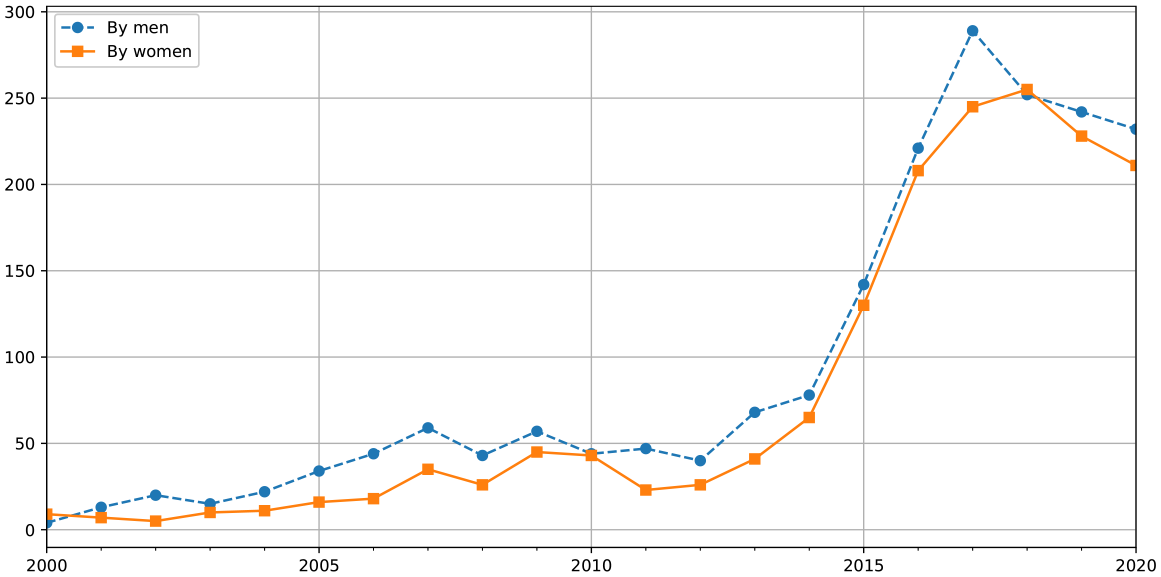
Evolution of the Number of News Articles on Trans Issues by Gender.
To explore the impact of journalists’ gender on the presence of various trans delegitimacy indicators, logistic regressions were employed (Table 2). While controlling for the publication year and considering journalists’ reporting experience on trans issues, gender did not emerge as a significant factor for most indicators, such as deadnaming, misgendering, instability of gender identity, trans identity, nominalization, and explicit genitalization. In contrast, typically feminine bylines increased the likelihood of wrong body discourse and implicit genitalization in their news articles. The interaction between gender and reporting experience was not significant for any indicator, leading to its exclusion from the logistic regressions. Thus, news articles bylined by typically feminine names did not contain fewer attributes that delegitimize the trans community compared with those authored by typically masculine names. In fact, they often included a similar or slightly greater number of such attributes.
Logistic Regressions for the Impact of Gender and Reporting Experience on Delegitimacy Indicators.
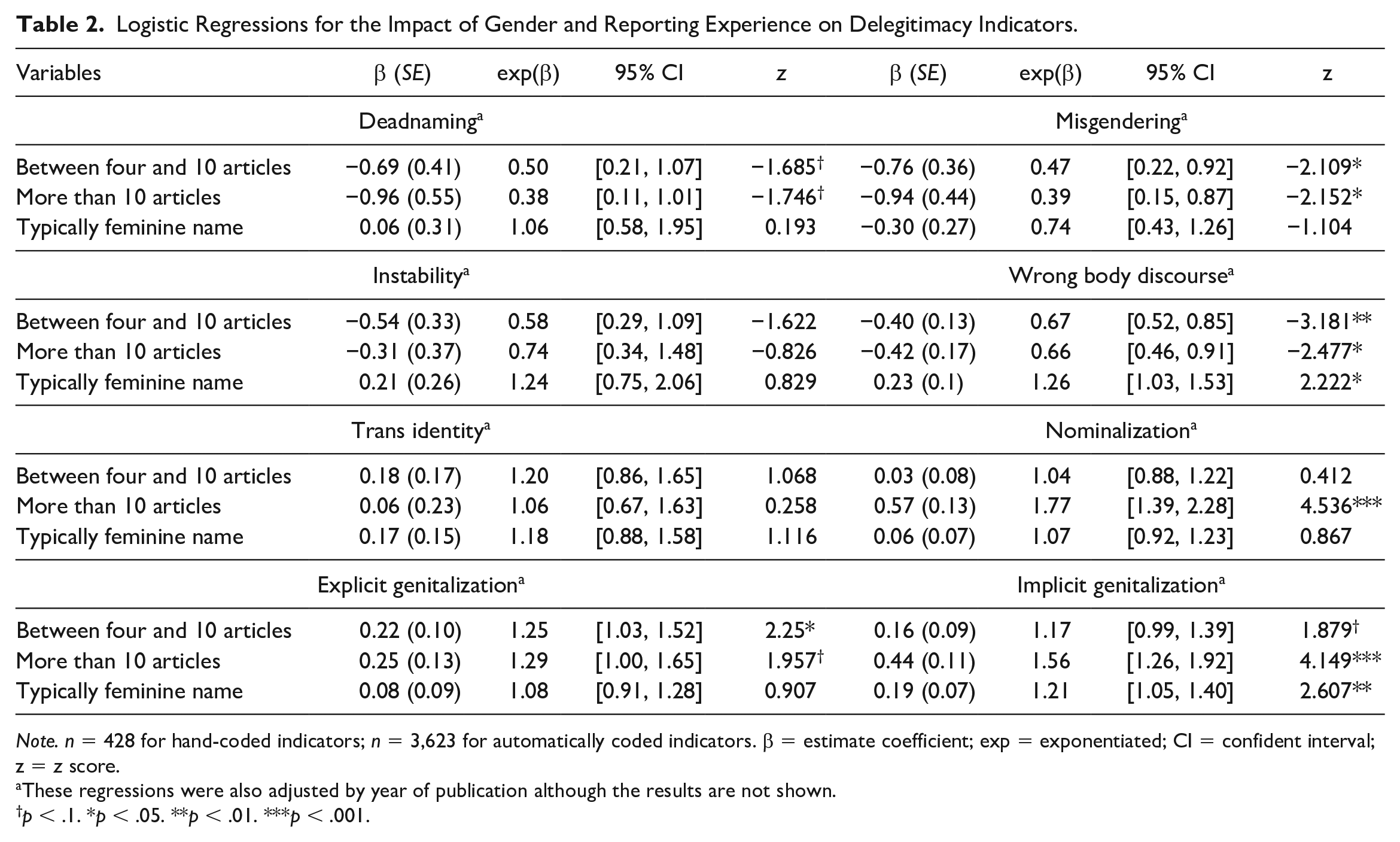
Note. n = 428 for hand-coded indicators; n = 3,623 for automatically coded indicators. β = estimate coefficient; exp = exponentiated; CI = confident interval; z = z score.
These regressions were also adjusted by year of publication although the results are not shown.
p < .1. *p < .05. **p < .01. ***p < .001.
Practical Reporting Experience
Unlike gender, practical reporting experience as an outcome emerged as a significant factor for most of the analyzed indicators (Table 2). For instance, a higher number of articles bylined by reporters reduced the likelihood of deadnaming, misgendering, and wrong body discourse. Conversely, a higher number of articles increased the probability of nominalization, explicit genitalization, and implicit genitalization. The number of articles on trans issues bylined by reporters did not significantly affect the instability of gender identity and trans identity indicators. In all significant cases, the effect size was greater with a higher number of articles. Consequently, news articles about trans issues bylined by journalists with a greater number of published stories on the subject reduced the likelihood of certain delegitimacy indicators while increasing the likelihood of others.
To determine whether practical reporting experience on trans issues as a process was responsible for the observed effects, logistic regressions were employed (Table 3). As the majority of journalists did not exceed 20 news items, in the case of outliers who published more news stories, only the first 20 news articles were considered for this analysis. In addition, only articles from authors who have published at least four articles on trans issues were considered. The publication year was also controlled. Using these criteria, the chronological order in which journalists wrote their news articles on trans issues was not found to be associated with most of the analyzed indicators. The exception was the nominalization indicator, which increased with practical reporting experience on trans issues. Therefore, practical reporting experience on trans issues as a process was not the underlying factor responsible for the effects of the number of articles on trans issues authored by reporters on delegitimacy indicators.
Logistic Regressions for the Impact of the Chronological Order of the Published Articles on Trans Issues on Delegitimacy Indicators.
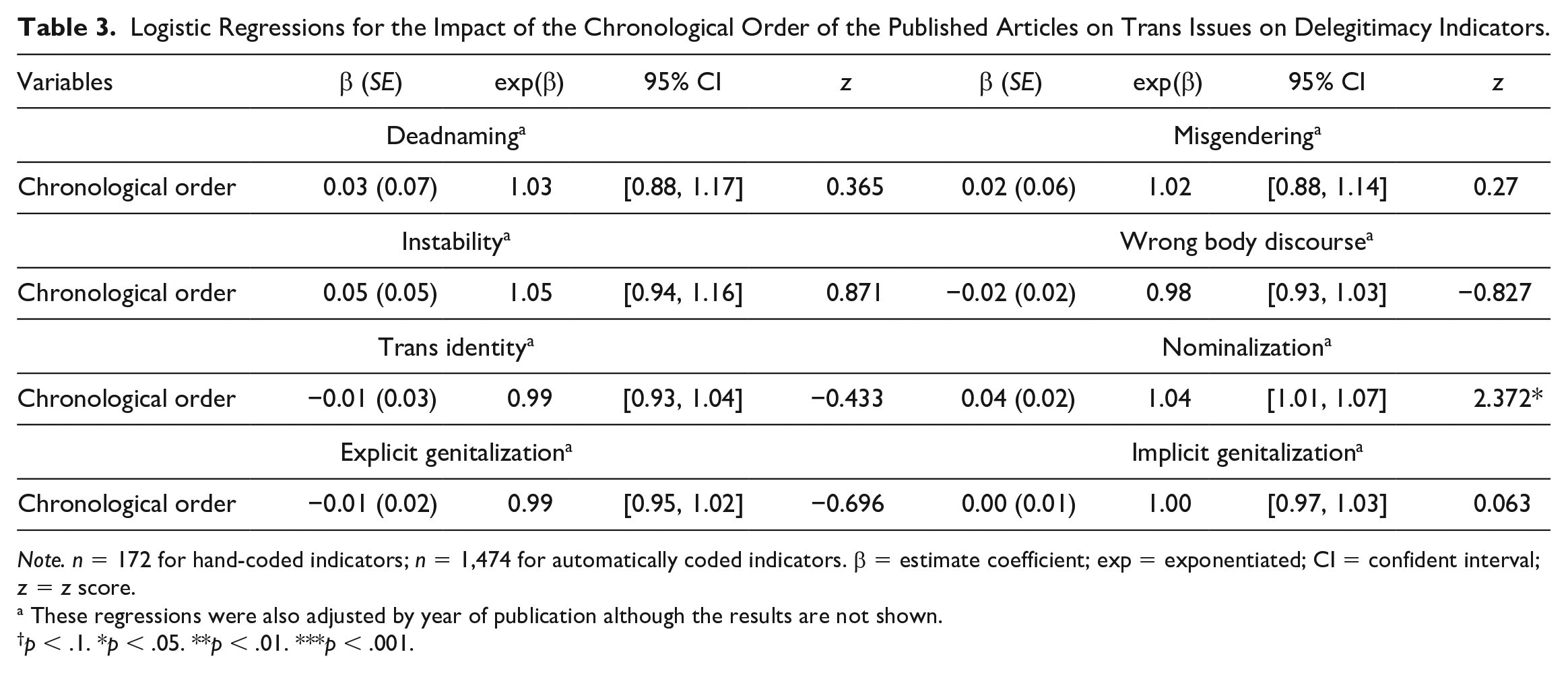
Note. n = 172 for hand-coded indicators; n = 1,474 for automatically coded indicators. β = estimate coefficient; exp = exponentiated; CI = confident interval; z = z score.
These regressions were also adjusted by year of publication although the results are not shown.
p < .1. *p < .05. **p < .01. ***p < .001.
Discussion
This study aims to examine how journalists’ gender and practical reporting experience on trans issues affect the presence of attributes that delegitimize the trans community in their news coverage of trans issues in Spain. Shoemaker and Reese (2013) emphasize gender and experiences within the professional context as two of the individual factors that can shape the news agenda.
According to the gender model, gender differences in reporting may arise because women, influenced by their distinct gender-related socialization, might bring a different value system to their work (Rodgers & Thorson, 2003). This can result in more diverse news coverage in terms of topics, attributes, and news sources. In fact, previous literature has provided empirical evidence that news stories written by women and minority reporters are more likely to use women and minority sources (Armstrong, 2004; Gallagher, 2006; Mateos de Cabo et al., 2014; Mitchelstein et al., 2019; Zeldes et al., 2007; Zeldes & Fico, 2005). However, the empirical data provided in this study do not support this idea in the case of the news coverage of trans issues in Spain.
On one hand, the number of news articles on trans issues bylined by typically feminine names was slightly smaller than those authored by typically masculine names (
On the other hand, news articles bylined by typically feminine names did not contain fewer attributes that delegitimize the trans community compared with those authored by typically masculine names; they often included a similar number of such attributes (
Collectively, the empirical data from this study align more closely with the job model than the gender model. The job model assumes that women perform equally to men when their organizational experiences are similar (Rodgers & Thorson, 2003). In fact, existing literature suggests that women’s roles and practices as reporters and editors do not significantly differ from those of men (De Swert & Hooghe, 2010; Freedman et al., 2007; Ross, 2007). Therefore, media attention to trans issues and the media delegitimization of the trans community likely result from the predominant value system cultivated through socialization in newsrooms, such as news values (Olveira-Araujo, 2022). In addition, these findings suggest that journalists prioritize their social identity as journalists over their gender when reporting on trans issues. This alignment facilitates the influence of the prevalent newsroom value system, mitigating the emergence of gender differences.
Unlike gender, the number of news articles about trans issues published by journalists or practical reporting experience on trans issues as an outcome is associated with attributes that delegitimize the trans community (
The chronological order in which journalists wrote their news articles on trans issues did not show an association with most of the analyzed indicators. Consequently, reporting experience as a process alone did not determine the observed effects (
On one hand, journalists with trans-friendly attitudes may proactively engage in ongoing efforts to educate themselves, their colleagues, and their readers (Thorpe et al., 2023). However, the majority of journalists may not follow suit (Thorpe et al., 2023). Moreover, prejudiced attitudes toward trans individuals can prevent journalists from gaining broader knowledge and education about trans issues. Therefore, the impact of reporting experience on trans issues may result in enhanced news coverage when trans-friendly reporters are involved, but not for the majority of journalists, including those with prejudiced attitudes. As the number of trans-friendly reporters is likely a small fraction of all journalists covering trans issues, their enhancements may be overshadowed by the majority who do not improve.
On the other hand, the coverage of trans issues may also depend on how they perceive their role as journalists (Kijratanakoson, 2023). For instance, those roles with more advocate ideals may exhibit trans-friendlier attitudes and actively educate themselves. In contrast, more neutral reporters may unintentionally perpetuate implicit biases, with only superficial improvements in their coverage.
The fact that practical reporting experience on trans issues as a process does not lead to improved news coverage of the trans community has at least three significant implications. First, whereas prior literature on general journalism practice suggests that theoretical knowledge is as important as practical experience (Ismail & Ismail, 2017), in the context of specific news topics and specialized journalism, theoretical knowledge may be even more crucial than reporting experience. Second, communication strategies that aim to increase media attention to trans issues may indeed boost media attention, but this does not guarantee simultaneous improvement in news coverage. Third, formal journalism education in gender and sexual diversity knowledge is essential for enhancing news coverage as practical reporting experience alone has proven inadequate.
In the context of the Agenda Building process for trans issues, contrary to expectations, neither gender nor practical reporting experience on trans issues appears to significantly influence the increased visibility of trans people in news media or the reduction of media delegitimization of trans rights and misrepresentation of trans people (Åkerlund, 2019; Billard, 2016; Olveira-Araujo, 2022, 2023a). Hence, the association between the number of news articles published by journalists and the likelihood of including attributes that delegitimize the trans community may result from the personal attitudes, values, and beliefs of the reporters and journalistic role performance. However, this study does not provide empirical data supporting this hypothesis. Nevertheless, this association underscores the pivotal role of journalists in shaping the news agenda on trans issues. Therefore, communication strategies aimed at advancing trans rights and combating transphobia through the news media should consider alternative approaches to educate reporters beyond reporting experience.
This study has advanced our comprehension of how journalists’ gender and practical reporting experience affect their news coverage of trans issues. Nevertheless, it concludes that these factors are not as influential as personal attitudes, values, and beliefs and journalistic role performance, which could benefit from the theoretical knowledge acquired through formal education. There are some potential limitations concerning the results of this study. For instance, personal attitudes, values, and beliefs and journalistic role performance have not been empirically analyzed. The low prevalence of various delegitimacy indicators may also result in reduced statistical power in specific cases. In addition, the gender of journalists has been inferred from their first names. Although not a perfect measure, it still allows for the inference of gender in bylines. Future research could explore the impact of prior experience on the reporting quality of different news topics, using a larger sample and more prevalent indicators to address the current limitations. Furthermore, it would be very valuable to analyze both qualitatively and quantitatively the role of reporters’ personal attitudes, values, and beliefs and journalistic role performance in relation to their news coverage.
Conclusion
Although gender and prior reporting experience are often considered determinants influencing news coverage at the individual journalist level, the empirical findings of this study emphasize their minimal impact on reporting about trans issues. Instead, media attention to trans issues and the delegitimization of the trans community appear to be shaped by the prevailing value system cultivated in newsrooms through socialization. Furthermore, the lack of influence of prior reporting experience in news coverage on trans issues suggests that personal attitudes, values, and beliefs may be behind the effect of a higher number of published stories on the subject, which reduces the likelihood of certain delegitimacy indicators but increases the likelihood of others. Taken together, these findings highlight the importance of theoretical knowledge over practical reporting experience in the news coverage of specific news topics and specialized journalism. Consequently, strategies aimed at promoting trans rights and combating transphobia through the news media should explore alternative approaches to educating reporters beyond reporting experience.
Footnotes
Declaration of Conflicting Interests
The author(s) declared no potential conflicts of interest with respect to the research, authorship, and/or publication of this article.
Funding
The author(s) disclosed receipt of the following financial support for the research, authorship, and/or publication of this article: This work was supported by the University of the Basque Country.
