



Abstract
Social exclusion refers to the processes by means of which individuals and groups of people have limited rights and opportunities to become fully integrated into society. In Spain, several social and legal developments have taken place. However, they have not necessarily resulted in real social advancement and equality for transsexual people. This discriminatory situation is organized within a structural and legal framework, which does not satisfy the particular needs of transsexual people. This reality, coupled with social intersubjectivity and a predominance of ignorance and negativity (both of which are directed by a dominant gender), requires a global strategy to address its structural, cultural, and intersubjective dimensions. A global strategy of this sort should originate from a participative perspective. By using a variety of methods, this article deals with the above issues, as well as the social factors and problems that limit the empowerment and social inclusion of this collective in a heterocentric society that is increasingly plural and diverse.
Keywords
Introduction
The aim of this study has focused on the process of social exclusion of transsexual people in Spain. Social exclusion is defined as the denial or unfulfillment of civil, political, and social rights of the citizens, paying special attention to the mechanisms and effects of the discriminatory social practices as a reflection of individual experiences (Room, 1995). The European Union (1993) defines social exclusion as the inability to enjoy social rights with no help (because of the individual’s limited self-esteem), to face the individual’s own duties, because of the risk of being set aside as an assisted individual and being stigmatized in the cities and neighborhood where he or she lives. Some years later, the concept is extended to include all the different social spheres, relating it to the equality of opportunities and referring to all the people who are not allowed to benefit from the vital opportunities of a society. From our point of view, social exclusion is a process of gradual distancing from a situation of social integration, which structural mechanisms prevent social groups that are different from the heterocentric dominant position from actively taking part in the economic, social, political, and cultural spheres of a society.
This concept includes three key aspects that can explain what it is to be outside or inside the society:
Structural origin. Social structure, inequalities, and social disruption result in the difficulty in gaining access to the market society and to the different social spheres that prevent transsexual people from having a high quality of life and social welfare.
Multidimensional character. There are many sectors or dimensions that can affect social exclusion, such as political, social, economic, cultural, and health factors, which feed back into each other and hinder the inclusion.
Nature of the process. It is a continuum. It is a process that begins with a situation of vulnerability and may increase over time. In this specific case, social exclusion can result from a previous situation of vulnerability. Nonetheless, there is a Copernican shift when the person decides to have a new identity, either a male or female transsexual identity. This process begins with a social exclusion, and it usually results in the most absolute social marginalization due to prejudices, social rejection, and the lack of opportunities and social expectations.
According to the aforementioned concepts and from this point of view, the main objectives of this study are
To show the relationship between social factors and social situation of transsexual people in a heterocentric society that prevents their integration in equality conditions;
To analyze the ways of social exclusion and the effects on social inequality of transsexual people;
To identify stigma and intersectionality as elements associated with the empowerment of these people.
Social Exclusion Based on Gender and Sexual Identity
We can add an extra factor of social inclusion to the poverty situation or social inequality in people with male or female sexual identity. Sexual identity is a relatively nonvisible stigma, which is hidden to avoid rejection and social exclusion. The lack of a specific socialization and the limited social and familiar affiliation results in a series of categories of social exclusion in those homosexual, bisexual, and transsexual people who do not achieve the category of subjects. These factors can be seen in the social recognition as citizens who enjoy equal rights. Therefore, the experiences lived by these people must be analyzed by taking into account their complex relationships with other social-structural characteristics. To improve their social status and achieve equality, a series of actions is required to allow the inclusion of transsexual people in the society as subjects of law to build a new inclusive citizenship, free from differences.
In a heterocentric society, the social and cultural construction of social rules from a privileged position of heterosexuality may result in a cultural structure that is degrading and unfair in terms of sexual differences (Fraser, 1997). Social exclusion of homosexual, bisexual, and transsexual people highlights more and more questions and problems faced by these vulnerable and disadvantaged collectives. In the specific case of the transsexual group, it is a multidimensional and dynamic process in which different associated exclusive factors can cause an obvious social disadvantage compared with the rest of the society or the heterosexual dominant group. These barriers are shown in social, family relations, and in exclusive social institutions, all of which prevent their effective involvement in social and cultural life (Pattnaik & Mohanty, 2014)
The aforementioned direct discrimination usually overlaps the legal discrimination suffered by those members of minority social groups, which can be shown indirectly as social barriers that prevent this social group from a complete social emancipation. Legal discrimination is more tangible than social discrimination, as it is easier to identify, and therefore to fight against legal grievances, than the decoding of the mechanisms that are often hidden behind cultural and social rules of daily practice (Takács, Mocsonaki, & Tòh, 2008). Legal questions, such as the full recognition of the gender identity, marriage, adoption, and inheritance rights, or the irregular situation in the case of immigrant transsexual people facing expulsion, can be decisive factors that limit social inclusion. Legal recognition of the identity is basic for these people to join society in conditions of equality and to be recognized as full and active citizens. It is true that, in the case of Spain, the law has had a pedagogical effect, recognizing some values, such as the plurality of family models, the right to the difference, privatization of the affective relationships, and the overcoming of some sanctioning social rules as its own. However, there is a long way to go to build and realize the importance of the invisible and symbolic aspects.
Together with these social factors, we have to take into account others, which are shown in the casual attribution of the social perceptions and in the discourse analysis. That is the case of the impact of the stigma and the exclusion from the health system. Sexual and gender minority groups usually have to face different mental and physical problems, which are referred as minority stress, with a high psychological impact on the position of disadvantage suffered by these people, either in a high level, such as the unequal treatment in legal or economic institutions, or in the stigma that is shown in daily interactions and microaggressions (Meyer, 2003). Many types of stigma and exclusion within some social and economic environments, which can affect health, might be perpetuated by the tension suffered by minorities as a result of the imposition of the majority. Together with this psychological stress, we also found an economic discrimination due to their low income. We also have to take into account that there is a lack of opportunities in a working society that is homogeneous and exclusive, resulting in a precarious job limited to marginal occupations with little recognition and no social affiliation.
We have also to mention the social discrimination and family rejection that affect mental and emotional health of these groups, reducing the potential of endogenous resources. The fear of being stigmatized by society and the resultant stress could be reduced by the social protection and shelter provided by the family. Few of these individuals start a family from their different models, and, in the case of our subjects involved in the study, they either have scarce or a difficult relationship with their families. In other cases, transsexual people may also have problems to defend their place or role in the family, to inherit what is legally theirs, or to express their wishes from puberty, either due to fear or social pressure. There is also a weak socialization due to the fact that the family socialized in roles that may be different from the identity of the transsexual subject. There is no other social model of reference or pattern to learn how to live in a society according to one’s sexual identity, regardless the physical condition of the genre role adopted at birth.
The mentioned facts constitute a process of social exclusion from outside to inside. When these subjects assume their marginal status and internalize the different position granted by the dominant society, through stigmas, it, in turn, implies self-exclusion. Society establishes several means to categorize people as well as features that are considered as ordinary and normal for the members of those categories. This allows us to categorize a stranger at first sight because of his or her appearance and to tell which his or her features and social identities are. The stigma is a deeply discrediting feature and implies a double perspective: the one of the discredited person, whose difference is known or is immediately obvious (when the physical appearance or the body anthropology of the transsexual person shows ambiguous signs or a different appearance), and the one of the discreditable person, whose difference is not known nor immediately detected, and it is purely symbolic. It is the moment when the rules and social expectations play a role (Goffman, 1998).
The same features are found in every case: A subject who could have been easily accepted in an ordinary social interchange has a feature that leads us to move away from him or her when we meet him or her. This subject has a stigma, an undesirable difference that we have not predicted. Goffman refers as normal to those subjects who do not negatively move away from particular expectations, from what is expected from them. Normal subjects, that is, the heterosexual collective, consider that the person who has a stigma is not completely human and, according to this perception, they practice different types of discrimination: We build some arguments and ideas to explain his or her inferiority and provide a detailed account of the danger posed by this person.
The stigma implies a social process of two roles in which the subject is involved, at least in some contexts and some stages of life. The normal subject and the stigmatized subjects are not people, they are perspectives. Long-lasting features can turn a certain subject into a stereotype, and he or she can play this stigmatized role in almost every social situation he or she has to face. So, it will be considered as normal to refer to him or her as stigmatized. Nevertheless, these features do not determine the nature of the roles considered as normal or stigmatized, but the frequency with which the subjects play one or the other. This process makes the transsexual person reproduce the patterns and expectations that society anticipates from him or her and face some psychological or symbolic social barriers that can lead him to a segregated transsexual lifestyle and limit his or her chances of social promotion and advance, as he or she assumes this symbolic label as normal.
Social Intersubjectivity
According to Foucault (2009), there must be a harmony between the field and the habitus so that there can be a social order, which depends mainly on the agents’ will to respect and follow the dominant regulations and the imposed rules. Then, the habitus reproduces the rules, but, at the same time, it can change them, transform them, as it has this innovating character. In this dialectical relationship, the symbolic capital plays an important role. The symbolic violence is the mechanism of social reproduction par excellence, which is kept because people need to be recognized and reinforce their social identities (Foucault, 2009). This violence is shown in the invisibility, in the factors that generate social exclusion, when different people are not admitted in a job offer or in a social circle. Therefore, it is very difficult to detect and report, as it is indirect and less visible.
As an alternative to this symbolic and social violence, Butler (1991) deals with the deconstruction of the oppressive power relationships, which can be perceived in the language and in the discourse practice, to show the essentialist category with regard to the identity and gender. He focuses on the deconstruction of the heteronormativity imposed by the heterosexuality and considered as natural, essential, and moral, devaluing other options of sexuality (Moon, 2008). This model is reproduced from the social and human interactions, in the language, and operates in our thoughts and social life (Livingstone, 2010). These discourses dominate our thoughts and interactions, establishing a dichotomy of gender, between men and women, male and female, in a binary way.
The social construction that defines heterosexual identity as the normal identity creates a stigma that implies a self-exclusion process of the transsexual people and social barriers within the social, political, educational, and working environments. As a result of this, a disaffiliation within these environments is produced, reducing transsexual people to a second-class citizenship status and limiting their chances to be socially included. We are socialized and used to accepting heteronormativity, to allowing and justifying the potential oppression toward different options, behaviors, and attitudes. It is a cognitive heuristic concept that identifies what is not heterosexual as deviated or intelligible (Butler, 1991; Connolly, 1991/2002; Hodges, 2008; McIntosh, 2001).
Queer theory deals with the deconstruction of oppressive power relationships that are perceived in the language as normalizing trends of resistance of the liberation movements, together with the discourse practices. This theory also tries to show the nonsense of the essentialist categories of sexual and gender identity. Namaste (2000) holds that sexual minorities have different interests of gender, and that transgender people and their experiences have been put aside. He also provides a critical frame to identify normative processes of categorization and identities, paying special attention to the ways of human differentiation. Excluding policies and practices, and the denial of their existence in the institutions results in invisibility of these transgender people when they have to face everyday practices that are reduced to the categories of men and women. These practices also deny the possibility of other options that, if considered as positive, can enrich the plural and heterogeneous society that has loomed in this century. Full integration will not be possible without the abolition of transsexual subjectivities, which are still evident in our society, minds, and institutions. These patterns are followed when transphobia and genderism are considered as a conviction or belief that men and women are the only normal expression of gender (D. B. Hill & Willoughby, 2005).
Intersectionality
This concept was analyzed by Williams in 1995. This author suggests that the structure of dominance hinders the attempts of resistance. He also explains how social and cultural differences according to the gender can challenge the dominant hegemonic model. It is a complex system of multiple and simultaneous oppression structures, which explains the specificities of sexism as a result of the dynamic intersection between gender, sex, ethnic group, and social class. This study has also analyzed the specificity of transsexual immigrant women, because of the important flow of Latin American immigrant women to Spain in the last 20 years. In Spain, with the regulatory processes and the improvement of the civil rights, the right of gender identity was regulated by the Spanish Act 3/2007 published on March 15, which regulates the change of the Civil Registry entry related to a person’s sex and allows to change the person’s sexual identity with a previous medical or psychological report. Transsexuality has also been categorized as a possible cause to apply for political asylum. A great number of people from the Southern Cone and the Caribbean came to Spain searching for human rights and a decent life. In these cases, cultural differentiation of gender in their places of origin comes up against the gender construction of the dominant society and the historical, social, and cultural construction of the gender identity in Spain. Moreover, we can also add the concept of social class as another element of exclusion, as the options and possibilities of social insertion differ in middle or high class people, with a better socioeconomic status. That is, the combination of gender, ethnic group, and social class converges as an atomized vector leading to social exclusion. We also have to take into account the dialectic between gender and interculturality as an independent binomial when analyzing social exclusion.
Together with all the above mentioned facts, multiple additional mechanisms of gender discrimination and heterosexism, such as age, situation, and social status, also converge. On many occasions, these women are not only discriminated due to their transsexual condition, but they are also stigmatized and despised because they belong to a lower status, are poor, or have a marginal job. Thus, discrimination is related not only to gender but also to social classes.
Intersectional subordination often results from a discriminating factor which, when interacting with other existing oppression mechanisms, creates a new dimension of disempowerment. This analysis reveals the need for a global approach to the structural and political aspects, and the role of public institutions in avoiding the perpetuation of these intersections and the resulting social barriers.
We agree with Spelman (1988) and P. Hill (2000, 2006) on the critical discussion on the feminist frames, which have not recognized the importance of the class, sexual, and gender discrimination within the different studies on patriarchy. There has been a quick advance in certain aspects related to equality, but with regard to identities and differences this advance has been slower.
Purdie-Vaughns and Eibach (2008) go back to the concept of intersectionality, mentioning an interactive model that is shown in policies, social practices, stereotypes, and stigmas. According to this, social stigma of transsexuality results in a two-tailed exclusion. On one hand, society does not establish policies of inclusion, employment, or integration because of their different condition or the invisibility represented by these groups for the public institutions. On the other hand, the stigma makes these people assume the label of different or excluded, reproducing the sociocultural stereotypes and patterns determined by the society, such as working in jobs related to beauty or sex (vertical segregation) and having a lifestyle according to these social stereotypes and expectations. It is the so-called “pink glass ceiling.”
The distinction between the additive and intersectional approach has been studied by Spelman (1988) and Hancock (2007). McCall (2005) and Walby (2007) have developed useful theoretical frameworks on the complexity of the intersectionality with regard to identity discourses and constructions. They show that people with social identities considered as inferior by hegemonic power systems experience these multiple identities as a whole, spreading into all the social spheres and going along with them through all their different evolution stages, from the beginning of their young age to their maturity or adult age, thus gradually reducing their chances and potentialities.
The described circumstances show the necessity to review the Western gender perspective in the approach of transsexual women from different cultural origins, overcoming the so-called feminist mainstream and recognizing that the female subject is not a homogeneous category. It is basic to develop a gender approach, including social, cultural, and ethnic differences and allowing the analysis of the roles, relationships, and identities of men and women from their own logical point of views. It is also necessary to encourage the internal dialogue on women’s right, exploring the interconnections between individual and collective rights (Cobar, 2008).
Method
This study is funded by the Junta de Andalucía (Regional Government of Andalusia, Spain) and the University of Malaga (Spain) as a teaching innovation project. It was carried out between 2014 and 2015. For this research, our team has worked using a plural and mixed methodology, that is, quantitatively and qualitatively.
The quantitative method consists of a statistical, descriptive, and inferential analysis using SPSS Statistics, Version 22. A transversal design has been carried out using questionnaires addressed to both male and female users of the Servicio de Atención a Personas Homosexuales, Bisexuales y Transexuales de la Comunidad de Madrid (attention service for homosexual, bisexual, and transsexual people of the region of Madrid, Spain) and the Federación Estatal Española de Lesbianas, Gays, Bisexuales y Transexuales (Spanish federation of lesbian, gay, bisexual, and transsexual people). This questionnaire measures the level of agreement of the subjects on the proposed factors generating exclusion, with a dichotomous scale and multiple choices.
Participants were randomly selected among the people who got in touch with those institutions, which provided us with a list. We also used the so-called snowball sampling technique, which consists of recruiting new subjects (recruited by existing study subjects). Participation was voluntary and anonymous. Data were collected from September 2014 to September 2015.
The triangle interviewing technique was chosen for the qualitative method. Ten triangle interviews were carried out. Purposeful questions were agreed together with the technicians and experts of the institutions involved in the study and with specialists in the field. The length of each triangle interview ranged from 1 hr to 1.5 hr. Atlas.ti software was used. The analysis of the content of the interviews organizes the information taking into account several dimensions: social status of the collective, factors generating social exclusion, and the role of the socialization agents and institutions
Population and Sampling
There are few studies in the world that have approached transsexuality estimation. Nevertheless, those few ones show that there is a higher prevalence of male–female transsexual people (Hoening & Kenna, 1974; Weitze & Osburg, 1996). In most of the countries in which this prevalence has been studied, there is an incidence of transsexuality that varies from 0.14 to 0.26 per 100,000 people each year. Nevertheless, this estimation is higher in Australia and Singapore. In Spain, according to the incidence data consulted, there are 67 new cases each year.
There are no official statistics that provide the number of transsexual people. This is the reason why we have turned to those Spanish institutions working in this field at a national level. Those data can show some kind of bias of the sample, given than almost 50% of those people are provided by social organizations of gay, lesbian, bisexual, and transsexual people and by the Spanish federation of gay, lesbian, and transsexual people, and are users or participants of these organizations (first source). Another consulted source was an official agency, the Servicio de Atención a Personas Homosexuales, Bisexuales y Transexuales de la Comunidad de Madrid (attention service for homosexual, bisexual, and transsexual people of the Region of Madrid, Spain).
Main studies and sources agree that the number of transsexual people in Spain ranges from 7,000 to 9,000. According to the Fundación Española para la identidad de género (Spanish foundation for the gender identity), the scientific research carried out in 2015 showed 7,419 transsexual people in Spain, of whom 5,522 (74.4%) were female and 1,897 (25.6%) were male. With regard to the origin or ethnic group, 2,826 were immigrants (38.1% of the total population), of whom 84% were living in Madrid and Barcelona and came mainly from Latin America (Equator, Brazil, Colombia, Argentina, Venezuela, Peru, Costa Rica, Mexico, Panama, and Dominican Republic), although there were also people from Egypt, Nigeria, and Kuwait, which are the most oppressive countries with transsexual people.
Participants
Most of the participants live in a situation of social exclusion. Their socioeconomic level is medium-low, with low incomes (one out of three living below the poverty threshold), and almost 50% of them have engaged in prostitution some time. In a global population, the unemployment rate is around 35%. According to the estimations of the Federación Estatal de Lesbianas, Gais, Transexuales y Bisexuales, this rate could be up to 70% in the case of transsexual, homosexual, and bisexual people.
Results
The results of the quantitative method will be analyzed in the first place, and then, this information will be completed with the data collected with the qualitative method, so that the reasons for social exclusion of transsexual people could be more thoroughly explained.
From the quantitative data, we can conclude by means of the analysis of the sociodemographic variables that transsexual people are young, with a high percentage of immigrants and mainly female; 40.5% are male versus 49.5% female. With regard to age, 25.4% are younger than 18 years, 41% (modal data) are between 18 and 25, 20.4% are between 26 and 35, 10.8% are between 26 and 45, and only 2.4% are older than 46 years. One out of five (20.5%) is immigrant, mainly from Latin America (Peru, Equator, Argentina, Venezuela, and Brazil).
As a result of the descriptive statistics, we have categorized social conflicts that most often occur related to gender identity and which act as the factor generating social exclusion.
First of all, in the variables related to conflicts, we found that almost nine out of 10 people (88%) suffer social conflicts because of their identity, both during childhood and puberty, and in the adult age, when they decide to change their gender. In the access to social institutions and social life, 33.7% have been victims of social discrimination. Furthermore, 19.3% have specific conflicts as they get out of the closet to a new gender identity and break the social rules and the heteronormativity model, with a higher impact than the homosexual option. We have to add that 26.5% suffer conflicts when socially interacting and participating in the community. Scores obtained in the above mentioned conflicts are shown in Table 1.
Types of Social Conflicts Suffered by Transsexual People.

Second, in the variables related to social environment, we describe social situation and social problems suffered by this group. We have to take into account that, although some of these problems and situations are common in the rest of the population, due to the specificities and vulnerabilities of transsexual people, transactions of these factors have a higher impact and intensity in this particular case, given their social fragility, social and family disaffiliation, and the lack of social and labor opportunities. Also, 22.9% have interpersonal and familiar problems with their family of origin and the primary groups of reference, and 19.3% state they have difficulties of social integration when facing different social environments, such as employment, education, political participation, and so forth. Very few of these people have a partner or start a family from different models (2.7%), and 19.3% have conflicts within their own family. To family problems, we have to add the previous ones suffered before founding their own family, taking into account that 8.1% state to be rejected or not accepted by their families because of their transsexual condition. Furthermore, 1.7% have suffered episodes of gender and familiar violence with their current or former partners. That is, we can confirm that there are family conflicts previous to the current situation, and subsequently, once they have started a family or their own unity of habitation.
The unemployment rate is high (22.7%). In the current context of economic crisis, perspectives are limited for transsexual people, even more difficult than for the rest of the population, taking into account that job opportunities are vertically segregated and reduced to marginal jobs or jobs related to beauty or sexual exploitation. Mobbing rate is also high. Of the male and female interviewees, 7.2% have suffered mobbing due to their identity. Scores obtained according to the social status of the transsexual people are shown in Table 2.
Social Status and Problems of Transsexual People.

To the social status, we have to add specific health problems resulting from the problems and social situation, which have been described. Social problems can result in health problems, if we take into account that 8.4% suffer psychic disorders due to the emotional and psychosocial impact of the gender change and the identity crisis suffered by many of these people. There are also cases of gender dysphoria. Because of their disability, 3.2% have functional social needs, and 1.1% suffer problems of drug addiction; 7.3% have other health problems. All of this leads us to take into account this high psychosocial and mental impact apart from the social exclusion and inequality suffered by transsexual people in our society, and to consider this health situation as a factor generating social exclusion.
For the inferential statistics, in the differences detected with the chi-square statistic, we have found that there is a statistical significance in the correlation of the following variables: conflicts of identity, discrimination, social problems, mobbing, and socialization.
The statistical tests show the incidence of the specific social factors that limit social inclusion of transsexual people because of their identity. Nevertheless, other descriptive and adescriptive factors, such as the age, the type of family, and getting out of the closet, are not statistically significant. So, we can conclude that the mere fact of belonging to a male or female identity different from the dominant heterocentric model implies a specific social difficulty, which results in discrimination, different social problems, and difficulties to access to the different spheres, which define socialization environments.
In the specific case of immigrant people, the chi-square test has provided some additional significant results in the following variables: age, unemployment, familiar conflict, and discrimination. According to the tests that have been carried out, there is an added factor of exclusion or social specific problem in immigrant transsexual people, as we have already mentioned in our initial hypotheses. Apart from the above mentioned social exclusion factors, we have to add social problems of social discrimination due to their transsexual and immigrant condition: unemployment (which severely affects) and different familiar conflicts. Age is also related to social exclusion in immigrant people. From an intersectorial perspective, we can state that social status, gender, and ethnic group represent a complex system of simultaneous structures that lead to social exclusion, just because of being transsexual and immigrant, that is, different.
From the qualitative data, we have found in the triangle interviews some explanations regarding how these factors generating social exclusion occur. These are the following:
Economic and employment environment. The employment is unstable and jobs are vertically segregated within the field of beauty, domestic care services, and marginal jobs. The level of education and training is low. Immigrant women survive thanks to charity and prostitution. In the case of male transsexuals, jobs are more normalized, but in any case, unemployment is very high. “Nobody is going to hire me in a shopping center as a shop assistant or secretary if they know that I am transsexual” said Subject 1. “As I am immigrant and also transsexual, the only option I have found in Spain is prostitution” said Subject 5.
Social groups and networks. In the collective imagination, there are some stereotypes and stigmas related to transsexuality, which hinder their access to social groups and networks. Social affiliation and participation is limited, reduced to groups made up of transsexual people. In the case of immigrant transsexual people, they usually socialize with Latin American people. These primary groups are the main social link and support they have. “People look at me in the street. If I am seated next to heterosexual person in a pub or public place, we are the center of attention,” said Subject 8.
Family. Few of them found their own families in spite of the legalization of same-sex marriages. We can talk about familiar estrangement in general and specific difficulties to start their own family. “Men look for a heterosexual woman to get married” said Subject 4. “Men only want me for sex, but not for something else, not for introducing me to their families” said Subject 9. In the case of immigrant women, their families living in their origin places do not know their new orientation. “I have not said anything to my family about my new life in Spain. They would not understand it” said Subject 6. Sometimes they are rejected by their families and they have difficult relationships, without taking part in family events or rites.
Social discrimination. Discrimination is worse in homosexual people, as they radically break with the dominant heterocentric model, with a higher impact than in other options. According to the subjects’ statements, they have been rejected because of their excessive femininity (female transsexual) and masculinity (male transsexual) when they were children or teenagers. Once they have changed their identity in the adult age, they feel more rejection than when they presented themselves in society as homosexual. “Many times, when I go to public institutions to do some paperwork, I dress as a man to look like a very feminine gay, instead of a transsexual woman because they treat me better with more respect,” said Subject 10. “When I became transsexual, I thought that discrimination would end. I did not think it was going to be worse,” said Subject 7.
Cultural environment. If we understand gender as a construct with a historic, social, and cultural origin, we can find some differences of understanding gender in immigrant people. In the interviews, female transsexual people often talked as if they were men, and they called themselves gays. “In my country there is a gay or a man, transsexuality is not understood,” said Subject 6. We also find differences in the processes of social inclusion of male and female transsexual people, as female ones have more difficulties because of the cultural construction of gender and social inequality socially built around the female symbols.
Figure 1 shows the factors generating social exclusion in transsexual people according to the information collected in the triangle interviews:
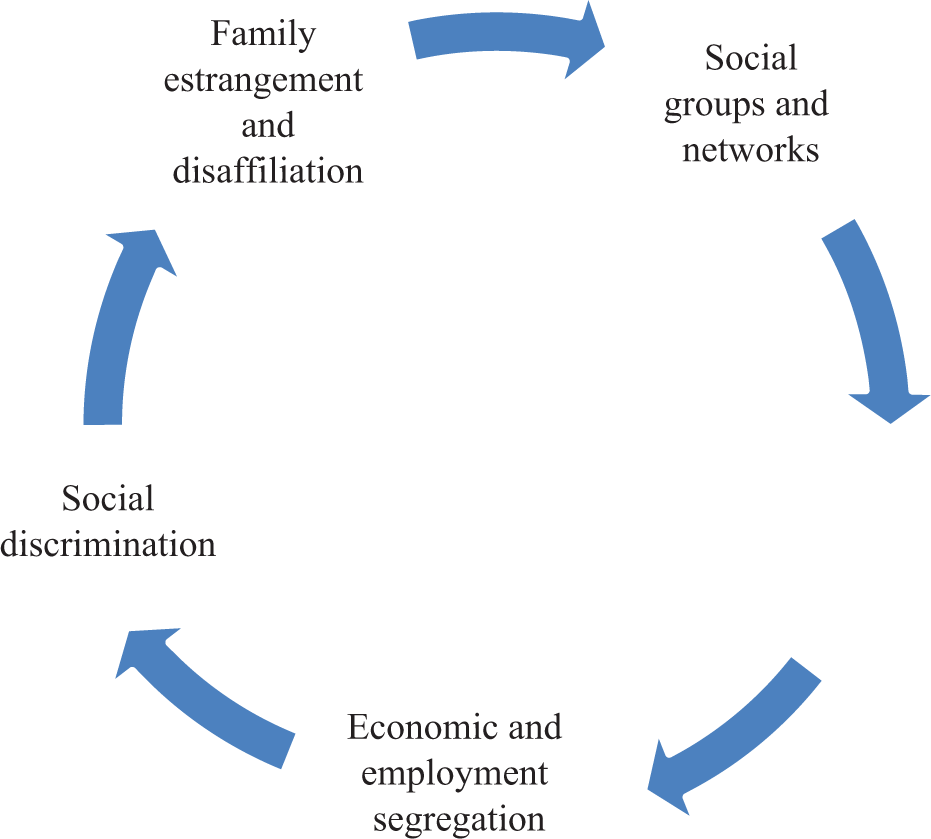
Factors generating social exclusion in transsexual people.
Conclusion
Social exclusion of transsexual people has some specific characteristics. It is articulated within a structural and regulatory framework in which the social intersubjectivity and the construction of the dominant gender in the heterocentric society represent an added element of exclusion. The lack of specific socialization and reference models, and social and familiar disaffiliation, results in a situation of evident social inequality, which hinders the mechanisms to reach the recognition as citizens enjoying equal rights. It is a multidimensional and dynamic process where several social, economic, family, and employment factors and community participation converge. All of this can cause a social disadvantage with regard to the rest of the people who belong to the dominant heterosexual model. These barriers have a social, cultural, and, also, symbolic origin. Transsexual people fight against the social exclusion and inequality. This fight is going to be a long battle, and it is not only a question of legal rights and equality but also a question of equity and human rights (Pattnaik & Mohanty, 2014).
As social exclusion is not only structural but also symbolic, it is a process, which in a long term, can result in social marginalization. Vertical and horizontal segregation, difficulties to get a job, reducing the possibilities of transsexual people to unstable jobs or to prostitution, implies worse social conditions, social discrimination, and hinders their social mobility and to be fully included in the society.
The subjective experiences of the people involved in the study show complex stories, with tensions between the society and the intersubjectivity (Ali, 2014). Those elements represent an argument to criticize the dominant hegemonic model and the policies of social and gender inclusion. The postmodern theory needs to delve into these questions from the perspective of the queer theory, allowing to build the discourses of the difference in an equality position, where there are different regulatory models in which everybody can fill, beyond the binary classification of man and woman.
There are a lot of models of identity, sexual orientation, and differences according to the gender, and each one needs to be approached from their differences and specificities, understanding this diversity as a positive and unifying element in a plural and heterogeneous society. It is necessarily a social and politic empowerment of transsexual people, breaking the traditional heteronormative hegemony of gender, from a perspective that perceives those people as active subjects, as a part of the society, because the intersectorial subordination is a factor of oppression and discrimination. The above mentioned circumstances clearly show the need to review the Western perspective of gender, in the approach to transsexual people, incorporating social, cultural, and ethnic differences from the plurality of approaches and views.
The stigma built around transsexual people is a discrediting feature that establishes some differences regarding what is considered as normal, from the privileged and normalized position of heterosexuality, which stigmatize transsexual people, compared with other social groups. It is an interactive model, evident in policies, social practices, and stereotypes, which involves the invisibility or denial of the transsexual collective and its reduction to a marginal group or to second-class citizens. Moreover, many transsexual people assume this label, which results in their self-exclusion.
There is another additional element of exclusion regarding immigrant transsexual people who stand for a third of the global population. Regulatory development and advances in the last 10 years have not been translated into equal rights and have not had the desired pedagogical effects. As for immigrant people, there is a social and differential construction of the gender and there are also some specific factors of social exclusion that can result in social marginalization with the lack of access to the social resources due to their irregular status. Immigrants and transsexual people suffer a significant social discrimination, unemployment, and the lack of resources and social protection. So, to the exclusion because of their condition of transsexual, we have to add the condition of immigrant, as they belong to a disadvantaged social class.
Footnotes
Declaration of Conflicting Interests
The author(s) declared no potential conflicts of interest with respect to the research, authorship, and/or publication of this article.
Funding
The author(s) received no financial support for the research and/or authorship of this article.