



Abstract
This study includes a survey of 1,077 participants to explore the audiences’ perceptions of news representations about the largest minoritized group in the United States: Latinxs and Hispanics. The findings suggest that news exposure, age, ethnicity, education, and income are significant variables for the public to perceive more positive portrayals of Latinxs/Hispanics. Also, some negative stereotypical interpretations of Latinx/Hispanic news frames continue to be pervasive. The results point to the need for updated theoretical approaches focused on the role of media in the minoritization process of ethnoracial populations.
Keywords
Latinx and Hispanic populations represent the largest minoritized group in the United States, with 61 million individuals—18% of the total population (U.S. Census, 2021), and they have become a substantial political body capable of influencing the electoral landscape nationally and in several states (Acevedo, 2022b; Náñez, 2020; UCLA, 2021). Despite this context, most journalism studies about Latinxs and Hispanics are focused on content analysis, while media effects remain largely understudied for this group. In this sense, this article explores the public’s perception of news media representations about Latinx/Hispanic populations in the United States.
News Media Representations and Perceptions
Previous research has established that the news media influence public opinion, help build the public agenda, and impact social attitudes (Bryant & Oliver, 2009; McCombs, 2004; McCombs & Shaw, 1972; Shoemaker & Reese, 1991). From that perspective, news media representations are relevant elements in the distribution of power (Entman, 2007; Gorham, 1999). In this process of social organization, minoritized populations have been historically underrepresented and misrepresented in the media (Brown et al., 2018; Puente et al., 2022). Also, researchers have systematically found that alienated groups are overrepresented as a threat to society (Cruz, 2022; Dixon & Linz, 2000; Fujioka, 2011; Paul & Sui, 2023) and, as documented by a myriad of studies, there is a long history of media disseminating oversimplified portrayals of ethnic groups (e.g., Dale et al., 2020; Tukachinsky et al., 2017; Zhang, 2010).
Framing theory is a pivotal element of media and communication research, as it explores the elements news media practitioners include and exclude in their stories (Entman et al., 2009; Famulari, 2020). Framing studies are varied and scholars have taken a multitude of approaches throughout the last few decades (de Vreese, 2012; de Vreese & Lecheler, 2012). As an extension of framing theory, researchers have focused on frame-building theory, which is mainly interested in the sources employed by media practitioners to shape news and how those agents influence the job of journalists, the stories, and ultimately their impact on public opinion (Fernandes & De Moya, 2022; O’Neill & O’Connor, 2008; Tewksbury & Scheufele, 2019; Weaver & Elliott, 1985).
An important branch of news research related to media effects is linked to how audiences interpret messages (Tully et al., 2020). As Tsfati and Cohen (2012) note, there are three main concepts/approaches for research on media perceptions: credibility and trust, hostile media perceptions, and third-person perception. The latter has become one of the major frameworks in communications research (Bryant & Miron, 2004), with many studies exploring a bias in which individuals believe that media content influences others more than the self (Davison, 1983; McLaughlin et al., 2022; Tsfati, 2007). In this respect, a quantitative approach to study media effects has demonstrated to add another analytical layer (Riffe et al., 2019). One of the few studies focused on news media effects and Latinos reflects the value of surveys (Suro, 2004). In that study, it was found that Latinxs/Hispanics use English-language media to embed themselves in the general American cultural patterns, while ethnic media serve as a bridge with their ethnic identity.
Media and Minoritized Populations
As part of the media representations of race and ethnicity, researchers have found distinctive patterns associated with narratives focused on alienated populations (Dukes & Gaither, 2017; Larson, 2006; Mastro et al., 2007; Retis & Puente, 2022). Scholars like T. A. Van Dijk (1989) found decades ago that the media have been complicit in systems that—consciously or not—reproduce racist and ethnicist attitudes. This phenomenon has given place to a process of mediated minoritization, a concept that for the purposes of this study is defined as: The media practices that systematically underrepresent and misrepresent populations that in the wider social, political, cultural, and economic context have been historically alienated. In this sense, three main characteristics of the mediated minoritization process are identified: (a) the media operate as crucial tools for public discourses that seek to reinforce and perpetuate a status quo based on historical ethnoracial hierarchies (e.g., Domke et al., 2003; Littlefield, 2008), (b) the oversimplification—stereotyping—of the range and depth of the people who identify as part of racial and/or ethnic minoritized groups (e.g., Dixon, 2019; Ramasubramanian, 2007; Retis, 2019), and (c) the media ignore or downplay the roles of minoritized populations and their needs (e.g., Larson, 2006; Thorbjørnsrud & Figenschou, 2016).
The scholarship documenting elements that support a theoretical approach focused on the mediated minoritization of ethnic and racial groups is robust and stretches across geographies and timeframes (e.g., T. A. Van Dijk, 1989; Vu & Lynn, 2020). In the U.S. context, a study that analyzed 20 years of contemporary news about Latinxs published on the front page of The New York Times found that, even in articles with frames coded as positive, the narratives still racialized this population by reproducing an imaginary separation of this group from the rest of the U.S. society (Estrada et al., 2020).
Mediated minoritization patterns have been found in relation to other racial and ethnic groups as well. When participants were presented with stories that included negative stereotypes about a Black individual who was a victim, audiences were more likely to blame that victim for their own death (Dukes & Gaither, 2017). The impact of mediated minoritization does not only affect the directly involved populations; in some cases, stereotypical perceptions can be transferred to other groups as well. For instance, audiences who were primed with Native American sports mascots tended to increase their stereotyping of other ethnic groups (Kim-Prieto et al., 2010).
Latinx and Hispanic Media Representations
Even though ethnicity has often been linked to nationality and race, ethnicity is a separate and interrelated concept (Spinner-Halev, 1995). Socially constructed notions like ethnicity, nationality, and race do not exist in the natural world, but they do have a significant impact on people (Brown et al., 2018). These concepts have continued to evolve in a globalized environment where political, cultural, and technological lines are blurred (Wiley, 2004). In that sense, ethnic identity can be based on psychological, cultural, or biological traits (Gudykunst & Kim, 1997; Shiramizu, 2000). Thus, the terms Latinx and Hispanic are ethnic identities, and within these groups, there are individuals who simultaneously identify as part of a racial group (e.g., Afrolatinos).
Individuals with Hispanic and/or Latin American descent have been in what is known today as U.S. territory since before this country existed (Molina, 2014), and while European immigrants were dominant until the early 1900s, people from Latin America have become the largest immigrant group in recent decades (Ramirez & De La Cruz, 2003), with Cubans, Dominicans, Guatemalans, Mexicans, and Salvadorans comprising more than one-third of the immigrant population; Mexicans alone represent 24% of all contemporary immigrants, a decrease from 30% since the year 2000 (Ward & Batalova, 2023). In addition, Mexico and the United States share one of the most active borders in the world (Johnson et al., 2009), with ~350 million regular and documented crossings in either direction every year (Mexico Initiatives, 2020). Despite the relevance of the Mexico–U.S. relationship, media representations of Mexicans and Mexican-Americans are understudied (Rendon & Johnson, 2015).
In addition, Latinxs and Hispanics of all backgrounds remain underrepresented across media industries (Acevedo, 2022a), and there is a tendency in media to homogenize populations of Latin American origin/descent and deny them the range of complexity and diversity that is representative of these groups (Gonzalez-Sobrino, 2020; Retis, 2019). Along those lines, Anguiano and Castañeda (2014) have pointed to a systemic exclusion of Latinxs in communication studies and in the higher education system—both for students and professors—which has had a direct impact on the research being disseminated; these scholars have argued that a Critical Race Theory approach from the perspective of Latinas/os has generated a framework that is central for the communication studies field as a whole.
The underrepresentation and misrepresentations of Latinxs have been linked to a lack of understanding of Latinx communities by media practitioners (Puente et al., 2022). This phenomenon is even more evident in the case of Latinas, who, as a group, are even less visible in media representations (Castañeda, 2022). In different periods of the U.S. history, news outlets have underreported violence against Latinxs/Hispanics (Carrigan & Webb, 2013), cultivated stereotypical visions (Mastro et al., 2007; Reny & Manzano, 2016; Vaquera et al., 2022), treated Latinxs as foreigners in their own country (Retis & Puente, 2022), overrepresented them as a threat (Chavez, 2020), and often journalists cover Latinxs with a pre-established mindset that restricts this population to immigration issues (Cruz, 2022).
Also, in local news, Latinxs and Hispanics are underrepresented and more likely to be portrayed using negative stereotypes in comparison to other ethnic groups (Sui & Paul, 2017). Other studies have documented that negative representations of Latinxs/Hispanics by news outlets tend to reinforce threatening perceptions among White and African American individuals (e.g., Fujioka, 2011), while others have found that news media representations of Latinxs/Hispanics have encouraged inter-ethnic conflict with Blacks (Díaz McConnell, 2019; Rodriguez, 2007). Despite this scenario in Latinx/Hispanic media portrayals, Cueva Chacón and Retis (2022) have found an increasing number of digital-native news outlets being created by/for Latinx populations, which points to the continued importance of ethnic representations in the broader media landscape (Deuze, 2006; Johnson, 2000, 2010).
Given that most studies about media representations of Latinxs and Hispanics are focused on content analysis, this research explores some of the effects of news media frames on Latinx/Hispanic populations. Therefore, the following research questions are relevant:
Method
Sample
This research was based on the quantitative analysis of a random sample that included the complete surveys of 1,077 (N) participants. The answers of unfinished surveys (158) were removed from the dataset. The study was conducted in the spring of 2023 at a time when politicians across the United States were officially or unofficially launching their 2024 presidential aspirations (Jones, 2023; Memoli et al., 2023). Similarly to previous election cycles, the political climate at the time of the survey included immigration as a polarizing topic for potential presidential candidates, including in states with high percentages of Latinx and Hispanic populations like in the case of Florida’s governor Ron DeSantis, who grounded his presidential bid on controversial policies, including an anti-immigration bill that was widely discussed in the media at the time of this study (Gamboa, 2023).
In that context, the survey was conducted via Qualtrics’ paid program, which included the sampling of the general U.S. population older than 18 years of age in the contiguous national territory. According to Qualtrics’ procedure, the representative sampling was based on the U.S. adult population, ~238 million as estimated by the U.S. Census (2020), with a confidence level of 95% and a margin of error of 3%. The suggested sample size based on those parameters was 1,067 participants.
Survey
The survey was completed online and it was divided into five steps: (a) research consent, (b) demographics, (c) news consumption patterns, (d) perceptions of news media representations of the entire U.S.-born population, and (e) perceptions of news media representations about Latinxs and Hispanics in the United States.
First, respondents consented to participate in this study and no personal identifiers were recorded. Then, participants were asked questions related to age, education, employment status, sex, marital status, ethnicity, race, and household income. The third step of the survey requested respondents to choose their frequency of news consumption (“How often do you consume the news?”), with the following options available: “never,” “rarely,” “regularly or somewhat regularly,” and “daily or almost daily,” which was a scale with 1 representing no exposure and 4 being the highest level of news consumption. After this, respondents were asked to list up to three news sources (“What news media outlets do you watch, listen, or read more frequently?”). Participants typed in the outlets and not all respondents included three sources.
Later on, participants were asked how frequently they were exposed to news frames that were explicitly presented with a positive or negative valence in relation to the entire U.S.-born population before asking them the same questions but phrased in relation to Latinxs and Hispanics—with the understanding that the majority of Latinx/Hispanic individuals are also part of the entire U.S.-born population. News frames were selected using previous studies that have explored positive and negative news coverage of Latinxs/Hispanics (e.g., Abrajano & Singh, 2009; Díaz McConnell, 2019; Rendon et al., 2019; Reny & Manzano, 2016). While the employed frames are not inherently positive or negative, previous literature has found that specific narratives about Latinxs and Hispanics tend to be connected to representations with a positive, neutral, or negative valence. For instance, researchers have found that society—with the help of the media—has created an urgency for Latinxs/Hispanics to assimilate into the mainstream American culture (Burdick-Will & Gómez, 2006), which in turn has produced varying acculturation stressors among these communities (e.g., Cervantes et al., 2019; Ju Shin et al., 2023). In this part of the survey, respondents had the option to select the following frequencies related to their perception of positive/negative representations about the entire U.S.-born and Latinx/Hispanic populations: “never,” “sometimes,” “about half the time,” “most of the time,” and “all the time,” which was a scale with 1 meaning no perception of news related to the frames and 5 representing pervasive perception of the frames. See Appendix for the complete list of news frames.
Results
News Media Sources
For participants in this study, traditional legacy news media companies continued to be dominant sources of information. There were no ethnic media organizations with significant presence. Among all respondents, a total of 698 unique national, local, and digital media companies were recorded as regular sources, with some participants listing social media networks as their primary outlets to get news. The sources referenced more than 15 times were: CNN (468), Fox News (431), NBC News (259), ABC News (255), CBS News (187), MSNBC (123), The New York Times (54), Facebook (53), BBC (52), Newsmax (49), Washington Post (48), NPR (38), Yahoo! News (32), YouTube (26), Twitter/X (25), The Wall Street Journal (19), PBS (16), and USA Today (15).
Media Exposure
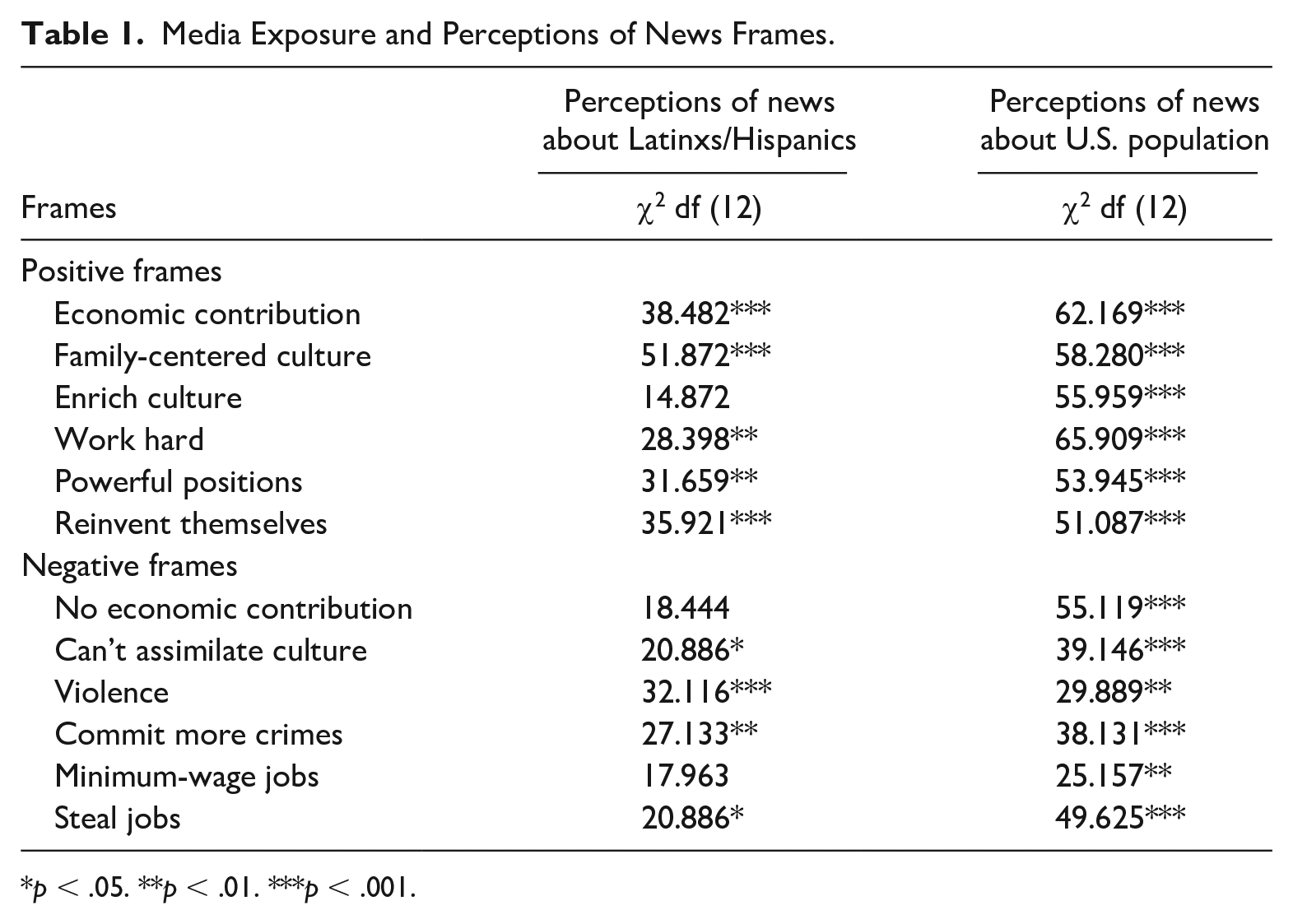
The first research question (RQ1) was interested in the relationship between news exposure and perceptions of positive/negative frames of Latinx/Hispanic populations in the United States. A total of 410 participants identified that they consumed news daily or almost daily, 388 were regular or somewhat regular news consumers, 220 were rarely exposed to news, and 56 participants were never exposed to news content. The data showed that people who reported to consume news more frequently perceived more of the positive frames about Latinxs in comparison to individuals who were less exposed to news—for example, “Latinxs and Hispanics contribute economically to the country” (χ2[12] = 38.482, p < .001). In contrast, respondents who were less exposed to media perceived more of the negative representations of Latinxs/Hispanics—for example, “Latinxs and Hispanics are violent” (χ2[12] = 32.116, p = .001).
For comparative purposes, participants with higher levels of news exposure significantly noticed all positive frames included in this study in relation to the entire U.S.-born population—for example, “U.S.-born citizens contribute economically to the country” (χ2[12] = 62.169, p < .001). Also, different levels of media exposure produced significant differences in the perception of all negative news frames—for example, “U.S.-born citizens cannot assimilate a new culture” (χ2[12] = 39.246, p < .001). But in this case the analysis suggests that participants who were less exposed to news had higher perceptions of the negative frames; see Table 1.
Media Exposure and Perceptions of News Frames.
p < .05. **p < .01. ***p < .001.
Demographic Factors
Audience Age
The second research question (RQ2) was focused on how demographic characteristics impact the audiences’ perception of positive/negative news media representations about Latinxs and Hispanics. In terms of the age of respondents, the sample distribution was: 18 to 24 years old, 150 participants; 25 to 34 years old, 233; 35 to 44 years old, 228; 45 to 54 years old, 123; 55 to 64 years old, 147; +65 years old, 193. Differing levels of news exposure yielded significant differences among age groups (χ2[15] = 138.103, p < .001). The data showed that the younger group (18–24 years old) consumed significantly less news content, while the older group (+65 years old) was much more exposed to news stories.
Participants older than 55 years in general perceived less positive news stories about Latinxs and Hispanics than the rest. Also, perceptions of all negative news frames about Latinxs/Hispanics were significantly different, with the group aged +65 reporting that their exposure to negative news stories about Latinxs/Hispanics was significantly lower—for example, “Latinxs and Hispanics don’t contribute economically to the country” (χ2[20] = 81.045, p < .001).
In comparison to the news representations of the entire U.S.-born population, younger participants from 18 to 24 years old were less exposed to the narrative that this population has enriched culture in general (χ2[20] = 35.966, p = .01). In addition, all negative frames about the entire U.S.-born population resulted in statistically significant differences—for example, “U.S.-born citizens don’t contribute economically to the country” (χ2[20] = 84.562, p < .001). The data analysis suggested that, in comparison to the three older groups (+45 years old), the three younger groups (ages 18–44) were more likely to agree that news outlets convey negative frames related to the entire U.S.-born population.
Education and Income
Another area of interest was about education and income linked to public perception of news about Latinxs/Hispanics. The sample distribution in education was: Less than high school diploma (21), high school graduate—including GED (172), some college but no degree (222), 2-year associate degree in college (103), 4-year bachelor’s degree in college (316), master’s degree (179), and Ph.D. (31). In this respect, higher levels of education produced more frequent exposure to news (χ2[18] = 77.491, p < .001). In terms of income, the number of participants who reported a yearly household income before taxes of $39,999 or less was 271, then 275 respondents between $40,000 and $79,999, 345 individuals between $80,000 and $149,999, and 183 participants with annual household earnings of +$150,000. There was a significant difference in terms of income and level of news consumption as well (χ2[9] = 55.704, p < .001). The analysis showed that less income was a strong indicator of less news consumption.
All education groups agreed that the news media regularly convey that “Latinxs and Hispanics work hard.” For all the other positive news frames, people with master's and Ph.D. degrees were more likely to notice those narratives, while at the same time those with a Ph.D. also reported to significantly notice more news linked to the negative frame: “Latinxs and Hispanics cannot assimilate a new culture” (χ2[24] = 63.550, p < .001).
In contrast, respondents who didn’t finish high school were more likely to perceive that the news media constantly disseminate the following positive news representations: “U.S.-born citizens have enriched culture in general” (χ2[24] = 44.806, p = .006); and “U.S.-born citizens work hard” (χ2[24] = 42.008, p = .01). In addition, participants with a Ph.D. were more likely to notice the frame “U.S.-born citizens are employed in powerful positions” (χ2[24] = 46.662, p = .004). All negative frames produced significant differences, with respondents in the two highest levels of education more likely to perceive negative news about the entire U.S.-born population—for example, “U.S.-born citizens steal jobs that belong to other people” (χ2[24] = 60.332, p < .001).
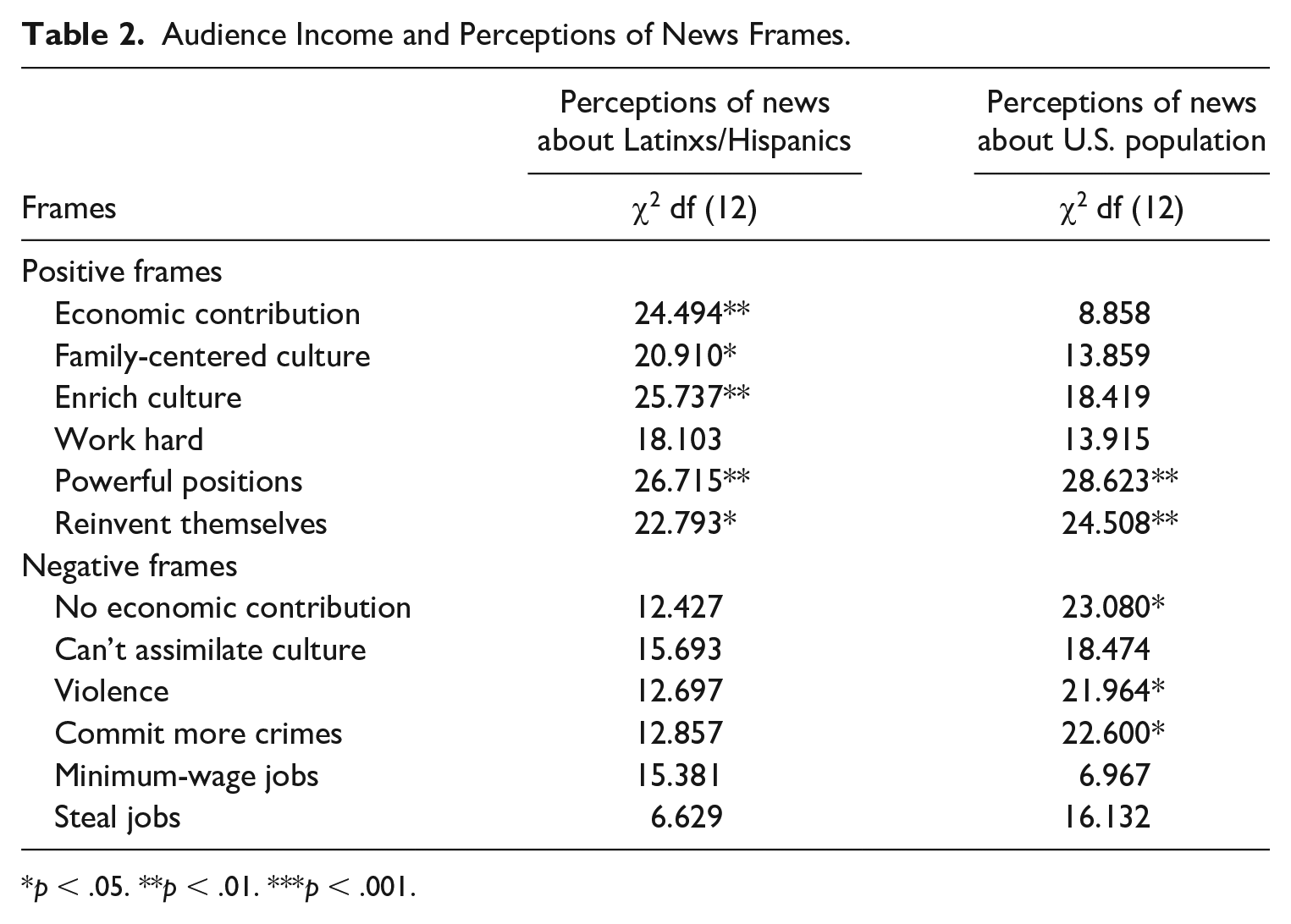
In relation to income, almost all positive news representations about Latinxs and Hispanics had statistically significant differences. The data showed a clear tendency of participants earning more than $80,000 per year to report higher exposure to positive news stories about Latinxs/Hispanics, whereas all income levels had similar perceptions of all the negative news media portrayals about the same populations.
For comparative purposes, in the questions related to the entire U.S.-born population there were significant differences in two positive frames: “U.S.-born citizens are employed in powerful positions” (χ2[12] = 28.623, p = .004); and “U.S.-born citizens reinvent themselves” (χ2[12] = 24.508, p = .01). The analysis suggests that participants who reported yearly household earnings higher than $150,000 were significantly more likely to come across those narratives. Income level yielded significant differences in half of the negative frames about the entire U.S.-born population—for example, “U.S.-born citizens don’t contribute economically to the country” (χ2[12] = 23.080, p = .02); higher income was an indicator for respondents to notice the negative coverage, as well. See Table 2.
Audience Income and Perceptions of News Frames.
p < .05. **p < .01. ***p < .001.
Audience Work Status
The audience analysis was also focused on the possibility of work status impacting news media perceptions of Latinxs and Hispanics. In this respect, there were 698 participants who were working either full- or part-time at the time of this study, whereas 378 were not working for any reason. Respondents with active work didn’t report more frequent exposure to news content than people who were not working. The analysis showed that, except in the case of the news frames “Latinxs and Hispanics have a family-centered culture,” all other positive news representations had significant differences, with employed participants perceiving more positive news about Latinxs/Hispanics. Along those lines, respondents who self-reported to be employed were also more likely to perceive all negative news frames about Latinxs and Hispanics—for example, “Latinxs and Hispanics commit crimes at higher rates than other populations” (χ2[4] = 22.011, p < .001).
For comparative purposes, except for the frame “U.S.-born citizens work hard,” perception of all other positive representations were significantly different. In all cases, people with employment at the time of the survey were more likely to perceive those portrayals. As for the negative representations, all news frames yielded significant differences—for example, “U.S.-born citizens are violent” (χ2[4] = 22.970, p < .001). In all cases, unemployed participants were less likely to notice those negative news frames.
News Perceptions and Sex
In terms of the relationship between the sex of the respondents and perceptions of positive/negative news coverage of Latinxs and Hispanics, 538 participants in this study described their sex as female and 527 males. The analysis of these variables yielded significant results as well. In most positive news frames included in this study there were significant differences—for example, “Latinxs and Hispanics contribute economically to the country” (χ2[4] = 27.046, p < .001). In all cases, males reported to be more exposed to positive news frames of Latinxs. In addition, males were more likely to perceive this news frame presented with a negative valence: “Latinxs and Hispanics cannot assimilate a new culture” (χ2[4] = 12.172, p = .01). For all other negative frames, both female and male participants had similar perceptions.
In comparison to news coverage of the entire U.S.-born population, males were more likely to report a higher perception of all positive news representations than female participants. Whereas all negative frames—except for “U.S.-born citizens are employed in minimum-wage jobs”—produced significant differences, again with males reporting more prevalence of negative news about the entire U.S.-born population.
Marital Status
In the exploration of how marital status relates to perceptions of positive/negative frames about Latinxs and Hispanics, the sample distribution was: married, 586 participants; never married, 323; divorced, 99; separated, 18; and widowed, 50. Exposure to news varied significantly between groups of marital status (χ2[12] = 51.359, p < .001), with the data suggesting that married and widowed participants reported more frequent news consumption. In addition, there were significant differences in the positive news frame “Latinxs and Hispanics contribute economically to the country” (χ2[16] = 32.600, p = .008), with divorced participants less likely to be exposed to that frame. In addition, most negative news portrayals—except for “Latinxs and Hispanics are violent” and “Latinxs and Hispanics are employed in minimum-wage jobs”—produced significant differences. The analysis suggests that in general married and never married participants tended to perceive more negative news coverage of Latinxs and Hispanics.
In contrast, participants who had never been married, were divorced or separated, were less likely to notice several of the positive frames about the entire U.S.-born population—for example, “U.S.-born citizens are employed in powerful positions” (χ2[16] = 30.925, p = .01). Also, participants who had never been married had higher perceptions of negative frames—for example, “U.S.-born citizens commit crimes at higher rates than other populations” (χ2[16] = 31.420, p = .01).
Racialization and Ethnicity
Finally, research question three (RQ3) focused on how racialization and ethnicity might impact perceptions of positive/negative news frames of Latinxs/Hispanics. Eight hundred sixty-two respondents self-identified as White and 208 reported being part of a racialized group (Black or African American, 95; Asian, 55; two or more races, 26; Native American or Alaska Native, 12; Native Hawaiian or Pacific Islander, 7; and other, 17). Respondents of racialized populations and White participants had similar perceptions about positive and negative news frames of Latinxs and Hispanics. Racialized and White populations differed significantly in their news consumption patterns (χ2[3] = 10.296, p = .01); with self-identified White participants reporting being exposed to news content more frequently than racialized individuals.
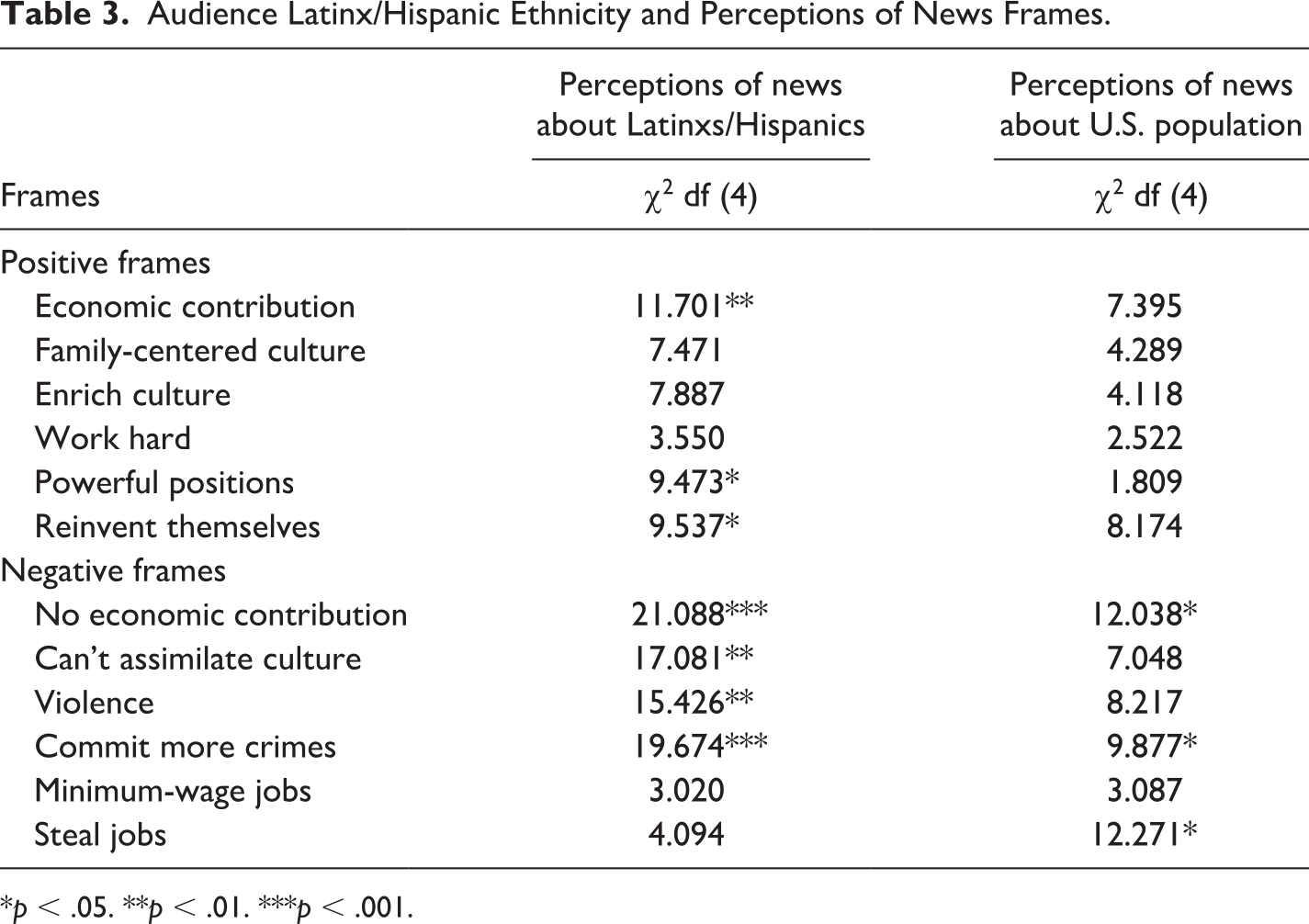
In terms of ethnicity, 97 participants in this study self-identified as Latinx and/or Hispanic. This group reported significantly consuming less news than other respondents (χ2[3] = 8.187, p = .04). At the same time, the results showed that Latinxs and Hispanics perceived higher exposure to half of the positive news frames about their ethnicity—for example, “Latinxs and Hispanics contribute economically to the country” (χ2[4] = 11.701, p = .02). Similarly, Latinxs and Hispanics were more likely to notice the majority of the negative news coverage about their own group. Except for “Latinxs and Hispanics are employed in minimum-wage jobs” and “Latinxs and Hispanics steal jobs that belong to other people,” participants who self-identified as Latinx/Hispanic were more likely to come across all other negative news frames about their own ethnic group.
In contrast, there were no significant differences in how Latinxs/Hispanics and other participants perceived any of the positive news frames about the entire U.S.-born population. Whereas half of the negative frames had significant differences—for example, “U.S.-born citizens steal jobs that belong to other people” (χ2[4] = 12.271, p = .01)—with Latinx/Hispanic participants perceiving more of these frames. See Table 3.
Audience Latinx/Hispanic Ethnicity and Perceptions of News Frames.
p < .05. **p < .01. ***p < .001.
Discussion
In the analysis of the answers from 1,077 participants, there were pervasive significant differences in the audiences’ perception of the news media representations about Latinxs and Hispanics in the United States. Throughout the study, the results consistently showed that specific personal traits and news exposure patterns can be strong indicators of how individuals perceive news representations of Latinxs/Hispanics.
“The Usual Suspects”: Hegemonic News Sources
In this research, legacy national news outlets continued to be influential sources of information, with CNN and Fox News—in any format—being frequently referenced as one of the top three sources of information for respondents. This is aligned with publicly available data stating that, despite losing some terrain, TV-based news outlets continue to be major sources of information (Pew Research Center, 2019; Saad, 2013) and that news corporations have concentrated power and created news deserts (Abernathy, 2018). In addition, the changing media landscape (Pew Research Center, 2011) was also noticeable, and some digital media platforms—that is, Facebook, Yahoo! News, YouTube, and Twitter (which later on was in the process of being rebranded as “X”)—were also highlighted by participants as recurrent news sources. Interestingly, NPR and PBS were relevant outliers, as they were the only nonprofit media organizations that were cited more than 15 times as frequent sources of information, which is linked to the notion that some news consumers associate not-for-profit content with credible journalism (Shen et al., 2019).
Also, the findings suggest that more frequent exposure to news content allowed people to have higher perceptions of positive frames about Latinxs/Hispanics and, in contrast, lower levels of news consumption produced higher perceptions of negative coverage of these groups, which suggests that lower levels of media consumption don’t necessarily produce lower engagement with news about Latinxs and Hispanics. Interestingly, while audiences who consume more news had higher perceptions of all the positive news frames about the entire U.S.-born population, this same group didn’t yield higher perceptions of all positive representations about Latinxs/Hispanics. These results support previous findings that have found a different media treatment associated with Latinxs and Hispanics (Díaz McConnell, 2019; Reny & Manzano, 2016).
Audience Perceptions of Latinxs/Hispanics
The results suggest that some enduring stereotypical visions continue to be pervasive across audiences, a phenomenon that can operate in two ways: the news media continue to convey a distorted image of Latinxs/Hispanics that doesn’t capture the range and depth of these communities (Acevedo, 2022a; Cruz, 2022), and that some of those stereotypical constructs have been cultivated in the American public to the extent that audiences regularly employ them as main points of reference (Fujioka, 2011; Mastro et al., 2007).
Enduring Stereotypical Constructs
A relevant finding in this research was related to how news perceptions of Latinxs and Hispanics can be impacted by a generational chasm (Acevedo, 2022b). In this study, there was extensive evidence that participants who were older than 55 years were less likely to perceive that news outlets disseminate a negative coverage of Latinxs/Hispanics, with an even stronger pattern for respondents older than 65 years of age. This finding contributes to previous research citing generational discrepancies that lead to dissimilar political and ideological interpretations of news stories (Andersen et al., 2021). Along those lines, younger participants in this study reported to be significantly less exposed to news content and noticed more of the negative news frames about Latinxs and Hispanics. These disparities underline that, in the case of Latinx/Hispanic news representations, some sociocultural attributes can directly impact the propensity to notice and acknowledge some news frames more than others (Martins et al., 2022). Thus, some news frames related to Latinx and Hispanic populations were more salient in the eyes of younger audiences, even if the exposure to news content was not recurrent. In this sense, given that the new media outlets being created by/for Latinx and Hispanic populations are based on digital platforms (Cueva Chacón & Retis, 2022), the generational chasm found in this study emphasizes the possibility that the digital divide can widen even more (J. Van Dijk, 2020).
From an intersectional perspective (Byerly et al., 2023), other important opposing patterns were found in relation to one positive and one negative representation. The positive news frame “Latinxs and Hispanics are employed in powerful positions” yielded lower perceptions, whereas the frame presented with a negative valence “Latinxs and Hispanics are employed in minimum-wage jobs” had higher perception rates across all variables: media exposure, ethnicity, race, income, age, sex, marital and work status. In all cases, audiences were more likely to perceive that these were the least (Latinxs/Hispanics in power) and most (Latinxs/Hispanics as low-wage workers) salient news representations about Latinxs/Hispanics. This was not the case when comparing those same frames to the audiences’ perceptions about the entire U.S.-born population.
These findings suggest that, while portrayals of Latinxs and Hispanics in positions of power continue to be underrepresented, the framing of Latinxs/Hispanics as an underclass remains ubiquitous in news content interpretation. Thus, some representations of Latinxs/Hispanics continue to be perceived by audiences in terms of stereotypical understandings that have long permeated narratives across genres (Chavez, 2020; Domínguez Partida, 2022; Guzmán, 2006). From a wider social perspective, this might be a signal that these sort of stereotypical constructs about Latinxs/Hispanics have taken deep roots in the collective imaginary (Taylor, 2004). As other studies have found, stereotypes tied to news frames have a significant impact on ethnic populations (Brown et al., 2018; Ramasubramanian, 2015; Rendon et al., 2019) and, as a possible solution, the inclusion of opposing frames (counterstereotypes) in media content has been suggested as a practice to support audiences in recognizing prejudices and biases that have been normalized by society (Ramasubramanian, 2007).
“It’s the Economy” News Interpretation
This study provided evidence that news perceptions about Latinxs and Hispanics can be influenced by the audiences’ economic circumstances, as well. In this respect, the analysis suggests that, the higher the household income, the more likely for audiences to notice positive news about Latinxs/Hispanics, while at the same time, a better financial situation wasn’t a relevant factor to significantly perceive more negative news coverage. A detailed analysis showed that living in households earning more than $80,000 per year was a relevant threshold for higher perceptions of positive news frames about Latinxs and Hispanics.
Education and work status were other socioeconomic variables that had an impact on how audiences interpret news about Latinxs/Hispanics. Higher levels of education allowed people to perceive both positive and negative narratives about these ethnic groups, with a stronger tendency among participants with master and Ph.D. degrees. Also, employed individuals noticed more of the negative news frames “Latinxs and Hispanics are employed in minimum-wage jobs” and “Latinxs and Hispanics steal jobs that belong to other people” in comparison to perceptions of the same representations about the entire U.S.-born population. Other studies have found that a negative economic outlook for the U.S. impacts the news coverage of minoritized populations (e.g., Aguayo, 1998). The findings in this research suggest that individual economic circumstances remain relevant for how audiences interpret news about Latinxs/Hispanics (Sizemore & Milner, 2004) and, in turn, those perceptions can influence public policies that directly impact these populations (McCombs, 2004).
The Ethnoracial Gap
Another important finding in this study was related to an ethnoracial gap that acted in two ways: First, ethnic identification as Latinx and/or Hispanic was a strong variable for participants to perceive more positive and negative news content about their own ethnic group; and second, participants of non-Latinx/Hispanic racialized groups perceived news about Latinxs and Hispanics at rates that were similar to those of self-identified White respondents—which supports previous research stating that the media can influence how the rest of the U.S. society interprets news about Latinxs/Hispanics, regardless of their racial identification (Fujioka, 2011).
While Latinxs and Hispanics noticed most of the negative news frames about them, the analysis showed that the representation “Latinxs and Hispanics are employed in minimum-wage jobs” yielded no significant differences due to non-Latinxs/Hispanics also perceiving higher prevalence of that narrative in the news industry. The latter further expands the literature on the differentiated news-making process in relation to Latinxs and Hispanics (Guzmán, 2006; Rendon et al., 2019) and that Latino-related media content with a stereotypical approach can negatively impact this group’s own perception (Martins et al., 2022; Tukachinsky et al., 2017; Vaquera et al., 2022; Zaman & Das, 2021).
Toward a Theory of Mediated Minoritization
This study contributed with a contemporary understanding of audience perceptions about the largest minoritized group in the United States: Latinxs and Hispanics. Given the relevance of these populations (Náñez, 2020; UCLA, 2021), the enduring media representation patterns about them (Valentino et al., 2013), and rooted in efforts initiated in previous communication research (Anguiano & Castañeda, 2014), the findings in this study support the notion that scholarship focused on Latinxs/Hispanics can serve as a blueprint to explore the practices and effects linked to mediated minoritization processes. In that sense, one of the main arguments that stems from this research is that a branch of media and communication research focused on mediated minoritization can be helpful to explore the broader context in which enduring alienating media practices and misrepresentations continue to be common.
Minorities—as they have been described for decades in scholarly work across fields—are not minorities due to chance or a divine order. Throughout history, governments have developed public policies and campaigns that have restricted the growth, participation, and acceptance of some populations (e.g., Brandt, 1978; Dikötter, 1998), while simultaneously encouraging the growth and engagement of specific racial and ethnic groups (Molina, 2014). In this form of social organization, research has shown that the agency of news media systems in disseminating and perpetuating frames that underrepresent and misrepresent specific groups has been impactful (Tukachinsky et al., 2017), while at the same time reinforce the public belief that some populations belong and some others don’t (Báez, 2018).
As outlined in the literature review, in the case of Latinx/Hispanic populations there is a long history of underrepresentation and misrepresentations in the media, which has led to public mindsets that often follow a long-standing ethnoracial hierarchical structure drawn from understandings that associate these groups with a low-wage underclass (Vargas, 2000), a public threat (Chavez, 2020), and alienation by framing them as foreigners in their own country (Retis & Puente, 2022). In that context, the findings in this study suggest that some of those social constructs continue to be salient among U.S. adult audiences, especially in relation to the prevalence of news media perceptions of Latinxs/Hispanics as low-wage workers and the representational absence of Latinxs/Hispanics in positions of power.
A limitation of this study was that it did not measure the immediate political, geographic, and cultural factors of the participants and it did not address the biases and prejudices that could impact how people build interpretations of minoritized populations and news frames (Entman, 2007). Therefore, a subsequent analysis is needed to explore the possibility of news audiences with specific sociocultural and demographic backgrounds deliberately tuning out positive or negative news frames about Latinxs/Hispanics. Another important potential avenue for future research is related to the analysis of how specific news media formats can impact the mediated minoritization process of racialized groups.
With a population of 61 million individuals (U.S. Census, 2021), the granularity, depth, and range of Latinx and Hispanic communities is vast, but as the results showed, oversimplified media perceptions remain common (Abrajano & Singh, 2009; Estrada et al., 2020; Gutierrez, 1980; Reny & Manzano, 2016). Therefore, in addition to providing guidance to journalists and media practitioners—both current and future—on how to cover Latinx/Hispanic populations (Puente et al., 2022), the findings in this study point to the need for updated theoretical approaches that explore the specific role of media in the minoritization process and the interrelated practices and effects.
Footnotes
Appendix
Declaration of Conflicting Interests
The author declared no potential conflicts of interest with respect to the research, authorship, and/or publication of this article.
Funding
The author received no financial support for the research, authorship, and/or publication of this article.
