



Abstract
The (under)representation of women in the news has received much attention in scholarly research. Using a population dataset of news broadcasts in Belgium, this article describes how gender equality has changed over time (2003–2021) and investigates which factors explain the presence (or absence) of women as speaking actors in the news. The findings reveal a structural underrepresentation of women in the news, but a slow increase in their presence over time. Overall, women are more equally represented in softer news topics or in non-elite roles. Remarkable is that women journalists tend to interview more female sources than their male counterparts.
Keywords
“You can’t be what you can’t see.” This short quote by Marian Wright Edelman is often used to describe the need for more representation in the mass media as it perfectly symbolizes the power of being visible and thus represented in the media. News media often reflect structural inequalities in society, such as gender, amplifying those in powerful positions. The debate about the representation of women in the news has its roots in the second wave of feminism in the 1970s, where it was found that women were not only underrepresented in the news but also represented in stereotypical gender roles (Tuchman, 1978). Although this observation was made 50 years ago, the extent to which women’s voices are included in the news still receives much attention in journalism and academic research (Carter et al., 2019). Even today, women are found to be underrepresented (Baitinger, 2015; De Vuyst et al., 2016); often portrayed as secondary or passive actors in the news (Emeksiz, 2013; Sjøvaag & Pedersen, 2019); presented in stereotypical roles (Armstrong et al., 2012; De Swert & Hooghe, 2010); and excluded from (higher) functions in newsrooms (e.g., Armstrong & Gao, 2011; Fröhlich, 2007; Ross & Padovani, 2019).
These (under)representations of women in the news can have far-reaching consequences. News media are showing a construction of the world, which in turn contributes to gender dynamics in society (D’Heer et al., 2020). The news shapes ideas about who can become, for example, an expert, a politician, or a sportsperson (Haraldsson & Wängnerud, 2019). It is thus important to know how we can explain this underrepresentation of women in the news. In the first place, it might be a reflection of biases and inequalities that already exist in society (Shor et al., 2015). For example, men tend to dominate positions of power in politics and business. Consequently, when journalists cover stories involving these elites and reflect the prevailing social landscape, they inadvertently perpetuate these societal norms. Second, gender biases in news reporting might also be attributed to factors within the media industry itself. Studies on gender diversity in the news have revealed that editorial practices, media routines (such as relying on easily accessible and familiar sources), and gender imbalances in newsrooms contribute to women’s limited access to media platforms compared with men (De Swert & Hooghe, 2010; Ross & Carter, 2011).
However, the rise of women in elite positions in society (Carter et al., 2019) and heightened awareness in newsrooms of these gender disparities might have resulted in an increase of female sources in the news in the past two decades. The number of women in journalistic functions has also been growing over time (Byerly, 2016; Ross & Padovani, 2019; Van Zoonen, 2002; Weaver & Willnat, 2020). Previous research, however, is rather inconclusive as to whether a journalist’s gender also influences who is interviewed for a news story (Armstrong, 2004; Shor et al., 2015). This could be explained by the fact that these studies were seldom systematic analyses; moreover, they were often based on specific time periods such as elections and/or specific actors such as politicians (e.g., Ross et al., 2013). By investigating the relationship between journalists’ gender and the sources they quote more systematically, this study seeks to contribute to our understanding of how gender dynamics operate within the journalistic profession and their implications for news content.
Using a unique population dataset comprising 19 years of news broadcasts in Flanders, the Dutch-speaking region of Belgium, this article examines the evolution of gender representation over time (2003 to 2021) and investigates which factors explain the presence (or absence) of women in the news. Most importantly, we systematically investigate how the gender of the reporter of a news story influences gender balance in the news. Moreover, we take a broad approach in terms of topics and roles in which women appear in the news. While gender imbalance in the news has been firmly established, up to now, most studies focused on specific types of female voices in the news (such as politicians: Baitinger, 2015; citizens: Beckers, 2017; or experts: Niemi & Pitkänen, 2017), or looked at the overall representation of women. We will take into account different actor categories to study whether different types of actor categories unveil different patterns. Do women still mostly get a chance to speak as ordinary citizens, or is there also progress in their prevalence when appearing in more elite roles such as experts and politicians? And are there systematic imbalances regarding the themes about which they get to speak? In sum, this study provides a unique insight into the representation of gender diversity in speaking actors in television news over time, between broadcasters and issues.
Predicting Gender Diversity in the News
From a normative point of view, media diversity ideals assume that a fair distribution of voices is important to counter structural imbalances in social, economic, and political power in society (Jeffres et al., 2000). The extent to which women are represented in news media sends important messages to audiences about women’s roles in society. If news media consistently fail to represent women in elite functions and portray them mostly as victims or as actors in softer news topics, this might influence audience perceptions about the appropriate gender roles (Ross & Byerly, 2008). Moreover, who is invited to speak in the news affects who is regarded as a legitimate source to speak on a topic by audiences (Kim & Weaver, 2003). The quantity and salience of media coverage may even matter more than the actual content of the coverage, as media visibility—whether positive or negative—may serve as a signal for what and who society deems important (Andrews & Caren, 2010). By not representing women in the news, this “symbolic annihilation” (Tuchman, 1978) could play a significant role in maintaining the gendered (im)balance of power in society. Several factors are expected to predict whether women will get the chance to speak in the news.
Time
In the past few decades, we have seen an increase in women in elite functions in society in countries all over the world (Carter et al., 2019). Despite this progress, women are still underrepresented in the most powerful societal positions (Shor et al., 2015). It can be expected that these biases are reflected in the sources that are interviewed in the news and that the representation in the news follows the increase in the representation of women in society. However, scholars argue that the differential media coverage of women and men is not merely a reflection of existing gender inequalities in economic participation, but on top of that, media practices exacerbate and intensify this underrepresentation (De Swert and Hooghe, 2010; Zoch & Turk, 1998). The 24-hour news deadlines and intensifying speed with which journalists are faced often means that journalists seek out “the usual suspects” in their news coverage, individuals in key strategic positions, with whom they are already familiar and to whom they have easy access (Berkowitz, 2009; Carlson, 2009). Most of the attention focuses on a small number of individuals, and by mostly seeking out the same sources instead of diversifying, the status quo is reinforced. However, over the years, there has been an increased awareness of systematic inequalities in news access, and several editorial guidelines focus on diversity. Although this increasing awareness might have a delayed impact on actual news content, we do expect that the situation has improved over time.
Indeed, there are empirical indications that there is an increase in female news sources. Two large studies in particular are worth mentioning. Based on an impressive longitudinal dataset and computational name recognition, Shor and colleagues (2015) found that the share of female names in U.S. print news increased between 1880 and 2008. Between 1890 and 1960 about 15% of the total number of mentions in the New York Times were female subjects, but after the 1960s, this share grew slowly but consistently up to around 25% of all coverage in 2005. Another, more comparative endeavor studies gender diversity in the news based on a single “global monitoring day” of online and offline news media in 116 countries, known as the Global Media Monitoring Project (GMMP). They find that the representation of female news sources (TV, radio, and newspapers) across the globe has increased from around 17% in 1995 to about 25% in 2020. Again, despite this positive trend, women remain heavily underrepresented, by making up one out of four news sources on average (Global Media Monitoring Project, 2020). However, these longitudinal data are based on limited samples of one day of news making it difficult to generalize the data, as the results could be influenced by various factors such as specific news events occurring on that particular day.
Based on previous research we expect that overall, women are underrepresented as speaking sources in the news, but we do expect that the share of female speaking actors in the Flemish television news will have increased in the period between 2003 and 2020.
Gender of the Journalist
In recent years, we have also seen a rise of women in journalistic functions in particular (Ross & Padovani, 2019; Van Zoonen, 2002). Byerly’s (2016) global assessment of the status of women in the news media finds that women have increased their participation in newsrooms, although they remain underrepresented in most editorial positions (Adams et al., 2022). It must be noted that these rising numbers of women journalists are not found in all country contexts and that women sometimes were found to exit the profession at comparatively higher intervals than their male colleagues (Guo & Fang, 2023; Powers, 2022). There are only a few countries where there are more female than male journalists (e.g., in Estonia and Russia). Nevertheless, in most countries, the situation has improved over time (Byerly, 2016; Weaver & Willnat, 2020). In Belgium, however, journalist surveys indicate that the number of female journalists did not increase between 2003 and 2018. By 2018, still less than one out of three journalists were women (Raeymaeckers et al., 2012; Van Leuven et al., 2019).
Although socialization in the newsroom is strong, multiple reasons in the literature suggest that the presence of women in the newsroom could influence the selection of sources. First, it might be related to a stronger awareness of (gender) inequalities among women. While reporters might have become more aware of the imbalance in male and female representations, it can be expected that female journalists are even more conscious about it than male reporters, and therefore, more prone to select women as sources (Armstrong, 2004; Niemi & Pitkänen, 2017; Yeboah, 2011; Zoch & Turk, 1998). Second, female journalists might have more access to female sources, who are more often part of their network (Armstrong, 2004; Berkowitz, 2009). In particular, under time pressure, journalists rely heavily on their personal network of sources when making news stories. It is likely that these personal networks, as with social networks in general (McPherson et al., 2001), are characterized by gender similarity.
Moreover, shared experiences can foster increased trust between journalists and their sources (Barnoy & Reich, 2022; Dansker et al., 1980). Women might experience a greater sense of comfort and confidence when expressing their opinions or sharing their experiences with individuals who can empathize with their gender-specific challenges and belong to the same interpretive community (Berkowitz, 2009).
In the United States, Armstrong (2004) found that the presence of a woman journalist had a positive effect on the proportion of female mentions in a news article. The Global Media Monitoring Project (2020) also established this connection between the gender of the journalist and the sources they cover: In 2020, 31% of the people in traditional news covered by women reporters were female, in contrast to 24% of subjects and sources in stories by men reporters. Several other studies found similar results in different contexts (Rodgers & Thorson, 2003; Sutcliffe et al., 2005; Zoch & Turk, 1998). Although the abovementioned studies found clear differences between female and male reporters with regard to the selection of news sources, many other studies did not find evidence for such a straightforward relation between the gender of the journalist or editor and the news production process (e.g., (Freedman et al., 2007; Ross, 2007; Shor et al., 2015). However, most studies were based on samples and sometimes focused on specific news topics, which could influence source selection. Based on our theoretical consideration of increased awareness and access, we hypothesize that the probability that a source is a woman increases when the journalist is also a woman.
Media Type
Gender diversity might also be contingent on the goal of a news medium, such as either fulfilling public service versus a more commercial role. Specifically for public service broadcasters, diversity policies and guidelines are generally being adopted and imposed by the government requiring them to provide a balanced picture of the entire population (Cushion, 2012; Padovani, 2020). Also in Belgium, specific guidelines and regulations exist regarding gender diversity on screen. The Flemish public service broadcaster specifically addresses the roles and topics in which women appear as actors in the news: A woman can fulfill different roles. Women often come into the news as a vox pop, and less as experts or studio guests. We see more women speaking about upbringing, nutrition, cosmetics, . . . Invite women as experts on all subjects (VRT, 2021b).
The management contract between the public service broadcaster and the Flemish community puts forward an increasing target of women that have to be depicted in their imaging on-screen from 40% in 2020 to 48% in 2025 (in 2016 the target was 33% women) (VRT, 2021a). These targets apply to all content, but we expect them to be reflected in news coverage to some degree.
Commercial broadcasters may have more leeway and are less bound to follow legal requirements of diversity (Cushion, 2012); however, some studies found that commercial broadcasters actually scored better regarding gender balance in their news coverage than their public service counterparts (De Swert & Hooghe, 2010; Sjøvaag & Pedersen, 2019; Stout & Stevens, 2000). Although these findings seem counterintuitive, given the stricter guidelines regarding diversity on the public service broadcaster, it might be partly explained by the type of sources (e.g., citizens) and topics (more soft news) that are generally found to be more prevalent on the commercial broadcaster (Beckers & Van Aelst, 2018; Sjøvaag & Pedersen, 2019). Given these contradictory empirical findings, we propose a research question rather than a hypothesis:
Topics and Roles
Extant research found that news often follows specific stereotypes by representing women in stereotypical gender roles. Gender roles are socially shared expectations of which attributes men and women have and how they should behave (Eagly & Karau, 2002). Women are seen as communal, which means that they are perceived as sensitive, nurturant, and warm. While society ascribes more agentic traits to men: being intelligent, competent, and assertive. These roles are also reflected in policy issues: whereas men are perceived as more capable of “masculine issues” such as foreign policy, women are associated with feminine issues such as “health care” (Van der Pas & Aaldering, 2020).
Not only can we see these stereotypes in how sources are portrayed, but they are also still visible in the allocation of tasks to journalists. In a survey of female journalists in Australia, North (2016) found that while women appear to be covering hard news topics like politics and business, the majority are still assigned to cover the bulk of the soft news areas of faits-divers, culture, education, and health—and most perceive that female reporters remain branded into those traditionally “female” story areas. Hard news stories are generally considered to be at the top of the news hierarchy and are viewed as important work typically conducted by men (Poindexter & Harp, 2008). A news item’s topic is expected to be linked to the gender diversity of its content. Some topics have been found as traditionally associated with women: Examples are consumer news, health or family matters, education, culture, or social policy (Craft & Wanta, 2004; Van Zoonen, 1995). Female journalists are often assigned to one of these topics and women have a higher chance to appear in the news as a source here (De Vuyst et al., 2016; Hooghe et al., 2015; Meeks & Domke, 2016). In their study of media coverage of presidential candidates in the United States, Chang and colleagues (2023) found that the primary factors influencing media coverage were the campaign topics and the agenda set by the incumbent candidate, rather than the gender of the politicians. It is worth noting, however, that female candidates were often associated with these “softer” topics. Overall, it can be concluded that women seem to be covered more in typical “soft” news topics (cfr. Reinemann et al., 2012), whereas they have much less chance to appear in hard news topics such as politics and economy (Global Media Monitoring Project, 2020; Sjøvaag & Pedersen, 2019; Vandenberghe et al., 2015). Based on these previous studies, we thus expect that news topic will be a predictor of the presence of women as speaking actors in the news.
In the first 1995 study of the Global Media Monitoring Project, it was found that the most popular roles women occupied in the news were in the capacity of victims, mothers, and wives (Media Watch, 1995). In a more recent study, Sjøvaag and Pedersen (2019) investigated in what capacity female voices were featured in the Norwegian news media. They found that the only source function where women were represented better than men is when women appeared in the news as children or as friends or family of other sources. In elite roles such as experts, businesspeople, and politicians, women systematically appeared less frequently. The Global Media Monitoring Project (2020) found that women in 2020 are underrepresented in many elite roles, and score better in less active roles such as eyewitnesses or vox pops (“people on the street”). The occupational roles in which women are represented most are as homemakers (68% women), health, child care and social workers (47%), non-management office workers (42%), or members of civil society organizations (37%). Following this empirical evidence, our last hypothesis states that actor role is a significant predictor of the presence of female-speaking actors in the news. However, we do expect that the situation has improved over time because of two reasons. First of all, there is more awareness, and editorial guidelines explicitly urge journalists to also interview women in elite roles (See, for instance: VRT, 2021b). Second, in the last decades, there is still a slow, but positive trend in the number of women that take elite positions, such as politicians (IPU, 2023) or experts (Clavero & Galligan, 2021).
Method
To study the presence of women as speaking actors in the news, we use a unique population dataset containing all television news items from the main commercial and public service broadcaster in Flanders (the Northern, Dutch-speaking part of Belgium) from the period 2003-2020. By using data over a period of 19 years, we are able to identify systematic patterns and changes over time. This study is based on the “Electronic News Archive,” 1 an archive containing all 7 pm news broadcasts from the two main Flemish broadcasters (public broadcast channel VRT and commercial channel VTM). The dataset is based on 244,066 news items from the 19-year period. Entire newscasts are archived and coded on a daily basis, and information about the issues and actors involved in the news items are coded and stored together with the footage.
The Flemish media system consists of a strong public service broadcaster and only one main commercial broadcaster with a daily newscast. These two evening news broadcasts are similar in scope and content and compete for audience share. The public service broadcaster has specific targets about gender representation across all content (not only news content; VRT, 2021a), while the commercial broadcaster has more leeway regarding their content diversity. In Flanders, many people still rely heavily on mainstream media content to inform themselves and learn about society. Up to now, television is the main source of news for many, and while people increasingly consume news online, the sources they use are often websites and apps of legacy newspapers and broadcasters (Reuters Institute, 2022).
Belgium performs relatively well in terms of gender equality, slightly surpassing the average of other European Union Member States according to the 2022 Gender Equality Index (European Institute for Gender Equality, 2023a) Hence, the Belgian case seems representative for and comparable to many European countries when it comes to the representation of women in society, and we do not expect substantial differences in the representation of women in the news. We find similar patterns when focusing on specific dimensions such as politics, board members, and university personnel. In the federal parliament, women make up 43% of the current representation, ranking Belgium 21st in the global ranking of women in parliaments. The country has implemented a legislated candidate quota to maintain a balanced representation of men and women on candidate lists (International Institute for Democracy and Electoral Assistance, 2023). When examining the board members of the largest listed companies, Belgium sees 39% of women on these boards, surpassing the European Union (EU) average of 33% (European Institute for Gender Equality, 2023b). However, there is still work to be done, especially in the field of information and communication technologies, where women constitute only 11% of doctoral graduates compared with 89% of men (European Institute for Gender Equality, 2023b) In all, Belgium scores somewhat in the middle ground compared with other EU member states in terms of gender representation in society.
All news items were coded, except for the separate sports section which could be identified from a switch to the sports anchor, and the weather forecasts. For each news item, the journalist was coded when the name was shown on-screen or mentioned explicitly in the news report. Of the 742,713 observations, 209,104 did not mention a journalist’s name (28.15%). There were no systematic biases in the presence or absence of journalist names based on broadcaster (44.0% on VRT and 56.0% on VTM) or over time. Based on a Google search, we were able to identify the gender of most journalists (0.03% missing). Every news item could be categorized into up to three topic codes which could be selected from a list of 37 themes. In our analyses, we use a sample containing only items (n = 61,914) about the five most popular news topics: justice and crime (13.8% of news items), politics (10.2%), economy (9.9), culture (7.2), and social affairs (5.9%). 2
In those news items, all speaking actors were identified, resulting in a total of 284,952 actors that are analyzed in this study. For every actor, the name and function description were coded. The function description was either the literal function description as it appeared on screen, or it was selected from a list of function descriptions. The functions were then recoded into four aggregate categories (governmental and political sources, professionals and experts, civil society organizations, and citizens) and 10 more detailed actor categories, based on the actor classification put forward by Beckers and Van Aelst (2018).
Our main variable of interest is the gender of the actors. For every actor, we coded the gender based on visual characteristics or identifying information (such as names or function descriptions such as “mother”) in the news item. Next, we created an actor dummy for female-speaking actors (woman = 1). The main dependent variable in our analyses is the presence of a female source in a news item. We are aware that our binary approach is an oversimplification of reality and that there are multiple gender identities. However, because of the aggregate level of our analysis and the fact that the gender of a news actor is hardly ever explicitly specified, we opted for the dummy variable, focusing only on the presence or absence of female-speaking actors. Summary statistics of our dependent and independent variables are presented in Supplemental Table A1 in the Online Supplementary Materials.
The newscasts were coded by on average 12 active coders who watched the newscasts in detail and filled in a standardized coding form. The coders were trained individually and were monitored throughout the process. Krippendorff’s α reached satisfactory values for the actor categories (αPolitical actors= .98; αExperts and professionals= .94; αCivil society organizations = .96; αCitizens = .79). The news issue codes were also reliable with inter-coder reliability scores between α = .68 and α = .90 (for a more extensive overview, see De Smedt et al., 2013).
Results
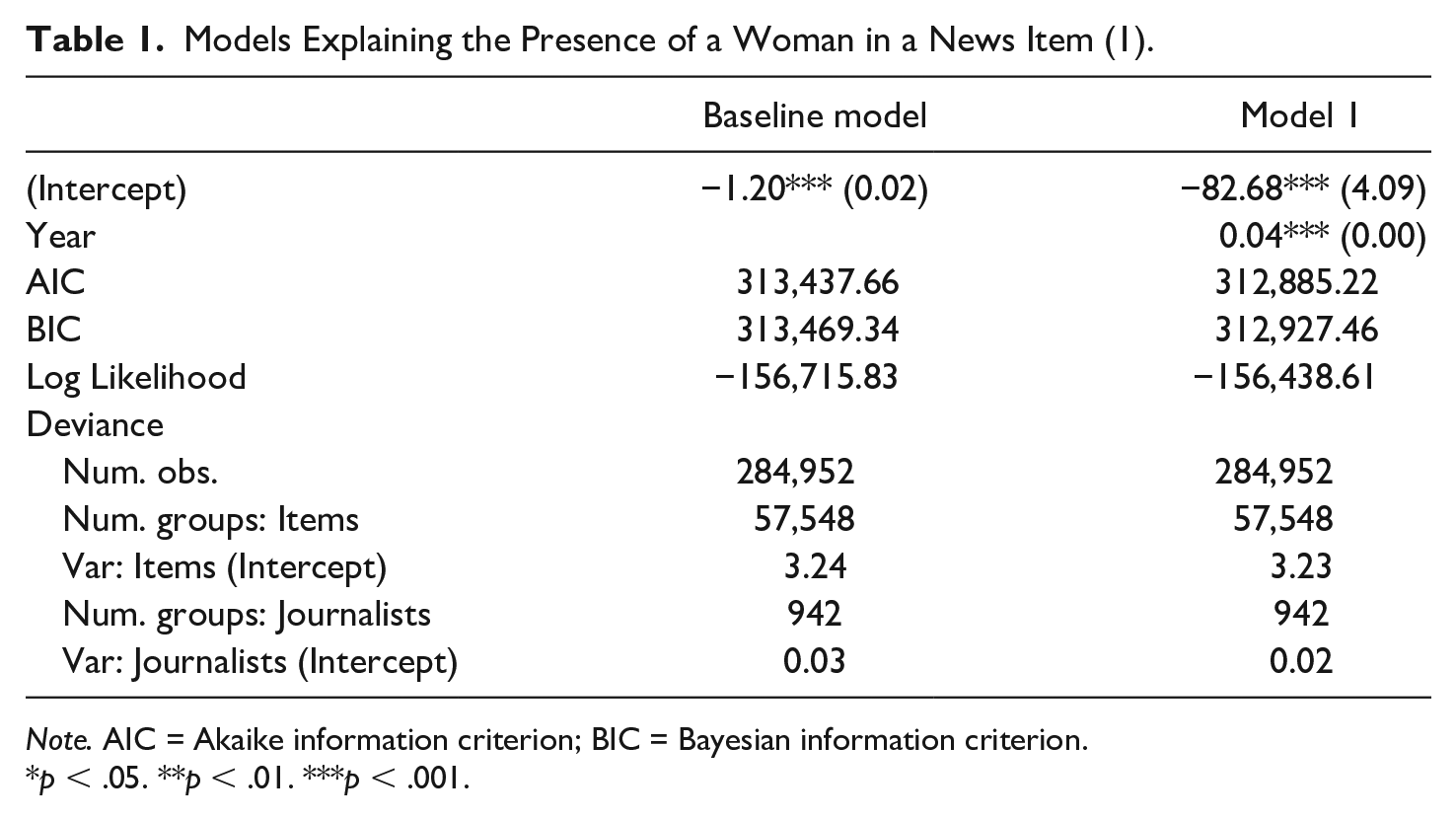
To answer our hypotheses and research questions, we conduct logistic analyses explaining a female-speaking source in a news item as the dependent variable. Because of the nested character of our data (actors are nested in items and items are nested in journalists), we conduct multilevel models. Our general expectation in this paper is that women in general are underrepresented as speaking sources in the 19 years under study. Based on the plot in Figure 1 and the negative intercept in the baseline model, we can accept the first hypothesis. We do expect that the situation has improved and that women would have a higher chance to appear as a speaking source in a news item over time. Again Model 1 in Table 1, shows a positive effect of year, which is rather small. In Figure 1, the share of news items containing at least one female-speaking actor is portrayed on a monthly level. Although there is a slow but steady increasing trend over time, overall the number of female sources has not been equal to that of male sources. So, although the situation has improved, women are still less present in the news than men by 2020.
Models Explaining the Presence of a Woman in a News Item (1).
Note. AIC = Akaike information criterion; BIC = Bayesian information criterion.
p < .05. **p < .01. ***p < .001.
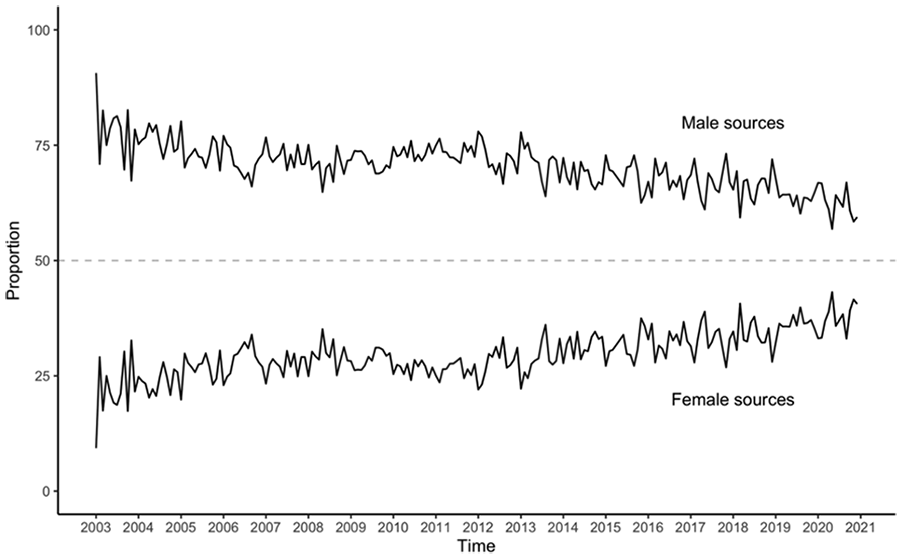
Share of News Items Containing at Least One Female Speaking Actor (Monthly Average).
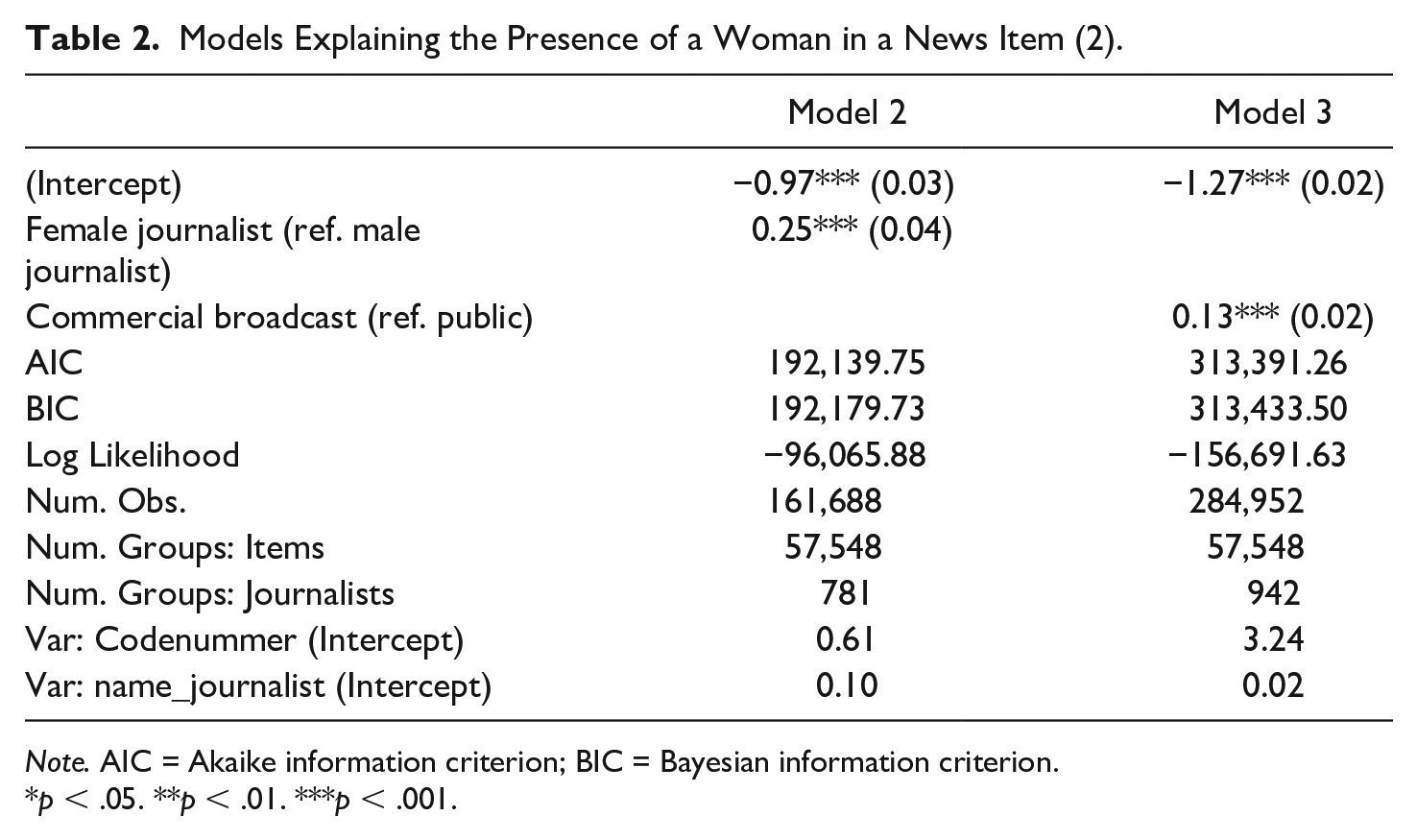
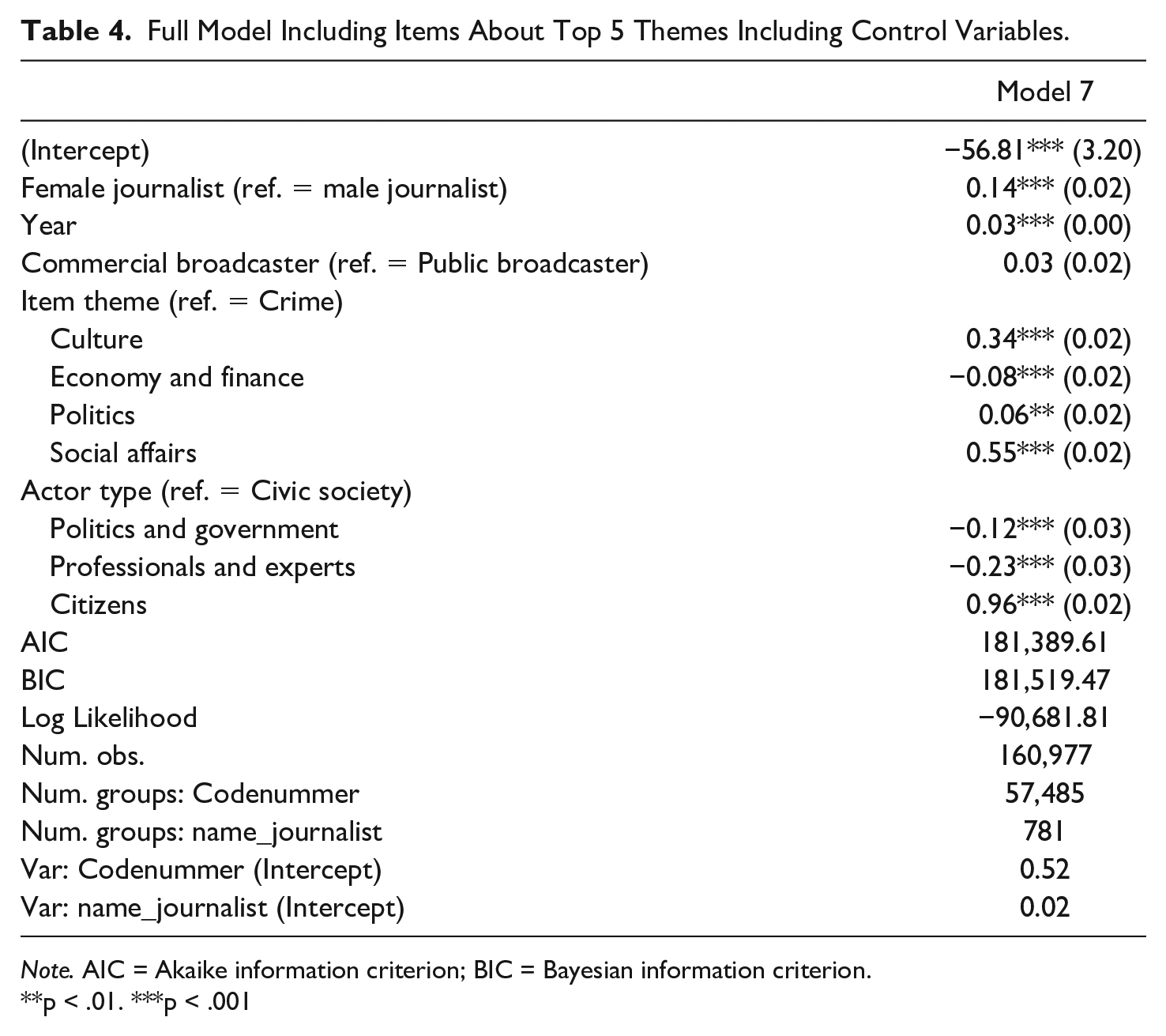
As previously hypothesized, we have reasons to expect that female journalists are more likely to include female sources in their news items than their male colleagues. Looking at Model 2 in Table 2, we can indeed accept our second hypothesis: the probability that a source is a woman increases when the journalist is also a woman. The probability of having a woman as a source increases from 27% when the journalist is a man to 33% when the journalist is a woman. Even with all other predictors in the model (Table 4, Model 7), the effect still holds. So regardless of time, broadcaster, or topic, news items made by female journalists have a higher chance to contain female-speaking actors than news items made by male journalists.
Models Explaining the Presence of a Woman in a News Item (2).
Note. AIC = Akaike information criterion; BIC = Bayesian information criterion.
p < .05. **p < .01. ***p < .001.
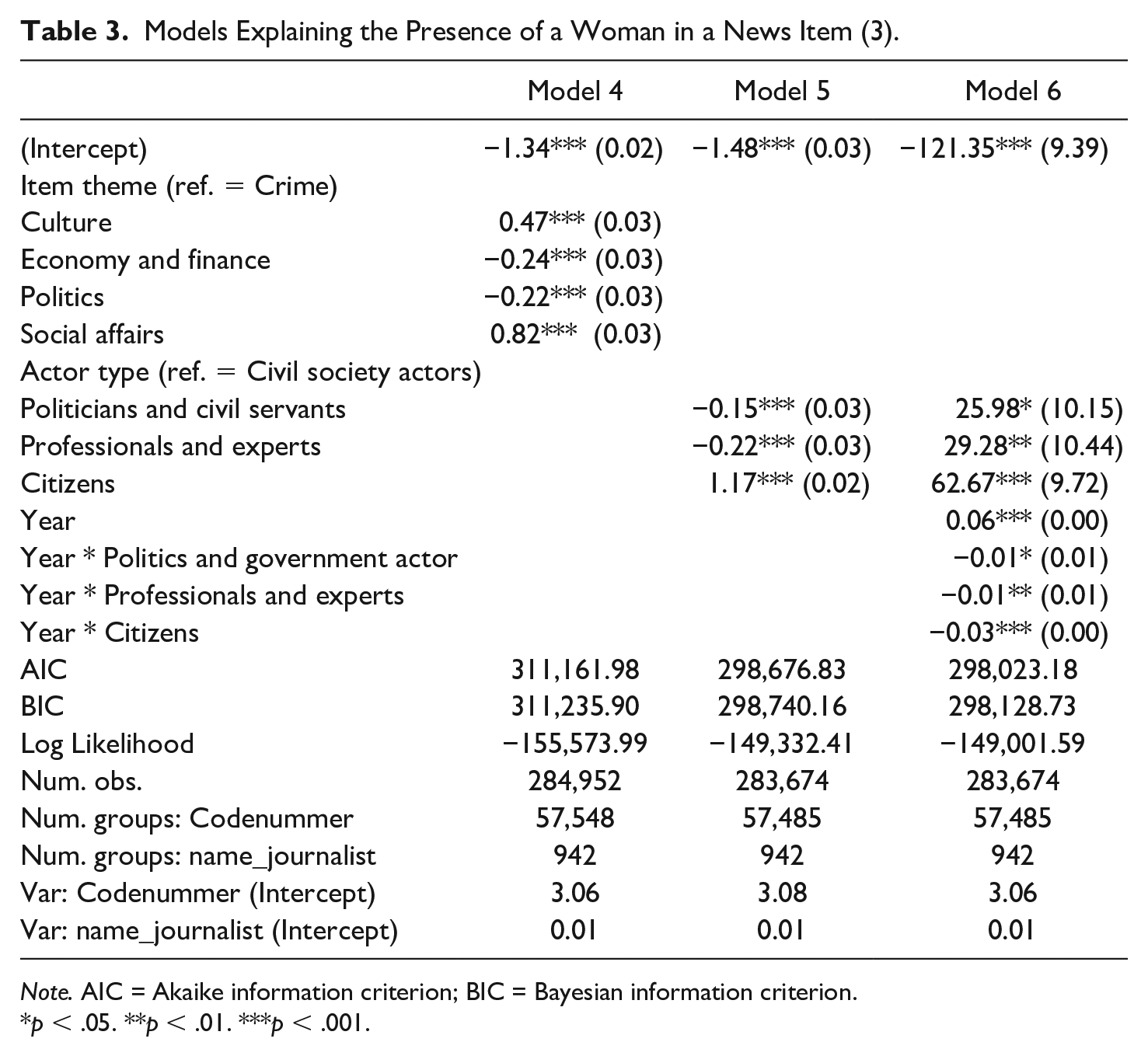
Models Explaining the Presence of a Woman in a News Item (3).
Note. AIC = Akaike information criterion; BIC = Bayesian information criterion.
p < .05. **p < .01. ***p < .001.
Full Model Including Items About Top 5 Themes Including Control Variables.
Note. AIC = Akaike information criterion; BIC = Bayesian information criterion.
p < .01. ***p < .001
Regarding differences based on the type of broadcaster, there seems to be a positive effect of an item being aired on a commercial broadcaster (see Model 3). However, if we include all variables in Model 7, including issue, actor type, year, and the journalist’s gender, the effect becomes insignificant. Hence, we conclude that there is no difference in the probability that women appear as speaking sources in news on commercial broadcaster compared with the public service broadcasters.
We do find an effect of news topics when analyzing the five most common news topics which is in line with our hypotheses (see Model 4; Table 3). Using crime as a reference category, we see that items about culture and social affairs positively affect the probability that there is a female source in a news item. Items about politics and the economy, on the contrary, have a negative effect on the probability that a female source is present. Our hypothesis, stating that women have a higher chance to appear as speaking actors in soft news topics as compared with hard news topics can be supported: crime, politics, and economy are typically seen as hard news topics; while culture and social affairs are typically considered as more soft news topics (Reinemann et al., 2012).
Because these broad categories might mask subtle differences in the effect of item’s themes, we have also included all 37 themes separately in the model (see Supplemental Table A4 in the Online Supplement Materials). However, all the items separately do behave in the way we expected: When more soft news items, such as royalty, tourism, education, and social affairs are discussed, women have a higher chance to appear as a source, compared with “harder” news items such as crime, sports, war, and economy.
It might be possible that these stereotypical gender roles are challenged by female journalists. We tested whether women and men use different sources per topic by adding an interaction effect to the model, which is shown in Figure 2 (for the accompanying model see Supplemental Table A2 in the Online Supplement Materials). In general, there are no distinct divergent patterns between news topics, but we do see that when it comes to economic and financial news, female journalists exhibited a stronger tendency to interview female sources compared with other news topics. This could potentially mean that female journalists are more aware of the gender imbalance and try to “correct” or compensate for the underrepresentation of women as speaking sources.
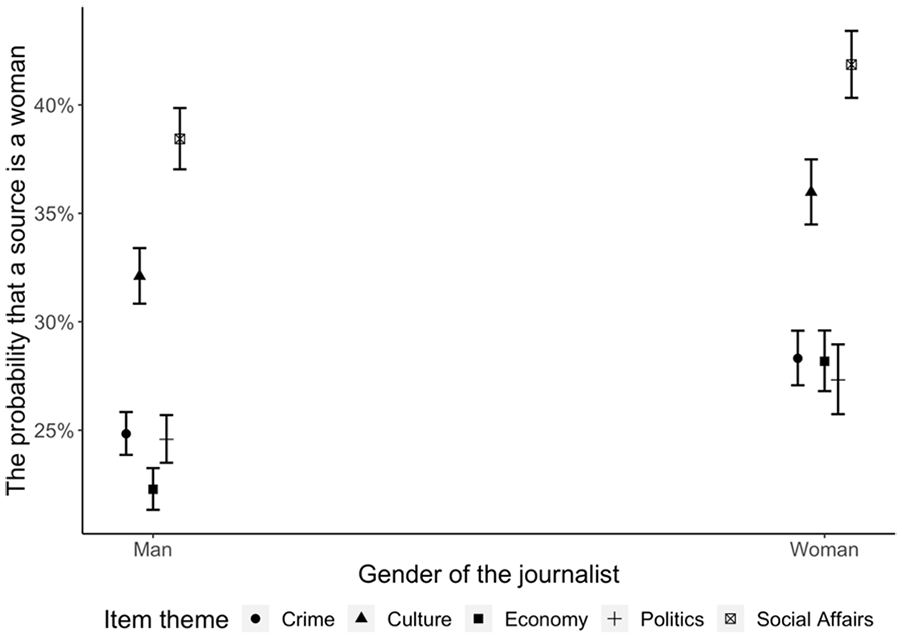
Probability of the Source Being a Woman Determined by Both the Gender of the Journalist and the Item Theme.
In Model 5 (Table 3), we focus on the different actor types. The reference category consists of civil society actors. Women have the lowest chance to appear as professionals or experts in the news, followed by political roles. This is especially remarkable in the Belgian context, given that there is a 50% gender quota on electoral lists. On the contrary, the probability that a source is a woman increases when citizens are portrayed. So, women are more likely to appear in the news in non-elite roles. However, as seen above, the position of women as speaking actors in the news has improved over time. It might be that this also changes over time, with more opportunities for women to appear in elite roles. We have thus tested this more systematically by analyzing the interaction effect of year and actor type (see Model 6a and 6b in the Online Supplement Materials). For both political roles and professionals and experts, the prevalence of female actors stays roughly the same (interaction term = 0.02). The category of civil society actors does seem to have a stronger increase over time (interaction term = 0.03, see also Figure 3). This means that over time, the chance that women appear in a civil society function increases. However, given that there are no substantial different patterns for the other elite roles, we cannot accept Hypothesis 4b.
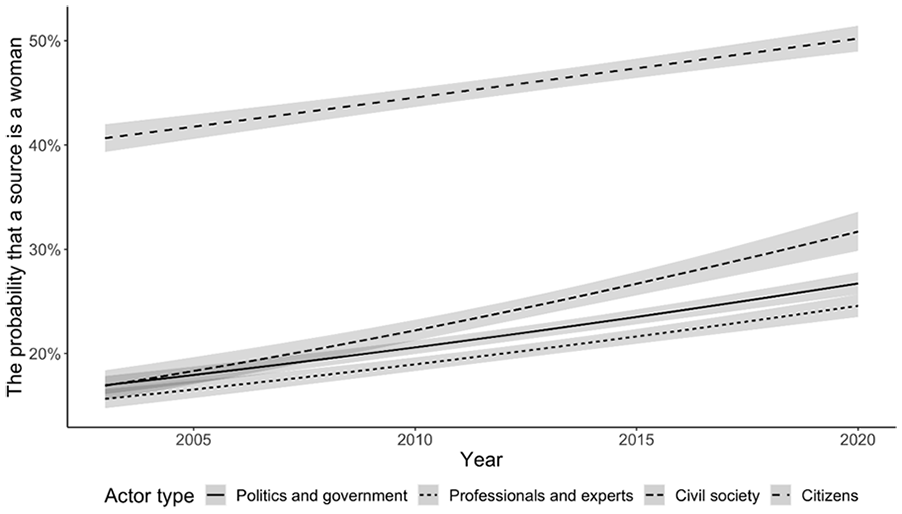
Probability of the Source Being a Woman Determined by Both the Actor Type and Year.
Discussion and Conclusion
Based on 19 years of population data in Flanders (Belgium), this article unveils systematic gender imbalances in the news and the factors explaining them. Our findings represent a double-edged sword. On the one hand, we find that women remain underrepresented in the evening news broadcasts. This underrepresentation is structural as it is present across broadcasters, issues, and roles. Women are more equally represented as speaking actors when it concerns softer news topics like social affairs, or as non-elite actors. These findings are in line with similar longitudinal efforts to analyze how women are represented in the news (Global Media Monitoring Project, 2020; Shor et al., 2014). On the contrary, we cannot ignore the slow but steady increase over time. Between 2003 and 2021 the presence of women in all types of roles has increased. Put differently, in 2021 it is still a man’s world, but with ever more women playing a visible role in it.
Maybe our most problematic finding relates to the role of the individual journalist; even when controlling for news topics and actor roles, we find that male journalists tend to interview fewer female sources compared with their female colleagues. More specifically, female journalists select more women in elite roles as speaking sources than their male counterparts. As with previous studies, we can only speculate upon whether this finding is driven by a higher awareness of the inequalities in society among female journalists (Armstrong, 2004; Zoch & Turk, 1998) or rather by their own gendered networks and shared experiences (Berkowitz, 2009). However, in contrast to previous research, based on extensive, longitudinal data, we can be more outspoken about the structural nature of this effect. Across all types of issues, the effect of the gender of the journalist remained a significant predictor of the gender of the source. Interestingly, in the case of economic news, the effect was even more outspoken. Perhaps as the economy was traditionally a male-dominated topic, female journalists have a stronger need “to correct” the image that men “run the economy.” Or would it rather be that for economic news topics it is less clear who should be included in the story (in contrast to the world of politics) and female journalists are freer to select the sources they deem relevant? Again, more research is needed to delve deeper into explaining why male journalists more often select male sources.
Our findings have several implications for newsrooms. First, promoting gender diversity within newsrooms can play a crucial role in enhancing the representation of women as sources in media content. By increasing the number of women journalists, newsrooms can contribute to a more balanced and inclusive portrayal of society. Second, it is important to prioritize awareness and training among journalists regarding these biases. By making journalists conscious of the biases that exist in media coverage, they can actively work toward mitigating them and ensuring a more equitable gender representation. By fostering an inclusive environment, news media have the power to amplify diverse voices, challenge stereotypes, and promote gender equality.
This paper was based on a unique population dataset, enabling us to identify systematic patterns in our data. However, the main strength of our paper also entails its biggest limitation: Because of the large amount of data, our explanatory analyses remain at an aggregate level. Our study for instance only looks at who gets to speak in the news, but not what they say or how they are framed. Future research might therefore focus more on analyzing what different actor types add to a news story. Drawing from the existing literature, we opted to center our analysis on the differentiation between “hard” and “soft” news issues. It is important to recognize that this demarcation is not always clear-cut, as “hard” topics can occasionally be addressed in a “soft” manner. Therefore, in our analyses, we not only concentrated on categorizing news as “hard” or “soft” but also examined each topic individually. Another pitfall of our study is that it starts from a binary distinction between men and women. Because of the nature of the news coverage, we had to use explicit cues such as names or actor roles to identify the gender of the sources. We are aware that gender consists of multiple different identities. Moreover, by focusing only on gender, we neglect inequalities based on ethnic background or socioeconomic inequalities. Therefore, we encourage other researchers to take a more intersectional approach to investigate how multiple inequalities are represented in the news.
Moreover, although this study focused on news coverage in only one media system, we anticipate that its findings are applicable beyond its specific context. The Flemish media environment, which is marked by a relatively robust public service broadcaster and elevated levels of journalistic expertise, is similar to that of various European countries, especially those classified as “Democratic Corporatist countries” (Hallin & Mancini, 2004) in the northern and central regions of Europe (e.g., Austria, Finland, Germany, The Netherlands). On the gender equality index, Belgium scores a bit above the European average, making it also comparable to neighboring countries in that regard. Previous research also established, for instance, that the underrepresentation of female voices in the media is a consistent finding across European contexts (e.g., Ross, 2007; Sjøvaag & Pedersen, 2019).
When one discusses representation, the main questions are who is being represented and how much representation is enough. The answer to the latter seemingly easy question is not as straightforward as it seems. We can compare the number of women in the news with the number of women in society. If we use this fifty/fifty benchmark, we must conclude that the representation of women in the news is far from accurate. However, one could also argue that news media simply reflect and mirror society and its existing inequalities. For example, if only 30% of the professors in Flanders are women, it would make sense if 30% of the academics in the news would also be women. 3 If we follow this line of reasoning, we neglect the idea that media not only reproduce but also produce gender and power dynamics (Tuchman, 1978). Even if we lower the bar to this more conservative benchmark, Flemish media underperform regarding the representation of women. This is especially the case when we look at the presence of politicians. In Flemish politics, about forty percent of political positions at the national and regional level are taken up by women4. In the news, their presence is still only twenty percent. This means that news media not only reflect the underrepresentation of women as, for example, experts or political leaders but even exaggerate inequalities in society, let alone try to compensate or take an active role in changing this imagery.
Hence, newsrooms should aim to reflect society more accurately. When we reach that goal, we can open the discussion on whether gender diversity in the news needs to be a reflection of the share of women in specific roles in reality or whether we should strive for more or less equal representation. By systematically giving women less of a voice in the news, journalists might be supporting the status quo instead of playing an active role in societal change and steps toward real gender representation.
Supplemental Material
sj-docx-1-jmq-10.1177_10776990231211806 – Supplemental material for A Long March Toward Equality: Predicting the Presence of Women in Television News
Supplemental material, sj-docx-1-jmq-10.1177_10776990231211806 for A Long March Toward Equality: Predicting the Presence of Women in Television News by Kathleen Beckers, Rozemarijn E. van Dijk, Peter Van Aelst and Knut De Swert in Journalism & Mass Communication Quarterly
Footnotes
Declaration of Conflicting Interests
The author(s) declared no potential conflicts of interest with respect to the research, authorship, and/or publication of this article.
Funding
The author(s) received no financial support for the research, authorship, and/or publication of this article.

Supplemental Material
Supplemental material for this article is available online.
Notes
Author Biographies
References
Supplementary Material
Please find the following supplemental material available below.
For Open Access articles published under a Creative Commons License, all supplemental material carries the same license as the article it is associated with.
For non-Open Access articles published, all supplemental material carries a non-exclusive license, and permission requests for re-use of supplemental material or any part of supplemental material shall be sent directly to the copyright owner as specified in the copyright notice associated with the article.
