



Abstract
This article presents an analysis of media effects articles published in JMCQ from 1954 to 2020. Although the primary focus of our sample of articles focused on news, a wealth of additional topics were also examined, including attitude change, media selection, and sharing of media content. While some of this body of scholarship reflects more “traditional” conceptualizations of media effects research, others point to a broader conceptualization that reflects individuals as active in their selection, processing, evaluation, and even creation of media content.
Keywords
As researchers who have spent the better part of our careers doing media effects research, we found the task of examining articles within this area published over the decades in Journalism & Mass Communication Quarterly (JMCQ) to be an exciting opportunity. Our own work has explored issues ranging from stereotyping to sports, crime dramas to self-transcendent media, among many other related topics. However, the articles identified and categorized as “media effects” and selected for our analysis by the Special Issue editors were decidedly more focused than our own research illustrates, with many unsurprisingly reflecting the journalism focus found in the journal’s title. Perhaps from the “bird’s eye view” perspective that our work has required us to take over the past few decades, what has come to “count” as media effects scholarship has become incredibly—perhaps overly—broad, including issues pertaining to such topics as health, environmental communication, political communication, emotion, persuasion, social media, and, of course, news (to name but a few). However, as Maslow (1966) famously wrote, “I suppose it is tempting, if the only tool you have is a hammer, to treat everything as if it were a nail” (p. 16).
Nevertheless, examining these articles offered us an excellent opportunity to see how one particular outlet has contributed to the research tradition over time as well as to paint with broad brushstrokes the picture of those contributions as conforming (or not) to our own, and more general, conceptualizations of the field. We begin by offering our own characterization of research and approaches that make up the field of media effects. From there we provide a general description of the sample of articles selected by the editors. We then delve a bit deeper into our pool of articles, pointing to evidence that conforms to our broad characterizations of media effects as well as counterevidence to some of those characterizations reflected in the articles. We finally offer our thoughts on how JMCQ and other outlets can help to move our field forward in ways that are more nuanced, inclusive, or helpful in a media landscape of apps, social media sites, trolls, AI, and virtual worlds that arise at such a rapid pace that it is difficult to keep abreast of—let alone design and conduct timely scientific studies on—all the changes.
Media Effects as a Field of Study
The study of media effects has a rich history, from the famous Payne Fund studies examining the effects of movies on teen audiences, the study of propaganda during World War I, or even the infamous and controversial study of the impact of the radio drama War of the Worlds on the listening audience. When identifying the “milestones” of media effects research, Lowery and DeFleur (1995) introduced their volume by suggesting that the chapters overview scholarship that largely reflects Shannon’s (1948) mathematical model of mass communication, which generally conceptualizes the effect of media as a one-way, linear process from source to receiver. In contrast, in their preface to Perspectives on Media Effects, Bryant and Zillmann (1986) embraced a much more expansive view, including coverage of uses and gratifications approaches and work based on cognitive psychology—both of which acknowledged the importance of the selection, perception, and processing of media messages; this expansion reflected, and further encouraged scholars to apply to the study of media use, approaches emerging from the cognitive and affective revolutions that took place across related disciplines, placing greater emphasis on understanding mechanisms, mediators, and moderators of media effects rather than the effects alone. Potter and Riddle’s (2007) content analysis of media effects articles also reflected this broadened approach, including such topics as patterns of media use, audience’s inferences, and emotional attachment to characters by an active (rather than a passive) audience. In other words, although still widely used in the discipline, the term “media effects”—which to some still implies a sole focus on audience outcomes—may now be an overly narrow phrase to capture the true breadth of the research tradition, which includes extensive explorations into media uses, processes, and effects. Hence, many scholars have now adopted the phrase “media psychology” to refer to research programs examining how users/readers/listeners/viewers and media interact.
As in psychology, the unit of analysis in the media effects tradition is primarily the individual. From a methodological perspective, evidence for (potential) media effects on individuals is generally based on the use of quantitative research methods, in particular laboratory experiments, surveys, and content analyses. In some contexts, and along both methodological and epistemological lines, some scholars have attempted to differentiate “media effects” from “media studies,” with the latter often characterized as (more of a) humanistic or interpretive enterprise that leverages theories and analytical approaches from critical, cultural, legal, and industry studies (among others).
Overview of Media Effects Articles in JMCQ
The JMCQ content tagged by the editors as representing the “media effects” tradition and selected for our review included 112 articles published between 1954 and 2020. These data were provided by Kim et al. (2023) in this special issue of JMCQ. After excluding book reviews and letters from readers, we examined the remaining 107 articles, coding for the issues that have frequently received attention, the nature of the methods used, the theories and concepts that were scrutinized, modified, and developed, as well as information about the authors. We also employed WordStat (Provalis Research, 2021), a text analysis software, to provide a broad look at the common words and phrases employed throughout the articles as well as theories identified as prominent in the field by prior bibliometric studies (Bryant & Miron, 2004; Chung et al., 2012; Potter, 2012; Potter & Riddle, 2007; Valkenburg & Oliver, 2020; Walter et al., 2018). Neither approach represents an extensive, line-by-line “formal” content analysis but rather provided us with systematically derived heuristics to distill the information and to identify broad themes and trends. In addition, we entered the title of each article into Google Scholar (on March 31, 2023) to record citation rates. To examine trends across time, we also categorized the articles into four timeframes: prior to 1970 (27.1% of our articles), the 1970s and 1980 (27.1%)s, the 1990s to 2009 (30.8%), and 2010 to the present (15%).
Prior to reporting our analysis, we think it intriguing to note how the dataset of articles we examined compares to “media effects” scholarship as reported on the JMCQ website: https://journals.sagepub.com/home/jmq. Using the keyword “media effects” and only including research articles (e.g., not book reviews, etc.), the search retrieved 266 articles (compared to the 107 in our dataset). Of these, 2.3% were published prior to 1970, 24.4% in the 1970s and 1980s, 30.8% from 1990 to 2009, and 42.5% from 2010 to the present. Clearly, the analysis provided below is based on a sample of articles considerably smaller than the search suggests, with the search results showing a clear growth in media effects scholarship published in JMCQ over time. This difference in “sample sizes” is obviously due to the categorization of articles for the Special Issue; that is, many “media effects” articles could also be categorized as “Politics and Media” or “Journalism/News and Press” and were analyzed and discussed within those contributions in this issue. Consequently, our analyses should be interpreted in light of this fact.
To provide readers with a visual overview of the topics examined in our sample, we created a word cloud of the terms employed in the sample of articles (see Figure 1). As this image illustrates, the articles in the sample were heavily focused on news, with many studies examining issues of credibility, sources, and user perceptions. Indeed, the issue of news was studied in 61.7% of the sample. According to Google Scholar, 8 of the 10 most-cited articles in the sample dealt with news. Figure 2 provides a listing of the topics covered in the sample, noting that these topics are not necessarily mutually exclusive (e.g., an article may have examined both politics and news).
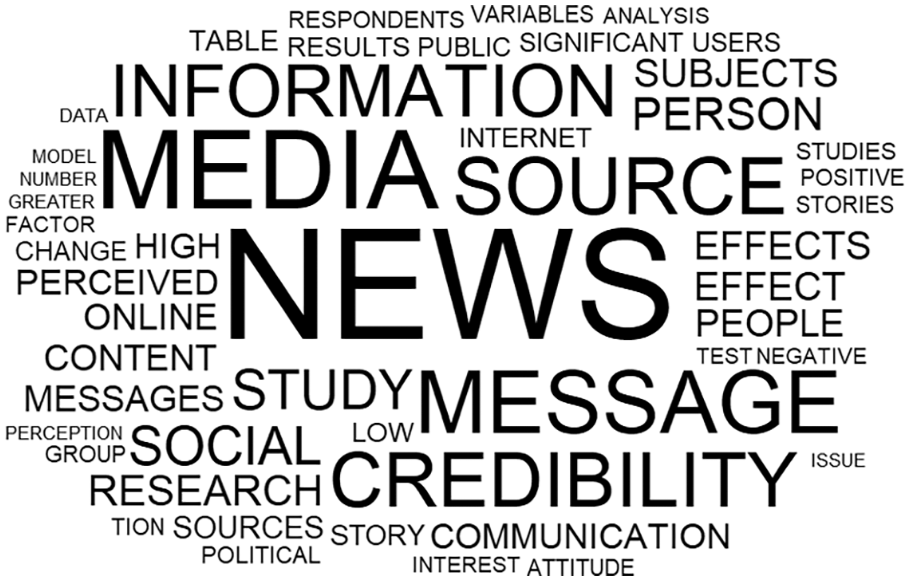
Word Cloud of Words in Articles.
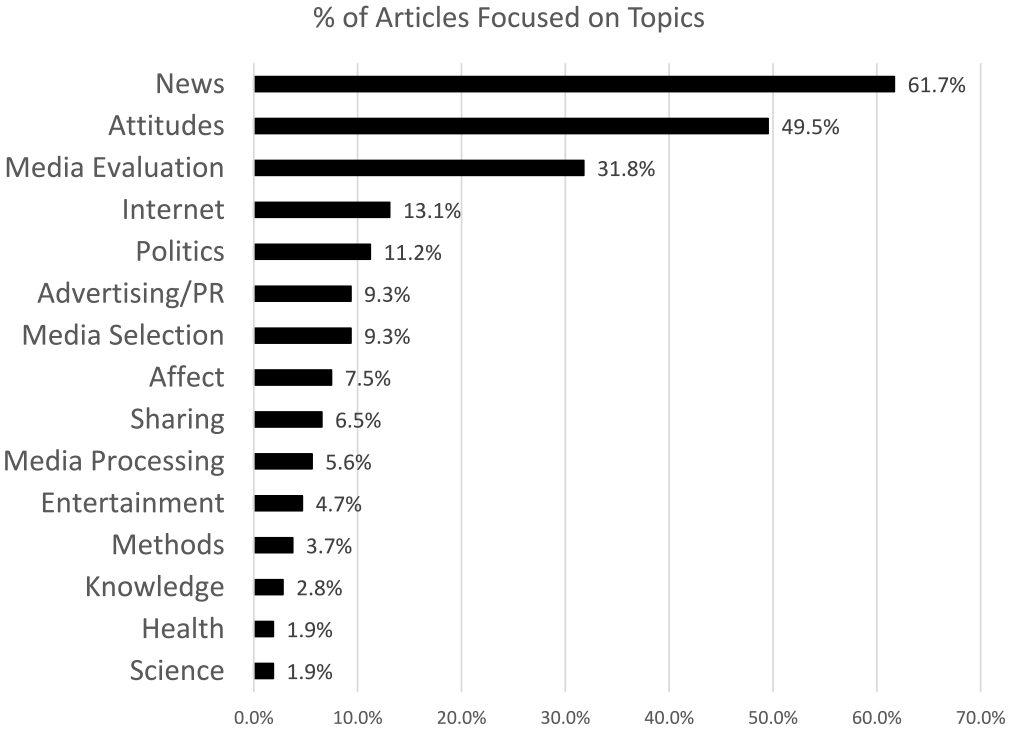
Topics in Articles.
We also examined topics across time, with articles categorized into four timeframes: prior to 1970, the 1970s and 1980s, the 1990s to 2009, and 2010 to the present. We conducted chi-square analyses on each of the 10 topics that were featured in at least 5% of the sample. Four of the topics significantly differed by timeframe. Two of the four differences appear to be related to the rise of computer technologies and social media. The topic of “the internet” did not appear until the 1990s, with 9.5% of the articles in the 1990-2009 timeframe featuring this topic; the majority (62.5%) of articles featuring “the internet” were published during the 2010-present time period, χ2 (3) = 46.31, p < .001, V* = .66. Similarly, the issue of “sharing” did not arise until 2010, with 43.8% of articles during this timeframe focused on this topic, χ2 (3) = 42.60, p < .001, V* = .63. Of these articles, all focused on sharing news either via a social media platform (e.g., Kim & Ihm, 2019; Trilling et al., 2016) or a news organization’s website (e.g., Ji et al., 2018). Two additional topics also increased in coverage over time: “media evaluation” (prior 1970: 3.4%; 1970s-80s: 31.0%; 1990-2009: 51.5%; 2010-present: 31.8%; χ2 [3] = 17.73, p < .001, V* = .41) and “media processing” (none before 1990, 1990-2009: 9.1%; 2010-present: 18.8%; χ2 [3] = 9.42, p = .024, V* = .30). According to our Google Scholar analysis, eight of the 10 most-cited articles in the sample involved media evaluation.
In terms of theories employed or tested, 71.0% of the articles included the word “theory” or “theories.” We used WordStat to compare the specific theories frequently mentioned in the current sample with those mentioned in prior bibliometric studies of media effects. Figure 3 displays the percentage of articles mentioning each of these theories. Consistency theories (e.g., cognitive dissonancy, balance, and consistency) were most frequently employed, with 22.4% of the articles mentioning these theories. Many of the articles that employed consistency theories were conducted in the earlier years of our sample, such as Tannenbaum’s research on the recall of radio news (Tannenbaum, 1954) and viewers’ interpretation of news (Tannenbaum & Kerrick, 1954). We reason that early interest in these related sets of theories reflects the publication of Festinger’s A Theory of Cognitive Dissonance in 1957. Additional theories frequently employed included information processing theories (16.8%), third-person effects (13.1%), and selective exposure (10.3%). Several notable media effects theories were mentioned in fewer than 5% of the articles, including framing theory (3.7%), social learning/social cognitive theory (3.7%), and cultivation (1.9%).
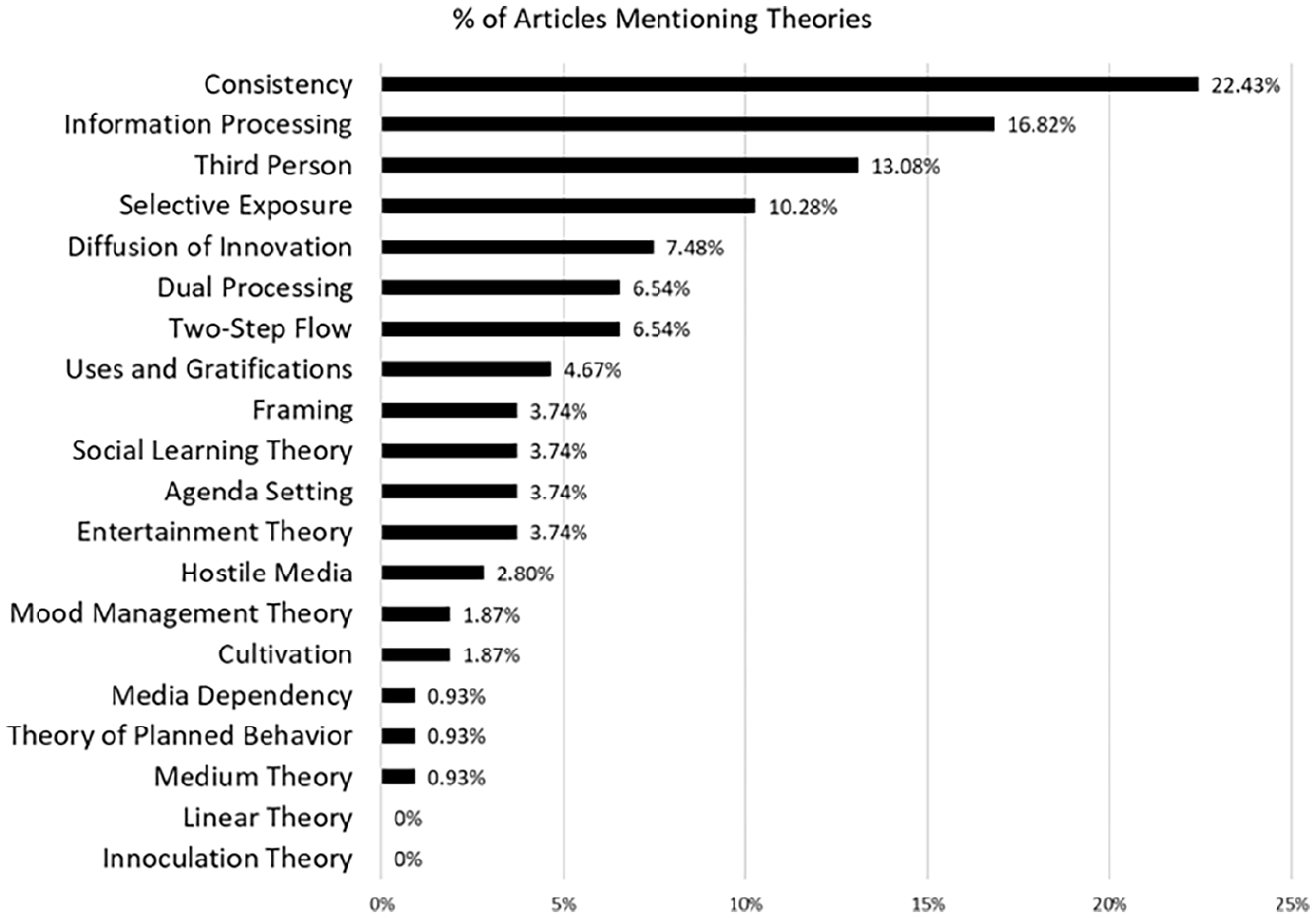
Articles Mentioning Theories.
In addition to testing specific theories, articles in the sample often reported examinations of fairly well-defined and accepted models or concepts, although we noted differences in the ways that those phenomena were discussed. For example, 59.8% of the articles included the word “model” or “models,” though the term was sometimes used to refer to a theory, sometimes to a process, and still other times to a set of hypotheses. For example, the elaboration likelihood model (Petty & Cacioppo, 1986) was employed in numerous studies (Flanagin & Metzger, 2000; Li et al., 2018), although the model provides a set of interrelated hypotheses that help to predict and explain attitude change. Similarly, the third-person effect (Davison, 1983) was mentioned in 13.1% of the articles in our sample, with some scholars referring to it as an “effect” (White, 1997) and others discussing it as a “hypothesis” (Price et al., 1997).
Finally, several concepts were conceptualized and tested as predictors of effects in some studies, as outcomes in others, and as moderators or mediators in others. For example, the concept of credibility was discussed in 43.0% of the papers in our sample. For the most part, this concept was treated as an outcome variable, often affected by some aspects of media messages or media sources (e.g., Jahng & Littau, 2015; Oeldorf-Hirsch & DeVoss, 2019; Sweetser et al., 2008). However, Slater and Rouner (1996) treated credibility as both an exogenous variable predicting evaluation of a message and as a mediator predicting attitude change. Likewise, mood or affect was employed as a dependent variable in some studies (e.g., Donohew & Palmgreen, 1971) and as an independent variable in others (e.g., Biswas et al., 1994).
To summarize, the articles in our sample categorized by the editors as “media effects” focused heavily on news and related concepts such as credibility, sources of information, and more recently, social sharing. Theories and concepts often tied to perceptions and attitudes were frequently employed and were often studied through the lens of consistency theories, information processing, and selective exposure. Finally, we noted several trends, including the increasingly consequential role that internet technologies have had on JMCQ scholarship.
Conceptualizations of Media Effects
As mentioned previously, media effects as a discipline is typically thought of as employing social-scientific methods to examine the effects of media on attitudes, beliefs, emotions, mood, and behaviors. At times, it has been accused of ignoring processes and of not giving greater agency to users/readers/viewers. In this section, we review evidence in our sample that supports the “traditional” conceptualizations of media effects as well as research that supports a broader conceptualization.
Traditional Conceptualizations
The articles in our sample strongly support the conceptualization of media effects as social scientific and as employing quantitative approaches. In our sample, 46.7% employed experimental approaches, 32.7% employed surveys, and 4.7% employed content analyses. In addition, several studies aimed to make strides in improving methods and measures, including an early study on how to identify positive and negative responses to specific aspects of persuasive messages (Carter, 1955). Likewise, Slater provided thought-provoking essay on how to measure media exposure (Slater, 2004) and the ways in which we can account for message variation in experimental contexts (Slater, 1991).
In addition to being primarily quantitative in nature, the articles in our sample featured primarily male scholars; only 29.9% of the articles in our sample included one or more female authors. However, a “by time period” analysis revealed a steady (and statistically significant) increase in the presence of female media effects scholars in JMCQ. Specifically, among the articles published prior to 1970, only 6.9% featured female authors, compared to 20.7% during the 1970s-1980s, 45.5% during 1990-2009, and 56.3% from 2010 to the present, χ2 (3) = 17.60, p < .001, V* = .41. Furthermore, our citation analysis indicated that four of the five most highly cited articles included a female author, with all four articles being published since 1996. Similar patterns were also observed in terms of the nationality of the authors. Within our total sample, only 10.3% of the articles included authors who were located at universities or other places of employment outside of the United States. However, in the most recent timeframe (2010 to the present), that number had jumped to 31.3%, reflecting a strong trend toward greater internationalization, with scholars from Hong Kong, Taiwan, South Korea, The Netherlands, and Austria represented.
An additional “traditional” characterization of media effects is that it is primarily interested in outcomes without attention to the processes that give rise to the outcomes (Lang et al., 2008). In some respects, several articles in our sample conform to this characterization, although arguably these studies were more common in the earlier years when the discipline was still developing. For example, some studies on attitude change simply employed experimental manipulations of some aspect of a media message, measuring attitudes after exposure (e.g., Greenberg & Tannenbaum, 1961; Mehling, 1959). Likewise, several studies provided broad, descriptive surveys to explore how mediums (e.g., television versus newspapers) affect the perceived credibility of news stories (e.g., Lee, 1978; Ryan, 1973).
Although not strictly a part of a “traditional” conceptualization of media effects, many topics and theories that can be found in the broader literature base had rare appearances in the JMCQ sample. We note that the journal has historically focused on journalism; so, the nature of the articles that we reviewed reflects that particular emphasis. Likewise, other topics such as race- and gender-related issues that are frequently studied by media effects scholars are covered elsewhere in this special issue (i.e., related articles were not included in our sample). Nevertheless, research on entertainment, media violence and sexuality, stereotyping, ideal appearance, children, and health and science were scarce in the sample of studies.
A similar scarcity was found with regard to the theories examined. Valkenburg and Oliver (2020) analyzed five extant bibliometric studies that each identified the most prominent media effects theories in communication journals, combined spanning a sample of leading journals between 1956 and 2016; three of those studies included JMCQ in their sample. Nevertheless, the most-cited theories from across the five previous bibliometric studies—cultivation, priming theory, uses and gratifications, and diffusion of innovations—were rare in the current sample. In fact, several highly prominent theories associated with journalism and news effects found in those studies—agenda setting, framing, and knowledge gap—were mentioned in less than 5% of the articles in our sample. The third-person effect was the one theory/phenomenon that was prominent in both the current sample and the other bibliometric studies. It is important to point out, however, that these findings might be an artifact of the sample since there is a separate article focusing on political communication as well as a separate article focusing on advertising research in the special issue. Consequently, some of those “rare” theories may be represented there.
To summarize, some aspects of traditional conceptualizations of media effects were indeed observed in our sample. The studies were heavily quantitative, with almost half employing experimental approaches. In particular, in early studies, women scholars were relatively rare, and outcomes were examined more than processes. Furthermore, many of the theories previously identified as being most prominent in the media effects tradition were rarely examined in our sample of JMCQ articles. But, as noted above, the “traditional” characterization of media effects as a field has been evolving over the past few decades. In the next section, we overview how the sample reflects a broader conceptualization of the media effects discipline.
Broader Conceptualizations of Media Effects
The term “effect” connotes a one-way, causal process, and for many decades of study researchers seemed to take that connotation to heart. Specifically, the audience was often conceptualized as passive and homogeneous. Early studies pointed to evidence of the contrary, most famously Lazarsfeld, Berelson, and Gaudet’s analysis of the 1940 U.S. presidential election, The People’s Choice (Lazarsfeld et al., 1944). Nevertheless, it was decades before a broad understanding and appreciation of the role of individual-differences factors was fully embraced by media effects scholars. But, it appears that contributors to JMCQ were ahead of the curve in this regard. For instance, nearly half (49.5%) of the articles in the sample either measured or discussed “attitudes,” with nearly 60% of those articles appearing before 1980. The consistent appearance of articles concerned with individual perceptions (e.g., credibility, third-person effect) across the sample is further evidence of this.
Likewise, unlike conceptualizations of receivers as passive, the importance of perceived credibility among the studies in our sample makes clear that the evaluation of media content has been of great interest among scholars publishing in JMCQ across many decades. Although many studies employed credibility as a manipulated message variable, in other studies, it functioned as a primary outcome variable. For example, West’s (1994) article presented a test of two models of perceived credibility measurement, and Johnson and Kaye’s (2000) research examined predictors of perceived credibility of news in an online context.
Furthermore, unlike conceptualizations of media effects that assume little agency among viewers, the number of studies in our sample examining media selection as a variable of interest highlights that the authors of our sample articles were keenly aware that in many instances, viewers are active, not only in terms of how they process information but also in what they choose to consume in the first place. In an earlier study of interest in news, Carlson (1960) found that both readers’ goals and their perceived importance of these goals were predictors of interest in reading news stories on different topics. In a later study examining mood management (the only one in our sample), Biswas et al. (1994) demonstrated that good versus bad moods predicted attraction to news stories focused on good-news versus bad-news stories.
We also believe that the studies in our sample grappling with message processing are indicative of a broader conceptualization of media effects. For example, Chew’s (1994) research demonstrated that individuals often exhibit greater questioning behaviors when interacting with news about a high-relevance topic. These findings were interpreted as reflecting “a higher degree of engagement with the issue” (p. 685). Likewise, Cameron (1993) employed both self-report and reaction-time measures to assess recognition of information presented in news stories, arguing that further research in this direction would help to clarify the understanding of involvement, which “must ultimately be a mental process of allocating mental energy to certain messages from an array of competing stimuli” (p. 865).
Finally, we note that a broader conceptualization of media effects is also evident in the study of the active role of users in both the dissemination and the creation of content. In terms of dissemination, the sharing or dissemination of content is most evident in the studies regarding the sharing of news stories via social media. However, the notion of sharing has a long history, going back to theories such as the two-step flow hypothesis (Katz, 1957; Lazarsfeld et al., 1944). This sample also showed early awareness of the importance of attending to the creators of content. For example, Atwood (1966) examined journalism students’ writing styles in a news story about a high- or low-credibility source and message. Similarly, in an earlier article, Gieber and Johnson (1961) examined reporters and sources in a city hall “beat” to explore how these two entities interact and how they view their respective roles in getting information to the public.
In summary, our sample of studies published in JMCQ showed evidence for the argument of a “broader” conceptualization of media effects, including their interest in attitudes and the individual differences that are typically assumed, in media processing and selection, and dissemination and creation of media content. Importantly, these studies were conducted when many technologies that are used to study these issues today were not yet available. As such, we expect to see even greater interest in these areas as technologies evolve and our measurements mature.
Concluding Thoughts
The diversity of articles in our sample illustrates the important role that JMCQ has had in publishing a rich literature in media effects throughout the years. Furthermore, these articles also demonstrate a much broader conceptualization of the discipline than traditional conceptualizations imply. As we reflect on this scholarship, we note that some scholars have recently called for an even greater breadth in media effects research that includes nuanced data and qualitative approaches that are currently more aligned with critical and activist literature (Ramasubramanian & Banjo, 2020). Likewise, the importance of affect in processing, selecting, and perhaps creating messages has been gaining traction over the years (Nabi, 2020). And finally, we note that as our professional organizations continue to enjoy greater internationalization, we are beginning to see a greater diversity of scholars and perspectives in our literature. Reviewing these articles leaves little doubt that JMCQ has been a leader in championing our field, and we look forward to seeing the future of media effects—even more broadly defined—that will fill its pages in the future.
Footnotes
Declaration of Conflicting Interests
The author(s) declared no potential conflicts of interest with respect to the research, authorship, and/or publication of this article.
Funding
The author(s) received no financial support for the research, authorship, and/or publication of this article.
