




Abstract
This study analyzed JMCQ articles in the specific topic area of mass communication technology and media channels, overall and across four 20-year periods. Primary topics changed from emphasizing media industry and policy issues, international issues of information freedom, audience research, and WWII media issues in early periods to more specific regulatory issues, ratings and audience analyses, macro and social issues, and media technology development issues in more recent periods. JMCQ serves as a treasure trove of the history of broadcast media technology and competition, policy debates, and audience interests, with a recent emphasis on more rigorous empirical analyses.
Keywords
Academic journals, like the fields and areas of specialization they publish, evolve gradually and reflect the concerns, criteria, and practices of their time. With the standardization of academic disciplines over the last century and consensus around what defines rigorous knowledge, refereed journal article writing has become a fairly regimented and academic endeavor. This wasn’t always the case. JMCQ started out as The Journalism Bulletin in 1924, changed to Journalism Quarterly as of 4(4), Jan 1928, and then to Journalism & Mass Communication Quarterly, 71(1) in 1995. In the early days, research summaries and informed essays about new media channels were just as likely to be written by industry representatives, research institute analysts, and journalists as they were by full-time academics. Today, all the JMCQ articles on mass media technology are authored by academics. While this shift signals heightened scholarly rigor, it also reflects a decrease in types of authors and in literary and popular writing style that came with early reflections and state of the art essays about industry trends and even media-related developments abroad.
The research question motivating this special issue article is: What is the overall, and changing, focus of JCMQ articles from 1935 through 2017, with respect to the topic of Communication Technology/Media Channels? This study does not present a comprehensive literature review of that topic but rather focuses on the articles identified via topic modeling by the special issue editors (see Kim et al., 2023). Even within JMCQ, this topic focuses primarily on mass/broadcast media, and thus does not include digital/online/mobile media technologies, policies, or research.
Resonating with the large-scale topic modeling approach that this special issues applies, we conduct both direct and indirect forms of textual analysis of the articles, both across and within time periods. Direct text analysis was performed through modeling topics (via factor analysis) and distinguishing articles (via k-means clustering) using the co-occurrence of n-grams across articles. Indirect text analysis was applied via content analysis of the articles based on an a priori but iteratively revised coding scheme. Thus we move from general topics to prototypical articles to specific relevant content, as a means of characterizing the foci of these JMCQ articles. The analyses provide a detailed look at news and mass media technology developments, important industry debates, trends, and scholarship from 1935 to 2017, overall and within time periods.
The Articles
The JMCQ special issue editors (Kim et al., 2023) provided a set of 127 articles, from 1935 to 2017, identified as Topic 9 or Communication Technology/Media Channels, based on their topic modeling of all articles in the journal over that time period. After removing 35 book reviews, 6 research-in-brief pieces, 2 annotated bibliographies, a foreign communications summary, an educators’ forum, and general quotes (common at the end of early articles), 82 articles remained for the topic and cluster analyses. We further dropped 3 short wartime communications for the content analysis. We refer to the entire set (1935–2017) as All; to assess changes over time, four (approximately equal-sized) 20-year periods were identified by the last two digits of their inclusive years, as 35-49, 50-69, 70-89, and 90-17.
Word Frequency and Topics
Method
We first prepared a spreadsheet with each article’s ID, year, time period, and text. Then we applied MEH (Meaning Extraction Helper; R. L. Boyd, 2018) to All and then to each of the periods. MEH removes stop words, and lemmatizes and stems all the remaining words, from each article’s text, resulting in a reduced set of n-grams, or individual standardized substantive words, for each article. We set MEH to remove the lowest-frequency words after each set of 2 articles, and keep the 200 most frequent n-grams in All and in each period. Table 1 provides descriptive statistics for articles and n-grams.
Descriptive Statistics for n-Grams Per Period and All.
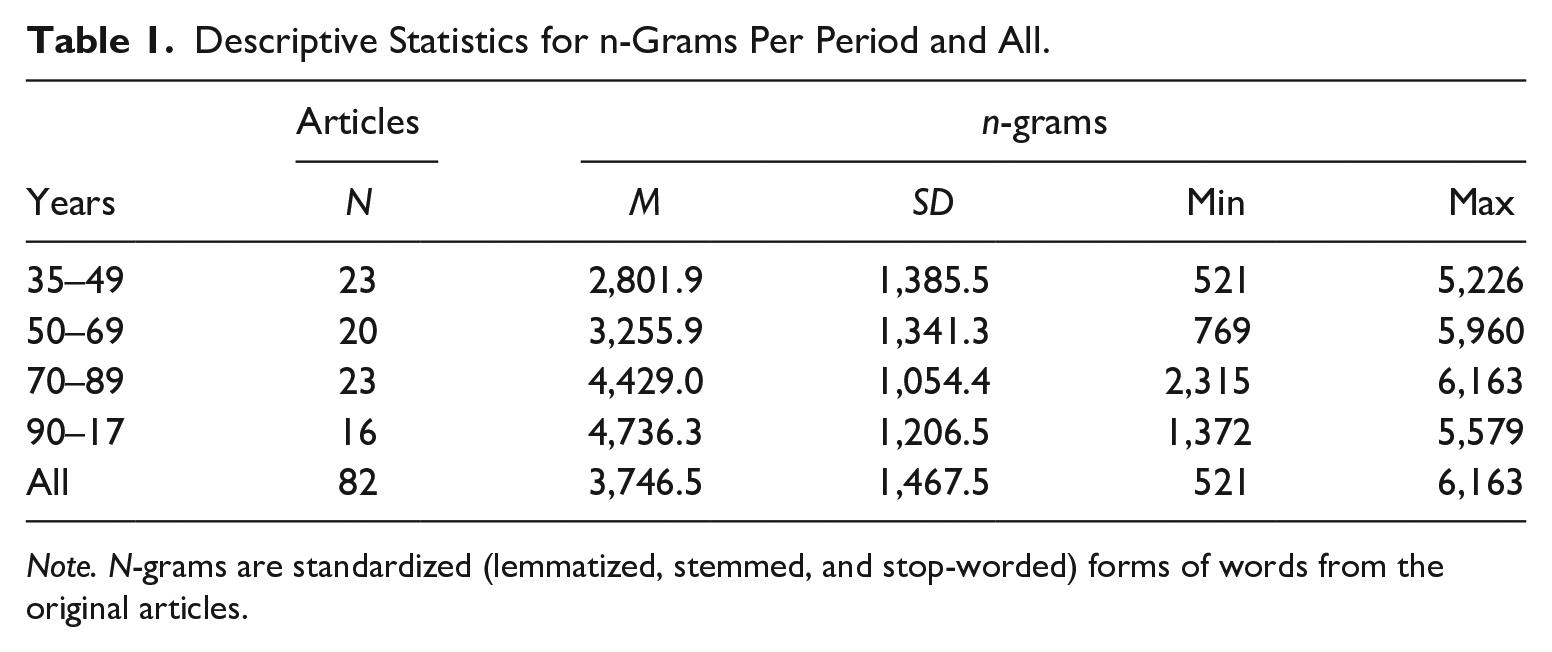
Note. N-grams are standardized (lemmatized, stemmed, and stop-worded) forms of words from the original articles.
MEH creates two primary output files. The first (n-gram text) lists all of the n-grams in the order they appeared in each article (i.e., a given n-gram may occur one or more times in each row). The second (n-gram number) is a matrix with the article IDs down the first column, each unique n-gram across the columns, and the total number of times each n-gram occurs in each article as the cell values. These two types of files from All and from each period provide the bases for the topic and word cluster analyses.
Results
The n-gram text files from All and each period were input separately to a word cloud generator (Free Word Cloud Generator, 2023), using the program’s maximum limit of the most frequent 100 words. Figure 1 visually displays the n-grams in sizes proportional to their frequency across the All articles (the four period word clouds are available from the first author). Given the emphasis of the Communication Technology/Media Channels topic in JMCQ on the early years of mass media, the most frequent words are radio, station, news, broadcast, program, television, media, newspaper, public, service, and interest.
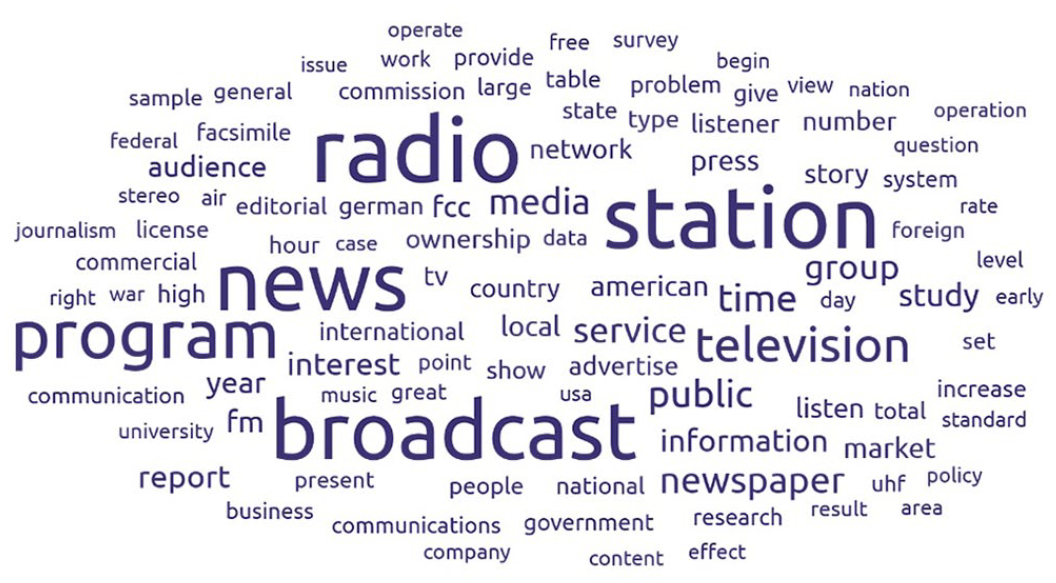
Word Cloud, All 1935–2017
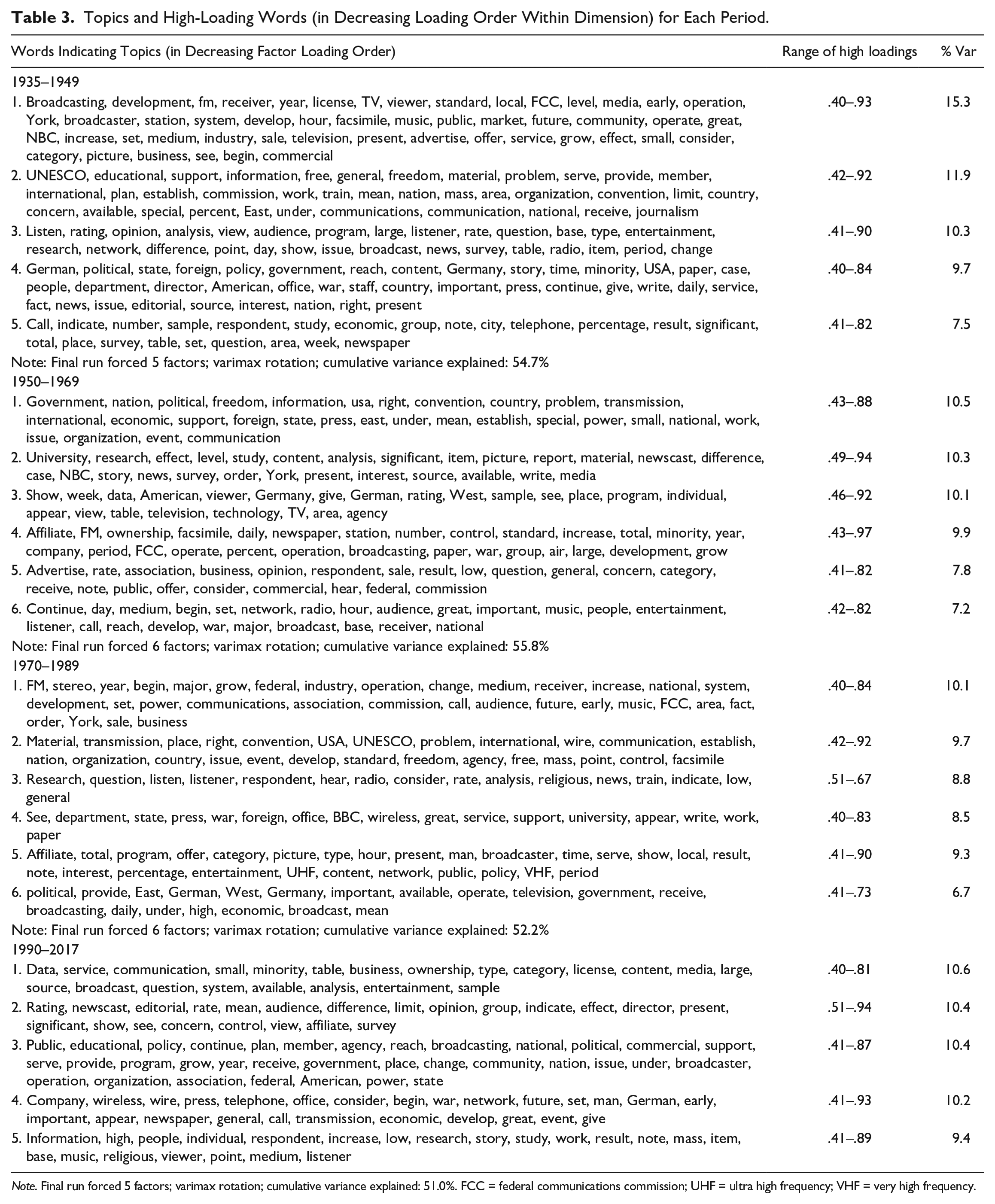
To identify general topics, we applied principal components analysis via SPSS to the n-gram number file. Because of the large number of words, many dimensions had eigenvalues over 1.0. For parsimony, interpretability, and consistency, we applied the following criteria for retention and reporting: positive loadings of .40 or above; in the few cases where a word loaded more than .40 on multiple dimensions, only use the dimension where it loaded highest; and iteratively reduce dimensions using forced extraction until cumulative variance explained just over 50%. This approach identified the following number of factor topics for each period: All = 13; 35-49 = 5; 50-69 = 6; 70-89 = 6; 90-17 = 5. The factors represent the primary topics for All and each period, respectively. Table 2 shows the results for All, while Table 3 presents the results for each period.
Topics and High-Loading Words (in Decreasing Loading Order Within Dimension) for All.
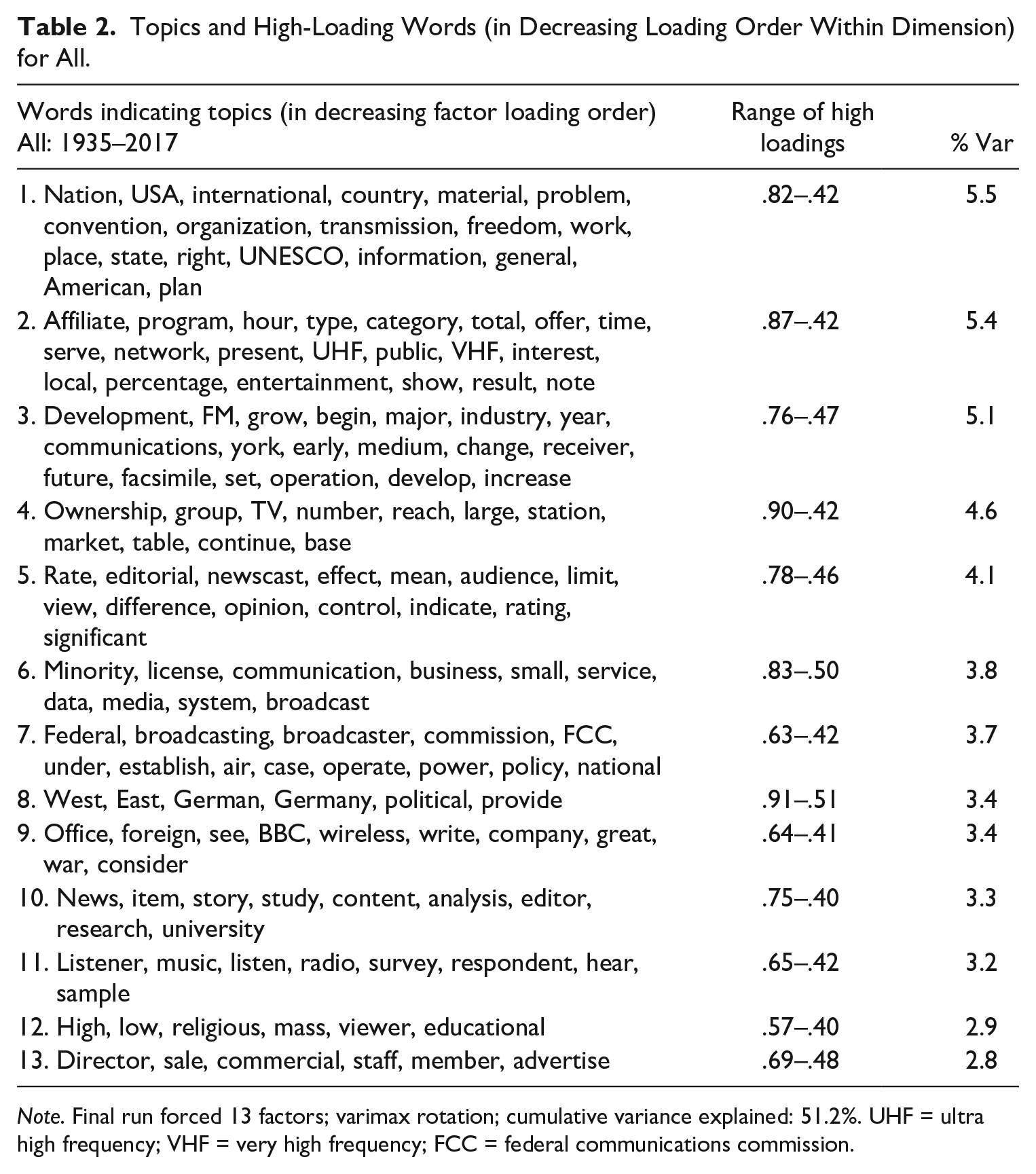
Note. Final run forced 13 factors; varimax rotation; cumulative variance explained: 51.2%. UHF = ultra high frequency; VHF = very high frequency; FCC = federal communications commission.
Topics and High-Loading Words (in Decreasing Loading Order Within Dimension) for Each Period.
The factor-based topics across for All are (1) national and international issues and media transmission; (2) programming (local, affiliate, network); (3) media technology and industry developments; (4) station ownership and markets; (5) audience viewing and ratings for news and editorial content; (6) licensing and minority broadcasting issues and data; (7) FCC policy issues; (8) political issues associated with WWII and Germany; (9) use of media for war communications, especially between US broadcasters and the BBC; (10) content analysis research on news items and stories; (11) radio listener surveys, esp. music-related; (12) mass media and cultural programming; and, (13) commercial media sales and advertising.
The topics for each of the separate four periods are fewer but more specific. They show a shift from media industry, advertising, international and national media issues, along with audience-related concerns (especially regarding the new medium of radio) in the first period, to more specific regulatory issues, social issues, retrospective histories of the early years of developing media technologies (e.g., FM radio, satellite broadcasting), and continuing into the modern era with more academically rigorous audience-based research in the most recent period.
Word Clusters and Prototypical Articles
Method
To identify prototypical articles for All and each period, we applied k-means clustering using the SPSS datasets. These results distinguish clusters of articles based on their shared frequency of the 200 n-grams in All and in each period. This form of clustering is unsupervised, working iteratively to group articles into distinct clusters, with at least two articles in a cluster. The number of clusters that were required to converge on a solution requiring no more iterations were: All = 5; 35-49 = 4; 50-69 = 4; 79-89 = 3; and 90-17 = 3. The output includes a measure of how close each article is to the center of its cluster. The closest article for each small cluster (along with a mid-level article for large clusters) is a good representative, or prototype, of the respective topic cluster.
Results
Table 4 for All, and Table 5 for each period, list the specific words with significantly different mean Euclidean distances from the cluster centers (i.e., words that distinguish the clusters), the article clusters, prototypical articles (closest to the center of each respective cluster), and a brief summary of those articles.
Article Clusters for All: Distinguishing Words and Prototypical Articles via K-Means Clustering.
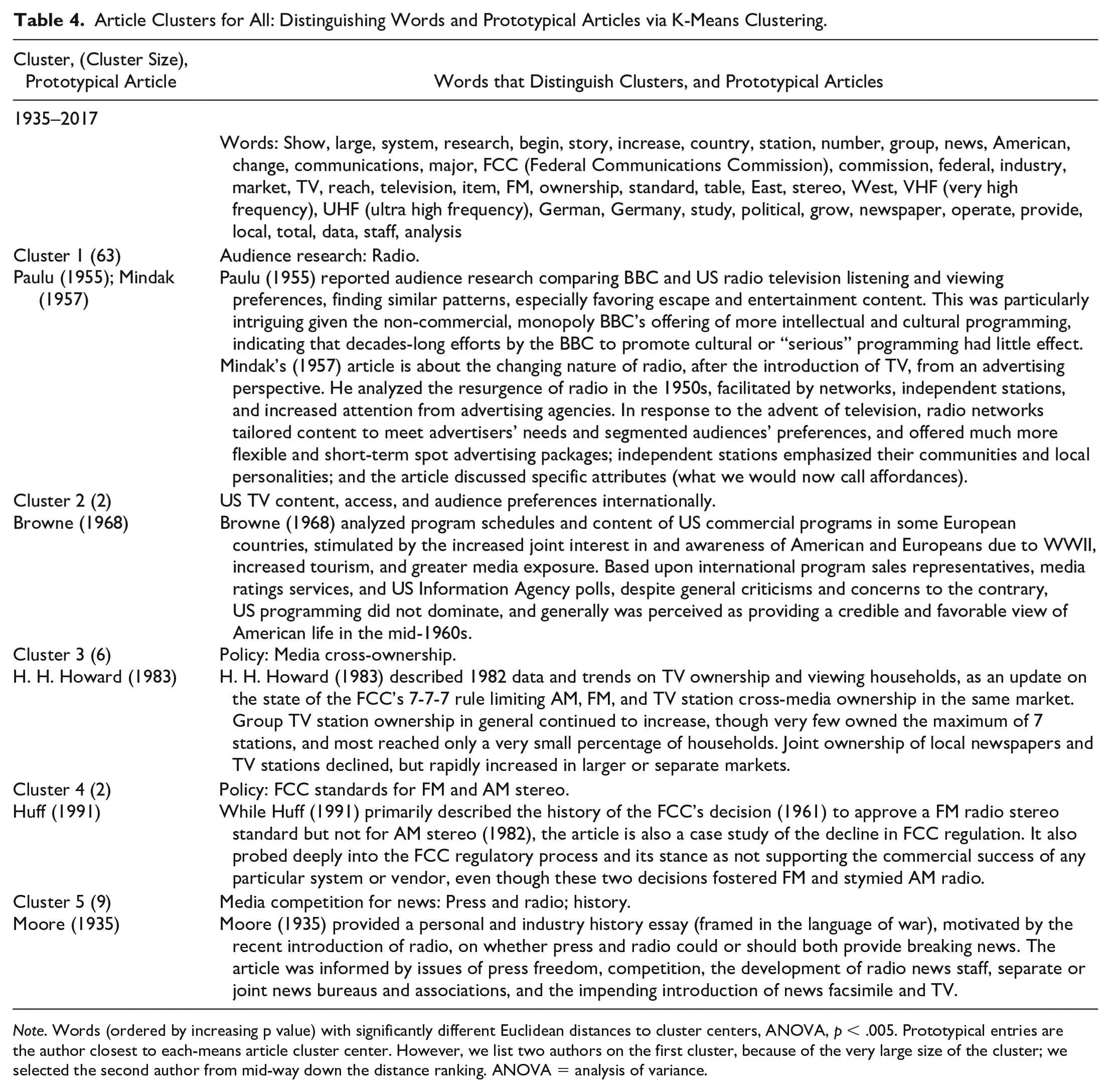
Note. Words (ordered by increasing p value) with significantly different Euclidean distances to cluster centers, ANOVA, p < .005. Prototypical entries are the author closest to each-means article cluster center. However, we list two authors on the first cluster, because of the very large size of the cluster; we selected the second author from mid-way down the distance ranking. ANOVA = analysis of variance.
Article Clusters for Each Period: Distinguishing Words and Prototypical Articles via K-Means Clustering.
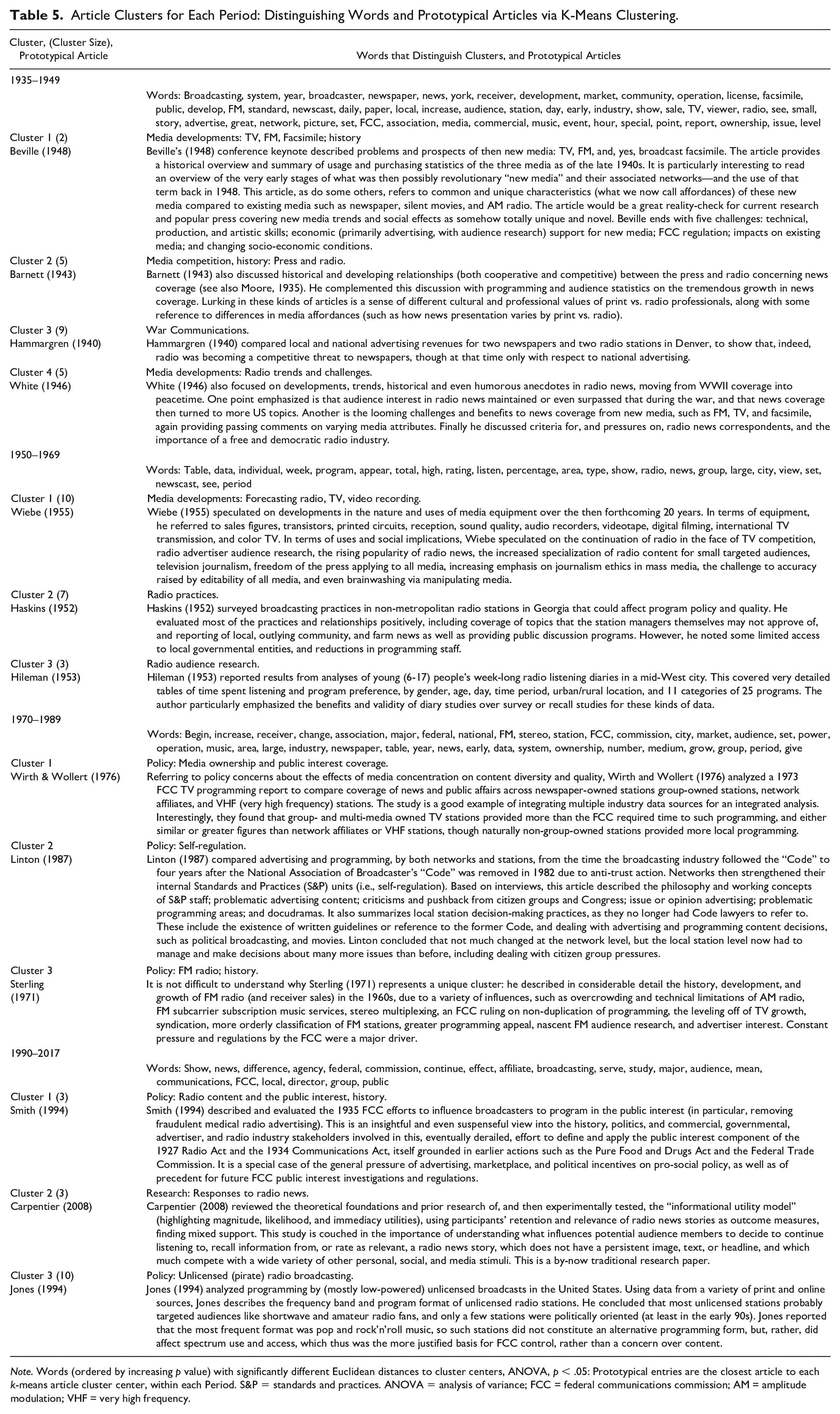
Note. Words (ordered by increasing p value) with significantly different Euclidean distances to cluster centers, ANOVA, p < .05: Prototypical entries are the closest article to each k-means article cluster center, within each Period. S&P = standards and practices. ANOVA = analysis of variance; FCC = federal communications commission; AM = amplitude modulation; VHF = very high frequency.
The main topics of the article clusters across all periods (the All set) are: Technical and media developments and standards, FCC and media policy, stations and markets, local stations and programming, US and international media coverage, news, and audience research. Most of the articles (n = 63) reside in a cluster about audience (primarily radio), with Paulu (1955) and Mindak (1957) as prototypical articles. The second cluster (n = 2) addresses US TV content, access, and audience preferences internationally (Browne, 1968). The third (n = 6) and fourth (n = 2) clusters concern policy, the former especially media cross-ownership (H. H. Howard, 1983) and the latter about FCC standards for FM and AM stereo (Huff, 1991). The last cluster (n = 9) focuses on accounts of press and radio competition for news, largely historical but some written by authors at the time (Moore, 1935).
Each period provides more detailed topics along with their prototypical articles. For Period 35-49, those are: Diverse media developments, broadcasting, policy issues such as licensing and standards, commercial media and advertisers, news, audience, (press and wire) associations, and (broadcast) networks. Period 50-69 includes: Audience research, programming, radio, and news. Period 70-89 article clusters are distinguished by: Macro issues such as government, industry, ownership, policy, media growth, FM stereo, audiences, sales and markets, and newspapers. Finally, article clusters in Period 90-17 are significantly distinguished by: Policy, public service, audience, media ownership, and research.
Content Analysis of Articles
Method
Here we turn to a more contextualized but indirect method for describing the focus of these articles: content analysis. The co-authors developed coding categories and operationalizations from other content analyses of published mass media research (Bucy & Evans, 2022; Evans & Bucy, 2010) as well as from a general overview of the articles, allowing for adaptation based on each round of coding. Each article was coded for manifest content of publication year and page length, and latent content of author type, two main topics, main theory, two data sources, research approach, main study design, analytical approach, main and up to three additional communication technologies/media mentioned, and academic indicators. (The final Codebook is available from the first author.)
We began by familiarizing ourselves with the first article from each of the four time periods, then compared, discussed, and revised the coding. A challenge arose due to the uneven nature of earlier articles (often shorter, without citations, covering industry trends, conference reports, or personal reflections, with several foci). Given this variability, categories initially used for coding were kept intentionally broad. We then read and analyzed 11 articles across the four periods through three rounds. At each round, we compared our codings, discussed disagreements, and revised the operational definitions where necessary. Our interpretations and operationalizations converged well by the end of the third round.
After each set of codings, all agreements of specific codes for each instance were recoded in the main spreadsheet as 1 for each coder, and disagreements as 0 for one coder (based on the lowest code value) and 1 for the other. Although we computed standard measures of reliability, percentage agreement was selected as the most appropriate criterion for establishing sufficient inter-coder reliability (all measures courtesy of Freelon’s [n.d.] ReCal2). Overall, average agreement was 91.8%. The only two problematic codes were second topic (45.5%, with first at 100%), and second media mention (63.6%, with first at 100%). In those disagreements, we agreed that all the choices were justifiable, so discussed and decided on the most specific example in each instance.
We then developed and applied general coding procedures (see the Codebook for more details), including adding several new substantive codes. We then each coded the same subsequent respective sets of 10 articles within seven rounds, with each of those articles distributed across the four time periods. The few disagreements that arose were discussed until a consensual coding decision was obtained; these emphasized a stronger focus, a more specific instance, or a less frequent and thus more unique instance.
Results
Table 6 presents the percent agreement for each time period for codes with one choice (author type, theory, research design general and specific, academic indicators), and Table 7 for codes with two or more choices (topic, data, analysis, and media technology). The following sections summarize results and provide examples for each of the content analysis areas.
Percentage for Each Period for Content Analysis Codes with One Choice.
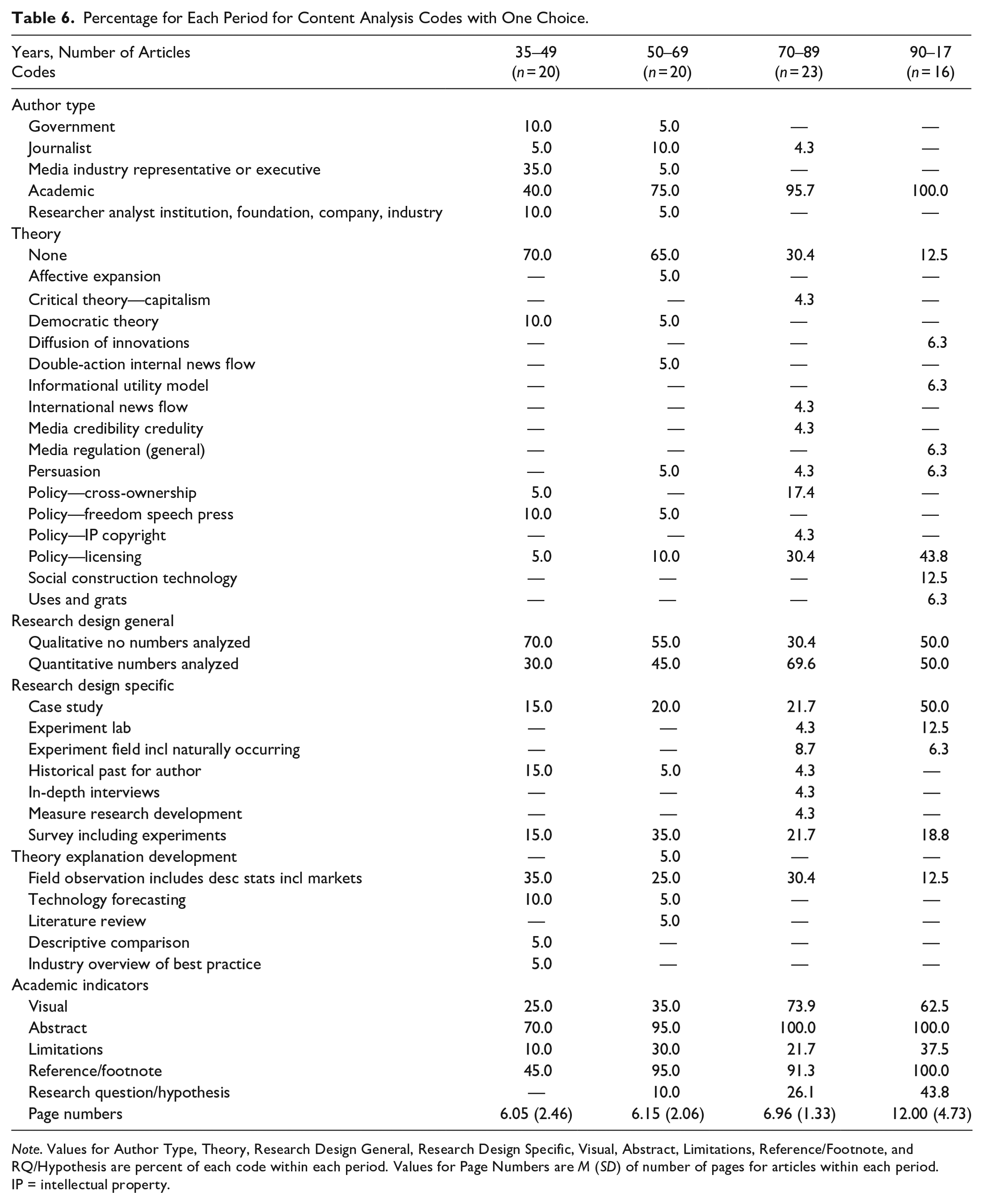
Note. Values for Author Type, Theory, Research Design General, Research Design Specific, Visual, Abstract, Limitations, Reference/Footnote, and RQ/Hypothesis are percent of each code within each period. Values for Page Numbers are M (SD) of number of pages for articles within each period. IP = intellectual property.
Percentage for Each Period of Content Analysis Codes with Two or More Choices.
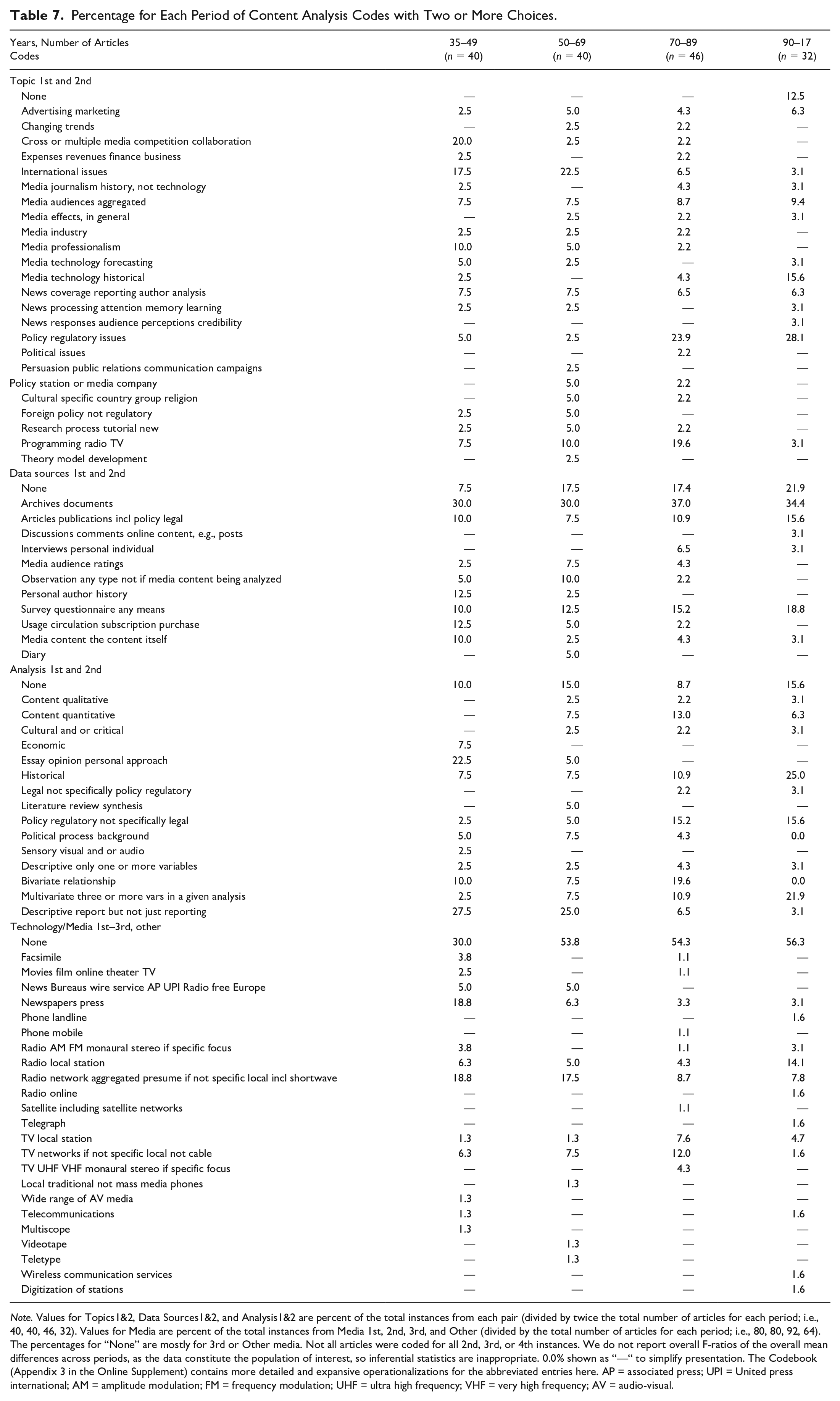
Note. Values for Topics1&2, Data Sources1&2, and Analysis1&2 are percent of the total instances from each pair (divided by twice the total number of articles for each period; i.e., 40, 40, 46, 32). Values for Media are percent of the total instances from Media 1st, 2nd, 3rd, and Other (divided by the total number of articles for each period; i.e., 80, 80, 92, 64). The percentages for “None” are mostly for 3rd or Other media. Not all articles were coded for all 2nd, 3rd, or 4th instances. We do not report overall F-ratios of the overall mean differences across periods, as the data constitute the population of interest, so inferential statistics are inappropriate. 0.0% shown as “—“ to simplify presentation. The Codebook (Appendix 3 in the Online Supplement) contains more detailed and expansive operationalizations for the abbreviated entries here. AP = associated press; UPI = United press international; AM = amplitude modulation; FM = frequency modulation; UHF = ultra high frequency; VHF = very high frequency; AV = audio-visual.
Communication Technology/Media Channels
Trends
Early JMCQ articles on mass media technology (i.e., 35-49) highlighted cross-media competition, particularly between newspapers and radio. FM radio, AM stereo, teletype, facsimile delivery of newspapers, color and satellite broadcasting, high-definition television, and digital news platforms are just a few of the technologies analyzed. Articles emphasized international media flows in the WWII and Cold War eras as the democratic way of life was under threat and depended on robust dissemination of information. With the destruction of Europe and rise of the Cold War following WWII, American and British media leadership played a vital role through the United Nations (via its cultural and scientific arm, UNESCO) in forming a new world information order that championed the free flow of news over propaganda on a global scale (such as through Radio Free Europe or international shortwave radio). The need for journalism education and media literacy training for propagandized and information-starved populations (such as through UNESCO commissions or the BBC) was fundamental during and after WWII.
Concerns about news professionalism and advertising ethics present in the earliest period of articles shifted to studies about programming on radio and television and, with that, ratings or audience analysis. In the latter periods (i.e., 70-89, 90-17), articles emphasized policy and regulatory issues that attended the growth of the broadcast media system. In later years, historical analyses of media technology became increasingly evident, reminding readers of the changes that had occurred and critical episodes from bygone eras.
Reflecting these trends, technology mentions in early articles (35-49) at first emphasized newspapers and radio (stations, networks, and AM/FM), then gradually incorporated television (stations, networks, and UHF/VHF), particularly in 70-89, which could be described as the heyday of television research in this topic area. Early studies and research commentaries about media technology in the journal focused largely on the practice of journalism and the challenge that the emergent medium of radio posed to the print press—to the point of questioning whether radio stations should have the right to report the news at all, given their unfair advantage of instant delivery or what was called “flash news.” These concerns were somewhat mitigated by newspaper group investment in radio and the unprecedented need for news brought on by WWII. Prior to the war, articles about broadcasting largely addressed issues related to the programming, advertising, and regulation of radio while after the war attention turned increasingly to television but continued to feature radio as well. Broadcast media policy has been a consistent focus of the journal ever since.
Media Technology History and Forecasting
While the rise of digital communication technologies has been acknowledged with the term “new media” (Rice & Associates, 1984), that and similar terms were used three-quarters of a century ago: for example, “new media” (Beville, 1948), television as a “new medium of communication” (Cassirer, 1949, p. 278), and “new communication technologies” (Rogers, 1952, p. 59). The introduction of new communication technologies was often greeted with great optimism in the pages of the journal: “The new media present us with unrivaled opportunities to overcome public ignorance and apathy concerning crucial issues of our times” (Beville, 1948, p. 11). The pages of JMCQ have also hosted fascinating analyses of the ebb and flow of competitive dynamics between the emerging medium of radio and the traditional print press concerning issues of timing, selling, sharing, or withholding of news. Related topics included competition for audience share, the rise of radio news commentators, awareness among some newspaper ownership groups about potential synergies with radio, co-ownership, pressures from radio that prompted innovation in the newspaper industry, and changes in circulation, listenership, and radio set ownership (Barnett, 1943).
Over the years, forecasts about new uses of emerging media met with various degrees of accuracy. Hotaling’s (1948, p. 143) review of three periods of broadcast facsimile history gushed that, “The breadth of facsimile’s possible uses staggers the imagination.” Two decades later, Webb (1971, p. 498) announced that “facsimile as a ‘mass’ communications medium is very much alive now and is already on its way to becoming one of the most widely used media in existence, public or private.” Early forecasting highlighted some capabilities now familiar to the digital era. For instance, Lazarsfeld (1941, p. 11) suggested that, “There is no reason why the radio should not announce the existence of a product and then refer, ‘for further details,’ to current advertisements in newspapers and magazines”—a concept similar to online hyperlinking.
Some speculations did come to pass, such as Tan’s (1976, p. 699) proposition that a cable TV channel devoted to weather might be an “ideal” alternative to covering the weather only during television and radio news slots; indeed, The Weather Channel, now a cable staple, was founded in 1982. Wiebe (1955) accurately predicted radio and television innovations, such as “feasible equipment advances as ear-phone radios, video tape recorders handling color, and worldwide TV transmission. . .. radio receivers smaller than a package of cigarettes. . .. pocket-sized tape recorders. . .video tape. . .trans-Atlantic coaxial cable. . .” (pp. 27–28), as well as the ability to edit audio and video tape recordings, which could create false or misleading information (similar to the “deep fakes” of today).
Affordances
While considerable communication and technology research has studied how media vary in terms of features, attributes, characteristics, or (more recently) affordances, early JMCQ articles discussed and compared aspects of what were then legacy (newspapers) and emerging (radio, television) media. These include shortwave radio’s timeliness and ability to circumvent media control by Russia and other countries after WWII (Davis, 1946); television’s combination of “the instantaneous immediacy of radio with the realism of the motion picture and the personal intimacy of the lecture platform” (Cassirer, 1949, p. 278); and, the features of the business-document transmission medium of facsimile (Webb, 1971). Meanwhile, radio offered a more intimate, relaxed listening context, and unlike newspapers, vocal contact (Browne, 1965). Mindak (1957) noted radio’s portability, companionship, and the value of listening while doing other things.
Newspapers attempted to adapt to the growth of new electronic media through “flash coverage” (rapid reporting), in-depth analysis, embracing their role as the medium of record and credibility, and an increasingly visual approach that incorporated more photos, varied typefaces, and comics (Barnett, 1943). Lazarsfeld (1941, p. 11) highlighted the convenience of print: “We can read at a time we choose, at a speed appropriate to the topic; we can skip one page in reading and dwell upon another. These are advantages which the less flexible radio program does not have.”
Counterintuitive Results
Several articles in the analysis presented results counter to prevailing arguments about mass media. For example, radio and TV program preferences in 1955 were about the same for the commercial American media as for the non-profit British Broadcasting Corporation (Paulu, 1955), indicating that motivations for structure and content emphasizing educational and cultural material do not overcome audience preferences for variety shows, drama, and light music. Articles analyzing the legal, technical, and regulatory aspects of unlicensed and pirate radio broadcasting (e.g., Jones, 1994; Phipps, 1991) concluded that most pirate radio broadcasting only conveyed rock and progressive dance music, so might run afoul of FCC rules that required radio stations to serve in the broader public interest, convenience, and necessity; they could also be challenged on the basis of illegal and wasteful frequency use (Jones, 1994). Wirth and Wollert (1976) found that most multi-media and group-owned radio stations actually provided more public interest programming than independent stations, countering arguments against cross-ownership and concentration.
Curiosities
Fans of now obscure—but at the time important—media issues and technologies will find much to enjoy. These include accounts of the FCC’s failed campaign to regulate false or misleading medical advertising on radio (Smith, 1994), the successful but eventually discontinued Public Telecommunications Facilities Program (Huntsberger, 2014), foundations of early radio in one-to-many wireless telephony (Balbi, 2017), or low-power radio using Class D FM (low-power 10-watt educational) (Stavitsky et al., 2001), and the worldwide newsprint shortage following WWII, which posed a major obstacle to education and the free flow of information (Behrstock, 1949; Maheu, 1948).
Theory
Policy/Regulation
Legal and policy principles (e.g., regulatory theories such as freedom of the press, copyright, and public service programming) provided the largest and most consistent conceptual backdrop for research while more social science concepts such as diffusion of innovations, persuasion, and information utility received scant mention. Media regulatory policy, processes, and effects were a frequent topic of JMCQ. Articles covered the rise of early TV stations and the 1953 FCC regulations on multiple- and cross-media ownership, which were shaped by a desire for diversification of media voices (H. H. Howard, 1976). Other articles reported on the effects on minority owners’ licensing of frequencies for radio, television, and other wireless communication services associated with the FCC’s switch to auction-based bidding and awarding beginning in 1995 (P. N. Howard & Smith, 2007). Carter (1951) reviewed the shifting Supreme Court, FCC, and radio industry positions on editorializing (especially in the context of the Fairness Doctrine), and the associated balance among news impartiality, media and public service, and government censorship. Sterling (1971) provided an in-depth policy, economic, technical, and sometimes tortuous history of the rise of FM radio, emphasizing the crucial role of the FCC.
International Information Flow
Thoughtful essays and analyses covered issues such as the role of the US government and commercial wire services in broadcasting information or propaganda in other countries post-WWII (Davis, 1946; Gerber, 1946). A bevy of analyses addressed the stark nature of the Cold War against communism after WWII, in both eastern Europe and Asia, fought via independent, private, and local Radio Free Europe and Radio Free Asia news and radio station networks (e.g., Feinstein, 1954).
Social Construction of Technology
During the 80-year period, just two cultural-critical theories were identified: a critical theory of capitalism and the social construction of technology. The social construction of technology approach was used to uncover and analyze how media innovations were shaped by social forces. For FM programming, Beville (1948, pp. 5–6) noted that Unfortunately . . . musical programs broadcast over standard band stations until recently could not be simultaneously broadcast over a companion FM station without employing a double crew of musicians. The American Federation of Musicians had refused to negotiate contracts for the use of musicians on networks of FM stations.
The passage, blockage, or delay of international treaties concerning freedom of information, especially news flows, were thoroughly interlinked with global political issues and conflicts of the time (Exley, 1953). Arceneaux (2006) revealed how the diffusion and domestication of early radio sets in the 1920s were heavily influenced by department store marketing strategies, including in-store radio stations.
Method
Research approaches were initially mostly qualitative in nature (70% in 35-49), then pivoted to a mostly quantitative footing (69.6% in 70-89). Balance (50% each) was achieved in the most recent period. Specific research designs followed these swings, with case studies, field observations, and survey methods most often employed. Experimental designs were utilized in 13% of articles in 70-89% and 18.8% in 90-17.
As research became increasingly sophisticated and precise, the focus broadened beyond industry concerns about ratings and competition to include audience studies that investigated questions around individual consumption, media effects, and user evaluations. The emergence and adoption of various media (radio, TV), and the rise of academic departments of media and communication, prompted the development and application of research methods to better understand audience preferences and type. These included comparisons across survey and sampling approaches, and combining data from multiple sources, such as coded program content, surveys, census tract information, and/or industry reports (Hileman, 1953; Mickelson, 1943; Williams & LeRoy, 1976). Some articles involved naturally occurring field experiments. One analyzed the change in broadcast advertising and program content regulation from National Association of Broadcasters Code-based (ending in 1982 due to anti-trust action) to company-based self-regulation (Linton, 1987). Another reported on a field experiment evaluation in two Alaskan Eskimo towns, one with of relayed television and the other with only radio (Coldevin, 1976).
Interestingly, case study approaches to technology research remained the most common form of research design and increased to 50% of all studies in the fourth period (90-17). These included coverage of culturally diverse audiences, such as of Pueblo Indian Radio (Rada, 1979); administrative, historical, technical and programming descriptions of international and national media structures, such as within and between West Germany and East Germany (D. A. Boyd, 1983); and, the emergence of radio as Pakistan’s national communication medium after the 1947 partition with India, especially noting issues of nation-building, geography, multiple languages and ethnicities, poverty, lack of media technological expertise, and illiteracy (Olson & Eirabie, 1954). Siebert (1971) described a complex copyright issue: how to control and compensate for multiple retransmision of content broadcast by satellites, with the introduction of direct broadcast satellites and the rapid growth of ground stations.
Sources and Types of Data
Data sources were often secondary in nature—archival papers, government documents, industry publications, and other academic articles. Less frequently used sources included questionnaires, audience ratings, circulation and usage data, interviews, and media content.
Academic Indicators
As the journal matured in the 1950s and 60s, academic authorship and more conventional research grew to 75%; by the most recent period, academics constituted 100% of authors in this JMCQ topic area. Hallmark signs of academic scholarship, including tables, figures, charts, graphs, abstracts, study limitations, references, footnotes, and identifiable research questions or hypotheses, have become increasingly evident. To accommodate the extra space requirements that academic research demands, average lengths of these technology articles increased from 6 pages in the earliest period (35-49) to 12 pages in the most recent period (90-17).
Conclusion
The development and diffusion of media technology was a top of mind concern for authors in Topic 9, Communication Technology/Media Channels, of JQ and then JMCQ. While tracking the growth of upstart media such as radio and television before and after WWII, analyses documented the impact to the legacy press (namely, newspapers) and chronicled its gradual decline in circulation and numbers as the country and world veered increasingly toward instant, audio, and visual forms of news. The story of journalism and mass communication is more one of integration than replacement, however, as the larger newspaper chains were quick to invest in radio stations and form cross-ownership groups with the new rival media. Unruly competition over the publicly owned airwaves forced the US government to intervene with standards and regulations, a trend that continued after WWII with the rise of television but became less evident as industry self-regulation became the norm in the Reagan era. This reluctance to regulate has remained the default posture of the government toward electronic media ever since.
Early articles in the journal ranged from applied research by academics, and overviews of industry trends by media executives, to reflections on best practices from educators, and descriptions of information flows and need for media development abroad. Over time, a more clearly academic style became evident and the percentage of non-academic authors dwindled. Aside from general principles (policy theories) of free speech, freedom of the press, and democracy, and regulatory concerns about licensing, cross-media ownership, media concentration, localism and related issues, very little recognizable “theory” was used with any regularity until the modern era.
Lessons and emphases from the past can serve as prologue to future developments. Indeed, some of the articles are highly valuable histories of the developments, challenges, and policy conflicts that led to stable media environments for broadcasters of radio and television, which were respectively seen as the “new media” of their time. Inherent in forecasts about the applications of new media, such as radio’s superficial headline style of reporting compared to the print press’s more in-depth style, early demonstrations of misleading video editing, and FM stereo changing the very nature of AM radio, are concerns about the power and unintended implications of communication technology.
These concerns are quite contemporary in nature and are reflected in debates over emerging media today, especially artificial intelligence, deepfake videos that pass as real, disinformation that passes as news, digital devices that enable diverse applications and customization but also continuous monitoring and surveillance, and so on. Indeed, JMCQ publishes articles on a wide variety of new digital media technology, but less about mass media and more integrated with other issues, so those were not included in Topic 9 but are embedded in some of the other topics. Considering just the past year (mid-2022 to mid-2023 and online first), JMCQ articles cover a wide array of digital media. Artificial intelligence-based algorithmic bias and filtering in media can foster discrimination, distortion, and low accountability (Shin et al., 2022). German audiences allocate different figurations of trust across digital news media and peers (Mangold et al., 2022), and how trust signals in Google search results influence perceptions of news credibility (Masullo et al., 2022). Black Instagram use is related to activism orientation and identity ideology (Li, 2022). Columbian TV news organizations use social media videos to complement their broadcast content, and to assess audience preferences (García-Perdomo, 2021). Use of social media in China for political expression and information affects civic engagement (Guo & Chen, 2022), and Chinese government and public user framing on the major social medium Weibo diverge in content and cohesion (Zhao & Wang, 2023). Identity-focused use social media by US Blacks can foster motivations to participate in Black community collective action (Stamps, 2022). There was considerable differential Twitter activism through #BlackLivesMatter and #BlackTransLivesMatter (Dunklin & Jennings, 2022); and Twitter users for Black Lives Matter and March For Our Lives movements applied identification strategies to build public relationships (Edrington, 2022). Other articles analyzed Twitter responses to two top magazines’ special issues on Breonna Taylor’s killing (Grant et al., 2022), and Twitter discourse accounts and hate speech about one US Muslim congresswoman (Pintak et al., 2022). YouTube algorithmic searches affected belief in misinformation about US Muslim congresswomen (Ahmed & Gil-Lopez, 2022).
Whether written by academics, working journalists, media executives, or government representatives, JMCQ articles about communication technology and media channels have looked cautiously forward and confidently back into the past to tell important lessons about media innovation, industry competition, complex policymaking, and informed citizenship. The shift away from ratings and audience analysis toward information processing by individual users in the television and now digital era signaled an embrace of wider trends in social science that positions the journal as an important resource in journalism and digital media studies generally. Journal topics in the emerging era might include concerns about AI and news, bot journalism, digital disinformation, political attacks on the mainstream press, the growing trend of news avoidance, and other difficult questions that the industry, policy-makers, the public, and democracies the world over are now facing. How Journalism & Mass Communication Quarterly keeps pace with these developments and continues to deliver useful insights for guiding the field forward will determine its resonance in the years to come.
Footnotes
Acknowledgements
We thank the special issue co-editors Jeong-Nam Kim and Homero Gil de Zúñiga Navajas for inviting us to contribute to this 100th Anniversary issue and to Jeong-Nam Kim, Hyelim Lee, and their team for providing the extensive initial working material. Dr. Rice acknowledges ongoing support of the Arthur N. Rupe Professor in the Social Effects of Mass Communication at UC Santa Barbara, and Dr. Bucy acknowledges the ongoing support of the Marshall and Sharleen Formby Regents Professorship in Strategic Communication at Texas Tech University.
Declaration of Conflicting Interests
The author(s) declared no potential conflicts of interest with respect to the research, authorship, and/or publication of this article.
Funding
The author(s) received no financial support for the research, authorship, and/or publication of this article. Both authors acknowledge the general support from their endowed.
