




Abstract
Hate crimes against Muslims in the United States have been on the rise since 2016 (FBI, 2022), discouraging this group’s participation in public life. Most Americans, therefore, encounter Muslims only via media representations. We investigated if two journalistic storytelling devices can kindle in white non-Muslim Americans empathy and supportive attitudes toward Muslim women who are victims of discrimination. Indeed, personalization and emotionalization of news stories increased empathy for Muslim victims among participants with high Muslim prejudice. Gender differences moderated the effect of emotionalization, with women participants reporting more empathy and willingness to help victims than men.
Anti-Muslim sentiment in the United States has dramatically fluctuated in the aftermath of the 9/11 attacks, but the longer-term trajectory of prejudice (Ogan et al., 2014; Pew Research Center, 2021) and hate crimes (Müller & Schwarz, 2023; Turpin-Petrosino, 2022) against this group is upward. With the rise of Islamophobia, Muslims in the United States fear and experience prejudice and discrimination in everyday life at unprecedented levels (Pew Research Center, 2017)—which sets in motion ripples of tension, polarization, and institutional distrust that reverberate throughout American society. Indeed, direct and indirect experiences of discrimination make members of minority groups distrust the government, discourage assimilation into American civic society, and possibly amplify tension between groups (Saleem et al., 2017, 2019; Saleem & Ramasubramanian, 2019). There are strong indicators that this corrosive yield of systematic discrimination will continue as Muslims grow into the second-largest religious group in the United States by 2050 (Pew Research Center, 2018).
As a result of discrimination, Muslims currently live as a relatively isolated minority in the U.S. low levels of interpersonal contact with the rest of American society (Public Religion Research Institute, 2017) is an obstacle to integration and empowerment. As research has shown, interpersonal connection (the so-called contact hypothesis) between groups has prejudice-neutralizing outcomes (Kalla & Broockman, 2020; Paluck, 2016) by facilitating perspective-taking and opportunities for emphatic responses (Miklikowska, 2018). Given the lack of interpersonal interactions, news media (as well as other mediated content) are the primary channel through which the majority of U.S. citizens encounter Muslims. In this sense, how the media tell stories that feature Muslims could be highly consequential to how this group is understood.
In this study, we focus on personalization and emotionalization, as two journalistic practices that are routinely used in reportage on human hardship to evoke feelings of empathy and compassion in news users (Wahl-Jorgensen, 2013). Indeed, these two techniques have been shown to elicit empathy-based altruistic outcomes buy putting a human face on social issues and making the distress of affected people more salient. Specifically, the inclusion of testimonies from victims who personally experienced hardship (i.e., personalization) provokes empathy, increases political engagement, and even enhances memory for news information (Grabe & Bas, 2021). Depicting the emotional states of victims in news reports (i.e., emotionalization; Pantti, 2010) has been shown to lead to an emotional contagion effect that can spark empathy (Goldenberg & Gross, 2020). While previous studies have identified empathy as an important mechanism to overcome prejudice (Banas et al., 2020), the potential of personalization and emotionalization to provoke empathetic concern in the context of mediated inter-group contact has not been tested.
Our aim is to bridge that gap. First, by focusing on the white racial majority in the United States, this study tests the contact hypothesis in a media setting as it relates to anti-Muslim sentiment. Second, if the experience of empathy in a mediated context is linked to lowering prejudice, cross-disciplinary research on empathy as a means of diluting prejudice would have a new media-centric entry point with tested message features as a basis for future experimental work. Third, we bring more clarity to the operationalization of personalization and emotionalization, testing the independence of these message dimensions on empathic responses. Fourth, we found gender differences among participants offering evidence from the media realm in support of social psychologists who are building theory around evidence of greater within than cross-gender capacity for empathy.
Mediated Inter-Group Contact and Empathizing With Minorities
An extensive body of work has explored an answer to the question of why humans help one another (e.g., Batson, 2011; de Waal, 2008). Some scholars view altruistic behavior as egocentric, arguing that humans help each other in anticipation of material and psychological returns (e.g., Cialdini et al., 1987; Smith et al., 1989). Yet, some studies show an inherent capacity to help others in distress with pure altruistic intent (Warneken & Tomasello, 2009). This view does not reject instrumental goals as an explanation for helping behavior. Instead, it points to empathic responses as an internal motivating force behind altruistic behavior (e.g., de Waal, 2008). Thus, empathy becomes the conduit for action to address the cause of the empathy-provoking situation (Batson et al., 2015).
Indeed, several studies have demonstrated that feeling empathy toward members of stigmatized groups (e.g., LGBTQ community, people facing mental health, homelessness, or an HIV-positive status) or racial minority groups (Sirin et al., 2016; Stephan & Finlay, 1999) facilitate helpful behavior toward such groups (Batson et al., 1997, 2002). 1 An important step that triggers this empathy-altruism process is bearing witness to the suffering of others, which media can facilitate by publicly featuring social problems and hardship associated with it. Previous studies have shown that mediated exposure to the suffering of others can evoke empathy (Cao, 2013; Grabe et al., 2017; van Krieken et al., 2015), even toward people who are geographically and culturally remote to the media user (Banas et al., 2020). These findings offer evidence that media can facilitate empathy.
Yet, as is true for most emotional responses, state empathy is regulated by a number of individual differences and contextual influences. First, the human capacity for empathy is highly variant and pliable. A single exposure to someone’s suffering does not automatically evoke empathic responses. Atrocities observed throughout history showcase the human ability to suppress empathy toward others in distress. In fact, a simple instruction to remain objective while reading a story about someone’s misfortune made study participants less likely to feel empathy (McAuliffe et al., 2018). Second, a necessary condition for feeling empathy (Lishner et al., 2011) is witnessing the discrepancy between the current status of another human being and the desirable alternatives that would alleviate negative physical (e.g., pain, disease, and poverty) or psychological (e.g., loneliness, sadness, and anger) conditions (Batson, 2011). Thus, observing the hardship of an identifiable individual is more likely to provoke emotion and be more effective in motivating prosocial behavior than statistical information that quantifies misfortune in abstract ways (Maier et al., 2017). Thus, the ways in which media present the ramifications of prejudice (e.g., vivid and personalized versus statistical and depersonalized) impact identification and emotion that regulates empathy.
Personalization and Emotionalization of Victims in the News
How people are affected by the tragedy is a staple of news content (Houston et al., 2012; Johnson, 1996). Yet this emphasis on human travail is often criticized as sensational journalism (Otto et al., 2017; Wong & Harraway, 2020). The counter argument, which informs this study, is that hardship draws compassion and sympathy from news users and makes distant events more relatable (Pantti & Ojala, 2019), often referred to as the emotional turn in journalism (see Wahl-Jorgensen & Pantti, 2021). In fact, emotionality is not necessarily incompatible with the hard news genre, as journalists often engage in what Wahl-Jorgensen (2013) calls the “strategic ritual of emotionality,” which refers to an institutionalized and routinized process to include emotions in news stories without violating the professional journalistic norms. For example, personalized storytelling is one such technique, which features personal stories and the suffering of individuals who are affected by tragic events to invite empathic responses from the audience (Boelle & Wahl-Jorgensen, 2022). Be that as it may, media coverage of suffering—especially around social injustice issues—is no guarantee for empathy with victims (Ong, 2014). Indeed, message characteristics have been shown to influence empathy for victims. For example, giving agency to victims by humanizing them with identification (i.e., names and visual representation) and giving voice to their experiences are associated with higher levels of compassion for victims (Grabe et al., 2017).
This journalistic practice of featuring testimony of ordinary citizens affected by public issues has been defined as personalization (Jebril et al., 2013). 2 Journalists often use personalization with the intent to make abstract issues tangible and to help news users grasp the gravity of issues (Kleemans et al., 2017; Pantti & Ojala, 2019). Previous studies that empirically tested personalization have demonstrated that the inclusion of citizen testimonies (i.e., personalization) promotes positive responses toward victims of tragedies (Andersen et al., 2017; Cao, 2013; Grabe et al., 2017). Although such empathy-provoking outcomes of personalization have not been tested in the context of mediated inter-group contact, there is reason to expect personal testimonies will promote empathy toward victims of marginalized groups. In fact, psychologists refer to person positivity bias as a human’s tendency to evaluate a person more positively than the group that the person belongs to (Sears, 1983). Indeed, sympathy is more acute in response to an identifiable victim compared to a group of people who suffered the same tragedy (Kogut & Ritov, 2005). Person positivity bias also overcomes the effects of undesirable traits, as demonstrated by C. T.Miller and Felicio (1990): Individuals with undesirable personalities were rated more likable than a group of people with the same traits. This finding is highly relevant to mediated inter-group contact, where the activation of negative stereotypes can be expected to influence attitudes toward outsiders (Iyengar et al., 2013).
These observations support the reasoning that personalization, as opposed to presenting a group of people, can be expected to facilitate empathic responses by making the stereotypes associated with a minority group less salient. From this perspective, personalizing the experience of discrimination—by literally giving a human face to it—is expected to open opportunities for news users to vicariously experience hardship, leading to the first hypothesis.
News has a long history of including emotive elements that verbally and visually display the emotional state of victims (defined here as emotionalization), especially in reports about human suffering (Johanssen & Garrisi, 2019; Pantti, 2011). Despite criticism of emotionally provocative news as sensationalist (e.g., Blumler & Kavanagh, 1999; Craig, 2003), emotionalization can serve important information functions. For example, emotional displays of victims, especially in the aftermath of tragic events, provide an interpretive framework that helps citizens make sense of the gravity of such events (Pantti, 2010, 2011) and motivate them to take action to address the causes of such suffering (Grabe & Myrick, 2016). Indeed, empirical evidence from previous work has suggested that displaying emotion-provoking content brings about perceptual, attitudinal, and behavioral shifts (Grabe et al., 2017; Maier et al., 2017).
Including images of emotionally distraught victims and describing their emotional state in news stories (i.e., emotionalization) may trigger empathic responses by activating the human tendency to adopt the displayed emotion through the process of emotional contagion (Hatfield et al., 1993). Indeed, observing overtly expressed emotions from another triggers a similar automatic emotional response (Dezecache et al., 2015; Hess & Blairy, 2001). For example, Small and Verrochi (2009) have shown that people feel sadness when observing another person who is sad while Gump and Kulik (1997) report that viewing an anxious person triggered anxiety in observers through the process of emotional contagion. Research has also established that exposure to emotion in a range of media platforms and modalities can set in motion emotional contagion processes (Steinert, 2021; Stel & Vonk, 2009). These observations offer reason to argue that the emotionalization of news stories might facilitate the same emotion in news users, leading to empathy and helping behavior. Among the range of emotions, we focused on sadness for two reasons. First, sadness is a natural emotional response to racial discrimination (Harrell, 2000; Noh et al., 2007), offering a realistic scenario for study participants to encounter victims of injustice. Second, studies have documented that people feel stronger empathy in response to sadness than other emotions such as anger and disgust (Duan, 2000; Sassenrath et al., 2017). For these reasons, we propose the second hypothesis.
Previous research has treated personalization and emotionalization as a single construct, calling it emotional personalization (Grabe et al., 2017; Jebril et al., 2013) or melodramatization (Mujica & Bachmann, 2016), ignoring potential conceptual differences between the two constructs (Umbricht & Esser, 2016). This conflation may be attributed to the tendency for emotions to naturally emerge when people talk about traumatic and painful experiences (Johanssen & Garrisi, 2019). With human suffering at the center of disaster coverage (Pantti, 2011; Pantti & Ojala, 2019), emotional firsthand accounts are baked into reportage. However, emotionalization and personalization may have independent effects on empathic responses. Personalization may help news users recognize the plight of victims by making their distress more salient, whereas emotionalization may activate an emotional contagion process. Based on concerns about conflation in existing studies that used the concept of emotional personalization, we formulated a research question to guide a test for the independent effects of personalization and emotionalization on empathic responses.
Prejudice, Personalization, and Emotionalization
Although empathy is an expected outcome of exposure to news coverage of discrimination, the extent of that response may be dependent on preexisting attitudes toward the group identity of the victim. In fact, psychologists have shown that people may derive joy (schadenfreude), not empathy, from the failures and misfortunes of rivals and enemies (Cikara et al., 2011; Leach et al., 2003). Preexisting levels of prejudice (unjustified negative attitudes) toward outgroup members are, therefore, likely to buffer empathic responses. Indeed, prejudice has been shown to lessen prosocial responses to others who are in pain and/or distress (Drwecki et al., 2011) or struggling to find a place to live (Stürmer et al., 2006). Even more critical, prejudice is associated with devaluing the welfare of a community (Dovidio et al., 2011) and dehumanizing out-groups due to lack of empathic responses toward victims in those groups (Andrighetto et al., 2014; Čehajić et al., 2009). In the context of our study, prejudice toward Muslims is expected to lower empathy toward members of this group who are presented as victims of discrimination. This leads to the third hypothesis.
While this study hypothesizes that personalization and emotionalization will promote empathic responses, it is not clear if these two journalistic devices will weaken the grip that prejudice has on feeling empathy for members of an outgroup. There is reason to suspect that journalistic coverage of injustice (cf. Ensari et al., 2012; N.Miller, 2002), featuring personal testimony and emotional displays, might neutralize negative views of Muslims by appealing to media users on a humanitarian level. Yet, given the lack of conceptual clarity about the relationship between personalization and emotionalization (see RQ1), it is not possible to predict how these two journalistic practices might moderate the effects of prejudice against Muslims. A research question was therefore formulated to direct this assessment.
Empathy-Based Altruistic Behavior
An extensive body of research has demonstrated the positive association between empathy and helping behavior (see Hoffman, 2008), with some studies concluding that empathy is a precursor to altruistic behavior (Batson, 2011). In the context of stigmatized groups (Batson et al., 1997, 2002; Stephan & Finlay, 1999), empathy with suffering others activates motivation for action to reduce the hardship (Batson et al., 2002; McAuliffe et al., 2018) instead of egocentric needs for disengagement though escape (Stocks et al., 2009). Personalization and/or emotionalization are expected to trigger empathic responses toward victims which might mediate the independent and interactive effects of the two journalistic practices on intent to engage in helping behavior. The last hypothesis was formulated to test for this mediation effect.
Moderating Effects of Gender
Neuro and social scientists have documented, in a large volume of published work, gender differences in emotional responses to interpersonal and mediated stimuli. Although there is a wide range in the valence and arousal levels of stimuli in these studies as well as the types of emotion (e.g., fear, anger, and sadness), self-identified women are associated with more emotional sensitivity than men, experiencing emotion more vividly than their male counterparts (Christov-Moore et al. 2014; Fujita et al., 1991; Rochat, 2022; Thayer & Johnsen, 2000). When it comes to sadness, the emotion induced in the study reported here, there is substantial evidence of women reporting more intense experiences than men (Deng et al., 2016; Ma-Kellams, & Wu, 2020). It is therefore not surprising that empathic 3 responses to sadness have been shown to provoke large gender differences (Stuijfzand et al., 2016) and that the inducement of situational empathy moves women to make more prosocial decisions than men (Khachaturyan & Czap, 2016; van Rijn et al., 2018).
A small number of studies in psychology have pointed to significant differences in same-sex versus other-sex empathy. For example, Stuijfzand et al. (2016) report that men have lower empathic sadness for same-sex than other-sex targets, whereas women were found to feel more empathic sadness for same-sex than other-sex subjects. 4
The victims of discrimination in our experiment’s stimuli are all women, offering an opportunity to test these differences in relation to news content about injustice. There are also theoretical and practical reasons for our focus on women victims. First, Moeller (2002) calls women idealized victims because they are generally viewed as innocent and draw greater empathy. We, therefore, chose women victims to optimize the possibility of evoking empathy for Muslims among white participants who vary in anti-Muslim sentiment. Second, including stimuli of male victims would require roughly double the sample size and participation time of subjects. Resource limitations prohibited a larger-scale project.
It is unlikely that our stimuli would elicit gender-equalizing empathic responses. Yet, it is possible that reading news stories that feature personal testimonies and emotional displays may offset gender differences in empathic responses. We formulated the following research question to test for participant gender interactions with the two journalistic practices on empathy levels for women victims of discrimination.
Method
An online experiment with a 2 (personalization: present vs. absent) × 2 (emotionalization: present vs. absent) × 2 (gender: self-identified men vs. women) between-subjects design was conducted among 490 participants. A three-message repetition factor was added to address limitations associated with single-message experiments and to ensure the robustness of our findings (Grabe & Westley, 2003). Volunteers were first screened via an online survey to meet the sample’s demographic quotas, and they participated 1 week later in the experiment.
Experimental Manipulation
Three experimental stimuli were created from existing news stories published in the online webpages of professional news organizations. Each news story reported an incidence of discrimination and prejudice against a Muslim woman. These incidents included a physical attack during a train ride, employment discrimination, and a ban on religious clothing at a local pool. Experimental stimuli for the four conditions had a similar structure, were comparable in length (between 182 and 226 words), and featured women victims who were clearly identifiable as Muslim, wearing the hijab. The news stories were not attributed to news sources to minimize the effects of preexisting perceptions about news sources on the dependent variables (e.g., Baum & Gussin, 2008; Kim & Grabe, 2022). Online Appendix A contains an example of the four stimulus conditions, showing both verbal and visual manipulations. 5
Personalization
Three of five paragraphs of the personalized versions included testimonies, using direct quotes from the victim. By contrast, nonpersonalized versions described the discriminatory incident in third-person singular pronouns (i.e., she and her) without giving voice to the victim’s experiences in quotation. The visual manipulation of personalization involved the inclusion of close-up images of the victim that made her identifiable and increased the potential for connecting with media users (Grabe & Bucy, 2009). Nonpersonalized versions included medium or long shots of Muslim women in groups, without identifying the victim, thereby putting her at arm’s length of media users.
Emotionalization
Stories representing the emotionalized versions verbally described the sadness of victims, whereas nonemotionalized versions excluded reference to emotion. The visual manipulation included photographs of sadness displays, whereas the nonemotionalized versions featured neutral displays.
Pretests
Online Appendix B summarizes the results of manipulation checks conducted to facilitate the construction of emotional stimuli and to assess the internal validity of experimental manipulations. A pretest for the textual manipulation showed that victims featured in the emotionalized versions of news stories were perceived to display more sadness than those in the nonemotionalized versions. The perceived information quality of the four versions was at statistically comparable levels. Similarly, the emotionalized visual manipulations were perceived to display more sadness than their nonemotionalized counterparts while versions of the stimuli did not statistically differ on other dimensions such as the physical attractiveness of the victim or identifying her as a Muslim.
Participants and Procedure
A total of 500 Caucasian participants were recruited from Amazon Mechanical Turk (mTurk) to allow for testing altruistic behavior toward an outgroup. 6 Ten participants were removed from analyses due to missing values. The sample size of 490 provided enough statistical power to detect significant differences between experimental conditions. 7 A two-stage participation procedure was used with a 1 week interval between the preexperimental survey and the main experiment. Participants completed a battery of questions in the preexperimental survey, which included a measure of Muslim prejudice. In the main experiment, participants read three news stories in one of four versions and answered a set of questions that measured empathic responses and prosocial behavioral intentions. To control for possible order effects, participants were exposed to news stories in one of five-story sequences using the Latin square design that counterbalances story presentation sequences (Winer et al., 1991).
Measures 8
Empathic Responses
After reading each news story, participants answered five Likert-type scaled items adopted from Batson et al. (2002, 1997) that captured the experience of other-oriented emotional responses (i.e., empathy) to Muslim victims in the stimuli. These items were highly reliable for all three news stories (M = 5.80, SD = 1.23; ɑ ranged from .97 to .98).
Prosocial Behavioral Intent
A modified Willingness to Intervene scale (Espelage et al., 2012) was administered upon exposure to each news story. Five items asked participants to what extent they would step in to help if they witnessed a Muslim in a situation similar to the one in the news story. The seven-point Likert-type scale items were found to be reliable (M = 5.37, SD = 1.22; ɑ ranged from .87 to .92).
Muslim Prejudice
At the preexperimental stage, nine items adopted from Collingwood and colleagues (2018) were used to measure unjustified negative attitudes (prejudice) toward Muslims. Seven-point Likert-type scale responses were reliable and averaged to create an index of Muslim prejudice (M = 5.17, SD = 1.38, ɑ = .93).
Gender
The gender of respondents was captured by a single item asking for self-identification as man, woman, or other. Slightly more than half (54.6%) of the respondents were women (n = 273). None of the respondents opted for the other option.
Covariates
A group of control variables were measured at the preexperimental stage and included in predictive models. These are demographics: age (M = 43.7, SD = 12.7), family income (M = 4.09, SD = 1.83), levels of education (M = 4.65, SD = 1.46), being Christian (Yes: n = 247, 49.4%), nonreligiosity (Yes: n = 122, 24.4%), and party identification (M = 4.44, SD = 2.12). Also included were measures of the quantity and quality of interpersonal contact with Muslims (for quantity: M = 2.63, SD = 1.38; for quality: M = 4.64, SD = 1.51). A 10-item measure of media use (M = 3.36, SD = 0.95, ɑ = .68) was included to control for the effects of media exposure on the outcome variables. Previous experiences with discrimination were captured using 9 items (M = 1.89; SD = .66, ɑ = .85) adopted from Krieger and colleagues (2005). Finally, an 11-item measure of trait empathy adopted from an emotional reactivity subscale (Lawrence et al., 2004) was administered (M = 4.96; SD = .90, ɑ = .79) to control for the effects of individual-level trait empathy on the dependent variables.
Analytical Strategy
A series of linear mixed regression analyses with random intercept were conducted using STATA to explore the relations between the two journalistic practices and Muslim prejudice as well as empathy-motivated altruistic behavior. Because each participant was exposed to multiple messages of victimization, it was necessary to control for within-subject autocorrelations. One of our objectives was to test whether empathic responses mediate the effects of journalistic practices on helping behavior; therefore, regression-based models were specified instead of analysis of variances, as the former allows for the estimation of conditional indirect effects. Of note, analyzing the three news stories separately produced similar results.
Linear mixed regression Model 1 was specified to establish a baseline for the effects of the two journalistic practices and Muslim prejudice on empathic responses for subsequent analyses. In Model 2, the effects of the two journalistic practices on empathic responses were tested after controlling for the effects of Muslim prejudice. Model 3 was used to test whether the two journalistic practices moderated the effects of Muslim prejudice. Model 4 was specified to examine whether personalization, emotionalization, and Muslim prejudice have direct effects on the intention to engage in helping behavior. In Model 5, we examined whether empathy mediates the effects of the three focal predictors on the intention to engage in prosocial behavior. Finally, Models 6 and 7 were specified to test whether the gender of participants conditioned the effects of the predictors and the indirect effects of the predictors on prosocial behavioral intent. Details about the effects of control variables (Models 1-5) and the results of Models 6 and 7 are reported in the Online Appendix.
Results
The first two hypotheses predicted the main effects of personalization (H1) and emotionalization (H2) on empathic responses, and the first research question prompted an assessment of the combined impact of personalization and emotionalization on empathic responses toward Muslim victims (RQ1). We found no support in this data set for H1 and H2 (see Model 1 in Table 1). Even after controlling for the effects of Muslim prejudice (see Model 2 in Table 1), there were no direct or interaction effects for the two journalistic practices on empathic responses. Our findings suggest that personalization and emotionalization did not have main or interaction effects on empathy. If anything, they were equally unimpactful individually and in combination, at least in terms of eliciting empathy.
Predicting Empathic Responses and Prosocial Behavioral Intent.
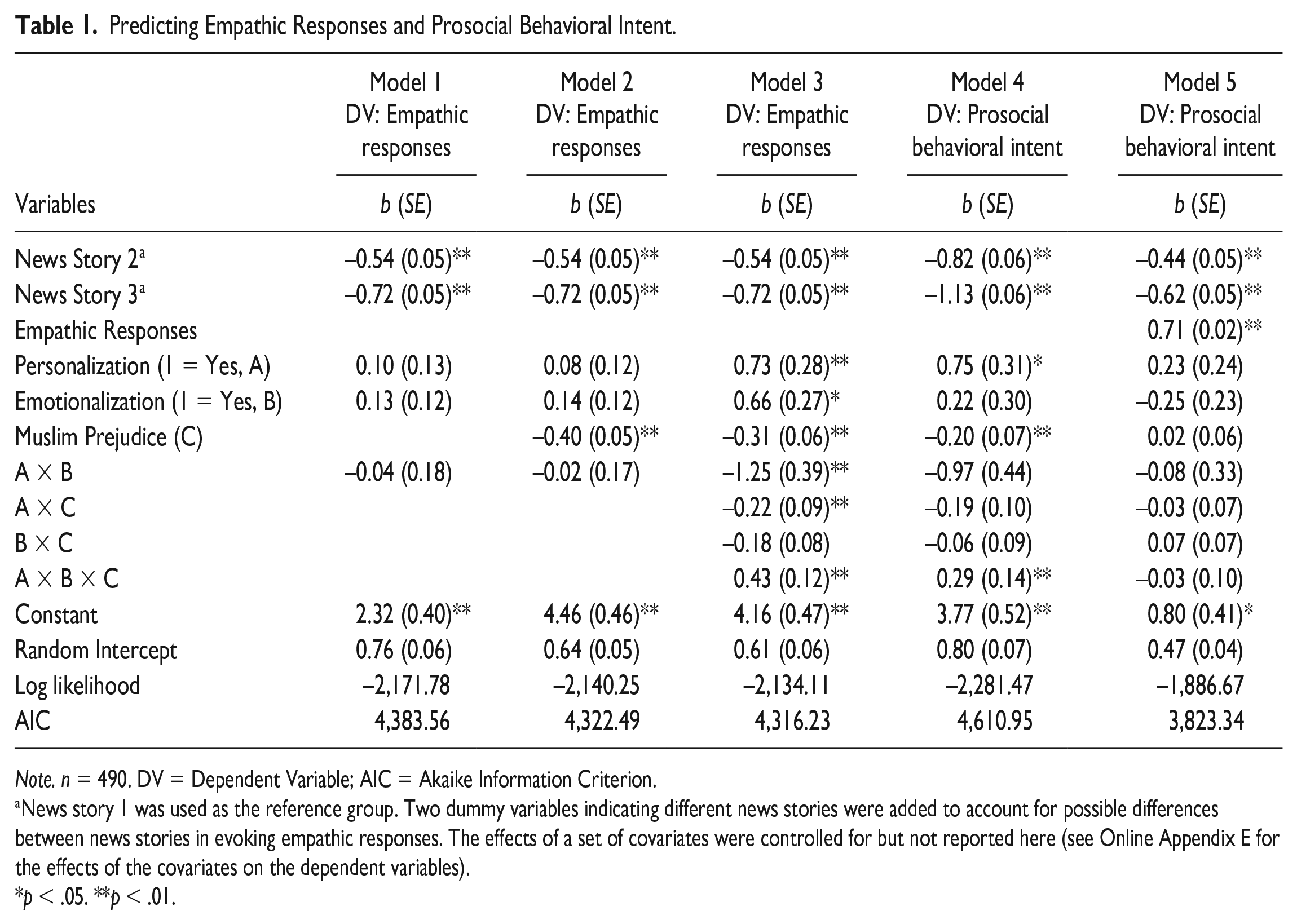
Note. n = 490. DV = Dependent Variable; AIC = Akaike Information Criterion.
News story 1 was used as the reference group. Two dummy variables indicating different news stories were added to account for possible differences between news stories in evoking empathic responses. The effects of a set of covariates were controlled for but not reported here (see Online Appendix E for the effects of the covariates on the dependent variables).
p < .05. **p < .01.
Hypothesis 3, which predicted a negative association between Muslim prejudice and empathic responses, was supported with a statistically significant negative correlation (b = −0.40, SE = 0.05, p < .01; see Model 2 in Table 1). The higher the prejudice against Muslims, the lower the empathy for the victims who appeared in the news stories.
Research Question 2 prompted a test to assess if the effect of personalization varies as a function of emotionalization in news stories and participant prejudice toward Muslims (see Model 3 in Table 1). There was a statistically significant three-way interaction among personalization, emotionalization, and Muslim prejudice (b = −1.25, SE = 0.39, p < .01). This suggests that Muslim prejudice conditions the effects of the two journalistic practices on empathic responses. Further probing of this interaction effect revealed that, with the presence of emotionalization, personalization increased empathy for the victims in news stories. This was true only for participants with relatively strong prejudice toward Muslims (greater than 4.3; about 20% of the sample; see the right panel of Figure 1). Yet, in the absence of emotional displays of victims, the effects of personalization on empathic responses decreased as a function of Muslim prejudice among participants with relatively strong Muslim prejudice (see the left panel of Figure 1).
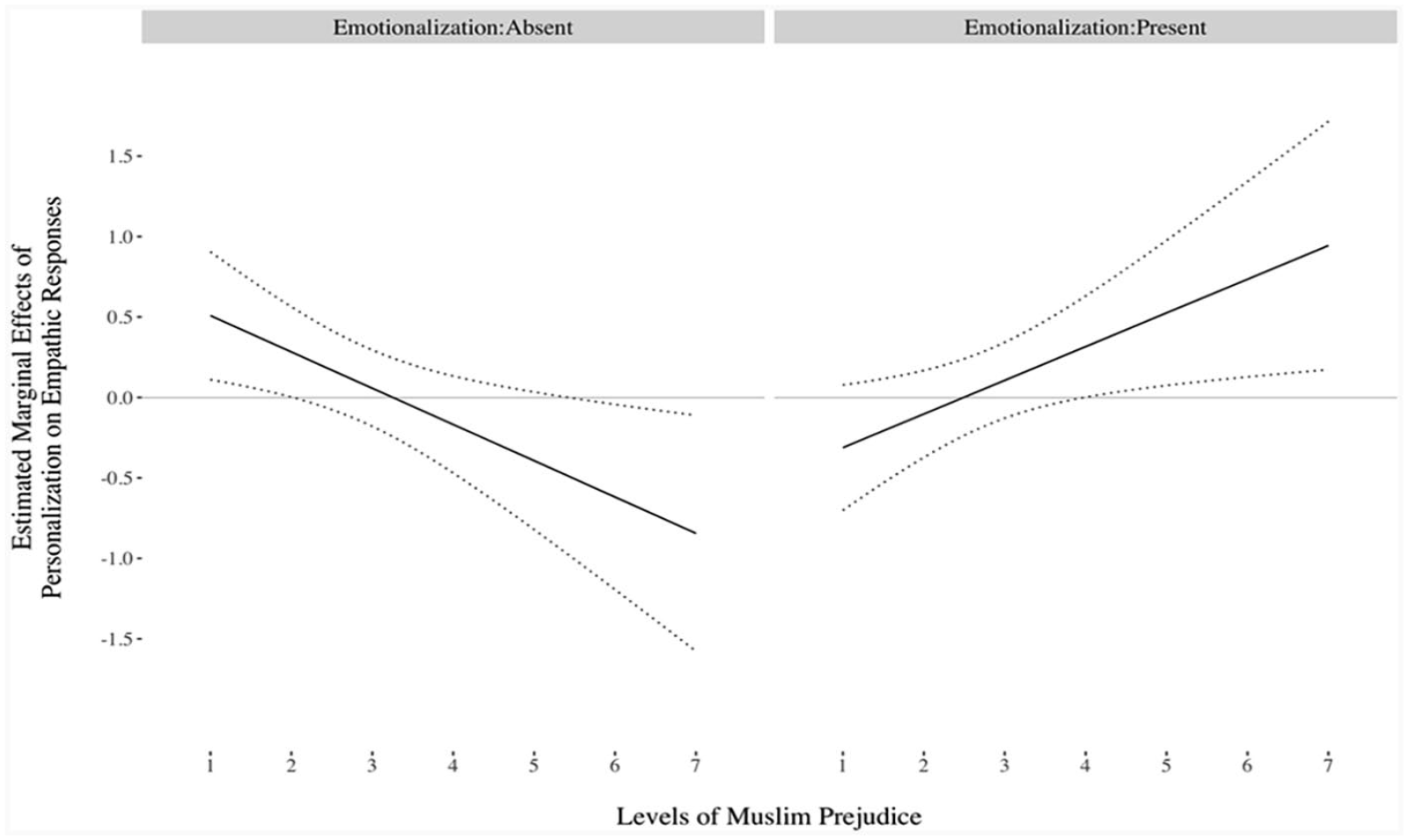
Conditional Marginal Effects of Emotionalization on Empathic Responses at Varying Levels of Personalization and Muslim Prejudice.
Hypothesis 4(a–c) predicted independent and interactive effects of the two journalistic practices on helping behavior via empathic responses toward the victims featured in news stories. The results show that neither of the main effects of the two journalistic practices nor the interaction between the two directly influenced prosocial behavioral intent. However, there was a statistically significant three-way interaction between the two journalistic practices and Muslim prejudice on prosocial behavioral intent (b = 0.29, SE = 0.14, p < .01; see Model 4 of Table 1). This interaction became statistically insignificant when empathy was entered as a predictor of prosocial behavioral intent (b = 0.71, SE = 0.02, p < .01; see Model 5 of Table 1). These findings indicate that Muslim prejudice conditioned the indirect effects of the two journalistic practices on prosocial behavioral intent via empathic responses. Table 2 presents the estimated indirect effects of personalization on helping behavior with the presence and absence of emotionalization and at different levels of Muslim prejudice. Consistent with the findings above, it is noteworthy that without emotionalization, the indirect effects of personalization decreased at higher levels of Muslim prejudice (see the upper panel of Table 2). Yet, with emotionalization, the indirect effects of personalization became stronger as Muslim prejudice increased (see the lower panel of Table 2). These findings partially support H4c.
Estimating Indirect Effects of Personalization on Prosocial Behavioral Intent at the Varying Levels of Emotionalization and Muslim Prejudice.
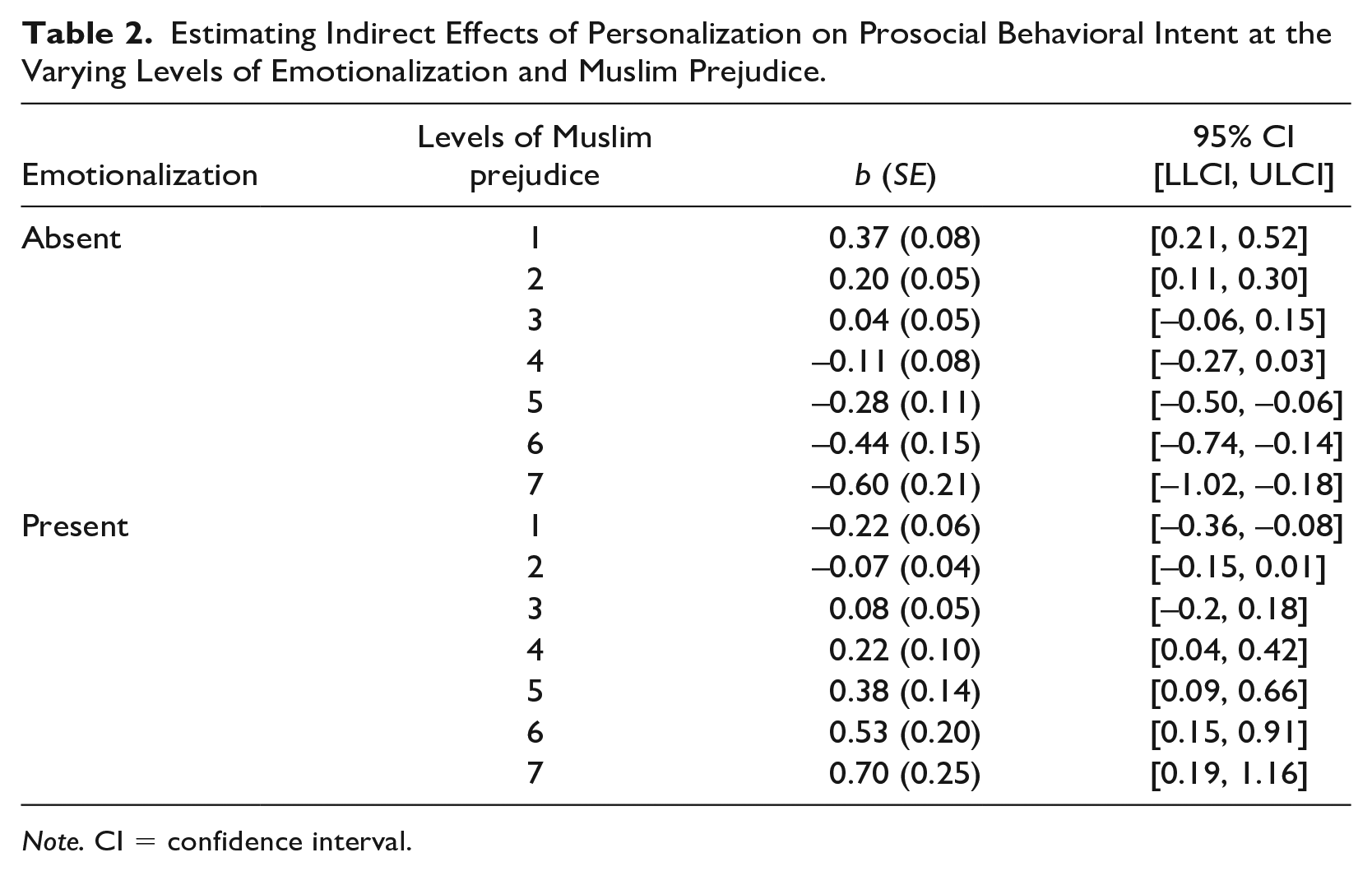
Note. CI = confidence interval.
Research Question 3 asked whether the gender of news users conditions the observed effects of the two journalistic practices and Muslim prejudice on empathic responses and subsequent helping behavior. To answer this question, a model that includes a four-way interaction term between the two journalistic practices, Muslim prejudice, and gender was specified (see Model 6 in the Online Appendix G). While there were no statistically significant four-way interactions between the predictors, a statistically significant interaction between emotionalization and gender (b = −1.13, SE = 0.53, p < .05) emerged. This interaction was further qualified by Muslim prejudice by a significant three-way interaction between emotionalization, Muslim prejudice, and gender (b = 0.51, SE = 0.17, p < .01). Thus, the effects of emotionalization varied as a function of Muslim prejudice and gender. Further probing of the interaction suggests that the effect of emotionalization on empathic response was statistically negligible among men. Women, on the other hand, felt more empathy when emotionalization was present–especially those who self-reported higher (above 2.8) Muslim prejudice, which constituted 43.5% of women participants. These findings suggest that women participants were more likely to feel empathy when they saw the emotional expressions of victims (see Figure 2). Finally, the indirect effects of emotionalization were also estimated to examine whether the mediating effect of empathy was conducted by Muslim prejudice and gender. As reported in Table G2 in the Online Appendix, the indirect effects of emotionalization on prosocial behavioral intent were not significant for men with prejudice scores higher than 2.3 (about 59.9% of men). By contrast, indirect effects on prosocial behavioral intent were statistically significant among women participants with Muslim prejudice scores lower than 4.1 (about 84.1% of women participants).
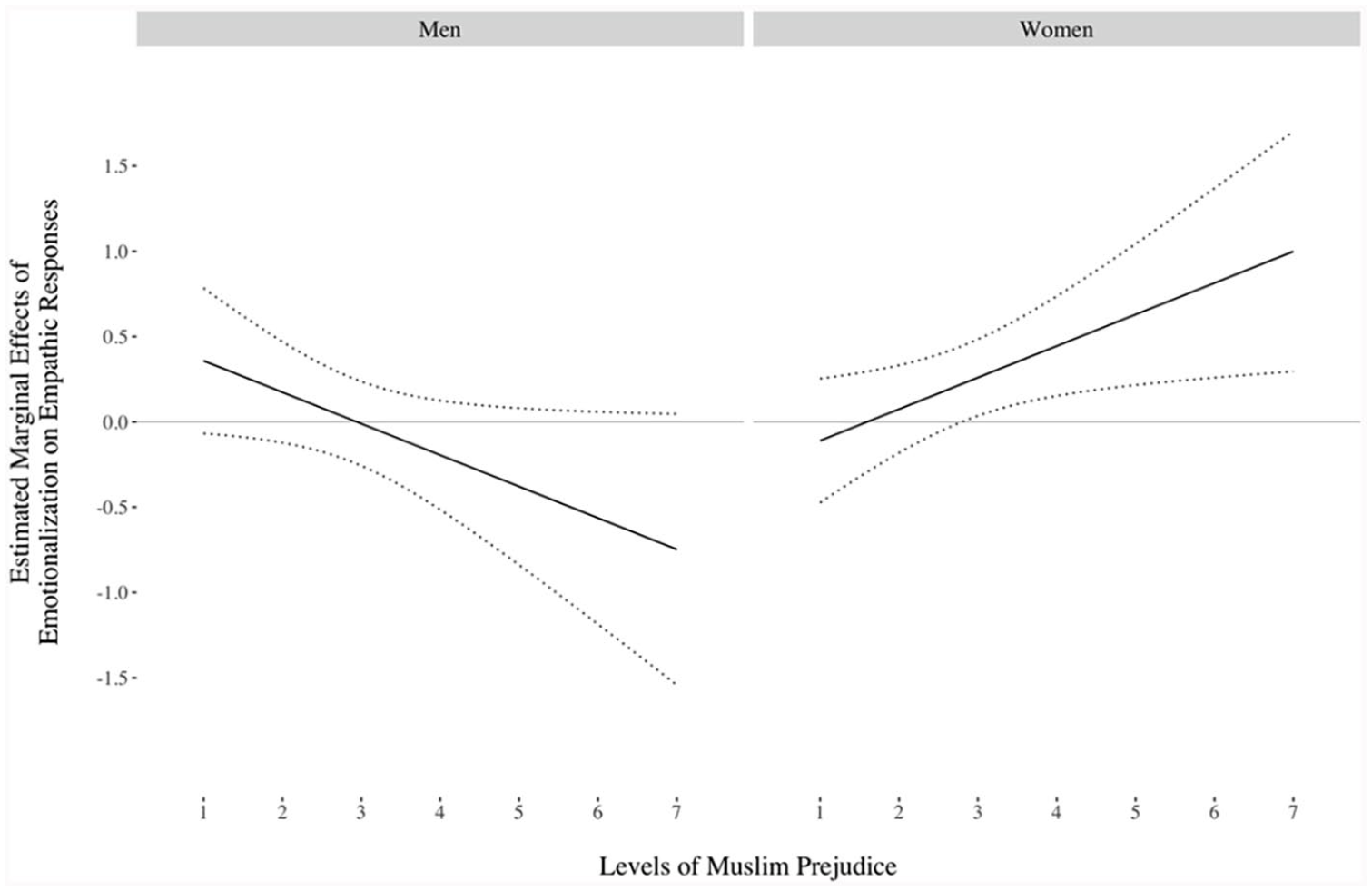
Conditional Marginal Effects of Emotionalization at Varying Levels of Gender and Muslim Prejudice.
Discussion
The study reported here offers evidence that empathy with the plight of Muslims falls within the repertoire, as Batson et al. (2015) would put it, of white Americans who encounter this minority group in news stories about discrimination. There is also tentative evidence in this data set for the potential of news stories to attenuate polarization in post-9/11 America. The majority of Americans do not frequently interact with Muslims, leaving news media as one of the few conduits of inter-group encounters. In this study, we demonstrated that the ways in which journalists cover the discrimination that Muslims endure could pave the way for goodwill across religious lines in the United States. What we found is promising but qualified. News stories can facilitate empathy toward Muslims, especially among media users who are prejudiced against this group. This finding puts empathy-provoking journalistic storytelling on par with media literacy and counter-stereotyping (Holt, 2013; Ramasubramanian, 2007) as potential ways to attenuate prejudice against Muslims.
Personalization and emotionalization, two commonly used journalistic practices of featuring victims in reporting on tragic events (Grabe & Bas, 2021; Pantti, 2010) are central to precipitating empathy and helping behavior. These reporting practices were expected to make the suffering of victims more salient, thereby triggering empathy-based altruistic behavior. We found partial support for this hypothesized effect. First, personalization and emotionalization of victims in news reports, on average, did not increase empathic responses toward victims. Yet, the absence of main effects does not indicate a lack of empathic responses. In particular, participants with low levels of Muslim prejudice reported strong empathic responses toward the victims featured in the news reports. Second, while the two journalistic practices did not independently trigger empathic responses, in combination, they affected participants who held prejudiced views of Muslims. Specifically, personalization moved participants who scored high on Muslim prejudice to higher levels of empathy when emotionalization was present in the story. These observations indicate that personalization and emotionalization might not be independent in eliciting empathy–at least not in the context of mediated inter-group contact. Together, though, they can move people who hold prejudicial attitudes toward an outgroup to empathic responses. This finding also offers some evidence to alleviate concern about the conflation of emotional personalization in previous studies (Bas & Grabe, 2015).
We also found support for a positive association between empathic responses and prosocial behavioral intentions. Personalization and emotionalization of Muslims who are at the receiving end of discrimination not only drew empathic responses from participants who scored high on Muslim prejudice but also mobilized prosocial behavioral intent to help members of this group. Moreover, the gender differences that emerged in this dataset added another layer of insight into the effects of two journalistic practices on empathy-motivated prosocial behavior. Being exposed to the emotional states of victims in news stories provoked strong empathic responses among women regardless of the presence of personal testimonies. Strikingly, this effect was strongest among women who scored high on Muslim prejudice, indicating that emotionalization could break through anti-Muslim sentiments to evoke empathy for victims of discrimination. This was not the case for men. A clearly identifiable victim who gives a firsthand account of emotional distress (i.e., emotional personalization) is necessary to draw empathic responses from men. Our results for men align with existing scholarship that puts the identification with a specific victim as a necessary step toward empathy (Grabe et al., 2017). For women, perhaps the emotional charge of same-sex victimization was enough to elicit empathy without personalization.
Overall, our findings provide an optimistic outlook for the future of inter-group relations because people who hold negative attitudes toward Muslims are likely to support discriminatory policies against this group (Dunwoody & McFarland, 2018; Sides & Gross, 2013). News media are positioned to facilitate reconciliation by granting the victims of prejudice a voice to tell their stories and publicly emote the toll that Islamophobia takes on them. In this sense, our findings have implications for journalistic practice, pointing to active engagement within under-served communities and relaying the voices of members of those communities. This may seem at odds with the conventional cold-hard-facts conception of journalism as a profession, but it is precisely what contemporary citizens expect from the news (Weaver et al., 2019). Thus, despite the criticism of personalization and emotionalization of news content in some circles, emotion-laden personal testimonies in news stories are found to be socially productive and attractive to news users. The long-term impact of such emotion-based engagement could facilitate shifts in cultural values and social integration patterns. Yet, the increasing reliance on algorithm-driven media use (Newman et al., 2023) drives exposure to content that aligns with the political identity of users and thus reinforces existing beliefs (e.g., Ahmed & Gil-Lopez, 2022). In this context, people who hold negative views of Muslims may be unlikely to encounter news reports that offer an opportunity for this minority group to voice their experiences of discrimination. Given that engagement with personalized and emotionalized news stories appears to be a necessary condition for prosocial-mediated inter-group contact, the algorithmic hold on information flow is a formidable obstacle in achieving the pluralistic ideals of democracy.
A few limitations of our study warrant attention. First, while samples recruited from mTurk are often used in academic research and were found to replicate the findings of nationally representative samples (Mullinix et al., 2015), caution should be taken in generalizing the findings reported here to the larger U.S. population. Experimental research like this needs replication to establish the robustness of findings for generalizability nationally and internationally. Given rising anti-Muslim sentiment in Europe (Pickel & Öztürk, 2018), the findings we report here offer impetus to test personalization and emotionalization in European contexts where Islamophobia has taken hold.
Second, it should be noted that the victims who appeared in the experimental stimuli were what Moeller (2002) defined as idealized victims, and existing studies reported greater same-sex than other-sex empathy among women. It is, therefore, not clear whether the two journalistic practices would produce similar gender results when applied to victimized Muslim men. Third, given that sadness is not the only emotion that victims of discrimination express, it is not clear whether news users would respond similarly to anger, an emotion that is often felt in the context of discrimination. For these reasons, more work is needed to test the robustness of personalization and emotionalization in other emotion and gender configurations.
Fourth, while behavioral intent is a strong predictor of actual behavior, it does not always translate into action (Sheeran & Webb, 2016). Future studies are needed to determine if personalization and emotionalization of Muslim victims in media content can elicit empathy-motivated prosocial behavior and assess the longevity of such effects in everyday life. Kalla and Broockman (2020) tested the longevity of the contact hypothesis in face-to-face conversations using field experiments. A similar approach with mediated contact between majority and minority groups would greatly benefit this area of research. Twenty years ago, N.Miller (2002) argued for more evidence of the contact hypothesis in terms of subsistence and generalizability beyond a single contact. This question, if prosocial responses during contact with an outgroup member would persist and extend to other members of that outgroup, sparked cross-disciplinary inquiry on interpersonal contact. Sustained scholarly focus on the consequences of mediated contact remains largely unrealized, despite its far-reaching promise.
Despite these limitations, the findings we report here offer insight into how news could alleviate a religious divide. It also indirectly attributes responsibility to journalists in their decision making when they cover discrimination against Muslims. Editorial commitment to give voice to victim experiences and visually document their emotional hardship might help news audiences with prejudice toward minority groups overcome the barriers of compassion fatigue. This is a roseate outlook on the role of journalism in attenuating tension across communities. Of course, empathy-provoking media coverage of Muslims is unlikely to magically break cycles of hate crimes and discrimination. Indeed, the dominant media narrative about Muslims still pegs members of this minority group as outsiders in an us-versus-them framework that continues to resonate with some Americans. Indeed, the dominance of stereotypical media representations of Muslims (Saleem & Ramasubramanian, 2019) is well-positioned to undo empathy that personalized and emotionalized news may afford. At the same time, we have demonstrated here that there are ways to prevent further rupture of the social fabric that undermines the health of democracies. As Nelson Mandela (2008) famously said: “No one is born hating another person because of the color of his skin, or his background, or his religion. People must learn to hate, and if they can learn to hate, they can be taught to love, for love comes more naturally to the human heart than its opposite.”
Supplemental Material
sj-docx-1-jmq-10.1177_10776990231202702 – Supplemental material for Empathy With Muslim Victims of Discrimination: Can Personalization and Emotionalization in News Reporting Pave the Way?
Supplemental material, sj-docx-1-jmq-10.1177_10776990231202702 for Empathy With Muslim Victims of Discrimination: Can Personalization and Emotionalization in News Reporting Pave the Way? by Minchul Kim and Maria Elizabeth Grabe in Journalism & Mass Communication Quarterly
Footnotes
Declaration of Conflicting Interests
The author(s) declared no potential conflicts of interest with respect to the research, authorship, and/or publication of this article.
Funding
The author(s) disclosed receipt of the following financial support for the research, authorship, and/or publication of this article: This research was supported by the Chung-Ang University Research Grants in 2022.
Supplemental Material
Supplemental material for this article is available online.
Notes
Author Biographies
References
Supplementary Material
Please find the following supplemental material available below.
For Open Access articles published under a Creative Commons License, all supplemental material carries the same license as the article it is associated with.
For non-Open Access articles published, all supplemental material carries a non-exclusive license, and permission requests for re-use of supplemental material or any part of supplemental material shall be sent directly to the copyright owner as specified in the copyright notice associated with the article.
