



Abstract
Trust in the news media is an important prerequisite for democracies. Building on media trust and accuracy research, we investigate reciprocal effects between perceived accuracy and trust in news. We implemented a two-wave online panel survey (N = 952) in the context of the 2021 German federal election. For media individuals' use, we find that trust and accuracy are reciprocally related and are influenced by media use. For the media in general, only trust has an effect on accuracy, whereas media skepticism and cynicism are only associated with trust, not with accuracy. Further results and their implications are discussed.
There is ample agreement among communication researchers that public trust in news media is a requirement for any democracy to function properly. Access to accurate information and trust in its accuracy enables citizens to make informed decisions (Jones, 2004). This is especially true in the context of democratic elections. Longitudinal studies have shown that the less citizens trust the news media, the more they believe in (online) disinformation (Zimmermann & Kohring, 2020).
Even though a slight increase in media trust was observed during the COVID-19 pandemic, media trust remains rather low in many countries (Newman et al., 2022). The topic is highly debated, concerning the measurement of media trust (Prochazka & Schweiger, 2019; Yale et al., 2015), if and how it can be distinguished from similar constructs such as credibility (Engelke et al., 2019), and correlates of trust (Fawzi et al., 2021). Regarding shortcomings of the current literature, Strömbäck et al. (2020) argue that researchers often do not clarify what exactly trust refers to. They stress that the measured levels of trust are likely dependent on the object of trust respondents think about while answering surveys. Fawzi et al. (2021) suggest that trust evaluations vary depending on whether users judge the news media in general or the news media they use, which only a few studies differentiate. They further point out that there is a lack of longitudinal studies, which creates two problems for media trust researchers: First, it hinders causal inferences about predictors of media trust. This results in a plethora of correlates of trust, for which it is not clear whether they are a cause or a consequence of trust. Second, it limits the field’s understanding of what causes intraindividual effects on media trust. The few longitudinal analyses that exist do not provide any cure for these ills because they rely on data from repeated international cross-sectional surveys (e.g., the World Values Survey, Hanitzsch et al., 2018). While they make important contributions about how news media trust changes within and across countries over time, they have to neglect intraindividual effects.
We address these shortcomings in several ways and pursue three goals in our study: Regarding the scope of trust in news, we focus on this topic before and after the 2021 German federal election. Germany provides an interesting case to examine trust in the news in general and election coverage in particular for two reasons: First, the overall level of trust in Germany in news media is relatively high (Newman et al., 2022). Second, Germans are less trusting about controversial topics and attitudes toward the news media were increasingly polarized before the pandemic (Jackob et al., 2019). This is especially worrying in the context of elections, which lead to additional increases in political polarization (Hansen & Kosiara-Pedersen, 2017). Regarding the methodological approach, one goal of our study is to investigate the relationship between trust and one important correlate, namely the perceived accuracy of news (Fawzi et al., 2021; Prochazka, 2020; Wilner et al., 2021), in a two-wave panel design. This allows us to draw inferences about the causal structure of the relationship between the two constructs. Researchers have to date neglected the question of which construct is causally dominant (Prochazka & Schweiger, 2019). As a second goal, the design enables us to examine to what extent media, social, and political characteristics predict news media trust and if these variables have intraindividual effects on trust evaluations. Moreover, little is known about how trust in specific topics changes or if it does so at all over a rather short timeframe, such as an election campaign. With this approach, we third try to make a step in providing longitudinal data for trust in news media and we differentiate users’ trust evaluations between news media in general and news media they use to account for the lack of empirical evidence on this distinction.
In the first part of the article, we will give a brief overview of what media trust is. We will then situate Germans’ trust in the news and the 2021 election in a broader context, followed by a literature review about individual factors associated with media trust. Next, we will present the methodology and results from our panel study. Finally, we discuss their consequences alongside the limitations of the study and make suggestions for future research.
Trust in News Media
In the broadest sense, media trust refers to the risk news users are willing to take regarding the quality of the information they receive through the news: Resource constraints (e.g., time or money) make it impossible for them to verify everything the news media report. Users have to trust the news media to adequately fulfill their role of providing reliable information (Hanitzsch et al., 2018).
Media trust research has identified a plethora of predictors and correlates of trust. Fawzi et al. (2021) separate these into societal and individual factors. These factors can refer to multiple objects: Strömbäck et al. (2020) differentiate between trust in the news media in general, trust in media types (or channels), specific media brands, individual journalists, and media content. They note that researchers should focus on trust in information provided by the news media and not trust in the news media itself. Tsfati et al. (2022) confirmed that general media trust should be distinguished from topical media trust and that the latter is a better predictor of correct recognition of issue-relevant facts. Based on this research, we focus on the individual factors that predict news users’ trust in specific content, namely the coverage of the 2021 German federal election. Election coverage is an important determinant of political parties’ and candidates’ electoral success (Cushion & Thomas, 2018), and it can activate political cynicism (Cappella & Jamieson, 1997) or foster political aspects such as trust, knowledge, and engagement (Norris, 2000).
German’s Trust in News Media and the Elections
Politically, Germany can be characterized as a stable democracy with a parliamentary regime and a strong multiparty system. Usually, elections in Germany lead to coalition governments. The German two-tier electoral system is based on proportional representation, giving the citizens one vote for a constituency candidate and a second vote for a closed party list. Regarding the media system, Germany belongs to the democratic-corporatist cluster that is characterized by an inclusive media market, low degrees of political parallelism, i.e., “the extent to which the structure of the media systems parallels the divisions of the political party and interest group system” (Hallin, 2021, p. 4), high levels of journalistic professionalism, and a strong role of the state (Humprecht et al., 2022, p. 11). Hanitzsch et al. (2018) propose that this combination of media and political systems serves as a potential safeguard against polarization which could explain the comparatively high levels of media trust (50% according to the 2022 Digital News Report; Newman et al., 2022). Others have observed a positive effect of state media ownership on trust—at least in democracies (Tsfati & Ariely, 2014). The German state has no media ownership, but the country does have strong public service media. However, another country-level analysis did not reveal any link between public service news media use and media trust (Kalogeropoulos et al., 2019).
Against this backdrop, the 2021 election in Germany is a special case for three core reasons: First, Angela Merkel, Chancellor since 2005, did not run for another term in office. There was no incumbency bonus (the news media’s tendency to disproportionally cover the sitting Chancellor over other candidates), which is generally rather pronounced in Germany (Leidecker-Sandmann & Wilke, 2019). Second, the Greens, a minor party, named a chancellor candidate for the first time because the party was riding high in the polls and was believed to have a chance of winning the election which was previously mostly decided between the conservative Christlich Demokratische Union (CDU, engl. Christian Democratic Union) and social-democratic Sozialdemokratische Partei Deutschlands (SPD, engl. Social Democratic Party). Third, the election was held during a global pandemic. According to Germany’s COVID monitoring (Betsch et al., 2020), the vaccination campaign in Germany had slowed down considerably, because at the time of the election about one-third of adult Germans thought that the government’s measures went too far, and almost half believed that the news media were overhyping COVID-19. Due to these circumstances, news users’ trust in the election coverage was highly important and therefore is an interesting research topic.
Individual Factors Related to Media Trust
Following Fawzi et al. (2021), individual factors related to media trust can be sorted into social (i.e., age, gender, and education), political (i.e., political trust and cynicism, political ideology, political interest and knowledge, and political efficacy), and media characteristics (i.e., media use, media skepticism, and cynicism). Here, we focus on media characteristics but empirically control for social and political characteristics.
One important correlate of media trust is the perceived quality of news. The terms are sometimes used interchangeably and quality perceptions are used as indicators of media trust, implying that the underlying latent construct of trust causes quality perceptions (Prochazka & Schweiger, 2019). Often used scales to measure credibility (Gaziano & McGrath, 1986), media trust (Kohring & Matthes, 2007), or related constructs such as media skepticism (Tsfati & Cappella, 2003) contain items that directly relate to news quality, such as the perceived accuracy or balance of news. This approach is reasonable in so far, as users tend to have high expectations of the media concerning news quality: Recent research on audiences’ role perceptions of journalists shows that their main expectation is the accurate reporting of facts by detached observers (Loosen et al., 2020). Fawzi and Mothes (2020) showed that a discrepancy in users’ expectations and observations of journalism, if journalism “underperforms,” is negatively related to media trust. Prochazka (2020) found that perceived accuracy was the most important dimension of news quality with regard to media trust. Yale et al. (2015) investigated the factor structure of common media trust scales and found that multidimensional conceptions of media trust are empirically inadequate, likely because users cannot pick up on the often subtle differences that researchers do when they differentiate between news’ balance or accuracy. Building on this work, Prochazka and Schweiger (2019) propose that it might be time to abandon the implied equivalence of perceived media quality and generalized media trust and propose the investigation of the causal structure of the relationship between the two constructs. Following this, we investigate the relationship between perceived news accuracy—one important dimension of quality—and media trust.
Since the 1930s, researchers have tried to assess news accuracy by sending newspaper clippings to the cited sources who were asked to report any errors (Charnley, 1936). Later studies started to differentiate between objective and subjective errors, referring to the inaccurate reproduction of facts and errors in judgment (e.g., over- or underemphasizing aspects of a story) (Blankenburg, 1970). Using this method, Maier (2005) found a relationship between the accuracy of news and its perceived credibility. Although these results were based on the sources of news, there is some evidence that a generalization to the wider audience is appropriate. Livio and Cohen (2018) found that individuals with firsthand experience of events had lower trust when they observed a discrepancy between their experiences and the news. One theme in a series of qualitative interviews with users by Prochazka (2020) was that repeated errors in the news would lead to lower media trust. In a survey, he found additional evidence for such an effect, but only if the errors were attributed to malice rather than negligence. Based on the operationalization of errors as either objective or subjective (Maier, 2005), Wilner et al. (2021) found that subjective errors were observed more frequently than objective ones and that this frequency was negatively associated with media trust.
In summary, there is strong evidence that perceptions of errors in the news are related to media trust. In the first step, we analyze if a (positive) correlation between the two constructs exists:
However, it is not clear yet what casual relation these constructs have. There are three possibilities: (1) perceived media accuracy causally affects media trust, (2) media trust causally affects perceived media accuracy, or (3) both constructs are related but without a clear causal direction, similar to a (negative) feedback loop. This relationship is the main interest of this study. Therefore, we ask:
Another important correlate of media trust is media use (Strömbäck et al., 2020). Studies have shown a relationship between exposure to traditional news media and media trust (Hanitzsch et al., 2018; Tsfati & Ariely, 2014; Tsfati & Cappella, 2003) and that low levels of trust correlate with alternative or non-traditional media use (i.e., nonlegacy digital news; Kalogeropoulos et al., 2019). Fawzi et al. (2021) point out that while the general association between media use and trust is somewhat inconsistent, this might be an artifact of how trust is measured. They propose that users differentiate their trust assessments between the news in general and the news they consume. Recent German data support this assumption with a detectable difference between general trust (50%) and trust in the news users consume (57%) (Hölig et al., 2022, p. 27). Further experimental evidence is provided by Daniller et al. (2017) who found that questions about trust in the news media as an unspecified entity lead to the lowest trust scores, compared to questions about trust in news media which respondents consume, or the mainstream media in general. For our study, these findings have two consequences: First, it makes sense to differentiate between users’ trust in the news they consume and the news media in general. Second, we need to account for news usage on an empirical level. More concretely, we expect that people who consume news more often should perceive errors with a higher frequency and judge the news media as less accurate. On a longitudinal level, we expect that individuals’ media use frequency at a given time predicts the perceived accuracy of news at a later time:
Building on prior research that has found media use to be a predictor of trust (Hanitzsch et al., 2018; Tsfati & Ariely, 2014; Tsfati & Cappella, 2003), we also expect that individuals’ media use will predict news users’ trust in election coverage:
These effects can only exist for the news that people consume, but not the news media in general. If individuals do not use specific news outlets, they are less likely to perceive errors in those outlets and these perceptions will by definition not be based on firsthand experiences. This leads to the question of how perceptions of accuracy and trust of the (not used) news media form and which factors influence these perceptions.
Here, critical attitudes about the news media are relevant. One construct that is often studied in relation to media trust is media skepticism (Carr et al., 2014; Quiring et al., 2021). Early research defined the construct as “a subjective feeling of alienation and mistrust towards the mainstream news media” (Tsfati, 2003, p. 67) considering that it is the absence or even the opposite of trust (Fawzi et al., 2021). Such critical attitudes toward the news media are related to lower usage of mainstream media and increasing consumption of alternative ones (Tsfati & Cohen, 2012).
Recent research has started to differentiate between media skepticism and cynicism and investigated their relation to media trust. With this conceptualization, researchers account for two key aspects of attitudes about the news media. First, they are not always an overall unreflective criticism and rejection of the news media but can also be a constructive-critical engagement without rejecting or disregarding the news media completely. Second, they are not the opposite or absence of trust but rather correlates of it (for an overview see Cappella & Jamieson, 1996; Quiring et al., 2021).
In the context of politics, Yamamoto and Kushin (2014) define cynicism as a “mistrustful disposition towards, and an absence of confidence in, the political system” (p. 431) and show its negative relation to trust and perceived political performance. Quiring et al. (2021) argue that media-related cynicism is characterized by an undifferentiated and across-the-board rejection of the news media since users perceive them to be flawed and have “malevolent motivations to manipulate public opinion and conspire with political actors” (p. 3,500). Consequently, users completely exclude “reflective balancing perceptions” (Quiring et al., 2021, p. 3,500) and therefore show low levels of news media trust. Subsequently, media cynicism is related to negative generalized judgments about the manipulation of public opinion as well as about biased and incorrect news reporting. Empirically, this is partially supported by Henke et al. (2022) who showed that more media cynical users were less able to understand and forgive errors in the news. Therefore, we assume:
On the other hand, Yamamoto and Kushin (2014) argue skepticism in the context of politics is “a disbelief in the political process but not a rejection of it” (p. 432) resulting in fact-checking and additional information-seeking, which increase political involvement and participation. Therefore, it is healthy for democracies (van der Meer & Zmerli, 2017).
Similar to this context, media skepticism refers to constructive-critical scrutiny of the media’s performance and competence (Quiring et al., 2021). Media skeptical attitudes are “based on the observable imperfect performance of the media” (Quiring et al., 2021, p. 3,499). Therefore, media skeptic users are aware that errors can occur in news, but they can tolerate them as long as they remain exceptions and are used by journalists or newsrooms to improve their journalistic work. Consequently, the correlation between media skepticism and media trust should be positive. We assume:
Methods
Sample
To answer our research question and test our hypotheses, we carried out a two-wave online panel survey in the context of the 2021 German federal election campaign. This design allows us to examine the stability of our dependent variables on the individual level as well as the causal relations between the variables as assumed in our hypotheses. The participants of the study were recruited from a commercial online access panel administered and remunerated by the market research company “Bilendi & respondi.” We defined representative quotas for age, gender, and education according to the German population (Statistisches Bundesamt, 2021). Germany’s 2021 federal election occurred on September 26. Data for the first wave (henceforth Wave 1) was collected 4 weeks before the election (August 30–September 8, 2021) and for the second wave (Wave 2) during the fourth week after the election (October 18–21, 2021).
The study received N = 1,564 completed questionnaires in Wave 1 and N = 1,164 in Wave 2, which equates to a retention rate of 74%. Before analyzing our data, we removed participants who had withdrawn their consent, had an identical anonymous participant ID, or gave either nonsensical answers or none at all to an open-ended question about news use in Wave 1. This was done to filter out low effort as well as automated responses. This procedure left us with aggregate questionnaires for each Wave, Wave 1 (n = 1,423), and Wave 2 (n = 1,160). We then matched a unique participant ID to responses from both Waves (n = 1,050), from which we removed 98 cases due to discrepancies in sociodemographic variables between Wave 1 and 2 (Discrepancies from the total of wave 2 are due to participants who completed both waves but were removed due to the criteria described above.). Consequently, a total of 952 participants are included in our analyses. In the final sample, the distribution of age (M = 54.7; SD = 14.5) and education level (34% with general or specific qualifications for university entrance) was in line with our quotas, while female participants were slightly underrepresented (47%). The data and the codebook are available in our OSF project (Holtrup et al., 2023).
Measures
Trust in German Election Coverage
To measure our key dependent variable, we translated the scale proposed by Strömbäck et al. (2020). The items, measured on a five-point scale ranging from 1 = “strongly disagree” to 5 = strongly agree,” contain different aspects of news media trust, that is, fairness, objectivity, completeness, accuracy, and separation of facts and opinions. As explained above, we distinguished between news media that participants use (T1: M = 3.29, SD = 0.99, McDonald’s Ć = .923; T2: M = 3.41, SD = 0.98, McDonald’s Ć = .921) and the news media in general (T1: M = 3.09, SD = 0.97, McDonald’s Ć = .923; T2: M = 3.22, SD = 0.97, McDonald’s Ć = .923). We calculated McDonald’s Ć as the reliability coefficient instead of Cronbach’s α—which is a special case of the former and assumes that all factor loadings are equal—since we used a measurement model with varying loadings (c.f. data analysis section). It can be interpreted just like Cronbach’s α.
Perceived News Accuracy
Participants’ perception of news accuracy was based on the operationalization of Wilner et al. (2021). Participants were asked how often they perceived (1) inaccurate headlines, (2) misspellings, (3) factual errors, (4) essential information missing, (5) overemphasis on individual aspects of the subject, and (6) a story sensationalized in the election coverage. We added two items that referred to errors in the selection of information: (7) Too much coverage of unimportant issues and (8) too little coverage of important issues in the context of the federal election. Participants were asked to indicate how often they observed these errors in the election coverage ranging from 1 = “never” to 5 = “always.” For interpretation purposes, all variables were recoded so that higher values indicated higher perceived accuracy. Again, we asked participants to differentiate between the media they use (T1: M = 2.57, SD = 0.87, McDonald’s Ć = .899; T2: M = 2.43, SD = 0.86, McDonald’s Ć = .899) and the news media in general (T1: M = 2.84, SD = 0.85, McDonald’s Ć = .891; T2: M = 2.67, SD = 0.87, McDonald’s Ć = .892).
Media Use
In Wave 1, we measured participants’ media use based on Kruikemeier and Shehata (2017). According to this measurement, respondents were asked how often they follow the German election coverage (1) by reading printed daily newspapers, (2) listening to radio news, (3) watching television news, and (4) using the internet to follow the news. We added one more item to measure participants’ social media use (i.e., “reading or watching the news on social media platforms”). The items were answered on a five-point scale ranging from 1 = “never” to 5 = “at least five days a week.” We calculated an additive index ranging from 5 to 25 (M = 16.2, SD = 4.46, Cronbach’s α = .733) which was used as a manifest variable in later analysis.
Media Skepticism and Cynicism
We measured media skepticism and cynicism in Wave 1 with the instrument developed by Quiring et al. (2021). The items were answered on a five-point scale ranging from 1 = “do not agree at all” to 5 = “completely agree.” Both scales consist of four items. The index of media skepticism (M = 3.40, SD = 0.89, McDonald’s Ć = .872) contains items about users’ general attitudes toward the balance, objectivity, reliability, and independence of news media. The four items for media cynicism (M = 2.60, SD = 1.19, McDonald’s Ć = .934) reflect users’ attitudes about whether the news media manipulate people, tell lies, are abused by those with power, and prescribe opinions to people.
Control Variables
Following the classification of individual factors related to media trust into social, political, and media characteristics by Fawzi et al. (2021), we include political trust and cynicism, political ideology, political interest and knowledge, and political efficacy (internal and external) as control variables. According to several studies, trust in democratic structures and processes, political interest, knowledge, and efficacy are positively correlated to media trust (e.g., Prochazka, 2020; Tsfati & Ariely, 2014), while political cynicism is negatively correlated to it (e.g., Carr et al., 2014). For political ideology, researchers have found that media trust varies by the political attitudes individuals hold (Livio & Cohen, 2018; Yamamoto et al., 2016).
Concerning social factors, Fawzi et al. (2021) argue that most studies of media trust investigated sociodemographic variables and found inconsistent findings. Following recent studies, we include gender, age, and education as control variables in our analyses.
All control variables were measured in Wave 1. The wordings for the items of trust, media skepticism, and cynicism as well as descriptive statistics of all control variables and wordings for the associated items are provided in the Online Supplements Materials.
Data Analysis
We fitted two latent variable cross-lagged panel models (McArdle, 2009). These models allow us to investigate the possibly reciprocal relationship between media trust and perceived news accuracy. The backbone of the models are auto-regressive paths from trust and perceived news accuracy in Wave 1 to their counterparts in Wave 2. By controlling for these effects, we can estimate the influence the constructs have on each other, that is, the effect of trust in Wave 1 on perceived accuracy in Wave 2 and vice versa. Because we measured media, social, and political characteristics in Wave 1, we can estimate their intra-individual effects on news media trust and perceived accuracy. All analyses were carried out in R (R Core Team, 2021) using the lavaan package (Rosseel, 2012). Missing data were not imputed. Model-implied correlations between all variables are reported in the Online Supplement Materials as well.
Before fitting the models, we tested for measurement invariance of our constructs, that is, the equality of measurement properties over time achieved by constraining item loadings and intercepts to be equal (Liu et al., 2017). The measures achieved full (perceived accuracy of news media respondents use) or partial (all other DVs) scalar invariance, indicating that the latent factor means can be meaningfully compared across waves. For both trust measurements, model fit was best after freeing the item intercepts of the fifth item (“The media separate facts from opinions when covering the election”). In the case of perceived accuracy of the news media in general, the fit was best after freeing the intercepts of items 3 (frequency of factual errors) and 8 (frequency of the coverage of unimportant topics). The final models were used as our measurement model in the following cross-lagged analysis. Table 1 gives an overview of our invariance tests.
Measurement Invariance Model Fit Statistics for All Dependent Variables.
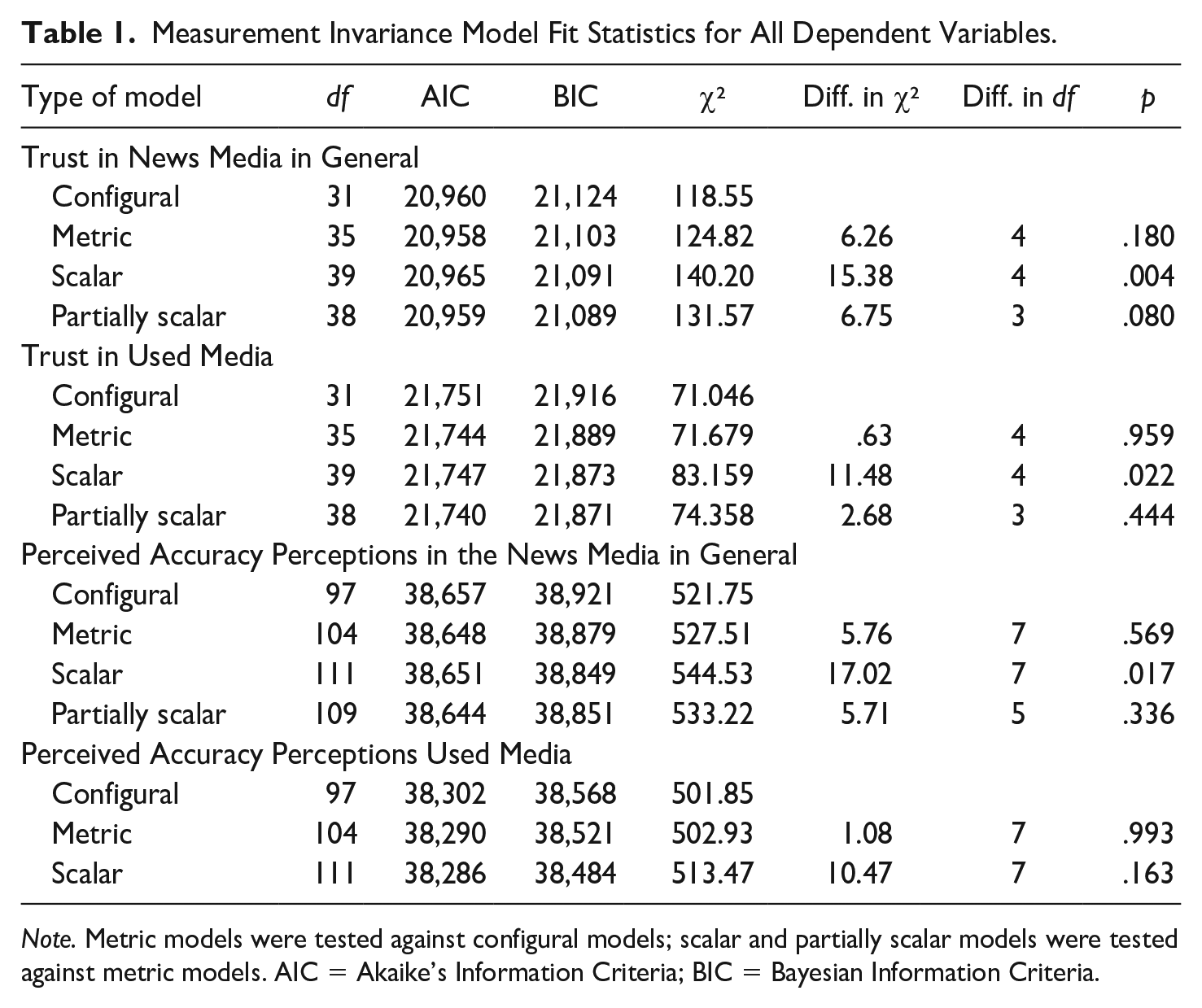
Note. Metric models were tested against configural models; scalar and partially scalar models were tested against metric models. AIC = Akaike’s Information Criteria; BIC = Bayesian Information Criteria.
Results
First, we fitted our hypothesized model for trust in and the perceived news accuracy of the news media our respondents used. Figure 1 gives an overview of this model. Our control variables were modeled as correlated with our other measures in Wave 1, but as predictors for the dependent variables from Wave 2. Except for political knowledge, ideology, media use, and socio-demographics, all variables were modeled as latent variables (c.f. methods). Overall, the model fit the data well, N = 891; χ²(814) = 1143.21; p < .001; CFI = .993; TLI = .991; RMSEA = .021; 90% CI [.018, .024].
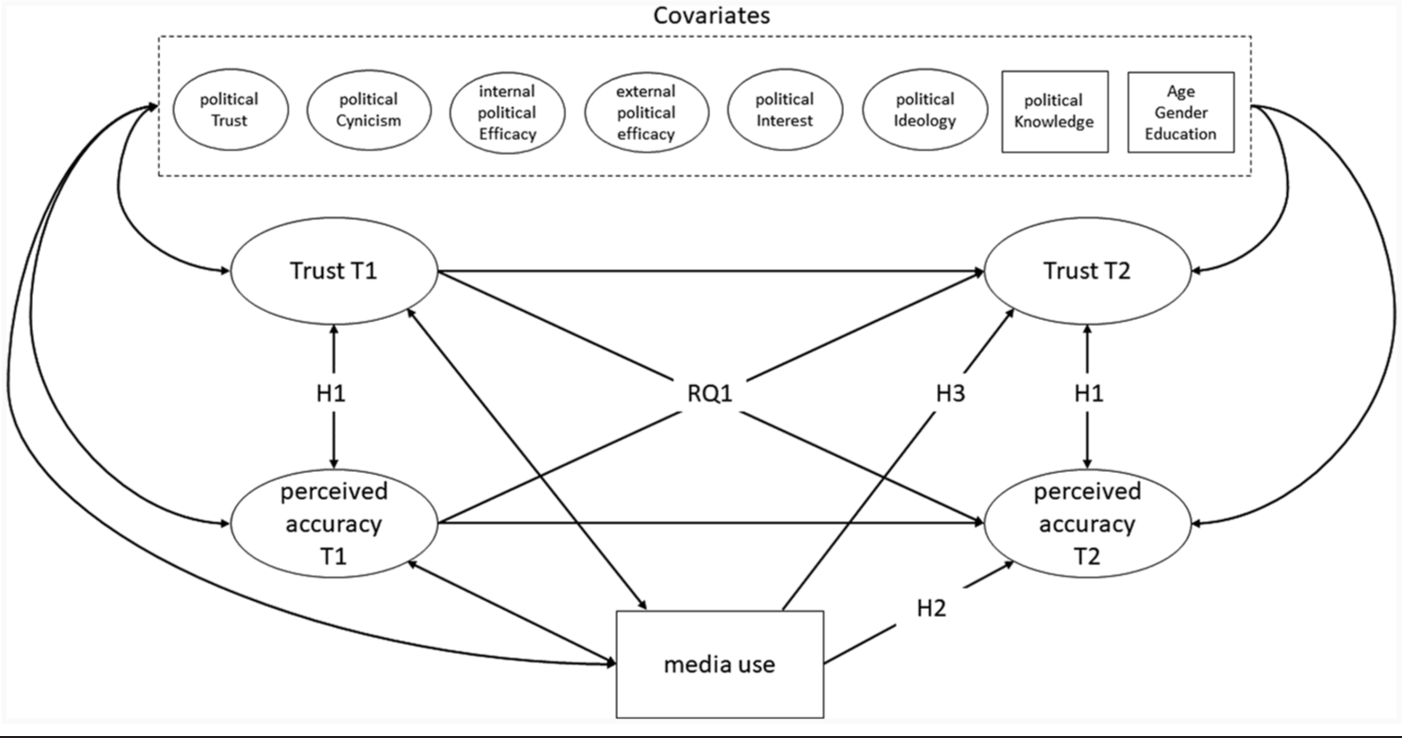
Cross-Lagged Panel Model for the Reciprocal Effects of Media Trust and Accuracy Perceptions of Media Used by Respondents.
First, we looked at how our dependent variables changed between the first and second measurements. For the first measurement, the latent means were set to 0 (trust SD = .97; news accuracy SD = .93). We then freely estimated the latent means of our variables at the second measurement (keeping item loadings and intercepts constrained to be equal according to our scalar invariant measurement models). Keeping in mind that we have to be cautious in comparing these latent means, due to only partial scalar invariance, we observed a small increase in trust in news media our respondents use (Mwave2 = .16; SD = .96). The same pattern was observed for perceived news accuracy (Mwave2 = .16; SD = .92).
Next, we tested our hypotheses. In H1, we assumed a correlation between media trust and perceived accuracy. This held for both Waves (Wave 1: r = .38; p < .001; Wave 2: r = .44; p < .001). In H2, we predicted that higher media use would lead to lower perceived media accuracy of news media respondents use. We did find this effect but it was small (β = −.11; p < .001). Thus, we can confirm H2. However, we found no evidence for a positive effect of media use on media trust in news media respondents use (H3; β = .06; p = .062) and have to reject H3. Finally, we were interested in whether media trust or perceived news accuracy was a dominant cross-lagged predictor (RQ1). We found a reciprocal relationship, meaning both cross-lagged paths showed significant effects. However, the effect of media trust in Wave 1 on perceived accuracy in Wave 2 was slightly stronger (perceived accuracy on trust: β = .16; p < .001; trust on perceived accuracy: β = .20; p < .001). Regarding the control variables, we only find significant positive effects of political trust and internal political efficacy on media trust and of external political efficacy on perceived accuracy in Wave 2. A full overview of all effects on the two dependent variables is presented in Table 2.
Estimates of Effects on Trust in and Perceived Accuracy of Media Used by Respondents.
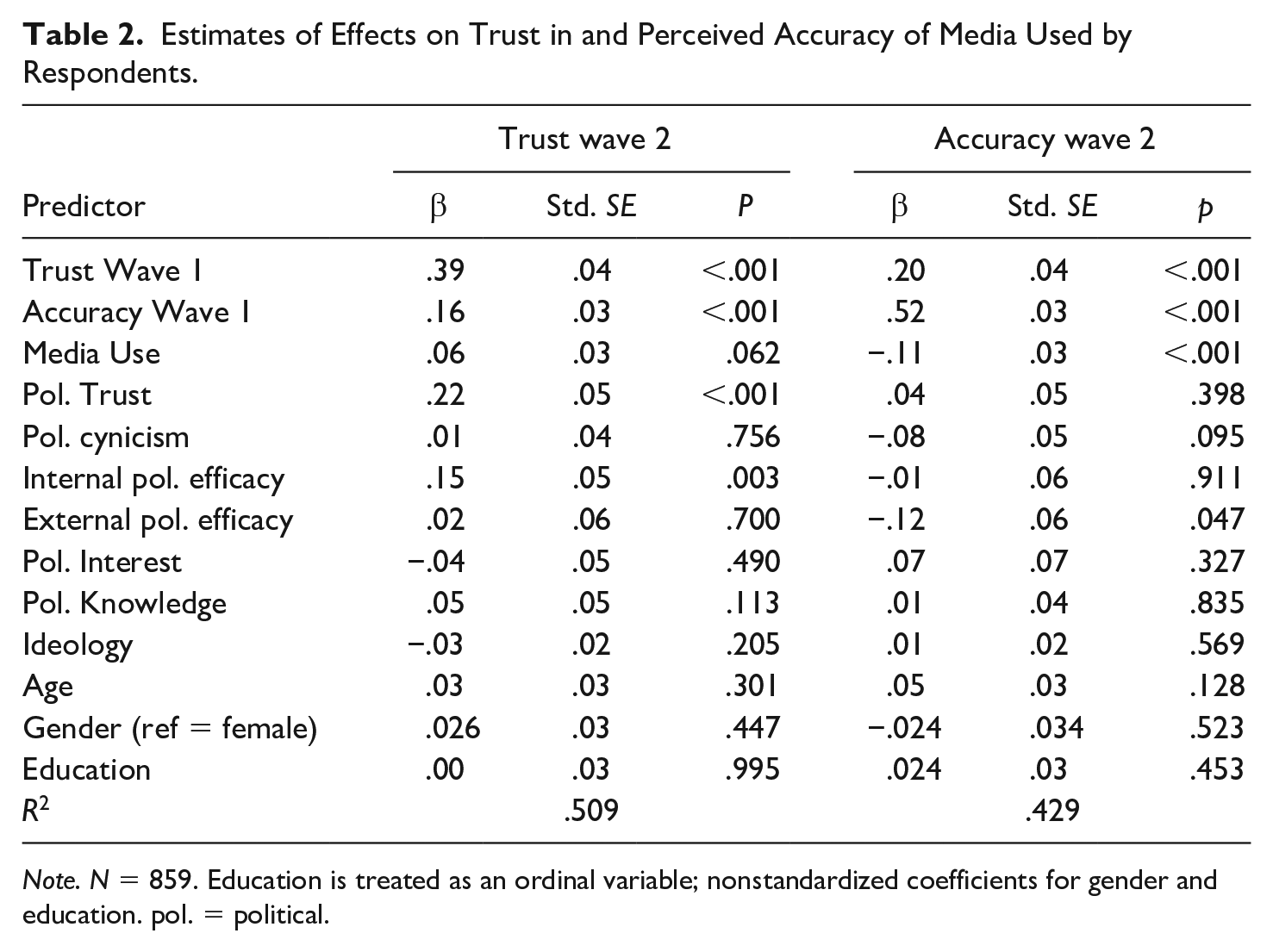
Note. N = 859. Education is treated as an ordinal variable; nonstandardized coefficients for gender and education. pol. = political.
Next, we fitted a similar model for trust in and perceived accuracy of the news media in general. Importantly, we did not include media use in this model. In its place, we modeled the effects of media skepticism and cynicism (Figure 2). Again, the model fit the data well, N = 859; χ²(976) = 2,184.65; p < .001; CFI = .956; TLI = .951; RMSEA = .038; 90% CI [.036, .040].
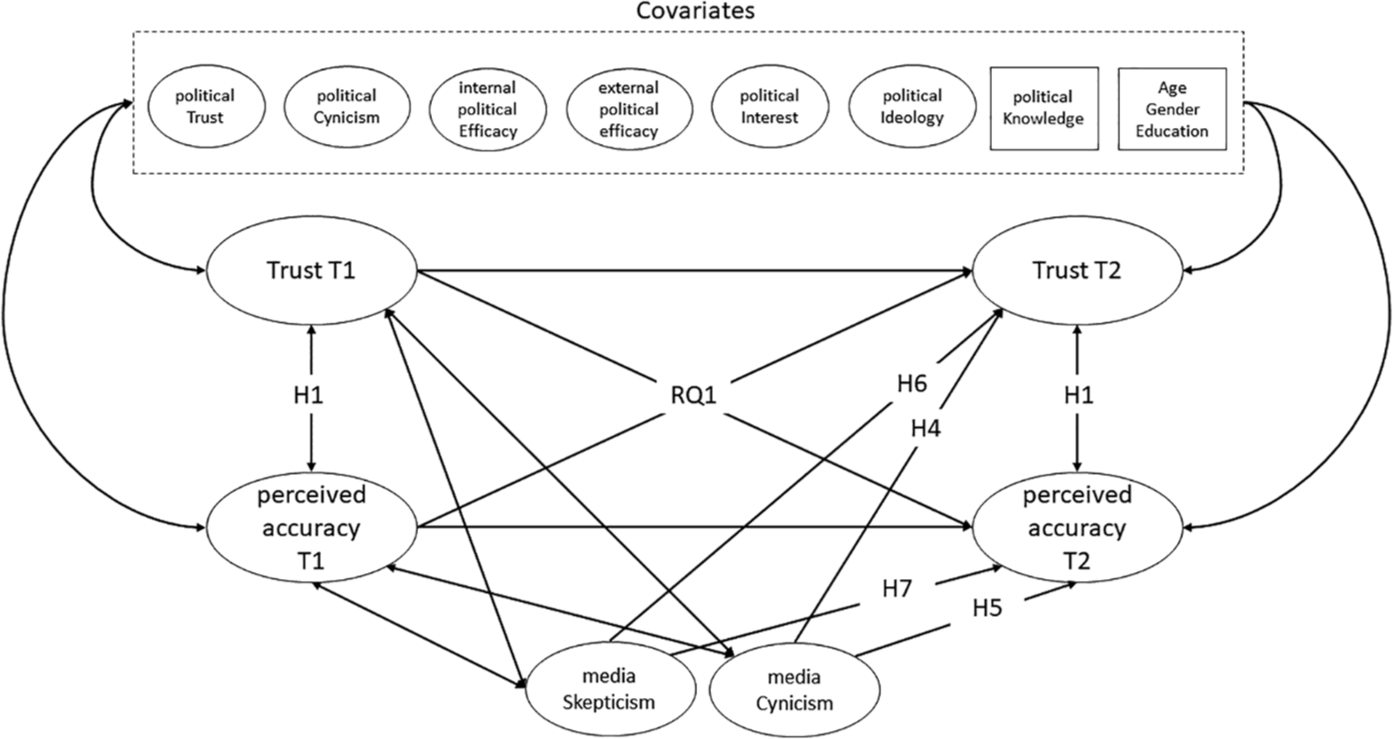
Cross-Lagged Panel Model for the Reciprocal Effects of Media Trust and Accuracy Perceptions of the Media in General.
Again, we first looked at how our dependent variables changed across waves. Overall, a similar pattern to the first model emerged: Trust in the news media in general increased slightly (Mwave1 = 0; SD = .98; Mwave2 = .16; SD = .97) and so did perceived media accuracy (Mwave1 = 0; SD = .87; Mwave2 = .2; SD = .91). Again, we have to be cautious with interpreting these changes because only partial scalar invariance was achieved for both latent variables.
Next, we looked at the hypothesized correlation between media trust and perceived accuracy for the news media in general. Compared to our first model, the correlations were slightly stronger (Wave 1: r = .44; p < .001; Wave 2: r = .49; p < .001). Overall, we can confirm H1. In H4, we predicted that media cynicism would have a negative effect on media trust in Wave 2. We can confirm this hypothesis, although the effect was small (β = −.10; p = .030). Our hypothesis that media cynicism would lead to lower perceived media accuracy (H5) was not confirmed (β = −.10; p = .066). H6 predicted that media skepticism would positively predict media trust in Wave 2. We found this effect and confirmed the hypothesis (β = .25; p < .001). In H7, we hypothesized that media skepticism would lead to higher perceptions of media accuracy in Wave 2. We have to reject this hypothesis (β = .11; p = .107). Finally, we investigated the cross-lagged paths of this model (RQ1). In contrast to the first model, only the effect of trust in Wave 1 on perceived accuracy in Wave 2 was significant (perceived accuracy on trust: β = .04; p = .238; trust on perceived accuracy: β = .17; p < .001). Concerning the control variables, we also find a positive effect of political trust on media trust in Wave 2 and a positive influence of age on perceived accuracy in Wave 2. An overview of all effects is presented in Table 3.
Estimates of Effects on Trust in and Perceived Accuracy of Media in General.
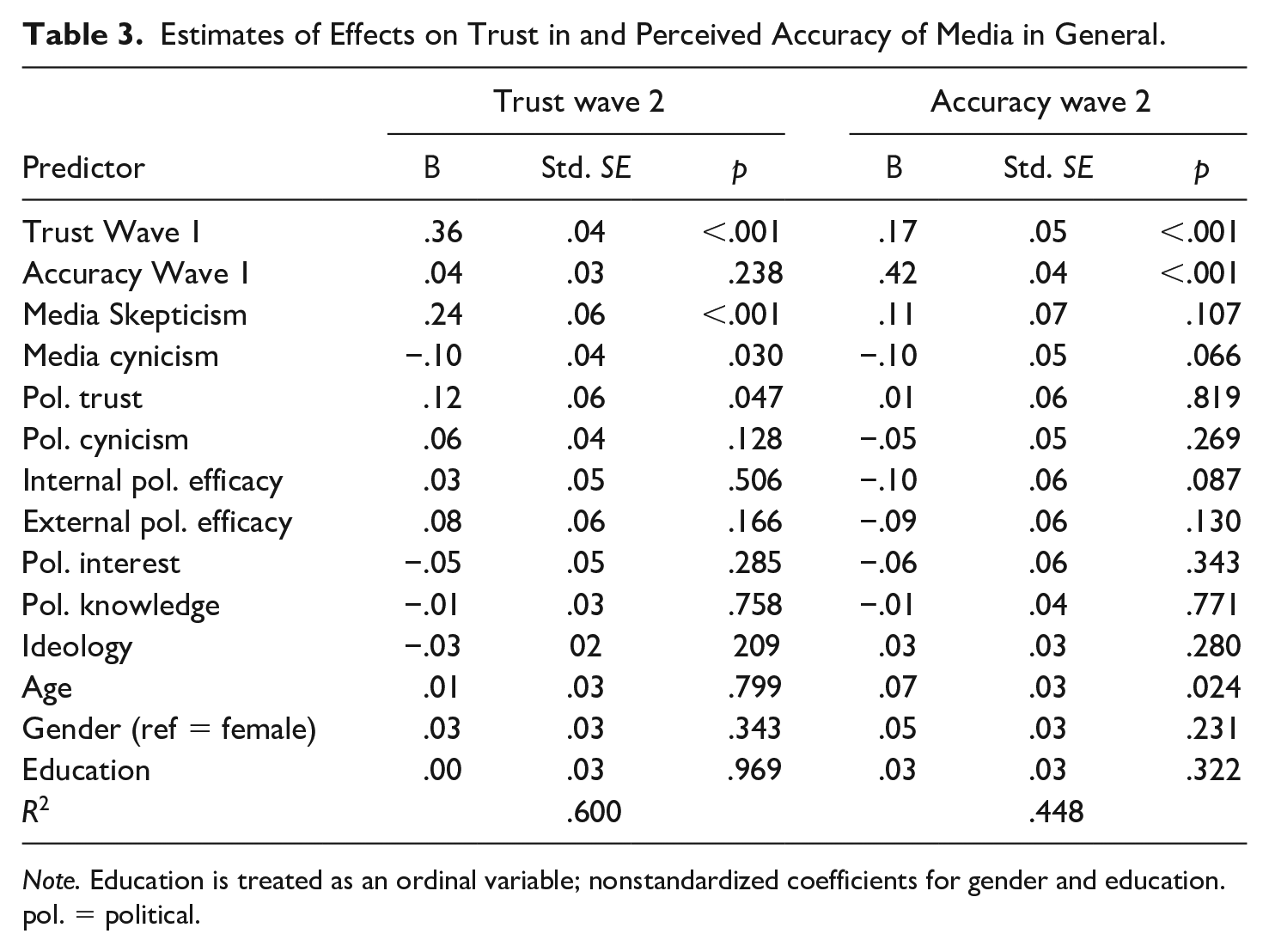
Note. Education is treated as an ordinal variable; nonstandardized coefficients for gender and education. pol. = political.
Discussion
The starting point of our article was the observed decline of media trust in many countries (Newman et al., 2022). One desiderate of the current literature is a longitudinal assessment of media trust and its possible predictors in dedicated panel studies (Fawzi et al., 2021). In this study, we focused on perceived news accuracy as an important correlate of media trust (Wilner et al., 2021). One goal of our study was to shed light on the causal relationship between these constructs. Our second goal was to investigate intra-individual effects on media trust. Finally, we set out to distinguish news users’ evaluations of the election coverage in the media in general and in the media they used.
Our results show that this differentiation is warranted. For news media the respondents used, trust in the election coverage and perceived news accuracy are in a reciprocal relationship (RQ1). This means that more trusting users perceived fewer errors at a later time and users who already perceived the news as less accurate were less trusting in Wave 2 (see Table 2). The same is not true for the news media in general. Here, trust in the election coverage was causally dominant and predicted perceived news accuracy at a later time, but not vice versa (see Table 3). These findings can serve as a starting point for scholars who are interested in the causal dynamics of media trust and who—as Prochazka and Schweiger (2019) proposed—want to disentangle the constructs of media trust and perceived accuracy as one part of news media quality. According to our results, how accurate users perceive the news to be is first and foremost contingent on their experiences with the news, namely their news media use (H2). Contrary to prior research which suggests a relationship between news media use and trust (Hanitzsch et al., 2018; Tsfati & Ariely, 2014; Tsfati & Cappella, 2003), we did not find an effect of media use on trust (see H3 and Table 2). This suggests that in the media use-media trust relationship, the latter might be the causally driving force. This hypothesis should be assessed by future longitudinal research on media use.
In the case of the news media in general, we hypothesized that users judge trustworthiness and accuracy based on different criteria, such as general attitudes toward news media. In line with recent research on media skepticism and cynicism (Quiring et al., 2021), we found that these constructs play a vital role in individuals’ media trust judgments (H4 and H6). However, we found no support for the hypotheses that these constructs affect perceived news accuracy (see H5 and H7 and Table 3). This finding suggests that these perceptions are based on other factors. In fact, the effect of trust in the media in general on perceived accuracy could hint at a mediating process, wherein skepticism and cynicism affect media trust, which in turn affects accuracy perceptions. Another, and perhaps more pessimistic possibility is that perceptions of whether or not the media report accurately are ultimately inconsequential and completely detached from attitudes toward the media. Finally, our effects on the media in general could be interpreted as a hint that it could be time to retire research on generalized attitudes toward the media, which are not good indicators of actual information behaviors (Daniller et al., 2017) and instead focus on specific brands and their users.
While we found that political trust and internal political efficacy influence trust in news, we found that external political efficacy and age affect perceived news accuracy. The former effect is in line with previous research which shows that media trust is closely related to trust in other institutions (Fawzi et al., 2021; Hanitzsch et al., 2018). Therefore, and according to the second goal of the study, these variables are—together with media use, media skepticism and cynicism—relevant predictors of trust and/or perceived accuracy and have intra-individual effects on these variables (see Tables 2 and 3).
However, we have to address some limitations: First, our results are limited to the German context, since we implemented our study in this country. Generalizations to other contexts—especially to countries with a different political or media system—have to be made with caution. Second, our study focused on trust and perceived accuracy of news in the context of one specific topic—the German federal elections in 2021. Trust and quality evaluations can vary depending on media content and topics (Strömbäck et al., 2020; Tsfati et al., 2022) or are formed in relation to different news sources (Mangold et al., 2022). Future studies should investigate causal relations of media, social, and political characteristics in different contexts and/or with a focus on how trust evaluations are formed by the individual audience member. Furthermore, we focused on the effects of just a few media, political and social variables on trust and perceived news accuracy. Future studies would be wise to examine the influence of trust in specific institutions in democracies (e.g., the German Bundestag or legal system) on perceived news accuracy and media trust with regard to political characteristics since research has shown that users’ trust in different institutions can be very disparate (German Longitudinal Election Study, 2016). The reciprocal effect between news media trust and perceived accuracy could be explained by the Reinforcing Spiral Model (Slater et al., 2020). The model argues that there is a reciprocal interconnection between media use, variables that influence media use, and its outcomes. To test such reinforcing spirals, Slater et al. (2020) imply a three-step, cross-lagged process. Therefore, future studies are well-advised to add at least a third wave in their panel designs. Finally, the items of the media skepticism scale are phrased double-barreled which complicates the interpretation of the respondent’s answers to the statements. Future studies should refine how the construct is measured or develop new instruments to measure media skepticism.
Despite these limitations, our results reveal that it is worthwhile to differentiate between news media that individuals use and the news media in general when investigating trust in news and accuracy perceptions (Daniller et al., 2017). This differentiation has consequences for the causal relationships of social, political, and media characteristics on media trust and perceived news accuracy: While some media characteristics—in our study ‘media use’—mainly influence the judgment of content individuals use, others refer to media content in general (i.e., media skepticism and cynicism). Overall, we find support for specific causal relationships between media, social, and political characteristics and users’ perceived news accuracy and media trust. Our results also support the need that (1) media trust should be investigated on a more specific level related to media content and information and (2) that more complex analyses help to understand the complex processes of news perceptions and evaluations. This is not only important for researchers, but also for journalists’ understanding of their audience, their preferences, and the characteristics that influence their news consumption and evaluation.
Supplemental Material
sj-docx-1-jmq-10.1177_10776990231202692 – Supplemental material for The Reciprocal Effects of Perceived Accuracy and Trust in News Media: A Two-Wave Online Panel Study in the Context of the 2021 German Federal Election
Supplemental material, sj-docx-1-jmq-10.1177_10776990231202692 for The Reciprocal Effects of Perceived Accuracy and Trust in News Media: A Two-Wave Online Panel Study in the Context of the 2021 German Federal Election by Stefanie Holtrup, Jakob Henke, Dennis Steffan and Wiebke Möhring in Journalism & Mass Communication Quarterly
Footnotes
Declaration of Conflicting Interests
The author(s) declared no potential conflicts of interest with respect to the research, authorship, and/or publication of this article.
Funding
The author(s) received no financial support for the research, authorship, and/or publication of this article.

Supplemental Material
Supplemental material for this article is available online.
Author Biographies
References
Supplementary Material
Please find the following supplemental material available below.
For Open Access articles published under a Creative Commons License, all supplemental material carries the same license as the article it is associated with.
For non-Open Access articles published, all supplemental material carries a non-exclusive license, and permission requests for re-use of supplemental material or any part of supplemental material shall be sent directly to the copyright owner as specified in the copyright notice associated with the article.
