




Abstract
This article conceives of populist communication as a contextually dependent political strategy. We bridge actor- and communication-centered approaches by arguing that the context of issues conditions the extent to which parties employ populist communication. We draw from a content analysis of 2,085 news stories in eight news media outlets and Eurobarometer data connected to 41 EU policy issues and analyze statements from 85 political parties. Our findings show that populist parties are more prone to express populism on salient and polarized issues. Issues important to civil society groups, in contrast, make non-populist parties more inclined to express such communication.
Introduction
In 2016, during an exclusive banquet attended by some of the most powerful and wealthy people in the world, the then British Prime Minister Theresa May delivered a speech in which she fiercely criticized the global elite. “People—often those on modest to low incomes living in rich countries like our own,” May argued, see their jobs being outsourced and wages undercut. They see their communities changing around them and don’t remember agreeing to that change [ . . . ] They see the emergence of a new global elite who sometimes seem to play by a different set of rules and whose lives are far removed from their everyday existence.
1
By arguing that there is a “global elite” that is disconnected from ordinary people’s “everyday existence,” May employed a rather populist discourse. This is striking because it demonstrates that not only populist politicians but also mainstream political actors may employ a populist discourse—at least to some extent.
Indeed, several previous studies have shown that mainstream politicians can be populist (Mudde, 2004; Schmuck & Hameleers, 2019), and that a great deal of variation exists in the extent to which (populist) parties employ a populist discourse (Ernst et al., 2017, 2019; Meijers & Zaslove, 2021; Pauwels, 2011; Rooduijn et al., 2014). To a great extent, this variation can be explained by the ideological positions of parties: populism is endorsed more strongly by parties with radical left and right ideologies, at least in Western Europe (Ernst et al., 2017; Rooduijn & Akkerman, 2017). Yet, it is important to emphasize that “[p]opulist communication does not occur in a vacuum but is embedded in specific social contexts which can be grasped by the concept of opportunity structures” (Engesser et al., 2017, p.1280). Relatively little is known about the context or opportunity structures under which parties employ a populist discourse strategically (Stanyer et al., 2017). One exception is Ernst et al. (2019), who studied the rhetorical opportunity structures that govern populist communication in six Western countries and demonstrated that politicians express populism depending on populist affinities, communication channels used, and issues on which they mobilize.
Indeed, populist discourse is not only an expression of some deeply rooted (thin) ideology but also a strategic response to a political opportunity. Furthermore, populist communication can be used strategically by both mainstream and populist parties in a rhetorically opportune context. This article responds to recent calls in the literature to bridge actor- and communication-centered approaches (de Vreese et al., 2018; Stanyer et al., 2017). While studies focusing on populist actors and populist communication are both valid, they may lead to different conclusions about when and why populist communication is used (Stanyer et al., 2017). We therefore integrate both approaches, by arguing and demonstrating that the context of policy issues conditions the extent to which populist and mainstream actors employ populist communication in the news.
Do certain contexts stimulate some parties more than others to employ populism to embellish their media statements on particular policy issues? We address this question by focusing on a least-likely case—policy issues that relate to the European Union (which are generally technical and distant from everyday experiences)—and demonstrate that, indeed, certain political circumstances make the adornment of (the formative elements of) populism more likely than others. Based on a content analysis of 775 media statements about 41 EU policy issues from eight news media outlets (2010–2016), combined with Eurobarometer data, we demonstrate that both populist and non-populist politicians employ populist communication. However, they do so to a different extent and under different conditions.
Populism as a Set of Ideas
Populism, like many social science concepts, is highly contested. It deals with “an essential impalpability, an awkward conceptual slipperiness” (Taggart, 2000, p. 1), and the term has been employed to refer to specific types of organizations, leaders, or ideologies. As a result, there are many different approaches to populism. Today, however, an increasing number of scholars agree that populism is an ideational phenomenon that concerns the antagonistic relationship between the virtuous people and the evil elite (Hawkins et al., 2018; Moffitt, 2016; Mudde & Rovira Kaltwasser, 2017; Stanyer et al., 2017). Some refer to it as an “ideology” (e.g., Mudde, 2004), whereas others label it a “discourse” (Hawkins, 2010), “style” (Jagers & Walgrave, 2007), “frame” (Aslanidis, 2016), or “political claim” (Bonikowski & Gidron, 2015). Most scholars seem to agree, however, that populism is essentially a substantive set of ideas and should therefore be distinguished from specific forms of organization or leadership. According to Cas Mudde (2004), populism is [a thin-centered] ideology that considers society to be ultimately separated into two homogeneous and antagonistic groups, “the pure people” versus “the corrupt elite,” and which argues that politics should be an expression of the volonté générale (general will) of the people. (p. 543)
Building on previous work, we argue that populism consists of two core elements: people-centrism and anti-elitism. People-centrism means that populists emphasize the centrality of virtuous people; its core thought is that the general will of the people should guide all political decisions (Ionescu & Gellner, 1969; Reinemann et al., 2017). Populism is anti-elitist because it accuses “the elite” of obstructing the centrality of the people (Mény & Surel, 2002). The elite is accused of being condescending, arrogant, selfish, and corrupt and is believed to have no sense of what ordinary people find important (Barr, 2009). 2
According to Paul Taggart (2000), populism has an “empty heart” because it does not have core ideological values. Many scholars who define populism as an ideology therefore refer to it as a “thin-centered” ideology. Populism is different from full ideologies such as conservatism and socialism, in that it only focuses on the relationship between the virtuous people and the evil elite (Mudde, 2004; Mudde & Rovira Kaltwasser, 2012; see also Freeden, 1998). As a result of this empty-heartedness or thin-centeredness, populism tends to be highly chameleonic, adapting itself to the environment in which it occurs (Taggart, 2004). In other words, populism can be combined with basically every ideology, including far left, far right, ultra conservative, and highly progressive.
It is important to distinguish populism from the related concept of nativism (Bonikowski, 2017; Rooduijn, 2019). Nativism (or exclusionary nationalism) concerns the antagonistic relationship between the native group and “dangerous others” (e.g., immigrants or ethnic minorities; Albertazzi & McDonnell, 2008; Mudde, 2007) and is therefore different from populism. Although populist radical right parties, such as the Italian League of Matteo Salvini and the French National Rally (previously Front National) of Marine Le Pen typically combine populism and nativism, many populist parties are not nativist. Examples are Podemos in Spain, Syriza in Greece, and the Five Star Movement in Italy. In fact, the PopuList, which has provided an overview of populist parties in Europe since 1989, identifies 60 parties that are populist but not nativist (Rooduijn et al., 2019). Although older studies included nativist exclusionism as a defining element of populism, we agree with the more recently established consensus that nativism is not a defining element of populism (Bonikowski & Gidron, 2015; Hawkins et al., 2018; Mudde & Rovira Kaltwasser, 2018; Van Kessel, 2015).
Populism as a Communication Strategy
Defining populism as a set of ideas implies that populism should not only be understood as a feature of a specific political actor (e.g., a political party, a movement, or an individual politician), but also as a characteristic of the message that is expressed by such an actor. Indeed, previous work has shown that political actors vary greatly in the extent to which they endorse populism (Deegan-Krause & Haughton, 2009; Hawkins, 2010; Manucci & Weber, 2017; Meijers & Zaslove, 2021; Pauwels, 2011; Rooduijn et al., 2014). Much of the variation between populist and non-populist parties can be explained by the ideological positions of parties and politicians; more radical political actors also tend to be more populist (Ernst et al., 2017; Rooduijn & Akkerman, 2017).
Although we define populism as a substantive set of ideas, political actors may employ this set of ideas for strategic rather than ideological reasons. Rooduijn et al. (2014), for instance, find that populist parties moderate their populism after having been elected. Political parties seeking office may tone down their populism because they hope to signal that they could be reliable coalition partners. Moreover, Ernst et al. (2019) show that expressions of populist discourse vary across populist affinities, communication channels, and the degree to which issues entice mobilization. This suggests that populism need not be a deeply rooted, stable and sincere worldview; it could equally be employed as a communication strategy to win popular support (Ernst et al., 2017).
This article builds on recent work by de Vreese et al. (2018), who conceive of populism as a discursive manifestation of a substantive set of ideas (see also Aalberg & de Vreese, 2017; Reinemann et al., 2019). In other words, populist communication is a strategic enterprise (see also Schmuck & Hameleers, 2019). It is important to note, however, that this does not imply that populism is a mere strategy (see Betz, 2002; Weyland, 2001). Instead, populism is a set of ideas that could, but does not need to be employed for strategic reasons (see Aslanidis, 2016). Hence, we investigate the circumstances in which populist and non-populist parties tend to use the formative elements of populism (i.e., anti-elitism and people-centrism) to adorn their political communication. Rather than drawing on one way to conceive of populism, our article thus relies on both actor- and communication-centered approaches to populism (Stanyer et al., 2017), namely by identifying populist actors (Rooduijn et al., 2019; Van Kessel, 2015) and by examining the behavioral manifestations of anti-elitism and people-centrism in the public statements of both populist and mainstream actors (de Vreese et al., 2018).
Based on our focus on populist communication as a contextually dependent strategy, we develop testable hypotheses about the conditions under which elected representatives use populist discourse. All else being equal, we presume representatives from populist parties to engage more intensively in populist communication than those from non-populist parties (Ernst et al., 2019; Schmuck & Hameleers, 2019; Wettstein et al., 2019). These representatives more frequently refer to an undivided and homogeneous citizenry and are more likely to portray elites as corrupt, exemplifying their populist belief system. To some observers, this presumption is not only self-evident but also an endogenous artifact of how populist parties are defined in the first place. Namely, if a party does not make anti-elitist or people-centric references in its public communication, why would we consider it populist in the first place? Although we acknowledge this concern, we nonetheless believe that a systematic and empirical test of this expectation in a least-likely scenario could form a contribution to the literature on populism. We therefore formulate the following hypothesis:
More importantly, we argue that the extent to which (populist) parties employ populist communication is contextually contingent: some conditions make (populist) politicians more or less prone to articulate populist claims. However, not only politicians from populist parties but also non-populist representatives may be tempted to adopt a populist discourse when it becomes strategically opportune to do so (Schmuck & Hameleers, 2019). To evaluate these strategic opportunities, we focus on three key features of issue politicization that can make citizens more vigilant and acquainted with politics, and hence create a momentum for political parties to influence public opinion and other policy elites: public salience, civil society mobilization, and political polarization (see De Bruycker, 2020; De Wilde et al., 2016; Hutter & Grande, 2014; Rauh, 2019). These three elements of an issue’s political context constitute key aspects of the discursive opportunity structures in which populist and non-populist politicians operate (Ernst et al., 2019, Koopmans & Olzak, 2004).
The first feature that may stimulate representatives to articulate people-centric and anti-elitist claims is the media salience of a certain policy issue (Mazzoleni, 2003; Van Kessel, 2015). Media salience is the degree to which an issue is visible in news media debates. When an issue is visible to citizens, representatives are incentivized to express people-centric claims to clarify for their constituents whether the public interest is considered. Politicians may be tempted to express resentment toward elites as a strategy to challenge their political opponents and win voters. Moreover, it is less relevant to openly blame and shame elites when there is no audience with whom to communicate these allegations. While media salience may thus stimulate both mainstream and populist politicians to express people-centrism and anti-elitism, we expect that it stimulates populist politicians relatively more. Salient issues are a fertile “breeding ground” for populist parties, as they enable reaching a wide audience and stimulating contestation through pressuring the media and other political actors (Ernst et al., 2019; Van Kessel, 2015, p. 172). Moreover, expressing populist messages on salient issues is a less-risky strategy for populist parties, as it fits well with their customary discourse (Jagers & Walgrave, 2007). Mainstream parties attempt to develop a reputation of competence in a particular salient political domain and showcase their ability to resolve a problem of concern to voters (Petrocik, 1996). Compared with mainstream politicians, populist politicians have fewer office-seeking ambitions and are therefore less interested in a positive reputation with regard to handling issues. They would rather emphasize the lack of competence among mainstream elites to deal with salient societal challenges and the need for more popular sovereignty. This leads to our second hypothesis:
The second feature—civil society mobilization—refers to the civil society groups involved in the policy debate on an issue. Although civil society organizations serve as key societal intermediaries between mainstream parties and their constituencies, their links with populist parties are questionable. Civil society represents a bastion of pluralism, universal human rights, and liberal democracy, which diametrically opposes the populist primacy of popular sovereignty over the rule of law and minority rights (Edwards, 2014). Indeed, previous research shows that civil society organizations tend to interact mainly with political parties that are in office and with whom they align ideologically and only rarely entertain contacts with populist parties (Berkhout et al., 2019). For these reasons, we expect that politicians from populist parties employ more populist rhetoric when civil society is not mobilized. Populist politicians are strategically more vulnerable when facing bottom-up forms of citizen engagement, as it becomes more difficult to present themselves as the sole representatives of a pure and homogeneous citizenry when a vocal and diverse civil society mobilizes (Lundberg, 2021). Mainstream politicians who endorse liberal values will attempt to ally with and defend the constitutional rights of organized citizens by justifying their claims as resonating with the will of the people and by expressing resentment and disappointment toward elites (De Bruycker, 2017). Such claims would then be geared at defending citizen rights and popular sovereignty as enshrined in the rule of law, rather than advocating the primacy of popular sovereignty over constitutional rights. Therefore, the mobilization of citizen groups is expected to make non-populist representatives more inclined to express people-centric and anti-elitist claims, whereas it makes populist representatives less likely to resort to such claims:
A third feature of the issue context is the degree to which issues are polarized (De Wilde et al., 2016; Hutter & Grande, 2014). Polarization is the degree to which citizens disagree on a policy issue, and populism flourishes in a polarized environment (Bustikova, 2014; Merrill Iii & Adams, 2002). However, we argue that mainstream and populist politicians face different strategic incentives and hence react differently to mass polarization. First, polarized issues are politically risky for mainstream parties because their constituencies are often divided on these issues, and the median voter’s position is unpredictable. It is strategically problematic for mainstream politicians to claim that they represent an “undivided” and “homogeneous” citizenry via people-centric claims when public opinion and (presumably) their support base are divided. Similarly, anti-elitist claims may backfire, as mainstream politicians themselves are often responsible for political stagnation on polarized issues. They may have been attempting to depoliticize or dismantle these issues for years, and populist communication would further deepen the political divide. As a result, we expect mainstream politicians to temper their populist communication on polarized issues and express pacifying rather than populist claims.
Populists, in contrast, intentionally politicize issues that elites overlook or neglect (Mudde & Rovira Kaltwasser, 2018). Populist parties are strategically incentivized to address elites’ neglect of these issues and appeal to a larger number of citizens who are ideologically distant from the center (Silva, 2018). Populist attacks toward elites on such issues may, in turn, spark mainstream parties to defend themselves from populist allegations, which spur anti-populist rhetoric as part of a “fight fire with fire” strategy, feeding further polarization (Mudde & Rovira Kaltwasser, 2018). Therefore, we expect that mass polarization will trigger populist politicians to express people-centric and anti-elitist claims, significantly more so than non-populist representatives. This expectation exemplifies an important paradox between populism as a set of ideas versus populism as a communication strategy. Namely, populism as an ideology considers the public to be unified and homogeneous, whereas populist communication is most prevalent on issues where the public is divided:
The News Media as an Arena for Populist Communication
This study focuses on populist claims in the news media. One drawback of media sources is that media statements from political elites are a result of media selection processes. We cannot fully grasp these selection processes and their effect on the nature and content of media claims exclusively by analyzing media coverage (Wettstein et al., 2018). This article thus strongly relies on the perspective of “populism through the media” (Esser et al., 2016, p. 369) and conceptualizes the news media as an arena through which politicians communicate with voters (Gattermann & Vasilopoulou, 2015). Indeed, Blassnig et al. (2019) find that the majority of populist claims in the news media are expressed by politicians and do not originate from journalists themselves.
Simultaneously, the news media have their own rules of engagement and consequently reflect only a fraction of the parties involved in populist claim making. There are important differences in terms of which parties seek and are granted media coverage. On the demand side, tabloid-style media outlets may grant more coverage to populist actors than broadsheet outlets, and populist communication varies from one communication channel to the other (Cranmer, 2011; Ernst et al., 2019; Mazzoleni, 2003; Wettstein et al., 2018). Although the media have been criticized for giving disproportionate attention to populist actors for the sake of news value, Wettstein et al. (2018) find that journalists are restrictive in granting populists a voice in the news (see also Bos & Brants, 2014; Esser et al., 2016). On the supply side, certain politicians may more actively seek media coverage than others. Because many populist parties are less institutionally entrenched, they are sometimes thought to be more dependent on the news media. However, Bos et al. (2011) find that populist politicians are equally as dependent on the media as mainstream politicians. Even if media coverage is biased in favor of certain politicians and rhetorical styles, it is still broadly considered the main forum of exchange between citizens and politicians. The media informs EU citizens about their representatives so that the former are able to hold the latter publicly accountable (Gattermann & Vasilopoulou, 2015). Therefore, our focus on populist communication in mass media debates is justified and substantively important.
Research Design
To test our hypotheses, we employ a “most difficult” research design and thus select a “least-likely” case (see Gerring, 2006). The least-likely case in our study consists of EU policy issues. EU policy issues are generally complex and technical and are therefore considered by many citizens to be distant from their daily lives (De Bruycker, 2017; Follesdal & Hix, 2006). Such issues usually do not constitute attractive topics for politicians who aim to make populist claims for strategic reasons, as these issues are expected to resonate poorly among voters. The topics of general EU politics or European integration can be considered highly attractive by citizens and populist politicians. The European Union as a political institution may serve as an ideal scapegoat for national politicians or government parties to “shift blame towards Brussels.” This is not our focus, however. In this study, we assess specific EU policy issues toward which most citizens are indifferent (Follesdal & Hix, 2006). Hence, we conduct a conservative test: if we find empirical support for our expectations under these least-likely circumstances, then it is probable that our hypotheses would also be confirmed under less restrictive conditions.
In this study, an EU policy issue is operationalized as a specific policy topic for which the European Union is at least partially competent. The starting point for the project is a sample of 41 issues drawn from Eurobarometer polls for which fieldwork was conducted between January 1, 2012, and December 31, 2014. We included questions which were surveyed in all EU member states and connected to a specific policy. For example, one issue involved the question of whether citizens agreed on or opposed the introduction of a financial transaction tax. In addition, we only considered questions that pertained to the opinion of citizens in terms of agreement or disagreement about a specific policy (see Rasmussen et al., 2018). This sampling procedure allowed for the assessment of public polarization on issues. Moreover, the 41 selected issues vary with respect to crucial criteria, such as media salience and policy field (see Figures A1 and A2 in the online appendix for more information).
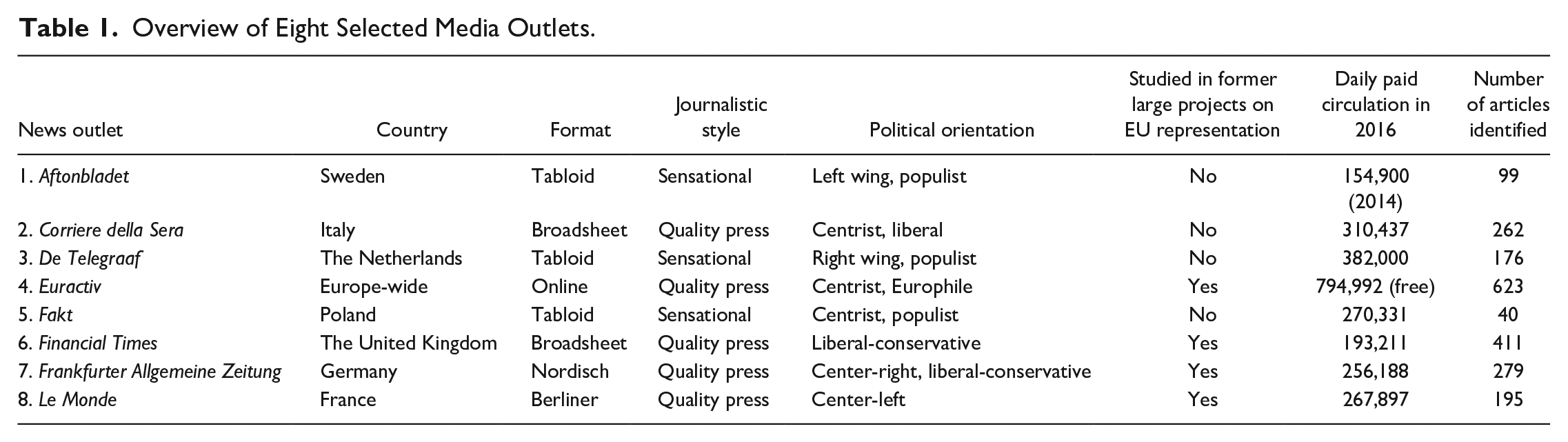
To identify relevant parties and their populist communication on the sampled set of issues, we conducted a content analysis of news media sources. In the first step of our media content analysis, the relevant media coverage of eight media outlets related to the sampled set of cases was assembled manually. For the selection of news media outlets, a “most different case selection design” was applied to maximize the possible sources of relevant extraneous variance. We selected media outlets from countries located in different parts of Europe with journalistic styles that vary in format and adhere to diverse political orientations. Due to the central research objectives of the project to study the links between the elite and the public, news outlets with a wide circulation were prioritized to ensure that their coverage had the potential to reach a wide range of European citizens. To generate a substantive corpus of statements from political elites and stakeholders on the sampled set of issues, four news outlets that extensively covered EU-related topics were selected; these had also been studied in previous research projects on EU representation (Klüver et al., 2015; Thomson, 2011). Table 1 gives an overview of the sampled outlets, and Section 3 in the online appendix details the selection criteria and the reliability tests conducted. This procedure allowed us to capture as much variation as possible but prevented deductively comparing populist claims across countries, which would have required the selection of multiple and similar outlets within one country. This selection procedure should strengthen the external validity of our findings to pan-European media debates; however, it limits the generalizability of observed differences across countries and media outlets.
Overview of Eight Selected Media Outlets.
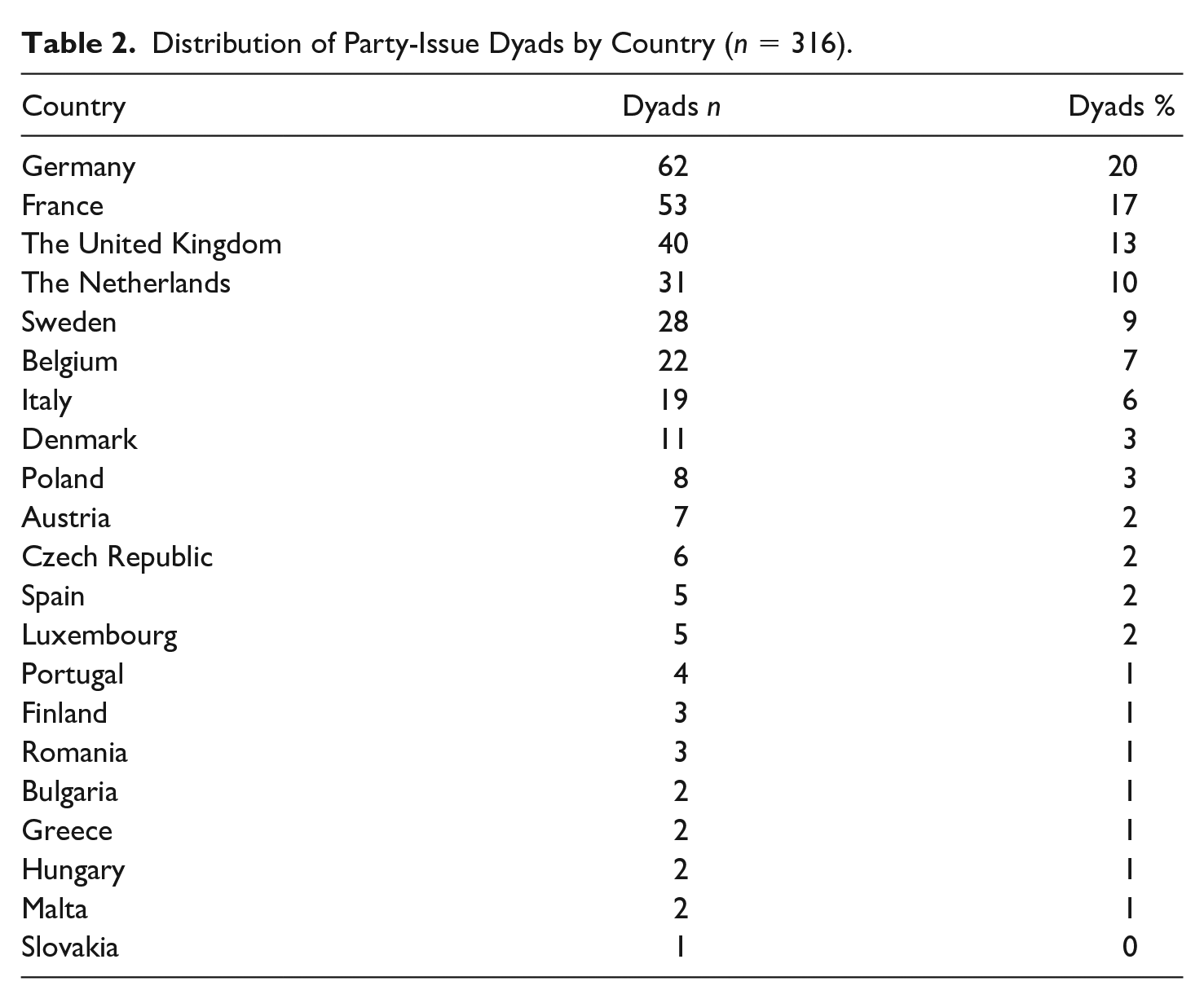
The media archive search was based on carefully selected keywords based on the name of the issue, the corresponding Eurobarometer question and explorative searches of news archives. This approach allowed us to account for potential differences across news outlets. Not all articles that resulted from keyword searches were retained. Each article was screened for its relevance, and only those that were directly related to the sampled cases and were published between January 1, 2010, and December 31, 2016, were retained. The results were centralized and stored by the principal investigator, who screened archived articles for their relevance and assessed the correspondence of the overall levels of attention which issues received across outlets. Based on extensive keyword searches, 2,085 articles were identified. Once the articles were mapped, the statements made by political actors in these articles were archived and coded. A statement is a quote or paraphrase in the news that can be connected to a specific actor. In total, 5,891 statements were identified from various political actors. Out of these, 775 were made by members of parliament (national or European), and could thus be linked to a specific political party in the European Union. These 775 media statements come from elected representatives affiliated with 85 different political parties and hailing from 21 EU countries (see Table 2). Each statement was coded for whether it (a) made people-centric references and/or (b) made anti-elitist claims.
Distribution of Party-Issue Dyads by Country (n = 316).
People-centric claims refer to public opinion, the people, citizens, the general public, a majority or broad categories which are used to describe a homogeneous public (e.g., “taxpayers,” “public health,” “consumers,” or “the people”). Although these groups are often diverse and divided, they are (implicitly) portrayed as unified and homogeneous. References to “the people” are used in an advocative sense, to support the politicians’ objectives and to endorse the ideal of responsive decision-making and governance in the public interest (see also Wettstein et al., 2018). For instance, on the issue of the financial transaction tax, British Green Member of the European Parliament (MEP) Jill Evans stated in Euractiv that “it is time to rein in the banks which have been largely responsible for so much economic turbulence—the cost of which has too often been passed on to ordinary people.” In 113 statements (15%), we found people-centric references.
Anti-elitist claims portray elites (e.g., policymakers, parties, corporations, and politicians) as corrupt and biased. Elites are depicted as pursuing their own self-interest or special interests over the common good or public interest. For instance, on the issue of a free trade agreement between the European Union and the United States, Michael Efler from Die Linke stated in Euractiv that “the Commission is only listening to lobbyists, rather than the citizens.” Such anti-elitist references are rare, however; we found 46 statements (6%) with such references.
The coding of the statements was conducted by two trained researchers, and subsequent inter-coder reliability tests conducted for the variables used in this article revealed satisfactory levels with Krippendorff’s alpha scores of .8 and higher based on double coding of 180 media statements. To ensure comparability across languages and issues, we did not use standardized dictionary approaches, which would have resulted in many false positives. The coders instead interpreted each statement in the context of the article and the issue to which it relates. We did not encounter notable differences in terms of anti-elitism or people-centrism across media outlets but did identify important variation across issues. Further explanation of the coding and examples of people-centric and anti-elitist claims can be found in the online appendix.
We consider the use of the formative elements of populism (i.e., anti-elitism and people-centrism) and, more particularly, their combination, as populist communication. Because it is unlikely for both claims to be made within a single statement (see Rooduijn et al., 2014), we employ the “party-issue dyad” as our unit of analysis. Party-issue dyads consist of all statements by elected representatives from a party about a certain policy issue in the news (e.g., one party-issue dyad in the data set comprises media statements by the Social Democratic Party of Germany on the banking union issue). Because our hypotheses pertain to the strategic communication of parties across policy issues, an empirical enquiry at the level of party-issue dyads is justified. Moreover, the advantage of focusing on party-issue dyads is that they constitute units that are slightly more general than specific statements (and are therefore more likely to contain both people-centrism and anti-elitism), yet they still form substantively confined and coherent entities (i.e., if both people-centrism and anti-elitism are present, they are most likely connected to each other). Our analyses draws from 316 party-issue dyads, of which 37 were classified as anti-elitist, 82 as people-centric, and 18 as containing both elements of populist communication. 3
To assess our hypotheses about populist communication as a political strategy, we distinguish parties as being either populist or non-populist using a recent list of populist parties in Europe established by Rooduijn et al. (2019). In total, we identified 56 media statements (7%) and 28 (9%) party-issue dyads coming from members of national parliaments (MPs) or MEPs affiliated with populist parties. A list of the identified populist parties can be found in the online appendix (Table A12). To assess our
We also included a set of relevant control variables in the analysis. First, media outlets employ different journalistic styles and routines and often have different approaches to cover EU-related matters. Some previous studies, for instance, found that populist communication is more prevalent in commercialized media and tabloids, whereas elite media tends to portray populists in a more negative light (Aalberg & de Vreese, 2017; Bos et al., 2011; Mazzoleni, 2003; Wettstein et al., 2019). We took these differences in journalistic styles into account when selecting media outlets (see online appendix) and included fixed effects for the different media outlets in which a party made statements in the analysis to capture this source of extraneous variance. Because it is possible that a party made statements on the same issue in different outlets, these dummies are not mutually exclusive and no reference category applies.
Second, populist communication may vary depending on the left-right (host) ideology of the party (Ernst et al., 2017; March, 2017). To gauge the left-right positioning of elected representatives, we relied on the left-right scores of their parties as defined by the Chapel Hill Expert Survey (CHES). This index has an empirical range of 0 to 10 (Polk et al., 2017). This measure is appropriate for our purpose to compare 85 different national parties and their positions across Europe. The alternative RILE index rendered similar results in the analyses. Third, we included a control variable which indicates the share of statements from a party made by elected representatives of the national parliament relative to those from MEPs. We expect that MEPs are socialized within “the Brussels bubble” and tend to be more favorable toward EU policy measures in general compared with their counterparts in the national parliaments. As such, MEPs may be less prone to articulate populist claims in media debates compared with national MPs. Fourth, we coded whether the party was in office during the time when the issue was discussed in the news. Hence, parties that are part of the national government and represented in the European Council are expected to be less critical toward the policies proposed by the European Commission. Hence, we included whether the national party was in office or not as a control variable. 4
Fifth, we control for whether a party made a statement in a media outlet from its country of origin. It is less strategically opportune for parties to express populism in foreign newspapers, as the party’s voters are not systematically exposed to foreign news. Finally, we controlled for the number of statements within each party-issue dyad because the presence of more statements in a dyad could increase the likelihood of populism to be present. Because party-issue dyads are nested within issues, we clustered standard errors at the issue level. We explore country variation and present mixed-effects models with random intercepts for countries and parties in the online appendix (see Section 12 in the online appendix and Tables A8–A11).
To assess which contextual conditions stimulate or inhibit populist communication and to test our hypotheses, we present binary logit regressions with the presence of both people-centric and anti-elitist elements in a party-issue dyad as our dependent variable. Because the two ingredients of populism rarely occur simultaneously in a single party-issue dyad, we present separate regression analyses for people-centrism and anti-elitism only, as this allows for an assessment of the use of the formative elements of populism in political speech. Models 1 and 2 focus on populist communication (people-centrism and anti-elitism together) as the dependent variable, whereas Models 3 to 6 look at people-centrism and anti-elitism separately. Models 1, 3, and 5 present the main effects only, whereas Models 2, 4, and 6 include interactions between a populist party and different contextual features (e.g., salience, mobilization, and mass polarization). We present a rare events logistic regression in the online appendix to account for the relatively low number of populist statements (Table A6). Moreover, a range of alternative model specifications can be found in the online appendix (Tables A5–A11).
Results
The results show that representatives from populist parties are significantly more likely to articulate people-centric and anti-elitist claims. This confirms the strong connection between populism as an actor-centered and populism as a communication-centered phenomenon (Stanyer et al., 2017). Based on Model 1, populist parties have a predicted probability of 19% (SE = 0.03) to express populism, whereas this probability is 5% (SE = 0.01) for representatives from non-populist parties (based on the author’s calculations of predictive margins for populist parties as estimated in Model 1). This result confirms
The models including interactions (Model 2, 4, and 6) show that while populists and non-populists express populist claims to a different extent, they do so under different contextual conditions. With regard to our remaining three hypotheses regarding political context, first, we expected populists to be more likely than non-populist parties to express populist communication, particularly when an issue is salient (
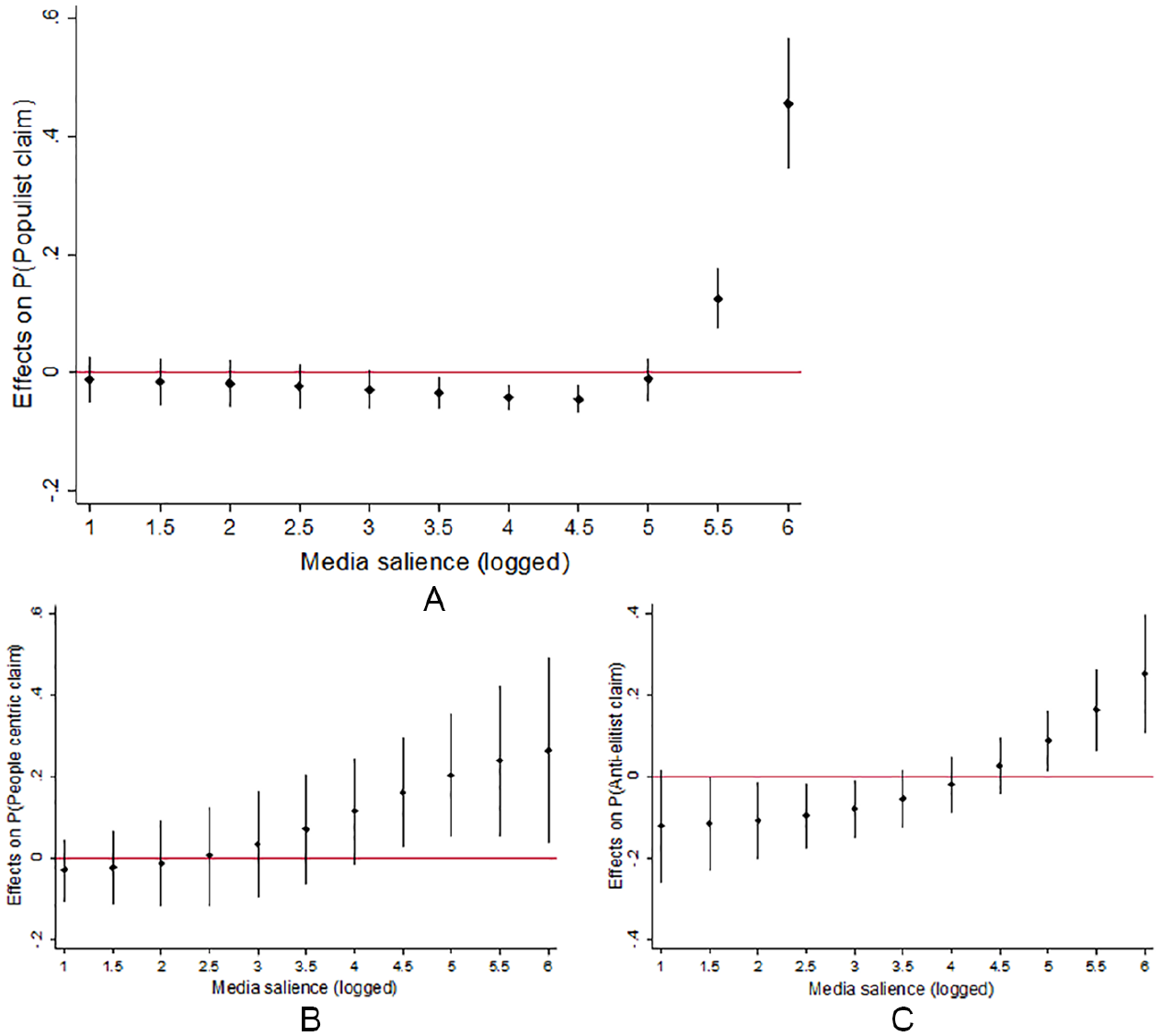
Average marginal effects of media salience for populist parties versus non-populist parties on (A) populist claims, (B) people-centric claims, and (C) anti-elitist claims with 95% CIs.
In addition, our
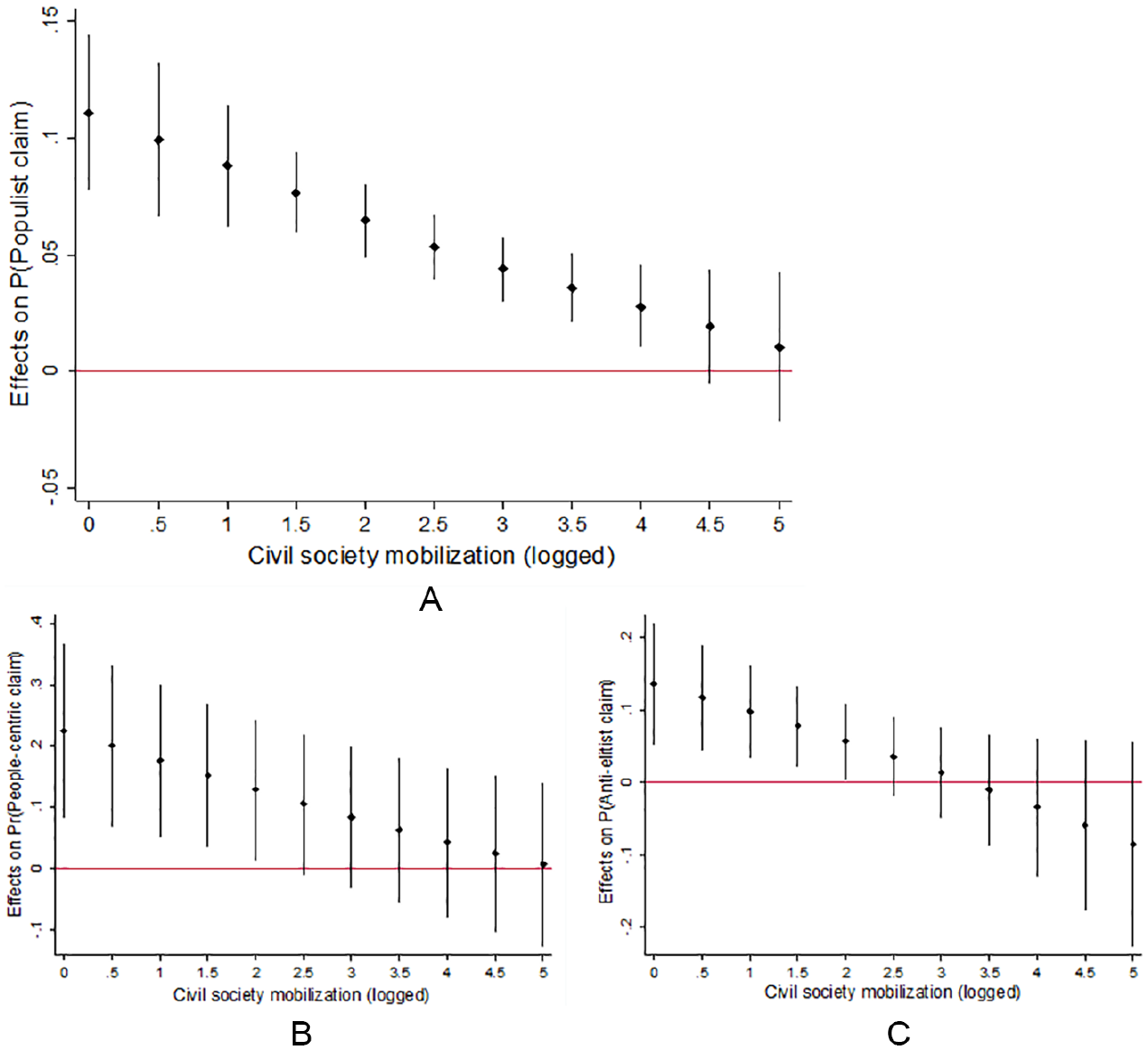
Average marginal effects of civil society mobilization for populist parties versus non-populist parties on (A) populist claims, (B) people-centric claims, and (C) anti-elitist claims with 95% CIs.
Finally, our
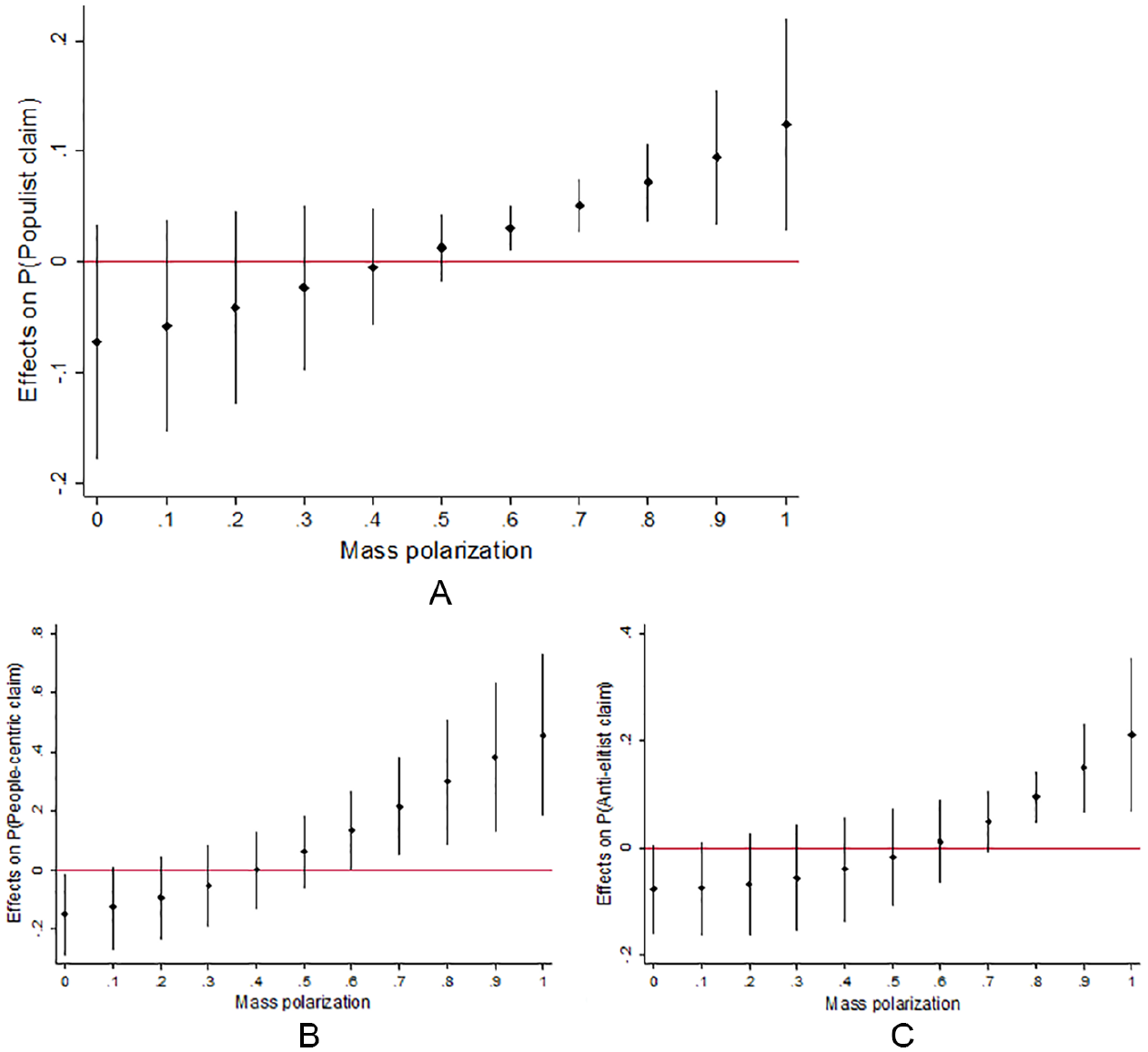
Average marginal effects of polarization for populist parties versus non-populist parties on (A) populist claims, (B) people-centric claims, and (C) anti-elitist claims with 95% CIs.
Certain control variables yielded interesting results. First, parties in office are less likely to express populist communication in the media than parties not in office. Second, leftist parties are more likely to express populist claims in the news media, which seems to differ from studies at the national level (Ernst et al., 2017). Third, parties are more likely to express populism in news outlets from their country of origin. This aligns with our conception of populist communication as a political strategy to (domestic) voters, making it less opportune to express populism in foreign newspapers. Fourth, the more statements parties make on an issue, the greater the likelihood that it expresses populism. Finally, we found significant differences across media outlets. Parties appearing in Aftonbladet, Corriere della Sera, or Euractiv were significantly more likely to express populism, whereas parties featured in the Financial Times or De Telegraaf were significantly less likely to express populism (based on Model 1). Although previous accounts have argued that tabloid-style media are more likely to feature populist content (e.g., Aalberg & de Vreese, 2016), we cannot discern this pattern in our data. This result aligns with recent findings by Wettstein et al. (2019), who found that populist content does not necessarily feature more prominently in tabloid-style newspapers. Our study further qualifies this finding by demonstrating its prevalence for a case in which strategic populist communication is unlikely. Moreover, we concur with Wettstein et al. (2019) that “the populist ideology of actors cited in the stories” is an important predictor of populist communication in the news (p. 532). We advance their findings by showing that the link between populist ideology and news content is contingent on the context of policy issues.
As indicated by the significant Wald chi-square tests (Prob > chi-square in Table 3), the presented models constitute a significant improvement when compared with their baselines. The goodness of fit of our regression predicting populist communication increases after including the interactive terms, as indicated by the lower Akaike information criterion (AIC) of Model 2 (when compared with Model 1). This is not the case for the models predicting people-centrism and anti-elitism separately. That said, we should not focus on the product term’s statistical significance and fit improvement for interpreting the substantive meaning and importance of interaction effects, but rather consider marginal effects presented in Figures 1 to 3 (Berry et al., 2010; Brambor et al., 2006). All these show that the likelihood of populist communication significantly varies within a particular range of values on the salience, civil society, and mass polarization variables.
Binary Logistic Regression of Populist, People-Centric, and Anti-Elitist Claims With Clustered Standard Errors at the Issue-Level. a
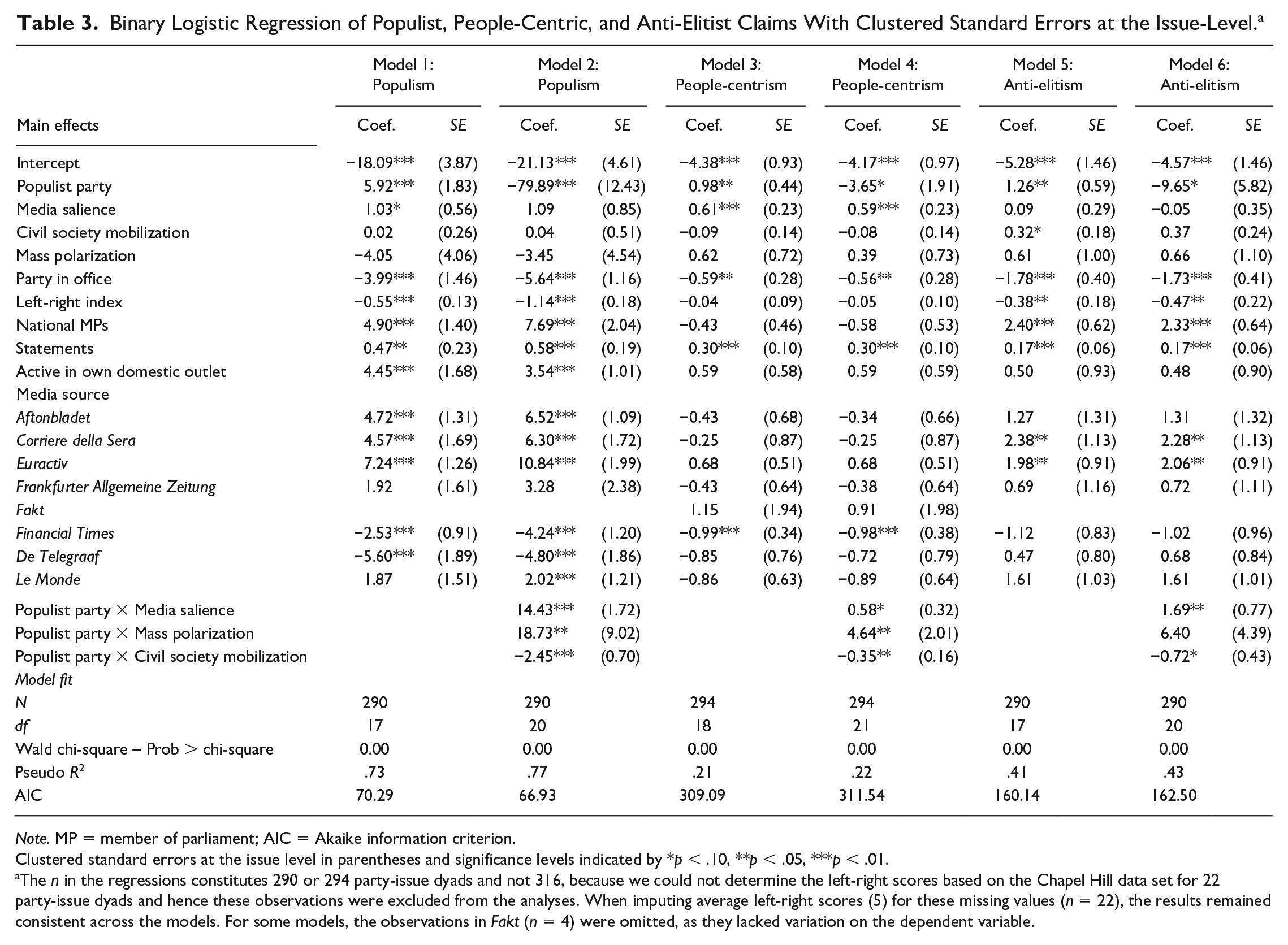
Note. MP = member of parliament; AIC = Akaike information criterion.
Clustered standard errors at the issue level in parentheses and significance levels indicated by *p < .10, **p < .05, ***p < .01.
The n in the regressions constitutes 290 or 294 party-issue dyads and not 316, because we could not determine the left-right scores based on the Chapel Hill data set for 22 party-issue dyads and hence these observations were excluded from the analyses. When imputing average left-right scores (5) for these missing values (n = 22), the results remained consistent across the models. For some models, the observations in Fakt (n = 4) were omitted, as they lacked variation on the dependent variable.
To assess the robustness of our findings, we ran several alternative models, including rare events logistic regressions, models at the level of individual statements, a multilevel model, and a linear probability model. These largely confirm the findings presented here and can be consulted in the online appendix (Tables A5–A11). The models at the statement level show minor incongruences, but as discussed in the online appendix, these incongruences do not weaken the robustness of our initial hypotheses tests. In the statement-level models, we included an additional control variable which indicates whether a statement was made in the 6 months preceding the European elections of May 2014. The models show that populist and people-centric (but not anti-elitist) statements are more likely to be expressed during an election cycle (see Table A7). This is another indication that populist communication is expressed in politically opportune contexts. As mentioned, within-country variation is mostly limited to the countries from which we selected news outlets. Hence, our results cannot be readily generalized to countries from which we did not select news outlets.
Conclusion
Under what circumstances do political actors employ populist communication? Previous studies have shown that political parties and politicians—both populist and non-populist—vary greatly in the extent to which they are populist (Ernst et al., 2019; Hawkins, 2010; Manucci & Weber, 2017). One often-mentioned determinant of parties’ populism is their ideology; more radical parties (on both left and right) tend to be more populist (Ernst et al., 2017; Rooduijn & Akkerman, 2017). In this article, we argued and demonstrated that to fully understand parties’ populist communication, the political context must be taken into account. Our study responds to the recent call by Stanyer et al. (2017) to bridge actor- and communication-centered approaches by arguing that certain (populist) actors strategically express populist communication depending on the political context in which they operate.
Based on Eurobarometer data, combined with the results of a content analysis of 316 party-issue dyads comprising 775 media statements pertaining to 41 EU policy issues in eight news media outlets between 2010 and 2016, we demonstrate that both populist and non-populist parties express populist claims but that they do so to a different extent and under different contextual circumstances. Furthermore, populist parties tend to express people-centrism and anti-elitism more often than non-populist parties, in particular on issues which are highly salient and when public opinion vis-à-vis these issues is polarized. Non-populist parties, in contrast, are more prone to employ populist communication on issues important to civil society groups. In addition, parties rarely express populism in foreign news outlets and seem to target domestic voters in media outlets from their country of origin with populist claims.
Our findings endorse previous accounts that conceived of populism as a communication strategy (see Aalberg & de Vreese, 2017; Ernst et al., 2019; Stanyer et al., 2017). The idea of strategic populism is not necessarily at odds with the literature on populism as a substantive set of ideas (see Hawkins, 2010; Mudde, 2004; Stanley, 2008). In Paris Aslanidis’ (2016) words, If we are to uphold the analytical utility of the concept of populism for political science, we need to acknowledge that it stands for a behavior that fulfills a specific political function which can then be either employed strategically or asserted as a matter of conviction, that is, put on the mantle of ideology. (p. 96)
Research on the use of populism as a communication strategy is flourishing, and many interesting research pathways lie ahead. Future studies could employ, for instance, a qualitative research design to investigate the extent to which party leaders and campaigners employ populism consciously and under which conditions. Such information can only be uncovered through conversations with politicians and others involved in election campaigns (i.e., strategic decision makers). Future investigations should also assess the endogeneity problem of the relationship between contextual conditions and the adornment of media statements with populism. We have argued that politicized circumstances shape the way in which politicians communicate. However, the reverse could also be the case; politicized conditions are affected by the extent to which politicians employ populism. Because we have discovered that the prominence of people-centrism and anti-elitism in the media was relatively limited, we believe that this reversed causal effect is modest. However, this is an empirical question that future studies may want to address.
Our sampling strategy enabled the collection of data from a wide variety of countries, political parties, media outlets, and policy issues. While this selection gives a comprehensive depiction of variation in media coverage at the pan-European level, it also demonstrates that parties are not likely to express populism in foreign news outlets, even on issues with a European scope. Although we analyzed claims from parties from 21 countries, future research has yet to reveal whether our findings are generalizable beyond parties from the seven countries from which we selected news outlets and from which we identified populist statements. To allow for such a deductive country comparison, future studies should select media outlets across countries which qualify as each other’s “most similar” equivalent, rather than employing a “most different” design. While EU public policy can, in many respects, be considered as a least-likely scenario for populist communication to be used strategically, future comparative research should qualify whether our findings translate well to other legislatures and communication environments. Notwithstanding these limitations and important pathways for future research, our study demonstrates that populist communication is contextually contingent and expressed under different circumstances by populist and mainstream parties.
Supplemental Material
sj-pdf-1-jmq-10.1177_1077699021998648 – Supplemental material for The People’s Champions? Populist Communication as a Contextually Dependent Political Strategy
Supplemental material, sj-pdf-1-jmq-10.1177_1077699021998648 for The People’s Champions? Populist Communication as a Contextually Dependent Political Strategy by Iskander De Bruycker and Matthijs Rooduijn in Journalism & Mass Communication Quarterly
Footnotes
Acknowledgements
The authors thank Stefaan Walgrave, Peter Van Aelst, Jonas Lefevere, Isaïa Jennart, Louisa Ha and several anonymous reviewers for their valuable suggestions to previous drafts of this article. Earlier versions of this manuscript were presented at the University of Amsterdam - Faculty of Social & Behavioral Sciences’ conference titled “Populism: Between Resentment and Resistance”, Amsterdam, 2017; the European Consortium for Political Research (ECPR) General Conference, Hamburg, 2018 and at the Media, Movements and Politics (M2P) research retreat, Berendrecht, 2019. We thank the panel and workshop participants for their constructive suggestions.
Declaration of Conflicting Interests
The author(s) declared no potential conflicts of interest with respect to the research, authorship, and/or publication of this article.
Funding
The author disclosed receipt of the following financial support for the research, authorship, and/or publication of this article: The data collection of this paper was supported by the Flemish Research Foundation [FWO postdoctoral grant 12N1417N to Iskander De Bruycker].

Supplemental Material
Supplemental material for this article is available online.
Notes
Author Biographies
References
Supplementary Material
Please find the following supplemental material available below.
For Open Access articles published under a Creative Commons License, all supplemental material carries the same license as the article it is associated with.
For non-Open Access articles published, all supplemental material carries a non-exclusive license, and permission requests for re-use of supplemental material or any part of supplemental material shall be sent directly to the copyright owner as specified in the copyright notice associated with the article.
