




Abstract
The policy of free movement—one of the core principles of the European Union—has become increasingly politicized. This makes it more important to understand how attitudes toward free movement are shaped, and the role of the media. The purpose of this study is therefore to investigate how news frames affect attitudes toward free movement, and whether education moderates framing effects. The findings from a survey experiment conducted in seven European countries show that the effects are few and inconsistent across countries. This suggest that these attitudes are not easily shifted by exposure to a single news frame.
The European Union (EU) policy of free movement entitles EU citizens to move to and freely take up employment in other member states. Although free movement is one of the core principles of the EU, this policy has become increasingly politicized over the last years. In richer EU countries, economic difficulties in many member states seem to have led to concerns about a mass influx of workers, while in poorer countries, worries about a “brain drain” of highly skilled workers who leave the country have emerged (Barbulescu, 2017; González-Ferrer & Moreno-Fuentes, 2017; Ienciu & Ienciu, 2015; Vasilopoulou & Talving, 2019). The issue also contributed to the outcome of the Brexit referendum (Goodwin & Milazzo, 2017; Hobolt, 2016).
In light of this, it has become increasingly important to understand how public attitudes toward free movement are shaped. In that context, there are reasons to believe that the media matter. To begin with, extant research suggests that media can have significant effects on public attitudes in general (Maurer, 2014). Second, research indicates that media might matter in particular with respect to issues that are perceived to be complex and abstract, which applies to EU politics (de Vreese & Boomgaarden, 2006). Third, extant research shows that media might influence attitudes on related issues, including both EU policies (Vliegenthart et al., 2008) and migration (Eberl et al., 2018). Altogether, this suggests that media may have an impact on attitudes toward free movement within the EU.
Aside from the question of whether media have an impact on attitudes toward free movement, of importance is also how media effects on free movement attitudes arise. In that context, there are at least three aspects that are likely to matter. First, it is reasonable to assume that the valence of the news frames is a central factor. There are indications that people who immigrate from other EU countries tend to be portrayed as threats to the economy and welfare of the host countries, while positive coverage is less prevalent (Balch & Balabanova, 2016; Eberl et al., 2018). Evidence also suggests that media frames focusing on negative economic implications of immigration tend to lead to more negative attitudes toward immigration and increased support for restrictive immigration policies, while positive framing is likely to contribute to more positive attitudes (Eberl et al., 2018). Since free movement stimulates intra-EU migration, it is plausible that framing effects on immigration attitudes extend to free movement attitudes.
Second, whether the frame is episodic or thematic can also play a key role in shaping free movement attitudes. Research suggests that episodic frames—compared with thematic frames—are more emotionally engaging as well as easier to recall and less demanding to process (Gross, 2008; Iyengar, 1991; Springer & Harwood, 2015). Research also indicates that news stories focusing on people’s personal experiences (which episodic frames tend to do), rather than statistics and overviews of official information (which thematic frames often utilize), are more powerful in influencing attitudes (Brosius, 1999). Hence, episodic frames might be more effective than thematic frames in shaping free movement attitudes.
Third, media may not only influence attitudes toward free movement by highlighting positive or negative aspects of intra-EU immigration but also by emphasizing positive or negative aspects of intra-EU emigration. Concern about people leaving the country is substantial in some EU states (González-Ferrer & Moreno-Fuentes, 2017; Ienciu & Ienciu, 2015; Mazza & Soto, 2019), which is likely to make people receptive to media reports about the implications of emigration. Moreover, González-Ferrer and Moreno-Fuentes (2017) suggest that oversimplified and problem-oriented media coverage of emigration can affect people’s perceptions of emigration. To our knowledge, this notion has however not been empirically tested yet.
It is important to note, however, that media effects are seldom universal. Instead, they tend to depend on a range of individual-level factors (Valkenburg & Peter, 2013). In the context of free movement, one individual-level factor that might moderate media effects is education, since research suggests that education impacts attitudes toward free movement (Scheve & Slaughter, 2001; Vasilopoulou & Talving, 2019; Vergeer et al., 2000), as well as media effects on attitudes toward immigration (Schmuck & Matthes, 2015).
In light of this, the purpose of this study is to investigate whether and how different news frames affect attitudes toward free movement with special attention to the moderating role of education. Toward this end, we rely on an experiment where we manipulate a news article by varying the valence of the frame (positive vs. negative), the type of frame (episodic vs. thematic), and the type of intra-EU migration (emigration vs. immigration). In contrast to most experimental studies, we furthermore employ a design including seven countries: Germany, Hungary, Poland, Romania, Spain, Sweden, and the United Kingdom. Thereby, we will be able to test the robustness of the results.
Media Frames in the Context of Migration and the EU
Theoretically, this study departs from framing theory. This is still a rather fragmented research field with some dissensus regarding what exactly constitutes framing (Entman et al., 2009; Lecheler & de Vreese, 2018). Important in this context is the distinction between equivalence frames and emphasis frames. Whereas equivalence framing refers to logically identical content that is presented or phrased differently, emphasis framing can involve one set of facts or arguments to the exclusion of other facts or arguments and thus present qualitatively different content (Cacciatore et al., 2016; Lecheler & de Vreese, 2018). In the present study, we follow the emphasis framing tradition by focusing on the effects of news frames from a positive versus negative perspective and thematic versus episodic perspective. The rationale behind the decision to focus on emphasis framing is that (a) emphasis frames are closer to “real” journalistic news coverage than equivalence frames (Lecheler & de Vreese, 2018), leading to higher external validity, and (b) studies focusing on media frames in the context of migration and the EU tend to focus on emphasis frames by, for instance, comparing the effects of different types of “threat frames” and “benefit frames” (e.g., de Vreese et al., 2011; Igartua et al., 2011). Using the same approach as previous studies thus enables comparisons and exploration of the generalizability of findings from previous studies.
The Influence of Positive and Negative News Media Frames
According to the intergroup threat theory, opposition to immigration is likely to be based on perceived symbolic threats—such as threats to the cultural identity and values—or perceived realistic threats—such as threats to the economy or physical well-being (Stephan et al., 2009; Stephan & Stephan, 2000). Research suggests that threat perceptions can be triggered by negative news frames (Igartua et al., 2011). For example, research suggests that frames that link immigration to negative implications—for example, impact on the culture, economy, and physical threats such as terrorism and crime—are likely to generate more negative attitudes, while news stories highlighting positive implications are likely to have more positive effects (Igartua & Cheng, 2009; Lahav & Courtemanche, 2012).
Notably, many studies within the migration literature have found that opposition to immigration stems more from perceived symbolic than from perceived realistic threats (e.g., Hainmueller & Hopkins, 2014, for an overview). For free movement attitudes, the situation might however be different. As intra-EU migrants’ culture and ethnic background generally differ less from that of the host society than the culture and ethnic background of migrants coming from countries outside the EU, immigrants from other EU countries are likely to elicit fewer negative reactions stemming from symbolic threats (e.g., Dustmann & Preston, 2007; Ford, 2011). In addition, it is reasonable to assume that realistic threats are more central when it comes to intra-EU migration, in particular since the economy and labor market competition has been the focus of public debate about mobility within the EU (Ienciu & Ienciu, 2015; Ruhs, 2017; Vasilopoulou & Talving, 2019).
Moreover, evidence suggests that media frames focusing on negative implications of migration on the economy and labor market can generate negative attitudes toward immigration and immigrants (Costello & Hodson, 2011; Schmuck & Matthes, 2017). It is not too far-fetched to expect that this also holds true when it comes to attitudes toward free movement. At the same time, it should be noted that the effects might differ depending on whether the media coverage is about migration within the EU or immigration from other regions. European integration—that mainly has come about through the EU and its policies—might foster sentiments of closer connection to Europeans in other member states (Pichler, 2009). In line with this, research suggests that some people in European societies express a so-called “European cosmopolitism” by feeling close to other Europeans in addition to the people within the national-state (Bruter, 2004; Pichler, 2009). It might therefore be more difficult for media to move (especially negative) attitudes toward migration within the EU, compared with attitudes toward migration from other parts of the world. At the same time, the expectation that negative frames are likely to lead to more negative attitudes toward free movement is supported by evidence from a cross-national experiment, showing that support for free movement declines when people are exposed to information suggesting that immigration from other EU countries leads to labor market and welfare risks (Karstens, 2019). 1 Moreover, the expectation about more negative attitudes as a consequence of negative frames is in line with evidence from a comparative study based on panel data and a content analysis. Specifically, this study shows that exposure to negative news frames on migration can stimulate more negative attitudes toward free movement (Meltzer et al., 2020).
There is also some evidence suggesting that an “economic benefit frame” (e.g., increase in labor force as a consequence of immigration) generates more positive attitudes toward immigration compared with a negative news frame (Igartua & Cheng, 2009). However, it should be noted that most previous studies do not include a control group in the experiments (Igartua & Cheng, 2009; Igartua et al., 2011). Therefore, it remains unclear whether people who are exposed to positive frames are likely to develop more positive attitudes than people who do not get any information, or more positive attitudes compared with people who are exposed to negative frames. There are, however, some indications that positive frames are less powerful than negative frames. For instance, de Vreese and colleagues (2011) found that there was a significant difference in attitudes among respondents who received the negative economic frame and respondents in the control group, while no significant difference was identified between those who received the economic benefit frame and those in the control group. This finding is in line with research suggesting that negative information, in general, stimulates stronger effects than positive information (Cobb & Kuklinski, 1997; Schemer, 2014). Hence, our first hypotheses are:
Thematic Versus Episodic Frames
Aside from valence, the distinction between thematic and episodic frames might be important for understanding framing effects on free movement attitudes. In general, thematic frames place issues in general contexts, for example, by presenting statistics or other information about the overall status of the issue under consideration. Episodic frames, in contrast, focus on exemplars and stories from individuals whose experiences exemplify an issue (Daschmann & Brosius, 1999; Iyengar, 1991, 1996; Springer & Harwood, 2015).
Importantly, the personal exemplars that are a key element of episodic frames do not necessarily illustrate representative cases. Instead, they are often selected for their vividness, entertaining, dramatic, or sensational qualities, and to make issues more accessible (Brosius, 1999; Zillmann et al., 1996). This can be understood in light of media logic, where personalization—the tendency to focus on individual actors—is a central technique used to capture attention (Strömbäck & Esser, 2015).
In general, research suggests that episodic frames are more emotionally engaging than thematic frames, which might be a result of the personal connection that people feel with the person in the episodic news story and the fact that it might be less demanding to process episodically framed media messages (Gross, 2008; Iyengar, 1991; Springer & Harwood, 2015). Exemplification research also suggests that people rely more on personal exemplars than on rather abstract overviews to evaluate the overall conditions of an issue (Zillmann et al., 1996; Zillmann, 2002). In fact, research indicates that exemplars are likely to influence attitudes more than the type of content that is often used in thematic frames, such as statistics, expert opinions, and overviews of official information—even when the latter is more valid (Daschmann & Brosius, 1999). This has been explained by the fact that exemplars are easier to interpret, remember, and process—especially when it comes to issues that are likely to attract attention and evoke emotions (Zillmann, 2002).
Arguably, migration-related issues may be examples of issues where the use of episodic frames are especially powerful, as they are likely to evoke emotions (such as a feeling of outgroup fear in response to news on immigration). In addition, since thematic frames are typically more abstract, they may be less persuasive than episodic frames. Based on this, we expect that:
The Moderating Role of Education
Realistic group conflict theory (Campbell, 1965) suggests that social groups have to compete with each other in acquiring scarce goods and that people in less privileged socioeconomic positions—similar to the ones of many ethnic minorities—are especially likely to perceive that they have to compete with immigrants (e.g., about jobs and wages) and feel threatened by immigration. Consistent with this, research suggests that less educated people exhibit more negative attitudes toward immigration than highly educated people (Scheve & Slaughter, 2001; Vergeer et al., 2000).
In addition, those with higher education tend to be more positive toward the EU, as well as free movement, compared with less educated people. It is also worth noting that research suggests that education is a stronger predictor for EU support and free movement attitudes compared with other demographic factors such as age and gender (Hakhverdian et al., 2013; Vasilopoulou & Talving, 2019).
According to Vasilopoulou and Talving (2019), one reason why free movement might be viewed as more threatening among people with lower levels of education is that they are less equipped for successfully competing in a changing and competitive labor market, than those with higher education. They also suggest that the well-educated utilize free movement the most by moving from one EU member state to another. Since highly educated people hold more positive attitudes from the start and utilize the benefits connected to free movement to a greater extent, it is reasonable to expect that they are more resistant to negative news frames about the implications of free movement. That would be in line with research suggesting that people are less likely to accept counter-attitudinal information than congenial information (Druckman et al., 2012).
It should also be noted that highly educated and politically knowledgeable citizens, in general, are likely to be more resistant to media messages (Biek et al., 1996; Cao, 2008; Schemer, 2012; Zaller, 1992). One reason is that these individuals tend to use their knowledge to critically evaluate new incoming information. They are also more likely to use their knowledge to defend existing attitudes (Zaller, 1992). Furthermore, evidence suggests that education might moderate media effects on attitudes toward immigration (Huber & Lapinski, 2006; Schmuck & Matthes, 2015). For instance, Schmuck and Matthes (2015) found that a political advertisement that framed immigration as an economic threat led to more negative attitudes among less educated, while it did not have any effect on higher educated people.
Against this background, we expect that highly educated individuals will be less affected by news frames focusing on negative implications of free movement. 2
It might, however, be the case that this moderating effect differs depending on whether the news story frames the free movement issue by focusing on labor immigration or emigration. Individuals with lower levels of education might, for instance, be more positive toward emigration than immigration, as emigration may be viewed as an opportunity to go abroad to increase the chances of finding a job, while immigration might be thought of as something that increases the competition on the labor market. Therefore, negative news stories about immigration may be more effective in reinforcing negative attitudes. That being said, we expect negative articles focusing on immigration as well as emigration to have a larger impact on people with lower levels of education than on people with higher education. Yet, since the effects might differ depending on whether the news story is about immigration or emigration, we formulate a research question:
Finally, we expect the level of education to moderate the effect of episodically framed articles. As mentioned, episodic frames are less demanding to process. While this might be less important for highly educated who are better equipped for processing more abstract and complex information, it may be more relevant for the less educated. This might lead to more negative attitudes for negative episodically framed, compared with negative thematically framed news, among the lower educated. Thus, we expect that:
Cross-National Variations in Framing Effects?
Following previous theory and research, the above hypotheses could be expected to hold true across countries. That said, many of the cited studies are based on experiments, and these are usually done within single-country settings. At the same time, there are always a number of contextual factors that differ across countries, which might lead to cross-national variations in framing effects. To avoid falsely assumed universality (Blumler & Gurevitch, 1995; Dogan & Pelassy, 1984), it is hence important to test the robustness of any findings across national settings. Thus, our second research question is:
Data and Method
To test the above hypotheses and answer the research questions, we employed a comparative experimental design, where we vary the valence of the frame, the type of frame, and the type of intra-EU migration. Specifically, the experiment is a random 2 (positive vs. negative frame) × 2 (thematic vs. episodic frame) × 2 (immigration vs. emigration) in-between-subjects design plus one control condition (Theorin et al., 2020). 3 Extracts from the beginning section of the different news articles are provided in Table A1 in the Online Appendix.
The experimental design provides the opportunity to investigate the causal effects of specific frames on free movement attitudes, and thus offers a better understanding of how media influence these attitudes. By exposing respondents to the same experimental stimulus across countries, we also avoid the problem that media effects are difficult to compare across countries since media outlets, their content, and contexts differ (Boomgaarden & Song, 2019).
Although it is beyond the scope of this study to investigate the impact of contextual factors that might condition framing effects on free movement attitudes, we aimed to create variation regarding contextual factors that might have an impact, such as socioeconomic conditions, migration flows, EU membership history, attitudes toward immigration, media system, and political culture. Based on this, the following countries were selected: Germany, Hungary, Poland, Romania, Spain, Sweden, and the United Kingdom. Testing the hypotheses and research questions in this diverse set of countries enables us to explore whether potential media effects are universal or whether the effects rather are country-specific.
Participants
The experiment was administrated by the international survey company OPINION & IMPACT in collaboration with Dynata, and conducted between September 5 and 24, 2019. In each country, quota definitions were based on gender and age to ensure accurate estimations of the populations. In total, 8,457 respondents participated (about 1,200 per country). 4 The sample is largely representative of citizens in EU member states with respect to gender, age, and education, although the highly educated are slightly overrepresented. 5
Procedure
First, respondents answered questions about control variables, such as ideology and political interest. Thereafter, each respondent was randomly assigned to read one fictional online news article about the impact of labor immigration or labor emigration within the EU as a consequence of free movement. To avoid the risk that respondents would proceed with the survey before reading the article they were assigned, the “next” button was displayed only after 20 seconds. After reading one of the articles, respondents were introduced to the treatment and credibility check, measures on attitudes toward free movement, and sociodemographics, followed by a debriefing. 6
Stimulus Material
The fictional articles either addressed negative implications of immigration or emigration, such as exploitation of workers, undercutting of wages (immigration conditions), and labor shortages (emigration conditions), or positive implications, such as increased flexibility and decreased labor shortages (immigration conditions), and reduced unemployment (emigration conditions). Furthermore, the articles were either framed episodically—focusing on a citizen’s personal experience of intra-EU migration—or thematically, providing official information from a researcher about the general implications of intra-EU migration. Already in the headline of each article, it was indicated whether the article was positive or negative, and episodic or thematic. For instance, the headline of the English version of the negative episodic article was: “Callum Williams, unemployed: Immigration has severely worsened my work situation,” and the headline of the negative thematic article was: “Immigration has a severely negative impact on the UK economy” (see Table A1 in the Online Appendix for more detailed information). 7
The different articles were structured in the same way (heading, introduction, quotes, etc.), and designed to look like screenshots of real online news articles. The picture that belonged to the news articles showed several flags of EU member states and silhouettes of people in motion (illustrating intra-EU migration). The same picture was chosen for all experimental conditions and across countries. However, to maximize the cross-national comparability, the flag of the respective country was at the center of the image, and the name of the person featured in the article was changed to a common name in the country. For instance, the name in the U.K. versions was Callum Williams, and the name in the German versions was Jörg Bauer (see Figure A1 and Figure A2 in the Online Appendix).
Measures
Attitudes toward free movement were measured with four items that were linked to the stimulus material, focusing on the economy and labor market: The movement of individuals between EU countries should be (a) restricted to protect workers born in [country], (b) free to deal with labor shortages, (c) free to promote economic growth, and (4) restricted to avoid undercutting of wages (1 = strongly disagree, 5 = strongly agree). Statements 1 and 4 were reverse coded. Based on these items, an index was then constructed (α = .80. M = 3.39. SD = 0.90), where a higher value indicates more favorable attitudes.
Education was measured based on the highest completed level of education. We used local International Standard Classification of Education (ISCED) codes in each country. Thereafter, a correspondence table provided by United Nations Educational, Scientific, and Cultural Organization (UNESCO) was used to match the country-specific codes to its corresponding ISCED level (ranging from 0 = early childhood education to 8 = doctoral or equivalent). Based on this, a dichotomous education variable was created, where 0 refers to low education and equals ISCED Level 0 to 3 (early childhood education–upper secondary education), and 1 refers to high education and equals ISCED Level 6 to 8 (bachelor or equivalent–doctoral or equivalent).
Moreover, we controlled for age and left-right predisposition. Age is important to control for since it is likely to predict susceptibility to attitude change as well as immigration attitudes and EU support (Schotte & Winker, 2018; Vasilopoulou & Talving, 2019; Visser & Krosnick, 1998). Left-right predisposition, in turn, is also linked to immigration attitudes, and research furthermore suggests that people might rely on their left-right predisposition to make sense of frames about migration-related topics (Lahav & Courtemanche, 2012; Pardos-Prado, 2011).
Randomization and Manipulation Checks
The randomization check revealed no significant differences between respondents in the different groups with respect to age 8 (p = .138, f = 1.54), gender (p = .205, f = 1.37), education (p = .654, f = 0.74), and political ideology (p = .941, f=.36). Second, a manipulation check was conducted. This was done by comparing how respondents answered two questions about the article they had just read: (a) If the article was positive or negative, and (b) If the article focused on immigration or emigration. Results showed that there were significant differences in the expected direction between the groups (p < .001 with respect to both questions).
Third, a credibility check was conducted. 9 Overall, respondents perceived all articles to be rather authentic, interesting, convincing, and credible. Notably, however, respondents who received a positively framed article about immigration generally perceived the article to be slightly more authentic, interesting, convincing, and credible. This pattern holds true both when comparing answers on the different credibility questions and when using an index based on the different credibility questions.
When comparing respondents in the seven countries, they rated the articles fairly similarly. Yet, there were some cross-national differences. Overall, the articles were perceived as most credible in Poland and Romania and least credible in Hungary and Sweden. That being said, the main conclusion is that although there were some significant credibility differences between experimental groups, these differences were quite modest. Moreover, it is no major surprise that there are some variations since the discourse about free movement is likely to differ across countries. 10
Statistical Analyses
To test the hypotheses and answer the research questions about news framing effects on attitudes toward free movement, a series of ordinary least squares (OLS) regression analyses were performed. All analyses were conducted in Stata 16.
Results
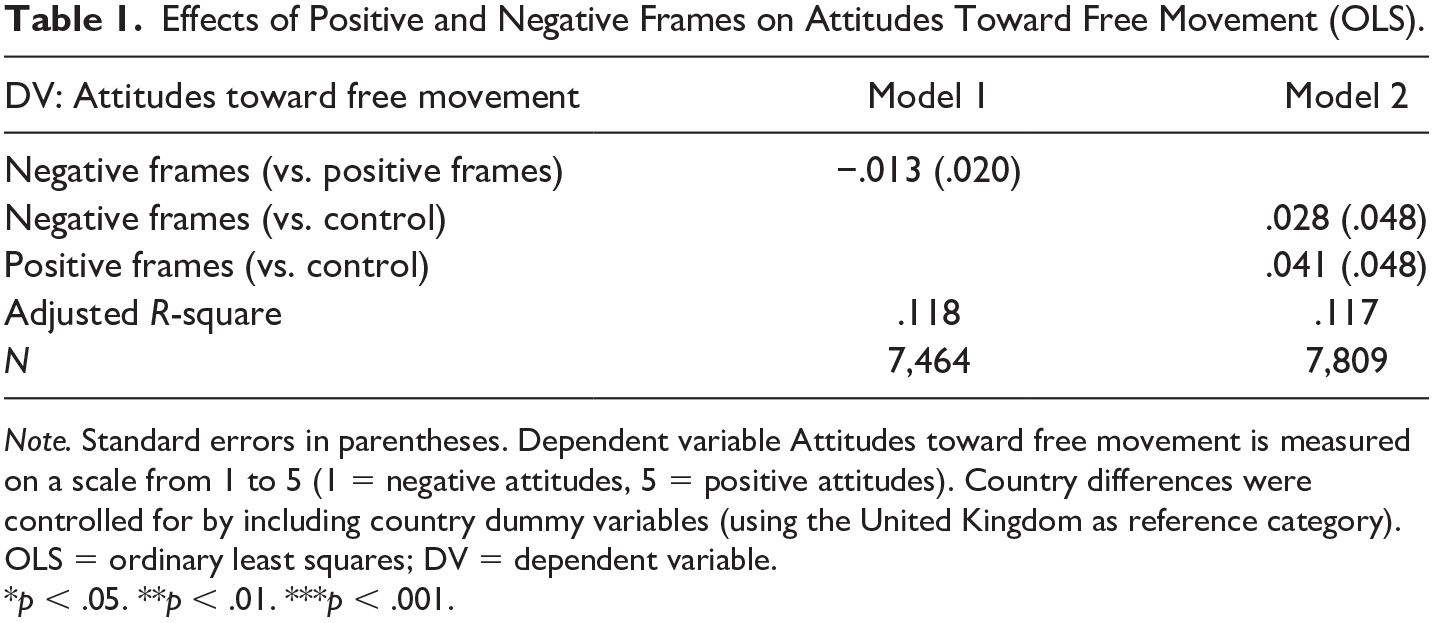
Turning to the results, Table 1, Model 1, shows that respondents exposed to the negatively framed articles did not exhibit more negative attitudes than those exposed to positively framed articles. Moreover, Model 2 in Table 1 shows that neither respondents exposed to negative frames, nor respondents exposed to positive frames, differed significantly from respondents in the control condition. Thus,
Effects of Positive and Negative Frames on Attitudes Toward Free Movement (OLS).
Note. Standard errors in parentheses. Dependent variable Attitudes toward free movement is measured on a scale from 1 to 5 (1 = negative attitudes, 5 = positive attitudes). Country differences were controlled for by including country dummy variables (using the United Kingdom as reference category). OLS = ordinary least squares; DV = dependent variable.
p < .05. **p < .01. ***p < .001.
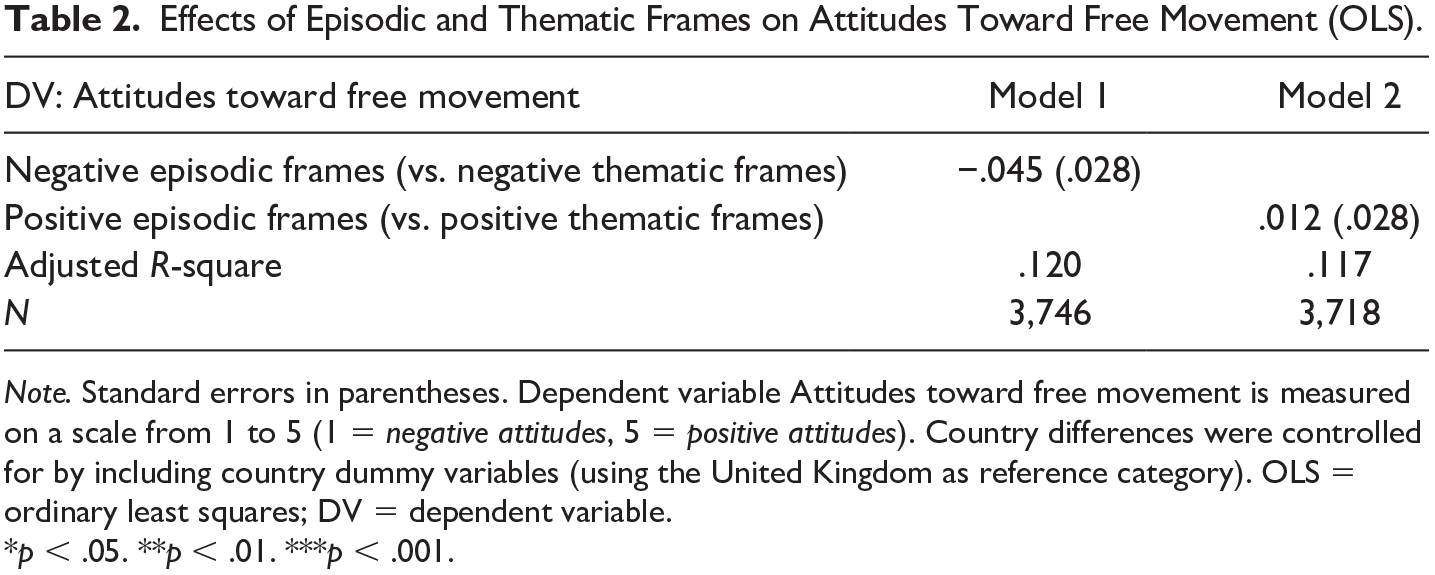
Turning to
Effects of Episodic and Thematic Frames on Attitudes Toward Free Movement (OLS).
Note. Standard errors in parentheses. Dependent variable Attitudes toward free movement is measured on a scale from 1 to 5 (1 = negative attitudes, 5 = positive attitudes). Country differences were controlled for by including country dummy variables (using the United Kingdom as reference category). OLS = ordinary least squares; DV = dependent variable.
p < .05. **p < .01. ***p < .001.
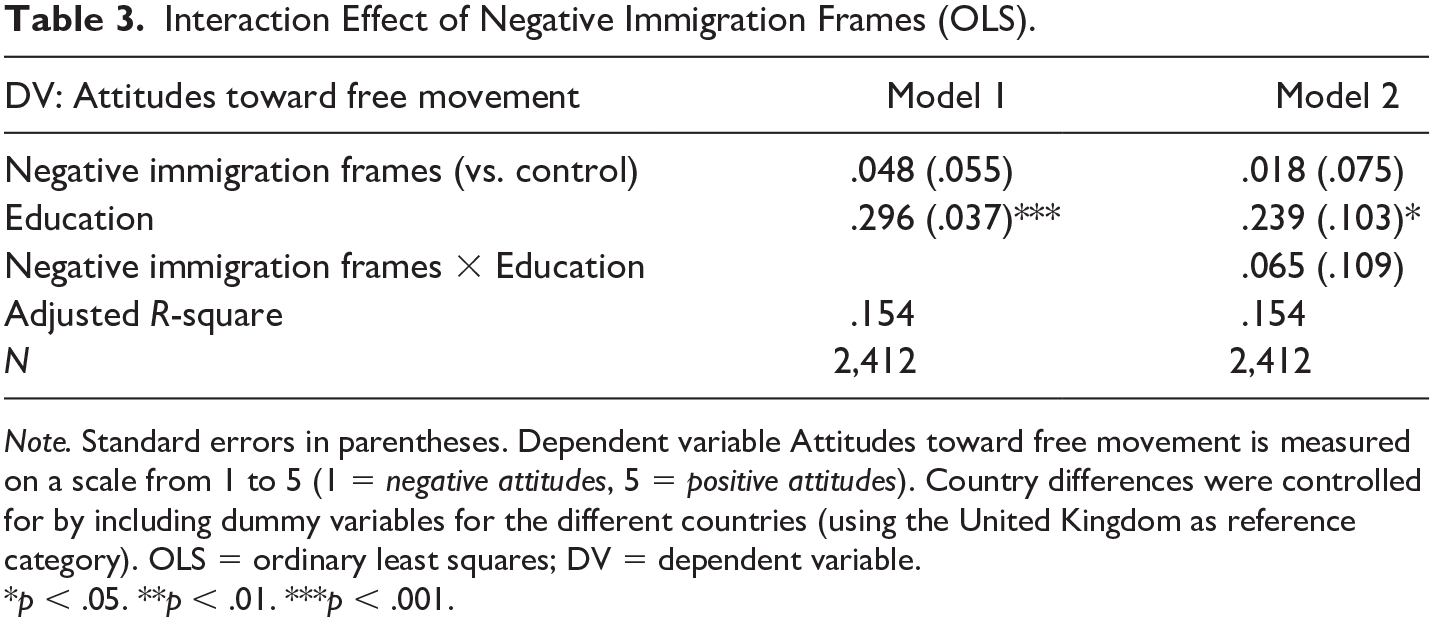
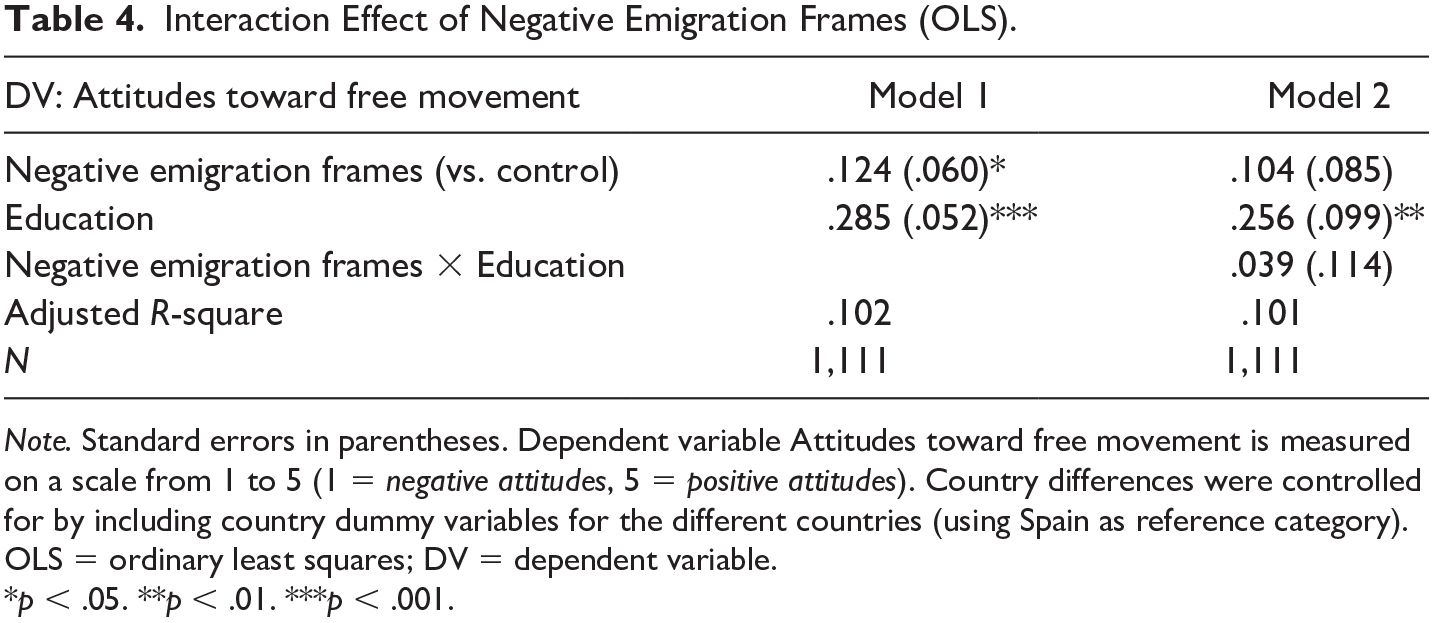
Model 2 in Table 3 furthermore shows that there was no interaction effect between education and exposure to the negative immigration frames. Likewise, no interaction effect was identified regarding the emigration frames, as shown in Table 4, Model 2. Hence,
Interaction Effect of Negative Immigration Frames (OLS).
Note. Standard errors in parentheses. Dependent variable Attitudes toward free movement is measured on a scale from 1 to 5 (1 = negative attitudes, 5 = positive attitudes). Country differences were controlled for by including dummy variables for the different countries (using the United Kingdom as reference category). OLS = ordinary least squares; DV = dependent variable.
p < .05. **p < .01. ***p < .001.
Interaction Effect of Negative Emigration Frames (OLS).
Note. Standard errors in parentheses. Dependent variable Attitudes toward free movement is measured on a scale from 1 to 5 (1 = negative attitudes, 5 = positive attitudes). Country differences were controlled for by including country dummy variables for the different countries (using Spain as reference category). OLS = ordinary least squares; DV = dependent variable.
p < .05. **p < .01. ***p < .001.
Finally,
Interaction Effects of Episodic Versus Thematic Negative Frames (OLS).
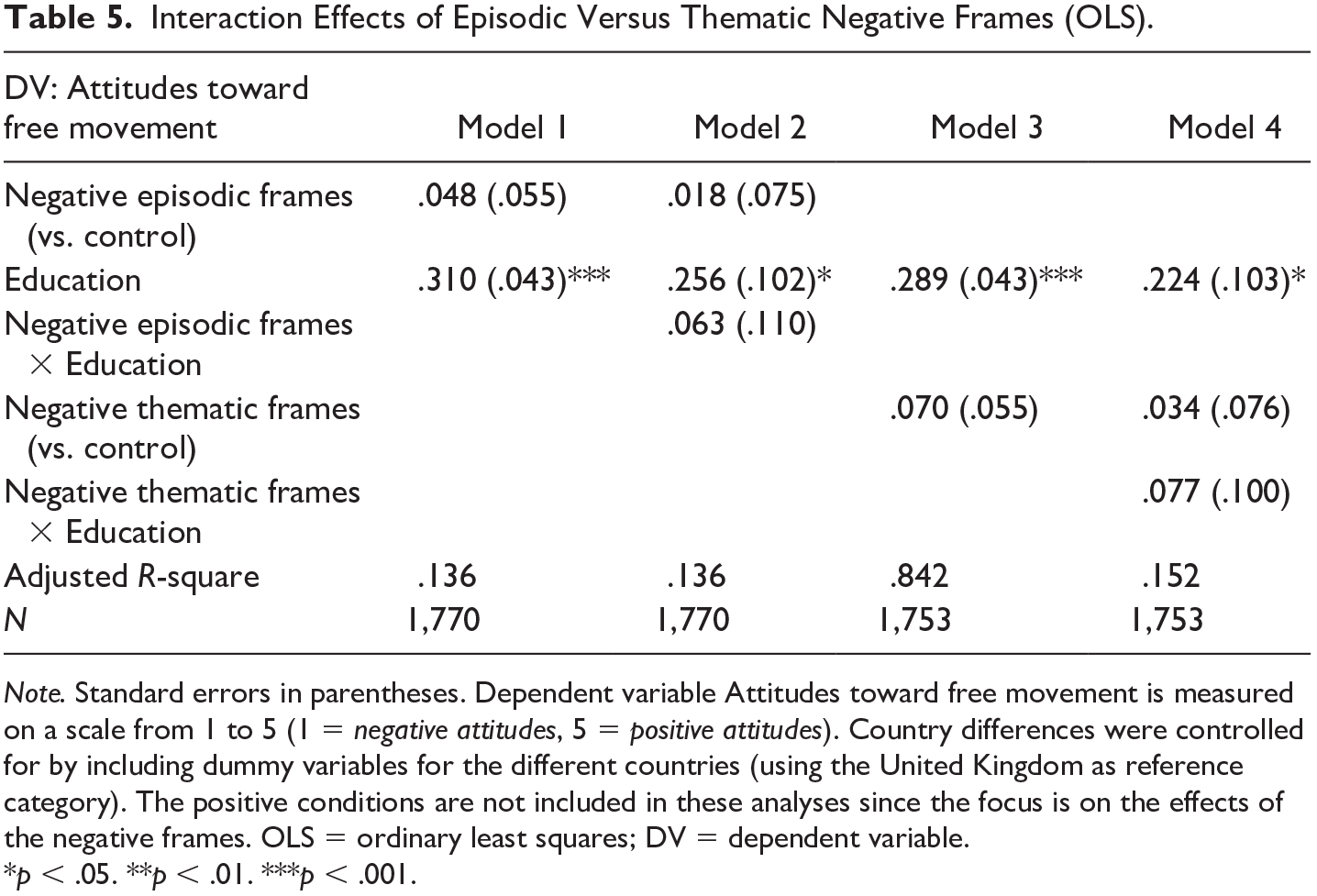
Note. Standard errors in parentheses. Dependent variable Attitudes toward free movement is measured on a scale from 1 to 5 (1 = negative attitudes, 5 = positive attitudes). Country differences were controlled for by including dummy variables for the different countries (using the United Kingdom as reference category). The positive conditions are not included in these analyses since the focus is on the effects of the negative frames. OLS = ordinary least squares; DV = dependent variable.
p < .05. **p < .01. ***p < .001.
Cross-National Variations in Framing Effects?
Thus far, the results show no support for our hypotheses. It could, however, be the case that there are effects in some but not in other countries. To explore this,
With respect to
Finally, we tested
Additional Analyses
As a robustness check, we re-ran all analyses, excluding respondents who failed in the attention checks by answering that the person in the article was a woman (in reality it was a man) or that they did not know. In total, 3012 respondents were excluded from these analyses (on average 430 per country). Using this sample did not substantially change the results however, with two exceptions: (a) the difference between the positive as well as the negative frames and the control group became insignificant in Spain. Yet, the negative frames still led to significantly more negative attitudes than the positive frames (B = −.121, p = .046), and (b) the expectation that the positive episodic news frames would lead to more positive attitudes than positive thematic news frames (
As another robustness check and to further investigate variations between educational groups, we also conducted the interaction analyses (
Conclusions and Discussion
The starting point for this study was that the media, by means of their framing, could be expected to influence people’s attitudes toward free movement within the EU. Despite the fact that the hypotheses were firmly based on framing theory and previous findings, the main conclusion of the current study is that the framing effects were few, weak, and not robust across countries. Some effects were found—more specifically, that negatively framed articles led to more negative attitudes than positively framed articles in Spain, that negative episodic articles led to more negative attitudes than negative thematic articles in Spain, that negatively framed articles about emigration led to more negative attitudes among less educated in Romania (when the dichotomous education variable was used), and that the negative and episodically framed articles stimulated more negative attitudes toward free movement among those with a low education level in Romania, while there was no such moderation effect for the thematic frames—but this does not change the overall pattern.
This raises the question of why the results showed few framing effects, and why there were not more cross-national differences despite the diverse set of countries included in the study. One answer might be weaknesses in the methodology and design of the present study. It might, for instance, be that the experimental manipulation did not work as intended. However, the experimental treatment was similar to treatments that have generated effects on immigration attitudes and EU-related issues in other studies. Our analyses also show that the credibility- and manipulation checks worked. This speaks for the robustness of the results, although it cannot be ruled out that the experimental manipulations generally were too weak to generate framing effects.
Another answer might be that although numerous studies have shown that media can have effects on public attitudes, this is not always the case (Shehata & Falasca, 2014; Theorin & Strömbäck, 2020). People are equipped with several sources of resistance to media influence (Blinder & Jeannet, 2017; Pomerantz et al., 1995; Slothuus & de Vreese, 2010; Taber & Lodge, 2006). Important in that context is that strong and crystalized attitudes reduce the likelihood of media effects (Pomerantz et al., 1995; Tesler, 2015; Zaller, 1992) while people tend to be more easily influenced by the framing of new issues where the attitudes and the interpretations of the issue have not yet been settled (Chong & Druckman, 2007a). The fact that free movement within the EU has been in place for several decades and that it has been widely debated over the years might thus limit the scope for framing effects. In other words, it might be the case that people are quite familiar with the pro and con arguments of intra-EU migration, which decreases the likelihood that reading a single additional news story influences their attitudes.
Moreover, European integration and sentiments of connections with other Europeans might make the public more resistant toward media coverage about free movement within the EU compared with media coverage about migration from other regions. This does, however, not mean that media frames do not affect the public when it comes to free movement. Chong and Druckman (2007b) argue that even when prior attitudes attenuate framing effects at the time of measurement, this does not tell us that framing, in general, has weak effects, as the prior attitudes themselves may have resulted from a previous diffusion of media frames. To investigate such dynamics, future research needs to broaden the perspective to long-term content analyses on media frames and respective effects on public opinion.
Still, one might ask why the results are inconsistent with previous research, which has found more clear-cut framing effects on related issues such as immigration attitudes. One possible explanation might be publication bias, meaning that the publication of studies is influenced by the significance or directions of the findings (Franco et al., 2014; Gerber et al., 2010) and that studies showing no effects have a harder time getting published. Although it is uncertain whether there is such publication bias in research on framing effects related to migration and the EU, it cannot be ruled out.
Furthermore, the inconsistency with previous research may be due to the rather broad definition of emphasis frames. Cacciatore et al. (2016) claim that a loose (emphasis-based) definition of frames might contribute to making framing effects appear more powerful than they really are as they overlap with other media effect theories. Thus, the authors argue for a more rigid (equivalence-based) definition of framing. We believe that the authors have a valid point, and firmer operationalizations would also simplify the comparison between studies. On the other hand, as previously mentioned, emphasis frames are closer to “real” journalistic news coverage than equivalence frames, which is why most studies—including the current one—have focused on emphasis frames (Lecheler & de Vreese, 2018).
Having said that, the lack of hypothesized effects and inconsistent findings does not equal a lack of results. Our study adds empirical nuances to the research field focusing on how media influence migration- and EU-related attitudes, by showing that news framing does not always move opinions. The fact that we did not find support for the prediction that negative frames would provide stronger effects than positive frames is an interesting finding that deserves to be discussed further. One potential explanation for this is that migration-related issues are more often negatively framed than positively framed. Thus, people might have become more accustomed to these frames, which in turn may decrease their impact on attitudes. That would be in line with research on habituation, suggesting that repeated exposure to the same stimulus can decrease people’s response to that stimulus (Potter, 2012).
Another finding that should be discussed is the insignificant effect of episodic versus thematic frames in the majority of our analyses. This could be understood in light of migration studies suggesting that people’s immigration attitudes are based on perceptions of the economic impact on the nation as a whole (sociotropic evaluation) rather than on perceptions of how immigration affects their personal situation (egocentric evaluation) (Hainmueller & Hiscox, 2010; Hainmueller & Hopkins, 2014; Valentino et al., 2017). Although research suggests that exemplars—a key feature of episodic frames—are likely to influence people’s perceptions about overall conditions as well (Daschmann & Brosius, 1999), it may be that respondents recognized that the thematic articles provided more information about national implications, which might have canceled out the stronger effects that exemplars tend to have. The fact that we only found one moderating effect of education is also consistent with research suggesting that immigration attitudes are based on perceptions of national rather than personal consequences.
Although we identified fewer framing effects than expected, this does not preclude that media can have framing effects on free movement attitudes. It might, for instance, be that stronger reinforcement effects would occur if respondents could choose whether they wanted to read a positive or negative article. Moreover, although we found few effects of being exposed to one news frame, there might be effects of repeated exposure to the same frame. That would be consistent with findings in a panel study on how media influence public opinion about EU enlargement (de Vreese & Boomgaarden, 2006). Specifically, the study found that a substantial level of rather one-sided message flow (positive or negative) influenced public opinion, whereas a more mixed information flow did not.
It might also be that the effects would differ if people got exposed to frames about Roma EU migrants—who are often depicted as economic threats (Meeusen & Jacobs, 2017)—compared with frames about, for instance, Danish EU migrants. Finally, whereas few moderating effects of education were found, other factors might influence the relationship between news frames and free movement attitudes. For instance, it would be interesting to investigate the role of political knowledge since evidence suggest that it is one of the most important individual-level moderators for framing effects (Lecheler & de Vreese, 2018). There is also evidence showing that those with lower issue-specific knowledge are more likely to be influenced by news stories about migrants (Schemer, 2012). Moreover, prior attitudes might play a moderating role: In line with previous research (Druckman et al., 2012), it is plausible to expect that negative (positive) attitudes about free movement are more easily reinforced among individuals who are negative (positive) from the start, and that stronger attitudes are more resistant to change.
Since free movement is a fundamental principle of the EU, research on the media’s role in shaping attitudes toward free movement is of high societal relevance, and further research that addresses these kinds of questions is thus clearly needed.
Supplemental Material
sj-docx-1-jmq-10.1177_10776990211006793 – Supplemental material for Does News Frame Affect Free Movement Attitudes? A Comparative Analysis
Supplemental material, sj-docx-1-jmq-10.1177_10776990211006793 for Does News Frame Affect Free Movement Attitudes? A Comparative Analysis by Nora Theorin, Christine E. Meltzer, Sebastian Galyga, Jesper Strömbäck, Christian Schemer, Jakob-Moritz Eberl, Fabienne Lind, Tobias Heidenreich and Hajo G. Boomgaarden in Journalism & Mass Communication Quarterly
Footnotes
Acknowledgements
We thank Per Alm at the Department of Journalism, Media and Communication, University of Gothenburg, for editing the fictional news articles.
Declaration of Conflicting Interests
The author(s) declared no potential conflicts of interest with respect to the research, authorship, and/or publication of this article.
Funding
The author(s) disclosed receipt of the following financial support for the research, authorship, and/or publication of this article: This work was supported by Horizon 2020 Framework Programme (grant number 727072).

Supplemental Material
Supplemental material for this article is available online.
Notes
Author Biographies
References
Supplementary Material
Please find the following supplemental material available below.
For Open Access articles published under a Creative Commons License, all supplemental material carries the same license as the article it is associated with.
For non-Open Access articles published, all supplemental material carries a non-exclusive license, and permission requests for re-use of supplemental material or any part of supplemental material shall be sent directly to the copyright owner as specified in the copyright notice associated with the article.

.png)