




Abstract
There is a lack of comparative research on nudity in television advertising. Building on cross-cultural theory, we examined countries’ gender indices and preclearance policies as predictors of nudity. We also tested the influence of a main actors’ gender and age, as well as the role of product categories. We sampled N = 1,755 TV ads from 13 countries and found that the main characters’ nudity was higher for women compared with men, less likely with increasing age, and occurred more often for congruent than incongruent products. Multilevel analyses showed that nudity was independent of a country’s gender indices and preclearance policy.
Sex appeals in TV advertising, such as male and female characters’ nudity, have a long tradition in advertising practice and research. Nudity is used to help advertisements stand out in a cluttered media environment or to make messages more appealing to the audience (Manceau & Tissier-Desbordes, 2006). There are many different indicators of sexual appeal in today’s advertisements. Among them, nudity—or, the degree of dress—of the primary characters is the characteristic most likely to give a sexual connotation to an advertisement. Several content analytical studies in the United States have investigated nudity as a main variable in advertising (e.g., Reichert et al., 2012; Soley & Kurzbard, 1986; Soley & Reid, 1988), whereas a few studies have investigated countries beyond the United States (Hetsroni, 2007) or have used cross-cultural data (Nelson & Paek, 2005, 2008; Paek & Nelson, 2007). While full nudity itself was rarely found in these studies, a clear gender difference emerged in the degree of dress of the primary characters. Results consistently showed that women are more likely to be suggestively dressed or partially dressed, whereas men are more likely to be fully dressed. Previous research also indicated that higher levels of nudity were especially common for congruent products, that is, products for which nudity has a perceived relevance, such as clothing and beauty products (Nelson & Paek, 2008; Paek & Nelson, 2007) and that culture might play some role for the degree of nudity (Nelson & Paek, 2008). It is especially important to examine the role of culture when analyzing ad content because the depiction of gender is clearly culture driven (Nelson & Paek, 2008). If, for instance, nudity is culturally accepted in a country, advertisers should be more likely to use nudity for a product compared with a country where nudity is less established. However, knowledge on the influence of culture on nudity in advertising is scarce.
Against this background, this article attempts to address four major research gaps: First, while some studies on gender representation in television advertising have looked at nudity as a by-product (e.g., Ibroscheva, 2007; Stern & Mastro, 2004), there is a lack of research focusing on nudity in television advertising. Second, we lack theory-driven, comparative research. Although single-country studies are valuable, they usually analyze a specific sample at a specific time of the year in a descriptive manner. As a consequence, we cannot compare the findings across countries (Matthes et al., 2016). As one exception, Nelson and Paek (2008) compared the nudity of TV advertising characters in seven countries and used Hofstede’s masculinity dimension and the countries’ preclearance policies (i.e., a compulsory examination of an advertisement for its compliance with regulatory rules before it can be broadcast) to explain nudity levels. While this study is pioneering, the data sets are from 2002. Also, the study sampled its material from different months, which may reduce the validity of the conclusions. What is more, the study only examined Hofstede’s masculinity dimension, and the role of other important gender indices assessed at the country level remains unexplored. We thus follow the footsteps of Nelson and Paek (2008) using the same underlying conceptual framework but test the roles of two cultural models as well as preclearance policies.
Third, no prior research has used a multilevel modeling logic (see also Raudenbush & Bryk, 2002). In fact, it is not the same to interpret differences between two countries by simply referring to cultural differences as it is to empirically measure and analyze the role of culture in a statistical model (Matthes et al., 2016). If context shapes nudity in television ads, then a country’s score on a contextual factor should help us to statistically explain its degree of nudity in a multilevel model. As the fourth research gap, we lack knowledge about the role that a model’s age plays in regard to nudity, a particularly pressing question, given aging societies around the globe (Prieler & Kohlbacher, 2016), because portrayals of nudity of older people may affect the way younger people think about older people and the way the increasing number of older consumers think about themselves and react to such advertisements (Donlon et al., 2005; Gerbner et al., 1980; Mares & Cantor, 1992).
Nudity in Advertising
Sexual content in advertising includes various types: nudity/dress, sexual behavior, physical attractiveness, sexual referents, and sexual embeds (Reichert, 2003). In this study, we focus on one of these types only, namely nudity/dress. Numerous studies have looked at the effects of nudity on the attitudes of consumers toward the ad, brand recall, and purchase intention. Some studies have found that advertisements containing nudity get better brand recall (Furnham & Mainaud, 2011) or even lead to stronger purchase intentions compared with advertisements without nudity (Severn et al., 1990). Such positive effects for nudity are more likely for products that are congruent to sexual appeal (Chang & Tseng, 2013). Yet other studies suggest that nudity does not enhance brand recall (Alexander & Judd, 1978). Research has also indicated that women generally adopt more negative attitudes toward ads containing nudity compared with men (Dianoux & Linhart, 2010). One meta-analysis suggests that sexual appeals have a positive effect on ad recognition and recall, but not on brand recognition/recall and attitude toward the ad, though the latter differed by gender (Wirtz et al., 2018). Another meta-analysis found that sexual media had no effect on memory or buying intentions, and as intensity of sexual ad content increased, memory, attitudes, and buying intentions decreased (Lull & Bushman, 2015).
Yet there are comparatively few content analyses for nudity, especially when it comes to television ads. Generally, studies on television and print advertising have found, for example, that nudity became more prevalent between 1964 and 1984 and that sexual illustrations became more overt and relied more on visuals (Soley & Kurzbard, 1986; Soley & Reid, 1988). Other studies also indicated an increase of visual sexual imagery and sexual dress between 1983 and 2003 and that sexual content became more explicit in women’s and men’s magazines compared with newsweeklies (Reichert et al., 2012). Previous research has found key variables predicting nudity, such as the gender of the primary character, the characteristics of the product (i.e., if a product is congruent), and to a lesser extent, the age of the primary character. These refer to different and unrelated strands of research, so we will present them separately in the next sections.
Gender
Research on advertising has shown differences in gender representations throughout the decades (Eisend, 2010; Furnham & Paltzer, 2010): Women are more often shown as product users, in dependent roles, at home, as younger, and associated with a domestic product. Overall, however, such stereotypes seem to be decreasing (Wolin, 2003). Research on nudity on television advertising has also shown gender differences: More men than women were fully dressed and more women than men were depicted in states of undress (Prieler, 2016; Stern & Mastro, 2004). The cause (and theoretical explanation) for this finding is that the female body appears to be more sexually objectified than the male body. Feminist theorists see the reason for sexual objectification in creating and maintaining patriarchy (see also Fredrickson & Roberts, 1997). Also, advertising can be understood as a system of symbolic power relations between men and women (see Barthel, 1988). Objectification theory states that objectification of women has real consequences and potentially leads to anxiety, shame, depression, and eating disorders (Fredrickson & Roberts, 1997). Based on this theoretical reasoning and on prior research, we hypothesize the following:
Nudity-Product Congruence
Previous research also suggests that advertisements for congruent products show a higher degree of nudity than advertisements for incongruent products (Nelson & Paek, 2008; Paek & Nelson, 2007). For congruent products, nudity has a perceived relevance, such as for underwear or fashion products and cosmetics, but it is also considered relevant to products that are associated with sexuality, such as alcohol. Other products, such as banking or computers, are incongruent and therefore rarely associated with nudity. Scholars usually explain the nudity-product congruence with the match-up hypothesis which claims that a spokesperson’s image should be in line with the selling idea (Nelson & Paek, 2008). In fact, persuasion theory suggests that match-up fosters attitude change and leads to positive ad evaluations. In the context of television advertisements, Nelson and Paek (2008) found that the product category was the most significant predictor for the degree of nudity. Because of the perceived relevance of nudity for congruent products, the audience might be more accepting of nudity in such contexts than for, for example, car advertisements. Previous research has confirmed this assumption in that nudity in ads for congruent products is more acceptable than or sometimes even preferred over ads without nudity (Chang & Tseng, 2013). It follows that
Age
Hardly any studies on TV advertising have examined the relationship between age and the degree of nudity. Stern and Mastro (2004) have shown that age differences played a significant role in how characters were dressed. Young adults were more suggestively dressed, whereas older adults were more conservatively and more fully dressed. These results are in accordance with literature suggesting that older people are not associated with attractiveness (Prieler & Kohlbacher, 2016), and the same is true with sexuality. Sexuality and old age are understood as incompatible, and popular culture even emphasizes that older people are not sexually desirable (Vares, 2009). Nude and eroticized depictions of older people are mostly nonexistent (Kilbourne, 1999) and when used, they are shown as ridiculous and even disgusting (Baumann & de Laat, 2014). This is in line with research showing that older people are regarded as less attractive than younger people, which is valid for both genders, but even more pronounced for women (Deutsch et al., 1986). Thus, the bodies of older men are less filtered than the bodies of older women (Marshall & Swinnen, 2014). This finding is in accordance with the so-called double standard of aging (Sontag, 1972), that is, the idea that society is much more permissive of aging in men than in women. Based on the literature suggesting that older people are not associated with sexuality, we formulate the following hypothesis.
Conceptual Comparison Framework: Cultural Dimensions and Preclearance Policies
Previous research suggests that culturally normative advertising content, such as the depiction of gender, is culture driven. As a result, standardization of advertising content, which “occurs when the execution tactics of advertising elements (e.g., advertising copy, visuals) are kept the same across the countries’ advertisements” (Nelson & Paek, 2007, p. 65), is appropriate, regardless of socioeconomic differences between countries (Karande et al., 2006). Scholars have indicated that nudity is especially difficult to standardize across cultures (Frith & Mueller, 2010). French and Israeli advertisements, for instance, make more use of sex appeal than ads in the United States (Hetsroni, 2007). In addition, consumers were found to react differently to nudity in different parts of the world (Nelson & Paek, 2008; Paek & Nelson, 2007). For example, Europe is generally believed to accept more nudity, which might suggest a localized approach to nudity in advertising (Paek & Nelson, 2007).
To explain those differences, we adapt the conceptual framework from two pioneering studies on nudity in advertising and culture (Nelson & Paek, 2005, 2008). Both studies are built on the theoretical notion that cultural dimensions (Hofstede, 2001; House et al., 2010) are related to nudity in advertising. The underlying theory is that cultural models translate to preferences of the audience and thus, in turn, affects creative decisions by advertisers. Following Hofstede (2001), Nelson and Paek (2005) examined the advertisements in Cosmopolitan magazine from seven countries and found that masculinity and a restrictive political system were negatively related and that sexual freedom was positively related to degrees of nudity. Similarly, Nelson and Paek (2008) looked at television advertisements from seven countries and came to the conclusion that Hofstede’s masculinity index was negatively related to degrees of female and male nudity, but held little explanatory value for the degree of nudity in each culture. In addition, countries with strong censorship rules had a slightly higher mean score of male (but not female) nudity than those with less strict censorship guidelines. However, Hofstede’s masculinity index is only one of the available indices, so findings may differ using other indices. Against this background, we now explain several cultural models and gender indices and, after that, preclearance policies.
Cultural Models
Hofstede’s cultural dimensions have been applied in advertising research in areas such as visuals forms (Bu et al., 2009), celebrity endorsers (Paek, 2005), advertising strategy (Li et al., 2009), information content (Taylor et al., 1997), advertising appeals (Bang et al., 2005), and for developing a framework for standardization of ad content (Karande et al., 2006), among others. Hofstede’s cultural model includes originally four dimensions (he later added two): power distance, individualism/collectivism, uncertainty avoidance, and the masculinity dimension (Hofstede, 2001). Within these dimensions, the masculinity dimension is the most relevant for the purposes of this article. Some studies confirmed an association between Hofstede’s masculinity index and gender portrayals (Huang, 1995; Wiles et al., 1995), while other studies led to mixed results (D. An & Kim, 2007; Milner & Collins, 2000; Paek et al., 2011) or to results that were mostly opposite from those predicted by Hofstede’s masculinity index (Milner, 2005; Moon & Chan, 2002; Odekerken-Schröder et al., 2002). As explained above, two studies specifically investigated the relationship between Hofstede’s masculinity index and female nudity and found some indication of a negative relationship (Nelson & Paek, 2005, 2008). The masculinity dimension reflects differences among societies in how far each emphasize masculine values such as assertiveness and competition versus feminine values such as nurturance or solidarity (Hofstede, 2001). In addition to that, another aspect of the masculinity dimension reflects differences among societies in their beliefs about appropriate behavior for males and females with more masculine cultures having more emphasis on males being more assertive and tough and females expected to be modest, whereas in feminine cultures, there are less gender differences and males as well as females are expected to be modest (Emrich et al., 2004; Hofstede, 2001). Such differences should directly translate to our study in that men and women are represented in more different ways in masculine than in feminine societies (Huang, 1995; Wiles et al., 1995). In addition, feminine societies are more gender equal which might translate to audience preferences and also that women might play a bigger role in the creation of advertisements. Thus, we posit the next hypothesis in the following way:
Hofstede’s cultural model has been increasingly criticized over the years as being outdated (Okazaki & Mueller, 2007) and that the masculinity dimension mixes two subdimensions, that is, the characteristics of a society and its gender role distinctions (Emrich et al., 2004; Hofstede, 2001). Thus, it is essential to use additional indices. Also, Nelson and Paek (2008) suggested future research to “consider other kinds of and more contemporary value frameworks to understand the differences of advertising content across countries” (p. 732). One alternative approach is, in fact, the Project GLOBE (House et al., 2010). Despite the urge to use Project GLOBE’s dimensions in advertising research (Okazaki & Mueller, 2007), only a few studies to date have employed them (Terlutter et al., 2010). The GLOBE project differentiates between societal practices and values. Practices are measured through questions regarding “what is,” while values are measured through questions regarding “what should be” (House et al., 2010). Because gender stereotypes are about the actual situation in a society and the way a society performs (Busby & Leichty, 1993; House et al., 2010; Lafky et al., 1996), we decided to use societal practices in this study (House et al., 2010). Hofstede’s masculinity dimension clearly influenced the GLOBE project. However, the GLOBE project separated this dimension into gender egalitarianism and assertiveness. Gender egalitarianism was defined as “the degree to which a society minimizes gender role differences while promoting gender equality” (House et al., 2010, p. 118). It reflects the beliefs of a society about whether biological sex should determine roles in that society. The more gender egalitarian societies rely less on biological sex and thus have less gender differentiation (Emrich et al., 2004). This might have an effect on audience expectations as well as on the ratio of male and female advertising creatives and therefore also on gender representations. The dominance of female over male nudity in TV ads should thus decrease in gender egalitarian societies. Based on this theory, we state the following hypothesis:
Preclearance Policies
Another factor shaped by culture that might have an influence on the degree of nudity in television advertisements is the advertising regulations in each country (Nelson & Paek, 2008). Regulations are highly varying by country and are based on what is appropriate in a specific culture. For example, nudity did not work well in China (Cheung et al., 2013) and is thus also comparatively seldom used there (Nelson & Paek, 2008; Paek & Nelson, 2007), while nudity is more accepted in Europe (Paek & Nelson, 2007). Not surprisingly, religion was also found to be an important aspect on how people react to nudity in advertising (Boddewyn, 1991; Digout & Tayeh, 2015). Such cultural differences have certainly also an influence on advertising regulation.
The main purpose of advertising regulations is to protect society from untamed business behavior (Frith & Mueller, 2010). Regulations can be generally divided into two groups: One is self-regulation, and the other is government regulation. Self-regulation is generally supported by the advertising industry because it monitors messages and increases the reputation of the industry. In addition, strong self-regulation might also prevent government regulation. One weakness of most self-regulation systems is that the regulatory bodies only learn of the problematic ad through complaints after the ad has already been run (Sheehan, 2014). Thus, some countries also employ advertising preclearance, which is a compulsory examination of an advertisement for its compliance with regulatory rules before it can be broadcast. In the context of nudity, for example, the Korea Communications Commission’s regulations state that one should not promote vulgar contents, expose too much of the body, or feature obscene material (S. An, 2014). We focused on preclearance because this is the stronger form of regulation and research has indicated that regulations can minimally explain the degree of nudity (Nelson & Paek, 2008). Based on previous literature, we posit the following hypothesis:
Method
We analyzed 13 countries (Austria, Brazil, China, France, Germany, Japan, the Netherlands, Romania, Slovakia, South Korea, Spain, the United Kingdom, and the United States). These countries were selected based on their masculinity scores. We aimed for a broad range of countries with different scores on various gender indices. We included Japan, Slovakia, and Austria because of their high scores and the Netherlands for its low score on Hofstede’s masculinity index; countries with high scores (e.g., the United Kingdom, the Netherlands, and France) and a low score (South Korea) on Project GLOBE’s gender egalitarianism index were also included (see Table 1).
Gender Indices and Preclearance by Country.
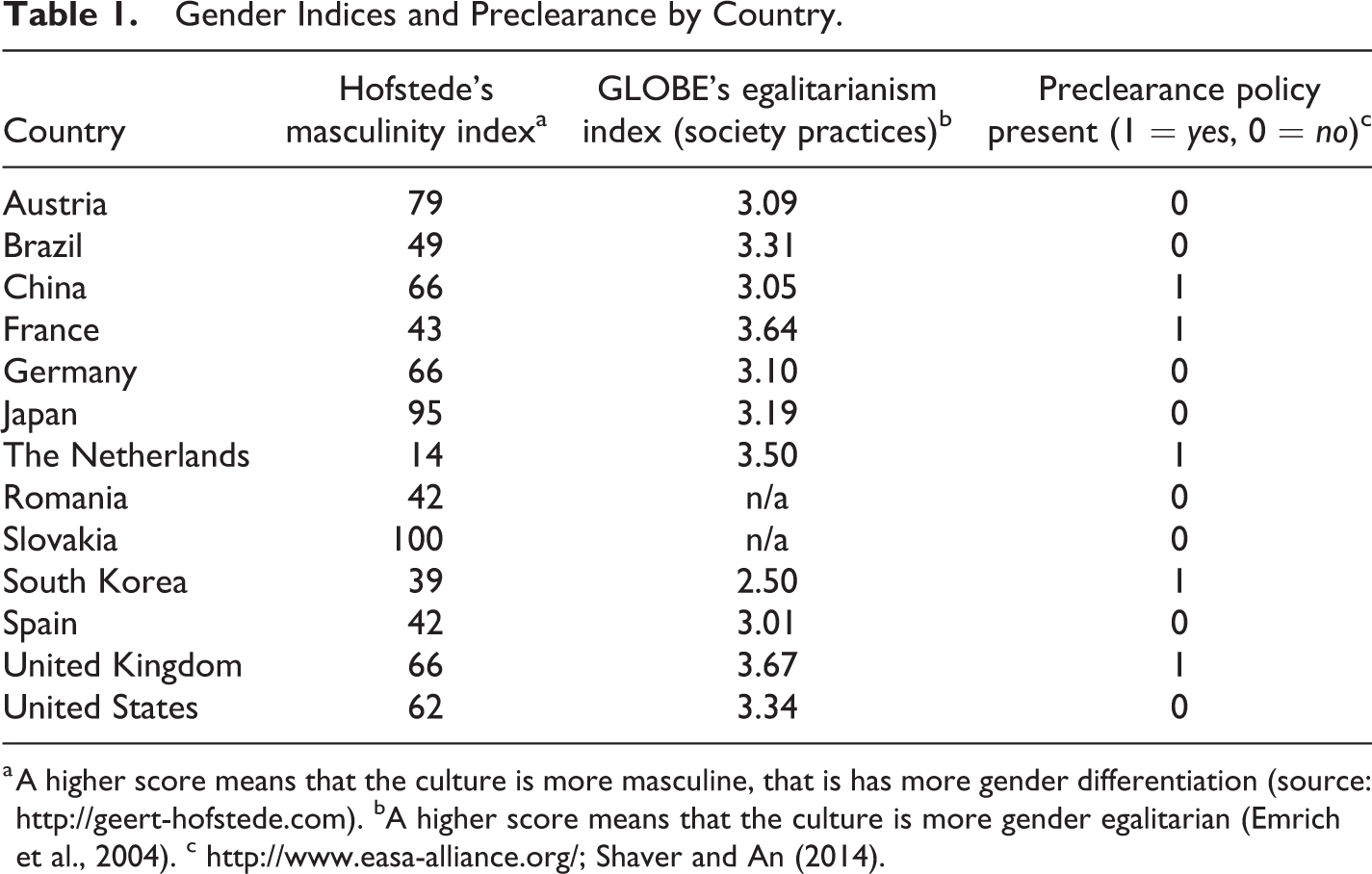
a A higher score means that the culture is more masculine, that is has more gender differentiation (source: http://geert-hofstede.com). bA higher score means that the culture is more gender egalitarian (Emrich et al., 2004). c http://www.easa-alliance.org/; Shaver and An (2014).
We recorded 15 hr of primetime TV (6:00 p.m. to 11:00 p.m.) in May 2014 from the private broadcaster with the largest audience share because primetime television content has the greatest reach and thus potentially strongest effect. The recordings were split into three typical days of the same week (May 14/Wednesday, May 16/Friday, and May 18/Sunday), resulting in 3 × 5 hr per channel. Because public service broadcasters might be more affected by country-specific regulations, we focused on private television. Also, private channels are comparable on economic grounds. However, we did utilize CCTV-1 as it was the clearly dominating channel for China and also included the largest public service channel in Austria due to a very low audience share of private channels. Duplicate ads; political ads; ads for films and CDs; public service announcements (PSAs); and ads with kids, animals, or comic figures as dominant actors were not included in the study. After 150 ads were collected from one country, we stopped additional data collection.
This led to N = 1,755 ads that appeared on primetime television: Austria (ORF2, n = 98; Puls4, n = 124), Brazil (Rede Globo, n = 123), China (CCTV-1, n = 137), France (TF1, n = 150), Germany (RTL, n = 144), Japan (NTV, n = 150), the Netherlands (RTL4, n = 149), Romania (ProTV, n = 115), South Korea (SBS, n = 127), Spain (Telecinco, n = 146), Slovakia (TV Markiza, n = 118), the United Kingdom (ITV1, n = 149), and the United States (ABC, n = 149).
Measures
Primary character
We analyzed whether there was a primary character in the advertisements (1 = male, 2 = female). A primary character is a person that appears on camera either with a speaking role or with prominent exposure for at least 3 s, must be clearly visible (especially their faces), and must be aged 18 years or older. If more than one primary character seems to appear in the commercial, we adapted the rules used in previous studies to identify the primary character (Nassif & Gunter, 2008): (a) the character who appears at the center of the story and/or is essential to the story; (b) the character who appears in close-ups longest/most often; (c) the character who appears longest; (d) the character who provides substantial information about the advertised product or service; (e) the character who uses or holds the product; and (f) the character who speaks longest.
Age
Following a common categorization from previous literature (see Prieler, 2016), a primary character’s age was estimated as being (a) 18 to 34, (b) 35 to 49, or (c) 50 years or older.
Nudity
We have followed our previous research on nudity (Prieler & Centeno, 2013), which adapted codes from Ibroscheva (2007) and Nelson and Paek (2008) and coded for (a) fully dressed, (b) suggestively dressed, (c) partially dressed, and (d) nude. Thus, we have removed the category “subtle sexual nuances” from Nelson and Paek (2008) because the coders had difficulties to identify this category and it seemed not connected with nudity, but more with sexuality (the example says the following: “slightly opened or opened lips with lipstick or sexy male lip”—p. 739). If a character had different levels of nudity in the same ad, the highest degree of nudity shown was coded. Fully dressed included shorts/dresses/skirts that covered the knees, tops that covered the cleavage or décolleté, and all shirts with sleeves. Suggestively dressed meant clothing that fulfilled one of the following criteria: those that partially exposed the body, such as shorts/dresses/skirts that exposed the knees and thighs (the skin shown is either naked or visible through translucent clothing); exposed cleavage or décolleté (as deep or deeper as the neck is long); sleeveless shirts; shirts that exposed bare backs; shirts that exposed one or two shoulders; and largely unbuttoned or open blouses. Partially dressed included the character wearing under apparel, lingerie, or bathing clothes such as bikinis, bathing suits, bathing shorts, and so on. Nude was used to mean bare bodies, including actual nudity or suggested nudity.
Preclearance policies
Advertising preclearance is a compulsory examination of an advertisement for its compliance with regulatory rules before it can be broadcast. The information about preclearance policies was derived from previous literature (European Advertising Standards Alliance [EASA], 2014; Shaver & An, 2014) and was categorized as existing (=1) or not existing (=0).
Product categories
Body care/toiletries/cosmetics/beauty products: mouthwash, sanitary napkins, soaps, shampoos, toothpastes, lotions, creams, face cleansers, diapers, and so on; alcoholic drinks: beer, wine, whisky, and so on; travel; fashion/clothing/accessories: Levi’s jeans, and so on were coded as congruent (=1). All others were coded as incongruent (=0).
Coding Procedure and Reliability
The study included 30 coders from two major universities in Austria and South Korea. Coders were trained for approximately 15 hr, blinded to the hypotheses, and native or bilingual in the language of the country for which they coded. After the training sessions, three independent reliability tests on randomly selected advertisements were conducted (N = 10 each, from 2 to 27 coders) using Krippendorff’s alpha (Krippendorff, 2013). Two tests were performed prior to coding the material: One test was between four coders (i.e., three from Asia, one from Europe) on English-language ads. A second one was between 27 coders from Europe. As a third test, a share of the coded material was double coded without the 27 coders knowing that they were tested. This allowed reliability estimation after the entire material was coded. The lowest intercoder reliability coefficients among all tests were as follows: nudity (α = .79), primary character (α = .80), age (α = .76), and product category (α = .92). This was clearly above the recommended chance-corrected agreement of .60 by Neuendorf (2010). It is important to note that two tests involved N = 27 coders (27 × 10 articles = 270 different codes per category), and they performed very well. Based on that, there were no reasons for an additional test.
Data Analysis
To answer H4 to H6, hierarchical linear models (i.e., multilevel analyses) are needed (Raudenbush & Bryk, 2002). Multilevel models are appropriate when cases are clustered within countries. The clear advantage of multilevel analysis is that we can predict the individual-level variation in the dependent variable while statistically controlling the variation across levels of analysis. Furthermore, we can predict the variation of regression slopes by including constructs at the country level.
Results
Table 2 shows the frequencies for fully dressed, suggestively dressed, partially dressed, and nude primary characters for all countries. Overall, there was a statistically significant effect of country (F = 5.83, p < .001) suggesting that countries differ in their degree of displayed nudity in advertisements. As can be seen, nude primary characters were extremely rare, ranging from 0% in China, Romania, and the United States to 8% in France. In all subsequent analyses, we therefore had to merge the “nude” and the “partially dressed” categories. For this new category (“nude or partially dressed”), again, frequencies were low (Austria: 9.6%, Brazil: 5.4%, China: 0%, France: 10.9%, Germany: 11.6%, Japan: 5.1%, the Netherlands: 14.7%, Romania: 3.8%, Slovakia: 8.1%, South Korea: 5.8%, Spain: 8.1%, the United Kingdom: 7.8%, the United States: .9%).
Degree of Nudity of the Primary Character by Country.
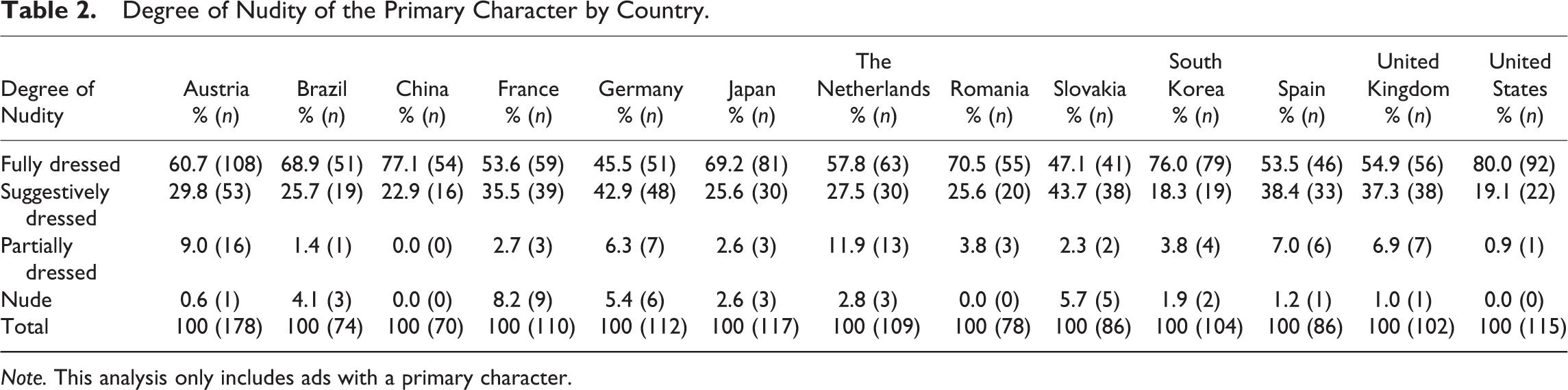
Note. This analysis only includes ads with a primary character.
To examine gender and age differences as well as the role of congruence, we did not perform chi-square tests but relied on ordinal regression analysis instead as the statistically more powerful tool. Because frequencies for the “nude or partially dressed” category were rather low in some countries, we also performed logistic regression with a nominal outcome (1 = “fully dressed” vs. 0 = “suggestively dressed, partially dressed, or nude”) to test the robustness of our findings. In fact, the logistic regression yielded the very same results compared with the ordinal regression. Because of this finding, and because collapsing variables reduces statistical power, we report ordinal regression. The findings of ordinal regression analyses are depicted in Table 3. As can be seen, there was a significantly negative effect of age in four countries (Austria, Germany, the Netherlands, and Japan). In all other countries, the effect of age on nudity was not significant, albeit it pointed into the expected direction (Brazil: p = .25, China: p = .37, France: p = .10, Romania: p = .18, Slovakia: p = .91, South Korea: p = .13, the United Kingdom: p = .33, and the United States: p = .91). The effect was p = .058 for Spain.
Ordinal Regression Predicting Degree of Nudity by Sex of Primary Character (Female), Product Congruence, and Age of Primary Character by Country.
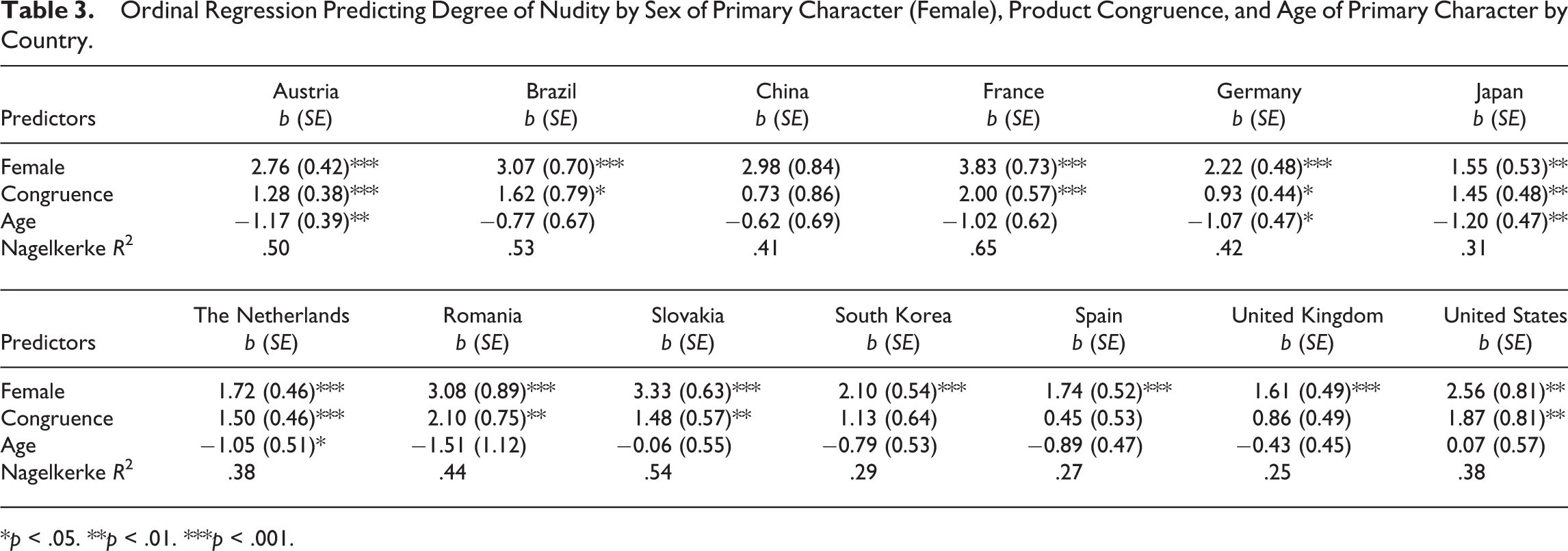
*p < .05. **p < .01. ***p < .001.
The pattern of findings was clearer when it comes to product congruence. As can be seen in Table 3, there was a positive effect of product congruence in all countries but in China (p = .40) and Spain (p = .40), while the p value was .076 for South Korea and .076 for the United Kingdom. Finally, when it comes to the gender of the main character, the findings clearly suggest that women are more likely to show a higher degree of nudity compared with men. This effect was highly significant in all countries.
So far, we have looked at the effects of age, product congruence, and gender on displayed nudity at the level of single countries. While such an analysis is useful, we are unable to explain why an association is found in one country and not in another. Thus, the question we want to ask is whether variations in the association between age, product congruence, as well as gender and displayed nudity can be explained by cultural and preclearance differences between countries. Because our outcome variable is ordinal, we ran an ordinal hierarchical nonlinear model with the statistical package HLM 7. The Level 1 model includes the age and gender of the primary character as well as product congruence. The Level 2 model includes the respective index (i.e., Hofstede’s index, GLOBE, and preclearance). Because the Level 2 variables are correlated, we ran a separate model for each index. In the first step, we computed the variance components to examine whether there is a significant amount of variance between the countries. The upper level variance is significantly different from zero for our dependent variable (χ2 = 70.69, p < .001, ICC = 0.22).
Because we included the grand-mean centered terms for the Level 2 variables, the effects of age, product congruence as well as gender on displayed nudity must be interpreted as the effect at the average level of a gender index (e.g., the effect of gender on depicted nudity at the average level of Hofstede’s masculinity index). The Level 1 effects of age (b = −.81, SE = 0.14, p < .001), product congruence (b = 1.31, SE = 0.16, p < .001) as well as gender (b = 2.34, SE = 0.17, p < .001) were significant (intercept: b = 1.92, SE = 0.24, p < 001), providing support for hypotheses H1, H2, and H3.
Besides the Level 1 predictor, the main focus of the multilevel model lies on the cross-level interactions between age, product congruence as well as gender and the gender indices as well as preclearance. These interaction effects tell us whether the variations between countries in the effects of age, product congruence as well as gender on nudity can be traced back to variations in the gender indices as well as preclearance policy. To answer this question, we looked at the random-coefficients model. No systematic differences in the regression slope between the countries could be observed (age: χ2 = 8.99, p > .50; gender: χ2 = 13.72, p = .32; congruence: χ2 = 8.14, p > .50). Thus, for displayed nudity in advertising, there were no differences in the regression slope that can be explained by culture. It follows that there can be no cross-level interactions.
In fact, keeping in mind that the computation of cross-level interactions is meaningless in light of the zero variation in the variance of the slope, we found no substantial cross-level interactions for all gender indices as well as preclearance policy (Hofstede b = 0.00, SE = 0.01; GLOBE: b = −0.05, SE = 0.83; Preclearance: b = −0.12, SE = 0.51). It was not possible to explain why there is a stronger (or weaker) association between age, product congruence as well as gender on nudity in a given country by Hofstede’s masculinity index (H4), Project GLOBE’s gender egalitarianism index (H5), and preclearance (H6). Thus, hypotheses H4 to H6 were not supported.
In addition to Hofstede and GLOBE, we have also tested other models related to gender development in an exploratory analysis. We extended the prior research by using the Gender Development Index (GDI; United Nations Development Programme [UNDP], Human Development Reports, 2014a), the UNDP’s Gender Inequality Index (GII; UNDP, Human Development Reports, 2014b), and the World Economic Forum’s Global Gender Gap Index (GGGI; Hausmann et al., 2014) to test whether any of the measures could predict the nudity of male and female models in advertising. However, that was not the case; none of these indices exerted any significant effect.
Discussion
This study sets out to report and explain nudity in television advertising in a comparative manner. We confirmed the finding of prior research that the gender of the primary character is a significant predictor of displayed nudity. Even though full nudity was scarce in all countries, the degree of dress was lower for women than for men. When looking at the distribution of our nudity variable, it is clear that this effect can be traced back to the difference between fully dressed and not fully dressed. In other words, men are more likely to be fully dressed as compared with women, who are more likely to be suggestively dressed, partially dressed, and nude. This finding can be interpreted in the context of prevailing gender stereotyping suggesting that women are more likely to be associated with bodily attributes such as nudity compared with men (e.g., Sjøvaag & Pedersen, 2019).
When compared with previous research, nudity seems to be less prevalent in television advertising as compared with print (Nelson & Paek, 2005), and a rise of nudity in television ads cannot be observed (Nelson & Paek, 2008; data from 2002). That full nudity is rarely used in television advertising may be explained by the weak and potentially unwanted effects that such advertisements would have on the audience (Cui & Yang, 2009). We also observed that, overall, congruent products were more likely to show a lesser degree of dress compared with products that are incongruent to nudity. This finding seems to indicate that advertisers do not use higher degrees of nudity for products unrelated to nudity cues because this would most likely dampen ad effectiveness (Chang & Tseng, 2013; Lull & Bushman, 2015).
Finally, while age was a significantly negative predictor of nudity only in some countries, the effect was statistically significant when taking all countries into account in a multilevel model. The reason for this difference in findings can be found in the fact that the direction of the effect was negative in many countries, albeit not significant. Yet with a model including all countries, the statistical power is much bigger. In other words, with a larger number of cases, the effect may be significant even in single countries. We treat this finding as support for the idea that younger primary characters show a lesser degree of dress than older ones. This is in line with research on gender stereotyping (e.g., Karsay et al., 2020; Matthes et al., 2016; Zotos & Grau, 2016). However, the effect is small, in fact, smaller than the effect of gender.
But why are younger characters less likely to be fully dressed? One explanation is that sexual cues, such as a lower degree of dress, are not associated with older people (Vares, 2009). That is, when older primary characters appear in television advertisements, their role is different compared with younger ones. They most likely are less associated with attractiveness cues and rather represent values such as experience, wisdom, or expertise compared with younger actors. Somehow related to that, older characters are used for different products because these products require specific characteristics that are not present in younger actors. In an additional analysis of our data, a simple correlation between age and product congruence supports this reasoning (r = −.14, p < .001). In other words, for those products that older people serve as main characters, sexual cues such as nudity are less functional. Our findings reveal, for the first time, that age is to be taken into account when analyzing the nudity of primary characters.
When it comes to the degree of nudity as well as the roles of product congruence and age, our findings suggest significant differences among the countries investigated. Some countries showed more nudity than others (see Table 2). Specifically, there was no nudity in China, Romania, and the United States, whereas 8% of all primary characters were nude in French ads. Yet even though these differences could be observed, they cannot be explained by cultural indices as well as preclearance policy. The effect of culture and advertising regulation on shaping the nudity of primary characters is, therefore, smaller than commonly thought. While Nelson and Paek (2008) concluded that the role of cultural dimensions and preclearance policies is minimal for shaping ad content, our findings suggest that they do not play a role at all. In other words, while there are differences between the countries, cultural dimensions and preclearance policies fall short in explaining them. In this context, it is important to stress that our study is the first to statistically model the influence of culture in a multilevel model using equivalent samples. When looking at Table 2, one could easily pick two or three countries and explain the observed differences by different scores on gender indices or cultural dimensions. However, such an analysis strategy cannot analyze whether an increase in a gender inequality index leads to an increase in nudity (Matthes et al., 2016). For this, a multilevel model is necessary.
One could argue that the differing degree of nudity may be explained by differences in the creative values and styles of advertising professionals rather than by broad country characteristics. There may also be differences in attractiveness cues, religious differences, or differences in social desirability and public norms not captured by gender indices and cultural dimensions. In line with that, we need to take into account that gender indices as well as cultural dimensions are very broad constructs lumping together many different aspects. Gender indices are primarily designed to explain differences in the status of women in several societies which are driven by more powerful factors than are the creative decisions in producing television ads.
Similarly, preclearance policies are very broad and do not always specifically refer to nudity. Also, having a preclearance policy may still mean something fundamentally different from country to country, not speaking of the actual implementation of such policies in practice. Taken together, while there is variance to explain, we have not identified the factors that help us to understand why nudity is handled differently in different countries. Clearly, more comparative research is needed.
Limitations
Our sample did not include countries from Africa or Oceania. For future research, we thus need larger and more diverse samples. Our data are also unable to account for seasonal variations. Furthermore, while we have strived to choose comparable TV networks, this is a daunting task, as various countries have different broadcasting systems. Analyzing only one TV channel for each country, even the most dominant one, might not be fully representative of the pool of TV ads from each country. In addition, we investigated only primary characters, a limitation that restrains the amount of information on representations of nudity gleaned from the television advertisements to a certain extent; future research should consider including more characters. Finally, although this detail is consistent with most studies (Furnham & Paltzer, 2010), our research was based only on primetime advertisements, thus limiting the inferences that can be made regarding the gender representations in a full day’s cycle of television advertisements. As a result, we suggest that future gender research examines the differences in representations among different television time slots. Future research might also consider measuring different levels of advertising regulations and not only whether preclearance policies are existing or not. Finally, while we have applied the same coding rules for all countries, what different degrees of dress mean in different cultures is beyond the scope of this analysis. For example, showing some body parts might be offensive in some cultures, whereas not in others. Thus, future research should further consider these potential cultural differences, especially by testing the cultural differences in the perceptions of nudity using non-self report methods such as eye-tracking (see King, Bol, Cummins, & John, 2019). Related to that, the indices we used may hint at cultural differences, yet the term “culture” is far more complex than captured in the present research. This calls for a qualitative research approach complementing the present study.
Practice Implications
Congruent products are associated with a stronger degree of nudity confirming common practical knowledge about persuasion in advertising. Furthermore, from the perspective of social responsibility, advertising practitioners are called to raise their awareness for the differences with respect to gender and age. Showing male and older primary characters with more dress than younger and female ones can be interpreted as gender stereotyping. Moreover, nudity of younger female models can also be critically discussed in terms of sexual objectification (Karsay et al., 2018, 2019). If women, especially young ones, are depicted with less dress than men, then they may be associated with physical appearance rather than other attributes. This may lead to self-objectification and body dissatisfaction. Finally, nudity of female models can also have some negative consequences in advertising effectiveness on a female audience because previous research has shown that women have more negative attitudes toward ads containing nudity (Dianoux & Linhart, 2010; see also Wirtz et al., 2018). Obviously, current (self-)regulatory efforts do not seem to be successful in implementing an unbiased representation of men and women. We suggest that advertising councils and professionals should work toward a clearly defined set of recommendations about how nudity should be presented in TV ads. These recommendations can be implemented in preclearance policies.
Conclusion
One key conclusion of this study is that gender differences in nudity advertising can be found around the world, even though the degree of nudity differs considerably. Yet the observed gender differences were independent of a given gender equality status and preclearance policy in a particular country. That is, countries with more progressive gender policies and higher gender equality do thus not necessarily depict women in more progressive ways in television advertising compared with other countries. Also, current (self-)regulatory efforts do not seem to be successful in implementing an unbiased representation of men and women. Thus, the advertising industry should implement further recommendations about the usage of nudity in preclearance policies. Last but not least, our findings can be used in advertising education to teach students about the role of nudity in different cultures. Overall, we hope this research helps to spur a discussion among scholars, advertisers, and regulators on this important and practically relevant aspect of advertising.
Footnotes
Declaration of Conflicting Interests
The author(s) declared no potential conflicts of interest with respect to the research, authorship, and/or publication of this article.
Funding
The author(s) disclosed receipt of the following financial support for the research, authorship, and/or publication of this article. This work was supported by the Ministry of Education of the Republic of Korea and the National Research Foundation of Korea (NRF-2018S1A3A2074932).
