




Abstract
The Association for Education in Journalism and Mass Communication (AEJMC) leadership charged a 13-member Presidential Task Force on Careers to obtain membership’s thoughts on preferences and needs regarding career-assistance programming and activities. This Spring 2019 report details a survey of the interest of educators, of all ranks, in current AEJMC efforts and the need for more targeted and accessible opportunities, both at annual conferences and online modules. Results included members’ thoughts on professional development, burnout, tenure and posttenure processes, academic culture, and the importance of being forward thinking regarding news and strategic communications industries outside of academia.
Keywords
Media and communication education professional organizations (such as the Association for Education in Journalism and Mass Communication [AEJMC]) have historically provided career opportunities (hereafter referred to as “professional development programming”) for their respective memberships. Yet, since AEJMC’s founding in 1912, the complexion and culture of university life has drastically transformed. The academy has—by including professor of the practice titles and graduate teaching associates—expanded the number and type of instructors populating journalism schools globally. The productivity expectations for “research” faculty at most institutions (especially those classified as “R1” or “Doctoral Universities—Very high research activity”) have greatly increased, along with expectations for faculty to seek federal grants or industry funding.
As this institutional environment grows in complexity, training and mentorship opportunities have emerged to help academicians navigate their jobs today. Programming needs seemingly vary among these groups, however. Graduate students and assistant professors, for instance, require continued guidance on the job-seeking, promotion, and/or tenure processes. Posttenure reviews, on the contrary, have emerged as a chief concern for associate and full professors. Across media and communication programs, levels of on-the-job burnout are another crucial consideration. Given these concerns related to career advancement and morale, what can professional organizations (like AEJMC) do to better provide networking and peer-to-peer support in these key areas? This study identifies and addresses this issue.
In August 2018, then AEJMC vice president (2018–2019) David D. Perlmutter assembled a 13-member Presidential Task Force on Careers. (Perlmutter transitioned to the presidency for term of 2019–2020.) The committee’s membership encompassed leadership from numerous AEJMC councils, committees, divisions, and interest groups—as well as from AEJMC members who have been active in the organization’s professional development programming. The Presidential Task Force members were chosen because AEJMC wanted to represent a wide variety of constituencies of the organization, including diversity of race and gender, but also of program size and institutional orientation (teaching vs. research missions).
The president charged the task force to evaluate the current status of professional development programming and to propose recommendations for creating and enhancing these offerings.
His motivation was drawn, first, from his own wider experience, writing essays on academic affairs and campus issues in the Chronicle of Higher Education—the trade newspaper for our profession—for almost two decades and a book on doctoral programs and promotion and tenure (Perlmutter, 2010). In the latter, he noted that the average doctoral program does a reasonable job preparing people to be researchers, a spotty job preparing them to be teachers, but provides absolutely little or no training to be a successful professor and workplace professional—that is, how to navigate the career track, the people, the politics, and all the other variables that severely affect someone’s progress in the careers of academia (Perlmutter, 2010). In the media and communication fields, this issue can be exacerbated because quite a number of our faculty enter after spending considerable time in the private sector—where the rules, protocols, and culture of say, hiring and promotion, may be radically different than the average academic public relations department at an “R1” university.
Second, Perlmutter, in his campaign for the vice presidency of AEJMC, stated that he felt the organization was in heightened competition for attention and loyalty among the many competing large national professional organizations within media and communication, but also the many smaller specialty conferences that had grown up. We can no longer rely on tradition to convince millennials, Generation Y and eventually Generation Z faculty to attend our conferences simply because their advisors or mentors did. Thus, finally, it was imperative to brand AEJMC as a conference where you find the latest advances in research and teaching—but perhaps more importantly—in personal career advancement: from the perspective of the graduate student, to the professional entering academia, to a mid-career professor considering moving into administration, to the senior scholar considering retirement. The Task Force, thus, was impaneled to sketch out a baseline: How do AEJMC members perceive current professional development programming opportunities? And what untapped potential exists for expanding these efforts?
In addition to the task force’s eight-page report that was unveiled in August 2019, subcommittee members crafted and fielded a survey to help accomplish the task force’s mission. This data-driven approach mirrors how several previous AEJMC task forces and research initiatives have used membership surveys to examine student and faculty issues including general membership demographics (Kosicki et al., 1994), graduate education (Christ & Broyles, 2007), teaching duties (Riffe et al., 1997), gender equity (Rush et al., 2005), and diversity outreach (Stephens, 2003). Together, these studies have provided a foundation for AEJMC’s strategic plan, which advances membership programming as a central goal for the future (AEJMC, 2017).
To date, prior research has not fully delved into professional development programming from the vantage point of media and communication educators. More specifically, limited research has been previously conducted on programming preferences and/or the level of faculty receptivity to these types of opportunities. Against this backdrop, this study provides descriptive data from the task force survey, in which AEJMC members shared their thoughts and views on the personal and professional development opportunities available, as well as strategies for improvement in future programming and initiatives. These findings provide evidence that AEJMC members desire professional development programming that is reflective of the diverse spectrum of duties that media and communication educators accomplish on their campuses every day.
Literature Review
In day-to-day academic work, media and communication educators (including both graduate students and faculty) acquire two types of occupational knowledge. First, they must understand how the professional practice of journalism and strategic communications operates so that they can effectively study the industry and/or inform future practitioners. Given this professional training orientation embedded in the mission of journalism schools, media and communication educators have historically maintained strong ties to industry (Mensing, 2010). However, tensions arise, in that practitioners often identify knowledge gaps between what is learned in the classroom and what is needed in the newsroom and other communications workplaces (Ferrucci, 2018). This disconnect is especially sensitive, given the rapid pace of change within communications industries today (Ferrucci, 2018). To address this knowledge deficit, graduate students and faculty in media and communication education must constantly update their research and pedagogical approaches to align with the latest technological trends (Wenger et al., 2018). In addition to keeping up with industry advances, media and communication education stakeholders must also acquire a second type of occupational knowledge: understanding how their roles and responsibilities fit into the broader academic environment (Bogler & Kremer-Hayon, 1999). In short, academics must be socialized into their jobs. Tenure-track journalism faculty, it should be noted, have particularly struggled in this regard (Peirce & Martinez, 2012). This process of learning about the inner workings of academia is not the exclusive province of the university’s junior hires; however, senior faculty also need direction on how to adapt their approaches to meet changing campus climates. Taken together, media and communication education stakeholders must gain knowledge about both external industry practice and internal academic culture.
Several impediments exist toward gaining this occupational knowledge. Prior scholarship has demonstrated that the temporal pressures of academic life (Oskam, 1996) and budgetary constraints (Christ & Broyles, 2007) often preclude chances for occupational learning. At the same time, previous studies have identified increasing levels of burnout among university journalism faculty. As early as the 1990s, researchers began tracking on-the-job fatigue among media and communication faculty (Dillon & Tanner, 1995; Endres & Wearden, 1996; Riffe et al., 1997). As a whole, AEJMC faculty members (both early career and later career) have previously “reported concern with job stress and mental fatigue, lack of leisure time, and the political nature of the job” (Riffe et al., 1997, p. 115). Junior faculty, in particular, are more susceptible to burnout than are their senior colleagues (Dillon & Tanner, 1995). Digging deeper into the data, further demographic cleavages are apparent—in that women and underrepresented populations generally exhibit lower levels of job satisfaction than do their male and White counterparts (Riffe et al., 1997).
Professional development programming has been identified as a potential lever to both bolster occupational knowledge and to counter burnout (Austin & Sorcinelli, 2013). In the current study, professional development programming is defined by the authors as opportunities that can encompass (but are not limited to) workshops, webinars, conference sessions, or mentorship programs that assist media and communication educators in confronting their day-to-day duties. Such chances for growth beyond the university campus can play an important role in the career advancement and fulfillment of graduate students and faculty (Kneer, 1989; Richards et al., 2016). Professional organizations like AEJMC often offer these opportunities, through which academics can build relationships beyond their own institutions (Austin & McDaniels, 2006). The need for more professional development programming has been championed across all career stages and appointment types within academe (Austin & Sorcinelli, 2013). To enhance knowledge about external industry practice of our own discipline, prior AEJMC task forces have advocated creating pedagogical workshops targeted for graduate students headed for tenure-track employment, for example (Christ & Broyles, 2007). To broaden knowledge around internal academic culture, prior AEJMC research initiatives have also recommended the creation of faculty-to-faculty (Thomsen & Gustafson, 1997) and faculty-to-student mentorship programs (Christ & Broyles, 2007). To date, however, little scholarship has assessed the effectiveness of these interventions. And more specifically, prior studies have not fully examined the degree to which graduate students and faculty find these opportunities valuable in acquiring new forms of occupational knowledge. To this end, this study fills a gap in the literature by identifying the types of professional development programming favored by these stakeholders in bridging gaps in industry and academic knowledge. This study also considers the extent to which media and communication educators are eager to participate in these opportunities. The subcommittee’s charge was to look at specific topics across the career life cycle. Consequently, this study addresses the following research questions:
Method
This study’s survey sought to understand how professional organizations, like AEJMC, can systematically and sustainably support the career advancement of its members. As such, the study’s 23-question instrument asked about the different types of professional development programming preferred by media and communication educators and the level of receptivity to these opportunities by the respondents. In developing the instrument, the subcommittee sent the survey 3 times, for comments and suggestions, to the entire Presidential Task Force, whose members helped review the survey—checking for accuracy and purpose of mission before sending the instrument out to all AEJMC members. As AEJMC’s membership also includes media professionals and others outside the academy, the subcommittee also consulted with industry leaders to review the survey tool.
After receiving institutional review board (IRB) approval, the researchers sent the survey to AEJMC central office staff. The survey was then distributed to all 3,324 registered members of AEJMC, including all membership types (current faculty, graduate students, and retirees). AEJMC’s central office staff distributed the survey via email to its listserv of registered members. To broaden participation in the study, the survey was also sent to the 22 registered members of the Association of Schools of Journalism and Mass Communication (ASJMC, a group that represents administrative leadership from 125 journalism schools) via email. It should be noted that ASJMC members are also typically members of AEJMC, and that every member of ASJMC is not necessarily an administrator. The study’s researchers did not filter responses from ASJMC to reflect specific administrative thoughts or comments. Upon reviewing the data further, there were no direct responses, in the open response sections, from ASJMC members regarding programming. All respondents (both AEJMC and ASJMC members) received an identical survey instrument asking the same questions.
The researchers fielded the survey instrument across a 4-week period, spanning January 29 to February 22, 2019. Per the researchers’ instructions, members received three reminders to complete the survey. As an incentive for members to complete the survey, respondents were voluntarily entered into a raffle to receive free conference registration at the end of the survey. Incentive data were, at no time, linked to identifiable information about survey participants and their responses. All survey respondents were anonymous to the researchers. The survey took, on average, 7 min to complete. (Please note that the survey instrument can be provided upon request of the corresponding author.)
After seeking consent to participate in the study, respondents were asked general questions about their individual unit (e.g., department, school, college) and their involvement within the association, as well as the likelihood of participating in new opportunities around professional development programming. Participants were asked, using both quantitative and qualitative measures, to assess how and to what extent professional development programming within the association would benefit themselves, while also considering examples of future programming the association should create for professional development. Finally, the respondents answered questions about their individual positions within their units and provided demographic information. We handled the responses in the following ways: We reported the frequency of respondents’ past involvement in the types of professional development opportunities and their preferences for future development programming (e.g., options include research panel, scholar-to-scholar session, socials). We also asked two open-ended questions (e.g., their preferred professional development programming), and we coded their qualitative responses. The subcommittee, through its pretesting of the survey, found that using a qualitative approach to capture the thoughts of respondents (regarding topics such as tenure, for instance) provided another level of rich description in reporting the study’s data. Researchers conducted a close-reading of the responses, establishing recurrent themes expressed among survey participants (Glaser & Strauss, 1967). We also asked questions regarding respondents’ behavioral intention/attitudinal evaluation on 5-point Likert-type scale and reported the means.
Sample
In total, 363 respondents participated in the survey, representing 10.9% of the association’s total membership. According to the American Association for Public Opinion Research (AAPOR), while the polling industry has not convened around an “acceptable” participation level for online surveys, response rates “have markedly fallen over the last several years to a point in many cases they are 10 percent or less” (AAPOR, 2010). While this study’s response rate represents a limitation of the study’s generalizability, it should also be noted that all AEJMC divisions, interest groups, and commissions were represented in the sample.
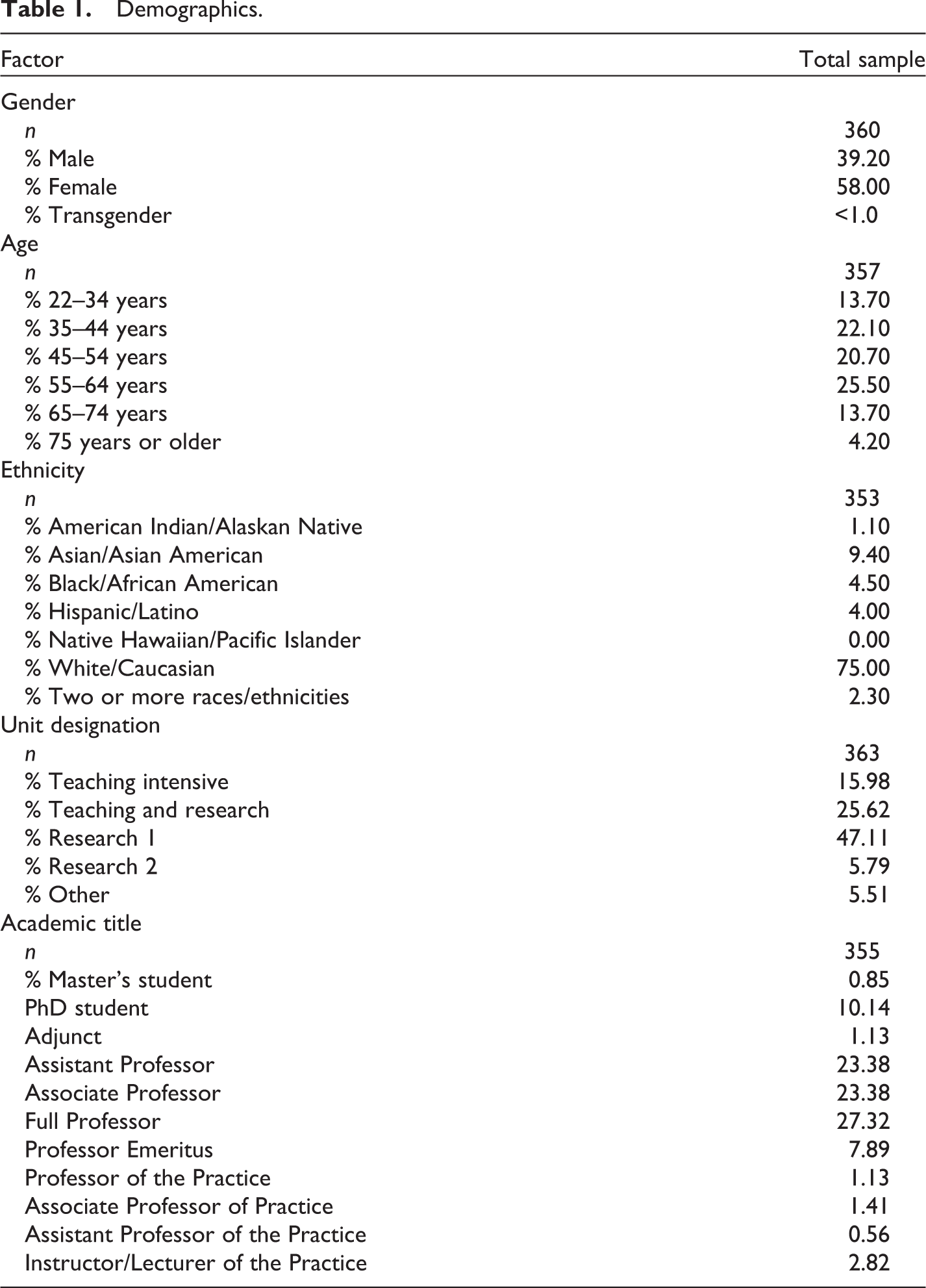
Respondents primarily encompassed full professors (27.3%), associate professors (23.3%), assistant professors (23.3%), and Ph.D. students (10.1%), with smaller numbers of adjuncts, professors of the practice, and industry professionals. Retired faculty represented a small portion (7.9%) of the sample. Nearly half of the survey subjects work at R1 institutions (47.1%). Survey subjects also encompassed educators from teaching and research institutions (25.6%), teaching intensive institutions (15.9%), R2 institutions (5.8%), or other (5.5%) types of institutions. Slightly more than half (51.6%) of respondents represented journalism units/departments/schools with more than 500 students. Demographically, the sample was primarily White/Caucasian (75.0%) females (58.0%) who were between 55 and 64 years (25.5%). Further details on the demographics of the sample are illustrated in Table 1.
Demographics.
Findings
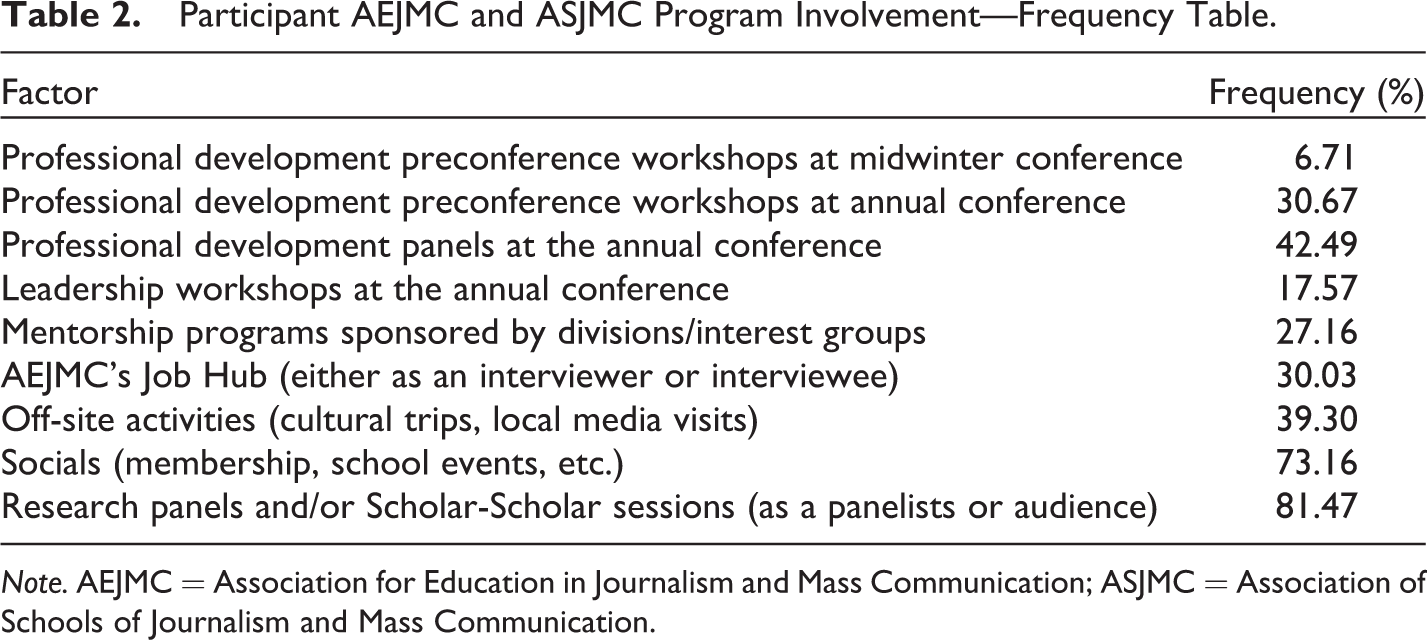
First, to gather baseline information on the current level of involvement of participation in the organizations/conferences, the researchers asked respondents how long they had been a member of the organization and specifics on their current program involvement. Results revealed that, on average, survey subjects had been members of AEJMC and/or ASJMC for 15.54 years, with roughly two thirds (65.6%) attending the most recent (at the time the survey was fielded) AEJMC annual conference in Washington, D.C. Survey subjects were most likely to have previously participated in research panels and/or Scholar-Scholar sessions (81.5%), followed by socials (73.2%), professional development/career enhancement panels at the annual conference (42.5%), off-site activities, which take place away from the primary conference venue (39.3%), professional development/career enhancement preconference workshops at the annual conference (30.7%), the association’s Job Hub (30.0%), mentorship programs sponsored by divisions/interest groups (27.2%), leadership workshops at the annual conference (17.6%), and/or professional development/career enhancement preconference workshops at midwinter conferences (6.7%). Frequencies of current conference programming involvement are illustrated in Table 2.
Participant AEJMC and ASJMC Program Involvement—Frequency Table.
Note. AEJMC = Association for Education in Journalism and Mass Communication; ASJMC = Association of Schools of Journalism and Mass Communication.
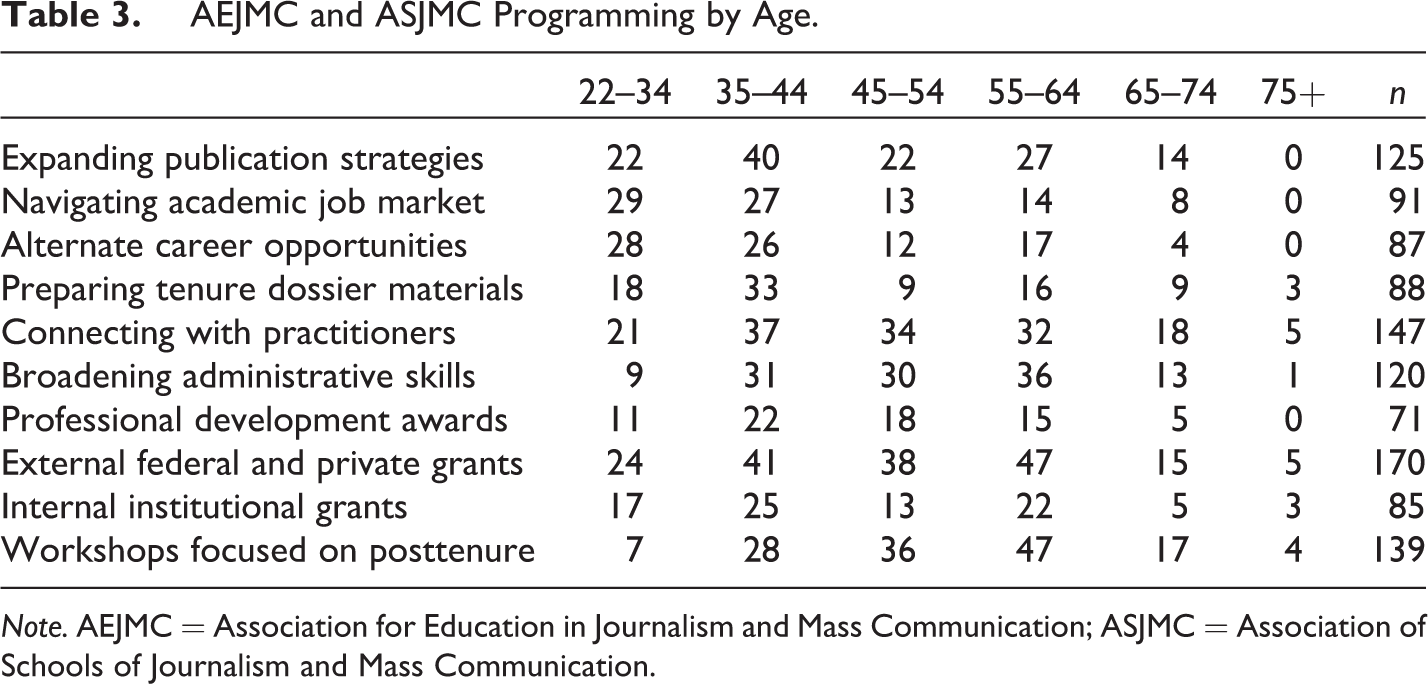
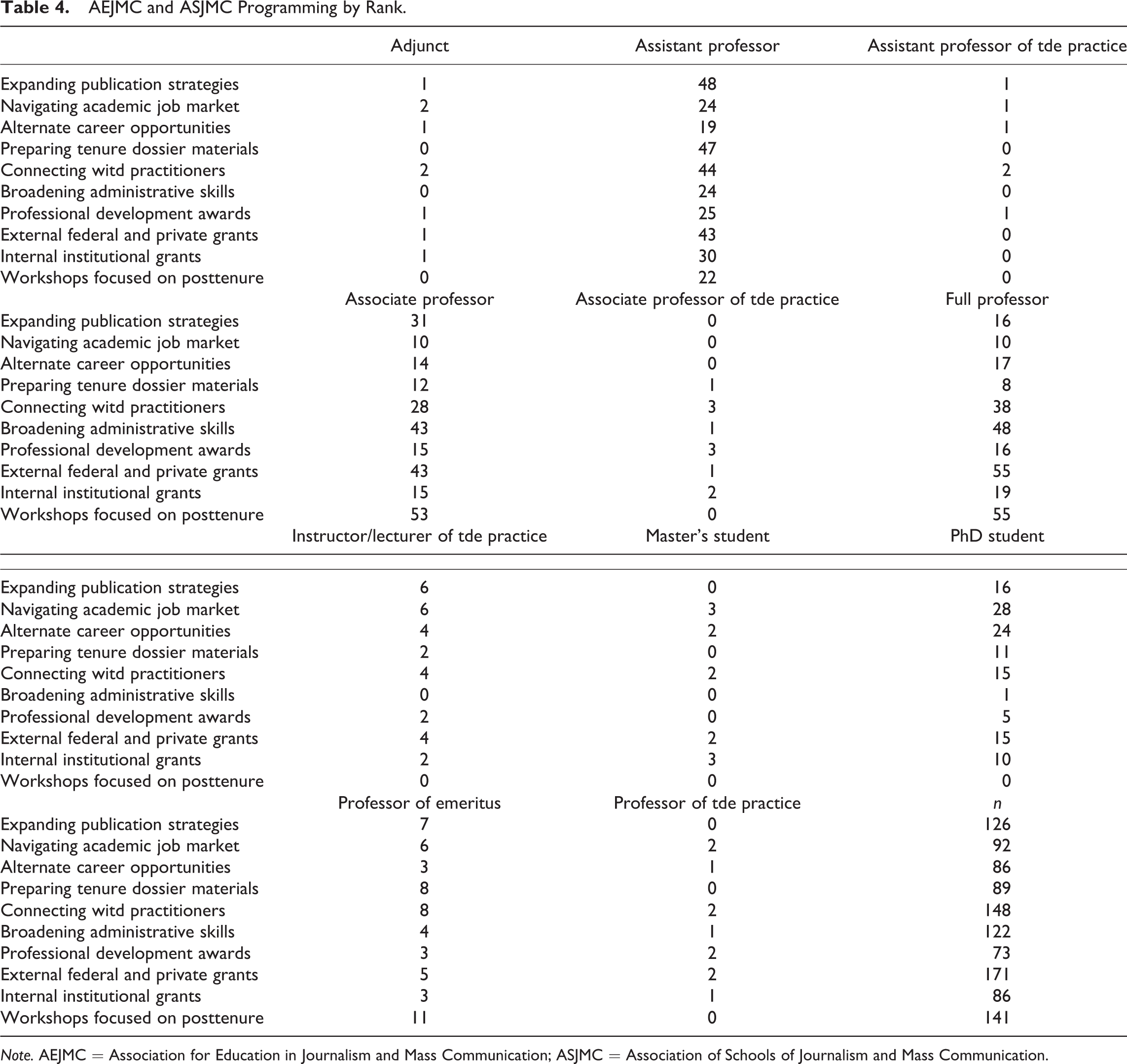
To capture the different types of professional development programming that respondents preferred to be offered by the association, researchers asked each survey participant three questions about their programming preferences. First, the researchers asked about the type of programming the respondents have been involved with in the past. Respondents were asked to check all response options that applied. Some of the survey questions had more than 10 choices (which were mutually exclusive), and one question had more than 20 choices. On average, every choice had at least 344 responses. (Please note that focus of most of the programming selected was not geared specifically for either tenure or posttenure dossiers. The responses, paired with the study’s qualitative data, show an overall desire to improve skills for both professional and academic career opportunities.) Second, respondents were asked to select from a list of options on programming that they feel would benefit their own professional development. Again, respondents were asked to check all response options that applied. Survey subjects most favored programming related to writing (external) federal and private grants (52.4%), followed by connecting with industry practitioners (44.9%), participating in workshops focused on posttenure themes (42.2%), expanding publications strategies for tenure-track faculty (37.7%), broadening administrative skills posttenure (36.5%), navigating the academic job market (27.8%), identifying alternate career opportunities after a doctoral degree (26.7%), preparing tenure dossier materials (26.7%), writing (internal) institutional grants (26.7%), and establishing new awards for professional development excellence (22.2%). Survey subjects’ responses on programming that they feel would benefit their own professional development varied by age (see Table 3) and rank (see Table 4).
AEJMC and ASJMC Programming by Age.
Note. AEJMC = Association for Education in Journalism and Mass Communication; ASJMC = Association of Schools of Journalism and Mass Communication.
AEJMC and ASJMC Programming by Rank.
Note. AEJMC = Association for Education in Journalism and Mass Communication; ASJMC = Association of Schools of Journalism and Mass Communication.
Finally, the last measure that researchers used to help capture which type of professional development programming that association members preferred was a qualitative response option. The addition of this question enabled subjects the chance to elaborate on the wide array of programming preferred. In developing themes from the qualitative responses, many respondents reported favoring programming that would be more responsive to the shifting needs of industry. As one respondent noted, “We need to do more research on the general skills and specific j-skills that CURRENT news media employers are seeking. What is it that we should be teaching?” These views were echoed by another respondent, who similarly wrote that As a journalism educator, the more we can engage current practitioners and other experts in conducting skills training workshops, the better. When you’re no longer in a newsroom, you need to make sure that your teaching is still relevant. For journalism faculty, I think it’s important and relevant to emphasize continuing links with the fields. Professionals often scoff at academics, and they would be less likely to take that attitude if they were collaborating with working academics.
The survey also considered whether media and communication educators would be receptive to expanded programming opportunities that would stretch into new areas. To capture the level of receptivity to the preferred professional development programming opportunities that would be offered by the association, the researchers asked three, scale-based questions. The first question measured perceptions of the benefits that these professional development programs would bring to the association and its members (i.e., programs on professional development and/or career advancement would benefit AEJMC and its members). Using a 5-point Likert-type scale, which ranged from strongly disagree to strongly agree, respondents were asked to what extent they agreed with the statement (M = 4.56, SD = 0.613). The second question measured how likely respondents would be to participate in these programs if they were adopted by the association (i.e., If the association expanded its professional development and/or career advancement programs, how likely would you participate in some of the programs?). Again, using a 5-point Likert-type scale, which ranged from very unlikely to very likely, respondents were asked to indicate their likelihood of participation in the programs (M = 3.95, SD = 1.101). The third question asked respondents to rate on a 5-point scale (with 5 being the highest value) how much value their academic unit places on respondents’ attendance at the association’s annual conference (M = 3.27, SD = 1.308). On the whole, survey subjects either strongly agreed or agreed (94.7%) that AEJMC programming on professional development would benefit members.
Implications
Media and communication educators pursue professional development programming through organizations like AEJMC to acquire two types of occupational knowledge. First, AEJMC members say they are seeking the programming to learn more about how the news/strategic communication industries function beyond their campuses. This finding aligns with prior literature (Ferrucci, 2018; Mensing, 2010; Wenger et al., 2018), which suggests that media and communication educators engage in a continuous learning process to stay current with industry trends. Respondents in the current study identified particular value from networking opportunities and annual conference sessions, in which they can exchange best practices about how professional communicators approach their jobs. Several survey subjects advocated that industry experts should be more consciously integrated into professional development programming. Others suggested in the study’s qualitative data that forming stronger partnerships may lead to heightened levels of respect between practitioners and educators.
Second, AEJMC members reported that professional development programming helps fuel knowledge about academic culture. Again, this finding comports with prior scholarship establishing that academics require training and support on their place and fit within their complex institutions (Bogler & Kremer-Hayon, 1999). In the current study, survey responses provide evidence that media and communication educators find the greatest utility in face-to-face networking events—such as annual conference socials, off-sites, and scholar-to-scholar sessions—that foster relationship-building around academic folkways. At the same time, survey participants used professional development opportunities to learn about their roles throughout every stage of the academic life cycle—from graduate student until retirement. The open-ended, write-in comments suggest that media and communication educators may seek out professional development programming to ameliorate levels of occupational burnout. A slight disconnect exists, however, in that respondents reported that their academic units ascribed moderate value to attending AEJMC’s annual conference. This finding necessitates further research to understand the extent to which administrators internally support and prioritize professional development programming for their graduate students and faculty. In-depth interviews and surveys directed to media and communication deans and department chairs may provide additional context on resource allocations and promotion and tenure considerations that influence levels of department support. More specifically, future research could focus solely upon surveying ASJMC members regarding their budgets and time allowances available to support their faculty by paying for training and conferences.
It should be noted that the final sample may overrepresent members with a keen interest in career issues. Given the study’s response rate (with small numbers of professors of practice and adjuncts participating), the data presented in this study may not reflect the views of all members, and should not be generalized to media and communication faculty at large. Additional methods of data collection—such as focus groups or interviews at the association’s annual conference—may help solicit additional feedback from a broader array of members. Future studies can also extend upon the current research by assessing the effectiveness of professional development opportunities in providing occupational knowledge for media and communication educators. Additional scholarship may also wish to evaluate how prior professional experience outside of the academy may influence, alter, or shape how they view professional development programming opportunities. This research—as charged by AEJMC leadership—serves as a baseline toward more fully understanding the evolving role that professional organizations like AEJMC can play in building community among media and communication educators at every stage of their careers.
Footnotes
Acknowledgements
The task force’s findings, previously presented at AEJMC’s annual conference in August 2019, have been rewritten and restructured for this manuscript. These findings may not reflect the opinions of the entire task force, whose membership included: Hong Cheng, PhD (co-chair), Angela Powers, PhD (co-chair), Deb Aikat, PhD, Jan Lauren Boyles, PhD, Sylvia Chan-Olmsted, PhD, Jerry Crawford II, PhD, Frauke Hachtmann, PhD, Terri Hernandez, PhD, Heloiza Herscovitz, PhD, Marcel Jennings, PhD, Chen Lou, PhD, Sara Netzley, PhD, Amy Schmitz, PhD.
Declaration of Conflicting Interests
The author(s) declared no potential conflicts of interest with respect to the research, authorship, and/or publication of this article.
Funding
The author(s) received no financial support for the research, authorship, and/or publication of this article.
