



Abstract
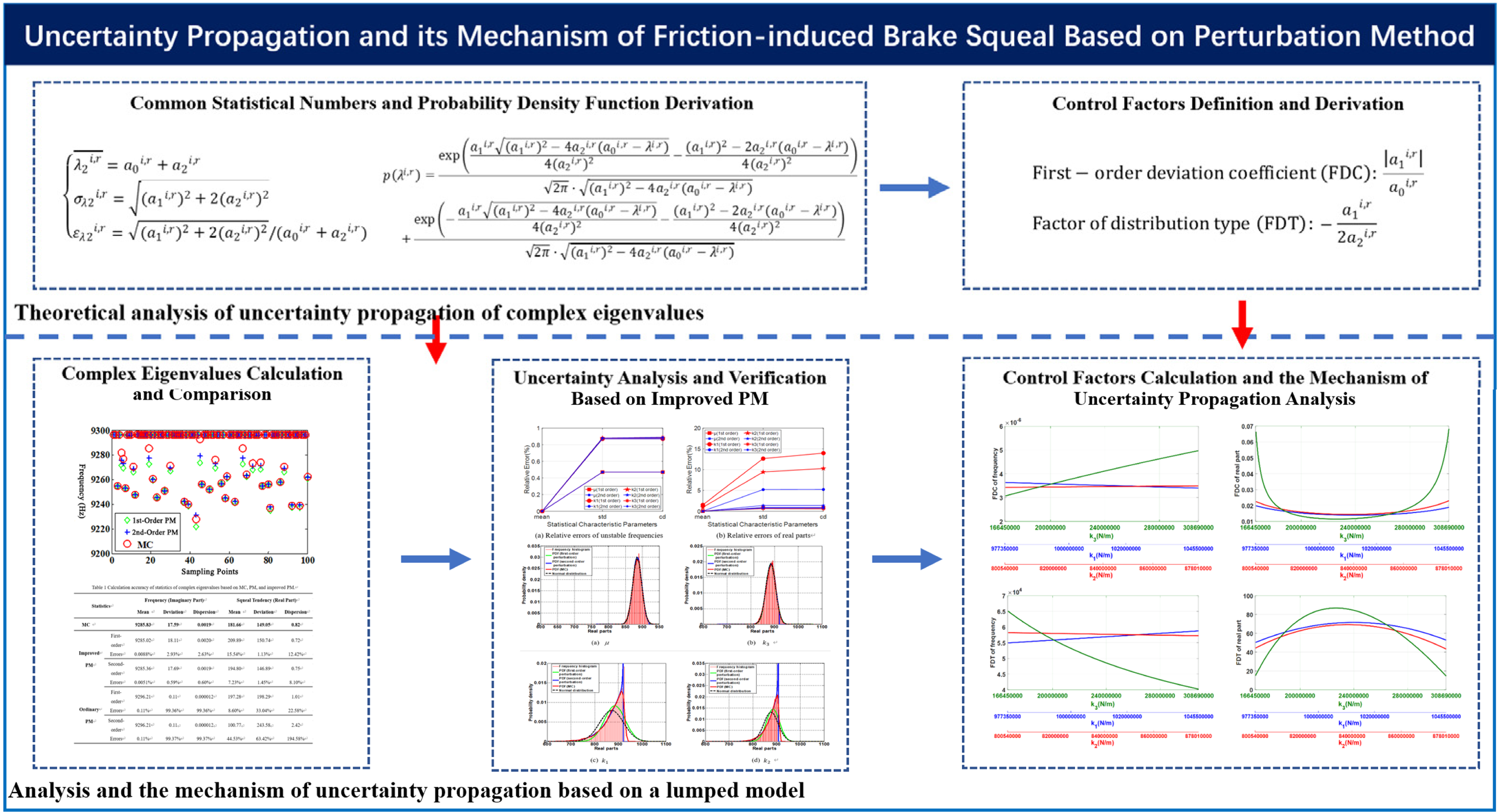
The instability study of the friction-induced vibration (FIV) system with uncertain parameters has gained increasing attention in automotive engineering. The perturbation method (PM) provides analytical insights into brake squeal uncertainty propagation mechanisms. However, three critical gaps exist in current literature: (1) systematic theoretical derivation of second-order perturbation expressions for uncertainty propagation probability density functions (PDFs) is lacking; (2) traditional perturbation methods fail for random parameters in mixed mode-coupling zones near bifurcation points; and (3) quantitative indicators for understanding uncertainty propagation mechanisms remain undefined. This paper makes three novel contributions to address these gaps. First, we establish a complete theoretical framework deriving analytical second-order PDF expressions for complex eigenvalues under normally distributed parameters. Second, we propose an improved bifurcation-aware perturbation method that employs piecewise interval perturbation at bifurcation points, dramatically improving accuracy in mixed mode-coupling zones where traditional methods fail. Third, we introduce two innovative control factors—first-order deviation coefficient (FDC) and factor of distribution type (FDT)—providing, direct analytical tools to predict eigenvalue dispersion and distribution types without computationally expensive Monte-Carlo sampling or empirical PDF fitting. Validation against Monte-Carlo simulations demonstrates that the improved method achieves over 95% accuracy improvement in mixed zones, while FDC and FDT successfully predict whether eigenvalue distributions will be normal or skewed based solely on perturbation coefficients. These contributions provide brake system designers with efficient analytical tools for uncertainty quantification and robust optimization.
Keywords
Get full access to this article
View all access options for this article.