



Abstract
Since the outbreak of Covid-19 in December, 2019, scientists worldwide have been committed to developing COVID-19 vaccines. Only when most people have immunity to SARS-CoV-2, COVID-19 can reduce even wholly overcome. So far, nine kinds of COVID-19 vaccines have passed the phase III clinical trials and have approved for use. At the same time, adverse reactions after COVID-19 vaccination have also reported. This paper focuses on the adverse effects of thrombosis and thrombocytopenia caused by the COVID-19 vaccine, especially the adenovirus-vector vaccine from AstraZeneca and Pfizer, and discusses its mechanism and possible countermeasures.
COVID-19 Vaccine Types and Preparation Methods
COVID-19 Vaccine Types
The following nine vaccines have completed phase III clinical trials and have approved by the World Health Organization (WHO). The effectiveness of the various vaccines and other relevant information shows in Table 1.
Types of COVID-19 vaccine.

COVID-19 Vaccine Preparation Methods
Currently, there are three types of COVID-19 vaccine approved worldwide: inactivated vaccine, adenovirus-vector vaccine and nucleic acid vaccine. 11
The inactivated COVID-19 vaccine made from native SARS-Cov-2, which is heated or chemically treated to make its replication defective, thus maintaining the immunogenicity of the SARS-Cov-2 but without causing pathogenicity.
The adenovirus-vector COVID-19 vaccine is to insert part of the gene sequence of SARS-Cov-2 into the adenovirus, in order to construct a fusion type of the two viruses so that it has the infectivity of adenovirus and expresses the antigenicity of SARS-Cov-2.
The mRNA COVID-19 vaccine consists of a nucleoside-modified mRNA encoding SARS-Cov-2, packaged in lipid nanoparticles to reduce RNA degradation and improve translation efficiency.
Adverse Effects of COVID-19 Vaccine
The results of clinical trials on the safety and effectiveness of COVID-19 vaccines have reported one after another. Under the premise of fully affirming the immune protection of the COVID-19 vaccine, the adverse effects cannot ignored.
The most common symptoms after COVID-19 vaccination are fatigue, headache, muscle pain, chills and pain at the injection site, which described in the safety evaluation reports of COVID-19 vaccines such as Pfizer and Moderna and other vaccines.9,12
Scholars conducted a descriptive analysis of the WHO global individual case safety report database VigiBase, reporting the arterial and venous thrombosis adverse effects of COVID-19 vaccination. The thrombosis adverse reactions mainly occurred after vaccination with Pfizer, AstraZeneca and Moderna these adenovirus-vector mRNA vaccines. 13
To Discuss the Mechanism of Adenovirus-Vectored Vaccine Inducing Thrombocytopenia and Thrombosis
Thrombosis and Thrombocytopenia After AstraZeneca's COVID-19 Vaccination
The incidence of thrombotic events per million people after COVID-19 vaccination was 0.21 [95% CI:0.19-0.22]. For VTE (venous thrombus embolism) and ATE (arterial thrombus embolism), there were, respectively, 0.075 [95% CI: 0.07-0.08] and 0.13 [95% CI: 0.12-0.14]. 13
On March 19, 2021, the European Medicines Agency (EMA) disclosed to the public two deaths after AstraZeneca's COVID-19 vaccination. 14 A 49-year-old woman died of severe coagulopathy dysfunction and a 35-year-old woman died of pulmonary embolism. It found that patients with cerebral thrombosis after AstraZeneca's vaccination has the characteristic that they appeared decreased platelet count. On April 10, two simultaneous studies, published in the New England Journal of Medicine (NEJ), discussed symptoms of thrombosis and thrombocytopenia following AstraZeneca's COVID-19 vaccination, and for the first time reported on the underlying mechanism.15,16
Vaccine-Induced Immune Thrombotic Thrombocytopenia
It has confirmed that COVID-19 is associated with a prethrombotic phenotype characterized by coagulation dysfunction and endothelial dysfunction.17-21 In the NEJ reports, all 11 patients in the initial analysis had moderate to severe thrombocytopenia and abnormal thrombosis, especially cerebral venous thrombosis and visceral venous thrombosis. In addition, five patients also had disseminated intravascular coagulation (DIC), with the significantly higher D-dimer level and one or more of the INR (international standardized ratio) of PT (prothrombin time) or fibrinogen level abnormal.15,16
When evaluating the serological characteristics of the four initial patients by the platelet activation assay, found that platelet factor 4 (PF4) significantly enhanced the response and platelet activation. All reactions were blocked by monoclonal antibody and immunoglobulin, indicating that platelet activation occurs through platelet Fcγ receptors. The PF4–heparin ELISA tests of these patients were positive. Most samples (19 out of 24) inhibited by LMWH (low molecular weight heparin). Almost all models (22 out of 24) activated by adding PF4 and inhibiting by high doses of heparin.
This increased PF4 antibody level mediated thrombocytopenia and thrombosis is similar to the heparin-induced thrombocytopenia (HIT). HIT is an immune complication of heparin therapy caused by PF4 and heparin complex antibodies.22,23 PF4/heparin antibody binds and activates FcγRIIA on platelets and monocytes and mediates HIT and thrombosis. 24
It is precise because the clinical manifestations of thrombocytopenia and thrombosis after adenovirus-vectored COVID-19 vaccination and the production of peculiar auto anti-PF4 antibodies are very similar to HIT. This syndrome is named vaccine-induced immune thrombotic thrombocytopenia (VITT).25,26
VITT is related to the anti-PF4 platelet-activating antibody, patients with VITT occur thrombocytopenia and thrombosis without heparin exposure.27,28 Studies have shown that VITT anti-PF4 antibodies had a stronger binding reaction than HIT antibodies to the PF4 and PF4/heparin complexes, which collect the PF4 tetramers to cluster and form immune complexes, thereby causing the FCγRIIA dependent platelet activation. Adverse reactions after adenoviral-vectored vaccination include microvascular damage, micro-bleeding and thrombosis, which are the result of released platelet activation and PF4-directed autoimmunity of VITT antibody.29,30
HIT and VITT mechanism shows in Figure 1.
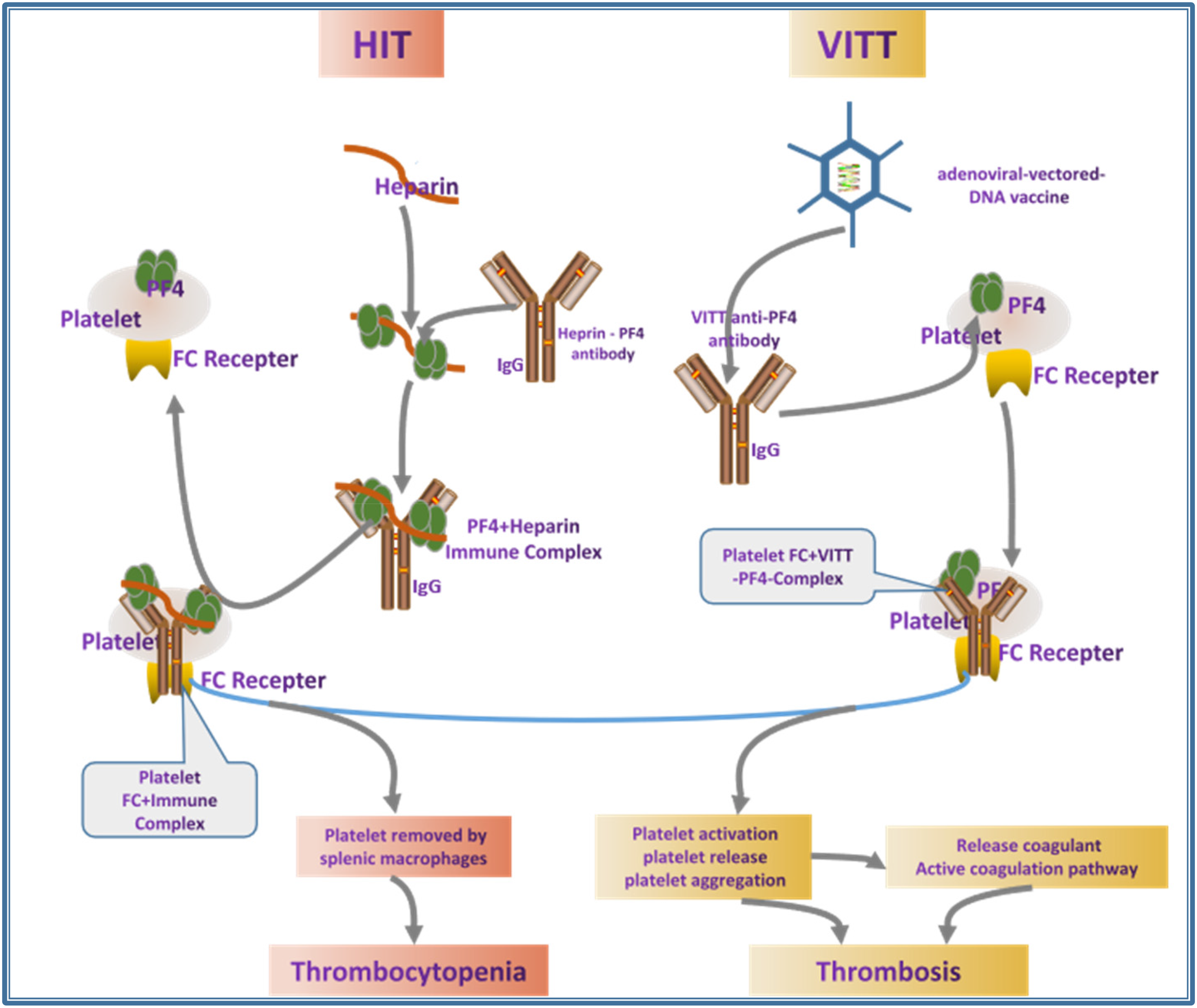
HIT and VITT mechanism schematic. Abbreviations: HIT, heparin-induced thrombocytopenia; VITT, vaccine-induced immune thrombotic thrombocytopenia.
Adenovirus Vectors are Associated with Platelets
According to the proposed model, any adenovirus-vectored-DNA vaccine could drive autoimmune VITT in susceptible individuals. Electrochemical DNA–PF4 interactions and PF4–heparin interactions, but at different locations, represent the common denominator in HIT and VITT related autoimmune-mediated thrombosis.
It has confirmed that some adenoviruses can use coxsackie and adenovirus receptor (CAR) to bind to platelets.31,32 The replication-deficient recombinant chimpanzee ChAdOx1 vector, which is the main component of the Asrazeneca AZD1222 vaccine, uses CAR.33,34 However, Johnson & Johnson's Ad26.COV2.S vaccine does not use CAR as the primary entry receptor. 35 If thrombocytopenia and thrombosis occur after Johnson & Johnson's vaccination, or have target PF4–heparin antibody response, considered that related to the adenovirus vector.
How to Prevent and Treat Thrombocytopenia and Thrombosis Caused by Adenovirus-Vector COVID-19 Vaccine?
Although researchers have not yet been able to confirm what component of the COVID-19 vaccine, caused this rare thrombocytopenia and thrombosis symptom, the following suggestions still have some reference value:
If the patient has venous or arterial thrombosis in unusual parts (brain, abdomen) within 5 to 20 days after COVID-19 vaccination, or accompanied thrombocytopenia, it indicates vaccination adverse reactions.
For patients who have not been exposed to heparin recently but have thrombosis or thrombocytopenia, the PF4–heparin antibody can be detected. This is indicative for the determination of thrombocytopenia or anti-pf4 antibody-related thrombosis after COVID-19 vaccination.
Given that VITT has the same laboratory findings and clinical manifestations as HIT, the use of unfraction heparin (UFH) or LMWH and, or platelet transfusion therapy may lead to disease progression, 36 In contrast, non-heparin anticoagulants and intravenous immunogloblin (IVIG) therapy are often associated with rehabilitation.
Conclusion
Overall, adverse events associated with adenovirus-vectored COVID-19 vaccination was less than 1 in 1 million. The European Medicines Agency has determined that AstraZeneca's COVID-19 vaccine is effective and recommended, thrombosis should list as an “extremely rare” side effect. 14 The agency also stated that there is a “possible link” between AstraZeneca's vaccine and thrombosis, but the existing data are not yet sufficient to confirm specific risk factors. The overall benefits of this vaccine outweigh the disadvantages.
According to current research results, we have known that the adenovirus-vector vaccine activates platelets and produce PF4 antibodies, but only a subset of sensitized patients progress to life-threatening complications of thrombocytopenia and thrombosis,22-24 the reasons and mechanisms need to be further explored.
Footnotes
Compliance with ethics guidelines
This article does not contain any studies with human or animal subjects performed.
Declaration of Conflicting Interests
The author(s) declared no potential conflicts of interest with respect to the research, authorship, and/or publication of this article.
Funding
The author(s) received no financial support for the research, authorship and/or publication of this article.
