



Abstract
The relationship between antiphospholipid antibodies (aPL) and sickle cell disease (SCD) has never been systematically addressed. Our aim was to evaluate potential links between SCD and aPL in all age groups. EMBASE/PubMed was screened from inception to May 2020 and Peto odds ratios for rare events were calculated. The pooled prevalence (PP) of IgG anticardiolipin antibodies (aCL) was higher in individuals with SCD than in controls (27.9% vs 8.7%, P < 0.0001), that of IgM aCL was similar in the two groups (2.9% vs 2.7%); only individuals with SCD were positive for lupus anticoagulant (LA) (7.7% vs 0%, P < 0.0001). The PP of leg ulcers was similar between aPL positive and negative individuals (44% vs 53%) and between patients in acute crisis and stable patients (5.6% vs 7.3%). Reporting of aPL as a binary outcome and not as a titer precluded further interpretation. The results indicate that a prospective case-control study with serial measurements of a panel of aPL in SCD patients might be warranted, in order to understand further the possible pathogenic role of aPL in SCD.
Keywords
Introduction
Sickle cell disease (SCD) is the most common severe monogenic disorder in the world. It is characterized at the molecular level by a valine to glutamic acid transition at position 6 in the β-globin chain; homozygous mutation affecting the β-globin chains encoded on both chromosomes (S allele) is responsible for the presence of hemoglobin (Hb) SS in patients with SCD. At low oxygen tension Hb SS polymerizes into a fibrous structure that changes the normally discoid shape of erythrocytes into a sickle shape. At the clinical level people with Hb SS undergo acute vaso-occlusive crises in the microcirculation. 1 Over time patients with SCD develop a chronic vasculopathy leading to pulmonary hypertension, ischemic stroke and leg ulceration. 2 In addition, SCD patients have a greater risk of venous thromboembolism than the general population. 3 The pathophysiology of thrombosis as a determinant of vaso-occlusive crises in SCD patients is known to be multifactorial and implication of an autoimmune mechanism is probably underestimated. It appears that sickle erythrocyte rigidity may not be the sole pathogenic mechanism underlying vaso-occlusive crises, as a recent report suggested a contribution of arteriolar neutrophil-platelet aggregates in the lungs. 4 Vasculopathic abnormalities associated with SCD are attributable to pathways involving vaso-occlusive events and intravascular hemolysis, which promote inflammation and redox instability. 5
The presence and persistence of antiphospholipid antibodies (aPL) detected via immune or clotting assays in association with thrombotic occlusions in any vascular district defines the antiphospholipid syndrome (APS). 6 Pulmonary hypertension 7 and leg ulcers 8 may also be part of the APS disease spectrum. An association between IgG anticardiolipin antibodies (aCL) and recurrent coronary artery disease (CAD) was evidenced by a recent meta-analysis. Patients with CAD and elevated IgG aCL had a doubled risk of recurrent major adverse cardiac events at 12 and 24 months. 9 A relation was reported also between aPL and lower extremity peripheral artery disease (PAD), whereas LA related also to critical limb ischemia and failed revascularisation. 10 We performed this systematic review to verify whether aPL occur in individuals with SCD and whether aPL contribute to the vascular manifestations of SCD.
Materials and Methods
Search Strategy
The systematic review was carried out according to the PRISMA guidelines. 11 MEDLINE and Embase databases were searched from inception to May 2020 using the following terms: [‘sickle cell disease’ OR ‘sickle cell anemia’] and [‘anticardiolipin’ OR ‘anti-beta 2-glycoprotein-I’ OR ‘antiphospholipid syndrome,’ OR ‘lupus anticoagulant’ OR ‘lupus inhibitor’].
Article Selection Criteria
Inclusion criteria were: (i) case-control and/or cohort observational studies assessing: (a) difference in prevalence or titer of aPL between individuals with SCD and a control group or (b) difference in prevalence or titer of aPL between individuals with SCD with and without vascular occlusions or with and without leg ulcers; (ii) aPL measured by immune or clotting assays; and (iii) articles written in any language. Exclusion criteria were: (i) prevalence studies; (ii) studies not reporting the relationship between aPL and SCD; and (iii) non-original research articles. Data were independently extracted into a standard electronic form and any discrepancies were resolved by consensus.
Data Processing
Four authors performed the database search. Additional studies were considered by reading the references of selected articles (Figure 1). The records were entered into EndNote to remove duplicates. The same authors screened the primary records for relevancy and excluded irrelevant articles. The remaining articles were independently screened by two authors, who extracted the relevant data into a standard electronic form. The same authors employed the Newcastle Ottawa Quality Assessment Scale (NOQAS) to evaluate the quality of non-randomized studies. The NOQAS yields scores ranging from 0 to 8 after summing individual scores from three major domains: (i) selection and comparability of cases and controls; (ii) exposure of interest; and (iii) outcome of interest. 12 Data extracted included: (i) the country of origin of the study; (ii) the number of participants; (iii) participant age, sex, Hb genotype, and eventual vascular involvement (deep vein thrombosis and presence of leg ulcers); and (iv) type of antibody measured (Table 1). At the end of this process, the same authors reviewed the data jointly. Discrepancies (n=3) were resolved by discussion with a third party, until a final consensus was reached.

PRISMA flow chart showing the study selection process.
Demographics, Clinical and Laboratory Variables of Participants in Studies Included in the Systematic Review and Meta-Analysis.

Abbreviations: No, number, M, male; F, female; SS, hemoglobin SS; SC, hemoglobin SC; AS, hemoglobin AS; aPL, antiphospholipid antibody; CTR, controls; NOS, Newcastle-Ottawa score; CC, case-control; CHT, cohort.
a Median (interquartile range) or mean ± standard deviation is indicated.
Outcome Measures
The primary outcomes were: (i) the comparative pooled prevalence (PP) of different aPL in individuals with SCD and controls; (ii) where possible, the comparative PP of aPL in individuals with SCD with and without vascular occlusions and with and without leg ulcers; and (iii) where possible, the standardized mean difference of aPL titers between the groups listed in (i) and (ii).
Statistical Analysis
The Peto odds ratio for rare events was used to compare groups using random effects meta-analyses of categorical and/or continuous outcomes. 13 Because the studies identified in the systematic review were observational, and because of their limited number, we did not produce funnel plots or use Egger’s test to assess publication bias. These analyses may be misleading if applied to fewer than 10 studies. 14 Heterogeneity was assessed using the I2 statistics. Heterogeneity was considered low for I2 < 25%, moderate for 25% < I2 < 50% and high for I2 > 50%. Statistical analyses were carried out using Comprehensive Meta-Analysis (Biostat, Frederick, MD, USA).
Results
Study Number and Vascular Involvement
The initial database search yielded 1076 entries. Another eight entries were identified after reading the references of selected articles, thus yielding a total of 1084 entries. After duplicate removal, 749 records remained. After excluding 721 irrelevant articles, 28 articles were assessed for eligibility. At the end of the screening and exclusion process (Figure 1) we identified 11 articles 15 –25 examining the relationship between aPL and SCD (Table 1). From one record, we could retrieve only the abstract because the volume including the article was missing from the publisher website. 18 Likewise, we found only one article reporting ischemic stroke 19 and three articles reporting leg ulcers, 15,19,25 two of which were included in the meta-analysis. 15,25 No articles examined venous thrombosis or any other vascular involvement.
aPL Tests
aPL were detected by immune or clotting assays depending on the study. IgG anticardiolipin antibodies (aCL) were most commonly reported as frequencies of positive participants 15 –20,22,24,25 though in two studies IgG aCL were reported in graphical format. 19 –24 Mean values of IgG aCL in different groups were reported only in one article. 18 One study indicated the cut-offs for negative, borderline and positive IgG aCL; 20 for this study we summed the numbers of SCD patients and controls with borderline and positive IgG aCL for the purpose of the analysis. IgG aCL was measured more than once in one article. 15 Five studies investigated lupus anticoagulant (LA) and expressed it as a frequency of positive participants. 21 –23,25 LA was assessed via the textarin/ecarin ratio 26 in one study, 17 by the kaolin clotting time (KCT) 27 in three studies 21,23,25 and via the activated partial thromboplastin time with hexagonal phospholipid neutralisation 28 in one study. 22
Relationship Between aPL and SCD
Eight articles, comprising a total of 472 Hb SS patients and 434 controls, explored the relationship between IgG aCL and SCD. The PP of IgG aCL was greater in individuals with SCD than controls (27.9% vs 8.7%), with high heterogeneity (I2 78%, P < 0.0001). All but one study of a pediatric population favored a positive association between aCL and SCD (Figure 2A). A sensitivity analysis, performed by removing the pediatric study, 17 resulted in only slightly diminished heterogeneity (I2 71%, P = 0.002). However, heterogeneity decreased further by removing the study of the oldest participants 24 (I2 38%, P = 0.19), indicating that extremes of age were a potential source of heterogeneity. Three articles, comprising a total of 170 Hb SS patients and 143 controls, explored the relationship between IgM aCL and SCD. The PP of IgM aCL was similar in the two groups (2.9% vs 2.7%) (Figure 2B). Four studies, comprising a total of 271 Hb SS patients and 150 controls, explored the relationship between LA and SCD. LA was detected only in SCD patients (7.7% vs 0%) (Figure 2C). In one study, neither individuals with SCD or controls were positive for LA and thus this study does not appear in the graph. 17

Effect size of (A) IgG anticardiolipin antibodies (aCL), (B) IgM aCL and (C) lupus anticoagulant (LA) in participants with sickle cell disease (SCD) and controls (CTR). 95% CI: 95% confidence interval.
Relationship Between aPL and Clinical Manifestations of SCD
Two articles, 15,25 comprising a total of 18 aPL-positive and 149 aPL-negative SCD patients, explored the relationship between leg ulcers and aPL. One study measured IgG aCL 15 and one measured LA detected via the KCT 25 : data from these studies were pooled. The PP of leg ulcers was similar in both groups (44% vs 53%), with no heterogeneity (Figure 3). A third article 23 found a slightly but not significantly increased frequency of LA (measured via KCT) in SCD patients with leg ulcers, compared with SCD patients without leg ulcers (18.8% vs 6%, P = 0.1).
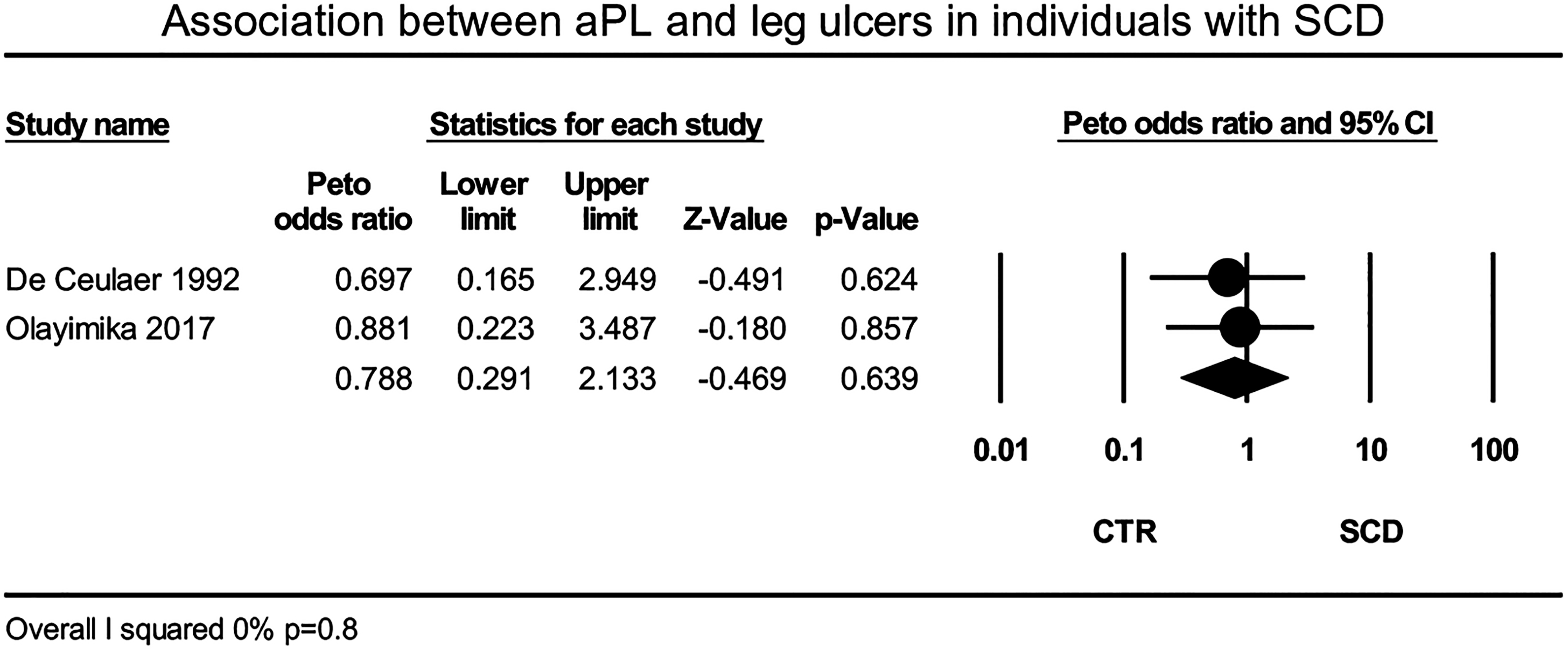
Relationship between antiphospholipid antibodies (aPL) and leg ulcers in individuals with sickle cell disease (SCD) and controls (CTR). 95% CI: 95% confidence interval.
Two articles, 21,22 comprising a total of 88 individuals with SCD in acute crisis and 68 individuals with SCD not in acute crisis, explored the relationship between LA and SCD status. The PP of LA was similar between individuals with SCD in crisis and not in crisis (5.6% vs 7.3%). A third study found no difference between the IgG aCL titers of individuals with SCD in crisis and not in crisis. 19
Discussion
In SCD, reactive oxygen species and lipid peroxidation products accumulate within erythrocytes at each sickling/unsickling cycle, exhausting the antioxidant activities of superoxide dismutase, catalase and glutathione. The resulting damage to intracellular structures leads to red cell destruction. Intravascular hemolysis is accompanied by release of several molecules such as modified hemoglobin, asymmetric dimethylarginine, and adenine nucleotides that promote vasomotor dysfunction and, in the longer term, the proliferative vasculopathy typical of SCD (reviewed in 29 ). Moreover, anionic phospholipids, including phosphatidylserine, are exposed on the surface of erythrocytes during hemolysis and may simultaneously elicit aPL and support coagulation activation, a key phenomenon in the development of venous thrombosis in SCD. 30 Hence, there is strong interest in understanding the contribution of aPL in SCD.
Despite a degree of age-related heterogeneity, our meta-analysis found that the PP of IgG aCL and LA in individuals with SCD was higher than that in controls, while the PP of IgM aCL was similar between the two groups. Strangely, the relationship between aPL and thrombosis was poorly addressed in the studies included in our meta-analysis. In most studies, it was difficult to determine whether the average IgG aCL titer of SCD patients was above or below the thrombogenic threshold of 40 IgG phospholipid subunits established in the 1990s, as very few studies reported average aPL titers. Moreover, studies assessing changes of aPL after acute sickle crisis did not identify any differences in these titers compared to the background status. 19,22
Additionally, three studies investigated the relationship between aPL and leg ulcers, a common feature of SCD vasculopathy. The two studies included in the meta-analysis did not find any difference in the PP of aPL between individuals with SCD with leg ulcers and without leg ulcers. 15,25 Although the one study not included in the meta-analysis reported a slightly but not significantly elevated frequency of LA in SCD patients with leg ulcers, 19 the test employed for detection of LA in two of these studies was the KCT, a sensitive but poorly specific assay 31 that is no longer recommended for diagnosis of APS. 32
In our meta-analysis, we were unable to include an interesting survey from Oman of 550 SCD patients of whom 14 had co-morbid APS. Unfortunately, the 14% prevalence of ischemic stroke in the APS group was not compared with the prevalence of ischemic stroke in SCD patients without apparent APS, as it was unclear whether aPL had been tested in this latter group. 33
Our meta-analysis had several limitations. First, only a few studies and their outcomes were included. Second, we were unable to evaluate publication bias. Third, anti-β2 glycoprotein I antibodies, which are considered of pathogenic importance in APS, were not evaluated across the studies reviewed. Fourth, most studies reported frequencies of participants positive for aPL but not titers or ratios. Fifth, aPL were measured only at a single time point in most studies.
Conclusions
Although our meta-analysis revealed a statistical link between aPL and SCD, the clinical relevance of aPL in SCD remains unaddressed. From the clinical point of view, checking aPL in SCD patients with venous thrombosis, ischemic stroke and leg ulcers may prove rewarding; from the point of view of pathogenesis, a prospective case-control study taking serial measurements of a wider panel of established and more modern aPL could be very useful in understanding the possible mechanistic role of aPL in SCD.
Footnotes

Declaration of Conflicting Interests
The author(s) declared no potential conflicts of interest with respect to the research, authorship, and/or publication of this article.
Funding
The author(s) received no financial support for the research, authorship, and/or publication of this article.