




Abstract
Aim:
Ankaferd Blood Stopper (ABS) is a new promising local hemostatic agent, and its mechanism on hemostasis has been shown by many studies. However, the effects of ABS on skin superoxide dismutase (SOD) and catalase (CAT) activities have not been investigated before. The aim of this study was to evaluate the effects of this new generation local hemostatic agent on warfarin-treated rats focusing on its the antioxidant potential in short-term soft tissue healing.
Methods:
Twelve systemically warfarin treated (warfarin group) and 12 none treated Wistar Albino rats (control group) were selected for the trial. Rats in the warfarin group were treated intraperitonally with 0.1 mg/kg warfarin, and rats in the control group were given 1 mL/kg saline 3 days earlier to surgical procedure and continued until killing. All rats had incisions on dorsal dermal tissue, which was applied ABS or no hemostatic agent before suturing. Six of each group were killed on day 4, and the other 6 were killed on day 8. Blood and skin samples were taken. Prothrombin time (PT) in blood samples, CAT, and SOD activities in skin samples were determined.
Results:
Warfarin treatment dose was found to be convenient and warfarin treatment increased the PT levels as expected. Warfarin treatment decreased CAT activity significantly compared to the control group. The ABS treatment significantly increased SOD activities in the warfarin group at the end of the eighth day.
Conclusion:
Ankaferd Blood Stopper acted positively in short-term tissue healing by increasing SOD activity in warfarin-treated rats. Therefore, ABS may be suggeted as a promoting factor in tissue healing.
Introduction
Surgical interventions are performed frequently in patients who receive treatment with an oral anticoagulant such as warfarin and so on. The risk of operative or postoperative bleeding must be balanced against the risk of thromboembolism in patients whom warfarin is interrupted. 1,2 In the past, anticoagulant treatment has been suggested to be stopped or reduced for several days before minor surgical procedures such as a dental extraction. Surgical interventions can be performed in patients treated with oral anticoagulants without interruption or diminution of the medication. Local hemostasis with gelatin sponge and sutures appears to be sufficient. 3
Warfarin is one of the coumarin group of drugs and is prescribed for various conditions. It blocks the formation of prothrombin and factors II, VII, IX, and X, which are involved in both the extrinsic and the common coagulation pathways and prevents the metabolism of vitamin K to its active form that is needed for the synthesis of these factors. Other vitamin K-dependent proteins inhibited by warfarin include proteins C and S, which are involved in the fibrinolytic system. Because coumarins bind strongly to plasma proteins, warfarin has a half-life of 36 hours and acts slowly. The activity of warfarin is expressed as the international normalized ratio, which is the standard introduced by the World Health Organization 20 years ago. It is a prothrombin ratio obtained by dividing the prothrombin time by the laboratory control prothrombin time. 1,2
Ankaferd Blood Stopper (ABS; Ankaferd Health Products Ltd, Istanbul, Turkey) is a standardized unique combined medicinal plant extract, which has been approved in the management of postsurgery dental bleeding and external hemorrhage in Turkey. 4 The basic mechanism of action of ABS is through the formation of encapsulated protein network providing focal points for vital erythrocytes to aggregate on. The ABS-induced protein network formation involves blood cells, particularly erythrocytes, without affecting the physiological individual coagulation systems. Ankaferd Blood Stopper is a standardized extract from the following plants: Thymus vulgaris, Glycyrrhiza glabra, Vitis vinifera, Alpinia officinarum, and Urtica dioica. 4,5
Reactive oxygen species (ROS) are produced in metabolic and physiological processes, and excessive production of ROS can cause direct damage to cellular macromolecules such as DNA, proteins, and lipids and can alter normal signaling pathways through activation of redox-sensitive transcription factors. Enzymatic and nonenzymatic antioxidant mechanisms are required for the detoxification of ROS. Superoxide dismutase (SOD) and catalase (CAT) are a part of integrated antioxidant system that protects cells and tissues from oxidative damage. 6,7 When the increase in oxidants and decrease in antioxidants cannot be prevented, oxidative and antioxidative balance shifts toward the oxidative status. Consequently, oxidative stress, which has been implicated in over 100 disorders, develops, and antioxidant molecules such as SOD and CAT prevent or inhibit these harmful reactions. 8 On the other hand, there is no study in the literature evaluating skin SOD and CAT activities in short-term soft tissue healing under ABS administration and warfarin treatment. The aim of this study was to evaluate SOD and CAT activities in ABS-set, warfarin-treated rats compared with the control group. Our results will help to have an idea about the availability of this brand new local hemostatic agent on short-term soft tissue healing in warfarin-treated oral surgery patients.
Methods
Animals and Treatment
We operated totally 24 Wistar albino rats and 12 of them were systemically warfarin treated as the warfarin group and the other untreated 12 rats were the control group. All 24 experimental animals were male and were in 280 to 560 g of weight range. Experimental animals were obtained from Department of Experimental Animals Unit, Kocaeli University (Kocaeli, Turkey) and surgeries and postoperative care have been also performed in this unit. All experimental protocols were approved by Animal Care and Use Ethical Committee of Marmara University (December 15, 2009; number: 16/3-2009).
Control group of rats were injected 1 mL/kg saline intraperitonally for 3 days before surgery, stopped on the day of surgery, and continued from postoperative first day until the day of killing. Of 12 rats in the control group, 6 have been killed 4 days after surgery and other 6 have been killed on the eighth day after surgery. Warfarin group has been injected 0.1 mg/kg warfarin intraperitonally for 3 days before surgery, stopped on the day of surgery, and continued from postoperatively first day until the day of killing. Of 12 (warfarin group) rats, 6 have been killed 4 days after surgery and other 6 have been killed on the eighth day after surgery. Killing procedure has been performed using high-dose anesthetics.
After aseptic and antiseptic conditions were achived, experimental animals were anesthesized with 90 mg/kg ketamin (Ketalar 500 mg enjektabl 1 flakon, Pfizer İlaçları Ltd, Şti, İstanbul, Türkiye) and 10 mg/kg xylazine (Rompun Bayer HealthCare, Leverkusen, Germany) combination. One of the rats in the control group died due to a complication of the anesthetic, and study was completed with a number of 23 rats.
As soon as shaving the dorsal skins, incisions were made on all 23 rats. Incisions were 2 cm long and 2 cm far from each other and perpendicular to the head–tail direction. On the day of surgery, 2 × 20 mm2-sized tissue samples were taken from the margin of the wound for further biochemical tests. One of the wounds has been sutured without any hemostatic agent and left to heal naturally. The other wound has been applied 0.25 mL of ABS before suturing. This protocol has been followed in both the control and the warfarin groups.
On the day of killing, the whole dorsal skin including the healing wound area has been totally excised. Two different wound healing areas (ABS-nonhemostatic) have been separated from each other and prepared for the biochemical evaluation. Biochemical tests were performed at Department of Biochemistry, Faculty of Dentistry, Marmara University (Istanbul, Turkey).
Immediately after killing, 2 mL of intracardiac blood sample was taken from all experimental animals and centrifuged at 2000 rpm for 5 minutes to gain blood plasma for prothrombin time (PT) tests. The PT tests were determined in Düzen Norwest Veterinary Laboratories (Ankara, Turkey).
Tissue Sampling
All the skin samples with or without ABS were excised. All pieces were kept in −94°C equally and transfered to −24°C 2 days before performing tests. Samples were waited to defreeze at +4°C on the day of tests performed. Samples were washed with saline and cleaned from blood and veins carefully, dried, and weighted. Then samples cut into smaller pieces and homogenized with a glass homogenater with adequate saline. The conditions were recorded (homogenization time and rpm level). Tissue homogenates were put in eppendorf tubes and centrifuged at 4000 rpm for 10 minutes. Tissue supernatants were used for further biochemical search.
Determination of Protein
Total protein levels of pancreas tissues were determined by the method described by Lowry et al. 9 Briefly, in alkali medium, proteins are reacted with cupper ions and reduced by Folin reactive. The absorbance of the blue-colored product was evaluated at 500 nm. Bovine serum albumin was used as a standard, and total protein levels of pancreas tissues were used to express the the results of the parameters per protein.
Determination of SOD Activity
Activity of SOD was assayed as the ability of accelaration of o-dianisidine’s photo-oxidation. The SOD activity is measured with trays consisting 2.7 mL 50 mmol/L potassium phosphate (pH:7.8) with 0.1 mmol/L EDTA, 0.39 mmol/L riboflavine in 10 mmol/L potassium phosphate (pH:7.5), and 0.1 mL 6 mmol/l o-dianisidine. Trays are lightened with 20-W Slylvania Grow Lux fluorosan under 37°C.
Absorbances are measured spectrophotometricly at 460 nm. Absorbance records were made in the zeroth and eighth minutes of enlightment, and clear absorbances were calculated. As the reference, Bovine SOD is used to prepare a standard curve. (Sigma Chemical Co, S-2515-3000 U, Missouri, USA). 10
Determination of CAT Activity
The CAT enzyme has 2 functions. First function is disruption of H2O2 to H2O and O2 (catalytic activity), and second function is oxidation of H transmitters. Specimen consisting 2 mL of enzyme solution and 1 mL of H2O2 is noted as compared with 2 mL of enzyme solution and 1 mL of phospate buffer (instead of specimen) and at room temperature. Reaction begins with H2O2 addition. Change in 1 minute at 240 nm absorbance is recorded. 11
Statistical Analysis
All statistical analyses were performed using Statistical Package for the Social Sciences (SPSS) 16.0 Software program. Results were expressed as mean ± standard deviation. Differences between the groups were evaluated using Kruskal-Wallis test. Student t test used for comparison of the quantitive data that do achieve 2 independent group’s parametric test assumptions. Mann-Whitney U test was used for comparison of the quantitive data that do not achieve 2 independent group’s paramethric test assumptions. A P value less than .05 was considered statistically significant. Kruskal-Wallis test used for comparison of the quantitive data that do not achieve 3 or more independent group parametric test assumptions.
Results
Prothrombin Time Comparison
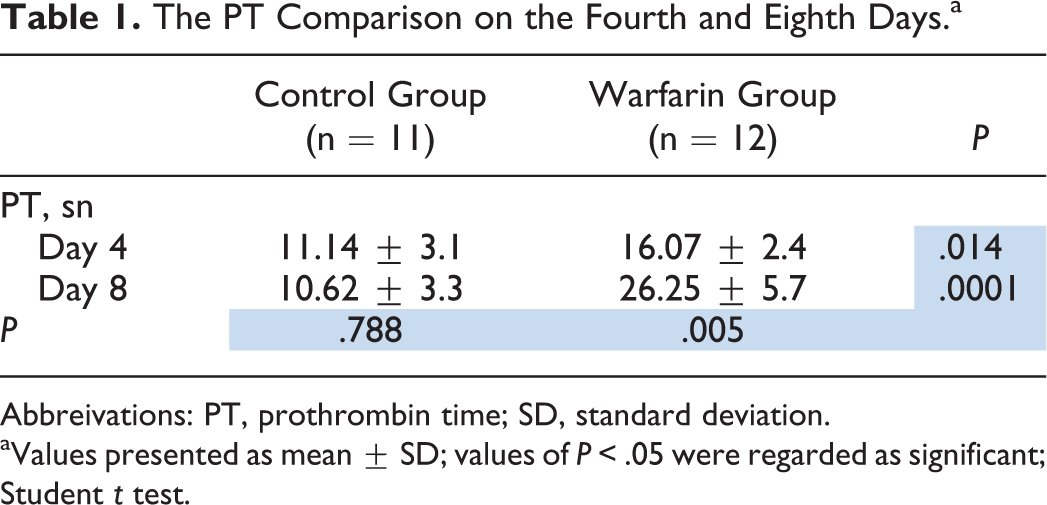
The PT values were analyzed on the fourth and eighth days. In the control group, no change was observed in PT values on days 4 and 8; however, in the warfarin group, the PT values significantly increased on day 8 when compared to day 4 (P = .005). The PT values of the warfarin group were significantly longer than the control group both on the fourth and on the eighth days (P = .014 and P = .0001; Table 1).
The PT Comparison on the Fourth and Eighth Days.a
Abbreivations: PT, prothrombin time; SD, standard deviation.
aValues presented as mean ± SD; values of P < .05 were regarded as significant; Student t test.
Comparison of the SOD and CAT Activities of Tissue Samples Taken During Surgical Procedure Before any Hemostatic Agent Administration in the Control and the Warfarin Groups
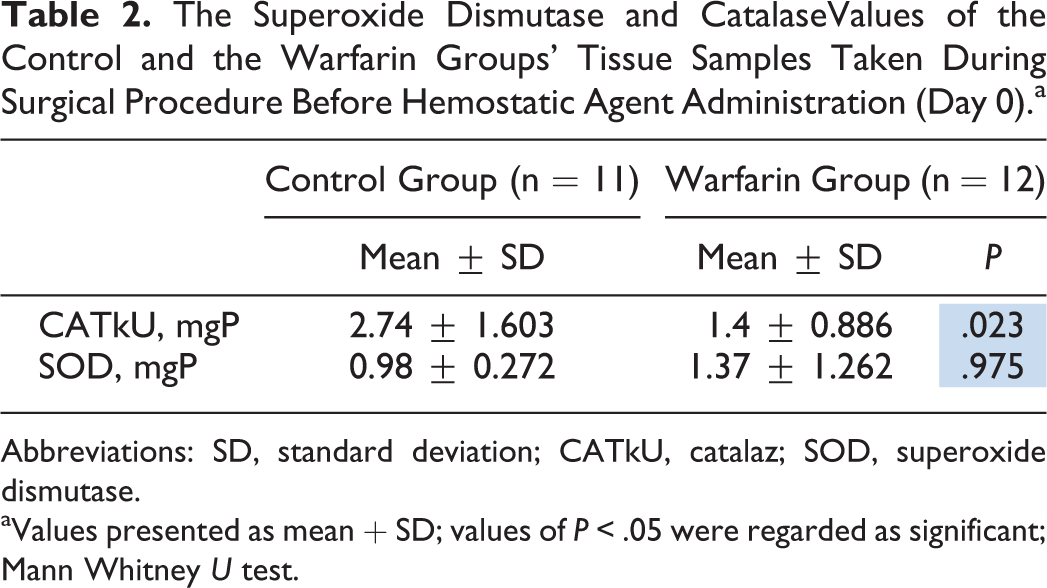
The CAT values of tissues in control group are significantly higher than in the warfarin group during surgical procedure at the beginning (day 0; P = .023; Table 2).
The Superoxide Dismutase and CatalaseValues of the Control and the Warfarin Groups’ Tissue Samples Taken During Surgical Procedure Before Hemostatic Agent Administration (Day 0).a
Abbreviations: SD, standard deviation; CATkU, catalaz; SOD, superoxide dismutase.
aValues presented as mean + SD; values of P < .05 were regarded as significant; Mann Whitney U test.
Comparison of the SOD and CAT Activities of Tissue Samples Taken on the Fourth Day After Hemostatic Agent Administration in the Control and the Warfarin Groups
CAT comparison
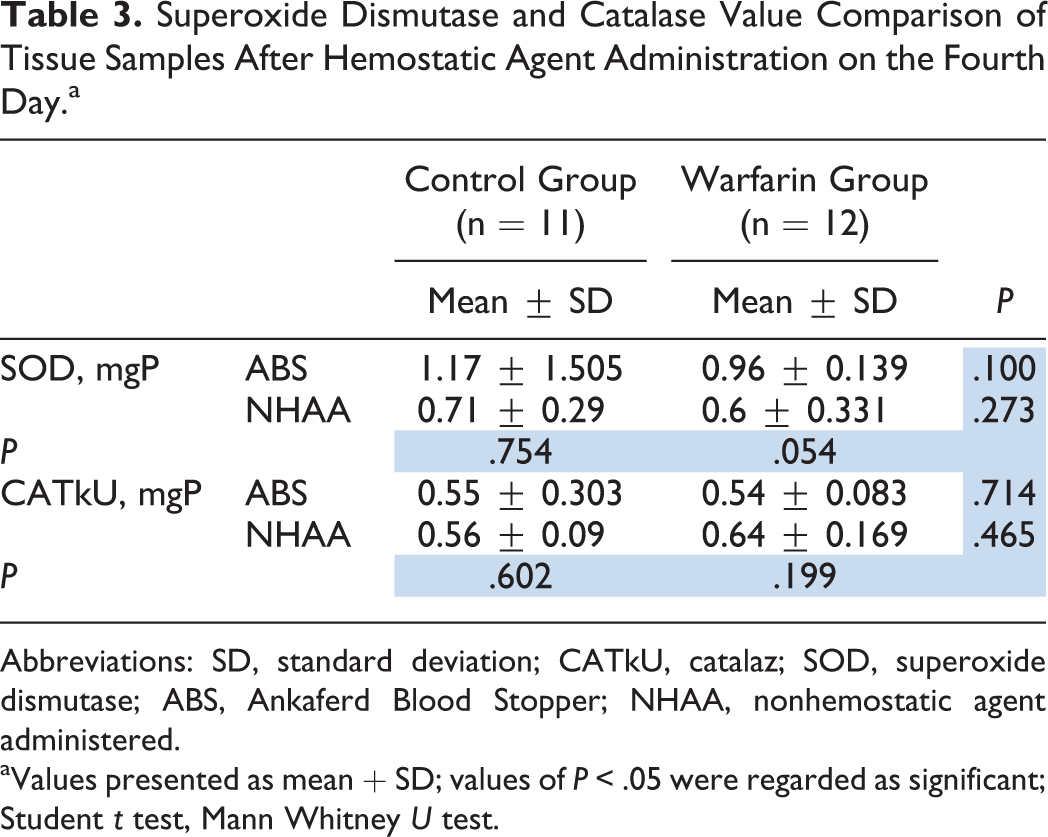
No significant difference has been noted between the groups on the fourth day (P = .714 and P = .465 respectively; Table 3).
Superoxide Dismutase and Catalase Value Comparison of Tissue Samples After Hemostatic Agent Administration on the Fourth Day.a
Abbreviations: SD, standard deviation; CATkU, catalaz; SOD, superoxide dismutase; ABS, Ankaferd Blood Stopper; NHAA, nonhemostatic agent administered.
aValues presented as mean + SD; values of P < .05 were regarded as significant; Student t test, Mann Whitney U test.
SOD comparison
No significant difference has been noted between the groups on the fourth day (P = .100 and P = .273 respectively; Table 3).
The SOD values of ABS-administered tissues are not statistically significantly higher than nonhemostatic agent administered (NHAA) tissues in the warfarin group at the fourth day, but it is very close to the significant limit of P < .05 (P = .054; Table 3).
Comparison of the SOD and CAT Activities of Tissue Samples Taken on the Eighth Day After Hemostatic Agent Administration in the Control and the Warfarin Groups
CAT comparison
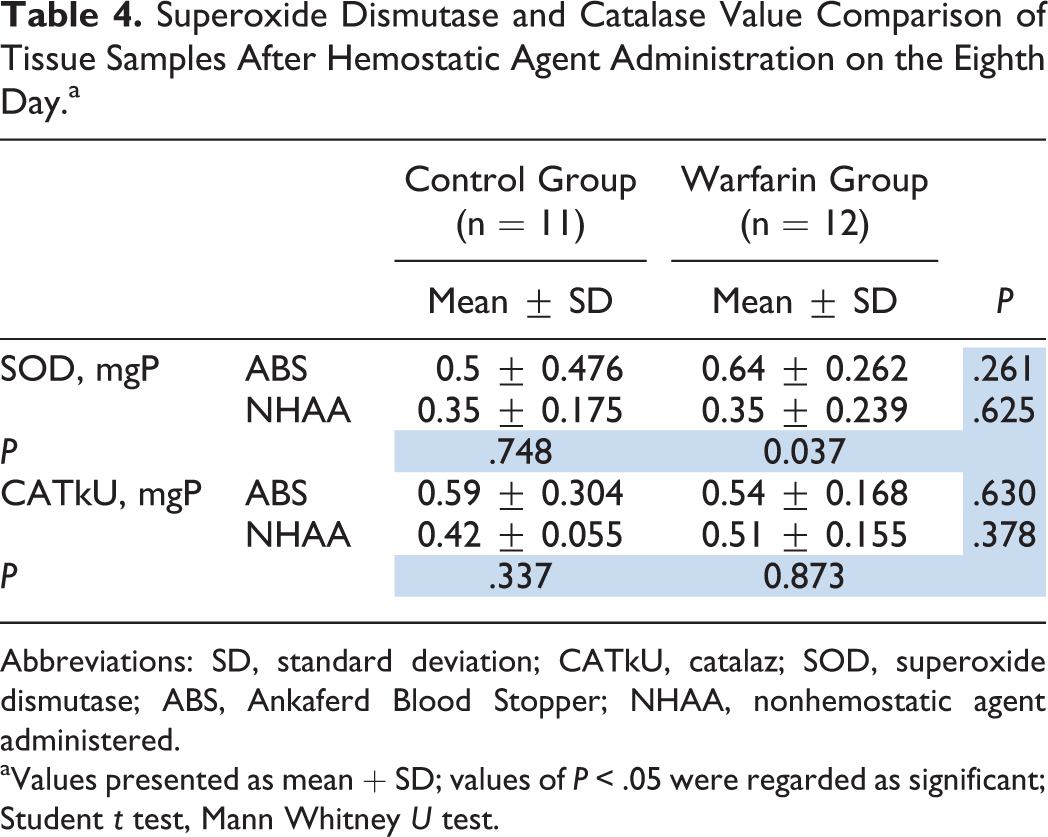
No significant difference has been noted between the groups on the eighth day (P = .630 and P = .378 respectively; Table 4).
Superoxide Dismutase and Catalase Value Comparison of Tissue Samples After Hemostatic Agent Administration on the Eighth Day.a
Abbreviations: SD, standard deviation; CATkU, catalaz; SOD, superoxide dismutase; ABS, Ankaferd Blood Stopper; NHAA, nonhemostatic agent administered.
aValues presented as mean + SD; values of P < .05 were regarded as significant; Student t test, Mann Whitney U test.
SOD comparison
No significant difference has been noted between control and warfarin groups on the eighth day (P = .261 and P = .625 respectively; Table 4).
The SOD values of ABS-administered tissues are significantly higher than NHAA tissues in the warfarin group at the eighth day (P = .037; Table 4).
Comparison of CAT Values of Tissue Samples Taken on Days 0, 4, and 8
All tissue samples’ CAT values decreased from day 0 to 4, and this decreased value remained until day 8 in both the control and the warfarin groups. The NHAA tissue samples’ CAT values decreased from day 0 to 4 (P = .002) and decreases more from day 4 to 8 (P = .008) in the control group (Table 5).
The CAT Values of Tissue Samples Taken on Days 0, 4, and 8.a,b
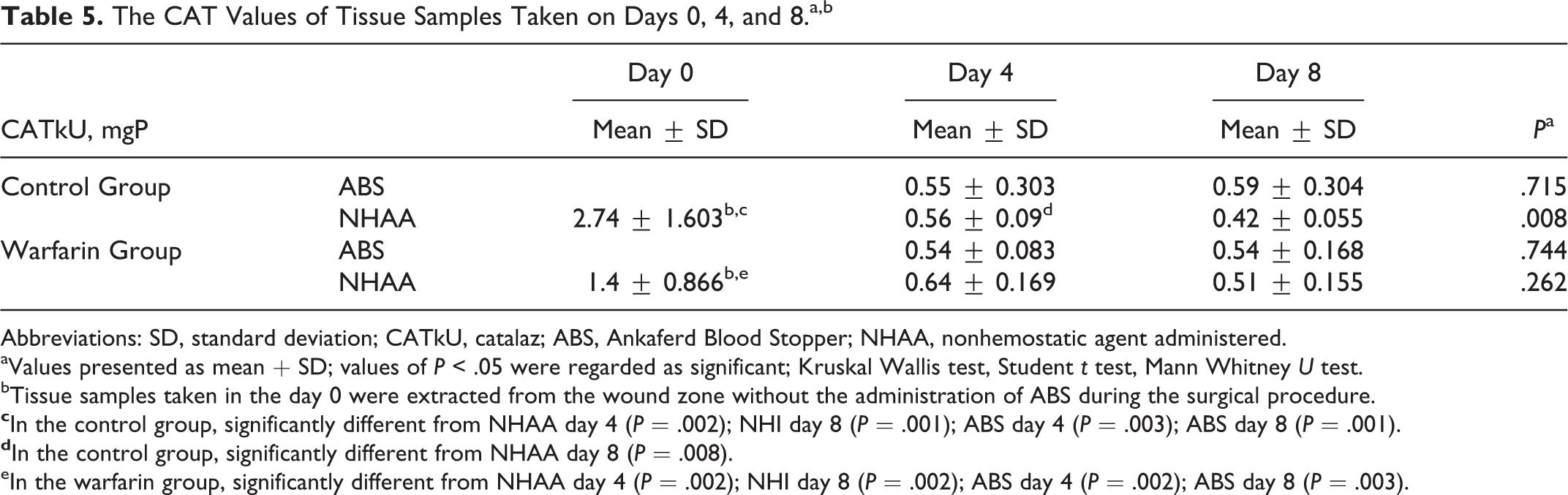
Abbreviations: SD, standard deviation; CATkU, catalaz; ABS, Ankaferd Blood Stopper; NHAA, nonhemostatic agent administered.
aValues presented as mean + SD; values of P < .05 were regarded as significant; Kruskal Wallis test, Student t test, Mann Whitney U test.
bTissue samples taken in the day 0 were extracted from the wound zone without the administration of ABS during the surgical procedure.
eIn the warfarin group, significantly different from NHAA day 4 (P = .002); NHI day 8 (P = .002); ABS day 4 (P = .002); ABS day 8 (P = .003).
Comparison of SOD Values of Tissue Samples Taken on Days 0, 4, and 8
All tissue samples’ SOD values remained from day 0 to 4 and decreased from day 4 to 8 in the control group. The NHAA tissue samples’ SOD values decreased from day 0 to 4 (P = .022) and remained from day 4 to 8 (P = .078), as ABS-administrated tissue samples’ SOD values remained from day 0 to 4 (P = .779) and decreased from day 4 to 8 (P = .024) in the warfarin group (Table 6).
The SOD Values of Tissue Samples Taken on Days 0, 4, and 8.a,b
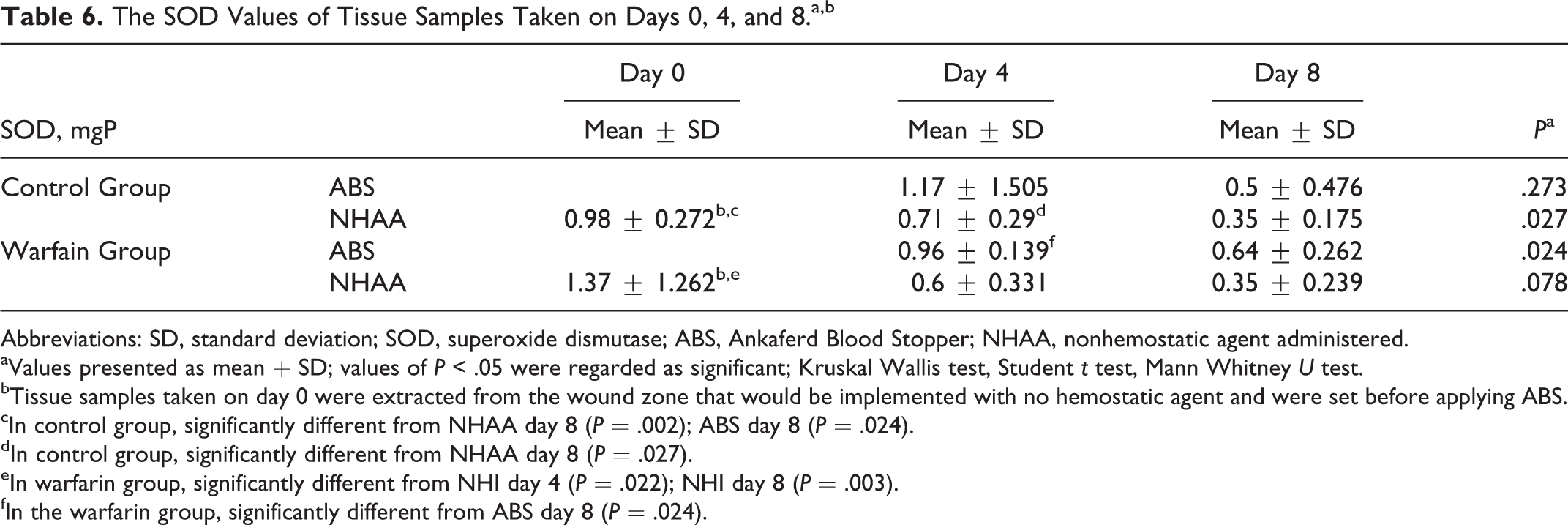
Abbreviations: SD, standard deviation; SOD, superoxide dismutase; ABS, Ankaferd Blood Stopper; NHAA, nonhemostatic agent administered.
aValues presented as mean + SD; values of P < .05 were regarded as significant; Kruskal Wallis test, Student t test, Mann Whitney U test.
bTissue samples taken on day 0 were extracted from the wound zone that would be implemented with no hemostatic agent and were set before applying ABS.
cIn control group, significantly different from NHAA day 8 (P = .002); ABS day 8 (P = .024).
dIn control group, significantly different from NHAA day 8 (P = .027).
eIn warfarin group, significantly different from NHI day 4 (P = .022); NHI day 8 (P = .003).
fIn the warfarin group, significantly different from ABS day 8 (P = .024).
Discussion
Tissue repair and wound healing are complex processes that involve inflammation, fibroplasia, neovascularization, wound contraction, and resurfacing of the wound defect with epithelium. 12 The cascade of events starts with activation of the procoagulant pathway and recruitment of inflammatory cells and is followed by a phase of cellular proliferation and tissue repair/resolution of the injury. Free radicals and oxidative reaction products produce tissue damage and play a major role in the tissue damage. 13,14 Oxidative stress refers to disrupted redox equilibrium between the production of free radicals and the ability of cells to protect against damage caused by these species. Defense against oxidative stress is maintained using several mechanisms including antioxidants. 15,16 Among the antioxidant enzymes, SOD, CAT, glutathione peroxidase, and glutathione S-transferase (GST) are the first line of defense against oxidative injury. 17 These enzymes act in coordination, and the cells may be pushed to oxidative stress state if any change occurs in the levels of enzymes. 18 Accordingly CAT and SOD activities have been suggested as useful parameters to evaluate the healing potential 19 –21
On the other hand, in the literature, most of the studies performed in experimental hemorrhagic diathesis model investigated the hemostatic potential and the healing potential of some hemostatic agents clinically or histolocigally. 22 –26
To our knowledge, the effects of ABS that is used as a local hemostatic agent in surgery, on CAT and SOD activities, have not been investigated earlier. Therefore, the aim of this study was to investigate the effects of ABS on CAT and SOD activities in order to evaluate its potential effects in early-stage soft tissue healing in warfarin-treated rats. In our study, warfarin was administered to animals 0.1 mg/kg once daily intraperitonally for 3 days, before the surgery, until the day of killing. According to our experience, intraperitonal way was found to be a more effective way of administering warfarin when compared to oral gavage. 27 The dose of warfarin was confirmed by the PT tests performed on the day of killing in our study. 27 Our study was different from the studies of Cipil et al 28 since in our experimental model, warfarin-treated rats were kept alive after surgical procedures. Therefore, adjusting the correct dose of warfarin was indispensable in warfarin-induced hemorrhagic diathesis. In our model, intraperitonal dose of warfarin 0.1 mg/kg was useful and effective and can be a good example for further studies, where keeping experimental animals is necessary.
As warfarin has been suggested to have prooxidant properties, the effect of exogenous warfarin (3.5 mg/mL) on SOD activity was also tested in a study. No changes in SOD activity were noted in the presence of warfarin compared to the activity without warfarin, thus demonstrating that SOD activity has not been inhibited by warfarin itself. 29,30
Similarly, in our study, we did not observe any significant change in SOD activity, but there was a significant decrease in CAT activity after warfarin treatment on day 0. The decrease in the activity of CAT might indicate the expenditure of this enzyme while preventing the prooxidant properties of warfarin. Previous studies have shown that different doses of warfarin might affect SOD and CAT activities differently depending also on the type of tissue. Changes in CAT and SOD activities might have resulted from the need for the activation of protective mechanisms necessary for scavenging ROS produced. 31,32 Given the interrelation of oxidative activity and inflammation changes in the antioxidant enzyme activity observed in tissues in warfarin-treated rats might be considered as an indirect indicator of inflammation at systemic level in these animals. 33 The ABS is a standardized extract from 5 different plants. 4,5 The effects of these plants (T vulgaris, G glabra, V vinifera, A officinarum, and U dioica) on antioxidant system have been shown in many studies. Cheel et al has shown antioxidant and free radical scavenging effects of G glabra in their in vitro study. 34
In another study, Hong et al reported that administration of G glabra significantly enhanced blood SOD, CAT, GSH-Px activities and total antioxidant capacity compared to the control mice. 35
El-Nekeety et al noted that the essential oil of T vulgaris had a potential antioxidant activity and a protective effect against aflatoxin toxicity and this protection was dose dependent. 36 Lakshmi et al detected a significant increase in GSH levels, CAT, and SOD activities in kidneys and livers of rats treated with V vinifera extract orally. 37 Another study showed that extracts of A officarium showed a concentration dependent radical scavenging activity by inhibiting diphenylpicrylhydrazyl free radical. 38 Urtica dioica application has been shown to have an important effect on drug metabolism enzyme systems by Ozen and Korkmaz. 39 The authors reported increased antioxidant enzyme activities including SOD and CAT in the liver of mice that may sufficiently scavenge the toxic free radicals which are produced in normal and abnormal cellular metabolism. Similarly, Yener et al concluded that U dioica had a hepatoprotective effect in rats with aflatoxicosis, acting by promoting the antioxidative defense systems. 40
Although there are studies showing the antioxidant potential of the plants present in ABS, the data about the antioxidant effects of this herbal extract are very limited. In a recent study, Sen et al demonstrated that Ankaferd was protective against the oxidative damage in experimental intestinal obstruction. 41 Kocak et al suggested that ABS had an antioxidant action in the intestine in an experimental distal colitis model which could be attributed to herbal mixtures including G glabra and T. Vulgaris. 42
Consistent with these results in our study, ABS treatment significantly increased SOD activity in the warfarin group at the end of the eighth day when compared to the no hemostatic agent applied group. The SOD is an enzyme that repairs cells and reduces the damage done to them by superoxide, the most common free radical in the body. Studies have shown that SOD acts as both an antioxidant and an anti-inflammatory in the body, neutralizing the free radicals that can lead to wrinkles and precancerous cell changes. 42,43 Therefore, increased SOD activity in ABS-treated group shows that ABS is effective in increasing the antioxidant potential during short-term soft tissue healing. In our study, warfarin treatment decreased CAT activity significantly compared to the control group. Berkarda et al suggested that the cytotoxic effect of warfarin may be due to superoxide radicals produced in the malignant cells by warfarin, which is a potent electron-transferring substance. 44 However, Onaran et al suggested that the mechanism by which warfarin potentiates this cytotoxicity was still unclear and may not be directly due to toxic damage induced by warfarin-generated free radicals. 45
To our knowledge, our study evaluating the effects of ABS treatment on CAT and SOD activities in soft tissue healing is first in the literature. Ankaferd Blood Stopper acted positively showing a promising effect on SOD activity in the warfarin-treated group and seemed a better potential of healing than NHAA.
Conclusion
These findings clearly present immunomodulatory effects of warfarin in vivo and contribute to the list of biological activities of anticoagulant warfarin, other than those affecting hemostasis. This animal experiment can guide ABS administration to achieve hemosthasis in surgical procedures to patients under warfarin regimen, as ABS has a positive effect on SOD activity under warfarin treatment besides its hemostatic effect. Further research should be conducted for ABS mechanism on healing process.
Footnotes
Declaration of Conflicting Interests
The author(s) declared no potential conflicts of interest with respect to the research, authorship, and/or publication of this article.
Funding
The author(s) received no financial support for the research, authorship, and/or publication of this article.