




Abstract
Backgound/Aim:
Preeclampsia (PE) is a multisystem disease resulting in high maternal–fetal morbidity and mortality. The aim of the study was to investigate antiangiogenesis-associated alterations in antiapoptotic and antioxidative proteins in PE.
Method:
Of the 46 patients with PE, 25 (54.3%) were with gestational hypertension (GH), 12 (26%) were with mild, and 9 (19.5%) were with severe PE. The serum levels of vascular endothelial growth factor receptor 1 (VEGFR-1), heme oxygenase 1 (HO-1), and B-cell lymphoma/leukemia (Bcl-2) levels were measured by enzyme-linked immunosorbent assay.
Results:
In the severe PE group, the VEGFR-1 serum levels (27.3 ± 16.8 vs 13.3 ± 10.7 ng/mL, P = .023) were higher, but the Bcl-2 levels (1.5 ± 0.2 vs 2.1 ± 1.7 ng/mL, P = .047) were lower than the levels in the GH-mild PE group (P = .047). Also, VEGFR-1/Bcl-2 ratio in the severe PE group was significantly higher (P = .003) than the ratio in the GH-mild PE group.
Conclusion:
The Bcl-2 and HO-1 proteins seem to have important roles in the antiangiogenic environment of preeclampsia.
Keywords
Introduction
Preeclampsia (PE) still has many obscure points to be investigated from the pathophysiological point of view. Recent studies show an existence of an imbalance in angiogenic factors in PE. 1,2 Vascular endothelial growth factor (VEGF) and its receptors (VEGFR-1, VEGFR-2, and their soluble forms) are expressed in the placental trophoblasts throughout gestation. 3 The PE is characterized by generalized endothelial dysfunction associated with increased levels of VEGFR-1 and soluble VEGFR-1 (sVEGFR-1: soluble fms-like tyrosine kinase 1 [sFlt-1]), a splice variant of VEGFR-1, all of which have antiangiogenic properties. 4,5
The B-cell lymphoma/leukemia (Bcl-2) is an antiapoptotic protein that regulates apoptosis by preventing cell death. The PE is often accompanied by hypoxia of the placenta, and this condition induces apoptosis in trophoblastic cells. This hypoxia-induced apoptosis is accompanied by decreased expression of Bcl-2 in human choriocarcinoma cell line JAR. 6
An antiinflammatory enzyme, heme oxygenase 1 (HO-1), influences apoptosis to protect the cell against oxidative stress. The HO-1 and its metabolite carbon monoxide inhibit sFlt-1. Chorionic villous samples from women at the first trimester of gestation showed that HO-1 mRNA expression was decreased in those who had PE. 7 There seems strong evidence for a protective role of HO-1 in terms of PE during pregnancy, and HO-1 was identified as a target for the treatment of PE. 8
Here, we tested the hypothesis that there are associated alterations in antioxidative and antiapoptotic proteins in severe PE. This may indicate the significance of VEGFR-1, HO-1, and Bcl-2 in the pathophysiology of PE.
Materials and Methods
A total of 46 pregnant women with several types of hypertension were included in the study. All patients were followed at the Department of Obstetrics & Gynecology, Trakya University between May 2011 and May 2012. Institutional review board approval (TÜTFEK 2009/149) was obtained, and all women gave informed consent before enrollment in the study.
Preeclampsia is defined as pregnancy-associated hypertension with proteinuria seen after 24th gestational weeks, whereas severe PE is as hypertension (above 160 mm Hg and diastolic 110 mm Hg, respectively for systolic and diastolic, at 2 measurements) with ≥3 g proteinuria/24 h in urine. The mild forms of pregnancy-induced hypertension are gestational hypertension (GH) and mild PE. The mild PE is associated with mild hypertension (140/100 mm Hg) with proteinuria (1 + dipstick). Gestational hypertension is accepted as hypertension in pregnancy without proteinuria. From the group of 46 patients, 25 (54.3%) were with GH, 12 (26%) were with mild PE, and 9 (19.5%) were with severe PE. Since it is known that gestational hypertension/preeclampsia is accepted as a syndrome characterized by heterogeneous laboratory, clinical, and radiological evidence that can be associated with acute and long-term serious perinatal and maternal complications, 9 we joined the GH and mild-PE groups as “mild form of pregnancy-induced hypertension.”
Women with known autoimmune, renal, cardiovascular, hepatic and infectious diseases, diabetes mellitus, coagulation disorders, cancer, chronic hypertension, and obesity were excluded. Also, patients having premature labor and any kind of bleeding were not included in the study.
From an antecubital vein, 5 mL of blood was collected during admission. The blood samples were centrifuged at 4500 rpm for 7 minutes, and serums were separated and kept in −20°C until assayed. The serum levels of VEGFR-1 (Boster Biological Technology Ltd), HO-1 (Cusabio Biotech Co Ltd), and Bcl-2 (eBioscience, Vienna, Austria) levels were measured by enzyme-linked immunosorbent assay according to the manufacturer instructions.
The results were evaluated using the Statistical Package for Social Science program (release 9.0; SPSS, Chicago, Illinois) for Windows. The Kruskal-Wallis test was used for investigating the difference in the VEGFR-1, HO-1 and Bcl-2 values between the groups. The Mann-Whitney U test was also used for comparison of means for the nonparametric parameters. Using Bonferroni’s correction, significance criteria were set at P < .008.
Results
Table 1 shows the demographical features of the population studied. The median (min-max) age was 31 (16-45) years for the mild group (GH + mild PE) and was 27 (23-33) years for the severe group (P = .185). The gestational weeks and birth weight in the severe PE group were significantly less than those in the mild PE group (P < .001 and P = .002, respectively).
Population Characteristics of the Women With Mild and Severe Forms of Preeclampsia (mean ± SD and median [min-max]).
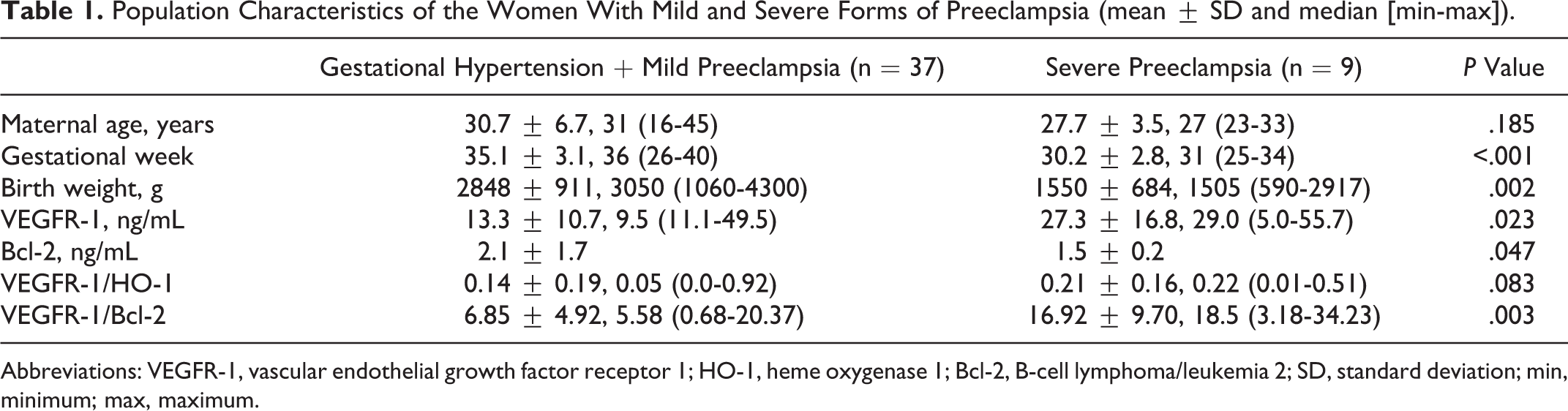
Abbreviations: VEGFR-1, vascular endothelial growth factor receptor 1; HO-1, heme oxygenase 1; Bcl-2, B-cell lymphoma/leukemia 2; SD, standard deviation; min, minimum; max, maximum.
The mean ± standard deviation of serum VEGFR-1 levels in the severe PE group (27.3 ± 16.8 ng/mL) were higher than the levels in the mild group (13.3 ± 10.7 ng/mL) (P = .023; Figure 1). Similar HO-1 levels were observed in both the groups (276.1 ± 403.6 vs 185.4 ± 118.8 ng/mL, P = .873). However, the plasma Bcl-2 levels in the GH-mild PE group were significantly higher than those in the severe PE group (2.1 ± 1.7 ng/mL vs 1.5 ± 0.2 ng/mL, P = .047).
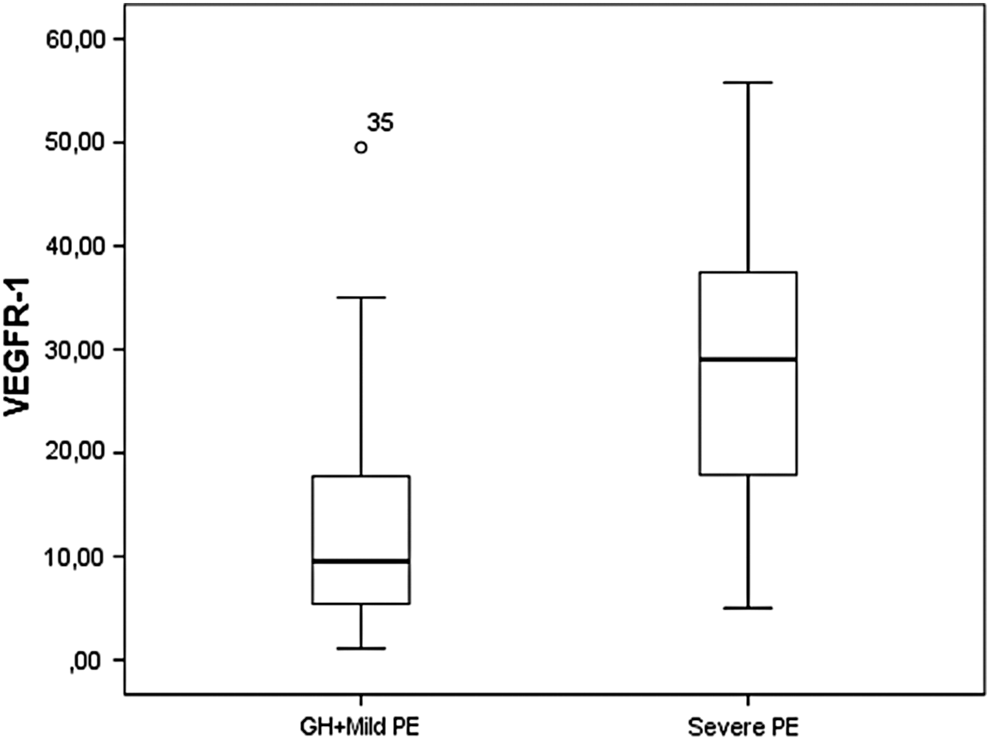
Plasma levels of Vascular endothelial growth factor receptor 1 in the mild and severe forms of preeclampsia.
Although the VEGFR-1/HO-1 ratio did not approach to significance level (P = .083), the VEGFR-1/Bcl-2 ratio in the severe PE group was significantly higher (P = .003) than the ratio in the mild group (Figures 2 and 3)
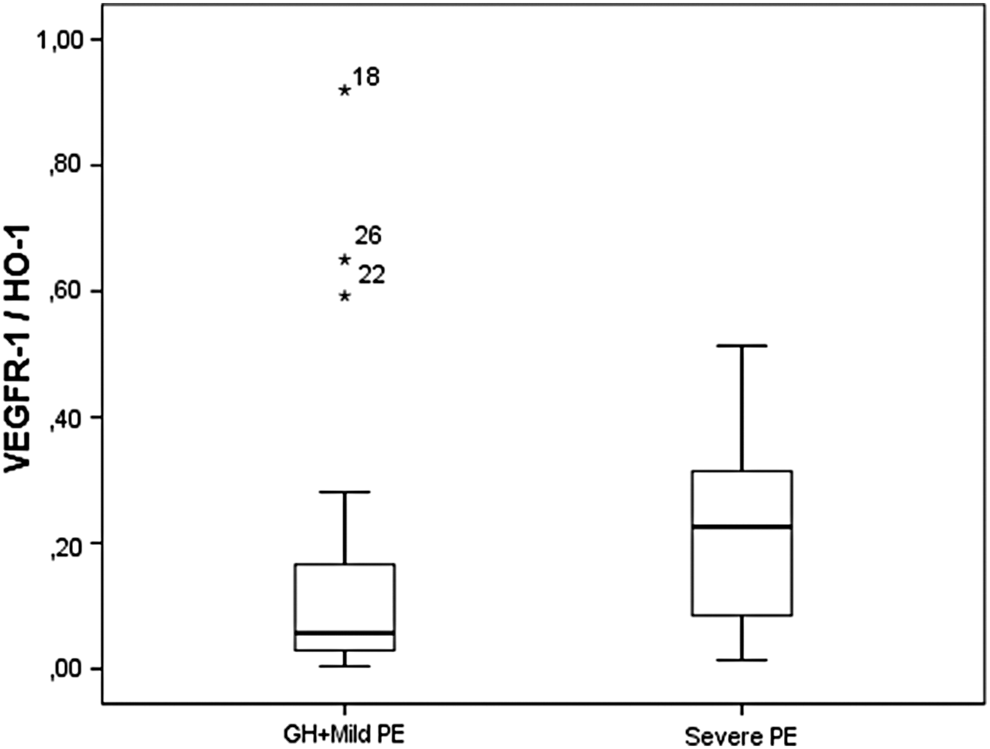
Vascular endothelial growth factor receptor 1/heme oxygenase 1 ratio values in the mild and severe forms of preeclampsia.
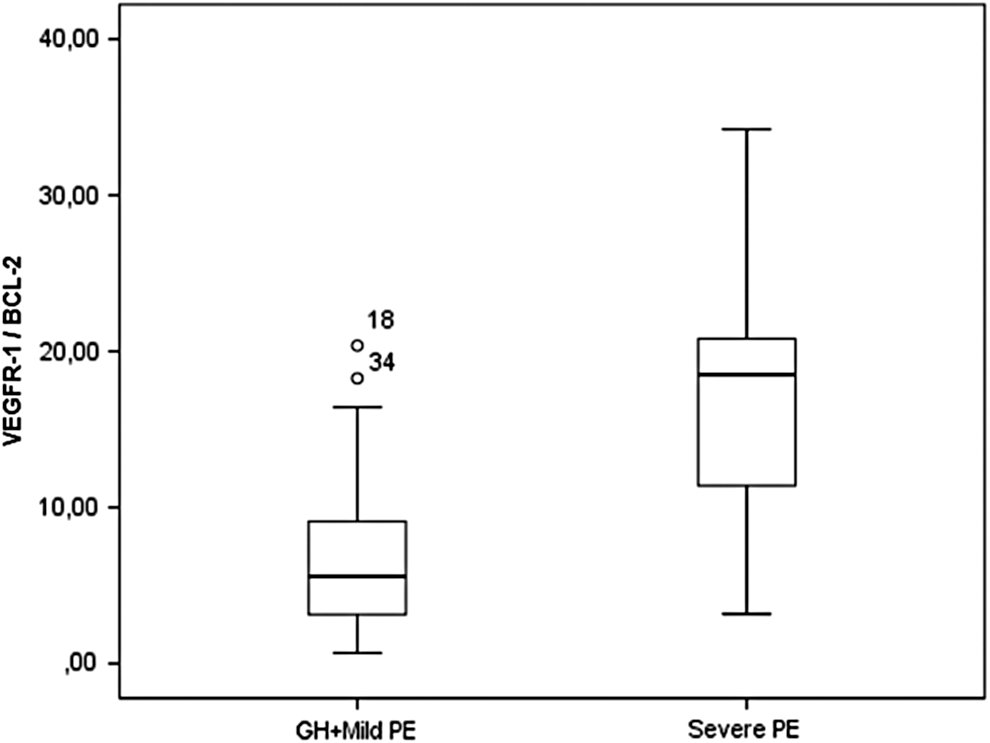
Vascular endothelial growth factor receptor 1/B-cell lymphoma/leukemia 2 ratio values in the mild and severe forms of preeclampsia.
Discussion
In our study, we found higher serum VEGFR-1 levels and VEGFR-1/Bcl-2 ratio but lower Bcl-2 levels in women with severe preeclampsia compared to those with GH and mild preeclampsia.
Preeclampsia is a multiorgan syndrome characterized by placental ischemia and widespread endothelial damage. In response to placental ischemia, several vascular endothelial growth factors, having important roles in the regulation of angiogenesis, are secreted. There is also a strong correlation between circulating antiangiogenic factors and PE. These alterations are prominent in patients who present with severe PE. An antiangiogenic protein VEGFR-1, which is a tyrosine kinase receptor protein, was utilized in our study. The VEGFR-1 was found to be increased in patients with severe PE in comparison to women with GH-mild PE. This is similar to the increase in sFlt-1, a splice variant of VEGFR-1, which is overexpressed in the preeclamptic placenta. 10
Due to several disarranged biological pathways, antioxidative and antiapoptotic proteins are also altered in response to placental ischemia in PE. It has been previously reported that HO-1 and carbon monoxide downregulate sFlt-1 production in vitro. 11 Furthermore, HO-1 induction significantly attenuates placental ischemia-induced hypertension, partially through normalization of the sFlt-1-to-VEGF ratio in the placenta. The HO-1 is a cytoprotective enzyme, but it is dysregulated in preeclampsia. 12 In our study, although the VEGFR-1/HO-1 ratio in women with GH-mild and severe PE was not statistically different, studies with a larger number of patients may approach results of significant level. Thus, antioxidative proteins seem to be consumed in severe PE. Therefore, one promising therapeutic approach to treat PE in the next future might be through manipulation of the HO-1 protein. In this aspect, resveratrol was utilized in experimental studies. 13,14 Resveratrol is an antimicrobial agent having cardioprotective effects with anti-inflammatory abilities. In one of these studies, this agent caused an upregulation of HO-1 by VEGF inhibition. 14
In our study, there was also altered VEGFR-1/Bcl-2 ratio in severe PE which was also associated with decreased levels of Bcl-2, antiapoptotic protein, and decreased levels of HO-1. This togetherness of HO-1 and Bcl-2 are seen in several tissues such as in retina, overexpression of HO-1 by hemin induction through anti-inflammatory, antiapoptotic, and antiproliferative effects is also associated with an increase in the activation of Bcl-2 and a decrease in the expression of VEGF. 15 Besides, hypoxia-induced elevation of p53 was associated with downregulation of Bcl-2 and trophoblast-specific apoptosis in uteroplacental tissue. 16 In line with these findings, we observed lower bcl-2 levels in women with severe PE. A vital immune cellular population, regulatory T cells (Tregs), exists at the maternal–fetal interface. 17 The deficit of Tregs in PE may be a consequence of apoptosis in Tregs. This Fas/FasL-mediated apoptosis maintains appropriate balance during pregnancy. However, Bcl-2 remains unchanged during normal pregnancy. 18 The deficit of CD4+CD25+FoxP3+ Treg lymphocytes which is observed in PE may be associated with altered apoptosis signaling in Tregs. 19
In conclusion, severe PE possesses significant increase in antiangiogenesis VEGFR-1-associated alterations in the VEGFR-1/HO-1 and VEGFR-1/Bcl-2 ratios.
Footnotes
Authors’ Note
FV contributed to concept; FV, RU, and NS contributed to design; FV, HE, NS, and CS performed supervision; RU contributed to resource and materials; FV, RU, and NS contributed to data collection and/or Processing; FV, NS, and CS contributed to analysis and/or interpretation; FV, RU, HE, and CS contributed to literature search; FV, RU, CS contributed to writing; and CS and HE provided critical reviews.
Declaration of Conflicting Interests
The author(s) declared no potential conflicts of interest with respect to the research, authorship, and/or publication of this article.
Funding
The author(s) disclosed receipt of the following financial support for the research, authorship, and/or publication of this article: Supported by a grant at Trakya University, TUBAP, no. 2010-53.