




Abstract
Objective:
To investigate the impact of bivalirudin alternative treatment on antiheparin/platelet factor 4 antibody levels perioperatively in rats undergoing cardiopulmonary bypass (CPB).
Methods:
Two groups of rats received heparin pretreatment and two groups of rats not, and during CPB all the four groups received either bivalirudin or heparin. Pre-CPB and post-CPB day 7 venous blood samples were used to determine the levels of antiheparin/PF4 antibody immunoglobulin (Ig) G with enzyme-linked immunosorbent assay.
Results:
Preoperative heparin pretreatment increased the antiheparin/PF4 antibody IgG levels (P < .01), while the administration of heparin further increased this levels (P < .01). The use of bivalirudin prevented further increase in antiheparin/PF4 antibody IgG levels.
Conclusion:
Bivalirudin, as a direct thrombin inhibitor, could circumvent the increased antiheparin/PF4 antibody level in circulation due to the heparin administration.
Keywords
Introduction
The repeated use of unfractionated heparin (UFH) could cause serious effects such as heparin-induced thrombocytopenia ([HIT] platelet reduction). In all, 25% to 50% patients who underwent cardiopulmonary bypass (CPB) procedure developed antiheparin antibody, and 1% to 3% of these patients developed HIT immunoglobulin (Ig) G. 1 It has been found that the appearance of antiheparin/platelet factor 4 antibody was associated with increased incidence of acute coronary syndrome and adverse events in cardiovascular surgery.
Bivalirudin is a direct thrombin inhibitor (DTI) unaffected by the platelet released substances and has been applied to unstable angina and percutaneous coronary intervention (PCI). 2 The present study investigated the application of bivalirudin in a rat model of CPB surgery to examine the preventive effects of increase in antiheparin/platelet factor 4 antibody levels.
Materials and Methods
Animals
Twenty male Sprague-Dawley rats (4-6 months old, weighing 454-512 g with an average of 494.6 ± 26.9 g) were provided by Shanghai Experimental Animal Center of the Chinese Academy of Sciences. The animals were fasted for 6 hours before surgery. The study was approved by local ethic committee of animal research.
The animals were randomly assigned into 4 groups (5 animals each). Group I, no heparin pretreatment, CPB anticoagulation drug was 1.5 mg/kg bivalirudin followed by 2.5 mg/kg constant infusion; group II, no heparin pretreatment, CPB anticoagulation drug was 2 mg/kg of UFH; group III, 5 days of UFH 1 mg/kg pretreatment before surgery, CPB anticoagulation drug was 1.5 mg/kg bivalirudin followed by 2.5 mg/kg constant infusion; group IV, 5 days of UFH 1 mg/kg pretreatment before surgery, CPB anticoagulation drug was 2 mg/kg of UFH.
Rat Model of CPB
The rats were anesthetized with intraperitoneal injection of 10% chloral hydrate 350 mg/kg. After the animals were sedated, the animals were laid in a supine position on a warm blanket, with limbs ECG and rectal temperature probe connected to a multifunctional monitor. Tracheotomy was performed, and the animals were connected for mechanical ventilation (3-5 mL at 60-80 times/min). The tail artery was isolated and connected with pressure sensor to the monitor for arterial blood pressure monitoring. The femoral artery was isolated and connected to the arterial pump for infusion. The right jugular vein was punctured and the connecting tube was left for drainage of venous blood during CPB.
The prewash liquid for CPB contained 6 mL Voluven, 1 mL5% sodium bicarbonate, 1 mL0.1% furosemide, 1 mL50 mg/kg cefuroxime sodium, as well as the anticoagulants. The total volume was 10 mL. The oxygen exchange in vein blood was 100% at 50 to 80 mL/min, which was measured using a small animal oxygenator (Kewei Medical Instruments, Dongguan, Guangdong). The bypass was started at 10 mL/kg per min and then sustained at 50 to 80 mL/kg per min for 1 hour with all the prewash liquid washed. The mean arterial pressure was kept at 50 to 90 mm Hg during the whole process. Furosemide was infused according to the blood pressure and the amount of urine secreted. Finally, the animals were treated with protamine for neutralization with heparin treatment. The rats were allowed to recover in a warm place before sending them back to the home cage.
Specimen Collection
One milliliter of venous blood was collected prior to the surgery and 1 week after surgery. The serum was isolated and preserved at −20°C in a freezer before enzyme-linked immunosorbent assay (ELISA) of the antiheparin/platelet factor 4 IgG level. The commercial GTI Co (USA) ELISA kit 3 was purchased from Shanghai Shenggong Co and used as described previously. 4 In detail, the standard control or sample was mixed with HIT antigen labeled with biotin, streptavidin–horseradish peroxidase and incubated at 37°C for 1 hour. The mixture was washed 5 times before adding the visualizing agents A and B of 50 µL each. The mixture was incubated at 37°C for 10 minutes before adding the stop solution 50 µL. The optical density (OD) values from standard samples were measured at 450 nm for calculation of the linear regression equation. The OD values from the samples were also measured and put into the equation. Then the OD values were changed into the final concentration (in ng/mL).
Statistics
The data were represented as mean ± standard deviation and analyzed with SPSS 16.0 software (Chicago). The standard error was analyzed for comparisons within group, and the single-factor analysis of variance was used for comparisons among groups. P < .05 was determined as statistically significant in analyses.
Results
The Surgical Data
There were no differences in heart rate and mean arterial pressure among the 4 groups of rats (Table 1). Additionally, after surgery there were no differences in spontaneous breathing recovery time and ACT values (Table 1).
The Surgical Data Among Different Groups of Rats (n = 5 for Each Group).

Changes in Antiheparin/Platelet Factor 4 IgG Level
We found that the antiheparin/platelet factor 4 IgG level was not affected by the CPB anticoagulation drug administration (bivalirudin or UFH; Table 2). However, in groups III and IV with presurgery administration of UFH, the IgG level both before and after the surgery significantly increased (P < .01; Table 2). Additionally, group IV showed higher IgG level than group III (P < .01).
The Changes of Antiheparin/Platelet Factor 4 IgG Level After Surgery.
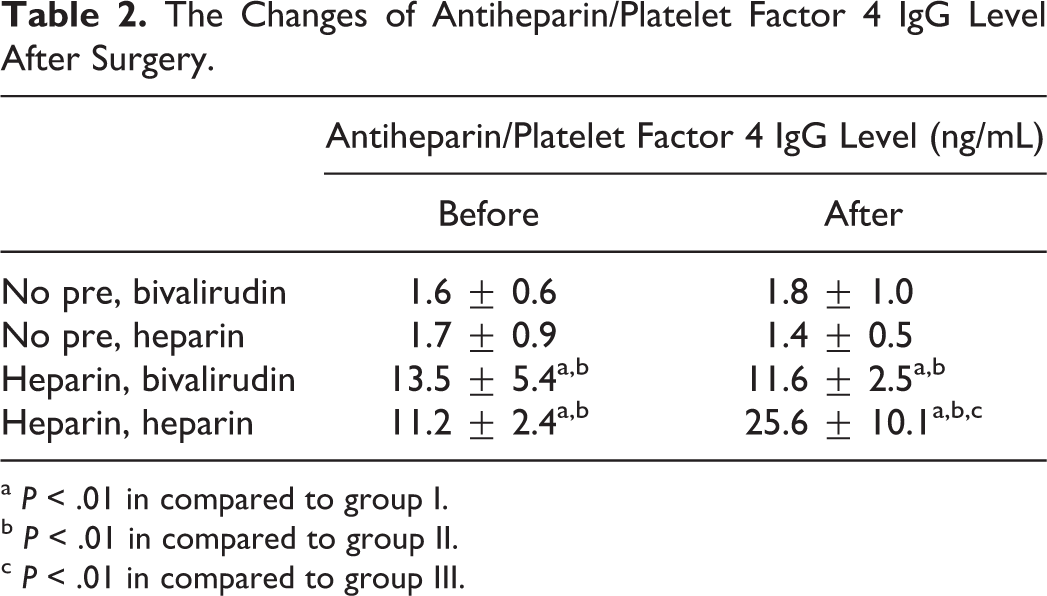
a P < .01 in compared to group I.
b P < .01 in compared to group II.
c P < .01 in compared to group III.
Discussion
Unfractionated heparin is a commonly used anticoagulation drug in cardiac surgery. The defect is that after 5 to 14 days of administration, this could lead to HIT. Heparin-induced thrombocytopenia is mediated by antiheparin/platelet factor 4 IgG, 1 and can cause mortality in more than 20% of patients after cardiac surgery. 5 Of all, 20% to 50% of the patients with HIT showed thrombotic complications, 6 with 5% to 10% of these patients required amputation. 7
Bivalirudin is a synthetic 12-peptide bivalent DTI, which was based on the hirudin extracted from leech salivary glands. 8 Bivalirudin inhibits both thrombin with blood clot and thrombin in liquid phase to prevent the development of fibrin formation. 2 In the present study, we found that the pretreatment with UFH led to increase in antiheparin/platelet factor 4 IgG level before the surgery (groups III, IV, before surgery), and the continued administration of UFH during CPB resulted in further increase in the IgG level (group IV, after surgery) but not in the group with bivalirudin application during CPB (group III, after surgery). This suggested that the platelet activation during CPB would promote further generation of IgG antibody after surgery, while the administration of bivalirudin could circumvent this adverse effect. This is especially meaningful for cardiac surgery on patients with HIT or risks for HIT.
The Food and Drug Administration has approved the application of bivalirudin during PCI, rather than cardiac surgeries. 9 Some previous studies also demonstrated the potential effects of bivalirudin in preventing the adverse events after cardiac surgery. 2,10 Our animal study allowed further mechanistic investigations in the future, such as the exploration of bivalirudin-bound thrombin 2 and the discovery of other potential drug targets. These data contributed to the improvement of CPB surgery in clinical practices.
Footnotes
Acknowledgment
The authors were supported by the University and the School of Medicine.
Declaration of Conflicting Interests
The author(s) declared no potential conflicts of interest with respect to the research, authorship, and/or publication of this article.
Funding
The author(s) received no financial support for the research, authorship, and/or publication of this article.