




Abstract
This research investigates the effectiveness of virtual reality (VR) as a science communication tool to promote pro-environmental change. A laboratory experiment (N = 70) was conducted to examine the short-term effects of VR immersive video, in comparison with flat screen video, on level of presence, message perception, and cognition. Viewing the VR video produced greater levels of presence, which was associated with increased positive perceptions of the video, perceived importance of water issues, and pro-environmental attitudes, and behavioral intentions. Implications are discussed in terms of how immersive VR can be used as science communication tool.
Although digital media have made environmental science information more readily available to the public, this has not necessarily resulted in positive attitudinal or behavioral change (Ouariachi et al., 2017). There remains a gap between knowledge acquisition about environmental issues and adoption of pro-environmental behaviors. Introducing information to a person is an important step but not sufficient to motivate them to change the way they think or act (Bray & Cridge, 2013). As such, research examining the efficacy of communicative strategies to affect cognitive and behavioral change is central to guiding environmental and science communication practices.
Virtual reality (VR) enables science communicators to eliminate boundaries of space to immerse a person in a distanced location through a virtual simulation of an environment and decrease psychological distance (Breves & Schramm, 2021; Markowitz & Bailenson, 2021). The vividness and immersiveness of VR reduces the need for people to imagine a locale, as well as an environmental problem, and provides a realistic visualization that has the potential to engage the senses (Won et al., 2023). The study of VR as a science communication tool is in its early stages and systematic empirical investigations are few (Fauville et al., 2020; Markowitz & Bailenson, 2021).
Science communication may be defined as the use of media, activities, and dialogue to stimulate awareness, enjoyment, interest, and understanding of scientific issues and phenomena (Burns et al., 2003). The present research focuses on environmental issues and, as argued by Davis et al. (2018) and Comfort and Park (2018), conceptualizes environmental communication as interconnected with science communication. There are perceived differences between environmental communication and science communication, such as environmental communication typically has a persuasive intent (e.g., designed to elicit behavior change), whereas science communication may be designed to inform (Comfort and Park, 2018; Davis et al., 2018). Furthermore, not all science communication pertains to environmental issues, and environmental communication may contain less scientific information in its messaging. Nonetheless, it is evident that environmental and science communication share many commonalities, including informing publics, translating scientific information to lay audiences, and raising interest in science-based topics. For simplicity, we will generally use the term science communication in this research. The findings of our research may be applied to environmental contexts as well as guide other science communication endeavors.
We examined VR as a modality to engage individuals in a community-based message about the importance of wetlands and watersheds to water quality and community well-being, human threats to the sustainability of these bodies of water, and actions individuals can take to reduce harm. Our research utilized a laboratory experiment (N = 70) to test the short-term effects of an immersive video viewed via VR head-mounted display (HMD) on young adults’ environmental attitudes, behavioral intentions, and perceived importance of water issues. We developed an original immersive VR video, “How the Water Cycle Works: Wetlands and Watersheds,” in collaboration with a city office of sustainability and stormwater education. We collaborated with the city’s stormwater education and outreach coordinator to learn about the challenges facing sustainability of the local environment and to inform the development of a VR video to communicate about these issues and motivate change. Subsequently, we tested the effects of presence and message perception on the efficacy of the immersive video to produce pro-environmental outcomes.
Prior research (e.g., Breves, 2021; Uhm et al., 2020) suggests that transporting an individual to a locale via VR HMD may result in a more impactful experience in contrast to exposure to two-dimensional (2D)-mediated information. However, understanding remains limited in terms of the contexts within and processes through which VR may be an effective science communication tool. As such, we examine the processes through which VR affects attitude and behavior change and further explore whether message interactivity may enhance or diminish information retention.
Grounded in the theoretical concepts of psychological distance, immersion, presence, and message processing, the present research examined the differential effects of an immersive VR video versus flat screen video on cognitive change. Presence and perceptions of the message are tested as mediators between the effects of exposure to the stimulus and environmental value salience, attitudes and beliefs, and behavioral intentions. There remains debate about whether the benefits of VR outweigh the drawbacks, given that VR may distract individuals from information acquisition (Barreda-Ángeles et al., 2021). Our research advances understanding of the cognitive processes and outcomes associated with the use of VR for science communication and further demonstrates potential for scientific communities to utilize VR to both inform and foster pro-environmental attitudes and behaviors.
Despite some promising evidence, there continues to be unknowns about the influence of interactive media on cognitive and behavioral change, as immersive experiences can be both cognitively engaging and distracting from the information being communicated. The aims of our research are to further explore the short-term effects of an immersive VR video on perceived importance of water issues and pro-environmental attitudes and behavioral intentions. Beyond the theoretical contributions of this study, we take an applied research approach to collaborating with a local city government agency to develop the messaging utilized in this research. Recommendations are made regarding the development of VR videos as a tool for science communication.
VR as a Science Communication Tool
VR creates a sense of physical space, or being there, through sensorial absorption that may result in positive attitudinal change. As such, immersive VR has the potential to reduce psychological distance from an environmental problem, such as water pollution (Breves & Schramm, 2021). Psychological distance is the separation between one’s personal experience, familiarity, and the direct observation of something (Liberman & Trope, 2014), which decreases people’s belief that a problem, such as water pollution exists and causes severe effects (Zhang et al., 2014). In general, psychological distance is correlated with uncertainty about environmental issues, weaker belief in the effects of negative environmental behaviors, and subsequently weaker pro-environmental attitudes and behaviors (Breves & Schramm, 2021; Zhang et al., 2014). Conveying information about water pollution is often not sufficient for attitudinal and behavioral change, as these changes require motivation (Bray & Cridge, 2013). Adopting immersive environmental communication strategies may address the challenge of psychological distance by creating a sensorially engaging experience that shrinks the distance between the self and the environmental problem and motivates pro-environmental outcomes.
Rather than physically bringing the person to a location (e.g., through a field trip, onsite job training), the place is brought to the person via VR HMD technology that simulates being there with the ability to interact with and explore the virtual environment. In contrast to 2D or flat screen-mediated experiences, VR utilizes an immersive and/or three-dimensional (3D) environment and multisensory cues that engage the senses and help block out external distractions and, in theory, heighten comprehension (Salzman et al., 1999) and increase individuals’ concern about environmental problems (Markowitz & Bailenson, 2021). As VR technology becomes more accessible and mainstream, it is more readily available as a tool for science communicators to engage the public and create personal experiences with scientific problems and phenomena, such as climate change and environmental pollution (Markowitz & Bailenson, 2021).
The immersiveness of VR is thought to be a precursor to the effects of VR on cognitive and behavioral responses. Communication technologies produce varying degrees of potential for immersing a user and engaging them with a message, and VR technology has the capability to produce high levels of immersion resulting in feelings of presence. Indeed, research provides evidence that presence with a virtual simulation increases change in attitudes and behavioral intentions (e.g., Behm-Morawitz et al., 2016; Breves, 2020, 2021) There is sufficient evidence to suggest that presence is a central variable to understanding the effects of VR on individuals’ perceptions.
The modality of communicating scientific information as a foundation of knowledge acquisition to change attitudes, and ultimately behaviors, is important to consider. Prior research provides evidence that the modality and format of environmental communication affects individuals’ responses to the information. Specifically, immersive modalities have demonstrated potential to affect environmental beliefs and behavior change. Oh and Sundar (2015) and Breves (2021) suggest that the heightened interactivity of a modality results in greater positive cognitive change toward environmental health, due to individuals’ engagement with the media experience rather than their close processing of the information. In other words, engagement alone may contribute to desired cognitive change even without elaborated thinking about the issue at hand.
Immersion and Presence
Immersion is both a property of the technology (VR, in the present case) and an experience of the user (Nilsson et al., 2016). Nilsson et al. define technological immersion as an “objectively measurable property of the system” (p. 112). For example, in the case of VR, the hardware and software elements of VR are more immersive in nature than 2D technologies. Scholars describe user immersion as the feeling of being surrounded by or enveloped in the virtual environment (McMahan, 2003; Witmer & Singer, 1998) and experiencing mental absorption (Ermi & Mäyrä, 2005) while using the technology. It is theorized that greater technological immersion produces increased feelings of user immersion during the simulation. However, the degree of immersion people experience may differ. As Nilsson et al. (2016) note, dimensions of presence are most often utilized to measure the level of a user’s immersion in a simulation, such as VR.
Presence manifests in multiple forms, namely spatial presence, social presence, and self-presence. The experience of “being there” or physically present in a virtual space (i.e., physical or spatial presence), experiencing the social actors within the virtual space as “real people” (i.e., social presence), and the perception of one’s online digital self-representation as an extension of oneself (i.e., self-presence) have been identified as ways people perceptually feel connected to and immersed in a mediated environment (Lee, 2004). These types of presence affect a person’s responses to VR in unique ways (Behm-Morawitz et al., 2016), for example, self-presence is impactful on users’ offline self-perceptions and appearance modification behaviors (Behm-Morawitz, 2013). In the present study, spatial presence evoked through the VR environment is most relevant to understanding how the “transportation” of a person to local wetlands and watersheds may affect their environmental attitudes and behavioral intentions.
Spatial presence is the illusion of the virtual simulation being experienced as real (Steuer, 1992). As Slater (2018) explains, the experience of spatial presence is not a delusion or belief but rather a sensorial and perceptual response that allows an individual to suspend belief and experience the virtual as real: It is a perceptual but not a cognitive illusion, where the perceptual system, for example, identifies a threat (the precipice) and the brain-body system automatically and rapidly reacts (this is the safe thing to do), while the cognitive system relatively slowly catches up and concludes ‘But I know that this isn’t real.’ But by then it is too late, the reactions have already occurred. (p. 432)
Immersive VR lends itself to heightened spatial presence to transport a person via HMD to the location that is best suited for communicating scientific information that is persuasive in affecting positive change. The user experiences a perceptual response that allows them to feel that the virtual simulation is real. In the present study, relevant locations are urban and natural settings depicting bodies of water and sources of pollution. Many VR applications for environmental communication and science education, such as those utilized in the works of Markowitz et al. (2018) and Ahn et al. (2016), have used game-like simulations depicting 3D graphical representations of an environment (e.g., coral reef) where the user sees themselves as an avatar via third-person perspective and explore the features of the environment in the form of the avatar.
Ahn et al. (2016) conducted a laboratory experiment with college students (N = 54) where they embodied animated animals in a VR simulation, and the results indicated these students felt more interconnected with nature than their peers who watched a flat screen animal video. Ahn’s research demonstrates that degree of interactivity and perspective-taking afforded by the communication modality played roles in enhancing feelings of closeness of the self to nature. Markowitz et al. (2018) conducted a study with high school students (N = 9) and demonstrated some positive information retention outcomes from utilizing a VR simulation about ocean acidification in a high school classroom. In their research, however, environmental attitude change was not observed and there were no differences in students’ experiences of presence based on embodying a human scuba diver avatar or coral avatar on feelings of closeness to nature and information retention. Thus, the VR intervention was associated with feeling closer to nature and acquiring knowledge but not with presence. The VR application in Ahn et al.’s (2016) study failed to produce greater presence than watching a flat screen video, and embodying a nature versus human avatar in the VR application in Markowitz et al.’s (2018) research did not produce differential levels of presence.
Simulations such as those used by Markowitz and Ahn utilize a third-person perspective and computer-generated environment that may be equally as powerful as first-person perspective in generating feelings of spatial presence but perhaps less effective in a sense of self-location (Gorisse et al., 2017). Gorisse and colleagues empirically demonstrated that first-person perspective produces a stronger feeling of self-location, or the feeling of the self being located in the virtual environment. The first-person perspective allows the user to see through their own eyes and potentially feel more connected to the experience (Gorisse et al., 2017), particularly when the VR experience is brief in nature. Research examining first-person and third-person perspective and body consciousness following a VR simulation suggests the third-person depiction of a body, either a “real” person or computer-generated avatar, increases the likelihood that a person may experience body consciousness and unintended (negative) effects on self-perception (Bréchet et al., 2019).
In our research, we utilize a VR immersive video, rather than a computer-generated environment, and the user’s point of view is first-person. This decreases the cognitive load for users by eliminating the need for them to process and envision themselves as the avatar (human or non-human). Removing the variable of a body associated with the user in the VR simulation allows the user to focus on the environment and educational message rather than how they look in the simulation as well as how the virtual appearance may or may not relate to their actual physical appearance and identity.
Perspective-taking in VR, however, extends beyond the idea of first-person or third-person point of view. The ability to view an environment “firsthand” by being present in VR enables another sort of perspective-taking, which involves cognitive immersion through “self-location” (Gorisse et al., 2017) to perceive yourself as a witness to the environmental problem. Fauville et al. (2021) explored the use of a game-like virtual environment to teach users about ocean acidification and identified user agency, perspective-taking, and visualization as key components of knowledge acquisition. They suggest that VR enhances a users’ ability to engage with scientific material as well as visualize the environment and problem, rather than relying on their imagination.
We argue that visualization is experienced with greater connectivity of the individual to the learning environment via VR HMD, in contrast to a flat screen experience, due to fuller sensory engagement and spatial presence. As noted earlier, this may reduce the psychological distance between the individual and the issue of water pollution. Prior research suggests that spatial presence predicts increased number of thoughts about the message, suggesting greater cognitive immersion, however, not necessarily resulting in closer processing of the message (Breves, 2021). For example, Ahn et al. (2022) demonstrated a negative effect between spatial presence and information recall. VR produced greater feelings of spatial presence, however, higher levels of spatial presence was associated with poorer recall of the message information. Further considering message processing is helpful to understanding the potential of VR and the ways that the outcomes may differ depending on the mediated experience.
Message Processing
Cognitions are antecedents to behaviors, such that, attitudes and behavioral intentions are typically congruent with and predictive of behavior. Furthermore, when they are not, this creates such psychological discomfort that people will adjust their attitudes to fall in line with their behavior (Festinger, 1957). As such, understanding how message processing may influence an individual’s cognitions related to an environmental issue is helpful to understanding how to promote long-term behavioral change. Research explicates the cognitive processes through which attitude change and behavioral intentions develop following exposure to messaging. Such theoretical frameworks, including dual processing models (e.g., Eagly & Chaiken, 1993) and the theory of planned behavior (Ajzen, 1985), identify attitude change as an antecedent to behavior change, with the intention to engage in a behavior important to the prediction of future actions. In our research, we examined perceived importance of water issues along with environmental attitudes and behavioral intentions following exposure to an environmental communication message.
Message factors beyond strength of argument may influence cognitive processing and decision-making, such that, visuals and vividness serve as heuristics to capture attention and increase feelings of message credibility when they are congruent with the message argument (Smith & Shaffer, 2000). The perceived relevance of the message to the user also influences message effects (Kollmuss & Agyeman, 2002), and as such in the present research, we developed a VR video focusing on the local community to enhance message relevancy. Furthermore, the usefulness of VR resides with the ability to provide people with the perception of direct experience and connecting with an environmental issue, which Spence et al. (2011) indicate is resultant in stronger effects than exposure to secondhand information. Psychological distance is reduced when a person experiences direct experience or observation of the problem.
In contrast to heuristic processing, wherein an individual focuses on heuristic cues (e.g., visuals, vividness, message length) rather than argument strength, systematic processing involves an individual carefully focusing on the argument presented (Eagly & Chaiken, 1993). In the context of environmental communication, cognitive and behavioral change “is difficult because the issues are complex and challenging to internalize” (Markowitz et al., 2018, p. 4). Utilizing a message that has the potential to be highly evaluated in terms of production quality as well as argument quality is prudent to reach a multitude of audiences to engage and draw attention to the issue. Both heuristic and close processing may result in attitude and behavior change, however, as Skalski and Tamborini note, heuristic processing may be a “more limited mode of information processing that requires less cognitive effort and fewer cognitive resources than systematic processing” (p. 327). This may be particularly advantageous for complex issues, such as scientific information being communicated to publics.
In the case of VR, some research also indicates that this modality of communication is perceived to be more highly credible and is associated with stronger message recall in comparison with exposure to less interactive and vivid messages (Sundar et al., 2017). Building upon this evidence, Breves (2021) argued that VR facilitates heuristic processing resultant in high perceived source and message credibility due to the focus of the user on heuristic cues rather than argument strength. Although Breves’ research provides promising evidence for the effectiveness of VR in science communication to produce engagement and perceptions of credibility, it is tempered by the caution that biased cognitive processing of weak arguments may not produce fact-based decision-making. If a VR simulation contains weak arguments, it may be just as powerful persuasively as a VR message containing strong arguments.
As Ouariachi et al. (2017) explain, it is not simply a lack of information about environmental change that is problematic, but rather the communication strategies used to convey scientific information and message perception fall short in eliciting a behavioral response. Environmentally friendly behaviors, such as picking up pet waste, are perceived to be inconvenient and thus may require substantial motivation. Indeed, resistance to and ignorance of scientific facts poses challenges to the adoption of behaviors that are environmentally beneficial but may not be appealing for people to adopt.
Ahn et al. (2014) experimentally examined positive environmental attitudes and behavioral intentions after cutting down a sequoia tree in a VR game setting. They conducted a laboratory study of college students (N = 47) and demonstrated that participants who did not experience the VR simulation used 20% more napkins while wiping up an intentional spill by the researchers. In contrast, those who had participated in the VR condition used less napkins. This research provides evidence of positive behavioral impact from a VR intervention. They further suggest that repeated or long-term exposure to VR environmental scenarios may produce lasting and impactful results. In the present study, we examine the influence of an immersive VR video on behavioral intentions to engage in pro-environmental behaviors modeled and discussed in the video. We predict positive change following message exposure, resultant from presence and valence of message perceptions.
Hypotheses and Research Question
Taken together, research suggests that presence and message perceptions drive cognitive and behavioral change. As such, we theorize that the effects of exposure to the video in the present research will occur through presence and participants’ perceptions of the video stimuli. Specifically, based on prior research (e.g., Breves, 2020, 2021; Oh & Sundar, 2015; Sundar et al., 2017), it is posited that VR will produce greater levels of presence and stronger positive perceptions of the video, in comparison with the flat screen video viewing. In line with previous findings by Breves (2021), we argue that presence serves as the antecedent to perceptions of the video. Higher levels of spatial presence will be associated with more positive perceptions of the video. Finally, an individual’s perceptions of the video will be associated with positive outcomes, namely increased perceived importance of water issues, positivity of environmental attitudes, and stronger intentions to perform pro-environmental behaviors. Cognitive processing theories, such as the heuristic systematic model, suggest that vivid imagery serve as heuristics to capture attention and increase feelings of message credibility (Smith & Shaffer, 2000) indicating that immersive VR may afford more positive message perceptions and greater persuasive outcomes.
In sum, the attitudinal and behaviors outcomes were theorized to be stronger when participants experienced greater spatial presence and more favorable perceptions of the video. The following hypotheses were developed (see Figure 1).
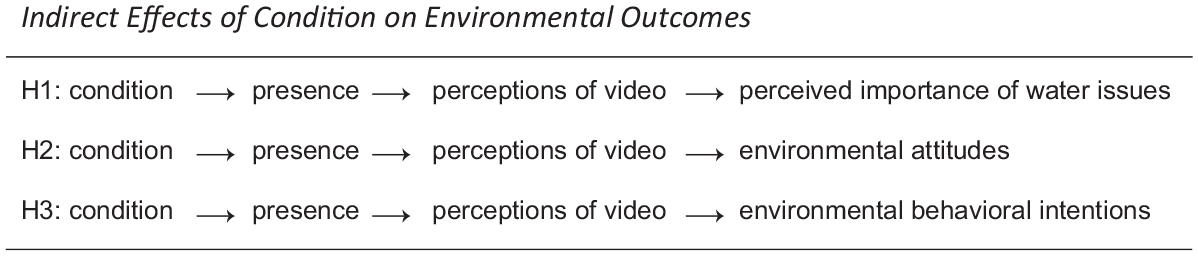
Indirect Effects of Condition on Environmental Outcomes.
Finally, a research question was developed to explore whether video modality influences retention of information communicated in the video. Prior research has produced conflicting results (e.g., Breves, 2021; Sunder et al., 2017), thus not enough evidence exists to confidently predict similar or differential retention effects based on message modality. More immersive media may enhance or distract memory recall of scientific and factual information in the message. For example, presence has been associated with both greater and lesser information retention (Ahn et al., 2022; Breves, 2021):
Method
This study implemented a randomized experimental design to empirically test whether a VR video experience produced similar or different effects on environmental values, attitudes, and behavioral intentions in comparison with a flat screen video. Specifically, to test the effects of these levels of immersion, we used a highly immersive condition that viewed a 360-degree video via VR HMD and a less immersive condition that viewed the same content as a flat screen YouTube video.
Developing a VR Video: Explanation of Collaboration and Design
The authors designed the stimulus in consultation with a university digital production instructor and the city’s stormwater education and outreach coordinator. A storyboard and script were developed and a professional company was hired to film a flat screen version and a 360-degree version of the video in the field with the city coordinator serving as the field guide depicted in the video. Won et al. (2023) assert the importance of researchers describing the features of the VR learning design, as it is helpful to compare results of studies that use similar rather than dissimilar stimuli.
Background on the Problem
The shrinking of wetlands and the pollution of watersheds threatens water quality and the well-being of ecosystems. Wetlands are described as areas of saturated soil that form shallow bodies of water, such as marshes, that sustain plants, fish, and wildlife (U.S. Environmental Protection Agency [EPA], 2022a). The significance of wetlands to local ecosystems is summarized by Kingsford et al. (2016) as such: “Wetlands provide a range of critically important ecosystem services including fresh water, nutrient cycling, food and fibre production, carbon fixation and storage, flood mitigation and water storage; water treatment and purification and habitats for biodiversity” (p. 892). Significant threats to wetlands and their aquatic inhabitants include pollution, climate change, and habitat loss due to factors, such as industry and urban development. The increase of stormwater or surface runoff from impervious surfaces, such as roads, parking lots, and sidewalks, alters the natural hydrology and channel morphology and increases pollutants, such as pesticides, organic pollutants (e.g., animal waste or manure), and oil to bodies of water and wildlife habitats (City of Corpus Cristi, n.d.; EPA, 2022b). Stormwater is not treated and thus contaminants flow directly into creeks, rivers, lakes, and oceans.
Modification of human behavior can help to mitigate these threats. Human behaviors, such as littering, use of pesticides in the garden, and not picking up pet waste contribute to the deterioration of water quality and the threat to the local ecosystem. Altering human behavior is difficult in that it requires individual motivation, moreover the desired behaviors may be perceived to be difficult or inconvenient. Thus, this VR intervention was designed to inform and motivate behavioral change.
Message Design
In this research, an immersive VR experience was created using Oculus HMDs. This enabled individuals’ sensorial immersion in the visual and auditory components while watching the video. The completed and edited video was 4 minutes and 49 seconds in length. The length of the video was kept under 5 minutes to maximize practicality of use in a variety of settings, hold a person’s attention, and limit the amount of time a person would need to use the HMD, as lengthy periods of time can be disorienting for some people.
The video contained oral and visual information about the water cycle, wetlands, watersheds, stormwater pollution, and behaviors to mitigate water pollution. See Figure 2 for an image from the video. The message design mimicked a field trip to local environments, where the communicator transports the learner to a locale, points out features of the environment, and imparts scientific information. The video contains footage from six sites across the community, including natural and urban settings. Text highlighting key points narrated in the video at each location was added during editing.
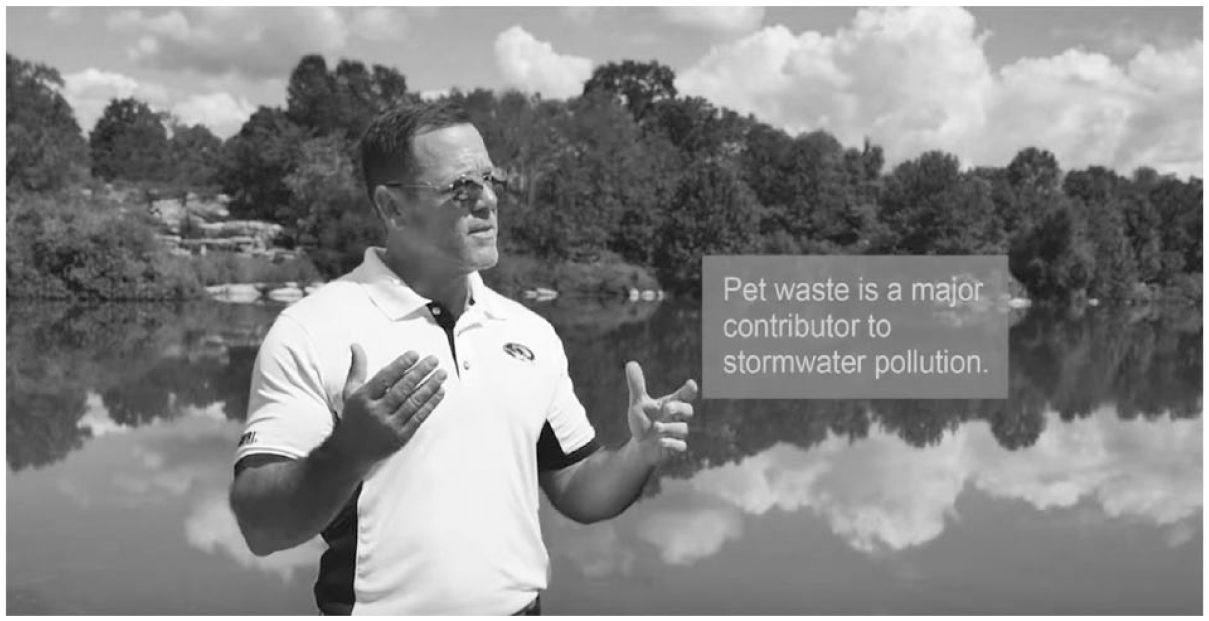
Still Image From Video Depicting Narrator and Natural Locale.
The design also included moments of silence from the narrator during which the natural sounds (e.g., water, cicadas, birds) of the environment were enhanced in editing to be slightly amplified. This allows the user’s senses to be further engaged while watching the 2D or 360-degree version of the video, and with the use of the HMD to feel as if they are surrounded by nature fostering spatial presence. In contrast, in the urban settings, human-made noises (e.g., traffic) can be heard by the user, which is a departure from the nature sounds heard in other parts of the video.
Our local field guide identified the importance of establishing the visual link for individuals between urban environments and the effects on water pollution. Thus, the message design included introducing the user to the environmental issue in beautiful natural settings and then transporting the user to locales where nature intersects with urban surfaces, such as footage from a creek that runs under the bridge of a busy road. This contrast of the natural and urban environments was designed to enhance the understanding of the effects of human behaviors on nature as well as provide the user with ample opportunity to experience self-location in the community locales.
The degree of immersiveness and interactivity of the message varied based on whether the video was viewed as 2D/flat screen version on YouTube or as 360-degree version via VR HMD. The 360-degree video is identical to the standard 2D video with the exception of the 360-degree view, enabling viewers to look around and explore the environment surrounding the focal point in the 2D video. The immersiveness and interactivity is heightened using VR, because the HMD fully envelopes the user’s sight and sounds with the video and provides user agency in looking around the environment.
Participants
Environmental problems, such as climate change and global warming, are issues that many U.S. adults are worried about (e.g., Funk, 2021; Reinhart, 2018). In particular, young adults express greater interest and concern about environmental issues than other age groups (e.g., Ballew et al., 2019; Funk, 2021; Reinhart, 2018), however, this concern does not always translate into positive environmental behaviors. There is a need to examine how young adults’ cognitive responses and behaviors may be influenced by different types of message deliveries and how to effectively convey environmental information to this group of people for promoting more pro-environmental attitudes and behavioral intentions. Thus, this study focused on young adults, and as part of the group, undergraduate students (N = 70) from the local community were recruited as research participants.
The age range of participants was 18 to 23 years of age, and the average age of the participants was 20 years old (SD = 1.17). The majority of participants identified as female (n = 53, 75.7%), followed by male (n = 16, 22.9%), and gender non-conforming (n = 1, 1.4%). Most of the participants identified as White (n = 51, 72.9%), which was followed by Black (n = 14, 20.0%), Hispanic or Latinx (n = 5, 7.1%), Asian or other Pacific Islander (n = 3, 4.3%), and Native American or Native Alaskan (n = 1, 1.4%). Participants were permitted to select multiple race/ethnicity categories, if applicable.
Laboratory Procedure
This research took place in a communication laboratory equipped with three rooms: a waiting room, a VR equipped room, and a computer lab. As participants arrived at the waiting room, they were randomly assigned to participate in the immersive VR video condition or the flat screen (2D) video condition. The participants in the VR condition received instructions on how to use the Oculus HMD in the VR room, where they viewed the VR video. The participants in the flat screen video condition were directed to the computer lab where they viewed the video at an individual computer station with headphones. After watching the video, participants in the VR and flat screen video conditions completed a Qualtrics survey at individual computer stations in the computer lab. Participants answered questions about their demographics, perceived importance of water issues, environmental attitudes, perceptions of the video they watched, information retention, and their behavioral intentions to engage in the pro-environmental behaviors modeled and/or mentioned in the video.
Measures
Demographics
In addition to the questions about gender identification, racial identification, and age (reported in the “Participants” section), participants were asked to respond to the following question about educational background: Have you taken a class that covered water pollution or climate change? (yes/no). We included this item as a potential covariate, given that prior education on climate change and water pollution may impact an individual’s response to the video used in this study. The majority of participants (n = 45, 64.3%) reported never taking a course that included information about water pollution or climate change. A bivariate correlation test demonstrated that educational background was not significantly related to any other variable in this study.
Spatial Presence
Spatial presence (α = .90, M = 4.89, SD = 1.22) was measured using nine items taken from the telepresence measure by Nowak and Biocca (2003) and the Presence Questionnaire (Witmer et al., 2005). The following items were included in this study: “To what extent did you experience a sense of ‘being there’ in the video?”; “To what extent did you feel that the video was like reality to you?”; “To what extent did you feel involved with the video?”; “I had the sense of being in the video”; “I had the sense of being in the research lab” (reverse coded); “How completely were all your senses engaged?”; “How much did the visual aspects of the video involve you?”; “How much did the auditory aspects of the video involve you?”; and “How well could you examine objects from multiple viewpoints in the video?” Participants responded on a scale from 1 = not at all to 7 = very much.
Perceptions of the Video
Participants’ perceptions of the video (α = .75, M = 5.20, SD = 1.14) were measured with 3 items on a scale from 1 = not at all to 7 = very much: “How interesting was the video?”; “How informative was the video?”; and “How persuasive was the video?” These items were included based on prior research (e.g., Breves, 2021) that suggests VR may be heuristically processed as more engaging and credible in contrast to 2D-mediated messages.
Perceived Importance of Water Issues
An adaptation of the water attitudes scale by Adams et al. (2013) was used to measure perceived importance of water issues (α = .88, M = 4.26, SD = .64). The scale developed by Adams and colleagues includes the importance of “water issues,” including drinking water and “personal issues,” including animal (manure) waste management important to maintaining clean, natural bodies of water. The prompt asked participants to consider how important these items were, in their opinion. Participants responded on a scale of 1 = not important to me to 5 = very important to me to nine items: “Clean rivers, lakes, and streams,” “Clean groundwater,” “Clean drinking water,” “Residential water conservation,” “Commercial water conservation,” “Recycling,” “Picking up pet waste,” “Supporting policies that protect clean water,” and “Conservation of wetlands.”
Environmental Attitudes
The Environmental (2-MEV) Scale is an established measure of environmental attitudes (Bogner, 2018; Bogner & Wilhelm, 1996). The scale questionnaire specifically taps into attitudes related to utilization and preservation of nature. The following items from the 2-MEV were utilized in this study: “Our planet has unlimited resources,” “People worry too much about pollution,” and “We do not need to set aside areas to protect endangered species.” Participants were asked to report their agreement with these items, on a scale from 1= strongly disagree to 5 = strongly agree. As per scale instructions, scores are summed and lower scores indicate more positive environmental attitudes. Descriptive statistics revealed that scores (M = 5.54, SD = 2.44) ranged from a minimum of 3 to a maximum of 14.
Environmental Behavioral Intentions
A sum score was created for likelihood of performing 6 types of positive environmental behaviors (Msum = 34, SD = 4.10). Specifically, participants responded to the prompt “In the future, how likely are you to” on a 1 = not likely at all to 7 = very likely scale for the following 6 behaviors: “Recycle glass, plastic, or paper”; “Contact a government representative about an environmental issue”; “Pick up pet waste, if I have a pet”; “Throw trash on the ground” (reverse coded); “Support the Clean Water Act”; and “Throw trash into waterways” (reverse coded). These six behaviors were selected as they were specifically noted in the video as actions people should take to help the environment and keep waterways clean. The video also depicted examples of trash not properly disposed of, as well as modeled the positive behavior of recycling a drink container.
Retention of Information
Participants answered multiple-choice questions about the information communicated in the video. For example, participants were asked to recall the name of a wetland visited in the video and to correctly identify the causes of stormwater pollution discussed in the video. A sum score was created for the number of retention questions that a participant answered correctly, with a maximum possible score of eight correct answers. Retention scores ranged from a minimum of 3 to a maximum of 8 (M = 6.63, SD = 1.21).
Results
The hypotheses and research question were tested using Hayes’ SPSS PROCESS macro version 4.3 model 6. Indirect effects of experimental conditions on perceived importance of water issues (H1), environmental attitudes (H2), environmental behavioral intentions (H3), and information retention (RQ1) through presence and perceptions of the video were examined using 95% confidence intervals with 5,000 bootstrapped samples. Note that PROCESS model significance is interpreted by examining bootstrap confidence intervals—if the lower-limit confidence interval (LLCI) and upper-limit confidence interval (ULCI) do not include zero, then the indirect effect model is significant.
Hypothesis 1: Perceived Importance of Water Issues
Hypothesis 1 was supported. Condition predicted level of presence (b = 1.26, t = 5.05, p < .001, R2 = .27), such that, the VR video produced greater feelings of spatial presence than the flat screen video. Presence predicted perceptions of the video (b = 0.73, t = 7.49, p < .001, R2 = .47), such that, greater presence resulted in increased positivity of perceptions of the video. Perceptions of the video, in turn, was associated with perceived importance of water issues (b = 0.33, t = 3.98, p < .001, R2 = .22), such that, greater positivity of perceptions of the video resulted in greater perceived importance of water issues. The indirect effect of condition on perceived importance, through presence and perceptions of the video, suggests VR video is associated with a stronger effect on perceived importance of the environmental issue than the flat screen video (95% CI [.13, .53]) (see Table 1).
Model Results for Perceived Importance of Water Issues.
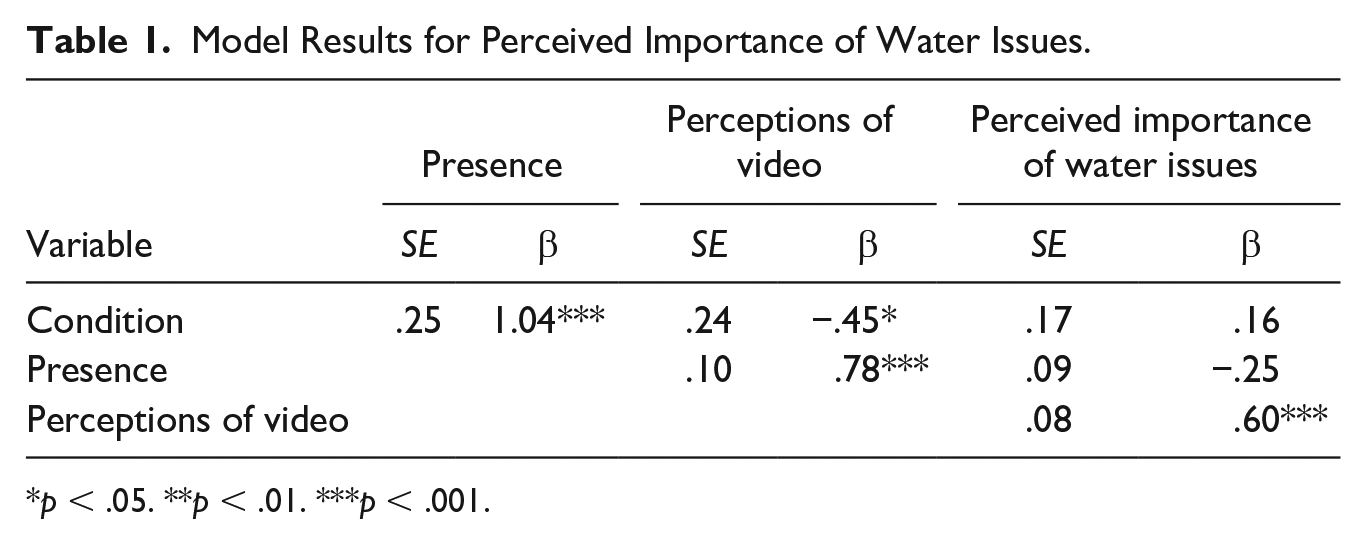
p < .05. **p < .01. ***p < .001.
Hypothesis 2: Environmental Attitudes and Beliefs
Hypothesis 2 was supported. See Hypothesis 1 results for significant relationships between condition and presence and between presence and perceptions. Perceptions of the video predicted environmental attitudes (b = −0.94, t = −2.79, p < .01, R2 = .47), such that, greater positivity of perceptions of the video resulted in more positive environmental attitudes and beliefs. A note that lower attitude scores indicated more positive attitudes and beliefs, thus the relationship between perceptions of the video and attitudes and beliefs is negative. The indirect effect of condition on environmental attitudes and beliefs, through presence and perceptions of the video, suggests VR video produced a stronger effect on attitudes and beliefs than the flat screen video (95% CI [−1.50, −.34]) (see Table 2).
Model Results for Environmental Attitudes.
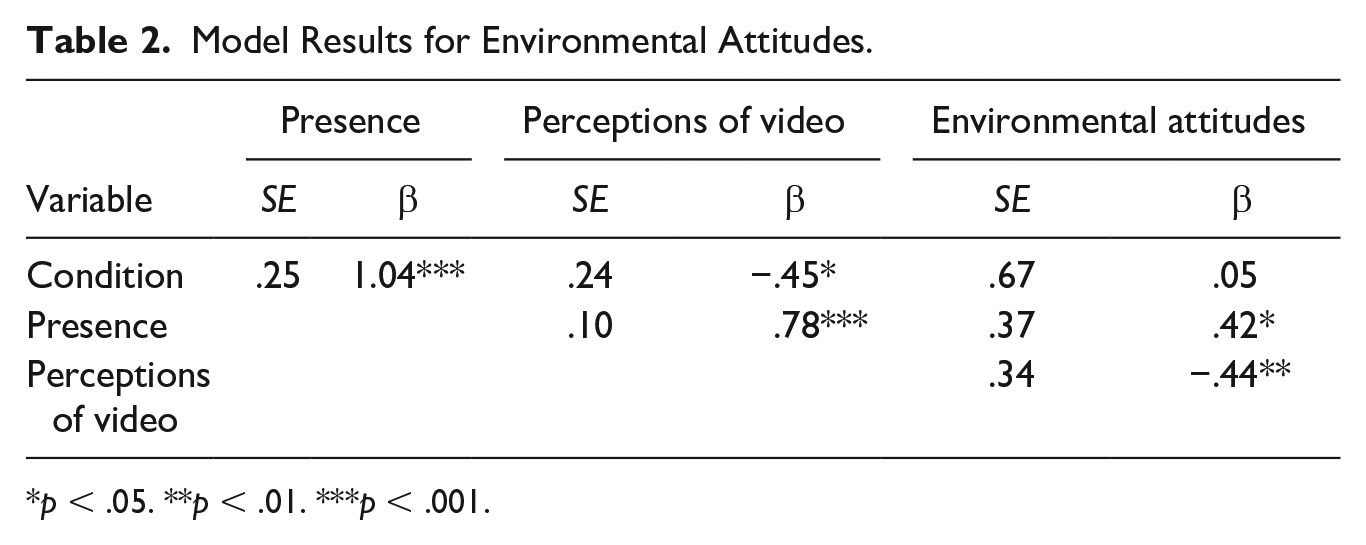
p < .05. **p < .01. ***p < .001.
Hypothesis 3: Environmental Behavioral Intentions
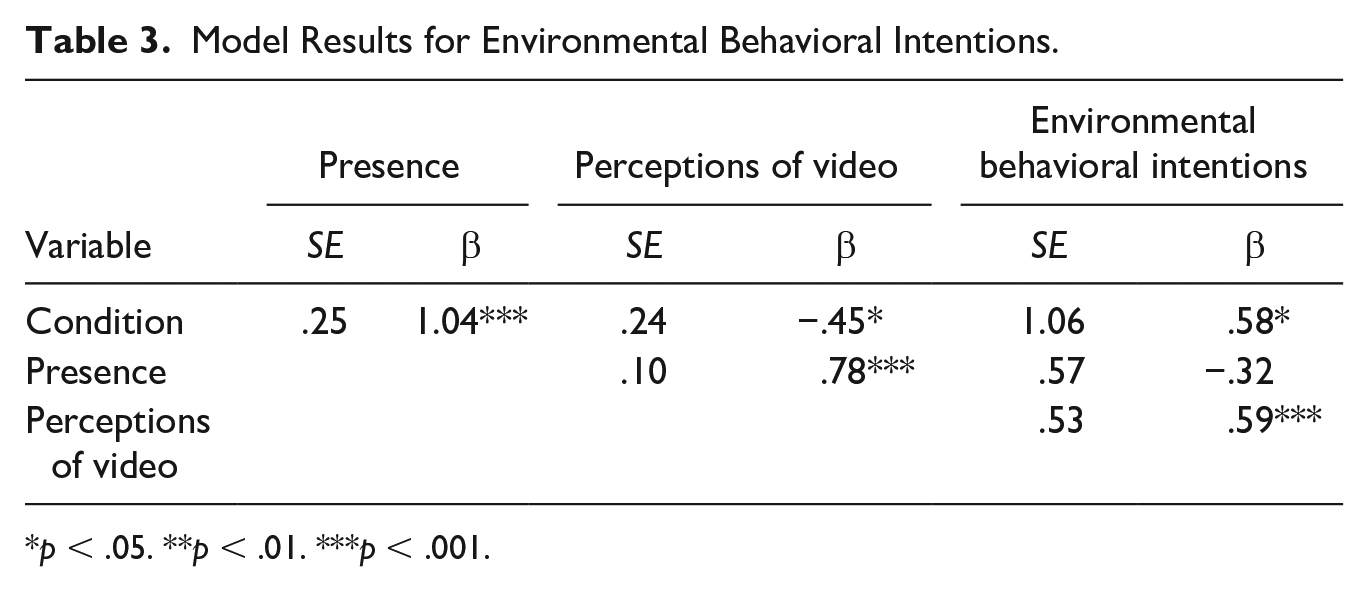
Hypothesis 3 was supported. Perceptions of the video predicted environmental behavioral intentions (b = 2.10, t = 3.98, p < .001, R2 = .05), such that, greater positivity of perceptions of the video resulted in increased behavioral intentions. The indirect effect of condition on environmental behavioral intentions, through presence and perceptions of the video, suggests VR video produced a stronger effect on behavioral intentions than the flat screen video (95% CI [.78, 3.30]). There was also a direct effect of condition on environmental behavioral intentions, such that, the VR condition was directly associated with greater pro-environmental behavioral intentions (see Table 3).
Model Results for Environmental Behavioral Intentions.
p < .05. **p < .01. ***p < .001.
Hypotheses Results Summary
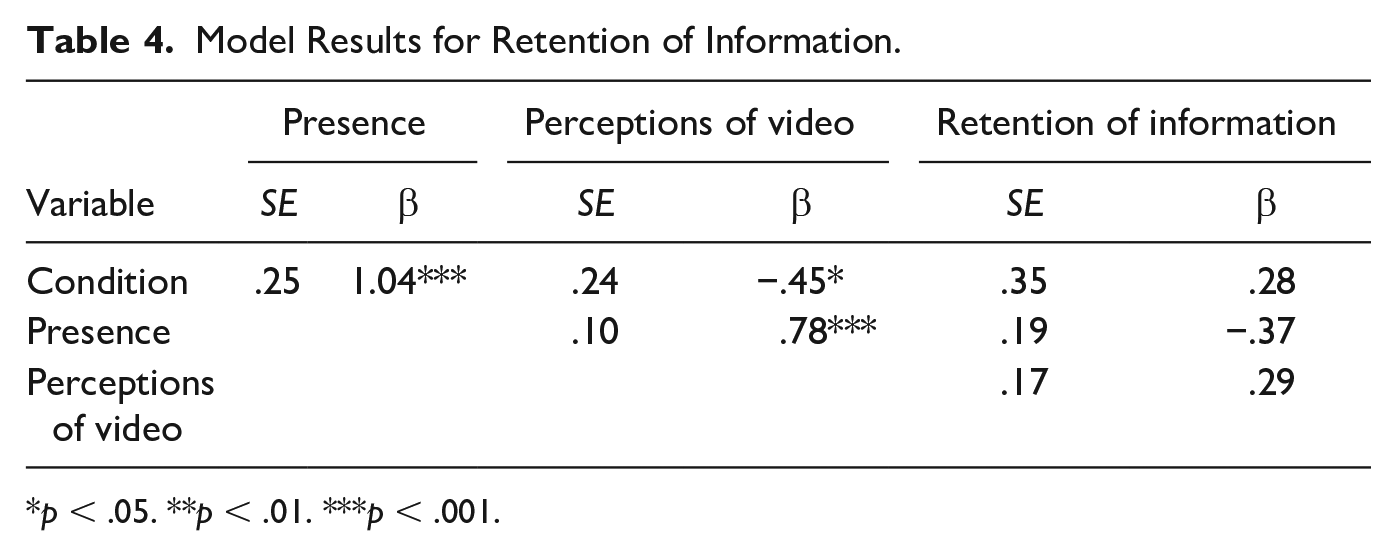
Taken together, the results of Hypotheses 1 and 2 indicate that condition had an indirect effect on perceived importance of water issues and environmental attitudes. The results of Hypothesis 3 indicate that condition had a direct effect, as well as indirect effect via presence and video perceptions, on behavioral intentions. Results for Hypotheses 1 to 3 demonstrate condition predicted level of presence experienced by the participant, with greater levels of presence evidenced with the VR video. Presence subsequently predicted perceptions of the video message, such that, higher presence predicted more positive perceptions of the message. Finally, perceptions of the video message predicted perceived importance of water issues and environmental attitudes and behavioral intentions, such that, more positive perceptions resulted in greater pro-environmental outcomes.
Research Question 1: Retention of Information
Finally, the research question explored whether accuracy of information recall differed after viewing the message via immersive VR video versus flat screen video. On average, participants correctly answered 83% of the factual questions after viewing the video message, indicating a high level of accurate recall. PROCESS model 6 for serial mediation was utilized to test the direct and indirect effects of condition on retention of information. Results of Research Question 1 indicate that condition did not have a significant direct effect on level of retention of information from the video (b = .34, t = 0.98, p = .33), nor was there a significant indirect effect of condition on retention through presence and perceptions of the video (95% CI [−.02, 66]). Thus, no significant differences were observed in retention levels. Participants who watched the VR video were not more or less likely to correctly answer factual questions than those who viewed the flat screen video. See Table 4.
Model Results for Retention of Information.
p < .05. **p < .01. ***p < .001.
Discussion
This research examined immersive VR as a science communication tool to promote cognitive and behavioral pro-environmental change. Prior research (e.g., Ahn et al., 2016; Breves, 2021; Sunder et al., 2017; Uhm et al., 2020) suggests that 3D and 360-degree immersive VR enable individuals to feel an enhanced degree of connection with a depicted environment and message in comparison with traditional 2D media. The study of VR as an environmental education strategy is in its early stages and empirical investigations are relatively few (Fauville et al., 2020). Our research, utilizing a laboratory study, advances scientific understanding of the processes through which VR affects environmental cognitions and behaviors among young adults. The results of this research advance theoretical understanding of the effects of VR as a science communication tool.
The present study extends prior research by testing and demonstrating significant indirect effects models of immersive VR on perceived importance of water issues and pro-environmental attitudes and behavioral intentions. The findings from this study confirm Breves’ (2021) research demonstrating VR predicted stronger feelings of presence, which in turn was associated with more positive perceptions of the message in contrast to 2D modalities. Breves initially established the relationship between presence and valence of perceptions of the message. Our findings extend this prior work by demonstrating that this relationship has a positive relationship with perceived importance, attitudes, and behavioral intentions related to an environmental issue. Spatial presence and message perception were hypothesized to mediate the relationships between video modality (i.e., immersive VR versus flat screen) and the desired outcomes.
The immersive VR video produced greater feelings of spatial presence and more positive perceptions of the video than the flat screen video. Specifically, spatial presence predicted positive perceptions of the video, and these perceptions subsequently were associated with greater pro-environmental perceptions, attitudes, and behavioral intentions. The VR video also directly resulted in greater pro-environmental behavioral intentions compared with the flat screen video. Research suggests that psychological distance is correlated with uncertainty about environmental issues and subsequently weakens pro-environmental attitudes and behaviors (Breves & Schramm, 2021; Zhang et al., 2014). The experience of spatial presence that is the perception of being present and enveloped by the virtual environment shrinks the distance between the individual, nature, and the environmental problem. As the indirect effects models in our research suggest, the ability of an immersive VR video to increase positive perceptions of a science communication message, results at least in part from the experience of presence. In turn, positivity of perception of the message is associated with pro-environmental outcomes. Thus, there is a significant indirect link between presence and pro-environmental perceptions, attitudes, and behaviors that should be considered when engaging in message design. The utilization of VR messages that maximize the potential for the experience of presence are better suited to prosocial outcomes.
Taken together, our results suggest that immersive VR is associated with greater pro-environmental outcomes than 2D messaging. In the case of the perceived importance of water issues, viewing VR video was associated with greater perceived importance, which is beneficial to motivating individuals to engage in pro-environmental behaviors. Moreover, from a dual processing model perspective, the modality of communication influences what cues individuals utilize when encoding and decoding messages, such that, vivid modalities produce more favorable evaluations of the communicator and message (Chaiken & Eagly, 1983). Video, in general, is deemed to be a more highly vivid and visual communication strategy than text-based messages, and immersive VR more so than “traditional” flat screen video. This advantages immersive VR in producing attitude and behavior change because individuals feel more immersed with the message they are viewing, resulting in positive change.
In terms of information retention, there is debate about whether the benefits of VR outweigh the drawbacks, given that VR may distract individuals from information acquisition (Barreda-Ángeles et al., 2021). Despite the potential for VR to be perceived as distracting, we found that participants in the VR video condition performed equally as well with information recall as participants in the flat screen video condition. The immersive VR experience did not diminish, nor enhance, accurate recall of scientific information. Therefore, our research suggests that the positive responses participants had to the VR experience may serve to only enhance positive outcomes of the scientific communication and not distract from the message. However, the VR video message design likely has impacts on effectiveness and cognitive load. We intentionally designed the video stimulus to utilize first-person perspective, which lessens the cognitive load for individuals in contrast to other VR interventions that utilized third-person perspective. First-person perspective is advantageous in that the user does not need to cognitively process their avatar and can instead focus on the depicted environment and message.
Taken together, the findings of this research support the theoretical assertion that immersive VR produces greater levels of immersion than flat screen video. The results of this study also extend theoretical understanding of how VR is related to message perception, cognitive, and behavioral outcomes. Future work should consider testing normative beliefs as part of the model, as social influence is predictive of pro-environmental behaviors (Göckeritz et al., 2010). People’s perceptions of others’ environmental behaviors (descriptive normative beliefs) as well as others’ support of environmental behaviors (injunctive normative beliefs) may predict behavior. Normative beliefs may mediate (as described by the theory of planned behavior) or moderate the relationship between presence, perceptions of the message, attitudes, and behavioral outcomes. Göckeritz et al. (2010) found that injunctive normative beliefs moderated the relationship between descriptive normative beliefs and environmental behaviors. A future avenue of research would be to test normative beliefs to expand the understanding of the use of VR as a science communication tool within the context of social influence.
Immersive VR may be an effective science communication tool through increased positive perceptions of message quality, in comparison with less immersive messaging. Participants in the VR condition shared with researchers that the experience was memorable and enjoyable. This enjoyment of the VR experience may account for the positive cognitive effects. Future studies should further explore the relationship between VR, presence, enjoyment, and cognitive outcomes. Finally, the results of this research indicate that the heuristic appeal of the immersive VR video did not have a detrimental effect on pro-environmental outcomes nor information retention. Thus, the immersive experience was persuasive and informative without negatively impacting message processing.
Practical Implications
From a practitioner perspective, the results of this research suggest immersive VR using HMD produces immersive and vivid memorable experiences. People find immersive VR to be cognitively stimulating, which engages them and produces more positive feelings about the message. Using VR as a part of science communication may produce greater positive outcomes in comparison with 2D messaging (e.g., flat screen videos and text-based messages). Individuals view immersive VR video as higher in message quality in comparison with flat screen video, even when the content of the videos is the same. Thus, the modality of VR alone produces more positive feelings toward the message, suggesting that VR is a worthy communication tool to consider.
The results of an open-ended response item at the end of our questionnaire also suggest that community-based message design enhances message relevancy. This exploratory question probed what participants think they will “most remember about the video” they watched. In both conditions, multiple participants (approximately 11%) noted that the message will be particularly memorable because local landmarks and settings were included in the video. Our message design utilized a personalized approach that may have prompted greater attention to the message, in both VR and 2D forms, and prompted a sense of personal connection and responsibility for the environment. Thus, we suggest personalization (e.g., through localization) of message design.
Our primary aim was to examine the manipulation of modality for message delivery and experience, however equally important may be careful message design. Specifically, we recommend mapping of communication goals onto message design to effectively produce desired outcomes, such as interest, awareness, and behavior acquisition related to the persuasive and informative intent of the message. We took this approach with aligning the video content with the desired knowledge, attitudinal, and behavioral outcomes. In other words, the message should be designed to produce the change science communicators aim to accomplish. One cannot expect behavior change as an outcome if sufficient information and persuasion is not provided to motivate that change. As noted earlier, we also were intentional about situating the message within the local community to increase a sense of connection to the issues.
Finally, we utilized first-person perspective in the VR message design to enhance connection and sense of “being there.” Cognitive load is reduced for the individual and enables them to be more readily immersed in the experience and focused on the message. The use of VR is advantageous in transporting a person to a locale without actually having to physically take them there. As such, allowing the individual to see through their own eyes the environment mimics this experience more readily and reduces the need for them to connect with an avatar (i.e., digital representation of a person). Particularly in short interventions, using first-person perspective enables people to immerse themselves more effectively in the virtual environment.
Limitations
The laboratory experiment examined short-term effects; examination was not conducted to determine persistence of effects over time. Thus, it is unknown whether effects persist in the long-term. Our sample was also limited to a relatively small group of undergraduate college students, which may not be representative and generalizable to broader populations. Young adult populations extend beyond college students, and as such, there may be differences in other groups of individuals. In addition, the results may not be generalizable to a broader audience beyond young adults. The empirical investigation undertaken in our research can be additionally tested in the future with other groups and communities.
First-person and third-person perspectives were not manipulated in our research. The message design using first-person perspective was grounded in prior research, however, future studies may want to further test how point of view influences the indirect effects models examined in our research to empirically examine the differences’ point of view may have on cognitive load.
In addition, future studies may examine multiple facets of message credibility. We utilized three items to assess perceptions of the video, which provided us with a sufficient measure of the valence and strength of their perceptions of the video quality and effectiveness. However, there may be additional types of credibility that could be examined more specifically, such as speaker credibility. We did not assess multiple types of credibility, and this could be an area of future research when testing the effects of immersive VR as a science communication tool.
Finally, behavioral intentions are a strong predictor of behavior, however, they are not the equivalent of measuring behavioral change in the real world and over the long term. Although challenging, future research may consider how to examine the effects of VR messaging on real-world environmental behaviors.
Footnotes
Declaration of Conflicting Interests
The author(s) declared no potential conflicts of interest with respect to the research, authorship, and/or publication of this article.
Funding
The author(s) received no financial support for the research, authorship, and/or publication of this article.
