




Abstract
This article examines fiction references in news coverage of extended reality. Based on a mixed methods analysis of 977 news articles from UK mainstream mass media outlets, this study found that fiction references were frequently used as framing devices within the news articles, with a focus on two franchises: The Matrix original trilogy (1999–2003) and Star Trek: The Next Generation (1987–1994). These references were utilised in the following three key ways: claiming fiction is becoming real; as a tool to improve readers’ understanding of extended reality; and, to a limited degree, to create dystopic visions of extended reality. Ultimately, this article shows that, despite the dystopic representations of extended reality in fiction, fiction references have primarily been used to portray extended reality as advanced and high-quality. This supports extended reality adoption and the commercial interests of technology companies, raising questions as to whether journalists prioritise the interests of their readers when creating such news.
Keywords
1. Introduction
When new technologies emerge, the news media can have a significant impact on public perceptions of those technologies (Cogan, 2005; Scheufele and Lewenstein, 2005; Sun et al., 2020). Furthermore, fictional texts have also been found to have considerable influence on the expectations and perceptions of the technologies they feature (Asif and Gouqing, 2023; Dourish and Bell, 2014; Nisbet et al., 2002). Considering both of these points, if news discourse about emerging technologies includes references to fiction, this could act as a powerful framing device to shape public opinion during the diffusion of the technology. While previous studies have examined fiction references in news coverage of innovations such as biotechnology (Hellsten, 2000; Petersen et al., 2005) and artificial intelligence (Guzman, 2013; Hansen, 2022), this article builds on such research by focusing on a different emerging technology: extended reality (XR).
XR is an umbrella term for a group of technologies that primarily includes virtual reality (VR), augmented reality (AR) and mixed reality (MR). VR is typically experienced with the use of a head-mounted display that presents the user with a fully virtual world, whereas AR and MR display virtual elements in a physical space, usually through a headset or smartphone (Brigham, 2017). Compared to AR, MR enables greater interaction between the virtual elements and the user and/or physical environment (Greengard, 2019). While VR and AR are not new, it is only in recent years that they have started to gain commercial traction and become more widespread (Steinicke, 2016), with MR developing as a more advanced form of AR. A key year for XR was 2016, when several VR headsets were released for general consumer use. In this year, VR revenue was estimated at US$2.8 billion (SuperData, 2016) and this has increased each subsequent year, with AR and MR following a similar trend. As of 2023, the XR market is estimated to be worth US$40.1 billion (Markets and Markets, 2023), with further growth predicted (Cook et al., 2022; Markets and Markets, 2023). Multiple large technology companies are invested in the XR industry, including Meta (which owns VR company Oculus), Google (with its Google Glass AR product and AR applications for mobile devices) and Apple, who announced a new XR headset in June 2023 (Apple, 2023). The growth of the industry, combined with the involvement of large technology companies, means studying fiction references in XR news makes a valuable contribution to the existing literature. Added to this, Chan (2014) states that XR can affect our perceptions of reality as well as the virtual. Madary and Metzinger (2016) even argue that VR will change ‘our general image of humanity’, social interactions and ‘the very relationship we have to our own minds’ (pp. 1–2). Considering these significant effects, XR is an important area to focus on when it comes to analysing media coverage of technology.
The work discussed in this article is one part of a larger study that focused on XR media discourse (see Graves, 2024). From a social constructivist perspective informed by framing theory (Entman, 1993; Gamson and Lasch, 1983; Goffman, 1974; Linström and Marais, 2012; Van Gorp, 2007), the study involved a quantitative content analysis and qualitative framing analysis of 977 online news articles from three mainstream mass media outlets in the United Kingdom (the Sun, the Guardian and MailOnline) for the period of 2012–2017. This article explores one key feature of the news discourse that emerged from this wider study: references to fiction. While this article discusses XR broadly, the majority of the findings focus on VR and AR as MR was mentioned very rarely in the sample.
The remainder of this article is structured as follows. The next section provides a review of the literature on fictional representations of XR and previous studies examining fiction references in technology news. Further methodological information is provided, followed by a detailed examination of how news coverage of XR has utilised references to fiction. Quantitative data are first analysed to provide a clear overview of the extent fiction references appeared and which texts were focused on. The following three themes that emerged during the qualitative analysis are then explored: (1) claiming fiction is becoming real, (2) fiction being used as a tool to improve readers’ understanding of XR and (3) referencing fiction to create dystopic representations of XR (although this approach was used to a minimal degree). Overall, the article shows that fiction references have primarily been used to present XR technologies positively, which supports their diffusion and the commercial interests of XR companies. This highlights a potential concern regarding whose interests journalists prioritise in news coverage of XR and, indeed, emerging technology more broadly.
2. Literature review
Media impact on expectations and perceptions of technology
Both news discourse and fictional representations can have significant influence on audiences’ perceptions and expectations of the technologies presented (Asif and Gouqing, 2023; Dourish and Bell, 2014; Meinecke and Voss, 2018; Nisbet et al., 2002). The author’s previous research (Graves, 2018) examining the media influence on consumers’ perceptions of VR identified that viewers of fictional VR were more likely to describe the technology in ways that aligned with its fictional representations, as opposed to those that had not seen it in fiction. Considering other technologies, Scheufele and Lewenstein (2005) carried out an extensive survey on attitudes towards nanotechnology in the United States. Based on 706 telephone interviews, they found that the positive themes in nanotechnology news were reflected in the responses of those who frequently engaged with such news, while this was less common for respondents who did not consume news about nanotechnology.
In relation to artificial intelligence (AI), Asif and Gouqing’s (2023) review of studies on AI in the media highlights the significant impact of news on shaping the public’s perception of, and attitude towards, AI. For example, in the US context, Brewer et al. (2022) found that the more often participants engaged with technology news, the more likely they were to refer to AI using frames similar to those that appeared in that news. Asif and Gouqing’s (2023) review also summarised that fictional representations of AI have been found to affect public perceptions and expectations of AI in numerous ways, including generating positive attitudes and raising awareness, as well as creating unrealistic expectations and raising concerns about the technology. Relatedly, in regards to fiction, Kirby (2010) argues that representations of technologies in popular films often act as ‘diegetic prototypes’ which can either increase audiences’ desire for the featured technologies or can be used to instil fear (see also Kirby, 2003). Regardless of what the impact may be, these studies make it clear that both news and fictional portrayals of technology can influence public perceptions. Since public perception of emerging technologies has a significant impact on their acceptance and potential adoption (Buenaflor and Kim, 2013), it is worthwhile to examine such discourse in other contexts: in this case – XR.
Extended reality in fiction
XR technologies appeared in fictional texts many years prior to becoming consumer products. For VR, popular examples include William Gibson’s novel Neuromancer (1984), the holodeck in the Star Trek franchise (particularly Star Trek: The Next Generation (1987–1994)) and The Matrix trilogy (1999–2003), whereas films such as RoboCop (1987), Minority Report (2002) and Iron Man (2008–2013) feature representations of AR. Although not based on any empirical research, several authors have argued that fictional coverage of XR is often dystopic (Ariel, 2017; Bailenson, 2018; Steinicke, 2016). More reliably, through an extensive study of VR representations in novels and films, Chan (2014) found both celebratory and critical representations of the technology, sometimes even within one text. Positive portrayals of VR in fiction include framing it ‘as a revolutionary and unprecedented immersive experience’ (Chan, 2014: 58) and highlighting the transcendental capabilities of VR. Taylor (1997) agrees that transcendence is often the focus, not just in literary texts but also in artistic and musical representations of VR. This portrays the technology positively, as it supposedly allows users to do or be more than is possible without VR. However, Taylor highlights that this transcendence is typically coupled with the concept of escapism, which has more negative connotations. Indeed, Chan does note that several texts offer cautionary tales about real-life VR. Using the film Surrogates (2009) as an example, Chan summarises that the text warns of what could happen if society becomes overly reliant on technologically mediated social interaction.
While few studies have examined fictional representations of XR specifically, others have looked at technology in fiction more broadly, with some consideration of XR. Focusing on technology in young adult science fiction, Applebaum (2010) summarised that ‘[i]n most texts, technology is depicted as opposed to the humanities, a destructive force, uncreative and dehumanising’ (p. 69). Of particular interest to this article is Applebaum’s discussion of this theme in one novel, The Last Book in the Universe (2000), which ‘depicts a society that has became [sic] so immersed in virtual reality environments accessed through “mind probes” that it has lost all interest in books and reading’ (Applebaum, 2010: 58). Applebaum argues that the book presents a cautionary tale of VR, which echoes Chan’s (2014) findings. Thus, despite there being some positive representations of XR in fiction, it appears they are mostly negative. This could have implications for the way that fiction references are used as framing devices in XR news discourse.
Fiction references in technology news
As will be discussed here, a number of studies have analysed references to fiction in science and technology news, though none appear to have focused on any of the technologies within the XR umbrella. First, Petersen et al. (2005) state that science fiction imagery is often used in news that discusses ‘the powers and dangers of biotechnology’ (pp. 338–339). Along those lines, Hellsten (2000) examined news coverage of cloning around the time that Dolly, the sheep, was cloned. Hellsten found that Dolly was sometimes compared to Frankenstein’s monster in The Times to construct a negative representation of cloning. However, Kitzinger (2010) argues that not all references to fiction in news are dystopic, citing studies examining news coverage of embryo research (Mulkay, 1996), genetically modified foods (Cook, 2004) and stem cell research (Kitzinger and Williams, 2005).
While these studies are mostly science focused, other researchers have looked at fiction references in news about AI. Guzman (2013) examined 53 US news articles about Siri throughout October 2011 (when Apple launched the feature). Science fiction references appeared in this news coverage, where they were used to present Siri as futuristic, or as ‘science fiction brought to life’ (Guzman, 2013: 2). There were some references to negative fictional technologies; however, the author argues that this was typically ‘tongue-in-cheek’ (Guzman, 2013: 2). Instead, fiction was simply used to make sense of Siri. Although Guzman’s sample size was quite limited as it focused on just 1 month and one tool, a similar theme was uncovered in Hansen’s (2022) more extensive study of Danish AI news coverage. Based on 253 articles published in Danish newspapers and magazines from 1956 to 2021, Hansen identified that science fiction references appeared frequently from the 1980s to 2010s. These references were used to explain real-word AI developments, as well as to associate AI with advanced technology from fiction. Based on these results, Hansen argues that there is a futuristic discourse surrounding AI in this news coverage. This article builds on this existing research with data regarding fiction use in XR news. Not only does this add a perspective about a different technology, it does so using a larger sample size (977 news articles) and a mixed methods approach that does not appear to have been used by previous researchers.
3. Methodology
Framing theory
As stated earlier, this article focuses on one area of the author’s wider study of XR media discourse (see Graves, 2024). The broader study, and thus the data regarding fiction references discussed here, was primarily underpinned by framing theory (Entman, 1993; Gamson and Lasch, 1983; Goffman, 1974; Linström and Marais, 2012; Van Gorp, 2007). Framing involves making particular aspects of a story or topic salient through emphasis and exclusion, thus encouraging the audience to interpret a point in a certain way. As Entman (1993) states, ‘To frame is to select some aspects of a perceived reality and make them more salient in a communicating text, [. . .] to promote a particular problem definition, causal interpretation, moral evaluation, and/or treatment recommendation for the item described’ (p. 52, original emphasis). Entman (1993) further explains that salience involves ‘making a piece of information more noticeable, meaningful, or memorable to audiences’ (p. 53). Within a text, information can be made more or less salient in a number of ways. This includes where it appears, whether or not it is repeated and by associating it ‘with culturally familiar symbols’ (Entman, 1993: 53). Therefore, to uncover a frame is to uncover the aspects of reality that have been given prominence (or salience) by a communicating text, which points to their power in influencing perceptions of an issue or topic.
The elements that construct a frame are known as ‘framing devices’ (Gamson and Lasch, 1983; Linström and Marais, 2012; Pan and Kosicki, 1993). Framing devices can be understood as ‘tools for newsmakers to use in composing or constructing news discourse as well as psychological stimuli for audiences to process’ (Pan and Kosicki, 1993: 59). Linström and Marais (2012) categorise framing devices as rhetorical (related to language use, such as metaphors and exemplars) or technical (referring to the structure and composition of a news article, including source usage). The wider study that this article is based on found that fiction references acted as a major framing device throughout XR news coverage, as will be discussed below. Before beginning the analysis, however, it is important to specify more detail about the research methods.
Mixed methods: Content analysis and framing analysis
As noted, this study utilised a mixed methods approach to examine media coverage of XR. Specifically, this combined quantitative content analysis and qualitative framing analysis. The major benefit of using a mixed methods approach is that the drawbacks of quantitative research can be offset by the advantages of qualitative research – and vice versa. For instance, an advantage of using quantitative content analysis is that the research can cover a large sample (Krippendorff, 2012). However, because this approach deals with only numerical data, it is limited in its ability to uncover deep meaning. However, qualitative methods can produce richer data (Merriam and Tisdell, 2016) but are usually limited to a smaller sample size because of the labour intensive nature of qualitative analysis. Using a mixed methods approach meant that this study benefitted from being able to quantitatively analyse a fairly large sample of 977 news articles and uncover deeper meaning through qualitative analysis of the 169 articles that included references to fiction.
Furthermore, qualitative research is often criticised for being subjective (Creswell and Plano Clark, 2018; Tankard, 2001). However, the potential for subjective interpretations is reduced in quantitative research due to its systematic and replicable nature. Therefore, using mixed methods allowed this study to gain deep and valuable insight through qualitative analyses, as well as more objective data through a quantitative approach which mitigated the risk of biased interpretations. Overall, using a mixed methods approach means that ‘researchers gain new knowledge that is more than just the sum of the two parts’ (Creswell and Plano Clark, 2018: 13). Thus, combining qualitative and quantitative methods together can uncover findings that would not be apparent if either method was used on its own, strengthening the results presented in this article.
Sampling strategies and data analysis
In order to examine media discourse during the inception of XR, the chosen sample period was 1 January 2012 to 31 December 2017. This covered the first device announcements of the re-emergence of XR (specifically, Google Glass in April 2012 and Oculus Rift in August 2012) to the year after the so-called ‘year of VR’ in 2016 (Steinicke, 2016). It was important to analyse data up to the end of 2017 to see whether the discourse changed after the key moments in 2016. Mainstream generalist news outlets were the focus due to their wide readership and the fact they are targeted to audiences that may not be familiar with technology (as opposed to audiences of technology outlets), thus making the way these outlets represent XR key in affecting readers’ perception (Scheufele and Lewenstein, 2005). Three UK news outlets were chosen: the Sun, the Guardian and MailOnline. This allowed the study to examine the discourse of traditionally tabloid, middle-market and quality news outlets. In particular, these outlets were chosen because they had the largest readership in their group (i.e. tabloid, middle-market and quality) across the sample period of the study, according to data from the Audit Bureau of Circulations and the National Readership Survey (now known as PAMCo). However, it is important to note that, despite the international readership of these news sites (Majid, 2021), particularly MailOnline (Veseling, 2017), the majority of readers would be UK-based, which is one limitation of this study.
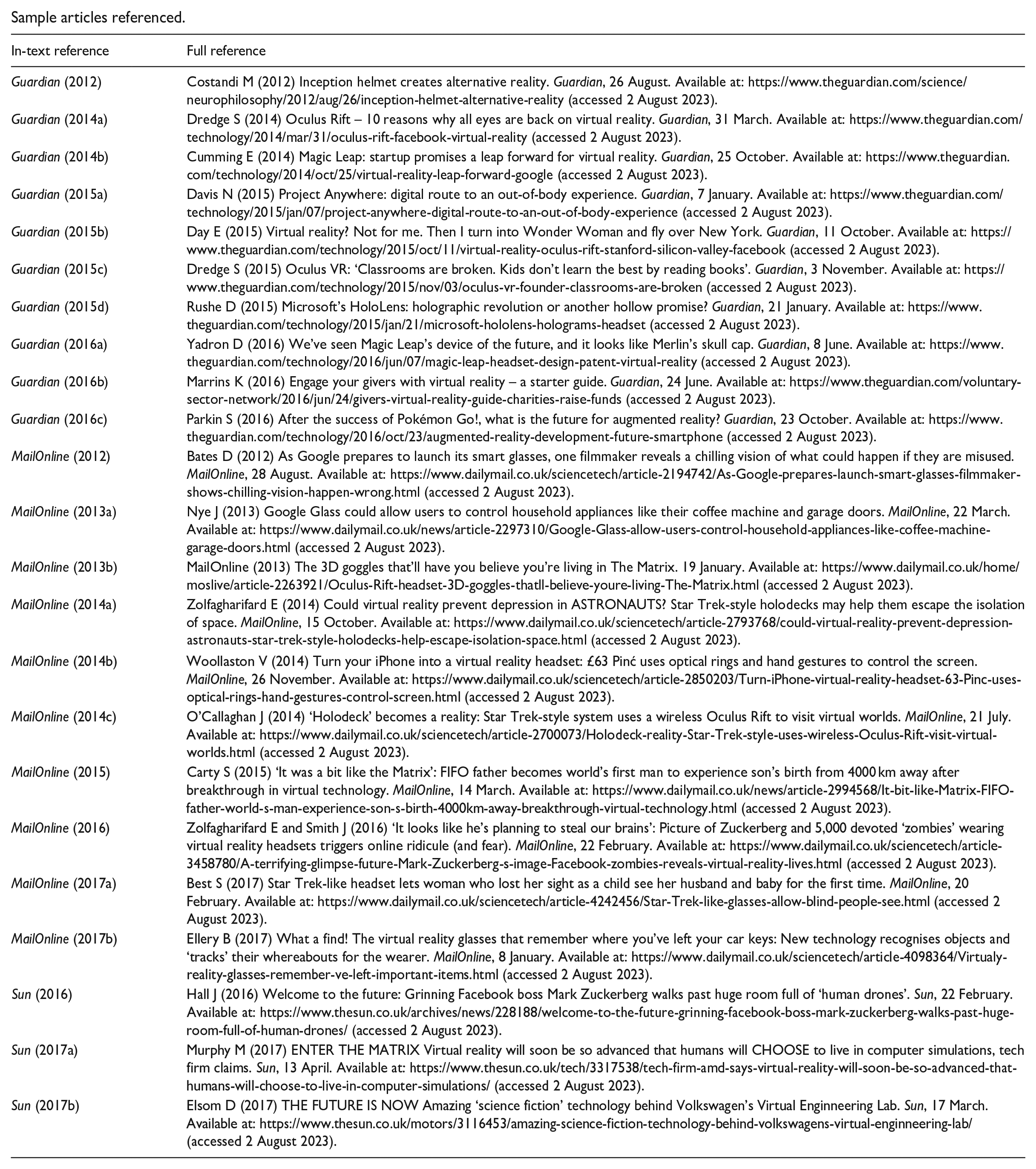
Articles were identified using a combination of Google searches and search features on the specific news sites. The combination of these techniques meant that the sample could be as comprehensive as possible while also capturing the visual elements of the articles that would be absent from databases such as LexisNexis News. A search string was developed to find relevant news articles between 2012 and 2017: (‘virtual reality’ OR ‘augmented reality’ OR ‘mixed reality’) AND (headset* OR helmet* OR goggles OR glasses OR ‘head mounted display*’ OR hmd*). It was important to include words associated with head-mounted displays to reduce irrelevant results appearing such as ‘virtual reality’ being used to refer to screen-based videogames. The string was used in the search tool for each news website as well as in Google searches, the latter of which added a further search requirement of appearing within the URL of the news site. To avoid the Google results being customised by their algorithm, articles were ordered by date and all results within the specified time period were screened. All articles focusing on XR were included in the sample, with the exception of review articles and duplicate articles. In total, 977 relevant articles were identified for analysis (61 from the Sun, 248 from the Guardian and 668 from the MailOnline). Any articles from the sample that are referenced in the discussion below are cited using square brackets, with the full references available in Appendix 1.
Quantitative content analysis was applied to the sample of news articles using a coding sheet. While the findings discussed in this article form part of a larger study of XR discourse (the full methodological information for which is detailed in Graves (2024)), this section focuses on the parts of the research design that relate to fiction specifically. The coding sheet recorded whether an article referenced fiction (in writing or visually), where it first appeared (i.e. headline, lead or body), which fictional texts were mentioned and how often (see Supplemental Material 1 for the coding book). Supported by NVivo to aid accuracy and comparability, the qualitative analysis consisted of an in-depth examination of any articles that included references to fiction to identify how these references had been used and the subsequent impact on the framing of XR. An inductive approach (de Vreese, 2005) was used to code references to fiction in terms of how these references were utilised, while annotating the articles with comments relating to the framing of XR (see Supplemental Material 2 for some example analyses). After all articles were analysed, six different nodes had been created, representing six ways fiction references had been used in the sample. The coded segments were then revisited to determine whether there was any overlap between the nodes and whether they had been used often enough or with enough emphasis to act as a key theme (see Supplemental Material 3 for all nodes and further explanation). The articles displaying each theme were then re-examined, taking into account the annotated comments to consider their impact on the framing of XR. The results of this analysis will now be explored.
4. Results and discussion
Fiction references
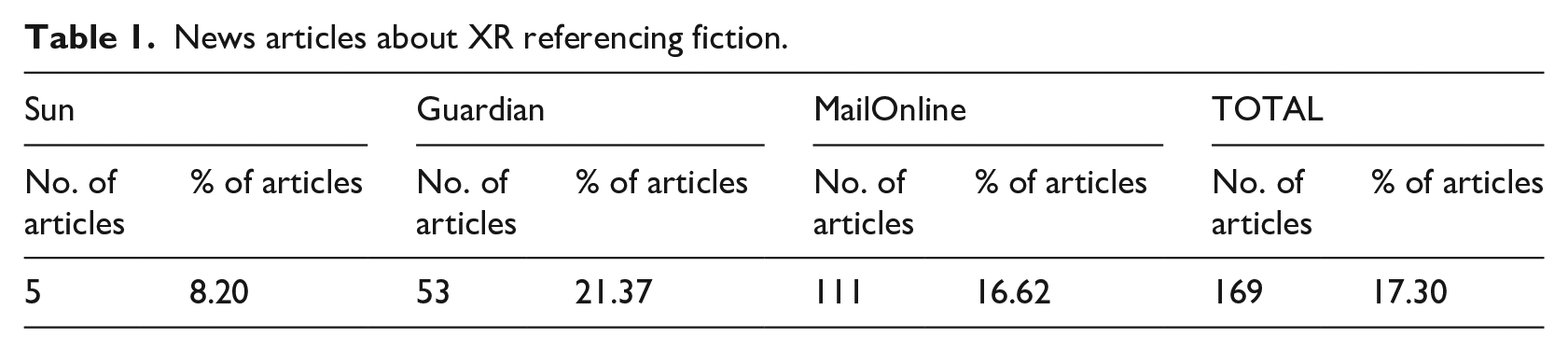
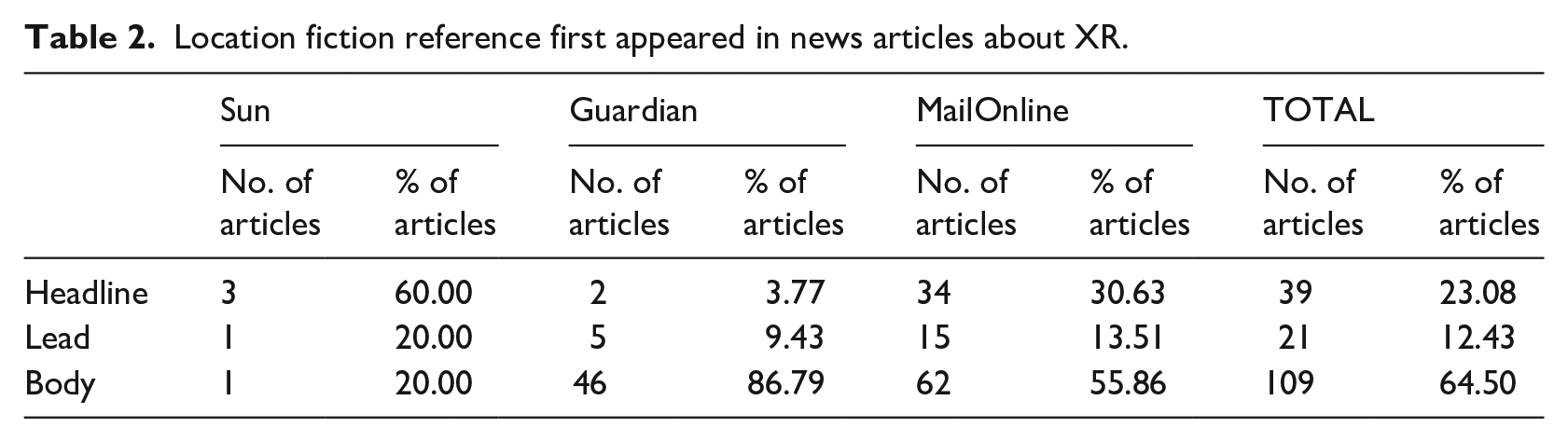
Across all 977 news articles, 169 (17.3%) made references to fiction. This included broad references such as comparing XR to fiction generally, as well as references to specific fictional works such as The Matrix. As shown in Table 1, these fiction references appeared most often in the Guardian (21.37% of articles), followed by 16.62% of MailOnline articles, and least often in the Sun (8.2% of articles). Although none of these numbers represent the majority of articles from each news outlet, this shows that fiction references were used as a framing device in all three publications to some extent. Furthermore, the number of articles referencing fiction in the Guardian and MailOnline is quite substantial, indicating that referencing fiction is a key framing device in the news coverage of XR. Moreover, a substantial portion of articles referencing fiction did so within the headline or lead of an article (see Table 2), showing that this has been emphasised and used to gain the attention of audiences, particularly in the Sun and MailOnline.
News articles about XR referencing fiction.
Location fiction reference first appeared in news articles about XR.
Further analysis revealed that multiple fictional texts were mentioned across the news articles (see Table 3), though two franchises dominated: The Matrix (1999–2003) and Star Trek (1966 to present), the latter particularly in reference to the holodeck in Star Trek: The Next Generation (1987–1994). There was no substantial difference in the portion of articles from each news outlet that referenced The Matrix, though the MailOnline mentioned Star Trek significantly more frequently than the other outlets. This suggests The Matrix was a key point of reference for all outlets, thus framing readers’ understanding of XR. Overall, the texts cited were primarily popular science fiction films from as early as 1973, up to 2014, with more recent TV series such as Black Mirror (2011 to present) also being noted. Moreover, one article discussed a short science fiction film, Sight (2012) that had just been released. In addition, a number of novels and short stories were referred to; in particular, The Master Key (1901) and Pygmalion’s Spectacles (1935) were described as originating the concepts of AR and VR, respectively [Guardian, 2016b, 2016c]. This relates to the idea that science fiction and technological developments are closely linked and practitioners may take inspiration from fiction when designing real-life technologies (Harley, 2024; Kitzinger, 2010).
Fictional texts mentioned in news coverage of XR.
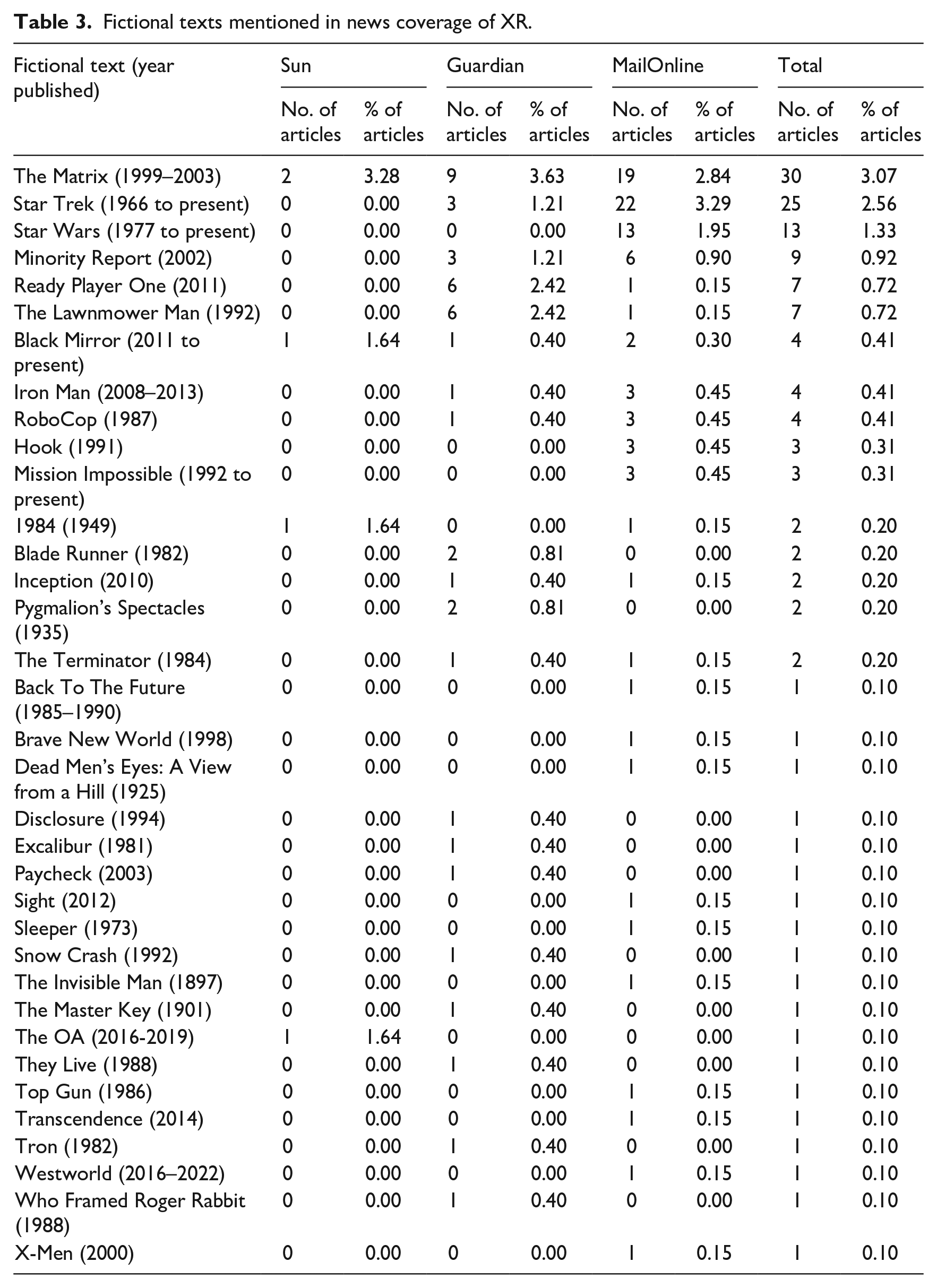
While each of these examples has clear links to technology or XR, there were some fictional texts that were mentioned outside of the sci-fi category. For instance, the Guardian cited Who Framed Roger Rabbit (1988), comparing the way HoloLens MR works to how the animated characters in the film appear to exist in the real world [Guardian, 2015d]. In addition, Excalibur (1981) was referenced to compare the appearance of Merlin’s skull cap to Magic Leap’s patent design [Guardian, 2016]. Finally, the film Hook (1991) was mentioned in three articles as inspiration for the creation of an XR experiment, Project Nourished, referencing the scene in which food magically appears when the Lost Boys imagine it to be there. Thus, fiction references were numerous and varied, though mostly focusing on science fiction texts.
Referencing multiple popular fictional texts released across a period that spans more than a century means that a large portion of readers may be familiar with at least one of them, thus making these connections more likely to resonate with the audience. Moreover, the focus on The Matrix and Star Trek is significant; although the XR technology depicted in these texts is much more advanced than current XR devices and is therefore not an accurate metaphor, journalists appear to have chosen the texts that are likely to be the most well-known representations of XR for their audiences. Indeed, Entman (1993) states that frames become more salient when connected ‘with culturally familiar symbols’ (p. 53). This could have implications for how the public views the technology, as will be further discussed below. Based on its dystopian portrayal of VR, the fact that The Matrix trilogy was the most referenced fictional text could, at surface level, indicate that fiction was used as a framing device to represent XR negatively. However, as will now be shown, deeper qualitative analysis revealed that this was rarely the case.
Fiction to improve understanding
A common way fiction references were utilised in the sample was as a tool to improve the audience’s understanding of real XR technologies. This typically involved comparing real XR products to their fictional counterparts, often in article headlines. As shown in Table 2, 23.08% of articles referencing fiction did so in their headlines. Some examples are as follows: Could virtual reality prevent depression in ASTRONAUTS? ‘It was a bit
Since commercial XR products had only just emerged into the consumer market when these articles were published, readers may have been unaware of the features and capabilities of the technology. However, they are more likely to be familiar with these popular fictional texts. Therefore, referencing fiction allows readers to gain a better understanding of the real products by referencing something they may already be familiar with. Indeed, part of framing involves connecting the dots for the reader to encourage a certain interpretation of a topic (Nisbet, 2010). These fiction references work as framing devices to do just that. Moreover, framing strategies that appear in article headlines have the most salience, since this is the first and perhaps only part of an article readers might see (Pan and Kosicki, 1993). This creates an immediate association between the fictional products and the real, demonstrating the prominence of this framing device.
Furthermore, for readers that may also be unfamiliar with fictional XR, articles sometimes used images of fictional technologies to further enhance understanding. One example of this appeared in a MailOnline article about a smartphone-based VR headset, Pinć (as shown in Supplemental Material 2: 17–21), which came with finger rings that users could wear to interact with the virtual environment. One paragraph stated, ‘a user can make hand gestures to control on-screen objects, in a similar way to the gloves used by Tom Cruise in 2002 sci-fi film Minority Report’ [MailOnline, 2014b]. A picture of Tom Cruise wearing the gloves was also included to provide a visual comparison. Therefore, the real technology is again associated with the fictional technology, regardless of existing understanding of the fictional text. This helps readers to grasp what XR is more quickly. Such techniques were also found to be present in news coverage of AI (Guzman, 2013; Hansen, 2022), showing similarities between the way these two technologies have been framed in the news.
Understanding is a key part of the diffusion process for technological innovations as gaining knowledge is the first step in the innovation-decision process (Rogers, 2003). Thus, such framing strategies support the diffusion of XR by making it easier for readers to understand the technology. However, understanding real technology through fiction could create the expectation that real XR is more advanced than it currently is, due to the futuristic portrayals of XR in fiction. This could later lead to consumer disappointment when they realise it is not as advanced as expected, thus having a negative effect on diffusion (Ruef and Markard, 2010). Still, this framing supports the commercial interests of the technology companies creating XR products by positively facilitating understanding in the first instance.
Fiction becoming reality
Linked to the above, the most common way that fiction references were used as a framing device was to suggest fictional XR technologies have become, or are becoming, real. For instance, the headline of one article began, ‘“Holodeck” becomes a reality’ [MailOnline, 2014c] and another described Google Glass as ‘[s]traight out of science-fiction predictions of what future homes will be like’ [MailOnline, 2013a]. Similarly, the introductory sentence of a Guardian article stated, ‘It might look like a scene from Minority Report, but Constantinos Miltiadis’s hi-tech gear is science fact, not fiction’ [Guardian, 2015a]. Each of these examples associate fictional representations of XR with their real-world counterparts, encouraging readers to make connections between them which could affect their expectations and perceptions of XR. This shows continuity with Guzman’s (2013) study of fiction references in US news about Siri.
In addition to stating fictional XR is becoming real, journalists used other techniques to frame this in a positive light. Focusing on a specific application, the Sun stated, ‘Once an impossible concept seen only in sci-fi movies and comic strips, car manufacturers are now able to use the premise of virtual reality to progress automobile design’ [Sun, 2017b]. Claiming that this was previously ‘impossible’ portrays the development as very significant, even impressive. Moreover, another article titled ‘Oculus Rift – 10 reasons why all eyes are back on virtual reality’ included the following statement: ‘VR, drones, space balloons, augmented eyewear and robots – it’s the stuff of science fiction, but also of the next big bets on connectivity from the internet’s largest companies’ [Guardian, 2014a]. The journalist then listed some different technologies (including VR and AR), stating that, though previously associated with fiction, they are expected to become real. Claiming that ‘the Internet’s largest companies’ are investing in producing these previously fictional technologies stresses the importance and significance of this development. Similarly, the Guardian quoted Meta and Oculus owner Mark Zuckerberg stating, ‘In just a few years, VR has gone from being this science fiction dream to an awesome reality’ [Guardian, 2015b]. As well as arguing that fiction has become real, Zuckerberg presents this as something very positive by using the words ‘dream’ and ‘awesome’. For such comments to originate from owners of XR companies coincides with Harley’s (2024) analysis of themes in the discourse of VR professionals.
Importantly, what was omitted in all of the above examples is how real-life XR differs from its fictional depictions. In fiction, particularly in The Matrix and Star Trek (the most commonly referenced texts), XR is presented as highly advanced and futuristic, far beyond the current technical capabilities of the real world. While some articles do highlight this, such sentiments were rare. For instance, opposing Zuckerberg, Oculus founder Palmer Luckey was quoted, ‘He also warned that the future for VR is “not going to look like any of the sci-fi depictions of it”’ [Guardian, 2015c]. Nevertheless, the next paragraph in the article continued to quote Luckey: ‘Virtual reality is a science fiction technology [. . .] To be able to work on that and have it actually become real is one of the best things I can imagine working on’ [Guardian, 2015c]. Therefore, XR is presented as a fictional technology that is becoming real, even if it may not be as advanced as its fictional representations. Still, very few articles highlight this caveat, creating the impression that these products are of higher quality than they really are. Of course, that is not to say that readers will believe real XR to be the same as it appears in fiction. However, making these connections without mentioning the differences impacts the expectations of XR, particularly for readers of the generalist news outlets included in this study who may be unfamiliar with technological advancements (Weiss-Blatt, 2016). While such framing could initially be beneficial for XR companies in terms of adoption, relating XR to fiction in this way could create unrealistic expectations for the technology. This was also found to be a concern in Asif and Gouqing’s (2023) review of fiction’s impact on consumer perceptions of AI.
Limited dystopic portrayals of XR
Although the above examples show that fiction references were normally used to present XR positively, it is important to note that there were some occasions where the opposite occurred. One article in particular presented Google Glass very negatively by comparing it to a new short film, Sight (introduced above). Published in 2012 when Glass was in the early stages of development, the article was headlined: ‘As Google prepares to launch its smart glasses, one filmmaker reveals a chilling vision of what could happen if they are misused’ [MailOnline, 2012; see Supplemental Material 2: 11–16 for the full article]. The article elaborated, a new science fiction film suggests that augmented reality glasses actually have a far darker side – and might allow us to control one another. ‘Sight’ shows how virtual reality can take over from normal life to the extent that we can’t exist without it. [MailOnline, 2012]
Here, the abuse of AR in the film is associated with real AR. The rest of the article continues to explain what happens in the film, highlighting the potential concerns with AR. This ends with some information about Google Glass, stating the film was ‘loosely based on the technology’ [MailOnline, 2012]. Therefore, in this instance, the film has been used to portray Glass in a very negative light. However, this was the only item in the sample that was entirely dedicated to analysing a fictional text in order to present XR negatively.
Other articles made passing references with negative connotations. The MailOnline stated that HoloLens ‘has been likened to a plot device in an episode of hit Netflix show Black Mirror in which humans are implanted with a gadget that records all that they do, say and hear’ [MailOnline, 2017b]. This highlights potential privacy concerns with HoloLens, which has indeed been a topic of debate for academics and industry professionals (Brigham, 2017; Carter and Egliston, 2020). However, this sentence appears at the very end of an article that is mostly positive overall; the second paragraph of the article calls HoloLens a ‘remarkable new piece of technology’ and, later, it is said that the device can help dementia sufferers [MailOnline, 2017b]. In other words, although fiction has been used to portray HoloLens negatively in one comment, it is not a main focus in the article.
In addition, the response from the general public to Zuckerberg’s Gear VR launch event was used to present XR negatively. One article (as shown in Supplemental Material 2: 22–31) began as follows:
It may look like a scene from dystopian sci-fi movie, but this image is, in fact, a glimpse at our future.
It shows Mark Zuckerberg breezing past rows of devoted followers, each plugged into virtual reality headsets, while he looks on with an unnerving smile.
The haunting photo was taken yesterday at the Mobile World Congress in Barcelona, and has since triggered a stir on social media. [. . .]
Others have likened the image it [sic] to ‘The Matrix’, which depicts a machine created dream world that humans believe is real.
But the reality is that humans are trapped in fields of pods dispensing electrical energy to power their machine masters [MailOnline, 2016].
In addition to the clear links with a dystopian fictional text, the second paragraph mimics a dystopian science fiction narrative by stating that Zuckerberg is ‘breezing past rows of devoted followers’. The idea of being ‘plugged into’ VR is also borrowed from VR fiction, such as the phrase ‘jacking in’ in William Gibson’s Neuromancer (1984). Further negative discourse is used by describing Zuckerberg’s smile as ‘unnerving’ and the image as ‘haunting’. The article continued on to describe the general public’s reaction to the event using posts from social media, which included several references to fiction in a negative light. Interestingly, the Sun covered this in much the same way [Sun, 2016], which suggests the story might have originated from a news agency, although no evidence could be found to confirm this.
Nevertheless, it must be emphasised that such discourse was certainly not prominent within the news articles. Indeed, even The Matrix itself, which has a clear dystopian narrative, was used to present XR positively. The headline of the first MailOnline article about Oculus Rift was ‘The 3D goggles that’ll have you believe you’re living in The Matrix’ [MailOnline, 2013b] and the Guardian claimed Magic Leap ‘could be a revolution in creating screen-free, Matrix-style dream worlds’ [Guardian, 2014b; see Supplemental Material 2: 7–10 for the full article]. Because the virtual world in The Matrix is almost indistinguishable from reality, comparing it to XR implies real XR is very advanced and high-quality as it is framed as realistic and believable. Furthermore, the Magic Leap example has positive connotations, with ‘free’ referring to freedom and versatility and the use of the word ‘dream’ implying it is a desirable experience. In addition, as demonstrated in the previous section, the use of Star Trek as a reference in particular has been presented in very positive contexts. This includes suggesting these technologies could help prevent depression [MailOnline, 2014a] and let a blind woman see her family [MailOnline, 2017a]. Therefore, instead of focusing on dystopic portrayals of XR in fiction, these references have primarily been used to frame XR positively. This coincides with Kitzinger’s (2010) argument that fiction references do not always generate negative portrayals of technology and can instead present them in a positive light. Still, this is surprising when considering that fictional portrayals of XR, particularly The Matrix, are typically dystopic (Ariel, 2017; Bailenson, 2018; Steinicke, 2016) or offer cautionary tales about the technology (Applebaum, 2010; Chan, 2014). However, this follows the trend that was identified in the wider study that this article is based on, which found that positive representations of XR dominate the news, with significantly overlapping frames used in both the news and marketing of XR (see Graves, 2024). While strongly negative representations of XR would not be desirable as this could result in moral panic discourse or unnecessarily strict regulation (Marwick, 2008), such positive framing could benefit the commercial interests of XR companies by encouraging adoption. By framing XR in this unrealistically positive light, journalists prioritise the commercial interests of XR companies over the general public who rely on news media to understand new technological developments (Scheufele and Lewenstein, 2005). This is a concerning result regarding journalistic practice.
5. Conclusion
This article has built on the limited number of studies examining references to fiction in technology news (e.g. Guzman, 2013; Hellsten, 2000; Petersen et al., 2005) by looking at a different context (XR), a larger sample and using a robust mixed methods approach. It has shown that fiction references have been utilised as framing devices to improve readers’ understanding of XR and present it positively, framing the technology as advanced and high-quality by relating real XR to its futuristic fictional counterparts. This shows overlap with studies of fiction references in AI news (Guzman, 2013; Hansen, 2022). Although some articles included negative and even dystopic portrayals of XR by using fiction, this was rare, limiting the impact it could have on the audience. While the dystopian fictional depictions of XR could have been utilised to frame it negatively, this certainly has not happened in this sample. Even texts with dystopian narratives, such as The Matrix, were generally used to frame XR positively. Since news coverage of emerging technologies has been found to affect public perceptions of those technologies (Cogan, 2005; Scheufele and Lewenstein, 2005; Sun et al., 2020), this is significant; the focus on strongly positive representations of XR could encourage readers to form favourable opinions of the devices and, thus, may increase the likelihood of adoption. Such framing benefits the commercial interests of the companies creating these products, while omitting to point out how fictional XR differs from real XR, to the disadvantage of readers. This raises questions as to whose interests journalists have in mind when crafting technology news.
Limitations and future research
Due to the required labour of the research methods used and the volume of news coverage about XR, these results are based on only three UK national news outlets. Although it is possible that different results may have occurred if other (or more) publications had been sampled, including a tabloid, middle-market and quality news outlet could still make these findings generalisable to the wider population of news discourse (at least in the United Kingdom). Still, it is important for future research to expand on this by examining other news outlets, including technology news and publications in other countries. Second, while the results presented here offer valuable insight into the use of fiction in XR news during the inception of the technology, it is also worthwhile to expand on this by analysing a more recent time period to see whether these trends have changed or persist. Finally, since referencing culturally familiar texts (such as fiction) acts as a powerful framing device (Entman, 1993), examining fiction references in news coverage of other technologies would also be beneficial to see how (or if) the results differ. For now, this article provides a valuable contribution to the literature on news coverage of technology, particularly regarding references to fiction, with a rigorous mixed methods study of an under-researched technology: XR.
Supplemental Material
sj-pdf-1-pus-10.1177_09636625241277446 – Supplemental material for Fiction references as framing devices in extended reality news discourse
Supplemental material, sj-pdf-1-pus-10.1177_09636625241277446 for Fiction references as framing devices in extended reality news discourse by Emma Kaylee Graves-Sandriman in Public Understanding of Science
Footnotes
Appendix 1
Sample articles referenced.
| In-text reference | Full reference |
|---|---|
| Guardian (2012) | Costandi M (2012) Inception helmet creates alternative reality. Guardian, 26 August. Available at: https://www.theguardian.com/science/neurophilosophy/2012/aug/26/inception-helmet-alternative-reality (accessed 2 August 2023). |
| Guardian (2014a) | Dredge S (2014) Oculus Rift – 10 reasons why all eyes are back on virtual reality. Guardian, 31 March. Available at: https://www.theguardian.com/technology/2014/mar/31/oculus-rift-facebook-virtual-reality (accessed 2 August 2023). |
| Guardian (2014b) | Cumming E (2014) Magic Leap: startup promises a leap forward for virtual reality. Guardian, 25 October. Available at: https://www.theguardian.com/technology/2014/oct/25/virtual-reality-leap-forward-google (accessed 2 August 2023). |
| Guardian (2015a) | Davis N (2015) Project Anywhere: digital route to an out-of-body experience. Guardian, 7 January. Available at: https://www.theguardian.com/technology/2015/jan/07/project-anywhere-digital-route-to-an-out-of-body-experience (accessed 2 August 2023). |
| Guardian (2015b) | Day E (2015) Virtual reality? Not for me. Then I turn into Wonder Woman and fly over New York. Guardian, 11 October. Available at: https://www.theguardian.com/technology/2015/oct/11/virtual-reality-oculus-rift-stanford-silicon-valley-facebook (accessed 2 August 2023). |
| Guardian (2015c) | Dredge S (2015) Oculus VR: ‘Classrooms are broken. Kids don’t learn the best by reading books’. Guardian, 3 November. Available at: https://www.theguardian.com/technology/2015/nov/03/oculus-vr-founder-classrooms-are-broken (accessed 2 August 2023). |
| Guardian (2015d) | Rushe D (2015) Microsoft’s HoloLens: holographic revolution or another hollow promise? Guardian, 21 January. Available at: https://www.theguardian.com/technology/2015/jan/21/microsoft-hololens-holograms-headset (accessed 2 August 2023). |
| Guardian (2016a) | Yadron D (2016) We’ve seen Magic Leap’s device of the future, and it looks like Merlin’s skull cap. Guardian, 8 June. Available at: https://www.theguardian.com/technology/2016/jun/07/magic-leap-headset-design-patent-virtual-reality (accessed 2 August 2023). |
| Guardian (2016b) | Marrins K (2016) Engage your givers with virtual reality – a starter guide. Guardian, 24 June. Available at: https://www.theguardian.com/voluntary-sector-network/2016/jun/24/givers-virtual-reality-guide-charities-raise-funds (accessed 2 August 2023). |
| Guardian (2016c) | Parkin S (2016) After the success of Pokémon Go!, what is the future for augmented reality? Guardian, 23 October. Available at: https://www.theguardian.com/technology/2016/oct/23/augmented-reality-development-future-smartphone (accessed 2 August 2023). |
| MailOnline (2012) | Bates D (2012) As Google prepares to launch its smart glasses, one filmmaker reveals a chilling vision of what could happen if they are misused. MailOnline, 28 August. Available at: https://www.dailymail.co.uk/sciencetech/article-2194742/As-Google-prepares-launch-smart-glasses-filmmaker-shows-chilling-vision-happen-wrong.html (accessed 2 August 2023). |
| MailOnline (2013a) | Nye J (2013) Google Glass could allow users to control household appliances like their coffee machine and garage doors. MailOnline, 22 March. Available at: https://www.dailymail.co.uk/news/article-2297310/Google-Glass-allow-users-control-household-appliances-like-coffee-machine-garage-doors.html (accessed 2 August 2023). |
| MailOnline (2013b) | MailOnline (2013) The 3D goggles that’ll have you believe you’re living in The Matrix. 19 January. Available at: https://www.dailymail.co.uk/home/moslive/article-2263921/Oculus-Rift-headset-3D-goggles-thatll-believe-youre-living-The-Matrix.html (accessed 2 August 2023). |
| MailOnline (2014a) | Zolfagharifard E (2014) Could virtual reality prevent depression in ASTRONAUTS? Star Trek-style holodecks may help them escape the isolation of space. MailOnline, 15 October. Available at: https://www.dailymail.co.uk/sciencetech/article-2793768/could-virtual-reality-prevent-depression-astronauts-star-trek-style-holodecks-help-escape-isolation-space.html (accessed 2 August 2023). |
| MailOnline (2014b) | Woollaston V (2014) Turn your iPhone into a virtual reality headset: £63 Pinć uses optical rings and hand gestures to control the screen. MailOnline, 26 November. Available at: https://www.dailymail.co.uk/sciencetech/article-2850203/Turn-iPhone-virtual-reality-headset-63-Pinc-uses-optical-rings-hand-gestures-control-screen.html (accessed 2 August 2023). |
| MailOnline (2014c) | O’Callaghan J (2014) ‘Holodeck’ becomes a reality: Star Trek-style system uses a wireless Oculus Rift to visit virtual worlds. MailOnline, 21 July. Available at: https://www.dailymail.co.uk/sciencetech/article-2700073/Holodeck-reality-Star-Trek-style-uses-wireless-Oculus-Rift-visit-virtual-worlds.html (accessed 2 August 2023). |
| MailOnline (2015) | Carty S (2015) ‘It was a bit like the Matrix’: FIFO father becomes world’s first man to experience son’s birth from 4000 km away after breakthrough in virtual technology. MailOnline, 14 March. Available at: https://www.dailymail.co.uk/news/article-2994568/It-bit-like-Matrix-FIFO-father-world-s-man-experience-son-s-birth-4000km-away-breakthrough-virtual-technology.html (accessed 2 August 2023). |
| MailOnline (2016) | Zolfagharifard E and Smith J (2016) ‘It looks like he’s planning to steal our brains’: Picture of Zuckerberg and 5,000 devoted ‘zombies’ wearing virtual reality headsets triggers online ridicule (and fear). MailOnline, 22 February. Available at: https://www.dailymail.co.uk/sciencetech/article-3458780/A-terrifying-glimpse-future-Mark-Zuckerberg-s-image-Facebook-zombies-reveals-virtual-reality-lives.html (accessed 2 August 2023). |
| MailOnline (2017a) | Best S (2017) Star Trek-like headset lets woman who lost her sight as a child see her husband and baby for the first time. MailOnline, 20 February. Available at: https://www.dailymail.co.uk/sciencetech/article-4242456/Star-Trek-like-glasses-allow-blind-people-see.html (accessed 2 August 2023). |
| MailOnline (2017b) | Ellery B (2017) What a find! The virtual reality glasses that remember where you’ve left your car keys: New technology recognises objects and ‘tracks’ their whereabouts for the wearer. MailOnline, 8 January. Available at: https://www.dailymail.co.uk/sciencetech/article-4098364/Virtualy-reality-glasses-remember-ve-left-important-items.html (accessed 2 August 2023). |
| Sun (2016) | Hall J (2016) Welcome to the future: Grinning Facebook boss Mark Zuckerberg walks past huge room full of ‘human drones’. Sun, 22 February. Available at: https://www.thesun.co.uk/archives/news/228188/welcome-to-the-future-grinning-facebook-boss-mark-zuckerberg-walks-past-huge-room-full-of-human-drones/ (accessed 2 August 2023). |
| Sun (2017a) | Murphy M (2017) ENTER THE MATRIX Virtual reality will soon be so advanced that humans will CHOOSE to live in computer simulations, tech firm claims. Sun, 13 April. Available at: https://www.thesun.co.uk/tech/3317538/tech-firm-amd-says-virtual-reality-will-soon-be-so-advanced-that-humans-will-choose-to-live-in-computer-simulations/ (accessed 2 August 2023). |
| Sun (2017b) | Elsom D (2017) THE FUTURE IS NOW Amazing ‘science fiction’ technology behind Volkswagen’s Virtual Enginneering Lab. Sun, 17 March. Available at: https://www.thesun.co.uk/motors/3116453/amazing-science-fiction-technology-behind-volkswagens-virtual-enginneering-lab/ (accessed 2 August 2023). |
Funding
The author(s) received no financial support for the research, authorship, and/or publication of this article.

Supplemental material
Supplemental material for this article is available online.
Author biography
References
Supplementary Material
Please find the following supplemental material available below.
For Open Access articles published under a Creative Commons License, all supplemental material carries the same license as the article it is associated with.
For non-Open Access articles published, all supplemental material carries a non-exclusive license, and permission requests for re-use of supplemental material or any part of supplemental material shall be sent directly to the copyright owner as specified in the copyright notice associated with the article.
