



Abstract
Introduction
Public parks are an integral part of the built environment, with a considerable role to promote public health by advancing physical health, mental wellness and overall quality of life. The potential exists for parks and greenspace to contribute to cancer control and prevention, and local park and recreation departments (PARDs) are natural partners for Comprehensive Cancer Centers as they pursue Community Outreach and Engagement activities. However there is a lack of research on best practices for structuring these relationships to ensure success.
Methods
A collaboration framework for Comprehensive Cancer Centers and PARDs was informed by the Exploration, Preparation, Implementation, Sustainment (EPIS) model of implementation science. The model was applied by a large cancer center to 3 implementation sites in the greater Houston area. A set of shared measures were developed and tracked across all sites.
Results
Three PARDs implemented 5 unique active living and sun safety evidence-based interventions (EBIs) of 2 main types, educational focused interventions (to increase knowledge and change behavior) and infrastructure interventions (to modify the physical environment). Three-quarters (75%, 9/12) of all educational EBIs across communities were sustained by the PARDs one or more years after the funding ended; all (13/13) infrastructure projects were completed during the active implementation period and sustained by the PARDs. A range of 10-39 partners supported the work of the PARDs.
Conclusion
The 3 collaboration sites each offer a case study on the impact and effectiveness of health promotion across sectors to impact modifiable risk factors for cancer, leveraging the replicable EPIS model. Partnership is critical to both sectors to advance community health and impact.
Introduction
Public parks are an integral part of the built environment, with considerable potential for promoting public health. Both the physical facilities at parks, such as recreational equipment and trails, and the programming at parks, such as classes, sports programs, and health service delivery, play a role in advancing physical health, mental wellness and overall quality of life.1,2 At least 5 pathways related to parks are highly relevant for preventing cancer and for improving the lives of cancer patients: promoting physical activity; promoting healthy behaviors such as healthy eating and sun protection; providing nature contact; promoting social connections; and delivering preventive services such as cancer screening.
Physical activity is a mainstay of cancer prevention, and among cancer patients and survivors, physical activity is associated with improved well-being.3–6 Parks represent an evidence-based strategy for promoting physical activity.7,8 Both living near a park, and utilizing a park, are associated with higher levels of moderate-to-vigorous physical activity (MVPA). 9 Importantly, certain park features increase the probability that a park will promote physical activity: programming and marketing; conducive facilities ranging from sports equipment to shade structures; and safety. Park users of different ages and demographic backgrounds manifest different preferences and physical activity patterns.9,10 Thus, there is no one-size-fits-all approach to physical activity promotion in parks; community engagement in planning and overseeing parks can help tailor physical activity promotion to local needs.
Parks are also suitable venues for health education. Of particular relevance to cancer prevention is sun safety. 11 Outdoor recreation increases sun exposure, but park-based educational efforts can promote the use of protective behavior such as the use of sunscreen.12,13 Parks can help advance healthy eating, both through on-site health education and through programs such as community gardens,14–16 farmers markets, 17 serving healthy foods in park concessions, 18 and serving as food access points. 19
Yet another benefit of parks is the opportunity for contact with nature, which offers wide-ranging health benefits through such pathways as stress reduction 20 and improved immune function 21 ; these may have special relevance for cancer patients and survivors.22–24 Parks also serve as a setting for social connections, which are beneficial for the public in general but specifically for those with a history of cancer.25–28
National Cancer Institute-designated Comprehensive Cancer Centers are mandated to engage with the communities they serve through formal Community Outreach and Engagement (COE) efforts. 29 Specifically, Comprehensive Cancer Centers are tasked with directing resources to address local needs in collaboration with local partners. Through these collaborative COE efforts, centers implement evidence-based interventions (EBIs) in the communities they serve.
Given the potential for parks and greenspace to contribute to cancer control and prevention, local park and recreation departments (PARDs) are natural partners for Comprehensive Cancer Centers as they pursue COE. PARDs are well positioned physically (as there are local parks in many communities), socially (as parks are freely available to all), and organizationally (as PARDS are integrated into local government) as partners. In many communities, PARDs often fill in resource gaps by serving as de-facto health promotion/public health entities. There is considerable experience with park-based health interventions,30,31 many of these are accomplished through partnerships between health institutions and PARDs.32–38
There is an opportunity for Comprehensive Cancer Centers to work with PARDs to implement EBIs related to modifiable risk factors for cancer (ie, sun safety and physical activity), however there is a lack of research on best practices for structuring these relationships to ensure success. Implementing community-based EBIs is complex, and many programs fail to reach their full potential due to implementation challenges and processes. The Exploration, Preparation, Implementation, and Sustainment (EPIS) model is an implementation science framework that details the process for integration of EBIs in any given implementation effort or context, from exploration of a problem to sustainability of programming.39,40 EPIS offers a potential framework for establishing relationships between invested entities such as cancer centers and PARDs, to jointly explore, prepare, implement and sustain EBIs for cancer prevention.
There are 3 objectives of this paper. The first objective is to describe the development of a Comprehensive Cancer Center – PARD collaboration informed by the EPIS framework to promote cancer prevention behaviors. The second objective is to assess the implementation of the collaboration model in 3 Texas communities. Lastly, lessons learned and implications relevant to other public-healthcare system partnerships are discussed.
Methods
The current study is not a research study but was reviewed and approved by the Quality Improvement Assessment Board of The University of Texas MD Anderson Cancer Center. Participant consent was not applicable to this study.
Collaboration Development Context & Setting
The University of Texas MD Anderson Cancer Center is nestled in the heart of Houston, Texas, within the Texas Medical Center, the world’s largest medical complex. Be Well Communities™ is the institution’s place-based strategy for comprehensive cancer prevention and control, working with communities to address modifiable risk factors for cancer. Individuals, schools, workplaces, government agencies, health care providers and policymakers form community coalitions to plan and carry out sustainable, community-led EBIs. Be Well Communities has programming in 3 greater Houston locations including the cities of Pasadena and Baytown, and the Houston neighborhood of Acres Homes. The principal focus is on 2 strategies—physical activity promotion and skin cancer prevention—given their relevance to the local communities and the availability of EBIs. As noted below, there were also some efforts focused on healthy eating, tobacco use, and preventive care.
Be Well Communities was launched in 2016 in Baytown and Pasadena and expanded to Acres Homes in 2019. These 3 communities were selected through a process including waterfall interviews based on recommendations and introductions from philanthropic supporters and key business and community leaders. The greater Houston area has several independent cities and localities, many with their own PARDs. The need to engage local PARDs from the selected communities (Pasadena PARD, Houston PARD, and Baytown PARD) as critical community partners became apparent quickly once interviews began, as they were consistently noted as both influential organizations and pillars of the community. Smaller localities, including Baytown and Pasadena, rely on their PARDs to promote healthy living and wellness programs. The PARDs in each community were subsequently invited, along with other community organizations, to serve on the Steering Committees (coalitions for health) that drive initiatives forward. The PARDs were early adopters of the initiatives and have remained consistently active members.
Applying the EPIS Framework to Comprehensive Cancer Center-PARD Collaboration
A collaboration framework for Comprehensive Cancer Centers and PARDs was informed by the EPIS model
39
(Figure 1). This model posits a four-phase process of successful EBI integration, influenced by interactions between inner (internal to organization) and outer (external environment) factors. The EPIS model suited one of the central goals of Be Well Communities, which was to engage PARDs to be active partners in cancer prevention work in communities across all phases from problem identification (exploration) through sustainment, with an initial focus on promoting physical activity and sun safety. Comprehensive Cancer Center - Parks and Recreation Department collaboration to promote cancer prevention behaviors using the Exploration, Preparation, Implementation, Sustainment framework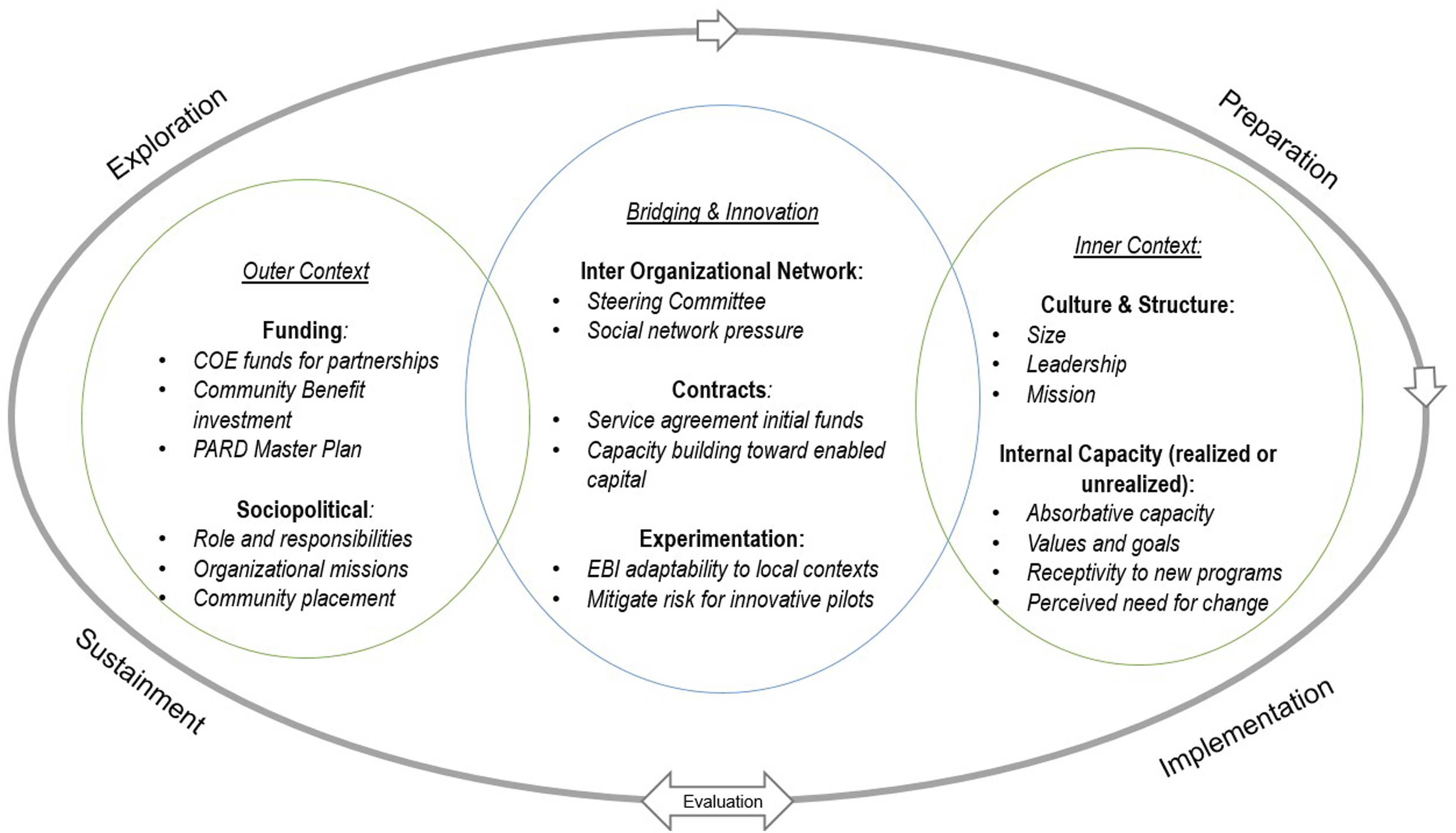
The Exploration phase of the EPIS model in the context of Comprehensive Cancer Center - PARD collaboration includes preliminary work to identify opportunities for joint health promotion ventures. Within this first phase, the Comprehensive Cancer Center team focused on creating dialogue, interviewing PARD leadership to learn about the organizational culture, strategic vision, building trusting relationships, and identifying areas of intersection for potential collaboration. As part of this effort, community-level Steering Committees were formed with invited membership based on the interviews conducted, and including PARDs. One critical role of the Steering Committee is to support co-implementation of the Community Action Plans, which includes relevant EBIs. During the Preparation phase, which includes decision making around specific interventions, EBIs were jointly identified that would be appropriate for PARD settings. EBIs were sourced from the Centers for Disease Control and Prevention’s The Community Guide and County Health Rankings and Roadmaps What Works for Health Guide. EBI selection was mapped to Community Action Plans that were co-created with the multi-sector Steering Committee to address key community concerns.
Implementation refers to the active implementation of the EBIs within the context of the new setting, in this case PARD locations. Financial support for implementation of EBIs in the Community Action Plans occurred via a services agreement between the PARDs and the Comprehensive Cancer Center. The collaborative model supports co-implementation, including two-way support between the Comprehensive Cancer Center and PARD teams in the form of bi-weekly meetings, technical support with promotion and evaluation of EBIs, and joint troubleshooting when problems arose. This included items such as streamlining registration, aligning evaluations of participants with quarterly reports to the Comprehensive Cancer Center, co-development of promotional materials and communication language especially for new program offerings, providing facilitated discussion time during the Steering Committee to provide updates and discuss implementation in a safe space with other supportive community organizations.
Evaluation is closely linked with implementation as both process and outcomes measures informed ongoing implementation. Data was gathered and reviewed informally in the context of bi-weekly meetings and formally each as PARDs submitted reports quarterly to the Comprehensive Cancer Center. Implementation was responsive to the context and community and captured regularly through the quarterly reports which resulted in modifications to planned activities.
Sustainment, or sustainability, refers to the ongoing implementation of EBIs in the park setting. Sustainability was integrated throughout the continuum, with the Comprehensive Cancer Center team offering specific technical assistance to PARDs to ensure provision of programming and availability of data to make the case for department funding to continue EBI implementation. Durable equipment was purchased for use by classes, training was provided to staff for both registration and reviewing program numbers in their internal systems as well as participant facing team members on subject matter (e.g., Zumba, sun safety). Additionally, the Comprehensive Cancer Center team worked with staff on finding and writing grants to support future implementation.
The phases of the EPIS framework were contextualized by outer and inner factors (on the left and right sides of Figure 1, respectively) affecting the PARDs and the Comprehensive Cancer Center. The outer context included funding (Comprehensive Cancer Center COE funding, community benefit investment, master/strategic planning) and sociopolitical factors (e.g., role and responsibilities of the teams, organizational missions, and placement within the communities). The inner context included cultural and structural factors (eg, team size, leadership, and mission) and internal capacity both realized and unrealized (e.g., absorbative capacity, values/goals, receptivity to new programs, and the perceived need for change).
Bridging and Innovation (at the center of Figure 1) occur across outer and inner contexts, and throughout the EPIS cycle. Factors that supported bridging between the Comprehensive Cancer Center and PARDs were interorganizational network (ie, development of the Steering Committee in each community, social network pressure to be involved in the initiatives), and contracts that formalized agreements to work together, including building the capacity of the PARDs to deliver and enhance programming. Finally, experimentation was a key component of Bridging and Innovation. PARDs were willing to try new EBIs and adapt them to the local constituency at each location. The Comprehensive Cancer Center assuming the financial risk of a new program provided a safe space to innovate and mitigate risk to the PARDs. Understanding these factors was critical in successfully identifying, adopting, co-implementing, and sustaining EBIs with PARDs.
Collaborative Implementation Sites
Community Demographics Compared With the State of Texas and PARD Descriptions

aUnited States Census Bureau. American community survey 5-year data (2019-2023): United States Census Bureau; 2024 [available from: https://www.census.gov/data/developers/data-sets/acs-5year.html].
bUnited States Census Bureau. Quick facts: United States Census Bureau; 2023.
cHouston PARD website [available from: https://www.houstontx.gov/parks/].
dBaytown PARD website [available from: https://www.baytown.org/1149/Parks-Recreation-Activities].
ePasadena PARD website [available from: https://www.pasadenatx.gov/150/Parks-Recreation].
Pasadena
In 2016, MD Anderson collaborated with the community of Pasadena, Texas, to mobilize health and wellness in the community. 41 Active EBI implementation occurred with Pasadena PARD 2018 – 2021. This initiative transitioned to the sustainment phase as of 2021, by which time 90% of all interventions were completed or integrated into the collaborating organizations’ strategic plan for ongoing implementation. An audit in 2024 indicated that 84% of EBIs were completed or continued to be offered through integration into collaborating organizations’ strategic plans.
Acres Homes
Be Well™ Acres Homes is an initiative of MD Anderson that started in 2019 in collaboration with more than 30 community organizations united with Acres Homes residents. 42 Active EBI implementation occurred with Houston PARD in Acres Homes 2022 – 2023. One-year post-implementation 85% (6/7) of the Houston PARD EBIs were integrated into the collaborating organization’s strategic plan or completed.
Baytown
In 2016 MD Anderson worked with the community of Baytown, Texas, to launch Be Well™ Baytown to address health and wellness in the 5 key areas of healthy eating, active living, sun safety, tobacco-free living, and preventive care (eg, HPV vaccination, screening).43–47 Active EBI implementation began with Baytown PARD in 2019 and remains on-going (2026).
Comprehensive Cancer Center-PARD Collaboration Implementation Metrics
Consistent with implementation evaluation, shared metrics were tracked including number of physical activity and sun safety EBIs implemented and sustained. The EBIs that are implemented and sustained in each community are tracked via an internal program implementation database, and cultural adaptations are described and tracked therein. As noted in the introduction, healthy eating interventions are a common and important aspect of PARD programming, however through Be Well Communities, PARDs were not the primary lead implementer of such interventions and thus healthy eating interventions are not reported herein.
PARDs in each community completed quarterly reports during active implementation and submitted them to the MD Anderson Be Well Communities team. Quarterly reports included program-level implementation progress, program participation, and aggregated participant data on items such as satisfaction, and confidence and intention to engage in healthy behaviors. As network development is a key goal of Be Well Communities and predictor of implementation success and sustainability, the reports also included metrics to capture the total number of organizational partners PARDs worked with over that quarter and the individual partner organization names. Partners were then organized into sectors by the research team (ie, education, healthcare, etc.). As possible, the same metrics were tracked across communities implementing the same EBIs. Pasadena PARD provided reports quarterly from 2017 to 2021, inclusive of 16 reports. Houston PARD provided reports quarterly from 2021 to 2023 including 8 reports. Baytown PARD provided quarterly reports from 2018 to 2025 including 29 reports.
Statistical Analysis
Evaluation of the Comprehensive Cancer Center – PARD Collaboration via Be Well Communities consisted of examining the number of physical activity and sun safety EBIs tailored, implemented, and sustained in each community, documenting reach of programs, as well as the number of inter-organizational partnerships in each PARD.
Evidence-Based Interventions and Programs/Activities Implemented by Community

aRobert Wood Johnson Foundation. (2019). What works for health guide. Retrieved March 11, 2024.
bCommunity preventive services task force. The guide to community preventive services (the community guide). US Department of Health and Human Services. Accessed March 11, 2024.
cSustained >1 year post funding.
Results
Evidence-Based Interventions Implemented and Sustained
EBIs were chosen by the Steering Committee through a facilitated consensus-building process, from a menu of EBIs that was based on the community assessment and needs of the community (also described in the Preparation phase of the EPIS framework, Figure 1, above). Key EBIs that were implemented by the PARD in each community pertaining to active living and sun safety are outlined in Table 2.
To ensure maximum uptake and success, EBIs were culturally tailored to the wants and needs of the community, a process informed by the local Steering Committee. As well, modification of planned activities was flexible and occurred in response to continuously assessing process metrics via quarterly reports. PARD EBIs consist of 2 main types, educational focused interventions (to increase knowledge and change behavior) and infrastructure interventions (to modify the physical environment).
Educational interventions varied slightly by community. The PARDs were each aware of the community needs in terms of class types and best suited locations for classes. In Pasadena, classes offered were Zumba, yoga, low-impact cardio, and river walking at the pool; and all classes were taught by bilingual (English/Spanish) instructors. Class sizes averaged 15 people per class and over 300 unique people participated in classes. In Baytown, educational interventions focused on pop-up park events and senior fitness classes. The community demand and attendance at Baytown pop-up parks increased each year, with 250 attendees at 1 event in 2020 and 2100 attendees across 8 events in 2023. In Acres Homes, educational interventions included senior fitness, Zumba, and hydro-fit classes at the pool; classes consistently reached their capacity and over 700 residents participated. All communities hosted sun safety education training for their staff annually, which was provided by MD Anderson trainers. A range of 81% to 100% of participants across years and communities indicated ‘very confident’ or ‘completely confident’ in their ability to implement sun safety behaviors post training.
The infrastructure EBIs implemented differed by community based on need. All PARDs had department records for updated or new infrastructure and prioritized locations, based on need. Pasadena PARD focused on playground infrastructure to promote playground equity as well as added amenities to the parks to improve quality and safety (e.g., drinking fountains, lighting). Baytown PARD focused on the development of a Fitness Court (free outdoor gym, part of a national network) and exercise trail. Infrastructure improvements made by Houston PARD included improvements to the pool at Lincoln Park in Acres Homes. All PARDs installed sunshades (total of 43 sunshades and non-permanent umbrellas) and sunscreen dispensers (total of 21) to promote sun safety.
Communication about and promotion of resources, programs, and park and recreation amenities to reach a greater proportion of the community percolated as a need in Baytown. In response, Baytown PARD implemented a mass communication campaign to complement and support the work being done in the parks: Baytown Moves. The campaign was developed by The University of Texas Center for Health Communication in collaboration with Baytown PARD and the Be Well Communities team. Baytown Moves consisted of messaging across diverse platforms and settings to encourage the community to utilize parks, trails, and free fitness classes. Baytown Moves elements include flag poles, flyers, digital billboard, news article, social media promotion and website content. The campaign has been ongoing (as of this writing) since 2021. The social media elements of the campaign alone reach approximately 1300 people annually. Future plans include developing a culturally tailored version of the physical activity campaign for the Acres Homes community.
EBI Sustainability
Consistent with the Be Well Communities definition of sustainability, 48 EBIs are considered sustained if they continue to be present in the community after the initial Comprehensive Cancer Center funding has ended. Three-quarters (75%, 9/12) of all educational EBIs across communities were sustained by the PARDs one or more years after the funding ended (see Table 1). Notably, if the educational EBIs are isolated by health topic, then all (7/7) of physical activity and nearly half (40%, 2/5) of sun safety EBIs are sustained across communities. Sustainability is the maintenance of the infrastructure that was installed, as well as developing a plan for future replacement of the infrastructure; all (13/13) infrastructure projects were completed during the active implementation period and sustained by the PARDs.
Partnerships
As part of the fourth quarter report, PARD in each community reported the number and type of partnerships that existed over the prior year of implementation. Figure 2 highlights the number of inter-organizational partners by sector and by community (combined across years). Figure 2A shows that Pasadena PARD worked with 10 partners, with the most partners in the non-profit sector, followed closely by healthcare. Figure 2B shows that Baytown PARD worked with 15 partners, most of those partners including non-profit organizations. Finally, Figure 2C shows that Houston PARD worked with 39 partners and the sector most represented was non-profit organizations. Number of inter-organizational partners and represented sectors by community. (A) Pasadena PARD interorganizational partners (n = 10). (B) Baytown PARD interorganizational partners (n = 15). (C) Houston PARD interorganizational partners (n = 39)
Discussion
This work highlights the potential for partnerships between Comprehensive Cancer Centers and PARDs to promote health and integrate cancer prevention initiatives into public greenspaces. Using the EPIS framework to understand implementation influences and inform the structure of relationships clarifies the key aspects and activities of collaborative implementation of EBIs in the PARD setting.
Spending time at local parks has the potential to support healthy living including increased physical activity, mental wellness, and quality of life. A recent review 31 of 20 place-based health interventions undertaken at parks found most interventions focused exclusively on park infrastructure, with only 5 including park-based exercise programming. One unique feature of the collaboration between Be Well Communities and PARDs is the cultural flexibility of EBI implementation and inclusion of both infrastructure and educational interventions centered around community priorities. This approach is aligned to prior findings of a survey 37 study of healthcare providers that highlighted the importance of culturally appropriate offerings and structural accommodations needed to ensure diverse patients feel comfortable at parks. Engaging the community is not only a best practice for culturally responsive program and infrastructure design but has also been demonstrated to increase park-based physical activity. 49
The 3 collaboration sites each offer a case study on the impact and effectiveness of health promotion across sectors to impact modifiable risk factors for cancer. The Trust for Public Land offers 14 strategies to address emerging health crises through parks. 2 The 3 communities herein employ 5 of the 14 strategies. The first strategy - “Prioritize capital improvements and engagement with historically underserved communities” was employed by Acres Homes through prioritizing investment at the Lincoln Park Pool in Acres Homes, as well as through Pasadena updating and installing new playground and exercise equipment to foster equity in areas of the community. Second, “Bring parks to people through pop-ups and mobile offerings” was done in Baytown through the pop-up park program. Third, “Install and maintain the amenities most strongly associated with increased physical activity” was done though the equity-based park improvements in Pasadena as well as the Fitness Court in Baytown and the pool improvements in Acres Homes, all to increase physical activity. Fourth, “Invest in capital improvements in parks as community health investments” was a cornerstone of the collaboration between MD Anderson and each of the community PARDs through their infrastructure improvements. Lastly, “Partner with parks and recreation agencies to evaluate the impact of park initiatives on key patient and community health outcomes” was done in all 3 communities to document and share the impact of the important work being done. As well, evaluation data was used to make the case for integrating programs and maintenance into PARD operating budgets. As more PARDs engage in health promotion, there is more opportunity for integrating health initiatives into park and recreation master plans and budgeting priorities.
Implementation with the 3 sites was not without challenges and barriers. The COVID-19 Pandemic occurred during part of each implementation at each site, thus it was essential for the Comprehensive Cancer Center to be flexible with the competing priorities of the PARDs, consider adjustments to program reach goals as return to in person activities varied by community, and adjust planned construction timelines as needed due to the multitude of supply chain disturbances and contextual barriers. As well, every PARD has one or more signature community event and it was important to be flexible and responsive to the PARDs and their event planning timelines and activities, shifting program activities and reporting as needed. Lastly, there were contextual factors to work though related to communication and promotion of programs, activities, and events that needed to be taken into consideration by both the Comprehensive Cancer Center and by each PARD to fulfill branding and marketing requirements by both parties.
This work adds to the literature on partnerships between PARDs and health entities. Leichty et al 32 conducted a qualitative research study with public parks managers on their experiences with health partnerships and identified barriers to successful collaborations included lack of time/resources and waning enthusiasm. The Be Well Communities model addresses these barriers by supporting upfront investment, capacity building, and multi-sector partnership building. The 3 community PARDs presented in this paper were each supported through a community coalition or Steering Committee. Through active participation on the Steering Committee the PARDs were part of a supportive community which assisted with developing culturally responsive programming, promoting programs, connecting with other local vendors such as sunshade and playground suppliers, and troubleshooting implementation issues. This is important as research from Barnes et al 36 has found that PARDs are an essential sector in multi-sector partnerships to promote health. Mowen et al 38 conducted a national survey and found that many PARDs are indeed engaged in health promotion efforts, but it was likely larger organizations. In the case of Be Well Communities, the initiative framework was accessible to several sizes of PARDs for participation and engagement. Further, the use of the EPIS model provided a framework for structuring these relationships with several sizes of PARDs.
A key feature of the Be Well Communities model is a focus on sustainability. 48 There is intentional planning to integrate sustainability for long-lasting positive impact from the outset. The educational EBIs were sustained by the PARDs by absorbing the costs into the departmental operating budgets. Utilizing the Be Well Communities evaluation, 47 PARDs were equipped to present the total cost and usage metrics to advocate local government for continued funding for programs.
Strengths and Limitations
This study has several limitations including that all implementation sites are located within a single greater urban area, the implementation sites used slightly different applications of the EBIs across sites which promoted flexibility and tailoring of interventions but then may not be comparable to each other, and lastly, the study relied on self-reported data from PARDs. However, this study also had many strengths, despite the relatively proximal geography each site represented a diverse community, each PARD had their own infrastructure and network of support and partnerships, and the Comprehensive Cancer Center and PARDs were all committed to the relationship and program, keeping the community at the forefront.
Conclusion
The work herein describes a promising model for PARDs to collaborate with Comprehensive Cancer Centers to promote health and engage in primary cancer prevention activities. Partnership is critical to both sectors to advance community health and impact.
Footnotes
Acknowledgements
We wish to acknowledge the 50+ organizations that serve on the Pasadena Vibrant Community, Be Well Baytown, and Be Well Acres Homes Steering Committees. We also wish to acknowledge current and prior members of the Cancer Prevention and Control Platform who have contributed to the successful implementation of the programs in each community, namely Haley Gardiner, Lauren McDonald, Mayra Aquino, and Elizabeth Caballero. We would like to acknowledge the administrative support of Maria Vazquez.

Ethical Considerations
This is not a research study, but was reviewed and approved by the Quality Improvement Assessment Board (QIAB) of The University of Texas MD Anderson Cancer Center.
Author Contributions
Katherine Oestman led the development of the manuscript and data curation and analysis with support from Margaret Raber and Brad Love. Karen Basen-Engquist supported design of methodology. Trina Rodriguez, Clifford Hatch, and Louis Moore led community implementation and have been champions and supporters since the very first day of the program and implement programs at their respective community institutions. Howard Frumkin supported data validation and writing review and editing. Ruth Rechis supervised the project, led conceptualization of the model, and was the fiscal steward. All authors contributed to the final manuscript and agree on its contents.
Funding
The authors disclosed receipt of the following financial support for the research, authorship, and/or publication of this article: This project has been supported by the National Institutes of Health (NIH) National Cancer Institute (NCI) under award number P30 CA016672, The MD Anderson Cancer Center Community Outreach and Engagement Fund. The contents of this work are solely the responsibility of the authors and do not necessarily represent the official views of the NIH. This work was also supported by philanthropic contributions to the Cancer Prevention and Control Platform from ExxonMobil, Shell Oil, Inc, Lyda Hill Philanthropies, and the Pamela and Wayne Garrison Family Foundation.
Declaration of Conflicting Interests
The authors declared no potential conflicts of interest with respect to the research, authorship, and/or publication of this article.
Data Availability Statement
Data is available to researchers upon written request to the authors.