



Abstract
Background
Breast cancer remains a leading cause of cancer morbidity and mortality worldwide. In the United States, Black women face significant disparities in screening mammograms, experience higher rates of breast cancer at advanced stages, and are more likely to die from the disease.
Aims
This study aimed to develop and beta-test a virtual health navigation program to enhance breast cancer care within the Black community. We identified barriers to utilizing virtual patient navigators and factors impacting the adoption of virtual navigation for breast cancer information among Black women.
Methods
The vCONET (Virtual Community Oncology Navigation and Engagement) intervention was delivered through the Second Life virtual platform. The informational content was collaboratively developed with community members. Participants engaged in an informational session on risk factors, mammography information, and preventive behaviors. Surveys (n = 18) and focus groups (n = 9) assessed knowledge and insights into perceptions.
Results
Findings revealed a positive impact of the intervention, with participants expressing increased knowledge and willingness to seek further information about breast cancer prevention, and highlighted the engaging nature of the virtual environment, while acknowledging potential technological challenges.
Conclusion
Virtual health navigation shows promise in addressing breast cancer disparities by promoting awareness among Black women. Future efforts should optimize virtual navigation approaches through collaborative engagement for lasting impact, enhancing breast cancer care and equity in communities of color.
Keywords
Introduction
Although there have been significant advances in cancer prevention and control, breast cancer remains a significant public health challenge, marked by persistent racial and socioeconomic disparities in cancer mortality. 1 Among the most impacted are Black women, who face substantial disparities across the cancer care continuum, from screening mammograms to treatment and survivorship, with mortality rates disproportionately higher than those of White women. 2 Furthermore, Black women carry a higher burden of triple-negative breast cancer and inflammatory breast cancer, both of which tend to occur at earlier ages and with increased severity than other ethnic groups. 1 Despite a 4% lower incidence rate of breast cancer than White women, Black women have a 40% higher breast cancer mortality rate, the highest of any U.S. racial or ethnic group.1-4
To address these disparities, the primary aim of this study was to develop and establish the usability of a Virtual Community Oncology Navigation and Engagement (vCONET) program. vCONET represents a novel approach that synthesizes proven strategies with innovative communication techniques aimed at enhancing breast health knowledge, awareness, and behavioral intent regarding breast cancer prevention education. Building on the Health Belief Model’s (HBM) emphasis on the importance of perceived benefits and barriers in shaping health behaviors, 5 the vCONET program targets perceptions of breast cancer severity, susceptibility to breast cancer, and the benefits of preventive measures. Additionally, vCONET incorporates patient navigation principles, which have been shown to enhance engagement and bridge healthcare disparities in underserved populations.6-8
The broader adoption of virtual care and telehealth, accelerated by the COVID-19 pandemic, has opened new avenues for health interventions 9 like vCONET. Therefore, we administered the intervention using a virtual platform to facilitate culturally sensitive health communication, education, and information dissemination. 10 Through this intervention, we sought to significantly contribute to the growing body of knowledge on community-centered, virtual health navigation and its potential in improving breast cancer outcomes for underserved populations.
Materials and Methods
Study Objectives
The study aimed to evaluate vCONET’s role in enhancing breast cancer awareness, screening behaviors, and health equity among Black women. The specific objectives were: (1) to identify perceived barriers in using virtual patient navigators, and (2) to understand factors influencing the adoption of a virtual navigator model for breast cancer screening among Black women. These objectives were framed within the Health Belief Model, emphasizing the perceived barriers and benefits to breast cancer screening and preventive health behaviors. 5
Program Description: Virtual Community Oncology Navigation and Engagement (vCONET)
Virtual Community Oncology Navigation and Engagement is an educational platform that was designed to address the distinct needs and experiences of Black women in the area of breast cancer awareness and prevention. At the core of its educational framework was the emphasis on the importance of regular mammography screenings, highlighting the benefits of early detection and the urgency of early interventions. The program also provided guidance on preventive strategies against breast cancer, including the adoption of a balanced diet and consistent exercise regimen. An essential component was the promotion of breast self-examinations, informing participants of the importance of regular self-checks to monitor any potential changes. Additionally, vCONET directly addressed the disparities faced by Black women in the context of breast cancer, aiming to increase awareness through targeted education and advocate for equitable access to essential screening resources. By leveraging a combination of collaborative content development, an engaging virtual platform, and a focus on community-specific needs, vCONET aims to positively influence participants’ awareness and intentions towards breast cancer screening and prevention. The collaborative process behind vCONET involved integrating community expertise and healthcare professionals’ insights to develop culturally relevant content addressing the specific needs of Black women in breast cancer awareness and prevention. This included input from oncologists, public health experts, and community advocates.
The Health Belief Model (HBM) was used as the primary analytical framework for our study. This model guided our interpretation by focusing on participants’ perceived susceptibility to breast cancer and their perceptions of the severity of the disease, the benefits they associated with preventive actions like mammography, and the barriers they faced in accessing cancer screening services. Each of these HBM components was used to categorize and understand the responses, facilitating a structured analysis of how beliefs influence behavior. For example, discussions about personal and community experiences with breast cancer were examined for cues that potentially encourage proactive health behaviors, such as seeking mammography screening or engaging with health education. This approach allowed us to systematically explore and document the effectiveness of the vCONET program in addressing these beliefs and modifying participant behavior towards breast cancer prevention and awareness.
Virtual Community Oncology Navigation and Engagement was hosted on the Second Life computer program, offering participants an immersive virtual environment as depicted in Figure 1. Within this digital setting, participants were guided through the platform and its functionalities by the first author during an informational session. The implementation session was comprehensive, detailing breast cancer risk factors that are particularly relevant to Black women, providing insights into mammography, and suggesting practical measures to lower associated risks. The content presented was developed based on the principles of community engagement
11
and was reviewed by community members, medical experts, and leaders, whose feedback was incorporated into the final version for high potential impact. The program aimed to provide both knowledge and promote preventive behaviors related to breast cancer. Snapshot of vCONET (virtual community oncology navigation and engagement) intervention session within second life program.
Study Design and Framework
Our research utilized an explanatory sequential mixed-methods design. This involved a quantitative phase where pre- and post-program surveys were administered to measure changes in knowledge, attitudes, and behaviors towards breast cancer screening. The qualitative phase followed, with focus group discussions to delve deeper into the participants’ experiences. These discussions were facilitated by the first author, a female postdoctoral researcher at the time, and holds a Doctor of Public Health with extensive training in community engagement, public health and qualitative methodologies. All sessions were audio-recorded and transcribed verbatim for analysis. The HBM guided our approach across both phases, enriching our interpretation of how participants’ beliefs and attitudes might influence their health behaviors.
Quantitative Phase
We conducted pre- and post-program surveys to measure participants’ knowledge, attitudes towards breast cancer, and their behavioral intent regarding breast cancer screening. These surveys, conducted before and after participating in the vCONET program, served as foundational tools for gathering baseline data and collecting feedback on participants’ perceptions post-participation. The core measures for the surveys were adapted from existing literature and validated questionnaires.12-14
Qualitative Phase
Building on the insights from the quantitative findings, focus group discussions were conducted to explore participants’ experiences with the vCONET program. These discussions sought to understand participants’ perceptions of breast cancer risks and the program’s role in addressing health disparities. This study’s reporting adheres to the Consolidated criteria for reporting qualitative research (COREQ) guidelines. 15
Participant Recruitment, Demographics and Study Setting
Participants were Black or African American women aged 18 or older with sufficient English proficiency. The inclusion criteria also required participants to have basic reading skills to effectively interact with the intervention materials and surveys. For recruitment, we utilized snowball sampling methods, 16 capitalizing on existing networks and community event participation to reach potential participants. This strategy enabled us to connect with a diverse group, approaching individuals via phone, email, and in-person based on existing relationships and prior community engagement.
Initially, we conducted data collection in person at a community event that promoted breast cancer awareness, leveraging existing relationships with local community organizations. Prior to the event, we engaged in discussions with these organizations to explain the research objectives and express our commitment to building a foundation for future collaboration. The community event itself allowed for direct and meaningful interactions with participants. However, due to the onset of the COVID-19 pandemic variants, the study was adapted to a remote format after the initial implementation in October 2021. This required participants to access the vCONET program via their personal internet connections at home, ensuring the safety of all involved.
Ethical approval was granted by the Mayo Clinic Institutional Review Board (Approval No. 21-010111) on October 8, 2021. All participants provided verbal informed consent.
Data Collection Strategy and Analysis
To measure the impact of the vCONET program, our study employed a mixed-methods approach, integrating both quantitative surveys and qualitative focus groups to collect data. This strategy allowed for a nuanced understanding of the program’s effects on participants’ knowledge, attitudes, and behaviors towards breast cancer screening.
We used both pre- and post-intervention surveys to assess the vCONET program. The baseline survey collected initial data on participants’ knowledge and attitudes towards breast cancer and their prior engagement with screening activities. Immediately following their engagement with the vCONET program via the Second Life platform, participants were invited through the post-assessment survey to express their views on using the program, intention for future screening, as well as interest in joining focus group discussions. These discussions aimed to examine topics in more depth, such as breast cancer awareness, the effectiveness of the program, and community engagement in breast cancer prevention efforts. This approach not only measured the program’s immediate impact but also facilitated a richer understanding of participant experiences.
Quantitative Phase
The baseline and post-intervention surveys were designed to assess participants’ self-reported knowledge, attitudes, and behaviors regarding breast cancer and screening practices. The baseline survey included questions about participants’ demographics, health insurance status, regular medical care, history of mammography screening, awareness of clinical trials, and perceived breast cancer risk. Questions were a mix of Yes/No, multiple-choice, and Likert scale responses to gather comprehensive data on initial conditions.
The post-intervention survey focused on participants’ experiences with the vCONET program and its impact on their intentions towards breast cancer prevention. It included questions about satisfaction with the virtual Second Life platform, the perceived usefulness of the information received, comfort using the program, and intentions to undergo mammography screening within the next year. The post-survey also assessed difficulties encountered, preferences for reviewing information in different settings, and overall feedback on the program.
We used descriptive statistics to analyze the self-reported survey data, focusing on summarizing baseline responses and assessing post-intervention perceptions. This method allowed us to evaluate participants’ self-reported awareness and behavioral intentions related to breast cancer screening. These findings provide insights into the program’s perceived efficacy in meeting the study’s objectives.
Qualitative Phase
Following their participation in the vCONET program, interested participants were invited to voluntary focus group sessions, resulting in a total of 9 participants. Using a semi-structured guide, participants shared their experiences, specifically highlighting usability, effectiveness, and challenges of the virtual platform. Questions explored participants’ general experiences with health information sources, particularly how they receive and perceive breast cancer information. Discussions also probed community-specific needs, asking participants to suggest how breast cancer messages should be tailored and delivered to Black women in their community, focusing on the most relevant and engaging content and delivery methods. Audio recordings of these discussions, complemented by field notes, were utilized to capture the nuances of the conversations.
Thematic analysis process 17 was conducted by 2 researchers who independently reviewed the focus group data to identify key themes derived from the data. Discrepancies in coding were resolved through consensus to ensure thematic consistency. This approach allowed for the emergence of important themes from the data. NVivo software supported data organization, which contributed to an efficient analysis. We also included responses to open-ended survey questions in the qualitative analysis, adding depth to our findings. As an exploratory study, data saturation was reached across the 3 focus groups, demonstrating a thorough exploration of the topic and ensuring that the emergent themes comprehensively represented the participants’ experiences and the impact of the intervention. These findings were analyzed using the HBM dimensions of perceived susceptibility, perceived severity, perceived benefits, and perceived barriers. This analysis explores themes within these dimensions and demonstrates how these data reflect the target population’s experiences and the intervention’s impact.
Results
Participant Characteristics for the vCONET (Virtual Community Oncology Navigation and Engagement) Program.

The integration of pre- and post-intervention survey findings with insights from virtual focus group discussions provided a holistic understanding of the vCONET program’s impact. These combined results shed light on the program’s effectiveness, technological challenges, and the pivotal role of tailored information in advancing breast cancer care in marginalized communities.
Quantitative Findings
The vCONET program, delivered through the Second Life platform, significantly enhanced participants’ awareness and screening behaviors for breast cancer. Initial surveys distributed to eighteen participants showed that only 25% of participants had undergone mammography screening in the past year, despite most having health insurance. Post-intervention, 94% found the program beneficial, reflecting effective knowledge transfer. Notably, 77% of participants reported they intended to undergo mammography screening within the next year rose and 75% planned to seek further information on breast cancer prevention and early detection.
Participant satisfaction with the Second Life platform was high, with 88% expressing satisfaction, indicating the platform’s effectiveness in engaging users. Some participants provided feedback on improving the accessibility and user-friendliness of the technology. Despite these challenges, 94% of participants were willing to use the program again, underscoring its perceived value and acceptance.
These results demonstrate the vCONET program’s success in improving knowledge and proactive health behaviors among participants, highlighting the potential of virtual platforms for delivering impactful health education.
Focus Group Insights
After participating in the intervention, focus groups were conducted virtually to gain valuable insights into participants’ experiences and perceptions. The analysis revealed key themes directly derived from participant discussions, ensuring the representativeness and depth of our findings. Participant quotations are used throughout to illustrate these themes, enhancing the transparency and relatability of our results. Focus group discussions revealed several prominent themes that emphasized the program’s influence on breast cancer awareness and knowledge among Black women. These themes were grouped according to the Health Belief Model dimensions of perceived susceptibility, perceived severity, perceived benefits, and perceived barriers. Notably, the influence of the virtual environment, the balance between technological excitement and challenges, the significance of tailored knowledge and constant awareness, and the journey of trust-building and persistence in healthcare contexts within Black communities emerged at principal themes as demonstrated below and in Table 2. All names mentioned in the following section are pseudonyms. (1) (2) (3) (4) Qualitative Themes for vCONET.
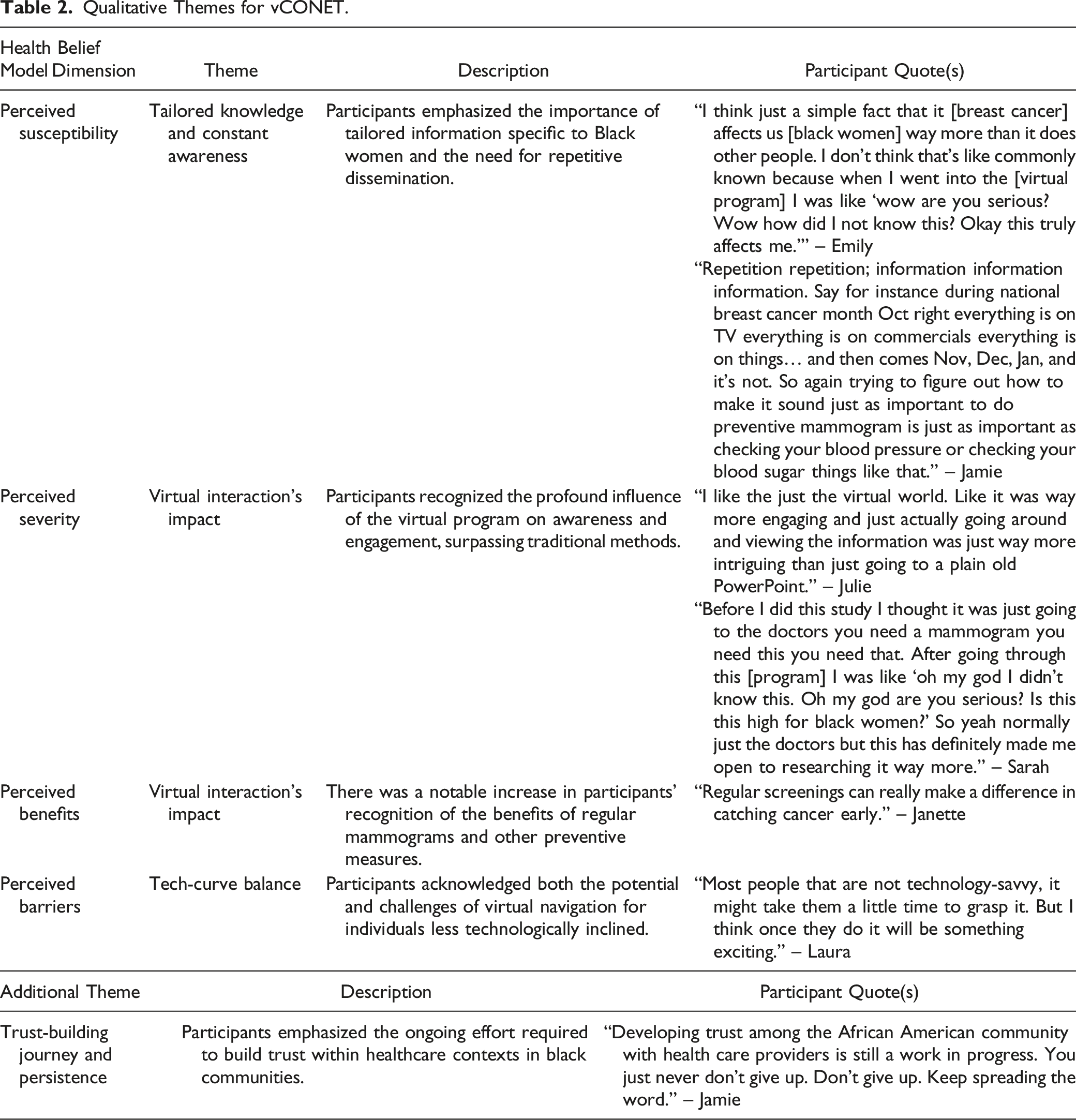
Additionally, participants recognized the existing trust deficit between the Black community and healthcare establishments, leading to the theme of
In summary, the focus group discussions provided nuanced insights into the potential and challenges of the program. The themes emphasized the importance of specifically tailored information for Black women, the imperative nature of constant health communication, and the enduring effort required to foster trust in Black community healthcare scenarios. The integration of these themes within the Health Belief Model dimensions of perceived susceptibility, perceived severity, perceived benefits, and perceived barriers offers a comprehensive understanding of how the vCONET program influenced participants’ health behaviors and perceptions.
Discussion
This study aimed to explore the potential of virtual health navigation for breast cancer survivors in communities of color, specifically addressing disparities in cancer care. By emphasizing cultural sensitivity and inclusivity, the tailored virtual navigation sought to bridge the gap in breast cancer inequities through accessible information dissemination. The results demonstrated a positive impact on breast cancer awareness and knowledge among Black women, with participants showing increased awareness of breast cancer risk factors and screening practices. This led to a greater readiness to seek knowledge that aids in informed decision-making about prevention and early detection. The virtual environment proved both engaging and intriguing, providing an immersive experience that positively contributed to participants’ awareness and engagement.
Our analysis revealed several key findings: First, participants exhibited an increased understanding of breast cancer and its significance in screening practices. Second, there were notable positive shifts in attitudes towards breast cancer prevention, accompanied by intentions to engage in screening behaviors. Third, the provision of personalized, culturally sensitive information was found to effectively address the unique needs of the community. Our findings also highlighted the various dimensions of the Health Belief Model, including perceived susceptibility, severity, benefits, and barriers, and how these dimensions influenced participants’ attitudes and behaviors. While participants reported high satisfaction with the program, the feedback also highlighted opportunities for enhancing technology access and digital literacy, suggesting future improvements for broader accessibility.
The study also recognized potential challenges for individuals who may be less familiar with technology. While some participants expressed excitement about the possibilities of virtual navigation, others recognized the need for ongoing support to help individuals adapt to the virtual environment. Addressing these challenges is vital to ensure equitable access to breast cancer education and screening for all Black women, regardless of their comfort level with technology.
This study addresses a critical gap in the literature by examining the impact of virtual health navigation specifically tailored to the needs of Black women in relation to breast cancer. 18 While prior research acknowledges racial and ethnic disparities in breast cancer care, 19 there is limited information on the implementation and efficacy of virtual navigation models, particularly through more immersive virtual platforms. 20 This innovative approach aligns with the increasing interest in immersive technology-based patient advocacy and its multifaceted benefits for in the healthcare sector. 21
The community-engaged nature of vCONET is also a key strength. Throughout the study, we sought input and insights from community members, both during the program’s design phase and afterward to gather feedback. This collaborative approach ensured that vCONET was tailored to meet the specific needs and preferences of the community. Our findings highlight the importance of consistently disseminating information, especially through virtual tools, to reinforce the significance of preventive measures, such as mammograms, throughout the year. Past studies which have incorporated Second Life as a component of health communication have also shown promise of virtual delivery of health messages, 22 though further research is warranted to evaluate long-term effectiveness and address access barriers among marginalized populations.
Our study also adds to the growing body of literature by demonstrating the potential of virtual health navigation, observed in past studies and reviews highlighting virtual environments in different aspects of the cancer continuum.23,24 Thus, our findings offer valuable insights into the role of virtual health navigation in addressing breast cancer disparities among communities of color. This highlights the innovative use of virtual technology to promote health behavior change and emphasizes the need for further exploration and application in diverse healthcare settings.
In addition to these broader implications, our analysis also provided insights into the specific experiences of different age groups within the Black community. Interestingly, participants’ ages ranged from 18 to 79 years, with the majority falling within the 50-69 age group. This age distribution allowed for insights into how different age groups within the Black community responded to the virtual health navigation program. Younger participants showed familiarity and comfort with technology, leading to positive engagement with the virtual platform and increased breast cancer awareness. Initially hesitant, older participants quickly became proficient in navigating the virtual environment of Second Life, controlling their avatars effectively and thus challenging age-related stereotypes about adaptation to virtual capabilities. 25
As multiple age groups demonstrated increased intention for mammograms and seeking breast cancer information post-intervention, virtual navigation holds promise for engaging different age demographics in breast cancer care and prevention. We found that addressing technological barriers and literacy from the start, such as implementing a program orientation, is crucial for equitable access to virtual programs, which is consistent with another study’s findings on Second Life usage in healthcare settings. 26 Future interventions should consider community-specific preferences to improve breast cancer outcomes across all age groups in the Black community.
Limitations
This study had certain limitations. First, the literacy level criterion may have introduced a bias, as most participants had higher levels of education. Second, the study primarily focused on participants’ intentions to undergo breast screening rather than their actual behaviors, leaving room for further exploration of the factors influencing the transition from intention to action. Additionally, the virtual format of the program might have restricted participation to individuals with reliable internet access, potentially excluding those from different socioeconomic backgrounds or areas with limited internet connectivity. Although efforts were made to address these challenges by providing support, future research should consider these design limitations. To further test efficacy of a program like vCONET, future studies should also aim to expand and diversify the participant pool and develop strategies to bridge the gap between intention and action in healthcare decision-making processes.
Conclusion and Future Implications
Despite the limitations, this study highlights the contribution of vCONET as a tool for virtual health navigation for breast cancer care in communities of color. The community-based design and focus on addressing disparities through virtual technology highlight the potential of virtual navigation as an effective and accessible avenue for improving cancer care outcomes in underserved populations. As technology continues to advance, virtual health navigation can play a critical role in advancing health equity and promoting cancer prevention among vulnerable communities. By incorporating community input and leveraging immersive virtual platforms, we demonstrated the effectiveness of virtual navigation in enhancing breast cancer awareness, knowledge, and engagement among underserved populations.
Participants indicated that a more mobile-friendly application would significantly increase accessibility and reach. Addressing these technological challenges is critical to ensuring equitable access and participation in virtual navigation programs. Future research should consider developing and utilizing more adaptable and user-friendly technological platforms to overcome these barriers. This approach could enhance engagement and accessibility, making it easier for a broader range of participants to benefit from virtual health navigation. By leveraging advanced and versatile technology, we can better meet the diverse needs of underserved communities and further promote health equity.
In addition to the present findings, this study carries important future implications for advancing cancer care and health equity. The integration of virtual patient navigation as a tailored and culturally sensitive approach has the potential to be implemented on a broader scale, reaching marginalized communities and reducing disparities in breast cancer outcomes. Future studies should focus on expanding the reach of virtual navigation programs to include a more diverse and representative sample of communities of color, as well as exploring the long-term effects of such interventions on health behaviors and cancer-related outcomes. Additionally, ongoing efforts should be made to address technological accessibility concerns and provide support and training to ensure equitable access to virtual platforms. Making information available through multiple virtual modalities that are most preferable to the community would help with this. By continuously building on the success of virtual navigation, healthcare professionals can work towards creating a more inclusive and effective approach to breast cancer prevention and care, ultimately contributing to improved health outcomes and reduced disparities in communities of color.
Supplemental Material
Supplemental Material - Addressing Breast Cancer Equity Through Virtual Community Oncology Navigation and Engagement (vCONET)
Supplemental Material for Addressing Breast Cancer Equity Through Virtual Community Oncology Navigation and Engagement (vCONET) by Manisha Salinas and Folakemi T. Odedina in Journal of Cancer Control.
Supplemental Material
Supplemental Material - Addressing Breast Cancer Equity Through Virtual Community Oncology Navigation and Engagement (vCONET)
Supplemental Material for Addressing Breast Cancer Equity Through Virtual Community Oncology Navigation and Engagement (vCONET) by Manisha Salinas and Folakemi T. Odedina in Journal of Cancer Control.
Footnotes
Acknowledgments
We would like to acknowledge the staff, community members, and coordinators who contributed to this study. Special thanks to Brian Kaihoi for his assistance in integrating vCONET into Second Life and to the American Legion Post 194 for hosting the community space for part of our data collection and recruitment. Finally, we are grateful to all the study participants for their valuable contributions.
Declaration of Conflicting Interests
The author(s) declared no potential conflicts of interest with respect to the research, authorship, and/or publication of this article.
Funding
The author(s) received no financial support for the research, authorship, and/or publication of this article.
Ethical Statement

Supplemental Material
Supplemental material for this article is available online.
References
Supplementary Material
Please find the following supplemental material available below.
For Open Access articles published under a Creative Commons License, all supplemental material carries the same license as the article it is associated with.
For non-Open Access articles published, all supplemental material carries a non-exclusive license, and permission requests for re-use of supplemental material or any part of supplemental material shall be sent directly to the copyright owner as specified in the copyright notice associated with the article.
